❌

Reading view

How The U.S. Army’s ‘Navy’ Aims To Go More Autonomous With Its Vessels In The Pacific

The U.S. Army wants to infuse new autonomous capabilities into its current and future fleets of amphibious landing ships and other watercraft. The service is also aiming to acquire up to 100 new purpose-built uncrewed surface vessels (USV). The maritime assets the service has now, often referred to as ‘the Army’s Navy,’ are obscure and generally underappreciated. However, the small force offers an important additional set of naval logistics capabilities, especially for any future fight in the Pacific, which could be further bolstered with optionally-crewed or entirely uncrewed platforms.

Army Maj. Gen. Frederick Crist, head of 8th Theater Sustainment Command (TSC), issued plans for future autonomous watercraft capabilities during a talk last week during a talk at the Association of the U.S. Army’s (AUSA) main annual symposium. 8th TSC, which has its main headquarters at Fort Shafter in Hawaii, is one of the top formations tasked with managing U.S. military logistics across the Pacific.
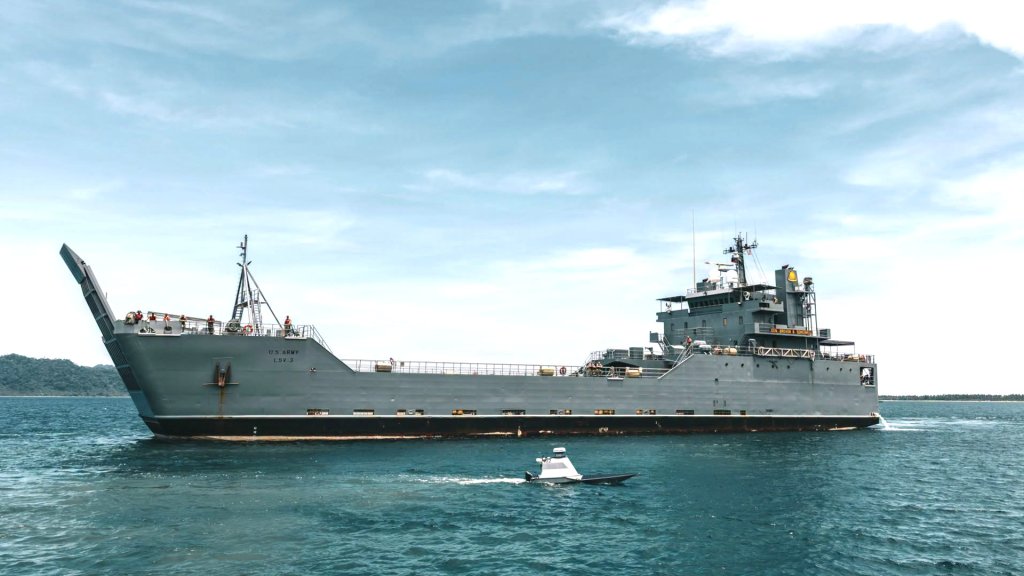
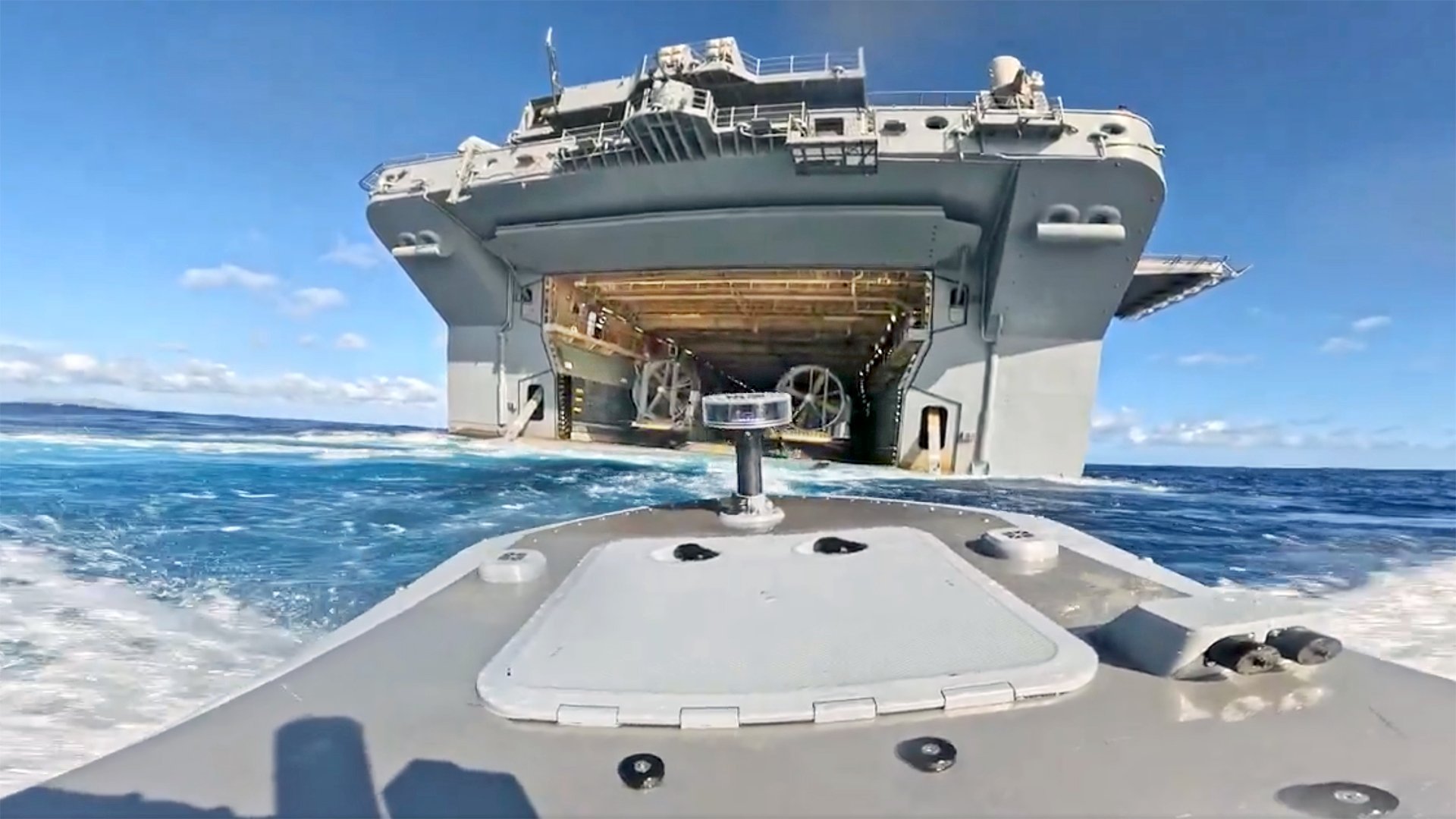
An uncrewed surface vessel (USV) passes by the US Army’s General Frank S. Besson class Logistics Support Vessel USAV General Brehon B. Somervell. US Army

“In order to be able to increase theater distribution, we have the two composite watercraft companies, at end state there, west of the IDL [International Date Line],” Crist explained, referring to the Army’s future planned maritime force posture in the Pacific. “We continue partnering with industry to be able to move into autonomous watercraft systems to be able to conduct other means of maritime distribution.”

To take a step back quickly, as part of its broader regional role, 8th TSC also has forward-deployed elements in Japan. This includes the 5th Transportation Company, which is currently organized as what the Army calls a composite watercraft company. As of 2024, the unit had a pair of General Frank S. Besson class Logistics Support Vessels (LSV), as well as 10 smaller Landing Craft Utility (LCU) type vessels and four small tugs, according to the Government Accountability Office (GAO).

The Army has eight LSVs, in total, and these are by far its largest and most capable ships. The two youngest LSVs, which were acquired in the mid-2000s, also form a distinct subclass, and their design is optimized for long-distance open-ocean operations, as you can read more about here. It’s not immediately clear which LSVs are currently assigned to the 5th Transportation Company. The unit is also set to receive new Maneuver Support Vessel (Light) landing craft.

Examples of the original LSV design, at left, and the open-ocean-optimized design, at right. An LCU-type landing craft is also seen at far right. US Army

Until very recently, the 10th Support Group (Regional), headquartered in Okinawa, was more directly responsible for overseeing forward-deployed Army logistics units in Japan. Earlier this month, the Army performed a so-called ‘reflagging’ of that formation, a largely administrative process that transformed it into the 45th Sustainment Brigade.

As part of the reflagging of the 10th Support Group into the 45th Sustainment Brigade, the Army has also been pushing ahead with plans for “the standup of a second composite watercraft company in Yokohama North Dock,” in the port city of the same name on the Japanese home island of Honshu, Maj. Gen. Crist explained last week. “That end state will have two composite water[craft] companies west of the IDL [International Date Line] under the command and control of the 45th Sustainment Brigade.”
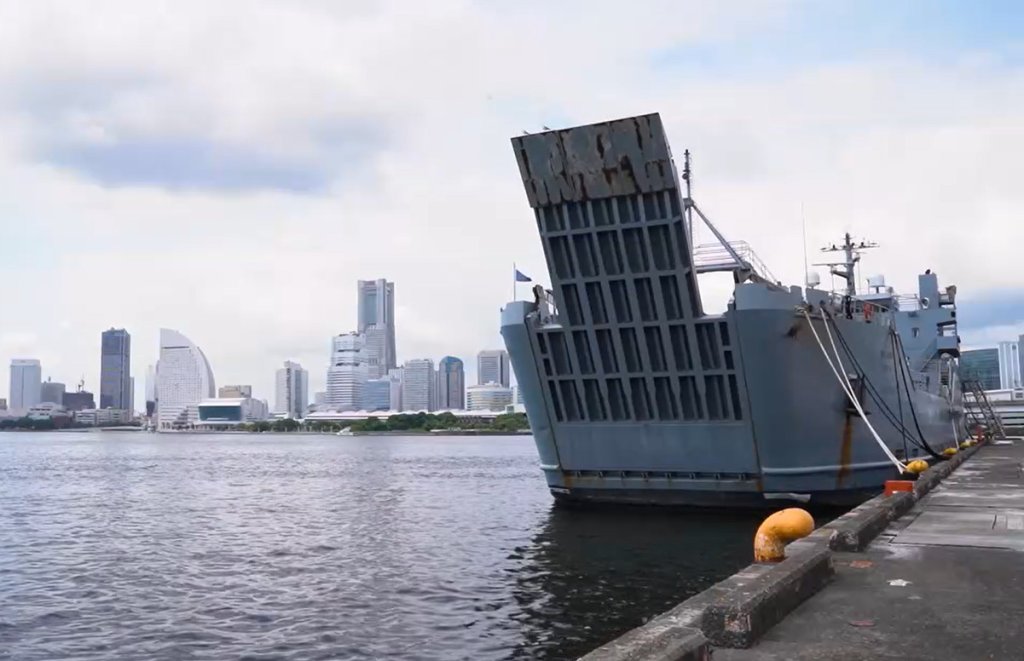
A US Army LSV at the pier in Japan. US Army

When it comes to the watercraft assigned to these units, “we’re also moving into the autonomous lane,” Crist added. “Just in August, USARPAC [U.S. Army Pacific] had an opportunity to conduct an experiment by retrofitting an existing commercial vessel, the HOS Resolute [sic; HOS Resolution], with a kit to provide autonomous navigation.”

Maritime autonomy firm Sea Machines was able to integrate its SM300 software package on the HOS Resolution in just nine days for this demonstration. The ship is a 257-foot-long offshore support vessel more typically used to support oil and gas rigs. However, it features a stern ramp and four jack-up legs that also make it well suited to loading and unloading cargo at remote beaches.
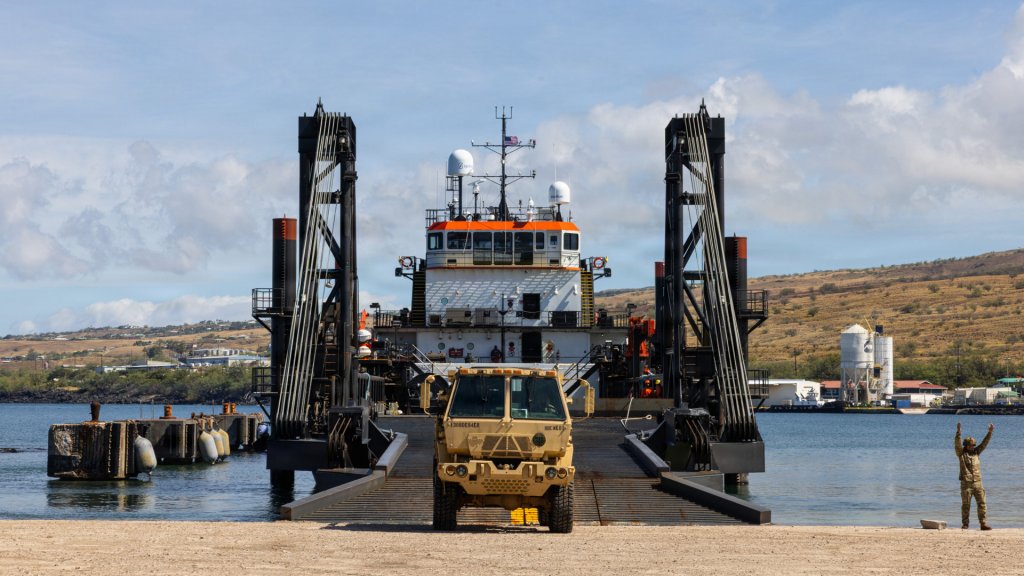
A US Army truck drives off the HOS Resolution during the experimenting in August where the ship was fitted with the Sea Machines autonomy package. US Army

For years now, the U.S. Marine Corps has also been experimenting with the HOS Resolution and other similar ships more generally. That service has been using the vessels to help refine its new expeditionary and distributed concepts of operations, which are themselves heavily centered on future conflict scenarios in the Pacific. The Marines have brought those capabilities to Army demonstration exercises in the past, as well.
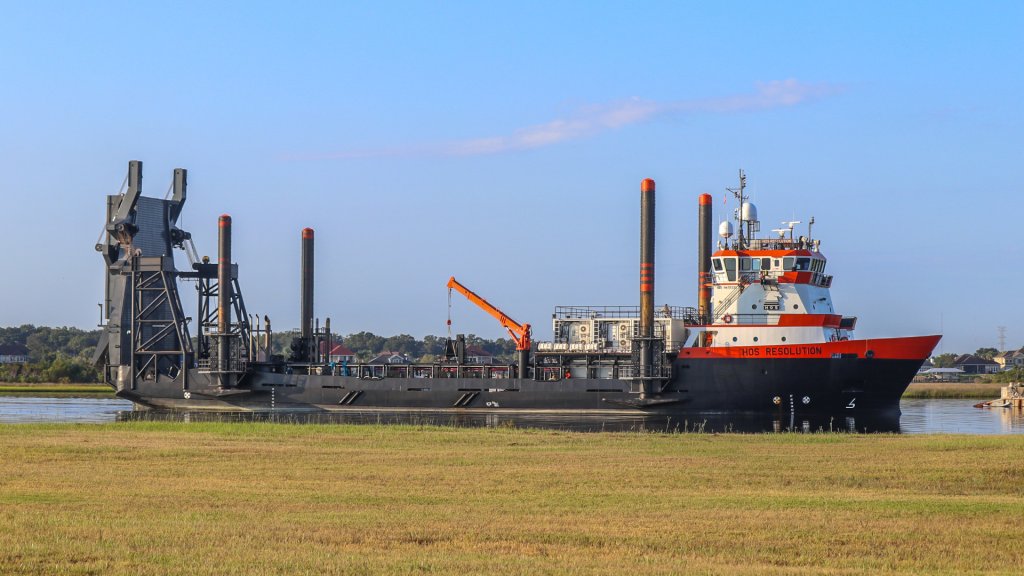
Another look at the HOS Resolution, in 2023, while operating under contract to the US Marine Corps. USMC

The Army sees the August experiment as a potential stepping stone to integrating increasing degrees into its existing watercraft fleets.

“You could increase the fleet of autonomous vessels by tapping into the existing manned fleet,” Maj. Gen. Crist said. “Put on retrofitting kits to be able to conduct navigation, and then eventually propulsion and engine room activities, and eventually get to a fully autonomous system.”

Even just adding in autonomous navigation capabilities could help reduce the workload for the human crews on Army vessels and provide added margins of safety. Blending autonomy with “propulsion and engine room activities” could improve reliability and reduce maintenance demands. Being able to operate those ships in a fully uncrewed mode, if desired, would open up additional operational possibilities, including just for repositioning ships across the broad expanses of the Pacific.
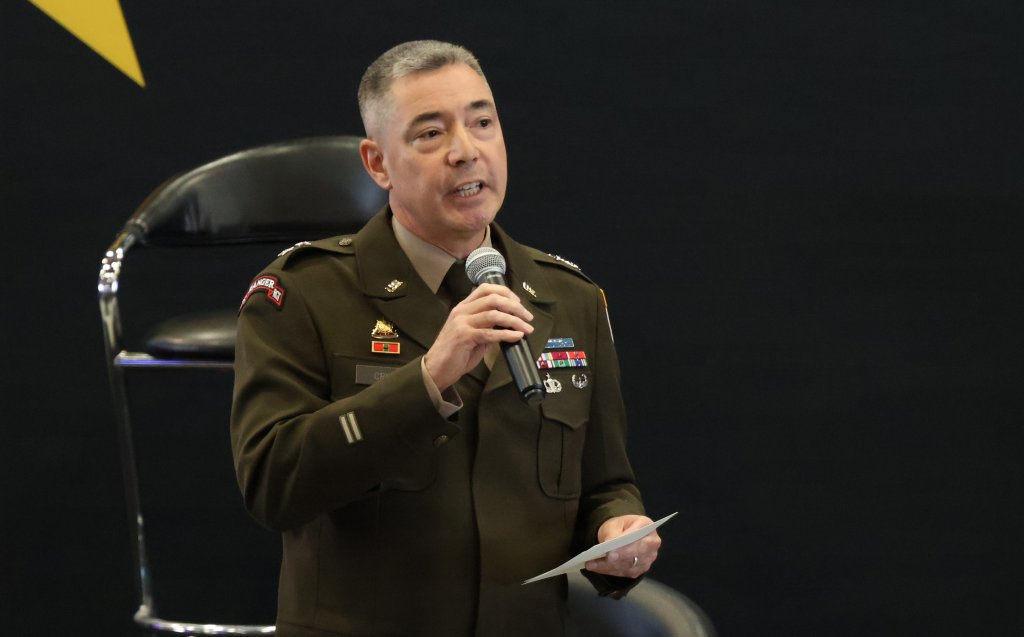
Army Maj. Gen. Frederick Crist, head of 8th Theater Sustainment Command (TSC), speaks at AUSA last week. US Army

Reduced manning requirements could be especially attractive for the Army’s ‘Navy,’ which is already a very small part of the service’s overall force structure. Last week, Maj. Gen. Crist also talked about further leveraging traditional crewed vessels owned and/or operated by contractors.

“It’s going to be a broad portfolio of systems of systems,” he said of the overall watercraft vision for the Pacific. “Army watercraft with Army Mariners will be, of course, one aspect of it. We also look for the opportunity to be able to leverage USTRANSCOM’s (U.S. Transportation Command) contracting capability to leverage operational support vessels that are commercially owned and commercially operated. We’re considering ways of being able to have commercial vessels that become manned by Army mariners.”

It is also interesting to note here how extremely similar this all sounds to the modifications the U.S. Navy made to the Spearhead class Expeditionary Fast Transport USNS Apalachicola ahead of its commissioning in 2023. However, despite tens of millions of dollars spent and successful demonstration of autonomous capabilities, the Navy curiously decided to put the Apalachicola into service without any plan to make use of these features operationally. There does not appear to have been any effort to integrate these capabilities more broadly within the Spearhead class since then, either.
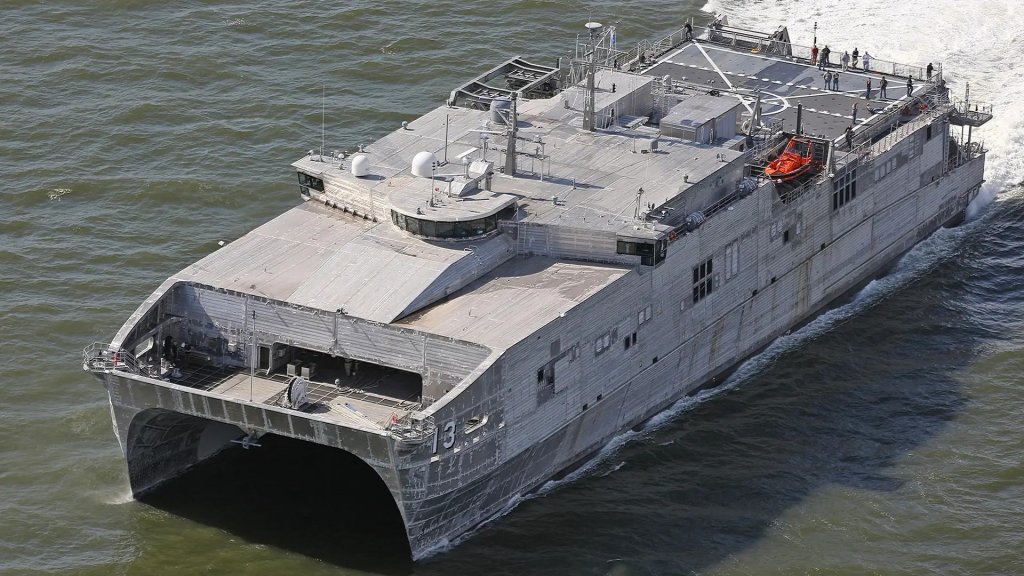
The Spearhead class Expeditionary Fast Transport USNS Apalachicola. Austal USA USNS Apalachicola. Austal USA

Last year, the Navy struck the four oldest Spearhead class ships from its rolls entirely and has put several others on reduced operating status, ostensibly as a cost-saving measure. The service is still acquiring new Expeditionary Fast Transports, including members of the Expeditionary Medical Ship subclass that feature expanded medical facilities. The Spearhead class was born out of a program specifically to meet Army and Marine Corps requirements, and the ships are regularly used to support those services in the Pacific and elsewhere globally.

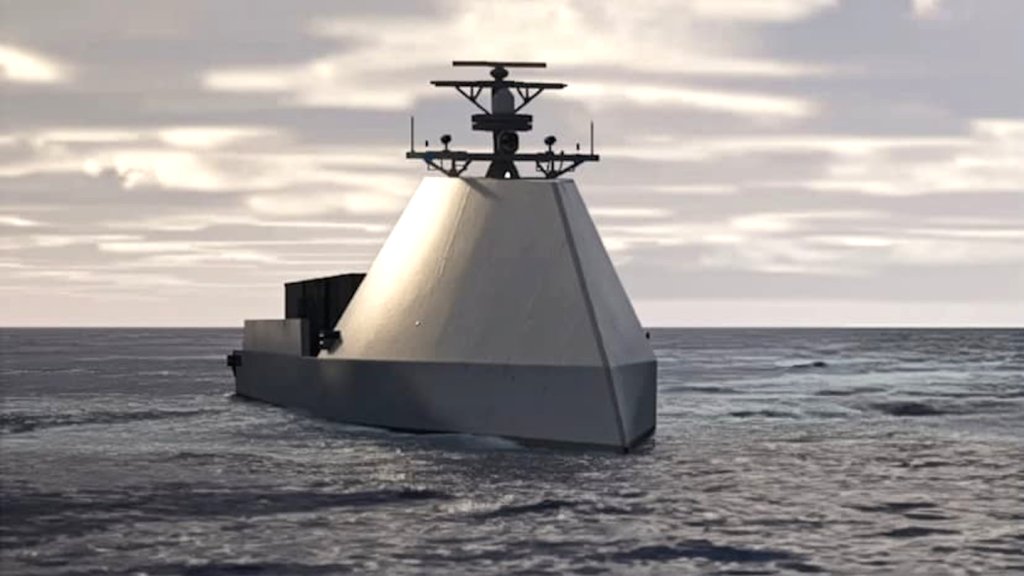
The Army also wants to expand its fleets of purpose-built uncrewed surface vessels (USV) for use in the Pacific, as well as elsewhere globally. Just earlier this year, Army Maj. Gen. Gavin Gardner, who preceded Maj. Gen. Crist as head of the 8th Theater Sustainment Command, said he wanted to rapidly acquire as many as 100 drone boats. His vision included larger USVs capable of carrying eight to 10 standardized shipping containers.

“I could see those operating in the U.S. PACOM area of responsibility,” Gardner told reporters at a roundtable in June, according to Military Times. “I think that gives you a ton of operations, inventory in motion, easy to respond. And then because they’re autonomous, and we can work with our partner nations forward, you have those berthed up everywhere from Korea to Japan, the Philippines, Australia, Singapore, Thailand, etc.”

“Clearly, [the autonomous vessels] would be forward in the theater, kind of moving supplies, because we have a constant demand for Army watercraft time now, to deliver equipment and supplies forward in the theater,” Gardner added at that time.

One of the inherent benefits of the Army watercraft fleets, and its LSVs in particular, is their ability to help alleviate the need for the U.S. Navy to meet more localized littoral logistics needs, if they are even available to help in the first place. Navy amphibious and military sealift ships would already be heavily strained by high demand during any major conflict in the Pacific or elsewhere globally. This could easily be further exacerbated by threats to those supply lines. All of this has already been underscored this year by pressure on maritime logistics chains in the context of the war with Iran. The Army’s ‘Navy’ also offers valuable additional capabilities and capacity in non-combat contingencies, such as responding to natural disasters.
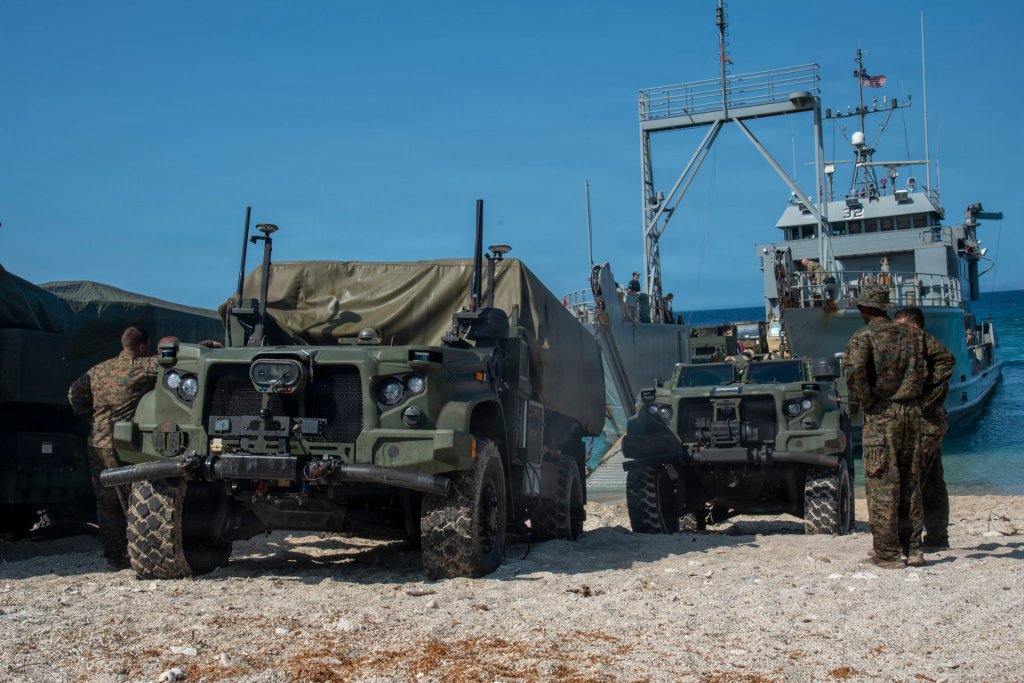
Marine vehicles drive off an Army LCU landing craft during an exercise. USMC/Cpl. Ernesto Lagunes

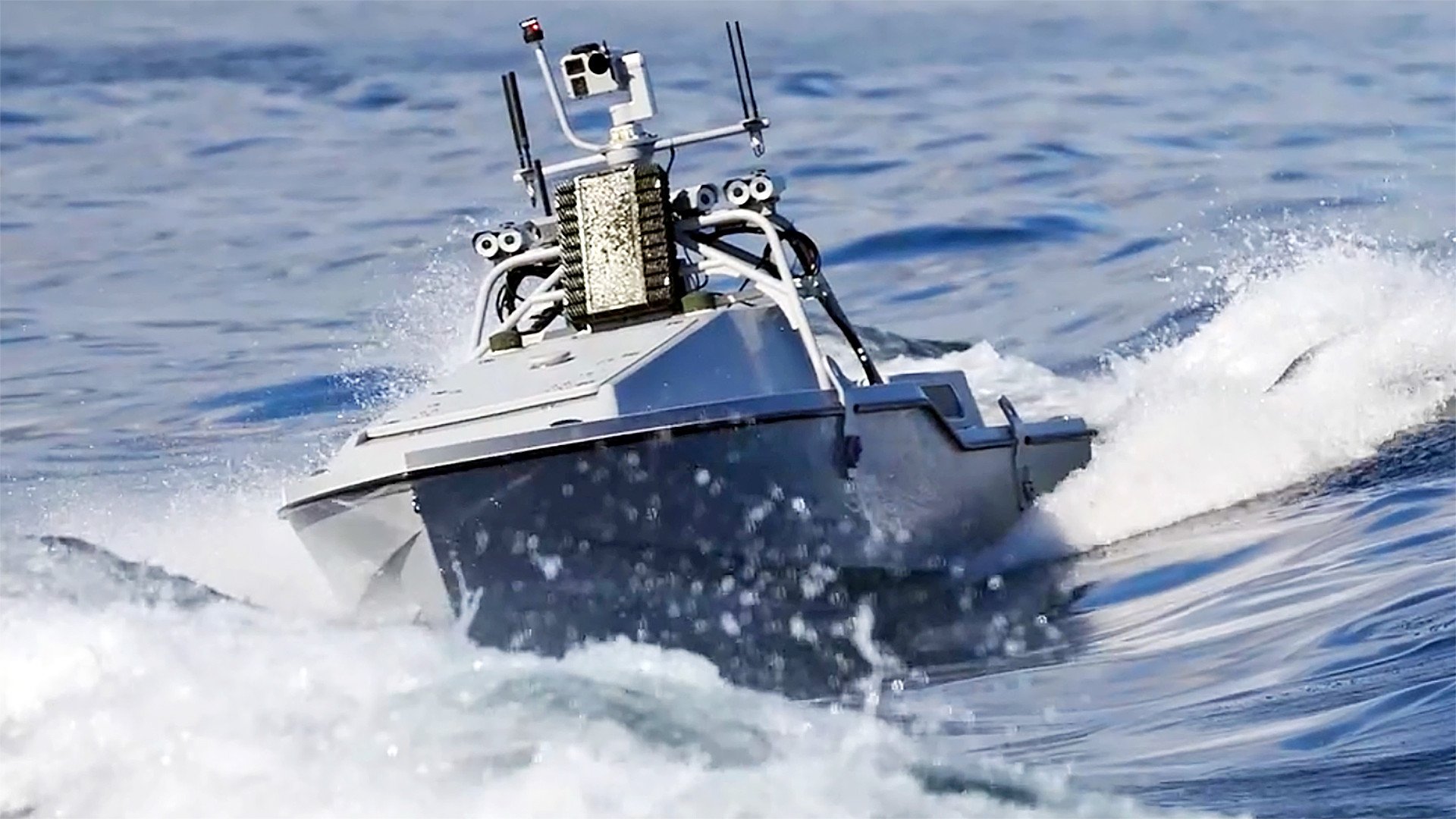
More generally, the Army has been working to expand its use of smaller USVs, including speedboat-like designs, in various roles. The service has clearly been paying close attention to Ukraine’s very successful use of drone boats in one-way kamikaze attacks, as well as ones armed with guns and rockets and examples configured as launch platforms for surface-to-air missiles and weaponized uncrewed aerial systems (UAS).

The 7th Infantry Division, one of the Army’s main maneuver combat formations in the Pacific, just recently experimented with a Ukrainian-developed Magura-series USV during an exercise in Michigan. That particular USV was configured to launch a quadcopter-type drone. Another member of the Magura family was observed being used in a one-way-attack configuration by U.S. Army Green Berets from the 1st Special Forces Group during the annual Balikatan exercise in the Philippines earlier this year.
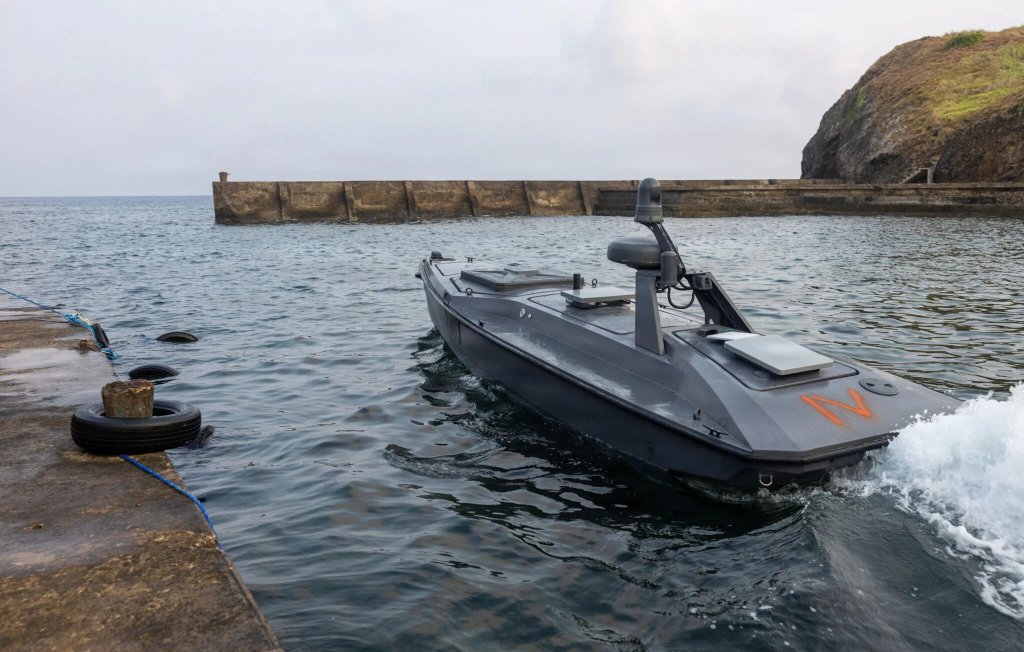
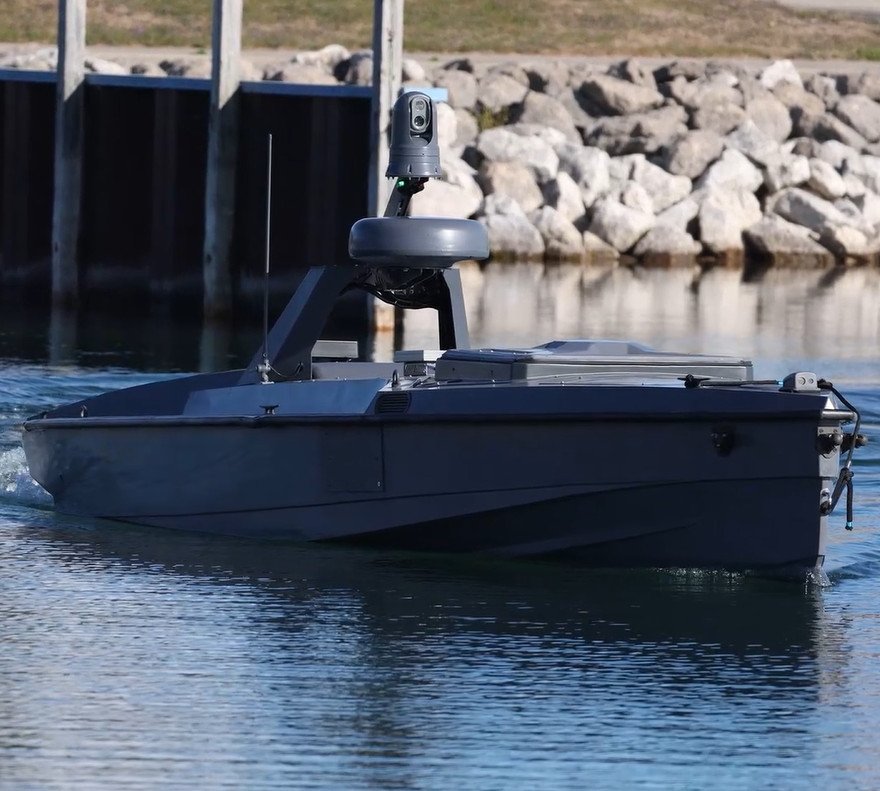
A Magura-series USV seen in use at the annual Balikatan exercise this year. US Army
Another Magura-series USV in use during Exercise Bayonet Quest 2026 in Michigan. US Army
The Magura USV launches a quadcopter-type drone during Exercise Bayonet Quest 2026. US Army

The Army has also been experimenting with American-designed USVs. The aforementioned recent exercise in Michigan also featured a Saronic Corsair, the same type of USV that the Navy used to rescue the crew of an Army AH-64 Apache attack helicopter that went down in the Gulf of Oman in June. Explosive-laden Corsairs were also used to carry out the first known U.S. kamikaze USV attack, which was launched against a coastal target in Iran in July.
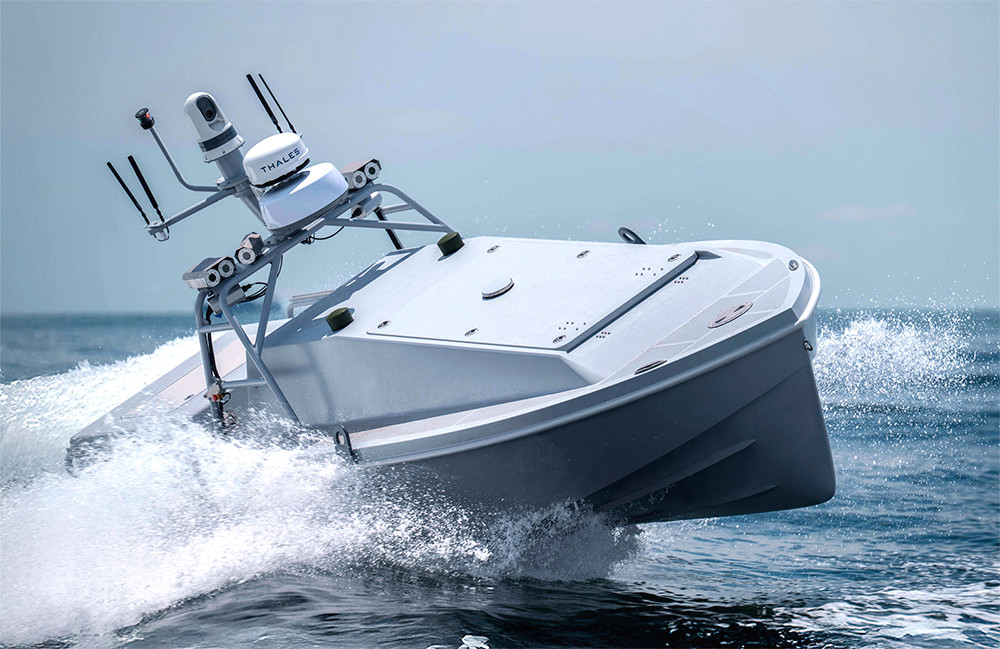
A stock picture of a Saronic Corsair. Saronic

During another separate exercise in the Philippines this year, Salaknib 2026, Army forces used unarmed Rampage USVs from U.S. firm Havoc, as seen below. As part of that exercise, the USVs escorted a crewed General Frank S. Besson class LSV to its destination, heading out in front to help spot potential hazards.
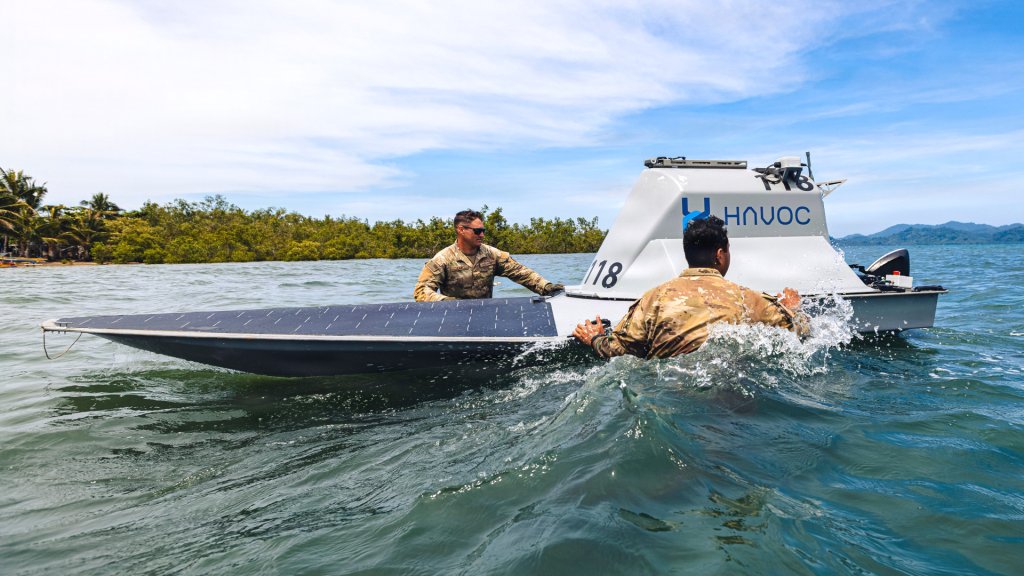
US Army

“There’s all the work that the Department’s already doing with autonomy and autonomous systems that we look to take advantage of in the [Pacific] theater, as well,” Maj. Gen. Crist said at AUSA.

The Navy and the Marine Corps have both been working to grow their operational fleets of smaller USVs, as well as larger ones, in recent years. At the same time, the Navy has suffered years of setbacks and shakeups in its efforts to operationalize bigger and more capable designs. The service awarded contracts for a total of 30 new medium-sized USVs last month in its latest attempt to reverse that trend.

In September, Secretary Pete Hegseth also announced several new initiatives aimed at further expanding use of uncrewed platforms and advanced autonomous capabilities across the U.S. military and all domains. The Pentagon is presently laying the groundwork for the establishment of an all-new top-level Autonomous Warfare Command (AUTOWARCOM), which it hopes to see come to fruition next year.

What is clear now is that the Army’s vision for future watercraft operations, especially in the Pacific, is increasingly autonomous.

Contact the author: joe@twz.com

The post How The U.S. Army’s ‘Navy’ Aims To Go More Autonomous With Its Vessels In The Pacific appeared first on TWZ.
  •  

Navy Orders 30 Drone Ships To Finally Advance Its ‘Medium’ Uncrewed Vessel Ambitions

The Navy has announced plans to buy 30 new drone boats, 10 from each of three companies, under its Medium Unmanned Surface Vessel (MUSV) program. The deals are an important step forward for the Navy’s latest attempt to field larger USVs after years of setbacks and shakeups, but it remains to be seen when these new capabilities might actually become operational.

Galliano Marine Services, Huntington Ingalls Industries (HII), and Saronic Technologies each received so-called Other Transaction Authority (OTA) agreements in relation to the MUSV program today. OTA is a contracting mechanism designed to support rapid prototyping and other research and development work without having to use more traditional and often lengthy processes.

The awards “mark a significant step forward in translating the strategic vision into a tangible fleet capability,” Chris Miller, the Navy’s Acting Direct Reporting Portfolio Manager for Robotic and Autonomous Systems (DRPM RAS), told TWZ and others at a media roundtable earlier today. “Each agreement is for the procurement of 10 MUSV at an average procurement cost of $40 million per vessel.”

A rendering of HII’s Romulus design. HII

Saronic and HII submitted their Marauder and Romulus designs, respectively, to the MUSV Phase I competition. Galliano Marine Services, which does business as Edison Chouest, does not appear to have announced its entrant publicly. At a unit cost of $40 million, the total price tag for 30 MUSVs, regardless of type, would be $1.2 billion.

“Production will begin immediately at shipyards in Loreauville, Houma, and Franklin, Louisiana, with deliveries starting as early as the fourth quarter of [Fiscal Year] 2027,” Miller added.

To take a step back quickly, the Navy has used a variety of definitions for what qualifies as a “medium” USV over the years. It’s also important to note that the Navy already fields several speedboat and jet ski-type USVs operationally that are capable of performing various different missions, including employment as one-way attack munitions.

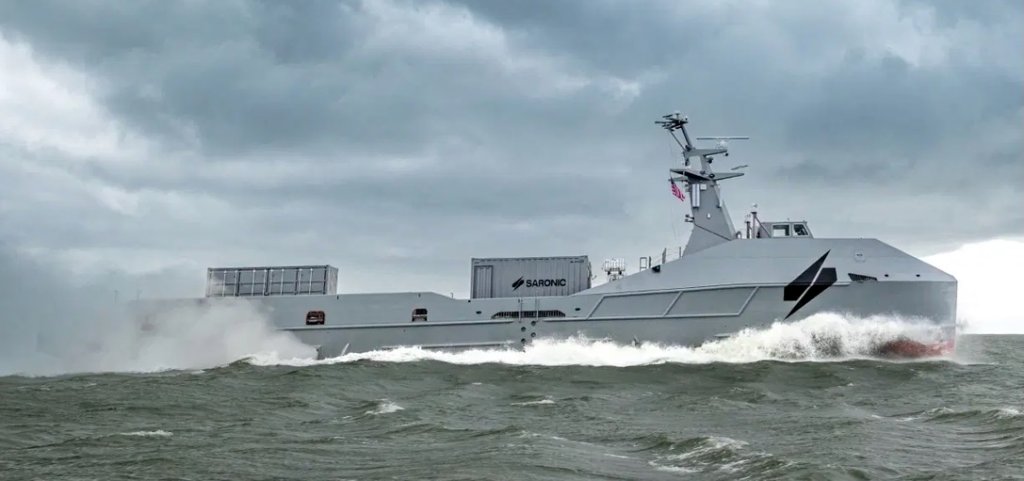
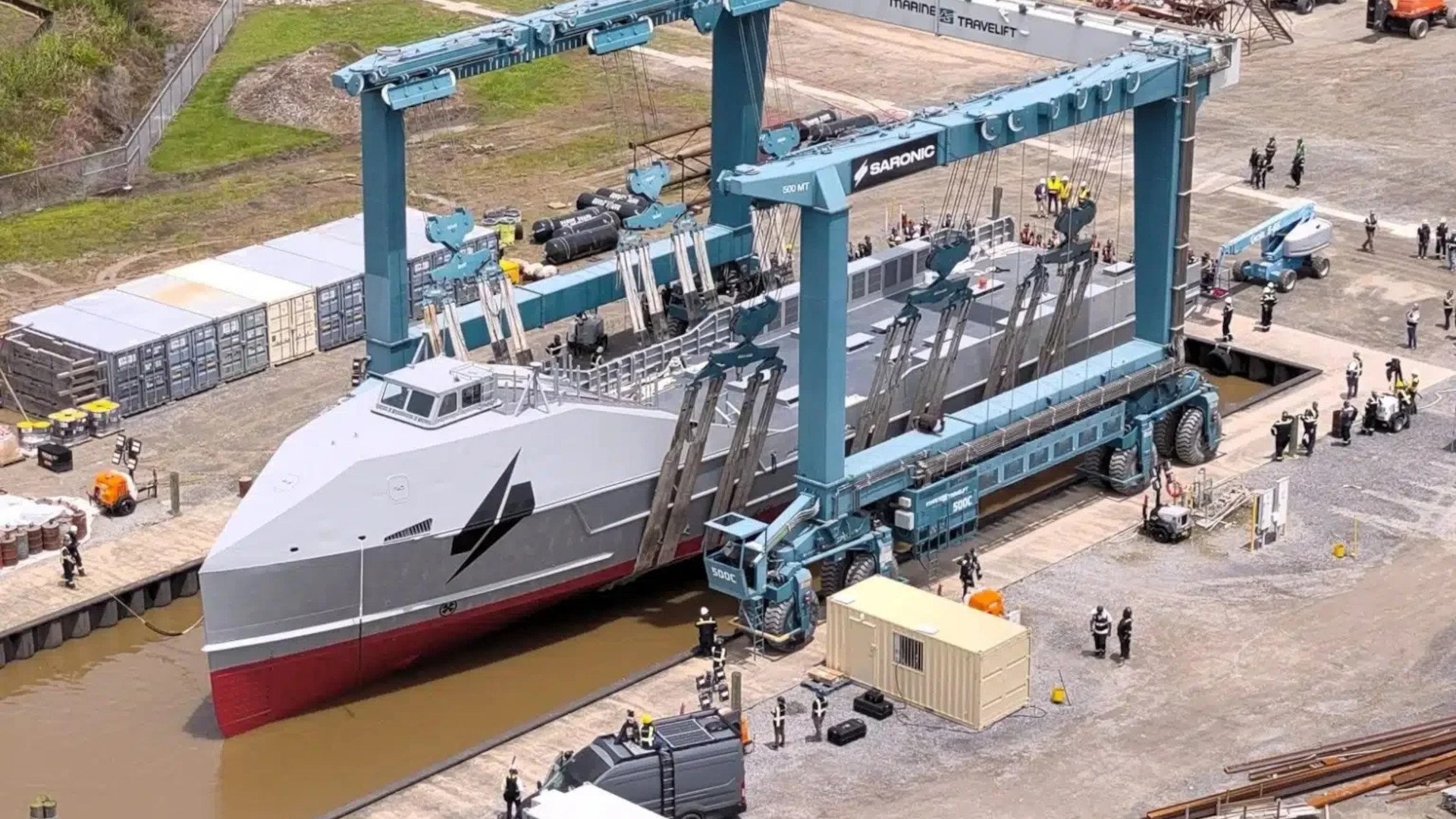
Saronic’s Corsair, seen here, is an example of a speedboat-sized USV already in operational Navy service. Saronic

Threshold MUSV program requirements the service put out in March included a range of at least “2500 nm [nautical miles] at 25 knots while carrying a 25 MT [metric ton] load on the payload deck in NATO STANAG 4194 Sea State 4.” Sea State 4 is characterized by wind speeds of 17 to 21 knots and wave heights between four and eight feet, per that NATO standard. The MUSVs also had to be able to carry forty-foot equivalent units (FEU) containerized payloads and refuel at sea at a rate of “2,000 gallons per minute of fuel through deck connections.” Various other operational and sustainment requirements were laid out at that time, as you can read more about here.

The OTAs announced today were awarded “following successful at sea testing” under Phase I of the MUSV program, according to a press release the Navy put out today. A total of seven companies competed in this initial phase, with the others being Birdon, Leidos, PacMar Technologies, and Sea Machines. That work was conducted under an earlier round of OTAs.

“The testing evaluated, among other things, the vessel’s ability to see and understand the surrounding maritime environment, how well the vessels navigated autonomously according to the international regulations for preventing collisions at sea, and the vessel’s ability to conduct a long-duration mission,” the Navy’s Miller said at the roundtable earlier today. “The demonstrations had to prove that the designs were mature enough to meet the Navy’s operational standards and our requirements.”

In terms of the long-duration mission requirements, “the test was that they had to be able to execute [over] roughly 26 hours and over 360 nautical miles with only a single input during that time from a C2 [command and control] station allowed,” Milleter further explained. “So, it basically demonstrated that the vessel could run for an excess of 24 hours at an extended range with very minimal input from the actual operator from a C2 station. This provided basically our input and our ability to assess how truly autonomous the functionality was of the platforms.”

Overall, the OTA awards “were based on the optimal mix of autonomy, performance, design, production schedule, and cost,” he added.

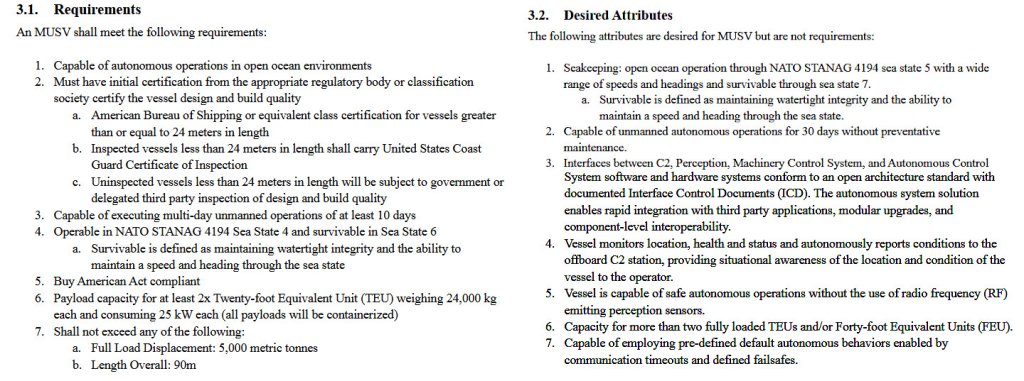
The MUSV Phase II contracting notice outlines additional parameters, including that submitted designs cannot be more than 295 feet (90 meters) long or displace more than 5,000 metric tons. The USVs also have to be able to accommodate “at least 2x Twenty-foot Equivalent Unit (TEU) [containerized payloads] weighing 24,000 kg each and consuming 25 kW each” and be “capable of executing multi-day unmanned operations of at least 10 days.” The drone boats need to be “operable in NATO STANAG 4194 Sea State 4 and survivable in Sea State 6,” as well. The full lists of threshold requirements and desired attributes are reproduced below.

USN

In addition, “to be considered for this Call for Solutions, the proposed MUSV must be ready for operational demonstration at the time of solution submission,” according to the Phase II contracting notice. “An MUSV requiring substantial modifications for the production platform compared to the as-demonstrated platform will not be considered.”

“The Phase II solicitation allows entrants to compete and existing vendors to submit updated product blocks and modular payload configurations,” Miller, the Acting DRPM RAS, said today. “Testing evaluations will begin as early as November 16th, and proposals will be assessed on a continually rolling basis over the next five years.”

Miller also drew attention to the elimination of the speed and at-sea refueling targets previously outlined in Phase I.

“What we learned from Phase I is that as you increase the speed requirements and some of these other things, it does present certain challenges for industry,” according to Miller. “So I’m trying to actually find the sweet spot in the market where there is healthy competition, and there’s opportunities, and we can have more things that potentially are dual use, both military and civilian.”

A rendering of Saronic’s Marauder with containerized payloads. Saronic

So far, the Navy has only offered limited insights into exactly what specific mission sets it wants the MUSVs to perform, even initially.

The “MUSV Phase I requirements were closely tailored to fulfill operational requirements for a specific mission set focused on demonstrated ability to carry containerized payloads while meeting specific vessel performance requirements for speed and range,” Miller said during today’s roundtable. “However, there is an ever-increasing demand signal that we must be ready to meet. To ensure scalability across the broader mission sets and to support our joint force, we issued a formal call for solutions for MUSV Phase II integration and testing.”

He also stressed that the modularity of the designs being acquired now would allow for the continued evolution of their capabilities as time goes on.

With the focus on containerized payloads, “honestly, inside you could have a sensor, you could have repair equipment for ships,” Rebecca Gassler, who was the Navy’s Portfolio Acquisition Executive for Robotic and Autonomous Systems (PAE RAS) until August, also told TWZ and other outlets back in March. “You could have any number of payloads inside those, and you basically are able to just swap them on.”

In announcing the new OTAs today, as well as discussing the Phase II MUSV plans, the Navy also highlighted continued opportunities for the other companies that had been involved in Phase I.

“Leidos, PAC MAR, and Sea Machines were determined to complete the project provided for in their prototype other transaction agreement and will receive a $15 million award as part of the previously established terms of the prototype OTs,” the Navy’s MUSV announcement today adds. “Alongside the OT awardees, will be accepted onto the Drones.mil hosted Maritime Marketplace, where they are now eligible to receive follow-on production agreements from authorized acquisition authorities across the DOW [Department of War].”

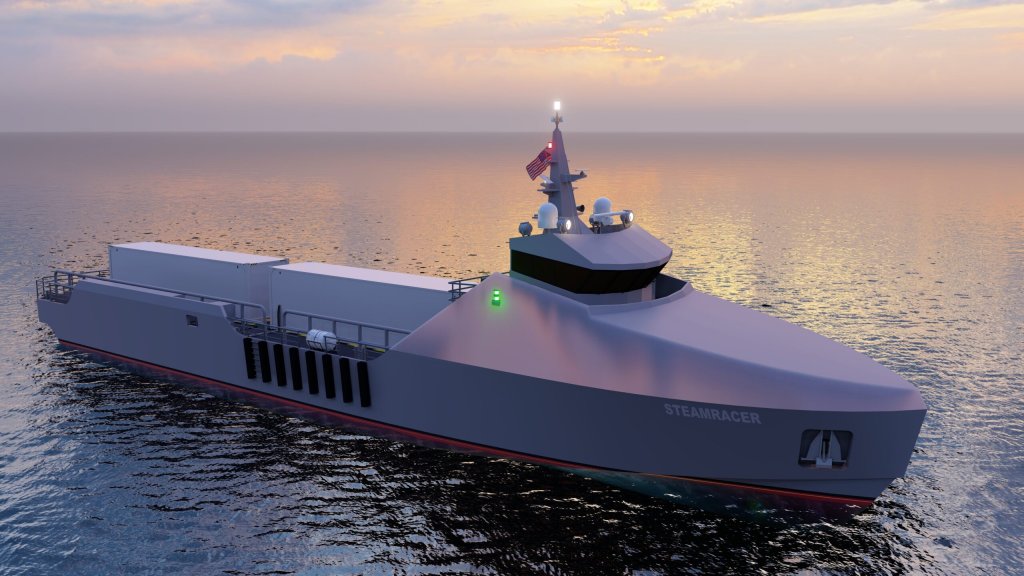
A rendering of Steamracer, a larger USV design Sea Machines has pitched to the US Navy in the past. Sea Machines

Birdon did not complete the required testing. Based on the terms of the Phase I OTAs, Galliano, HII, and Saronic will also receive $15 million awards and be included in the marketplace. The aforementioned Phase II CFS is intended “to expand its acquisition pipeline through a Maritime Marketplace to broaden offerings and satisfy future MUSV mission sets,” as well, per the Navy.

The Navy stressed the importance of this open-ended “marketplace” model as a way to accelerate the acquisition process when it first outlined the MUSV program to the public back in March, as you can read more about here. Just last week, the service also established a new Robotic and Autonomous Systems Warfighting Development Center (RASWDC) to serve as a focal point for “the development, operational integration, and employment of robotic and autonomous systems (RAS) across the maritime domain,” to include the MUSV effort.

The Drones.mil marketplace also extends to all branches of the U.S. military and beyond just USVs. Miller today did highlight the potential for possible cooperation with other services on drone boat efforts through this framework. He also said the Navy might be willing to consider additional acquisition strategies, including leasing uncrewed platforms, in the future.

Larger USVs have long been seen as key to bolstering the U.S. Navy’s overall operational capacity above the waves, and doing so in a cost-effective and rapidly producible manner. They are also viewed as central to enabling new, more distributed concepts of operations designed to help expand operational coverage and reduce the vulnerability of crewed ships, especially in any future high-end fight in the Pacific with China.

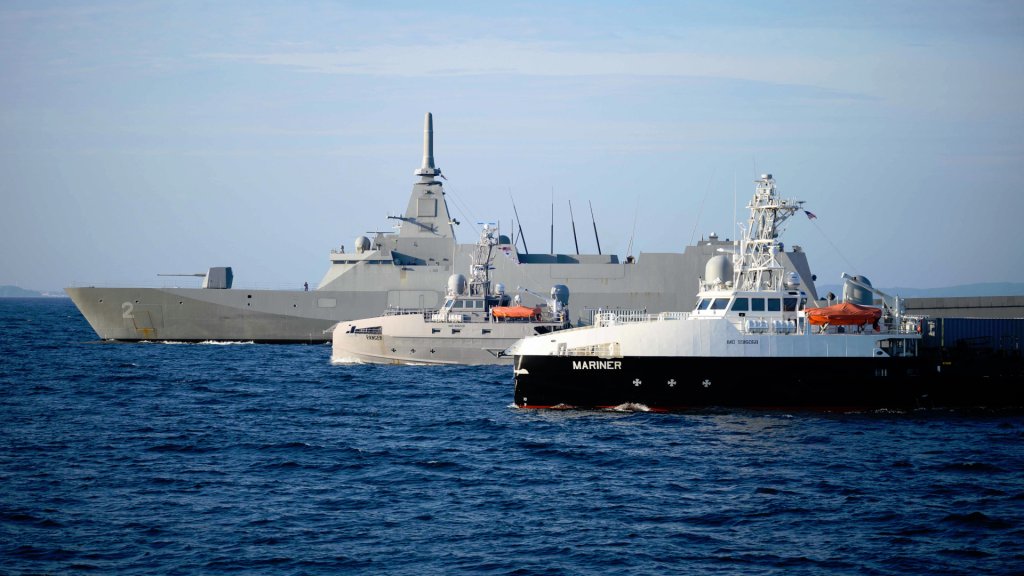
A pair of optionally-crewed vessels the Navy has been experimenting with for years now seen sailing together with a Japanese Mogami class frigate. USN

“Unmanned technology is redefining operations and providing our combatant commanders with unprecedented scale, persistence, and risk tolerance,” the Navy’s Miller said at the roundtable.

At the same time, as mentioned, the Navy has attempted to acquire operational fleets of larger drone boats in the past without success. Today, the service’s capabilities in this regard remain limited to a pocket force of still largely experimental optionally-crewed designs.

Since the Navy first unveiled it in March, MUSV has already faced certain hurdles. This includes a major leadership shakeup in August that saw PAE RAS Rebecca Gassler, the first person to ever hold that post, removed from her post after just eight months for reasons that are still not immediately clear.

In July, it also emerged that Blue Water Autonomy and Saildrone had filed suit against the Navy over being left out of Phase I of the MUSV competition. The companies alleged that the service did not follow its own selection criteria. That lawsuit is still ongoing. Blue Water Autonomy, among others, had also previously made investments in response to requirements the Navy had laid out for a previous effort called the Modular Surface Attack Craft (MASC) last year. The MUSV program has now fully supplanted MASC.

In speaking at the roundtable today, Miller acknowledged potential budget limitations and other hurdles that could still impact MUSV going forward. “I’m trying to be prepared depending on where that demand goes,” he said.

As said at the start, today’s MUSV announcement is an important new step forward for the Navy’s efforts to acquire fleets of larger USVs, but the service still has to transition these efforts into operational realities.

Contact the author: joe@twz.com

The post Navy Orders 30 Drone Ships To Finally Advance Its ‘Medium’ Uncrewed Vessel Ambitions appeared first on TWZ.

  •  

Marine Colonel Who Led Mideast Combat Deployment Wants His Own Drone Boats

The officer who led the 31st Marine Expeditionary Unit (MEU) on its recent combat deployment to the Middle East told us he needs his own uncrewed surface vessels (USVs) on future deployments. Operationalizing USVs is an area where the Marines are lagging behind. In particular, he wants the ability to send USVs forward to reconnoiter potential highly-contested beach landing areas, a mission largely assumed by the Navy.

As we have frequently reported, the military use of USVs is now proliferating around the globe at an increasing rate. Ukraine has employed sea drones to devastating effect against Russia’s Black Sea Fleet vessels and facilities, forcing the general evacuation of Russian naval assets from occupied Crimea to bases in Russia proper. During Operation Epic Fury, the U.S. used them for the first time in combat, as one-way attack weapons against Iranian targets, to hunt for mines, and for a search and rescue operation to locate the crew of an AH-64 Apache helicopter downed by Iran, as well as general broad-area surveillance and awareness. China is investing heavily in the space, as well, along with many other navies around the globe, both friend and foe.

The following video shows the first U.S. use of a USV as a kamikaze weapon.

Yesterday, using multiple one-way attack surface drones, CENTCOM forces successfully struck a submarine and ship maintenance facility in Iran. Three Corsair unmanned surface vessels hit the port at Bandar Abbas Naval Base, marking the first time American forces have employed sea… pic.twitter.com/bOM2kmgRxz

— U.S. Central Command (@CENTCOM) July 13, 2026

“There was a lot in theater that were being used, but it wasn’t something that we went out with,” Col. Chris P. Niedziocha told us when asked if the 31st MEU deployed with USVs. He then answered in the affirmative in response to a question about if MEUs need sea drones on future deployments. He said it is part of the “explosion in robotics and autonomy” being used in combat.

“These systems are incredibly useful and capable,” explained Niedziocha, now director of the USMC Expeditionary Warfare School. “And you say, ‘Hey, you know, [in] the next war, if the first thing you’re putting through the breach isn’t a robot, something’s wrong. You say never send a Marine someplace you haven’t sent a bullet. I think the new way is [you] never want to send a Marine someplace you haven’t already sent a robot. So yeah, we’re embracing [the technology] and we’re not leaders. We’re fast followers in that regime.”

Asked for specific use cases he sees for USVs, the colonel talked about using them before putting Marines ashore.

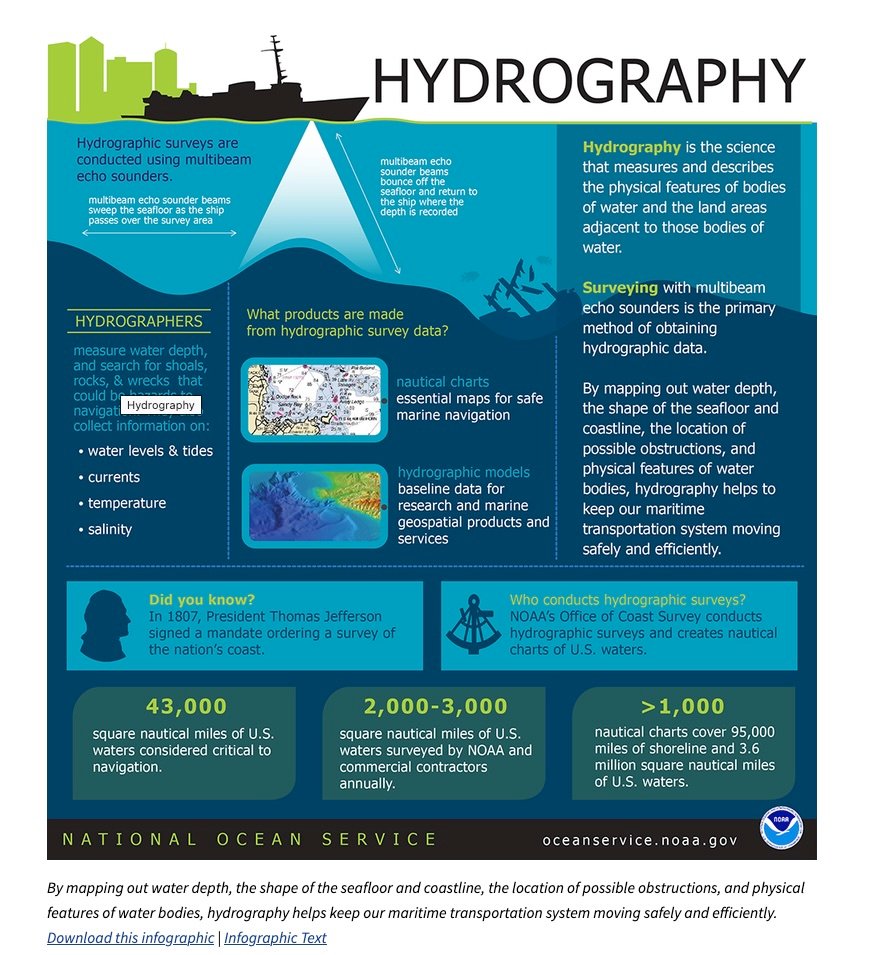
“I can tell you if you’re doing an amphibious operation, you want to understand what’s waiting beneath the surface in the water column,” Niedziocha noted. “So something can go either with a side-looking sonar array or even forward-looking to demonstrate that there’s nothing there, and the hydrography and bathymetry is what you… need for the operation to be successful.”

Hydrography measures “the shape and features of the shoreline; the characteristics of tides, currents, and waves; and the physical and chemical properties of the water itself,” according to NOAA. Bathymetry, which is part of that, focuses on mapping the depths and shapes of underwater terrain.

NOAA

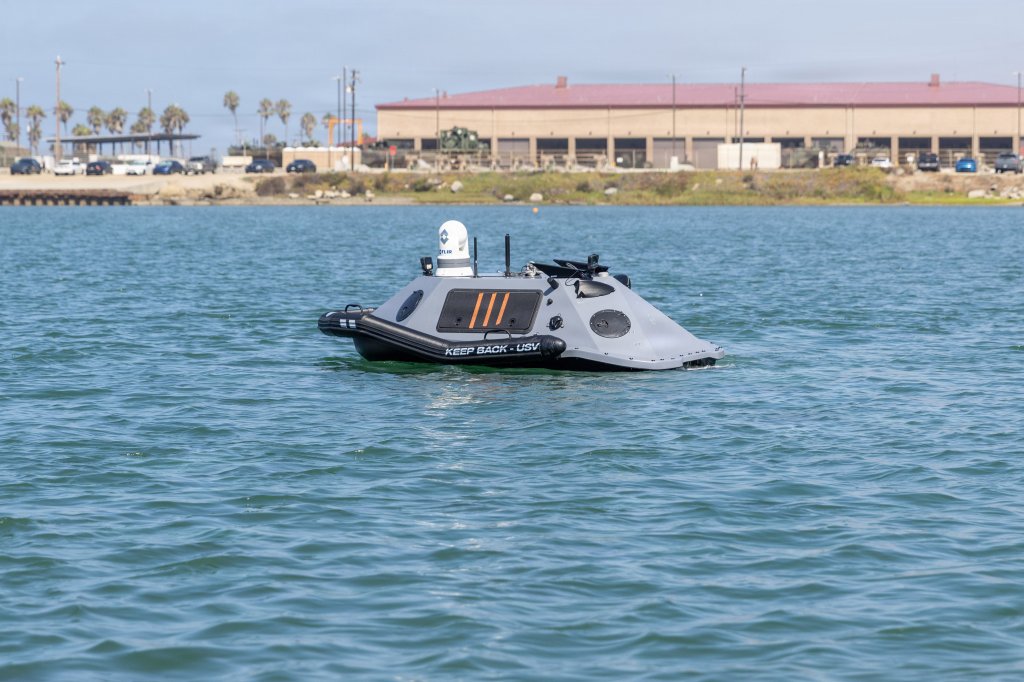
These functions are critical for mine detection and determining whether there are man-made or natural obstacles that would impede landing operations. While these missions are largely being performed by the Navy, including with USVs, the Marines are moving toward making that an organic capability. Recently, the Marines announced they were testing a counter-mine USV system. The evaluation was conducted late last month at Camp Pendleton by the Program Manager Combat Support Systems (PM CSS) Explosive Hazard Defeat Team.

The test of the USV was “in response to a littoral capability gap,” according to the media release. “The solution: seek a commercial USV solution that is equipped with integrated autonomous driving and payloads that consist of Sonar, Forward-Looking Infrared (FLIR) cameras, Line of Sight (LOS) Communications and Acoustic Communications (AComms).”

This was part of the overall effort to develop “solutions that enable increased standoff for Marines to detect, investigate and neutralize threats,” the release added. “The innovation of Explosive Ordnance Disposal (EOD) and Littoral Explosive Ordnance Neutralization (LEON) systems will provide Marine EOD Technicians with the confidence to operate in contested environments while preserving combat power, increasing operational reach, and minimizing exposure to explosive threats.”

LEON is a so-called system of systems, using a remotely operated vehicle, diver equipment, an unmanned underwater vehicle (UUV), a USV, and an Amphibious Unmanned Ground Vehicle to enable “EOD to confirm and mark hazards and obstacles from very shallow water to the beach zone,” the media release added.

While unmanned systems have long been part of EOD operations, “we’re expanding that into maritime systems that allow more endurance and less risk for operators,” said Chief Warrant Officer 2 Alfredo Andrade, officer in charge, Explosive Ordnance Disposal Company, 7th Engineer Support Battalion (ESB). “Some of the conflicts that we are engaged in take a toll on the force, and surging in new forces is costly. It turns into a logistical problem. To preserve the safety and the health of the forces… the USV and the [LEON] program exist to ensure that we have readily available combat power.”

In late August at Camp Pendleton, the PM CSS Explosive Hazard Defeat Team tested an Unmanned Surface Vessel in response to a littoral capability gap. The solution: seek a commercial USV solution that is equipped with integrated autonomous driving and payloads that consist of Sonar, Forward-Looking Infrared (FLIR) cameras, Line of Sight (LOS) Communications and Acoustic Communications (AComms). The LEON System of Systems (SOS) consists of five increments of capabilities to include a Remotely Operated Vehicle, diver equipment, Unmanned Underwater Vehicle, Unmanned Surface Vehicle, and an Amphibious Unmanned Ground Vehicle. LEON enables EOD to confirm and mark hazards and obstacles from very shallow water to the beach zone. (PAE Marine Corps photo by Kristiana Gehly)
In late August at Camp Pendleton, the PM CSS Explosive Hazard Defeat Team tested an unmanned surface vessel in response to a littoral capability gap. (PAE Marine Corps photo by Kristiana Gehly) Kristiana Gehly

While Niedziocha didn’t address USVs for offensive combat roles, the Marines have evaluated them for that use as well as for logistics, among other functions.

Our Autonomous Low-Profile Vessel (ALPV) solicitation is now accepting submissions.

The @DeptofWar and the @USMC need to resupply units spread over wide distances in contested littoral environments. Increased all-domain threats targeting logistics capabilities, locations, and… pic.twitter.com/Af8v0DTRHS

— Department of War Innovation Unit (@DIU_x) March 3, 2026

There have been many other tests, as well. Including one just this summer at RIMPAC. These trials saw the launch and recovery of one of Splash Industries’ Typhoon USVs aboard the USS Essex. The ‘Gator Navy’ of amphibious assault vessels that haul Marines and their kit around the oceans is uniquely suited to act as USV motherships. Their well decks allow for easy deployment and recovery of USVs of many sizes and capabilities near seamlessly. So it won’t be surprising if these vessels and the Marines aboard them quickly become staples in the Pentagon’s USV playbook.

Watch us land one of our drone-boats inside a moving US Navy warship during RIMPAC. This world-first resupply mission was performed completely autonomously using a Splash Industries Typhoon USV. pic.twitter.com/AEzNzZjsL1

— Ivan Avanesov (@i_vanesov) July 14, 2026

Still, the Marines have a long way to go to catch up to how these systems are already being used.

The Houthi rebels of Yemen actually pioneered the operational use of kamikaze USVs years ago and Ukraine has led the way in advancements of these systems. They first employed them as kamikaze weapons, but then added machine guns and rockets and later missiles, which were used to shoot down Russian helicopters and jets. Ukraine has also used them to launch first-person view (FPV) and bomber drone attacks as well as deliver uncrewed ground vehicles (UGVs) into enemy territory. Last week, Ukraine claimed to have attacked a Russian USV with a USV, marking another first.

You can see that engagement in the following video.

Ukraine's Navy says a Sargan unmanned surface vessel destroyed a Russian unmanned boat with machine-gun fire in the Black Sea, the first-ever battle between unmanned surface vessels. Ukrainian Navy personnel operated in coordination with HUR. #Ukraine pic.twitter.com/Avg4ecz8m6

— NOELREPORTS 🇪🇺 🇺🇦 (@NOELreports) September 12, 2026

Having recently returned from a six-month deployment that saw the Marine Corps’ first use of its Expeditionary Advanced Base Operations (EABO) concept in a combat setting during the fight against Iran, Niedziocha has a good sense of the realities of modern warfare. His Marines operated forward arming and refueling points (FARPs) for various aircraft in combat for the first time and set up remote sensing locations.

That a commander like him sees value in USVs is a good sign for progress in the development of these systems.

Contact the author: howard@twz.com

The post Marine Colonel Who Led Mideast Combat Deployment Wants His Own Drone Boats appeared first on TWZ.

  •  

Apache Crew Rescue Highlights Need For AI In Combat Says Joint Chiefs Chairman

The U.S. military’s top officer on Wednesday talked about how AI is changing the character of warfare and offered two examples to illustrate his points. His comments included new insights into how two U.S. Army AH-64 Apache crew members were rescued after being shot down by an Iranian drone near the coast of Oman in June. The recovery effort involved America’s first known use of an uncrewed surface vessel (USV) executing a personnel recovery action as part of a military search and rescue operation.

“Information moves so fast that leader decision times have compressed from weeks down to days down to seconds,” explained Air Force Gen. Dan Caine, chairman of the Joint Chiefs of Staff, during his keynote speech at the Air & Space Forces Air, Space and Cyber Conference that TWZ is attending. “In the future fight, advantage will go to the side who can see first, who can understand first, decide first, and act first, and along the way, be a learning organization, and no factor is accelerating change as fast as artificial intelligence and advancing cyber capabilities.”

“AI is here now, and it’s already changing the way militaries see, sense, decide, and act across the joint force,” the chairman proclaimed.

The first example Caine used to highlight these changes took place on June 8. After the Apache went down, “U.S. CENTCOM launched a rapid, responsive joint search and rescue effort to recover the crew. That response drew on the totality of the joint force, and ultimately was required to use enabled unmanned vessels to participate in the rescue of downed U.S. service members for the first time ever.”

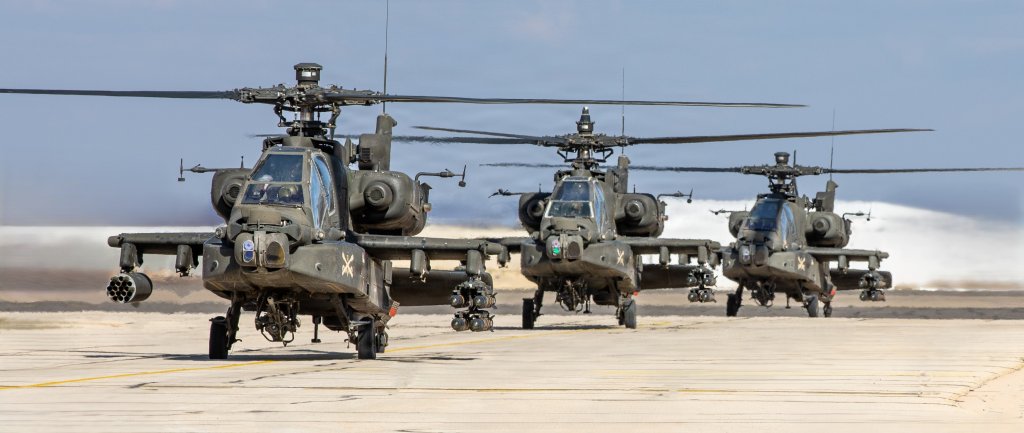
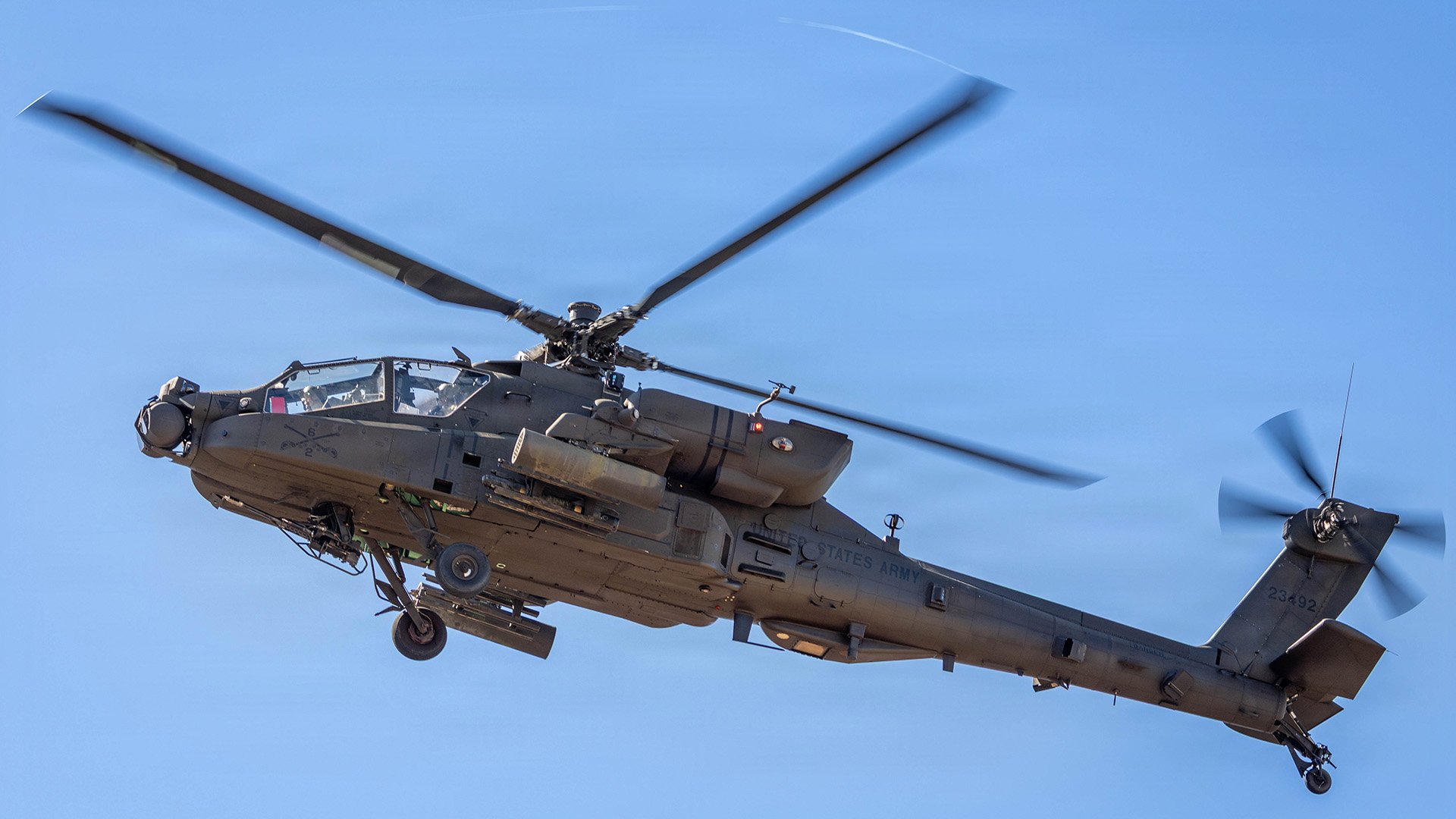
A flight of U.S. Army AH-64 Apache attack helicopters, armed with rockets and Hellfire missiles, taxi out to conduct a scheduled flight in the U.S. Central Command area of responsibility. In addition to rockets and missiles, the Apache is additionally armed with a 30mm chain gun. (U.S. Army photo)
A flight of U.S. Army AH-64 Apache attack helicopters, armed with rockets and Hellfire missiles, taxi out to conduct a scheduled flight in the U.S. Central Command area of responsibility. In addition to rockets and missiles, the Apache is additionally armed with a 30mm chain gun. (U.S. Army photo) U.S. Army Central

As we noted in our previous coverage, CENTCOM deployed “a U.S. Navy Corsair unmanned surface vessel,” the command’s spokesman told us at the time.

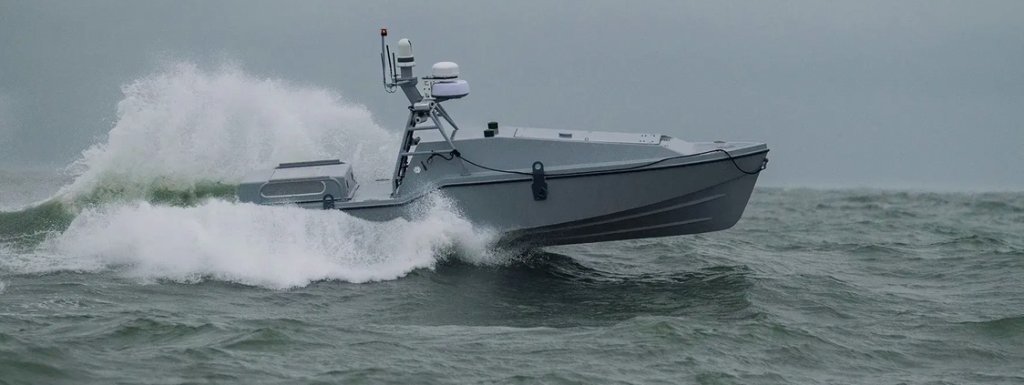
The Corsair uncrewed surface vessel (USV) (Saronic)

The ability to pull off that rescue mission “did not appear overnight,” Caine pointed out. “It came from the men and women of Task Force 59, CENTCOM’s forward-leaning unmanned joint maritime unit who spent the last several years testing, integrating, and operationalizing unmanned systems and AI in one of the most demanding and kinetic environments on Earth right now.”

“What helped make this possible was not a bunch of general officers and flag officers,” Caine continued. “What made this possible was a bunch of entrepreneurial sailors and members of the joint force on watch floors, at piers, managing networks of unmanned systems across thousands of miles of water, and using AI to turn massive amounts of data into a crisp, clear, perfect maritime picture that allowed us to go grab those two soldiers in the water.”

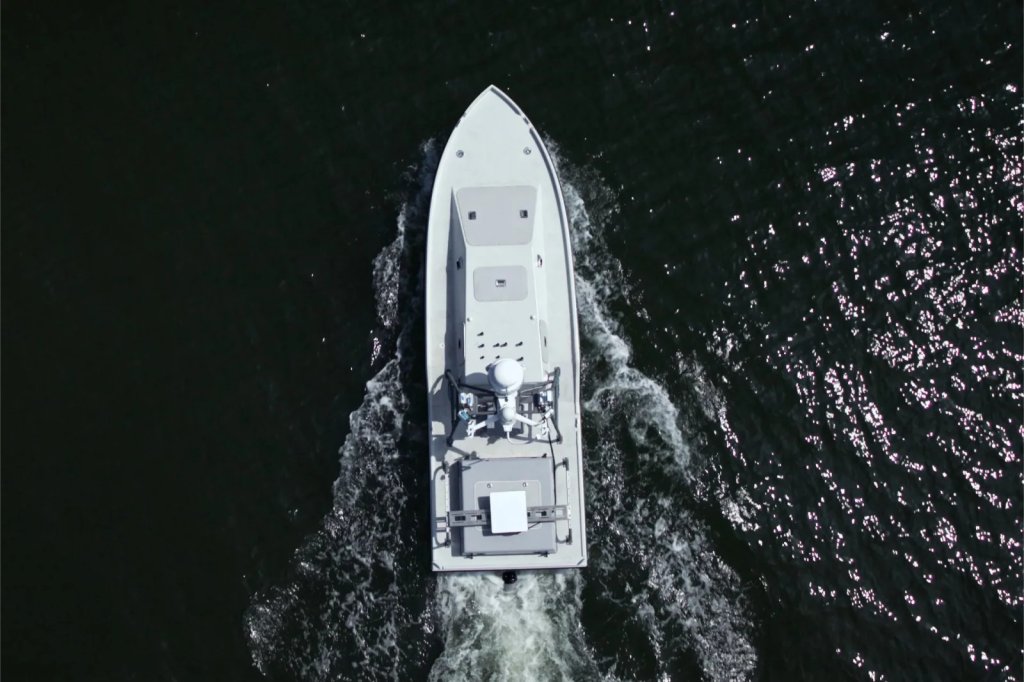
A top-down view of the Saronic Corsair USV. (Saronic)

The second example Caine shared about the use of AI “points in the other direction, not how quickly we are using these tools, but how quickly these tools are changing the threat.”

In Ukraine, “we see first-person view drones operating in heavily contested EMI [electromagnetic interference] environments. Some now using AI-enabled computer vision to continue to drive towards targets, even when there’s no GPS or the links are cut. That gives small units affordable precision and shows how quickly software and autonomy are changing what is possible at the tactical edge, and the results are stark.”

The use of AI to enable lower-end drone warfare is a topic TWZ has been among the first to point out.

“In certain locations on the front line of troops right now, the life expectancy of a new Russian recruit arriving on the front lines is as little as 20 to 30 minutes,” Caine added. “Think about that. This is what happens when low-cost precision is fielded fast, adapted quickly, and scaled across the battlefield.”

“The price of lethal exchange is decreasing day over day,” the chairman noted. “One wonders what the future of close air support looks like, but I am comforted by the fact that each and every one of you are in this room thinking about that. Taken together, these examples from the Straits of Hormuz to the front lines in Ukraine show how quickly technology is changing the character of war, and this means our joint force needs to do two things at one time.”

“[W]e need to prepare the joint force to win in this kind of conflict,” the general stated. “We have to assume from now on that our formations will be hunted by autonomous systems, jammed across the spectrum, and tracked in real time, and we have to transition the joint force to be prepared to fight and win our future war by generating and delivering lethality at scale with an agile, optimized, high-low mix of combat capabilities to give the young members of the 2.8-million member all volunteer joint force the tools that they need before they need them.”

Contact the author: howard@twz.com 

The post Apache Crew Rescue Highlights Need For AI In Combat Says Joint Chiefs Chairman appeared first on TWZ.

  •  

First-Ever Kill Of A Drone Boat By Another Drone Boat Claimed By Ukraine

The Ukrainian Navy is claiming one of its uncrewed surface vessels (USV) sank a Russian USV, marking the first time one of these weapons, also known as drone boats, destroyed another. The engagement is the latest iteration in the use of combat drone boats, which Ukraine has employed to devastating effect against Russia’s Black Sea Fleet vessels and facilities, forcing the general evacuation of Russian naval assets from occupied Crimea to bases in Russia proper. The use of weaponized USVs is now proliferating around the globe at an increasing rate.

The incident took place somewhere in the Black Sea, said the Ukrainian Navy, which provided no details about when it happened or exactly where. TWZ cannot independently verify this claim; however, we cannot find any evidence of a drone boat killing another drone boat in the past.

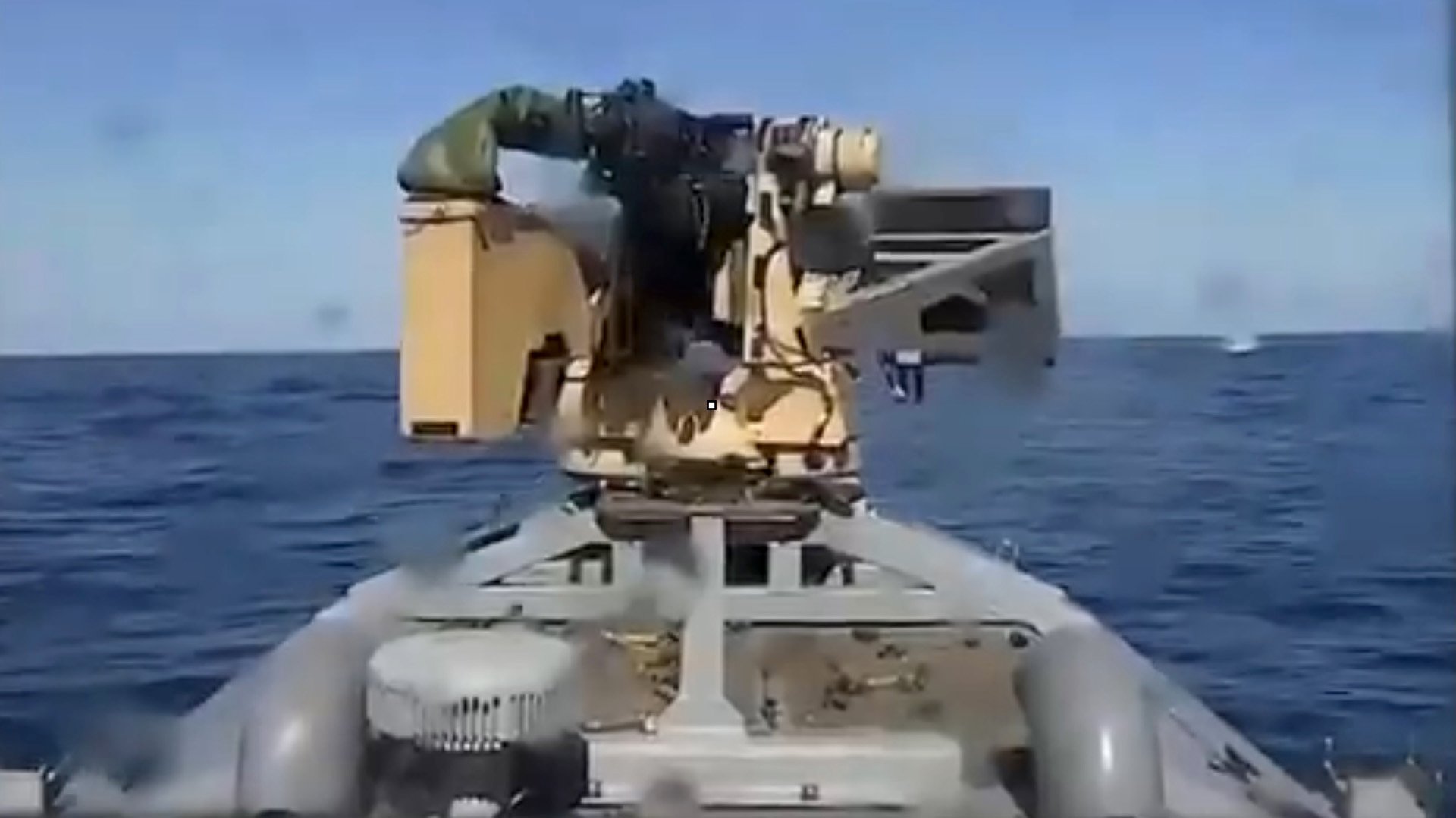
“Units of the Main Intelligence Directorate (GUR) detected the target,” the Ukrainian Navy stated on Telegram. “The Ukrainian Navy’s ‘Sargan 3000’ unmanned boat, equipped with a remotely operated weapon station (RWS) Protector 12.7 mm, successfully destroyed it. This is the first naval battle in history between unmanned boats.”

An 81-second video released by the Ukrainian Navy opens with a view from the Sargan 3000’s onboard camera. It shows the Ukrainian USV acquiring, then engaging the Russian USV with its machine gun. It then cuts to a closer view of the Protector gun system firing at the Russian drone boat. At about the 30-second mark, the view switches to a feed from an aerial platform, though it is unclear if it is piloted or a drone. The video continues with the Sargan 3000 raking the Russian USV with its heavy machine gun until pieces start flying off and it eventually sinks, stern first.

Ukraine's Navy says a Sargan unmanned surface vessel destroyed a Russian unmanned boat with machine-gun fire in the Black Sea, the first-ever battle between unmanned surface vessels. Ukrainian Navy personnel operated in coordination with HUR. #Ukraine pic.twitter.com/Avg4ecz8m6

— NOELREPORTS 🇪🇺 🇺🇦 (@NOELreports) September 12, 2026

The Sargan 3000 (the name means needlefish in Ukrainian) was first introduced by Ukrainian President Volodymyr Zelensky in April as a “multi-purpose platform that has undergone testing and entered service with the Ukrainian Navy. These uncrewed vessels are highly maneuverable and capable of carrying out strike missions.”

Though initially designed as a kamikaze weapon, it evolved into a platform for remote-controlled weapons, according to the Russian AmalNews outlet.

“The maritime drone features a specialized low-profile hull with distinctive hydrodynamic lines and is constructed from materials that reduce its radar signature,” the publication explained. “The Sargan-3000 USV is equipped with a waterjet propulsion system (presumably powered by a diesel or hybrid engine to ensure a long operational range).”

AmalNews states that the Sargan 3000 is 6.9 meters (about 22.6 feet) long, 2.2 meters (about 7.2 feet) wide, with an operational radius of up to 1,600 km (about 994 miles) and can carry a payload of 450 kg (about 992 pounds). It travels at an estimated speed range of 40-55 knots.

During operations, the Sargan 3000 connects to Ukraine’s Delta situational awareness system, “enabling the real-time transmission of target data, video feeds, and telemetry to operators,” AmalNews noted. “It features multi-channel control capabilities, including redundant satellite communication terminals (utilizing secure Western commercial networks and NATO military networks).”

It is also equipped with “an autonomous inertial and optical navigation system to ensure operation in the event of GPS jamming, and it incorporates electronic countermeasures (ECM) modules.”

There are several variants of this USV. They include those equipped with machine guns; rockets; FPV drones; an electronic warfare version and one that lays mines, the publication added.

Ukraine’s Sargan-3000 naval drone was presented in an FPV drone carrier variant, additionally fitted with a remote weapon station. The type first appeared in combat conditions in early June, when one washed ashore and detonated in the waters of Romania’s Constanța port. #Ukraine pic.twitter.com/QyKnyJFqUq

— NOELREPORTS 🇪🇺 🇺🇦 (@NOELreports) July 5, 2026

The Sargan 3000’s Protector remote weapon station is made by Kongsberg.

The drone boat’s first publicly known combat engagement took place in July, when one “destroyed the Russian Federation’s FSB border guard ship Izumrud,” the Ukrainian Navy stated at the time.

“Ukrainian naval sailors sank the border guard ship of the 2nd rank with the Sargan-3000 maritime unmanned complex near Novorossiysk,” the Ukrainian Navy claimed on Facebook. “Among the crew of the ship are dead and wounded.”

It is unclear whether the USV acted as a kamikaze vessel or a weapons platform, although the former is most likely.

“It was Izumrud that on November 25, 2018, participated in the attack on the ships of the Ukrainian Navy in the Kerch Strait,” the service added. “Revenge is inevitable.”

Ukraine's Navy has sunk the Russian FSB Border Guard patrol ship Izumrud near Novorossiysk using the Sargan-3000 unmanned maritime system.

The vessel, a Rank 2 patrol ship, reportedly sustained catastrophic damage, with casualties and injuries among its crew.

The Izumrud was… pic.twitter.com/7VjKDH2ReD

— SPRAVDI — Stratcom Centre (@StratcomCentre) July 14, 2026

One sea drone killing another is a notable development given the damage these systems can inflict and the challenge of locating and destroying them on open waters. Being able to operate on the water over long distances and timeframes, they can be used to hunt down other drone boats, as what appears to have taken place in this engagement, or serve as a picket line of sorts to protect harbors, vessels and other targets that have been attacked by USVs in the past.

The Russian drone boat, which is not identified, did not appear to be armed.

The Houthi rebels of Yemen actually pioneered the operational use of kamikaze USVs years ago. We first reported about this capability in January 2017, when an explosive-laden Houthi USV struck a Saudi frigate. Before that, Iran developed various crude kamikaze USVs and those capabilities soon migrated to its Houthi proxies, which put them to use in the Red Sea for the first time.

Ukraine has led the way in advancements of these systems, first employing them as kamikaze weapons, but then adding machine guns and rockets and later missiles, which were used to shoot down Russian helicopters and jets. Ukraine has also used these to launch FPV and bomber drone attacks as well as deliver uncrewed ground vehicles (UGV) into enemy territory.

You can see that delivery in the following video.

No soldiers. Just machines.

Ukraine has carried out the world's first known combat mission in which a sea drone transported and deployed an armed ground robot behind Russian lines on the occupied Kinburn Spit. pic.twitter.com/zyJdFXWxVb

— Ivan Khomenko (@KhomenkoIv60065) July 13, 2026

In the wake of the Ukrainian success with these weapons, Russia developed its own drone boats, and in August 2025, launched its first attack on a Ukrainian vessel.

The U.S. used drone boats as kamikaze weapons for the first time in July, during an attack “on a submarine and ship maintenance facility in Iran,” U.S. Central Command (CENTCOM) announced on X at the time.

Yesterday, using multiple one-way attack surface drones, CENTCOM forces successfully struck a submarine and ship maintenance facility in Iran. Three Corsair unmanned surface vessels hit the port at Bandar Abbas Naval Base, marking the first time American forces have employed sea… pic.twitter.com/bOM2kmgRxz

— U.S. Central Command (@CENTCOM) July 13, 2026

Regardless, it looks like history was made with this incident in the Black Sea. But this involved a sea drone hunting down and destroying another that couldn’t fight back. Given the rapid pace of weapons development by both sides in the Ukraine war, it seems inevitable that a duel between two armed drones boats could soon follow.

Contact the author: howard@twz.com

The post First-Ever Kill Of A Drone Boat By Another Drone Boat Claimed By Ukraine appeared first on TWZ.

  •  

Ukrainian Sea Drones Strike Russian Black Sea Resort Town Of Sochi For The First Time

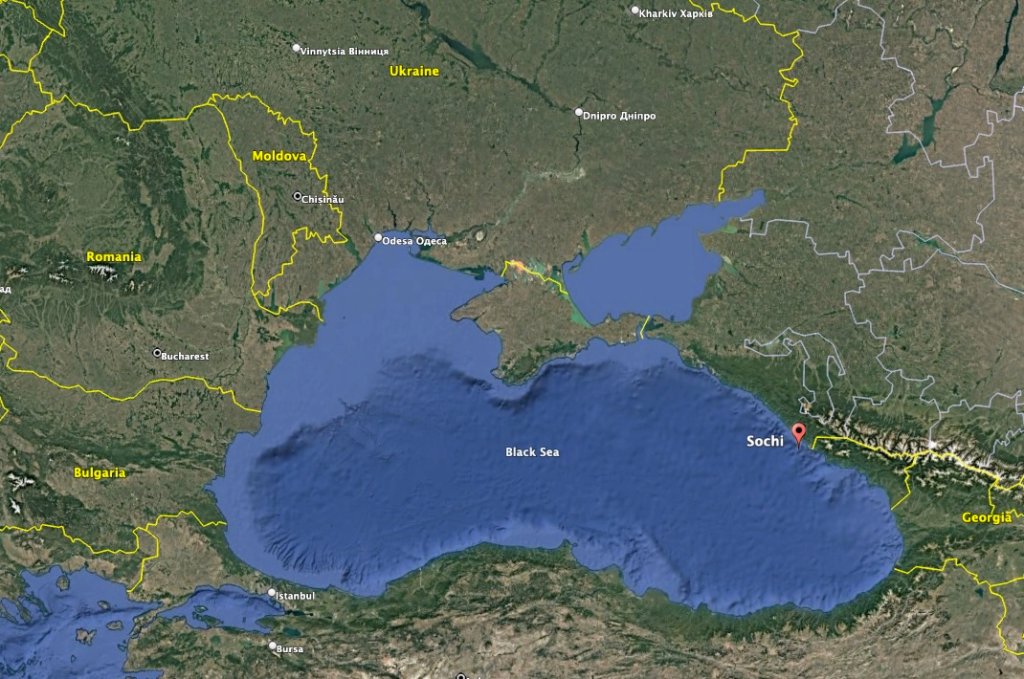
Ukraine carried out one of its farthest uncrewed surface vessel (USV) attacks from Ukrainian shores, striking the Nefrit, a multipurpose offshore vessel, in the Russian Black Sea resort city of Sochi. The seaside getaway is located about 350 miles on a direct line from the nearest Ukrainian-held territory, but the trip is a lot longer if originating from Ukrainian-held shores.

This marks the first known USV attack on this city that Russian President Vladimir Putin often visits. As we have reported in the past, it has been attacked several times by Ukrainian aerial drones.

The Russian Black Sea port of Sochi came under attack on Thursday. (Google Earth)

The Ukrainian Navy said it carried out the attack as part of the country’s campaign against Russia’s energy infrastructure. The Nefrit supported that infrastructure, the Ukrainian Navy claimed.

“The multipurpose support vessel, flying the Russian flag, was hit by an unmanned naval vessel of the Ukrainian Navy,” the service said on Telegram. “A powerful explosion and smoke were observed in the area of the vessel.”

“The NEFRIT is part of Russia’s maritime and energy infrastructure, providing support for oil and gas operations, servicing offshore facilities, transporting cargo and personnel, and carrying out underwater technical work,” the Ukrainian Navy explained. “Its activities directly supported the enemy’s war economy and financed the criminal aggression against Ukraine.”

“The damage to the NEFRIT is a blow to the enemy’s logistics, special capabilities, and military-economic infrastructure,” the Ukrainian Navy added. “The Ukrainian Navy continues to deprive the enemy of resources and capabilities for waging war, and once again demonstrates that even Russian territory is not a safe haven.”

🇺🇦⚓ВМС України уразили судно забезпечення рф NEFRIT у порту Сочі
Багатоцільове судно забезпечення під прапором рф було уражене морським безекіпажним катером Військово-Морських Сил. У районі судна зафіксовано потужний вибух та задимлення.

Детальніше https://t.co/DTfnO15nYO pic.twitter.com/yPDFkks37r

— Військово-Морські Сили ЗС України (@UA_NAVY) September 3, 2026

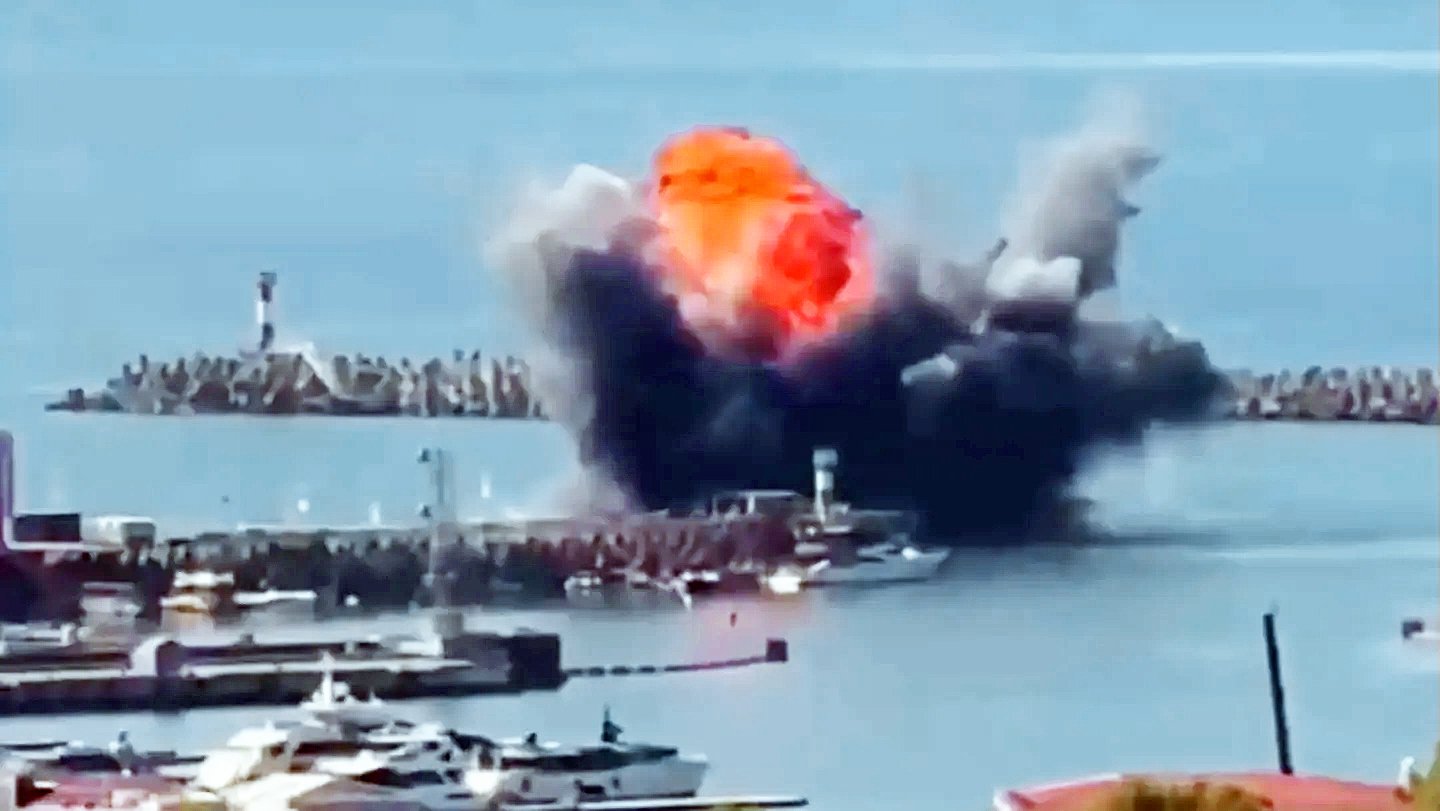
While the Ukrainian Navy claimed the Nefrit was damaged, the extent of that is hard to determine from imagery emerging on social media.

Some video, shot from inside the city, shows a large explosion at the port.

❗The moment of today’s explosion of a Ukrainian surface kamikaze drone next to a Russian ship in Sochi. pic.twitter.com/zpavwj97BW

— 🪖MilitaryNewsUA🇺🇦 (@front_ukrainian) September 3, 2026

The port in Sochi, Russia, came under attack from Ukrainian naval drones. pic.twitter.com/XygeQLaAWi

— Open Source Intel (@Osint613) September 3, 2026

A still picture shows smoke wafting from the Nefrit; however, the quality of the image makes it hard to determine the vessel’s condition.

Sochi: footage of this morning’s USV raid on the seaport.

The likely target was a Multipurpose Supply Vessel (MPSV) used to support offshore oil and gas operations. pic.twitter.com/Ndr5bRAYV5

— Exilenova+ (@Exilenova_plus) September 3, 2026

There is also video of one of the USVs being destroyed before it could reach its target.

Ukrainian sea drone sails into Sochi port in fascist Russia – appears to be hit by machine gun or cannon fire. https://t.co/GaCZHPu1DJ

— Euan MacDonald (@Euan_MacDonald) September 3, 2026

Starting at about 6 a.m. local time, Sochi Mayor Andrey Proshunin declared an emergency.

“ATTENTION! THREAT OF A USV ATTACK IN SOCHI,” he warned on Telegram. “All forces and resources are working to defend the city. Take shelter in a safe place, remain calm.”

Sochi Mayor Andrey Proshunin declared an emergency about an impending sea drone attack on Thursday. (Sochi Mayor Andrey Proshunin’s Telegram)

About a half hour later, Proshunin issued an all-clear notice, but did not provide any details about what happened.

Sochi Mayor Andrey Proshunin lifted the emergency about a half hour after it started. (Sochi Mayor Andrey Proshunin’s Telegram)

There was no immediate response from the Kremlin.

Ukraine has carried out long-distance USV attacks on Russian Black Sea targets in the past, including one in 2023 on the Ropucha class vessel Olenegorsky Gornyak, located in Russia’s Black Sea port of Novorossiysk. A major Russian port on the eastern coast of the Black Sea, it sits roughly 420 miles from Ukrainian-held shores. Sochi is about 110 miles southeast of Novorossiysk, meaning the USVs in today’s attack would have had to travel an even longer distance if launched from Ukrainian-held shores. However, the launch point of the Sochi USV strike is not publicly known and there is always the possibility that a mothership could have been used.

The attack occurring during broad daylight is also interesting, as Ukraine has often taken advantage of the cover of darkness for USV strike operations on port facilities.

You can see a video of that strike below:

Footage of the Ukrainian USV hitting the Russian Ropucha class LST. pic.twitter.com/ksLP9PZfE5

— OSINTtechnical (@Osinttechnical) August 4, 2023

The strike on the Nefrit is the latest in Ukraine’s long-running drone boat campaign in the Black Sea. This onslaught has already kept Russia’s Black Sea Fleet (BSF) at bay, forcing it to retreat from Crimea to Novorossiysk. Ukrainian USVs have also damaged enemy military facilities in occupied Crimea and the Kerch Bridge.

The Houthi rebels of Yemen actually pioneered the operational use of kamikaze USVs years ago. We first reported about this capability in January 2017, when an explosive-laden Houthi USV struck a Saudi frigate. Before that, Iran developed various crude kamikaze USVs and those capabilities soon migrated to their Houthi proxies, which put them to use in the Red Sea for the first time.

In July, the U.S. military used USVs as combat weapons for the first time, striking Iranian targets in Bandar Abbas. The following video shows that attack.

Yesterday, using multiple one-way attack surface drones, CENTCOM forces successfully struck a submarine and ship maintenance facility in Iran. Three Corsair unmanned surface vessels hit the port at Bandar Abbas Naval Base, marking the first time American forces have employed sea… pic.twitter.com/bOM2kmgRxz

— U.S. Central Command (@CENTCOM) July 13, 2026

It may be a day or so before we get a better picture of the extent of the damage to the Nefrit. Regardless, the attack itself is another sign that Ukraine can reach targets with sea drones far from its own shores.

The Latest

All across the battlefield, Ukrainian forces are largely holding off continued Russian attacks or are making small advances. Overall, in August, “Russian forces advanced or infiltrated into about 123.53 square kilometers — an average pace of 3.98 square kilometers per day,” according to the Institute for the Study of War (ISW). “Russian forces’ main territorial gains in August 2026 have been in the Fortress Belt area, Donetsk Oblast. Even there, Russian forces managed to achieve only marginal tactical gains and have thus far failed to complete the seizure of Kostyantynivka.”

Here are some key takeaways from the ISW assessment.

  • Kharkiv: Russian forces continued offensive operations in northern Kharkiv Oblast and the Velykyi Burluk direction on September 1 and 2 but did not advance. Russian forces also continued offensive operations in the Borova and Kupyansk directions on September 2 but did not advance. However, Moscow’s troops continued attempts to secure and expand the bridgehead on the left bank of the Oskil River to enable further infiltrations into Kupyansk.
  • Donetsk: Ukrainian forces recently defeated a Russian infiltration mission in the Slovyansk direction. They also recently maintained positions or advanced in the Dobropillya tactical area. Russian forces continued offensive operations in the Novopavlivka direction on September 1 and 2 but did not advance. Neither Ukrainian nor Russian forces reported ground activity in the Oleksandrivka direction on September 2.
  • Zaporizhia: Russian forces continued offensive operations in the Hulyaipole direction on September 1 and 2 but did not advance. Russian forces continued offensive operations in western Zaporizhia Oblast on September 1 and 2 but did not advance as Ukrainian forces counterattacked west of Orikhiv.
  • Kherson: Neither Russian nor Ukrainian forces reported ground activity in the Kherson direction on September 2.

MORE 🧵(1/3): ISW has observed evidence to assess that Russian forces consolidated positions in or seized about 90.35 square kilometers of territory in Ukraine in August 2026, averaging 2.91 square kilometers seized per day. Including Russian infiltrations, Russian forces… https://t.co/0RlwRfBdhs pic.twitter.com/Cp2Knry2Du

— Institute for the Study of War (@TheStudyofWar) September 2, 2026

Air traffic around Moscow continued to be disrupted on Thursday as Russian authorities responded to another large-scale Ukrainian drone operation, according to EU Today. The disruptions came two days after President Volodymyr Zelensky warned international airlines and insurers that Russian airspace was becoming increasingly unsafe for civilian aviation due to Ukrainian drone attacks.

Moscow Mayor Sergei Sobyanin said that 548 drones had flown towards the wider Moscow region between 8 a.m. on Wednesday and midday Thursday local time. However, Russian authorities claimed that most were intercepted before they could reach the Moscow area while 143 were destroyed on approaches to the Russian capital.

“Temporary restrictions were again imposed at Moscow’s principal airports,” EU Today noted. “Vnukovo and Domodedovo stopped arrivals and departures for periods during the operation, while Sheremetyevo handled flights under additional restrictions. The measures produced cancellations, delays and diversions extending beyond the periods in which individual airports were formally closed.”

The disruption “had already become extensive on Wednesday,” the publication added. “Flight-tracking data showed 21 cancellations and 235 delayed services at Sheremetyevo, Russia’s largest airport, while Vnukovo recorded 22 cancellations and 94 delays.”

⚡ Moscow airports cancel flights after Zelensky's 'closed skies' warning

"Temporary restrictions on the arrival and departure of aircraft have been introduced," Russia's Federal Air Transport Agency (Rosaviatsia) said.https://t.co/BAlAASaDv5

— The Kyiv Independent (@KyivIndependent) September 3, 2026

Putin on Thursday said there is a chance of resolving the “Ukrainian conflict” but Kyiv’s campaign to shut down Russian airspace is “complicating the negotiation process.”

Russia and Ukraine themselves must reach an agreement, while other countries can only support and assist, the Russian leader added, according to a translation from former Ukrainian government official Anton Gerashchenko.

Russia is in contact with the White House and President Donald Trump “is committed to positive and constructive engagement,” Putin proclaimed. “Russia has many friends in the United States. One of them is Steven Seagal, the ‘best envoy of peace.'”

Putin said there is a chance of resolving the "Ukrainian conflict" but Ukraine's threats to shut down Russian airspace are "complicating the negotiation process."

Comment from me: Putin's orders to attack Ukrainian energy infrastructure aren't complicating anything, it seems… https://t.co/QYJ3AKXjou pic.twitter.com/C1NKz3V7cH

— Anton Gerashchenko (@Gerashchenko_en) September 3, 2026

A Russian drone strike on an Odesa apartment building injured at least 17 people, including three children, Zelensky stated on X.

In Odesa, emergency services continue working at the site of a drone strike on an apartment building. Damage to apartments from the 10th through the 17th floors left 17 people injured, including three children. Efforts are also ongoing to deal with the aftermath of the strikes in… pic.twitter.com/FWAmFNJSYp

— Volodymyr Zelenskyy / Володимир Зеленський (@ZelenskyyUa) September 3, 2026

Overall, Ukraine says its air defenses downed or suppressed 135 of 163 Russian drones launched overnight, including Shahed-type UAVs, about half of which were jet-powered. Russia also used S-8000 Banderol, Gerbera and decoy drones. Hits were recorded at 15 locations and debris fell at four.

Ukraine says air defenses downed or suppressed 135 of 163 Russian drones launched overnight, including Shahed-type UAVs, about half of them jet-powered. Russia also used S-8000 Banderol, Gerbera and decoy drones. Hits were recorded at 15 locations and debris fell at four.… pic.twitter.com/JyxTS6QBzL

— NOELREPORTS 🇪🇺 🇺🇦 (@NOELreports) September 3, 2026

Russia has been increasingly using jet-powered drones to attack Ukraine. The Ukrainian Defense Ministry released video it says shows troops from the 208th Anti-Aircraft Missile Brigade downing one of those drones. The jet powered Shahed-like one-way attack drones fly higher and faster than their propeller-driven cousins, making them harder to intercept by more cost effective and plentiful means, such as Ukraine’s many drone interceptors. Instead, much more expensive and increasingly scare missile must be used in some circumstances.

💥Shaheds down!

Jet-powered Russian strike drones intercepted on September 2.

📹: 208th Anti-aircraft Missile Brigade pic.twitter.com/ZXkbZMO5an

— Defense of Ukraine (@DefenceU) September 3, 2026

What appears to be the first video of Ukrainian troops using Cold War-era Leopard 1 tanks with turrets swapped out for the Rheinmetall Skyranger 35 short-range air defense system has emerged on social media. The @deaidua X account that tracks German war materiel donations to Ukraine said the 1020th Anti-Aircraft Missile Regiment recently took delivery of this system, designed to be a highly mobile counter to a range of aerial threats.

The Skyranger 35 “is equipped with a KDG 35/1000 revolver cannon in 35 mm x 228 caliber with a firing rate of 1,000 rounds per minute,” according to Rheinmetall, which began delivering these to Ukraine in January. “It has an effective range of up to 4,000 meters and a high degree of commonality with the Oerlikon Revolver Gun Mk 3. Thanks to AHEAD technology, the Skyranger 35 is airburst-capable. In the future, it will also be possible to equip it with modern guided missiles.”

It seems that Ukraine's 1020th Anti-Aircraft Missile Regiment which belongs to the Ground Forces has taken delivery of the first Skyranger 35 SPAAGs mounted on a Leopard 1 chassis made by @RheinmetallAG.

A contract for the delivery of the Skyranger 35 SPAAGs was signed in H2 of… pic.twitter.com/VRWhGx1LCa

— GAU (@deaidua) September 3, 2026

A new documentary about Ukraine’s use of the combat-proven National Advanced Surface-to-Air Missile System (NASAMS) air defense system debuts tomorrow.

“Sky Defenders is a new documentary taking audiences inside the increasingly critical battle to protect the skies of Europe and Ukraine,” according to the film’s producers. “Launching globally on Apple TV and Amazon Prime on Sept. 4, the 50-minute film explores the people, technology and strategy behind modern air defense and the race to stop missiles and drones before they reach their targets.”

A new video shows a Russian soldier being attacked by three Ukrainian kamikaze drones simultaneously, underscoring just how dense the drone threat has become to troops near the front.

That kind of attrition is also visible around Pokrovsk, where Ukrainian kamikaze drones are increasingly coordinating strikes against individual Russian infantrymen and small assault groups.https://t.co/HfKBCW7ZOm

— ZSU News (@ZSUNews) September 3, 2026

It’s been more than three years since the Russians captured the town of Bakhmut in the eastern Donetsk region after a long battle that incurred a tremendous toll on personnel and equipment on both sides of the fight. New drone video has emerged showing the city remains in ruins, with blocks and blocks of vacant and destroyed buildings.

A harrowing new video from Bakhmut, filmed in the summer of 2026. The Ukrainian city was captured by the Russians three years ago and has lain in ruins ever since.

In this once-vibrant city of 72,000 inhabitants, there are no longer any shops, schools, kindergartens, cafés,… pic.twitter.com/clFfLu5jkq

— Jürgen Nauditt 🇩🇪🇺🇦 (@jurgen_nauditt) September 3, 2026

That’s it for now. We’ll update this story with new details when they emerge.

Contact the author: howard@twz.com

The post Ukrainian Sea Drones Strike Russian Black Sea Resort Town Of Sochi For The First Time appeared first on TWZ.

  •  
❌