The office dress code is changing, and for some professionals, workwear is becoming a serious investment.
At New York Fashion Week, Business Insider's Clarisa Melendez spoke with attendees who said workplace style can signal personality, confidence, and the kind of business they conduct. Some of their most meaningful workwear investments came with eye-catching price tags.
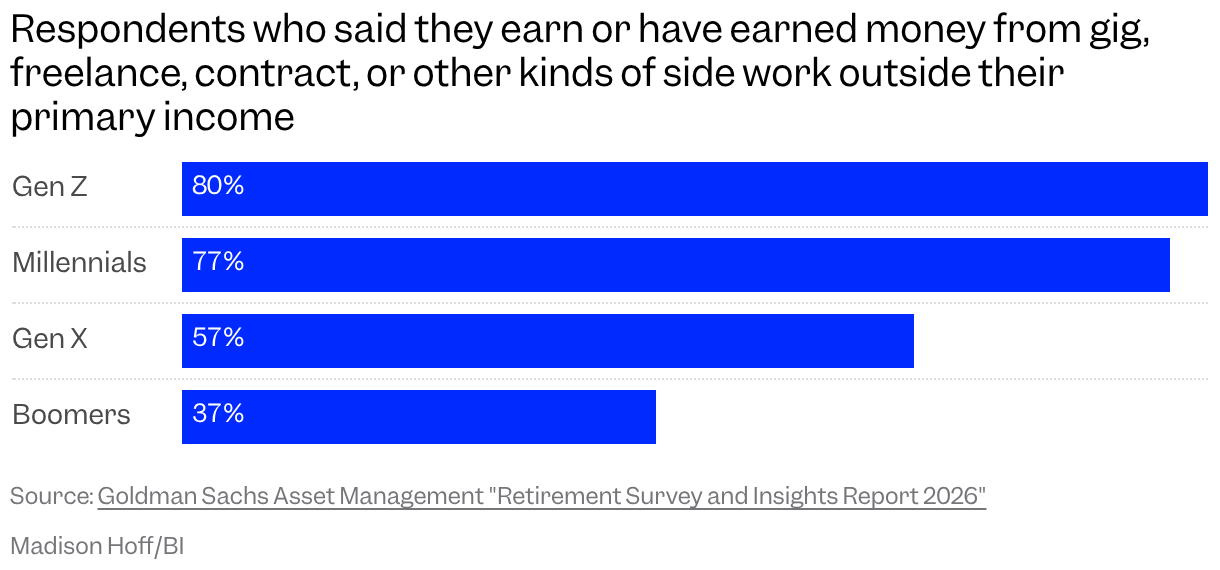
A new study finds 80% of Gen Zers have worked outside their main jobs.
LeoPatrizi/Getty Images
Goldman Sachs Asset Management found 80% of Gen Zers have worked outside their primary jobs.
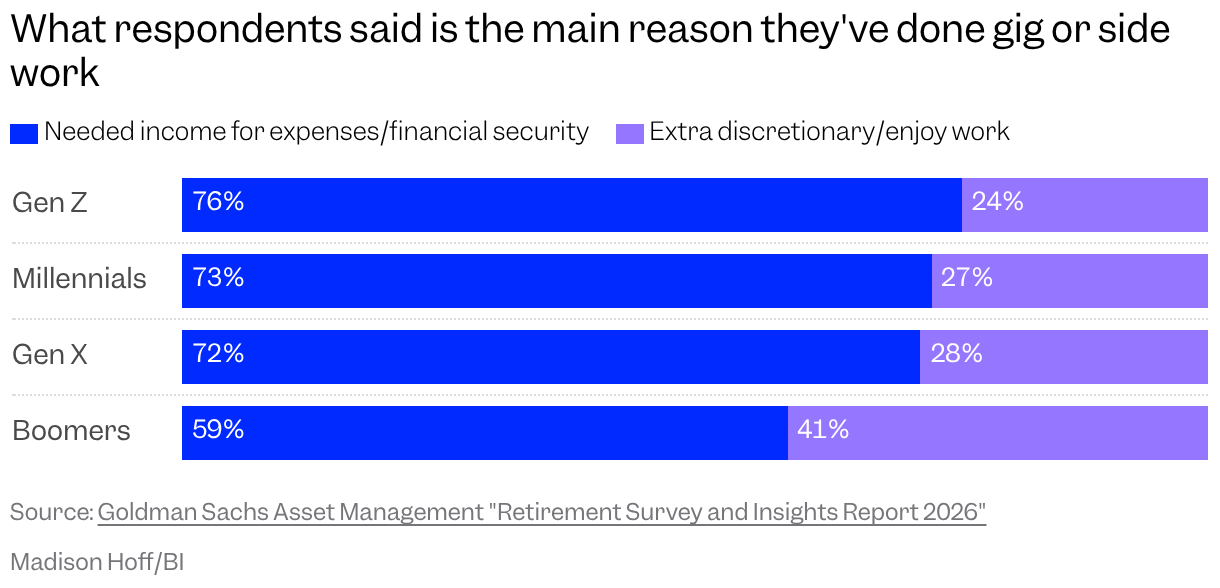
People across generations said this was because they needed the money or for financial security.
Not feeling secure can affect financial goals, like homeownership.
Having a job doesn't always mean you have enough to cover daily living or savings goals.
A July survey of Americans by Goldman Sachs Asset Management and the behavioral economics firm Escalent found over 60% of respondents have worked outside their primary roles, largely because they needed to. Twenty-seven percent of respondents said work covers their expenses, but it's tough to get ahead.
"Employment remains essential for retirement security, but for many Americans, it is no longer sufficient," a Goldman Sachs Asset Management retirement report said.
Gen Zers were most likely to say they earn or have earned money outside their primary job; millennials followed closely behind. The report said that's despite most Gen Z and millennial workers reporting their jobs provide financial stability.
"Younger workers may feel stable in their main jobs while still seeing extra work as necessary," the report said.
Throughout the generations, a majority said they're doing gig or side work out of necessity or for financial security.
"The traditional full-time job may no longer be carrying the full weight of financial security," the report said. "For many, supplementing income appears to have become part of the baseline."
Some Americans are living paycheck to paycheck or adjusting their budgets to cope with rising gas prices and other everyday expenses. It can be hard to get ahead whenwage growth has been consistently falling short of inflation, and it's tough to find a new job to try to earn more money.
Not feeling financially secure can lead to putting off savings goals. Eighty-three percent of Gen Z and 78% of millennials said they put major financial goals on hold. Forty-one percent of millennials have delayed emergency savings despite being employed, and 30% said they delayed housing or homebuying goals. For Gen Zers, the shares were 35% and 34%, respectively.
While some people may be working a part-time side job, others are "overemployed" and working multiple full-time jobs. One millennial has worked five full-time remote IT jobs, earning over $700,000 annually. As Business Insider's Jacob Zinkula reported, overemployed people use their extra earnings for different reasons, such as retiring early or paying down debt.
Having multiple income streams can also be considered a "portfolio career," where people piece together different kinds of work, such as writing a newsletter, doing a side gig, and holding an office job. It can be one way to try "stability stacking" to feel more secure about your career if, for example, you were laid off and lost an income stream.
"When you decentralize everything from one 9-to-5 and build a portfolio career, you protect yourself from the emotional and financial shock if and when business needs change at your 9-to-5," said career coach Janel Abrahami in a TikTok video.
And sometimes, working a side gig can become a complete career pivot. Harlan Rappaport, in his 20s, turned his email marketing side hustle into a full-time career after working as an investment analyst at a financial institution.
"I used to get really excited about the numbers, but over the last couple of years, I realized it's more about the freedom I've had in my life over the last couple of years as a freelancer," Rappaport said in an as-told-to essay. "I don't miss family events, can travel when I want, and can work from anywhere in the world."
May Lee worked in Antarctica from October 2025 to February 2026 and has now returned for a new role.
Courtesy of May Lee
May Lee successfully applied for a role at McMurdo Station in Antarctica at age 60.
Jobs at McMurdo require an extensive background and health check, and are very competitive.
She told Business Insider about the nearly seven-month job process, from application to deployment.
This as-told-to essay is based on a conversation with May Lee, a 60-year-old broadcast engineer with GreyHawk Global at McMurdo Station in Antarctica. She previously worked there as a supply technician for Amentum after spending decades at HP, most recently as a marketing and communications manager. The conversation has been edited for length and clarity.
I was laid off from HP after 30 years, so I decided to look beyond tech jobs and pursue something different at 60.
I had visited Antarctica twice for vacation and fell in love with it. At the time, I didn't know that you could work there. When I looked into it, I knew I had to apply.
It's so hard to describe how amazing it is to work at McMurdo Station. If you ever get a chance to experience it, I highly recommend it.
Here's what the job application process was like.
I applied for 3 roles, but didn't realize how competitive it is
The US National Science Foundation manages the US Antarctic Program. The body contracts out operational support to several companies, each with a specific focus. For example, Gana A'Yoois responsible for areas like food services and waste management.
In mid-April, I applied for three roles: rooms coordinator at Gana A'Yoo, service desk support technician at Grey Hawk Global, and a supply assistant supervisor at Amentum.
I applied using my HP résumé, which lists my various roles at the company.
On a snowmobile outing in Antarctica.
Courtesy of May Lee
I was turned down for the rooms coordinator role within a week or two, with an email stating that I did "not meet the minimum requirements."
This came as a surprise to me. So, I started researching more about working in Antarctica — something I should have done beforehand — and learned that it's very competitive to get a job there. I read on blogs that if you don't make your résumé match the job description exactly, you get weeded out. So, I think that's what happened.
A recruiter reached out to me anyway
I then kind of wrote off my pursuit of a job in Antarctica. I thought maybe this just wasn't meant to be.
Return from McMurdo in February 2026.
Courtesy of May Lee
Then, in May, a recruiter from Amentum, which offers roles in logistics and skilled trades, reached out to me, saying that my résumé appeared to be a match for what they were looking for. The job I got was a supply technician at Amentum.
When asked to send my résumé by email, I updated it to make sure it matched the job description.
I also received a pre-screening questionnaire about my availability, credentials, and whether I could work in the US without sponsorship.
I got hired as an alternate
A week later, I had a 30-minute video call with the recruiter about what the hiring process entails and more details about the job environment.
This was followed a few days later by an 80-minute phone call with the hiring manager, during which they asked behavioral, situational, and competency-based questions.
May Lee's previous dorm at McMurdo Station.
Courtesy of May Lee
I received an offer contract for an alternate position. An alternate is the backup for a primary who can't go for whatever reason. I was told that the quicker I get through the background andphysical qualification (PQ)checks, the quicker I could get to the top of the alternate list.
The health check is extensive
Because Antarctica is so remote, they want to make sure that you're healthy. Because if you go down there and something happens, there are no medical facilities that can take care of you.
In June, I received a 17-page PQform that requested comprehensive medical and dental information.
There were eight required blood tests, a physical exam, vision screening, and a dental exam, among others. Depending on your age, sex, and deployment location and term, there may be additional tests. The costs of these were reimbursable by the company.
There is also a very comprehensive background check
In addition to the PQ, I underwent a comprehensive government background check.
I was cleared to onboard in June and was notified that I was changed to a primary in July.
Often, this is because a primary has dropped out; they might've failed the PQ, even if they passed it the year before, or something in their life might've happened that requires them to stay home.
Forklift training for May Lee's role as a supply technician.
Courtesy of May Lee
There was some back-and-forth with my PQ, which I had to resubmit after getting an updated Tdap vaccine.
In September, I received the current-season influenza vaccine, and my PQ was approved.
I made it to Antarctica in October
I flew from San Francisco to Auckland, New Zealand, and then to Christchurch. There were a couple of days of training, and I also got outfitted with extreme-cold-weather gear.
Then, after seven months of preparation, I was finally deployed to McMurdo on a Boeing C-17 Globemaster III.
Walmart's chief people officer identified three green flags that make her lean in during a job interview — regardless of the role they're applying for. First, she told Business Insider that she looks for a genuine alignment with the company's purpose and values.
Second, she wants to see an ability to take on multiple responsibilities and make things work.
"They demonstrate a track record of grit," Morris said, defining those individuals as people who have overcome adversity.
In an ideal world, she said that means they've worked onthe frontline, since so many of Walmart employees have customer-facing roles. She said the company looks for candidates with a focus on service.
Morris, who started working at 13 at a dry cleaner's and then worked at a drugstore for eight years, said that if a candidate has never experienced what it's like to be a frontline hourly worker, it may be challenging for them to lead. Morris said those jobs gave her purpose, and she found it hard to resign.
Now, when she interviews candidates, Morris saidher go-to question is "If I was to ask people who've worked for you before, what will they tell me?" She said the open-ended question generates a genuine response and helps her gauge whether the person is focused on servant leadership, which is a "big green flag."
Asking this question allows her to hear more about a candidate's first job or a work experience. She said that while graduating from an Ivy League school is valuable, she's more focused on hearing about what they've learned from work experience.
"What was the grit they had to persevere through?" Morris asked.
The chief people officer, who worked at Adobe for more than 17 years before joining Walmart, said that her third green flag is candidates who are passionate about making a difference.
"That, to us, would be really, really key," Morris said.
This as-told-to essay is based on a conversation with Bridget Griswold, the 25-year-old CEO of Lean In, who lives in San Francisco. It's been edited for length and clarity.
I fell in love with technology at Brown University, where I studied computer science and business. I worked with two female professors to build a robot. I interned at a semiconductor manufacturing company and also loved design and art.
Product management felt like a really wonderful combination of all those interests, and that was my role at Meta a year after graduating from college. My team and I redesigned the Instagram search grid, so now when you search for large Instagram accounts, you're routed to the search results page rather than directly to those accounts. I'm very proud of that.
While at Meta, an incredible female mentor connected me to Sheryl Sandberg. Meeting her felt so surreal and is what led me to start my role as CEO at Lean In in March. It feels like a once-in-a-lifetime opportunity to do mission-driven work.
Griswold started working at Meta two years after Sheryl Sandberg stepped down as COO.
Gabriela Hasbun for BI
I was a swimmer as a kid, and as my swim coach used to say: "You get out of swimming what you put into it." I think that applies to many things in life: The more you put in, the more you get out.
Here's a day in my life.
I wake up to my needy, angelic cat around 7:30 a.m.
The second I wake up, I pet my crying and whining cat. She's an angel but very needy.
I'm not a breakfast person, but I need coffee immediately. I have many cups of coffee throughout the day. One of the first things I do is make some at home.
I always tidy up my apartment while brushing my teeth
The most productive two minutes of my day are when I brush my teeth. I clean and tidy my apartment at the same time.
I'm probably not super focused on brushing my teeth, which is maybe a problem, but I'm also making my bed, emptying the dishwasher, feeding my cat, or starting the coffee maker.
I always move really quickly; I don't like to sit still. Brushing my teeth and standing still would make me antsy, so I like to get something else done at the same time.
I'm still adjusting to West Coast hours
I moved from New York City to San Francisco in August.
In New York, I went to Solidcore classes before work every day. Working on the West Coast, the workday starts earlier than on the East Coast, so I'm still learning whether I like to work out in the morning or after work.
When I take the bus to the office three days a week, I often use that time to catch up on personal housekeeping tasks like scheduling appointments or texting back my friends who live on the East Coast.
I come to the office around 8 a.m. or 8:30 a.m.
A majority of my in-person time is spent in meetings. As CEO, I enjoy being involved in all aspects of the team.
I'll meet with our content and research team — we spend a lot of time digging into data, such as some really exciting new research on trad wives in the manosphere. I also often meet with our product and tech team, as well as many of our partners, to help grow our programs.
We have lunch in the office — my favorite is a salad-plus-smoothie combo — and it's a really wonderful time to connect with the team.
Most of Griswold's workday consists of meetings.
Gabriela Hasbun for BI
I also love connecting with our Lean In community. One thing we're focused on is closing early gender gaps in AI usage. Our flagship program, Circles, consists of groups of 8 to 12 women who meet regularly to support each other in their careers — we have over 170,000 members. It's a perfect forum to hold each other accountable for upskilling in AI.
Every week, I send AI tips to our network leaders. A recent one encouraged the use of AI notetakers, as women are more likely to take notes during meetings and miss out on participating.
Lean In is in over 180 countries, and it's really heartwarming to see that our commitment to our mission has a positive impact on women's careers. Getting to speak with them is really energizing and rewarding.
I rehearse for meetings by talking to myself on walks
If I have a presentation or interview coming up, I'll set up a Zoom and practice speaking to myself. Talking for a long time is sort of an unnatural act, and the first time you do it is probably not going to be your best.
Sometimes, I'll even go on a walk and wear headphones, pretending like I'm in a meeting or on a phone call, but I'm actually talking to myself and practicing.
When there's a bug, I usually fix the code myself
Because of my background in computer science, I spend a lot of my time finding bugs or things I believe we should change on our platform. I'll code and fix those on my own. Thankfully, with AI, it's so much faster to code now than it was a few years ago.
Our team is busy, and my goal is to enable everyone to have as much impact and move as quickly as possible. If I can help unblock the tech team or resolve an issue rather than add it to their plate, I'm always more than happy to do so.
I leave work around 6 p.m.
I continue to work until I go to bed pretty much every night.
It's nice to have that time at home, when I'm not running around between meetings, to focus, give feedback on documents the team has sent, write, respond to emails, and brainstorm my own ideas.
I take breaks to tidy up my apartment and make dinner. Living in New York got me out of the habit of cooking, so I'm taking the initiative to cook more meals, like rice bowls.I would say about half the time I order takeout, like pho, and the other half I cook, which is progress for me.
Griswold continues working when she gets home, catching up on more deep work when she doesn't have meetings.
Gabriela Hasbun for BI
If my work doesn't require intense focus, I'll do it from the couch and put a happy TV show on, which right now is "Schitt's Creek." I think it's a nice balance between relaxation and getting things done.
I usually get in bed around 10:30 p.m.
I've been trying to make a habit of reading every night instead of going on my phone, which has been a really positive change. I like anything I read to be a distraction. I'm currently reading "Big Little Lies" and enjoying it.
It's nice to spend 30 minutes reading something like fantasy that's completely different from what I think about at work. That way, I'm not spinning on all the things I need to do or coming up with new ideas that can't get done in my sleep anyway.
Weekends are for the beach and farmers market
My boyfriend works in Los Angeles and flies up to San Francisco every weekend. We've made a tradition of going to the Fort Mason Farmers Market on Sundays for fresh produce to cook an at-home meal that night.
I also enjoy seeing friends over the weekend. My preference is to go on a long walk or go to the beach. I also enjoy fitting in some work — emails, deep-focus work, or reading — throughout the weekend.
When Rishub Jain worked on safety at Google DeepMind, he held one of the most coveted jobs in tech. He was among a small group of researchers workingto mitigate the most consequential risks of AI.
But he left to cofound a nonprofit, Sampura Research. Jain traded the prestige and access that come with a Google job because he feels he can have a sharper, more profound impact on AI safety from the outside. Jain says he wants the autonomy to pursue research on a specific issue in AI alignment, which he felt had been deprioritized.
"All the top AI companies do care a lot about safety, and they invest in it, but they could be investing a lot more, and that's kind of what was inhibiting me," Jain says. "If they invested more in safety, I would still be at the lab and working on what I'm interested in with a large team." Google did not respond to a request for comment about whether it maintains a focus on this specific area of research, but DeepMind's principles state that it maintains "a holistic approach to responsibility, safety and security."
Jain's founder story echoes concerns raised by safety researchers who have quit OpenAI and Anthropic, including dire warnings that these companies are "gambling with our lives," and could develop technology that ends humanity. Once dismissed as fringe and doomsday-obsessed, the AI safety profession is growing as hacks by rogue agents and a string of departures have vaulted the issue into mainstream concern.
Open roles in AI safety jumped by 91% on LinkedIn over the past year. The industry expects a flood of cash from much-anticipated IPOs at Anthropic and, potentially, OpenAI, as those made absurdly wealthy by the equity returns may funnel money into potential clean-up crews for the messes created by the technology's rapid development.
The AI safety problem is existentially big, but the people who have spent time honing AI expertise are few. These are people who test and train AI systems to operate ethically. Some focus on technical research, others on policy and governance. And they're increasingly sounding alarms.
"The people who are most worried about AI are often the people who have been closest to the technology," Laura González Salmerón, advising manager at 80,000 Hours, a nonprofit focused on transitioning people into careers with high social impact. The scarcity issue is less about funds and more about people. "Talent is the main bottleneck."
Startups and nonprofits in AI safety must fight for talent in a shallow pool.
Jain's Sampura lists a salary range of $273,000 to $395,000 for an experienced team leader, which would put that worker in the top 3% of earners in the US, but likely pales in comparison to offers from larger companies. Meta reportedly offered $100 million in signing bonuses last year to poach the world's top experts. OpenAI gives employees an average of $1.5 million in stock-based compensation, and technical staff at Anthropic can earn more than $1 million annually.
Money aside, researchers are divided over whether they're more effective when working inside tech companies to mitigate risks as the latest models develop, or stepping back and attempting to steer the ship toward safer outcomes from the outside, like Jain did.
"I'm a little bit concerned about the pace of AI, and if we're able to actually come up with something useful before the rug gets pulled beneath us," Jain says. He's worried that AI's advancement will outpace the work to keep it in line with human values. "That's kind of what's been happening already."
David Robinson, who led transparency work for OpenAI's safety team, wrote an essay for The Atlantic explaining his departure. He said that AI companies should have more layers of checks and safety measures, akin to those in airports and nuclear energy, rather than the steamrolling culture of Big Tech.
"Perhaps I should have stayed and fought for fundamental shifts in our staffing and culture, but in practice, my colleagues and I were so busy sprinting that we seldom had the chance to consider big changes, much less to actually make them," he wrote. Robinson has said he plans to work on these issues from outside of the company.
As the issue grows in prominence, so has a niche of organizations helping train and recruit workers — and the opportunities aren't just for AI experts. Neav Topaz, co-director of Kairos, a nonprofit that upskills people to work in AI safety and recently raised $50 million from Coefficient Giving, says he speaks with about 10 to 20 people each month who want to move to AI safety, and interest is growing. He tells me that people are asking him more frequently about what the work entails.
"People are watching AI get good at their own jobs and starting to ask themselves what comes next," he says. The emerging jobs in AI safety "pay well, the field is growing fast, and you get to work on what might be the defining problem of our time."
Kairos this summer launched its Generator Residency, a cohort of 27 people who spent three months training for career transitions into AI safety. It's less about the research and technical work and more about merging other expertise, like in consulting, with AI safety principles.
He says that of the 27 residents, a dozen have already landed roles in the AI safety space, and many of the rest have offers to do so.
"Most of the people who will do this work are doing something else today," Topaz says. "The biggest talent gap in the field isn't researchers. It's people who grasp how high the stakes are and can translate their varied expertise into things that could make a difference in this space."
The major AI companies maintain that safety is a top priority. Last month, Anthropic CEO Dario Amodei wrote an essay calling for a slowdown in AI development, and Sam Altman and Elon Musk have agreed with him. Amodei and Altman have both said recently that they will bring third-party evaluators into their companies to bolster safety protocols.
These companies have their own safety teams, but safety work competes with business priorities to build the most advanced models and win in the market. The tension, along with safety issues like OpenAI's rogue agents hacking Hugging Face, has led to more scrutiny of internal safety work. Within days of Robinson's departure, OpenAI fired three researchers, claiming they shared sensitive internal data improperly with third-party AI safety researchers. The ousted researchers wrote a letter, reported by The Wall Street Journal, to OpenAI's board, arguing that their engagement with safety researchers fell within the scope of their roles, and that their terminations were "chilling those who remain at OpenAI." OpenAI said that the decisions "were not about raising safety concerns or speaking out," and that the company would not fire people for doing so.
While some have obsessed over AI risks for years, 2026's breakthrough moment has accelerated funding for and interest in the industry. 80,000 Hours has had calls with some 8,000 people since its founding in 2011, the majority of which have focused on AI in some way, González Salmerón says. Philanthropic groups like Coefficient Giving offer massive grants to startups in the AI safety space. METR, a nonprofit AI safety group that investigated the OpenAI agentic hack on Hugging Face, says it raised $71 million in six months this year.
Much of the funding flowing into AI safety filters through effective altruism, the Silicon Valley-tied philanthropic ideal focused on using evidence and logic to donate money where it will achieve the most good. Critics say the philosophy can place too much emphasis on avoiding future problems rather than addressing imminent needs. With more alarms sounding around the existential threat of AI, more people view those theoretical, distant fears as urgent causes.
AI safety groups and individual donors have spent nearly $50 million in this year's election on candidates focused on regulating AI, Axios reported. Jaan Tallinn, a billionaire who invested early in Anthropic and could soon have even more billions as a result, has donated $170 million to nonprofits focused on AI safety. Tallinn's view, as he recently told The Wall Street Journal, is that he can have the biggest impact on the future of AI and its risks by investing in AI companies, and then donating returns to nonprofits working in the AI safety space.
Coefficient Giving, the philanthropic venture from Facebook cofounder Dustin Moskovitz rooted in the effective altruism movement, announced its AI-safety-focused arm, Project Tailwind, in September. It says it's on track to give more than $1 billion this year to help companies of all sizes scale up in preparation for what it believes will be a deluge of philanthropic capital. Sampura Research has received an $11 million grant from the group. If startups don't begin hiring now, the logic goes, they won't move quickly enough when massive wealth hits the industry.
The dizzying development of AI has created safety risks, and there are "gaps in the ecosystem that aren't being filled and that aren't being owned by people," says Rossa O'Keeffe-O'Donovan, the program director in technical AI safety at Coefficient Giving. There are few people, he says, who sit at the intersection of technical expertise, risk analysis, a solutions-oriented vision, and the capacity to hustle as a startup founder.
New roles will emerge not just for technical talent, but also for consultants, policy wonks, communications experts, and founders who can run a business alongside technical experts. Working from the outside, they'll face hurdles in buying compute power, a lack of direct access to the latest AI models, reduced leverage, and smaller paydays.
The world feels unmoored, and the future perhaps more malleable than ever. The appeal of doing work that does good could stave off feelings of uncertainty, dread, and anxiety that people increasingly feel toward AI. In one doomer camp, AI will obliterate white-collar jobs. The optimistic view is that AI drastically reshapes work and spurs the creation of jobs we haven't yet thought of. AI safety is one of the first.
"There are lots of people beyond AI researchers who can help, like cybersecurity experts, like biosecurity experts, like economists," says Mantas Mazeika, a researcher with the Center for AI Safety, a nonprofit focused on AI research and advocacy. "They're making very significant contributions that the pure AI researchers, who were most of the people focusing on the problem beforehand, would be completely unable to do on their own."
Rand Wacker, a Box executive, loves a good side project.
Box
Rand Wacker, a Box product executive, wants his potential hires to go beyond being just AI-literate.
Wacker likes when candidates show him their side projects, especially if they've monetized them.
He's dipped his toes into building, too, with an Apple TV app that evokes the feel of old-school TV.
Knowing how to use AI is only enough to get a foot in the door for interviews, according to a Box executive.
Rand Wacker, Box's vice president of product strategy, said that for candidates applying for a job at Box, AI literacy is a bare-minimum requirement. Having a fully developed side hustle or project — something he practices himself — is what gives potential hires a leg up in interviews.
Case studies, which he said used to be a staple in Box interviews, are now a relic of the past. Now, he expects candidates to be prototyping out their ideas.
What he really likes to see is candidates showing him a product they've built themselves using AI, even if it has nothing to do with Box's business. He said he's had potential hires show him mobile apps that they've built, gotten onto the App Store, and are monetizing to some degree.
"They're running this little side hustle overall," he said. "And it shows the passion."
He said that people who explore and experiment with AI are the ones who win in the AI world, as they figure out how to use it most effectively in their personal and professional lives.
He practices what he preaches
Wacker, who's spent almost 30 years in the software engineering and product management fields, said he started out as a "computer nerd" and loved playing around with software tools and building things.
As he progressed in his career, he said he had less time to experiment with building, but AI has recently allowed him to test small ideas he didn't have time to explore before vibe coding existed.
He recently made an app to bring back old-school TV because he missed the days when he'd turn it on, pick one of three cable channels, and it would play a random movie from a random point.
"These days, whenever I'm trying to find something to watch on the weekends, it's decision fatigue. Which of the six streaming services do I go to? What are the 20 million titles I scroll through?" he said.
Using Cursor, he built an Apple TV app that would access his entire movie library, pick a random movie, and play it from a random point.
Working on these kinds of projects is a great way to learn the tools available on the market, get ideas for how to use them in other areas, and scratch the itch to create something of his own.
Wacker is one of many executives who have dipped their toes back into building and writing code in recent years. Leaders who haven't written lines of code in decades have started experimenting with AI coding to stay closer to their products and feel like individual contributors.
Nvidia vice president Laura Fay has retired after a decade at the company.
Fay grew Nvidia's enterprise marketing team from roughly 60 to 600 employees.
Nvidia brought in Google Cloud's Alison Wagonfeld as its first chief marketing officer this year.
Laura Fay, a longtime Nvidia marketing executive who reported to CEO Jensen Huang, retired in July after roughly a decade at the AI chip giant.
Fay formerly served as Nvidia's vice president of global enterprise marketing, overseeing campaigns, events, analyst relations, and partner marketing. She said her team grew from roughly 60 to 600 people by the time she left.
Fay was among 36 employees on an internal list obtained by Business Insider last year of company leaders reporting directly to Huang. Prior to joining Nvidia, she spent 22 years at Cisco, concluding her tenure there as VP of global marketing.
Fay said Huang recruited her to build Nvidia's enterprise marketing organization as the company looked to expand beyond gaming.
"I want to change the world, and I want you to change it with me," she recalled him telling her on their first call.
Fay said she began considering retirement around her 10th anniversary in January, though a call from Huang congratulating her and expressing hope that she'd stick around for another decade persuaded her to stay a little longer.
Nvidia declined to comment.
Fay's retirement came as Nvidia also brought in new marketing leadership. In February, the company hired Google Cloud executive Alison Wagonfeld as its first chief marketing officer.
The Wall Street Journal reported at the time that Wagonfeld would oversee all marketing and communications teams and assume responsibilities previously divided among several leaders.
Those changes follow another longtime marketing departure. Greg Estes, Nvidia's former vice president of corporate marketing and developer programs, retired in 2025 after roughly 15 years at the company.
Several other longtime Nvidians have retired this year, including sales chief Jay Puri, chief accounting officer Donald Robertson, and VP of hardware engineering Robert Huang. Some retirees told Business Insider that Nvidia's exponential stock run helped precipitate their decisions.
Nvidia's communications organization has also undergone a shake-up as scrutiny around the company has intensified, with roughly 15 employees departing since 2025 amid a reorganization under new leadership.
Have a tip? Contact this reporter via email at gweiss@businessinsider.com or Signal at @geoffweiss.25. Use a personal email address, a non-work WiFi network, and a non-work device; here's our guide to sharing information securely.
Former Google CEO Eric Schmidt said AI could make companies flatter by taking over some planning and coordination work.
Bloomberg/Getty Images
AI is changing how executives oversee their companies, Eric Schmidt said on the "In Good Company" podcast.
Google's former CEO described several ways execs he knows use AI agents to manage staff.
He described one company that uses AI assistants to ensure that staff are following its core values.
Eric Schmidt thinks the CEO of the future will have an AI assistant that can see across the entire company. For employees whose job is to keep a sprawling business coordinated, that could be bad news.
In an episode of the "In Good Company" podcast, the former Google chief executive described assistants that check whether company activity aligns with a leader's values, follow up on projects, and help identify ways to increase profits.
He argued that the technology could make businesses faster and flatter, with fewer people needed to plan, relay information, and move numbers around.
Schmidt sees little time for companies to adjust. He said competition in AI is fiercer than the PC-versus-Mac or Android-versus-iPhone battles: a model can take roughly six months to build, another two to test, and then be overtaken within five months of release.
"Time compresses every cycle," he said.
He also rejected the idea that AI is a bubble, pointing to Anthropic's rapid revenue growth. Schmidt said the company had grown faster than a record set during his time at Google, calling it "real money with real customers."
The changes he envisions are already visible in smaller experiments, he said. Schmidt gave the example of two founders he knows who ask an AI assistant every Friday to flag anything happening at their company that conflicts with their values.
Another executive created an AI version of himself that checks on an employee's progress, gives him instructions, and responds when he needs help, Schmidt said. That exchange sounded potentially abusive and worried him, he added, though he also saw how it sped up the executive's decisions.
Schmidt said his days as CEO were consumed by meetings, 12 hours a day, five days a week, as he listened to people explain projects and decisions. He thinks AI platforms can eliminate much of that "coordination tax": the effort of gathering updates, passing them upward, and keeping teams aligned.
For a company with 10,000 employees, Schmidt guessed AI could leave "a couple of thousand people who you don’t need."
He cited a friend whose fast-growing company cut 20% of its staff, including the "glue people" who handled planning and coordination. The friend later told Schmidt he had received death threats over the cuts.
Schmidt said companies would still need people who build products, make sales, speak with regulators, and lead teams. His advice to workers whose roles were disappearing was that executives should transition them "legally and humanely."
The author left her job after an RTO mandate and started her own business.
Courtesy of Rose Ann Mullet
While pregnant with my second child, an RTO mandate was issued at work.
Going into the office five days a week wasn't going to work for me, or for my family.
I decided to take the leap and build my own business instead.
I never imagined myself starting a business, but after a return-to-office mandate that wasn't going to work for my family, I had to rethink what should come next in my career. I spent a lot of time networking on LinkedIn, and after some encouragement, I started asking myself, "Why not?"
I worked in marketing as a content writer, and I've always been ambitious. I was a top performer at my company, receiving glowing reviews and setting a record for campaign performance. However, there was always a constant pull between time at the office and time with my family.
Being required to show up to the office five days a week simply wouldn't work for me
The office was about an hour from my house, which was fine for two to three days a week, especially with the flexibility to work remotely for additional days as necessary. When they instituted the expectation for a full five days in office with no flexibility at the beginning of the year, I knew it wasn't going to work. I was expecting my second child, and my 5-year-old had a weekly appointment and some commitments I didn't want to miss.
Showing up to my kid's events often meant working from home an extra day or leaving the office early, and even though I was crushing performance metrics, those absences made me feel like I wasn't doing enough at work, especially as my department began focusing on new goals. Worse, as departmental pressure increased, my boss made a few comments that left me wondering whether he felt I wasn't sufficiently dedicated to the new direction and my role, adding a layer of fear about my job when I was trying to be present with my family.
Then, there were the moments I felt like I wasn't doing enough as a mom. I apologized on more than one occasion for a school closure or my kid getting sick, and I found myself checking messages while he napped in my arms. It was uncomfortable to acknowledge the guilt I felt across all aspects of my life.
The tug-of-war had become a constant since becoming a mom, and I kept thinking there had to be a way to be true to my high-achieving nature while still being the kind of loving, involved parent I aspired to be. After a series of coffee chats with other "mompreneurs" and marketing colleagues, I realized building a business, like motherhood, isn't about having it all figured out. I could chase entrepreneurship like I once chased accolades.
I've always been a writer. Communication and storytelling have been the constants in my career across industries and roles. I'd helped friends and family with marketing for their law firms while still working full-time; I'd worked in education, both in the classroom and in marketing. I realized my experience would translate to the kind of business I wanted to build: brand development, content strategy, and ghostwriting in higher education and law. I spent most of my third trimester balancing business planning and baby preparation.
I took the leap and started my own business
My LinkedIn community encouraged me to take the leap and supported me again as I began shifting my personal brand to support the business after my son was born. I signed my first client before he arrived, and had two referrals come in during my first couple of months in business.
By the time both my children started school and day care earlier this year, I'd built something that would support the life I wanted without requiring an apology. My first client was recommended in AI overviews after only 30 days. I was a guest on a podcast about AI visibility called Found In AI and invited on a few others focused on motherhood and ambition.
I build my own schedule. I work between pickup and dropoff, and I don't feel the need to check my phone while volunteering or at school events. I relish the details I get when my oldest hops in the car: the games at recess or the math facts that fascinated him in class. I build Magna Tiles cities and go for "treasure hunts" around the neighborhood without guilt or explanation. Sure, there are days when I'm logging back in after bedtime, but instead of putting in those hours to chase titles or prove something, I'm simply putting the work where it fits for me or pursuing something I'm genuinely excited about for one of my clients.
I spent a lot of my career frantically trying to prove that motherhood didn't lessen my capability, while simultaneously feeling guilty for every ask that mattered: the Halloween school parade or my child's sick days. I was afraid of losing respect at my job and afraid of missing out on my kids' childhood.
Now, I recognize that fear was holding me back from building a life that feels much more fulfilled. I've let go of the competition between the roles of "Mom" and "Career Woman." Three ghostwriting clients alone equal my monthly salary from corporate, which was the goal, and anything after that is a bonus. The control of my time is priceless; I'll never have to ask permission to be fully present with my children.
Andie Allan wants to work remotely in part so she can care for her German Shepherd, Luther.
Courtesy of Andie Allan
Still dreaming of logging on in comfy clothes? Fully remote jobs are getting harder to land.
Remote roles accounted for 9% of LinkedIn postings in September, yet drew 33% of applications.
If you want a remote position, be prepared to show you can communicate well and thrive from afar.
When Andie Allan scans job listings, her dog, Luther, is never far from her mind — or her side.
The 92-pound German Shepherd has a spot on the couch in Allan's home office. Allan, a marketing manager who hasn't worked full-time in person in more than a dozen years, is looking for a job that lets her remain fully remote, in part so she can stay close to Luther.
More than six years after the pandemic ushered in awork-from-home revolution, many office workers have gotten used to skipping some commutes and having more flexibility outside their 9-to-5. Others have embraced a return to in-person collaboration.
For some, these remote setups are a preference. For others, it can make holding down a job feasible alongside factors like caregiving responsibilities or disabilities.
The search for remote jobs can be tough, however, unless you have an especially in-demand or niche skill set. In the US, fully remote roles made up 9% of job postings on LinkedIn in September, yet drew 33% of applications, the company said.
Competition for those roles has also increased as many companies have returned to the office, at least part-time. The number of applicants per remote job rose 10% from a year earlier, according to LinkedIn.
Candidates seeking these roles might need to show employers they can succeed without regular office time — contrary to what some corporate leaders might prefer. Allan is using her track record of remote work as a selling point when applying. She points to the successful products she launched while working with global teams she rarely met in person.
Allan said she's happy being at home, even if it means forgoing opportunities. Commuting to an office from her home outside London could work, Allan said, "If I was 25 and had no ties and wasn't married to a German Shepherd."
More jobs require in-office time
Access to remote jobs also isn't evenly spread across industries. LinkedIn found that it was most common in technology, information, and media; financial services; and administrative and support services.
Winston Murdock, who's dialed in from home since 2010, works in one of the more remote-friendly corners of the job market as a software team lead. He and his wife bought their house outside Atlanta with an extra bedroom for his dedicated office.
Years ago, Murdock said, a recruiter approached him about a job that would have paid more but required a two-hour round-trip commute on weekdays. Murdock and his wife considered the added costs of childcare, gas, vehicle wear and tear, lunches, and work clothes fancier than a T-shirt.
"There's maybe a number that will get me to choose to be back in the office," Murdock said. "That number was not it."
Murdock said he loves his role at a Canadian software company and plans to stay, in part because of the remote arrangement. He would consider office work only if he lost his job.
How to find fully remote work
For workers looking for a new role, office time is increasingly part of the bargain. Robert Half, the staffing firm, said in a July report that a shift toward in-office work meant "more competition for fully remote roles and a near guarantee that new opportunities will come with at least some in-office time."
The relative scarcity of remote jobs makes a targeted search especially important, said Markos Korvesis, a career coach who helps people find such roles. He said job seekers often don't know how to tailor their résumés to show they are a good fit for logging on from outside an office.
Korvesis spends most of his time in Vietnam and has worked from more than three dozen countries over the last eight years. He recommends that job seekers highlight that they're up to date with AI tools and have solid experience using a variety of communication platforms, from Slack to Discord.
People should point to examples of how they've worked across offices, nations, and cultures, Korvesis said. It's important, he said, to be specific: If you've worked with teams in five time zones, say so.
Landing a remote job is only one of the difficulties. Chad Albert, who lives in South Florida and helps customize and sell software used in healthcare, said technology has made it easier to collaborate across distances, yet communicating through a screen can make it harder to connect with colleagues.
Albert said he makes an effort to pay attention when coworkers talk about their hobbies or what they did over the weekend.
The goal is to be a bit more outgoing and engage people in some side conversations, he said, adding that otherwise, "You wind up living on an island."
With fewer remote openings and more applicants per posting, the job search can demand persistence.
From her home southwest of London, Allan has been looking for a full-time marketing role since May 2025. Last year, she said she was in a "blind panic, applying for everything," submitting more than 1,000 applications.
Now, Allan said, she is being more deliberate. Unless she fully fits the criteria, she doesn't apply, she said. Allan also remains upfront with prospective employers about Luther, who gets at least three walks a day, including one at lunchtime.
"If they get me, great," she said. "And if they don't, well, maybe it's not a great fit."
Anthropic is advertising the role of an executive communications writer for $295,000 to $345,000 a year.
Jakub Porzycki/NurPhoto via Getty Images
Anthropic is hiring an executive communications writer for up to $345,000.
A comms pro told Business Insider that "When speed becomes cheap, judgment carries a premium."
3 writing experts gave Business Insider tips for young workers on practicing critical thinking.
Anthropic's AI chatbot can draft a speech in seconds, but the company is now hiring a human writer — for $295,000 to $345,000 a year.
Anthropic isn't looking for just anyone with a way with words. It wants someone with at least 8 years of experience who can quickly grasp technical concepts, help executives sharpen their thinking, and remain composed when news breaks.
While some LinkedIn users reacted skeptically to the idea that the new hire's work would be used to train AI, with an Oregon-based author commenting that this is the job one would take if the "writer wanted to build their own gallows," communication pros say the Anthropic job offers clues about the enduring value of human creatives.
Three professional writers and comms experts told Business Insider that young writers need to understand that the work starts long before the typing does, and that being good with words is only part of the job.
“When speed becomes cheap, judgment carries a premium," Ann Handley, the chief content officer at MarketingProfs and author of “Everybody Writes,” told Business Insider. "I think we're seeing that value extended to the role of the writer.”
What AI could not achieve
The opening for an "Executive Communications Writer" comes as Anthropic’s own research shows how AI is reshaping its workforce. According to the company's report, junior workers accounted for 9% of hires in technical departments in June, down from 27% in early 2025.
In May, Anthropic CFO Krishna Rao said that AI already writes 90% of the company's code, which shifted hiring needs in all office roles toward oversight, judgment, and strategy, away from the actual execution. Rao also added that the company may actually expand hiring because "there's no shortage of work to do."
Handley said that successful corporate communicators need to become strategists for the company's leaders, rather than simply polish their language.
"Good writers have always been strategic, in the sense that they have always made choices about what goes on the page, and what does not," Handley said.
"The successful candidate isn't merely shaping language, but shaping thought leadership and how the team is presenting to the world," Handley added. "That means knowing which ideas are worth owning, which are worth exploring, and which are just plain dumb."
Joseph Braue, the executive editor of Content Marketing Partners, told Business Insider that a large part of the job as a corporate writer is to challenge unsupported claims, avoid overpromising, and resist pressure to publish weak material.
“The decisions I’ve regretted the most were times I didn’t push back enough on corporate or customer executives,” Braue said, adding that while many writers do collaborate with AI, they must control the narrative and ensure accuracy.
Measure your impact
The compensation for Anthropic's communication role is high compared to similar openings, and professional writers said that there are ways a new hire in such a role could prove they are worth the expense.
By comparison, Amazon Web Services has a job opening for an Executive Communications Manager based in Seattle, offering between $126,700 and $171,400 in annual pay.
Josh Bernoff, an author on business strategy and former executive with 20 years of experience,told Business Insider that a bigger pile of content isn’t proof of a writer’s value in a company, and that to get promoted, writers need to collect evidence of the impact of their writing.
“If your job is to create market research reports, then you're only effective if people read those reports and say, 'here are the changes we're going to make on this product,'" Bernoff added. "Your job is to move people and think about how to do it before you start writing."
Braue, who leads a content strategy team, said that writers looking to prove their value need to understand business language and check whether internal partners and key sales leaders are using their content.
“Learn basic marketing analytics. Understand attribution, conversion, and how a pipeline works," Braue said. "Writers who speak revenue get promoted."
Build evidence that you can think
For young graduates, the pros recommend practicing original thinking while learning to use AI deliberately, even if you don't intend to be a writer.
Bernoff said he would urge all early-career workers to take writing classes and to practice using AI for research and efficiency while composing the words themselves.
Bernoff, who conducts an annual survey on how writers use AI, said he found last year that writers commonly used AI as a thesaurus or search engine, but fewer than 10% used it to create content intended to be published as is.
"If you're in a position to move your fellow students or people reading a school newspaper or your professors, then you're going to be taking the first step that's necessary to be able to move people in a corporate environment," Bernoff said.
Handley said she recommends that early career professionals start a newsletter and publish at least every two weeks, even with a small audience.
“Maybe you'll learn to interview people or ask better questions or notice things others don't," Handley said. "In doing so, you'll build a body of work that shows a potential employer that, sure, you can write, but most importantly, you can think, and you can engage on the page.”
UK defence secretary had been due to unveil proposals on Thursday until concerns were raised at 11th hour
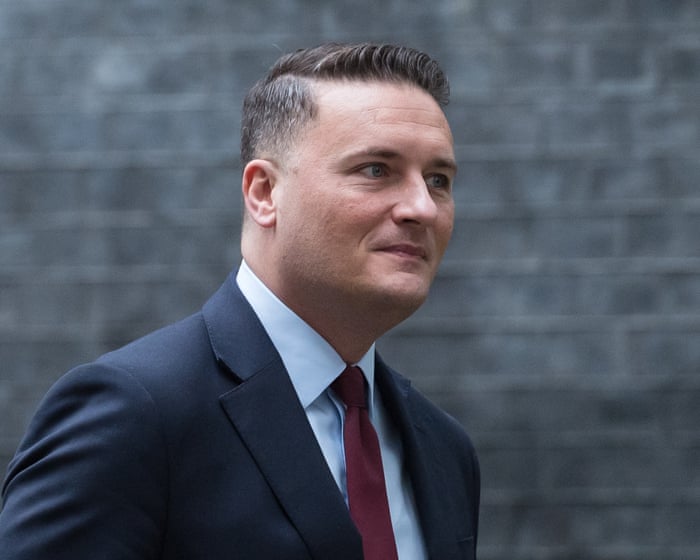
Wes Streeting has been forced to delay the publication of a plan to get more young people into defence industry jobs after pushback from trade unions, the Guardian understands.
The defence secretary had been due to announce the proposals on Thursday, but some unions in the sector are understood to have reacted angrily to the plans, accusing the government of bypassing their members and minimising their roles in job creation.
Union furious as bank scraps remote-first policy from February 2027, requiring all of its UK employees to come in at least twice a week
NatWest has ordered 13,000 staff to increase their in-office days from two days a month to two days a week, angering its staff union.
The banking group, which serves customers under the Royal Bank of Scotland, NatWest, Ulster Bank and Coutts brands, will require all of its nearly 40,000 UK staff to follow a strict two days a week office schedule from February 2027, abolishing a remote-first policy for thousands of employees.
Economist Aaron Terrazas warns inflation could drive economic inequality.
Baby boomers are helping to prop up the economy, as they're in their core retirement spending years.
There's an income premium for job switchers — and for retirees.
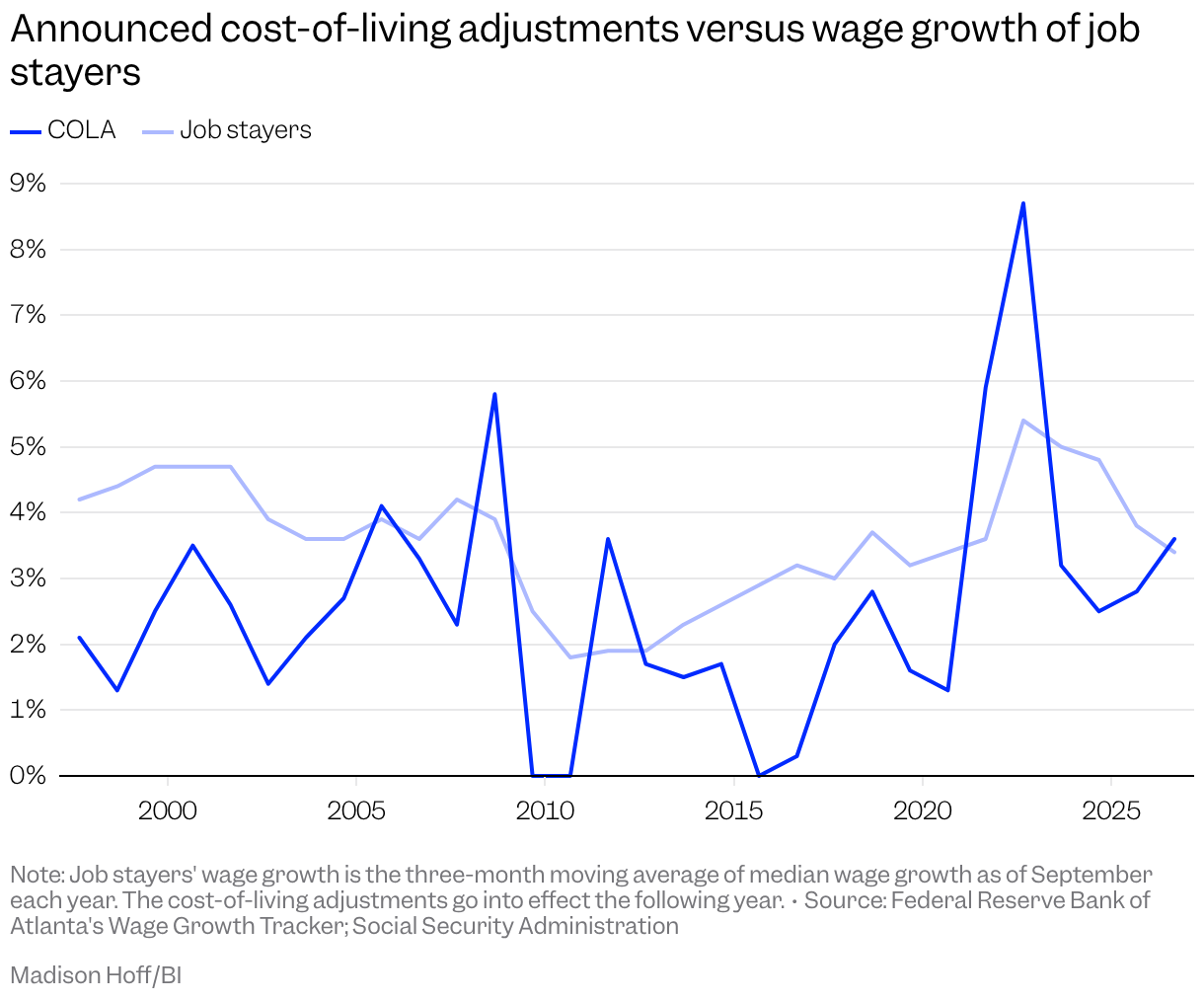
The Social Security Administration recently released the cost-of-living adjustment for next year. About 72 million recipients will experience a 3.6% increase in their benefits in January, higher than the September three-month moving average year-over-year median wage growth for job stayers at 3.4%.
Independent economist Aaron Terrazas said cost-of-living increases for Social Security beneficiaries were higher than job-stayers' increases in three of the past six years, the most recent being the 8.7% 2023 increase announced in 2022 amid the post-pandemic inflation spike.
"Retiree income is adjusted with the cost of living, whereas people who are working are mostly compensated according to the cost of labor," Terrazas said. "For most of the past decades, we've been in a low inflation labor shortage world, so that's worked out in workers' favor, but it feels like that's shifting underneath the surface."
The headline consumer price index increased 3.7% from a year ago in September, moving away from the Fed's 2% inflation target but down from the high rates back in 2022. The Social Security Administration bases the annual cost-of-living adjustment on the average of a related inflation rate during the third quarter of each year.
"Indexing incomes to the cost of living rather than cost of labor is a big part of what fueled inflation, the wage-price spiral in the 1970s," Terrazas said. "We moved away from that practice for most of the workforce, but not for retirees. With the growing share of Americans in their retiring years, more and more consumers are, whether we want it or not, having their incomes indexed to inflation rather than the cost of labor."
This, Terrazas thinks, could continue to drive the K-shaped economy of the haves and the have-nots, as he said older consumers are driving an outsize share of spending, although that could change as boomers start to age out of the peak retirement spending years.
"Baby boomers are in their core retirement spending years," he said. "When we think about consumer trends and what's holding up the economy, that is something we can't forget — that once people reach their 80s, we should expect that spending to start to contract as people become homebound."
Meanwhile, the three-month moving average for job switchers was higher than for job stayers and higher than the announced COLA, so job-hopping could be better than job-staying if you prioritize earning more. The problem is that it may be hard to find a new opportunity, depending on where you're looking. White-collar fields have been experiencing job loss, and employment levels in the leisure and hospitality sector have been pretty volatile.
The US has spent the last couple of years in a low-hire, low-fire period: Layoffs are low, so if you have a job, you're likely doing OK, but job openings and hiring have also been anemic, making an ominous situation for job seekers.
While that means employees may be more secure if they have a job, it also means employers don't have to do a lot to convince people to stay. Some workers have turned to "loud working" to try to make sure their accomplishments are being heard internally at their company or externally via LinkedIn or other platforms, whether that be because of fear of job cuts, to make the case for a raise, or some other reason.
"It's tough, I think, for job seekers to see headlines when we get the jobs report that unemployment is low, we're continuing to create jobs, but it's something very different from what they're feeling," Terrazas said. "And so I think it is important for them to understand that message that they're not alone. Many people, especially in white-collar work, are struggling to find new jobs or struggling to stay afloat in their workplaces."
Jeff Bezos, the billionaire founder of Amazon, wrote about the phrase "disagree and commit" in a 2016 Amazon shareholder letter under a section labeled "High-Velocity Decision Making," and it's been making a comeback.
While Bezos popularized the phrase, it echoes a management philosophy that goes back to the 1980s, when Andy Grove ran Intel. Richard S. Tedlow, Grove's biographer, previously told BI that the concept of disagreeing and committing "was the essence of how he felt you should comport yourself at Intel."
Why it works
The idea behind "disagree and commit" is to defend your argument and make a clear case. However, if the team rallies around a different decision, you have to commit to it too. Bezos argued that the use of "disagree and commit" could "save a lot of time."
"If you have conviction on a particular direction even though there's no consensus, it's helpful to say, 'Look, I know we disagree on this but will you gamble with me on it? Disagree and commit?'" Bezos wrote.
The former Amazon CEO has even used it himself, such as when his team green-lit an Amazon Studios project that he didn't think would succeed. Instead of continuing the back-and-forth, he disagreed but committed to the plan.
Try it today
The next time you disagree with a coworker, make the case for your idea and give it your all.
Once the decision is made, though, ask yourself if there's anything you can do to help it work better.
The bottom line
You don't need to agree with every decision at your job, but everyone benefits if there's an expectation that once a decision is made, everyone rallies behind it and tries to make it work.
Source
This insight is drawn from Business Insider's reporting about the origins of the "disagree and commit" phrase that Jeff Bezos popularized, and why it's making a comeback. Read the full story in Business Insider from Ana Altchek and Tim Paradis here.
Has this framework for disagreements worked for you? Tell us what you think of this advice in the comments below.
Uber is offering some drivers hundreds of dollars in incentive pay, depending on how many rides they complete in a given period.
Michael Macor/The San Francisco Chronicle via Getty Images
Uber is offering bonuses to some drivers for completing more rides or referring new drivers.
The bonuses can add up to hundreds or thousands of dollars.
Uber has used such extra pay in the past to attract drivers to the platform.
Uber is offering ride-hailing drivers something that many haven't seen in years: Big bonuses.
The ride-hailing service is coaxing some drivers to take more rides, offering up to several hundred dollars in "incentive" pay if they complete a set number of rides within a set time period, according to several screenshots of the offers seen by Business Insider.
In one example, a driver was offered $525 if the driver completed 45 trips within a few days. Similar offers involved smaller payouts and fewer trips, but paid out proportional amounts of $10 to $12 per trip.
That's a huge pay bump for many drivers, who make as little as a few dollars per trip, said Sergio Avedian, an Uber driver and senior contributor to the gig-driver-advocacy blog and YouTube channel The Rideshare Guy.
The bonuses might also be Uber's attempt to get more drivers on the road to meet rider demand during busy periods like Halloween and the holiday travel season, Avedian said.
"This may tell the story that they need supply," he said. "They're saying that we need to get everybody out there."
Some drivers have also gotten messages from Uber encouraging them to refer friends to sign up as drivers or get those who haven't driven in a couple of years back on the app, according to screenshots seen by Business Insider. Payment for those referrals can reach up to $1,225.
The payments are a potential boon to Uber drivers, whose pay can vary significantly between cities.
Uber drivers have to cover their own costs, such as car maintenance, since they are independent contractors, not full-time employees. Rising gas prices have eaten into drivers' pay after the US and Israel started a war with Iran earlier this year.
An Uber spokesperson did not provide details on why the company is offering the payments.
Uber has used targeted incentive payments before.
In 2021, demand for rides began to outpace the number of available drivers after many had stopped driving during the pandemic.
In response, the company decided "to invest fast and to invest aggressively in attracting drivers back to Uber" and increased the number of active drivers on the app by 65% between January and November that year, CEO Dara Khosrowshahi said on an earnings call at the time. Uber later pulled back on the extra pay.
"When we were coming out of the pandemic, they were short tons of drivers," said Avedian, who was driving for Uber at the time. "It was crazy bonuses out there."
More recently, riders have been paying more per mile and waiting longer for their rides to show up, according to a study published last month.
Do you have a story idea about Uber? Contact this reporter at abitter@businessinsider.com or via encrypted messaging app Signal at 808-854-4501. Use a personal email address, a nonwork WiFi network, and a nonwork device; here's our guide to sharing information securely.
Nvidia CEO Jensen Huang urged Europe to move faster on AI in a conversation with Germany Chancellor Friedrich Merz on Monday.
Nadja Wohlleben/Getty Images
Nvidia CEO Jensen Huang wants Europe to be less cautious in its approach to AI innovation.
Huang told Germany's chancellor that the country and others in Europe are overreliant on regulation.
"I think you overthink things," he told British journalists on a trip to the UK last week.
Cast off the shackles and be bolder, or risk losing the AI race for good.
That's the pointed message Nvidia CEO Jensen Huang has delivered to European leaders during his trip to the continent over the past week.
Over the last seven days, Huang has visited France, Sweden, the UK, and Germany ahead of Nvidia's GTC event in Berlin, which began Tuesday.
During that time, he's been clear that he believes the continent needs to move faster on artificial intelligence and rely less heavily on regulating the sector.
Huang made the case most directly on Monday evening in Berlin, during a public conversation with German Chancellor Friedrich Merz.
Asked how Europe should regulate AI, Huang said safety had to be paramount, but cautioned that policymakers could not regulate their way to technological leadership.
"There's nothing to regulate if the industry doesn't thrive," Huang told Merz, arguing that Germany needed to foster a domestic AI industry while ensuring it developed safely and responsibly.
He said that policymakers should focus on regulating AI applications, similar to the way they regulate products that use the internet, rather than trying to regulate the underlying technology wholesale.
"We should be regulating the applications right away," Huang said.
Merz replied that Europe was still trying to find the balance between innovation and regulation. The German leader said he did not believe "no regulation" was the right answer, but that overly tight rules were not either.
Huang’s response: "Give Germany a chance. Give this industry a chance."
The exchange came as Huang and Merz pitched AI as a potential answer to the economic malaise that led Germany into recessions in 2023 and 2024.
Huang said the country's manufacturing sector, engineering expertise, and industrial know-how are national resources, and that AI could help its companies turn them into an advantage in the next phase of the technology race.
"The next wave of AI is physical," Huang said, referring to robotics, manufacturing, cars, and heavy industry. "Electrons will never replace atoms."
It was the same urgent message Huang had delivered in London days earlier. Speaking to reporters last week, Huang said there was a "strange general behavior" going on in the UK.
He took a swipe at what he described as Britain’s tendency to dwell on failure.
"You have smart people, you have a great culture, you have young people, and the energy is vibrant. But for some reason, if there was a million reasons to win, you find the one reason not to do it."
"I think you overthink things," he added.
The remarks underscore a familiar tension in Europe’s approach to AI. The continent has moved early to establish sweeping rules for the technology, including the EU AI Act, while the US and China have pulled ahead in developing frontier models and the infrastructure needed to train them.
Huang, whose company dominates the market for the advanced chips powering the AI boom, is hardly a neutral observer. Nvidia stands to benefit enormously if governments and companies move faster to build AI infrastructure and deploy its technology.
Regardless of his stake in Europe's AI success, Huang's message was blunt. If the continent spends too long debating how to regulate AI, it may find that the meaningful innovation is done elsewhere.
I'm Gen Z and have always valued rest, leisure, and finding balance in my life.
My 86-year-old grandfather has worked as a doctor for 60 years and refuses to retire.
His dedication has changed how I think about ambition, purpose, and growing older.
As a Gen Z, I have struggled with my work ethic. I have learned to optimize leisure, travel, and rest, and to get into a flow state. However, my grandfather's work ethic has made me rethink my approach.
At 86, my grandfather refuses to retire. For the past 60 years, he has woken up at the same time every morning, showered, dressed immaculately, had breakfast, and left for his work as a general physician in his private clinic.
Barring sickness and rare travel, he has never taken a day off, never deviated from schedule, and has an enviable work ethic that I have not seen in anyone. My grandmother, who was 70, died last year, and he was back to work in a week.
He is the eldest son
Born in 1940 in the small town of Gonda in North India, he was the eldest of six younger siblings. In 1966, at the age of 26, he began his medical practice after completing his MBBS.
From the beginning, he has been focused on his career and his responsibilities as the eldest son of a South Asian family. He worked in big hospitals, then opened a private practice a few years later, and he also established a Rotary Club Chapter in his city, leading it many times in the decades that followed.
The author's grandparents in the 80s.
Courtesy of the author
There has always been a deep sense of empathy in him, which has made him a very considerate doctor for those who are economically marginalized. Because he charged less, took his time to understand each patient's issue, and prescribed medicines with great care, he gained popularity in his city very soon.
After six decades, the patients who were once young men and women bring their grandchildren from different cities to be treated by him. Only two years ago, he scaled back his work, working only till lunch. So now many patients come home in an emergency. "I don't like turning them away. Helping them makes me feel elated," he told me in one of our weekly phone calls.
He doesn't want to retire
From his work, he built a home for his parents and siblings, and another for his wife and children. He paid for the education of most of his siblings and put down a significant sum when it was time for them to get married. In short, he has been responsible for every role and relationship in his life.
He has three kids, two daughters and a son. They feel as if he should take it easy. "Why don't you retire?" My mother asked him a few years ago, and he shook his head vigorously, as if the thought itself was impossible.
"There were friends who were much healthier than me. They retired early, and I have seen many of them pass away," was his response to my mom. He also feels that being in a perpetual state of rest will dull his senses. Barring a partial hearing loss in one ear and a decrease in activity level due to age, he is fit and completely Independent.
He makes time to enjoy life
He can decide if he ever wants to retire because he has built his own practice, which is a privilege. However, he hasn't denied himself the pleasures of life either. He took time off to go on vacations and spent dedicated time with his kids, parents, and wife.
From him, I am learning that having a work ethic also means having a deep respect for your own life. It is not just dedication to his work; his ethic showcases his will to live as long as he can, independently. I want to live a purposeful and robust life, helping and guiding others and being of use till it's time to go. I want to eat clean, work out every day, put in the work to nurture my ambition, spend time with my loved ones, and focus on my goals. His work ethic has also shown me how he values his time. He nourishes it, nurtures it, and uses it to build a better life for himself. An honorable relationship with time and hard work has led him here.
He wants to be a functional part of society, and it has given me a fresh perspective on how I want to live my life. It is an odd thought, but I aspire to have a work ethic just like his and not retire.
Google is injecting more AI into the interview process.
The company has been testing a new format that tests candidates on their AI fluency.
The pilot has recently rolled out more broadly across Google, internal docs show.
AI is changing how Google employees work — and how Google hires them.
The company has been testing several AI-related changes to its hiring process for software engineers, according to documents reviewed by Business Insider. These changes, which Google has been rolling out in phases throughout this year, include allowing the use of AI in coding interviews and permitting interviewers to use Gemini to give candidates feedback.
Many engineers are also now expected to show some degree of AI fluency as a bare minimum, the documents show.
In May, Business Insider reported that Google was piloting ways to integrate AI into the interview process with a small handful of orgs. This included a new "code comprehension" interview in which candidates are assessed on AI fluency and prompt engineering. Candidates can also use Google's Gemini AI as an assistant during the interview.
The new formats have since been rolled out more broadly across the company, according to the internal documents. However, a spokesperson said they were still considered to be in the pilot phase for now.
"We're piloting updates to our interview process for software engineers, including evaluating for AI fluency, to be more reflective of how our teams are operating," Brian Ong, vice president of recruiting at Google, told Business Insider in a statement.
Like other companies, Google is adapting its hiring process to keep pace with the huge transformation AI is having on software engineering. As developers increasingly rely on AI coding assistants, hiring companies want to know how competent they are with these tools.
In April, Google said that three-quarters of new code created at the company is generated by AI and reviewed by humans, a trend that has since continued across the tech industry. Google has said that its employees are increasingly using the company's own Gemini models to both improve other Google products and to build the next generation of Gemini.
The documents say that for some roles, including software engineering, AI fluency and AI product integration are now used as measures of a candidate's abilities. A Google spokesperson said that AI fluency is a requirement for all software engineering jobs, while AI product integration is required for most roles outside entry-level positions.
Google is also piloting the use of Gemini for interview transcription and note-taking in some job interviews conducted via the company's videoconferencing platform, Google Meet, one document shows.
Google wants to speed up the feedback process using AI, too. The same document states that Google is working to enable interviewers to use Gemini to draft role-tailored feedback.
As Google builds out this new interview system, employees were told they may be asked to participate in some of the pilots — but were warned against using AI tools to generate their own interviewing "solutions."
"Do not use GenAI or LLMs to create your own standalone solutions or agents for hiring or interviewing use cases," the document states, referring to large language models.

 Login