For the first time in the history of the Russian tire market, the volume of passenger car tires imported from China has surpassed the total output of domestic manufacturers. This structural shift, observed in the first half of 2026, marks a definitive transition from a market defined by the absence of Western brands to one dominated by Asian supply chains, even as local production capacity sits largely underutilized.
According to data from the Association of Rubber Producers of Russia (RASPP), 7.1 million Chinese passenger car tires were imported into Russia during the first half of 2026. In contrast, domestic factories produced only 6.7 million units over the same period. Consequently, the import share of the market rose to between 55% and 57%, a significant jump from 48.5% a year earlier. With 80% of all imported tires originating from China, the balance of power in the sector has irrevocably tilted toward foreign suppliers.
Production Collapse Amidst Sufficient Technical Capability
The influx of inexpensive Chinese goods has coincided with a sharp contraction in local industrial activity. Official statistics indicate that the production of tires and inner tubes fell by 9.3% in the first seven months of 2026, totaling 22.5 million units. In the specific segment of passenger car tires, the decline was even steeper, dropping by 18% in the first half of the year. Operational efficiency at some domestic plants has deteriorated to the point where utilization rates are estimated at just 50%, leaving half of available capacity idle.
The onset of winter often prompts vehicle owners to check their coolant, yet the fluid's primary function extends far beyond preventing freezing. Modern engine coolants are engineered chemical cocktails designed to inhibit corrosion, suppress foam formation, and prevent the accumulation of deposits within the cooling circuit. When the additive package degrades over time, the engine is exposed to risks that a simple visual check cannot detect.
The Mechanism of Wear: From Fluid to Pump
A critical vulnerability lies in the water pump, specifically its mechanical seal. This component relies on the lubricating properties of the coolant to operate without excessive friction. When the chemical integrity of the fluid fails-either through age-related degradation or incorrect specification-the seal loses its lubrication. This transforms a routine maintenance item into a potential catalyst for expensive engine repairs.
The risk is compounded by the variety of specifications, such as G11, G12, G12+, G12++, and G13. These are not merely labels but indications of the chemical base. Coolants are broadly divided into silicate (inorganic) and non-silicate (organic carboxylate) types, both typically utilizing monoethylene glycol. While the base is similar, the additive packages are fundamentally different.
The integration of artificial intelligence in automotive manufacturing has shifted from conceptual software updates to the deployment of physical systems that redistribute labor between human operators and machines. The primary objective is the elimination of variability in quality control and the reduction of physical strain during the handling of heavy components.
Automated Defect Detection and the Shift in Labor
At Audi's Neckarsulm plant, the Weld Splatter Detection (WSD) system replaces selective manual inspection with a continuous loop of machine vision and robotic intervention. Previously, quality assurance relied on technicians using ultrasonic equipment to sample a fraction of the weld points. The WSD mechanism now analyzes approximately 1.5 million weld points across 300 vehicles per shift, utilizing neural networks to locate splatter defects and a robotic arm to grind them down.
This transition alters the technician's role from detection to remediation. Where 80% of the work cycle was previously spent searching for defects, the automation of identification allows specialists to spend the majority of their time on the actual correction of the fault. A similar logic has been applied at Renault for body geometry and paint inspection. However, this efficiency creates a trade-off in skill development; at Skoda, the ability to generate exterior sketches in seconds via AI removes the routine drafting process that historically allowed young designers to refine their fundamental skills.
The restructuring of Russia's vehicle recycling tax, or utilizatsiya, at the end of 2025 has triggered a sharp increase in prices for popular foreign-made cars. Korean models, previously imported in large volumes, have seen their costs rise by hundreds of thousands of rubles. Against this backdrop, the second-generation Kia Niro emerges as a notable exception. This hybrid crossover has retained a relatively favorable cost structure, a direct consequence of the new regulatory formula that now prioritizes engine power over other metrics for private importers.
The decisive factor in this shift is the engine's output. Under the updated rules, individuals importing a vehicle for personal use pay a preferential rate if the total power of the powertrain does not exceed 160 horsepower (l.s.). For vehicles under three years old, this rate is set at 3,400 rubles; for older models, it is 5,200 rubles. The Kia Niro fits comfortably within this threshold. As a parallel hybrid, its total combined output from the petrol and electric motors is 141 horsepower. This technical specification allows it to avoid the commercial rates that now apply to more potent vehicles. In contrast, owners of larger Korean crossovers with approximately 200 horsepower face surcharges ranging from 800,000 to 900,000 rubles, a penalty that fundamentally alters the economics of ownership compared to the Niro.
Practical ownership and performance
The Niro's hybrid architecture pairs a 1.6-liter petrol engine with an electric motor, a combination that delivers tangible benefits in daily driving. In real-world Russian conditions, fuel consumption is reported to be between 5.0 and 5.2 liters per 100 kilometers. A full tank provides a range of 800 to 900 kilometers, reducing the frequency of fueling stops. The electric motor contributes significantly to urban driving dynamics, enabling quiet and responsive starts that make navigating traffic congestion more comfortable. The vehicle's electronic systems, specifically the Greenzone Drive Mode, utilize navigation data to automatically switch the crossover to electric-only mode in residential areas and courtyards, further enhancing its suitability for dense environments.
New planning rules promise cheaper home charging for drivers without driveways, although council approval means access to pavement gullies remains a postcode lottery
The compact crossover segment is often a compromise between urban agility and budget-driven engineering. The Changan CS35 Max enters this space not as a stylistic exercise, but as a focused effort to refine the mechanical foundations of the city commuter. Where competitors typically sacrifice chassis sophistication for cost, Changan has opted for a more rigorous engineering approach.
The vehicle's character is defined by its immediate responsiveness. Under the hood, a 1.5-liter turbocharged engine produces 147 horsepower, but the critical figure is the 280 Nm of torque delivered at low revolutions. This eliminates the lag common in smaller displacement engines, ensuring the car pulls away from a standstill or transitions into a gap in traffic with a linear, confident surge. This powertrain is paired with a 7-speed dual-clutch transmission (DCT), which manages shifts with a precision that allows the CS35 Max to reach 100 km/h in under eight seconds-a benchmark that shifts the car from a simple city runabout to a capable highway cruiser.
Chassis Dynamics and Road Response
The most telling detail of the CS35 Max is found in its rear architecture. While the industry standard for budget crossovers is the torsion beam-a cost-effective but rigid solution-Changan has implemented a multi-link independent rear suspension. The physical result is a marked difference in how the car handles road imperfections. Rather than transmitting shocks directly into the cabin, the multi-link setup isolates the chassis, maintaining stability and trajectory during high-speed cornering.
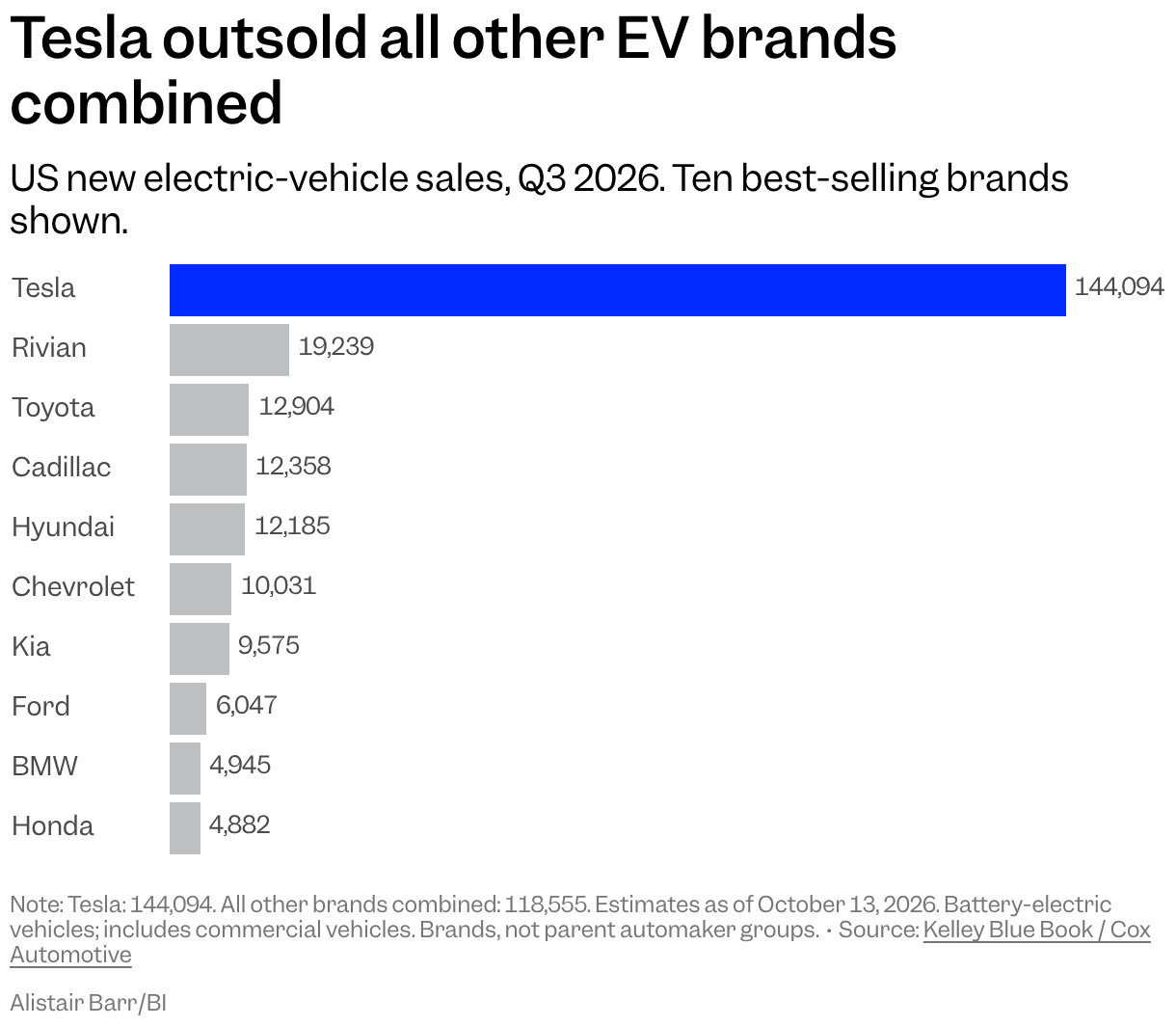
Tesla accounted for more than half of US electric-vehicle sales in the third quarter.
Its quarterly sales increase exceeded the entire market's gain, Cox estimates show.
High gas prices are helping EVs compete, though sales remain below last year's levels.
Tesla is taking a bigger slice of America's electric-vehicle market as high gas prices give drivers another reason to consider ditching the pump.
The company sold an estimated 144,094 vehicles in the US in the third quarter, up from 124,800 in the previous three months, according to Cox Automotive's latest sales report.
That increase was bigger than the gain for the rest of the US EV market. Put another way: Tesla drove the recovery. Everyone else, taken together, went backward.
The figures offer a new twist on the EV comeback I wrote about in July. Back then, sales had finally improved after the slump that followed the end of federal incentives in the US. Several manufacturers were benefiting, but only those withthe fortitude to stick with EVs after federal government support waned.
While recovery continued in the third quarter, it became more dependent on Tesla.
Americans bought 262,649 new EVs during the period, about 6% more than in the second quarter. Sales outside Tesla fell roughly 3%, based on a comparison of Cox's latest counts with its second-quarter report.
Tesla's own sales rose about 15% from the second quarter. It supplied 54% of the country's new EVs in the third quarter, extending its lead from the previous period.
High gas prices help make the case for going electric, according to Cox.
"With gas prices well above $4 a gallon, electric vehicles look better than ever," Stephanie Valdez Streaty, Cox's director of Industry Insights, said in the company's analysis of the quarter.
Expensive gasoline and diesel make running a conventional vehicle more painful. For drivers who can charge cheaply, particularly at home, an EV offers a valuable alternative to repeated trips to the pump.
There's an important caveat to the comeback story: Sales are improving from a depressed level.
Total US EV sales were down almost 40% from a year earlier. Last year's third quarter was unusually strong because buyers rushed to claim federal incentives before they disappeared.
Tesla's sales were down about 20% against that comparison. The company remains heavily dependent on two vehicles. The Model Y and Model 3 accounted for roughly 97% of its US sales in the latest quarter.
The Cybertruck sold over 4,300 units, and Tesla has stopped making the Model S and X. (There's a Roadster, though not until 2028).
So Tesla's growing dominance isn't a story of every model flying out of showrooms, or of selling more cars than a year ago.
For now, it is winning a larger share of a smaller market. As Americans return to EV shopping, Tesla is capturing more of their business.
Honda is executing a significant strategic pivot, abandoning the production of its three "0" series electric vehicles in the United States after incurring $15 billion in losses, to prioritize hybrid technology. The manufacturer has committed to launching at least 15 hybrid models by 2030, with the majority of these units targeted for the North American market. This shift marks a decisive move away from the electric platforms that failed to deliver expected returns, redirecting capital toward hybrid powertrains that promise superior fuel economy compared to existing turbocharged petrol engines, a standard set by the development of a new V6 engine intended for upcoming SUVs and minivans.
Simultaneously, Volkswagen has identified a structural vulnerability in its compact electric vehicle segment. Thomas Schreyer, the company's chief executive, acknowledged that producing small electric cars has become the most challenging area of the business, despite ongoing cost-sharing strategies. For a brand historically defined by mass-market economics, the inability to maintain competitiveness in this price bracket represents a critical operational risk that directly limits vehicle accessibility for mainstream consumers.
While legacy manufacturers recalibrate their product portfolios, European designers are signaling a return to accessibility and heritage at recent concept premieres. Citroën unveiled a revival of the iconic 2CV, previewing an affordable electric vehicle slated for release in 2028 with a projected price of approximately $17,000, alongside a commercial van variant. In contrast, performance-oriented concepts dominated other displays: Peugeot presented the E-T16, a three-motor electric prototype generating 805 horsepower inspired by Group B rallying, while Alfa Romeo showcased the Cuorerosso equipped with a twin-turbo V6. BMW also displayed the Concept 7 Protection, an armored vehicle designed for low visibility, although production plans for this specific model remain unconfirmed.
The White House plans to impose elevated taxes on vehicles manufactured in Canada for the U. S. market starting January 1, 2027. This policy shift directly threatens the industrial stability of Toyota and Honda, which together account for more than 75% of Canada's total automotive output. The measure places immediate risk on the assembly lines in Canada that produce the RAV4 and CR-V, two models that consistently lead sales in the U. S. SUV segment.
According to Barclays data, the reliance of these Japanese manufacturers on Canadian capacity is substantial. In 2025, approximately 25% of all Honda vehicles sold in the United States and 17% of Toyota models were produced in Canada. Canada's annual output of roughly 1.2 million vehicles supports 427,000 jobs, but the introduction of new tariffs could jeopardize these operations because the products are engineered specifically to meet U. S. regulatory and market requirements. Redirecting this production to other regions presents significant logistical and competitive challenges. Manufacturing facilities in other parts of the world are operating near capacity limits, while Japanese brands are losing market share in Europe, Latin America, and Southeast Asia due to the aggressive expansion of Chinese electric vehicle manufacturers. The U. S. market remains a critical protected enclave for these firms, particularly because Chinese competitors such as BYD are barred from entering that market.
Toyota is responding to this industrial constraint by accelerating its shift of production capacity into the United States. The company has announced investments of up to $10 billion in the North American region over the next five years. A central component of this strategy is the construction of a new plant in Texas, valued at $3.6 billion, which will relocate the assembly of the Tacoma pickup truck from Mexico. This move allows Toyota to internalize the production costs within the tariff-free zone.
The German Ministry of Transport has compelled Tesla to rename its advanced driver-assistance suite in the European market. The feature previously marketed as "Full Self Driving" (FSD) will now be designated as "Assisted Driving," a shift that fundamentally alters the legal and operational framing of the technology within the jurisdiction.
The regulatory intervention centers on the distinction between autonomy and assistance. According to the ministry, the term "Full Self Driving" creates a misleading impression of the vehicle's capabilities, suggesting a level of independence that the hardware and software cannot sustain. In practice, the system does not replace the driver; rather, it manages specific mechanical tasks-such as acceleration, braking, and steering-while requiring the human operator to remain fully vigilant and capable of immediate intervention.
The Boundary Between Support and Control
By redefining the system as "Assisted Driving," regulators are clarifying the chain of responsibility. The safety promise of the technology depends entirely on the condition that the driver remains the primary actor in the control loop. This distinction ensures that the user understands the system as a tool for reducing workload rather than a substitute for human judgment and situational awareness.
The balance of power in the Russian new passenger car market is poised for a fundamental shift by the end of 2026. According to a forecast from Sergei Tselykov, head of the analytical agency Avtostat, domestic brands are projected to overtake Chinese competitors for the first time in a long period, capturing 43% of sales volume against 41% for Chinese marques.
This projection suggests that the current marginal advantage held by Chinese manufacturers will erode in the remaining months of the year. Data for January through July indicates a near-tie in market share, with Chinese brands accounting for 40.9% of sales and Russian producers for 40.6%-a difference of merely 0.3 percentage points. The competitive gap is so narrow that the outcome of the leadership battle depends on minor fluctuations in the final quarter.
Despite the projected shift in aggregate market share, the internal hierarchy within each national bloc remains stable. Lada continues to dominate the Russian segment, while Haval maintains its position as the leading Chinese brand. The potential reversal in overall market leadership signals a significant transformation in consumer preferences and the structure of vehicle supply, marking a turning point in the competition between localized and imported production platforms.
For decades, Russian and Soviet automotive exports have served as more than just transportation tools for foreign heads of state; they have functioned as diplomatic instruments and, in some cases, enduring symbols of geopolitical alignment. From the rugged utility of the UAZ-469B to the modern prestige of the Aurus Senat, the interaction between Russian vehicle manufacturers and international leaders reveals a complex dynamic where engineering capability, political signaling, and logistical realities intersect.
The historical precedent for this relationship dates back to the Cold War, when the Soviet government gifted an open-top, rear-wheel-drive UAZ-469B, a vehicle originally designed for military command, to Kim Il-sung, the leader of North Korea. This gesture established a pattern of reliance that persisted through generations. In 2018, his grandson, Kim Jong-un, arrived at a summit with the South Korean leader in a heavily armored Mercedes-Maybach, a clear indicator of a shift in the preferred status symbols of the North Korean regime. However, reports indicate that the North Korean leader's private garage also contains new models of the UAZ Patriot, suggesting that the brand has retained a functional place in the national fleet despite the availability of German luxury alternatives.
This appreciation for Soviet and Russian engineering has not been limited to ideological allies. In 1990, German Chancellor Helmut Kohl demonstrated a practical interest in Russian heavy-duty engineering by personally driving a KAMAZ prime mover at the factory in Naberezhnye Chelny. This was a rare instance of a Western leader engaging directly with the mechanics of a vehicle that was being actively exported to capitalist markets. The KAMAZ truck's appeal to Western buyers and officials alike rested on its robust construction and ease of maintenance-characteristics that offered a pragmatic solution in environments where sophisticated European or American vehicles might struggle or prove too costly to repair.

 Login