Governor Yaron urges next coalition to cut debt and pursue growth reforms to fund security needs; bank raises forecasts but warns overseas production distorts domestic picture
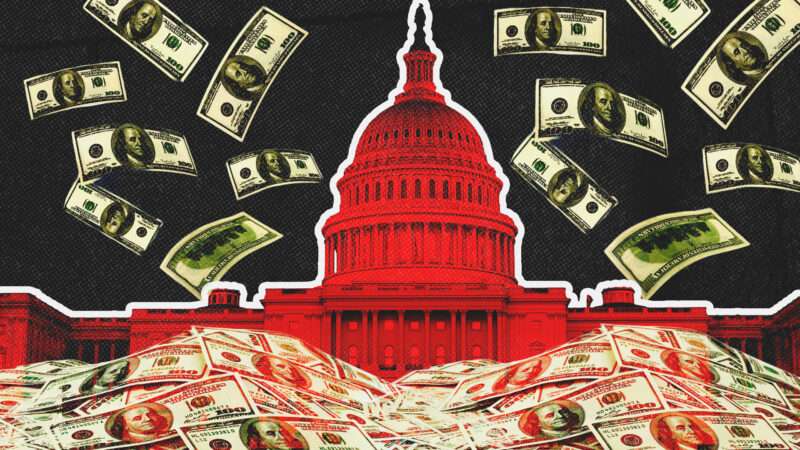
The federal government just closed fiscal year 2026 with a deficit of nearly $2 trillion, according to figures the Congressional Budget Office (CBO) released last Thursday. Only the two pandemic years of 2020 and 2021 were worse. Today, though, there is no recession and no emergency. These enormous budget deficits are the new normal.
The usual response to a deficit warning is that the government just needs more money. It doesn't. Thanks to the remarkable strength of the private sector, federal revenue rose by 3 percent, to more than $5.4 trillion, over the fiscal year. But spending rose by 6 percent, reaching $7.4 trillion.
Some will blame the Supreme Court for striking down most of President Donald Trump's tariffs and forcing the government to issue refunds. But even if Washington had kept the $130 billion in illegal levies, it would cover less than one-tenth of the gap. Tariffs were never a serious revenue source at our insanely high level of spending.
Look at where the money went. Spending on the three main entitlement programs—Social Security, Medicare and Medicaid—grew by 7 percent. That's faster than total spending growth. Defense grew by 5 percent. Interest on the debt rose by 11 percent, exceeding $1.1 trillion. That last figure is the bill for every earlier year of borrowing—years when Washington was sending clear signals that it isn't serious about fiscal responsibility.
If you want to see where such irresponsibility can lead, look at France. The country that big spenders from Paul Krugman to Sen. Bernie Sanders (I–Vt.) have cited as proof that big government is viable and full of upsides is now on the brink of a serious crisis. France's debt equals 120 percent of its gross domestic product (GDP), and interest payments are rising quickly. Slow growth and social unrest aren't helping.
The U.S., of course, has some advantages that France doesn't, largely because we're a country of innovators with a private sector unmatched at creating wealth. Nonetheless, debt that is swelling out of control should still worry us. First, the same anti-wealth and anti-growth forces that brought France to where it is now are gaining popularity here. Second, we too will see debt reach 120 percent of GDP in a few years, and our interest payments are already consuming an alarming share of resources.
A wise Congress would put us on safer footing if only because debt raises interest rates for everyone, from homebuyers to small businesses. This operates as a drag on growth, and hence on wages. In other words, controlling debt should be part of an affordability agenda in the same way as streamlining regulation.
When legislators decide to take affordability seriously, I recommend looking at a September Advancing American Freedom (AAF) report on this topic. Its section on fiscal restraint offers a useful menu of reforms, including targeting the programs that most drive the debt.
Start with Social Security. Under current law, benefits will be cut by roughly 20 percent when the program's trust fund runs dry in the early 2030s. Nobody believes Congress will actually let that happen, but we'd better hope its answer isn't to double down by borrowing the difference between payroll taxes and benefits.
Nor are tax increases an option. The payroll tax meant to fund entitlements is now 12.4 percent of wages. It began at 2 percent when Social Security was first rolled out. It is also the most burdensome tax for many Americans. Enough already. The fixes AAF fellow Rachel Greszler proposes are worth considering: Index the retirement age to life expectancy, use an accurate inflation measure for cost-of-living adjustments, and move gradually toward a flat universal benefit that protects lower-income retirees while ending Social Security's de facto welfare for the wealthiest.
Next is Medicare. More than 40 percent of its financing already comes from general revenue rather than from payroll taxes. The report recommends converting the program to premium support, giving beneficiaries a fixed contribution to spend on traditional Medicare or on competing private plans. It would also raise the eligibility age to 67, matching Social Security, and trim subsidies for well-off seniors. That's a start.
As for Medicaid, the problem is one of pricing. And yet competition based on price—the best cost-control tool—has never been seriously tried. Washington covers 90 percent of the cost of states' expanded Medicaid programs for adults. A state can buy a dollar of spending with just a dime of its own money. Changing the states' incentives would be key here. Implementing risk-adjusted per-capita caps, through which the federal government would give states a fixed amount per enrollee, would do just that. States would pay for their own inefficiencies or would be able to use every dollar they save by becoming more efficient.
The same logic supports returning more welfare programs to states, starting with the federal share of the Supplemental Nutrition Assistance Program. State governments have to balance their budgets in some form.
None of these reforms are painless. But the alternatives will prove far more painful. The U.S. will either continue paying a slow, unlegislated tax called inflation or face a fast, ugly fiscal crisis when bond buyers stop giving Washington the benefit of the doubt.
European Union governments have committed €17.9 billion this year to measures intended to protect households and businesses from rising energy prices as disruption in the Middle East and global fuel markets continues to feed through into European inflation.
Twenty-five of the EU’s 27 member states have adopted some form of energy support during 2026, according to the latest assessment of the measures.
More than two-thirds of the spending consists of measures that directly suppress energy prices rather than targeted income support.
The figure has increased since the Commission’s spring economic forecast.
National measures include reductions in fuel taxes and excise duties, energy vouchers, direct financial assistance and support for companies facing higher production and transport costs.
The Commission has repeatedly urged governments to concentrate assistance on vulnerable households and particularly exposed industries rather than subsidising energy use across the entire economy.
Its spring assessment found that roughly three quarters of the support then in force was not targeted specifically at vulnerable consumers or energy-intensive companies.
Broad price measures can reduce household bills immediately, but they also carry a larger fiscal cost and reduce the incentive to cut consumption when supplies are constrained.
The present shock began with disruption to oil and gas supplies caused by the Middle East conflict.
Brussels says Europe does not currently face an immediate security-of-supply problem for the winter of 2026–27 because supplies have been diversified and strategic reserves remain available.
Price exposure is a different matter. Europe still depends heavily on imported fossil fuels, leaving domestic businesses and consumers exposed when world-market prices rise.
Natural gas presents another risk. European storage sites entered the autumn at unusually low levels, with EU Today reporting that EU gas stocks were around 67 per cent full in mid-September, leaving the bloc more exposed if winter demand rises sharply.
Pressure has now spread into refined fuel markets as well. Russian diesel exports are restricted, Middle Eastern supply remains vulnerable and China has suspended most fuel-product exports outside Hong Kong and Macau. Washington is simultaneously pressing European governments to release diesel from their strategic reserves.
The energy shock is also affecting the wider economic outlook.
The Commission’s spring forecast had already anticipated weaker growth and higher inflation. It projected EU employment growth of only 0.3 per cent in 2026 and expected the aggregate government deficit to rise from 3.1 per cent of GDP in 2025 to 3.6 per cent by 2027.
More recent Commission estimates indicate that eurozone growth in 2026 could be somewhat stronger than the earlier forecast, while expectations for 2027 have deteriorated.
Inflation is expected to remain around 3 per cent this year and to remain above earlier projections next year. That increases the fiscal problem facing governments.
Large energy subsidies can reduce the immediate impact on households but add to public borrowing and may complicate monetary policy if they support overall demand.
The Commission is also drawing lessons from the measures adopted after Russia’s full-scale invasion of Ukraine in 2022. Energy support introduced during 2022 and 2023 alone had a net cost equivalent to about 2.1 per cent of EU GDP, according to Commission calculations.
Brussels wants to avoid a second prolonged cycle of broad subsidies while accelerating investment intended to reduce Europe’s structural reliance on imported fossil fuels. That includes grid investment, electrification, renewables and measures to reduce taxes on electricity relative to gas.
For national governments, however, the immediate pressure is coming from bills paid today rather than energy infrastructure planned for the next decade. With €17.9 billion already committed during 2026, further disruption in international oil, diesel or gas markets could determine whether what was designed as temporary support has to be extended into next year.

 Login