Leave it to Arundhati Roy to deliver a scorching, dizzying essay on the perils of artificial intelligence that references Greek mythology, Francis Ford Coppola, the Bible, India’s industrial history, and Tie Me Up! Tie Me Down! Plus, Emily Dickinson features in the lede:
The auguries are raining down hard. Think or Sink. Comply or Die. Look Up or be Left Out. And so, with these not-so-gentle threats, it has come to pass that the Age of AI—Actual Idiocy, Actual Super Idiocy, Recursive Snowballing-Idiocy—is upon us. Heck, I’ve already used two dashes in this opening paragraph. That, as they say, is a tell. So, perhaps I haven’t written this essay at all. You’d have to use an AI app to check if it’s actually AI, and whether I’m really, or not really, or only partially me. You can no longer use your instincts. You have to use the App. Now that AI owns the em dash, what will future generations make of Emily Dickinson and her love of them? Has she been fed to the machine, too? Will they love her less? Are we being gradually locked out of language? Does it matter anymore?
Governments and businesses in Kenya, the Netherlands and elsewhere were scrambling to prevent hackers from exploiting a vulnerability in PHP, a widely used programming language.
Prime Minister Rob Jetten of the Netherlands in Brussels last week. He said that his cabinet was closely monitoring the online vulnerability caused by a security flaw in PHP.
The tech giant is funding one of the nation’s largest “virtual power plants,” which would pay homes and businesses to adjust their energy use when grids are strained.
Ukraine’s military intelligence (HUR) published a 3D model and parts list of Russia’s new Filin cruise missile on 22 October. The breakdown names the Russian companies behind the missile and the foreign makers of its electronics.
HUR runs its War&Sanctions portal to trace such parts back to their makers. Its stated aim is to “deprive the aggressors of the ability to produce weapons for terror,” the portal says. Meanwhile, Russia is betting on cheap, fast cruise missiles, Serhii Beskrestnov, a freelance adviser to the president on technology, told Radio NV in mid-September. Naming the Banderol, Dan-T, Dan-M, and Gerbera-5, he warned they would soon outrun Ukraine’s jet-powered interceptors, so Ukraine needed its own cheap missiles to shoot them down.
Composite body, ground launch
JSC NPO Molniya, part of Russia’s Tactical Missiles Corporation, builds the Filin, HUR said. The agency called it part of a Russian defense-industry trend toward cheap jet-powered, ground-launched air-attack weapons. Russia began firing it at Ukraine in late summer 2026.
HUR’s data puts the carbon and fiberglass fuselage at 3.5 m, with a 3 m wingspan. Some parts are 3D-printed. Russia claims a top speed of 800 km/h. The range is 600–1,200 km, and the missile flies at ultra-low altitude or up to 6 km. Versions carry 50-kg or 100-kg warheads. A solid-fuel booster fires it from a ground launcher.
A firm tied to a Shahed-type drone
PLAZ LLC makes the onboard equipment, HUR said. The firm also helps produce the Garpiya, a version of Russia’s Shahed-type Geran-2 drone. Filin and Garpiya units share a similar layout and markings. Guidance combines a Chinese-made inertial navigation system with a 16-channel Kometa anti-jamming module from Russia’s VNIIR-Progress.
The electronics resemble those in other Russian missiles and drones but carry a larger share of Chinese parts. Of 81 components, 35 are American and 22 Chinese. The engine, however, is Russian: an R500 turbojet from Reynolds LLC. A similar engine earlier turned up in the S-71K Kover aviation cruise missile and S-71M Monokhrom, HUR said.
For comparison, Ukraine found more than 20 foreign components in a different cheap missile, the Banderol, in May 2025. They included 10 US microchips, and the Banderol flies on a Chinese jet engine.
As of October, Russia has up to 700 ballistic and several thousand cruise missiles in reserve, and its 2026 state order for Geran-type drones and decoys such as the Gerbera exceeded 100,000 units, Ukraine’s military intelligence (HUR) told NV in figures the outlet published on 20 October. The missile stocks are roughly the same as HUR reported to NV in July, the outlet found.
Ukraine enters the heating season facing what it says is a Russian plan to hit 60 infrastructure sites this winter. HUR’s figures suggest Russia has the weapons for it, even after its fall mass strikes. In June, HUR said Russia could fire up to 100 ballistic missiles a month while keeping its stocks steady. Its drone output, meanwhile, is shifting to jets that are harder to shoot down.
Russia produces 110 ballistic missiles a month
Russia can make more than 200 missiles a month, 110 of them ballistic, HUR said. About 115 of its ballistic missiles are Iskander-Ms, with production of up to 65 a month. A modernized Iskander with a projected range of 550 to 700 km is in development.
At the same time, Russia holds up to 400 S-300PM and S-400 air defense missiles adapted to strike ground targets, and makes about 40 a month. Meanwhile, Kinzhal production has been temporarily paused over poor accuracy, and the capacity has gone to conventional ballistic missiles.
Most new Kalibrs go into reserve
Russia plans to make more than 80 Kh-101 cruise missiles a month and is exceeding that, though defects in releasing them from aircraft have sent some batches back to the factories.
Russia has more than 450 Kalibrs and makes about 29 a month. Because Ukrainian air defense downs them effectively, Russia sends most new ones to its strategic reserve and to equip its fleets, HUR said. It also holds more than 600 Oniks anti-ship missiles, upgraded for ground strikes, and more than 120 Zircons.
Explore further
Ukraine recovers Russia’s undamaged Geran-3 jet kamikaze drone carrying camera and live-link equipment (VIDEO)
Russia now assembles 4,000 jet drones a month
Russia holds a reserve of about 6,200 Gerans and makes about 10,000 drones a month. Its main production hub is the Alabuga special economic zone in Tatarstan.
Since summer, Russia has shifted toward turbojet drones. “The reason is the saturation of Ukraine’s Air Force with mobile fire groups that shoot down low-speed targets en masse,” HUR said. Russia now assembles about 4,000 jet drones a month, mostly Geran-4s and Geran-5s, which fly at 400 to 500 km/h. It also makes about 2,000 cheaper propeller-driven Geran-2s, which HUR said are used to wear down air defense and locate air defense positions.
Hugging Face released a new AI model that can analyze and generate DNA sequences.
Samuel Boivin/NurPhoto via Getty Images
Hugging Face released a new AI model that allows users to "chat with DNA."
Carbon-X can analyze and generate DNA and allows researchers to ask questions in plain language.
Hugging Face said the model can help researchers who work outside the big AI labs.
Hugging Face is releasing an AI model that could make it easier for scientists to study DNA and develop new genetic treatments, the company announced Thursday.
Carbon-X is a "first of its kind" model that combines DNA analysis and generation with plain language, allowing researchers to ask questions and essentially "chat with DNA," according to Lewis Tunstall, a senior research scientist at Hugging Face.
Hugging Face, which Nvidia agreed to acquire for nearly $13 billion in September, is a platform for sharing and developing AI models and also releases its own. The company worked with research labs in Italy and China on Carbon-X, which is an open-source model. Hugging Face built Carbon-X by training an existing language model, Qwen3-14B, on genomic sequences and natural language. It was trained on DNA sequences from humans, other mammals, plants, and fungi.
As an example of how Carbon-X can be used, Tunstall said a researcher could provide a DNA sequence and ask whether a particular mutation could increase a person's risk of disease. The model would then offer a prediction and explanation. It can also generate new DNA sequences, which could help researchers develop new gene therapies.
Tunstall said the company was partly motivated to build Carbon-X to prevent biology researchers from becoming dependent on the major AI labs, noting how AI has disrupted mathematics.
"If you want to really push the frontiers of mathematics, you likely have to be at one of these AI labs like OpenAI or Anthropic, because they're the ones who have the best mathematics models," he said, suggesting a similar situation is likely to play out in other fields of science.
"We wanted to provide the open research community with tools that don't make them fully dependent on some external single provider," he added.
Researchers can run Carbon-X on their own computers, avoiding the need to share sensitive patient data with external AI companies. He also said that some of the misalignment behavior observed in larger models, such as the OpenAI agents that famously hacked Hugging Face in July, has not yet been observed in smaller, more specialized models.
Tunstall said generalist chatbots also sometimes refuse to answer legitimate biology questions from researchers because they mistake them for attempts to "design a bioweapon." He said viruses were explicitly excluded from Carbon-X's training data in order to avoid misuse of the model.
While Carbon-X is likely to be used by researchers, Tunstall said the model represents a small step toward a future where AI can help provide more personalized medical care.
"I think the holy grail is, in general, this concept of personalized medicine where we're able to, as individuals, take our own patient records, our own genomes, and use this to ultimately find or even maybe design our own treatments," he said.
Tech companies are painting data centers with gray coatings on top of gray concrete and steel to resist fire, rust and static electricity. That has made data centers a fast-growing market for paint makers.
Economists hope earlier episodes of labor disruption, from the Industrial Revolution to the Great Depression, can help us prepare for the age of artificial intelligence.
Companies are announcing enormous new data centers to power the AI boom. Some promise facilities bigger than anything the industry has built before.
There's just one problem: Most of these projects may never happen.
Bernstein Research analyzed thousands of planned US data centers and concluded that only about 35% of the announced capacity is likely to get built. That's roughly 170 gigawatts of data center capacity out of a total of almost 500 gigawatts.
The rest? A significant chunk of it belongs to a category the industry has a wonderfully dismissive name for: "Bragawatts." These are ambitious announcements, often from newcomers with little experience building data centers, that have a slim chance of becoming reality.
"Press releases are cheap…concrete is not," Bernstein analysts wrote in a research note.
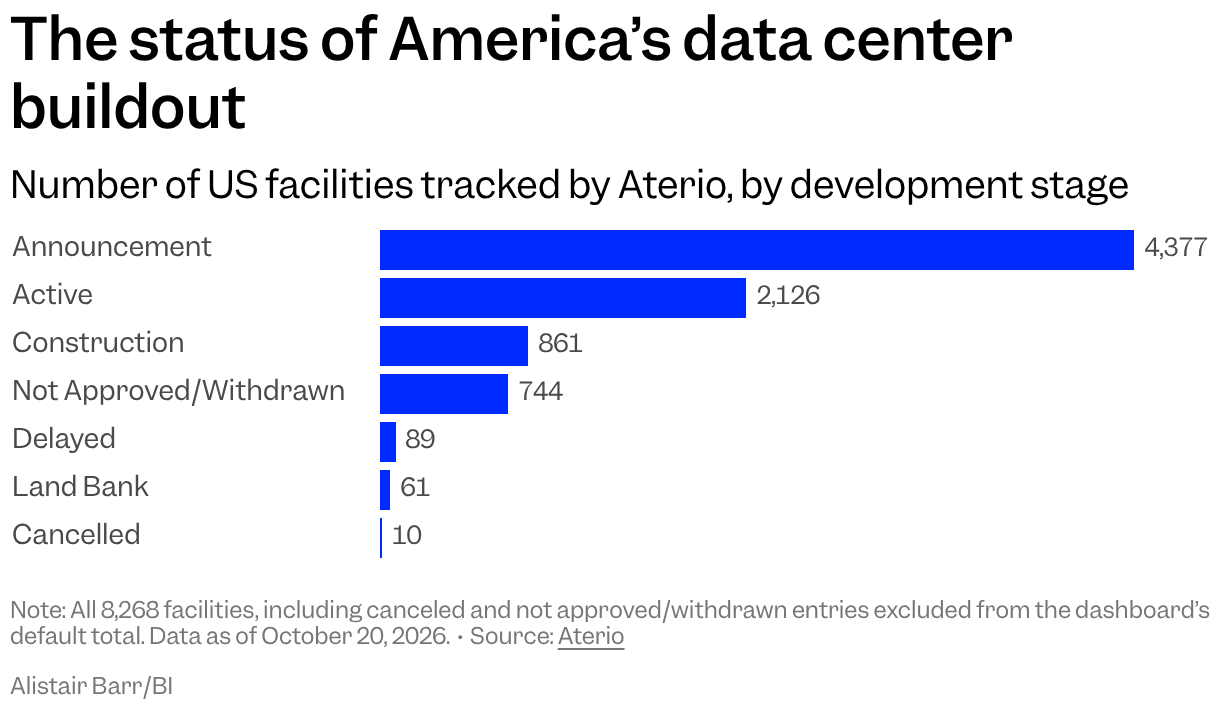
Bernstein began its analysis with more than 7,000 data center projects across North America, drawing on information from Aterio, a company that tracks construction through satellite imagery, permits, and other records. The analysts narrowed that to more than 5,000 projects (partly by excluding thosealready canceled).
Then they assessed the chances of these remaining projects being completed. The analysts considered factors such as whether construction had started, whether electricity was available, and whether the companies involved had successfully built data centers before.
The results revealed a striking divide.
The 'bragawatt brigade'
Kevin O'Leary.
Daniel Delgado Jr./Disney via Getty Images
Experienced operators including Amazon, Google, Microsoft, and Meta landed at the top. Bernstein gave these companies perfect scores of 5 out of 5 for their development credentials. Other data center specialists, such as Digital Realty, Equinix, and CoreSite, got top marks, too.
O'Leary Digital, associated with celebrity investor Kevin O'Leary, ended up at the bottom,with a credibility score of 0.35 out of 5, according to Bernstein. His company has announced 15 gigawatts of data center projects, and Bernstein estimates that only 489 megawatts, or about 3%, will actually materialize.
Although the term "bragawatts" has been doing the rounds in the data center industry lately, it's unclear who coined it, Bernstein analyst Madison Rezaei told me.
"I wish I could take credit for that," she said. "I believe I originally heard it from an Equinix executive, but I don't think he owned it either."
She said that whilesome ambitious newcomers could succeed, they haven't yet demonstrated they can deliver.
"It's not that all of these guys are sort of terrible and not going to deliver, but we just have lower confidence because we don't know them," Rezaei said.
O'Leary Digital responds
O'Leary Digital disputed Bernstein's assessment, saying the research doesn't account for substantial work that occurs before construction begins.
While acknowledging that O'Leary Digital is a young company, CEO Paul Palandjian said the team has decades of experience building major infrastructure projects and that its proposed 15 gigawatts of capacity would be built in stages over several years.
The company said it has secured binding agreements covering about 11,000 acres in Utah and 13,000 acres in Alberta, obtained a 30-year development agreement in Utah, and made progress on planning, engineering, and permits at both sites. It also said the projects would generate their own electricity.
The company said its early development work is funded, additional capital is committed to reaching key milestones, and experienced engineering and construction partners are involved.
"We would rather be judged on milestones than on a model," Palandjian said.
'An announcement in search of a project'
Opponents of the proposed La Osa data center attend a Pinal County Board of Supervisors meeting in Florence, Arizona, on August 26.
USA TODAY Network via Reuters Connect
Other low scorers in the "bragawatt" brigade included Vermaland and Joule Capital Partners, according to Bernstein analysis based on Aterio data.
Joule has announced 50 data center projects with a combined capacity of 11.7 gigawatts. Bernstein estimates that only about 11% of that capacity will actually get built. Almost all of Joule's planned capacity remains at the announcement stage, with little evidence of construction progress or of major customers committing to use the facilities, Bernstein wrote in a July note to investors.
The analysts gave Joule a credibility score of 2.05 out of 5, placing it among the lowest-ranked developers in its database.
"An announcement in search of a project," the analysts wrote.
Vermaland has announced plans for a massive data center project in Arizona. Bernstein estimates that only 4% of its proposed 2.2 gigawatts of capacity will get built. The company is primarily a landowner, not a data center developer. Its proposed $33 billion La Osa project near Eloy had already been sharply scaled back amid local opposition and without construction approval. In late August, regulators formally rejectedthe project. Even before that, the analysts gave Vermaland a credibility score of 0.75 out of 5.
Joule and Vermaland didn't respond to emails seeking comment this week.
A yawning gap for data centers
Sergio Toro, CEO of Aterio, sees similar patterns in his firm's voluminous, detailed data.
Aterio's tracking shows that roughly 30 to 40 gigawatts of new data center capacity get announced each month. Yet only about 7 gigawatts begin construction each month, while 2 to 3 gigawatts actually start operating.
This leaves a yawning gap.
Many announced projects get withdrawn before construction begins — and before real money has been spent.
"They just make the announcement, but they didn't get their approvals. Or they make multiple filings in multiple locations to see which one gets selected," Toro told me. "That's why we track with satellite if there's real movement on the ground or not."
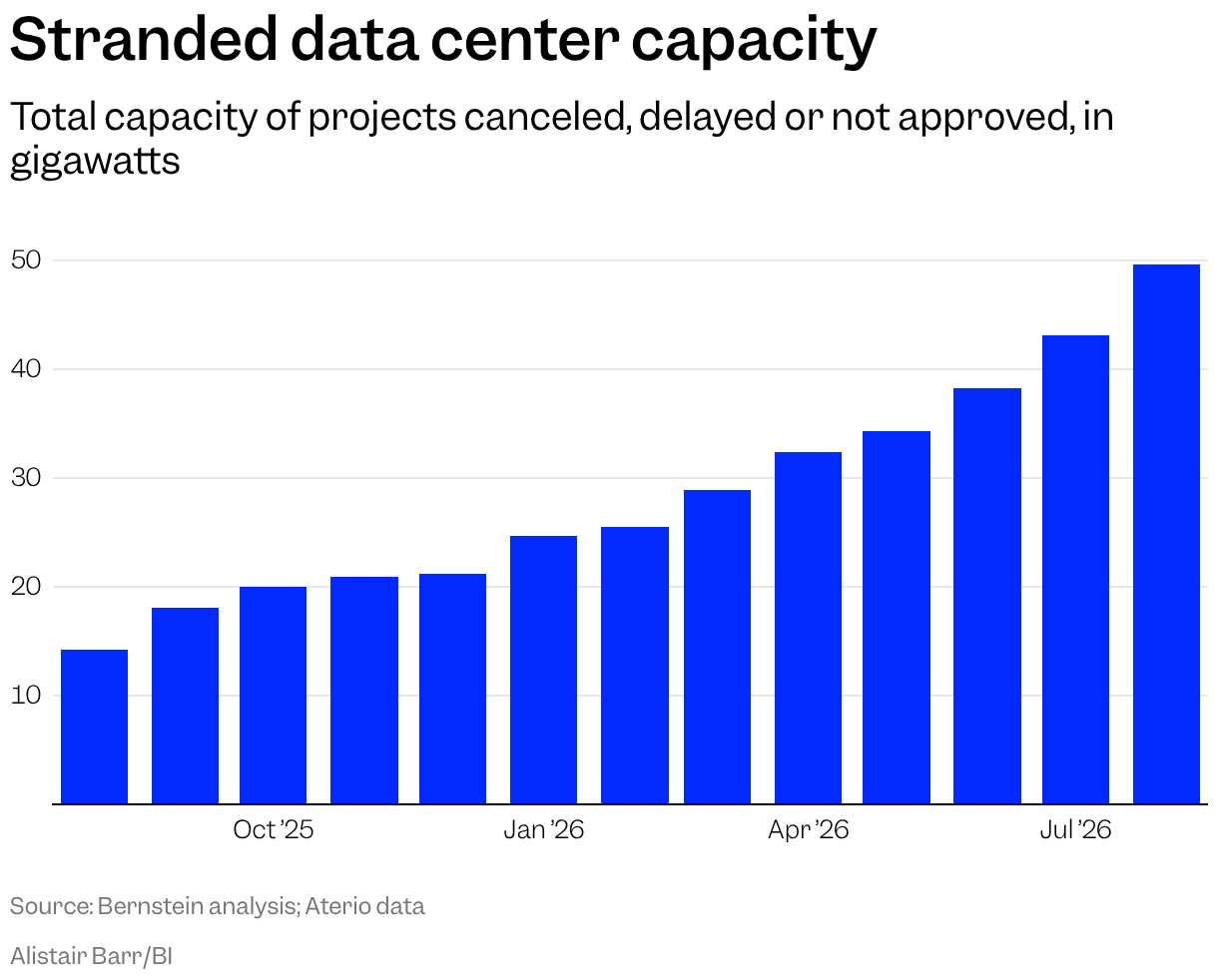
Indeed, Bernstein analysts wrote recently that the amount of "stranded" data center capacity has surged. These are projects that are either canceled, delayed, or not approved.
The AI boom's three tiers
Toro sees three broad groups competing to build AI infrastructure.
At the top are the established technology giants, including Amazon, Microsoft, and Google. They've built data centers for decades and generally deliver on their commitments. Most of their projects will get done, he said.
In the middle are "neoclouds," newer companies such as CoreWeave that rent out computing power specifically for AI. Although they're more vulnerable to financing problems and delays, many are making solid progress, especially because some of these players already have access to electricity.
"We see them advancing quite well," Toro said. "Sometimes we see some delays, but it's not something significant or any kind of big capacity that is at risk."
Then come the newcomers making extraordinary promises. That's where most delays and cancellations happen, Toro said.
Even Amazon needs a backup plan
A technician works at an Amazon Web Services AI data center in New Carlisle, Indiana.
Noah Berger/Getty Images via Amazon Web Services
Not every project that disappears was a fantasy, though. Even a top player like Amazon struggles sometimes to secure electricity and other supplies on time for these huge projects.
The biggest, most experienced tech companies deliberately pursue more potential data center capacity than they need because they know some developments will fail or get delayed.
Major AI companies were committing to three or four times the space and electricity they needed over the following two years, Jeffrey Moerdler, a data center lawyer, estimated during an interview with Bernstein analysts.
His reasoning: Of data center projects that haven't started construction, roughly a third will arrive on schedule, another third will be delayed, and the remainder won't happen.
Rezaei and Toro estimate that the top players don't over-commit that much — more like double the capacity they need at most.
The strategy provides a "Plan B," as Toro put it, in case of delays involving electricity, equipment, permits, local opposition, or other factors.
Texas has a ghost problem
The Decker Creek Power Station in Austin.
Brandon Bell/Getty Images
This helps explain another extraordinary number.
Data center companies have requested connections for roughly 450 gigawatts of electricity demand on Texas' main power grid, more than five times the grid's roughly 85 gigawatts of existing capacity, according to Toro and others.
Many of those requests are placeholders rather than firm construction plans. Toro calls them "ghost projects."
These speculative projects clog the waiting lists for electricity connections, making the electricity shortage look a lot worse than it actually is.
"Developers routinely spam projects across several sites, and many are speculative builds with no customer yet," Ryan McEntush, a partner at venture capital firm Andreessen Horowitz, wrote in a recent blog. "Often these new developers have never even plugged in a GPU, let alone a power plant."
Texas has paused applications to review and weed out projects that aren't serious. Toro, from Aterio, expects this to favor the established players at the expense of the bragawatts.
The real AI boom
None of this means the AI infrastructure boom is imaginary.
Aterio tracks thousands of buildings, including major projects already under construction. Bernstein estimates that nearly 80% of the capacity the largest technology companies are directly developing is credible.
And when speculative projects disappear, Rezaei doesn't expect a wave of unpaid debt. Many will fail before building begins, the stage when developers borrow serious money through project financing.
Some of those missing data centers were never really coming in the first place.
The website for the French government was temporarily unavailable on Wednesday amid hacking concerns stemming from major bugs in a piece of software used widely across the internet.
For two decades, data centers were relatively safe, lucrative real estate investments. They attracted investors because they served as digital infrastructure — the essential plumbing that keeps the internet running. The growth of artificial intelligence (AI) and its increased demands on computing power has meant data centre builders are in a race to build out […]
The European Union has taken a significant step towards revising its digital regulatory framework after member states agreed proposals to amend the General Data Protection Regulation (GDPR), simplify cookie consent requirements and overhaul cybersecurity reporting obligations.
The measures form part of the European Commission’s Digital Omnibus package, introduced in November 2025, and represent one of Brussels’ most substantial attempts to simplify the regulatory obligations imposed on businesses operating across the single market.
Changes to GDPR and personal data rules
The proposed reforms would modify several provisions of the GDPR, which has governed the processing of personal data across the EU since May 2018.
Rather than replacing the legislation, the Council wants to clarify existing obligations, particularly those concerning pseudonymised information, requests for access to personal data and the use of information in scientific research.
The agreed position retains the existing definition of personal data while introducing provisions intended to clarify when pseudonymised information can be linked to an identifiable individual.
Companies would also benefit from simplified procedures for handling manifestly unfounded or excessive data requests and from reduced information requirements in certain low-risk circumstances.
Another proposed change would extend the deadline for notifying authorities of personal data breaches, while establishing more consistent reporting templates across the EU.
For multinational companies, which currently navigate different interpretations of data protection obligations by national authorities, these provisions could reduce compliance costs and administrative duplication.
However, the changes have raised concerns among European privacy regulators.
In a joint opinion published in February, the European Data Protection Board and European Data Protection Supervisor warned that parts of the Commission’s original proposal could create legal uncertainty and undermine existing protections.
They were particularly concerned about proposals affecting the definition of personal data and the Commission’s potential role in determining when pseudonymised information falls outside GDPR requirements.
The Council’s decision to retain the existing definition addresses part of that debate, although the final legislative text remains subject to negotiations.
Fewer cookie banners for internet users
One of the most visible changes would affect the consent notices encountered by Europeans when visiting websites.
Under the Council’s proposal, additional categories of cookies and similar tracking technologies could be used without obtaining explicit consent, provided the relevant legal conditions are satisfied.
The proposed exemptions include technologies necessary to deliver a service, maintain device security or conduct audience measurement.
For website operators, publishers and online businesses, the changes could reduce the number of consent requests displayed to visitors and simplify technical compliance.
The current system has generated extensive legal disputes over whether consent is genuinely voluntary and whether tracking technologies collect information beyond what users have authorised.
The latest proposal would not abolish consent requirements for commercial tracking or behavioural advertising. Technologies falling outside the permitted exemptions would remain subject to the applicable privacy rules.
Cybersecurity reporting and artificial intelligence
The package also addresses the growing number of reporting obligations imposed on European businesses under overlapping cybersecurity legislation.
The Commission originally proposed a single European reporting mechanism for certain data and cybersecurity incidents.
Member states have instead agreed to establish national entry points, supported by an EU-level information system and provisions for coordinating cross-border notifications.
The Council’s position would also clarify the legal grounds for certain uses of personal data in artificial intelligence systems and introduce safeguards for processing sensitive information in specified circumstances.
These provisions follow increasingly complicated disputes over the application of European privacy legislation to AI development and automated decision-making.
The Commission estimates that its wider digital simplification initiative could save European businesses up to €5 billion in administrative costs by 2029.
The initiative reflects pressure from European governments and business organisations to reduce the regulatory fragmentation that makes operating across multiple EU jurisdictions more expensive.
The Digital Omnibus is part of a broader legislative programme influenced by the competitiveness reports produced by former Italian prime ministers Enrico Letta and Mario Draghi.
Under the Council’s negotiating mandate, several existing data-related rules would also be consolidated, while provisions governing the protection of trade secrets would be strengthened.
The European Parliament must now determine its negotiating position before formal discussions between the institutions can begin. Until the legislation is agreed and adopted, existing GDPR, cookie consent and cybersecurity requirements remain in force.
The Google CEO said he uses AI agents to track Google's model development and internal discussions.
Bloomberg/Getty Images
Sundar Pichai said he uses AI agents to track Google's model development and internal discussions.
The bots summarize updates and monitor how Google's computing resources are used.
Pichai said humans still make consequential decisions about resource allocation.
Even Google's CEO needs help keeping up with Google.
On the Sources podcast released Wednesday, Sundar Pichai described to host Alex Heath how he delegates some of the information-gathering that comes with running the tech giant.
“It could easily take me an hour a day to kind of catch up,what's happened in the last 24 hours, right?" Pichai said. "But now I have agents running which summarize and bring that information to me. I can still go deeper, and I do so often."
Pichai said that his AI agents give him a way to "understand the model development arc," figure out how Google's computing resources are being used, and follow threads spread across numerous internal chat groups without having to read through every conversation himself.
“Similarly, there are agents with telemetry into our compute usage by product area, efficiency, utilization, and giving me inputs and insights, you know," Pichai added. "I think it's made all of us, you know, be better at what we do."
That doesn't mean Pichai has handed over the important calls to AI. He said humans — including himself — remain directly involved in consequential decisions about allocating computing resources.
Managing agents is becoming a skill in its own right, giving some workers a new set of headaches, from checking the bots' output to preventing them from duplicating work or straying beyond their assignments. Business Insider previously reported that the need to manage agents is making everyone a boss without higher pay.
Delegating to bots doesn't necessarily make work easier, either. A Cisco engineering director who manages more than 10 agents told Business Insider that overseeing them involves more task switching and can make work feel more intense without shortening his days.
For the Google CEO, however, continuous work is a plus.
"So because your agents, they're running in the cloud, they're running 24/7, they have your context, and so they can pick up things where you left off," Pichai said. "It's a continuum there. By the time it's doing that, you would be applying yourself to the next problem and so on."
The billionaire told Meta’s board that he planned to list his Silicon Valley home for sale. The company remade its stock structure to help him pay the tax if voters pass it.
Mark Zuckerberg, the chief executive of Meta, at his home in Lake Tahoe, Calif. He has another California home in Palo Alto, close to Meta’s headquarters.
Digital models modified Flávio Bolsonaro’s event photography to artificially expand audiences and simulate support from female voters.
The Brazilian presidential election has become an arena for modern, dirty digital tactics. Senator Flávio Bolsonaro, representing the Liberal Party (PL), has centered his campaign strategy around coordinated digital reach and automated content production.
Rather than working as a traditional political campaign of physical rallies, the operation relies heavily on digital distribution infrastructure across social media platforms.
Flávio’s strategy operates through two main mechanisms. First, the campaign uses synthetic consensus tools, automated social media accounts, AI image generation, and digital avatars to simulate organic public backing.
Second, the campaign benefits from algorithmic distribution asymmetries on digital platforms, which amplify far-right material while placing system restrictions on competing political content.
Collected evidence by independent researchers, journalism networks, and electoral authorities indicates that systemic digital manipulation and platform-level infrastructure played a decisive role in shaping voter perception and electoral engagement in Brazil.
Industrial Bot Networks
A core component of Flávio Bolsonaro’s digital strategy involves the commercial purchase of automated networks designed to manufacture artificial public support.
An investigation by The Intercept Brazil revealed that Flávio Bolsonaro paid Elytron, a cybersecurity firm, to carry out data collection and voter identification to spread rumors and create fake accounts.
These automated tools operate primarily across WhatsApp, Instagram, and X, generating synchronized posts and artificial engagement to bypass standard organic distribution patterns.
This infrastructure uses astroturfing techniques to alter online public discourse. By deploying thousands of automated accounts programmed to post identical messaging scripts, the campaign artificially inflates engagement metrics, pushes specific political hashtags into regional trending lists, and floods comment sections on public news pages.
This creates a false impression of widespread popular momentum, designed to sway undecided voters through perceived consensus.
Technical evaluations submitted during electoral court proceedings reveal the scope of these automated operations. Data presented to electoral monitors shows coordinated account clusters posting at frequencies humanly impossible without software automation.
🚨 BREAKING: Flávio Bolsonaro paid R$600,000 to a company that offered AI to manipulate elections, according to Intercept Brasil. pic.twitter.com/eFcRp74vNw
Various social organizations and media outlets have denounced the deployment of AI image and video generation tools as another facet of Flávio Bolsonaro’s digital strategy.
A prominent example occurred during campaign launch events, where the campaign broadcast an AI-generated digital avatar of former president Jair Bolsonaro endorsing his son’s candidacy. This technique allowed the campaign to maintain the political presence of the former president Bolsonaro in public events despite judicial rulings restricting his direct participation in political activities.
In addition, the campaign used AI tools to manipulate visual documentation of campaign gatherings. Documented instances show event photography processed through image generation models to alter crowd compositions.
These AI modifications included scaling up crowd sizes to exaggerate physical attendance and digitally swapping male attendees with female faces. The primary objective of this demographic engineering was to simulate broader support among female voters, a demographic group where polling data consistently showed lower support for the candidate.
An investigation by a Brazilian media outlet identified more than 50 TikTok videos altered using AI, specifically on-the-street interviews in which subjects claimed they would vote for Flávio Bolsonaro. These videos garnered over 7 million views, yet in only 18% of them did the platform indicate that the individuals featured were AI-generated.
While Brazilian law prohibits the use of AI-generated videos in political campaigns, it is difficult to determine when such content is created by third parties with no direct affiliation to the campaigns.
Due to a lack of female supporters, Brazilian presidential candidate Flávio Bolsonaro has resorted to using AI to transform middle-aged men into attractive young women.
Flávio Bolsonaro’s public communications strategy relies heavily on coordinated attack campaigns directed against President Luiz Inácio Lula da Silva and the Workers’ Party (PT).
The Flávio campaign’s public messaging routinely utilizes sensationalist allegations and targeted attacks. Online networks affiliated with the campaign circulate manufactured claims regarding public safety, economic stability, and social values, framing the current administration in terms of moral crisis.
On Sunday the 18th, the public debate between the two candidates took place, and Flávio Bolsonaro spent most of his time attacking Lula during his turns to speak.
Throughout the debate, Flávio was sarcastic and mocking toward President Lula; he attempted to intimidate him physically, to which Lula responded by moving away, stating that he did not want to be near either Flávio or the Bolsonaro family.
Furthermore, when the discussion turned to public safety, Flávio claimed that Lula is the preferred candidate of organized crime, pointing out that Lula received a large number of votes from within the country’s prisons. Lula replied, “I want 100% of them to vote for me -even your father,” a reference to the fact that Jair Bolsonaro is currently incarcerated.
This aggressive messaging strategy directly impacts the broader political environment. By flooding public discourse with inflammatory claims, the campaign creates heightened polarization, distracts from substantive legislative evaluations, and systematically delegitimizes established democratic processes and electoral monitoring bodies.
Hundreds of Brazilians protested outside Meta’s São Paulo offices, accusing the technology giant of limiting President Luiz Inácio Lula da Silva’s campaign reach while boosting far-right candidate Flávio Bolsonaro, just six days before the presidential runoff. The demonstration… pic.twitter.com/KRAxExFjMO
The Brazilian presidential race was shaped by asymmetries within Meta’s platforms, including Instagram, WhatsApp, and Facebook.
Filings submitted to the Superior Electoral Court (TSE, in Spanish) by President Luiz Inácio Lula da Silva’s legal team documented clear disparities in how content from both campaigns was handled by the different platforms.
A primary issue involved Meta’s generative AI features. When users requested campaign materials incorporating Lula’s official ballot number, 13, the system repeatedly rejected the prompts, citing political content restrictions. Conversely, identical requests containing Flávio Bolsonaro’s candidate number, 22, were routinely processed, generating promotional material for the far-right campaign.
In other instances, the AI tool inserted Bolsonaro’s electoral number into completely unrelated image requests. Following formal complaints, the Superior Electoral Court ordered Meta to ensure equal treatment. Meta attributed these outcomes to technical errors and implemented broad restrictions on political image generation.
Internal Meta communications revealed that technical errors caused Lula’s official Instagram profile to be excluded from platform search results and recommendation engines, while Flávio Bolsonaro’s profile remained fully discoverable and actively recommended to users. Furthermore, internal technical escalations confirmed that temporary account restrictions had hindered the reach of Lula’s messaging assets.
WHO'S THE REAL THIEF? LULA CHALLENGES BOLSONARO TO SHOW RECORDS
Ahead of Brazil’s presidential election, Brazilian President Lula da Silva publicly challenged rival Flávio Bolsonaro to open his bank accounts, release his phone records, and let the Brazilian people decide who… pic.twitter.com/U6Ge0yOV6A
The execution of Flávio Bolsonaro’s digital presidential campaign illustrates the evolving mechanics of far-right electoral operations.
By combining commercial bot procurement, generative AI deepfakes, coordinated public attacks, and platform-level algorithmic advantages, the campaign constructed a heavily synthetic media environment designed to influence voter perception.
These developments underscore the limitations of existing legal and regulatory frameworks in addressing digital campaign manipulation. While judicial interventions by the Superior Electoral Court forced technical corrections, reactive oversight remains insufficient to counteract real-time automated suppression and algorithmic imbalance.
Protecting democratic processes requires structural regulatory reform, including mandatory algorithmic transparency, strict auditing of generative AI systems, and clear accountability standards for global technology corporations operating within national borders.
Exposing the mechanics of digital manipulation through independent research and data-driven journalism remains essential to safeguarding electoral integrity against automated distortion and platform bias.
Sources: Brasil de Fato – Agência Brasil – Gov.br – O Globo – Folha de S.Paulo – O Estado de S.Paulo – El País – CNN Brasil – EFE – Instituto Tricontinental – La Base América Latina – Diario Red – The Intercept – El Salto
The European Central Bank says artificial intelligence investment, changing energy consumption and increased government spending have helped the eurozone withstand this year’s energy crisis, although economists warn that several sources of growth may prove temporary.
The eurozone economy has proved more resilient to the energy price shock of 2026 than economists initially expected, supported by increased investment in artificial intelligence, reduced dependence on fossil fuels and higher government expenditure, according to an assessment published by the European Central Bank on Wednesday, 21 October.
ECB economists Óscar Arce, Gerrit Koester and Beatrice Pierluigi found that structural changes in European energy consumption have reduced the economic consequences of rising oil and gas prices. Stronger international demand for technology equipment and additional public spending, particularly in Germany, have also supported growth.
The findings come as the ECB faces renewed inflationary pressure following disruption to global energy markets caused by the conflict involving Iran, raising questions about the outlook for interest rates and economic activity.
Excluding Ireland, where economic statistics are frequently affected by the activities of multinational companies, real eurozone GDP in the second quarter was 0.6 per cent above its level at the end of 2025.
The ECB also identified quarterly growth of approximately 0.3 per cent over the preceding four quarters, excluding Irish figures.
These results exceeded earlier expectations that the disruption to energy markets would have a greater impact on European manufacturing, consumer spending and business investment.
Nevertheless, the eurozone’s rate of expansion remains modest compared with its longer-term historical performance.
The ECB’s findings suggest that the economy has become better able to absorb international disruptions without experiencing the immediate contractions that might previously have followed comparable energy price increases.
Reduced reliance on imported oil and gas
One of the most significant structural changes concerns energy consumption.
According to the ECB, the eurozone economy is now approximately half as dependent on oil as it was during the early 1990s, measured against economic output.
Greater energy efficiency, the expansion of services and investment in alternative electricity generation have progressively reduced the amount of fossil fuel required to produce economic activity.
The growth of renewable energy has also altered the relationship between natural gas prices and electricity costs.
In Spain, the proportion of hours during which gas-fired power stations determined wholesale electricity prices fell from approximately 80 per cent in 2020 to just over 20 per cent during the first nine months of 2026.
France recorded a similar decline, from approximately 60 per cent to around 20 per cent, supported by its extensive nuclear generating capacity.
Consequently, increases in international gas prices are having a smaller effect on electricity markets in countries with substantial renewable or nuclear generation.
The ECB cautioned, however, that European economies remain exposed to global energy disruptions, particularly through industrial activity and international supply chains.
Artificial intelligence provides unexpected support
The international expansion of artificial intelligence has generated an additional source of demand for European manufacturers and technology companies.
Investment in computing infrastructure, digital services and specialised equipment has increased demand for products supplied by European businesses.
According to the ECB, global trade has performed considerably better than expected at the end of 2025.
The latest projections indicate international trade growth of approximately 4.7 per cent in 2026, compared with the 2 per cent forecast in December.
AI-related investment accounts for part of that improvement.
European manufacturers producing specialised machinery and technology equipment have benefited from increased export orders, while domestic investment in technology has supported economic activity.
However, the ECB found that the effects vary considerably between sectors.
Technology-equipment manufacturers recorded comparatively strong growth in output, employment and new orders.
Software companies performed better in output terms, but the improvement was less evident in employment and new business.
This uneven performance suggests that the economic benefits of the AI investment cycle are concentrated in particular industries.
German spending strengthens European demand
Fiscal policy has provided another source of support.
The ECB estimates that the expansionary fiscal stance in the eurozone has increased to approximately 0.5 percentage points of GDP, twice the level anticipated in December 2025.
Much of the additional stimulus reflects higher German government spending on defence and infrastructure.
Other eurozone governments have introduced measures to limit the effect of energy prices on households and businesses.
Public investment and expenditure have therefore helped compensate for weakness in areas affected by higher import costs and international uncertainty.
Yet the ECB warned that fiscal support cannot necessarily continue at its present level.
Several eurozone governments face borrowing constraints, while additional public spending can place pressure on national budgets.
Interest-rate decisions remain difficult
The ECB’s assessment comes amid expectations of further monetary tightening as policymakers respond to renewed energy-related inflation.
The central bank must consider whether higher energy costs will remain temporary or begin influencing wages, prices and inflation expectations more broadly.
Additional interest-rate increases could reduce inflationary pressures but would also raise borrowing costs for businesses, governments and households.
The economic recovery remains exposed to potential reversals in global demand, international trade and investment in artificial intelligence.
The ECB’s economists also identified geopolitical escalation and further supply-chain disruption as continuing risks.
Their findings indicate that reduced fossil-fuel dependence has made the eurozone less vulnerable to energy shocks, while technology investment and government spending have provided additional support.
Whether that resilience continues into 2027 will depend partly on the durability of international demand and the ability of European governments to maintain investment without increasing inflationary pressure.
The spending has hurt the Silicon Valley giant’s cash flow, which turned negative. Meta said it would issue a new class of stock to help it raise more money.
 Login