A 26-year-old foreign national has been arrested for the murder of the 38-year-old British woman whose body was found in a suitcase in Kypseli district of Athens last month. The man has reportedly confesses to the murder and a case file was filed against him for manslaughter, robbery and violation of weapons laws. The woman’s […]
When Leslie Buck was discovered dead in her home in 2002, Mystic, Connecticut, went into shock. What had happened to the grade school teacher and who had wanted her to die? For journalist Brenna Ehrlich, this one was personal; Buck had been her teacher in grade one. In her latest for Rolling Stone, Ehrlich returns to Mystic to learn more about who Leslie Buck was and why she was murdered.
And Anna Greene, my second-grade teacher, told me about the poems she found in Leslie’s desk after she died — that she read at the funeral. There’s one about the kids who are different, “who don’t fit,” who “dance to a different drum.” For some reason, that hit me harder than police reports or autopsies. More than the horrors that true-crime often focuses on. I still can’t read it without crying. Maybe because I definitely was one of those kids, or maybe it’s just because it shows that she truly saw her students — all of them. Or maybe it’s a much-needed reminder that Leslie Buck isn’t a story, a case to be solved. She was a person. And she deserves to be remembered.
Parliament in Greece has approved a government bill concerning the country’s two major water utilities, EYDAP and EYATH in Athens and Thessaloniki respectively. The bill passed amid strong opposition criticism that the legislation could lead to the privatization of water services. The bill, introduced by the Ministry of Environment and Energy, passed with support from […]
The genocide in Gaza has created some 60 tons of rubble. In doing so, it has released asbestos, lead, and other toxic materials, guaranteeing “an epidemic of cancer, lung disease, and brain damage,” Helen Epstein writes, “[that] could come to rival in lethality the war’s bombs and bullets.” Research is starting to make visible the scale of dangerous fallout, but there are limitations:
To confirm [scientist Yaakov] Garb’s estimates, it would be necessary to test soil samples from the areas he has identified as particularly likely to be contaminated. But the Israeli government seems to be obstructing efforts to carry out such tests, let alone assist the current and future victims of this environmental catastrophe. Aid workers and others entering Gaza attend an official briefing where they are informed that it is forbidden to leave the enclave with even small amounts of soil or sand. Once in the Strip, any scientists surreptitiously collecting research material risk being spotted by overhead surveillance drones. At departure checkpoints every piece of luggage is emptied onto a conveyor belt, and border guards carefully inspect each item. Several people told me they knew researchers whose soil samples had been confiscated. Palestinian researchers in Gaza have no capacity to conduct such experiments on their own, since the enclave lost all twelve of its universities and scores of scientists in the bombing. Without the Israeli government’s cooperation, only remote assessment and modeling like Garb’s can even begin to determine the scale and location of toxic contamination in which Gaza’s population now lives.
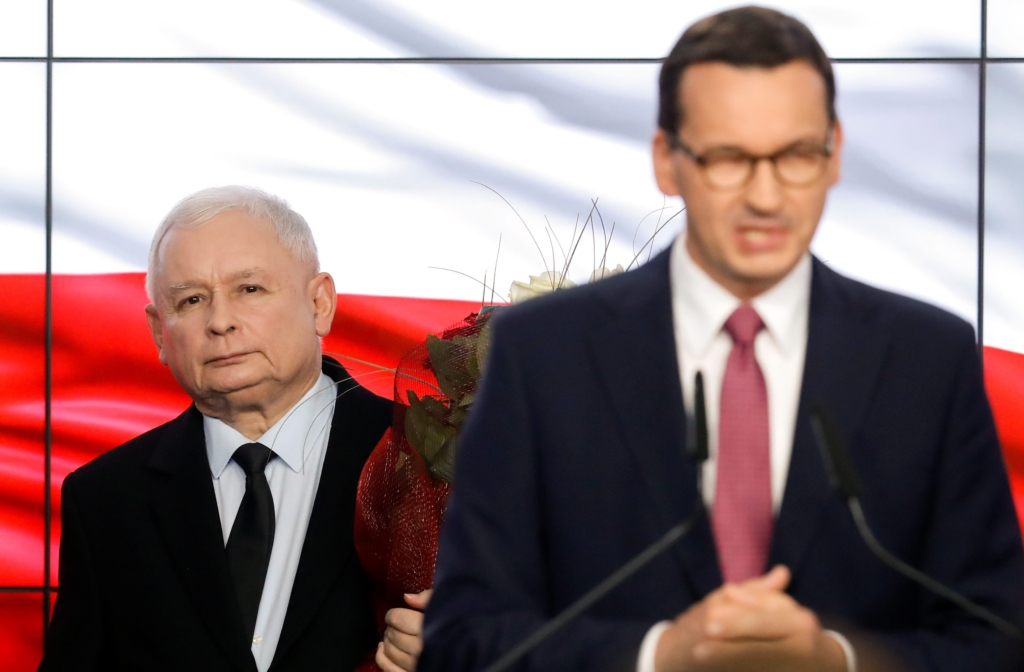
Poland’s party system is unravelling. The Law and Justice (PiS) party, led by Jaroslaw Kaczyński, has split. More than 40 of its members have formed a separate parliamentary caucus that includes Mateusz Morawiecki, prime minister for most of the party’s rule from 2015 to 2023. This ends an era of over 20 years that has been shaped by two powerful men and their parties: Kaczynski’s right-wing nationalist, Eurosceptic PiS and Donald Tusk’s liberal-conservative, pro-European Civic Coalition (KO).
At first glance, the collapse of his old enemy is a gift to Tusk. KO leads with 29%; PiS has slipped below 19% since the split. Four groupings now compete on the right, and Poland’s voting system punishes fragmentation, so four medium-sized parties win fewer seats than one large party on the same vote.
However, Morawiecki broke away in protest at PiS’s radicalisation, hoping to win over the very centre-right voters who helped return Tusk to power in 2023 after eight years of PiS rule. Most are now disillusioned (Tusk’s government has dismal approval ratings), politically homeless and angry. If they split their vote among the four right-wing parties or stay at home, Tusk may meet the same fate as Kaczynski in 2023: he could win the election in 2027 but be unable to assemble a majority coalition.
The other problem is one of method. For two decades Tusk has, often successfully, run against Kaczynski rather than on a programme of his own. Polarisation served both men well: each could rally his own voters by invoking the threat of the other, and smaller parties were squeezed out. Kaczynski’s decline forces Tusk to find another way to win.
Solution
Rather than betting on his enemy’s demise, Tusk should proactively set the agenda and win centrists beyond his base, as in 2023. Economic and social questions will matter, but foreign policy is set to loom unusually large in next year’s campaign. A record 25% of Poles favour leaving the EU (“Polexit”), hostility to Ukraine is rising and the right-wing parties are competing to outdo one another in anti-EU, anti-German and xenophobic rhetoric.
Tusk, a risk-averse tactician, has long avoided confrontation on those fundamental issues, calculating that exposing himself to attack from the right would be self-defeating. The far-right, however, has filled that vacuum, for example through its campaign against SAFE, the EU’s defence-loan scheme, and in the hardening mood towards Ukraine.
A more volatile party system may paradoxically make anti-Tusk majorities easier to build. That is an argument for the leader of Poland’s pro-European camp to take up the fight rather than duck it. Tusk needs to explain to Polish voters, more forcefully than before, why the EU is the best response to pressure from Donald Trump and Russia; why anchoring Ukraine in Europe is a Polish raison d’état; and how Poland’s interests differ from those the nationalists describe.
Context
Poles vote for a new parliament in October 2027. Tusk’s five-party coalition faces an uphill struggle to stay in office. The coalition partners have weak support or may not be able to re-enter the government at all.
Recent polls give the four right-wing parties a majority between them; whether their rivalries would allow a coalition is another matter. PiS has moved further right in recent months to stop core voters defecting to more radical rivals, in a shift which provoked Morawiecki’s rebellion. His departure will probably set off further political realignments before the 2027 election.
I’d be lying if I said I understand everything Michael Levin believes. But I’m also not alone; sometimes his own colleagues can’t even follow his arguments. Elizabeth Weil’s profile of the renegade (and genius) biologist bridges that gap, sketching out Levin’s research and claims in a way that’s just grokkable enough to blow your mind. I mean this as a true compliment: When’s the last time we had a genuine mad scientist on our hands?
Critics accuse Levin of all kinds of teleological crimes — making unfalsifiable claims, using words in ways that render those words meaningless. Levin is unfazed. In his talks, he tries to disarm his detractors by preempting the accusation that he’s nuts: “I have some unusual things to say and then I have some crazy things to say”; “So this is a kind of crazy claim I’m making.” His true retort is his wet lab. There, at the bench, he’s working to prove his metaphysics by running old-school (in a way) biological experiments. He studies flatworms with two heads. Frogs with eyes on their stomachs. Little round creatures called xenobots, synthesized from frog skin cells. They swim like tiny Pac-Men. They do not exist in nature.
“The only thing that ever settles arguments is technology,” Levin tells me, a line he borrowed from biophysicist Chris Fields. “People have been saying for thousands of years what they think” about minds, consciousness, souls, energy fields. “What I can contribute is ways to test some of those things.”
Longreads has published hundreds of original stories—personal essays, reported features, reading lists, and more—and more than 14,000 editor’s picks. And they’re all funded by readers like you. Become a member today.
Hannah Engler Harvey | Longreads | July 30, 2026 | 3,927 words (14 minutes)
In the long, slow days of August, Christmas comes. The halls are decked with vintage glass holiday towns in two colorways, Pastel and Traditional. They are lit by a wall of electric candles whose realistic dancing flames were designed by Disney Imagineers. (Inventory is getting low in Beige, but consider the White as an alternative; Plum could pull double duty for Halloween.) Smiling people wear sweaters embellished with stars and snowflakes. They moan with pleasure as they sample handmade caramel marshmallows and defrosted barbecue ribs and special-edition three-and-a-half pound cheesecakes, on sale for $56.00 or three easy payments of $18.67. (But move fast: There are fewer than 750 left in Strawberry.)
It’s nice here, safe as a daydream. In the pretend kitchen, with the make-believe food and the fireless flames, there is something for everyone.
The first thing to know about QVC, the most important thing, is that it is always on.
My best friend Lizzie and I are couch potatoes, dedicated ones; our friendship set, like a custard, in front of the television. At first it was TheReal Housewives and 30 Rock, then Difficult People and Dancing with the Stars. When we first moved in together, when we were both 24, we resolved, initially, to shake ourselves out of this instinct. I had just gone through my first adult breakup. She had finally had enough of her roommates and of Brooklyn. It was early 2020, the year of broken leases.
We found a place in a neighborhood we both loved, and ignored the fact that the door of the bathroom could not open past the toilet, and that Lizzie had to climb over her bed to get to her closet. It didn’t matter that it was small, we reasoned. We would never be there.
Two weeks after we moved in, the city shut down, and we started paying for cable.
What it boiled down to was this: If you watch enough television, you eventually get sick of deciding what to watch. The beauty of TV, for the true couch potato, is when it comes and finds you: the sick-day marathons of Intervention, the late-night reruns of Frasier and The Nanny, the reliable Sunday-afternoon showing of the movie Backdraft. This is what Lizzie and I had loved about television growing up, and this is what the prestige-TV era had taken from us. We were sick of ordering à la carte. We wanted a buffet.
So, there on our pink Drew-Barrymore-for-Walmart sectional, balancing takeout containers on our laps, we watched.
We watched old episodes of Match Game and Three’s Company; we watched Live with Kelly and Ryan and the movie channels and sports, if we were desperate.
But there were times—the true couch potato always finds times—when the only thing to watch was QVC.
QVC (which stands for Quality, Value, Convenience) was founded in 1986 by the businessman Joseph Segel and still airs 24 hours of programming a day, approximately 20 hours of which are live broadcasts. The broadcasts are simple in structure. A host demonstrates products in an unscripted, conversational way, speaking directly to the audience from a set that looks like a living room. Sometimes, the host banters with a cohost. Along the way, they are joined by a rotating cast of brand representatives who are there to assist in selling their wares.
And this tactic has worked, at least on some tranche of the population. For the 40 years it has been around, QVC’s core demographic—women over 50—has held steady, and the channel has a remarkable ability to inspire loyalty. According to a 2021 article in Main Line Today, the newspaper local to West Chester, Pennsylvania, where QVC is headquartered, “Ninety percent of QVC customers are of the repeat variety.”
The personalities are the point. In a 2006 article in Studies in Popular Culture, Jennifer Courtney and Gabriel Wettach wrote that QVC’s innovation, as well as its biggest challenge, was to make its advertisements seem less like corporate directives and more like recommendations from friends or peers. “To create and maintain credibility with the audience,” they write, “QVC hosts must emphasize roles that convey authenticity, such as mother, beauty expert, or bargain hunter. . . . viewers must be able to trust or ‘relate to’ the host; invoking trusted personas creates a welcoming and reassuring environment.”
We are all living inside the world that QVC made, the commingling of identity and acquisition.
Twenty years later, this insight about the power of QVC hosts could be applied to far greater swaths of the consumer economy. Today’s Instagram influencers talk about how and when they use certain products in the same relatable way the hosts on QVC do. Shopping is integrated into most online and IRL experiences. We are asked to place things in context, imagine the lives we would have and the people we would be if we could only own the right items.
When I talk about QVC, people are baffled by my interest in it. To them, it seems like a relic, something whose relevance is shriveling up. On the contrary: We are all living inside the world that QVC made, the commingling of identity and acquisition. We occupy our homes like amnesiacs, trying to figure out who we are by looking around at what we own.
For me, QVC applies an unexpected salve to the wound it caused. I am too young for bladder-leak underwear or anti-crepe elbow cream; I have no lawn for ornaments or freezer space for a four-pound bag of pot stickers. Like most people my age, conditioned to view themselves from a distance, I have spent a lot of time curating my life: my physical space, my wardrobe, my media diet. All my algorithms are tuned to perfection. In other words, I spend so much time within a prison of my own preferences that it has become a relief to be offered things I would never want.
To talk about what QVC is does very little to illustrate the experience of watching QVC, which is altogether more difficult to pin down. The sets are vividly lit, the people arranged like pints of ice cream in an illuminated freezer. For as long as I’ve been watching, the main set has been dressed with a bright yellow couch, glossy gray-brown laminate floors, and faux windows that look out onto a digital lawn. The artifice of the environment is in charming tension with flickers of helpless realism: a rep from Roberta’s Unique Gardens who struggles to lift a planter full of SunPatiens; a host whose Barefoot Dreams cardigan keeps rubbing against her mic. There is a hallucinatory quality to it: The brightness is the same at 8 in the morning and 11 at night. There seems to be no rhyme or reason to when they present certain products, whether they’re selling perennial plants or seasonal decorations or Beekman 1802’s goat milk skin care. (The reps from Beekman often bring a flock of real baby goats with them.) But there is also a groundedness, a kind of ruthless maternal practicality: Faroe Islands salmon is full of Omega-3s, which reduce triglycerides, crucial as we approach middle age. Elastic-waist pants are a godsend if you fluctuate sizes.
The presentations follow predictable, elliptical patterns; they are designed to be half-watched, for viewers who are flipping channels, or maybe falling asleep. The hosts repeat themselves—they must—revisiting colors, sizes, quantities, and prices every couple of minutes, the repetition contained within the steady stream of good-natured patter. The consistency of this patter is remarkable; to be able to just keep talking, no matter how boring the topic or useless the product, can be downright impressive to watch. A host might say all of these things and more during the course of an hour-long presentation on espadrille sandals: The weather is getting warmer, those outdoor barbecues are around the corner, days are getting longer, patio dining is here, summer is showing its face, it’s iced coffee season, it’s frozen margarita season, it’s baseball season, the weather is warming up. Sometimes it devolves into silliness. “Belts are really trending right now,” said designer Susan Graver on QVC3 the other morning. “Oh, I love to put one on.”
At first, we entered this world like anthropologists, observing the bizarre habits of the native species. But we soon became attached to its familiar rhythms. Lizzie developed a habit of turning it on in the morning and keeping it on in the background through a day of working from home or cleaning the house, and this routine lingered long after the acute phase of the pandemic began to wane. Certain things about our lives had changed for good. Never again would we go into the office five days a week, and never again would a day pass without the ambient, almost meditative thrum of QVC—not exactly white noise, but maybe ecru, or eggshell.
In other homes, in other cities, we learned, other women were doing the same thing. Longtime QVC customer Arlyn David—a 62-year-old resident of Bala Cynwyd, Pennsylvania—told Main Line Today in 2021: “If I’m home, I have it on.”
All my algorithms are tuned to perfection. In other words, I spend so much time within a prison of my own preferences that it has become a relief to be offered things I would never want.
QVC pioneered a new type of television programming, shopping and entertainment churned together in one comfortable swirl. But the entertainment is of a specific type: It provides something that Lizzie and I sometimes call “The Voices.” The Voices could come from a podcast, or from scrolling on TikTok; the point is that they give a restless mind something to do between bouts of more concentrated thought, like psychological chewing gum.
I have spent the last few years learning about how my generation’s attention spans have been torched by social media and smartphones and how our minds now require constant stimulation in order to function. But Arlyn David and her ilk are proof that the desire for The Voices predates millennial dopamine addiction by decades at least. What does the everpresence of QVC do for them?
Whenever I ponder this, I think of the house I grew up in, set back into trees at the end of a cul-de-sac, in an American suburb that thundered with silence. Perhaps The Voices answer a deeper, more basic human desire: the urge to fill a quiet house with conversation, no matter how inane.
Like friendship, QVC has its own vernacular, formed over years and opaque to outsiders. For example: Weighty, substantial fabrics are sometimes referred to by hosts as “beefy.” Host Leah Williams was, by her own account, the first person to use this term. Then QVC stalwart Isaac Mizrahi borrowed it, and then his reps started using it when they went on for their presentations, spreading it back to the hosts. So everyone calls things “beefy” now, usually crepe pants or wool-acrylic blend sweaters. Another one: Cotton has “a dry hand.” This means that when you run your hand over the fabric, it feels dry to the touch, not slick and smooth like a synthetic blend. Fabrics that have a dry hand are cooler and less clingy on the body.
The colors on QVC have beautiful and evocative names, like Butter Rum, Flame, Celebration Pink, Nantucket Blue. Sometimes, when color names are too highfalutin, conflict occurs. The brand rep from the QVC brand Denim & Co. is always going at it with host Amy Stran over this. “This one is called Heather,” he’ll say, and Amy will rush in to offer an alternative: “But it’s really not gray at all, more like a beautiful smoky purple, a lavender.” Then, next time they go through colors, she’ll say, “This one is called Heather, but remember, think lavender.” Amy is very serious about colors. It really pisses her off when brands call black “onyx” or gray “silver.” She probably assumes it will confuse the customers. She is probably right. Whenever these tiffs would happen, Lizzie and I would lean forward over our knees, eager to see the two of them go at it.
If you watch enough, you start to notice these tensions; you become a scholar of them. Lizzie and I are fandom members of the country’s longest-running reality show. The faces of the hosts unfurl themselves under our unrelenting gaze, revealing an ill-advised spray tan, an early pregnancy, plastic surgery, dead teeth. QVC has deepened the language we share with each other, created a shared set of references, in the same way that going to college together did, or the time when we were both AMC A-Listers. It has become more than brainless viewing. It is a hobby.
We have the festering snobbishness of transplants. New York City is our home, but our impossible aspiration is to have never lived anywhere else.
There is even a subreddit dedicated to making fun of QVC personalities and their quirks: r/QVC_Snark. It is a community of insiders. The Redditors attack with the vicious specificity that only intimacy can produce. “Why is her head a literal box?” asks a recent poster, sharing a photo they took of host Courtney Khondabi on their TV screen. Or, of host Rick Domeier: “Rick has been wearing the same jeans for weeks now!” They make fun of the prices, usually during the food presentations ($100 hot dogs, $11 per 6 oz. piece of salmon) and the clothing segments (LOGO by Lori Goldstein is a popular punching bag: “All this needs is some lace and a ‘wide load’ banner across the ass”).
During the three years we lived together, Lizzie and I spent countless evenings performing QVC-themed comedy routines for an audience of one, doing spittakes with our wine, high on the feeling of being clever and understood. But we only discovered r/QVC_Snark later, after we were living on opposite sides of Manhattan. All this time, here were our people! One night I sent her a series of posts I collected during a lurking session, wishing I could see her reaction. After a few seconds, she responded: “Nothing but you has made me laugh this hard since I was a kid.”
Redditors will be Redditors, but look, we are all supposed to be in this together. The hosts and reps are wives and mothers too (or the gay best friends of wives and mothers, or at least the closeted neighbor of wives and mothers). They are wearing the sweaters, using the hand cream, planting the perennials, or at least, they say they are. Part of QVC’s structure—a crucial part, in some readings—is the connection between hosts and viewers, not theoretical, but literal. Almost every live broadcast has a call-in element that allows viewers to speak on-air to their favorite hosts, to ask questions about the product, or, more frequently, praise it and announce their intention to buy more.
“Speaking with a host is, for many callers, a meaningful, seemingly priceless exchange,” write Courtney and Wettach. “Callers frequently divulge personal information, telling the host about illnesses, financial status, and family matters.”
It’s true; I have seen it. A recent caller told QVC personality Kim Gravel, in a voice thick with tears, that she had gotten used to “not feeling part of the world,” due to her weight, but that Kim’s clothing line had given her the confidence to participate in life. “That is your ministry,” said the caller.
I looked up. Ministry! It was such an extreme word, and even odder applied to Kim Gravel. (Boisterous! Brassy! The onetime host of a Lifetime reality show called Kim of Queens where she ruthlessly prepared young girls for beauty pageants!) The longer I thought about it, the more I found myself relenting. Anyone who denies the therapeutic value of clothes that fit has never had the experience of not being able to find them.
This is, perhaps, at the heart of my ambivalence toward QVC, or more accurately, my inability to see my engagement with it as pure ridicule or even a hate-watch. Every so often, I am startled with a reminder of who else is out there watching. Skechers presents a pair of sandals with hands-free slip-on technology, so that you don’t have to bend over to put them on. On the Over 50 & Fabulous program, the women from Breezies sell underwear designed to withstand hot flashes and bladder leaks. Where else can these items be reliably purchased, or so frankly and cheerfully discussed?
Onscreen, listening to the caller’s praise, Kim was nodding. She was clearly touched, or at least, she looked like it.
I sometimes imagine the person I would be if I took them all up on it. If, one day, a tower of packages arrived on my doorstep, containing Women With Control stretch denim, IHKWIP quilted tote bags, Clarks Cloudsteppers shoes, and silicon Cool Grippers pot-holder tongs. How would my life be arranged around these items? I imagine I would measure out the years in landscaping projects. My afternoons would be taken up by long car journeys, ferrying children to softball tournaments or play rehearsals, going to the grocery store and the nail salon.
I know women like this; I grew up with them. So did Lizzie. We have the festering snobbishness of transplants. New York City is our home, but our impossible aspiration is to have never lived anywhere else. We turn up our noses at the strip malls of our youth, and share our faltering moments only with each other: the secret joy of a Target where deodorant isn’t locked behind plexiglass, the frustrated desire to place groceries in the trunk of a car, the fizzy hedonism of a 44-ounce Diet Coke from a fountain. This, too, unites us: our aborted suburban futures, the secret panic that they may have only been deferred. Do we watch QVC to indulge these sublimated cravings for peace and comfort, taking furtive bites of soccer-momdom to keep us going when the subway is delayed and the rent is due? Or do we watch it to set ourselves apart, to reassure ourselves that we will never give in?
What happened within me when I cringed at the caller on the Kim Gravel broadcast? Why was my initial instinct an abstracted pity? Do I think I will never get there—never find a source of unexpected divinity, never be moved to tears by something ridiculous, that the material conditions of my life will never become more complex or more banal? Do I think I will never grow old?
It’s not true that QVC has nothing to offer me. I order my mascara from there, almost exclusively, three tubes for $40 when a single tube of the same mascara at Sephora is $28. Lizzie and I went halfsies on a MacKenzie-Childs teakettle (in the limited-edition Tattoo design) that we gave to a friend for her birthday. They have great prices on Dyson products. And some of the purses are cute.
We do not call in, of course. We order online, like we do everything else.
In April 2026, the QVC Group (which operates the three QVC channels as well as HSN, the Home Shopping Network) filed for Chapter 11 bankruptcy, announcing that the company would be significantly restructured in an effort to reduce its debt (a process which included increasing CEO David Rawlinson II’s total compensation by 70% as they braced for impact). The shopping channels, they insist, will proceed as usual. Despite layoffs of over 900 employees in March 2025, the company says there are no plans for further cuts, and there will be no disruption to the flow of content upon which my fellow QVC-nuts and I have come to rely.
Still, there is danger on the horizon. Change is coming, and has been for a while. The 2000s have not been kind to the networks. There have been lawsuits: In 2000, the Federal Trade Commission barred QVC from making unverified claims about weight-loss products, such as the claim that Lite Bites items like granola bars and shakes enable customers to lose up to 125 pounds, and that Lipofactor Cellulite Target Lotion “causes measurable inch loss from users’ arms, thighs, and abdomens, without the need for a restricted calorie diet or increased exercise.” QVC violated the order, and the government sued in 2004. In 2024, QVC recalled 1.1 million pairs of Temp-tations oven gloves after customers reported burns caused by insufficient heat protection. The 2025 layoffs were preceded by staff reductions in 2023, and in 2020 during the pandemic, when the network also eliminated live programming on QVC2. Something has got to give.
Wouldn’t it be better for QVC to die with dignity, rather than contort itself to chase audiences it will surely never get?
The rumor on Reddit, at least, is that QVC will continue to invest in its social media platforms, working with fresh-faced TikTok creators while their seasoned hosts languish on cable, tailoring their product pitches to a richer, more sophisticated audience. The transformation has already begun. You can see it in the jewelry presentations (5-stone diamond eternity bands for $8,500), the beauty products (10-pouch boxes of ELEMIS Cellutox Herbal Bath Synergy bath salts for $262), and even the food (lobster tails, filet mignon tips, or 3 lb. of shrimp cocktail for $133). Hosts now talk about the lack of “chemicals” in their bagels, or the importance of building “hair health” with Dyson blow dryers.
Will this work? It seems unlikely. Lizzie and I are the only people we know who watch QVC, let alone shop there. When I brought up the topic to a group of women my age, half of them had never even heard of it. Wouldn’t it be better for QVC to die with dignity, rather than contort itself to chase audiences it will surely never get?
It turns out I am tender. I do not want QVC to change. There has been too much change already. A couple of years ago, I moved out of the apartment with the pink couch and into a place 13 blocks uptown, with a man who became my husband. Lizzie found a rent-stabilized one-bedroom on the other side of the park. I went back to school and made new friends; Lizzie started spending more time in London with her sister. For the first few months in my new home, I tried to watch QVC, but it made me sad: The Voices were still there, but the only voice I wanted to hear was a 30-minute subway ride away.
We reached that inflection point, that warped and curved surface upon which women friendships sometimes teeter. We are at the age where everything gets ruined. Still, we talk all day long, an unending commentary on whatever is in front of us. Our enduring closeness is an anachronism, but a beautiful one. We should not still be here, the way we are, but we are.
I suppose it’s a lesson: Whatever will come will come. For now, it’s August, and Christmas, and there is still so much to do. The flameless candles have sold out in Beige. The man from Bethlehem Lights is here to present his pre-lit trees, stately faux spruces twinkling with proprietary Color Prism illumination technology, 81 color and light combinations, the best time to purchase is now. Why limit this glittering joy to the festive season? Many customers keep their Bethlehem Lights boughs decked all year long: red or orange lights for Harvest Time; red, white, and blue for the Fourth of July.
But you have to act soon. At the end of the broadcast, the eight-and-a-half-foot tree (“their most popular height,” according to the rep) will double in price. Under the bright overhead lights, in their living-room diorama, the people onscreen peer out at me, concern on their made-up faces.
They are worried, but they can’t seem too worried; they want me to pick up the phone, but not panic. This is the beauty of it—of all of it, in fact; this not-urgent urgency, this solvable problem. This is why we watch. The deals are going away, but there is no such thing as an ending. Tomorrow it will be Christmas again.
Hannah Engler Harvey holds an MA in journalism from New York University. Her work has appeared in Longreads, Evergreen Review, Talk Vomit, among other places. She lives in Manhattan.
Editor and fact-checker: Cheri Lucas Rowlands Copyeditor: Krista Stevens
For Eater, Bettina Makalintal reports on a refreshing trend in the restaurant industry: businesses embracing lo-fi, handwritten communications and announcements in response to the ceaseless AI slop we’re served across social media these days. From a grocery store’s hand-illustrated flyers to a burger joint’s Sharpie-scribbled menu specials, restaurants are choosing advertising with a human touch and rejecting polished AI-generated graphics.
It’s hard to think of a path of more friction than choosing to run a restaurant; why add even more friction to that? In these conditions, yes, it costs more to hire a photographer to promote your new menu than to generate one with AI, but it’s also increasingly clear that many people would rather see a badly taken, lo-fi photo than an engineered AI image. For one thing, it feels like a reflection of one’s values. To me, a restaurant that employs AI art is capitulating to the culture of slop, akin to reheating premade food from Sysco. It’s impossible to square with a value system that cares about craft and integrity.
What moves the star of Jackass to risk his life for our entertainment? This “very serious investigation” involves interviews with friends and family, a surf trip to Malibu, a gag with a fake raccoon, and a stop at In-N-Out:
He nosed the car into the drive-through line, drawing stares as he nosed—some for the vehicle, some for the driver. Mostly male stares. A teen-age boy stepped up to the passenger window and leaned in to take his order.
“One hamburger with tomato, lettuce, and mustard,” Knoxville said. “Fries, please. And a cup of water.”
“Onion?”
“No, sir.”
The teen-ager squinted. “You look familiar. Are you famous, by any chance?”
“Actually, completely by chance!” Knoxville improvised.
The peg for Robert Zaretsky’s essay on Samuel Beckett’s Waiting for Godot feels flimsy: “the 70th anniversary of its American premiere,” which lagged the show’s proper premiere, in Paris, by three years. Disregard the peg; as Zaretsky makes clear, there’s not a bad time, these days, to consider Beckett’s best-known work, a demonstration of “solidarity and compassion” set against a “featureless, colorless vista.” The stage directions for Godot have Estragon, one of the play’s leads, look out into the auditorium as an extension of the devastation. “Inspiring prospects,” he says. Let’s hope so.
Of course, Godot never arrives. In a Sesame Street parody of the play, the tree, fed up with the melodramatic and nonsensical patter of two Muppets waiting for Elmo, uproots itself and walks off the stage. But we cannot uproot ourselves and walk off the stage; instead, stuck like Didi and Gogo in a state of non-arrival, we wait. For those who waited for an answer from Beckett, none ever came. He once snapped at the English actor Ralph Richardson, who asked if Godot stood for God. If he had meant God, Beckett said, he would have written God. The play, he insisted, strove to avoid definition. This strategy of avoidance leaves us to gaze at a landscape void of meaning, one that by turns is the source of our bemusement and amusement.
I have a vague eighth-grade memory of trying to run 400 meters in under a minute. The operative word here, of course, is “trying.” But what eluded me then is nothing for the middle- and high-school kids of today, who are shattering track records on a weekly basis. Some of that is sneaker technology, some of it is training, some of it seems to be an intense competitive drive fueled by social media. Whatever it is, Brendan I. Koerner has seen it in his own kids—and now he throws himself into the world of scholastic speedsters for his latest Wired feature.
The results make track old-timers shake their heads with wonder. In April, for example, an eighth-grade boy shattered the national middle-school record for the mile (he ran it sub-4:18). Just two weeks later, an eighth-grade girl ran the 400 meters faster than any US high schooler had at that point in the year (she clocked 51.58).
It’s not just the superstars who are getting faster. The runners in the pack behind them are picking up the pace, too, and they’re transforming what’s considered a decent time. “I think I have 10 middle-school girls who run between a 4:56 and a 5:16 mile,” says Peterson. “Ten years ago, you’d be like, ‘That’s insane.’ Now it’s nothing.” When these kids head to high school, they have the strength and experience to flourish right away. But given the sky-high expectations they face, the intensity can come at a cost.
He dresses up for his labor of love, always wearing a white shirt, a silk tie, and a blue four-pocket French work coat as he documents Nashville, Tennessee, moment-by-moment behind the lens of his Leica. Ray Di Pietro started photographing people and events in the city nine years ago and uses precise composition and framing to tell the story of the city and its people.
Di Pietro’s inspiration comes from a surprising place. Andy Warhol, one of his favorite artists (he has several authentic Warhol works), kept a meticulous record of how he spent his days for the 10 years leading up to his death. In 1989, the pop artist’s secretary-turned-collaborator, Pat Hackett, published the notes in a book called The Andy Warhol Diaries.
Warhol, of course, was famously obtuse and provocative. But stories of the flash and dash of the artist’s fame — the crazy parties at The Factory, Warhol’s legendarily debauched, silver foil-papered studio and clubhouse — weren’t necessarily what interested Di Pietro about the conceit. Nor did Warhol’s habit of recording appointments or expenses of the day, including doctors visits, meals, even the price of cab rides. Di Pietro admires Warhol as an accidental historian who documented global figures while recording his daily routine, whether his subjects were Jimmy Carter and the empress of Iran or Mick Jagger and Lou Reed. “He’s writing world history without knowing that it’s world history,” Di Pietro marvels.
Greek authorities imposed a sailing ban from the ports of Rafina and Lavrio, eastern Attica, as gale-force winds sweeping across the Aegean Sea also on Friday, July 31, 2026, and ferry services have been disrupted. The sailing ban comes into effect after some ferries has problems to anchor at islands ports and as thousands flock […]
A 27-year-old firefighter lost his life while on duty on Wednesday during a wildfire near Gytheio in southern Peloponnese. The Fire Department officer was the third firefighter to die while on duty on a single day after two of his colleagues lost their lives on Crete. The young officer, who served as deputy commander in […]
Greece’s Ηealth Minister Adonis Georgiadis visited the island of Lemnos to inspect some improvement at the local hospital and speak with residents. What was really creepy is the fact that the Minister was wearing a pair of highly controversial Rayban Meta Glasses that have a built-in camera and a microphone. Did he film his chat […]
Cover image: picture alliance / AP Photo/Virginia Mayo | Virginia Mayo
Problem
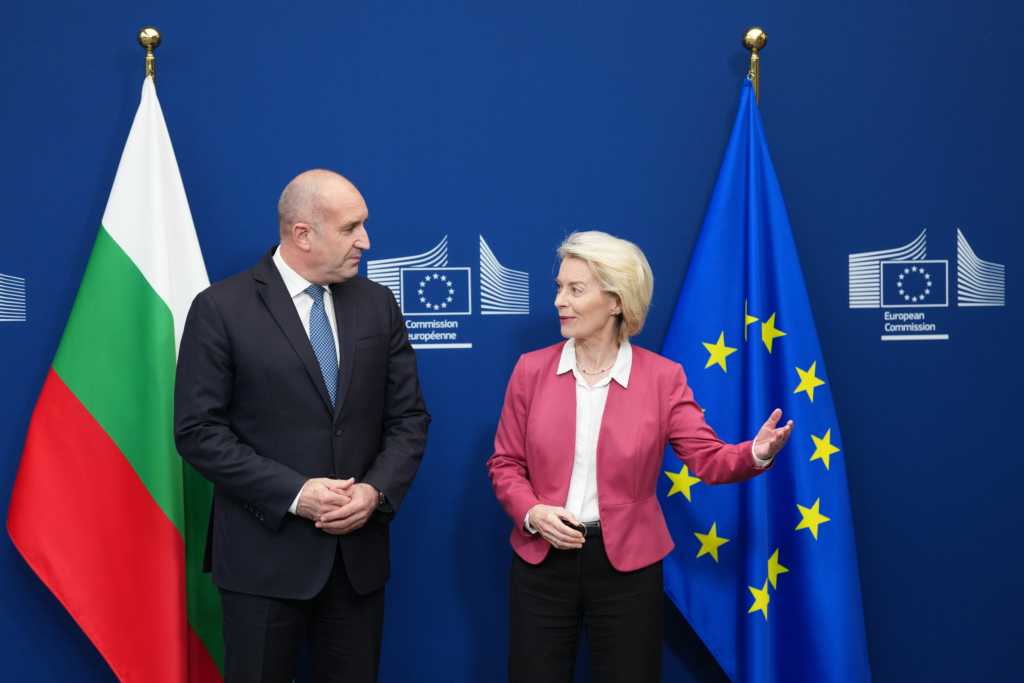
Bulgaria has agreed to host up to eight American refuelling tankers at its Bezmer military base to support US operations in the Middle East. The announcement came just days after prime minister Rumen Radev withdrew his country from the European coalition of the willing (CoW) for Ukraine, arguing that military support would only prolong the war and that Bulgaria lacks the resources to contribute.
Radev has put the final decision on Bezmer to a vote in Bulgaria’s parliament, allowing him to spread the political responsibility and limit direct ownership of the move. Now the prime minister can maintain his rather clumsy position: by rejecting military support for Ukraine (despite previous parliament votes) and justifying logistical support for American military operations elsewhere, he hopes to preserve US security guarantees without dedicating Bulgaria to Europe’s developing security architecture.
These decisions expose a growing inconsistency in Bulgaria’s strategic posture. Sofia is distancing itself from European efforts to strengthen Ukraine and is planning for its own defence, while simultaneously supporting Washington’s military operation in the Middle East. Rather than aligning with the broadly pro-European consensus and anti-American sentiments in Bulgarian society, Radev is attempting to balance competing security frameworks without sufficiently considering European security interests.
This ambiguity also presents a broader challenge for Europe. As the Trump administration continues to conduct foreign policy through bargaining, some European governments appear tempted to pursue bilateral arrangements with Washington rather than invest in European unity. Such behaviour risks weakening collective defence, precisely when strategic coordination is needed.
Solution
European security cannot rely on member states choosing cooperation only when politically convenient. The EU needs to engage more actively with the Bulgarian government and push back on Radev’s form of hedging while political conditions remain favourable, to help strengthen defence cooperation among the EU’s 27 member states.
The EU should also reinforce the political and practical incentives for participation in common defence initiatives, for example through its Multiannual Financial Framework (MFF) and other European defence instruments. At the same time, it needs to reduce opportunities for external powers—particularly China, Russia and the US —to exploit divisions, institutional weaknesses and the strategic ambiguity encouraged by MAGA. Bulgaria’s recent work to delist two Russian oligarchs and a Russian patriarch from the EU’s 21st sanctions package is an example of Russia’s growing leverage over the government in Sofia.
Overall, the EU should treat Bulgaria as an urgent political case rather than a lost cause. This is especially true given that, in 2027, Europe will see several major elections which have the potential to return governments that are more concerned with nationalism than European unity. This, in turn, would constrain the political space in which governments committed to a strong European foreign and security policy can act.
Context
Since taking office in May 2026, Radev has gradually shifted Bulgaria’s foreign policy away from alignment with its European partners. Bulgaria did not join the international agreement to establish the Special Tribunal for the Crime of Aggression against Ukraine, nor did Radev attend May’s B9 summit in Bucharest. Bulgaria’s decision to leave the CoW has attracted strong criticism from pro-European parties and raises broader questions about Bulgaria’s long-term strategic orientation.
The latest move in Bezmer follows the previous deployment of as many as 15 US tanker aircraft at Sofia Airport between February and June, which sparked political controversy. The government ended the deployment, which was linked to arrangements for (unsuccessful) discussions on Bulgaria’s inclusion in the US Visa Waiver Program, on June 30th.
Delays in military modernisation and uncertainty surrounding planned defence-industrial cooperation, including a Rheinmetall partnership, are compounding Sofia’s lack of clarity about whether it intends to become a consistent contributor to Europe’s security architecture. As it stands, Radev appears to be pursuing more transactional, case-by-case relationships with both Europe and the US.
Cover image: picture alliance / Sipa USA | Davide Bonaldo
Problem
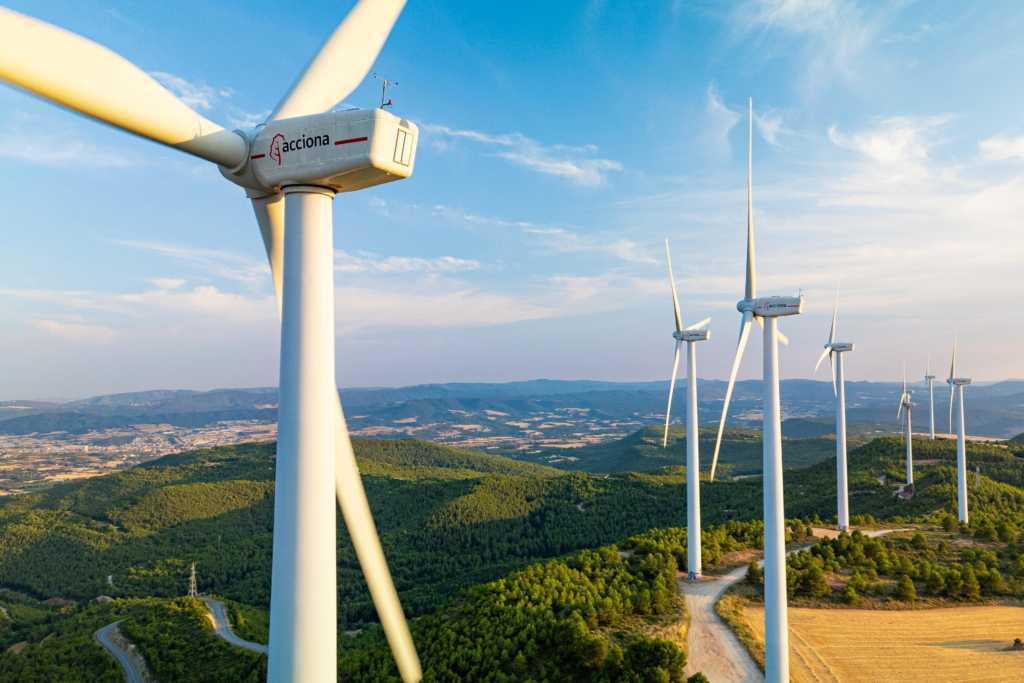
Industrial decarbonisation is not easy. While EU leadership in the field has brought some benefits—it was the first to offer innovative, low-carbon products to the global market, for example—there are also transition costs, especially in sectors such as steel and chemicals.
Now Russia’s full-scale war in Ukraine and the US-Israel-Iran conflict are pushing up energy prices; there is fierce competition from China and others for products such as chemicals, fertilisers and steel. At the same time, companies also face growing emission trading costs. Other parts of the world are not moving fast enough to reduce cost differences for European front-runner companies; the 2025 IEA Breakthrough Agenda report shows that global low-carbon industrial transitions are happening too slowly to achieve the targets of the Paris Agreement.
At the EU level, climate diplomacy is not sufficiently prioritising partnerships for industrial decarbonisation and instead focuses on general mitigation and financing issues. While the launch of the EU Task Force for International Carbon Pricing and Markets Diplomacy in 2024 was an important step, it did not address how Europeans can help develop the infrastructure, access to finance, intellectual property rights and personnel skills necessary for industrial decarbonisation.
The EU thus requires a stronger and more coherent diplomatic approach to industrial transformation. Most of all, it needs to focus on improving its outreach and expanding its offers on finance, market demand and innovation cooperation.
Solution
An informal meeting of environment and climate ministers (ENVI) is taking place on July 23rd-July 24th. It has two relevant items on the agenda: decarbonisation and competitiveness, and climate diplomacy. But these items are interconnected, and ministers should take an integrated approach when addressing them.
The EU should learn from the more active industrial policies of China, Japan and South Korea, which have the institutional capacity to make strategic choices about which technology to support, and have designed a good mix of policy instruments to promote them. Europeans should also look at how European coal regions, for example in Poland, have transitioned to create new green jobs. Such areas provide a blueprint for other countries trying to build public acceptance for closing mines and winding down fossil-dependent manufacturing.
The EU needs to devote more resources to international cooperation with partner countries on industrial transformation, for example by lowering the climate impact of steel and cement production. Such partnerships should be long term and include innovation cooperation for emerging clean technologies. Ministers should include industrial transformation diplomacy in the strategic roadmap document that underpins their discussions, and push for adequate funding in the next “Global Europe” instrument for development policy.
The EU must address the lack of coherence between EU and member state initiatives and promote a “Team Europe” approach. To meet the China challenge, even big member states such as Germany cannot build strong enough partnerships alone. But this requires a more cooperative culture; staffing for climate diplomacy in Brussels and at EU delegations should be increased to facilitate this.
Finally, ministers should engage more positively in the industrial decarbonisation agenda under the Paris Agreement. This could follow Brazil’s 2025 initiative to launch a process for accelerating low-carbon transformations of industry, and Turkey’s ambition to continue this work at COP31 in November 2026.
Context
The EU has set ambitious climate targets for 2030 and 2040, with the bloc aiming to become climate neutral by 2050. However, policy instruments are being hotly debated. For example, on July 17th the European Commission proposed weakening EU emission trading to accommodate industry while simultaneously strengthening its support mechanism for green transitions.
In parallel, EU environment ministers and their climate negotiators have started a process to improve climate diplomacy after what many saw as disappointing, weak language on reducing overall emissions at the 2025 COP30 in Belém. The process has so far focused on improving preparations for formal climate negotiations, such as the upcoming COP31 in Turkey—and less on broader partnerships around, for example, industrial decarbonisation.
Cover image: picture alliance/dpa | Michael Kappeler
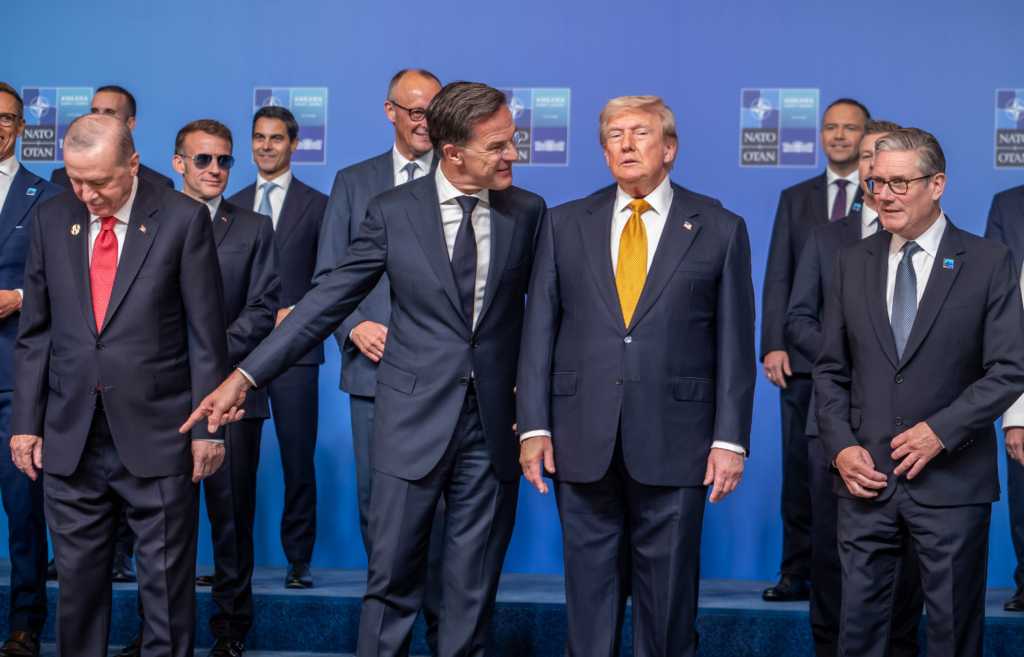
European leaders breathed a sigh of relief as US president Donald Trump departed last week’s NATO summit in Ankara, Turkey. Despite a few unseemly moments in which Trump reiterated his desire to seize Greenland and nonsensically ordered a halt to all trade with Spain, the meeting went off without any major catastrophes.
Most importantly, Trump did not announce any major troop withdrawals from Europe or any moves to leave the alliance. He even had warm words for Ukrainian president Volodymyr Zelensky, and pledged to grant Ukraine a license to manufacture Patriot air-defence missiles domestically. By the end, even Trump proclaimed that there was “love” in the air.
But optics aside, the summit was an absurd exercise. NATO leaders revelled in their pledges to increase defence-related spending to 5%, even though everyone knows that this arbitrary number means nothing in the absence of deeper discussions about capabilities. The figure was pulled out of thin air last year to appease Trump. In the months leading up to the summit, the same leaders had worried that Trump would withdraw the US from the alliance or dramatically reduce its presence in Europe, which would then find itself at the mercy of Vladimir Putin’s Russia.
That is why NATO leaders expended so much energy preparing a summit that would not allow for any unscripted moments. Fears that the mercurial US president would use the occasion to undermine the alliance were palpable. When the moment came, European leaders reportedly fell over themselves to praise Trump, with NATO’s secretary general, Mark Rutte, leading the sycophantic charge.
Some commentators believe that saving NATO and keeping the Western alliance alive was worth this self-abasement. But by kowtowing to Trump and indulgently harking back to the good old days of the transatlantic relationship, Europe’s leaders are risking more than just their dignity.
Consider the period following the fall of the Berlin Wall. After the initial euphoria, many parts of the former German Democratic Republic (East Germany) were emptied out as their populations left, even as property prices were driven up by an influx of wealthier West Germans. The result was a wave of nostalgia for a lost world, expressed in films like Good Bye, Lenin!
The term coined to describe this emotion was Ostalgie (“Eastalgia”), and it has shaped German politics and culture for almost 40 years now. Although many East German writers have criticised such sentimentality for trivialising East Germany’s decades-long repression, some see it as the key to understanding what ails Germany’s eastern regions today. There one finds a widespread refusal to acknowledge that the world has changed, a habit of free riding, and a tendency—occasionally—to look ridiculous, such as when East Germans parrot Russian talking points on Ukraine.
Ironically, Europe’s problem today is not just that Ostalgie has held back eastern Germany; it is that a new malady, Westalgia, has taken hold. It was on full display in Ankara.
Westalgia has several key features. The first is a refusal to acknowledge that the world has moved on. By acting as if US security guarantees are still as ironclad as they were under the Ronald Reagan and George H.W. Bush administrations, and by continuing to purchase US weapons, they hope to turn back the clock. But a better strategy would recognise that America has changed in fundamental ways. Even if a Democrat moves into the White House in January 2029, US retrenchment will continue.
Europe’s hyper-reliance on American power clearly had an infantilising effect
Those who want to turn back the clock naturally see the past through rose-tinted glasses, even though elements of the post-cold war settlement were not to Europe’s advantage. Specifically, Europe’s hyper-reliance on American power clearly had an infantilising effect. Even when caught between a predatory Russia, a fickle US and a coercive China, Europeans are still wont to downplay and underestimate their own power and influence.
The second feature of Westalgia is a tendency to free ride. Just as eastern Germans grew accustomed to the transfer payments and subsidies (the infamous Solidaritätszuschlag, or “solidarity tax”) that flowed eastward after unification, so have Europeans become accustomed to America bankrolling their security. As a result, Europeans have under-invested, not just in defence but also in their industrial base, technological sovereignty and energy independence.
Instead of complaining that US citizens no longer want to be responsible for defending Europe, and instead of spending billions of dollars to satisfy Trump’s vanity, Europeans would be better off having a serious conversation about how they could fight a high-intensity conflict on their own, if necessary. Instead of spending an arbitrary share of their GDP on defence, they should critically evaluate their capability gaps and adjust their spending to match their needs. Coffers are tight everywhere, but it will be easier to justify expenditures on weapons if they appear less geared toward flattering Trump.
Third, in their subservience to the US president, Europeans often do not hide it well, which prevents them from being taken seriously—be it by Trump, Putin, or Chinese leader Xi Jinping. If there is one man who presumably respects Rutte less than Rutte himself, it is Trump. Europe will garner the world’s respect only when it stands up for itself.
Whereas Ostalgie was a bottom-up phenomenon, Westalgia is being driven by elites. Of course, European politicians need to allay their skittish electorates’ fears. But if they want to succeed in the 21st century, they must stop selling nostalgia and start looking to the future.
This article was first published by Project Syndicate on July 15th 2026

 Login