The map of absolute destruction: 42% of the forests in Attica burned in the last 10 years. From 2017 until yesterday, August 3, 2026, a total of 15 major fires have burned more than 800,000 stremma* or 80,000 hectares and approximately 197,684.3 acres acres. The data resulting from the updated analysis of the burned areas […]
Four turtles rescued from a fire-stricken area in northern Greece were found to have been abused by human thugs who painted their shells with orange oil paint.The discovery prompted the intervention of the Prosecutor’s Office in Thessaloniki on Tuesday. The unprecedented incident was revealed when members of the Wild Animal Rescue & Reintegration Team arrived […]
British tourists on the island on Kefalonia showed their gratitude and paid for water bottles for the firefighters battling the big blaze on the island in the Ionian Sea over the weekend. Local media kefaloniapress.gr reported about the spontaneous “Thank you!” incident that apparently occurred on Sunday, August 2. The post published today, Tuesday, August […]
Japan must reinforce and transform its defense capabilities with a stronger “sense of urgency and crisis” than ever before, Defense Minister Shinjiro Koizumi said Tuesday, as Tokyo released its annual white paper that once again flags risks from China, North Korea and Russia.
In the preface to the 598-page Defense of Japan report, Koizumi wrote that the security environment surrounding the country is now the most severe and complex since the end of World War II.
He pointed to the rapid military build-ups by Beijing and Pyongyang, their expanding cooperation with Moscow, and the new forms of warfare demonstrated by Russia’s invasion of Ukraine, warning that a serious crisis capable of shaking the postwar order cannot be ruled out in East Asia.
Japan is already accelerating its military modernization. Defense spending has been pushed higher, with the budget for the current fiscal year exceeding 9 trillion yen for the first time, while Tokyo deepens security partnerships across the Indo-Pacific.
Missile launchers are being stationed on remote southwestern islands closer to potential flashpoints, the Self-Defence Forces are moving to field longer-range “counterstrike” weapons that could hit targets beyond Japanese territory, and rules restricting arms exports have been loosened to allow greater transfers of equipment and technology to like-minded partners.
In the Indo-Pacific, “not only are China and North Korea further strengthening their military capabilities, China-Russia and Russia-North Korea are also reinforcing their cooperation,” he also added.
The new white paper said China was “intensifying its activities” in the region around Japan, “extending beyond the so-called first island chain to the second island chain”.
It listed a series of incidents in 2025, including activities by Chinese aircraft carriers and the “unusual close approach” by Chinese aircraft to Japanese planes in two incidents in June and July.
Japanese jets scrambled 595 times in the year to March 31, 2026, including 366 sorties against Chinese aircraft and 214 for Russian planes. This compares to 704 the previous year and was the fewest since at least 2021.
Japan decided in April to lift its self-imposed ban on weapons exports, but the white paper highlighted issues in the country’s production base that could jeopardize procurement and innovation.
Koizumi also said that he and US counterpart Pete Hegseth had “exchanged candid views” on the “unwavering” US-Japan alliance, while also increasing security cooperation with the Philippines, Australia and South Korea to realize a “Free and Open Indo-Pacific”.
“As the security environment becomes increasingly and rapidly severe, what is required now is to strengthen resilience against crises all across the entire Indo-Pacific region,” Koizumi said.
“In order to do so, Japan will build and expand multilayered networks among allies and like-minded countries, and enhance interconnectivity with like-minded countries and others in every area.”
Meanwhile, China has repeatedly voiced concern at what it sees as a return to “new militarism” by Tokyo.
After World War II, Japan adopted a pacifist constitution in 1947, with Article 9 renouncing war as a sovereign right and prohibiting the maintenance of military forces, seeking a peaceful global order.
“Aspiring sincerely to an international peace based on justice and order, the Japanese people forever renounce war as a sovereign right of the nation and the threat or use of force as a means of settling international disputes. In order to accomplish the aim of the preceding paragraph, land, sea, and air forces, as well as other war potential, will never be maintained. The right of belligerency of the state will not be recognized,” reads Article 9 of the Japanese Constitution.
Japan, the only victim of a nuclear attack in history, also adopted the “Three Non-Nuclear Principles” of non-possession, non-production, and non-introduction of atomic weapons. Even though all five victors of the Second World War built their nuclear weapons.
Japan relinquished wars of aggression, militaristic societies, and the production of nuclear weapons. In the post-war era, Tokyo directed the nationalistic impulses of its country toward becoming an economic powerhouse and technology leader.
Japan became the world’s second-largest economy in 1990 after the disintegration of the Soviet Union.
China’s military muscle-flexing in the South China Sea, North Korea’s missile proliferation, and Japan’s strained ties with Russia, especially after the Ukraine invasion, are forcing Japan to shed its post-war inhibitions and adopt a more assertive defense role.
Former Prime Minister Shinzo Abe played a critical role in Japan’s transformation. Abe had raised the prospect of the country hosting US nuclear weapons facilities on Japanese soil, boosted defense spending, and called for a strong foreign and security policy.
Under Abe, Japan passed legislation allowing the Japan Self-Defense Forces to engage in overseas combat missions. Essentially, this bill allows Japan’s armed forces to help defend its allies, like America, even if Japan itself isn’t under attack. The Japanese Constitution, following the devastation from the war, previously limited Japan’s forces to self-defense within its borders.
In December 2024, Japan approved a 9.4% increase in defense spending for FY2025. This marked another record figure for the 11th year in a row for Japan’s national defense budget. Japan, which has historically spent less than 1% of its GDP on defense, has also promised to raise it to 2% of its GDP by 2027.
This defense spending hike was part of the Defense Buildup Program, which outlines US$273 billion in defense spending over the five-year period through FY2027.
Japan is also building alliances with China’s competitors. It has developed and promoted military ties with several countries in and beyond the Indo-Pacific region. It has strengthened security cooperation with Australia and India—both members of Quad alongside Japan and the USA—through high-level dialogues, joint military exercises, intelligence sharing, and mutual access to each other’s military facilities.
In December 2022, Japan announced a joint program with Italy and the United Kingdom to develop a new sixth-generation combat aircraft—the Global Combat Air Program (GCAP).
Japan is developing two hypersonic weapon concepts: the Hypersonic Cruise Missile (HCM) and the Hyper Velocity Gliding Projectile (HVGP), as well as long-range missiles.
Japan’s Ministry of Defense (MOD) also conducted flight tests for its island defense hypersonic glide vehicle (HGV). Four test launches were conducted at a site in California, with one launch in August 2024, two in November 2024, and one in January 2025.
Japan’s new 10kW-class high-power laser electronic warfare (EW) vehicle recently entered service to counter aerial and missile threats, including hostile unmanned aerial vehicles (UAVs) and low-altitude missile systems.
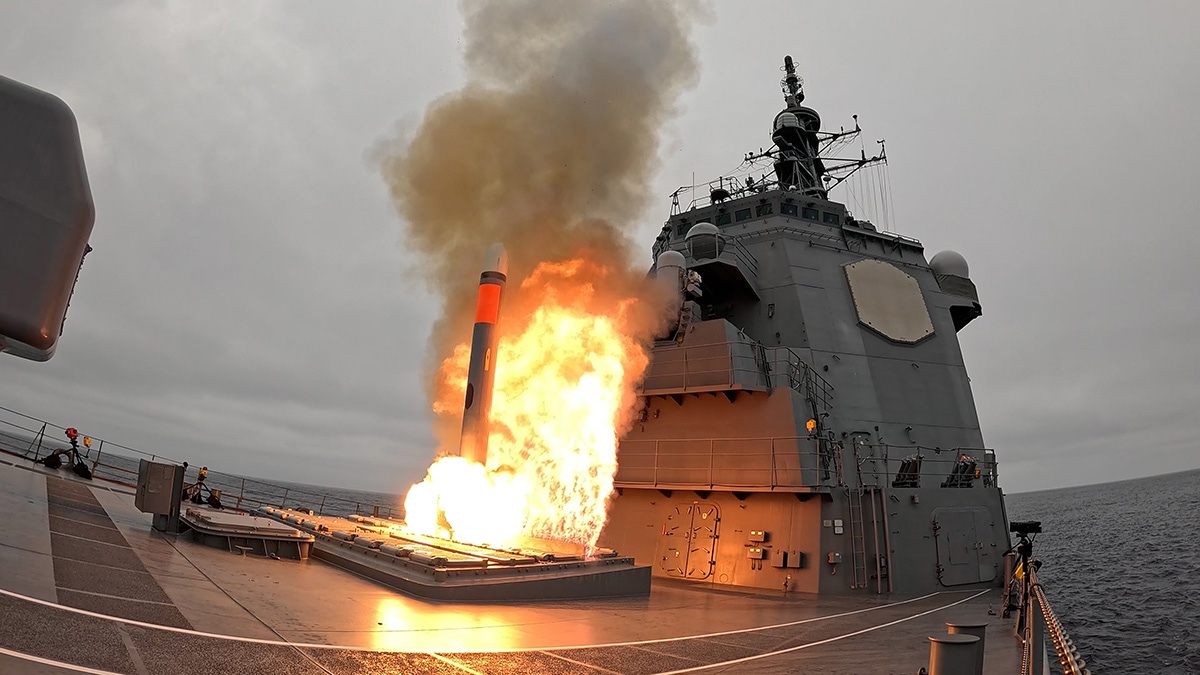
Meanwhile, Tokyo announced on July 30 that it had test-fired a Tomahawk land-attack cruise missile from one of its warships, the Aegis guided-missile destroyer JS Chokai (DDG-176), for the first time.
Additionally, Tokyo fielded the Type 25 Hyper Velocity Gliding Projectile, its first indigenous hypersonic boost-glide weapon, following successful California flight tests and domestic deployment drills that included loading launchers onto ships and aircraft.
In late July, an F-2 fighter conducted the first captive-carry flights of the air-launched Improved Type 12 (Type 25) long-range missile at Gifu Air Base, validating integration ahead of planned service in 2027.
Separately, a 100 kW-class shipboard laser system began sea trials aboard the test ship Asuka in late 2025, targeting drones and projectiles. Japan also conducted its first anti-ship missile live-fire on domestic soil in June 2025, firing a Type 88 from Hokkaido.
These developments highlight Tokyo’s push for stand-off strike and layered defenses amid regional tensions.
The Regional Unit of Attica will remain on Very High Risk of Fire also tomorrow, Tuesday, August 4, 2026, the Civil Protection announced on Monday. According to the Fire Risk Forecast Map issued by the General Secretariat of Civil Protection of the Ministry of Climate Crisis & Civil Protection a Very High Fire Risk (Risk […]
The US Navy has awarded a historic $76.6 billion contract to build 14 new submarines, as Washington races to maintain its dominance over China in undersea warfare.
The deal includes the construction of five Columbia-class nuclear-powered ballistic missile submarines (SSBNs), awarded to General Dynamics Electric Boat (GDEB).
The contracts also provide for the construction of nine Virginia-class nuclear-powered attack submarines (SSNs) during fiscal years 2025–2029. The nine-ship contract was awarded to GDEB and HII-Newport News Shipbuilding (HII-NNS).
Together, these new awards represent a historic investment in maritime modernization and supremacy, with a combined total value of US$76.6B. The award will also strengthen the U.S.’s nuclear triad capacity.
“The awards drive the critical, once-in-a-generation recapitalization of the Navy’s undersea forces and the Nation’s nuclear triad,” according to the U.S. Department of the Navy.
“This historic investment underscores the Department’s continued commitment to undersea superiority and the recapitalization of our nuclear triad,” said Vice Adm. Robert Gaucher, Director, Submarine Programs.
The Columbia-class submarines will replace the Navy’s aging nuclear deterrent fleet, ensuring the continuity of the United States’ sea-based strategic nuclear deterrent.
— Acting Secretary of the Navy Hung Cao (@SECNAV) July 29, 2026
As the most survivable leg of the nuclear triad, the Columbia Class ballistic missile submarine represents a modern platform of national security and remains the Department of War’s number one acquisition priority, the U.S. Navy statement said.
Furthermore, these contract awards support the fielding of enhanced Virginia Class submarines, a platform engineered for unparalleled stealth, heavy payload strike capability, and multi-domain lethality.
The Virginia Class submarine is the premier tactical strike and multi-mission platform, ensuring continuous global undersea dominance, the US Navy said.
“By securing the continuous production of both the Columbia and Virginia classes, we ensure we will continue to deliver the world’s most lethal, survivable and resilient combat platform to our global Combatant Commanders, while providing long-term stability to our shipbuilding industrial base,” Vice Adm. Gaucher said.
The U.S. Navy now has seven Columbia-class submarines under contract, complementing a force of 26 operational Virginia-class submarines with 23 more slated to be built.
U.S. Navy Seeks Revolutionary Submarine-Launched Surface-to-Air Missile
Separately, the U.S. Navy is also seeking a new family of modular surface-to-air missiles, including a version that will arm future variants of the Virginia-class submarine.
The information was provided in a draft request for solutions contracting notice recently posted online.
“The United States Navy (USN) is seeking a new, modular interceptor to serve as the basis for the Naval Modular Missile (NMM) program, a next-generation initiative designed to revolutionize surface naval capabilities through multi-mission utility, enhanced capacity, and a modular open architecture,” according to the recent draft request.
Under this new NNM program, the U.S. Navy seeks to develop at least four distinct surface-to-air missile interceptors.
Though all four NNMs will fall in the broad category of Terminal Stage Interceptors (TSI), the four variants will differ substantially in their role and capabilities.
The four variants are: NNM Multi-Mission Long Range (LR), NMM Extended Range Submarine (ER-S), NMM Dual-Pack Extended Range (DP-ER), NMM Quad-Pack Medium Range (QP-MR).
The NMM ER-S is an extended-range interceptor intended to be launched from future versions of Virginia-class nuclear-powered attack submarines.
Notably, US submarines do not have an operational dedicated SAM system for engaging aircraft or other aerial threats.
Traditional weapons of US submarines are Tomahawk cruise missiles, Harpoon anti-ship missiles, Torpedoes, and Trident ballistic missiles.
Therefore, the development and operationalization of submarine-launched NMM ER-S would add a critical, all-new capability to the U.S. submarine fleet and would provide protection against airborne threats such as anti-submarine warfare (ASW) aircraft, while also contributing to broader fleet air defense.
This would give US submarines a true anti-aircraft capability for the first time, allowing them to engage planes or drones while remaining submerged or semi-submerged.
Furthermore, given that no country has operationalized a submarine-launched surface-to-air missile capability, this would give the U.S. submarine fleet a critical and exclusive defensive capability that will enhance its survivability in contested waters.
However, Germany is also developing its own submarine-launched SAM.
Germany’s IDAS (Interactive Defense and Attack System for Submarines), based on the IRIS-T missile, is designed for fully submerged launch from standard 533 mm torpedo tubes.
Traditionally, submarines were armed with man-portable air-defense systems (MANPADS), and submarines had to surface or expose the conning tower so a crew member could fire them manually. A tube-launched submarine-based SAM would be a revolutionary addition.
The addition of 14 new submarines (Five Columbia-class and nine Virginia-class) and SAM capability on future Virginia-class variants will boost the U.S. Navy’s capabilities as it races to maintain its edge over China in the critical domain of undersea warfare.
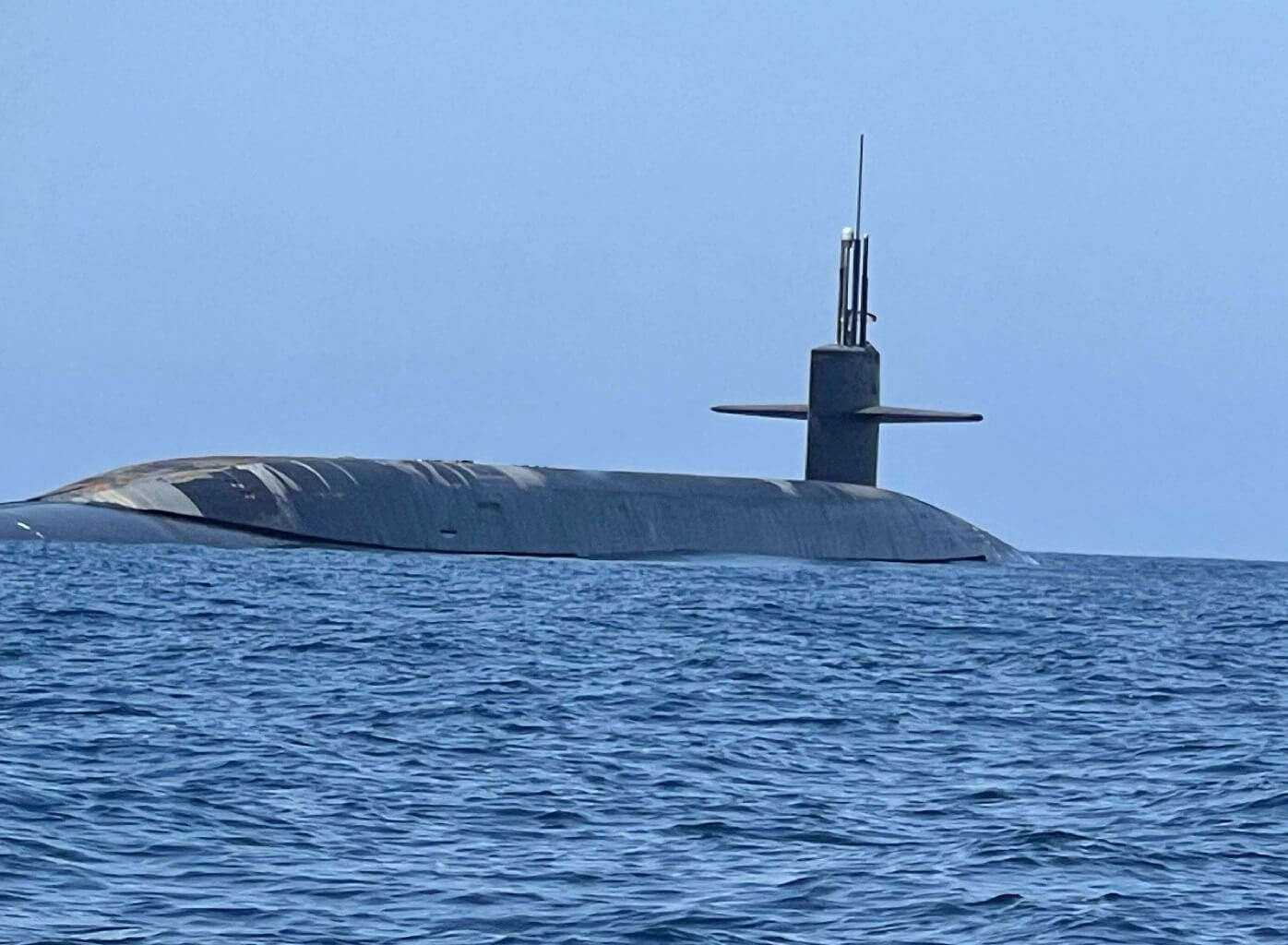
File Image: USS West Virginia Submarine: Via US CENTCOM
U.S. Vs China In Undersea Warfare
China already possesses the world’s largest maritime fighting force, with 234 warships compared to the U.S.Navy’s 219.
However, the U.S. still maintains an edge over China in undersea warfare.
But, according to a Pentagon report on the People’s Liberation Army (PLA), released in December last year, even in submarine fleet strength, Beijing is set to match U.S. capabilities by the end of this decade and might even surpass Washington’s submarine fleet by 2035.
According to the Nuclear Threat Initiative (NTI), the US Navy currently has 71 submarines, all nuclear-powered. However, some latest reports put the strength of the current U.S. submarine fleet at 66.
This list includes 14 Ballistic Missile Submarines (SSBNs), 53 Nuclear-Powered attack submarines (SSNs), and four Guided Missile Submarines (SSGNs).
Similarly, according to the NTI, China has 60 submarines, of which only 12 are nuclear-powered.
China has six Ballistic Missile Submarines (SSBNs), six Nuclear-powered attack submarines (SSNs), and 48 Diesel-electric attack submarines (SSKs). Of the 48 SSKs, 12 submarines feature Air-independent propulsion (AIP), a technology that makes them quieter and allows them to stay submerged longer.
While China has not yet operationalized a nuclear-powered aircraft carrier, Beijing has nearly half a century of experience with nuclear-powered submarines.
China’s first nuclear-powered submarine, which was a loud and slow vessel, entered service in 1974. Since then, Beijing has made considerable progress in improving its nuclear-powered subs. They are now larger, quieter, and faster.
In recent years, China has made particular strides in nuclear-powered submarines, whose greater speed, range, and endurance give its Navy greater reach.
New models under development include the Type 095, which analysts expect to feature vertical launch tubes capable of accommodating cruise missiles.
According to the Institute for National Defense and Security Research, the capabilities of China’s two new nuclear submarines – the Type 095 and Type 096 – match those used by the US and Russia.
Additionally, China is set to add more submarines each year than the US, meaning it will have far greater submarine strength than the US in the future.
According to the US Navy’s long-range shipbuilding and fleet inventory plan 2025, the US submarine strength will drop to 47 by the end of this decade, before hovering in the mid-50s for many years. The fleet isn’t projected to hit 66 until 2054.
On the other hand, China’s submarine strength will rise in the coming years. A 2023 US Department of Defense (DoD) report anticipates that China will grow its submarine force to 80 units by 2035. Nearly 20 of these subs could be nuclear-powered.
According to a 2024 CSIS report, China’s submarine technology is rapidly improving, and its submarine production capacity is growing.
China has added between seven and eight Type 093B submarines in just the past three years, a production rate that exceeds the number of attack submarines China has constructed over the past three decades.
When including conventional submarines, such as the new Type 039C, China’s total submarine fleet launched over the past three years exceeds 15, underscoring China’s impressive submarine-building capacity.
These numbers suggest that in the next decade, China might have nearly 20 more submarines than the US.
However, in qualitative terms, Washington still might have an edge over China. As noted earlier, while all of the US submarines are nuclear-powered, China will have only around 20 nuclear-powered submarines.
The addition of 14 new submarines and a SAM capability are, therefore, key to Washington’s efforts to maintain parity with Beijing in undersea warfare.
Nitin J Ticku holds a double master’s degree in Journalism and Business Management from the University of Glasgow. He has over 20 years of global experience in MARCOM, Journalism, and Digital Marketing, and has worked & traveled widely across Europe, the Americas, and Asia. Nitin is the Editor of the EurAsian Times.
He can be reached at editor (at) eurasiantimes.com
For the fourth consecutive day, firefighters continue to battle the major wildfire in western Attica that appears to be out of control on Monday, despite the weakening of the winds. New flare-ups are non-stop and the fire front seems go in one direction, then change its route, return and sets on fire again what it […]
In June 2025, as Israel and Iran fought a brief 12-day war, Russian President Vladimir Putin was pressed on why Moscow was not providing more direct military support to Tehran.
Rather than answering directly, Putin deftly redirected the question, drawing attention to an often-overlooked reality about Israel: its large Russian-speaking population and the growing political weight of immigrants from the former Soviet Union.
“I want to draw your attention,” Putin said, “to the fact that almost two million people from the former Soviet Union and the Russian Federation reside in Israel. It is almost a Russian-speaking country today. And, undoubtedly, we always take this into account in Russia’s contemporary history.”
As Israel heads into polls in October this year that could close the country’s most difficult period in recent decades, Putin’s words will ring like a warning to Israeli politicians, especially Benjamin Netanyahu, the country’s longest-serving Prime Minister who is facing his toughest poll contest.
Indeed, the votes of Russian-speaking immigrants to Israel, many of whom are also called “Putin Aliyah,” those who migrated to Israel from Russia and former Soviet Union republics during the Putin era, could be the most decisive factor in the upcoming elections.
How Russian-Speakers Became the King-Makers in Israel
In Israel’s peculiar election system, just a few seats could decide the outcome of the country’s upcoming general elections, scheduled for October 27.
Israel’s parliament, the Knesset, has 120 seats, and a party, or a coalition, needs 61 seats to form the government.
However, in the last eight decades, Israel never had a single-party government, and the country has always been ruled by multi-party coalitions.
These 120 Knesset seats are filled by proportional representation and a 3.25% electoral threshold.
The whole country is treated as a single electoral district. Voters do not elect individual candidates or local representatives. Instead, they vote for a party, or a coalition of parties. Seats are distributed roughly in proportion to each list’s share of the national vote, provided the list clears the electoral threshold of 3.5%.
Meaning, all political parties/alliances that receive more than 3.5% of the electoral vote will get seats in the Knesset in proportion to their vote share.
For instance, if a party receives 10% of the total vote share, it will have 12 seats in the 120-seat Knesset.
Given the history of multi-party coalition governments in Israel, and a deeply fractured polity and mandates, 5-10 seats could very well decide the outcome of elections.
In the October elections, Israel’s Russian-speaking population could be the X factor that makes or breaks Netanyahu’s dream of coming back to power for a record seventh time.
Russian-Speaking Population in Israel
According to various estimates, Russian-speaking immigrants constitute 12 to 15% of eligible voters in Israel. However, some reports give a number as high as 17%.
This figure primarily covers immigrants and their descendants from the former Soviet Union/post-Soviet states who arrived mainly in the large 1990s wave.
After Putin launched an invasion of Crimea in 2014, and then attacked Ukraine in 2022, a second large wave of Russian-speaking Jews immigrated from Russia and Ukraine to Israel. These new Russian-speaking immigrants are known as “Putin-Aliyah.” Aliyah is the immigration of Jews from other countries to the Land of Israel.
Russian speakers could number around 1.3 million in the country’s population of 9.6 million.
Russian is described as the third most common native language in Israel after Hebrew and Arabic.
Furthermore, Russian-speakers are known for their high voter turnout and for voting as a bloc.
According to estimates, Russian speakers could influence 14-15 seats in the 120-member Knesset.
Given that in the current Knesset, the largest political party, Netanyahu’s Likud, won 34 seats, whereas the second-largest party, Yesh Atid, won only 24, 15 seats could very well decide who will form the next government.
Furthermore, nearly 125,000 Russian-speakers have migrated to Israel since Putin launched its military offensive in Ukraine in February 2022.
Therefore, in the October 2026 election, the influence of Russian-speaking immigrants in the electorate would be even stronger.
Another 125,000 Russian-speakers had migrated to Israel earlier after the occupation of Crimea by Russia in 2014.
Together, these 250,000 Russian-speaking immigrants, or “Putin-Aliyah,” could influence 5-6 seats in the Israeli Knesset, and the scramble for these votes has already begun.
Voting Preferences of Russian-Speakers in Israeli Elections
“People form norms and habits, and it is very hard to change their minds. Even when reality changes, they adjust their internal priorities to maintain the same voting patterns. For example: ‘Likud is terrible on religion and state issues, but I vote for them out of security considerations.’ That is why the new immigrant community is worth its weight in gold. The vote of this audience in the upcoming elections could set a trend for decades,” political psychologist Dr. Hagay Elkayam-Shalem told Haaretz.
There have been many studies on the voting behavior of these Russian-speaking immigrants. While these studies have reached different conclusions, it is safe to say that the Russian-speakers are not a monolithic bloc.
Elkayam-Shalem’s study of more than 600 Russian-speaking Israeli residents who arrived after 2012 found that 73% described their political views as “moderate” – 25% center-right, 30% centrist, and 18% center-left. Among those who arrived after 2022, more than a quarter identified as left-wing (27%).
Israeli Prime Minister Benjamin Netanyahu attends the annual ceremony on the eve of Israel’s Remembrance Day for fallen soldiers (Yom HaZikaron) at the Yad LaBanim Memorial in Jerusalem on April 20, 2026. (Photo by Marc Israel SELLEM / POOL / AFP)
The same study also found that in the 2022 elections, 45% of new Russian-speaking immigrants supported today’s opposition, and only 13% chose parties represented in the ruling coalition.
If these trends continue, it would mean that Netanyahu will have a hard time convincing these people to vote for his party.
However, Netanyahu and his Likud party were not always this unpopular among Russian-speaking immigrants.
According to multiple studies done by Prof. Zeev Hanin, a professor with the Department of Political Studies at Bar Ilan University and a lecturer at the Department of Israel in the Middle East and Political Science at Ariel University in Judea and Samaria, the Likud won 26.7% of the immigrant vote in the 2019 election, behind 40.2% of the vote share for Yisrael Beytenu; the Blue and White party won 15.1%; and the Kulanu party won 5.8% of the sector’s vote.
The rest of the votes were divided between the Labor party (2.3%), the New Right (3.2%), and Sephardic Ultra-Orthodox party Shas (1.5%).
So, in 2019, Netanyahu’s Likud won the second-highest share of votes among Russian-speaking immigrants in Israel.
However, together with Yisrael Beytenu, the right-wing parties in Israel got nearly 67% of the vote of Russian-speakers.
Hanin explains this preference for right-wing parties among Russian-speakers as the result of their experience in Russia in the troublesome 1990s.
“Immigrants from the former Soviet Union believe in strong leadership more than they believe in the democratic apparatus,” Remennick said. “The drunken democracy they experienced in the 1990s immediately after the dissolution of the Soviet Union was essentially chaos: there was no law and order, no work, and nothing to eat, which is why [Russian President] Vladimir Putin was able to rise to power and stay there for 20 years. People cling to the order and stability that a strong leader can provide.”
However, the voting preferences of Russian speakers are not static and have evolved over time and with changing circumstances.
For instance, they helped Labor’s success in 1992 and contributed to Netanyahu’s narrow 1996 prime ministerial win. They supported Ehud Barak in 1999 and later Ariel Sharon.
However, in the 2022 election, according to Elkayam-Shalem’s study of more than 600 Russian-speaking Israeli residents who arrived after 2012, only 13% chose parties represented in the ruling coalition, including Netanyahu’s Likud party.
Netanyahu is perhaps already aware of the criticality of this bloc and conscious of his falling support among them.
In April this year, Israel’s Channel 14 announced the acquisition of the Russian-language news site Mignews, one of the oldest Russian-language resources in Israel. Channel 14 is often called Israel’s equivalent of Fox News and is considered a mouthpiece for the Netanyahu camp and far-right views.
Another critical factor could be the October 7, 2023, Hamas terror attacks. The Russian-speaking immigrants have historically adopted a hawkish attitude on the Palestine issue and support a strong security state, a preference they might have carried from the security-focused Russian state.
In this new atmosphere where security issues are set to dominate the election debate, many Russian speakers could again shift to the right, which could benefit Netanyahu. A strong showing among Russian speakers could help Netanyahu balance some of his losses in other sections of Israeli society.
Whether or not Netanyahu is able to win back support among Russian speakers, the bloc is set to play the king-makers in the 2026 elections.
Sumit Ahlawat has over a decade of experience in news media. He has worked with Press Trust of India, Times Now, Zee News, The Economic Times, and Microsoft News. He holds a Master’s Degree in International Media and Modern History from the University of Sheffield, UK.
He can be reached at ahlawat.sumit85 (at) gmail.com
As the wildfires in western Attica rage for fourth consecutive day, voluntary organizations give their own battle to rescue animals, mostly pets, cats and dogs, left behind when their owners were ordered to evacuate. Animal lovers and volunteers rushed to rescue the abandoned animals or strays from the fire affected areas, set up provisional collection […]
Greece’s Prime Minister Kyriakos Mitsotakis announced the establishment of an inter-ministerial group responsible for scientific research and the development of a legal framework for the potential deployment of nuclear energy. Greek Prime Minister Kyriakos Mitsotakis is championing small modular reactors. The country could reportedly participate in an investment round for the French EDF’s Nuward. The […]
A search-and-rescue operation in the sea off the island of Symi in the southern Aegean Sea continued on Monday morning in efforts to find a man who was still missing after eight yacht passengers, all German nationals, ended up in the water. The other seven passengers of the yacht have already been located and rescued […]
Nearly 50,000 of the 60,000 young Moroccans who had entered Ceuta, Spain’s 7.5-square-mile enclave on Africa’s coast, on July 29-30, 2026, by swimming around border barriers, may have returned to their country. But the global headlines they were responsible for have had geopolitical impacts on the rest of Europe and the United States.
Prime Minister Pedro Sanchez of Spain called the event “a violation of Spain’s territorial integrity”. But then the fact remains that his left-wing government’s series of liberal migration policies, coupled with the Spanish Supreme Court’s ruling last month that migrants arriving by sea could not be summarily returned, prompted such a massive migration, for which the country was perhaps not ready.
Of course, this was not the first surge from Morocco. As many as 10,000 from Morocco were said to have entered Spain in 2021. But the scale on July 29-30 made it the largest not only in Spain but also in the history of the European Union(EU).
After all, Ceuta, the small Spanish exclave on the North African coast, has a permanent population of just 84,000. Obviously, swarms of 60,000 outsiders totally overwhelmed the locals.
The crisis forces 3 questions: What drove it? What does Spain’s approach mean geopolitically? And how does the debate over religion, demography and identity shape it?
As pointed out above, the influx was possibly triggered by a ruling by Spain’s Supreme Court that a law allowing the prompt handing back of migrants who breach frontier barriers at Ceuta and Melilla, another Spanish exclave, does not apply to those who arrive by sea. (Those who swim, the court reasoned, do not technically breach frontier barriers, since there are none in the water.) Word of this got around on social media in Morocco, prompting the stream of swimmers.
It may be noted that historically, Morocco has contested Spanish sovereignty over Ceuta and Melilla, just 13 to 14 kilometers from its shores through the Strait of Gibraltar. This has led some analysts to believe that Rabat “deliberately did little to prevent the crossings”.
They cite the similar opening that was made in 2021. But this is a minority view, given that Morocco has already facilitated the return of 50,000 of its people and is doing so even now.
The 2021 episode was a little different. That time Morocco allowed its people to wade into Ceuta, as an expression of its anger that Spain had allowed the leader of Polisario, a group that has long fought for the independence of Western Sahara, to come to Madrid for medical treatment. Morocco, incidentally, had annexed two-thirds of Western Sahara, a former Spanish colony, in 1975.
However, over the last four years, diplomatic parleys between Madrid and Rabat have stabilized the bilateral ties. Spain now backs Morocco’s autonomy plan for Western Sahara in exchange for Rabat policing the coast and taking back illegal migrants.
In 2024, Spain started a program to legalize 900,000 undocumented migrants already in Spain (most of them Moroccans) to bring them into the tax and social security. It decided to issue “Labor visas”, under which fast-track permits to address Spain’s rapidly falling population.
The Sanchez regime has tried to legalize immigration as much as possible under what it calls a “human rights and labor needs” approach that envisages expanded regularization programs, bilateral cooperation with Rabat, and faster work permits for migrants in agriculture, tourism, and elder care.
Apparently, Spain has become the EU’s largest entry point for irregular migration, overtaking Italy and Greece. The vast majority of arrivals were from Morocco and the likes of Malians and Senegalese, who crossed through Morocco by sea. So much so that Spain now has the largest Moroccan diaspora in the EU — over 800,000 people of Moroccan origin, as per Spanish data.
Reportedly, the UN projects Spain needs 200,000 net migrants per year to maintain workforce size. And 10 million foreign-born people for the first time in Spain’s history; they now constitute a fifth of the country’s total population, about 50 million.
At 1.1 million, Moroccans happen to be the largest single nationality of all the foreign nationalities. Birth rates among Moroccan-origin residents are said to be higher than those of native Spaniards, but converge to the Spanish average of 1.6 percent by the second generation, per demographic studies.
In other words, Spain’s population would be shrinking without immigration.
However, the geopolitical reactions to what happened in Spain are quite different, particularly on both sides of the Atlantic.
The incident provided armor to President Donald Trump and all his supporters in their fight against what they say is illegal immigration into the US.
As images spread, Trump posted that the Ceuta scenes “vindicated” his wall and deportation policies, arguing Europe was now facing what the US faced in 2019. US conservative media amplified the Ceuta footage as evidence for border closure.
“I saw Spain yesterday, and I watched the catastrophe that took place,” Trump told a meeting of his cabinet at the presidential Camp David retreat in Maryland. “It looks like an invasion of a country by hundreds of thousands of people, and that same thing’s going to happen to us if the Republicans don’t get elected, except worse, much bigger.”
Tech billionaire Elon Musk also commented on the situation in Spain, writing on X that “Spain’s entire budget will be destroyed by illegal migrants” and arguing that offering benefits to migrants would create a “forcing function” for large-scale migration.
There were similar reactions from right-wing parties and EU centrists across Europe, demanding tougher immigration policies.
Far-right Alternative for Germany (AfD) co-leader Alice Weidel claimed in an X post that “Ceuta was left in ruins overnight” by the mass influx from Morocco. She argued that Germany is “likely the destination for most of these migrants”, adding “Germany must prepare itself: borders must be secured and rejections rigorously enforced”.
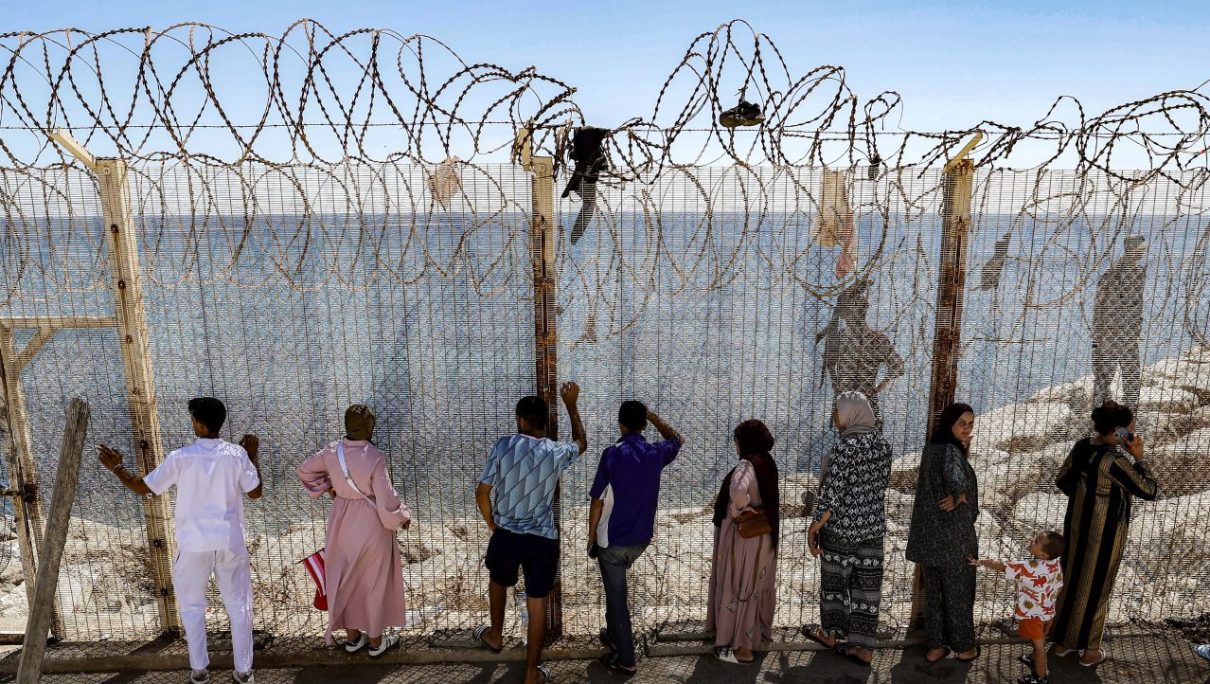
Relatives and friends wait by a fence topped with barbed wire for the return of people who had previously crossed into Spain’s North African enclave of Ceuta, at Morocco’s Bab Sebta border crossing on the outskirts of Fnideq on August 2, 2026. As many as 60,000 migrants entered Ceuta in recent days, mostly swimming around the small border post that juts into the Mediterranean Sea, in an unprecedented surge that prompted an international crisis for Spain. The mass crossing into the tiny Spanish territory resulted in at least 67 deaths, according to Spanish authorities, and led to clashes with Moroccan police on the shared border. (Photo by Abdel Majid BZIOUAT / AFP)
Italian Prime Minister Giorgia Meloni described the scenes in Ceuta as evidence that “uncontrolled illegal immigration poses a concrete threat to the security of Europe’s borders,” saying Italy was prepared to take “extraordinary measures” to defend its borders and the safety of its citizens, including the possible suspension of the Schengen Area with Spain.
The right-wing ruling coalition in Finland also called for excluding Spain from the European visa-free zone as a result of the situation. Czech Prime Minister Andrej Babis said the Ceuta situation was caused by Spain’s policy of offering hundreds of thousands of migrants already in the country a legal status.
In fact, the weekend incident in Spain is said to have accentuated the political turbulence in Europe and strengthened forces, including even conservatives and liberals, to end what was hitherto a “Liberal Consensus” on a liberal immigration policy.
That explains why on Saturday, Denmark’s Prime Minister Mette Frederiksen, German Chancellor Friedrich Merz, and Italian Premier Meloni initiated a letter that got signed by 22 member states, calling for immediate EU action.
“The bloc cannot allow uncontrolled mass crossings, the instrumentalization of migration or other hybrid threats to create the perception that illegal entry into the European Union is possible,” they wrote.
It may be noted here that for years Germany was the face of liberal asylum policy under Chancellor Angela Merkel. Now it has really reversed that under immense political pressure.
The AfD nearly doubled its vote share, especially in eastern Germany, by campaigning on immigration and crime linked to asylum seekers. As a result, the new CDU-SPD coalition started last year the policy of “Stricter border checks” and a “de facto entry ban” for undocumented migrants, including asylum seekers.
Even the British leadership labeled the developments in Spain deeply concerning while highlighting that the UK’s own restrictive operational measures are yielding lower overall small-boat crossing numbers compared to prior tracking periods.
Moving away from past perceptions of a liberal framework to stem the rise of populist Reform Party UK, the ruling Labour Party is now systematically tightening rules through higher salary thresholds, bans on dependents for most students, restrictions on overseas care worker recruitment, and shorter temporary protection grants for refugees.
And still its government is facing intense but growing popular pressure for mass deportations, rigorous enforcement and digital pre-departure checks.
Incidentally, the growing fears in Europe over uncontrolled and illegal immigration seem to have an angle of the fear of “Islamisation”. It may not be the main driver of policy changes, but it is a major factor in the political turbulence around immigration, particularly in Germany, the UK, and France.
There is a growing Muslim population in these countries due to immigration and higher birth rates among the immigrants.
Reportedly, there are 5.5 to 6.5 million Muslims in France, making it the largest Muslim minority in Western Europe. This group makes up about 8% to 10% of the country’s total population. The majority of them have roots in North Africa (Algeria, Morocco, and Tunisia), with smaller groups from Turkey and Sub-Saharan Africa.
Germany’s Muslim population is estimated to be between 5.5 and 7 million, which makes up roughly 6.5% to 8.5% of the country’s total population. The largest group has Turkish heritage, dating back to the guest worker program in the 1960s. Recent growth comes from refugees and migrants arriving from countries like Syria, Afghanistan, and Iraq.
The Muslim population in the United Kingdom is approximately 4 million people, making up about 6.0% to 6.5% of the total population. Islam is the second-largest religion in the country.
The largest share, as much as 66 percent, of British Muslims trace their family roots to the Indian subcontinent, with many arriving in waves during the 1950s and 1960s to fill postwar labor shortages. The rest came mainly from Somalia, Nigeria, Libya, Morocco, Algeria, Afghanistan, Iran, Turkey, and Cyprus.
In these three leading countries, considered to be the engines of Europe, the Muslim immigrants have created what are called economic, cultural, and political concerns over their running parallel societies, sharia law, religious schools, mosques, headscarves, and value clashes over free speech, gender, and LGBTQ issues.
Besides, there are problems relating to issues concerning economics, housing, asylum backlog, crime (the rise of extremism in Islam), and border control.
As it is, the Netherlands, Sweden, and Denmark have already passed laws on face veils, foreign funding of mosques, and “ghetto” laws. Denmark’s Social Democrats explicitly said they wanted “fewer Muslims” to protect their welfare state.
But then, as seen in Spain, these countries also face acute labor shortages, for filling up which most of these Muslims, like others, migrate. In any case, apart from the UK, in no country have Muslims become politically active to endanger the native whites. They do not have high-paying jobs like the skilled and highly educated immigrants, though they are doing very well in the sporting arena.
Therefore, if they are being seen with suspicion, it is because of the changes they have made to mainstream culture.
For many center-right and working-class voters in Europe, that includes concerns about mosques, religious schools, and values. That is why even left-wing parties like UK Labour and German SPD are now tightening controls. They have realized that if one does not address the cultural anxiety, one loses to parties who do or will.
In sum, what the weekend’s episode in Spain seems to have done is raise two questions: whether a liberal-immigration model of Europe will survive by combining open labor markets with credible borders; and whether Europe will still debate culture without dehumanizing people.
Author and veteran journalist Prakash Nanda is Chairman of the Editorial Board of the EurAsian Times and has been commenting on politics, foreign policy, and strategic affairs for nearly three decades. He is a former National Fellow of the Indian Council for Historical Research and a recipient of the Seoul Peace Prize Scholarship.
Opposition parties slammed Prime Minister Kyriakos Mitsotakis over his statement on the devastating wildfires in Greece in his weekly review traditionally posted on social media on Sundays. “Without a trace of self-criticism about the fires” as news website in.gr entitled its relevant report, “he blamed everything on extreme weather phenomena.” At a time when voices […]
The US has been the world’s largest defense exporter for more than three decades now.
According to SIPRI (Stockholm International Peace Research Institute), the United States accounted for 42% of global arms exports between 2021 and 2025.
For perspective, during this period, France was the world’s second-largest defense exporter, accounting for only 9.8% of global arms exports.
However, despite its dominant position in global arms exports, the United States has notably been absent from a particular high-value weapon system market that could have generated billions of dollars in additional revenue for its defense firms.
Ironically, Washington has stayed out of this business despite leading the world in this niche technology for over five decades.
On July 6, Canada reportedly selected the winner of the Canadian Patrol Submarine Project (CPSP) deal, expected to cost nearly US$ 30 billion, with Germany’s TKMS outdoing South Korea’s Hanwha.
Similarly, India is in the final stages of signing a major submarine deal with ThyssenKrupp Marine Systems (TKMS) under Project 75(I).
Both Canada and India are strategic partners of the US. One might wonder why the US defense companies were not even in the running for these “big ticket” deals.
This, despite the fact that the US is not only the world’s largest submarine operator, but its submarines are also some of the most advanced in the world. According to the Global Firepower Index 2026, both Russia and the US operate 66 submarines.
However, while Russia operates a mix of diesel-electric and nuclear submarines, all of the US’s submarines are nuclear-powered.
China is fast catching up with 61 submarines; however, China also operates a mix of diesel-electric and nuclear submarines.
However, Russia (and formerly the Soviet Union) has exported submarines to Algeria, Bulgaria, China, Cuba, Egypt, India, Indonesia, Iran, North Korea, Poland, Romania, Syria, Venezuela, Vietnam and others, and China has exported to Pakistan, Myanmar, Bangladesh and Thailand.
Interestingly, the US, despite its technological lead in the field, has not exported a single submarine to any country in the last 50 years. In fact, the last submarine the US exported was in 1973 to Taiwan.
So, why, despite its dominant position in global arms export and its technological lead in the field, has the US not exported a single submarine to any country in over 50 years?
The US was not always averse to exporting submarines. After the Second World War, the US emerged as one of the world’s largest submarine exporters.
During the war, the US constructed over 200 submarines, and by the time the war ended, the US had 232 submarines in commission.
However, within years of the end of the Second World War, a new Cold War began with the Soviet Union, and the US launched a massive modernization campaign for its submarines.
Under the modernization plan, the US decommissioned hundreds of its late-war-era Balao- and Tench-class diesel-electric submarines.
This left the US with dozens of decommissioned submarines.
At the same time, the US was financing a massive reconstruction plan in Europe under the Marshall Plan and building Europe’s military capabilities to create an effective deterrent against the Soviet Union.
For this purpose, the US decided to export these older, decommissioned, diesel-electric submarines to its allies. Between 1950 and 1970, the US exported nearly 50 submarines to its partners, including Turkey, Spain, Italy, Greece, the Netherlands, Canada, Taiwan, and others.
Most of these were Balao-class diesel-electric submarines built during World War II.
Meanwhile, in 1954, the US launched USS Nautilus (SSN-571), the world’s first nuclear-powered submarine, heralding the era of nuclear-powered submarines.
Nuclear-powered submarines have key advantages, such as unlimited endurance, as they can stay submerged for months, maintain high underwater speeds consistently, and have global reach.
After the launch of USS Nautilus, Washington gradually phased out diesel-electric submarines. After 1954, the US built only three Barbel-class diesel-electric submarines.
By the early 1960s, all new US Navy combat submarines were nuclear-powered. The last diesel-electric attack submarine (USS Blueback) was decommissioned in 1990, leaving Washington with only nuclear-powered submarines.
File Image: USS West Virginia Submarine: Via US CENTCOM
Why Does the U.S. Not Export Nuclear Submarines?
The US nuclear-powered submarines are considered the best in their class; however, to date, Washington has not exported this technology to any country for various reasons.
Firstly, the U.S. Navy has long opposed even the export of diesel-electric submarines due to concerns about the impact of submarine technology proliferation on the ability of its forces to operate securely in coastal waters worldwide.
Submarines fall under the US Munitions List and are subject to the International Traffic in Arms Regulations (ITAR) and the Arms Export Control Act.
When it comes to nuclear propulsion technology, the US Navy is highly sensitive, as it adds extra layers of control under the Atomic Energy Act.
The US nuclear propulsion, quieting technology, sonar, and combat systems are considered among America’s most protected “crown jewels.”
The US has deliberately avoided proliferating this technology to preserve its undersea dominance.
In fact, Washington is so sensitive about submarines’ nuclear propulsion technology that it has refused to share this technology even with its close allies, such as France, Japan, Taiwan, or Canada.
The only two exceptions are the UK and Australia.
The US has a long-standing special nuclear propulsion technology-sharing agreement with the UK, dating back to the 1958 US-UK Mutual Defense Agreement.
The US supplied the reactor for Britain’s first nuclear sub, HMS Dreadnought, and ongoing collaboration allows the UK to design and build its own boats.
However, this is alliance cooperation, not a commercial export.
Similarly, in 2021, the US, the UK, and Australia signed the AUKUS agreement, under which the US has agreed to sell/transfer up to three Virginia-class SSNs to Australia, starting in the early 2030s.
Another issue is US industrial capacity, which is already struggling to meet US Navy demand for Virginia-class submarines.
In its current modernization drive, the U.S. Navy hopes to add two to three Virginia-class attack submarines to its fleet annually until 2043.
In fact, it’s not just the US that is sensitive about exporting nuclear submarines.
Globally, nuclear-powered submarines are operated by only six countries: the US, Russia, China, France, the UK, and India.
The US, Russia (formerly the Soviet Union), and the UK have been operating nuclear submarines for over six decades now.
However, to date, there is only one example of a country exporting/leasing a nuclear-powered submarine to another country.
The Soviet Union first leased a Charlie I-class (K-43) nuclear-powered submarine to India in 1988–1991.
India operated it as INS Chakra.
Further, Russia leased an Akula-class submarine (Nerpa/K-152) to India from 2012 to 2021, which New Delhi operated as INS Chakra II.
The US, the UK, China, France, and India have never exported or leased a nuclear submarine to any country.
In fact, how all countries are highly protective of nuclear-powered submarines can be gauged from the fact that even China refused this technology to its all-weather ally, Pakistan.
Leaked documents revealed that Pakistan formally asked China for nuclear-powered submarine technology and sea-based nuclear second-strike capabilities to counter India.
However, Beijing ultimately refused to provide the technology, citing global non-proliferation commitments and a desire to avoid triggering a regional nuclear arms race.
Instead, China is providing Pakistan with eight Hangor-class diesel-electric attack submarines, under a US$5 billion deal.
However, since the US no longer produces diesel-electric submarines and is reluctant to export nuclear-powered submarines even to its close allies, Washington is effectively out of the global submarine business, which is dominated by countries such as Germany, France, Russia, China, and Spain, and the situation is unlikely to change in the near future.
Sumit Ahlawat has over a decade of experience in news media. He has worked with Press Trust of India, Times Now, Zee News, Economic Times, and Microsoft News. He holds a Master’s Degree in International Media and Modern History from the University of Sheffield, UK.
He can be reached at ahlawat.sumit85 (at) gmail.com
A 26-year-old foreign national has been arrested for the murder of the 38-year-old British woman whose body was found in a suitcase in Kypseli district of Athens last month. The man has reportedly confesses to the murder and a case file was filed against him for manslaughter, robbery and violation of weapons laws. The woman’s […]
Two water-dropping helicopters have been down while operating against the huge wildfire in Psatha, western Attica, on Sunday, August 2, 2026. According to initial information the two helicopters of Bell type collided in the air. The collision in the air has been confirmed by an official announcement of the Fire Service, state broadcaster ERT reported […]
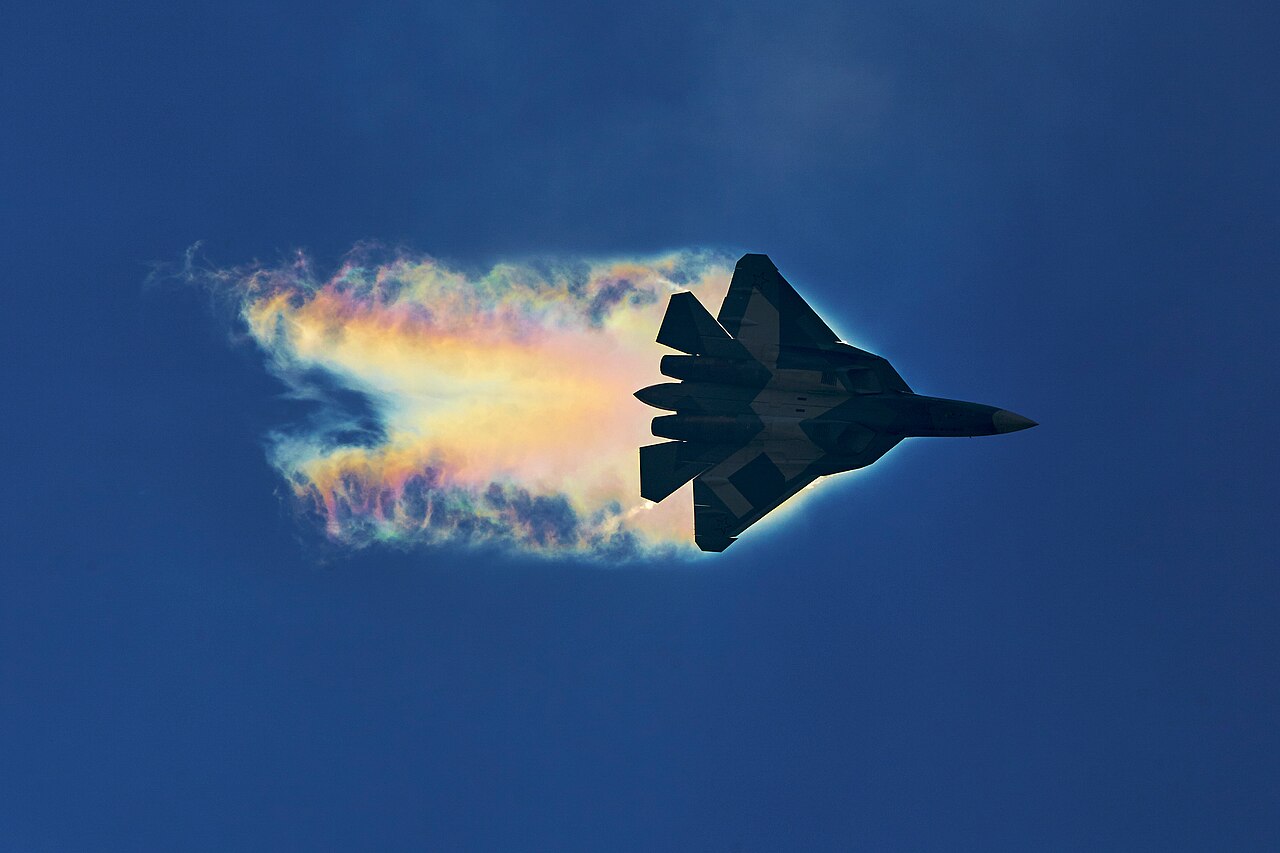
Russia has for the first time officially claimed that its fifth-generation fighter jet, the Su-57, has registered its first air-to-air kill in the Ukraine War, using a hybrid RVV-SDM missile.
Alexander Mikheev, Director General of Rosoboronexport, Russia’s state arms exporter, said that the stealth aircraft has proved its superiority in all aspects of warfare, including hitting targets on the ground and in the air.
This, he said, is fueling a heightened global interest in the Su-57E fifth-generation fighter.
“Rosoboronexport notes increased global market interest in the Su-57E fifth-generation fighter. It has proven its superiority in real combat conditions when countering the most advanced air defense and electronic warfare systems. The aircraft has engaged numerous airborne, ground, and surface targets with Russian air-to-air munitions, including the latest RVV-SDM guided missile,” Russia’s state-controlled news agency TASS quoted Mikheyev as saying.
The RVV-SDM is a new medium-range air-to-air missile introduced by Russia’s Rosoboronexport to arm the export variant of the fifth-generation Su-57E stealth fighter. It features fire-and-forget capabilities, active-passive radar guidance, and high resistance to electronic warfare.
According to Vijainder K Thakur, former Indian Air Force (IAF) pilot and defense analyst, the RVV-SDM is a medium-range missile, most likely a derivative of the RVV-SD tweaked for internal carriage by the Su-57 and improved performance.
While reports of Su-57’s first aerial kill have been doing rounds for some time now, this is the first official acknowledgment by Russia of Su-57’s air-to-air kill in the Ukraine War.
In April 2026, a report attributed to Sergei Lebedev claimed that a Su-57 had destroyed a Ukrainian Air Force aircraft in an aerial engagement over the Mykolaiv region using a long-range missile.
In May 2026, Russian media and Telegram channels claimed that a Su-57 had used a long-range R-37M missile to shoot down a Swedish Saab 340 AEW&C aircraft transferred to Ukraine over eastern Ukraine.
Mikheyev said that Su-57’s combat performance in the war has fueled global interest in the aircraft’s export variant, the single-seat Su-57E. However, despite its best efforts to promote the aircraft in the international market, so far there has been only one confirmed customer of the Su-57.
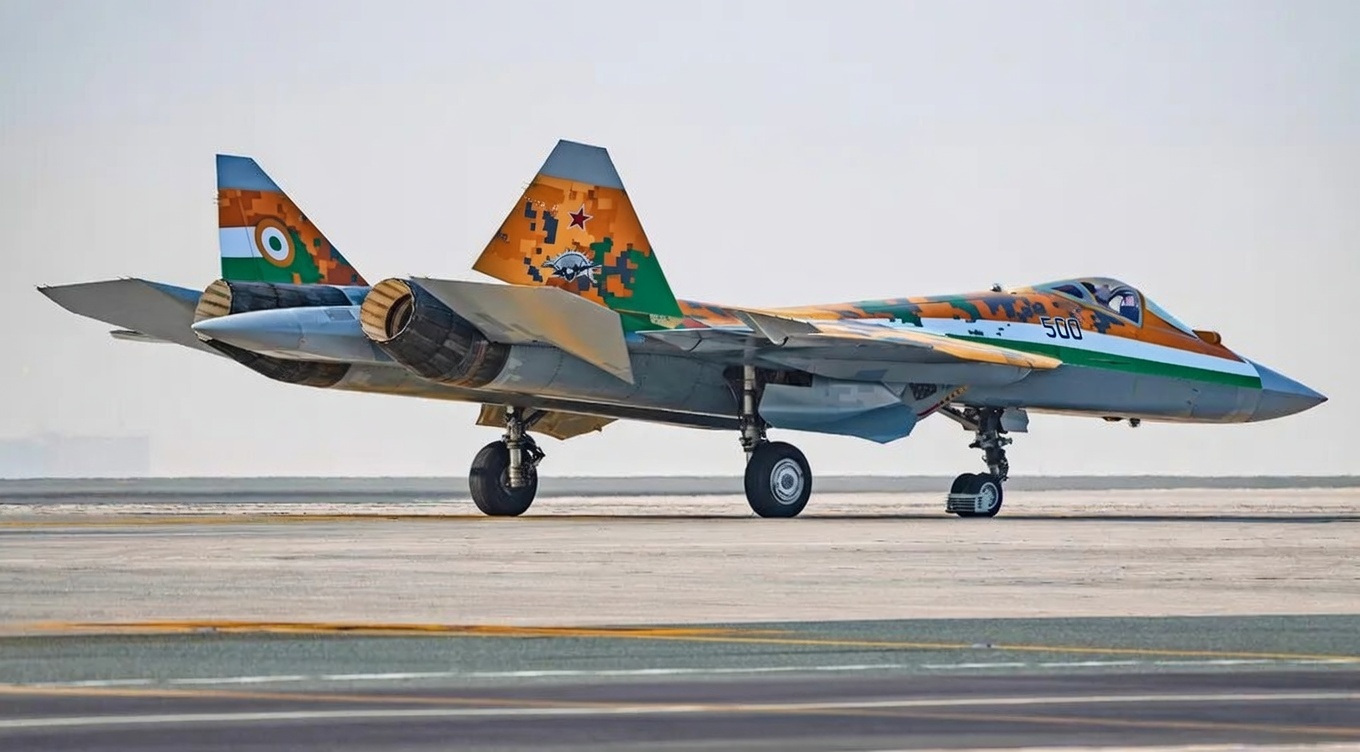
Edited Image: Su-57
Algeria was the first country to confirm the acquisition of the Su-57E. The country, which has a fleet of Soviet-Russian Su-30MKA, MiG-29, and MiG-25 fighters, has bought an unspecified number of aircraft and has reportedly deployed the jet on operational duty.
In November last year, Vadim Badekha, the Director General of United Aircraft Corporation (UAC), which manufactures the Su-57, announced that Russia has delivered two Su-57E stealth aircraft to a foreign client.
“Our foreign customer, our foreign partner, has already received the first two aircraft. They have begun to carry out combat duty and demonstrate their best qualities. Our customer is satisfied,” Badeja said.
Russia is also pitching the Su-57E to India and has even promised full Transfer of Technology (ToT) and to localize the production of the stealth aircraft in India. However, New Delhi has not made a decision yet.
According to Russian officials, the Su-57’s combat experience in the Ukraine War and limited exposure during the Syria war is a key highlight of the stealth fighter jet’s export potential.
Russia has, however, used the Su-57 very cautiously in the Ukraine war. According to security analysts, the aircraft has been mostly used for stand-off strikes from long distances.
Notably, just a few days earlier, a picture emerged showing the Su-57 fitted with R-73 air-to-air missiles attached to its wing pylons rather than in its internal weapons bay.
Carrying the missiles beneath the wing pylons would compromise the Su-57’s stealth; however, if the jet is deployed primarily for anti-drone operations, maintaining stealth is of no use.
Carrying these short-range AAMs externally suggests that the Su-57 load-out was optimized for close-range aerial engagements, most likely against the long-range Ukrainian one-way attack drones and cruise missiles that Kyiv has recently begun using.
Critics argue that Moscow is deliberately limiting the aircraft’s exposure to protect its export potential. Any confirmed losses to Ukrainian forces, they say, would severely damage the jet’s credibility in the international export market.
Still, an official acknowledgment by Russia of Su-57’s first aerial kill will no doubt boost the jet’s credibility, which has so far struggled to find many export customers.
Notably, while the US’s F-35 fighter jet has been in service for 11 years and has seen action in many wars, including in Iraq, Syria, Yemen, Gaza, and Iran, it scored its first air-to-air kill in March this year.
“This is the world’s first shootdown of a manned fighter jet by an F-35,” the statement added.
It must also be noted that Ukrainian airspace is heavily defended by frontline Western air defense systems such as Patriots. This is in contrast to where the F-35 has seen combat, in the poorly defended airspace of Gaza, Syria, Iraq, Yemen, and Iran.
Meanwhile, the USAF’s F-35 fighter jet also got hit by an Iranian drone-missile hybrid in the Iran war, underscoring that even most advanced Western stealth fighter jets are not completely invisible or invincible.
Additionally, while Russia initially faced many issues with the Su-57, including production delays, Moscow has made key improvements to the aircraft in recent years, increasing its lethality and survivability in contested airspace.
Su-57’s Continuous Upgradation
In February this year, Moscow’s Rostec press service said that the Russian Aerospace Forces (VKS) have inducted a new batch of Su-57 fighters featuring a “new technical profile.”
The upgraded version of Russia’s fifth-generation fighter incorporated enhanced onboard systems and a new weapons configuration that significantly expanded the jet’s combat role.
File Image: Su-57. Via Wikipedia
“To fulfill the targets set by the Russian Defense Ministry for the supply of highly sought-after weapons and military equipment to the troops, crews of the Russian Aerospace Forces have accepted the Su-57 aircraft in its new technical configuration,” the Rostec press service quoted a Su-57 pilot as saying.
“The aircraft has already proven itself during the special military operation (Ukraine War). The new technical configuration will provide for the expansion of the range of missions for which this aircraft type is deployed. The advanced capabilities incorporated into the aircraft armament system make it possible to use new types of aircraft weapons,” the pilot added.
While Rostec provided no details of the upgraded onboard systems or the new weapons package, analysis of higher-resolution images released by UAC and examined by OSINT analyst George N. revealed visible changes to the 101KS electro-optical complex, which supports self-protection and missile warning functions.
The 101KS complex is an electro-optical targeting system that provides the Su-57 with all-weather surveillance and passive infrared detection.
The 101KS complements the radar by detecting and tracking targets in the infrared and visible spectra. It can detect heat signatures of missiles and aircraft and conduct passive situational monitoring.
This allows the fighter to operate without active emissions, enhancing survivability in highly contested environments.
The aircraft also received revised apertures, presumably operating across multiple spectral bands, including visible, mid- and long-wave infrared (IIR), and possibly ultraviolet (UV), pointing to a substantial expansion of passive observation capabilities.
The imagery suggested that the 101KS would no longer function solely as a defensive sensor, but rather as a key element of situational awareness, aligned with the philosophy of the AN/AAQ-37 Distributed Aperture System (DAS) carried by the F-35.
It underscored that the Su-57 is moving toward a distributed, passive surveillance capability that can detect and track airborne threats without relying solely on radar.
The announcement came nearly two months after the UAC confirmed it had tested the Su-57 with a new Izdliye 177 engine, a powerplant developed by the United Engine Corporation (UEC) specifically for the Su-57.
The new Izdliye 177 engine was tested with the Su-57 in December 2025. According to a Rostec official, each Izdliye 177 engine can deliver up to 16,000 kg of thrust (approximately 35,000 pounds) with the afterburner engaged.
The new engine will further reduce fuel consumption and is stated to be far more durable than the previous power plant, the Saturn AL-41F1 afterburning turbofan engine.
In fact, the fighter jet has been steadily upgraded since its induction into the VKS in 2020.
Vadim Badekha, CEO of UAC, recently said the platform continues to evolve.
“The fifth-generation Su-57 aircraft system is the best aircraft in its class, but we’re not resting on our laurels. The fighter has undergone a tremendous evolution, and its improvement continues today – the aircraft’s weapons and systems capabilities are being upgraded,” Badekha said.
“This fighter allows us to solve the most important tasks today, demonstrating efficiency and excellent maneuverability and combat capabilities,” he added.
All these upgrades fit within the progressive maturation of the Su-57 program, also known as the Megapolis development program.
Under it, the Su-57 would receive incremental upgrades to its avionics, cockpit, engine, sensors, and weaponry.
Russian engineers claim that the Su-57 is a future-oriented project that will evolve as Moscow’s principal air combat system well beyond 2040.
At the same time, these upgrades will also boost the jet’s export potential.
Sumit Ahlawat has over a decade of experience in news media. He has worked with Press Trust of India, Times Now, Zee News, Economic Times, and Microsoft News. He holds a Master’s Degree in International Media and Modern History from the University of Sheffield, UK.
He can be reached at ahlawat.sumit85 (at) gmail.com
Sparks in wind farm caused the big fire in Viotia and western Attica investigators of the Fire Service found out and arrested two people. The fire was reportedly caused by sparks in the private network transporting the electricity produced by wind turbines to the central network. The electrical engineer and the contractor who had undertaken […]
A large fire broke out around Saturday midnight on the island of Kefalonia triggering the immediate mobilization of firefighting forces and leading to evacuations of several settlements and villages. The fire that broke out in the forest near the settlement of Kremmydi on the south-east of the island in the Ionian Sea and quickly reached […]
Since the outbreak of the US-Israeli conflict with Iran in late February 2026, the six largest Wall Street banks have posted one blockbuster quarter after another. It’s a paradox that isn’t really one: market volatility — the very thing savers and businesses dread — is precisely what trading desks feed on.
Numbers That Boggle the Mind
On July 14, 2026, five of the biggest US banks reported earnings on the same day, and the results surprised even the most bullish analysts. JPMorgan Chase, the nation’s largest bank by assets, posted quarterly profit of $16.9 billion, once again driven by its equities trading division, which “took advantage of market volatility triggered by the war in Iran.” Revenue in that division jumped 35% year-over-year, and equity markets revenue soared 86%.
According to several financial outlets, JPMorgan’s profit — including gains on its equity holdings — actually came close to $21 billion for the quarter, an all-time record for the bank.
Goldman Sachs was no exception: the investment bank also handily beat forecasts, lifted both by conflict-driven volatility and by SpaceX’s record-breaking IPO, which Goldman co-led. Its merger-advisory fees rose 55%, and in the first half of 2026 alone it advised on $1.2 trillion in announced mergers and acquisitions — an unprecedented pace for any investment bank, putting it $425 billion ahead of its nearest rival.
All told, in the second quarter of 2026 alone, the five biggest banks combined (JPMorgan, Bank of America, Goldman Sachs, Citigroup and Wells Fargo) posted roughly $49 billion in combined profit. In the first quarter, the six largest US banks — those five plus Morgan Stanley — had already collectively booked nearly $48 billion in profit, well above year-earlier levels.
Why Does War Benefit the Banks?
The mechanism is no mystery to market professionals, even if it startles the general public. A trading floor doesn’t make money when markets are calm — it makes money when they move. Every geopolitical jolt — a military strike, a rumored ceasefire, a partial closure of the Strait of Hormuz — triggers waves of buying and selling across stocks, currencies and commodities. Every transaction generates fees.
Since the first US-Israeli strikes on February 28, 2026, bond, oil and stock markets have swung wildly with each twist of the conflict and every dashed hope of a truce. That chronic instability has directly fueled investment banks’ trading revenues.
On top of that comes an indirect effect: the war slowed, then unleashed in waves, mergers-and-acquisitions activity and IPOs — two highly lucrative businesses for investment banks, which collect substantial advisory fees on every deal.
Goldman Sachs itself acknowledges as much in black and white in its quarterly financial report filed with the US securities regulator (SEC): the Iranian conflict has had “significant implications for the global economy,” combining disrupted oil supply, higher oil prices and heightened equity-market volatility — precisely the ingredients of the trading desk’s playbook.
A Paradox That Goes Beyond the Banks
This phenomenon isn’t confined to the banking sector. Major oil companies — especially European majors with large trading arms, such as TotalEnergies — have seen profits surge on the back of price swings following the partial closure of the Strait of Hormuz, a route for roughly a fifth of the world’s oil and gas. Defense contractors, for their part, are reporting record order backlogs, led by Lockheed Martin, Boeing and Northrop Grumman, buoyed by allied nations rearming.
Meanwhile, households and non-financial businesses bear the flip side of that same volatility: higher energy prices, costlier freight, and mounting uncertainty for long-term investment. The conflict has thus become a vast transfer of wealth, in which the very instability harming the real economy is simultaneously enriching a handful of financial and industrial players positioned to capitalize on it.
At a Glance
Q1 2026: the six largest US banks combined for nearly $48 billion in profit.
Q2 2026: five of them posted roughly $49 billion in combined quarterly profit.
JPMorgan: record quarterly profit of nearly $21 billion (including gains).
Goldman Sachs: M&A advisory fees up 55%, with its M&A backlog at a five-year high.
Mechanism: market volatility, driven by the twists and turns of the US-Israeli conflict with Iran since February 28, 2026, has mechanically boosted investment banks’ trading and advisory revenues.

 Login