Reading view
This Is the Vaccine that “Public Health Authorities” tricked, deceived, and coerced millions of people into taking
Whatever Happened to White Privilege?
White Female New York Lawmaker Wants to Legalize Theft Because people have need for the things they steal
Caitlin Sums It Up
Strategic Stalemate: Why the U.S. Is Losing the Iran War
After U.S. Navy forces attacked two Iranian oil platforms in the Persian Gulf on 19 October 1987, Wall Street suffered one of the heaviest losses in its history—$560 billion. Black Monday went down in history next to the 1929 stock market crash.[1] But a rising New York property man from Brooklyn was already underscoring the vital importance of not permitting Iran to possess nuclear weapons. That man was Donald Trump.[2]
The Iran war which began with U.S. and Israeli attacks on 28 February this year (following the Twelve-Day War in summer 2025) is in a strategic stalemate. The ceasefire exists only on paper and concerns about escalation are growing.
Since WWII, major democracies have been the ones who started most wars of aggression or got involved in asymmetric wars against smaller states—Afghanistan, Iraq, Somalia, Vietnam, and Algeria. Remarkably, they lost most of them.[3] Today, the U.S., vastly superior militarily and economically, is stuck in an asymmetric war with an extremely uneven distribution of power. Why is the global power, with a military budget exceeding the combined volume of the next ten largest states’ budgets, unable to defeat a middle power?
In an asymmetric war[4] the politically, militarily, and economically weaker party, which cannot defeat the stronger party in an ‘open battle’ (i.e., impose its will on the opponent by kinetic means, to borrow from Clausewitz), employs non-kinetic means along kinetic (military) ones: attacking public opinion through disinformation and a war of narratives, destabilizing the opponent’s public institutions, influencing government policy, and shaping public opinion in its favor—exactly as great Chinese strategist Sun Tzu recommended in the 5th century BC.[5]
This does not mean that Iran is exploiting and fanning the flames of antiwar opinion among the American public or covertly spreading Iranian propaganda in the U.S., for example, by paying American actors.[6] But in an asymmetric war decisions leading to victory or failure lie in the realms of morale, legitimacy, politics, and/or the economy, or a combination of the above, with the dominant factors shifting over the course of the war.[7]
What is important in any war, including asymmetric, is a clearly defined unambiguous political objective. By contrast, the means to achieve this objective can and must be deployable in any combination without restriction.[8] In the book fittingly titled Unrestricted Warfare in the English translation, Chinese military leaders and party officials Qiao Liang and Wang Xiangsui identify different types of warfare according to the dominant means deployed: environmental war (change of the weather and composition of the atmosphere, artificial earthquakes, and engagement through NGOs; psychological warfare; smuggling warfare; media warfare; drug warfare (e.g., fentanyl in the U.S.); resources warfare, economic aid warfare (with development assistance as a disguise for control of a foreign market); cultural warfare (assimilation by cultural hegemony); international law warfare.[9]
The problem for the U.S.—and generally for the collective West and to a certain extent for Russia in the Ukraine war—is the misguided belief that political, military, and/or economic objectives can be achieved through technological superiority alone. This delusion can metapolitically be traced to the Enlightenment ideology of progress, advocating the creation of a kind of technological nirvana—a secular, materialist, atheistic paradise on Earth built with the help of technology. The Chinese military thinkers decry this fallacy on several points, emphasizing that “…in future warfare, certain advanced weapons may play a leading role. However, as for determining the outcome of war, it is now very difficult for anyone to occupy an unmatched position.”[10] Referring to U.S. strategists, they write: “They would rather treat war as the opponent in the marathon race of military technology and are not willing to look at it more as a test of morale and courage, wisdom and strategy.”[11]
Lind cites Gen. Merrill McPeak, Air Force Chief of Staff at the time, who frankly admitted on camera: “Historically, air power has over-promised and under-delivered.”[12] In that respect the hype around drones is also futile. Recent research by the Swiss renowned Center for Security Studies (CSS) clearly shows that: “…while new technologies and the novel adoption and adaptation of existing platforms such as drones function as force multipliers in specific contexts, they have not yet produced a fundamental revolution.”[13] A revolution in military affairs (RMA) is defined not as the use of some new supposed wonder weapon (Wunderwaffe) but as “a profound transformation in the character and conduct of warfare produced by the innovative application of technology in conjunction with fundamental changes in doctrine, organization, and operational concepts.”[14]
To apply the foregoing to the Iran war: first and foremost, the U.S. had no clearly defined objective to the war and therefore no coherent overall strategy. Over the course of the war, the U.S. administration has cited a wide range of aims, which are certainly not clearly defined or unambiguous:
- to prevent Iran’s possession of nuclear weapons;
- to neutralize its military capabilities, such as the missile program, or destroy the Iranian navy;
- to stop Iranian support for proxies (militias) in Palestine/Israel, Iraq, Syria, Lebanon;
- to effect regime change;
- to contain Israel, which would have attacked with or without the U.S., through joint coordination and loss reduction;
- to protect freedom of navigation (after the Iranians closed the Strait of Hormuz).
In fact, this variety of aims reflects the varying views on the Iran war of leading representatives of the U.S. administration. Vice President JD Vance, for instance, whom Trump ordered to Pakistan to negotiate with the Iranians, was against the war right from the beginning.[15]
Another striking fact about the U.S.’s lacking a coherent overall strategy is that the Iranian threat to block the Strait of Hormuz had been known for years. As early as December 2011, Mohammad Reza Rahimi, then Vice-President of Iran, warned that “if sanctions are adopted against Iranian oil, not a drop of oil will pass through the Strait of Hormuz.”[16] So this came as no surprise to Washington and should have been incorporated in the U.S. strategy—particularly when it came to planning countermeasures.
Without clear aims, it is also impossible to communicate clearly. No wonder that most Americans have been against the war from the very beginning. Since its outbreak, almost two out of three Americans have expressed opposition to Trump’s continued attacks against Iran and see the progress of the war as negative for the United States. Even among Republicans, a large proportion (especially in younger age groups) take a highly critical view of the war.[17]
This is where Iran’s strategic closure of the Strait of Hormuz comes into play—at least for Western states and U.S. allies in the region. The blockade has a huge impact on energy supplies, given that a fifth of the world’s oil and gas is transported via that seaway. Fuel prices, in turn, have a direct impact on inflation. A blockade of such transport routes hampers energy supplies essential for many industries. It also affects food production and shipping of fertilizers—which makes food prices rise across the world, and even exacerbates or significantly contributes to famine in some regions. It is therefore not surprising why most Americans want a quick end to the war and welcomed the memorandum of understanding which was to guarantee free passage for at least 60 days and find a follow-on solution for the Strait of Hormuz.[18] U.S. citizens’ concerns in relation to the Iran war do not center around democracy or regime change, they are primarily about gas prices, the deployment of ground troops (which the majority oppose), and their own casualties.[19] Even the notoriously passive House of Representatives, including the Republicans, has voted two times(!) against the continuation of the Iran war.[20]
Iran has been preparing for this war since 1979 and is playing its hand cleverly, not only on the economic plane. Political analyst Mehran Zolfagharieh notes that the Islamic Revolutionary Guard Corpse’s aim is to gain a psychological victory, sap or even eliminate the opponent’s will to fight. Ali Jafari, commander of the IRGC from 2007 to 2019, said: “Asymmetric warfare… is [our] strategy for dealing with the considerable capabilities of the enemy.” In that view, the key capabilities of the Iranian armed forces are manpower, strategic thinking, and willingness to absorb losses while exploiting the weakness of their enemies who tend to be risk-averse, sensitive to losses, and tightly bound to their technology or dependent on it as well as on regional bases.[21]
However, this would mean[22] deploying U.S. ground troops and risking the lives of American soldiers, which, given the American public’s aversion to casualties[23] and opposition to the use of ground troops, would make the Republicans’ stock fall even further—and that in the run-up to the midterms in November. An occupation beyond Kharg would be an adventure with incalculable risks: Iranian big cities and important military bases with nuclear infrastructure are protected by the Elburs Mountains in the north and the Zagros Mountains in the West. In the East, there are the Salt and Lut Deserts. According to some estimates, to occupy the whole of Iran, the U.S. military would need 3,3 million soldiers.[24]
Yet things cannot remain as they are: Iran is still in a position to threaten the U.S. allies and American bases in the region and is likely now to want nuclear weapons more than ever.[25] An important point, not only from the U.S. perspective but also Europe’s, is that control of the Strait of Hormuz remains with Iran, which will probably also demand tolls for passage—possibly even in Chinese renminbi, which would be another step towards de-dollarization.[26]
Iran is exploiting U.S. strategic cul-de-sac: Trump can move neither forward nor backward, and is now exactly where Tehran wants him to be. The lesson of history, applicable to all asymmetric wars, is: “If strategists have little or no confidence that a prospective war can be kept short, then arguably the only prudent policy is not to fight it at all.”[27] This vital point was clear to John Quincy Adams, sixth President of the United States (1825-1829): “Whenever the standard of freedom and Independence has been or shall be unfurled, there will her [America’s] heart, her benedictions and her prayers be. But she goes not abroad, in search of monsters to destroy.”[28]
The 1979 hostage crisis (U.S. Embassy in Tehran), was resolved not through direct military action, but the freezing of Iranian currency reserves, the arms embargo, and support for Iraq in its war against Iran, which, along with subsequent diplomatic negotiations, helped to achieve the U.S.’s aims.[29]
Today, like in the past, it is time to take a diplomatic route, combined, of course, with (military) pressure—not least because no other route is realistic.
Two dead, nine injured from the wildfire in Salamina island near Athens
Two people have died and at least nine suffered burn injuries during the wildfire that broke on the island of Salamina close to Athens in the early afternoon on Sunday, August 16, 2016. The fire allegedly broke out in two fronts in Peristeria and Selinia within 15 minutes. According to initial information, the first fire […]
The post Two dead, nine injured from the wildfire in Salamina island near Athens appeared first on Keep Talking Greece.
Wildfire in Halkidiki out of control: Houses burned, mass evacuations (Videos)
A wildfire that broke out in Siviri on the first leg of Halkidiki peninsula on Thursday has already burned down houses and led to evacuations of big numbers of locals and tourists from the coastal village and surrounding areas. The fire broke out in low vegetation around 2 o’ clock early afternoon on August 13, […]
The post Wildfire in Halkidiki out of control: Houses burned, mass evacuations (Videos) appeared first on Keep Talking Greece.
West Nile virus: 45 new infections in Greece, 9 deaths in total
A significant increase in West Nile virus infections is being recorded in Greece, with 45 new locally acquired cases reported over the past week, bringing the total number to 110 since the start of the 2026 season through 12 August. Of these, 81 patients developed severe central nervous system manifestations, while nine deaths have also […]
The post West Nile virus: 45 new infections in Greece, 9 deaths in total appeared first on Keep Talking Greece.
The media’s go-to ‘electability’ experts are funded by Wall St., Amazon, and health insurance giants

As progressive, DSA, and DSA-adjacent candidates win primaries throughout the US, corporate media is rushing to prop up their favorite “centrist” and “moderate” critics—who, ostensibly, are just looking out for the wellbeing of the Democratic Party—to explain why these candidates people are voting for are actually dangerous and “unelectable.” What the media is refusing to do, on an institutional level, is disclose the glaring conflicts of interests these groups—backed by billionaires, health insurance giants, pro-Israel lobbying firms, and massive corporations —would have in attacking candidates who undermine their sponsors’ bottom lines and ideological agendas.
As progressive, DSA, and DSA-adjacent candidates win primaries throughout the US, corporate media is rushing to prop up their favorite “centrist” and “moderate” critics—who, ostensibly, are just looking out for the wellbeing of the Democratic Party—to explain why these candidates people are voting for are actually dangerous and “unelectable.”
As I noted in TRNN in June, certain personalities and parties with blatant conflicts of interest are being boosted by US media—presented as mere neutral observers who are Deeply Concerned About Electability—to dump on insurgent candidates such as Claire Valdez, Darializa Avila-Chevalier, Melat Kiro and, most recently, Michigan Democratic Senate nominee Abdul El-Sayed. El-Sayed’s primary victory in Michigan signaled serious upward momentum for the latest progressive insurgency within the Democratic Party—and triggered a PR crisis for the Democratic establishment. That momentum was stemmed this week, if only for now, as DSA-endorsed candidate for Wisconsin Governor Francesca Hong was narrowly defeated—a defeat that was reportedly due, in part, to voter concerns over “electability.”
But who shapes “electability” perceptions in our media?
Let’s examine a recent article in The New York Times, which broke the news on August 6, in the wake of El-Sayed’s primary victory, about a $15-million effort by “moderate” group Third Way to attack the DSA specifically and socialism more broadly (despite El-Sayed explicitly being neither a socialist nor a DSA member, but he still champions Medicare for All and cutting US support for Israel, so the distinction to these groups is purely academic). In response to socialist and progressive primary wins, Third Way President Jonathan Cowan told the Times he is “preparing for war” against candidates he views as insufficiently “moderate.” Central to Third Way’s argument are supposed concerns over the “electability” of Democratic candidates facing MAGA Republicans in the November midterms—a motive taken at face value by The New York Times.
Third Way does not publish their donors and refuses to answer media inquiries about who keeps their operation financially afloat.
Not once did Times reporter Shane Goldmacher inquire about or address—much less investigate and unearth—who is funding this operation. The money is simply said to come from Third Way. But Third Way does not generate revenue. They are backed by specific interests. “Who are these interests?” seems like a fairly obvious question that a reporter should ask. Alas, it’s not one Shane Goldmacher seems the least bit interested in.
So who is backing Third Way?
Third Way does not publish their donors and refuses to answer media inquiries about who keeps their operation financially afloat. But reporting in The Nation in 2013 revealed the group was being backed then by the US Chamber of Commerce, Deutsche Bank, Intel, the Business Roundtable, and the Pharma lobbying giant PhRMA (Pharmaceutical Research and Manufacturers of America). More recent digging by The Sludge revealed major donors now include the Republican-run insurance industry front group Better Solutions for Healthcare, PhRMA, CVS Health, pharma giant Johnson & Johnson, and the Business Roundtable. Other major corporate backers include Entergy, Yum! Brands, Amazon, and Meta––all corporations with much to lose in the event Congress passes measures to impose higher taxes on corporations and the rich, or to provide single-payer healthcare for all.
Additionally, Goldmacher quotes two other “centrist” groups in his Times article—the Center for New Liberalism and Welcome PAC—without noting the patronage they receive from billionaire and corporate interests. The Center for New Liberalism, as I documented in 2023, is a front group for Third Way Foundation (which also goes by the name Progressive Policy Institute) and is funded by ExxonMobil, Big Pharma, Big Tobacco, Walmart, and Amazon. (The Third Way Foundation used to be related to the aforementioned Third Way, but is now its own independent corporate front group.)
WelcomePAC, for its part, is funded directly by mega-billionaires: LinkedIn cofounder Reid Hoffman; six different relatives and heirs of Walmart founder Sam Walton (the richest family in America); Bain Capital co-chairman Joshua Bekenstein; Rupert Murdoch’s son James Murdoch; and Mark Heising, the founder of private equity firm Medley Partners, among others.
Shouldn’t these obvious conflicts of interest at least be mentioned? Noted in passing, maybe? Especially in an article specifically about one of these groups spending $15 million to attack “the left,” shouldn’t a reporter be asking where exactly the $15 million came from?
Shouldn’t these obvious conflicts of interest at least be mentioned? Noted in passing, maybe? Especially in an article specifically about one of these groups spending $15 million to attack “the left,” shouldn’t a reporter be asking where exactly the $15 million came from? Or where the money behind these other Deeply Worried Centrist Groups comes from? Isn’t it relevant to note Third Way’s long history of being funded by Wall Street and the health insurance lobby? For a high school reporter, this would obviously be the first line of questions to ask. Presumably, Third Way didn’t just manifest the money out of thin air… So who is footing the bill? And shouldn’t potential voters know who is paying for this campaign, and others like it, to bombard them with falsely “objective” arguments about who is and isn’t “electable” in America?
The Times isn’t alone. Recent softball coverage of, op-eds by, or interviews with Third Way and other “moderate groups” in mainstream media also did not disclose who is bankrolling Third Way, which has quickly emerged as a Sensible Voice opposed to the “radical left.”
Shouldn’t potential voters know who is paying for this campaign, and others like it, to bombard them with falsely “objective” arguments about who is and isn’t “electable” in America?
Last week, CBS News did a five-and-a-half-minute puff interview with Third Day’s Jon Cowan, in which Cowan was given free rein to bash the DSA and El-Sayed without mentioning that Cowan’s salary is paid by private health insurance companies and other corporate America behemoths that would all stand to lose a lot of money and power in the event Medicare For All became a mainstream Democratic position. The Washington Post, likewise, published an op-ed by Cowan and Third Way Executive Vice President Matt Bennett the next day, in which they lambast El-Sayed and other progressives’ supposed lack of “electability” without disclosing who backs their astroturf “think tank.” Earlier that same week, CNN ran an otherwise balanced segment on “The Left Insurgency” that nevertheless featured an interview with Cowan and introduced Third Way as a “Democratic centrist group” without mentioning the corporate funders paying him to go on CNN and lament about “electability concerns.”
Why is discussion of “electability” almost entirely being shaped by astroturfed corporate front groups with obvious conflicts of interest?
It’s not that US media should never report on potential “electability” dynamics—with both the center and left––but why not turn to parties with fewer obvious conflicts of interest? Why not consult independent pollsters or academics? Why not ask Left-aligned experts as well as those on the dole of the Health Insurance lobby? Why is discussion of “electability” almost entirely being shaped by astroturfed corporate front groups with obvious conflicts of interest?
Journalism is supposed to, at least in theory, be about questioning the motives of the powerful, following the money, and connecting the dots. It’s not supposed to be the practice of credulously reprinting the opinions of powerful people presenting themselves as having only the noblest of motivations.
But here’s the rub: these billionaire- and corporate-backed groups, and their media mouthpieces, can’t talk about the forces propping them up, because to do so would give the game away. They can’t openly discuss or defend their attendant ideologies of capitalism, deregulation, imperialism, and Zionism because these are increasingly unpopular among the Democratic voters whose interests they allegedly care about. So what’s left? If they can’t speak openly about their elite patrons and make arguments from first principles, all that’s left is feigned concern over the “electability” of the “other guy.” That’s why it’s all they talk about. They can’t make arguments for “centrism” or against Medicare for All, so all they have is a nonstop posture of Deep Concern Over Electability, which, over time, gets repeated into becoming conventional wisdom despite no empirical basis for the narrative that “moderate” “centrists” are more electable. It apparently doesn’t matter how many times the centrist wing of the party loses Congress or blows it to Trump, they still claim, through sheer assertion and dogma and endless media spots, that they are uniquely positioned to “defeat republicans.” And this is a posture our media pundits echo without an ounce of skepticism.
It apparently doesn’t matter how many times the centrist wing of the party loses Congress or blows it to Trump, they still claim, through sheer assertion and dogma and endless media spots, that they are uniquely positioned to “defeat republicans.”
“Moderate” groups like Third Way are fronts for corporate America and billionaire interests; they’re not just aw-shucks groups of concerned citizens with organic worries about Democrats losing in November. Those claiming to be journalists should ask deeper questions, follow the money, and provide readers essential context that the person being held up as a neutral—if vaguely ideological—expert on winning elections is sponsored by the very health insurance industry that stands to lose a great deal should the progressives they’re bashing ever ascend to positions of power.
FAUCI & CDC KNEW THAT COVID VACCINES COULD TRIGGER MISCARRIAGE (5 videos). As Denounced by Gospa News in 2021 on 3,573 Cases of Fetal Death among Vaccinated Women
by Fabio Giuseppe Carlo Carisio – founder and director of Gospa News
Trump’s Crazy Contradictions on COVID Vaccines
Once again, US President Donald Trump shows he wants to be a double-crosser on riding a wild horse that could unseat him at any moment…
During the White House press conference on the reduction of the US vaccination plan from 17 to 11 vaccines (still one more than Italy after the Lorenzin Decree came into force) and on the renewed safety program on the alarm about correlation between pediatric vaccines and autism (censored by the CDC) he was questioned by a journalist about the issue of the day…
President Trump drops this response to Dr. Fauci being exposed for privately admitting that the COVID vaccine may be linked to miscarriages.
“The Biden administration was a disaster in every way. That would be just one way, but they’ve been a disaster in every single one. It’s unimaginable what they did. “
It’s a shame that this comes after his repeated statements about the success of Operation Warp Speed, with which he himself funded, during the first Trump administration, the production of Moderna’s Spikevax COVID-19 vaccine, developed by Cambridge-based Big Pharma in close collaboration with the military agency DARPA and Fauci himself…
The Moderna vaccine itself was deemed by the WHO to be the most dangerous for pregnant women and therefore not recommended (read below).
Therefore, Trump is fully complicit in the Biden-Fauci disaster, which is why the former White House medical advisor will most likely never go to jail… Indeed, after the November 2026 midterm elections, the issue will likely evaporate from the horizon of Republican senators who are denouncing the scandals.
Fauci and CDC knew about the risk of miscarriage linked to mRNA Covid vaccines
Newly released government text messages (source 1) reveal that Dr. Anthony Fauci privately raised concerns in January 2021 that the immune response following the second COVID-19 “vaccine” dose could trigger miscarriage during the first trimester of pregnancy.
In a text exchange involving then-CDC Director Rochelle Walensky and Vivek Murthy, Fauci noted that fever and the heightened immune response following dose two “theoretically could be associated with miscarriage in the 1st trimester.”
The messages are part of a soon-to-be released cache containing more than 34,000 texts and 522 voicemails recovered from Fauci’s government-issued phone and released by Senators Ron Johnson and Rand Paul (source 2)
We recall that Fauci was charged with contempt of Congress after refusing to answer 111 questions from the Senate Committee established to shed light on manmade SARS-CoV-2 and the censorship related to the risks of mRNA vaccines.
At the heart of the story is a January 2021 text message exchange between Fauci, Vivek Murthy (then Surgeon General), and Rochelle Walensky (then CDC director). In those messages, Fauci wrote that “there is no data or theoretical reason to believe that vaccination is preferable early rather than late in pregnancy.” (source 3)
Pregnant Women’s Concerns About the Genetic Vaccine and Fauci’s Private Confirmation
He also highlighted a warning that would later prove prophetic.
“However, some people (including female healthcare workers) have concerns about administering a ‘genetic’ vaccine in the very early stages of pregnancy,” he wrote.
Nearly two hours passed before Fauci returned to the topic with an aspect he hadn’t mentioned the first time. “I asked around a bit more and another issue came up that you need to be aware of,” he wrote.
“Since many people have significant cytokine storm and fever after the 2nd dose, this heoretically could be associated with miscarriage in the 1st trimester .”

This exchange was never reflected in Fauci’s public statements. On February 3, 2021, in a JAMA livestream event, he stated that the FDA had found “no warning signs” regarding pregnant women.
The White House Advisor’s Lies About Risks to Pregnant Women – VIDEO
Months later, as White House medical advisor, he claimed that the CDC data showed “no indication” of additional risks, arguing that pregnant women should be vaccinated.
“It’s pretty clear that pregnant women should be vaccinated,” he stated. Here he is, in the video reposted on X by Senator Ron Johnson, confidently recommending the vaccination of pregnant women with a smile.
«Fauci on August 30, 2021: “it’s really one of those things that’s kind of not a close call. It really is pretty clear that pregnant women should get vaccinated.”But 7 months earlier he was concerned that the second dose of the COVID shot “theoretically could be associated with miscarriage in the 1st trimester» Senator Johnson comments (source 4).
The messages also show how the three officials weighed the vaccine’s risk-benefit balance against that of the virus, while worrying about public statements that could undermine pregnant women’s confidence in COVID vaccination.
On January 26, 2021, Murthy told Fauci and Walensky that he was “surprised to see the WHO issue a strong statement saying they do not recommend Moderna [sic] for pregnant women,”calling it “a strong statement to make and potentially quite damaging to public confidence among pregnant women.”
A 2024 study confirmed 37 adverse events in pregnancy
«The revelation takes on added significance in light of a recent peer-reviewed pregnancy safety study by Dr. James Thorp and colleagues» writes American epidemiologist Nicolas Hulscher in an article published on his Substack Focal Points. (source 5).
Using CDC/FDA VAERS data through April 26, 2024, they examined 37 pregnancy and newborn adverse events following COVID-19 vaccination and found that every one of the 37 exceeded the CDC/FDA safety signal statistical threshold.

These included miscarriage, fetal malformations, chromosomal abnormalities, placental disorders, fetal growth restriction, premature delivery, stillbirth, neonatal asphyxia, and newborn death.
Alarmingly, the study reported a COVID-19 vaccine miscarriage proportional reporting ratio (PRR) of 114 compared with influenza vaccination and 38.4 compared with all other vaccines.
Gospa News had already denounced the problem in February 2021,by analyzing the data from pharmacovigilance platforms in advance, reporting 3,573 cases of fetal death among the adverse reactions of women vaccinated with mRNA gene sera for Covid-19.
3,573 Fetal Deaths in VAERS Following COVID-19 Vaccines: 1,867% Increase Over Non-COVID Vaccines
Epidemiologist Hulscher: “Vaccines administered despite the risk of miscarriage: It’s diabolical.”
«In simple terms, official CDC/FDA data showed miscarriage was reported far more disproportionately after COVID-19 vaccination than after other vaccines—creating an unusually large safety signal» Hulsher commented

«While senior federal health officials were privately discussing miscarriage risk in January 2021, they went on to aggressively push COVID-19 mRNA injections during pregnancy. Years later, a peer-reviewed analysis found all 37 pregnancy and newborn adverse events examined breached safety-signal thresholds. That is diabolical» the epidemiologist concluded.
It should be remembered that in clinical trials of a new drug, pregnant women, just like the elderly and those more vulnerable due to pre-existing conditions, are generally excluded for safety reasons related to the protection of the fetus and the mother.
The Alarm about the Risk of Miscarriages in Vaccinated Women, raised by Gospa News in 2021
Despite this, once authorized under an emergency measure, vaccines were administered to pregnant women, just as they were to the most vulnerable individuals, even after the publication of numerous medical studies in world-renowned scientific journals that attempted to immediately raise the alarm, promptly reported by Gospa News in multiple investigations since 2021.
Because of these articles, our online newspaper has been censored on almost all socials by international and Italian fact-checkers, and we will soon reveal yet another shameful fact about them, just discovered…
This is why the contribution of our readers is important.
Fabio Giuseppe Carlo Carisio – founder and director of Gospa News
MAIN SOURCES AT THE BOTTOM OF THE ARTICLE
APPENDIX – Walensky Aware of Miscarriage Concern, Still Pushed C-19 Vaccine for Pregnant Women
by John Leak – originally published on Substack Focal Points
McCullough Foundation epidemiologist and administer just posted NEWLY RELEASED FAUCI TEXTS REVEAL HE PRIVATELY WARNED COVID SHOT COULD TRIGGER MISCARRIAGE.
On January 25, 2021, he texted then CDC Director Rochelle Walensky the following.
Nevertheless, in April 2021, Walensky had a published conversation with Dr. Eric J. Rubin (editor of TheNew England Journal of Medicine) in which she vehemently advocated COVID-19 vaccination for pregnant women, even though it hadn’t been tested on pregnant women (source 6).
This was a flagrant violation of the “Golden Rule of pregnancy”—namely, that novel and/or potentially harmful substances are never used when new human life is being formed and nurtured within the womb.
At this time, Drs. Peter McCullough and James Thorp were totally shocked by her recommendation, as both doctors had long taken it for granted that we’d already learned this lesson the hard way from the diethylstilbestrol (DES) and thalidomide disasters.
After Walensky’s approval, millions of pregnant women who wouldn’t have dared drink a solitary glass of wine lined up to get an experimental genetic shot that had been developed “at warp speed.”
Given that Walensky is herself a mother of three children, it strikes me as especially bizarre that she would make this recommendation just two months after hearing Dr. Fauci’s concern about miscarriage risk.
John Leak – originally published on Substack Focal Points
MAIN SOURCES
Source 1 – RON JOHNSON – FAUCI SMS
Source 2 – PEER REVIEWED SAFETY STUDY
Source 5 – NEWLY RELEASED FAUCI TEXTS REVEAL HE PRIVATELY WARNED COVID SHOT COULD TRIGGER MISCARRIAGE.
RELATED POST
TRUMP Begins Fight vs BIG TECH “CENSORSHIP CARTEL” & Fact-Checking firm NEWSGUARD (our Persecutor)
Trump doesn’t rule out ‘national security emergency for elections’ floated by far-right host


This story originally appeared in Common Dreams on Aug. 11, 2026. It is shared here under a Creative Commons (CC BY-NC-ND 3.0) license.
A right-wing talk show host on Tuesday pushed President Donald Trump to declare a “national security emergency” that would let him meddle in the 2026 midterm elections—and the president did not rule it out.
In an appearance on Real America’s Voice, Trump listened as host Wayne Allyn Root rattled off actions he would like to see the president take ahead of the midterms.
“Let me put an idea in your head,” Root told Trump. “Because it’s so hard to get the Senate to do anything, now they’re on recess, they never get anything done. If they never get the SAVE America Act done, you have the right to declare a national security emergency for elections.”
🚨🚨🚨
— Aaron Rupar (@atrupar) August 11, 2026
WAYNE ALLYN ROOT: You have the right to declare a national security emergency for elections. If you do this in the next month, we will get photo ID, proof of citizenship, and a limit to mail ballots
TRUMP: Let me just say stranger things have happened. I'll leave it at… pic.twitter.com/SvXYoYI0lQ
Root then told the president that “if you do this in the next month” it would allow for the implementation of photo identification and proof of citizenship requirements, as well as restrictions on mail-in ballots.
“Let me just say that stranger things have happened,” Trump said in response. “I’ll leave it at that.”
The US Constitution does not give the president power to declare a “national emergency” that would allow him to unilaterally rewrite states’ election laws.
Regardless, ABC News reported in February that a group of pro-Trump attorneys were circulating a 17-page draft order that would use the purported threat of election interference from the Chinese government to declare a “national emergency” that would outright ban mail-in ballots and mandate that all ballots be hand-counted.
Trump has not yet signed such an order, but he has issued other election-related directives, including one that instructs the United States Postal Service (USPS) to not deliver ballots in any states that have not given the federal government access to their voter lists.
The USPS executive order and an order that required Americans to show proof of citizenship when registering to vote have been blocked by courts.
Regardless, some observers expressed concern that the president wasn’t yet finished in his efforts to meddle in the coming elections.
“There is zero reason,” wrote CNN host Jake Tapper, “to not take Trump at his word that he and his team are planning something alarming to disrupt the midterms and beyond.”
Criminal defense attorney Scott Greenfield observed in response to the president’s appearance on Real America’s Voice that “Trump has no legal authority to do this,” but warned “that doesn’t mean he won’t try.”
Journalist Mike Rothschild questioned what the conversation between Trump and Root said about both men’s mental stability.
“Once again, Donald Trump is not a wizard,” wrote Rothschild. “He can’t just manifest things into existence by saying them or with a tweet. There is no ‘right’ to do this in US law, nor is there any mechanism that would enable any of this to happen. Both people in this conversation are deranged.”
After losing the 2020 presidential election to former President Joe Biden, Trump refused to concede the race, lied about the election being “stolen” by nefarious actors, pressured Georgia Secretary of State Brad Raffensperger to “find” enough votes to overtake Biden in the Peach State, and pushed then-Vice President Mike Pence to reject certifying the election despite lacking constitutional authority to do so.
When these efforts to overturn the election failed, Trump encouraged his followers to march to the US Capitol, where they broke into the building, assaulted law enforcement officers, and sent members of Congress running for their lives.
From Boutique Research Institute to Science Strike Force: How Igor Shuvalov Is Relaunching Skoltech
The Skolkovo Institute of Science and Technology has a new rector, a new Kremlin-appointed overseer, and a new mission. In the fifth year of the war, little remains of the old Skoltech — once a calling card of the Medvedev-era thaw and a small but successful innovation university. T-invariant analyzed the data: of the 358 researchers working there in 2021, only 141 still hold a Skoltech affiliation today. The transformation of this unique institution has been far from smooth: the rector post nearly went to Artem Oganov (a scientist known for his provocative public statements), then almost ended up with a close associate of Putin’s daughter. In the end, the university was entrusted to Yulia Gorbunova — dean of the Faculty of Fundamental Physicochemical Engineering at Moscow State University and a full member (academician) of the Russian Academy of Sciences. Her task will be to put Skoltech on a new track — no longer as Russia’s premier globally oriented research center, but as a key pillar of “technological sovereignty.” That sovereignty, judging by the new development program, rests on three pillars: AI, robotics, and drone technologies. T-invariant takes a closer look at why Skoltech was folded into VEB.RF (Russia’s state development corporation — T-invariant), how its leadership was replaced, and what new objectives have been set for it.
In 2026, Skoltech turns fifteen. It was conceived as a new model of the university in Russia, and for all those years it was exactly that. But the state’s vision of what a “new model” should look like has shifted — and the war was decisive in that shift. It transformed the “small innovation university” and “Medvedev’s favorite toy” (as former staff jokingly called it) into an instrument for countering the technological and scientific isolation imposed by the West. The Russian government — perhaps for the first time in the entire post-Soviet era — now knows precisely what it needs science and universities for: survival. And Skoltech will be the testing ground for whether it is possible to produce cutting-edge research and train highly qualified specialists while engaging only with the East and operating under the direct management of the state through VEB.RF.
Sanctions and transformation: how Skoltech has changed over four years of full-scale war
In 2021, several months before the invasion of Ukraine, Skoltech celebrated its tenth anniversary and took stock of its achievements. By that point it had managed to claim 65th place in the Nature Index ranking of young universities — the best result among all Russian institutions. The university’s board of trustees reported record revenue of nearly 250 billion rubles. Skoltech had become home to more than three thousand companies and had generated over 4,500 patents in ten years (including 864 in 2021 alone, of which 262 were filed in foreign countries). Despite Russia’s isolationist and anti-Western course, Skoltech remained a university with internationally recognized standing. It also occupied an unusually strong financial position among Russian universities. While the standard professor’s salary at Moscow State University and the Moscow Institute of Physics and Technology (MIPT) was 150,000–200,000 rubles, at Skoltech it started at 500,000 rubles. And while graduate students at MSU and MIPT received stipends of 5,000–10,000 rubles, at Skoltech it ranged from 75,000–90,000 rubles.
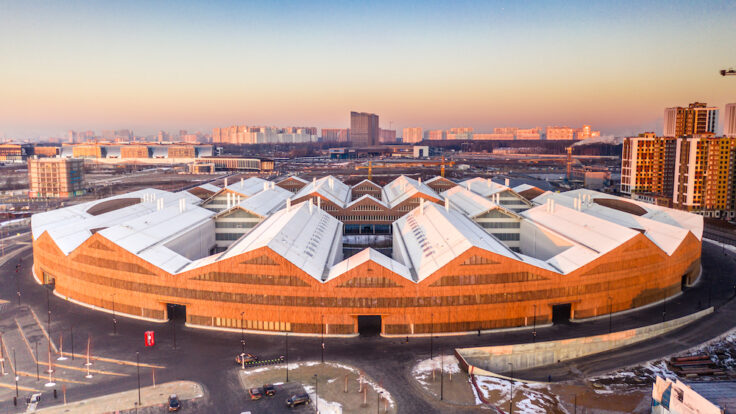
The start of the full-scale invasion of Ukraine ended cooperation definitively between Russian and Western institutions. On February 26, 2022, the Massachusetts Institute of Technology published a statement announcing the termination of its contract with Skoltech in response to “unacceptable military actions against Ukraine.” Shortly thereafter, Skoltech was sanctioned by the U.S. Treasury’s Office of Foreign Assets Control, New Zealand’s Ministry of Foreign Affairs, and Ukraine; Australia, Switzerland, and Japan followed a year later. Today, Skoltech — alongside MIPT — operates under one of the harshest sanction regimes of any Russian university.
The inevitable consequence of the sanctions was a brain drain — among both visiting professors and Russian researchers who were unwilling to remain affiliated with a sanctioned institution. T-invariant analyzed the career trajectories of Skoltech’s staff and examined how the institute’s standing on the international academic stage has evolved.
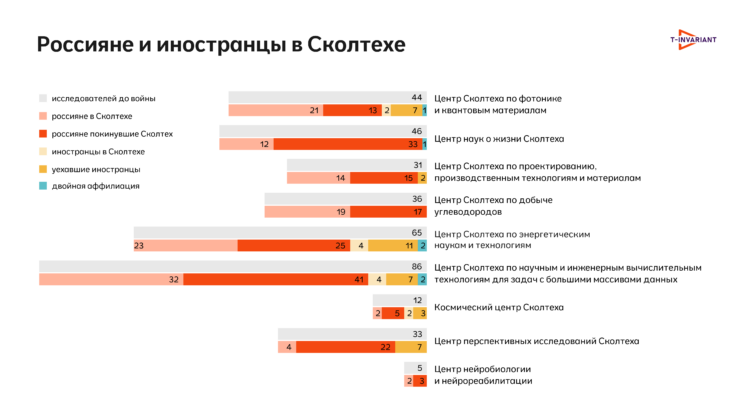
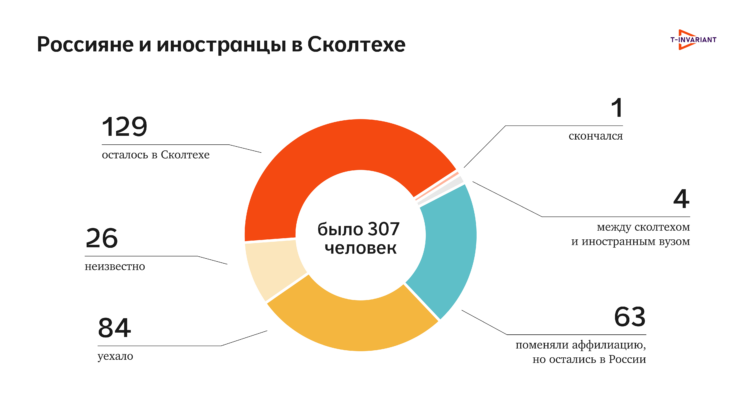
In 2020–2021, at least 358 researchers were working across Skoltech’s nine Centers for Science, Innovation, and Education. That figure includes junior researchers and postdocs as well as tenured professors. By 2026, only 141 of them still hold a Skoltech affiliation. 121 have moved to foreign institutions, while another 63 continue to work in Russia but at other organizations. Six individuals hold dual affiliations — one at Skoltech and one at a foreign university. Researcher Alexei Buchachenko died in 2023. The current affiliations of 26 people could not be identified.
Latest news on scientists’ work and experiences during the war, along with videos and infographics — subscribe to the T-invariant Telegram channel to stay updated.
The most common destination for departing researchers was the United States (28), followed by Germany (17), the United Kingdom (15), France (13), Canada (11), and Israel (10). As sanctions have tightened in the fifth year of the war, it has become extremely difficult for a researcher with a Skoltech affiliation on their CV to find employment in Europe or the U.S. Even in Israel, physics and computer science departments now routinely exclude such Russian researchers from work deemed sensitive to the country’s technological defense capabilities.
Interestingly, when researchers are grouped by nationality — Russian and non-Russian — the disparity between those who left and those who stayed is stark. Of the 51 foreign Skoltech staff members in the early 2020s, 37 left Russia. Among the remaining 307 Russian researchers, only 84 departed. In relative terms, foreign nationals left Skoltech at nearly three times the rate of Russians. This disparity most likely reflects that Russian researchers face greater difficulty finding equivalent positions on the international academic market. The pattern is especially visible in the Center for Hydrocarbon Recovery: none of its 36 staff members are foreign nationals, and only seven have moved to foreign affiliations (three in Saudi Arabia and one each in the UK, U.S., Canada, and Switzerland). Russia’s heavy dependence on hydrocarbon-sector research has kept those researchers in place.
The university, which had an informal reputation as a “flagship of Russian science,” was strongly embedded in international academic networks. In the pre-war year of 2021, Skoltech maintained 54 international cooperation agreements. Its former partners included some of the world’s leading research universities — among them the Technical University of Munich, KU Leuven, and the National University of Singapore. Nearly all of those agreements were either terminated unilaterally by the foreign partners or allowed to lapse at expiration. Many of Skoltech’s former partner institutions have since become new homes for researchers who once held Skoltech affiliations.
Over the years of war, Skoltech has adapted to operating under sanctions and to forge new connections, though it has had to shift its geographic focus — and the new partnerships are fewer and less robust than the old ones. As of April 2026, Skoltech has signed 31 agreements, none of which involve Western countries; more than half (17) are with Chinese universities. None of those Chinese partners appear in the top 100 of either the QS World University Rankings or the Times Higher Education World University Rankings. The list also includes India, Vietnam, Iran, Kyrgyzstan, the UAE, Brazil, Israel, and Oman. The new Skoltech will likely stop losing Russian staff — for whom leaving has become far harder than in the early years of the war — and will instead recruit from Central Asia, Southeast Asia, and the Middle East.
[[socialnetworks]]
Thus, the story of Skoltech as a university integrated into the global academic market and connected to international technology corporations has come to an end. And the final chapter of that story was a change of rector.
No exit, no return: facts and speculation
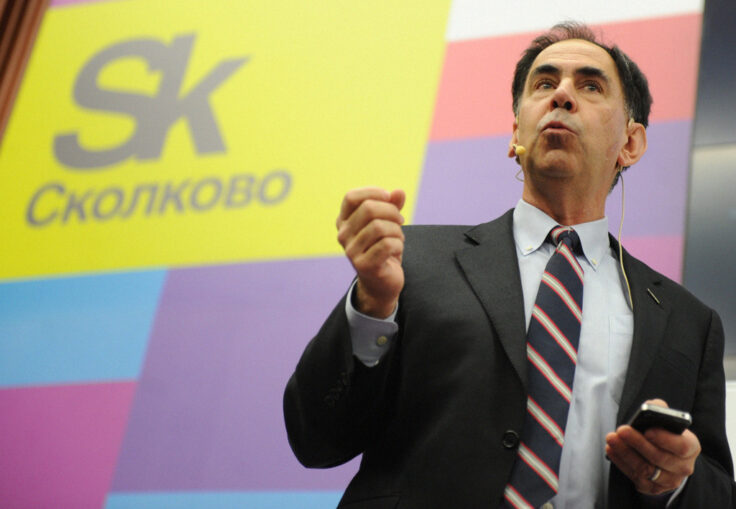
On November 10, 2025, Skoltech’s board of trustees approved a new development strategy through 2030. It was already known that the university would be implementing the strategy under new leadership: ten days earlier, incumbent rector Alexander Kuleshov had told colleagues he would be stepping down in December, though he planned to remain at the university in a different capacity. He showed no sign of concern at the announcement. Kuleshov had led Skoltech for ten years, having succeeded the institute’s first president — American Edward Crawley — in 2016. He had tried to resign several times even before the war. And after Skoltech was hit with sweeping sanctions from the U.S. and Europe, his desire to leave the helm of a struggling institution was entirely understandable. Several candidates were considered to replace him. Among them was Skoltech honorary professor Artem Oganov — one of the institute’s most visible public figures, known less for his research than for his political commentary.
At one point, the decision-makers nearly settled on Denis Kuzmin — director of the Phystech School of Biological and Medical Physics at MIPT and author of the Telegram channel “Kuzmin and School.” The young scientist’s academic and administrative credentials were so far out of line with those of his predecessors — and with the scale and significance of Skoltech itself — that rumors began to circulate: only a very well-placed hand could have put his résumé on the desk of those with signing authority. Whether that hand belonged to Maria Vorontsova (Putin’s daughter) — who interacts regularly with Kuzmin while sitting on various scientific councils — or to Andrei Fursenko, who manages the pipeline of young talent for science administration, remains unclear. It is equally hard to determine whether there is any connection between Vorontsova’s working visit to Skoltech — and her initiative to establish a vivarium there (which was to be followed by an expansion of research directions and increased funding) — and the reasoning that an undertaking of that kind would only be entrusted to someone enjoying unconditional trust.
In any case, a young scientist who had only recently struggled to defend his dissertation would have seemed out of place in the role. In April 2025, Kuzmin managed to defend his doctoral thesis at the All-Russian Research Institute of Agricultural Biotechnology — with difficulty, and not on the first attempt: a preliminary defense at the MSU Biology Department had failed, forcing him to seek out a different committee. In the end, though not without some dissenting votes, the doctoral degree was awarded. The Higher Attestation Commission (VAK — Russia’s national body that ratifies doctoral degrees — T-invariant) still needed to ratify it. Two months later, however, Kuzmin was called before the VAK in connection with the case of his co-author and doctoral student Sorokin, who had defended in the same committee in January 2025. A week before Kuzmin’s own defense — back in April — the deputy minister of science and education had signed an order annulling Sorokin’s degree. Kuzmin’s and Sorokin’s dissertations closely resembled each other; both were defended before the same committee, a few months apart. For Kuzmin, the VAK review concluded successfully: his doctoral degree was confirmed. After all that, the only way to explain Kuzmin’s presence on the shortlist for one of the most prominent rector posts in the country was influential patronage. That said, many who know Kuzmin personally speak positively about him — describing him as someone who “has a realistic sense of his own place in the academic landscape” (as one of T-invariant’s sources put it). So his appointment was expected as something nearly inevitable — but not, in most eyes, as something to dread.
Kuzmin was expected to begin his transition into the role in January, but after the new year Kuleshov was still running the university — his contract had been extended for another year. Then, suddenly, on February 13, 2026, it was announced that his authority had been terminated and that senior vice-president Alexander Safonov — Kuleshov’s longtime deputy — had been appointed acting rector.
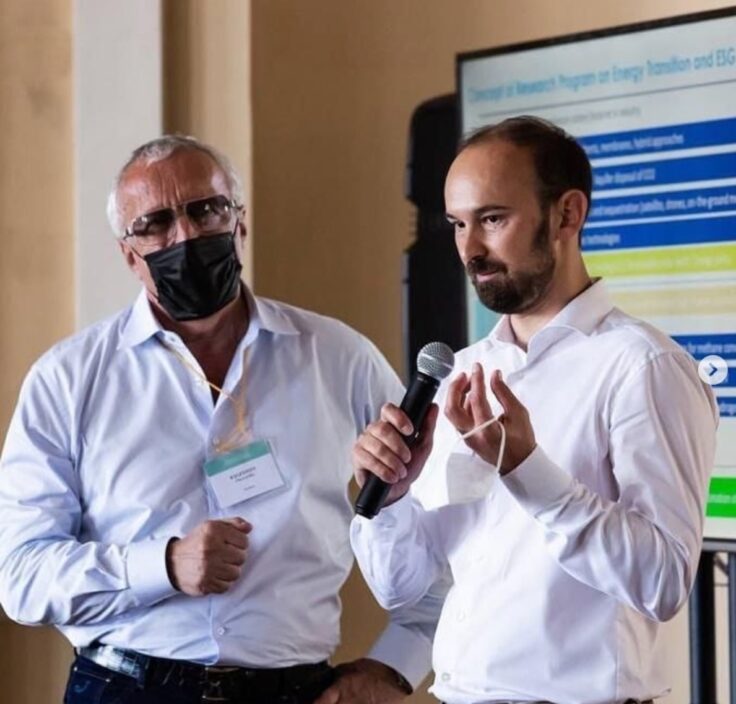
For a moment it seemed as though Kuleshov might be employing the classic “successor gambit” — where a seasoned, well-connected leader steps back into the background and continues managing his former domain from behind the scenes, leaving a loyal protégé as the figurehead. He had done something like this before, when he left the Institute for Information Transmission Problems (IITP) to move to Skoltech — and it ended in a major scandal (T-invariant covered it in detail here). But on February 20, the former rector sent colleagues a farewell letter (a copy of which is on file with the editors).
“Dear friends, I write with sadness to announce that my ten years of work at the Skolkovo Institute of Science and Technology have come to an end. I am proud of what we accomplished during this time. In my very varied life, these may well have been the best ten years. I am grateful to everyone — the professors, students, researchers, and of course the wonderful administrative staff — for what we built together. A single number captures what Skoltech is today: in 2025, there were 31,450 applications for 248 places. We are not simply — or even primarily — a teaching university; we are a ‘technology factory,’ and modern technology is impossible without world-class science. And we managed to achieve exactly that: to combine fundamental science with cutting-edge technology. I won’t turn a personal letter into a technical report, but let me share just one figure: in December alone, more than 1,000 5G base stations were deployed based on our documentation.
I don’t yet know what comes next for me, but I am quite certain I still have enough energy and intellect to start my fifth life. The first four I lived beautifully.
I wish Skoltech as a whole — and its graduates and students — every success. Believe me: a good life awaits you.
Yours, AK
P.S.
My deepest thanks go to our founders, Dmitry Anatolyevich Medvedev and Viktor Felixovich Vekselberg. Without them, none of this would have been possible.”
The letter was interpreted differently by different people at Skoltech. Some saw in it signs of frustration and resentment over unfair treatment. Others saw the opposite — relief: a sense that “I’ll be fine, now you figure it out without me.” But what stunned everyone was that a full member of the Russian Academy of Sciences who had successfully led first an academic institute and then an innovation university had apparently been given no position after his departure. And yet Kuleshov had never left institutions in decline in his wake. In 2015 he left IITP, which under his leadership had become one of the leading interdisciplinary academic institutes in the Russian Academy of Sciences — covering mathematics, biology, and information technology. By 2026, despite severe economic and scientific sanctions from the Western academic community, he had managed not merely to keep Skoltech operational but to develop it. And yet he received nothing — no honorary presidency to provide oversight and guidance, no advisory post with a lifetime pension supplement, not even his own “little domain” in the form of a technology center. That was unexpected.
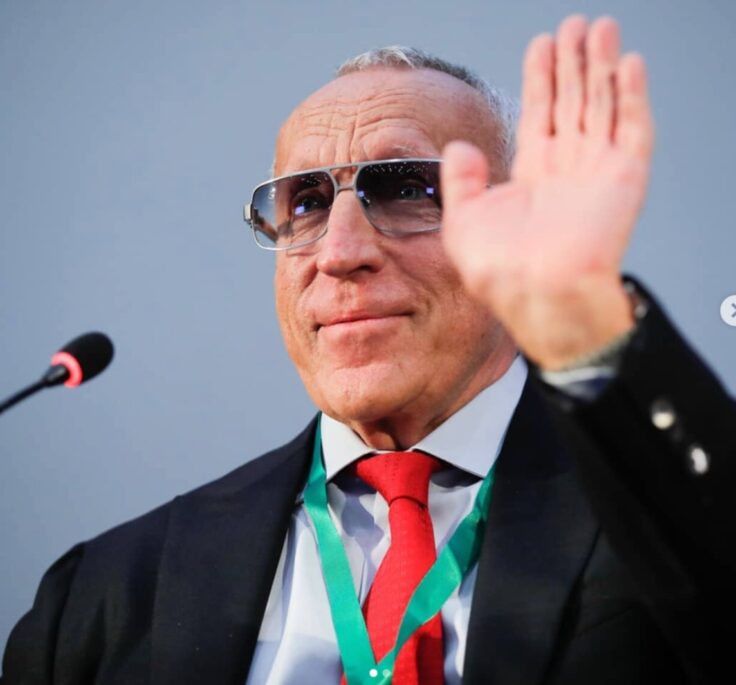
All of this indicated that something had happened between the November academic council meeting — when Kuleshov announced his upcoming departure along the lines of “I’m leaving, but this isn’t goodbye” — and the February board of trustees meeting. The scenario that many had anticipated, including Kuleshov himself — an outside appointee takes the top job while the senior local academic stays on — had evidently been rejected at the highest level. Which meant the role of that senior heavyweight was now open. And it was offered to Yulia Gorbunova — a full member of the Russian Academy of Sciences and dean of the Faculty of Physicochemical Engineering at Moscow State University. She was to become Skoltech’s vice-president for research.
What followed over the next month and a half is described by Skoltech staff themselves as “chaos.” Dividing responsibilities between Gorbunova and Kuzmin in a way that didn’t shortchange either party — while still producing a workable management structure — proved almost impossible. It fairly quickly became clear that this was an unworkable arrangement, at which point Denis Kuzmin withdrew his own candidacy and withdrew from the running. He could only have done so if someone influential had promised to protect him from the Skoltech board of trustees. In the academic world today, very few people hold that kind of influence. Whether it was Kuzmin’s direct superior — MIPT rector Dmitry Livanov — or Maria Vorontsova herself, will likely become clear in the near future. If Kuzmin stays at MIPT, the behind-the-scenes actor was almost certainly Livanov. But if his career suddenly accelerates through other institutions, the speculation about Vorontsova’s role in Skoltech’s leadership transition may turn out to be more than speculation.
None of T-invariant’s sources, however, supports the claim in which Vorontsova personally orchestrated Kuleshov’s removal. The decision to push Kuleshov out of Skoltech entirely is attributed to Dmitry Medvedev, who was presented with a dossier on Kuleshov. Whether that dossier contained financial materials — potentially connected to the Audit Chamber’s recent visit to Skoltech — or was purely ideological in character (Kuleshov had been insufficiently enthusiastic in his support for the government’s policies, made critical public statements, and notably did not sign the letter from Russian rectors in support of the war) — no one knows for certain. One thing was clear: it would likely be difficult for Kuleshov to launch his “fifth life” using whatever “energy and intellect” he mentioned in his farewell letter — say, in France, where his family lives and of which he is a citizen. He has not been personally sanctioned by the U.S. or the EU (no asset freezes or travel bans), but the UK and Ukraine have imposed personal sanctions on him, and with that background he cannot work professionally with U.S. or EU organizations. He had evidently been planning on living his “fifth life” inside Russia — and that is what he ultimately received.

On April 3, 2026, Skoltech’s website announced that the institute had a new rector: Russian Academy of Sciences full member Yulia Gorbunova. The announcement also noted: “Yulia Gorbunova has succeeded Alexander Safonov, who served as acting rector following the end of the term of academician Alexander Kuleshov, who led Skoltech from 2016 and will now take up the position of chief engineer of the institute.”
At the last moment, a man who had already been forced to say his goodbyes was brought back. The key role in this, according to T-invariant’s sources, was played by Viktor Vekselberg. The position of “chief engineer” had not previously existed at Skoltech. Indeed, it is an unusual position title for any Russian university. Only a handful of institutions have introduced it in recent years — such as Irkutsk National Research Technical University or Siberian Federal University. But in those cases, the people who hold the title are twenty or thirty years younger than Kuleshov, who turns 80 on May 2, 2026. This suggests that his “fifth life” has little chance of resembling the one he was living back around 1983, when he served as chief engineer at the NPO Kibernetika research production association.
What, then, might Skoltech become?
Up-to-date videos on science during wartime, interviews, podcasts, and streams with prominent scientists — subscribe to the T-invariant YouTube channel!
The chessboard, flipped
On March 27, VEB.RF chairman Igor Shuvalov announced: “We are currently relaunching Skoltech’s capabilities. You will soon hear about the appointment of a new rector — and that new rector has ties to Moscow State University.” Just a week later, it emerged that the new rector would be carrying out the relaunch under Shuvalov’s own supervision: he became the new chairman of the institute’s Board of Trustees. The previous chairman, Viktor Vekselberg, became his deputy. This was not a repetition of the situation five years earlier, when Shuvalov replaced Vekselberg as chairman of the Skolkovo Foundation’s board of directors. It signaled the beginning of a new chapter for Skoltech — one in which the institute’s role within the Skolkovo Foundation ecosystem is being significantly redefined and is becoming central. What does this mean in practice?
Until now, Skoltech was formally an autonomous university and a part in the Skolkovo Foundation ecosystem — their relationship officially described as a partnership. In practice, it was far from that. The Foundation controlled the university through key mechanisms of control. The primary decision-making body at Skoltech — the Board of Trustees — approves the development strategy, decides on the appointment of the rector, and controls the budget. Its composition changed periodically, but representatives from the Skolkovo Foundation always played a central role. The Foundation also provided significant funding to the institute. Now Skoltech will become a considerably more influential organization within the Skolkovo ecosystem — but far more directly accountable to the state. And Shuvalov’s appointment as chairman of the Board of Trustees clarifies the vague phrase “relaunching Skoltech.” What it effectively means is integrating the institute into the mobilization economy and maximizing output from it. The new board chairman himself put it in more measured terms, announcing that Skoltech faces “an overhaul of its educational model and closer integration into the efforts to achieve the country’s technological leadership.”
From Skoltech’s Development Strategy through 2030:
“Despite its relatively small size and reputation as a ‘boutique’ research institute, Skoltech already makes a quantitative and qualitative contribution to the achievement of national goals. <…> In the national projects aimed at ensuring technological leadership (including ‘Unmanned Aviation Systems’ and ‘New Atomic and Energy Technologies’), Skoltech is a key project executor and sits on expert groups developing roadmaps.”
The policy documents set out the following new priorities:
- Technological sovereignty: developing critically important domestic technologies across the entire pipeline — from scientific concept to serial production of competitive products.
- Developing “Engineering AI”: launching a large-scale program to create foundational and generative models, multi-agent systems, and elements of artificial general intelligence for industrial applications.
- Integrating with the Russian Academy of Sciences and industry: strengthening coordination with RAS institutes and the country’s leading universities, while creating conditions in which technology transfer to business can become a natural extension of scientific research.
- Developing new industry leaders: under the 2026–2030 strategy, the plan is to grow, together with VEB.RF, between 5 and 20 technology companies capable of competing globally and setting new standards.
- Attracting talent (brain gain): Skoltech is expected to become a “magnet” once more for leading scientists and talented researchers from around the world, offering them high-status positions and world-class working conditions.
- New scientific priorities: advanced research in photonics, life sciences, new materials, and energy efficiency.
The state had never before explicitly dictated the research agenda of a specific university. That had never happened in Skoltech’s history either. From the institution’s earliest years, its Board of Trustees had included leading international figures — among them former CIA Director (1995–1996), chemist, MIT professor, and Citigroup board member John M. Deutch; former president of the German Research Foundation and head of the European Science Foundation, biochemist Ernst-Ludwig Winnacker; and MIT professor, expert in systems engineering and space systems design, Edward Crawley. After the first year of the war, the board shrank by half and was reduced to a list of six names: Alexander Kuleshov, Irina Okladnikova, Alexander Vedyakhin, Anastasia Rakova, Dmitry Peskov — chaired by Viktor Vekselberg.
It is obvious that such a composition did not significantly strengthen Skoltech’s international standing. In 2026, two foreign nationals were added to the board: former president of the Hong Kong University of Science and Technology and mathematician Tony F. Chan, and technology executive Simon Bradley, who spent 13 years in various senior roles at Airbus and served as global head of cybersecurity at Siemens. Yulia Gorbunova joined the board as rector.
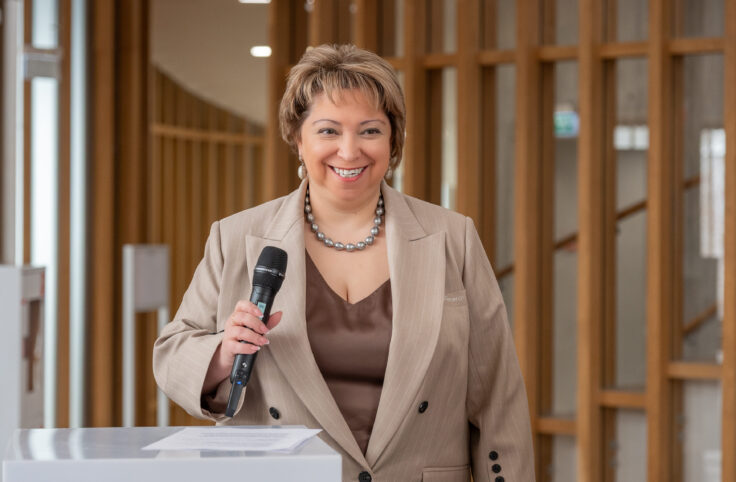
Foreign and Russian colleagues alike describe Gorbunova as a true scientist — a person of deep academic integrity and strong ethical convictions. And yet, even five years ago, the appointment of her to this post would have seemed inconsistent with the spirit of Skoltech, which in choosing its leadership had always placed priority on international experience in universities, corporations, and engineering centers. Gorbunova has spent her entire career within the structures of the Russian Academy of Sciences and Moscow State University, where the approaches and practices are quite different. But in the new political and economic reality, many colleagues see her appointment at Skoltech as the best thing that could have happened to the university at the time of its “relaunch” — at a moment when the state has decided to take a hands-on role in the substantive and operational aspects of scientific work. Her job will be to serve as a buffer in that process. And this role will impose new ethical demands on her, because science is no longer a refuge where one can wait out a dark era. The institutional experience of the Brezhnev years and the post-Soviet period is becoming increasingly less useful for working within a state that intends to operate under siege. Skoltech offers a vivid illustration of how, for the first time, the Russian government has seriously considered what it actually needs science for — and why it needs to be integrated into a new economic model under conditions of prolonged war and sanctions. If before 2022 Skoltech had no real engagement with the defense sector, it will now need to develop one. Staff who were directly involved in Skoltech’s procurement processes before 2022 told T-invariant that nothing resembling defense work was evident there. Agreements with Rostec and Uralvagonzavod, according to those sources, were largely framework arrangements that produced no tangible results. In that sense, Kuleshov was being completely candid with his 2022 comments on the sanctions imposed on Skoltech:
“We have nothing to hide — everything here is open. The only true statement in the State Department’s announcement is the first one: that Skoltech creates critically important technologies for the Russian economy. Everything about defense contracts and specific companies — Uralvagonzavod and the rest — is entirely unfounded.”
He repeatedly stated that Skoltech was an open civilian institution with many foreign professors on staff (which made classified defense research effectively impossible), and that the real aim of the sanctions was to accelerate the “depletion of Russia’s intellectual potential.”
This was partially corroborated by Skoltech professor Igor Krichever:
“Skoltech was sanctioned because it launched with significant publicity — not because any defense contracts were being run there. I chaired the committee responsible for hiring professors, and I can say confidently that never did I see anything defense-related at the institute. There were no defense contracts at Skoltech either.”
Now there will be. Otherwise it will be impossible to maintain Skoltech’s exceptional financial position among Russian universities. In the pre-war era, that position was driven by the need to stay competitive on the global academic market. Now different arguments are needed — and the only one that is persuasive is the ability to serve the Russian government’s core survival needs. That is why no one is likely to ask Skoltech’s new rector about the reasons for the sanctions. The answer to that question will be obvious.
Support T-invariant’s work by subscribing to our Patreon and choosing a donation amount that suits you.
The post From Boutique Research Institute to Science Strike Force: How Igor Shuvalov Is Relaunching Skoltech appeared first on Т-инвариант / T-invariant.

La lutte contre le racisme anti-Noirs doit devenir une priorité mondiale
Les propos tenus par la sénatrice paraguayenne Celeste Amarilla à l’encontre de Kylian Mbappé sont d’une gravité qui dépasse largement le seul cas du joueur français. Ces déclarations, à caractère suprémaciste et déshumanisant, portent atteinte à la dignité de millions de personnes noires à travers le monde qui subissent encore les conséquences de préjugés racistes. […]
L’article La lutte contre le racisme anti-Noirs doit devenir une priorité mondiale est apparu en premier sur .
West Nile virus infections increasing in Greece, summer 2026
The number of West Nile virus infections in Greece continues to rise, according to an announcement of the National Public Health Organization (EODY), which on Wednesday reported 23 additional locally acquired cases over the past week. Since the start of the surveillance period and up to 5 August, 2026, a total of 65 locally acquired […]
The post West Nile virus infections increasing in Greece, summer 2026 appeared first on Keep Talking Greece.
Regions, cities warn EU budget overhaul could derail affordable housing investment
Brussels (enr) – Local and regional leaders raised concerns that the next multiannual EU budget risks undermining investment in affordable homes needed to alleviate Europe’s deepening housing crisis.
“Europe’s housing challenge is not simply about building more housing units,” said Kata Tüttő, President of the European Committee of the Regions (CoR), an EU advisory body home to democratically elected regional and local representatives from all 27 Member States.
At a gathering in Brussels on Thursday, they demanded the EU “move from political ambition to concrete investment and delivery,” arguing that failing to invest now will only put affordable housing further out of reach for millions of Europeans.
As negotiations over the EU’s next long-term financial framework gather pace, cities and regions fear that affordable housing could become a casualty of competing spending priorities as several EU member states seek to cut the European Commission’s proposed €2 trillion budget for 2028-2034.
Tüttő called on the European Investment Bank (EIB), the EU’s lending arm, to “mobilise the scale of investment” that cities and regions need to “make communities liveable” by providing essential infrastructure. She cited public transport, as well as energy and water infrastructure, as key examples.
Italian MEP Irene Tinagli, Chair of the European Parliament’s Special Committee on the Housing Crisis (HOUS), said addressing the housing crisis “requires investment, better coordination across all levels of government and a shared commitment from European institutions, Member States, regions and cities”.
The CoR and EIB on Thursday agreed on closer cooperation in key areas including social infrastructure, housing, and energy. The European Investment Bank’s president, Nadia Calviño, said “investing into resilient cities and regions, into cohesion and housing” was a strategic priority.
According to EIB figures, the world’s largest multilateral development bank provided a record €5 billion in financing for housing projects across Europe in 2025. The EIB is targeting an increase to €6 billion this year, Calviño confirmed.
The investments are a contribution to the European Commission’s Affordable Housing Plan, which was launched in December and aims to boost housing supply, mobilise public and private investment, and support Member States and regions in expanding social and affordable housing.
According to the Commission’s estimates, however, the EU needs to build 2 million homes each year to meet current demand, which amounts to an investment of approximately €153 billion per year.
This story was produced by the European Newsroom (enr) in cooperation with the European Committee of the Regions (CoR). The editorial responsibility lies with the enr.
From Trade Settlements to Human Connectivity: A Practical Solution for BRICS Common Payment Space
Financial sovereignty has gradually moved from specialists’ attention to the forefront of strategic economic discussions. Over the past decade, BRICS countries have made substantial progress in developing alternative settlement mechanisms, expanding the use of national currencies in bilateral trade, and strengthening institutional frameworks for financial cooperation. These achievements are tangible and significant.
Yet, as the transformation of the global economy continues, new priorities are emerging. The structure of cross-border economic activity has changed. While interstate and corporate transactions remain vital, a growing share of cross-border payments now involve individuals: tourists, students, medical travelers, remote workers, freelancers, and small entrepreneurs. Importantly, these actors are not only beneficiaries but drivers of economic integration.
The existing international financial architecture was designed in a different era and for different purposes. Serving the global economy, it has been primarily focused on large-scale institutional and trade-related flows. Its retail dimension—money transfers of people moving across borders—has received far less attention.
This gap is becoming increasingly relevant for BRICS.
The task is to complement existing systems with new mechanisms that would comply with contemporary human mobility and economic exchange.
Why the Present International Financial Infrastructure Is No Longer Fully Effective
The international payment systems that dominate today were developed during the period of unipolarity and relative geopolitical stability. They have facilitated decades of global economic growth. However, the world has changed. Emerging economies now account for a significantly larger share of global production, consumption, and trade. New economic corridors have appeared across Eurasia, the Middle East, Africa, and Latin America.
Cross-border transactions have become more varied. Alongside traditional corporate financial flows, there is a substantial volume of citizen-to-citizen and citizen-to-business transactions. A student paying tuition abroad, a tourist purchasing services in another country, a freelancer receiving payment from an overseas client are not marginal financial activities; these money transfers amount to hundreds of billions of dollars annually and involve hundreds of millions of people. However, individuals often face practical difficulties in getting access to their domestic financial resources while traveling or doing business abroad. These difficulties are a natural consequence of a system that no longer fully aligns with the realities of a multipolar and highly mobile global economy.
Meanwhile, recent technological developments have demonstrated that many of these difficulties can be overcome. National payment systems such as Russia’s MIR, India’s UPI, China’s digital payment ecosystems, and Brazil’s PIX have proven efficient and secure for large-scale retail payments processed within domestic contexts. What is lacking is a framework for connecting these national systems across borders in a seamless and user-friendly manner.
Some digital platforms demonstrate high technical feasibility for cross-border transactions. For example, while staying in the United Arab Emirates, users of the Russian Yandex application can access transportation services abroad with payments processed through their domestic accounts in Russia and currency conversion occurring automatically in the background. This shows that the technological barriers to broader integration are much lower than is often assumed. The challenge is not technological but institutional: it lies in the lack of agreement on common standards, settlement procedures, and governance mechanisms.
From States to Citizens’ Financial Connectivity: The Rationale for a BRICS Card
BRICS countries’ financial cooperation has been focused on state-level issues: local-currency trade settlements, alternative payment messaging systems, reserve diversification, and development finance. These efforts are essential and should continue, but further integration may require an additional focus—one that would bring the benefits of financial cooperation directly to citizens. This is where the idea of a BRICS Card becomes relevant.
The rationale is straightforward. Economic integration is sustained not by governments alone but also by millions of daily interactions between individuals: tourists spending money, students paying for accommodation, entrepreneurs purchasing services, workers sending remittances. When these interactions are hindered by financial friction, the full potential of economic integration remains unrealized.
Such an ecosystem would not seek to replace national currencies, nor would it require a supranational central bank. It would enable citizens of participating countries to access their domestic financial resources when traveling or conducting business across the BRICS space, using local currencies and domestic banking relationships. A BRICS Card would be the visible, user-friendly instrument that makes this connectivity tangible.
The core principle is interoperability, not uniformity. Each participating country would retain full control over its monetary policy, banking regulation, and financial supervision. The common layer would handle the automatic conversion, settlement, and clearing of transactions according to agreed rules. For an individual, using a BRICS Card would be similar to using a domestic payment card at home—familiar, convenient, and predictable.
This approach has several advantages: it is built on existing infrastructure rather than requiring costly new systems; it respects national sovereignty while enhancing connectivity; and it focuses on practical utility rather than geopolitical symbolism. The BRICS Card is not a political statement; it is a practical tool.
Potential Benefits for Key Economic Sectors
A common payment mechanism embodied in a BRICS Card could have positive effects for further growth and smooth operation of several sectors.
Tourism and Business Travel. BRICS countries include some of the world’s most popular tourist destinations and major sources of outbound tourism. A BRICS Card would facilitate seamless payment access for travelers, reducing administrative burdens and making travel more convenient, potentially encouraging greater flows of visitors within the BRICS space.
International Education. Thousands of students from BRICS countries study in other BRICS nations. Tuition fees, living expenses, and family remittances all require cross-border payment instruments. A unified BRICS Card would simplify the necessary procedures for students and educational institutions alike.
Medical Travel. Healthcare services are an increasingly important area of cooperation, with patients traveling to specialized clinics across BRICS countries. At moments when financial certainty is particularly important, having a reliable BRICS Card that provides direct and reliable access to domestic funds would be a tangible benefit.
Digital Services and Freelancing. The growth of remote work and digitally delivered services has created new opportunities for professionals to offer their skills across borders. A BRICS Card would reduce friction for these workers, allowing them to focus on their activities rather than on payment logistics.
Small and Medium-Sized Enterprises (SMEs). For smaller businesses, international expansion is often complicated by payment-related challenges. A BRICS Card would lower these barriers, making it easier for SMEs to access customers and partners in other BRICS countries, thereby broadening the base of economic participation.
Existing Foundations for Creating a BRICS Card
The creation of a BRICS Card would not require a single dramatic leap. A phased approach is both more realistic and more likely to succeed.
The initial stage could embrace tourism and business travel among a limited number of participating countries, and be based on the use of existing national payment systems and bilateral agreements on settlement procedures. The BRICS Card could first be issued as a co-branded card linked to national systems like MIR, UPI, or PIX. The next stage could expand to include educational payments and medical services. Later stages could incorporate digital commerce, freelancing, and small-business transactions.
The technical foundation for this already exists. Russia’s MIR system, India’s UPI, China’s digital payment platforms, Brazil’s PIX—are all proven technologies capable of handling large volumes of transactions securely and efficiently. The task is to establish common technical standards, agree on settlement rules, and develop a governance framework that would ensure transparency, security, and consumer protection for the BRICS Card.
There is also the necessary institutional foundation for issuing and operating a BRICS Card. The New Development Bank has accumulated ample experience in facilitating multilateral financial cooperation. Commercial banks with cross-border operations are increasingly active in BRICS markets.
A BRICS Card would not need to be exclusive. It could operate alongside existing international payment networks, offering an additional opportunity for those who would like to use it. The goal is not to create a closed system but to expand the range of available options, thereby enhancing consumer choice and financial resilience.
Addressing Challenges and Potential Concerns
Issuing and operating a BRICS Card is a challenging task that may naturally raise concerns.
Technological feasibility. As noted above, the necessary technology already exists in the form of national payment systems that process billions of transactions annually. The missing element is not new technology but agreement on interoperability standards—a matter of coordination, not invention.
Regulatory and legal harmonization. Different countries have different rules regarding banking, data protection, anti-money laundering, and consumer rights. These differences are real but manageable. International payment systems have successfully navigated such differences for decades. The same principles of mutual recognition and common minimum standards could apply to the BRICS Card.
Geopolitical considerations. Some BRICS members face sanctions or other external restrictions. Others do not. The BRICS Card would be designed as a voluntary, complementary layer of infrastructure. It would not require countries to choose between existing and new systems. Participation would be based on mutual benefit, not political alignment.
Trust and security. Any payment system must be reliable, transparent, and secure. This requires robust governance, clear dispute resolution mechanisms, and strong data protection. BRICS countries already have regulatory institutions capable of providing such oversight for the BRICS Card. The challenge is to coordinate them effectively.
None of these concerns is insurmountable. They are the same types of challenges that every successful international payment network has faced and overcome. What is required is sustained dialogue and a willingness to find practical solutions.
The BRICS Card as an new mechanism would not replace national currencies, challenge monetary sovereignty, or seek to undermine any existing financial network. It would simply make life easier for hundreds of millions of people: students, tourists, medical travelers, freelancers, entrepreneurs acting across the BRICS space.
The technological base is available. The economic rationale is clear. The institutional foundations are already being laid. What remains is the political will to move forward—not in opposition to anything, but in commitment to the shared interest in deeper, more inclusive, and more practical economic integration.
For BRICS, which collectively represents nearly half of humanity, taking this step would be a natural progression from trade settlements to human connectivity. That is what economic integration is ultimately about.
A Time for Stranger Things
In an article titled “Eyes Wide Shut” published two years ago, I outlined twenty challenges that had brewed up and taken shape in Europe by the third year of the conflict in Ukraine. All of them, congested withing a focal point in time and space, structurally created an existential crisis in today’s Europe. The EU politicians concluded that the only recepie against it was the escalation of hostilities and—lately—direct involvement in the war against Russia.
They have been able to cope with some secondary challenges. For example, with France’s direct participation and involvement of the Viginum state agency, Brussels secured a favorable outcome of elections in Romania, Hungary, and Armenia, clamped down on European protests (at least for now), and, exploiting some of Donald Trump’s idiosyncrasies, managed to avoid a rapid collapse of the U.S.-Europe relations, letting them on a path of slow degradation.
The remaining challenges have definely aggravated. Europe has so far failed to revitalize its military-industrial complex; over 60 percent (in quantitative terms) of its weapons and military equipment still comes from the United States, with the costs amounting to a quarter of the EU budget (about €41 bn). European (to be precise, German) industry is shrinking: the automotive industry, once the pride of Germany, is cutting workforce and reducing production. Despite diplomatic efforts, Brussels has not overcome the crisis in relations with China. It has failed to completely abandon Russian energy imports, and what it has replaced by other sources comes at double or even triple price, with raw materials shipped through third countries or in circumvention of Europe’s own sanctions.
Supporting the Ukrainian regime is conctantly consuming more and more effort and resources. According to rough estimates, During 2022-2025 European countries collectively as well as within the EU framework provided about €170 bn of direct aid to Ukraine. The EU was greatly helped by the U.S., which donated a total of $106 bn, including $33.6 bn in monetary assistance. Now that Trump has slashed American assistance to Ukraine and Europe has to support Kiev all by itself, it is said to be spending about €90 bn on military supplies in 2026-2027 or even €70 bn during 2026.
The EU’s monetary support strategy is determined exclusively by Paris, Berlin, Brussels, together with adjacening London. And this quartet wants all 27 EU countries to chip in. Tensions between EU states are more than likely in the near future, especially between those who ignore the Maastricht standards (gross debt of no more than 60 percent of GDP—France, Italy, and Germany are among the most developed European economies violating this criteria) and those who at least try to comply with them. Poland is among the latter.
It is doubtful that Poland, which has long been seeking a special role in the EU, will agree to bow.
A ‘happy alliance’ of Poland and Ukraine looked unnatural from the very beginning, given the complexity of shared history. Besides tough relations in the time of the Polish-Lithuanian Commonwealth, there were many instances of mutual antagonism in the 20th century, ranging from clashes between Lvov Poles and the army of the West Ukrainian People’s Republic, the Volyn massacre, to decisive actions of the Polish border guards and Armed Forces to eliminate the OUN-UPA underground as part of Operation Vistula (when compared to the Russian NKVD/MGB forces, the Poles took much less time to wipe out the OUN underground groups.)
Despite the Polish authorities’ ostentatious solidarity with Kiev since 2022, Polish politicians have not forgotten or dropped their painful reminiscences. Polish politicians most likely still remember the three partitions of Poland. And the Poles seem to have much to say about this not only to the heirs of the Russian Empire but also to the heirs of Prussia and Austria. Similarly entangled are today’s relations between Poland and Germany, as borne out by the disputes about WWII reparations that flare up every year.
Poland’s historical traumas urge it to pursue an active policy in Europe in order to secure its special role as a buffer between the West and the East, no matter what happens in the continent in the future. Is this not an opportunity for Russia to seize? Two years ago, I have already speculated about the hypothetical prospects for Russia-Poland interaction amid the deepening conflict with Europe. The situation has only become even more vivid since then.
As Polish President Navrotsky and the Kiev leadership brawl over the glorification of Bandera, returning each other’s high state awards, dissatisfaction with Ukraine policy is brewing among ordinary Poles. To some, this may seem just a political game, but inside the Polish establishment some may take the Polish-Ukrainian split — while being strong-armed to pay for the Ukrainian strategies conceived by Brussels, Berlin, and Paris—quite seriously.
Let us engage in foreign policy speculations, and at least suggest to try to establish a confidential ‛second track’ of communication between the Russian and Polish expert communities or even between the relevant foreign policy operators from both ends in order to discuss not simply the post-war fate of Ukraine and the Ukrainian part of Kresy Wschodnie (Eastern Borderlands), but rather Poland’s key role in the post-war European Union?
Despite the current antagonisms between Russia and Poland, our historical experience and great-power (albeit from a long time ago) legacy allow us to at least assume that the Polish leadership is capable of exercising a kind of weird rationalism, looking for long-term benefits.
As I have noted in my earlier publications, once the conflict is settled, Poland could become a natural and influential hub for the supply of goods and energy resources from Eurasia to Western Europe, a tool for influencing Brussels that continues to disregard Poland’s fundamental interests and its’ ‘politics of the past’ by dragging Warsaw into an unnatural interaction with Kiev.
Sergei Karaganov now and again speaks about the need to deliver a preemptive nuclear strike on the NATO logistics center in Rzeszow. This indeed may have a purely military effect. But perhaps it would be more prudent to talk informally with influential Polish counterparts and discuss Uktraine’s post-conflict reconstruction and Poland’s security against crime? The latter issue is becoming particularly relevant in the context of the EU’s declared and intended deportation of Ukrainian migrants in 2027.
And after all, the Polish leadership and the Polish people are unlikely to be tempted by the prospect of becoming the next frontier in opposing Russia after Ukraine, as the European media often claim. Leading European powers have always been artful masters of throwing other countries under the bus while avoiding their own costs. (albeit, this never ended well for them, yet for some reason each generation of European “strategists” consider themselves smarter than their predecessors). These informal talks could also be used to discuss, hypothetically of cource, Europe’s post-conflict politics and economy, as well as Warsaw’s special role in determining Western European affairs, which in the long term can bring Warsaw more benefits than Brussels’s annual subsidies.
Knowing the Poles’ deeply rooted hostility towards Russia, and, worse still, utter mutual distrust, anyone would say that this is a utopian idea. Fair enough, though there is certain vital issue worth considering.
The national interests of Poland and Russia, say the parties might agree to deescalate against each other, may prove to be more concurring and complementary to each other than it might seem at first—ideologized and exalted—glance.
Whither Will Russia-Europe Confrontation Teeter?
Western narratives portray Russia as isolated, desperate, and nearing an internal collapse. This is not true. Moscow has shifted to a sustainable attrition strategy in Ukraine, NATO’s pressure tactics have backfired, and the U.S.’s strategic distraction in the Middle East has left Europe dangerously exposed. China holds unique mediation leverage—yet squanders it through underdeveloped communication mechanisms and unaddressed credibility gaps. The next two years will show whether the world fragments further into an armed rivalry or pivots towards peaceful coexistence. The choice demands more than rhetorical gestures—and time is not on Europe’s side.
A Misread Signal
When The Economist recently splashed Russian oligarch Andrey Melnichenko across its cover under the headline “The Man Who Would Change Russia,” Western analysts quickly framed his interview as evidence of the Kremlin’s teetering on the brink—besieged by war fatigue, elite infighting, and the public’s weariness to sacrifice. Melnichenko did indeed strike a sombre note, warning against Russia’s future of an “austere self-sufficiency” or “vulnerable dependency.” He advocated for a new generation of state administrators and a shift away from hyper-centralized governance.
But to read this as a death knell for the current Russian administration is to mistake a weathervane for a storm.
Melnichenko’s remarks may reflect his personal anxiety, a collective signal from Russia’s business magnates, or even a deliberate trial balloon floated with the Kremlin’s approval to test Western reactions. What is certain is that the Kremlin faces genuine pressure—domestic and external. Yet pressure is not paralysis. And Western media, in their eagerness to prophesy Russia’s collapse, have systematically misread the strategic calculus that actually drives Moscow’s decision-making. An establishment under stress is not one in retreat.
The Battlefield Reality: Misreading Tactical Harassment as Strategic Reversal
The first and most dangerous Western illusion concerns Ukraine’s supposed battlefield momentum. Headlines trumpet Ukrainian drone strikes deep into Russian territory—hitting refineries, supply depots, and even civilian energy infrastructure. These raids are spectacular, psychologically unsettling for Russian citizens, and technologically impressive. But they are tactical harassment, not strategic reversal.
A sceptic might object: Ukraine has reclaimed significant territory since 2023 and inflicted measurable damage on Russia’s rear areas. That’s true, but reclaiming territory and holding it against a mobilized Russian army with superior artillery and manpower are two different things. Territorial gains without attrition superiority are ephemeral. The West has mistaken YouTube footage of drone strikes for operational momentum.
Worse still, Ukrainian strikes have given Moscow a legal justification for escalation.
Over the past two weeks, the Kremlin seems to have abandoned the euphemistic term ‘special military operation,’ with official spokespeople now explicitly referring to it as a ‘full-scale war.’ This semantic shift is quite meaningful: it signals expanded targeting, broader conscription, and end of self-imposed restraint. Every Ukrainian drone that hits Russian soil brings Russia-NATO confrontation closer to an all-out conflict that Europe is not prepared to sustain.
Meanwhile, NATO’s Group of the Willing—assembled to funnel weapons, intelligence, and training to Kyiv—has fundamentally miscalculated. From Moscow’s perspective, this conflict has always touched a core national security red line: NATO’s eastward expansion into Ukraine would erase Russia’s remaining strategic buffer and place offensive missiles within minutes of its major cities. Having invested vast human, economic, and strategic resources, Russia cannot retreat as it would equate to a collapse of its great-power status. The West’s incremental pressure has not forced compromise: it has repeatedly pushed Moscow to double down, consolidate domestic support, and enhance its countermeasures.
The Strategic Calculus: Why Europe Will Break Before Russia Does
The second pillar of Russia’s strategy that is often overlooked in the West is that Moscow has abandoned the pursuit of quick victory and embraced a protracted war of attrition designed to exhaust Europe’s economic, social, and political resilience.
Three facts underpin this grim calculus:
First, following the official escalation to a ‘full-scale war,’ Russia has launched a national conscription drive and is deploying large quantities of advanced heavy weaponry: Soviet-era stockpiles, newly produced systems, and—increasingly—Iranian and North Korean-supplied munitions. Russia’s military-industrial complex has shifted to wartime footing, and its economy, while battered, has been reoriented to bypass Western sanctions through alternative trade corridors with China, India, Turkey, and Central Asian states.
Second, Europe’s heavy reliance on Russian energy and commodities has turned anti-Russian sanctions into a self-defeating exercise. The numbers are stark: German industrial production fell 3.8% year-over-year in Q2 2026, EU natural gas storage is at 58% capacity compared to 74% at the same point in 2023, and inflation across the Eurozone remains above 5.5%, with food and energy prices still climbing. Social unrest is spreading from Germany’s factory floors to France’s streets: recent protests in Lyon and Marseille drew over 40,000 participants demanding reduced military aid to Ukraine. The cost of subsidizing Kyiv’s war effort, securing alternative energy supplies, and maintaining domestic social cohesion is rising exponentially. European leaders speak of resolve, but their publics are increasingly asking: “At what price, and for how long?”
Third, the U.S.—long the backbone of NATO’s deterrent posture—has become strategically entangled elsewhere. Under the Trump administration, U.S.-Iranian tensions have escalated, diverting vast military and diplomatic resources to the Middle East. Vice President JD Vance’s remarks at the 2025 Munich Security Conference and Secretary of State Marco Rubio’s 2026 address have already shaken European confidence in unconditional American backing. With U.S. attention now split between the Persian Gulf and the Pacific, Europe faces a growing strategic isolation that its leaders are reluctant to admit publicly.
The result is a dangerous gap between Western strategic ambitions and practical capabilities. Europe talks of defeating Russia, but it lacks the energy independence, industrial capacity, and unified political will to sustain a multi-year attrition campaign. Russia, by contrast, has structured its entire state apparatus around endurance. In a long war, endurance often trumps firepower—and Europe’s clock is ticking faster than Moscow’s.
The Alternative Path: China’s Mediation and Untapped Potential
Amid this escalating standoff, where both sides seem locked in a zero-sum mindset, alternative approaches to conflict resolution are often dismissed as naive or self-serving. Yet one major power—China—can offer a fundamentally different path rooted in its traditional culture of harmony, tolerance, and win-win cooperation.
An ancient Chinese saying advises: “Taking a step back opens up boundless horizons.” This maxim advocates compromise over non-principled disputes. It does not imply moral ambiguity or ignorance of injustice; rather, it reflects a strategic tradition that values long-term stability over short-term victory. China’s consistent stance of promoting peace talks and mediation in resolving the Ukraine conflict stems directly from this tradition.
In practical terms, China has three unique advantages as a potential mediator: 1) it maintains normal economic and diplomatic ties with both Russia and Ukraine; 2) it has refused to impose unilateral sanctions, preserving its credibility as a neutral actor; 3) it is the only major power capable of engaging all parties—Washington, Brussels, Moscow, and Kyiv—on a relatively equal footing.
However, China’s mediation potential is hampered by two persistent challenges—both of which are better understood as unrealized assets rather than fatal flaws.
First, the underleveraged communication mechanism. Beijing’s calls for peace are timely but fragmented, lacking the sophisticated global communication infrastructure that Western nations have built over decades. Chinese spokespeople often rely on diplomatic clichés that fail to resonate with foreign publics, while Western media continues to frame China’s neutrality as either pro-Russian appeasement or self-interested opportunism. This is not a deficit of substance—China’s peace narrative is coherent and principled—but a deficit of delivery. It is a fixable communication challenge, not a fatal flaw.
Second, the credibility problem. Sceptical Western observers will reasonably ask: Doesn’t China benefit from a weakened Russia that has to rely on Beijing for trade, finance, and diplomatic support? Let me be blunt: yes, China gains some short-term advantages from Russia’s isolation: cheaper energy imports, expanded market access, and a strategic counterweight to U.S. influence. To deny this would be dishonest. But these are tactical gains that purchase strategic losses: a fractured Europe, a nuclear neighbour driven into a corner, and a global ‘rules-based order’ decaying into armed rivalry.
What would Chinese mediation look like in practice? Here is the concrete, phased pathway:
- Phase 1 (immediate):proposing a humanitarian corridor framework, jointly monitored by China, Turkey, and the UN, to evacuate civilians from active front-line areas and facilitate prisoner exchanges.
- Phase 2 (short-term):hosting back-channel Track II dialogues between retired Russian and NATO military officials in Beijing or Shanghai, focused on protocols for de-escalation and prevention of miscommunication.
- Phase 3 (medium-term):offering China as the venue for formal negotiations, conditional on a mutual ceasefire-in-place along current front lines, with international verification.
- Phase 4 (long-term):linking ceasefire to a broader European security architecture discussion, including NATO-Russia force posture agreements, arms control verification, and a roadmap for Ukraine’s post-war reconstruction with multilateral financing.
This pathway transforms China from a passive bystander into an active convener—without requiring Beijing to abandon its neutral posture or impose solutions on unwilling parties.
The Root Cause: Hegemonic Competition and the Zero-Sum Trap
A step back from the tactical minutiae of the Ukraine war reveals its deep structural sources. The root cause of this conflict—and of the broader turmoil from the Middle East to the South China Sea—lies in the hegemonic competitive logic of traditional Western geopolitics. This logic assumes that major powers must suppress rivals, expand spheres of influence, and view development as a zero-sum game. Russia, it must be acknowledged, has long been both a victim and a practitioner of this very logic.
China’s modernization trajectory offers counter evidence: that a nation can achieve prosperity and national strength without suppressing others or pursuing hegemony. Its Belt and Road Initiative, however imperfect, is predicated on connectivity and shared development rather than military containment. Its diplomatic rhetoric consistently emphasises “win-win cooperation,” “inclusive coexistence,” and “common development.”
Yet rhetoric alone is insufficient. The global community is drowning in conflicts, and China can no longer remain a passive bystander. The time has come for Beijing to embrace a special mission: to systematically disseminate the vision of peaceful coexistence, to break the shackles of Western-dominated narratives, and to drive the global community towards abandoning hegemonic competition once and for all.
This will not be a short-term campaign with quick wins. It is a strategy that requires comprehensive, multidimensional, and coordinated efforts across media, academia, cultural exchanges, and multilateral institutions. It demands patience, reserve, and willingness to listen as much as to speak. But it is a transformative endeavour worthy of China’s historical stature and future aspirations.
The Choice Before Us
The Ukraine war will eventually end—on the battlefield, at a negotiating table, or through mutual exhaustion. But the bigger question will remain: What kind of world will emerge from the ashes?
One path leads towards continued division, turmoil, and the perpetuation of zero-sum rivalries—a world where major powers arm themselves against each other, regional conflicts multiply, and humanitarian catastrophes become routine.
The other path leads towards peaceful coexistence—where differences are managed through diplomacy, development is shared rather than hoarded, coercion yields to consent, and force gives way to negotiation.
The choice hinges on the strategic decisions that major powers—particularly the U.S., Russia, China, and Europe—make in the coming months and years. China has a role to play, but it cannot play it alone. Nor can it do it without confronting its own communication underdevelopment and credibility challenges.
This is not an argument for passivity. It is a call for strategic imagination—the kind that sees beyond the next artillery barrage to the architecture of a sustainable peace.
Author’s Note
Dimitri Simes, a renowned Russian American political scientist and former chairman of the Center for the National Interest, is re-entering public discourse with a new political journal, Politika, as its editor-in-chief. He has graciously invited the author to contribute to its inaugural issue due to be released this September. The observations featured above form the core of my forthcoming article, War and Peace Revisited: A Chinese Perspective on the Ukraine Conflict and New Pathways to Global Peace. Readers are invited for debate, critique, and—above all—action.
Erosion from Within: Permanent Coercion and Functional Hollowing Out of Rules-Based Multilateralism
Debates on global governance are usually framed in terms of institutional collapse or systemic breakdown. However, this diagnosis misses a more subtle but far more significant symptom—its mutation. The contemporary international order is not abandoning multilateralism; rather, it is undergoing a structural transformation from within. Its formal institutions created after 1945 remain in place, but their regulatory capacity is systematically hollowed out by the very great powers that are meant to sustain them.
To understand this dynamic, we must look past the universalist rhetoric of the ‘rules-based international order.’ As Hans Morgenthau (1948) observed, the institutional architecture of multilateralism always functioned as a “Holy Alliance within the Holy Alliance”—a legal framework designed to concentrate effective power within a selective group of dominant states. Instead of establishing an impartial international arena, the global juridical order merely reproduces functional asymmetries. In this realist scheme, international law often operates fictionally (Zolo, 2000): designed as ethics to define international justice, it actually embodies the structural capacity of those who command the dominant military and economic networks, setting the rules and its boundaries.
Coercion operates simultaneously on two levels: 1) formal—through multilateral frameworks providing diplomatic cover, and 2) substantive—through weaponized interdependence that enables routine deployment of permanent coercion.
Great powers no longer seek to dismantle the multilateral system; instead, they instrumentalize its central nodes. While offensive realism explains the baseline incentives for states to maximize relative power in an anarchic environment (Mearsheimer, 2001), the use of specific mechanisms of contemporary competition is rationalized by weaponized interdependence (Farrell and Newman, 2019). In a highly interconnected global economy, structural power is exercised through control of the critical infrastructure of international exchange. States that occupy central positions in global networks can monitor, exclude, or choke adversaries, transforming connectivity into an unprecedented geopolitical lever.
This distinction matters because the persistence of institutional form can easily be mistaken for the persistence of institutional function. In reality, the sustained multilateral procedures serve to conceal a deeper transformation in the distribution and exercise of power. The most significant change is not that states have stopped invoking rules, but that the rules increasingly operate within environments shaped by coercion. In this sense, multilateralism does not disappear; it becomes increasingly dependent on the structural capacities of those actors which are able to activate, suspend, or reinterpret its mechanisms.
The vectors of Structural Coercion
The shift from rule enforcement to infrastructural weaponization manifests itself across multiple domains of global governance, turning once-neutral regulatory frameworks into asymmetric instruments of pressure.
Intra-Institutional Obstruction: The WTO Appellate Body’s Paralysis
The erosion of the multilateral trading regime is vividly illustrated by the structural paralysis of the WTO’s Dispute Settlement Mechanism. By unilaterally blocking the appointment of new members to the Appellate Body, the U.S. effectively dismantled the system’s second-instance adjudication (Barrueco, 2025). This means that panel reports are now stripped of legal finality.
Network Weaponization: Market Access and Secondary Pressures
Economic networks are now increasingly used as levers of disciplinary power in interstate competition. China’s synchronized trade restrictions on Australian exports—targeting barley, beef, wine, and coal following Canberra’s alignment with Western security demands (Ferguson, Waldron and Lim, 2023)—showcase how central nodes of value chains can be weaponized under the guise of technical or sanitary regulations. This practice is not entirely new, but its growing scale and frequency suggest a radical shift. Similarly, Beijing’s secondary supply-chain pressure against European firms linked to Lithuania (WTO, 2022) demonstrates how targeted economic insulation can be used to punish diplomatic deviations.
This dynamics has triggered a reactive institutionalization of coercion, exemplified by the EU’s Anti-Coercion Instrument, established by Regulation 2023/2675 (European Union, 2023). The use of this instrument, designed to neutralize foreign economic pressure through legal deterrence and commercial countermeasures, proves that globalization has ceased to function as a neutral arena of exchange. It has been transformed into a highly securitized space structured by strategic chokepoints, where even major regional powers must institutionalize counter-coercive capabilities to preserve autonomy.
Sovereign Revisionism: U.S. Unilateral Tariffs
The expansion of broad-based import tariffs justified under national security exemptions (such as Sections 232 and 301 of the U.S. Trade Act) exemplifies how multilateral commitments are systematically subordinated to unilateral decisions (Mulder, 2025). When a hegemonic power perceives that the structural costs of maintaining a liberal trading order outweigh its relative gains, it expands its autonomy by redefining the boundaries of rule application. Under this logic, tariff pressures are no longer exceptional anomalies, but regular, structural mechanisms deployed to manage interstate competition and make market access a permanent lever of geopolitical coercion.
Systemic Infrastructure Exclusion: The Case of Russia
The economic and financial sanctions imposed on Russia are the pinnacle of permanent coercion exercised through control over global systemic infrastructure (Dowlah, 2025). Rather than introducing selective trade restrictions, Western powers leveraged their structural dominance in international payments by:
- freezing Russian Central Bank assets and foreign reserves;
- enforcing targeted exclusion from the SWIFT financial messaging system;
- restricting access to dollar- and euro-denominated capital markets.
From the perspective of weaponized interdependence, the global monetary sysatem functions as a perfect structural chokepoint capable of isolating a state from vital transnational flows. Here lies the core contradiction of the contemporary international legal order: while the discourse justifying these measures claims to defend the ‘rules-based order,’ the capacity to enforce them depends entirely on an asymmetrical distribution of power over global infrastructure. Normative universalism is thus being unmasked as a fiction, blurring the boundary between economic coercion and strategic warfare.
These cases reveal that institutional structural persistence coexists with operational asymmetry.
Remarkably, coercion is exercised through the very mechanisms that sustain global interdependence.
The Transfiguration of Warfare: Coercive Unmasking
The hollowing out of rules-based multilateralism inevitably transforms the ontology of military conflicts. As institutional predictability declines, warfare abandons the long-standing requirement for universal normative legitimacy, operating as a primal tool for managing geo-economic interests (Blackwill and Harris, 2016). Historically, great powers felt compelled to drape their military interventions in the vocabulary of humanitarianism, promotion of democracy and human rights. Today, normative justifications are abandoned in favor of a brute, transparent coercive unmasking.
The U.S.’s recent coercive interventions graphically illustrate this shift. The 2026 U.S. operation to capture the Venezuelan president (Barabanov, 2026) was a direct enforcement that sidestepped multilateral mediation, even as it remains intertwined with broader methods of economic and financial pressure. Similarly, Trump’s territorial claims over strategic regions such as Greenland suggest a growing willingness to translate structural advantages into more explicit geopolitical assertions (Gupta, 2025). These developments indicate that coercion is no longer an exceptional, but increasingly consistent practice, employed across military, economic, and infrastructural domains. It signals not so much a breakdown of order as a more contested power reconfiguration, where managing transnational circulatory systems becomes the central condition for exercising power.
Furthermore, this transition signals the rise of a ‘geopolitics of flows,’ where territorial control is reconfigured around strategic nodes and global supply chains. U.S. hegemonic ambitions regarding Greenland and the escalating tensions over the Arctic do not signify a nostalgic return to 19th-century imperialism; rather, they reflect a cold calculation to control global energy routes and critical minerals. Westphalian principles, such as territorial integrity and non-intervention, are now treated by structurally dominant states as mere interpretive obstacles to be ignored whenever national vital interests prevail.
Crucially, contemporary conflict has been transfigured into an asymmetric ‘police execution’ (Zolo, 2007). Rather than serving as a legal punishment imposed for breaking a law enforced by equal sovereign states, penalties are now meted out from a position of absolute hierarchical and technological superiority. Certain actors arbitrarily assume the de facto mantle of global police forces while selectively relegating non-compliant nations to the status of ‘rogue states.’ This allows dominant powers to execute punitive actions, externalize the material and political costs of aggression, and deprive the targeted state of any effective legal protection.
Strategic Agency without Structural Backing
The empirical vectors of permanent coercion and the transfiguration of warfare do not merely alter the geopolitical balance, they fundamentally dismantle the institutional conditions that sustain what this paper conceptualizes as strategic agency without structural backing. This analytical category theorizes the specific, calibrated modalities of international action deployed by states that lack material, military, or structural power within a system marked by profound structural asymmetries.
The Global South now faces a profound strategic dilemma: while universal multilateralism historically functioned as an asymmetric shield enabling predictable dispute mediation, the current normalization of permanent coercion reduces rules to a legal veneer, severely narrowing the room for maneuver for states lacking structural power.
Far from being a systemic anomaly, strategic agency without structural backing constitutes a rational, deliberate statecraft. It is, however, structurally conditioned by a foundational requirement: the existence of a rules-based normative framework endowed with a minimum threshold of institutional credibility and operational predictability. Under the aegis of traditional multilateralism, less powerful states—particularly in Latin America and across the Global South—consistently drew upon international law and stable multilateral fora not as abstract moral preferences, but as vital strategic resources. When international norms are perceived as relatively stable and universally applicable, weaker actors can leverage them to channel asymmetric disputes, legitimize foreign policy positions, form diplomatic coalitions, and constrain the discretionary exercise of power by hegemonic states.
This form of agency depends less on the material attributes of power than on the availability of institutional procedures permitting to partially translate legal arguments into political leverage. For states lacking control over military, financial, or technological infrastructure, multilateralism historically offered a limited but meaningful capacity for action. It did not eliminate hierarchy, but it created a procedural space where weaker actors could delay, contest, expose, or diplomatically reframe asymmetrical pressures. In this sense, international law operated not as a neutral guarantee, but as a strategic language through which vulnerable states could seek recognition, build coalitions, and raise the political costs of unilateral coercion.
The transition towards permanent coercion brings a fatal tension into this mechanism.
Rules continue to be invoked as a superficial language of legitimation, but they no longer function as real constraints on material power. Consequently, the strategic value of multilateralism as an instrument of asymmetric insulation is drastically diminished.
The problem, therefore, is that the conditions that make weaker states’ agency effective are progressively degraded. Agency remains possible, but it becomes more reactive, more exposed, and more dependent on the actors that control the infrastructures of enforcement. Not only is the legal framework eroding, but also the fragile mediation that allowed states without structural power to transform normative claims into a diplomatic resource is no longer operative.
These observations shed light on the structural limitations of alternative institutional frameworks like BRICS. While politically potent for diplomatic coordination among revisionist and emerging economies, they cannot ensure predictability for weaker states. This also explains BRICS’s weakness, which lies not in the lack of political will, but infrastructure. Specifically, BRICS lacks:
- a unified, binding legal architecture;
- standardized and enforceable dispute-settlement mechanisms;
- independent, comprehensive control over the core global financial infrastructures.
Furthermore, the fragmentation of the Global South itself—compounded by deeply divergent levels of development and conflicting foreign policy alignments—prevents the formation of a cohesive coalition capable of anchoring a new normative regime. In this inter-systemic interregnum, the collapse of institutional predictability means that the room for maneuver for countries with strategic agency but without structural backing is squeezed, forcing weaker states into a highly volatile arena where form is entirely divorced from function.
* * *
The transformation of contemporary global governance cannot be adequately explained by institutional collapse or a crisis of the multilateral order. The multilateral order is undergoing a more insidious change—a functional hollowing out of its regulatory capacity from within. Formal structures persist, international law remains the nominal language of diplomacy, and institutions retain their architecture. Substantively, however, their ability to act as effective constraints on power is eroding, rendered contingent upon and subservient to the underlying power reconfiguration.
This transformation can be conceptualized as ‘permanent coercion.’ Coercion is no longer used as an exceptional tool; it is now routinely embedded in the everyday operation of multilateralism. By weaponizing critical nodes within global economic, technological, and financial networks, dominant powers have transformed interdependence into a mechanism of geopolitical discipline, stripping global governance of its normative neutrality.
What appears as the continuity of multilateralism conceals a deeper transformation—the consolidation of a structurally stratified and operationally selective order.