❌

Reading view

Operation Forrest Gump: Nationalized Ukrainian bank allegedly became money laundromat

An anti-corruption investigation reaching from Ukraine's Presidential Office into the management of state-owned Sense Bank has raised questions far beyond the alleged laundering of UAH 150 million. At stake are the governance of nationalised assets, the independence of Ukraine's anti-corruption institutions, a planned bank privatisation, an international arbitration worth more than $1 billion and Kyiv's credibility as it moves deeper into EU accession negotiations.

A week after Ukrainian anti-corruption investigators unveiled an operation carrying the improbable codename “Forrest Gump”, the affair has developed into one of the most consequential governance scandals to hit wartime Ukraine.

At its center is a deceptively simple question: Where did UAH 150 million — approximately $3.4 million — used to secure the release on bail of former Justice and Energy Minister Herman Halushchenko, a centerpiece of the biggest corruption scandal of Zelensky government, actually come from?

The answer alleged by Ukraine's National Anti-Corruption Bureau, NABU, and Specialised Anti-Corruption Prosecutor's Office, SAPO, is extraordinary.

Investigators say criminal proceeds under the supervision and manual management of deputy head of the Office of the president of Ukraine Iryna Mudra were converted into apparently legitimate funds through a series of companies and bank accounts. The source of the money is linked with the main suspect of another corruption scandal Timur Mindich, a close ally of president Zelensky, and the goal was to post bail for a suspect in the Operation Midas investigation into alleged corruption surrounding the state nuclear company Energoatom.

NABU's official account says members of a criminal organisation, acting with representatives and officials of a state-owned bank, arranged the laundering of UAH 150 million during June 2026. The cash was allegedly introduced into the legitimate financial system through accounts belonging to shell companies before being used for bail.

The most revealing evidence released by NABU is not just a bank transfer but Mudra’s own confessions, which give wider picture. In one recorded exchange, a female voice attributed to her says: “Corruption should be systematised and controlled… There is no need to fight it.” A male interlocutor adds: “And lead it.” This is said by one of the highest Ukrainian official in charge of judicial reform. Yet her own words are arguably more disturbing, presenting corruption not as an abuse to be eliminated but as a system to be organised and kept under political management.

Other recordings portray Mudra discussing state owned Sense Bank, where this money-loundering operation took place, as an asset to be under direct political control and used for enrichment. She recounts a proposed arrangement under which political figures politicians from Zelensky party Servant of the People would refrain from attacking the bank while “Sense Bank has to pay them”, and quotes an instruction she received from above to “take over the bank” because it contains “serious flows”. She then describes its managers as compliant figures who would carry money wherever a senior Presidential Office official instructed them, adding that they had “crawled” to her “like kittens” asking to be taken under protection.

NABU’s published recording also appear to show Mudra discussing protection from the institutions supposed to investigate such conduct. She asks how to mobilize votes for “our” candidates to NABU’s Public Oversight Council and describes SAP chief Oleksandr Klymenko as “not one of ours,” warning that if he secured a second term, “we’ll all be fucked.” Taken together, these phrases suggest something broader than participation in a single suspicious transaction: an alleged attempt to control a state-owned bank while influencing the bodies capable of investigating that control. If authenticated and confirmed in context, they would provide unusually direct evidence of political capture and consciousness of wrongdoing. Mudra denies criminal conduct and says the excerpts were released selectively and without their full context.

Taking over the bank  

Revelations are shocking in many dimension and will have influence for years to come. One of the most striking revelation is usage of the state-owned Sense Bank as systemic money-laundering machine.

Sense Bank carries unusual political and legal baggage. Until 2022 it was known as Alfa-Bank Ukraine and was owned through corporate structures associated with ABH Holdings. Among the beneficial shareholders were Russian businessmen including Mikhail Fridman and Petr Aven.

Ukraine subsequently imposed sanctions and, in July 2023, the government took Sense Bank into state ownership. Ukraine's Ministry of Finance says the measure was intended to maintain financial stability and protect depositors after sanctions were imposed on significant shareholders. The state today owns 100% of the bank.

It was therefore no ordinary commercial bank allegedly being exploited. It was an asset that Ukraine had taken into public ownership during wartime, in considerable part because of national-security concerns surrounding its previous ownership.

The source material examined by EU Reporter describes this as a crucial feature of the scandal: after nationalisation, the allegation is not simply that corrupt actors conducted transactions through Sense Bank, but that political influence was progressively established over the institution's governance.

That allegation remains contested and has not been established by a court. But documents released by NABU and widely reported by the Kyiv Independent and other leading Ukrainian media raise questions that are difficult for the Ukrainian authorities to ignore. The Kyiv Independent reported on 22 August that internal Nomination Committee records showed attempts to shape Sense Bank's supervisory board following nationalisation. The paper reported that Iryna Mudra, then deputy head of the Office of the President and chair of the committee involved in selecting supervisory-board members, strongly promoted Mykola Hladyshchenko for a place on the board despite objections concerning competence, potential conflicts of interest and previous employment. Hladyshchenko subsequently became chairman of the supervisory board.

The investigation also cited earlier leaked conversations in which prospective board candidates were allegedly described as “our guys”. Six people reportedly discussed in that context were subsequently appointed. EU Reporter has not independently authenticated those recordings or the leaked committee minutes, so their contents must remain attributed to the publications that obtained them.

However, now the anticorruption agencies established with support and guidance of the EU provide their findings suggesting that the bank was deliberately captured for criminal purposes. NABU says that by early June 2026 the alleged organisers had obtained de facto control of Sense Bank, enabling them to use accounts of controlled businesses in the laundering scheme. That allegation has now triggered action at the highest levels of financial regulation.

Bags of cash, shell companies and a banking bottleneck

The alleged mechanics of the operation read more like a crime thriller than a banking-compliance investigation. According to the investigative material compiled in the source document and subsequent Ukrainian reporting, cash was allegedly concentrated through businesses associated with former MP and developer Maksym Mykytas before being exchanged or routed through companies capable of putting apparently legitimate non-cash funds into the banking system.

The source describes alleged deliveries of cash in bags and boxes, routing through companies including Metrobud and other entities, and discussions about how transactions could pass financial-monitoring controls.

Ukraine's anti-money-laundering regime establishes a UAH 400,000 statutory threshold for certain financial-monitoring obligations, alongside wider risk-based requirements. It would be inaccurate to suggest that every payment above UAH 400,000 is automatically prohibited; rather, banks are expected to identify, scrutinise and where necessary report transactions according to statutory and risk criteria.

The significance of the NABU allegation is therefore not simply the size of the payment. Investigators allege that people involved in the transaction were actively discussing how to overcome or circumvent compliance barriers. Published recordings attributed to members of the alleged group include discussion of a Sense Bank compliance official who could prevent the transaction. Mudra in one recording says that she received demand “from above” to fire a bank official who refuse to clear transaction. The scheme released by NABU paint a shocking picture: to make the transfer the bank's automated monitoring arrangements were temporarily taken out of operation during the transaction.

Those are NABU allegations presented to the court. But the Ukrainian government has already treated them seriously enough to take immediate action. This confirms that NABU accusations are well grounded. 

Saving face

On 19 August, the Cabinet suspended supervisory-board chairman Mykola Hladyshchenko for six months and initiated the suspension of management-board chairman Oleksii Stupak. The Finance Ministry explicitly said that its intervention was designed to address risks including the possible use of Sense Bank for money laundering and inadequate oversight of AML procedures.

The following day, National Bank of Ukraine Governor Andriy Pyshnyi went further. The NBU concluded that Hladyshchenko no longer satisfied the statutory independence requirements for membership of the supervisory board and opened proceedings to examine the collective suitability of the entire board. On 21 August, the government terminated Hladyshchenko's powers altogether.  This regulatory reaction matters because it turns the episode from an allegation concerning individual criminal behaviour into a potential failure of corporate governance and banking supervision.

Sense Bank itself has said it is cooperating with the authorities. Following the NABU searches, the bank said it wanted the circumstances established “fully and objectively” and was providing investigators with the information required under legal procedures.

But the key question is different. There have been already multiple accusations of usage of nationalised Sense bank for allegedly corrupt or shadow schemes. NABU revelation did not come from nowhere and were not a separate incidental case. In previous NABU and journalistic investigations shocking facts of how bank has been used were presented. How was it possible that in time of war after nationalisation of one of the biggest banks  it could turn into money-laundering machine?

The Presidential Office role

The highest-profile suspect is Iryna Mudra. Mudra served as deputy head of the Office of the President and held responsibility for major legal and judicial-policy issues, including international mechanisms concerning Russian aggression and frozen Russian assets. President Volodymyr Zelenskyy dismissed her on 19 August. Presidential Decree No. 734/2026 confirms the dismissal but does not give a reason.  NABU and SAPO served Mudra with a notice of suspicion. On 25 August, Ukraine's High Anti-Corruption Court ordered her held in custody for 60 days while allowing release if UAH 20 million bail is posted. Prosecutors had requested considerably higher bail.

Mudra denies criminal wrongdoing. She has argued that the published recordings have been presented selectively and out of context. Through her lawyers, she has said that she is cooperating with investigators and is prepared to answer their questions through the proper legal process. The underlying source document expressly records those objections and cautions concerning the provenance and quality of some recordings.

On 24 August President Zelenskyy said the anti-corruption bodies had “no questions” for him regarding the investigation.

The billion-dollar shadow over Sense Bank

There is another legal dimension. Former shareholder ABH Holdings commenced ICSID arbitration against Ukraine after the 2023 nationalisation, seeking more than $1 billion and alleging unlawful expropriation. UNCTAD records the dispute as ABH v Ukraine, ICSID Case No. ARB/24/1, concerning the former ownership of Alfa-Bank/Sense Bank. A separate proceeding, EMIS v Ukraine, also concerns alleged unlawful expropriation of Sense Bank.

The government's 2023 decision was taken in the context of sanctions and financial-stability considerations. Whether it complied with the relevant investment treaties is a matter for international tribunals, not for a criminal investigation conducted three years later. Nevertheless, evidence about how the asset was governed after nationalisation could become relevant contextual material in those proceedings.

ABH's case alleges that the taking of Sense Bank was unlawful. Ukraine will defend the nationalisation on its own legal and national-security grounds. A subsequent allegation that politically connected actors exploited the nationalised institution does not answer that legal dispute, but it could make the factual history of the asset considerably more uncomfortable for Kyiv. The source analysis supplied to EU Reporter correctly identifies this potential intersection. Forrest Gump can raise a question about bad faith in the original nationalisation and the consequences might go much further than a bail for one allegedly corrupt official.

And the cherry on the top: Mudra was also one of the officials responsible for formulating and publicly defending Ukraine’s position against ABH Holdings, the former owner of Sense Bank, in its more than $1 billion ICSID claim over the bank’s nationalisation; she later chaired Ukraine’s delegation in other major international proceedings. This creates a particularly damaging contradiction: an official who defended the takeover as a lawful national-security and financial-stability measure is now accused of helping place the same bank under political control and use it to launder criminal proceeds. The allegations do not by themselves prove that the 2023 nationalisation was unlawful, but they seriously undermine the factual and moral credibility of Ukraine’s case and offer ABH a powerful argument that the bank was not transferred into genuinely independent state management, but into a system vulnerable to political capture.

Why Brussels should be watching

Forrest Gump is not an isolated investigation. Its roots reach into Operation Midas, NABU's investigation into alleged large-scale corruption at state nuclear operator Energoatom. NABU says Midas uncovered a criminal structure involved in substantial corruption and subsequent money laundering. Later investigative developments have continued into 2026.

The Forest Gump allegations concern money ultimately used as bail for an individual implicated in that wider investigation. This changes the character of the alleged conduct. If prosecutors prove their case, it would mean that money generated through criminal activity was not merely hidden or spent. It was allegedly recycled back into the criminal-justice system itself to secure the liberty of another suspect.

And here we come to the point vitally important for Brussels.

Ukraine formally opened negotiations on the EU's Fundamentals cluster on 15 June 2026. That cluster includes the judiciary, fundamental rights, justice and security, public procurement and financial control. Crucially, it is the first cluster opened and the last to close, and the European Commission has made clear that progress under it determines the overall pace of accession negotiations.

Ukraine is simultaneously receiving extraordinary financial support from the European Union. The Ukraine Facility provides up to €50 billion between 2024 and 2027, and support is tied to democratic mechanisms, the rule of law, sound financial management, anti-corruption safeguards and reform commitments.

The issue for Brussels is therefore not whether corruption exists in Ukraine. No serious accession process operates on the assumption that candidate countries are free of corruption.

The more important test is whether institutions can discover it, investigate it, prosecute it and correct the governance failures that allowed it without political obstruction. Viewed from that perspective, Forrest Gump presents two competing narratives. The negative interpretation is obvious: people occupying some of the highest positions in the Ukrainian state are alleged to have manipulated a nationalised bank and circumvented controls to launder criminal proceeds.

The more positive institutional interpretation is that Ukraine's own anti-corruption agencies investigated them, published evidence, served suspicion notices, triggered removals at a state bank and brought one of the country's most senior former presidential officials before an independent anti-corruption court.

Which narrative ultimately prevails will depend heavily on what happens next.
  •  

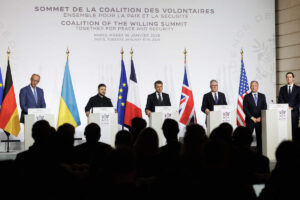
Ukraine : Macron, Merz and Burnham Close Ranks as Russia Steps Up the War

coalition of vontiers in Paris (Flickr)

coalition of vontiers in Paris (Flickr)

The Coalition of the Willing for Ukraine meets this Monday, August 24 — the 35th anniversary of Ukrainian independence — under the joint chairmanship of Emmanuel Macron, Friedrich Merz and Andy Burnham. The meeting comes at an urgent moment: fighting is intensifying on the ground and Moscow is preparing a new mobilization, while in Kyiv, Volodymyr Zelensky has just ruled out holding elections in wartime.

The ‘Volontaies’ Coalition at the Élysée (Élysée Palace)

A Meeting Under Heavy Diplomatic Pressure

According to a statement from the Élysée Palace released Friday, August 21, the Coalition of the Willing — an international alliance supporting Ukraine formed in March 2025 at the initiative of Czech President Petr Pavel — will meet this Monday at 1 p.m. in a hybrid format, with Volodymyr Zelensky taking part. The session will be jointly chaired by Emmanuel Macron, via videoconference, German Chancellor Friedrich Merz, and, for the first time, new British Prime Minister Andy Burnham. About a dozen leaders, including European Council President António Costa, are expected to be in Kyiv alongside the Ukrainian head of state, while European Commission President Ursula von der Leyen is not expected to attend in person.
According to a European official cited by several news agencies, talks are expected to focus primarily on strengthening Ukrainian air defenses, as the country faces a shortage of interceptors against Russian strikes. The Élysée says leaders will reaffirm “their determination to increase pressure on Russia” and continue coordinating measures aimed at drying up the resources funding Russia’s war effort, including the fight against the “shadow fleet” Moscow uses to circumvent oil sanctions. The meeting is also meant to advance work on security guarantees intended to underpin a “just, robust and lasting” peace, building on the Paris Declaration of January 6, 2026.

On the Ground, Moscow Prepares a New Mobilization

The meeting comes as the war enters a phase of intensification. Volodymyr Zelensky said this weekend that Russia plans to mobilize an additional 300,000 troops for the Ukrainian front after Russia’s parliamentary elections, scheduled for September 16-20, with a longer-term goal of recruiting 500,000. The Ukrainian president described a “peripheral mobilization” that would spare Russia’s major cities but, he said, would be hard to conceal. He also cited a Russian goal of producing roughly 1,300 ballistic missiles a year, while Ukraine expects to receive only 264 interceptor missiles this year, down from 364 in 2025 and 675 in 2023 — a shortfall Kyiv is trying to offset through new agreements, including delivery of at least one SAMP/T air-defense system from France and roughly 600 missiles from Germany.
These statements echo converging battlefield reports. Recent military bulletins point to intense fighting on the Zaporizhzhia, Kherson and Dobropillya fronts and in Dnipropetrovsk region, along with exchanges of soldiers’ remains between the two sides. This information comes from both Ukrainian and Russian sources, whose respective figures cannot be independently verified and should be treated with caution.

BACKGROUND

Formed in March 2025 at the initiative of Czech President Petr Pavel, and later organized under French and British leadership, the Coalition of the Willing brings together roughly thirty countries supporting Kyiv. It notably held a summit in Paris on July 13, 2026, on the eve of the Bastille Day parade, building on the G7 summit in Évian and the Paris Declaration of January 6, 2026.

Zelensky Rules Out Elections That Would “Destroy the Country”

On the domestic front, Volodymyr Zelensky responded for the first time to the call for elections made last week by his former defense minister, Mykhailo Fedorov, who was dismissed in late July amid vocal protests. In remarks made Saturday and released Sunday, the Ukrainian president said holding a wartime vote, absent a major cessation of hostilities, would “destroy the country by splitting society,” calling the prospect a “tsunami.” Ukrainian law bars elections under martial law, in effect since Russia’s full-scale invasion began in February 2022; Mr. Zelensky’s presidential term technically expired in May 2024.
Mr. Zelensky pointed to the practical hurdles such a vote would have to overcome — including how to enable voting by mobilized troops, millions of refugees abroad, and residents of Russian-occupied territory. According to an analysis by CNN, an incomplete or contested vote would hand Moscow a propaganda win, since the Kremlin already cites the wartime ban on elections to question the Ukrainian president’s legitimacy, even as Russia’s own electoral process is not considered free by Western observers. Polling suggests former armed forces commander Valery Zaluzhny or Mr. Fedorov himself would be the frontrunners in any eventual election.

Two Fronts for Kyiv: Military and Political

The convergence of these two issues — international military support and the debate over the democratic legitimacy of Ukraine’s leadership in wartime — casts Monday’s meeting in a particular light. For the Western leaders gathered around Emmanuel Macron, the goal is to demonstrate the durability of their commitment at a moment when Moscow is betting on wearing Kyiv down before winter, and when the question of security guarantees still has no concrete bearing on any ceasefire.

L’article Ukraine : Macron, Merz and Burnham Close Ranks as Russia Steps Up the War est apparu en premier sur FrenchDailyNews.

  •  

NC Elections Board decides early voting plans for 20 counties, mostly siding with GOP

State Board of Elections mostly backs fewer Sundays, more Saturdays in early voting plans. Increasing evidence of auditor staff interference.

NC Elections Board decides early voting plans for 20 counties, mostly siding with GOP is a story from Carolina Public Press, an award-winning independent newsroom. Our breakthrough journalism shines a light on the critical overlooked and under-reported issues facing North Carolina’s more than 11 million residents. Please consider making a contribution to support our journalism.

  •  

Political parties see high stakes in NC Supreme Court election

Anita Earls and Sarah Stevens compete for voters' attention and make case for why people should back them in race for NC Supreme Court seat.

Political parties see high stakes in NC Supreme Court election is a story from Carolina Public Press, an award-winning independent newsroom. Our breakthrough journalism shines a light on the critical overlooked and under-reported issues facing North Carolina’s more than 11 million residents. Please consider making a contribution to support our journalism.

  •  

Gov. Stein vetoes bills affecting elections and judge suspensions

vetoes records State Legislative Building. Budget impasse.

NC House GOP can likely override veto of courts bill in November, but might not have enough votes to override elections bill veto from Stein.

Gov. Stein vetoes bills affecting elections and judge suspensions is a story from Carolina Public Press, an award-winning independent newsroom. Our breakthrough journalism shines a light on the critical overlooked and under-reported issues facing North Carolina’s more than 11 million residents. Please consider making a contribution to support our journalism.

  •  

Greece’s public sector’s liabilities to private sector stand at €3.5 billion

The total outstanding liabilities of General Government entities to private individuals and businesses fell by 168 million euros in June, declining to 3.55 billion euros from 3.718 billion euros in May. However, over the first six months of the year, they have increased by 251 million euros compared with the 3.299 billion euros recorded in […]

The post Greece’s public sector’s liabilities to private sector stand at €3.5 billion appeared first on Keep Talking Greece.

  •  

GOP picks Balkcom to run in place of Edwards for NC congressional seat

Strong fundraising by Democratic candidate Jamie Ager hints that race with Balkcom could be heated despite district's usual GOP slant.

GOP picks Balkcom to run in place of Edwards for NC congressional seat is a story from Carolina Public Press, an award-winning independent newsroom. Our breakthrough journalism shines a light on the critical overlooked and under-reported issues facing North Carolina’s more than 11 million residents. Please consider making a contribution to support our journalism.

  •  

Secrets of the Atomic City

Paducah’s downtown flood wall murals pay homage to the Atomic City and depict scenes from the Gaseous Diffusion Plant in July in Paducah, Kentucky.

Holbrook Mohr and Mitch Weiss | The Atavist Magazine | July 2026 | 2,284 words (8 minutes)

This is an excerpt from issue no. 178, “Toxic Lies.”


January 3, 2026

In the isolation ward of a hospital in Birmingham, Alabama, a nurse approaches Ron Fowler’s bed, cell phone extended in her hand.

“You have a call,” she says.

Fowler’s eyes flutter open. He tugs off his oxygen tube and, with trembling fingers, accepts the phone.

“Thanks,” he whispers, before turning his attention to us—the callers.

From his voice it’s clear that something is very wrong; he sounds nothing like his usual self. He’s due the next day to meet us for an interview in Paducah, Kentucky, where he and his friend Chuck Deuschle worked at a uranium-enrichment plant that helped fuel America’s nuclear arsenal. Years ago they blew the whistle on the government and its contractors for poisoning thousands of atomic workers. “Can’t make it,” Fowler chokes out. “Blood clots. Hospital. They may have to remove some toes—if those clots don’t reach my heart first. If they do…” He trails off, the terrible ending hanging in the air.

The Atavist, our sister publication, publishes one deeply reported, elegantly designed story each month. Support The Atavist by becoming a member.

Fowler, soon to turn 77, is desperate to talk before it’s too late—to pull up the memories one more time and commit them to the historical record. He and Deuschle had both moved to Kentucky to work at the nuclear plant, only to discover a grim secret: The facility was exposing people to dangerously high levels of radiation and toxic chemicals, and had concealed the truth about it from employees and the surrounding community. This went on for decades. Faced with a choice—either walk away or stay and sound the alarm—Fowler and Deuschle returned to work, day after day.

More than thirty years later, lying in the hospital with cancer, Fowler is certain that the plant doomed him to a slow, painful death. At 83, Deuschle is also fighting a serious health issue: an unexplained autoimmune disease. They believe their fellow whistleblowers—Deuschle’s wife, Kay, and their friend Garland “Bud” Jenkins—succumbed to illnesses caused by the plant. Still, they’d do it all again. Someone had to reveal the callous disregard the government and the plant’s operators had shown their own people.

Fowler and Deuschle have never shared their story in full—the details of what it was like to live, breathe, and possibly die from their commitment to the truth. But they want people to know, particularly in light of recent news reports: In August 2025, more than a decade after the plant was shut down, a private firm announced that it planned to revive uranium-enrichment operations there. To Fowler and Deuschle, it seems wrong to begin a new chapter in Paducah’s nuclear story. Many former employees are still seeking compensation for their exposure to radiation. Will future generations of workers be any safer?

Fowler struggles for each breath.

“Time’s up,” the nurse says gently, reaching for the phone. “You need to rest.”

Fowler grips the device tighter.

“Call tomorrow when you meet with Chuck,” he implores. “I’m staying alive until then.” He pauses for a moment. “Just make sure Chuck’s with you. Promise me.”

We promise.

1.

One morning in late 1991, Ron Fowler stood in front of the bathroom mirror, parting his hair to the side and noting the first strands of gray at his temples. His beard was neatly trimmed, his black slacks and white dress shirt crisply pressed. He was ready. Today would be his first day at the Paducah Gaseous Diffusion Plant, a uranium-enrichment facility about ten miles outside Paducah, Kentucky. This was more than just a job—it was the start of a new life.

Fowler was a health physicist, an expert in the science of radiation protection. For years he’d traveled the country to train workers at nuclear plants in safety protocols. The pay was great, but being on the road weeks at a time had worn him down. When he moved to Paducah in his early forties, Fowler had already lived in Illinois, Pennsylvania, Maryland, Virginia, and Arkansas. Paducah promised stability: the perfect place to settle through retirement. His wife’s parents even moved from Illinois to be nearby.

After eating breakfast—a sausage patty and a scrambled egg—he kissed his wife, Sandi, goodbye and slipped out the door. He steered his green Oldsmobile Delta 88 through the country roads outside Paducah and let his mind drift back to his childhood in Florence, South Carolina. Life there had been simple. His father, who dropped out of school in the fourth grade, supported the family by working on the railroad. Florence was a place where men had jobs, women tended to the home and children, everyone went to church, and neighbors helped neighbors who fell on hard times. Paducah felt just as close-knit. Folks looked out for one another, and honest labor was rewarded.

Situated on the Ohio River where it meets the Tennessee, Paducah owes its origins to trade; it was founded in 1827 by William Clark of the Lewis and Clark expedition and named for a powerful Native American tribe. The area is naturally beautiful—the city is surrounded by rolling hills and sprawling plains dotted with ponds. For Fowler, a keen fisherman, it was paradise. Paducah had about 27,000 residents when he arrived. It was big enough to have all the right shops, yet small enough that restaurant owners knew whether regulars preferred barbecue or fried catfish, the local staples.

As Fowler drove, the plant appeared in the distance. It spread over some 3,500 acres—750 of them secured by fences and gates—and sat amid modest homes and farms. The community was proud of this place because of its long history supporting the military. Originally, it was a TNT munitions factory, built during World War II. Later, as Cold War tensions escalated, officials scouted locations for a uranium feed facility to supply weapons-production sites in Piketon, Ohio, and Oak Ridge, Tennessee, with the material required to make nuclear bombs. Paducah native Alben Barkley leveraged his position as Harry S. Truman’s vice president, campaigning aggressively to repurpose the munitions factory in his hometown. He recognized that the project likely would inject billions into the local economy and transform living standards for the region’s blue-collar workforce.

Construction of the nuclear plant began in 1951. By the following year, it was enriching uranium for atomic bombs and the Navy’s nuclear fleet. Rising from the countryside, the gleaming buildings looked like modern marvels, and the economic windfall lifted Paducah residents’ spirits. Meanwhile, employees at the plant—everyone from nuclear technicians to welders, cooks, and janitors—were united in patriotic pride. Their jobs paid well, and the workers believed that they were helping fend off communism. It was no wonder Life magazine printed a photo spread of the site.

As the Cold War thawed, the mission changed but the jobs remained. The plant began recycling materials—gold, among other things—extracted from dismantled atomic weapons while continuing to enrich uranium, now for nuclear power plants instead of bombs. Wages allowed families to buy homes and cars and afford vacations—the American middle-class dream. The plant operated like a self-contained town for its 1,700 employees: It had its own security force, fire department, library, post office, and health clinic. A shuttle service ferried employees around the plant’s grounds. Workers participated in golf leagues and fishing tournaments. The Uranium Enrichment News kept everyone informed about goings-on at the site.

Though the plant was owned by the Department of Energy, it was run by contractors. Union Carbide initially oversaw operations, followed by Martin Marietta, which later merged with Lockheed to become Lockheed Martin. Management changed, but to employees that just meant a different name on their paychecks. The people on the ground were like family—fiercely loyal to one another and to the plant they called the Atomic City.

Fowler smiled as he drove through a security gate into a sprawling lot. He parked by the administrative building and checked in with a secretary, who called someone to escort him to his department. From there he would lead health and safety training sessions. The federal government had known as early as 1944 that radiation was hazardous and had issued policies to limit worker exposure. It was Fowler’s job to help ensure that regulations were enforced, to protect both employees and the surrounding community from contamination.

He had barely settled in when a coworker poked his head in.

“Want to see the place?”

The complex was huge—more than five hundred buildings connected by nearly twenty miles of access roads. Fowler was impressed until, as he rounded a corner on his tour, a yellow triangular sign with the radiation symbol caught his eye. There was no step-off pad in sight. In a nuclear facility, a step-off pad is a buffer zone between a hazardous area and a clean one. Workers at the Paducah site were supposed to remove radiation-tainted clothing and footwear before crossing through these zones to ensure they didn’t unwittingly transfer dangerous materials to other parts of the plant or transport it home with them.

Fowler flagged down a worker leaving the building where the warning sign was posted. “You don’t have a step-off pad down here,” Fowler said. The worker shrugged and said there was nothing to worry about.

“That sign says otherwise,” Fowler said. He explained that protocol required a pad and training for workers so they knew how to use it.

The worker’s expression was unchanged as he walked away.

Fowler’s pulse quickened as he imagined invisible particles on boot soles spreading throughout the plant or, worse, tracking onto kitchen floors or into rooms where children played. He hurried to his division manager’s office. The supervisor listened, then leaned back in his chair and tapped a pen on his desk calendar. He said he’d call a meeting about the issue.

That night at home, Fowler sat at the kitchen table watching Sandi cook. Normally, he’d have been joking with his wife about her limited culinary range—she often made breakfast for dinner—but tonight his mind was elsewhere. The sizzle from the stove filled the silence between them.

Sandi knew something was wrong. In the years since they first met at a bar in Joliet, Illinois, she’d become attuned to her husband’s moods. Despite his imposing frame—six foot two, 245 pounds—Fowler had always been the gentle sort and quick to laugh. Their courtship progressed quickly, and within four months of meeting Fowler had moved in to her family’s home in Aurora. They married there so her father, a former school principal paralyzed from a stroke, could attend.

“What is it, Ron?” Sandi asked, spatula in hand.

He sighed. “Something’s not right at work.”

“What do you mean?”

“The way they treat radiation—like it can’t hurt them. No precautions,” Fowler said.

“That doesn’t make sense,” Sandi replied, frowning.

“I know.” Fowler shook his head. “I’ve never seen anything like it.”

Uranium is a silvery-white radioactive metal. More than 99 percent of it found in nature is U-238, and the rest is U-235, an isotope that can sustain the chain reactions needed to fuel nuclear power production and atomic weapons. Enrichment is the process of increasing the concentration of U-235 in a supply of uranium. At different points, enrichment produces one powder Paducah workers called black oxide—not to be confused with the coating of the same name applied to some metals to improve corrosion resistance—and another, uranium tetraflouride, that’s known as green salt. Eventually, uranium hexafluoride, a colorless crystalline solid, is heated into a gas that’s pushed through microscopic porous barriers. This process, called gaseous diffusion, separates U-235 from U-238; at plants like the one in Paducah, it’s done hundreds of times in a cascade until the desired enrichment level is reached.

Uranium enrichment is hazardous business. Fowler knew that any leak, spill, or accident at the Paducah plant could damage kidneys and lungs, irritate skin, and increase cancer risk. More insidiously, simple mistakes or oversights by workers could have that same result. During his first few weeks on the job, Fowler explored the plant on his own, and what he found unsettled him. Employees worked in radioactive areas without protective suits or masks. Some couldn’t read and might not understand warning signs. People left the site after their shifts without changing clothes or showering, likely conveying radioactive dust home to their families. Some workers even warmed their lunch on top of machines in hazardous areas.

Fowler knew that things needed to change, and quickly. He took his concerns to the plant manager, Steve Polston, who heard him out and then called a meeting about step-off pads—the very issue Fowler had flagged on his first day. At the meeting, Fowler outlined the safety gaps he’d observed at the plant, but it seemed to him as though the senior managers in the room could barely feign interest. He heard what would become something of a refrain: “We’ve been doing it this way for years.” He was also told that Department of Energy officials visited the site regularly and hadn’t raised concerns.

More worried than ever, Fowler spent the next several months developing new safety protocols. He beamed with satisfaction as he handed the plan to Polston. In the period that followed, however, he became frustrated with how officials implemented the measures. Even when company-issued safety equipment was made available, Fowler noticed that much of it was obsolete. And he watched in disbelief as employees poked holes in respirator masks to smoke while working.

“I’m not making progress,” he told Sandi one night between sips from a can of Miller Lite. “No one is listening.” He likened his work to “scooping water out of the ocean.”

Sandi, who had studied his training manual to understand his work, gently touched his arm. “Be patient,” she suggested. “Maybe you just have to get to know the people better.”

Fowler’s shoulders dropped. “It seems like more than that,” he said.

  •  

Republicans search for a replacement nominee for Congress in Western NC

capitol congress Washington

With troubled incumbent US Rep. Chuck Edwards stepping aside, GOP needs to find new nominee fast. One obvious choice says he's not interested.

Republicans search for a replacement nominee for Congress in Western NC is a story from Carolina Public Press, an award-winning independent newsroom. Our breakthrough journalism shines a light on the critical overlooked and under-reported issues facing North Carolina’s more than 11 million residents. Please consider making a contribution to support our journalism.

  •  

NC lawmakers send two big election bills to governor

Laura Klein of Black Mountain checks in to vote in the 2020 primary election with poll worker Jan Duckworth at the Black Mountain Primary School polling place in Buncombe County on March 3, 2020. Colby Rabon / Carolina Public Press

One of the NC election bills is fairly bipartisan. The other has only GOP support. Gov. Stein said he will veto that bill.

NC lawmakers send two big election bills to governor is a story from Carolina Public Press, an award-winning independent newsroom. Our breakthrough journalism shines a light on the critical overlooked and under-reported issues facing North Carolina’s more than 11 million residents. Please consider making a contribution to support our journalism.

  •  

Five takeaways from the 2026 legislative session

vetoes records State Legislative Building. Budget impasse.

For a so-called short session, a lot happened at the NC General Assembly in 2026, but a few issues also remain unresolved.

Five takeaways from the 2026 legislative session is a story from Carolina Public Press, an award-winning independent newsroom. Our breakthrough journalism shines a light on the critical overlooked and under-reported issues facing North Carolina’s more than 11 million residents. Please consider making a contribution to support our journalism.

  •  

What’s this Local Government Commission that keeps popping up in NC news stories?

The LGC plays an important role in financial matters surrounding local governments in NC, but what it is may be less clear to most people.

What’s this Local Government Commission that keeps popping up in NC news stories? is a story from Carolina Public Press, an award-winning independent newsroom. Our breakthrough journalism shines a light on the critical overlooked and under-reported issues facing North Carolina’s more than 11 million residents. Please consider making a contribution to support our journalism.

  •  

France: Public Debt Surges Past €3.5 Trillion, Raising Serious Concerns

The Ministry of Finance in Paris (Bercy). Jean-François Gornet / Flickr, CC BY-SA

The Ministry of Finance in Paris (Bercy). Jean-François Gornet / Flickr, CC BY-SA

France has crossed a critical threshold as its public debt exceeded €3.5 trillion in the first quarter of 2026, reaching 117.5% of GDP. The French Court of Auditors has sounded the alarm over what it describes as an “alarming” fiscal situation, as public deficits hit record levels and debt-interest costs continue to soar.

The Ministry of Finance in Paris (Bercy). Jean-François Gornet / Flickr, CC BY-SA

Public Debt Exceeds €3.5 Trillion

During the first quarter of 2026, France’s public debt passed the symbolic milestone of €3.5 trillion, reaching €3.5361 trillion at the end of March. The figure underscores the scale of the country’s budgetary challenges.
To put this amount into perspective, France would theoretically have to sell its entire gold reserve, all publicly traded and privately held state assets—including companies such as EDF, Engie, and Airbus—as well as all government-owned buildings and land in an attempt to repay the debt in a single payment. Even such a drastic measure would likely fall short.

In just one quarter, France’s Maastricht-defined public debt increased by €75.6 billion, a sharp rise in a very short period. This growing debt burden reflects a longstanding reality: for more than fifty years, the French government, local authorities, and social security system have collectively spent more each year than they have collected in revenue, particularly through taxation. To cover this structural gap, France has continued borrowing from financial markets.

Debt-to-GDP Ratio Nears Historic High

Beyond the headline figure, analysts and financial institutions are particularly concerned about debt relative to economic output. According to France’s National Institute of Statistics and Economic Studies (INSEE), public debt now equals 117.5% of gross domestic product.

The increase has been dramatic. In 1980, public debt represented only 20% of GDP. By 2000, it had risen to approximately 60%. Over four decades, the debt-to-GDP ratio has nearly increased sixfold.

The current level of 117.5% is approaching the all-time record of 117.8% recorded in the first quarter of 2021 during the COVID-19 pandemic. At that time, President Emmanuel Macron launched an unprecedented economic rescue effort, pledging to spend “whatever it takes” to prevent economic collapse.

Although the health crisis has long since passed, France’s debt trajectory has not slowed significantly. Within the European Union, only Greece and Italy have higher debt ratios, making France the third most indebted country in Europe.

Warnings from the Court of Auditors

In response to what it views as a critical situation, France’s independent Court of Auditors, responsible for overseeing public finances, issued a warning report describing the state of the nation’s finances as “alarming.”

The report, revealed by France Inter and released ten months before the 2027 elections, calls for “strong, credible, and swift measures” to restore fiscal stability.

The court highlights several aggravating factors. First, France remains the only country in the eurozone whose debt level is higher today than it was at the end of the COVID-19 crisis. Second, public deficits continue to break records. France posted a budget deficit equal to 5.1% of GDP in 2025, the second-highest in the eurozone after Italy.

The government’s goal of keeping the deficit at 5% is viewed as unrealistic by the Court of Auditors, which fears a further deterioration of public finances.

Debt-Interest Costs Are Soaring

A particularly troubling development is the rapid increase in debt-servicing costs. As debt accumulates and interest rates rise in financial markets, the amount spent on interest payments has grown dramatically.

In the current state budget, debt-servicing expenses have become the government’s single largest expenditure category, surpassing spending on the national education system (excluding pension obligations).

Paradoxically, this situation coincides with a significant increase in taxation. Taxes rose by €38 billion across 2025 and 2026 as part of efforts to limit further deficit growth. Yet France already has the highest overall tax burden in Europe when taxes and social contributions are combined.

This creates both political and economic tensions: higher taxes have not been sufficient to slow the growth of public debt, raising questions about the effectiveness of current fiscal measures.

Structural Challenges Extend Beyond Short-Term Solutions

France’s current trajectory highlights a troubling economic reality: structural public spending is growing faster than tax revenues, creating a persistent deficit that is difficult to eliminate.

Programs such as social welfare, pensions, healthcare, and public investment involve long-term commitments, while tax revenues tend to fluctuate with economic conditions.

This divergence between economic growth and debt growth raises a fundamental question for France’s public finances. If GDP expands by only 1% to 2% annually while debt continues to grow by 3% to 4% per year, the debt-to-GDP ratio will inevitably continue rising unless major policy changes are implemented.

French voters heading to the polls in 2027 will likely face a difficult choice between maintaining current levels of public services and restoring fiscal sustainability.

Breaking the Debt Spiral

To reverse the trend, experts and institutions such as the Court of Auditors recommend a combination of measures: controlling the growth of public spending, improving the efficiency of existing expenditures, broadening the tax base without increasing marginal tax rates, and accelerating economic growth to boost revenues.

As the eurozone’s second-largest economy after Germany, France possesses significant economic resources. However, meaningful structural reforms will require political consensus and a willingness to accept difficult compromises.

In the short term, the government must demonstrate that its deficit-reduction commitments are credible. In the medium term, comprehensive reforms of public spending—particularly in pensions and healthcare—appear unavoidable. Over the long term, only sustained economic growth combined with spending discipline will be capable of reversing the debt dynamics that have characterized France for decades.

L’article France: Public Debt Surges Past €3.5 Trillion, Raising Serious Concerns est apparu en premier sur FrenchDailyNews.

  •  

Marc Bloch at the Panthéon: A republican ritual honoring the historian

Le Panthéon, Paris (Par Moonik — Travail personnel, CC BY-SA 3.0)

Le Panthéon, Paris (Par Moonik — Travail personnel, CC BY-SA 3.0)

On June 23, 2026, Marc Bloch and his wife, Simonne Vidal, will symbolically enter the Panthéon, completing a republican rite that recognizes the extraordinary contribution of the founder of the Annales School to French historiography. This pantheonization honors not only a visionary scholar, but also a soldier and resistance fighter whose legacy continues to inspire generations of researchers and citizens committed to truth and freedom.

Marc Bloch: A multifaceted figure finally receiving broad recognition

Marc Bloc, historian and member of the Resistance, is inducted into the Panthéon alongside his wife, Simone Vidal (Wikipedia)

Marc Bloch represents an exceptional life that transcends the traditional divide between academia and civic engagement. A towering figure for historians and the social sciences, he remains paradoxically little known to the wider public, making this induction all the more symbolic. The French historian transformed his discipline through groundbreaking methodological innovations and through his direct involvement in the major issues of his era.

His admission to the Panthéon reflects a desire to share his intellectual and moral legacy with new generations. Three fundamental pillars explain this solemn recognition: his major scholarly work, his innovative teaching, and his unwavering courage.

The pantheonization ceremony

Key stages of the ceremony

The ceremony follows a carefully choreographed protocol marked by highly symbolic moments. It begins outside the monument with the gradual arrival of the coffins along Rue Soufflot, allowing the public to accompany the procession to the forecourt of the Panthéon, a place deeply imbued with republican significance.

At the heart of the ceremony is the solemn crossing of the threshold by the coffins carried by members of the Republican Guard. The Great Bronze Doors, normally closed, are opened especially for the occasion, symbolizing the deceased’s definitive entry into the Panthéon and admission among those who have contributed to the glory of France.

Presidential tribute and placement in the crypt

Once inside the monument, the coffins are placed at its center to receive the tribute of the President of the Republic, a moment when the nation as a whole bows before the memory of a great figure. This official homage forms the emotional and political centerpiece of the ceremony, publicly acknowledging the significance of the deceased’s contribution to French history.

After a vigil maintained by the Republican Guard, the coffins descend into the crypt, where they join the other men and women honored by the nation. Their final placement signifies permanent integration into France’s collective memory.

Simonne Vidal: the historian’s wife finally receiving recognition

Marc Bloch’s induction is accompanied by the symbolic entry of his wife, Simonne Vidal, in recognition of the vital role she played in his life and work. Mother of six children, whom she raised while supporting her husband’s scholarship, Simonne Vidal made an essential though often invisible contribution to his intellectual achievements.

Although she died in Lyon in 1944 and her remains could not be formally identified, her inclusion in the Panthéon carries profound symbolic meaning. It represents a belated but solemn acknowledgment of the women who stood behind many of France’s great thinkers and helps restore their place in history.

Organizing a state ceremony

Leadership by the Presidency and Government Ministries

The pantheonization is a major state event coordinated directly by the Presidency of the Republic in close cooperation with several ministries. The National Monuments Center oversees the project as administrator of the Panthéon, while a steering committee brings together ministries reflecting the many dimensions of Marc Bloch’s life.

The Ministry of Culture coordinates cultural and memorial aspects. The Ministry of the Armed Forces is involved because of Bloch’s military service in both world wars. The Ministry of the Interior and the Ministry of National Education handle public security and educational outreach. Finally, the Ministry of Higher Education and Research oversees the scholarly and academic dimensions of this national tribute.

The role of the family and practical arrangements

The Bloch family, which includes six children and numerous descendants, has played a central role in preparing the ceremony. Suzette Bloch, Marc Bloch’s granddaughter, and Matis Bloch, his great-grandson, were chosen to represent the family in discussions and decisions concerning the induction.

One distinctive aspect of this ceremony is the family’s wish that Marc Bloch’s remains remain buried in Bourg d’Hem, in the Creuse region, where he has rested since 1977 alongside his six children. As a result, the ceremony is symbolic rather than involving the transfer of his remains. Cenotaphs—empty symbolic tombs—will be installed in the crypt, and the names of Marc and Simonne Bloch will be permanently engraved on its walls, allowing visitors to pay tribute and reflect upon their legacy.

Marc Bloch the fighter : soldier, resistance member, and seeker of truth

The ceremony highlights Marc Bloch’s fighting spirit, both literally and figuratively. Literally, his commitment to defending France and the Republic was demonstrated through his service in both world wars and his clandestine involvement in the Resistance during the Nazi occupation. This courageous aspect of his life remains little known to many.

Figuratively, Bloch was an unrelenting champion of methodological rigor and historical truth. Alongside Lucien Febvre, he founded the Annales School and revolutionized historical inquiry by moving beyond event-based narratives to explore the social, economic, and mental structures shaping human societies. His intellectual rigor and relentless search for truth explain why his ideas remain profoundly relevant more than seventy-five years after his death.

A legacy for future generations

A message for young people

One explicit aim of the induction is to introduce a major historical figure to the broader public, especially younger generations. This educational mission is crucial in transmitting the values embodied by Marc Bloch: clarity of thought, courage, conviction, and resilience in the face of adversity.

Since the official announcement of his entry into the Panthéon, the response from academic and educational communities has been remarkable. The Ministry of National Education has already recorded thousands of initiatives and educational projects devoted to Marc Bloch and his work. This intellectual vitality demonstrates the enduring relevance of his message: truth must never yield to convenience, and scientific inquiry requires uncompromising moral discipline.

Permanent exhibition and free public access

Beyond the June 23 ceremony, the Panthéon has organized a series of initiatives to preserve and transmit Marc Bloch’s legacy. From June 25 to June 28, admission to the monument will be free, enabling everyone to pay tribute to Marc Bloch and his wife.

A major exhibition entitled Marc Bloch: The Spirit of History, curated by Yann Potin, will remain open until January 10, 2027. Through original archives, manuscripts, and other historical materials, visitors will discover the many facets of this remarkable figure: the methodological innovator, the devoted teacher, the courageous soldier, the committed resistance fighter, and the intellectual in the service of truth.

Keeping Marc Bloch’s inspiration alive

The pantheonization of Marc Bloch and Simonne Vidal represents far more than a commemorative ritual. It embodies the nation’s commitment to transmitting the values they exemplified to present and future generations. Marc Bloch stands as a model of the engaged intellectual, the rigorous scholar, and the courageous citizen—qualities that remain essential at a time when historical and scientific truth face constant challenges.

His revolutionary methods, his transformative teaching, and his ultimate sacrifice in defense of France and the Republic constitute an inexhaustible source of inspiration. Entry into the Panthéon marks not an end, but the beginning of a broader rediscovery of the “spirit of history” that Marc Bloch devoted his life to cultivating and transmitting.

Further Reading

“Marc Bloch at the Panthéon: Sharing the Historian’s Legacy” – French Ministry of Culture

L’article Marc Bloch at the Panthéon: A republican ritual honoring the historian est apparu en premier sur FrenchDailyNews.

  •  

NGTs: Europe legalizes a new generation of GMOs

OGM (DR)

OGM (DR)

On June 17, 2026, the European Parliament formally adopted regulations governing “New Genomic Techniques” (NGTs), marking a major turning point for European agriculture.

The decision paves the way for a new generation of genetically modified crops capable of withstanding drought and disease, but it has also raised legitimate concerns about the privatization of living organisms and potential environmental risks. The debate has divided the continent, pitting supporters of technological innovation against advocates of traditional farming.

What are NGTs and how do they differ from traditional GMOs?

NGTs, or New Genomic Techniques, represent a significant advance in plant genome editing. Unlike first-generation genetically modified organisms, which involve introducing foreign DNA from different species, NGTs operate on a fundamentally different principle.
These techniques allow scientists to modify a plant’s genome using only genes originating from the same species. For example, it may now be possible to make a tomato more resistant to aphids by transferring a gene from another naturally resistant tomato variety. Although these plants are technically genetically modified organisms, seeds produced through NGTs are not transgenic—a distinction that plays a key role in European regulations.

Two categories of NGTs and different regulatory standards

The compromise negotiated by the European Commission and member states established a two-tier classification system. Category 1 NGTs, involving a limited number of naturally occurring mutations, will be treated as equivalent to conventional varieties and will benefit from partial deregulation.
By contrast, NGTs engineered for herbicide resistance or designed to produce insecticides will not be authorized for commercial use, in the interest of sustainability and environmental protection.
Another major restriction is that no NGT crops will be allowed in organic farming, creating a clear divide between agricultural production using these technologies and certified organic agriculture.

European agriculture confronts climate challenges

Supporters of NGTs—including major farming organizations such as Copa-Cogeca and leading European seed companies—argue that these technologies are essential for maintaining competitiveness and adapting to climate change. NGTs could significantly accelerate the development of crop varieties capable of tolerating severe drought and extreme heat, both of which are becoming increasingly common across Europe.
For some farmers, particularly in the French Caribbean territories, NGTs offer a practical solution to existing plant diseases. Banana plantations, for example, have been devastated by black Sigatoka, a destructive fungal disease against which NGTs could provide natural resistance. Such practical applications have helped mobilize support within the agricultural sector for the new regulations.
Advocates also emphasize that the European Union is creating a “sovereign European model” distinct from those of the United States and Brazil, with specific safeguards governing approved techniques and strict oversight of the sector.

Environmental concerns and the privatization of life

Critics of NGTs raise fundamental concerns about agricultural sustainability and intellectual property rights. According to opponents, the safety of NGTs for human health and the environment has not been sufficiently established through democratic processes. They are calling for mandatory traceability and a ban on patenting living organisms.
Farmers’ unions such as the Confédération Paysanne view NGTs as a “Trojan horse” for major seed and agrochemical corporations. Their primary concern is the gradual monopolization of seeds by a handful of agribusiness giants, forcing smaller seed companies and farmers to pay licensing fees. Critics argue that such a trend could accelerate crop uniformity and reduce agricultural biodiversity.
They also warn that increasing corporate control over genetic resources could marginalize small farmers and undermine their autonomy. Thomas Gibert, a market gardener in Haute-Vienne and spokesperson for the Confédération Paysanne, has described the issue as a “major risk” involving the “privatization” of life driven by the “ultra-powerful agribusiness lobby.”

The european parliament’s decision-making process

The European Parliament approved the NGT regulation on June 17, 2026, after rejecting all amendments proposed by Green and Socialist lawmakers. These amendments sought to make traceability mandatory and prohibit patent protection for NGTs, two measures strongly supported by left-wing parties and environmental groups.
The legislation ultimately received broad political support, ranging from the centrist Renew group to the far right, with backing from the European People’s Party. This unusual coalition illustrates how NGTs have transcended traditional political divisions, bringing together pro-competitiveness forces around a technological agenda.
Centrist Member of the European Parliament Pascal Canfin defended the measure, saying, “We have created a sovereign European model for new genomic techniques that will serve our farmers,” underscoring Europe’s geopolitical ambitions in the face of global agricultural powers.

Scientific assessments and the timeline for market introduction

The European Food Safety Authority (EFSA) endorsed the European Commission’s approach to authorizing NGTs. However, other scientific bodies have adopted a more cautious stance. In 2024, France’s National Agency for Food, Environmental and Occupational Health Safety (ANSES) recommended case-by-case evaluations of potential health and environmental risks before any products are marketed.
These differing approaches reflect the lack of a complete scientific consensus regarding the long-term implications of NGTs. Despite the swift adoption of the legislation, several years are expected to pass before foods produced using NGTs actually reach European consumers. The interval between the testing of new varieties and their commercial release will remain substantial.

Balancing innovation and caution

The legalization of NGTs marks a significant shift in Europe’s agricultural strategy in response to climate change and increasing global competition. Yet the move also highlights unresolved tensions between the drive for technological innovation and legitimate concerns regarding the environment, public health, and the concentration of economic power within the food sector.
The challenge now lies in the practical implementation of the NGT regulations. Safeguards such as the prohibition of herbicide-resistant NGTs and their exclusion from organic farming represent important protective measures. Nevertheless, the issue of mandatory traceability remains highly controversial, with major implications for consumer transparency and the protection of small farmers’ interests.
Ultimately, the success or failure of Europe’s NGT experiment will depend largely on the ability of regulators to ensure rigorous oversight, maintain transparent communication with the public, and continuously adapt regulations in light of emerging scientific evidence. Europe has embarked on a narrow path between necessary technological innovation and the precautionary principles that have long defined its approach.

L’article NGTs: Europe legalizes a new generation of GMOs est apparu en premier sur FrenchDailyNews.

  •  

NC Senate splits massive elections bill into 2, sends them back to House with changes

First elections bill from NC Senate gets broad support. The second one draws a lot of pushback from Democrats over a range of provisions.

NC Senate splits massive elections bill into 2, sends them back to House with changes is a story from Carolina Public Press, an award-winning independent newsroom. Our breakthrough journalism shines a light on the critical overlooked and under-reported issues facing North Carolina’s more than 11 million residents. Please consider making a contribution to support our journalism.

  •  

NC National Guard settles case over free speech rights

A retired guardsman who says NC National Guard repeatedly tried to silence his critical Facebook posts claims victory in legal settlement.

NC National Guard settles case over free speech rights is a story from Carolina Public Press, an award-winning independent newsroom. Our breakthrough journalism shines a light on the critical overlooked and under-reported issues facing North Carolina’s more than 11 million residents. Please consider making a contribution to support our journalism.

  •  
❌