❌

Reading view

Oil prices jump more than 2% after US and Iran trade strikes

Oil prices rose more than 2% Monday after the United States attacked an Iranian island in the Strait of Hormuz and drew retaliation from Tehran, as the six-month-old conflict between the two countries showed no signs of easing. Brent crude futures climbed $2.21, or 2.51%, to $90.31 a barrel as of 0436 GMT. U.S. West ... Read more

The post Oil prices jump more than 2% after US and Iran trade strikes appeared first on BOL News.

  •  

Holding the U.S. to account, Tether exits EU & Congo’s conflict coltan

The United Kingdom has taken over the presidency of the Financial Action Task Force, the global standard-setter on tackling money laundering, and seems determined to keep calm and carry on despite the gigantic Donald Trump-sized hole being blasted in everything it’s trying to do.

The new president of the Financial Action Task Force is Giles Thomson, a career civil servant and archetypal safe pair of hands, who’s declared that the organisation’s priority for the next two years is fighting fraud. He estimated the global cost of fraud at $500 billion, which — if compared to the standard estimates of the volume of global money laundering as making up 2 to 5% of everything — means it contributes between a tenth and a quarter of all profits from financial crime.

Fraud is clearly thus a Very Big Deal, and therefore a well-chosen target for Thomson because everyone (including me) agrees that we need to hit it. However, I think I saw a hint of other perhaps more controversial tasks in the rest of his proposed priorities. The suggestion, for example, that the Financial Action Task Force (FATF) will conduct “proportionate assessments of lower capacity countries” looks to me like a recognition that it needs to stop criticising poorer countries that don’t actually launder money just because their legislation isn’t perfect.

This has been a weighty accusation in the past, not least because of the implicit suggestion of racism, made by, among others, regulator Charles Littrell, who summarised the FATF’s great flaw in 2022 thus: “the vast majority of dirty money and assets resides in, passes through, or is facilitated by the world's largest and richest countries. How then do the world's main [anti-money laundering] risk rankings invariably centre blame upon small, relatively poor, and nonwhite jurisdictions?”

This is not an academic question. Being blacklisted by the FATF is serious, and there has been definite unfairness in the past in which countries have ended up being singled out for a punishment beating. Hopefully a recognition of this reality is hidden somewhere inside Thomson’s rather gnomic utterance that “the FATF will support countries and the private sector to focus effort where the threat is greatest.”

Fortunately, the FATF will have an immediate opportunity to demonstrate that it shows neither fear nor favour when it comes to doing the right thing when it publishes the results of the ongoing evaluation of the United States. 

The U.S. was last evaluated in 2016, and the FATF made various recommendations, which Washington was supposed to have implemented within three years, and sort of did. With the passage of the Corporate Transparency Act in 2020, some progress was made, but since Donald Trump returned to the White House that has gone into screeching reverse.

Prosecuting foreign corrupt practices is “not a priority, ”transparency around residential ownership has been suspended, the Corporate Transparency Act  has been gutted, and crypto is everywhere. Above all, of course, the president himself has been making money at a rate that even Vladimir Putin would have to admire. His headline earnings figure —  $2.2 billion in the first year of his second term —  is clearly unprecedented, but so are the details. 

What for example will future historians make of the fact that the president declared his ownership of the trademark for “THINK BIG AND KICK ASS”? Ha, trick question, there won’t be any historians. They’ll have been replaced by AI.

Tether watch

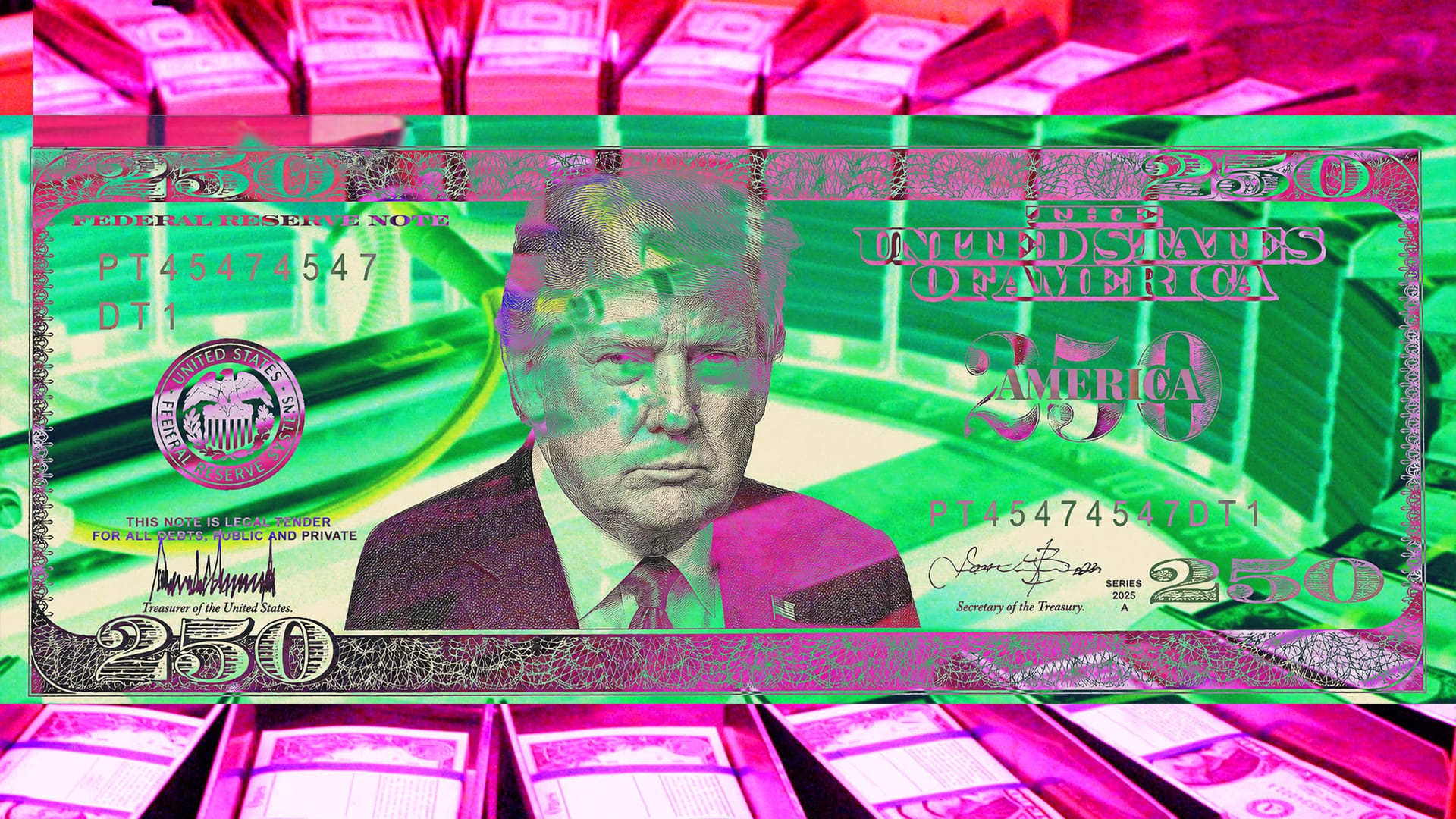
Talking of history, I had slightly been hoping that the U.S. dollars in circulation might hit the appropriately round number of $2.5 trillion to mark the round 250th anniversary of the Declaration of Independence, but it was not to be. If only the Fed had launched the $250 bill in time, perhaps it would have got there, but we’ll just have to wait.

Meanwhile, there’s an interesting time ahead for Tether, this newsletter’s favourite cryptocurrency, which is sailing into choppy waters. It has decided to pull its USDT out of the European Union rather than to comply with the Markets in Crypto Assets regulations on stablecoins, which is a boost for its great rival Circle (USDC), which is very much available in Europe. 

The two big stablecoins have markedly different strategies: Tether is dismissive of regulators, while Circle cosies up to them. And now here comes a new rival in Open USD, which is backed by many of the world’s largest banks and tech firms, and which also promises to abide by everyone’s regulations. Is Tether at risk of becoming irrelevant?

Congo’s conflict coltan

Huge credit to the good folks at Global Witness for this report from the Democratic Republic of the Congo, where coltan smuggling is helping to perpetuate the grim conflict in the east of the country. It is the kind of methodical, thorough research that really helps open your eyes to how grim things can be, and how complicit the rest of us are in a global supply chain forged from conflict. 

Congolese people hack coltan out of the ground under the eyes of M23 guerrillas, who then smuggle it into Rwanda, where it is repackaged as Rwandan and given certification intended to show it’s not from a war zone. It is then shipped to refiners in China or Kazakhstan to be processed into tantalum, which is in turn sold to leading companies to be incorporated in the phones, tablets, jet engines, and other products that we all rely on for our lovely modern lives.

“Rwandan official figures show that coltan exports have increased more than 2.5 times between 2021 and 2025,” the report notes. “Coltan is an important revenue stream for Rwanda, which levies a 5% tax on exports. Since 2023, it has become the country’s second-largest export earner, after gold.”

And where does the gold come from? Also from the Congo, which is why the U.S. Treasury sanctioned a Rwandan gold refiner last month, following action taken by the European Union against the same company last year, but it has done little to rein in M23.

A version of this story was published in this week’s Oligarchy newsletter. Sign up here.

The post Holding the U.S. to account, Tether exits EU & Congo’s conflict coltan appeared first on Coda Story.

  •  

How governments enable kleptocrats by doing nothing

I was listening to Ezra Klein interviewing a left-wing Democratic Party strategist the other day about what a post-Trump U.S. foreign policy might look like, and it was a pretty striking demonstration of Europe’s irrelevance right now that the only Western European country mentioned in the 90 minutes of the chat was the UK, and that was solely in the context of how it helps kleptocrats.

But aha, a notional Brit might have replied, at least we are about to convict Diezani Alison-Madueke, former head of OPEC, ex-Nigerian oil minister, for her alleged egregious corruption. That notional Brit would be feeling pretty foolish right now though, because this was yet another flop, with her being acquitted on all charges. 

Britain has a dire record both when it comes to enabling corruption and when it comes to successfully investigating it, as the failure of yet another high-profile prosecution shows. This latest fiasco should be the impetus the country needs to at last provide the resources and officers that its law enforcement agencies require.

Alison-Madueke saw the hand of divine providence in her acquittal. “It has been a hard journey,” she said, “but I tell you this, God will always do as he will. God will be God and God is not a man that he should lie; when he promises you something, he will see it through” — and who am I to say that she’s wrong? However, there are other potential explanations for what has happened beyond the Almighty manifesting at Southwark Crown Court to give instructions to the jury, including the entrenched incompetence of British police agencies.

It’s hard not to see a parallel with the failed attempt six years ago to investigate Dariga Nazarbayeva, daughter of the former president of Kazakhstan and possessor of a reasonable-to-large London property portfolio, which saw the National Crime Agency (NCA) being comprehensively outwitted by defence lawyers, just as it has been again.

“Today’s verdict is a major blow for the NCA who have come away empty-handed in one of their highest-profile corruption cases, which took over a decade to progress to trial,” said Zainab Saleem, Legal Fellow at Spotlight on Corruption. "It is vital that the UK government properly resources law enforcement agencies tasked with investigating complex bribery and corruption cases and does not take this defeat as grounds for rowing back on anti-corruption enforcement.”

It will be interesting to see what, if anything, results from the suggestions that the new Supreme Leader of Iran has been moving his wealth merrily around with the help of various Western banks, all of it now being investigated by the U.S. Department of Justice. “Funds for the transactions have been routed through financial institutions in the UK, Switzerland, Liechtenstein and the UAE,” reports Bloomberg.

What is the answer? Whatever it is, it will be even more embarrassing for the UK if it doesn’t come up with something plausible by the time it convenes its Illicit Finance Summit in December. (Unless it ends up being rescheduled again, like one of those meetings that no one actually wants to attend but also no one wants to be responsible for cancelling.)

Still, credit where it’s due, at least efforts to improve Companies House — the UK’s formerly-disastrous corporate registry — appear to be finally bearing fruit. It has sent almost a million enforcement letters to people who haven’t verified their identity, which must have been — at the very least — a useful money-spinner for the post office.

The idea of increasing funding to law enforcement agencies is something that Americans would do well to consider too, particularly when it comes to the Internal Revenue Service. “In 2022, under President Joe Biden, Congress approved an $80 billion increase in IRS funding over a decade, with more than half of it slated to restore the agency’s ability to go after the super-rich. This victory was short-lived. By March 2025, Republicans had slashed that $45.6 billion enforcement budget to just under $4 billion — “a 91% decrease,” it notes in this fascinating book excerpt.

I have been interested for a while in the idea of government’s being engaged in “legalisation by under-enforcement,” which is something we see with tax evasion, pollution of waterways, and almost anything else when the rules not being enforced benefit the kind of people who donate money to political parties. But I need a better name for the phenomenon, so please help me out and send one in.

Talking of phenomena that we need a new name for, Elon Musk’s wealth is doing weird things to the Forbes billionaires list. Whoever runs it appears to have decided to only display his net worth to two significant figures. That means that, while we can see an assessment of the wealth of relative paupers like Sergey Brin to the nearest $100 million ($277.6 billion, as I write), we only get a round $1.2 trillion for Musk. Or a round $1. 4 trillion, depending on what day it is, which means his wealth jumps up and down in a minimum increment that, on its own, would be sufficient to make its possessor the richest person in every country in the world except Spain, Canada, Mexico, the United States or France.

And talking of France, the G7 summit in Evian is over. It was of course at a previous French G7 summit when participants created what became the Financial Action Task Force. That was the 1980s and they were concerned about the spread of illegal drugs, the harm they were causing, and the fact that more countries were producing them, and wanted to stop drug dealers being able to keep their profits. Among other things they committed — in the words of the 1989 communiqué — “to prevent the utilization of the banking system and financial institutions,” which is part of the clause that gave birth to the entire global anti-money-laundering system. Well, 37 years have passed, so let’s check in on how that’s going. 

This year the G7 communiqué expressed concern about the spread of illegal drugs, about the harm they’re causing, and about the fact that more countries are producing them. “We emphasize the continued need to strengthen the global anti-money laundering architecture to prevent financial crime and improve enforcement and asset recovery outcomes, in line with the Financial Action Task Force standards,” this year’s summit document states. 

Plus ça change. Maybe in another 37 years, they’ll look up and wonder whether they should try something else, and indeed whether the FATF standards aren’t ripe for reconsideration.

A version of this story was published in this week’s Oligarchy newsletter. Sign up here.

The post How governments enable kleptocrats by doing nothing appeared first on Coda Story.

  •  

Trillionaires are a national security risk

I’ve been writing this newsletter since 2020, and in my first edition I marvelled at the concept of the centi-billionaire, and the fact there were at the time three people with 11 zeros in their net worth. What a six years it’s been. When I started writing this week’s edition, Elon Musk was a mere David Sun away from becoming the world’s first trillionaire, and now as I’m finishing it, Musk is worth the scarcely conceivable sum of $1.1 trillion. Nothing like this has ever happened before and there is no sign it is going to stop happening. There is no reason at all to suppose that in another half-decade I won’t be writing about how deci-trillionaires are the new thing.

This increasingly extreme inequality is a challenge for social cohesion, democracy and civilisation that we haven’t seen in modern times, second only to climate change as a threat to our future. Although in some ways, they’re the same challenge, considering the disproportionate share of emissions coming from rich people.

In some ways, if Musk’s wealth seemed to be making him happy it wouldn’t be so bad, but it appears only to make him angrier. I like to think that if I had a trillion dollars, I’d do something more constructive than stir up protests against ethnic minorities.

Reducing inequality is the right thing to do for every reason, not least because it would deprive very rich people of the ability to stoke pogroms anywhere they like. But how to do that? The only thing that has previously reduced inequality to any significant extent has been the 20th century’s series of global conflicts with massive destruction of life and property, and that’s the kind of thing it would be good to avoid.

I think there is a strong argument to be made, however, that the financial trickery abused by the very rich is also bad for national security, and it’s one nicely made here by Matthew McGlynn, who specialises in researching Russia. By degrading the ability of oligarchs to cheat their way to riches, we’d also limit the space of billionaires to dodge taxes and accountability.

It is notable that expert after expert speaking to the House of Representatives Committee on Financial Services about Chinese Money Laundering Networks pleaded for the Corporate Transparency Act to be properly implemented. “When a laundering network operates by scattering its footprint across hundreds of student accounts, dozens of shell companies, and multiple jurisdictions, traditional compliance frameworks may treat flags as isolated, minor incidents. The systemic risk is consistently underestimated, and responses remain heavily reactive,” noted Louis DeTitto.

If first we come for the money launderers, then the billionaires won’t speak out because they’re not money launderers. Also, it would mean we’d do a better job of tackling money laundering, which would be nice. 

While on the subject of congressional hearings, there are interesting moves by Senator Richard Blumenthal to probe how Iranian and Russian sanction-dodgers are using cryptocurrencies. In April, he wrote to Binance requesting further information, and now he’s written to Tether asking for information about misuse of its USDT stablecoin.

The details he’s requesting are far-reaching and potentially highly consequential, since they relate to connections with Iran and Russia, including A7, issuer of the leading ruble-denominated cryptocurrency. Perhaps most important, however, is his first question: “What legal jurisdictions does Tether believe it is subject to for USDT, in particular for anti-money laundering rules, reporting obligations, asset seizures, and sanctions compliance? Does Tether believe it is legally required to comply with Department of Treasury sanctions for USDT and issue suspicious activity reports (SARs) to the U.S. government?”

If the U.S. asserts regulatory authority over dollar-denominated cryptocurrencies as it has over all transactions in dollars then that would significantly undermine their attractiveness to illicit actors, and also do a lot to reassure people like me. Tether, meanwhile, has been bigging up its cooperation with law enforcement agencies, and says it’s frozen $450 million globally.

“For the past few years, stablecoins have come to dominate the landscape of illicit transactions, and now account for 84 percent of all illicit transaction volume,” concluded Chainalysis in 2026’s crypto crime report. It estimated total illicit transactions at $154 billion last year, so the stablecoin share of that was almost $130 billion. That is a fraction of the amount of money laundering estimated to move through either the trade system or indeed the formal financial network, but still a lot of money. It’s interesting to see, however, how Chainalysis still holds out hope for well-regulated cryptocurrencies helping to solve problems caused by standard finance.

“Stablecoins and on-chain settlement mechanisms in particular offer low-cost, borderless avenues for remittances, payments, and savings,” Chainalysis said. “If coupled with sound regulation and inclusive policy frameworks, these tools could help governments leverage crypto not just for resilience, but also for broader financial inclusion as part of economic recovery.”

Seeing will be believing.

A version of this story was published in this week’s Oligarchy newsletter. Sign up here.

The post Trillionaires are a national security risk appeared first on Coda Story.

  •  

Why Europe must disable Russia’s crypto ecosystem

Someone recently asked me what mark out of 10 I’d give for the efforts of governments to tackle financial crime. It got me thinking about that one bright spot of recent times — the West’s response to Russia’s full-scale invasion of Ukraine four years ago — and how it is now looking. Back in 2022, a lot of us were pleasantly surprised by the speed and ambition with which Western governments sanctioned the Russian government, state-owned companies and wealthy individuals. While Western pressure did not prevent the war, the asset freezes did impose a real cost on those conducting it. Four years on, however, those sanctions are beginning to look a bit shopsoiled. If they began at 7/10, they’re now scoring a lot lower.

There are reasons for this: Donald Trump does not appear particularly interested in Ukraine; the now former Hungarian prime minister Viktor Orbán has been snarling things up; and so on, as laid out in this analysis from Tom Keatinge. To make things worse, Trump’s latest adventure in Iran has pushed the oil prices sharply higher, earning more money for Russia while also giving Trump cover to lift sanctions, a temporary measure he has recently extended.

Keatinge argues that European countries need to be far more focussed on going after Russia’s payment mechanisms, particularly digital. “The extent to which crypto activity supports Russia’s war effort is clear,” he writes, “yet repeated initiatives to elevate the importance of opening a concerted line of effort on this issue are ignored. This must change.”

I agree, though it won’t be easy, considering the diffuse crypto ecosystem, and the increasing sophistication of Russian involvement in it. As long as Telegram is willing to host markets, the markets will continue to function to some extent whatever Western countries do (see the story of Xinbi, a Chinese-language hub for illicit crypto.) However, it does look like someone somewhere has lost patience with the ease with which Russia is funding itself.

“The sanctioned Russia-linked cryptoasset exchange Grinex announced an immediate suspension of its operations, citing a ‘large-scale cyberattack,’” reports Elliptic. According to the statement, which Kyrgyzstan-registered Grinex posted on Telegram, it lost around $13 million worth of USDT in the hack, blaming the theft on Western intelligence agencies.

“Today the attempts to destabilise our fatherland’s financial sector hit a new level, with the direct theft of the assets of Russian citizens and companies with the involvement of complex cyberattacks,” the statement said. Grinex is the successor to Garantex, which was shut down just over a year ago after years of effort by Western law enforcement. I would be surprised if Western countries had decided to take direct action against Grinex, as the exchange claims they did. Westerners tend to be a bit too legalistic for this kind of smash-and-grab, and I would expect any operation to more closely resemble what worked a year ago, conducted with Tether’s cooperation.

Instead, I suspect this attack is the work of hacktivists, perhaps working for or with the Ukrainians. Whatever the answer, it is embarrassing for the Russians, shows their crypto-security is not impregnable, and has made a noticeable dent in trading volumes of the A7A5 ruble-denominated stablecoin, which has become a key sanctions evasion tool. Three birds with one stone.

The important point is that sanctions were never supposed to be permanent: they are a foreign policy tool, not a law enforcement one. Hundreds of billions of Russian-owned dollars are languishing in various frozen bank accounts, and Western countries need to start thinking about what to do with them. They can confiscate them, investigate them or — if they’re feeling brave — use their potential return as leverage to persuade wealthy Russians to break with the Kremlin. What they shouldn’t do is leave them as they are to gather dust.

Hopefully, now that Orbán is out of the way, European countries will be able to take firmer collective action but they also need to be imaginative, and to start behaving as if they actually want Ukraine to win, rather than just not lose.

A defeat for transparency 

Of course, the United States will have a lot to say about that too, and what it ends up saying about how to tackle the Russian crypto operations will depend on what happens in the midterm elections this year. So, it strikes me as a big deal that crypto firms are once more pouring tens of millions of dollars into campaign vehicles in their quest for, what they euphemistically refer to as, “regulatory clarity.” Among them, of course, is Tether.

If you’re wondering quite how it’s possible to spend that much money on elections, I draw your attention once more to the great Integrity Index, with its records for who’s been spending what. It boggles my mind that, for example, the three Democratic rivals to the Republicans’ Susan Collins for the Maine Senate seat have raised more than $17 million just for the primary. Collins herself has raised over $10.5 million. There really shouldn’t be that much money in politics.

Besides, when it comes to value for money, investing in court cases beats investing in politics every day of the week. I don’t know how much the (ironically) anonymous plaintiffs in the 2022 case against corporate transparency in Luxembourg paid their lawyers, but its effects just seem to keep compounding to the benefit of those who want to hide their wealth from society. 

The European Union’s retreat from revealing the ownership of shell companies has given cover for Britain’s tax havens as they resisted efforts from London to force them to open up their own corporate registries. It looks like those efforts may have finally failed. “We are committed to full transparency, but I don’t think there will be any turning back,” said the British Virgin Islands’ Junior Minister for Financial Services Lorna Smith in comments confirming that the islands are in fact very much not committed to full transparency.

A version of this story was published in this week’s Oligarchy newsletter. Sign up here.

The post Why Europe must disable Russia’s crypto ecosystem appeared first on Coda Story.

  •  
❌