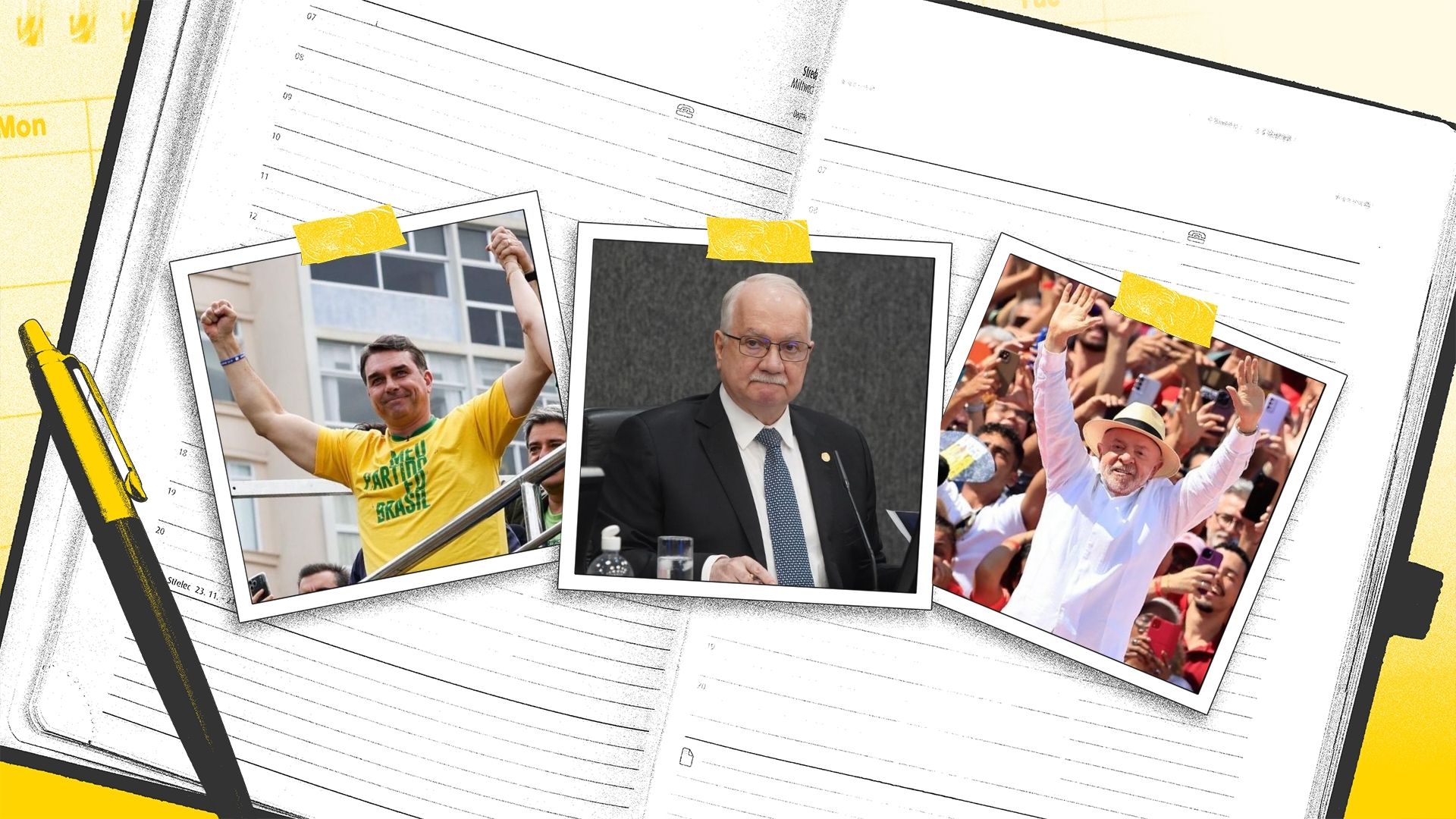
Nesta segunda-feira, 7 de setembro, candidatos à Presidência da República cumprem agendas voltadas para as comemorações pelo Dia da Independência do Brasil. Na avenida Paulista, em São Paulo, um ato foi convocado pelo candidato e senador, Flávio Bolsonaro (PL-RJ).
O presidente Lula, candidato à reeleição, estará presente ao tradicional Desfile Cívico-militar na Esplanada dos Ministérios, em Brasília. Os temas deste ano abrangem a luta contra a violência à mulher, a soberania nacional e a Copa do Mundo Feminina, que o Brasil sediará entre os dias 24 de junho e 27 de julho de 2027.
No Rio de Janeiro, o candidato do partido Avante, Augusto Cury, participa da “Caminhada da Independência Cury Brasil”. Com o trajeto entre o Posto 6 em Copacabana, zona sul do Rio de Janeiro, até o Posto 5, a concentração irá começar às 9 horas.
Em Brasília, o Partido Novo convoca seus aliados para participar de uma manifestação no feriado contra o ministro do Supremo Tribunal Federal (STF) Alexandre de Moraes. O ato está marcado para às 9h, em frente ao Banco Central, local próximo de onde estará ocorrendo o desfile oficial. O candidato do Novo à presidência, Romeu Zema, não confirmou presença e é esperado no mesmo evento de Flávio Bolsonaro em São Paulo.
Atenção segue voltada para o Supremo
As denúncias trocadas entre os ministros do STF André Mendonça e Alexandre de Moraes, que devem ser tema nos eventos eleitorais desta segunda-feira, também mobilizam a Corte nesta semana. O presidente Edson Fachin deve ouvir manifestações do ministro André Mendonça e da Procuradoria-Geral da República (PGR) a respeito do pedido de investigação sobre abuso de poder e improbidade administrativa supostamente praticados por Mendonça feito pelo ministro Alexandre de Moraes na última quinta-feira, 3 de setembro.
TSE julga pedidos de intervenção federal no Piauí e no Maranhão
Com menos de um mês para o primeiro turno das eleições, o Tribunal Superior Eleitoral (TSE) julga nesta semana as requisições dos Tribunais Regionais Eleitorais do Piauí e do Maranhão, de uso da Força Federal, composta por militares do Exército, da Marinha e da Aeronáutica. O objetivo é assegurar o livre exercício do voto nas eleições de 2026. As capitais, Rio de Janeiro (RJ), Fortaleza (CE), municípios distantes e aldeias indígenas de Rio Branco, capital do Acre, fizeram a mesma solicitação e já tiveram os pedidos aceitos pelo TSE.
Estão na agenda da semana de 7 a 11 de setembro:
TSE
Prestações de Contas (09/9): Partidos e candidatos devem enviar à Justiça Eleitoral a prestação parcial das contas das movimentações financeiras e estimativa para campanha desde o início da campanha até 8 de setembro.
STF
Marco Civil da Internet (ADC 91, 09/9, 14h): Ministros voltam a debater sobre o parágrafo 1° do artigo 10 do Marco Civil da Internet, que permite o compartilhamento de registros de conexão e de acessos na internet apenas com autorização judicial prévia.
Investigações feitas por delegados (ADI 5073, 09/9, 14h): Ministros discutem sobre a Lei 12.830/2013, que aborda investigações criminais conduzidas por delegados policiais. A Confederação Brasileira de Trabalhadores Policiais Civis (Cobrapol), que ajuizou o caso, argumenta que a lei retoma privilégios já extintos na Constituição Federal de 1998.
Dados pelos delegados da polícia (ADI 5059, 09/9, 14h): Julgamento em conjunto com as ADI 5073 e a ADC 91, ministros julgam a constitucionalidade do parágrafo 2° do artigo 2 da Lei 12.830/2013, que possibilita aos delegados requisitarem dados, informações, documentos e perícia sem autorização judicial.
Ministério Público do Amazonas (ADI 7512, 09/9, 14h): Ministros vão julgar se a lei do Amazonas nº 3.147/2007, que estabelece que 10% dos cargos comissionados devem ser reservados para efetivos do MPAM, viola regra do concurso público, os princípios da moralidade, da impessoalidade e da eficiência.
Créditos do ICMS (RE 835818, 09/9, 14h): Recurso Extraordinário avalia se os créditos presumidos de Imposto de Circulação de Mercadorias e Serviços (ICMS) podem ou não compor cálculo do PIS e da Cofins.
Proibição de divisão de lucros (ADI 5161, 09/9, 14h): Ação, ajuizada pelo Conselho Federal da Ordem dos Advogados do Brasil (CFOAB), questiona se o artigo 32 da Lei nº 4.357/1964, que proíbe empresas com dívidas ativas na União a distribuir lucro, com multa de 50% dos lucros distribuídos.
Há crises políticas que resultam de uma única decisão errada. Outras resultam de um conjunto de acontecimentos que, isoladamente, poderiam eventualmente ser explicados, mas que, acumulados, criam uma realidade politicamente insustentável. O caso Luís Neves pertence claramente à segunda categoria.
O que verdadeiramente distingue esta crise não é apenas a gravidade de cada episódio. É a sucessão de factos, contradições, relações pessoais, decisões administrativas e explicações posteriores que foram surgindo ao longo das últimas semanas. E é precisamente essa acumulação que levanta uma pergunta inevitável: até quando pode Luís Montenegro manter no Governo um ministro cuja permanência se tornou, ela própria, um problema político para o Executivo?
Tudo começou com as obras numa propriedade em São Teotónio, no concelho de Odemira. O empreiteiro responsável, João dos Santos Carvalho, da Construbarcelos, não era um desconhecido de Luís Neves. A empresa tinha realizado trabalhos para a Polícia Judiciária durante o período em que Luís Neves dirigiu aquela instituição. Posteriormente, foi o mesmo empreiteiro a realizar obras na propriedade privada do atual ministro da Administração Interna.
A questão não é afirmar que uma relação pessoal ou profissional constitui, por si só, um crime. Não constitui. Mas a proximidade entre quem dirigia a Polícia Judiciária e um empresário cuja empresa recebeu contratos daquela instituição exige um escrutínio particularmente rigoroso. Quando essa mesma empresa passa depois a realizar obras na propriedade pessoal do antigo diretor nacional da PJ, a exigência de transparência torna-se ainda maior.
As obras no Alentejo levantaram outras dúvidas. Foram divulgadas informações relativas a 108 faturas, emitidas por 13 empresas, num valor superior a 23 mil euros. Durante algum tempo, uma das principais questões foi precisamente a ausência pública dos comprovativos de pagamento. Luís Neves afirmou ter pago cinco mil euros ao empreiteiro, mas a forma como determinados pagamentos foram realizados e a documentação disponível tornou-se objeto de escrutínio público.
Também a própria legalidade urbanística das obras foi questionada. A Câmara Municipal de Odemira confirmou que estava a averiguar a situação e que não existia processo de licenciamento ou comunicação prévia para as obras referidas. Luís Neves acabaria por admitir a necessidade de regularizar a situação.
Mas foi o episódio do atrelado que transformou uma polémica numa verdadeira crise política.
Um atrelado apreendido no âmbito da Operação Pacoba, relacionada com tráfico de droga, foi encontrado nas instalações da empresa Construbarcelos, pertencente precisamente ao empreiteiro amigo do ministro. A Polícia Judiciária abriu um inquérito para apurar as circunstâncias da situação.
Importa ser rigoroso: a PJ esclareceu que os produtos encontrados no interior do atrelado não eram estupefacientes. Contudo, o atrelado tinha sido apreendido numa investigação de combate ao tráfico de droga e continha materiais e produtos químicos associados à operação que levou à sua apreensão. A questão central não é, portanto, insinuar que o empreiteiro ou o ministro traficavam droga. Não há qualquer fundamento para essa afirmação. A questão é outra e é suficientemente grave: como chegou um bem apreendido pela Polícia Judiciária às instalações privadas de um empresário próximo do então diretor nacional da PJ?
Há ainda uma questão adicional, relacionada com a segurança do próprio atrelado e do seu conteúdo. Segundo foi noticiado, a Marinha não queria que o atrelado permanecesse nas suas instalações por razões de segurança. Perante essa preocupação, o atrelado acabou por ser transportado ao longo de vários quilómetros e armazenado nas instalações do empreiteiro, aparentemente sem condições adequadas de segurança ou de custódia.
Esta circunstância torna a decisão ainda mais difícil de compreender. Se existiam preocupações de segurança suficientemente sérias para levar a Marinha a recusar a permanência do atrelado nas suas instalações, como se considerou aceitável transportá-lo para um espaço privado, sem condições comparáveis e pertencente a um empresário com uma relação de proximidade com o então diretor nacional da PJ?
Luís Neves assumiu posteriormente ter autorizado a deslocação do atrelado, defendendo que a decisão permitiu poupar dinheiro ao Estado e afirmando que não existia qualquer problema com o atrelado enquanto este esteve na posse do empreiteiro. Mas essa explicação levanta uma pergunta inevitável: se estava tudo bem com o atrelado e com o seu conteúdo, por que razão a Polícia Judiciária foi imediatamente apreendê-lo quando soube que se encontrava nas instalações do empreiteiro?
A apreensão posterior não prova, por si só, que tenha existido qualquer irregularidade criminal. Mas demonstra que a situação era suficientemente sensível para justificar uma intervenção imediata das autoridades. E essa intervenção contradiz, pelo menos politicamente, a ideia de que se tratava de uma solução normal, segura e sem qualquer risco.
A explicação, contudo, não encerrou a polémica. Pelo contrário, colocou no centro do debate a relação entre a decisão administrativa, a entidade que beneficiou da guarda do bem, as condições de segurança do armazenamento e a amizade existente entre o então diretor nacional da PJ e o proprietário da empresa.
Quando um cidadão comum olha para este caso, é legítimo que pergunte se o mesmo tratamento teria sido dado a qualquer empresário sem qualquer ligação pessoal ao responsável máximo da Polícia Judiciária.
E as dúvidas não terminaram aí.
Surgiu depois a questão de uma viatura apreendida pela PJ e utilizada por Luís Neves. O ministro tinha afirmado, numa conferência de imprensa, possuir apenas um automóvel familiar com cerca de quinze anos. Posteriormente, tornou-se público que tinha outra viatura pessoal e utilizava ainda um automóvel que tinha sido apreendido pela Polícia Judiciária e posteriormente cedido ao Ministério da Administração Interna.
A questão deixou, assim, de ser apenas a utilização de uma viatura. Passou também a ser uma questão de credibilidade. Quando um governante presta esclarecimentos públicos e a informação posteriormente conhecida demonstra que a realidade é mais complexa do que aquela inicialmente apresentada, é inevitável que a confiança nas suas explicações seja afetada.
Também foram levantadas questões públicas sobre outros bens apreendidos e sobre a gestão e utilização de património proveniente de processos sob tutela da PJ. Todas estas matérias devem ser investigadas com rigor, sem julgamentos antecipados e sem condenações mediáticas. Mas há uma diferença fundamental entre respeitar a presunção de inocência e exigir responsabilidade política.
Um ministro não precisa de ser condenado por um tribunal para deixar de reunir condições políticas para permanecer no Governo.
É precisamente aqui que a responsabilidade passa diretamente para Luís Montenegro.
Porque mantém o primeiro-ministro Luís Neves no Governo?
Essa é hoje uma das perguntas mais importantes desta crise. Montenegro continua a manifestar confiança no ministro, apesar da sucessão de episódios, das investigações e do desgaste evidente da imagem do Governo.
A explicação poderá ser política: afastar Luís Neves poderia ser entendido como admitir que a escolha foi errada. Mas mantê-lo tem igualmente um preço. Cada nova revelação prolonga a crise. Cada nova contradição transforma o problema de um ministro num problema do próprio primeiro-ministro.
E é também impossível ignorar o comportamento da restante oposição.
O silêncio ou a contenção de alguns partidos perante uma crise desta dimensão merece reflexão. O Partido Socialista, em particular, não demonstrou a mesma intensidade política que tantas vezes manifesta perante casos de menor dimensão quando os protagonistas pertencem a outros quadrantes políticos.
É legítimo perguntar porquê.
Não significa afirmar que existe qualquer acordo oculto, comprometimento ou cumplicidade. Não existem elementos públicos que permitam fazer essa acusação. Mas politicamente é legítimo questionar se determinados silêncios resultam de uma estratégia de prudência ou do receio de que uma escalada do escrutínio sobre relações entre poder político, empresas e instituições possa trazer novamente à superfície outros casos do passado.
É neste contexto que o CHEGA decidiu assumir uma posição clara.
André Ventura exigiu a demissão de Luís Neves e alertou para o risco de perda de confiança dos portugueses nas instituições. O partido apresentou uma moção de censura e procurou colocar o caso no centro do debate parlamentar.
A comissão de inquérito proposta pelo CHEGA tem igualmente uma importância política fundamental. O Parlamento não pode limitar-se a assistir às revelações e esperar que o tempo resolva aquilo que a política tem obrigação de esclarecer. Uma comissão parlamentar de inquérito permitiria chamar responsáveis, analisar decisões, conhecer documentos e perceber como foi possível que um bem apreendido pela PJ fosse parar às instalações de um empresário próximo do seu então diretor nacional, em condições de segurança aparentemente inadequadas.
Mais do que uma iniciativa contra uma pessoa, trata-se de defender uma regra essencial: ninguém pode estar acima do escrutínio democrático.
O Presidente da República também deixou claro, através das intervenções e alertas dirigidos ao funcionamento das instituições e à necessidade de responsabilidade política, que Portugal não pode normalizar crises permanentes no Governo. A estabilidade não pode significar silêncio. A estabilidade não pode significar tolerar indefinidamente situações que fragilizam a confiança dos cidadãos.
A moção de censura apresentada pelo CHEGA deve, por isso, ser analisada para além do seu resultado aritmético.
Mesmo que não tenha condições para derrubar o Governo, tem um significado político inequívoco: o CHEGA recusou ser cúmplice, recusou fechar os olhos e posicionou-se claramente contra um Governo que prometeu rigor, transparência e exigência, mas que hoje mantém no seu interior um ministro envolvido numa sucessão de casos que continuam por esclarecer.
O CHEGA fez uma escolha política clara, não proteger o Governo apenas porque algumas das suas posições podem coincidir pontualmente com propostas defendidas pelo partido.
O Governo de Luís Montenegro deve ser avaliado pelos seus atos. E, neste caso, o ato mais relevante do primeiro-ministro é precisamente aquilo que ainda não fez.
Ainda não retirou Luís Neves do Governo.
E enquanto isso não acontecer, a crise continuará a ter dois protagonistas, Luís Neves, por tudo aquilo que ainda precisa de explicar, e Luís Montenegro, por continuar a decidir que essas explicações são suficientes.
Talvez sejam suficientes para o primeiro-ministro.
Mas a pergunta verdadeiramente importante é outra: serão suficientes para os portugueses?
Acho que não.
O Estado de São Paulo já teve mais resgates de trabalhadores sujeitos a trabalho análogo à escravidão no campo nos seis primeiros meses do ano do que em todo o ano de 2025. É o que revelam dados do relatório de Conflitos no Campo, com dados parciais de 2026, divulgado nesta quarta-feira (2), pela Comissão Pastoral da Terra (CPT). O número nacional total de resgatados de condições degradantes de trabalho, por outro lado, diminuiu.
Ao todo, 148 trabalhadores foram resgatados no primeiro semestre deste ano em São Paulo. A marca já é superior aos 142 de 2025. A maior parte desses profissionais trabalhava no plantio e corte de cana-de-açúcar.
Para a coordenadora do CPT, Cecília Gomes, o aumento de casos pode ser visto pela característica do tipo de trabalho nos campos, incluindo lavoureiros e operários de construções. Entretanto, Gomes também avalia que o aumento da tecnologia pode influenciar nessa conta.
“Aquela história de que levar a tecnologia para o campo vai diminuir a mão de obra e o trabalho escravo, essa hipótese cai por terra. Porque, quando a gente olha, quanto mais tecnológico é o ambiente, maior a probabilidade ou a possibilidade de ter trabalho escravo. Essa é uma característica que tanto está no Sul, no Sudeste, no Centro-Oeste, está em todas as regiões brasileiras”, afirma a coordenadora.
No país, 355 trabalhadores foram resgatados em 30 casos registrados entre janeiro e junho. Em 2025, essa marca foi de 842 pessoas. Mesmo com as subnotificações das denúncias, Gomes afirma que o trabalho da CPT em conjunto com o Ministério do Trabalho mostra que existe uma necessidade de um olhar mais atento nas áreas mais tecnológicas.
A CPT também identificou que os casos mais graves de violência são praticados, em sua maioria, por fazendeiros (305 casos) e empresários (102 casos), que respondem por dois terços dos assassinatos e 61,4% dos episódios de violência contra ocupação e posse no primeiro semestre de 2026.
Para Gomes, a crescente violência no campo é possibilitada pela impunidade dos agentes causadores. “Pouco desses casos são apurados e os poucos que são apurados são pouco punidos”, explica a coordenadora da CPT.
Cresce a contaminação violenta de cidadãos
Violência mais praticada no campo em 2026, a contaminação por minérios atingiu 195 ocorrências. Para a CPT, o cenário é possível devido à priorização do “lucro em detrimento à vida” e da falta de fiscalizações mais rígidas de mineradoras.
Também houve 169 casos de contaminação por agrotóxicos, o que passa longe de ser por acaso, já que a organização vem identificando o uso intencional dessas substâncias como um tipo prático de arma química. “Não é só a contaminação das águas, esse agrotóxico é colocado para atingir os povos, para atingir as comunidades, como uma forma de expulsão”, denuncia Gomes.
E a contaminação por agrotóxico é venenosa porque as pessoas não conseguem produzir nem reproduzir o seu jeito, o seu modo de ser. Eles [a comunidade camponesa] têm uma cultura do plantio, da colheita, da alimentação e da diversidade. Mas não vão conseguir ter essa diversidade na produção, porque, como a água está contaminada, vai queimar as lavouras, vai danificar as lavouras”
Cecília Gomes
Coordenadora da CPT
Em 2025, o Brasil bateu recorde de agrotóxicos liberados. Foram 750 registros concedidos pelo Ministério da Agricultura, Pecuária e Abastecimento (Mapa).
Investigamos o que importa para os brasileiros além do que passa na campanha eleitoral. Leia mais reportagens como essa clicando aqui.
A violência policial matou 18 pessoas por dia e mais de 40 mil foram vítimas de mortes violentas intencionais em 2025 no país, segundo o Fórum Brasileiro de Segurança Pública. São dados que justificam a preocupação dos fóruns populares de segurança pública em apresentar, em um ano eleitoral, 27 pontos “inegociáves por uma Segurança Pública que Proteja a Vida”.
“A segurança no nosso país tem sido discutida e tem sido organizada só com a agenda da repressão qualificada. […] O que o Fórum Popular propõe é dar dois passos para trás e pensar numa segurança que seja sustentável a partir de uma política forte de prevenção à violência”, afirma Edna Jatobá, coordenadora executiva do Gabinete de Assessoria Jurídica às Organizações Populares (Gajob) e articuladora do Fórum Popular de Segurança Pública do Nordeste.
Reunião entre fóruns populares de segurança pública ocorreu em Fortaleza, em agosto
Nas reivindicações reunidas durante a 1ª Conferência Popular de Segurança Pública do Brasil (ConsepBR), realizada em Fortaleza (CE), saem pautas muito discutidas atualmente como aumento de penalidades, diminuição da maioridade penal, mudanças nos códigos penal e processual para entrar garantia de direitos, prevenção, educação, saúde, trabalho e renda, estratégias comunitárias de policiamento, mediação de conflitos e até segurança alimentar. No encontro, ocorrido entre 19 e 21 de agosto, estiveram presentes 300 representantes de fóruns populares e entidades que discutem o tema de 16 estados do Brasil.
Para Gerlane Simões, integrante do Fórum Popular de Segurança Pública do Nordeste e de Pernambuco, fazer a conferência antes das eleições foi importante para “a gente levar para o debate [sobre segurança pública] e colocar o dedo na ferida [dos candidatos e políticos]”. O objetivo agora é apresentar as ideias aos candidatos à Presidência da República e também ao máximo de candidatos aos governos dos estados.
A gente fez uma discussão enorme, várias reuniões, por conta desse timing [das eleições]. A segurança pública é a pauta que está na agenda do dia da extrema direita e a gente faz a disputa dessa narrativa. A ideia é encaminhar para todos os candidatos que a gente conseguir alcançar”, explica Simões.
Prevenção
Jatobá afirma que os pontos formulados mudam a forma como a segurança pública vem sendo discutida. Em vez de tratar sobre a punição aos crimes, abrangem a prevenção da criminalidade. Para ela, a primeira medida necessária é mudar a forma de investir na segurança pública.
“Primeiro é o investimento, a reorientação do investimento para programas de prevenção. Segundo, é entender a segurança como uma política que se vê realizada também em outros direitos, como acesso à moradia, acesso à cidade, acesso à cultura, esporte, lazer, entretenimento, educação, saúde”, afirma.
Para Simões, há uma diferença entre investimento na segurança pública e investimento em armamentos, que recebe investimentos bilionários com a crença de amenizar a violência nos estados. “Segurança pública para a gente não é um investimento bilionário. Por exemplo, aqui em Pernambuco, que se investiu mais de 4,5 bilhões em 2025, investiu-se em mais armamento e mais policiamento, e a violência só aumentou”, afirma.
A coordenadora do Gajob pondera que não se trata de dizer com isso “que não vai ter mais polícia, que não vai ter repressão, que não vai ter prisão. A gente está dizendo que esse caminho já foi percorrido e poucos resultados foram alcançados. O caminho da prevenção foi pouco percorrido e tem condições de dar base a uma mudança social”.
Garantia de direitos
“Segurança pública é garantia de direitos. É um conjunto de políticas públicas que estejam funcionando”, explica Gerlane Simões. Ela conta que em Pernambuco ocorreu uma pré-conferência com crianças e adolescentes. Nela, as crianças diziam que só queriam brincar. “Se isso não está na pauta do que é segurança pública então deveria ser outra coisa, né?” indaga Simões. Para ela, direito ao lazer, à saúde, ao trabalho e à renda, são pautas que devem ser abordadas sempre que o tema for a segurança pública.
“Se a gente tem investimento em prevenção, uma política de segurança articulada com outros direitos sociais, refletida num padrão de formação das forças de segurança, observando a diversidade da nossa população, orientando as forças de segurança para protocolos antimachistas, antirracistas, com respeito a todo credo e religião e à diversidade, a gente pode aí trilhar um caminho diferente”, completa Jatobá.
Guerra às drogas
A carta política dos fóruns populares também traz alternativas à chamada guerra às drogas, que segundo Jatobá “não é uma guerra contra a substância, ela é uma guerra contra as pessoas pobres que consomem drogas”.
Entre as soluções apresentadas está observar a questão das drogas “como um problema estruturalmente de saúde, um problema social”. A dirigente do Gajob ainda afirma que “não se faz guerra às drogas a quem está traficando no alto escalão, [de] colarinho branco”.
“Se tiver que fazer algum enfrentamento com relação ao tráfico de drogas, que comece com o sufocamento das grandes facções, dos grupos criminosos armados, por agir com inteligência e desmantelar esses grupos, tirar essas armas de circulação, sufocar financeiramente como algumas operações realizadas pela Polícia Federal, articulada com polícias estaduais”, aponta Jatobá.
Ela ainda lembra que mesmo nos bairros nobres, a “guerra às drogas” vai vitimar “o menino pobre, preto, morador de periferia, que faz uso de pequena quantidade de droga. Ou [que a droga] serve como trabalho, que é um dos piores trabalhos infantis e dos mais perigosos que existem”.
“A gente entende que uma política de segurança pública deve acabar com esse termo da guerra às drogas, que tem sido um pretexto para praticar o genocídio, o genocídio contra a juventude de pobre, negra e periférica”, finaliza.
Desinformação é intencional
Gerlane Simões acredita que a população brasileira não só está mal informada sobre o que devidamente é a segurança pública, como existe uma intenção em deixá-la desinformada. “A sociedade [brasileira] foi construída a partir de uma colonização, que ainda está em curso, e vai se reformulando. Então, a sociedade está bem formada nesse sentido do que é a segurança pública”.
Já a coordenadora do Gajob entende que há uma grande onda de notícias falsas no campo da segurança pública, “Há uma tentativa de tratar o tema da segurança como palanque eleitoral, prometendo que vai se resolver tudo com polícia, com morte e com prisão, mas sem apresentar alternativas estruturais para resolver o problema”, completa. O resultado da desinformação, para Edna Jatobá, é uma população “que está refém do medo e o medo tem sido um impulsionador para esses projetos fundamentalistas de tratar a segurança como morte”.
“A gente tem uma população que está buscando se informar, mas que ainda precisamos agir sobre esse grande mercado de notícias falsas, de propostas sem futuro e sem fundamento, sem nenhum respaldo de estudo ou de dados, para que as políticas deem certo”, conclui Jatobá.
Veja aqui todos os 27 Pontos Inegáveis para a Segurança Pública que Proteja a Vida.
Investigamos o que importa para os brasileiros além do que passa na campanha eleitoral. Leia mais reportagens como essa clicando aqui.
Já autorizados para fazer propagandas eleitorais nas ruas e na internet, os candidatos à Presidência terão disponível a partir desta sexta-feira, 28 de agosto, o horário eleitoral gratuito de rádio e de televisão. As veiculações seguirão até o dia 1.º de outubro, três dias antes do primeiro turno das eleições. O Tribunal Superior Eleitoral (TSE) divulgou na última quinta-feira, 20 de agosto, o tempo concedido à propaganda para cada partido.
O horário eleitoral gratuito será dividido em dois blocos de 12 minutos e 30 segundos para os candidatos à Presidência. A coligação de Lula, o Brasil Pronto para Mais, composta pelos partidos PT, PC do B, PV, PDT, PSB, PSOL e REDE, vai receber o maior tempo de propaganda, com 5 minutos e 31 segundos. Flávio Bolsonaro terá 4 minutos e 20 segundos; Ronaldo Caiado, 2 minutos e 2 segundos; e Augusto Cury terá 35 segundos de tela. Os demais candidatos à presidência não atingiram as exigências de cláusula de desempenho.
Seguindo com as sabatinas dos programas de televisão, a TV Globo inicia uma série de entrevistas com os candidatos à Presidência da República nesta segunda-feira, 24 de agosto. O primeiro entrevistado será Romeu Zema (Novo), que estará no programa nesta segunda-feira. Seguindo o cronograma, Ronaldo Caiado (PSD) é entrevistado nesta terça (25); Renan Santos (Missão), na quarta-feira (26); Lula (PT), na quinta-feira (27); Flávio Bolsonaro (PL), na sexta-feira (28) e Augusto Cury (Avante), no sábado (29).
As entrevistas serão transmitidas pelo canal a partir de 21h05, após o “Jornal Nacional”. Também será possível acompanhá-las pela TV a Cabo na “Globonews” ou pela internet no portal G1.
Uberização será tema no STF
No Supremo Tribunal Federal (STF), a “uberização” e o vínculo trabalhista entre motoristas de aplicativo e as plataformas de transporte voltam a ser discutidos pelo Plenário da Corte nesta quinta-feira, 28 de agosto. Os julgamentos do Recurso Extraordinário (RE) 1446336, que tem como relator o ministro Edson Fachin, e da Reclamação (RCL) 64018, com relatoria do ministro Alexandre de Moraes, poderão considerar a Convenção Internacional sobre o Trabalho Decente na Economia de Plataformas. O recurso relatado por Fachin aborda a relação de trabalho entre motoristas e plataformas digitais. Já a reclamação analisada por Moraes foi apresentada pela empresa Rappi, que contesta a decisão da Justiça do Trabalho em reconhecer vínculo empregatício entre a plataforma e o motorista.
A nova convenção sobre as plataformas digitais foi aprovada pelos estados-membros da Organização Internacional do Trabalho (OIT) em junho deste ano. Ela promove normas e garantias aos trabalhadores por aplicativo, como o pagamento dos valores a receber dentro dos prazos legais e, para aqueles que têm reconhecido o vínculo empregatício, um salário mínimo, além de uma compensação dos custos gerados pelo exercício da profissão.
Agenda da Semana de 24 a 28 de agosto:
TSE:
Juízo Eleitoral (25/8): último dia para partidos políticos e federações indicarem ao juízo eleitoral três pessoas para ocuparem a Comissão Especial de Transporte no primeiro e segundo turno.
Fusão de zona eleitoral (27/8): último dia para que a Justiça Eleitoral reúna, em uma mesma mesa receptora e mesmo local, as sessões eleitorais que possuem baixo número de eleitores.
Alteração e cancelamento de voto (28/8): último dia em que mesários, pessoas de apoio logístico, agentes penitenciários, policiais penais e servidoras ou servidores de estabelecimentos penais e de unidades de internação de adolescentes podem alterar ou cancelar a habilitação para votar em sessão diferente da que o título foi cadastrado.
STF:
Prevaricação no MP e Poder Judiciário (ADPF 881, 26/08, 14h): ministros julgam ação ajuizada pela Associação Nacional dos Membros do Ministério Público (Conamp), que julga se servidores do Ministério Público e do Poder Judiciário podem responder por prevaricação, quando um servidor público retarda, omite ou age contra uma lei durante o seu serviço por motivos pessoais.
Reforma Trabalhista (ADC 80, 26/8, 14h): vai a julgamento normas da Consolidação das Leis do Trabalho (CLT) que foram alteradas pela reforma trabalhista em 2017, como a concessão da justiça gratuita na Justiça do Trabalho e a autodeclaração de hipossuficiência para o recebimento de benefícios.
Caso Buser (RE 1506410, 26/8, 14h): ministros julgam a regulação dos transportes fretados coletivos em viagens municipais e intermunicipais em Minas Gerais.
Fim do voto de qualidade (ADIs 6399, 6403 e 6415, 26/8): Ministros discutem três ações de inconstitucionalidade sobre a determinação ao fim do voto de qualidade quando a empates nos julgamentos no Conselho Administrativo de Recursos Fiscais (Carf).
Agenda da semana daPúblicaé um serviço apresentado aos leitores aos domingos e segundas, concebido com base nas informações dos portais da Câmara, Senado, TSE e STF.
Longreads has published hundreds of original stories—personal essays, reported features, reading lists, and more—and more than 14,000 editor’s picks. And they’re all funded by readers like you. Become a member today.
One of the most vivid memories of my childhood involves an ice cream. My mother and father kept a relatively treat-free house, with desserts reserved for special occasions, but their standards loosened during summer vacations. During a visit with relatives we didn’t see very often, my parents decided to make the day even more special; they gave my sister, my two cousins, and me money to buy something from the ice cream truck that made a regular circuit around the neighborhood. Thrilled by this rare indulgence, I rushed down the sidewalk, delighted to finally take part in this classic summertime ritual, eating dessert in the middle of the afternoon!
I can still remember the thrill of holding that much-anticipated cone, taking my first lick . . . then watching the scoop roll off its biscuity throne to the sidewalk.
Perhaps that is why, as an adult, my freezer is always stocked with at least two flavors of ice cream, which I eat year-round. It’s my go-to way to reward myself after a productive day, or to make a bad one better. While I tend to keep things simple (and have been known to eat directly out of the carton), I love ice cream for its versatility. It can support a piece of apple pie or be the main event in a fudge-slathered sundae. Its near-infinite variety of flavors offers something for everyone, from no-frills vanilla to chef-inspired gastronomic experiments.
That ability to shape-shift has made this humble dessert a mirror of sorts, reflecting cultural changes. It even goes back to the founding of the country: Thomas Jefferson was the first known American to write down an ice cream recipe (though it’s only fairly recently that historians have begun to acknowledge his problematic relationship with the enslaved workers who produced such delicacies for his guests). A century later, advances in refrigeration transformed ice cream from a luxury good to a mass-market phenomenon. As immigration surged in the US, peddling ice cream on the street became a way for new arrivals to grasp the American dream. During World War II, the dessert symbolized the country’s can-do attitude: Despite the many logistical obstacles, the US government shipped it to troops as far away as the Pacific.
In our current Age of Ozempic, while celebrities get ever slimmer and our screens fill with physical-optimization hacks, desserts may seem like an endangered species. But I believe it’s more important than ever to take guilt-free pleasure in food that brings you joy. And if you still feel a twinge of hesitation before digging into a bowl of your favorite flavor, multiple studies over the past 20 years have shown that ice cream actually has real, measurable health benefits (see David Merritt Johns’s piece from The Atlantic below). No less an authority than Dr. Ezekiel Emanuel, a prominent bioethicist and oncologist, titled his most recent book on healthy living Eat Your Ice Cream.
So go ahead and have a scoop. Think of it as doctor’s orders.
This entertaining account traces ice cream’s transformation from an expensive luxury to an all-American dish in the early 20th century, when advances in refrigeration made it more widely available. Prohibition played a part, too: When alcohol was banned nationwide in the 1920s and early ’30s, some breweries switched to making ice cream instead, “a decent substitute for alcohol for the drowning of one’s emotions.”
But what really stands out in this story is the role ice cream played in World War II, when it became a symbol of American patriotism. Siegel weaves together historical anecdotes that show the enormous effort the US military put into embedding ice cream throughout its supply lines. Why go through all that trouble? Siegel makes a compelling case that getting ice cream halfway around the world, under such difficult circumstances, was a way of putting American exceptionalism into action. If we can do this for our soldiers, we can do anything.
By the time World War II came around, ice cream . . . had become inseparable from the American way of life, an emblem of American comfort, freedom, and democracy. The rest of the world went back to banning ice cream as part of its rationing efforts (with Great Britain adding salt to the wound by endorsing carrots on sticks as the official wartime substitute for ice cream bars), but the United States doubled down, building pop-up ice cream factories on the front lines; delivering individual ice cream cartons to foxholes; spending more than a million dollars on a floating ice cream barge that roamed the Pacific delivering ice cream to Allied ships incapable of making their own; and distributing 135 million pounds of dehydrated ice cream base in 1943 alone.
This engaging survey of popular ice cream flavors is filled with trivia-night-worthy fun facts: that vanilla is consistently the best-selling flavor worldwide; that chocolate ice cream may actually have been created first (cocoa being more readily available than vanilla); and that mint chocolate chip got an international popularity boost when a British culinary student created the dessert “Mint Royale” to celebrate the marriage of England’s Princess Anne in 1973.
But such is the nature of culinary history that not all lineages are straightforward. I appreciate the way Barron analyzes all the possible origin stories, even when they contradict. While some flavors have a single known inventor—such as the Grateful Dead fan who suggested “Cherry Garcia” to the hippie entrepreneurs Ben & Jerry’s—others resulted from experimentation over time. Some even have shameful associations: Butter pecan, for example, became popular in the American South, where the nuts were plentiful and used to dilute vanilla ice cream when serving it to Black customers.
Rocky Road could be considered the ice cream world’s first mix-in flavor, blending creamy ice cream with crunchy and chewy additions. According to legend, its creation dates back to 1929, when ice cream maker William Dreyer and candy maker Joseph Edy teamed up in Oakland, California. During the Great Depression—a “rocky” time for America—Dreyer supposedly invented the flavor by using his wife’s sewing scissors to cut marshmallows into a chocolate ice cream base studded with walnuts. The duo mass-produced the new flavor, giving the country a bit of sweetness and humor during a bleak decade.
But the name “Rocky Road” may have existed long before. In the mid-1800s in Australia, settlers used the term for a confection of sweets, nuts, and dried fruit; essentially, a proto-trail mix. And just down the road from Dreyer’s and Edy’s, Fentons Creamery also claims to have invented the flavor, swapping walnuts for almonds in their signature version.
Brianna Wellen had one overarching question when she visited the Chicago outpost of The Museum of Ice Cream: What is this place? I had the same thought as Wellen when it started showing up on Google Maps as a must-see attraction in my hometown—is this “an influencer’s paradise? A children’s playground?”
The answer, it turns out, in her snarky-but-fair review, is both. A privately owned chain with five locations in the US and one in Singapore, it started as a pop-up “experience” in New York, with an aggressively pink aesthetic that bridged the line between kids’ party and Instagrammable photo op. If you’re looking for “an anthropological look at the history and cultural impact of ice cream,” she writes, this isn’t it. (Though I’d happily visit that museum.)
It’s more fun to write a scathing review than a positive one, but Wellen doesn’t take the easy route and go full hater. She acknowledges that the people around her are having fun taking pictures in the giant pool of faux sprinkles, and that the unlimited ice cream samples may be worth the price of admission for some, even if the Chicago hot-dog-style signature treat looks better than it tastes.
What she points out so effectively is the chasm between the museum’s ethos of lighthearted escapism and its grim reality: It is housed in a building that used to be the headquarters of the prestigious Chicago Tribune newspaper, now given over to an ephemeral, commercial experience dependent on overworked, demoralized employees.
There’s something extremely dystopian about these bright, colorful, somewhat functionless installations popping up inside closed businesses, which is how the project started. And seeing Chicago’s iteration in the storefront of the now empty Tribune Tower, which once housed some of the most influential journalists the city had to offer, was disappointing, signaling that while the media industry is on its deathbed, people will form a line down the block to snap a photo with a plastic sprinkle.
There was something about the staff’s demeanor that led me to believe they weren’t as excited to be there as their oft-repeated scripted banter made it seem. The logistics of certain experiences seemed like a mess; the large, unending crowds needed to be endlessly wrangled; and the loud music meant that their faux cheerful taglines needed to be screamed right into the ears of visitors to be heard. Smiles were pasted on as impatient guests asked why they couldn’t just go into the Ice Cream Lab already. When Angela and I kindly told one worker that there was no rush in letting us into a particular room and then complimented her ice-cream-themed hair clips, she reacted with such graciousness at our attitudes that I thought she was about to start sobbing.
I still remember my visceral reaction on reading this Atlantic story a few years ago: Is ice cream actually good for me?
In this exhaustively researched and reported piece, Merritt Johns explains how a statistically significant finding can be pushed aside when it doesn’t fit an accepted narrative. For more than 20 years, nutritional studies have shown that diabetics who eat half a cup of ice cream a day have a lower risk of heart problems, and people who eat two or more servings of ice cream a week had a significantly lower risk of developing diabetes in the first place. Yet those findings seemed so contrary to public health advice that alternate explanations kept being pushed instead—it’s just dairy that’s good for you, especially if you choose low-fat milk or yogurt. “As academia’s public-relations machinery came to life,” he writes, “nuance went out the window.”
Poor ice cream never got its due—until now.
Every day brings another health story about a so-called “superfood,” but Merritt Johns’s relentless focus on the facts sets this one apart. Rather than relying on an academic study or two, he tracks down all the key researchers involved in what I like to call the Great Ice Cream Cover-up: “I wanted to know what happens when consensus makers are confronted with a finding that seems to contradict everything they’ve ever said before.” Some refuse to be interviewed (more proof of a conspiracy?), but most seem relieved to finally admit that seemingly set-in-stone advice about what’s good for us is more malleable than we think.
In 2004, the English epidemiologist Michael Marmot wrote, “Scientific findings do not fall on blank minds that get made up as a result. Science engages with busy minds that have strong views about how things are and ought to be.” Marmot was writing about how politicians deal with scientific evidence—always concluding that the latest data supported their existing views—but he acknowledged that scientists weren’t so different.
The ice-cream saga shows how this plays out in practice. Many stories can be told about any given scientific inquiry, and choosing one is a messy, value-laden process. A scientist may worry over how their story fits with common sense, and whether they have sufficient evidence to back it up. They may also worry that it poses a threat to public health, or to their credibility. If there’s a lesson to be drawn from the parable of the diet world’s most inconvenient truth, it’s that scientific knowledge is itself a packaged good. The data, whatever they show, are just ingredients.
Who thought foie gras ice cream was a good idea? And more importantly—what does it taste like? Amy Ettinger took on these pressing questions with a visit to Humphry Slocombe, a “kid-unfriendly” ice cream shop in San Francisco. Chef and co-owner Jake Godby admits the controversial flavor is only rarely on the menu (it’s too expensive and takes too long to make), but the debate surrounding it has been good for business. Hardcore foodies rush to buy it when they can, while the protests of animal-rights activists only raise the shop’s profile.
More than a food review, Ettinger explores why people make and eat extreme flavors. She argues that American palates have expanded over the decades; we’ve gotten used to ordering Korean barbecue tacos and sushi burritos, mash-ups unknown (and unthinkable) to our great-grandparents. To grab attention—and prove your chops as an out-of-the-box culinary thinker—you have to raise the stakes: “One person’s gross-out experience seems to be another person’s gleeful experimentation.”
As I took another bite, I couldn’t help but feel a thrill. There was something decadent in eating a treat that so many people would be upset about. The wrath I could incur by simply opening my mouth, chewing, and swallowing made me feel powerful. And maybe that perceived transgression is itself a flavor enhancer, much like artificial coloring can ramp up our experience of “lime” or “banana” in some mass-produced, neon-colored taffy or gum.
Is that why Godby put it on the menu—so he could wield that kind of power? Why continue making food that would anger people? Was it to get attention?
Who knew the simple ice cream truck had such a dramatic backstory? As an avid collector of historical trivia, I devoured this account of ice cream’s mobile history, starting with 19th-century immigrant street peddlers through controversies over the trucks’ music, cleanliness, and supposed ties to organized crime (the notorious Glasgow Ice Cream Van Wars ended with six people killed in a fire).
What gives this piece a lovely personal touch is the way Potts weaves this past with her own memories of growing up in an English seaside town, where she and her father would pick up ice cream treats in the summer: “An unspoken secret between us, given that Mum had dinner waiting on the table when we arrived, and would have been appalled to know that a mere seven minutes earlier, we were driving along the seafront, car top down, the salty air whipping my long hair into the ice cream and sticky sauce.”
As she interviews ice cream van owners whose vocation goes back generations—along with the entrepreneurs adapting their vehicles to new technologies—she is struck by how many people in the business are following a family tradition. “It’s an industry that remains strong, with an uncanny ability to adapt to changing times,” she writes. “I am fascinated by its survival.”
While it may be more common now to see an ice cream truck at an event or on TikTok, we still crave those summer days when jaunty chimes call us out to the street. The odds can feel stacked against the old-school icey men, with legislation that limits their movement, environmental and nutritional campaigners who demand more and more restrictions, rising pitch rents, the price of vans, the difference, even, in the way children play outside. But they’re still there, still clinging on. Why?
This portrait of master gelatiere Andrea Soban oozes with admiration for its subject—and had me craving his signature mandarin orange flavor. From his base in Valenza, Italy, halfway between Milan and Torino, he continues a family tradition that goes back at least five generations: creating the most flavorful, creamy gelato free of artificial ingredients or colors.
The word gelato—Italy’s lower-fat, lower-sugar version of ice cream—literally means “frozen,” but making it at Soban’s level involves science-whiz levels of knowledge. Zwingle shows the intricate steps he takes to get the right balance of ice crystals, fat droplets, and air bubbles. While he sources ingredients from around the world, most of his favorites come from specific parts of Italy; the best pistachios, for example, are grown in one small Sicilian town.
This story gave me a new appreciation for the effort that goes into making a seemingly simple dessert—when the person making it wants to be the very best, that is. Anyone want to join me on a field trip to Valenza?
“Try this,” Andrea said, as he handed me a tiny spoonful of a just-made mandarin sorbetto. Sensations of cold, and a smooth wave of extraordinary citrus flavor, blended into a faultless harmony as the whole combination swept up to my brain. It tasted juicier than the juice of the fruit itself. And then it simply disappeared. No loading my tongue with a mass of flavors jostling together, struggling for dominance, leaving assorted clinging aftertastes as my stomach braced itself. It left only the desire for more.
Suddenly I understood the hidden power of fine gelato. It doesn’t aim only for my mouth, and my stomach is really of no interest. It aims for the dopamine reward system lurking in my brain, the part that says, “You don’t need this, but you’ve got to have it.” We did these little teaching-tastings intermittently all morning. I paid close attention to everything he said, but the voice in my head kept crooning incoherently about what was happening in my mouth.
Elizabeth Blackwell is the author of While Beauty Slept, On a Cold Dark Sea, and Red Mistress. She lives outside Chicago with her family and stacks of books she is absolutely, positively going to read one day.
E se experimentar a cidade de Lisboa fosse menos condicionado por mapas coloniais e mais capaz de questionar territórios de poder, subalternidade e resistência? Por via da arte e de debates, agosto convida a deslocamentos entre Arroios, a Quinta do Mocho e a Cova da Moura. No livro O Espaço do Cidadão, Milton Santos sustenta que «o modelo cívico forma-se, entre outros, de dois componentes essenciais: a cultura e o território». Tal enunciado desloca a compreensão da cidadania para além da (…)
At the turn of the millennium, India became the global hub for medical transcription. With fiber optic cables laid in the 1990s, American hospitals found it cheap and efficient to...
Marine Le Pen’s candidacy for president means Europeans should brace for the possibility of a France wholly different to the one they know.
A Rassemblement National government would be hostile to the EU and a disruptive partner on numerous issues facing Europe; including on Russia, enlargement, climate and migration.
The party is divided over whether and how to work with other right-wing parties in France; and how to position the country within Europe and the Western alliance.
Le Pen is likely to work in a “duo” with party leader, Jordan Bardella, but there are notable differences between their outlooks. Europeans should pay attention to these.
European political leaders would struggle to influence a Le Pen-led government, but nor should they expect a unified European far-right to emerge. They would be wise to begin their preparations now.
Note: This policy brief is a second edition of an earlier paper published on June 9th 2026. It updates the prior analysis in light of Marine Le Pen’s confirmation that she will run for the French presidency.
The restoration of a matriarch
In the early hours of November 2nd 1976, a bomb exploded outside the Paris home of the far-right leader Jean-Marie Le Pen and his family. The perpetrators were never found. His youngest daughter, Marine, 8 years old at the time of the attack, later seethed that the family was not shown “the slightest sign of solidarity or compassion” by the French authorities. Today, as Marine Le Pen launches into her fourth—and most competitive—bid for France’s presidency, that quote reveals something of the woman who might soon occupy the Elysée Palace. If she wins, European policymakers will need to understand this self-defined outsider and how her family’s and party’s long years in the political wilderness shape her domestic and international agenda.
That insurgent self-perception may seem odd now. After all, the National Rally (Rassemblement National, RN) is far ahead in polling for the first round of the election, is accepted by an increasing share of French polite society, and is close to some of the country’s most powerful economic elites. But it still explains why the rest of Europe should brace for the possibility of a French president who sees herself as a rebel against the country’s and the EU’s established norms and institutions. As this paper will argue, a Le Pen presidency of France would be a significantly more formidable challenge to European orthodoxies than Giorgia Meloni is in Italy or Viktor Orban was in Hungary.
*
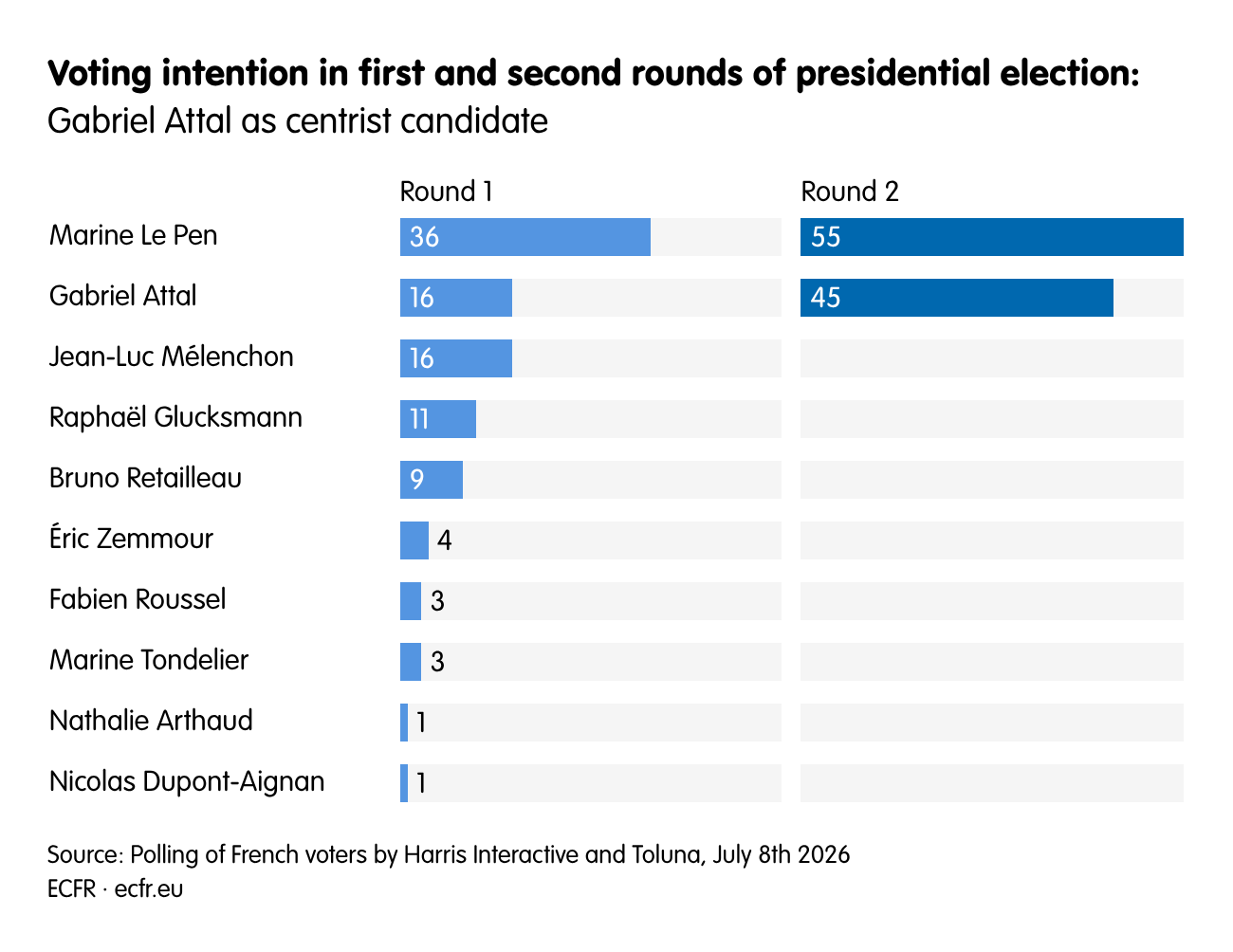
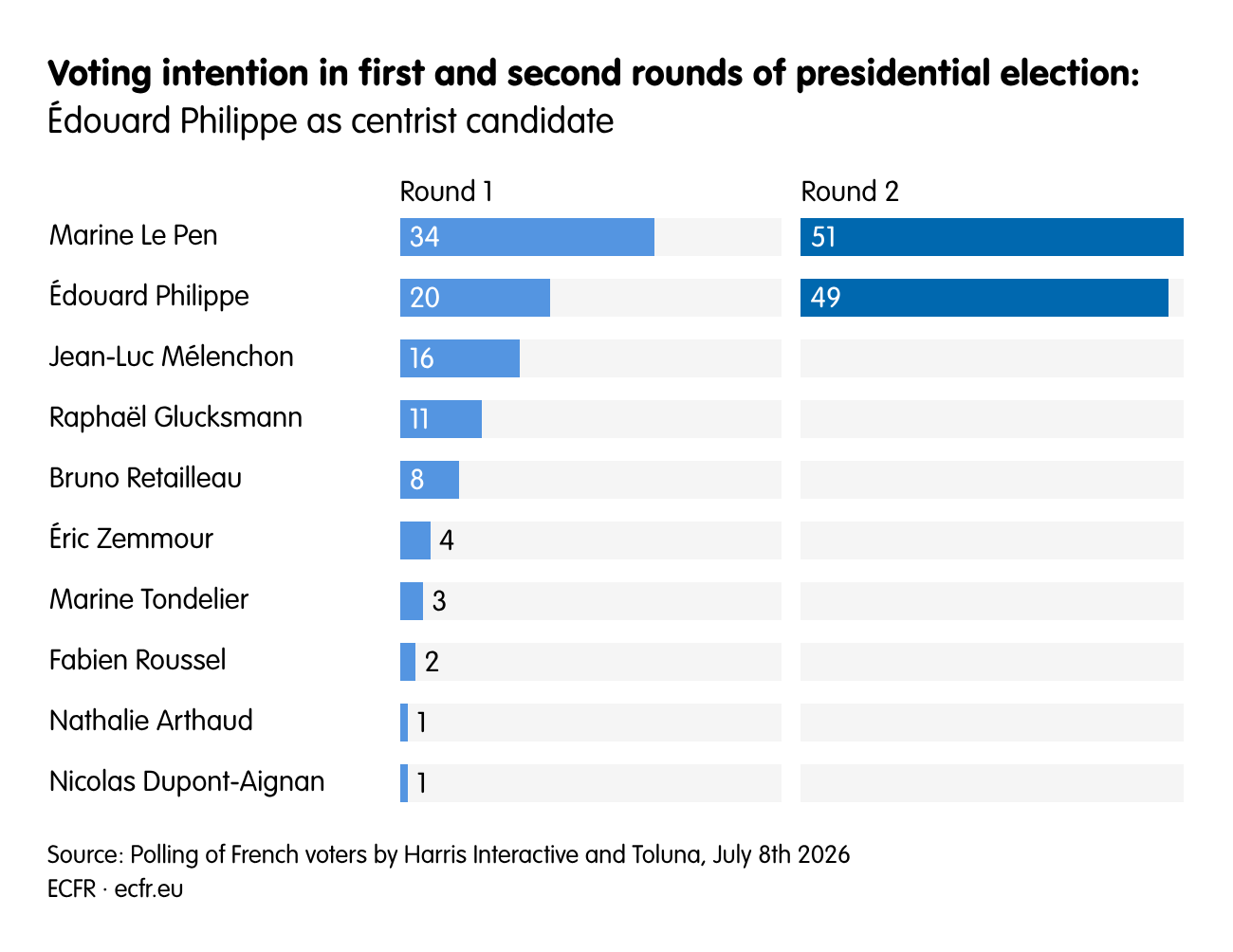
Only one thing is certain about the result of France’s presidential election next year: President Emmanuel Macron’s decade in power will come to an end. Who replaces him is an open question, with any number of conceivable outcomes. The exact field of candidates is not yet clear, not even in Macron’s centrist camp, where two former prime ministers—Édouard Philippe and Gabriel Attal—are vying for primacy. French presidential election campaigns are often volatile; both those in 2017 and 2022 saw major shifts over the half-year before polling day. But current polling suggests that the RN party candidate is on track to win the first round, on April 18th 2027, and to enjoy good prospects in the second, due on May 2nd.
The RN went through months of speculation over who would represent it at the presidential election. In March 2025, Marine Le Pen was convicted of embezzling European parliamentary funds and received a five-year ban on standing for election. Over recent months, Jordan Bardella, the RN’s untested young leader and Le Pen’s protégé, was talked about as the party’s best hope.
On July 7th 2026, however, the Court of Appeal reduced Le Pen’s ineligibility penalty, which enabled her to run. It also required her to serve a year of house arrest with an electronic ankle tag. That evening, Le Pen announced that she would seek the presidency and would appeal to the Court of Cassation. The penalty is suspended until France’s highest court rules on the case, which could take place as late as April 2027.
Her candidacy has significant implications for the rest of Europe. Le Pen is an experienced campaigner and an established (though also divisive) figure in France. Her bid for the presidency is perhaps more likely to survive the heat of the campaign than a Bardella run would have. The fact that she is the candidate probably increases the chances of the French far-right coming to power for the first time since Marshal Pétain, the puppet leader of Vichy France.
Le Pen is marked by the RN’s long years in the wilderness. She believes in radical solutions. As president, she would likely be a confrontational and abrasive force in Europe.
To reiterate, the outcome of the election remains wide open. But the scale of the potential rupture of a Le Pen win means policymakers elsewhere in Europe must both understand the RN and prepare for that eventuality. To that end, the authors of this paper have extensively researched the party’s Europe and foreign policies. The following study is based on in-depth interviews with an array of senior RN figures and external experts as well as analysis of the party’s speeches, legislative proposals, voting records and electoral programmes. The result is a series of five theses about what a Le Pen win next year would mean for Europe.
Understanding an RN presidency
Point 1: Marine Le Pen’s candidacy reaffirms her primacy inside the RN, although her duo with Bardella will endure
Marine Le Pen’s decision to run for president despite her upheld conviction—and in contradiction of her own prior statements—is a reminder of her centrality to the RN. She is still the party’s dominant leader. The decision also dispelled the illusion that Bardella constitutes a real alternative to her leadership. It showed that today’s RN is still Marine Le Pen’s inheritance and achievement.
The party was founded as the National Front (FN) in 1972 by Jean-Marie Le Pen, along with French former members of the Waffen-SS and other nostalgists for colonial French Algeria. It drew together different threads of the far-right. For decades most French citizens considered it beyond the pale. When Jean-Marie Le Pen narrowly made it into the second round of the 2002 presidential election, it shocked both France and Europe. He was roundly defeated by 82% to 18% by then-president Jacques Chirac.
Taking the reins of the party from her father in 2011, however, Marine Le Pen pursued a strategy of “dédiabolisation” (“detoxification”). This saw her expel Jean-Marie from the party in 2015 over his racist and anti-Semitic comments. After her resounding defeat to Macron in 2017 she intensified the process, renaming the party and dropping its commitment to “Frexit” (leaving the EU).
In 2019, she appointed a fresh-faced young activist from a deprived Paris suburb to lead the RN’s campaign for the European Parliament election. Jordan Bardella delivered the party’s first ever first-placed result in a national election and was rewarded with the RN presidency in 2021. He would play a central role in the party’s 2022 presidential campaign—a much closer contest—and in its triumphant win in the 2024 European vote. Le Pen further empowered Bardella when she announced he would be her choice for prime minister. When it looked like she might be banned from running, Bardella became her natural replacement as a presidential hopeful.
Nevertheless, despite Bardella’s rapid rise and growing public profile, the RN remains firmly in Le Pen’s hands. For nearly half a century, the promotion of family members, such as Marine Le Pen’s niece Marion Maréchal, and significant turnover among the lower levels of the party has kept power within the Le Pen clan. Many of the party’s cadres remain more loyal to her than to Bardella, and were determined that she should run rather than him.
Now that the party is back behind its leader, Le Pen will continue to highlight the duo she forms with Bardella—as she did on prime-time television when she launched her campaign. She once again promised to make him prime minister if she becomes president. Running a “ticket” for the French presidency is unprecedented and anathema to the function. But it has a distinct advantage: broadening her voter coalition while keeping the party together.
Le Pen’s own political base has two main parts. First, an anti-elite and disaffected working- and middle-class electorate in the northern post-industrial Pas-de-Calais region that she has represented since 1998 (as a councillor, MEP and in the National Assembly), And, second, a chain of strongholds along the Mediterranean coast, which adhere to long-term RN positions hostile to immigration and taxes.
By contrast, Bardella appears more economically liberal and temperamentally closer to other parts of the French right, including the conservative flank of the Republicans (LR, the rump centre-right force) and culturally reactionary forces like Éric Zemmour’s far-right Reconquest. He is also more engaged with the wider European right, especially Meloni in Italy. Within the RN itself this aligns him more with a more bourgeois and younger new electorate.
Over the last year, Bardella had even started to sand down some of the party’s most abrasive ideas. Where Le Pen cleaves to some of the party’s old Putin-friendly instincts on Russia, he has spoken in defence of Ukraine’s sovereignty. He also broke from Le Pen on pensions reform, suggesting dropping the fixed retirement age and moving to a more contributory system. Where Le Pen went to Budapest to help out an embattled Orban, he struck a friendly tone towards Germany and even met with the country’s ambassador in Paris. All this created expectations in Brussels and other EU capitals that a President Bardella might be closer to the bloc’s economic orthodoxies and more open, at least, to compromises.
Le Pen’s candidacy firmly relegates him to a subordinate position within the party. Gone, too, is the spectre of a somewhat more conciliatory RN presence in the Elysée Palace if the party wins power next year. “Bardellism cannot exist, as it is ultimately Marinism”, Jean-Philippe Tanguy, a senior RN figure, has said. The reassertion of Le Pen’s primacy within the RN thus makes the party both more likely to take power and more likely to disrupt the rest of the EU and its foreign policies if it does.
Point 2: An RN presidency would be a rupture in French and European politics
France is a highly centralised state, and its president wields executive power more akin to an American president than to counterparts in its European neighbours. The country also remains a pivotal power in Europe as one of its two nuclear-armed countries and half of the Franco-German motor that long drove the European project.
News of an RN win would therefore send shockwaves around the continent, stunning the mainstream. It would also lift the spirits of much of Europe’s radical right after a difficult 2026 in which its pre-eminent governing leader, Orban, lost power and its links with Trump turned out to be liabilities. After all, the RN has been unapologetic in its support for fellow “patriots” across Europe. Le Pen campaigned for Orban, and Bardella has engaged closely with Meloni and her government in Italy and Nigel Farage’s Reform in the UK.
Farther afield, the RN has been increasingly welcomed by fellow nationalists like Israel’s Likud government, which hosted Bardella and other far-right leaders in 2025. The Trump administration has professed its own commitment to supporting “patriotic parties” and would react favourably to an RN win. This is despite Bardella’s and Le Pen’s efforts to cool their party’s earlier enthusiasm for the US president.
The RN would revel in the sense of rupture. In private, party leaders compare their potential accession to power to left-winger François Mitterrand’s historic victory in 1981—which they see as the only true political change France has undergone in the last 50 years.
*
Thus empowered, the RN would want to enact its programme. Although foreign and defence policy may not be its top policy priority, “fixing” France’s relationship with the EU is bound to be one.
In its 2019 and 2024 European election campaign manifesto, the RN suggested transforming the European Commission into a mere secretariat of the EU, leaving legislative initiative only to the European Council. The party decries attempts to expand qualified majority voting, refuses any new transfers of competencies on foreign and defence policy to the commission—and seeks European allies in that endeavour.
The RN is vehemently against EU common taxation and borrowing. Both Le Pen and Bardella have proposed slashing the French contribution to the EU budget (by “between €2bn and 3bn”, as Bardella suggested, equivalent to 9-14% of the French payment in 2024). RN MPs have already put forward severalamendments to the budgetary laws to that effect. In July, Bardella has even advocated reducing the contribution by half. In place of European joint spending, the party wants the creation of a sovereign wealth fund to back “sovereign industries” in defence, technology and energy.
The party’s antipathy towards NATO means it plans to prioritise national-level defence instead. The RN has committed to maintaining current defence spending, but argues this should support France’s own military-industrial infrastructure first and foremost. Even if it has paused an earlier plan to leave NATO’s integrated command, at least for “as long as the war [in Ukraine] goes on”, Le Pen revived the idea as recently as May 2026.
The strictly national principle applies to energy too. The RN has promised to lower French energy costs, notably by breaking from EU-wide electricity pricing (which often depends on gas prices less relevant to France’s nuclear-heavy energy system) and thus allegedly reducing the French retail price. And, despite claiming to be concerned about the consequences of climate change, the RN is relentless in its opposition to the European Green Deal and its insistence that French nuclear energy should exempt the country from EU climate strictures.
Overall, if Le Pen were to become president, the RN’s highly disruptive European agenda would inevitably put France on a path to confrontation with European partners and institutions. As the fight against the EU is both a symbolic and a policy priority for the RN, other European leaders may have to find a way to negotiate on some of the demands—that for a budget rebate, for example—in order to prevent French vetoes.
Point 3: The RN’s inexperience and lack of interest in foreign policy would make France an erratic partner, especially in a crisis
Europe’s best hope, in the event of a Le Pen presidency, may reside in the fact that foreign policy would not be the top priority for the RN in power.
First, the RN’s foreign policies often remain vague or only partially formed. Despite its long-standing presence in the French political landscape, the party has no national governing experience and only in 2022 won a significant share of seats in the National Assembly. With little network among the French diplomatic establishment, RN leaders have rarely engaged closely with foreign policy debates. The party prefers to hide behind references to General de Gaulle’s pro-independence foreign policy to justify criticisms of the EU or NATO without being too specific.
According to RN insiders, the party’s foreign policy decisions emanate from private discussions between Le Pen and Bardella, with the occasional counsel of the advisory group Les Horaces. If she attains power in 2027, Le Pen may seek to attract more experienced figures from the traditional right (from LR or UDR) or from the military to lead on top foreign policy positions.
Second, the RN is clearly prepared to change its tone on international topics when political expediency dictates. RN figures privately insist that foreign policy cannot win it elections, but can lose it ones. They blame Le Pen’s defeat in April 2022 on her failure convincingly to pivot away from Russia after its full-scale invasion of Ukraine two months earlier.
The party abandoned Frexit after the UK’s Brexit turned out to be a disaster. It curbed its old openness to strongmen such as Putin (repaying a contentious loan to a Russian bank in 2023) and Syria’s Bashar al-Assad. In recent years, it attempted to erase its anti-Semitic past by adopting a strongly pro-Israel line. Since February 2022, the party has walked a tightrope: paying lip service to Ukraine’s right to self-defence while criticising sanctions against Russia as costly to French consumers and opposing some military aid to Kyiv as escalatory. Having greeted Trump’s re-election in 2024, the party has become a nimble critic as his erratic foreign policies have made alignment with him a political liability.
It is safe to assume, then, that, even with Le Pen as candidate, the party will tend towards orthodox language on most foreign policy ahead of the election. It has a vested interest in a campaign that focuses on topics such as immigration, crime and purchasing power (where the party is most confident), rather than one that debates France’s role in Europe or global geopolitics (where it is more uncertain and, in some cases, divided).
And even if the party wins power, the domestic agenda will likely come first. This can be summarised as: countering cultural and industrial decline by pursuing “national preference”. In policy terms it would include harsher law-and-order measures (especially on migration and crime), trade protectionism and efforts to reverse green policies in the hope of revitalising industry, and prioritising French nationals over foreigners in accessing welfare or public services. European partners should reckon on an RN presidency being most intransigent on EU matters related to those domestic priorities—and possibly being more open to negotiation in other areas.
In sum, however, they should expect a Le Pen foreign policy that is unclear, evolving or even contradictory. Under her leadership, France would take few initiatives and rather behave as a blocker. For example, it is hard to imagine an RN president responding decisively to a security crisis on Europe’s eastern flank. If under pressure from EU member states to be tougher on Russia, she would likely seek concessions and negotiations rather than further action.
If it does anything proactively, such a presidency would concentrate on disentangling France from EU policies that contradict its domestic goals. At best, the RN’s lack of interest and inexperience may be an opportunity for other European governments to shape some of the outcomes, as long as they keep their expectations low.
Point 4: How broad and how European? The strategic debates running through the RN
Today’s RN is infused by two strategic debates that would shape Le Pen’s tenure as president.
Movement or coalition?
The first has to do with the RN’s political identity: the party is struggling to determine whether it seeks to forge an union des droites (union of the right) or whether its outsider populist status remains its core identity.
In the long years the FN and the RN spent on the political margins, the Le Pens’ “neither left, nor right” approach appealed to disillusioned voters who rejected all forms of politics. It acknowledged the cordon sanitaire between the mainstream right and their parties. Even back in the FN days, Jean-Marie Le Pen crushed several internal attempts to unite the right. Marine Le Pen remains firmly opposed to any such efforts today.
If she is elected, it is unclear how Le Pen will position herself towards other right-of-centre French parties. Her instinct seems to be that working with them would dilute the RN and prevent it from conducting truly disruptive policies. Given her aversion to compromise and her long years of ostracism by the mainstream political class, Le Pen would struggle to extend a hand to others to form a majority in the National Assembly.
She may, however, continue using Bardella as a useful bridge to other parties of the right, at both national and European levels. In an interview with Le Figaro after Le Pen’s official launch of her presidential bid, he insisted that, as prime minister, he would seek to gather the right-wing electorate back to his party in order to build a “solid majority”.
It is reasonable to expect that, if Le Pen allows Bardella to forge these links at home, she will let him do so abroad too. If so, Bardella would continue building alliances with the European right spanning conservatives and various families of the radical right, likely with immigration as a focal point. The RN has already demonstrated its ability to build coalitions with other far-right parties and the European People’s Party to advance tougher migration legislation in the European Parliament. It would likely continue to do so if elected. Bardella has indicated that he wouldshare this agenda with leaders such as Meloni and German chancellor Friedrich Merz and seek to work with them.
Rival futures
The second faultline within the RN today is between rival conceptions of national sovereignty, a point that came across especially strongly in the authors’ interviews with senior party figures. Le Pen and the “old guard” around her have long held the view that France must resist Anglo-American hegemony and EU technocracy alike. They treat Washington and Brussels as equal threats to French autonomy.
Yet a new generation around Bardella—having come of age against the backdrop of the 2015 terror attacks in Paris and the Russian full-scale invasion of Ukraine—has adopted an identity-based sense of Europeanness. It acknowledges the need for European cooperation against common threats, as long as this cooperation is “chosen”. It is inclined to invoke a shared Western and European cultural affinity.
For example, on Russia and Ukraine, Le Pen and the old guard have continued to blame NATO’s enlargement for “provoking” Russia. This fits their antipathy to Washington and Brussels. Their old ideological affinities with Moscow as a counterweight to American hegemony allow them to imagine a future in which Russia might even be a partner in a multipolar order once the war ends. But Bardella has admitted the “naivety” of Europeans in the face of the Russian challenge. Despite a less-than-keenly pro-Ukrainian voting record in the European Parliament, he has also spoken in favour of Ukrainian national sovereignty and against Russian imperialism.
These debates will continue within the RN—especially because Le Pen has been unwilling to sweep aside Bardella’s “union of the right” and rhetorically “pro-Ukraine” positions. For as long as she wants the electoral breadth he brings, the tension will persist.
Point 5: The likeliest outcome of an RN presidency would be a more isolated France in a weaker EU
The disruptive nature of RN policies towards Europe means France’s relationship with European partners would deteriorate over time.
At first, the RN would likely seek to reassure the financial markets and its international partners. Victory for the party may be accompanied by protests and strikes, and the new government would face economic limitations like France’s high levels of debt. In this context, Le Pen may want to project stability. Nevertheless, the RN has promised to engage on a number of priorities that will put it at odds with other European governments—including those led by the right—as well as EU institutions.
Opting out of the EU-wide electricity pricing could push up prices for other member states; quitting the migration pact would put greater pressure on others; curbing the French contribution to the EU budget would force others to pay more and possibly trigger an infringement procedure. More generally, Paris governing in a spirit of French exceptionalism would roil Europe’s collective efforts on common challenges.
Enlargement could prove an especially inflammatory topic. Plenty of European governments have concerns about bringing Western Balkans countries, Moldova and especially Ukraine into the EU. But if the RN wins the French presidency, it will be the most outspokenly opposed government among major European states. It has warned that enlargement would ruin French agriculture and suppress French wages; intensify the EU budgetary demands on France; and further centralise power within the EU at the cost of individual states. The accession of Ukraine, with its vast agricultural industry, particularly alarms the RN.
The long-term result of these trends would likely be some degree of French isolation. The party’s policies and instincts would set Le Pen up for conflict with the European Commission—but also with other national governments, including right-wing counterparts. Although others in the EU might conceivably come around to RN doubts about enlargement, the insistence on French national priority will alienate even ideologically sympathetic forces elsewhere.
Tensions could emerge with other far-right leaders, such as Meloni, over issues like migration. Despite broad ideological alignment on reducing migration, the RN prioritises national sovereignty over the management of borders and migration flows. By contrast, Brothers of Italy has advocatedgreater EU coordination and burden-sharing. As a result, a cohesive far-right alliance at the EU level should not be taken for granted. If these conflicts escalate, an “empty chair” moment, where France simply withdraws from EU meetings as it did under de Gaulle in 1965, is not unthinkable.
At a time when nationalist parties are rising in other major EU states, including Germany, an RN presidency could encourage unilateralism there too. The result could be doubly paradoxical: a lonelier right-wing France in a more right-wing Europe, and a more nationalist France more exposed to the interference of external powers like China, Russia and the US.
How the rest of Europe can move into “brace position”
As the rest of Europe faces up to the possibility of President Le Pen, the risk is that leaders and other policymakers bunch around one of two poles: complacency (the over-confident belief that she could simply be “handled” like any other challenging leader); and panic (the fatalistic assumption that an RN-led France would automatically mean the beginning of the end of the European project). Of the two courses, the first—the assumption of business as usual—currently looks like the greater risk. But neither is advisable.
This paper has shown that an RN win is a real possibility and would herald great disruption for the EU and its place in the world. It has argued that a Le Pen presidency would see itself ultimately as a radical insurgency against the French and European establishment. But it has also explored some of the complexities and shed some light on how the rest of Europe should think about them. In particular, leaders elsewhere on the continent should:
Abandon all precedents when thinking about an RN-led France
As president, Le Pen would be as fundamentally rooted in French traditions and peculiarities as equivalent leaders are in those of their countries. Trump’s America is simply too different to be closely relevant to France, despite the executive power both presidents wield. Orban’s Hungary does not fit either, with its distinctive tale of state capture and subordination to kleptocratic interests. Meloni’s Italy, meanwhile, is a complex story of creeping authoritarianism at home but emollience internationally. A Le Pen presidency would bear passing resemblances to each, but be sui generis.
Seek to understand the party and its instincts
Le Pen is a familiar figure, but her party has never held national power before and has evolved over time. Knowing how it ticks will be essential. This should lead decision-makers to engage with the party now, including by pursuing carefully calibrated efforts to meet with its senior figures to assess their true intentions. The decision of the German government to make contact with Bardella, for example, was the right one—though Europeans should be wary about reading Le Pen’s positions and instincts via Bardella and his circle.
Brace for a wider, but not necessarily more unified, European right
An RN win would be significant for Europe’s far-right. But ECFR’s research points firmly away from the idea of a coherent and durable European “union of the far-right” of any sort. The radical right has an emphatic sense of momentum, but that is not the same thing as a common project. Indeed, dismantling European integration is likely to generate conflicts over budgets and policies on issues like borders, energy, industry and defence—even between governments of similarly nationalist ideological hues.
Manage expectations when seeking to work with an RN-led France
Even in today’s more plural Europe, France is too big and too important to be circumvented entirely in a world of predators. Perhaps there would even be some limited common ground (most likely to be around defence, geoeconomics and building strategic autonomy). There could even be the possibility to mould a party that is still uncertain about its exact foreign policy agenda. But, especially under Le Pen rather than Bardella, this would still be a significantly less predictable, less collegiate and less European France than the one partners have known under Macron.
Prepare to deploy all the arts of European and international politics
An RN-led presidency would be complicated and disruptive. It would call for real diplomatic skill and political leadership in the EU and the rest of Europe, especially in powerful states like Germany, Italy, Poland, Spain and, outside the bloc, Britain. In some cases, the task at hand might be to moderate France and bind it into groups of other states on matters of common and agreed interest. In others, it would be to build coalitions of the willing where France was reluctant to join. This would be a good time to deepen relationships between Brussels, Berlin, Rome, Warsaw, Madrid and London, as well as other capitals.
The other futures
Europeans prepare for the possibility of Le Pen as president of France, they should keep in mind that an array of outcomes is still possible. There is also a significant chance of a moderate candidate making it to the second round and rallying the republican front once again against the RN. And in today’s volatile and fragmented French politics, there is even the possibility of a far-right against far-left runoff. But polls are polls, and probabilities are probabilities. This paper is a response to one major possibility among several—and an urgent call to France’s European partners to be ready.
About the authors
Célia Belin is a senior policy fellow at the European Council on Foreign Relations and head of its Paris office.
Jeremy Cliffe is editorial director and senior fellow at the European Council on Foreign Relations. He co-heads the New Politics Project within the European Power programme.
Camille Lons is a policy fellow and deputy head of the Paris office at the European Council on Foreign Relations.
Constance Victor is the Paris office coordinator at the European Council on Foreign Relations.
Acknowledgments
We would like to start by thanking ECFR colleagues, including Piotr Buras, Teresa Coratella, Agathe Demarais, Janka Oertel, Nicu Popescu, Jana Puglierin, Marta Prochwicz Jazowska, Herman Quarles, Jeremy Shapiro, Vessela Tcherneva and Pawel Zerka who gave thoughtful comments on various drafts. We would also like to thank Zineb Bouziane for her thorough research support in the earlier stages of this project.
We are grateful to experts such as Catherine Fieschi, Jacob Ross and Victor Mallet for engaging with us and offering constructive feedback. We also would like to acknowledge the politicians, journalists and thinkers we interviewed over the course of this research; while we respect their anonymity, we thank each of them for their time and insights.
The task of editing the two editions of this paper fell to Kim Butson and Adam Harrison and we are grateful for their time and dedication in bringing it to completion. Thanks also go to Chris Eichberger for offering beautiful visuals to complement our work.
This story originally appeared in Mondoweiss on July 21, 2026. It is shared here with permission.
In December 2023, former State Department official, Josh Paul told CNN anchor, Christiane Amanpour that during his tenure in the foreign service, he learned of the rape of a 13-year old boy by Israeli officers while in captivity. In response to U.S. inquiries, the Israeli Government designated the Defense for Children International, the Palestinian organization that documented the abuse, a terrorist organization.
Since then, multiple Palestinian testimonies have emerged, enough to fill the pages of reports by the UN Human Rights Office (OHCHR), the Independent International Commission of Inquiry on the Occupied Palestinian Territory, as well as B’tselem, an Israeli human rights organization. Among the most harrowing incidents was a leaked video of five Israeli officers gang raping a Palestinian detainee in Sde Teiman prison. An Israeli court not only acquitted the officers, but Israeli society celebrated them as heroes and protested their trial in infamous “right-to-rape” rallies. Still, when American journalist Nicholas Kristof published his opinion essay bemoaning impunity for the systematic sexual abuse of Palestinians in Israeli captivity in The New York Times, he insisted that there was “no evidence that Israeli leaders order rapes.” (The Israeli government threatened to sue the paper of record for blood libel nonetheless.)
While Kristof, the UN, and human rights organizations are right to scrutinize the lack of concern and accountability for the sexual abuse of Palestinians, they have rarely asked how sexualized violence has functioned within Israel’s wider system of conquest, occupation and domination.
On June 30, 2026, the Palestinian Feminist Collective released a report that helps rectify that elision with meticulous research and painstaking documentation. A Predatory State: Israeli Systemic Sexualized and Gendered Violence against Palestinians lays out a decades-long pattern of Israeli sexual aggression against Palestinian children, women, and men. Harrowing as the 200-page report is, it is necessary reading for anyone concerned with human rights and gender justice. The report’s historic sweep, from the early days of the Zionist militia attacks on terrorized Palestinians, to the present day sexual torture of Palestinian prisoners inside Israeli prisons, should lay to rest any attempt to rationalize the current horrors as a response to the alleged rapes by Hamas militants of Israeli citizens or worse, an issue of a few rogue soldiers. Instead, the PFC report makes clear that such violence advances the genocide of the Palestinian people.
The report revisits a 1949 case, revealed in Israel’s first Prime Minister David Ben-Gurion’s own diary, in which he describes how a platoon of Israeli soldiers kidnapped a young Bedouin girl, “in her mid-teens.” When their commanding officer gave them the choice between using her as kitchen staff or a sex slave, the Israeli officers opted for the latter. They cut her hair and washed it with kerosene, then gang raped her so violently that on the next morning the officer in charge, Second Lieutenant Moshe, “saw fit to remove her from the world.”
Gendered violence is an inherent tool of settler colonialism and is not unique to Israel. Here in the United States, another settler colonial state, the Missing and Murdered Indigenous Women (MMIW) movement has highlighted the impunity surrounding the sexual assault of indigenous women on reservations where overlapping US and native criminal jurisdictions have made indigenous women particularly vulnerable to sexual assault. That it remains a significantly under-resourced and unaddressed crisis is not an accident.
Similarly, Zionist ideology, as a nation-making enterprise, necessitates the dispossession of Palestinian land and, ultimately, Palestinian elimination through juridical negation — denying their right to self determination, forced removal, containment, and/or destruction. Sexual violence is central to that effort as it both advances ethnic cleansing ambitions and shatters the social cohesion of those Palestinians who remain.
Israeli historian Benny Morris, who bemoans the fact that the 1948 Nakba did not go far enough in ethnically cleansing Palestine, noted many reported instances of rape dating to the founding of the Zionist state. He observed that “because neither the victims nor the rapists liked to report these events, we have to assume that the dozen cases of rape that were reported, which I found, are not the whole story. They are just the tip of the iceberg.” The sexual violence, like other forms of violence enacted throughout and since the Nakba, aimed to terrorize Palestinians and compel them to leave their towns and villages in search of safety. Official records show that the highest-ranking Israeli officials were fully aware of these abuses. The PFC report traces this history from before the establishment of Israel, into the present and intensified genocide in Gaza, to illustrate how Israel has always relied on sexual violence to advance its colonial plans. In it, we learn about the rape of civilians during the 1948 Nakba, the sexual torture of innocent prisoners in administrative detention during and in the aftermath of the 1967 War, and the rape of grassroots organizers during the Intifada, all the way to 2023–that is, before the October 7, 2023. The report also provides an analysis of the unfounded mass rape accusations against Hamas militants to demonstrate how such narratives work to further racialize Palestinian society as uncivilized and unworthy of life.
From being used as a method to expel Palestinians from their land in 1948 to the use of gendered sexualized violence to torture Palestinian detainees and prisoners in the wake of the 1967 War, and beyond, the report shows that while sexualized violence has changed frequency and form, it has remained a feature of settler-colonial displacement and oppression.
The United States cannot treat this as someone else’s crime. US officials have been told about these abuses. US weapons and diplomatic support continue to shield the system in which they occur. Accountability must go beyond a handful of soldiers to reach and tear down the legal, military and political structures that command and then protect these crimes.
There used to be no alternative to long queues for the most popular attractions at theme parks. Now, almost anywhere people have to wait, it's possible to skip to the front – for a price.
Cover image: picture alliance / Hans Lucas | Frédéric Pétry
The restoration of a matriarch
July 7th saw one period of uncertainty in French politics end and another begin. Despite an appeals court upholding Marine Le Pen’s fraud conviction, the leader of the far-right National Rally (Rassemblement National, RN) will run for president next year. The election result remains wide open, but she is polling strongly and the possibility of a Le Pen-ist France is once again plausible. Should she win, the rest of Europe would have to contend with a highly abrasive and confrontational leadership in Paris, determined to unwind significant parts of the country’s integration with the rest of the EU.
Bracing for impact
European policymakers must prepare for that turbulent eventuality. In particular, they should:
Avoid clinging to precedents when thinking about an RN-led France. A President Le Pen would be neither “a Viktor Orban” nor “a Giorgia Meloni”, but a distinct phenomenon rooted in French political traditions and circumstances.
Seek to understand the party and its instincts. Le Pen is a familiar figure, but her party has never held national power before and has evolved over time. Knowing how it ticks will be essential.
Manage expectations about the pliability of a Le Pen presidency. Unlike Bardella, she primarily thinks not in terms of alliances with the broader political right (at home or in Europe) but of the RN as a monolithic national movement, beyond left and right, dedicated to French autonomy. Working with others will come less easily to her.
Prepare to deploy the arts of European and international politics. As France is one of the keystone states of the EU, its turn away from the project could be highly disruptive. Handling a Le Pen presidency will demand a clear sense of where cooperation could be possible (elements of European defence, perhaps) and where events might necessitate coalitions-of-the-willing circumventing Paris.
Courting public opinion
France’s appeals court on July 7th confirmed Le Pen’s conviction for embezzling European public funds. It reduced her “ineligibility” sentence, opening the possibility of her running as a candidate in the presidential election, but required her to serve a year of house arrest wearing an electronic tag. Le Pen has always said she would not run in those circumstances, but has announced that she will appeal to the Court of Cassation, France’s highest court, suspending the penalty until it delivers its verdict at some point in the new year. Until then, she is tag-free and able to take back the reins from her young protégé, Jordan Bardella. The possibility that his more cautious approach might temper the party’s populist radicalism now seems remote.
Now entering her fourth presidential campaign, Le Pen is an experienced candidate well-known to the French electorate. Having taken over the party (then called the National Front) from her father in 2011, she has sought to detoxify its image. Le Pen presents herself as both an empathetic leader and an unapologetic nationalist who champions “national priority” for French citizens over foreigners. She is polling far ahead of challengers in the first round and appears highly competitive in the second. Current polls put her slightly ahead of her strongest (centrist) challengers in the second round of voting, though French presidential elections cansee significant volatility.
This week, Mark Leonard welcomes Célia Belin, head of ECFR’s Paris office and senior policy fellow, and Jeremy Cliffe, ECFR’s editorial director and senior policy fellow, to discuss Marine Le Pen’s decision to run in France’s 2027 presidential election.
After a Paris appeal court ruling rescinded her ban from holding public office, Le Pen has reasserted leadership of the far-right National Rally (RN) and sidelined Jordan Bardella, who was widely expected to lead the party into the 2027 election. Her announcement has led to rivals across the centre and the left recalibrating their strategies in an already volatile political landscape.
Together, Mark, Célia and Jeremy explore how Le Pen’s candidacy changes France’s electoral outlook. They discuss whether she is a stronger candidate than Bardella, how French political parties are preparing for an election that RN enters as the favourite, and they draw on ECFR research to examine what an RN presidency could mean in practice.
Would a Le Pen government seek confrontation with Brussels? How might it reshape France’s approach to migration, the EU budget and European integration? Could nationalist governments across Europe really cooperate? And how would a Le Pen presidency impact relations with Ukraine, the US and France’s European allies?
This podcast episode was recorded on July 8th 2026.

 Login