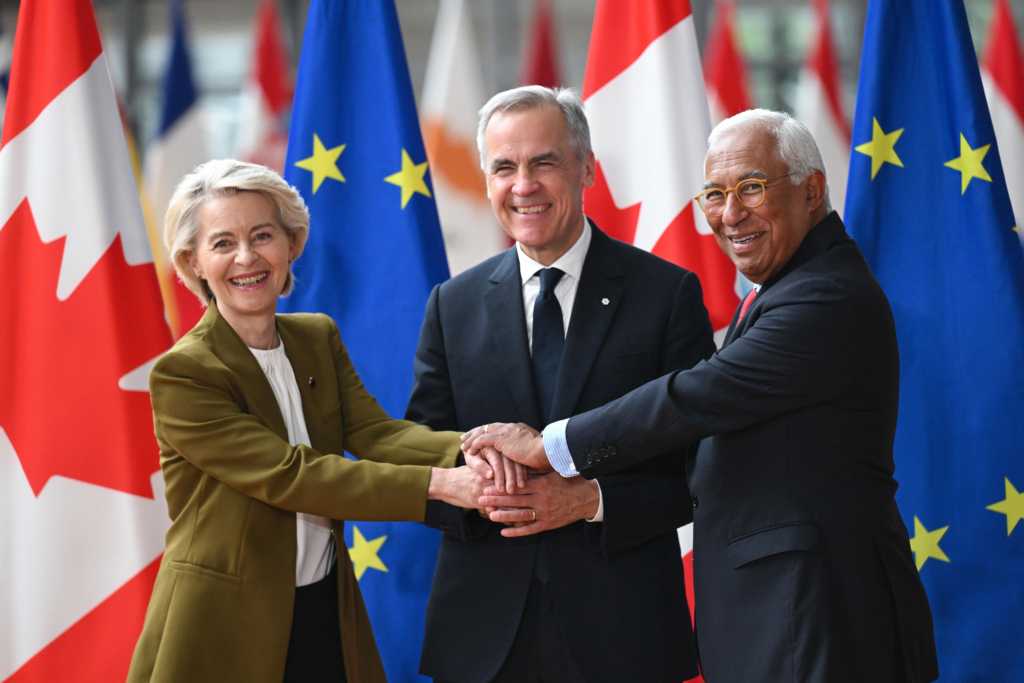
Cover image: picture alliance / Hans Lucas | POOL UNION EUROPEENNE / AGENCE HANS LUCAS
European leaders losing sleep over Trump’s economic and territorial threats should spare a thought for their Canadian counterparts. On August 22nd, Canadian prime minister Mark Carney announced that his country was “at war” with the United States after trade negotiations collapsed at the eleventh hour. Trump’s subsequent renaming of Lake Ontario to Lake America echoed the crisis with Greenland in January, when the US called into question Denmark’s sovereignty over the territory and refused to rule out taking it by military force.
Both the EU and Canada, in other words, face a similar conundrum: how to de-risk their relationship with an increasingly predatory United States, which exposes them to security threats from Russia and poses a new threat of its own. It is against this backdrop that Carney will attend commission president Ursula von der Leyen’s State of the European Union Speech in Strasbourg on September 16th. An EU-Canada summit will follow in October. The timing could scarcely be better for Europe and Canada to make common cause. But if European leaders want to shift the relationship into a new gear, they will have to revise their usual approach to how the EU treats third countries, particularly in defence and security, where both sides’ dependence on the US runs deepest.
Blurring the lines
Some Canadians, traumatised by Trump’s bullying, have fantasised about joining the EU. Alas, Article 49 of the Treaty on European Union—its accession clause—restricts membership of the bloc to European states. But the EU need not choose between full membership and arm’s-length third-country status. A strict in-or-out model of security and defence co-operation risks excluding partners like Ukraine, Britain, Norway and Canada from key initiatives and the bloc’s defence technological and industrial base—leaving Europe less safe as a result.
The EU already treats one non-member as something more than an ordinary third country or even one on the path to membership: Ukraine has received notable carve-outs for the European Defence Industry Programme (EDIP) and the EU’s Security Action for Europe (SAFE) mechanism, which offers €150bn in low-interest defence loans—not to mention exemptions in other areas like trade, energy, and telecommunications. In other words, the question is not whether bending the rules is permissible under certain circumstances, but what those circumstances are. Extending the same treatment to Canada (as inoffensive an ally as they come) would be popular at home and would offer a template for how other relationships, including with Britain, could be structured.
There is already a clear trend towards a closer relationship between Brussels and Ottawa, especially on the defence industrial side. In 2021, Canada joined the military mobility project of the EU’s framework for deeper defence co-operation, PESCO. Last year, both sides signed a security and defence partnership and this year they agreed to Canada’s participation in SAFE.
On the bilateral front, Berlin and Ottawa are finalising a strategic partnership agreement which will include elements on defence cooperation, on top of agreements already signed with France, Denmark, and other Nordics. On the procurement side, German shipbuilder ThyssenKrupp Marine Systems won a contest to build 12 submarines for the Royal Canadian Navy—the biggest defence deal in Canadian history. Canada is also considering buying Swedish Gripen fighter jets instead of American F-35s and is building ice-breakers in Helsinki. Finally, Canada is actively involved in deterring Russia with boots on the ground in Latvia, where it leads a multinational brigade as part of NATO’s Enhanced Forward Presence (eFP).
But these efforts are mostly non-binding and aspirational—except for SAFE (which is time-limited) and eFP (which sits outside of EU structures entirely). The EU-Canada summit at the end of October gives Brussels and Ottawa a concrete opportunity to turn these efforts into specific investments, capabilities and operational co-operation.
Under the radar
Canada is an underrated military power. The 2% of its GDP that it currently spends on defence is already more than the 14 smallest EU defence budgets combined
The EU stands to gain more from a closer relationship than one might think. Canada is an underrated military power. The 2% of its GDP that it currently spends on defence is already more than the 14 smallest EU defence budgets combined. Compared to the EU’s biggest defence spenders, it ranks behind only Germany, France, Italy and Poland. And its budget is set to increase significantly as Canada moves to spend 4% by 2030 and C$500bn (€310bn) over the next decade.
Much of that money will be invested in equipment and suppliers outside of Canada. As Carney made clear in a recent speech: “The days of our military sending 70 cents of every dollar to the United States are over.” EU defence projects should open up to countries outside the EU and the European Economic Area. Canada’s armed forces bring significant know-how in Arctic warfare, an area of increasing interest to Europe amid growing threats from both Russia and the US. And its six decades within the joint US-Canadian air-defence command, NORAD, give it rare experience of continental-scale air defence and early warning, just as Europeans scramble to expand their own independent missile-defence network.
Deeper cooperation
The EU can use these resources and capabilities to deter Russia and wean itself off its dependence on America, starting with deeper Canadian co-operation with the EU’s defence projects and agencies. A first step would be encouraging Canada to join further PESCO projects. Canada’s expertise could be of great help in ACCESS, which aims to develop Arctic-capable, GPS-denied electronic warfare and sensor systems, and TWISTER’s space-based early warning strand. Canada could join both without too much red tape (for EU standards) because neither project is supported by the European Defence Agency (EDA). A second step would be an administrative arrangement between Canada and EDA, which would allow Canada to join EDA-supported PESCO projects it is currently ineligible for, as well as joint training, monitoring and research. Since the US already has such an arrangement, extending it to Canada should prove uncontroversial.
But the most ambitious step the EU could take would be to treat Canada as a full-fledged member of the EU’s defence technological and industrial base instead of as a third country. Member states and the commission should write Canada into EDIP’s successor, the ring-fenced defence-spending stream—or “window”—of the upcoming European Competitiveness Fund (ECF), which is currently being negotiated as part of the EU’s next budget.
As it stands, current EDIP rules will likely roll over into the ECF unchanged. Under those rules, a system built in Europe carrying 35% American components would qualify for funding, but a wholly Canadian one would not. When EDIP was being negotiated, members states deliberately created a carve-out for Ukraine. Member states should extend the same preferential terms to Canada under the ECF, but also go further, letting Canada run programmes as well as bid for them.
These would be major concessions and they must not be given away for free. The expectation should be that Canada pay for access, open its own procurement to European firms in return, and align its export controls with the EU’s. As a proof-of-concept, both sides could design at least one major system with no US export-controlled parts in it (a counter-drone system would work very well).
In addition to these efforts, Berlin and Paris should also throw their weight behind Canada’s proposal for a Defence Security and Resilience Bank. They might even propose merging it with Britain’s proposed Multilateral Defence Mechanism to create a coalition spanning Britain, Canada and EU member states.
Skin in the game
As the EU’s borders come under pressure from multiple directions, there is a strong case for expanding Canada’s stake in European territorial integrity. That begins by establishing reciprocity. Europeans shouldn’t scoff at Canadian concerns—just as Denmark flew blood bags to Greenland in anticipation of a US invasion in January, so too have the Canadian Armed Forces modelled a possible US military invasion.
European countries should make it clear to Washington that its statements calling into question its ally’s sovereignty are intolerable. They should also prevail upon Canada to unequivocally pick sides should the US raise the Greenland issue again. In the event of a future military mission to Greenland, similar to the Danish-led Operation Arctic Endurance, or even a mission under the EU’s common security and defence policy, Copenhagen should invite Ottawa to join with boots on the ground, just as it has done in Latvia. Likewise, the EU could bind its anti-coercion instrument to equivalent Canadian countermeasures, ready for joint activation during a crisis.
Boosting Ottawa’s participation in Arctic issues would tie it more closely to the defence of the region more broadly and would give it a bigger role in defending European borders. After all, no serious conversation about the region is conceivable without Canada, whose Arctic territory is vastly larger than that of most other Arctic states. Canada is already part of the region’s multilateral infrastructure, but there is still scope to deepen its co-operation with the EU instruments specifically. One way to bridge the gap would be to take up the European Parliament’s proposal to create a dedicated EU-Canada Arctic cooperation framework with structured dialogues between EU and Canadian institutions.
An additional step which would contribute decisively to European security would be to invite Canada to the Joint Expeditionary Force (JEF), the UK-led coalition of northern European states. Canadian forces have already taken part in JEF exercises in Latvia last year and Carney has participated in virtual meetings of the group. Formally joining JEF, which sits outside NATO and EU structures, would involve little red tape and could happen almost immediately. As the US considers far-reaching troop reductions in Europe, any step that improves interoperability among non-US NATO allies is a win for the entire continent.
A price worth paying
The steps outlined above are likely to draw America’s ire and invite retaliation. The US has repeatedly cast scorn on Carney’s middle powers strategy—an effort to rally mid-sized states against pressure from larger ones—which it increasingly views as a serious challenge to its primacy. Under-secretary of war for policy Elbridge Colby recently suspended the Permanent Joint Board on Defence, a longstanding US-Canadian strategic consultative body, and linked the pause to Canada’s weak defence spending and its middle powers strategy. Both the EU and Canada should expect increasing pushback if they embark on this joint course. But any American paroxysm will prove the point—that both Europe and Canada are better off together than alone or in thrall to Washington. If that means blurring the boundaries between EU member states and third countries, so be it.
To find out what “Europe” means to people today, ECFR commissioned almost 6,000 interviews in six European countries and qualitative desk research across 15 more.
The interviews reveal that most people have strong opinions about Europe and its future; the complementary research found that geopolitical chaos and culture wars are helping the EU become more politicised in domestic debates.
How people feel about Europe may thus affect how they vote in the potentially seismic domestic elections to come, in many of which the far right leads in the polls.
The interviews also found many people want a stronger, more independent and more united Europe. But relatively few can picture a credible route from today’s disruptions to that destination.
This imagination gap is most prevalent among a pivotal constituency we call “the uncertain”. Pro-European leaders need to fill it, lest people become more receptive to politics that reinterpret the past as the future.
These leaders can do so by harnessing the power of “future nostalgia”, or a longing for a time when a better future seemed within reach.
For decades, Europe had quite a successful record. Its countries grew accustomed to living under America’s protection, trading freely with one another, and enjoying peace and prosperity at home. Borders opened and the EU expanded. Europe came to think of itself as one of the world’s economic and political centres of gravity—or even a model for others to follow.
But then, one by one, the cosy assumptions on which Europe had built its post-cold-war existence began to fall apart. It was time for Europe to change its tune. As European Commission president Ursula von der Leyen put it, there was “no time or room for nostalgia… this must be Europe’s independence moment”. Leaders across the continent offered variations on the same theme: Europe must become stronger, more united and more independent.
As the months passed, parts of the public saw Europe moving in that direction. But many others concluded different things from the same events. For some, the disruptions had exposed a system that had long been dysfunctional and captured by elites. Others hesitated, realising that the danger could finally stir Europe from its slumber but that it could also expose divisions impossible to overcome. And then there were some like the Frenchman quoted at the start of this section who just did not care: Europe was and always had been a background hum that barely registered in their lives.
This paper shows that people with views like his are in a minority. “Europe” may not be the most important issue in people’s lives, but it is something a lot of them care about. How people feel about Europe may thus affect how they vote at home and contribute to how much say the far right has in shaping the future of the continent.
The paper draws on 5,834 AI-moderated interviews with European citizens conducted in May and June 2026 in Britain, France, Germany, Italy, the Netherlands and Poland. These capture how ordinary people, in their own words, imagine Europe’s future. They also provide (after weighting) a nationally representative picture of how people’s views are distributed. The interviews are complemented by comparative desk research on public and political debates in 15 EU member states. This examined how Europe and the EU are discussed across national political and media environments.
The main finding of the research is that many Europeans have an “imagination gap”. A lot of the people interviewed—especially among a substantial group we call the “uncertain”—want a stronger, more integrated and more independent Europe. But they often struggle to picture a credible route from today’s disruptions to that destination. The complementary research finds this gap exists at a time when Europe and the EU are becoming more salient in the public debate, and more politicised.
The people we spoke to are hardly alone in their pessimism. ECFR’s 2025 polling revealed Europeans to be notably gloomy about the future of their countries and the world, and that Americans and Turks shared similar sentiments. But pessimism comes with a unique political risk in Europe. Americans who lose faith in the future cannot realistically demand that the US be dismantled. Yet Europeans who lose confidence in the EU can plausibly ask for “less Europe” or even their country’s exit. And European integration has always depended on a future-facing promise: the idea of an “ever closer union” asks people to believe in both what Europe is and what it might become.
So, the imagination gap could help explain why nostalgic politics has become attractive to some voters in Europe. When people struggle to imagine a believable tomorrow, they become more receptive to visions that reinterpret the past as the future. But pro-European leaders should aim to harness a different kind of nostalgia—a “future nostalgia”, to borrow Dua Lipa’s 2020 album title, or a longing for the sense that a better future was within reach. They may need to hurry. As Europe braces for national elections in several influential countries, some with the far right leading in the polls, pro-Europeans need to help ensure a recognisable Europe exists to defend in the years ahead.
Each interview begins with an icebreaker question: “Let’s imagine you have a friend who fell asleep five years ago and has just woken up. This friend asks you: ‘How is Europe doing at the moment?’ How would you describe Europe today—what would you tell them?” In their answers, by far the largest group of respondents (on average 68% across the six countries studied) talks about a general deterioration or loss of normality. Only 12% see opportunity in the crises confronting the continent and frame their responses in terms of Europe’s awakening or renewal.
Respondents speak of Europe’s awakening most often in Poland (21%). This is the most recent one of the six countries studied to join the EU and is closest to the Ukrainian war zone. According to one Pole, born in the 1980s, “Europe is doing reasonably well. It’s trying to strengthen itself and be more independent from the USA.”Read the extended quote from A European from Poland, born in the 1980s03 Or, to quote an older respondent in Germany, where just 13% of people raise these themes, “Crises make you stronger, and I think that applies to Europe as well. Investment in defence is increasing again. The crises have revealed the weak points, and we can start working on them.”Read the extended quote from A European from Germany, born in the 1960s04 Such voices of encouragement are particularly sparse in France, where a mere 5% of respondents describe today’s Europe in terms of awakening or renewal. This is despite a decade of calls for “strategic autonomy” from President Emmanuel Macron.
When it comes to naming Europe’s challenges, people most often talk about war and security, followed by economic pressures. But almost three-quarters of the people interviewed say Europe is coping badly with its greatest challenges. For this, they blame national governments twice as often as European institutions and EU leaders. According to a French respondent, born in the 1960s, “Leaders of the countries do what suits their own country; they don’t see unity and don’t want it.”Read the extended quote from A European from France, born in the 1960s05
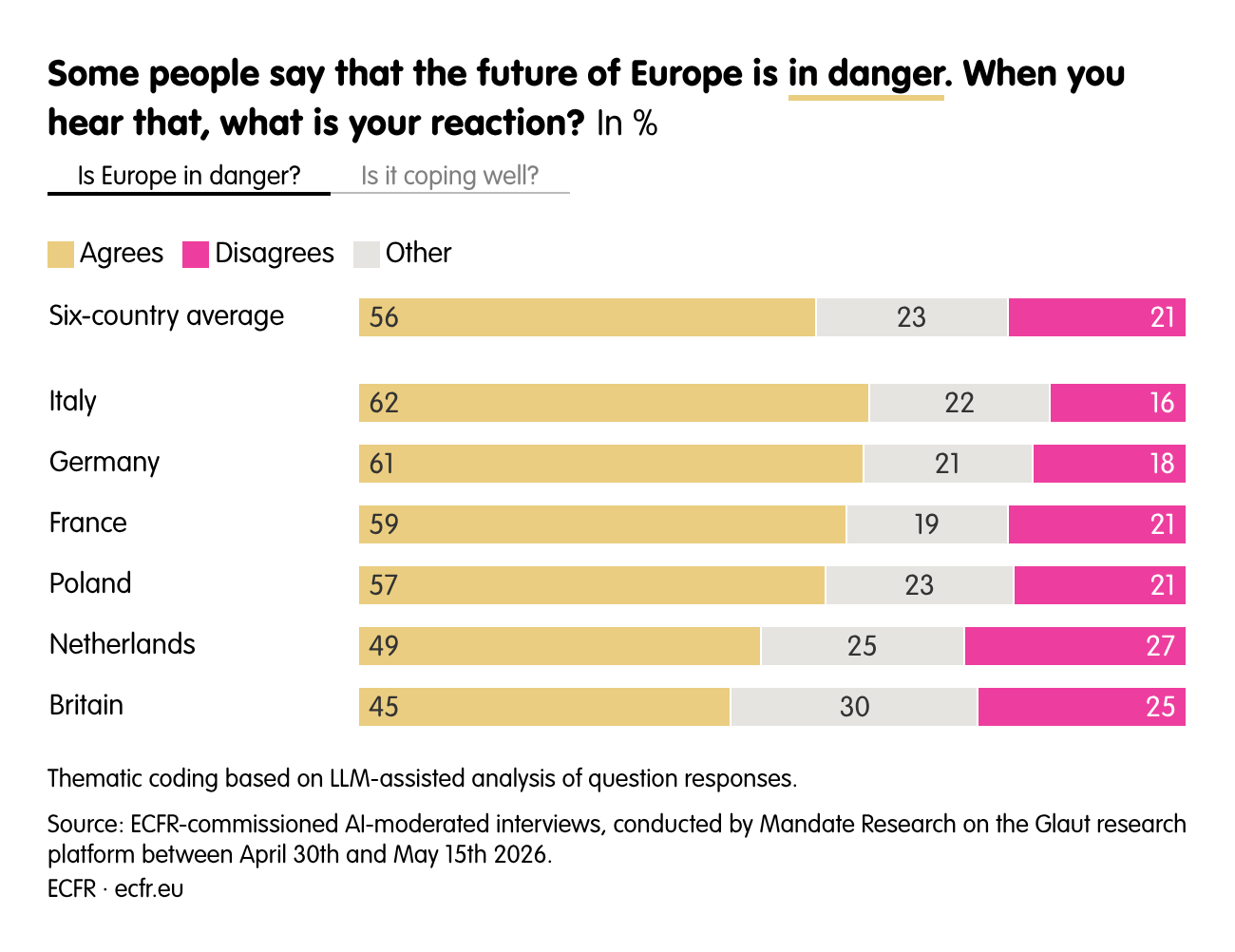
Turning to where things are heading, the AI asks: “Some people say that Europe’s future is in danger. How do you react when you hear that?” In response to this, on average 56% agree, against only 21% who disagree.
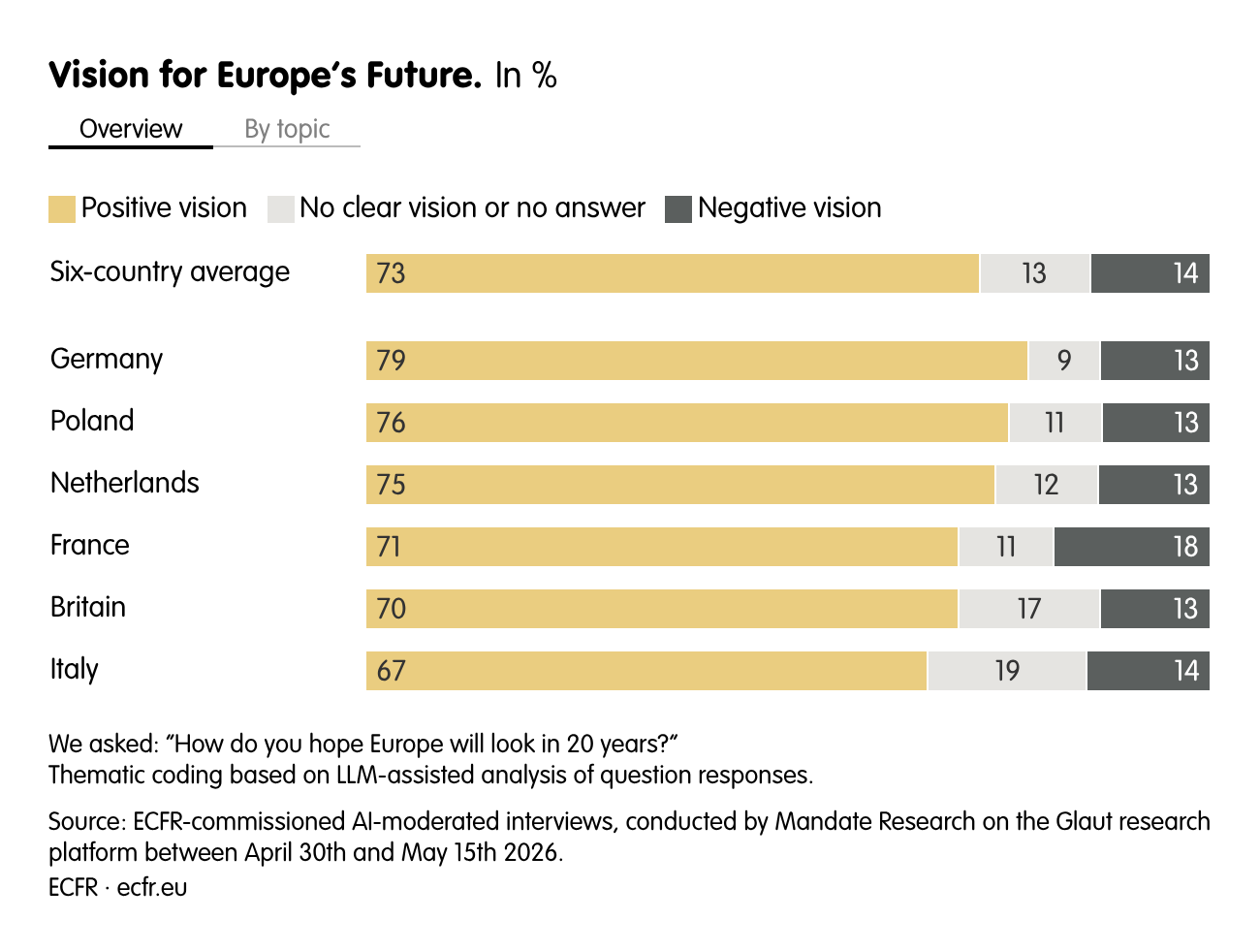
Still, many of the people interviewed identify strongly with Europe and want it to flourish. When asked what they would like Europe to look like in 20 years, three-quarters describe a positive European vision. They most often talk about unity and political integration, peace and security, and prosperity and well-being. Only around 13% hope for “less Europe” or for the EU’s dissolution.
But big dreams about Europe often come with big doubts. As one German, born in the 1990s, says: “I’m regularly relieved that I live in Europe. It’s not perfect and some things are going in the wrong direction at the moment, but no region in the world is safer, freer and more democratic.” He sees “climate catastrophe and attacks on democracy from the far right” as the greatest challenges facing Europe today—but does not think Europe is handling them very well. Asked about the reasons for this, he replies: “Elections focus too much on the here and now and not enough on the future.” Thinking about Europe in 20 years, he would like it to be “free, democratic, sustainable, less indebted, politically further to the left [and] peaceful”. But, on whether this is likely to happen, his response is a brusque: “No”Read the extended quote from A European from Germany, born in the 1990s06.
Across the countries covered by our interviews, many conversations followed a similar pattern. People appreciate Europe, but they recognise the challenges it faces and express little faith in its collective capacity to deal with them. Even when respondents have big ambitions for Europe, they often talk about them as mere aspirations that are unlikely to become reality.
So, it may no longer be enough to distinguish only between pro-European and Eurosceptic voters. Another important divide is whether people believe European leaders (EU and national alike) can turn their hopes into reality.
Four tunes
And how would you like Europe to look in 20 years’ time?
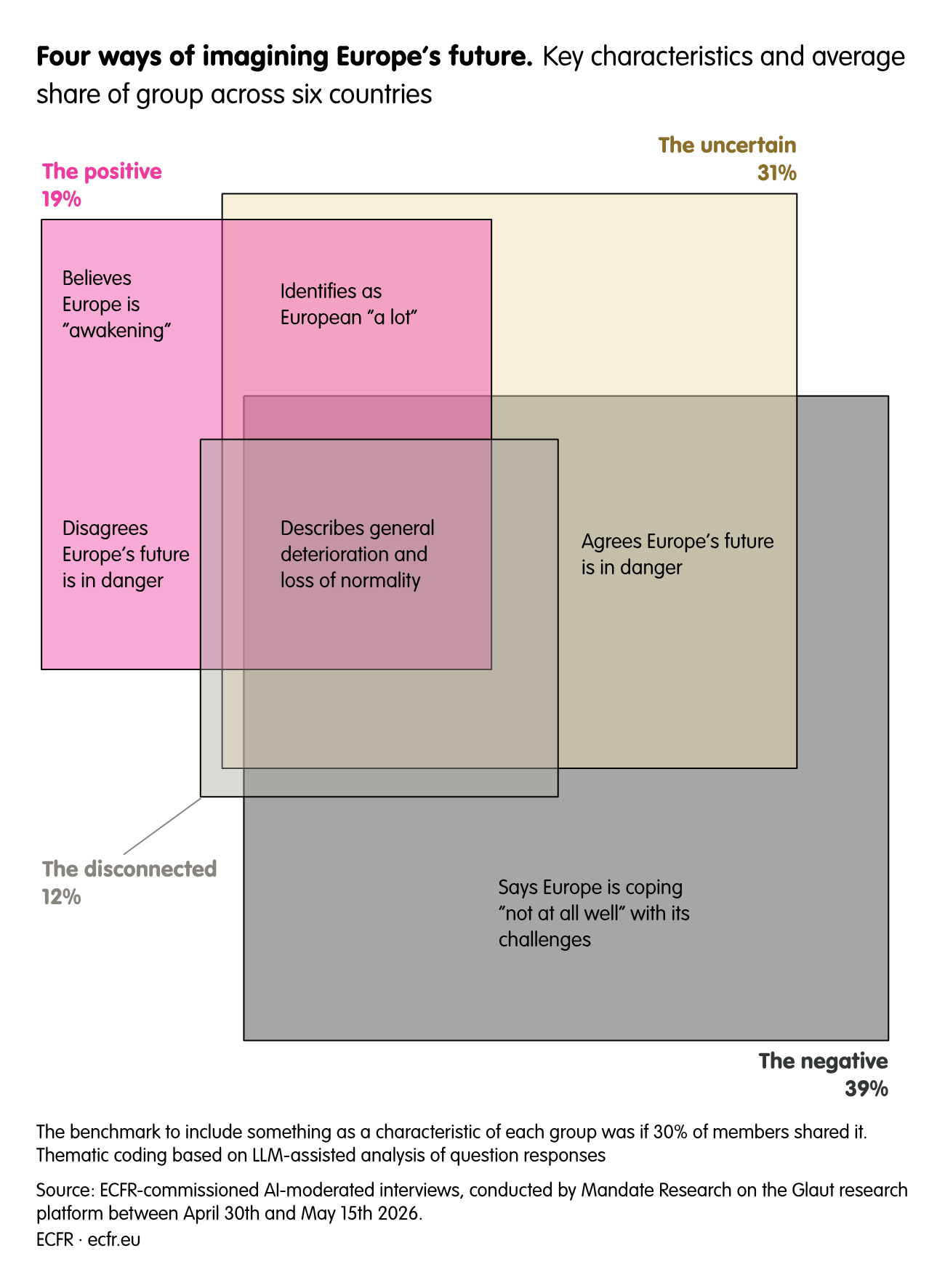
Most of the people interviewed express strong opinions about Europe’s future. And they tend to imagine that future in one of four ways.
The positive hear an anthem of renewal: today’s disruptions are finally forcing Europe to become stronger and more united. The negative hear a ballad of decline, with each new crisis confirming the continent’s best days are behind it. For the uncertain, the melody of a better Europe is recognisable, but the song is not finished—and they are not convinced it ever will be. Very few people belong to the disconnected, for whom Europe is just a background hum coming from too far away to command much attention.
The tunes vary by country. But the four basic themes recur across borders, genders and generations.
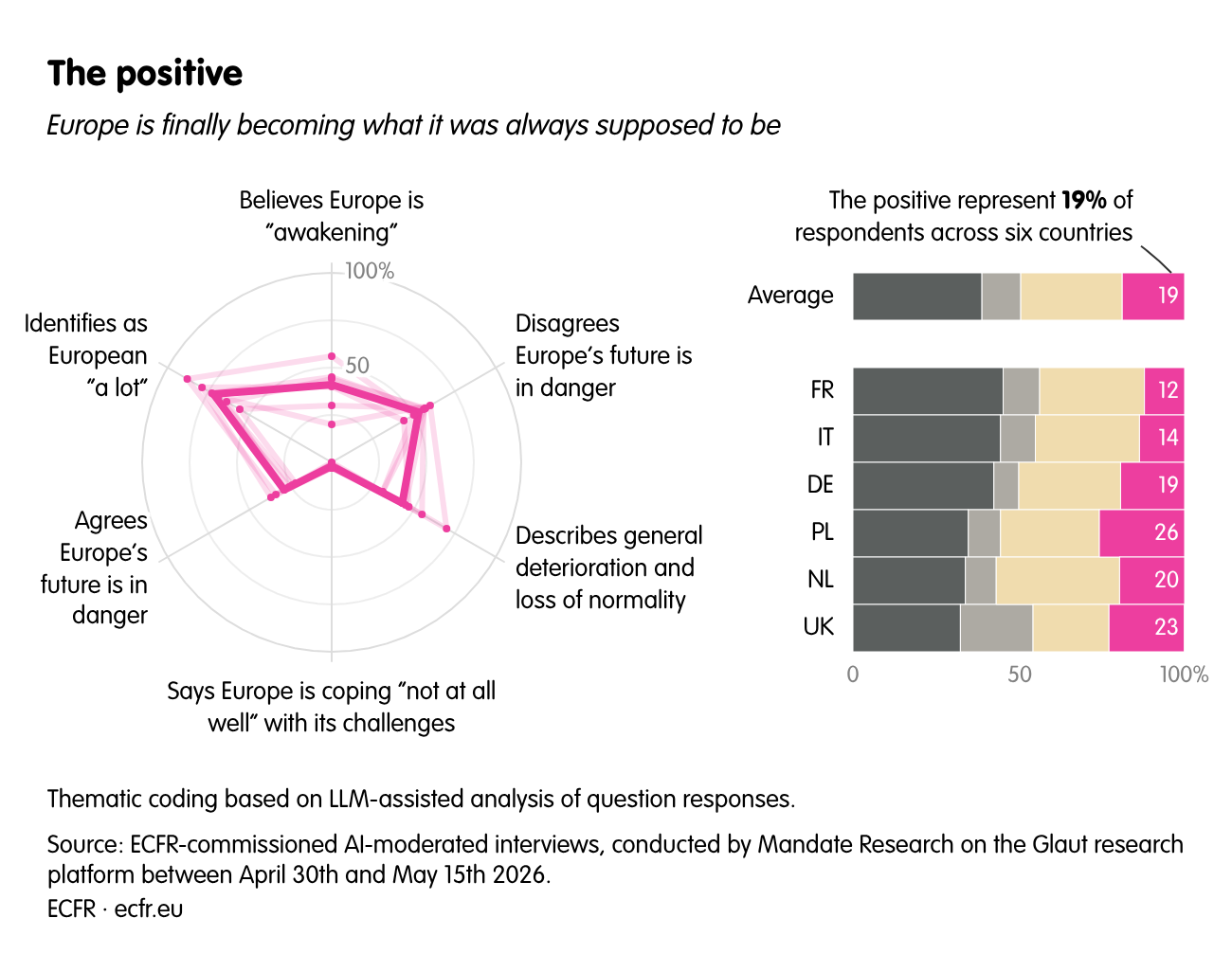
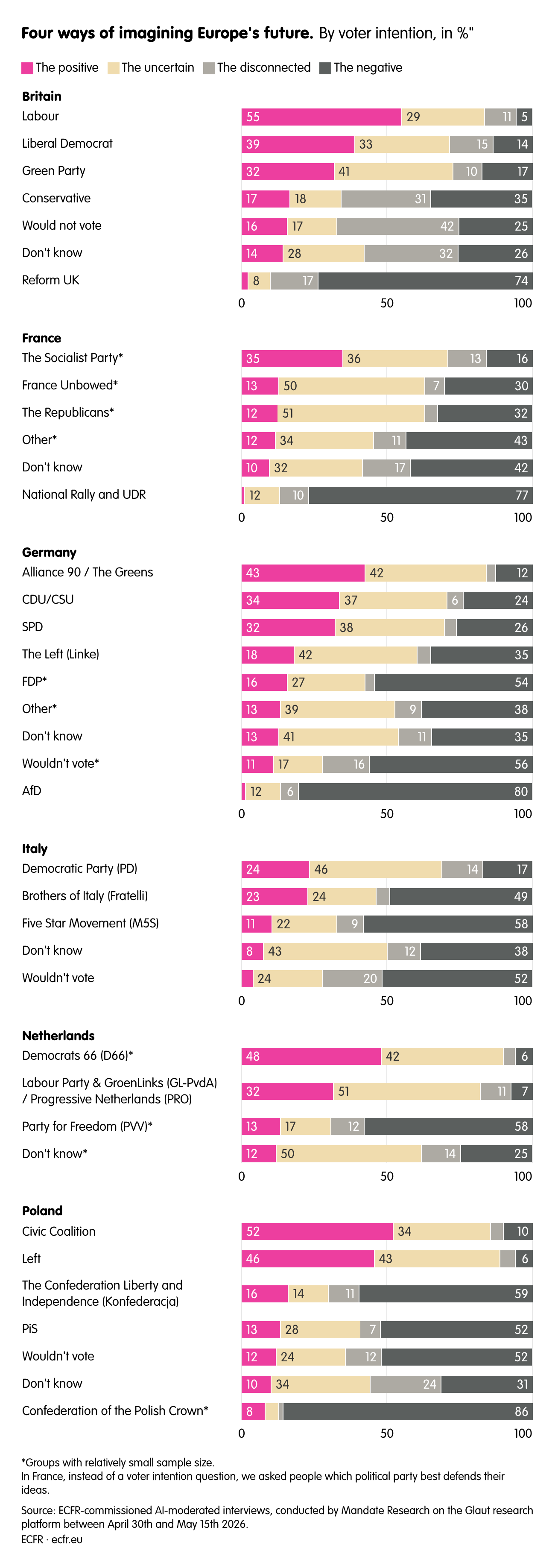
The present: The positive identify strongly as European, and two-fifths of them describe the EU’s situation today in terms of awakening. They are well represented in the electorates of EU-enthusiastic parties like the centrist Civic Coalition in Poland, Liberal Democrats in Britain and D66 in the Netherlands, as well as left-leaning EU-fans like the German Greens and the UK’s Labour Party.
Many of this group see the disruptions of the present as giving the EU the shock it perhaps always needed for its leaders to push for greater European integration and autonomy. One Dutch D66 voter, born in the 1980s, describes this as “a sense of urgency, the realisation that we must stand up for ourselves”. He stresses “a shared awareness from the population”Read the extended quote from A European from the Netherlands, born in the 1980s10 as contributing most to this.
The future: This is not to say the positive think it will be easy. They recognise that to overcome Europe’s problems, political will and institutional reform will be necessary. Many of this group also think the EU will have to address the national vetoes that hinder collective action.
It is common among the positive to worry about the rise of the far right, but they still tend to believe change is possible precisely because the alternative has become so visible: a fragmented Europe, dependent on others and unable to defend itself or its interests. “Five years ago, I think there was more of an illusion of stability,” says one Italian, born in the 1990s, but “today many things are more explicit … so I’d say [Europe has become] more unstable but more honest compared to before.”Read the extended quote from A European from Italy, born in the 1990s11
Still, most of the positive disagree with the idea that Europe’s future is in danger. “It’s a very serious crisis, but I think that with wise policymaking [the danger] can be avoided,”Read the extended quote from A European from Poland, born in 1990s12 says a Civic Coalition voter in Poland. Members of this group want Europe to show leadership and assertiveness internationally. And in 20 years, most of them hope to see a more united and better integrated Europe. They also tend to believe such a future is achievable.
In the world of the positive, the EU does not need to take a fundamentally different direction; rather, it needs to become what it was always meant to be. “We have it in our hands,” says a Dutch D66 voter, born in the 1980s, who has “doubts about the pace, not the direction”Read the extended quote from A European from the Netherlands, born in the 1980s13.
The negative
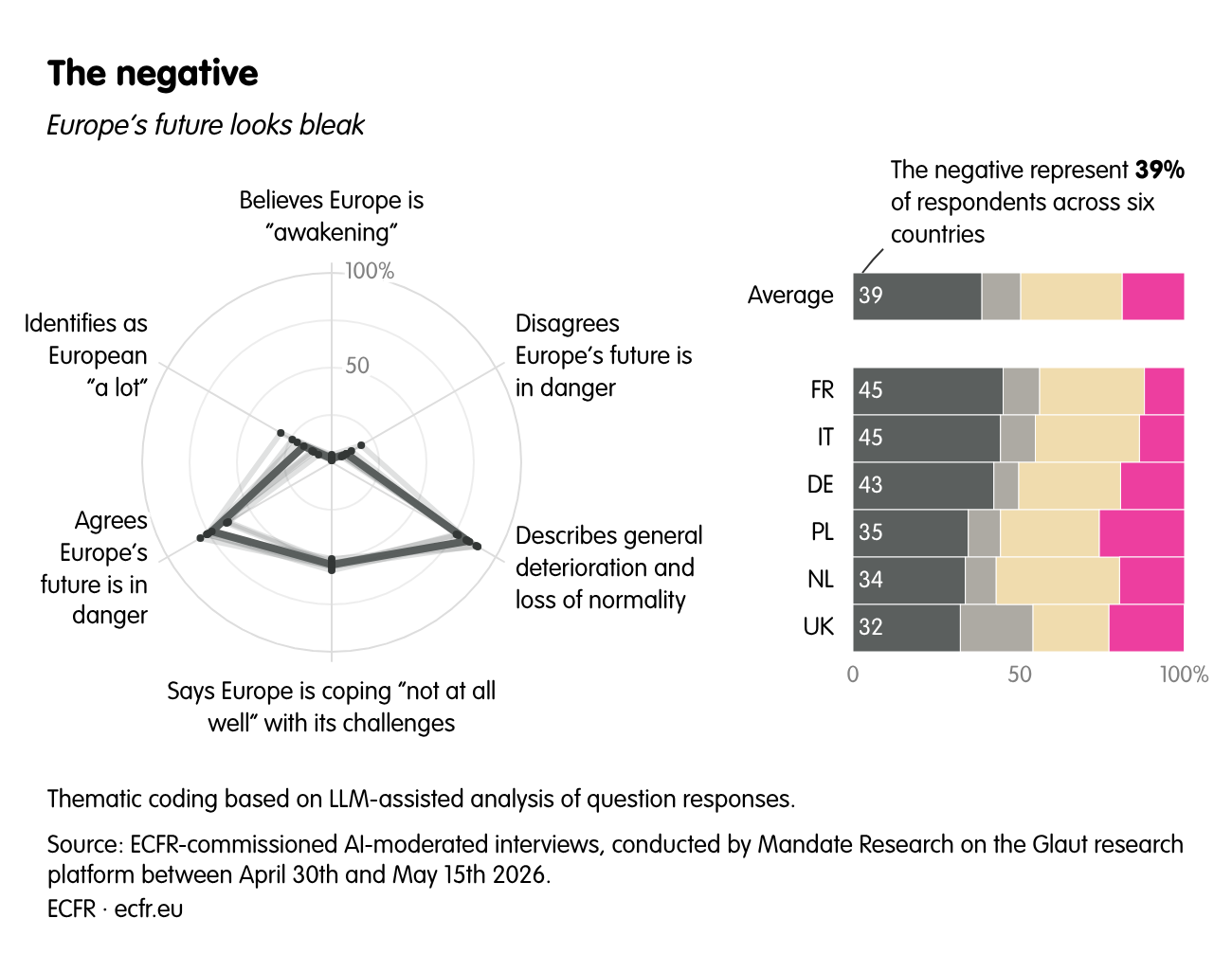
At the other end of the spectrum sit the negative. This is the largest group in every country studied, except the Netherlands, and is home to almost half of respondents in France, Italy and Germany. The negative hold a near-hegemonic position in the electorates of the far-right Alternative for Germany (AfD), National Rally (RN) in France and Reform UK. They are also strongly present on the Polish right and far right, among Party for Freedom (PVV) voters in the Netherlands, and in the electorate of the progressive populist Five Star Movement in Italy. They are well represented among non-voters in Italy, Germany and Poland, too.
The present: The negative stand out in their strong criticism of today’s Europe, which is characterised by a notable anti-elitist and anti-migrant streak. One Italian, born in the 1980s, describes Europe as: “A community run by people who have only thought about their own well-being until now; they’ve ruined our lives with surreal green ideologies, financing unjust wars, opening up to immigration that is destroying European identity and that of member states. [They are] unprepared on the military front [and] divided as peoples both in terms of collective thinking and economically.”Read the extended quote from A European from Italy, born in the 1980s14
Such pessimism is not always rooted in opposition to European cooperation. Many of the negative instead rail against what they consider the EU’s over-reach: “The EU is pushing itself literally everywhere, even into areas where it was never granted any competencies,”Read the extended quote from A European from Poland, born in 1980s15 says one Pole, born in the 1980s, who votes for the radical-right Konfederacja. It is common for people in this group to describe politicians as self-interested, captured by lobbies or too removed from ordinary life to be able to do the right thing. Negatives tend to interpret the crises piling up—and this group cites migration and inflation above all—as symptoms of deeper decay: “I feel sad for what once was a great place,”Read the extended quote from A European from the UK, born in the 1960s16 says a Reform UK voter, born in the 1960s.
The future: For most of the negative, Europe’s future looks bleak. But variation exists in how they feel about this. One Pole, who was born in the 1980s and votes for the nationalist Law and Justice party (PiS), agrees Europe’s future is in danger and is “pleased about it.”Read the extended quote from A European from Poland, born in 1980s17 Her Italian peer, who votes for the ruling Brothers of Italy party, expresses fear and anxiety: “I am afraid,” she says, before adding, “of war.”Read the extended quote from A European from Italy, born in the 1980s18 Asked about her hopes for Europe in 20 years, she mulls whether the EU will still exist. Other negatives actively want the EU to be whittled down or dismantled altogether. As they see it, less or no Europe would restore national sovereignty and give citizens a more direct say in how they are governed. Some of them want to recover what they feel they have lost: “We lived much better when the European Union didn’t exist,”Read the extended quote from A European from France, born in the 1950s19 says an RN voter in France, born in the 1950s.
The uncertain
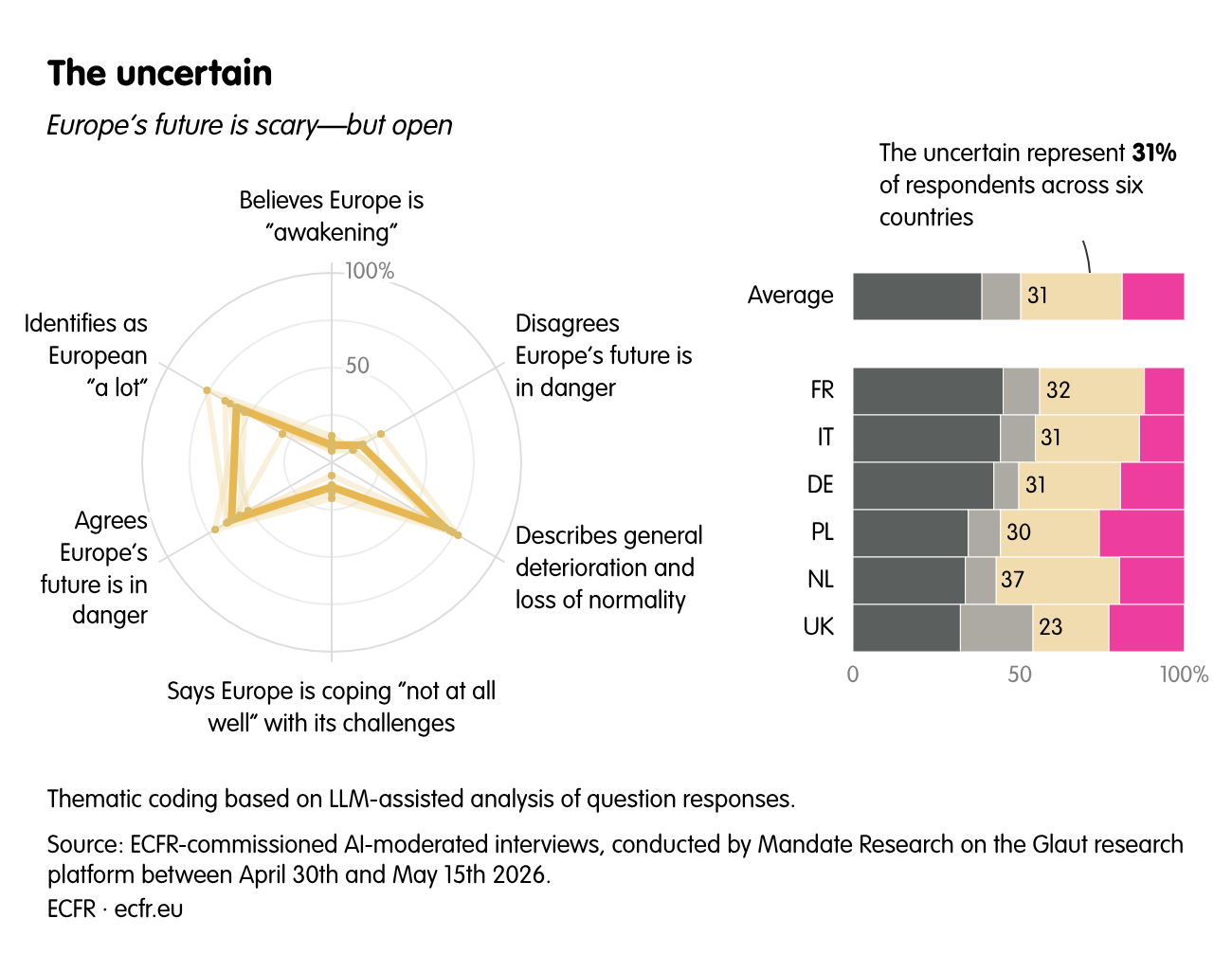
Somewhere between the negative and the positive dwell the uncertain. This group accounts for around a third of the public in most of the countries studied (but only around a quarter in Britain). They are common among the electorates of left-wing parties in all six countries, though they also feature prominently among voters of the ruling centre-right parties in Germany, the Netherlands and Poland.
The present: More than half of the uncertain identify strongly as European. Yet they rarely describe Europe today in terms of “awakening” and often bring up themes of decay and loss of normality. “Europe is doing badly, the different countries are not united, and we are facing a war on our doorstep,”Read the extended quote from A European from France, born in the 1960s20 says a French respondent born in the 1960s, who votes for Macron’s Renaissance party.
People in this group often see the case for optimism and pessimism alike. They recognise that the EU has made it through crises before and that the threats of today are producing solidarity. They tend to see support for Ukraine, developments in defence cooperation and the gradual reduction of dependence on the US as indicators that something is shifting for the better.
But political will appears fragile to the uncertain. They worry that nationalist and far-right forces could unravel European cooperation and that a gulf exists between European leaders’ words and their deeds. According to a Polish progressive, born in the 1990s, the EU suffers from a “lack of a common direction, disagreement amongst member states, poor ideas being implemented by force.”Read the extended quote from A European from Poland, born in 1990s21 Another Pole points to “lack of imagination among politicians, the habit that Europe doesn’t need to take responsibility for itself because someone will always save us.”Read the extended quote from A European from Poland, born in 1980s22
The future: When the uncertain think about the future, they worry. Most of them believe Europe’s future is in danger and what becomes of the EU will depend on choices that leaders have not yet made. Like the positive, most uncertain want Europe to become more united and integrated—but they are much less confident that it will.
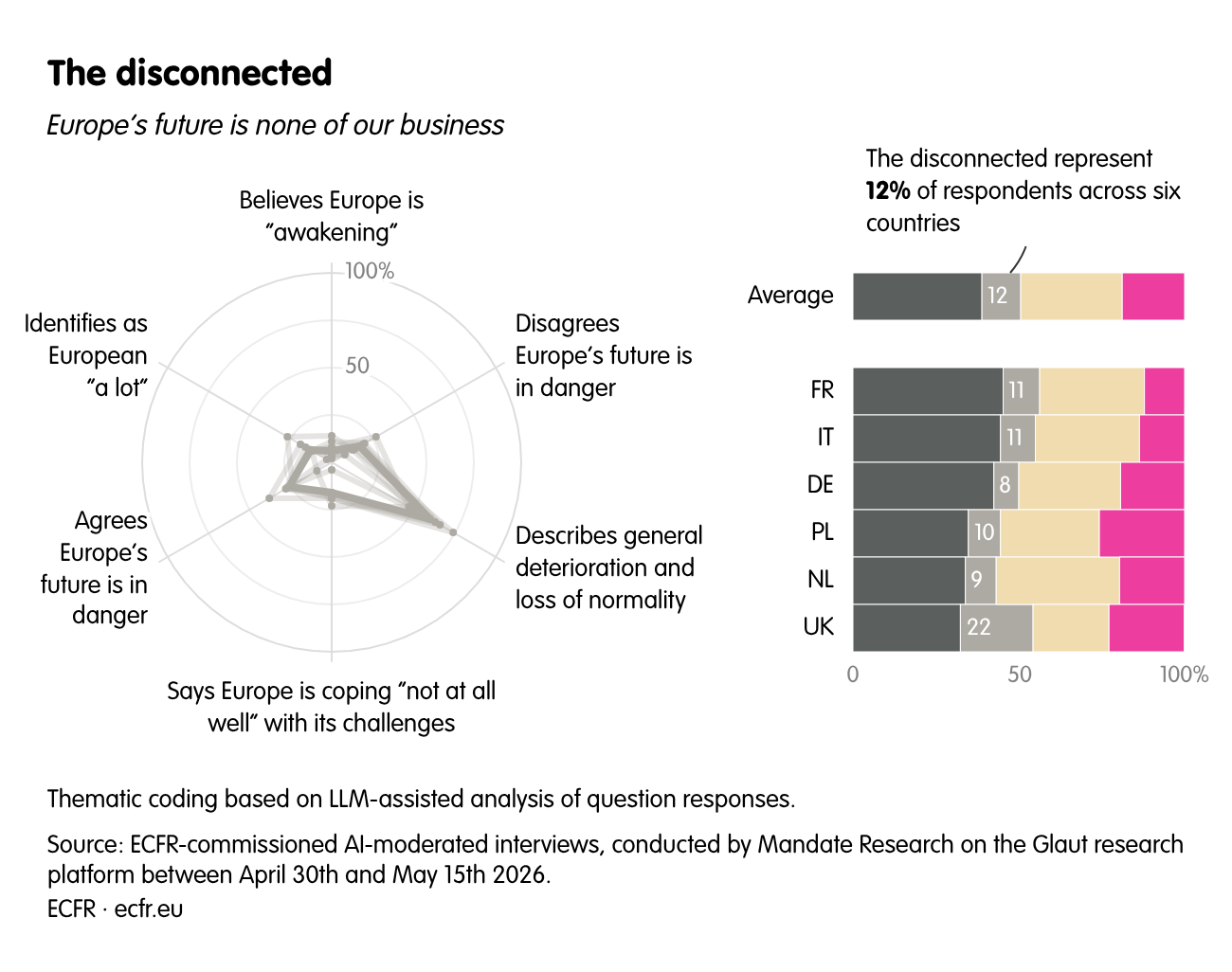
The disconnected account for only around a tenth of the public in most countries studied, except in Britain, where (perhaps reflecting the country’s non-EU status and the legacy of Brexit) their share rises to 22%. They feature in the electorates of every party but almost never constitute more than 15%. The only exception is the UK’s Conservative Party, in which they account for almost a third.
The present: This group sees Europe’s future as largely not their business because they do not experience it as central to their lives (and this often extends to politics in general). “I don’t ask myself all these political questions,”Read the extended quote from A European from France, born in the 1990s26 says a French respondent, born in the 1990s. Asked to describe today’s Europe to a friend who had just woken from a five-year sleep, a Pole born in the 1980s replies: “Mate. You’ve only just woken up and that’s the first question you’re asking?”Read the extended quote from A European from Poland, born in 1980s27 A Dutch respondent, born in the 1990s, is more direct still: “I just live my life the way I want, and Europe or whatever doesn’t interest me.”Read the extended quote from A European from the Netherlands, born in the 1990s28 Their responses to questions concerning Europe tend to be brief and evasive—don’t know, no idea, don’t care.
The future: When asked what they want Europe to look like in 20 years, the disconnected tend to reach for similar answers: more or less the same, no idea, it doesn’t matter. They are animated neither by fear of European collapse nor by hope for European renewal (although many still describe today’s Europe in terms of deterioration or a loss of normality). For the disconnected, the EU is largely a background institution. It occasionally affects prices and makes rules but otherwise feels remote from everyday life and domestic concerns. This group is unlikely to have much say in Europe’s political direction.
***
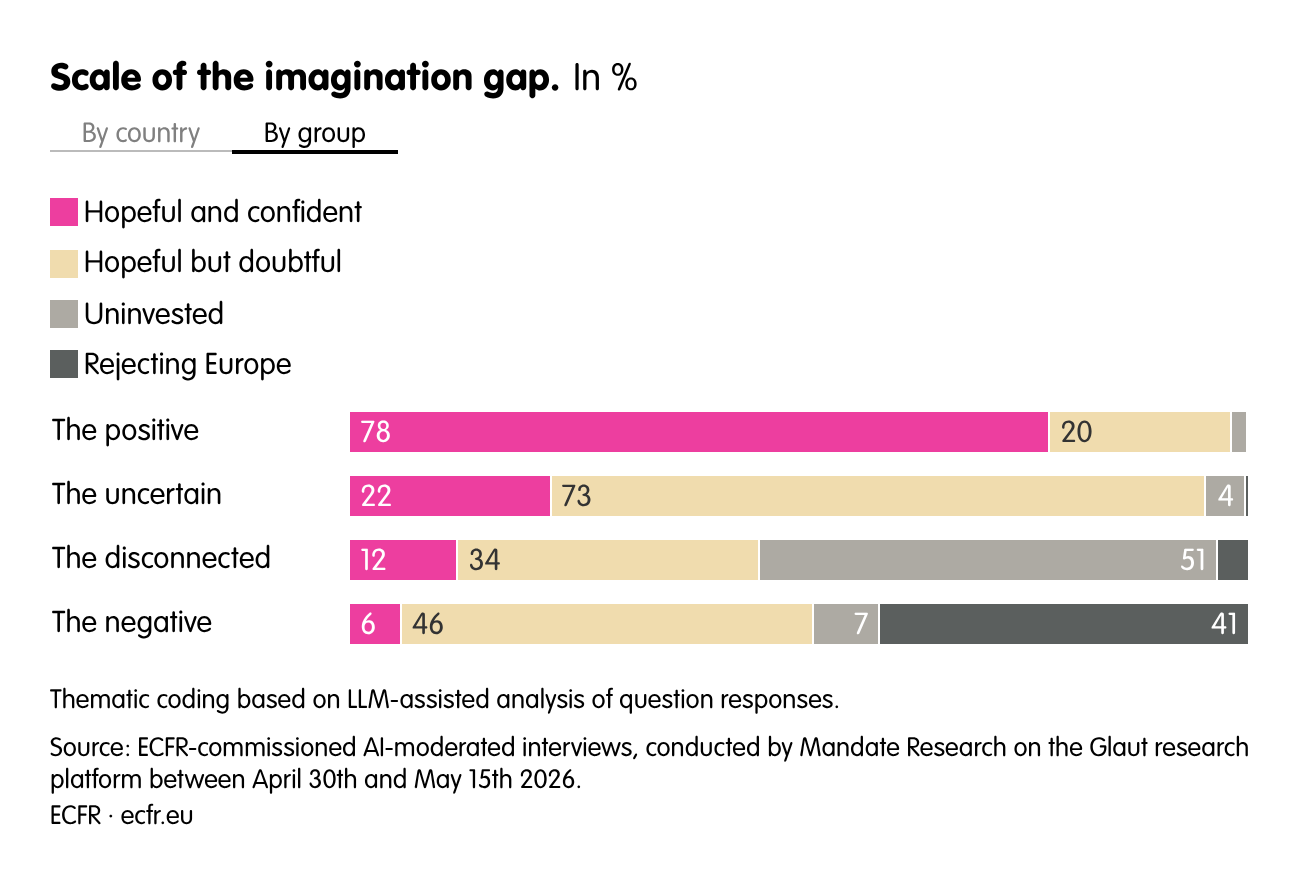
That role as a pivotal constituency belongs to the uncertain. This is not to say they are the only ones suffering from an imagination gap. Three-quarters of them are, but so are almost half of the negative and a third of the disconnected. Overall, about half of the European public seem to have an imagination gap. Poland is the exception: only around a third show symptoms there.
What makes the uncertain so pivotal, apart from the group’s size, is that they have not decided where things will end up. This distinguishes them from the positive, for whom Europe is already succeeding; the negative, many of whom have concluded that it cannot; and the disconnected, who just aren’t that bothered. Pro-European leaders will therefore need to focus their attention on filling the imagination gap among the uncertain, particularly given the growing salience and contestation of the EU in the public debate.
The dominance of strong opinions about Europe—positive, negative and uncertain—in the interviews aligns with our complementary research across 15 countries. That research suggests “Europe” has become more prominent in the public debate and thus more politically salient. This is corroborated by findings from other research that points to growing identification with Europe throughout the crises.
Three overlapping dynamics seem to be driving these developments.
First, foreign policy upheavals mean geopolitical questions of European power and vulnerability have landed squarely on people’s kitchen tables. Should we prepare for war? Can our countries defend themselves alone? If not, whom should they consider as their key allies—Americans or other Europeans? And is the EU, conceived as a peace project, still fit for purpose in times of “unpeace”?
Second, the EU is becoming “domesticated”. This is because the bloc’s policymaking increasingly reaches into some of the most politically sensitive areas of people’s lives (migration, climate and the cost of living, for example). Some member states, like Greece and Cyprus, experienced this well before others. In their case, the euro-zone crisis led to a lasting slump in public trust towards the EU.
But now the EU is in the limelight almost everywhere, in part because of Brussels-led policy initiatives. These policy choices are testing people’s vague or instinctive pro-Europeanism against consequences they feel. Should the EU spend more on defence? Is it a good idea to ban plastic straws, or phase out diesel cars and fossil fuel boilers? Should all European countries have mandatory refugee quotas? Such decisions can nudge European citizens towards developing more concrete pro-European attitudes. But they can also make their views more conditional, critical or ambivalent.
Finally, some political actors are stoking the culture wars. As I argued in last year’s Sentiment Compass, “Europe” is a target in the Trumpist political project and those of like-minded forces on this side of the Atlantic. Some well-known social media moguls and platforms play an active and polarising role in this. European far-right politicians need not support Trump or advertise closeness to his administration to draw on a similar repertoire: Brussels is bureaucratic; Europe is weak; the mainstream is ideologically captured; European institutions are obstacles to national sovereignty and cultural authenticity. Such narratives contest what “Europe” is for. They also call into question whose values it represents and whether its institutions deserve citizens’ allegiance.
This is not to say greater salience always translates into less support for a stronger, more united Europe. It can also open up space for a more serious debate in which pro-Europeans can clarify and update the case for integration. Geopolitical insecurity, for example, can strengthen the perceived value of European cooperation in the eyes of the public, as a growing pro-Europeanism of Danes and Swedes suggests.
The politicisation gap
But greater salience can push people to start feeling anxious about Europe’s future. It also strengthens the temptation for political forces to convert the EU into one of the main political and electoral battlegrounds. This is especially the case on the far right. The AfD’s co-leader Alice Weidel, for example, has called for Germany to leave the euro zone and the Schengen area; President Karol Nawrocki in Poland attacks European “follies”. They and others, like RN leader Marine Le Pen, seem to have concluded that trolling the EU gives them a language through which they can explain who they are. Such figures also use it as shorthand for what they oppose and what future they offer.
Pro-European political leaders often struggle to respond with the same confidence. Some react with unconditional defence of the EU (for instance, the Dutch prime minister Rob Jetten and his Spanish counterpart Pedro Sánchez). But that can stop them addressing people’s anxieties about Europe. Other leaders, including Donald Tusk in Poland and Friedrich Merz in Germany, offer a trimmed pro-Europeanism instead (for example, by posing as “realist” on migration and climate). This might bring them closer to a median national voter, but it also risks making far-right views about Europe look more normal.
Leaders thus tend to preach to the positives or bow down to the negatives. Yet it is among Europe’s uncertain that belief in Europe’s future is up for grabs. If the uncertain’s anxieties remain unaddressed, they could veer away from pro-European parties or even detach from politics altogether. And if people choose not to vote or to vote for far-right or Eurosceptic parties in their national elections, the entire continent could move in a direction that renders it unrecognisable in 20 years’ time. This is not to mention that it could become more vulnerable to Russia and even Europe’s old friend across the Atlantic.
One example of how things could be done differently comes from Romania. Speaking on television on Europe Day, President Nicusor Dan offered a nuanced view. He accepted that Europe has made mistakes, but at the same time defended its capacity for self-correction. In a country that has become highly polarised, this may have been an instinctive appeal to Romania’s version of the uncertain.
Other pro-Europeans who take the uncertain seriously may also be able to come up with a better response. In their voting preferences and media habits, the uncertain resemble the positive much more than the negative. (For more evidence, see the bonus track at the end of this paper.) Yet, when asked about Europe’s future, they do not share the positives’ confidence. And if these voters already inhabit relatively pro-European political and media environments (and, as discussed, identify strongly with Europe), their doubts cannot be explained only by exposure to Eurosceptic parties, hostile media and culture wars. Something other than old-school pro-Europeanism might thus be necessary to make them believe in Europe again.
A European from the Netherlands, born in the 2000s
Three recurring concerns appear to be holding the uncertain back: they doubt whether Europe can act when it needs to; whether it can live up to the values it professes and command respect; and whether it can really keep Europeans safe.
European slowness
One of the most striking findings from the interviews was that, across the six countries, respondents often mention Europe’s “slowness” as one of its most frustrating characteristics. This theme comes up most often in the Netherlands and Germany (where Merz once criticised the EU’s “massive over-bureaucratisation of almost all parts of life”). Positive and negative respondents also mention slowness, but the uncertain talk about it even more than any other group.
Many of the uncertain focus on the pace of decision-making. One millennial German, who voted for the centre-right Christian Democrats (CDU/CSU) in 2025 but now prefers the SPD, complains that “the bureaucratic apparatus is far too large and cumbersome. It takes far too long for a decision to be made. Some issues need to be addressed quickly, but by the time everything has gone through all the levels and member states, it’s usually already too late.” Asked who is responsible, he blames both sides: “EU institutions are too bureaucratic and bloated, and the member states don’t want to give up any responsibility or authority whatsoever.”Read the extended quote from A European from Germany, born in the 1980s31
For others, the problem is more structural. As a young Pole, born in the 2000s and looking beyond the mainstream parties, puts it: “The EU fundamentally discusses a lot but does nothing.” He attributes this partly to “the culture of operation of the states with the greatest influence in the EU.”Read the extended quote from A European from Poland, born in 2000s32 A Bavarian, born in the 1970s, who voted CDU/CSU in 2025 but is considering switching parties, says: “Everything takes far too long. By the time Europe reaches agreements, years have passed or nothing happens because one EU country is against it.”Read the extended quote from A European from Germany, born in the 1970s33 Her solution is to replace unanimity with, for example, a three-quarters majority. Similarly, a Dutch respondent who used to vote for the centre-right People’s Party for Freedom and Democracy, born in the 1970s, complains about “Lengthy consultations [and] little or slow decision-making,”Read the extended quote from A European from the Netherlands, born in the 1970s34 blaming member states for this.
But something else emerges from these conversations besides familiar complaints about Brussels bureaucracy. In a faster-moving and more dangerous world, slowness becomes a measure of Europe’s (in)ability to act.
A German man, born in the 1960s, links cumbersome procedures to declining competitiveness: “If a simple approval procedure in Europe takes years and sometimes decades, nobody can compete with such an industry-friendly society as in the USA, China or India.”Read the extended quote from A European from Germany, born in the 1960s35 His compatriot, a Green voter born in the 1990s, goes further, describing Europe as being “in an odd in-between state between the old and a new world order”. Because of regulation and bureaucratic hurdles, she argues, Europe is “not really able to adapt quickly enough and is being massively overtaken technologically by Asia and the USA.”Read the extended quote from A European from Germany, born in 1990s36
So, slowness makes the future the uncertain want hard to believe in. If Europe aspires to become more sovereign and competitive, as several European leaders have promised, then the uncertain first need to see evidence that the EU can make decisions and implement them—and that it can react quickly enough to the fast-changing global environment. This might require the EU to eliminate national vetoes in some areas. Or smaller groups of countries could lead on some initiatives when unanimity between countries is impossible to reach. But whatever the actions, they need to challenge the overwhelming impression of Europe being unable to act. Otherwise, too many people will continue to have the same impression as a British Labour voter, born in the 1990s, according to whom Europe simply “feels slow”Read the extended quote from A European from the UK, born in the 1990s37.
European hypocrisy
The second chord of doubt relates to perceptions of Europe’s lack of integrity. This theme is most common among the negative, but the uncertain also raise it fairly often. It comes up regularly among uncertain supporters of more radical left-wing parties, like LFI in France, Die Linke in Germany, and the Green Party in Britain. Yet the negative and uncertain focus on different things. The negative tend to focus on the dishonesty and hypocrisy of the political class; the uncertain are more likely to point to moments when Europe disappointed them.
Complaints among the uncertain take two main forms: Europe failing to live by the values it professes, and Europe failing to stand its ground when confronted by more powerful actors.
On double standards: “First the silence. Then the hypocrisy”, says an LFI voter who was born in the 1990s. “Russia attacks Ukraine; Russia is the villain. Israel attacks Palestine, but they’re terrorists. It doesn’t make sense.”Read the extended quote from A European from France, born in the 1990s38
On a lack of courage, the EU’s tariff agreement with Donald Trump’s administration seems to have become a powerful symbol. A Die Linke voter in Germany, born in the 2000s, says he felt “terribly ashamed” when “von der Leyen just caved in to the US”. He found it “really embarrassing personally, that we capitulated so hard”. For him, the episode represented something larger: “Every time the EU capitulates, it shows … we don’t want to do anything and would rather cling to the old status quo.”Read the extended quote from A European from Germany, born in the 2000s39
The disappointment about the tariffs crosses political boundaries. A Renaissance voter in France, born in the 1950s, was similarly ashamed of the tariff agreement. She saw it as “Letting ourselves be led by the nose by a madman,”Read the extended quote from A European from France, born in the 1950s40 and used even stronger words to describe what she saw as von der Leyen’s submission to Trump.
Nor does the accusation come only from those who want Europe to confront America or Israel more forcefully. A German, born in the 1980s, who previously voted Green but has since shifted towards Die Linke, is disappointed by what she considers insufficient support for Ukraine. “The usual hypocrisy,” she says. “Words are easy to say—actually providing real help is another matter. It requires genuine action.”Read the extended quote from A European from Germany, born in the 1980s41
This is particularly damaging given European leaders’ rhetoric about sovereignty and independence. The uncertain observe a distance between the Europe they are told is entering its “independence moment” and the one they see backing down when confronted by a stronger power. This does not mean they reject compromises as such, given compromising is something all political actors need to do. But for many uncertain, giving in on values is a no-go. One German, born in the 2000s, was also ashamed of the tariff agreement with Trump but saw it as a demonstration of a broader pattern: “The EU no longer stands unreservedly behind its values. Everything becomes a compromise solution; no solution is confined to true values.”Read the extended quote from A European from Germany, born in the 2000s42
As the “Samples of hope” section will show, shared values come first when the uncertain are asked to explain what being European means for them. So, when leaders in Europe appear to be compromising on these values in their foreign policy, this not only tarnishes Europe’s image abroad but also comes with a political cost at home. The challenge for leaders is to show that people can still take seriously both the values Europe professes and the claims it makes about its own power.
European insecurity
The third chord of doubt is about people’s feelings of insecurity. Half of the uncertain describe war and security as Europe’s greatest challenge. The positive mention it just about as often, but they also tend to refer to the more strategic notion of “geopolitical autonomy” (which fewer of the uncertain do); the negative divide their attention more evenly between inflation, immigration and war.
The uncertain tend to connect insecurity to broader European vulnerabilities, such as dependence on America. They also talk about the EU’s internal divisions and the rise of the European far right. “The USA will increasingly withdraw and Europe must be able to defend itself,”Read the extended quote from A European from Germany, born in the 1980s43 says a German, born in the 1980s, who previously voted SPD and now leans Green. She links this to concerns about the possibility of the AfD entering government and the divisions this could create in the face of Russia. A progressive Dutch voter, born in 2000s, makes a similar connection: “I’m worried about poor cooperation and that Europe is therefore less resilient to external threats—for example Russia, but also the US which wants to portray Europe as weak.”Read the extended quote from A European from the Netherlands, born in the 2000s44
This is not far removed from the positive vision of a more autonomous Europe. The difference lies in the extent of the imagination gap. A Renaissance voter in France, born in the 1950s, describes “war on Europe’s doorstep” as a major problem. But thinking about Europe’s response makes her feel “Europe is doing what it can, but it doesn’t actually have the means.”Read the extended quote from A European from France, born in the 1950s45
Finally, one Italian Five Star Movement voter, born in the 1960s, connects insecurity back to Europe’s slowness. “The first [challenge] is certainly security because the war near our borders has changed the general atmosphere,” she says. But Europe is not tackling it well because “there is often a lack of speed and unity in decision-making.”Read the extended quote from A European from Italy, born in the 1960s46
***
The imagination gap among the uncertain thus comes from things they believe they can observe. They see decisions that take too long, aspirations that sound hollow and threats Europe may lack the means to confront. To close the gap, leaders will have to offer more than an attractive vision of the future. They will have to show people Europe can act, command respect and protect them.
Still, if everything were gloomy in the world of the uncertain, they would belong among the negative. Like the positive, though, they often invoke shared values and principles when explaining what being European means to them. When asked what they would like Europe to look like in 20 years, many hope for greater European unity and political integration. They can also usually identify moments when Europe made them proud.
All these can serve as potential “samples of hope” for pro-European leaders to reconnect with the uncertain. But two aspects appear politically the most crucial: their memories of when Europe made them proud and the type of leadership they admire.
Memory bank
Politicians need to be able to tap into people’s best memories about Europe. When asked about moments when they felt proud of Europe or of being European, the uncertain can usually reach into their own experience and find evidence of Europe behaving in ways they value. This suggests that their attachment to Europe does not come from aspiration alone.
The examples differ widely and reflect the varied national histories of the respondents. They also come from people’s diverse political outlooks and personal experiences—from witnessing the opening of borders to participating in the Erasmus programme of academic exchange.
More than 70 years since European integration began, people still recognise how remarkable the beginning of the story was (even if they were born decades later). As a young Pole, born in the 1990s, says, “Europe emerged from a tremendous crisis after the [second world] war and rose above its divisions—that’s a great reason for pride.”Read the extended quote from A European from Poland, born in 1990s48
A French respondent, born in the 1950s, remembers the 2015 terrorist attacks in his country and the solidarity they generated across the continent: “I had the impression that Europe was entirely with us, the French, and I felt proud to be part of this union.”Read the extended quote from A European from France, born in 1950s51
For an Italian, born in the 1990s, the defining moment was the covid-19 pandemic, when European institutions intervened with economic support and helped secure vaccine distribution. What impressed him was that “for once the interests of individual countries were set aside to advance a broad-reaching, visionary and solidaristic intervention.”Read the extended quote from A European from Italy, born in 1990s54“A much older Italian recalls the 1976 earthquake in Friuli and the aid received from other Europeans.”Read the extended quote from A European from Italy, born in 1940s55
People’s national experiences offer particularly vivid sources of pride. Respondents in Poland often point to their country’s accession to the EU, and the freedom of movement that followed. In the Netherlands, respondents mention the introduction of the euro and European support for Ukraine—but also, rather wonderfully, the “Eurovision Song Contest.”Read the extended quote from A European from the Netherlands, born in 1990s56
The pattern underneath these scattered memories is that people tend to feel proud when European countries act collectively in accordance with something respondents value. When the EU shows solidarity, for example, or protects freedoms. Or when the bloc overcomes national divisions to stand up to external pressure. Or when the EU shows European cooperation can make things happen that individual countries could not achieve alone.
This is almost the mirror image of the hypocrisy described in the previous section. Shame arises when Europe’s leaders proclaim values but fail to act on them, or talk about power while appearing unable to exercise it. Pride wells up when words and actions come together.
These memories thus provide something the uncertain otherwise struggle to find: evidence that collective European agency is possible. Europe has acted. It has overcome national differences. It has shown solidarity. It has occasionally behaved with the ambition and courage the uncertain would like to see more consistently.
Given how much bad news about Europe people see, any piece of good news has a strong chance of standing out and being remembered. Indeed, some people actively seek out more promising stories. One example was the defeat of Viktor Orban in Hungary after 16 years in government. This was fresh in respondents’ minds at the time the interviews took place and was mentioned more than sporadically in the conversations, including among the uncertain. They would certainly welcome more good news like this.
Faces of change
The second sample of hope might prove politically harder to act on. This is about national leaders being able to offer principled leadership at the European level, so that the promise of Europe’s renewal can have a face attached to it. The song of Europe needs its lead singers to tell, and show, people who the leads are—not only who and what they are against.
As things stand, respondents struggle to name any countries, institutions or political figures that would represent, in their eyes, positive examples of European action. Almost half of the respondents (44%) fail to mention anyone; this is also the case among the uncertain. When they do mention someone, they often point to their own country or the leader of the party they vote for.
One European leader bucks this trend: Sánchez. Across the six countries polled (which did not include Spain), 8% mentioned Sánchez specifically, or Spain under his watch, as positive examples. No other country or leader generated comparable admiration. Sánchez and Spain proved especially popular in Italy, where (quite remarkably) a quarter of respondents referred to them, and in France, where 1 in 10 did. In both places, left-wing voters were particularly fond of the Spanish example. And the popularity of Spain and Sánchez was equally visible among positive and uncertain voters, with 10% of each group mentioning them as an example worth following.
Sánchez is a controversial figure. His country lags the rest of Europe in terms of defence spending, even if it has raised its level from previous lows. He is unpopular at home and often seen as using international activity to repair struggling domestic ratings. He does not have many friends in other European capitals, and even fellow social democrats from Denmark criticised his government’s migration policy in reaction to events in Ceuta over the summer. And as the leader of a country far away from Russia and Ukraine, he can afford more assertiveness vis-à-vis the US than his peers in Berlin or Warsaw.
But it is hard to dismiss the fact that today hardly any European leader offers an equally principled foreign policy stance. It is also rare for leaders to place Europe so centrally in their politics, and say things like: “We defend Europe because we can no longer conceive of any other way of being and existing in the world,” or, “the EU is the greatest project of peace and unity in history.”
Macron used to offer a similar form of leadership, using his speeches and interviews to urge other countries to boost Europe’s strategic autonomy. But, as he prepares for retirement and deals with a divided parliament, his star has clearly faded. Across the six countries studied, just 4% mention him as a positive example (though this still puts him in second place). And apart from these two, hardly any other politician not from the respondent’s own country—not even von der Leyen—is mentioned more than sporadically as a positive example. Undoubtedly, there is a vacuum here.
***
Taken together, the conversations suggest that the foundations for belief in the future extend well beyond committed Europhiles. The uncertain retain a language of European belonging, a relatively clear sense of the Europe they would like to see, and memories of moments when collective European action made them proud. Yet they still need convincing that the moments of pride can become the norm in the future, not exceptional memories of the past. And Europe often lacks leaders the uncertain consider an example worth following.
Pro-European leaders cannot afford to be naive about the contested information environment in which arguments (and falsehoods) about Europe circulate. But Europe’s imagination gap cannot be fact-checked away or repaired with the help of influencers alone. Many of the doubts our interviews uncovered come from what people believe they can see with their own eyes. The uncertain and many people in other groups resent decisions that take too long and principles that the EU applies inconsistently. They also see a continent that still seems unable to guarantee its own security or even stand up to those who threaten it. These are matters of policy as much as communication.
In their policymaking and communications, pro-European leaders should take a broader political lesson from our research. This paper has shown how geopolitics and culture wars combine with the domestication of EU policy to increase the salience of Europe in national political competition. But the mainstream has too often participated in this politicisation by offering an unconditional defence of Europe against its critics or by ceding ground to them.
The problem with blind defence is that it polarises voters into “for” and “against” Europe. Some leaders therefore risk treating people’s doubts about Europe’s performance as evidence of insufficient commitment. This could end up alienating the uncertain voters who identify strongly with Europe but who doubt whether what they want for the continent will come to pass. By moving closer to Eurosceptic or far-right views, other leaders allow their opponents to define what is wrong with Europe and what policies might rectify that.
So, pro-European leaders need to take back control of Europe’s politicisation. They should start by going beyond defence of the status quo. Uncertain voters already want the things the mainstream defends, but they worry that something not quite as rosy may lie ahead. To address these anxieties, leaders should acknowledge Europe’s slowness and inconsistencies. They should also speak openly about the EU’s policy failures. But they must offer clear ideas of their own about how to correct them, spelling out why dismantling the capacity Europeans have built together will do nothing of the sort.
But Europe’s mainstream also needs to change its relationship with time. When EU and national leaders alike offer grand visions but do not show how they intend to get there, people seem to doubt they ever will. But showing only small steps with no clear destination looks like crisis management. Leaders need to connect the two more explicitly.
If they do not, the past may become an even more attractive place for people to look for direction. Nostalgic politics thrives on offering familiarity in place of possibility, repackaging versions of yesterday as answers to tomorrow. This is proving only too successful. Far-right parties lead in the polls in several member states, with the AfD winning the largest share of votes in a regional election in Germany in early September. The same weekend as the AfD’s seismic triumph, Britain saw masked protesters clad head to toe in black march on the south coast, just after Reform UK leader Nigel Farage signed a pact with Le Pen’s protégé Jordan Bardella to “stop the boats” crossing the English Channel. All these parties and their many kin across Europe sell the vision of the past as the future. All these parties, in power, would also likely attempt to enact policy agendas to weaken Europe and dismantle its frameworks of cooperation.
Pro-European leaders urgently need to put Europe’s past to work for a different purpose. The conversations in this paper are full of memories of moments when Europe acted collectively, overcame national divisions, stood by its principles or simply made people proud to belong. Leaders will need to help those memories become evidence: reminders that European collective action is possible and that periods of crisis need not last forever. This is the possibility contained in “future nostalgia”. Its promise lies not in a longing to return to yesterday, but in a desire to gain a sense that the tomorrow people want is within reach.
Practical politics with a horizon
So, Europe needs practical politics capable of reproducing future nostalgia. Proponents of European integration once excelled at creating expectations and turning some of their most ambitious plans into reality. Europeans gained a sense of direction from successive waves of enlargement, the removal of borders and the introduction of a common currency. The future exerted a pull on the present.
Today, the direction seems reversed. Politicians manage one emergency after another, while the future increasingly appears to be something threatening. Some of these threats are existential, like war creeping ever closer and the climate disruption that landed so forcefully on Europeans’ doorsteps this summer (and the summers before that). Some are less immediately perceptible, such as Europe’s technological decline and economic “slow agony”. Some, like demographic ageing, are more generational. Others, such as “civilisational replacement”, are based in conspiracy theories but nonetheless provoke anxiety among parts of Europe’s population.
Telling people to “dream big” cannot overcome such a range of fears for the future. Pro-European leaders instead need to govern the present in ways that make a better future imaginable. Future nostalgia therefore describes a capacity that European politics has lost—and might recover—rather than a mirror image of the backward-looking politics it seeks to counter.
Again, the way national leaders respond to Europe’s politicisation will be important. As Europe has become more domesticated, issues like migration that citizens experience as national and personal are increasingly becoming debates about “Europe” itself. So far this has often worked to pro-Europeans’ disadvantage because Europe becomes implicated in people’s grievances; the EU becomes associated with the costs and constraints of policies that touch their everyday lives.
Leaders instead need to make European action today part of a practical account of how they intend to improve people’s lives tomorrow. Many of them have to date struggled to tell this side of the story, leaving Europe’s critics freer to define integration primarily through its costs, constraints and risks. This also gives Eurosceptics space to sell the illusion that the future would be so much easier with less integration.
To reach beyond the most committed Europe-believers, pro-Europeans cannot simply say: “Vote for me because I believe in Europe.” Nor can they tell people to “accept this painful policy because Europe requires it.” Their arguments need to be more concrete: “Here is the problem you care about today. Here is what we can do nationally. Here is what we cannot do nationally and where we need other Europeans. And here is what that combination could make possible five years from now.” If getting there requires changing the way the EU works today, so be it. But those reforms should not become another abstract European project that looks like a distraction; leaders really need to show what policies would bring the desired future within reach.
That would amount to a rather different kind of European politics. It would cast “Europe” as neither an identity proposition nor a distant dream. Europe would instead become part of the causal chain connecting the problems people feel now to tomorrow’s improvements. Pro-European leaders’ task is thus to show people where Europe’s unfinished song is going rather than keep on promising a future masterpiece. It is also to show the public, measure by measure, that Europe is truly capable of keeping the record turning.
Methodology
This paper draws on 5,834 AI-moderated interviews (AIMIs) conducted by Mandate Research on Glaut—a market research platform focused on AI-moderated voice interviews. The interviews were conducted between April 30th and May 15th 2026 across six European countries: France (815 interviews; May 5th-15th), Germany (1,253; April 30th-May 13th), Italy (1,039; April 30th-May 14th), the Netherlands (556; April 30th-May 15th), Poland (989; April 30th-May 15th), and the United Kingdom (1,182; April 30th-May 7th).
Participants were recruited from an online panel provider using quota sampling. After an initial pre-survey, respondents were asked whether they consented to take part in the AIMIs; 5,834 of the original 9,757 respondents (60%) consented to participate and subsequently completed the interview. These final interviewees were weighted according to their demographic and political characteristics to ensure the final sample aligned with the profile of each country’s adult population.
Each interview followed a structured discussion guide. Because the UK was the only non-EU state included in the research, the discussion guide here differed somewhat from the one used in other countries. Interviewees chose between conducting the conversation by providing audio responses (21%) or through a written chat (79%). On average, the interview took just under 18 minutes to complete. Responses were subsequently transcribed, machine translated into English and thematically coded with AI assistance.
The taxonomy of the four segments (the positive, the negative, the uncertain and the disconnected) was designed by the author based on the analysis of the data and interviews. Each interview was allocated to one of the four segments using AI-assisted coding to help manage the large volume of interviews. The research team provided a large language model (LLM) with detailed definitions of these four groups (see below). Acting as a digital research assistant, the model read through each interview, evaluated the respondent’s view of Europe’s future, and—based on the guidelines—assigned the most fitting label to each conversation.
For the purposes of the coding, the following definitions of the four groups were used:
The positive: “Those who feel European, and even if they are concerned about Europe, they still retain hopes about the continent’s capacity to surmount the current challenges. Some of them might feel proud of how it’s already dealing with those, but this is not a must to qualify for this group. The key criteria are feeling European and seeing the light, even if it’s only at the end of a long tunnel.”
The negative: “Those who are the most critical about Europe, the EU, its leadership and where the things are going. They might still be concerned—but for them Europe’s problems might largely be proof that European integration was a bad idea in the first place.”
The uncertain: “Those who feel European but have much less confidence about where things are going. They might display some ambivalence, for example: great hopes, little confidence; or strong attachment to Europe but major disenchantment with leaders.”
The disconnected: “Those who do not necessarily feel European that much and therefore, whatever the state of Europe or its imagined future, it does not concern them that much. They might often lack an opinion or their opinions might be very brief, basic and superficial. They seem as though they do not really care about Europe and its future.”
Similarly, the AI helped to assess the scale of the “imagination gap” by allocating respondents to groups based on the following definitions:
Hopeful but doubtful: “Expresses a clear desire, hope or preference for a positive future (unity, peace, prosperity, geopolitical strength, democracy, environment, and so on) for Europe, but simultaneously expresses scepticism, pessimism or significant doubt that this future will actually materialise. They want the European project to succeed but feel constrained by current political, economic or social realities.”
Hopeful and confident: “Expresses both a desire for a positive European future (unity, peace, prosperity, geopolitical strength, democracy, environment, and so on) and genuine belief or confidence that this future will come to pass. Their positive hopes align directly with their positive expectations for the future.”
Rejecting Europe: “Expresses a hope or desire for less Europe/EU involvement in the future or the dissolution of the EU. This includes individuals who are actively opposed to the European project and believe it is fundamentally flawed.”
Uninvested: “The participant is disengaged on the question of Europe and their future expectations or the participant does not discuss their personal hopes, dreams regarding Europe or the EU”
For this paper, AIMIs were complemented by qualitative research on public and political debates in 15 European countries: Bulgaria, Cyprus, Denmark, France, Germany, Ireland, Italy, Lithuania, the Netherlands, Poland, Portugal, Romania, Slovakia, Spain and Sweden. This comparative desk research examined how Europe is discussed and framed across different national political and media environments. It was carried out—in June 2026, using a standardised questionnaire—by ECFR’s staff and through ECFR’s network of associate researchers.
About the composer
Pawel Zerka is a senior policy fellow at the European Council on Foreign Relations. As lead analyst on public opinion, he spearheads the organisation’s polling and data research on foreign affairs.
Credits
The author would like to thank the European Cultural Foundation (ECF)—especially André Wilkens, Isabelle Schwarz and Tsveta Andreeva—for their unfailing interest and support in exploring the nexus between culture and foreign policy, and for their confidence in developing the European Sentiment Compass as a joint ECFR-ECF partnership and initiative: already in its fifth consecutive year!
The use of AI-moderated interviews for this study would not have been possible without the close assistance of and prior inspiration from our colleagues at Mandate Research who were responsible for the technical and operational part of this endeavour. In particular, Alex Hymer has been a tireless partner in conducting the analysis.
This project is also based on qualitative research conducted by ECFR’s associate researchers, whose hard work needs to be recognised. They included: Hüseyin Silman (Cyprus), Christine Nissen (Denmark), Stephan Naumann (Germany), Harry Higgins (Ireland), Alberto Rizzi (Italy), Justinas Mickus (Lithuania), Niels van Willigen (Netherlands), Lívia Franco (Portugal), Oana Popescu-Zamfir (Romania), Matej Navrátil (Slovakia), and Ludvig Broomé (Sweden). Our colleagues at ECFR offices in Madrid and Sofia—Carla Hobbs, Irene Olombrada, Maria Simeonova and Alexander Velichkov—provided research on Spain and Bulgaria. (The author covered France and Poland, the two countries he knows best.)
A project of this scale is inevitably the result of teamwork. It would be hard to overstate the contribution of Kim Butson, who demonstrated incredible patience, meticulousness and ingenuity as editor. Jeremy Cliffe and Adam Harrison provided sage advice. Special thanks go to Chris Eichberger for graphic design, Nastassia Zenovich for data visualisations, Martin Tenev for his brilliant web design, Andreas Bock for managing the communication side of the project, as well as Angela Mehrer and Karel Solar for leading on the advocacy side. And the author would not get very far without the trust of Susi Dennison and Anna Kuchenbecker, who have supported this project since its inception in 2021.
We are also grateful to MEP Michal Wawrykiewicz for offering the opportunity to discuss this paper in the European Parliament on its launch day; and to MEP Hannah Neumann for accepting our invitation to speak at that event.
Finally, big thanks to Dua Lipa for offering such a well-fitting framing. We will be happy to explore further collaboration.
This year’s project has also been supported (in part) by a grant from the Open Society Foundations.
Any mistakes or omissions are the fault of the author alone.
Bonus track
The charts below provide more evidence on the media habits of the four groups; the shares of the groups within the electorates of each of the six countries’ main political parties; and on people’s hopes for Europe in 20 years in the countries covered.
Saxony-Anhalt has returned 43.8% of the vote for the Alternative for Germany (AfD) in its state election. The result puts the party within reach of forming what would be the first state government run by the far-right in the history of the German federal republic.
The AfD has no executive experience and its Saxony-Anhalt branch is riven with tensions and splits. A chaotic state government could deter voters elsewhere from backing such parties. But if the AfD manages to govern halfway coherently, it will have the chance to pick fights with authorities in both Berlin and Brussels, and significant leeway to try out policies that could later be applied elsewhere. This might then embolden the radical right elsewhere in Europe.
Meanwhile the result increases the pressure on Chancellor Friedrich Merz’s centrist federal coalition. Already before the Saxony-Anhalt election, splits were widening between eastern and western branches of his Christian Democrats (CDU/CSU), and between him and his conservative party base. The result exacerbates these and, in turn, increases the chance that Merz will be too distracted and constrained by domestic politics to provide European leadership.
With France, Italy, Poland and Spain all entering election seasons, a Germany riven by internal drama cannot be the anchor that Europe needs.
Solution
Bold action is needed both in Berlin and beyond Germany. Talk of a party ban is too late and would anyway be unlikely to quell the underlying discontent felt by AfD voters. Action by the federal authorities against stand-out extremists in the party, and its funding streams, is both more realistic and more likely to keep its voters open to persuasion.
Meanwhile the CDU/CSU needs to make a strategic decision about what sort of party it wants to be; including where it will and will not cooperate with parties outside the traditional mainstream. Germany’s other pro-European parties also need to marshal a better answer to the radical right: substantive policies proving that they are on the side of ordinary people rather than powerful interests (Piotr Buras, Jeremy Cliffe and Susi Dennison have made concrete suggestions along these lines where climate policy is concerned.)
Other European capitals should curb their expectations of German leadership and nurture broader sources of impetus, including the new E6 group of major EU economies and the “coalition of the willing” on Ukraine. Merz, for example, is now even less likely to achieve a breakthrough on the EU’s 2028-2034 budget negotiations or on EU accession talks. Other European leaders, including European Commission president Ursula von der Leyen, will need to depend less on him to advance ambitious proposals. European diplomats in Berlin should think hard about how to sell their ideas into a more distracted and inward-looking government.
Context
Saxony-Anhalt is a small and demographically unrepresentative German state, with an atypically old and homogeneous population of 2.1m out of a national total of 83.5m. Nevertheless, its election result has reverberated through European capitals.
The vote on September 6th gives the AfD 39 seats, three short of a majority, requiring the party to seek support either from the left-conservative Sahra Wagenknecht Alliance (BSW) or the right flank of the CDU in order to govern. The only alternative would be a government supported (at least passively) by all five of the other parties, including the socialist Left party, cooperation with which is anathema to the CDU. The development comes as Merz’s fragile “grand coalition” is struggling to pass reforms aimed at reviving Germany’s stagnant economy.
Two upcoming state elections on September 20th—in Mecklenburg-Western Pomerania and in Berlin—could further dent his authority. It is possible, though not currently probable, that he will be forced out as chancellor in the coming months. The obvious frontrunner to replace Merz is Hendrik Wüst, the premier of North Rhine-Westphalia, but his moderate politics may not fit the polarised mood.
This week, Mark Leonard is joined by Jana Puglierin, senior policy fellow and head of ECFR’s Berlin office, in a World in 30 Minutes Emergency Room episode to discuss the latest in German politics.
The AfD’s win in the small eastern state of Saxony-Anhalt was widely expected, but the scale of the result and the collapse of Chancellor Friedrich Merz’s Christian Democrats (CDU/CSU) have still shocked Berlin. For the first time since the second world war, a far-right party is within reach of governing a German Bundesland. Jana unpacks the AfD’s possible paths to power, the pressure on Merz and his grand coalition, and what the result says about the far right’s continued rise in Europe.
Why does an election in a state of two million people matter so much for a country of 84 million? Can the AfD govern without a formal coalition partner, and would CDU lawmakers break the historic “firewall” to make that possible? Why is the party still treated as beyond the pale, even as it leads national polls? And should Europe prepare for a Germany too absorbed in its own crisis to lead?
VISBY, SVERIGE 20260625 Socialdemokraternas partiledare Magdalena Andersson (S) håller sitt tal under Almedalsveckan. Foto: Henrik Montgomery / TT / Kod 10060 | picture alliance / TT NYHETSBYRÅN | Henrik Montgomery/TT
The Gripen fighter jet came in low over the medieval rooftops of Visby, stood on its tail and climbed vertically out of sight. Hundreds of hands went up holding phones. Every late June, all Swedish party leaders gather for Almedalen Week in this town on Gotland, the Baltic Sea’s most strategic island. This year, the military display drew the only unanimous reaction of the week.
Sweden holds a general election on September 13th, but defence has barely featured in the campaign. All parties take the Russia threat seriously, and all want to face it as one. The election is being fought instead over welfare, migration, crime, climate and the economy—and on many of those, the government parties are losing.
Ulf Kristersson’s centre-right Moderates have held the prime minister’s office for four years, after an agreement in 2022 secured them the support of the far-right Sweden Democrats in exchange for a hard line on migration and crime. The so-called Tidö agreement—named after the castle where it was negotiated—broke a taboo: for the first time the Sweden Democrats had formal influence over a government, though it stopped short of joining the cabinet. Now the four parties supporting Kristersson’s government are trailing the opposition in the polls. The Liberal Party, currently in government, has suffered the most from the cooperation with the Sweden Democrats and is now polling below the 4% threshold to get into parliament.
Many analysts therefore expect Magdalena Andersson of the Social Democratic Party to return as prime minister. Her party governed Sweden for most of the 20th century and again between 2014 and 2022, when the country abandoned centuries of military non-alignment to join NATO. What would an Andersson government mean for Sweden’s foreign policy and its role in the EU? Based on several conversations with key people in the opposition parties, in Almedalen and elsewhere: not a dramatic change. But look closer and the differences start to show.
The maths
The political course will partly depend on the majority Andersson can assemble. A deal with the formerly communist Left Party, which is still formally committed to leaving NATO, would create a different government from one built with the market-liberal Centre Party and perhaps the Christian Democrats—and getting all them into the same majority would require political magic. The Green Party is likely to be part of the coalition either way, although senior figures say the case for being in government is still hotly debated internally.
The most likely outcome is that Andersson will lead a red-green coalition, assembled over months of difficult negotiations. The Greens and the Left would push for a less restrictive migration policy than the Social Democrats are ready to accept, having themselves tightened asylum rules when they were in power. For its part, the Centre Party would press for deregulation and other market liberal reforms Swedish business wants—against the trade unions as well as the Greens and the Left.
If Andersson struggles to hold a red-green government together, a grand coalition between the Social Democrats and the Moderates also cannot be ruled out. But that would require a serious external crisis and a significant change within the Moderates.
Names circulating for foreign ministers or “sherpa” for the prime minister are Paula Carvalho, Morgan Johansson, Ylva Johansson, Ann Linde, Kerstin Lundgren, and Oscar Stenström. Peter Hultqvist is likely to return as defence minister.
What will not change
On many key issues, a government led by the Social Democrats would continue Sweden’s current course, regardless of coalition partners. Support for Ukraine is strong across the Riksdag. NATO membership will not be reopened: the security situation and strong public support for NATO membership discourage the Left Party from pushing its formal position, and the Social Democrats would refuse if it tried.
Sweden rejected the euro in a referendum in 2003 and will not revisit it in the coming four years unless there is a deep economic crisis, although the Centre Party may extract a report on the topic. The country’s dependence on exports keeps every party in favour of open trade. Sweden will also remain one of the EU’s most frugal members in negotiations of the next Multiannual Financial Framework.
‘Magda will be Magda’
Elsewhere, the change will be real. A centre-left government will focus more on relations with the global south and gradually increase aid spending. The Social Democrats have a long tradition of cooperating with countries such as South Africa and Brazil and have deepened those ties while in opposition. If Lula da Silva is re-elected, Andersson will be well-placed to strengthen EU-Brazil engagement. The Social Democrats also want closer relations with African states and OECD countries such as Canada, where Andersson has built a strong rapport with Mark Carney.
This agenda includes climate politics—all red-green parties want greater ambition at home and in Europe. For the Social Democrats, green industrial policy is the way to keep workers on side in the green transition, a view shared by trade unions and many industrial leaders. The Green Party might get the development and environment portfolios back, but they would have to fight with the Centre Party for climate and energy.
Middle East policy would also shift. In 2014, a Social Democratic-led government recognised Palestine, the first EU member state in Western Europe to do so, to loud criticism by the centre-right. An Andersson-led government is more likely to criticise Israel’s actions while also condemning terrorism. The complication is Ebba Busch: her Christian Democrats are strongly pro-Israel, and if they join the coalition, Middle East policy will become more complicated.
Andersson would champion a strong UN and revive the “feminist foreign policy” of Margot Wallström and Ann Linde. But in an EU dominated by the European People’s Party, she would find few allies for traditional social democratic causes. The Nordic and Baltic countries are her natural bloc. Beyond them, only a re-elected Pedro Sánchez in Spain—a big if—would give the Party of European Socialists a large member state. However, leading Social Democrats are keen to avoid comparisons with Sánchez or Denmark’s Mette Fredriksen. “Magda will be Magda”, says one. On other topics, such as support to Ukraine, Sweden will continue to be part of coalitions of the willing.
A rapid increase of defence spending would continue with either Kristersson or Andersson as prime minister, with the Social Democrats also advocating additional resources for civil defence.
The consensus on security policy runs deep. In the all-party Defence Commission’s report this summer, the Social Democrats fully agreed with the government’s assessment of the security situation. A rapid increase in defence spending would continue with either Kristersson or Andersson as prime minister, with the Social Democrats also advocating additional resources for civil defence.
However, a centre-left coalition could face internal conflicts over the envisaged rotating presence of French nuclear-capable aircraft in Sweden or cooperation with Turkey on intelligence and anti-terrorism, both of which the Left Party would resist. Rather than fight it, the coalition might just pay them off. “Magda will buy them out,” says a prominent Social Democrat, comparing to how Fredriksen made a deal with the left-ish Enhedslisten in Denmark, giving them social reforms in exchange for staying out of her cabinet.
And while the Social Democrats accept the role of nuclear weapons in NATO strategy, they press harder than the Moderates on global non-proliferation.
Biting their tongue on Trump
Although senior Social Democrats are highly critical of US president Donald Trump in private, and Andersson expressed solidarity with Denmark when he threatened Greenland, the party will not pick a public fight. It agreed with the conclusions of the Defence Commission, such as the importance of the American security partnership, and even in background talks Social Democrats decline to discuss alternatives to NATO command structures for large military operations. “We presume that SACEUR is responsible”, says one senior figure, referring to NATO’s commander in Europe, who has always been an American. Sweden’s reliance on American aircraft, interceptors and satellites in the sensitive Baltic Sea area leaves Andersson far less room than Sánchez has in Madrid.
If Kristersson survives
None of this is settled. ECFR’s New Politics research shows how volatile European electorates have become, and a late swing could leave Kristersson in office—this time with Sweden Democrats in ministerial posts, as the Moderates have promised.
That would hand the far-right party real power this time. Given its size, it will likely take influential portfolios, such as representing Sweden in EU negotiations on migration policy and home affairs, and perhaps finance and competitiveness too, like the Finns Party in Finland.
Even more importantly, the Sweden Democrats would fully participate in foreign and security policy decisions. In Sweden, ministers make government decisions collectively and are briefed on sensitive intelligence matters at cabinet meetings. While the party has been vocal in criticising Vladimir Putin since its links to Moscow were exposed, the opposition still sees them as a security risk.
***
A new government will bring more of a tilt than a dramatic change in Sweden’s foreign and European policy. This will be important in the decisive year of 2029, when a new president of the European Commission will be chosen—and in a political landscape that might include far-right leadership in France, Italy and Poland. The Gripen will keep flying over Visby whoever wins in September. What changes is Sweden’s place in an EPP-dominated Europe.
Friedrich Merz (CDU), Federal Chancellor, photographed before the government declaration in the German Bundestag in Berlin, 18.03.2026. | picture alliance / photothek.de | Florian Gaertner
Berlin; late August: when politics normally stirs into life after the holiday lull. But this year, the lull never came.
German chancellor Friedrich Merz is beset by approval levels plumbing the depths of the depleted Rhine and Danube. His governing conservative CDU party spent the summer at war with itself over pension reform (not helped by a botched cabinet reshuffle). Some of the chancellor’s staunchest supporters are even openly wondering whether he is still up to the job. To get out of the hole they are in, Merz and his ministers now want to project a sense of Aufbruchstimmung—a feeling of renewal and restart.
Whether they succeed will determine Europe’s future.
Germany’s economy has endured six years of paltry growth. Its traditionally strong industries are screaming for protection against China, US tariffs and energy price shocks (and against their own past decisions). Strong end-of-the-republic vibes suffuse dark political commentary, “mainstream” parties oscillate between panic and despair, and resignation has set in among voters. What until recently seemed little more than a media talking point on an “Andy Burnham moment”—meaning the possibility of Hendrik Wüst, North Rhine-Westphalia’s minister-president, succeeding Merz as chancellor this autumn—could yet become reality.
For decades, Germany was Europe’s byword for political stability and predictability. Today, it is hard to overstate how little is now unthinkable in German politics. All bets are off. Decision-makers elsewhere in Europe should get ready for the possibility of a new kind of Germany: no longer boring, no longer stable—and no longer rich.
Why the Angst is now real
Germany is days away from elections in three eastern states which could shake the government in Berlin to its foundations. First up is Saxony-Anhalt, where on September 6th the far-right populist Alternative für Deutschland (AfD) could rewrite German post-war history and turn the decades-long mantra of “never again” into “actually, maybe”. Polling suggests even an absolute majority for the party is within reach. The AfD, the CDU and the Left could be the only parties to clear the 5% threshold for the state parliament. Two weeks after that possible momentous result, the states of Berlin and Mecklenburg-Vorpommern will also elect new parliaments.
While the situation for the political centre looks a little less dire in the latter two places, complicated three-party coalitions are the likely outcome in both. This will have a compounding effect on the stability of the federal government. The CDU leadership under Merz remains adamant that the “firewall” must hold, ruling out any coalition or cooperation with the AfD. Yet this position is increasingly being questioned by local politicians and by conservative thinkers within and around the party. Many in the CDU are frustrated by what they see as the strategic price of the firewall. With their preferred coalition partner, the liberal Free Democrats, now struggling to clear the 5% threshold almost anywhere, ruling out the AfD leaves the CDU ever-more dependent on centre-left coalitions. In critics’ view, this deprives the party of options and leaves it hostage to the remaining potential coalition partners.
An AfD minister-president would be a brutal demonstration of the political establishment’s inability to provide a convincing vision for the country
An AfD minister-president in one of Germany’s states would be more than a striking political development. It would be a brutal demonstration of the political establishment’s inability to provide a convincing vision for the country’s economic, political and social future. In recent years, German leaders have made more reform announcements than actual reforms. The previous government tried to adapt to the Zeitenwende without imposing any hardship on Germans—and failed. Now, the Merz government seems equally unable to muster the political strength for major reform.
Instead, it has too often looked to the past for answers: back to the combustion engine, back to looser labour rights, back to family values. The only policy area where the government now seems readier to change course is on China, where it has said it will push through a more active European position on protecting markets and punishing China’s predatory economic behaviour. In a revealing commentary, however, Merz himself announced this was enabled, not by his decisive political leadership, but by the altered posture of the German car industry.
This vacuum in dealing with the implications of the changing global environment leaves huge room for the political fringes, especially from the far-right. The AfD’s offer is revisionist—drastically curb immigration and asylum, reverse key elements of the energy transition, challenge European integration, end the euro and pursue a distinctly nationalist approach to foreign policy. All this is deeply unsettling to the political establishment, but resonates with a growing constituency of voters united by restrictive stances on migration and cultural issues.
The strength of the AfD is a symptom, not a cause. It did not rise to prominence overnight and has been part of Germany’s political landscape now for more than a decade. But the party is now within striking distance of actual political power at a time when the country’s political and economic foundations are starting to crumble. The war in Ukraine, volatility in America and conflict over the Strait of Hormuz are stretching the limits of German leaders’ attention as well as the country’s fiscal space. Germany’s long-term trade relationship with China is now a liability and an epic drought has shrivelled what little hope remained for Germany’s economic recovery. Berlin is not only forced to reckon with the failures and missed opportunities of the past decade on everything, everywhere, all at once; but the politicians seem unprepared either to put up a real fight for survival or even adjust to this new reality in a form of managed decline.
No time for Schadenfreude
Germany is hardly the first European country to experience a radical reshaping of its party system and the rise of the far-right; Italy and France have been through similar upheavals. And Germany itself, amid deep economic problems, was called “the sick man of Europe” back in 1999, only to recover and to become the continent’s exporting powerhouse. Why should the rest of Europe now worry so much about Germany’s malaise?
The answer is: because a German crisis is a European crisis. Germany is too economically and politically important to fail. Its economic weight, role at the heart of the EU and position as Europe’s most populous member state mean this would be more than just another episode of national political turbulence. A Germany that is oozing 15,000 industrial jobs each month, becoming even more dependent on technology imports and increasingly incapable of internal reform risks dragging Europe towards fragmentation and exploitation.
Unless political leaders come up with something new, a German pall will blot all major items on the EU’s agenda: the next multiannual financial framework; the future of the bloc’s industrial policy; European efforts to rearm and build resilience; a more autonomous capacity on emerging technologies and the economic muscle to create international leverage behind a new global trading agenda. That is not to mention the serious consequences of a German disengagement for Europe’s continued support for Ukraine.
“German leadership is not optional”, Sweden’s defence minister said at a public event this month, attended by one of the authors. German political elites seem to disagree. Theirs is the third largest economy in the world, sitting at the core of the world’s largest single market, boasting leading international companies and building up one of the largest defence budgets anywhere. Yet they appear to lack any sense of their own domestic, let alone global, agency. The three upcoming state elections may give them their last chance and some momentum to turn things around. But if Berlin becomes entirely enfeebled under the ensuing political fallout, the rest of Europe is likely to suffer in the same way.
This week, Mark Leonard is joined by Janka Oertel, director of ECFR’s DARE* initiative, and Andrew Small, head of ECFR’s Asia programme, to examine the growing impact of the “China shock 2.0” on Germany and Europe.
A new wave of Chinese competition, driven by overcapacity and state-backed industrial strength, is hitting sectors such as car manufacturing, chemicals and machine tools. Germany is at the epicentre, with mounting job losses raising questions about Europe’s long-term economic resilience and competitiveness. The crisis is reshaping German politics, exposing government divisions and putting pressure on Chancellor Friedrich Merz ahead of September’s potentially divisive regional elections.
Together, Mark, Janka and Andrew discuss the policy options being considered in Brussels and in European capitals—from emergency trade measures to new industrial strategies. Can Europe protect its industrial base without triggering a damaging escalation with China? Is Germany able to lead a coherent European response amid its own political turbulence?
This week, Mark Leonard is joined by Jörg Lau, international correspondent at Die Zeitand Jana Puglierin, head of ECFR’s Berlin office, to explore the political turmoil in Germany ahead of an electoral autumn. Chancellor Friedrich Merz’s government is becoming increasingly unpopular: it faces collapsing approval ratings, growing tension within the governing coalition and mounting pressure from the far-right Alternative for Germany (AfD).
As regional elections approach, Jana argues that Germany’s traditional parties face difficult choices that could reshape the country’s political landscape, while Jörg discusses what the AfD’s rise means for Germany. A “firewall” has kept mainstream parties from cooperating with the far right in the post-war period—but Jörg reflects on the strain this is under, and whether the AfD’s first taste of regional power could transform German politics.
Together, Mark, Jörg and Jana assess the prospects for Merz’s leadership, the future of the CDU and whether Germany’s political centre can withstand such pressure. Are established parties capable of renewing themselves? What happens if the AfD makes gains at the regional level? And what would prolonged instability in Berlin mean for Europe?
This podcast episode was recorded on August 12th 2026.
Cover image: picture alliance / Xinhua News Agency | Li Bo
Reluctance among German decision-makers has long stopped Berlin taking a tougher economic approach towards China. When France, Italy, Lithuania, the Netherlands and Spain recently pressed the European Commission for tougher measures and faster trade defence action against China, Germany not only declined to join, it even called for stronger industrial ties with Beijing.
Yet, one thing Berlin should not worry about is voters’ disapproval should it pursue a more hawkish China policy. ECFR polling data find that Germans are the most China-sceptical out of 15 European countries surveyed. No fewer than 60% of Christian Democrat and Social Democrat supporters regard the country as an adversary or rival. In contrast, elsewhere in Europe, majorities still see China as either a “necessary partner” or even an ally. In Italy and Spain, 56% and 65% of people hold this view respectively. (Closest to the sceptical Germans are the French public; President Emmanuel Macron’s increasingly hawkish political posture vis-à-vis Beijing may have found an audience willing to listen.)
The China shock has hit Germany particularly hard: its manufacturing sector lost around 420,000 jobs between 2019 and 2025 and it continues to shed 10,000 jobs each month. The car industry is paying the highest costs, being squeezed out of a market increasingly dominated by Chinese manufacturers at home and abroad.
The mood in the European Council is shifting, and with Germany’s acquiescence. When EU leaders met in June 2026, they backed a stronger trade defence toolbox of existing measures against China. This included instruments such as the Industrial Accelerator Act’s “Buy European” provisions and limits on high-risk Chinese technology. Despite its past hesitations, Germany no longer acts as a spoiler on firmer EU action, and it has cautiously supported this new direction. Nevertheless, the combination of growing public scepticism towards China, mounting pressure on German industry and appetite for a more assertive policy on the European level creates a political mandate that German decision-makers could yet seize.
The German public’s views on the energy transition should also prove encouraging for their leaders. Voters want to see investment in renewables: 57% back what would amount to the growing electrification of the economy. Across the countries polled by ECFR, 61% of respondents say they support prioritising renewables and the clean tech sector.
This public support should help persuade leaders, including in Germany, that they can take action to limit emerging dependencies on China. They can accelerate the energy transition while de-risking the clean tech sector through providing support for domestic European industries, from wind to batteries.
For Berlin, and capitals across Europe, it is safer to move ahead rather than delay. Chinese economic policy is already doing irreparable damage to European industry—but European policymakers still need to protect an increasingly electrified economy from weaponisation by China. If they fail to do so, governments will almost certainly pay the price at the ballot box. Those that pursue electrification and economic de-risking as a single package are most likely to reap the political rewards.
Marine Le Pen’s candidacy for president means Europeans should brace for the possibility of a France wholly different to the one they know.
A Rassemblement National government would be hostile to the EU and a disruptive partner on numerous issues facing Europe; including on Russia, enlargement, climate and migration.
The party is divided over whether and how to work with other right-wing parties in France; and how to position the country within Europe and the Western alliance.
Le Pen is likely to work in a “duo” with party leader, Jordan Bardella, but there are notable differences between their outlooks. Europeans should pay attention to these.
European political leaders would struggle to influence a Le Pen-led government, but nor should they expect a unified European far-right to emerge. They would be wise to begin their preparations now.
Note: This policy brief is a second edition of an earlier paper published on June 9th 2026. It updates the prior analysis in light of Marine Le Pen’s confirmation that she will run for the French presidency.
The restoration of a matriarch
In the early hours of November 2nd 1976, a bomb exploded outside the Paris home of the far-right leader Jean-Marie Le Pen and his family. The perpetrators were never found. His youngest daughter, Marine, 8 years old at the time of the attack, later seethed that the family was not shown “the slightest sign of solidarity or compassion” by the French authorities. Today, as Marine Le Pen launches into her fourth—and most competitive—bid for France’s presidency, that quote reveals something of the woman who might soon occupy the Elysée Palace. If she wins, European policymakers will need to understand this self-defined outsider and how her family’s and party’s long years in the political wilderness shape her domestic and international agenda.
That insurgent self-perception may seem odd now. After all, the National Rally (Rassemblement National, RN) is far ahead in polling for the first round of the election, is accepted by an increasing share of French polite society, and is close to some of the country’s most powerful economic elites. But it still explains why the rest of Europe should brace for the possibility of a French president who sees herself as a rebel against the country’s and the EU’s established norms and institutions. As this paper will argue, a Le Pen presidency of France would be a significantly more formidable challenge to European orthodoxies than Giorgia Meloni is in Italy or Viktor Orban was in Hungary.
*
Only one thing is certain about the result of France’s presidential election next year: President Emmanuel Macron’s decade in power will come to an end. Who replaces him is an open question, with any number of conceivable outcomes. The exact field of candidates is not yet clear, not even in Macron’s centrist camp, where two former prime ministers—Édouard Philippe and Gabriel Attal—are vying for primacy. French presidential election campaigns are often volatile; both those in 2017 and 2022 saw major shifts over the half-year before polling day. But current polling suggests that the RN party candidate is on track to win the first round, on April 18th 2027, and to enjoy good prospects in the second, due on May 2nd.
The RN went through months of speculation over who would represent it at the presidential election. In March 2025, Marine Le Pen was convicted of embezzling European parliamentary funds and received a five-year ban on standing for election. Over recent months, Jordan Bardella, the RN’s untested young leader and Le Pen’s protégé, was talked about as the party’s best hope.
On July 7th 2026, however, the Court of Appeal reduced Le Pen’s ineligibility penalty, which enabled her to run. It also required her to serve a year of house arrest with an electronic ankle tag. That evening, Le Pen announced that she would seek the presidency and would appeal to the Court of Cassation. The penalty is suspended until France’s highest court rules on the case, which could take place as late as April 2027.
Her candidacy has significant implications for the rest of Europe. Le Pen is an experienced campaigner and an established (though also divisive) figure in France. Her bid for the presidency is perhaps more likely to survive the heat of the campaign than a Bardella run would have. The fact that she is the candidate probably increases the chances of the French far-right coming to power for the first time since Marshal Pétain, the puppet leader of Vichy France.
Le Pen is marked by the RN’s long years in the wilderness. She believes in radical solutions. As president, she would likely be a confrontational and abrasive force in Europe.
To reiterate, the outcome of the election remains wide open. But the scale of the potential rupture of a Le Pen win means policymakers elsewhere in Europe must both understand the RN and prepare for that eventuality. To that end, the authors of this paper have extensively researched the party’s Europe and foreign policies. The following study is based on in-depth interviews with an array of senior RN figures and external experts as well as analysis of the party’s speeches, legislative proposals, voting records and electoral programmes. The result is a series of five theses about what a Le Pen win next year would mean for Europe.
Understanding an RN presidency
Point 1: Marine Le Pen’s candidacy reaffirms her primacy inside the RN, although her duo with Bardella will endure
Marine Le Pen’s decision to run for president despite her upheld conviction—and in contradiction of her own prior statements—is a reminder of her centrality to the RN. She is still the party’s dominant leader. The decision also dispelled the illusion that Bardella constitutes a real alternative to her leadership. It showed that today’s RN is still Marine Le Pen’s inheritance and achievement.
The party was founded as the National Front (FN) in 1972 by Jean-Marie Le Pen, along with French former members of the Waffen-SS and other nostalgists for colonial French Algeria. It drew together different threads of the far-right. For decades most French citizens considered it beyond the pale. When Jean-Marie Le Pen narrowly made it into the second round of the 2002 presidential election, it shocked both France and Europe. He was roundly defeated by 82% to 18% by then-president Jacques Chirac.
Taking the reins of the party from her father in 2011, however, Marine Le Pen pursued a strategy of “dédiabolisation” (“detoxification”). This saw her expel Jean-Marie from the party in 2015 over his racist and anti-Semitic comments. After her resounding defeat to Macron in 2017 she intensified the process, renaming the party and dropping its commitment to “Frexit” (leaving the EU).
In 2019, she appointed a fresh-faced young activist from a deprived Paris suburb to lead the RN’s campaign for the European Parliament election. Jordan Bardella delivered the party’s first ever first-placed result in a national election and was rewarded with the RN presidency in 2021. He would play a central role in the party’s 2022 presidential campaign—a much closer contest—and in its triumphant win in the 2024 European vote. Le Pen further empowered Bardella when she announced he would be her choice for prime minister. When it looked like she might be banned from running, Bardella became her natural replacement as a presidential hopeful.
Nevertheless, despite Bardella’s rapid rise and growing public profile, the RN remains firmly in Le Pen’s hands. For nearly half a century, the promotion of family members, such as Marine Le Pen’s niece Marion Maréchal, and significant turnover among the lower levels of the party has kept power within the Le Pen clan. Many of the party’s cadres remain more loyal to her than to Bardella, and were determined that she should run rather than him.
Now that the party is back behind its leader, Le Pen will continue to highlight the duo she forms with Bardella—as she did on prime-time television when she launched her campaign. She once again promised to make him prime minister if she becomes president. Running a “ticket” for the French presidency is unprecedented and anathema to the function. But it has a distinct advantage: broadening her voter coalition while keeping the party together.
Le Pen’s own political base has two main parts. First, an anti-elite and disaffected working- and middle-class electorate in the northern post-industrial Pas-de-Calais region that she has represented since 1998 (as a councillor, MEP and in the National Assembly), And, second, a chain of strongholds along the Mediterranean coast, which adhere to long-term RN positions hostile to immigration and taxes.
By contrast, Bardella appears more economically liberal and temperamentally closer to other parts of the French right, including the conservative flank of the Republicans (LR, the rump centre-right force) and culturally reactionary forces like Éric Zemmour’s far-right Reconquest. He is also more engaged with the wider European right, especially Meloni in Italy. Within the RN itself this aligns him more with a more bourgeois and younger new electorate.
Over the last year, Bardella had even started to sand down some of the party’s most abrasive ideas. Where Le Pen cleaves to some of the party’s old Putin-friendly instincts on Russia, he has spoken in defence of Ukraine’s sovereignty. He also broke from Le Pen on pensions reform, suggesting dropping the fixed retirement age and moving to a more contributory system. Where Le Pen went to Budapest to help out an embattled Orban, he struck a friendly tone towards Germany and even met with the country’s ambassador in Paris. All this created expectations in Brussels and other EU capitals that a President Bardella might be closer to the bloc’s economic orthodoxies and more open, at least, to compromises.
Le Pen’s candidacy firmly relegates him to a subordinate position within the party. Gone, too, is the spectre of a somewhat more conciliatory RN presence in the Elysée Palace if the party wins power next year. “Bardellism cannot exist, as it is ultimately Marinism”, Jean-Philippe Tanguy, a senior RN figure, has said. The reassertion of Le Pen’s primacy within the RN thus makes the party both more likely to take power and more likely to disrupt the rest of the EU and its foreign policies if it does.
Point 2: An RN presidency would be a rupture in French and European politics
France is a highly centralised state, and its president wields executive power more akin to an American president than to counterparts in its European neighbours. The country also remains a pivotal power in Europe as one of its two nuclear-armed countries and half of the Franco-German motor that long drove the European project.
News of an RN win would therefore send shockwaves around the continent, stunning the mainstream. It would also lift the spirits of much of Europe’s radical right after a difficult 2026 in which its pre-eminent governing leader, Orban, lost power and its links with Trump turned out to be liabilities. After all, the RN has been unapologetic in its support for fellow “patriots” across Europe. Le Pen campaigned for Orban, and Bardella has engaged closely with Meloni and her government in Italy and Nigel Farage’s Reform in the UK.
Farther afield, the RN has been increasingly welcomed by fellow nationalists like Israel’s Likud government, which hosted Bardella and other far-right leaders in 2025. The Trump administration has professed its own commitment to supporting “patriotic parties” and would react favourably to an RN win. This is despite Bardella’s and Le Pen’s efforts to cool their party’s earlier enthusiasm for the US president.
The RN would revel in the sense of rupture. In private, party leaders compare their potential accession to power to left-winger François Mitterrand’s historic victory in 1981—which they see as the only true political change France has undergone in the last 50 years.
*
Thus empowered, the RN would want to enact its programme. Although foreign and defence policy may not be its top policy priority, “fixing” France’s relationship with the EU is bound to be one.
In its 2019 and 2024 European election campaign manifesto, the RN suggested transforming the European Commission into a mere secretariat of the EU, leaving legislative initiative only to the European Council. The party decries attempts to expand qualified majority voting, refuses any new transfers of competencies on foreign and defence policy to the commission—and seeks European allies in that endeavour.
The RN is vehemently against EU common taxation and borrowing. Both Le Pen and Bardella have proposed slashing the French contribution to the EU budget (by “between €2bn and 3bn”, as Bardella suggested, equivalent to 9-14% of the French payment in 2024). RN MPs have already put forward severalamendments to the budgetary laws to that effect. In July, Bardella has even advocated reducing the contribution by half. In place of European joint spending, the party wants the creation of a sovereign wealth fund to back “sovereign industries” in defence, technology and energy.
The party’s antipathy towards NATO means it plans to prioritise national-level defence instead. The RN has committed to maintaining current defence spending, but argues this should support France’s own military-industrial infrastructure first and foremost. Even if it has paused an earlier plan to leave NATO’s integrated command, at least for “as long as the war [in Ukraine] goes on”, Le Pen revived the idea as recently as May 2026.
The strictly national principle applies to energy too. The RN has promised to lower French energy costs, notably by breaking from EU-wide electricity pricing (which often depends on gas prices less relevant to France’s nuclear-heavy energy system) and thus allegedly reducing the French retail price. And, despite claiming to be concerned about the consequences of climate change, the RN is relentless in its opposition to the European Green Deal and its insistence that French nuclear energy should exempt the country from EU climate strictures.
Overall, if Le Pen were to become president, the RN’s highly disruptive European agenda would inevitably put France on a path to confrontation with European partners and institutions. As the fight against the EU is both a symbolic and a policy priority for the RN, other European leaders may have to find a way to negotiate on some of the demands—that for a budget rebate, for example—in order to prevent French vetoes.
Point 3: The RN’s inexperience and lack of interest in foreign policy would make France an erratic partner, especially in a crisis
Europe’s best hope, in the event of a Le Pen presidency, may reside in the fact that foreign policy would not be the top priority for the RN in power.
First, the RN’s foreign policies often remain vague or only partially formed. Despite its long-standing presence in the French political landscape, the party has no national governing experience and only in 2022 won a significant share of seats in the National Assembly. With little network among the French diplomatic establishment, RN leaders have rarely engaged closely with foreign policy debates. The party prefers to hide behind references to General de Gaulle’s pro-independence foreign policy to justify criticisms of the EU or NATO without being too specific.
According to RN insiders, the party’s foreign policy decisions emanate from private discussions between Le Pen and Bardella, with the occasional counsel of the advisory group Les Horaces. If she attains power in 2027, Le Pen may seek to attract more experienced figures from the traditional right (from LR or UDR) or from the military to lead on top foreign policy positions.
Second, the RN is clearly prepared to change its tone on international topics when political expediency dictates. RN figures privately insist that foreign policy cannot win it elections, but can lose it ones. They blame Le Pen’s defeat in April 2022 on her failure convincingly to pivot away from Russia after its full-scale invasion of Ukraine two months earlier.
The party abandoned Frexit after the UK’s Brexit turned out to be a disaster. It curbed its old openness to strongmen such as Putin (repaying a contentious loan to a Russian bank in 2023) and Syria’s Bashar al-Assad. In recent years, it attempted to erase its anti-Semitic past by adopting a strongly pro-Israel line. Since February 2022, the party has walked a tightrope: paying lip service to Ukraine’s right to self-defence while criticising sanctions against Russia as costly to French consumers and opposing some military aid to Kyiv as escalatory. Having greeted Trump’s re-election in 2024, the party has become a nimble critic as his erratic foreign policies have made alignment with him a political liability.
It is safe to assume, then, that, even with Le Pen as candidate, the party will tend towards orthodox language on most foreign policy ahead of the election. It has a vested interest in a campaign that focuses on topics such as immigration, crime and purchasing power (where the party is most confident), rather than one that debates France’s role in Europe or global geopolitics (where it is more uncertain and, in some cases, divided).
And even if the party wins power, the domestic agenda will likely come first. This can be summarised as: countering cultural and industrial decline by pursuing “national preference”. In policy terms it would include harsher law-and-order measures (especially on migration and crime), trade protectionism and efforts to reverse green policies in the hope of revitalising industry, and prioritising French nationals over foreigners in accessing welfare or public services. European partners should reckon on an RN presidency being most intransigent on EU matters related to those domestic priorities—and possibly being more open to negotiation in other areas.
In sum, however, they should expect a Le Pen foreign policy that is unclear, evolving or even contradictory. Under her leadership, France would take few initiatives and rather behave as a blocker. For example, it is hard to imagine an RN president responding decisively to a security crisis on Europe’s eastern flank. If under pressure from EU member states to be tougher on Russia, she would likely seek concessions and negotiations rather than further action.
If it does anything proactively, such a presidency would concentrate on disentangling France from EU policies that contradict its domestic goals. At best, the RN’s lack of interest and inexperience may be an opportunity for other European governments to shape some of the outcomes, as long as they keep their expectations low.
Point 4: How broad and how European? The strategic debates running through the RN
Today’s RN is infused by two strategic debates that would shape Le Pen’s tenure as president.
Movement or coalition?
The first has to do with the RN’s political identity: the party is struggling to determine whether it seeks to forge an union des droites (union of the right) or whether its outsider populist status remains its core identity.
In the long years the FN and the RN spent on the political margins, the Le Pens’ “neither left, nor right” approach appealed to disillusioned voters who rejected all forms of politics. It acknowledged the cordon sanitaire between the mainstream right and their parties. Even back in the FN days, Jean-Marie Le Pen crushed several internal attempts to unite the right. Marine Le Pen remains firmly opposed to any such efforts today.
If she is elected, it is unclear how Le Pen will position herself towards other right-of-centre French parties. Her instinct seems to be that working with them would dilute the RN and prevent it from conducting truly disruptive policies. Given her aversion to compromise and her long years of ostracism by the mainstream political class, Le Pen would struggle to extend a hand to others to form a majority in the National Assembly.
She may, however, continue using Bardella as a useful bridge to other parties of the right, at both national and European levels. In an interview with Le Figaro after Le Pen’s official launch of her presidential bid, he insisted that, as prime minister, he would seek to gather the right-wing electorate back to his party in order to build a “solid majority”.
It is reasonable to expect that, if Le Pen allows Bardella to forge these links at home, she will let him do so abroad too. If so, Bardella would continue building alliances with the European right spanning conservatives and various families of the radical right, likely with immigration as a focal point. The RN has already demonstrated its ability to build coalitions with other far-right parties and the European People’s Party to advance tougher migration legislation in the European Parliament. It would likely continue to do so if elected. Bardella has indicated that he wouldshare this agenda with leaders such as Meloni and German chancellor Friedrich Merz and seek to work with them.
Rival futures
The second faultline within the RN today is between rival conceptions of national sovereignty, a point that came across especially strongly in the authors’ interviews with senior party figures. Le Pen and the “old guard” around her have long held the view that France must resist Anglo-American hegemony and EU technocracy alike. They treat Washington and Brussels as equal threats to French autonomy.
Yet a new generation around Bardella—having come of age against the backdrop of the 2015 terror attacks in Paris and the Russian full-scale invasion of Ukraine—has adopted an identity-based sense of Europeanness. It acknowledges the need for European cooperation against common threats, as long as this cooperation is “chosen”. It is inclined to invoke a shared Western and European cultural affinity.
For example, on Russia and Ukraine, Le Pen and the old guard have continued to blame NATO’s enlargement for “provoking” Russia. This fits their antipathy to Washington and Brussels. Their old ideological affinities with Moscow as a counterweight to American hegemony allow them to imagine a future in which Russia might even be a partner in a multipolar order once the war ends. But Bardella has admitted the “naivety” of Europeans in the face of the Russian challenge. Despite a less-than-keenly pro-Ukrainian voting record in the European Parliament, he has also spoken in favour of Ukrainian national sovereignty and against Russian imperialism.
These debates will continue within the RN—especially because Le Pen has been unwilling to sweep aside Bardella’s “union of the right” and rhetorically “pro-Ukraine” positions. For as long as she wants the electoral breadth he brings, the tension will persist.
Point 5: The likeliest outcome of an RN presidency would be a more isolated France in a weaker EU
The disruptive nature of RN policies towards Europe means France’s relationship with European partners would deteriorate over time.
At first, the RN would likely seek to reassure the financial markets and its international partners. Victory for the party may be accompanied by protests and strikes, and the new government would face economic limitations like France’s high levels of debt. In this context, Le Pen may want to project stability. Nevertheless, the RN has promised to engage on a number of priorities that will put it at odds with other European governments—including those led by the right—as well as EU institutions.
Opting out of the EU-wide electricity pricing could push up prices for other member states; quitting the migration pact would put greater pressure on others; curbing the French contribution to the EU budget would force others to pay more and possibly trigger an infringement procedure. More generally, Paris governing in a spirit of French exceptionalism would roil Europe’s collective efforts on common challenges.
Enlargement could prove an especially inflammatory topic. Plenty of European governments have concerns about bringing Western Balkans countries, Moldova and especially Ukraine into the EU. But if the RN wins the French presidency, it will be the most outspokenly opposed government among major European states. It has warned that enlargement would ruin French agriculture and suppress French wages; intensify the EU budgetary demands on France; and further centralise power within the EU at the cost of individual states. The accession of Ukraine, with its vast agricultural industry, particularly alarms the RN.
The long-term result of these trends would likely be some degree of French isolation. The party’s policies and instincts would set Le Pen up for conflict with the European Commission—but also with other national governments, including right-wing counterparts. Although others in the EU might conceivably come around to RN doubts about enlargement, the insistence on French national priority will alienate even ideologically sympathetic forces elsewhere.
Tensions could emerge with other far-right leaders, such as Meloni, over issues like migration. Despite broad ideological alignment on reducing migration, the RN prioritises national sovereignty over the management of borders and migration flows. By contrast, Brothers of Italy has advocatedgreater EU coordination and burden-sharing. As a result, a cohesive far-right alliance at the EU level should not be taken for granted. If these conflicts escalate, an “empty chair” moment, where France simply withdraws from EU meetings as it did under de Gaulle in 1965, is not unthinkable.
At a time when nationalist parties are rising in other major EU states, including Germany, an RN presidency could encourage unilateralism there too. The result could be doubly paradoxical: a lonelier right-wing France in a more right-wing Europe, and a more nationalist France more exposed to the interference of external powers like China, Russia and the US.
How the rest of Europe can move into “brace position”
As the rest of Europe faces up to the possibility of President Le Pen, the risk is that leaders and other policymakers bunch around one of two poles: complacency (the over-confident belief that she could simply be “handled” like any other challenging leader); and panic (the fatalistic assumption that an RN-led France would automatically mean the beginning of the end of the European project). Of the two courses, the first—the assumption of business as usual—currently looks like the greater risk. But neither is advisable.
This paper has shown that an RN win is a real possibility and would herald great disruption for the EU and its place in the world. It has argued that a Le Pen presidency would see itself ultimately as a radical insurgency against the French and European establishment. But it has also explored some of the complexities and shed some light on how the rest of Europe should think about them. In particular, leaders elsewhere on the continent should:
Abandon all precedents when thinking about an RN-led France
As president, Le Pen would be as fundamentally rooted in French traditions and peculiarities as equivalent leaders are in those of their countries. Trump’s America is simply too different to be closely relevant to France, despite the executive power both presidents wield. Orban’s Hungary does not fit either, with its distinctive tale of state capture and subordination to kleptocratic interests. Meloni’s Italy, meanwhile, is a complex story of creeping authoritarianism at home but emollience internationally. A Le Pen presidency would bear passing resemblances to each, but be sui generis.
Seek to understand the party and its instincts
Le Pen is a familiar figure, but her party has never held national power before and has evolved over time. Knowing how it ticks will be essential. This should lead decision-makers to engage with the party now, including by pursuing carefully calibrated efforts to meet with its senior figures to assess their true intentions. The decision of the German government to make contact with Bardella, for example, was the right one—though Europeans should be wary about reading Le Pen’s positions and instincts via Bardella and his circle.
Brace for a wider, but not necessarily more unified, European right
An RN win would be significant for Europe’s far-right. But ECFR’s research points firmly away from the idea of a coherent and durable European “union of the far-right” of any sort. The radical right has an emphatic sense of momentum, but that is not the same thing as a common project. Indeed, dismantling European integration is likely to generate conflicts over budgets and policies on issues like borders, energy, industry and defence—even between governments of similarly nationalist ideological hues.
Manage expectations when seeking to work with an RN-led France
Even in today’s more plural Europe, France is too big and too important to be circumvented entirely in a world of predators. Perhaps there would even be some limited common ground (most likely to be around defence, geoeconomics and building strategic autonomy). There could even be the possibility to mould a party that is still uncertain about its exact foreign policy agenda. But, especially under Le Pen rather than Bardella, this would still be a significantly less predictable, less collegiate and less European France than the one partners have known under Macron.
Prepare to deploy all the arts of European and international politics
An RN-led presidency would be complicated and disruptive. It would call for real diplomatic skill and political leadership in the EU and the rest of Europe, especially in powerful states like Germany, Italy, Poland, Spain and, outside the bloc, Britain. In some cases, the task at hand might be to moderate France and bind it into groups of other states on matters of common and agreed interest. In others, it would be to build coalitions of the willing where France was reluctant to join. This would be a good time to deepen relationships between Brussels, Berlin, Rome, Warsaw, Madrid and London, as well as other capitals.
The other futures
Europeans prepare for the possibility of Le Pen as president of France, they should keep in mind that an array of outcomes is still possible. There is also a significant chance of a moderate candidate making it to the second round and rallying the republican front once again against the RN. And in today’s volatile and fragmented French politics, there is even the possibility of a far-right against far-left runoff. But polls are polls, and probabilities are probabilities. This paper is a response to one major possibility among several—and an urgent call to France’s European partners to be ready.
About the authors
Célia Belin is a senior policy fellow at the European Council on Foreign Relations and head of its Paris office.
Jeremy Cliffe is editorial director and senior fellow at the European Council on Foreign Relations. He co-heads the New Politics Project within the European Power programme.
Camille Lons is a policy fellow and deputy head of the Paris office at the European Council on Foreign Relations.
Constance Victor is the Paris office coordinator at the European Council on Foreign Relations.
Acknowledgments
We would like to start by thanking ECFR colleagues, including Piotr Buras, Teresa Coratella, Agathe Demarais, Janka Oertel, Nicu Popescu, Jana Puglierin, Marta Prochwicz Jazowska, Herman Quarles, Jeremy Shapiro, Vessela Tcherneva and Pawel Zerka who gave thoughtful comments on various drafts. We would also like to thank Zineb Bouziane for her thorough research support in the earlier stages of this project.
We are grateful to experts such as Catherine Fieschi, Jacob Ross and Victor Mallet for engaging with us and offering constructive feedback. We also would like to acknowledge the politicians, journalists and thinkers we interviewed over the course of this research; while we respect their anonymity, we thank each of them for their time and insights.
The task of editing the two editions of this paper fell to Kim Butson and Adam Harrison and we are grateful for their time and dedication in bringing it to completion. Thanks also go to Chris Eichberger for offering beautiful visuals to complement our work.
Poland’s party system is unravelling. The Law and Justice (PiS) party, led by Jaroslaw Kaczyński, has split. More than 40 of its members have formed a separate parliamentary caucus that includes Mateusz Morawiecki, prime minister for most of the party’s rule from 2015 to 2023. This ends an era of over 20 years that has been shaped by two powerful men and their parties: Kaczynski’s right-wing nationalist, Eurosceptic PiS and Donald Tusk’s liberal-conservative, pro-European Civic Coalition (KO).
At first glance, the collapse of his old enemy is a gift to Tusk. KO leads with 29%; PiS has slipped below 19% since the split. Four groupings now compete on the right, and Poland’s voting system punishes fragmentation, so four medium-sized parties win fewer seats than one large party on the same vote.
However, Morawiecki broke away in protest at PiS’s radicalisation, hoping to win over the very centre-right voters who helped return Tusk to power in 2023 after eight years of PiS rule. Most are now disillusioned (Tusk’s government has dismal approval ratings), politically homeless and angry. If they split their vote among the four right-wing parties or stay at home, Tusk may meet the same fate as Kaczynski in 2023: he could win the election in 2027 but be unable to assemble a majority coalition.
The other problem is one of method. For two decades Tusk has, often successfully, run against Kaczynski rather than on a programme of his own. Polarisation served both men well: each could rally his own voters by invoking the threat of the other, and smaller parties were squeezed out. Kaczynski’s decline forces Tusk to find another way to win.
Solution
Rather than betting on his enemy’s demise, Tusk should proactively set the agenda and win centrists beyond his base, as in 2023. Economic and social questions will matter, but foreign policy is set to loom unusually large in next year’s campaign. A record 25% of Poles favour leaving the EU (“Polexit”), hostility to Ukraine is rising and the right-wing parties are competing to outdo one another in anti-EU, anti-German and xenophobic rhetoric.
Tusk, a risk-averse tactician, has long avoided confrontation on those fundamental issues, calculating that exposing himself to attack from the right would be self-defeating. The far-right, however, has filled that vacuum, for example through its campaign against SAFE, the EU’s defence-loan scheme, and in the hardening mood towards Ukraine.
A more volatile party system may paradoxically make anti-Tusk majorities easier to build. That is an argument for the leader of Poland’s pro-European camp to take up the fight rather than duck it. Tusk needs to explain to Polish voters, more forcefully than before, why the EU is the best response to pressure from Donald Trump and Russia; why anchoring Ukraine in Europe is a Polish raison d’état; and how Poland’s interests differ from those the nationalists describe.
Context
Poles vote for a new parliament in October 2027. Tusk’s five-party coalition faces an uphill struggle to stay in office. The coalition partners have weak support or may not be able to re-enter the government at all.
Recent polls give the four right-wing parties a majority between them; whether their rivalries would allow a coalition is another matter. PiS has moved further right in recent months to stop core voters defecting to more radical rivals, in a shift which provoked Morawiecki’s rebellion. His departure will probably set off further political realignments before the 2027 election.
Cover image: picture alliance / AP Photo/Virginia Mayo | Virginia Mayo
Problem
Bulgaria has agreed to host up to eight American refuelling tankers at its Bezmer military base to support US operations in the Middle East. The announcement came just days after prime minister Rumen Radev withdrew his country from the European coalition of the willing (CoW) for Ukraine, arguing that military support would only prolong the war and that Bulgaria lacks the resources to contribute.
Radev has put the final decision on Bezmer to a vote in Bulgaria’s parliament, allowing him to spread the political responsibility and limit direct ownership of the move. Now the prime minister can maintain his rather clumsy position: by rejecting military support for Ukraine (despite previous parliament votes) and justifying logistical support for American military operations elsewhere, he hopes to preserve US security guarantees without dedicating Bulgaria to Europe’s developing security architecture.
These decisions expose a growing inconsistency in Bulgaria’s strategic posture. Sofia is distancing itself from European efforts to strengthen Ukraine and is planning for its own defence, while simultaneously supporting Washington’s military operation in the Middle East. Rather than aligning with the broadly pro-European consensus and anti-American sentiments in Bulgarian society, Radev is attempting to balance competing security frameworks without sufficiently considering European security interests.
This ambiguity also presents a broader challenge for Europe. As the Trump administration continues to conduct foreign policy through bargaining, some European governments appear tempted to pursue bilateral arrangements with Washington rather than invest in European unity. Such behaviour risks weakening collective defence, precisely when strategic coordination is needed.
Solution
European security cannot rely on member states choosing cooperation only when politically convenient. The EU needs to engage more actively with the Bulgarian government and push back on Radev’s form of hedging while political conditions remain favourable, to help strengthen defence cooperation among the EU’s 27 member states.
The EU should also reinforce the political and practical incentives for participation in common defence initiatives, for example through its Multiannual Financial Framework (MFF) and other European defence instruments. At the same time, it needs to reduce opportunities for external powers—particularly China, Russia and the US —to exploit divisions, institutional weaknesses and the strategic ambiguity encouraged by MAGA. Bulgaria’s recent work to delist two Russian oligarchs and a Russian patriarch from the EU’s 21st sanctions package is an example of Russia’s growing leverage over the government in Sofia.
Overall, the EU should treat Bulgaria as an urgent political case rather than a lost cause. This is especially true given that, in 2027, Europe will see several major elections which have the potential to return governments that are more concerned with nationalism than European unity. This, in turn, would constrain the political space in which governments committed to a strong European foreign and security policy can act.
Context
Since taking office in May 2026, Radev has gradually shifted Bulgaria’s foreign policy away from alignment with its European partners. Bulgaria did not join the international agreement to establish the Special Tribunal for the Crime of Aggression against Ukraine, nor did Radev attend May’s B9 summit in Bucharest. Bulgaria’s decision to leave the CoW has attracted strong criticism from pro-European parties and raises broader questions about Bulgaria’s long-term strategic orientation.
The latest move in Bezmer follows the previous deployment of as many as 15 US tanker aircraft at Sofia Airport between February and June, which sparked political controversy. The government ended the deployment, which was linked to arrangements for (unsuccessful) discussions on Bulgaria’s inclusion in the US Visa Waiver Program, on June 30th.
Delays in military modernisation and uncertainty surrounding planned defence-industrial cooperation, including a Rheinmetall partnership, are compounding Sofia’s lack of clarity about whether it intends to become a consistent contributor to Europe’s security architecture. As it stands, Radev appears to be pursuing more transactional, case-by-case relationships with both Europe and the US.
Cover image: picture alliance / Sipa USA | Davide Bonaldo
Problem
Industrial decarbonisation is not easy. While EU leadership in the field has brought some benefits—it was the first to offer innovative, low-carbon products to the global market, for example—there are also transition costs, especially in sectors such as steel and chemicals.
Now Russia’s full-scale war in Ukraine and the US-Israel-Iran conflict are pushing up energy prices; there is fierce competition from China and others for products such as chemicals, fertilisers and steel. At the same time, companies also face growing emission trading costs. Other parts of the world are not moving fast enough to reduce cost differences for European front-runner companies; the 2025 IEA Breakthrough Agenda report shows that global low-carbon industrial transitions are happening too slowly to achieve the targets of the Paris Agreement.
At the EU level, climate diplomacy is not sufficiently prioritising partnerships for industrial decarbonisation and instead focuses on general mitigation and financing issues. While the launch of the EU Task Force for International Carbon Pricing and Markets Diplomacy in 2024 was an important step, it did not address how Europeans can help develop the infrastructure, access to finance, intellectual property rights and personnel skills necessary for industrial decarbonisation.
The EU thus requires a stronger and more coherent diplomatic approach to industrial transformation. Most of all, it needs to focus on improving its outreach and expanding its offers on finance, market demand and innovation cooperation.
Solution
An informal meeting of environment and climate ministers (ENVI) is taking place on July 23rd-July 24th. It has two relevant items on the agenda: decarbonisation and competitiveness, and climate diplomacy. But these items are interconnected, and ministers should take an integrated approach when addressing them.
The EU should learn from the more active industrial policies of China, Japan and South Korea, which have the institutional capacity to make strategic choices about which technology to support, and have designed a good mix of policy instruments to promote them. Europeans should also look at how European coal regions, for example in Poland, have transitioned to create new green jobs. Such areas provide a blueprint for other countries trying to build public acceptance for closing mines and winding down fossil-dependent manufacturing.
The EU needs to devote more resources to international cooperation with partner countries on industrial transformation, for example by lowering the climate impact of steel and cement production. Such partnerships should be long term and include innovation cooperation for emerging clean technologies. Ministers should include industrial transformation diplomacy in the strategic roadmap document that underpins their discussions, and push for adequate funding in the next “Global Europe” instrument for development policy.
The EU must address the lack of coherence between EU and member state initiatives and promote a “Team Europe” approach. To meet the China challenge, even big member states such as Germany cannot build strong enough partnerships alone. But this requires a more cooperative culture; staffing for climate diplomacy in Brussels and at EU delegations should be increased to facilitate this.
Finally, ministers should engage more positively in the industrial decarbonisation agenda under the Paris Agreement. This could follow Brazil’s 2025 initiative to launch a process for accelerating low-carbon transformations of industry, and Turkey’s ambition to continue this work at COP31 in November 2026.
Context
The EU has set ambitious climate targets for 2030 and 2040, with the bloc aiming to become climate neutral by 2050. However, policy instruments are being hotly debated. For example, on July 17th the European Commission proposed weakening EU emission trading to accommodate industry while simultaneously strengthening its support mechanism for green transitions.
In parallel, EU environment ministers and their climate negotiators have started a process to improve climate diplomacy after what many saw as disappointing, weak language on reducing overall emissions at the 2025 COP30 in Belém. The process has so far focused on improving preparations for formal climate negotiations, such as the upcoming COP31 in Turkey—and less on broader partnerships around, for example, industrial decarbonisation.
Cover image: picture alliance/dpa | Michael Kappeler
European leaders breathed a sigh of relief as US president Donald Trump departed last week’s NATO summit in Ankara, Turkey. Despite a few unseemly moments in which Trump reiterated his desire to seize Greenland and nonsensically ordered a halt to all trade with Spain, the meeting went off without any major catastrophes.
Most importantly, Trump did not announce any major troop withdrawals from Europe or any moves to leave the alliance. He even had warm words for Ukrainian president Volodymyr Zelensky, and pledged to grant Ukraine a license to manufacture Patriot air-defence missiles domestically. By the end, even Trump proclaimed that there was “love” in the air.
But optics aside, the summit was an absurd exercise. NATO leaders revelled in their pledges to increase defence-related spending to 5%, even though everyone knows that this arbitrary number means nothing in the absence of deeper discussions about capabilities. The figure was pulled out of thin air last year to appease Trump. In the months leading up to the summit, the same leaders had worried that Trump would withdraw the US from the alliance or dramatically reduce its presence in Europe, which would then find itself at the mercy of Vladimir Putin’s Russia.
That is why NATO leaders expended so much energy preparing a summit that would not allow for any unscripted moments. Fears that the mercurial US president would use the occasion to undermine the alliance were palpable. When the moment came, European leaders reportedly fell over themselves to praise Trump, with NATO’s secretary general, Mark Rutte, leading the sycophantic charge.
Some commentators believe that saving NATO and keeping the Western alliance alive was worth this self-abasement. But by kowtowing to Trump and indulgently harking back to the good old days of the transatlantic relationship, Europe’s leaders are risking more than just their dignity.
Consider the period following the fall of the Berlin Wall. After the initial euphoria, many parts of the former German Democratic Republic (East Germany) were emptied out as their populations left, even as property prices were driven up by an influx of wealthier West Germans. The result was a wave of nostalgia for a lost world, expressed in films like Good Bye, Lenin!
The term coined to describe this emotion was Ostalgie (“Eastalgia”), and it has shaped German politics and culture for almost 40 years now. Although many East German writers have criticised such sentimentality for trivialising East Germany’s decades-long repression, some see it as the key to understanding what ails Germany’s eastern regions today. There one finds a widespread refusal to acknowledge that the world has changed, a habit of free riding, and a tendency—occasionally—to look ridiculous, such as when East Germans parrot Russian talking points on Ukraine.
Ironically, Europe’s problem today is not just that Ostalgie has held back eastern Germany; it is that a new malady, Westalgia, has taken hold. It was on full display in Ankara.
Westalgia has several key features. The first is a refusal to acknowledge that the world has moved on. By acting as if US security guarantees are still as ironclad as they were under the Ronald Reagan and George H.W. Bush administrations, and by continuing to purchase US weapons, they hope to turn back the clock. But a better strategy would recognise that America has changed in fundamental ways. Even if a Democrat moves into the White House in January 2029, US retrenchment will continue.
Europe’s hyper-reliance on American power clearly had an infantilising effect
Those who want to turn back the clock naturally see the past through rose-tinted glasses, even though elements of the post-cold war settlement were not to Europe’s advantage. Specifically, Europe’s hyper-reliance on American power clearly had an infantilising effect. Even when caught between a predatory Russia, a fickle US and a coercive China, Europeans are still wont to downplay and underestimate their own power and influence.
The second feature of Westalgia is a tendency to free ride. Just as eastern Germans grew accustomed to the transfer payments and subsidies (the infamous Solidaritätszuschlag, or “solidarity tax”) that flowed eastward after unification, so have Europeans become accustomed to America bankrolling their security. As a result, Europeans have under-invested, not just in defence but also in their industrial base, technological sovereignty and energy independence.
Instead of complaining that US citizens no longer want to be responsible for defending Europe, and instead of spending billions of dollars to satisfy Trump’s vanity, Europeans would be better off having a serious conversation about how they could fight a high-intensity conflict on their own, if necessary. Instead of spending an arbitrary share of their GDP on defence, they should critically evaluate their capability gaps and adjust their spending to match their needs. Coffers are tight everywhere, but it will be easier to justify expenditures on weapons if they appear less geared toward flattering Trump.
Third, in their subservience to the US president, Europeans often do not hide it well, which prevents them from being taken seriously—be it by Trump, Putin, or Chinese leader Xi Jinping. If there is one man who presumably respects Rutte less than Rutte himself, it is Trump. Europe will garner the world’s respect only when it stands up for itself.
Whereas Ostalgie was a bottom-up phenomenon, Westalgia is being driven by elites. Of course, European politicians need to allay their skittish electorates’ fears. But if they want to succeed in the 21st century, they must stop selling nostalgia and start looking to the future.
This article was first published by Project Syndicate on July 15th 2026
Italy’s 2027 electoral campaign has begun. So far, the contest has been defined by opposition parties exploiting what they see as prime minister Giorgia Meloni’s flaws in government policy on Russia, Ukraine and defence spending.
One person in particular is fuelling this criticism: former general Roberto Vannacci and his far-right party, National Future (Futuro Nazionale). With Meloni struggling to justify her commitment to Ukraine, NATO and the EU, and an Italian left radicalising along pacifist lines, National Future embodies an ideological nationalism which could prove indispensable for Italy’s right-wing bloc ahead of 2027.
Vannacci is also a Trojan horse for Russian influence inside Italy. He has publicly stated that he would have “no problem” accepting party and legal funding from Moscow or Beijing, and has adopted a transactional, sovereigntist posture modelled closely on Hungary’s Viktor Orbán. Domestically, this is an easy argument to win: a recent ECFR policy brief confirmed that Italians are favourable to resuming imports of Russian gas and oil. This openness to Russia is compounded by his military past: Vannacci was Italy’s military attaché in Moscow, raising anxieties about counterintelligence and security.
Should National Future enter a governing coalition, Vannacci’s background could shatter the EU’s collective security consensus. A Rome influenced by Vannacci would actively block EU defence initiatives, veto sanctions and leak sensitive security coordination. For Meloni, normalising Vannacci would trigger an immediate rupture with the European mainstream with which she has been cooperating since 2022. Ultimately, he alone could paralyse Brussels’ capacity as a coherent geopolitical actor.
Solution
To fully grasp the extent of the danger that Vannacci poses to the EU, Europeans need to look beyond the playbook of contemporary European populism. While figures like Marine Le Pen have spent years achieving dédiabolisation—meticulously distancing themselves from Vladimir Putin’s regime to capture mainstream credibility—Vannacci is highly likely to align himself with the pro-Russia Alternative for Germany (AfD).
Italians and Europeans alike should thus not treat National Future as just another right-wing movement. Instead, Vannacci—who also sits in the European Parliament—should be dealt with as a strategic issue. Whether or not National Future joins a second Meloni government, his party’s emergence demonstrates that Europe’s mainstream must no longer simply contain the far right or the far left. Now Europeans need to preserve the credibility of democratic politics as new radical actors reshape the political landscape.
Meloni should exclude National Future from any form of governance. She needs to resist this new far-right siren call by using the political capital she has built in the EU since 2022: she has been at the forefront of support for Ukraine, collaboration on trade, initiatives on migration, and contributions to EU reactions to international developments. Importantly, Meloni has maintained a friendly relationship with European Commission president Ursula von der Leyen.
However, the conservative mainstream also needs to react. It is normalising anti-EU parties by seeking their political support at the EU level and in the European Parliament. Building a cordon sanitaire around anti-EU forces requires everyone’s engagement: EU conservative leaders should work together to show their voters that they reject such extreme views. Pragmatic collaboration will also help overcome some divisions which are freezing decision-making on issues such as Russian security threats and migration.
Context
Meloni entered office in 2022 and gradually established herself as a pragmatic conservative leader, separate from more openly revisionist forces on the European right. But her recent decision not to attend a Coalition of the Willing meeting in Paris on July 13th highlights the pressure she is under, ahead of Italy’s 2027 election, to focus on domestic commitments instead of European debates on Russia, Ukraine and defence.
Here, Vannacci is a key force. National Future, which he founded only four months ago, is polling around 6% and establishing itself as the second-largest force in Italy’s right-wing bloc. Vannacci’s platform combines nationalist rhetoric, opposition to military support for Ukraine, openness to legally permissible Russian and Chinese electoral funding, and a confrontational approach to liberal democratic values.
His ideological trajectory mirrors the social architecture, ethnonationalism and systemic Euroscepticism of the AfD. Vannacci is not constrained by regional economic interests or coalition dynamics, unlike the leader of Italy’s right-wing League party, Matteo Salvini. This defines Vannacci as a loose cannon; National Future is well-positioned to capitalise on societal anxieties and economic grievances to pull the Overton window toward radical revisionism.
America has long been the go-to home for emerging tech companies. With this, it has reaped economic and geopolitical benefits such as technological sovereignty, innovation culture, brain gain and standard setting, to name a few. But President Donald Trump’s rule is now eroding some of America’s most competitive assets: predictability and legal certainty. From tariff volatility and political pressure on independent agencies to restrictions on foreign researchers and the politicisation of investment decisions, doing business in America now comes with much higher risks.
For the first time in decades, Europe has a chance to compete by offering emerging companies an alternative: stable institutions, clear rules, independent regulators and a rule-of-law guarantee. To beat the US at its own game, the EU will need to take a much more continental approach.
In some ways, Europe is not too far behind. It currently competes head-to-head with the US and China in the creation of new tech companies, for example. Since 2015, it has produced more start-ups than America and has the same share of founders creating new companies with Asia. Talent costs are lower than in the Bay Area or New York, and Europe holds advanced positions in quantum technology, climate tech and biotech.
The problem arises at the scaling stage. The fragmentation of 27 member-state markets and the regulatory complexity this brings is an invisible ceiling on the continent’s start-up environment. In 2024, investment rounds above $100m totalled $120.8bn in the US compared to just $18.1bn in Europe. And in 2025, deep tech investment reached $130bn in the US compared to just $16bn in Europe, a gap that widens when looking at AI and other breakthrough technologies.
Over time, these dynamics have led to a structural decline: Europe’s share of global tech market value has plummeted from 30% in 2000 to just 7% today, even though the tech industry now accounts for 15% of Europe’s GDP, compared to 4% in 2015. The consequences for Europe’s tech sovereignty and geoeconomic sway are unquestionable.
It would be misleading to only blame regulatory fragmentation for this gap. Other factors weigh heavily on European venture capital growth too. There are few deep pockets in public equity markets able to absorb large tech IPOs; European institutional capital, like pension funds, chronically underinvests in venture capital; and the broader institutional culture prices risk more conservatively than America’s.
A lack of European money means that much capital comes from overseas. Nearly half of Europe’s growth-stage funding last year came from abroad, predominantly America. In itself this is not a problem, but it becomes one when those investors push entrepreneurs to relocate their companies once they reach scale. This creates a “high-growth forum shopping”that drains talent, high-quality jobs, innovation capacity and previously invested public funding out of Europe. This has created a familiar pattern of European-born companies ending up incorporated on the other side of the Atlantic.
Creating an EU Inc
To address these issues, the European Commission recently took a decisive step towards approving a European company model: EU Inc., otherwise known as the 28th regime. The idea is to create a harmonised EU-level legal framework to allow companies, especially startups and scale-ups, to operate in the single market under one set of rules rather than facing 27 different national systems. This should create European-born and -raised firms.
The first part is already on the table: a regulation establishing EU Inc. as an optional, automatically recognised and fully digital corporate entity covering commercial, tax, insolvency and labour law. In theory, this should lead to less regulatory fragmentation, more risk investment and better access to capital markets and European talent. The practice, however, is more difficult.
Achieving a broad ecosystem of innovative EU Incs will depend on whether founders choose it and whether investors trust it is consistent and usable. On the attractiveness front, the current proposal faces two big difficulties. First, the regime can only reach its full potential if the EU makes progress on other files including key items of the startup and scaleup strategy, the European Innovation Act, the capital markets union and the transformation of certain merger guidelines.
Second, in the complex institutional negotiations up until 2027, certain countries and stakeholders will likely seek to dilute the regime’s capacity to become a unified standard. This is because it will need to bypass certain domestic legal barriers to make it easier to build, invest, and scale across Europe. Germany, for example, will scrutinise any framework that bypasses its co-determination model (Mitbestimmung). France will defend the centrality of its tech national champions agenda. And the Nordics will protect the favourable tax treatment of stock options and employee share schemes. In June 2026, the Council’s own legal service already advised national delegations that the proposal may need to be downgraded from a regulation to a directive, which would undermine its harmonising ambition from the outset.
Should the 28th regime derail under pressure from national interests, it would be a macroeconomic failure of the first order
Should the 28th regime derail under pressure from national interests, it would be a macroeconomic failure of the first order. To prevent that and keep the capitals on board, the proposal must be preserved as the commission designed it, as a regulation, not a directive. That means EU Inc is optional for entrepreneurs and businesses, but not for member states: national company law stays in place, and companies simply gain a European corporate form alongside it. Capitals therefore retain their legal sovereignty while their most promising firms become less likely to move abroad. Within this, the new legislation must include tax measures to prevent huge imbalances of member states with more attractive tax laws such as Ireland, Luxembourg or the Netherlands.
Moreover, in case of an effective blockage of negotiations, parallel levers should be activated: the move away from unanimity voting suggested by Ursula von der Leyen in April together with fast-track routes such as mutual recognition mechanisms between member states. The European Competitiveness Lab is a good model to inspire this member-state coordination. The geopolitical urgency framing the debate can provide the political tailwind.
Europe has networks of academic research centres and connected clusters such as the AI factories which are already generating projects and spin-offs in critical technologies. There is still time for these spin-offs to be born as EU Incs. The combination is straightforward: AI factories and the EuroHPC joint undertaking provide the scientific infrastructure, EU Inc is the legal vehicle, and the European innovation council and investment bank work as the financing bridge between laboratory and market. This is the most scalable path available to Europe to turn its research strength into corporate strength; it just requires the alignment of institutions and laws that already exist.
The EU can do it again
The potential transformative dimension of the 28th regime has two precedents worth recalling, both of which combined a common legal framework, pooled public investment and continental scale to overcome the limits of national efforts.
In the late 1960s, Airbus emerged as a political-industrial project to equip Europe with a champion capable of competing with the US in commercial aviation. France and Germany agreed in 1970 to a single legal vehicle, joined shortly after by the UK and Spain. They then channelled public funding into a shared corporate structure, and eventually consolidated their fragmented national aerospace industries into one European company.
And in the 2000s, Galileo gave Europe its own global positioning technology based on a system that was open, civilian-controlled and compatible with GPS but more precise. It required EU member states to agree on a common legal and governance framework under EU law, to commit more than €10bn of joint EU-budget funding over two decades and to operate the system as shared European infrastructure rather than as competing national projects. Its development is widely credited as a factor that pushed Washington to end the deliberate restrictions of GPS for civilian use.
Today, both operate at a global scale. The lesson for the 28th regime is the same: a single legal framework, pooled resources and continental scale turned political ambition into industrial reality. Europe’s competitiveness in the coming decades will depend on its capacity to do this again and support companies, especially those driven by emerging technologies. With this, the EU could achieve a new strategic form of sovereignty and the greatest practical step forward for the single market in decades.
Cover image: picture alliance / Hans Lucas | Frédéric Pétry
The restoration of a matriarch
July 7th saw one period of uncertainty in French politics end and another begin. Despite an appeals court upholding Marine Le Pen’s fraud conviction, the leader of the far-right National Rally (Rassemblement National, RN) will run for president next year. The election result remains wide open, but she is polling strongly and the possibility of a Le Pen-ist France is once again plausible. Should she win, the rest of Europe would have to contend with a highly abrasive and confrontational leadership in Paris, determined to unwind significant parts of the country’s integration with the rest of the EU.
Bracing for impact
European policymakers must prepare for that turbulent eventuality. In particular, they should:
Avoid clinging to precedents when thinking about an RN-led France. A President Le Pen would be neither “a Viktor Orban” nor “a Giorgia Meloni”, but a distinct phenomenon rooted in French political traditions and circumstances.
Seek to understand the party and its instincts. Le Pen is a familiar figure, but her party has never held national power before and has evolved over time. Knowing how it ticks will be essential.
Manage expectations about the pliability of a Le Pen presidency. Unlike Bardella, she primarily thinks not in terms of alliances with the broader political right (at home or in Europe) but of the RN as a monolithic national movement, beyond left and right, dedicated to French autonomy. Working with others will come less easily to her.
Prepare to deploy the arts of European and international politics. As France is one of the keystone states of the EU, its turn away from the project could be highly disruptive. Handling a Le Pen presidency will demand a clear sense of where cooperation could be possible (elements of European defence, perhaps) and where events might necessitate coalitions-of-the-willing circumventing Paris.
Courting public opinion
France’s appeals court on July 7th confirmed Le Pen’s conviction for embezzling European public funds. It reduced her “ineligibility” sentence, opening the possibility of her running as a candidate in the presidential election, but required her to serve a year of house arrest wearing an electronic tag. Le Pen has always said she would not run in those circumstances, but has announced that she will appeal to the Court of Cassation, France’s highest court, suspending the penalty until it delivers its verdict at some point in the new year. Until then, she is tag-free and able to take back the reins from her young protégé, Jordan Bardella. The possibility that his more cautious approach might temper the party’s populist radicalism now seems remote.
Now entering her fourth presidential campaign, Le Pen is an experienced candidate well-known to the French electorate. Having taken over the party (then called the National Front) from her father in 2011, she has sought to detoxify its image. Le Pen presents herself as both an empathetic leader and an unapologetic nationalist who champions “national priority” for French citizens over foreigners. She is polling far ahead of challengers in the first round and appears highly competitive in the second. Current polls put her slightly ahead of her strongest (centrist) challengers in the second round of voting, though French presidential elections cansee significant volatility.
This week, Mark Leonard welcomes Célia Belin, head of ECFR’s Paris office and senior policy fellow, and Jeremy Cliffe, ECFR’s editorial director and senior policy fellow, to discuss Marine Le Pen’s decision to run in France’s 2027 presidential election.
After a Paris appeal court ruling rescinded her ban from holding public office, Le Pen has reasserted leadership of the far-right National Rally (RN) and sidelined Jordan Bardella, who was widely expected to lead the party into the 2027 election. Her announcement has led to rivals across the centre and the left recalibrating their strategies in an already volatile political landscape.
Together, Mark, Célia and Jeremy explore how Le Pen’s candidacy changes France’s electoral outlook. They discuss whether she is a stronger candidate than Bardella, how French political parties are preparing for an election that RN enters as the favourite, and they draw on ECFR research to examine what an RN presidency could mean in practice.
Would a Le Pen government seek confrontation with Brussels? How might it reshape France’s approach to migration, the EU budget and European integration? Could nationalist governments across Europe really cooperate? And how would a Le Pen presidency impact relations with Ukraine, the US and France’s European allies?
This podcast episode was recorded on July 8th 2026.
Andy Burnham, front left, is sworn-in as an MP in the House of Common in London, England, Monday, June 22, 2026. (House of Commons via AP) | picture alliance / House of Commons via AP | Uncredited
Within a few weeks, Britain will have a new prime minister. Andy Burnham, who was recently elected as an MP following nine years as mayor of Greater Manchester, looks set to take over without competition following Keir Starmer’s announcement that he would step down from the role.
Burnham has wide support among Labour MPs who think he represents the best hope of reviving the party’s popularity and seeing off the populist-nationalist Reform UK party in Britain’s next election. However, his recent experience in regional politics and his sudden ascent to become prime minister-in-waiting mean that Burnham’s approach to domestic policy is much clearer than his approach to foreign affairs. Domestically, as prime minister, he is likely to focus above all on spreading power and opportunity across Britain’s regions and communities.
Nevertheless, to achieve both his aim of inclusive regeneration and to protect the country’s security, Burnham needs to make some fundamental choices about Britain’s place in the world. It is possible to anticipate at least some of how he is likely to approach Britain’s international role. While Burnham is likely to continue with Starmer’s current approach to crisis management, the pressure of global trends and his political instincts could push him to set out a clearer picture of Britain’s partnerships, with a greater emphasis on Europe and middle powers.
Burnham’s vision of renewal
In Burnham’s set-piece speech on Monday, he presented the vision that he said will guide his leadership of Britain. He sees the defining goal of his premiership as restoring the British people’s trust in government by making it deliver better for all parts of the country. Some of his policy ambitions continue in the broad direction pursued by Starmer and chancellor Rachel Reeves: a focus on industrial strategy, the pursuit of greater self-sufficiency in key sectors essential for national security, encouraging innovation, directing public procurement towards domestic production, encouraging inward investment in Britain and tackling the shortage of affordable housing.
Burnham has said less about the foreign policy questions that have taken up much of Starmer’s time as prime minister, including Ukraine, the Middle East, relations with Donald Trump’s America and China. He will likely emphasise that he is prioritising domestic affairs, in contrast to Starmer who sometimes seemed more comfortable dealing with global issues than difficult domestic choices (and was mocked by critics as “never here Keir”). This might make Burnham inclined to appoint a relatively senior politician as foreign secretary who could carry out some high-profile diplomatic commitments on his behalf.
Aligned on foreign affairs
In any case, British policies on Ukraine and the Middle East are likely to remain much the same, because Starmer’s positions are mainstream within the Labour Party. According to foreign secretary Yvette Cooper, Andy Burnham is “100% behind [the UK’s] unwavering support for Ukraine” and is a fundamental believer in NATO and Britain’s multilateral partnerships. Jonathan Powell, Starmer’s influential national security adviser who played a key role in these areas, will likely stay on at least until the end of the year. Although Burnham has occasionally sounded more critical of Israel’s war in Gaza—he called for a ceasefire in October 2023, two months before Starmer—there is little reason to expect any significant change in policy.
Burnham is pro-European (and has a Dutch wife) and said in 2025 that he hoped Britain would rejoin the EU in his lifetime. But during the recent by-election that brought him back into parliament, held in a constituency that voted strongly for Leave in 2016, he emphasised that he was not advocating that Britain rejoin now. In the short-term, his government’s focus will be on completing the EU-UK agreements that were due to be signed at a summit meeting on July 22nd. The summit is also supposed to set a direction for the next steps in the reset process; it seems unlikely that Burnham will come into office with views that would significantly change Britain’s approach to negotiations.
For a medium-sized, open economy like Britain, prosperity, re-industrialisation and the kind of economic security that Burnham wants to focus on cannot be achieved without paying attention to international partnerships
Nevertheless, despite Burnham’s likely intention to broadly preserve Starmer’s foreign policy and to focus on domestic issues, he will have to answer big questions about Britain’s international role. For a medium-sized, open economy like Britain, prosperity, re-industrialisation and the kind of economic security that Burnham wants to focus on cannot be achieved without paying attention to international partnerships in areas like trade, supply chains, investment energy and technology. Britain is already overdue to develop a more defined national strategy for these sectors, for an age where the kind of rules-based international order that it once relied on (and saw itself as a guardian of) has given way to a messier and more uncertain world.
Finding Britain’s global place
While Starmer played a strong role in supporting Ukraine and building security coalitions with other European countries, he did not set out a compelling wider vision of how Britain should position itself and its interests in a challenging global context. Burnham, however, is well placed to take on this task. His commitment to inclusive growth at home pairs well with a revised view of how Britain works internationally: he could set out a vision of internationalism for Britain that is rooted in the needs and aspirations of communities across the country, in line with the goal of regional regeneration that he espoused.
To do that, however, he will have to take some decisions about Britain’s international partnerships and affiliations, and how they relate to each other.
Given the alignment in Britain’s interests and the extent of its links with Europe, its relationship with the EU must be at the centre of foreign policy. The idea of a closer relationship with Europe is increasingly popular and, at a time when the US has become unreliable as a partner, presents the best foundation for promoting British security and prosperity. Whatever institutional form it ultimately takes, Burnham could set a more explicitly political vision of Britain’s role in Europe as a central element in navigating a complex and uncertain world.
Alongside this, he will need to create a balance between Britain and the US that preserves the benefits of cooperation but gives Britain greater ability to withstand pressure. Central to this will be technology and particularly AI—a subject that was surprisingly absent from Burnham’s speech, but which ministers within Starmer’s government are thinking about. Some in Labour circles expect Burnham to adopt a less deferential approach to Trump than Starmer pursued, at least until the US-Israeli attack on Iran this year.
Beyond the traditional transatlantic relationship, Burnham will need to determine how Britain acts towards increasingly influential emerging and middle powers. Here, it may be significant that Lord Jim O’Neill, a former Treasury official and economist for Goldman Sachs, has emerged as one of Burnham’s key economic advisers. O’Neill coined the acronym “BRICS” and argues strongly for including non-Western powers in global economic management. Most relevantly, he has proposed that rethinking traditional Western economic models goes hand-in-hand with greater engagement with non-Western countries that have different political-economic models.
*
Britain’s G20 presidency in 2027 could be the perfect opportunity for Burnham to set out an ambitious vision of how international economic cooperation can benefit the populations of all countries. At the same time, Burnham should confront the trade-off between global cooperation and sustainability, and the risks of dependency, de-industrialisation and vulnerability to coercion. China will bring these trade-offs into sharp relief, making it among the defining strategic questions of Burnham’s premiership.
Biomanufacturing uses biological processes to produce food, fuels, chemicals and materials that today rely on fossil resources.
The underlying science is not new. But advances in AI and falling renewable energy costs are transforming biomanufacturing from a niche climate solution into a new production paradigm, with the potential to reshape industrial competitiveness and geopolitical power much as fossil fuels did in the previous industrial age.
China has identified biomanufacturing as a strategic technology for resilience and self-reliance, deploying a familiar playbook of state-backed investment and infrastructure to build globally competitive industries.
Europe remains a formidable competitor, leading in patents and core technologies, with world-class research, specialised industrial clusters, skilled talent and globally competitive firms across the value chain.
Its weaknesses are limited infrastructure, regulatory delays and growing dependence on Chinese manufacturing capacity.
Without greater urgency, Europe risks repeating the mistakes it made in solar panels, batteries and electric vehicles: inventing breakthrough technologies while ceding profits and geopolitical leverage to China, this time with even greater consequences.
The microbe revolution
For two centuries, the molecules that underpin modern life have been pumped from the ground in the form of oil and gas. The next industrial revolution may instead grow them in laboratories and tanks.
This is the promise of biomanufacturing: using biological processes to produce the building blocks of the future economy. Scientists can programme living cells to act like microscopic factories, capable of producing everything from food, fuels and fertilisers to plastic, chemicals and advanced materials—nearly all of which still rely to some degree on fossil resources. For millennia microbes were used to turn grain into beer and milk into cheese. Now they are engineered to turn straw into jet fuel and sugar into armour.
What sounds like science fiction is rapidly becoming reality. Driven by abundant and affordable renewable energy and dramatic advances in artificial intelligence (AI), biomanufacturing is beginning to change not only what economies produce, but how they produce it. In doing so, they address a deeper layer of fossil dependence than renewable electricity alone. The shift could be as transformative as the invention of the petrochemical industry itself. If the geographical distribution of fossil resources shaped the geopolitics of the last industrial age, then the ability to produce key molecules without them could shape the next.
China’s leaders have recognised this opportunity. Beijing has spent an average of roughly €1.4bn per year on electric vehicle research and development (R&D) over 15 years to build a globally dominant industry. It is now reportedly spending €2bn-3bn in biotechnology R&D alone. And it is doing this at a time when China already accounts for more than 70% of global basic fermentation capacity.
But its ambitions for the bioeconomy go much further. The 2022 Bioeconomy Five-Year Plan set a goal of global leadership by 2035, while the 2026 15th Five-Year Plan places biomanufacturing alongside AI at the heart of China’s future industrial model. In July 2025, Beijing unveiled a list of 35 flagship biomanufacturing products to replace fossil-based chemicals or food and feed additives, and selected 43 companies to build pilot plants. No other major power is investing in the bioeconomy with comparable scale or strategic intent.
But Europe has not lost the race to China just yet. As in areas like semi-conductors, European companies provide some of the key foundational technology and microbial strains that make Chinese fermentation successes possible. Europeans are at the cutting-edge of research—the continent has a thriving biosolutions sector worth €60bn, comparable to the GDP of Slovenia, and growing around 5% annually. And according to industry estimates, if scaled successfully, biomanufacturing could replace a quarter of European oil-based chemicals, halve the continent’s protein imports, drastically cut greenhouse gas emissions and create 700,000 additional jobs—by as soon as 2030.
Yet beneath these strengths lie familiar vulnerabilities. European firms already depend on Chinese producers for basic parts of the existing biomanufacturing value chain. As China scales its fermentation capacity, European start-ups are increasingly tempted to manufacture and scale there, exposing valuable intellectual property to a fierce competitor. In a 2025 report to Congress, the US-China Economic and Security Review Commission likened fermentation capacity to that of chip factories, warning that China’s dominance could become a strategic chokepoint. Policymakers are already losing sleep over China’s massive share of global rare-earth refining. But biomanufacturing could prove even more consequential. Imagine similar leverage extending across all future food, pharmaceuticals, chemicals and energy inputs.
Europe’s lack of urgency is worrying. Policymakers still seem to treat biomanufacturing as a niche sustainability issue rather than a foundational technology layer capable of reshaping whole economies. If Europe fails to adjust course soon, it risks sleepwalking into an old pattern: pioneering innovation, creating demand through regulation and then watching production, profits and geopolitical leverage migrate to China.
This paper argues that European policymakers should view biomanufacturing not simply as another industrial sector but as a strategic foundational technology layer. They should see China’s push for leadership in this field as a geopolitical challenge as much as an economic one. The EU needs policies and investments that amplify its significant advantages in research and innovation before they are eroded by China’s scale and industrial capacity. As with solar panels and batteries before it, Europe risks inventing the future only to surrender its strategic power—but this time with far greater consequences.
Biotechnology, biosolutions, biomanufacturing
The terminology surrounding the sector can be confusing. Biotechnology is the broadest catch-all description. In Europe, the term biosolutions is sometimes used to distinguish industrial applications of biotechnology from the pharmaceutical sector, although the boundary between the two is not always clear.
The distinction matters because the pharmaceutical sector follows a very different commercial logic. Biopharmaceutical companies develop low-volume and high-value products, such as specialised cancer treatment, where expensive R&D can be justified by potentially high returns—“consumers”, after all, are willing to pay steep prices for lifesaving or life-enhancing drugs.
By contrast, biosolutions often focus on replacing existing products (fertilisers or fuels). They create an alternative with environmental advantages (animal-free dairy) or inventing entirely new materials with specific qualities (spider-silk fabric) and wide industrial appeal. Unlike pharmaceuticals, these products must compete directly with established products or industries in low-margin markets often dominated by powerful incumbents.
China prefers the term biomanufacturing to describe the industrial applications of biotechnology. This reflects a focus on the process and a view that the technology is not simply the industrial application of biotechnology but the foundation of a new manufacturing model. As the world’s largest manufacturing power, China has already made it clear that it intends to dominate this next stage of industrial development. This policy brief adopts the same terminology to reflect that strategic perspective.
In the end, semantics matter less than the underlying shift. Whether described as biosolutions or biomanufacturing, the underlying transformation extends far beyond a collection of new products. It is a crucial layer of the emerging industrial economy, enabled by electrification and artificial intelligence.
The five pillars of biomanufacturing
Like the petrochemical industry before it, biomanufacturing at scale needs an industrial infrastructure.
Precision fermentation, one of the most promising techniques of the sector, uses genetically engineered microorganisms to produce specific target molecules. These organisms are cultivated in fermentation tanks and supplied with sugar-based feedstocks. The produced molecule is then extracted and purified. It could be a dairy protein made without a cow, a polymer with all the qualities of traditional plastic but none of the fossil-based input, or a protein that mimics spider silk, creating fibres strong enough to be used for body armour.
The science behind all this has been around for a while, but the combination of advances in AI and the renewable energy boom are making some of the existing solutions commercially attractive, while allowing the more cutting-edge innovation to scale from the lab to industrial production faster. Microorganisms are fickle—they are alive and evolving after all—but AI can make working with them more predictable. Success requires the availability of physical infrastructure (large tanks as one would know them from wine production, for example), access to cheap energy, reliable feedstock supply and significant investment before profits can materialise. AI specifically has accelerated the lengthy cycles of designing, prototyping and testing, changing the whole biomanufacturing equation.
China’s advantage is not due to a single scientific breakthrough or one national champion, but because it has positioned itself incredibly well across the five pillars of biomanufacturing and morphed them into a mutually reinforcing ecosystem: patient capital, industrial infrastructure, cheap energy, feedstock access and cost-competitive AI capabilities. Europe will need to accelerate on all of these fronts if it wants to compete.
Capital
Advanced fermentation-derived products still often cost two to three times more than petrochemical alternatives. Many are entering markets where they must either displace a product or create entirely new categories of demand.
This is precisely the sort of problem that China’s state-capitalist system is well suited to solve. Having identified biomanufacturing as a way to build new industries and upgrade existing ones, Chinese leaders are willing to support nascent companies through years of low returns and uncertain future profitability. Abundant patient capital allows Chinese companies, particularly small and medium-sized ones, to experiment, fail, refine and scale.
In Europe, industry groups consider the investment gap and lack of a coherent enabling framework one of the key weaknesses. This includes clear government signalling through consistent regulation. In a December 2025 report, the OECD argued that policymakers are falling to make full use of powerful tools to bring in private investment for the sector, including blended finance, de-risking mechanisms, market-based instruments and public-private partnership frameworks.
Infrastructure
China recognised the need for infrastructure very early. The 13th Five-Year Plan of 2016, for example, called for the development of fermentation products such as amino acids and vitamins, and China has since become the world’s largest producer of these products. They may seem mundane commodities, but the underlying infrastructure is relevant to more advanced applications.
Producing next generation proteins or biochemicals shares many industrial needs with vitamin production, despite the differences in the processes. Fermentation facilities, engineering expertise, supply chains and operational know-how can be decisive advantages in mastering the breakthrough on more advanced products.
However, Chinese producers still depend heavily on imported microbial strains—much like many AI developers rely on foundational models created elsewhere, but then fine-tune them for more specific applications. Denmark’s Novonesis, for example, is one of the world’s leading producers of microbial strains. Yet China is accumulating experience in large-scale fermentation using these strains, and it is advancing fast in building infrastructure needed for testing and scaling. Developing its own foundational strains is the next logical step of its industrial strategy.
Besides, manufacturing itself creates its own chokepoints. As fermentation capacity concentrates in China, innovators elsewhere may increasingly depend on Chinese infrastructure to bring products to market. Similar dynamics have already emerged in batteries and other clean technologies, where manufacturing ecosystems and testing facilities had to rely on infrastructure overseas.[1] As China’s lead grows, private capital in the rest of the world will be less attracted to building competing facilities because they will struggle to match its scale and costs. The result is not only supply-chain dependence, but the risk that valuable know-how migrate with it.
Europeans are not alone in their growing discomfort with this dynamic. The solution is to push for investment in infrastructure in Europe and in a range of partner countries. India, for example, has a strong industrial base in the pharmaceutical sector and low construction costs, making it well-placed to expand fermentation capacity quickly.
For decades, China’s leadership has invested in sectors it considers crucial for national power. Made in China 2025, the industrial masterplan that produced its massive dominance in automotive, robotics and energy technology, was designed as much to boost competitiveness as it was to build resilience and security. Biomanufacturing should be seen in the same way: a strategic capability that can strengthen food and energy security while reducing dependence on fossil imports.
Energy
Fermentation is energy-intensive and, outside pharmaceuticals, price margins for biomanufactured products will likely be slim. Electricity costs are thus a critical determinant of commercial viability. China’s industrial electricity prices are among the lowest in the world, below even those in emerging economies such as India or Mexico—and dramatically lower than in Europe, where energy prices shot up after Russia’s invasion of Ukraine and other geopolitical crises. A massive expansion of renewable energy, continued investment in nuclear and domestic coal, significant state control over pricing, plus regional pricing policies to encourage industries to set up in certain provinces mean that Chinese industry pays roughly 50% of the global average for its electric power.
For China, the green transition is not a hindrance to industrial competitiveness, but the vehicle towards it.Its leaders are driving an ambitious electrification agenda with the declared goal of fully replacing fossil fuels with renewables in the next decades. And the cheaper and cleaner China’s electricity becomes, the more competitive its biomanufacturing industry will be.
Feedstock
Feedstock represents another potential bottleneck. Sugars, grain, agricultural residues and other biological sources of carbon are, according to a recent report, responsible for up to 60% of total production cost.
As in any industry where margins are thin, access to cheap inputs matters significantly for market viability. Transporting large volumes of cheap biomass adds costs, making local supply a competitive advantage. The economics will also create incentives for recycling, reusage and carbon capture, all of which could become more viable as infrastructure for collection and processing expands. Regions that can grow biological feedstock, especially under conditions of rising temperatures, will become attractive partners. But quantity is only half of the equation: equally important will be improving yields and engineering crops better suited for industrial use.
According to one observer, no one has yet fully mastered the feedstock question. But China is positioning itself well. Under Xi Jinping’s leadership, longstanding scepticism towards genetically modified organisms (GMOs) has given way to a more pragmatic approach in favour of domestic innovation and food security. The takeover of European seed and agricultural technology giant Syngenta by state-owned ChemChina in 2017 was emblematic of this shift.
In the emerging bioeconomy, carbon will remain the essential raw material. The difference is that it will increasingly come from renewable, highly available and fully circular sources.
Artificial intelligence
The final pillar of the sector may prove the most important.
AI is beginning to transform biomanufacturing from end to end. By enabling products and production processes to be designed and tested digitally first, it can dramatically accelerate development cycles and reduce the number of costly physical experiments.
Industry leaders argue that the interactions between the production process and AI will become increasingly important. Better data analysis and digital modelling will improve production, while sensors embedded in the industrial process will generate the data needed to improve the AI models in a continued feedback loop. As biology can be fickle, and microbes are living organisms that can evolve during production, achieving consistent results is a challenge. Richer data makes production more predictable and commercially viable. This is why the increasing availability and the falling costs of AI computing and model inference are a game changer for biomanufacturing.
The Chinese leadership is prioritising the industrial use and of AI and is actively encouraging companies to integrate AI and manufacturing. In 2025, for example, the government released a list of 16 typical application cases for AI in biomanufacturing. Chinese AI models are also cheaper, driving uptake in sectors where margins are thin and where start-ups rely on limited funding, both in China and abroad. As analysts Dirk van der Kley and Tom Campbell have argued, China’s emerging lead in biomanufacturing thus does not lie in a single layer of the value chain or the production process, but in its ability to combine these pillars into an ecosystem that increasingly blurs the line between the digital and the physical world.
New materials, new food, new energy
Making things
The application of biomanufacturing extends well beyond replacing fossil-based inputs. It is increasingly focused on creating entirely new materials for new technologies.
Alongside textile and construction, the defence sector has become particularly interested in these products. NATO elevated biotech to a strategic priority with its first dedicated strategy in 2024 and now channels over €500m annually to 28 dual-use startups via the DIANA programme. Although still at the R&D stage, European researchers are developing new bio-based materials with specific defence capabilities, such as armour, drones and rare-earth substitutes.
Here Europe retains an important edge. While Chinese companies dominate production volumes in traditional industries such as textiles or bio-based plastics. Such plastics include PHB—a bio-polymer that can be used in the medical sector for sutures or in the food sector as bio-degradable packaging; it is already being produced at scale in China while in Europe it has barely achieved market entry. European companies lead in several advanced biomaterials for aerospace, defence and other high-performance applications. Germany’s AMSilk, for example, is the world’s first industrial-scale producer of spider silk proteins and is working with Airbus on lightweight aerospace composites and with Evonik for industrial-scale fermentation supply. In 2024, it partnered with Denmark’s 21st.BIO to scale its protein production. Dutch firm Avantium, backed by both EU and private investment, has begun commercial-scale production of PEF, a fully recyclable bio-based alternative to fossil-based PET plastic.
As in other advanced industries, China increasingly leads on scale while Europe remains strong in specialised innovation.
Making food
The food sector is one of the most promising areas for biomanufacturing. In fact, one of the most consequential biotechnology breakthroughs in agriculture passed largely unnoticed by consumers. Fermentation-produced chymosin (FPC), the enzyme used to make cheese, replaced animal rennet taken from a cow’s stomach. It became widespread in the 1990s and today accounts for 80–90% of all commercial cheese production globally. Now, similar technologies are spreading across proteins, fertilisers and crop production.
Microbial biofertilisers can reduce the need for synthetic fertilisers by 20-40% while improving crop yields. Gene-edited crops can be designed to adapt to different nitrogen levels in soil. Precision fermentation allows microbes to produce dairy or egg proteins without animals. Biomass fermentation can grow fungi directly into a protein source. Because these systems depend less on land, climate and livestock, they offer a degree of resilience that conventional food production cannot match.
This matters particularly for China. Protein security remains one of the weakest links in China’s quest for autonomy. The country must feed 19% of the world’s population with only 8% of its arable land, while still importing much of the energy needed to power its economy. As Xi Jinping has repeatedly said, “China must keep its rice bowls firmly” in its own hands. Yet rising incomes have transformed diets, increasing demand for animal protein and imported feed. Food self-sufficiency has dropped from 94% to 66% between 2000 and 2020, while in 2025 soybean imports hit a record 111.83m metric tonnes. By 2035, China could face a protein feed shortfall of 120m tonnes.
Reducing this vulnerability has become therefore a matter of national security. Beijing is pursuing a range of solutions, such as improving crop yields and climate resilience, developing ways to decouple the feed and food supply chains, and creating novel foods.
Europeans, on the other hand, rarely talk about protein security. Decades of subsidies and protection have created the impression of abundance of milk, butter, meat and grain, and Europe’s understanding of food poverty and famines has largely vanished. At the same time, agricultural lobbies continue to exert outsized influence in many EU member states, ensuring that agricultural exports remain a national priority. While exports of cars and advanced machinery struggles, European leaders returning from Beijing increasingly announce deals for oats (Sweden), pork (Spain), dairy and seafood (Ireland) and even chicken feet (Germany).
This is not just a European phenomenon. US president Donald Trump’s visit to China in April brought little clarity on semi-conductor sales, but agreements on soybeans and oil. The problem is that Beijing has little intention of remaining dependent on imported food. By the time Europeans realise this, it may already be too late.
Making fuel
Energy is the third frontier. Biomanufacturing can use engineered microorganisms or synthetic enzymes to convert organic matter into fuels that can replace or complement fossil fuels. The appeal is both environmental and strategic.
The closure of the Strait of Hormuz has yet again demonstrated the vulnerability of global fuel supply chains and its implications for shipping, commercial flying and military mobility. Sustainable aviation fuel (SAF) is a renewable, non-fossil alternative to conventional jet kerosene. Produced from renewable and waste-based raw materials, it can be safely blended up to 50% with conventional jet fuel (because it is chemically almost identical to it), requiring no modifications in existing aircraft or airport infrastructure. It is produced from renewable and waste-based raw materials rather than fossil fuels, cutting lifecycle greenhouse gas emissions by up to 80%. In a major conflict, air forces account for 85% of total military fuel consumption. Recognising this, the UK Ministry of Defence announced that all aviation fuel procured from January 2025 will include SAF.
China sees similar opportunities in global shipbuilding and port equipment. As the global shipping industry moves towards decarbonisation, Chinese firms are seeking to establish an early need. China is the world’s largest shipbuilder, controlling 55% of global output and 75% of new orders. Now the country has launched sea trials for the world’s largest methanol dual‑fuel container ship (designed and built by Nantong COSCO KHI) and is also building the world’s first deep‑sea bulk carriers with ethanol-powered main engines. These technologies allow Chinese shipyards and equipment makers to shape emerging standards and capture the market for biofuel‑ready ships.
The logic mirrors Beijing’s broader strategy: make China less dependent on the world while making the world more dependent on China. As alternative fuels become increasingly integrated in shipping, countries that control both the fuels and the infrastructure that use them will enjoy an advantage. Without investment, European companies such as Maersk or Hapag-Lloyd will have a hard time competing in this sector without embedding themselves into the Chinese supply chain, and risk becoming reliant on Chinese suppliers in yet another strategic industry.
Why Europe can still lead on biomanufacturing
Unlike on solar panels, batteries and EVs, Europe is not playing catch up on biomanufacturing. Europe has world-class research, vast industrial potential and a strong market. But the window to assert itself as a leader is closing fast.
Europe has the market
Europe holds twice the precision fermentation capacity of the US: 479 demonstration, semi-industrial, and pilot plants; 2,362 additional biorefineries, spanning pharmaceuticals, food, chemicals, and industrial biotechnology. With the right support, alternative proteins alone could contribute €111bn in annual gross value added to the EU economy by 2040—comparable to the size of Europe’s entire wine sector and could build a €60 billion export market, comparable to current EU exports to South Korea.
The bloc also has the infrastructure to scale. Although the EU faces a plant protein deficit of nearly 19m tonnes (largely for livestock feed), it holds 47% of global protein and enzyme fermentation capacity for industrial applications. Meanwhile, Europe’s biofuel market exceeded $43.7bn in 2025 and is expected to grow at 9.4% annually in the coming decade. The dependence on imported carbon to power should focus the minds of policymakers on using non-food feedstock (agricultural and forestry residue, waste and algae) and scaling the market to make these products competitive faster.
Perhaps most importantly, the EU is creating demand through regulation. By 2030, EU member states are required to achieve either a 29% share of renewable energy in transport or reduce transport fuel emissions intensity by 14.5%. SAF represented just 0.6% of all aviation fuel in EU airports in 2024 but is required to rise steadily to 70% by 2050. The FuelEU Maritime Regulation aims for a 6% reduction of emissions in 2030 and up to 80% by 2050.
The challenge is to ensure that European firms rather than foreign competitors capture the resulting market opportunities. Today, 69% of feedstocks used for production of SAF used in the EU originated outside the bloc, with China supplying 38% and Malaysia 12%. Europe risks creating demand at home while becoming dependent on foreign imports.
Europe has the conditions
Europe enjoys structural advantages over China as it has abundant, low-cost biomass availability in relation to population size. Denmark benefits from plentiful agricultural waste from sugar beet production, while Germany can use forestry residues and Italy its cereal or wine residues. South-eastern Europe combines renewable energy potential with availability of olive and wine by-products. Bulgaria, for example, could make use of its potent agricultural base to become a hub for large-scale fermentation, using its solar resources to power this infrastructure instead of relying solely on its booming battery storage sector, which largely relies on Chinese battery imports.
Europe also has an often-overlooked advantage: skills. Biotechnology requires not only trained manufacturing professionals but also researchers, scientists and AI experts. In Denmark, a large share of the industrial workforce receives vocational training tailored to biotech manufacturing, including precision fermentation and bioreactor management. Europe’s tradition of apprenticeships and technical education is well placed to adapt. But timing matters. The foundations of industrial leadership in the next decades will be laid over in the next few years.
Europe has the know-how
By combining strong fermentation infrastructure with supportive policies, Denmark has built one of the world’s most advanced biomanufacturing ecosystems, where pharmaceutical, agricultural and chemical firms share industrial waste with one another.
Denmark’s industrial base is also closely linked to agriculture. About 20% of Danish land is organically farmed, while companies like Novonesis produce microbial inoculants that boost crop yields by 3-7% while cutting fertiliser use. Instead of treating biotechnology as a threat to agriculture, Denmark positioned the sector as a tool to make farming more productive and sustainable. This contrasts with many other European countries in which the agricultural lobby continues to push back against genetically modified crops and alternative proteins.
Denmark also shows that the EU’s regulatory hurdles are not inevitable. EvodiaBio moved from laboratory to profitable industrial production in only three and a half years, a remarkable achievement in a region where biotechnology approvals are notoriously slow. Across the EU, novel food authorisations average 2.5 years and can take as long as six; GMO crop approvals take up to six years compared with less than two in America; biopesticide approvals average seven to nine years.
Germany is Europe’s second biotech powerhouse. Companies such as Sartorius, or the pharma companies BioNTech and Merck KGaAhold roughly 25% of EU precision fermentation capacity for low-carbon chemicals. Formo leads in fermentation-derived proteins, while Bayer and BASF are advancing biopesticides and other crop protection agents.
Switzerland dominates contract development and manufacturing organisations (CDMOs) globally, led by companies such as Lonza and Roche. These firms own and operate the specialised infrastructure required to produce biological products at scale. While biosoutions companies own the intellectual property, CDMOs provide the fermentation tanks, the purifiers, and the manufacturing capacity.
The Netherlands is Europe’s leading hub for cultivated meat and precision fermentation, with DSM-Firmenich and Avantium excelling in biomass conversion.
France also has a robust agricultural biomanufacturing industry, with companies like Standing Ovation and Valley in alternative proteins, and De Sangosse (€315m) in biopesticides. Meanwhile, Italy ranks third in the EU by organic farmland area. Firms such as Rovensa Next lead in biostimulants and biocontrol, products that improve crop health while reducing dependence on conventional synthetic chemicals. Finland, France, Germany, Italy and Spain are also leading EU SAF producers, with commercial-scale output already under way—Neste in Finland, TotalEnergies in France, BP in Germany, Repsol in Spain, and Eni in Italy.
How Europe can lead on biomanufacturing
Define the vision
What is holding Europe back is not a lack of capital, talent or technology. It is a lack of ambition, sense of urgency and confidence.
China’s leadership has already articulated its vision. The 15th Five-Year Plan leaves little doubt that Beijing sees biomanufacturing as a pillar of its future economy and is aligning industrial policy, infrastructure, regulation and investment accordingly. European policy makers should pay close attention and decide whether they want to compete or simply adapt to a world of Chinese biomanufacturing dominance, with all the consequences of dependence, deindustrialisation and decline.
If they want to compete, the first step is to move biomanufacturing out of the “green niche” category and recognise it as a strategic component of a post-fossil, highly electrified global economy. Biomanufacturing should not be treated as a sectoral issue but as part of a broader vision for Europe’s future prosperity, competitiveness and security—a holistic push for infrastructure, science, education, regulation and market entry conditions is needed.
This requires political leadership. Key decision-makers, not just technical experts, need to understand the sector’s potential. Policymakers do not need to become fermentation experts any more than they needed to become semiconductor specialists. But they need to become as comfortable discussing microbes and enzymes as they now are rare earths and chips.
European leaders should make the case for biomanufacturing in terms of jobs, growth and innovation as well as harnessing the potential of European frontrunners. The narrative should be less about environmental virtue and more about hard economic reality. The debate must move beyond technicalities around the forthcoming Biotech Act II and become part of a broader conversation about Europe’s future. The China factor can help make this case. The Chinese leadership is not investing billions into a niche sustainability sector. It is investing in what it believes will be the foundational layer of a new industrial order.
Involve the existing industry
European policymakers should bring together representatives from the chemical sector, the manufacturing industry, defence companies and trade unions. Europe’s chemical and machinery industries in particular are under massive pressure from Chinese competition and are looking for new sources of growth. Biomanufacturing offers one. The experience of chemical firms, many of which conduct bio-based research, will be crucial for scaling. The manufacturing sector will be critical in building the new industrial infrastructure. And unions should be involved from the outset to ensure broad societal buy-in for the transformation process.
Defence could become an important catalyst. Europe is currently investing billions in rearming. Even a fraction of that spending directed to biomanufacturing-related R&D could generate a massive innovation push. Applications already under way include biosensors and microbial technologies that detect chemical or biological toxins, which can support clean-up operations in conflict regions. New systems designed to identify chemical, biological, radiological and nuclear threats are expected to reach important milestones before the end of 2026.
New European legislation must also facilitate the integration of biotechnology innovations into civil-military supply chains. A recent ECFR event organised with Dank Industri underscored opportunities ranging from bio-based concrete for reconstruction to drones and medical supplies. In China, this integration of civil and military supply chains is part of its success story which Europe can take note of and replicate at a time of vast defence spending. Framing industrial renewal as defence could even help increase support for defence spending in more reluctant countries. Spain for example has a huge potential for becoming a biomanufacturing champion due to abundant renewable energy and proximity to agricultural feedstocks.
Build coalitions with allies
Besides building internal coalitions, Europe also needs its external partners if it is to succeed in a biomanufacturing revolution.
A grand bargain with Britain
Britain remains a world leader in life sciences and research but faces challenges in scaling. An ambitious EU-UK biomanufacturing partnership could combine European market scale and British scientific strength. Joint infrastructure projects, coordinated funding, university cooperation schemes, student exchanges and shared regulatory sandboxes would all help competitiveness. The UK’s higher appetite for risk-taking in areas such as cultivated products offers valuable lessons for Europe.
An economic security agenda with Japan
Japan’s biomanufacturing sector is smaller than China’s but highly mature and deeply embedded in agricultural, food and chemical supply chains. Patent activity has been consistently high in synthetic and engineering biology but remains dominated by large corporations and public research institutes. Public agencies and private investors support early-stage funding but Japanese companies lack the necessary infrastructure to grow, such as fermentation facilities. But Japan’s manufacturers are also deeply embedded in Asia-Pacific supply chains, making the country a potential hub rather than a standalone actor. Biomanufacturing should become a dedicated pillar in all EU-Japan exchanges, not just from a business but also from an economic security perspective. Japan’s concerns with Chinese coercion closely mirrors Europe’s own.
A dedicated Trade and Technology Council track for India
India has both the potential and the ambition to become an important actor in biotech. It combines a strong pharmaceutical industry with growing renewable energy capacity, while alsoplanning to expand manufacturing. Investments in biomanufacturing have been significant and its regulatory approval processes are much faster than Europe’s, a huge advantage in a fast-moving sector. The recently concluded EU-India Free Trade Agreement provides an opportunity for joint projects and technology exchanges. Biomanufacturing should become a priority track of the regular EU-India Trade and Technology Council, sounding out options for joint research and investment.
Speed up the action
The 2025 EU Bioeconomy Strategy sets out an ambition vision for bioplastics and biobased packaging, textiles, chemicals, construction products and fertiliser. The commission aims to launch theBio-based Europe Alliance to address gaps across the value chain that prevent companies from scaling up at the Global Bioeconomy Summit in Ireland in September 2026. The forthcoming Biotech Act II is expected to address regulatory hurdles and streamline access to European funding. The proposed European Competitiveness Fund could support biobased materials, biomanufacturing and innovative food products and biochemicals. On paper, momentum is building.
The question is whether biomanufacturing will be treated as a standalone sector or become an integral part of European industrial policy. The upcoming Industrial Accelerator Act mentions bio-based solutions only in passing, an omission that should be fixed during negotiations with the European Parliament.
Industry concerns[1] remain strikingly consistent: speed of permitting, over-regulation and lack of access to capital. Shell lost $600m in investments when it cancelled a SAF plant in the Netherlands in 2025, illustrating the risk that continues to deter private capital despite legislative demand signals. To unlock their own markets, governments will need to reduce those risks by providing guarantees, offtake agreements and funding from EU vehicles, such as the new European Competitiveness Fund.
Faster permitting, investment and regulatory simplification must go hand in hand with broader competitiveness policies and responses to Chinese overcapacity. China’s success stems not only from the scale of its investments but from its ability to integrate policy, infrastructure and strategic objectives.
That may be the most important lesson for Europe. If the continent wants to defend its market, preserve its innovation power and defend its manufacturing future, it cannot afford to let its biotechnology assets slip away.
[1] Interviews with biomanufacturing industry representatives between May 2025 and May 2026 in Copenhagen, Brussels, Berlin from a range of European countries.
The race is still open
China’s challenge to Europe’s traditional industries does not stop at cars and solar panels. As the rise of biomanufacturing shows, the competition now extends to the future of industrial production itself. The technologies discussed in this paper are still emerging but the foundations of industrial leadership are already being laid.
China’s leadership understands this. Through a combination of industrial policy, regulatory framework, state-backed capital, and the creative and entrepreneurial force of its companies, Beijing is positioning itself to shape the next industrial revolution.
Europe should take that ambition very seriously. The continent has the talent, the money, the sophisticated industrial clusters, and the network of international partners. It has the ingredients required to build a successful biomanufacturing ecosystem and to emerge as an additional pole in a world increasingly defined by technological rivalry.
Europe has a fair chance to accomplish this. To do so, policymakers in member states and in Brussels must look beyond protecting the incumbents and relieve the regulatory burden, and instead build the conditions for new industries to thrive. Bringing in private capital through the European Competitiveness Fund, the Industrial Accelerator Act, the Biotech Act II and the next EU budget will be key.
Biomanufacturing is not simply another climate technology—it is a new way of producing food, materials, chemicals and energy, driven by advances in biology, data, renewables and AI. The countries that master these technologies will define the rules of the future economy, the ones who do not even try will remain stuck in the industries of the past.
[1] Interviews with industry representatives from the batteries sector in March and May 2036 in various European locations and during the DARE* batteries taskforce meetings.
About the authors
Janka Oertel is a distinguished policy fellow with the European Power programme at the European Council on Foreign Relations. She leads the DARE* project, a three-year initiative focused on European competitiveness and clean technology transition.
Nina Schmelzeris a research assistant for the DARE* initiative at the European Council on Foreign Relations, based in Berlin. She supports a wide range of activities related to Europe’s industrial competitiveness, clean technology leadership and security within the context of global geopolitical and economic shifts.
Acknowledgments
The authors would like to thank Cam Watson, Dirk van der Kley and Nicolas Krink for their fantastic comments to this text and leading intellectual contribution to the overall research landscape; Sofie Carsten Nielsen of Dansk Industri and Emmanuel Molding Nielsen of Think Tank Europa for their support in deepening our understanding of the industry and connecting us to key companies; and Massimo Portincaso from Arsenale Bioyards for providing valuable insights into an entrepreneur’s approach to biomanufacturing and his conceptual framing of “neo-industrial”. Taisa Sganzerla did an outstanding job editing this unusually technical publication and added valuable insights and framing. And yet again, Sonia Li has provided invaluable support on research and conceptualisation. The publication is part of the DARE* initiative. All mistakes remain solely the authors’ responsibility.

 Login