❌

Reading view

German Forces Surge Onto Baltic Island In First-Of-Its-Kind NATO Drill

Swedish and German forces are conducting what appears to be the first joint rehearsal of their rapid-reinforcement plans for the Baltic island of Gotland. The exercise is another step in Sweden’s defense planning for an island whose position in the middle of the Baltic gives it an outsized strategic importance for controlling access, protecting the Baltic states, and maintaining NATO’s freedom of movement in a region where Russian military activity remains a persistent concern.

Silver Wotan 2026 / Weiterer Text über ots und www.presseportal.de/nr/179237 / Die Verwendung dieses Bildes für redaktionelle Zwecke ist unter Beachtung aller mitgeteilten Nutzungsbedingungen zulässig und dann auch honorarfrei. Veröffentlichung ausschließlich mit Bildrechte-Hinweis.
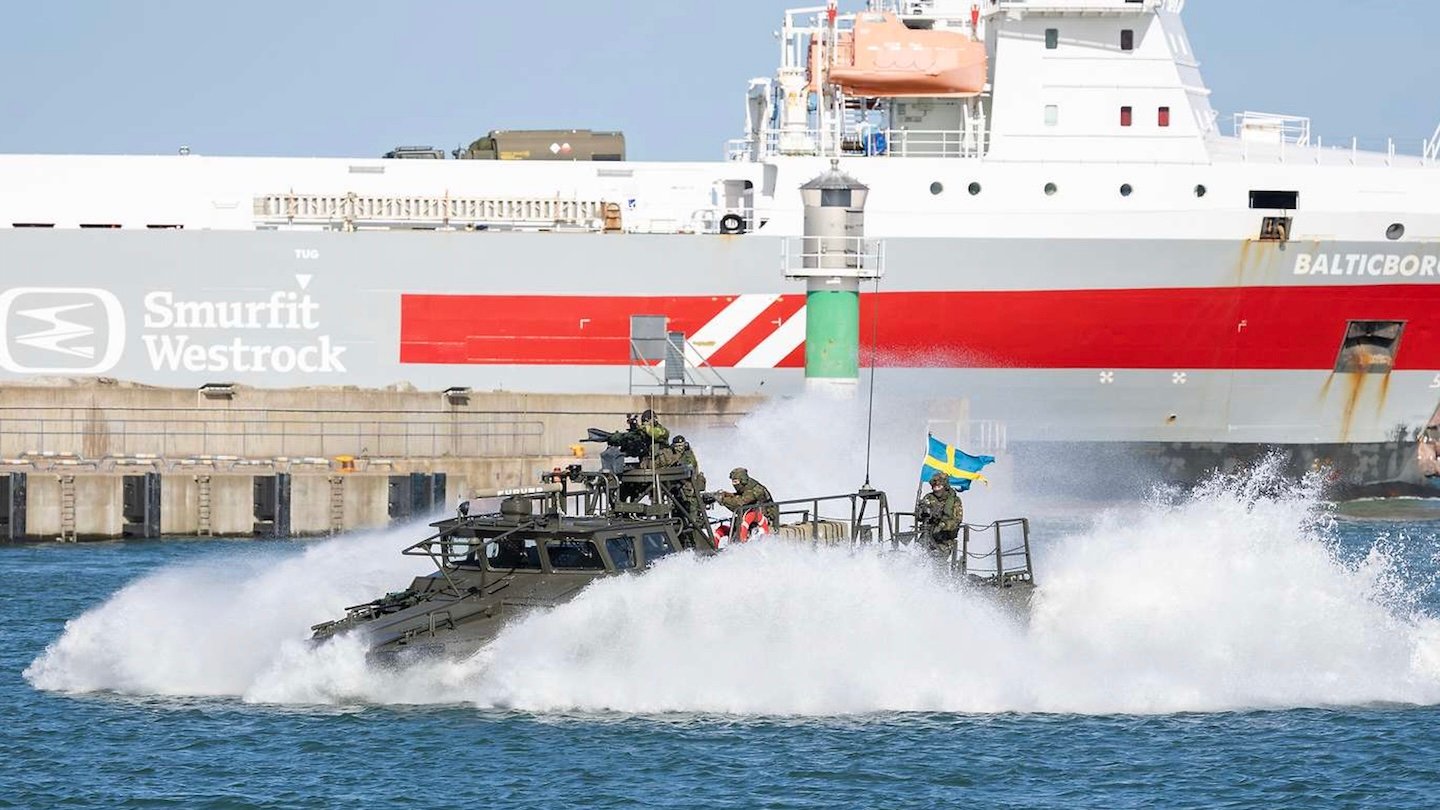
German and Swedish warships stand offshore while a Swedish CB90 fast assault craft operates in the harbor at Visby. Bundeswehr/Marc Tessensohn

The exercise, Silver Wotan 2026, running between September 14-23, brings together Swedish and German forces across the land, maritime, and air domains. The scenario is built around a Swedish request for allied assistance, with German forces moving personnel and equipment across the Baltic before integrating with Swedish units already defending the island. The operation is testing the entire process of getting allied combat power to Gotland, protecting it during the movement to Visby, and rapidly incorporating it into the island’s existing defensive network.

A video shows troops coming ashore on Swedish CB90 fast assault craft, a type that German soldiers are also trained to operate:

A rapid deployment of German and Swedish forces to Gotland island is being carried out today. Units from 🇸🇪 and 🇩🇪 are rehearsing the swift reinforcement of the strategic island in order to ensure the security of the Baltic Sea.#SilverWotan#NATO pic.twitter.com/A0r3LF8XUP

— Försvarsmakten (@Forsvarsmakten) September 18, 2026

The strategic importance of Gotland has grown considerably following Sweden’s accession to NATO in March 2024, which was a direct response to the full-scale Russian invasion of Ukraine.

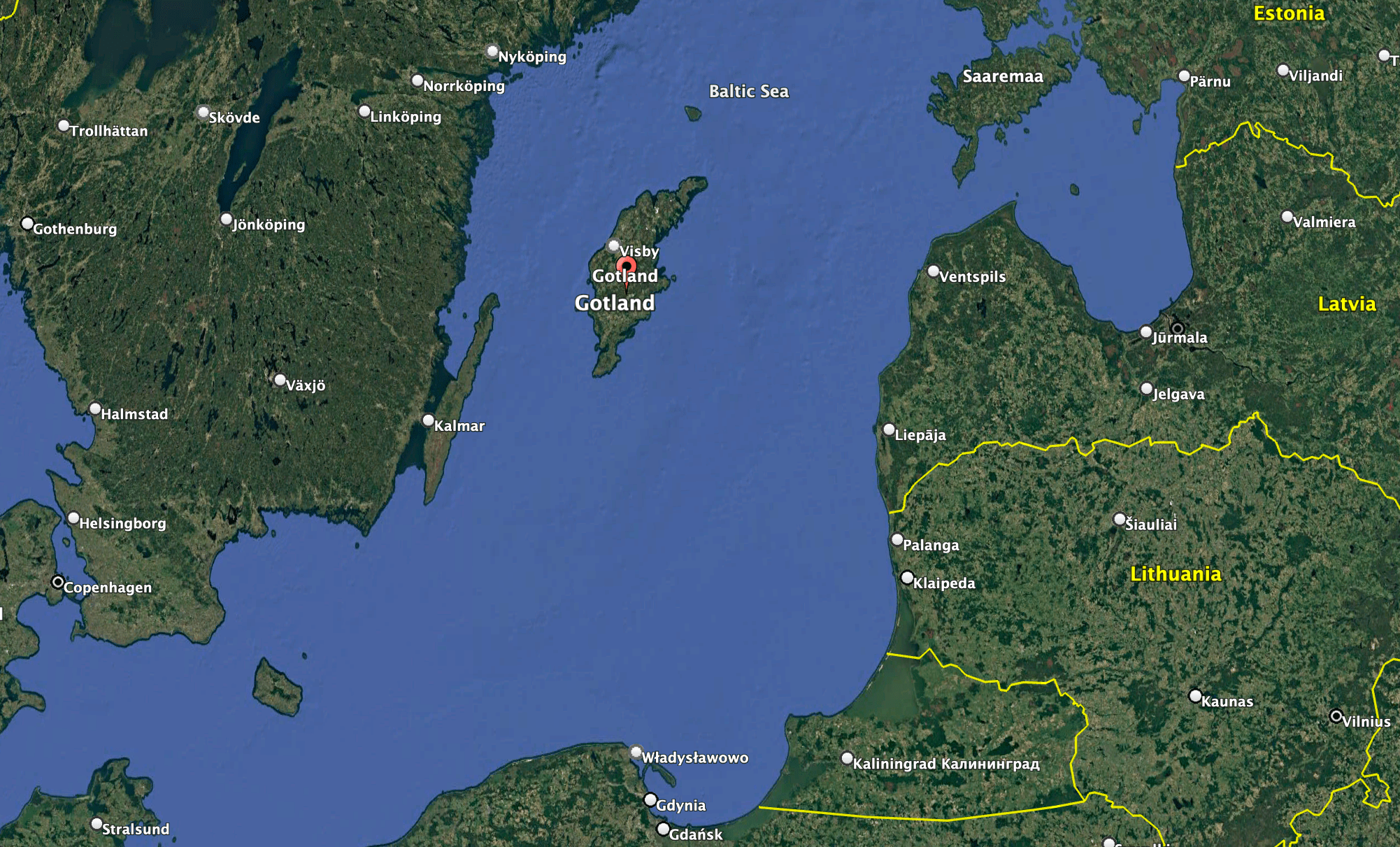
Located approximately halfway between mainland Sweden and the Baltic states, the island occupies a central position in the Baltic Sea, close to the maritime approaches to the Gulf of Finland and within reach of the Russian exclave of Kaliningrad. Its location gives forces operating from Gotland a potentially significant position from which to conduct surveillance, air defense, and maritime operations, while also making the island an important part of the wider network connecting NATO’s northern and eastern members.

The location of Gotland within the Baltic region. Google Earth

At the same time, Gotland sits within an extremely complex littoral environment, where shallow waters, islands, narrow maritime approaches, and the proximity of multiple states can make both offensive operations and defensive planning more difficult. The region has also been shaped by longstanding Swedish concerns about Russian clandestine activity, including intelligence gathering and other forms of covert or deniable activity. The complexity of the Baltic operating environment can make such activities harder to detect and attribute, adding another layer of uncertainty alongside the more conventional military challenges facing the region.

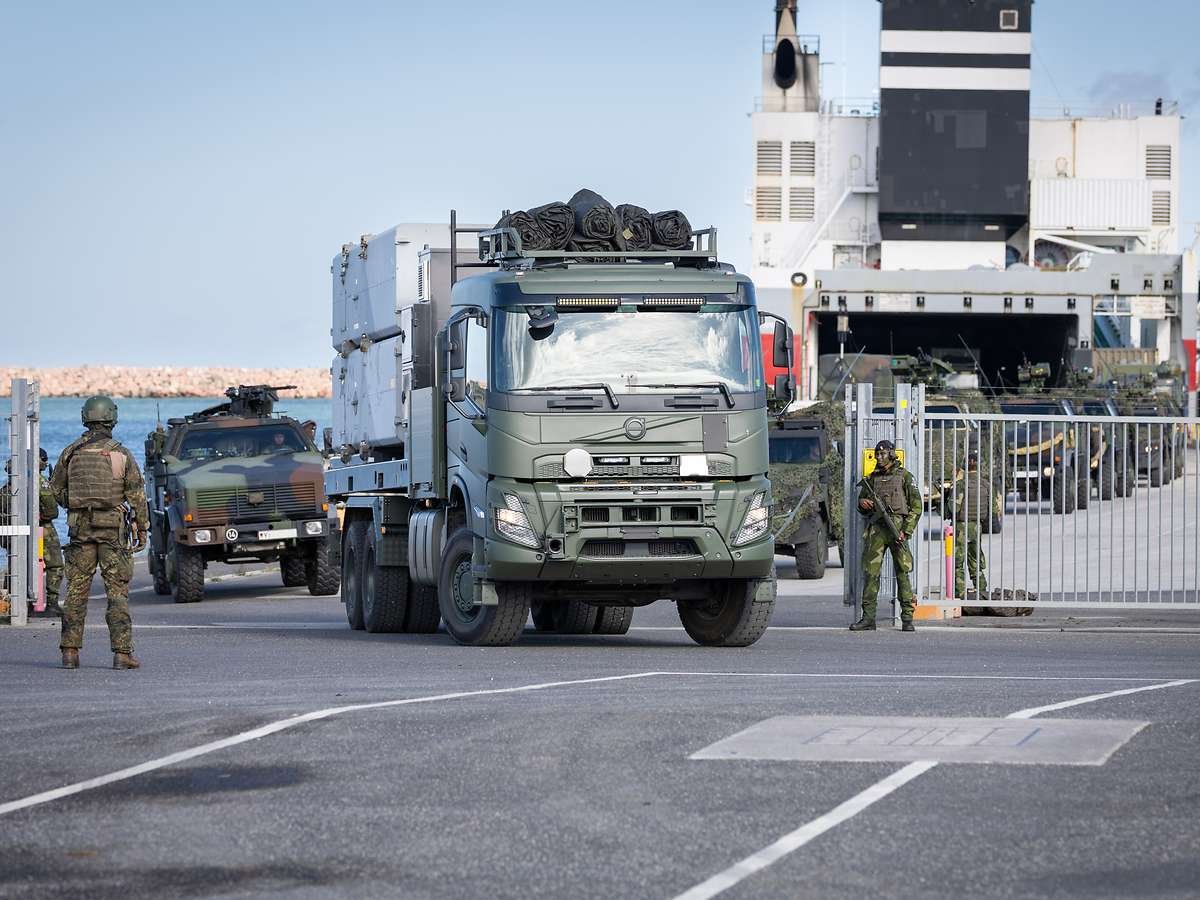
The unloading operation in Visby. The vehicles seen here were transported by sea from Karlskrona to the Swedish mainland. Bundeswehr/Marc Tessensohn

Geography has long made Gotland important to Swedish defense planning, but its significance has taken on a broader dimension since Sweden joined the alliance. NATO has described the island as strategically important to its freedom of maneuver in the Baltic, while Swedish officials have highlighted its potential role as a hub for military operations and logistics in the region.

The current exercise is designed around the practical difficulties of reinforcing such a position.

Military equipment is being transported by sea to Visby, Gotland’s principal port, including by commercial ferry. In Visby, Swedish and German personnel are securing the harbor and conducting the reception of the arriving force. Among the equipment being moved are air defense systems, while Swedish forces are also operating coastal defense systems armed with anti-ship missiles.

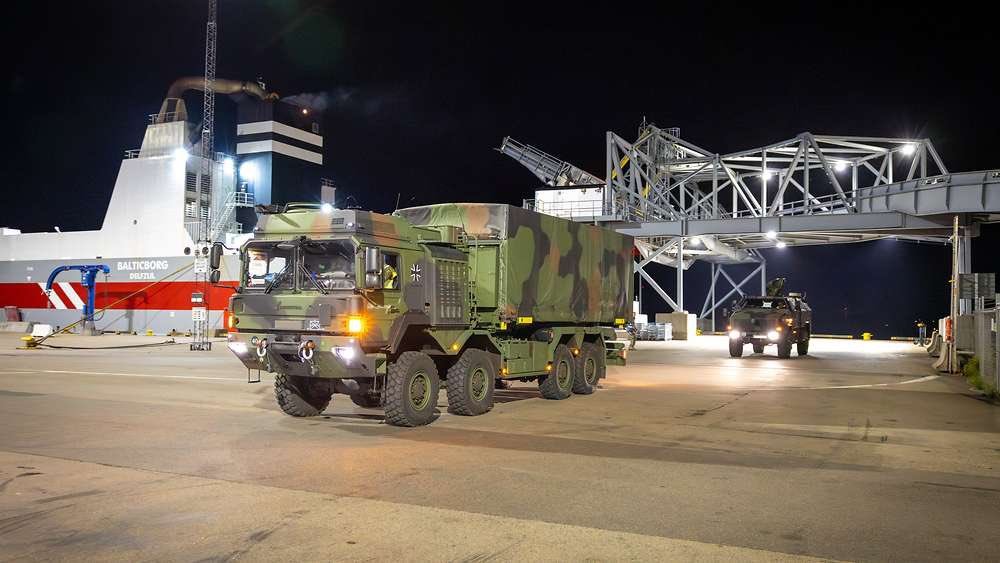
German Army vehicles roll into Visby during Silver Wotan. Bundeswehr/Marc Tessensohn

Meanwhile, publicly available flight-tracking data showed German Luftwaffe transport aircraft, including at least one Airbus A400M airlifter, apparently involved in the effort. The commercial airport at Visby has long also been used for military activities related to Gotland and the wider Baltic region.

”A rapid deployment of German and Swedish forces to Gotland island is being carried out today” https://t.co/z6oLs1LCT4 pic.twitter.com/n18MdST6r1

— Jamming (@balticjam) September 18, 2026

The movement is supported by Swedish and German naval forces and other aircraft, creating a scenario in which the maritime transit, protection of the port, air operations, and subsequent movement of troops and equipment ashore all form part of the same military problem. Once ashore, the arriving forces have to be moved into position and integrated with Swedish units already responsible for defending the island.

The Swedish Gotland Regiment, P 18, provides the core of the island’s permanent military presence. The regiment, Sweden’s youngest and smallest, has been rebuilding its capabilities since Sweden began expanding its military presence on Gotland. Its forces form the basis of the ground-defense structure into which allied reinforcements would be incorporated.

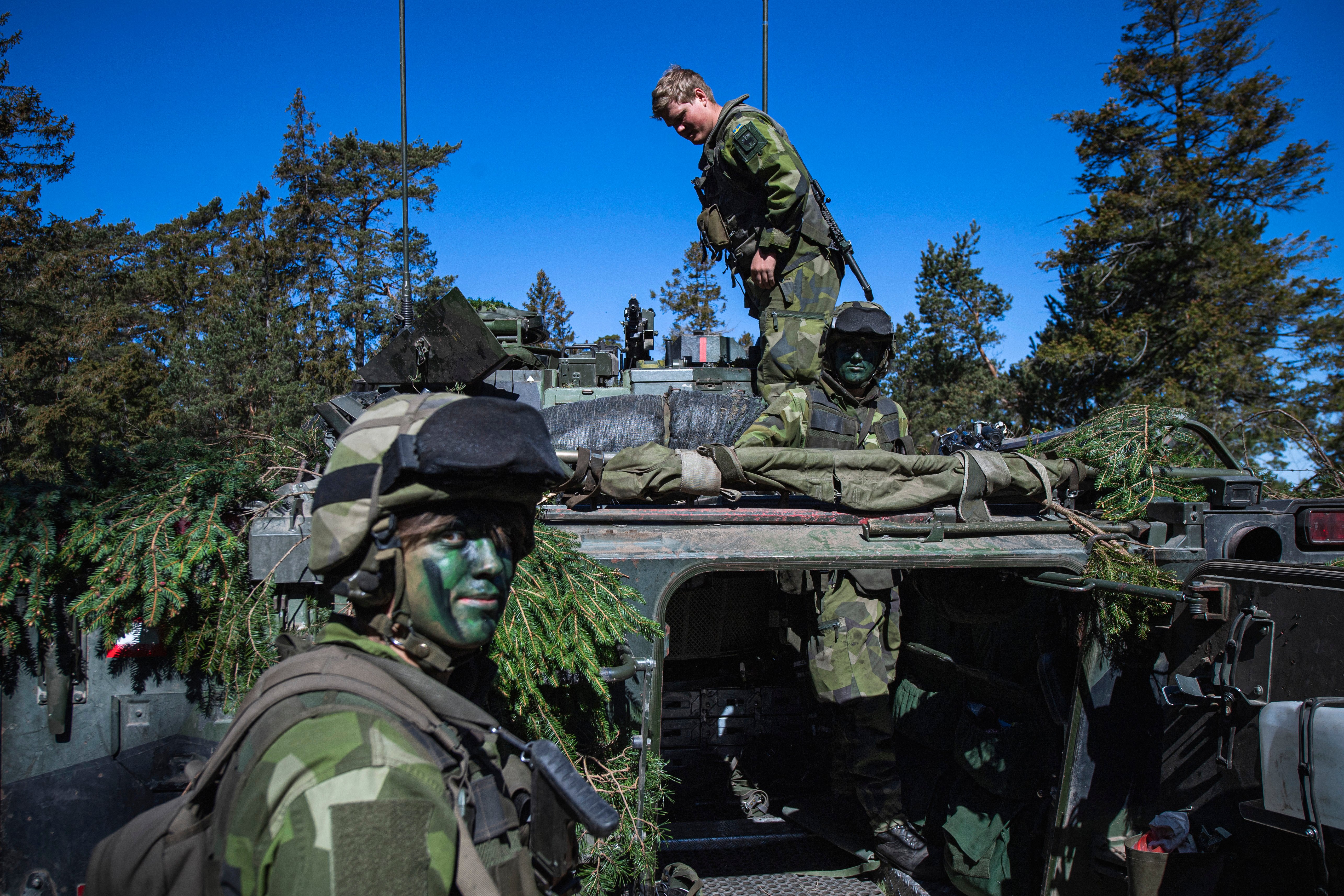
Soldiers of the P18 Gotland Regiment of the Swedish Army camouflage an armoured vehicle during a field exercise near Visby on the Swedish island of Gotland on May 17, 2022. Finland and Sweden are expected to announce this week whether to apply to join NATO following Russia's Ukraine invasion, in what would be a stunning reversal of decades-long non-alignment policies. On Sweden's strategically-located Baltic Sea island of Gotland, Home Guard troops were last week called in for a special month-long training exercise, coinciding with annual military exercises taking place across Finland and Sweden next week. (Photo by Jonathan NACKSTRAND / AFP) (Photo by JONATHAN NACKSTRAND/AFP via Getty Images)
Soldiers of the Gotland Regiment of the Swedish Army camouflage an armoured vehicle during an earlier field exercise near Visby. Photo by Jonathan NACKSTRAND / AFP

Swedish coastal defense capabilities are another important element of the drill. Land-based anti-ship missiles provide the island with a means of threatening hostile surface vessels operating in the surrounding waters, giving the defense of Gotland a direct connection to the wider maritime battle for the Baltic. During Silver Wotan, Swedish and German forces are also conducting anti-surface warfare activities alongside the broader reinforcement operation.

Germany is contributing more than 500 troops to the exercise, part of approximately 2,000 Bundeswehr personnel involved, including elements from the army, navy, and air force. The German Luftwaffe has deployed Panavia Tornado aircraft for surveillance, while German naval forces are participating in the maritime component, and German ground personnel are involved in the reinforcement and security activities on Gotland.

Piloten mit einer Nachtsichtbrille im Cockpit des Tornados 46+45 im Rahmen der Mission Counter Dash in Incirlik, Türkei, am 14.04.2016
Stock photo of a Luftwaffe Tornado ECR equipped for a reconaissance mission. Bundeswehr

The exercise scenario is particularly relevant against the backdrop of Russia’s continuing military presence in the Baltic region.

Russia maintains major military infrastructure in Kaliningrad, including naval, air, missile, and air defense capabilities, while the Russian Baltic Fleet operates from bases in the region. Kaliningrad’s position between Poland and Lithuania gives Moscow a significant military foothold inside the NATO area, while Russian forces and military infrastructure elsewhere along the Baltic add to the complexity of operating and reinforcing allied territory in the region.

The security environment around the Baltic has also deteriorated considerably since Russia’s full-scale invasion of Ukraine. NATO has increased its surveillance and military activity in the region, including the launch of Baltic Sentry in January 2025 following a series of incidents involving critical undersea infrastructure. The alliance has subsequently expanded efforts to monitor maritime activity and protect infrastructure and sea lines of communication.

A picture taken on February 4, 2025 shows a Helicopter 15 (HKP15) (L) on the flight deck of patrol ship HMS Carlskrona (P04) on open water near Karlskrona, Sweden, as part of the NATO Baltic Sea patrol mission, the Baltic Sentry, aimed to secure critical underwater infrastructure. The patrol ship HMS Carlskrona (P04) set off from the naval port in Karlskrona on February 4, 2025 to become part of NATO's Baltic Sentry operation as one of several Swedish ships that are part of Standing NATO Maritime Group One (SNMG1). This is the first time the ship has hoisted the NATO flag on board. The purpose of NATO's Baltic Sentry operation is to demonstrate presence and secure critical underwater infrastructure. (Photo by Johan NILSSON / TT NEWS AGENCY / AFP) / Sweden OUT (Photo by JOHAN NILSSON/TT NEWS AGENCY/AFP via Getty Images)
A Swedish Navy Helicopter 15 on the flight deck of patrol ship HMS Carlskrona as part of the NATO Baltic Sea patrol mission, Baltic Sentry, aimed to secure critical underwater infrastructure. Photo by Johan NILSSON / TT NEWS AGENCY / AFP

Swedish authorities have stressed that Silver Wotan was planned in advance and is not being conducted in response to a specific imminent Russian threat. The exercise nonetheless reflects the operational environment in which Swedish and NATO planners now have to consider the possibility that maritime and air movements across the Baltic could be monitored, disrupted, or contested.

The exercise also builds on a series of increasingly large Swedish-led activities designed to test the reception of allied forces on Swedish territory. During Aurora 26 earlier this year, more than 18,000 troops from 13 countries participated in operations across Sweden, including the deployment of allied forces to Gotland alongside the Gotland Regiment and Swedish Home Guard. NATO described that activity as an emergency deployment intended to test the reinforcement of the island.

A Dutch Boeing AH-64 Apache attack helicopter takes part in a combat display during a press day for the military exercise Aurora 26 at the Revingehed training field outside Lund in Skane, Southern Sweden on April 29, 2026. The exercise at Revingehed includes personnel from several NATO countires with the focus on lessons learned from the war in Ukraine including drones. (Photo by Johan NILSSON / various sources / AFP via Getty Images) / Sweden OUT
A Dutch AH-64 Apache attack helicopter takes part in Exercise Aurora 26 in southern Sweden on April 29, 2026. Photo by Johan NILSSON / various sources / AFP

Silver Wotan places a more concentrated emphasis on the Swedish-German relationship and on the movement of an allied force into the island’s existing defensive structure.

Germany’s participation is also consistent with its growing military role in the Baltic and along NATO’s northeastern flank. Berlin is already providing forces for NATO’s forward defense in Lithuania and has increasingly emphasized the ability to move German forces rapidly across northern Europe in support of allied operations.

For Sweden, meanwhile, Gotland has become one of the clearest examples of how NATO membership has changed the country’s defense planning. The island remains a Swedish responsibility, but its location means that what happens there has consequences well beyond Sweden’s territorial defense.

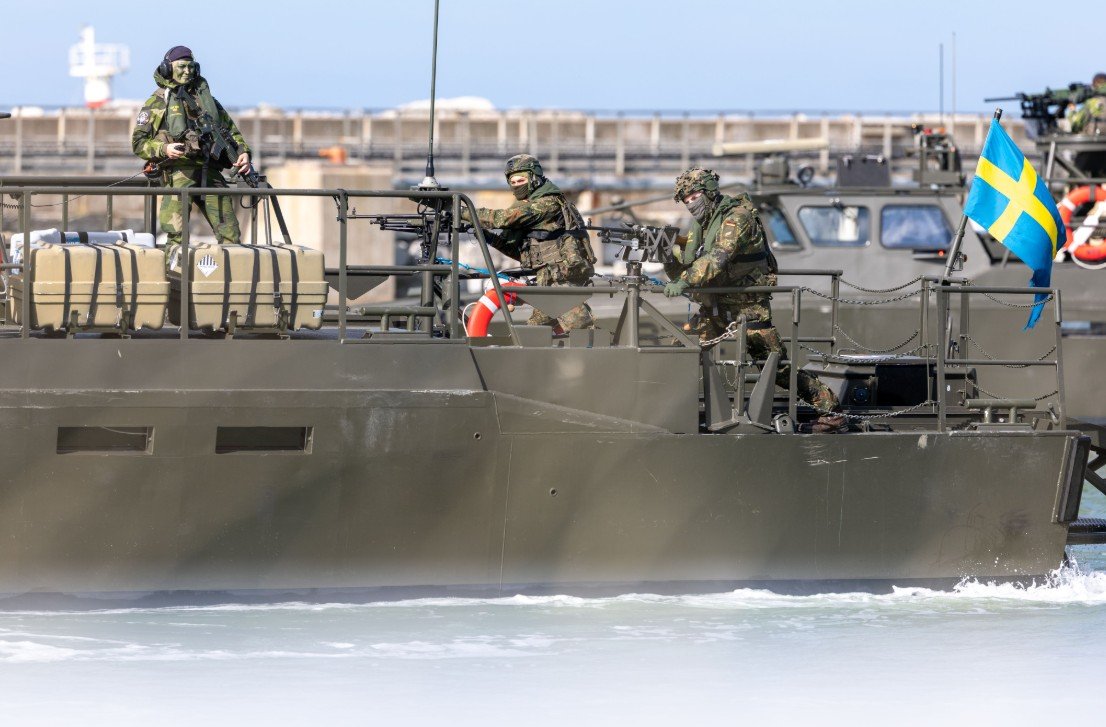
Silver Wotan 2026 / Weiterer Text über ots und www.presseportal.de/nr/179237 / Die Verwendung dieses Bildes für redaktionelle Zwecke ist unter Beachtung aller mitgeteilten Nutzungsbedingungen zulässig und dann auch honorarfrei. Veröffentlichung ausschließlich mit Bildrechte-Hinweis.
German and Swedish troops on a Swedish CB90 fast assault craft. Bundeswehr/Marc Tessensohn

A defended and adequately supplied Gotland provides NATO with a strategically positioned base for surveillance and defensive operations in the Baltic, while the ability to reinforce it demonstrates that the alliance can maintain access to the island even as the surrounding maritime and air environment becomes more contested.

The exercise comes as European allies are being forced to plan for a NATO in which the United States may provide less of the conventional military weight it has supplied for decades. The Pentagon is reviewing the size and posture of U.S. forces in Europe, including the forces and capabilities Washington would make available in a European crisis, while NATO’s top commander has said further U.S. troop withdrawals should be expected as European allies build up their own conventional capabilities.

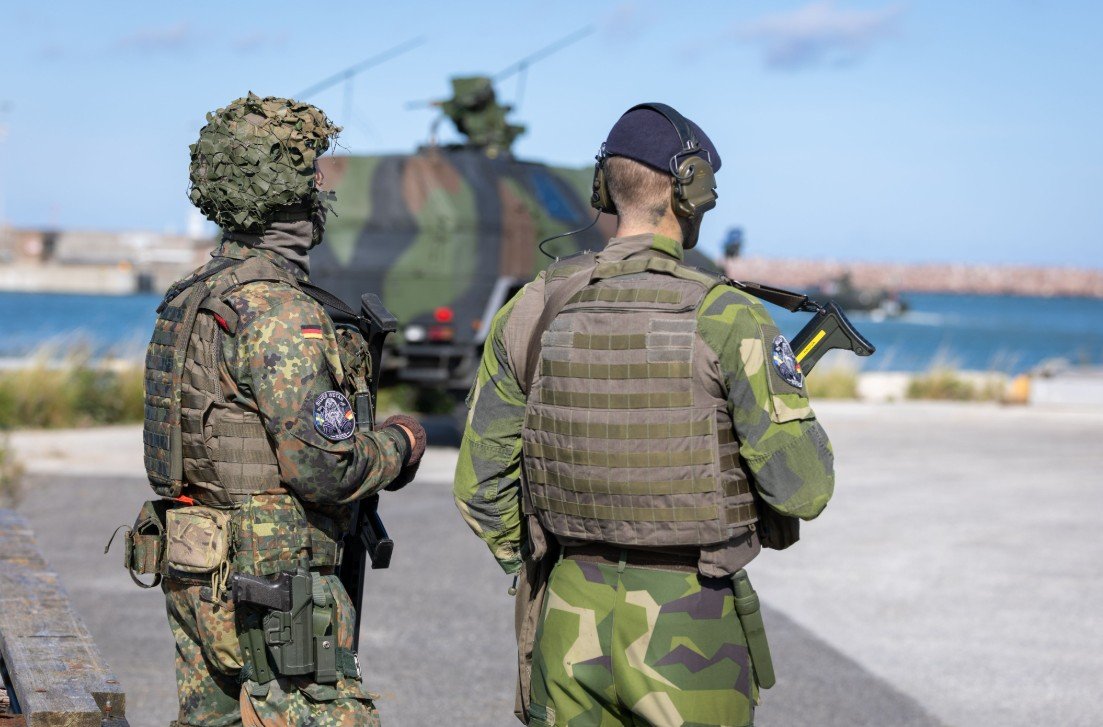
Silver Wotan 2026 / Weiterer Text über ots und www.presseportal.de/nr/179237 / Die Verwendung dieses Bildes für redaktionelle Zwecke ist unter Beachtung aller mitgeteilten Nutzungsbedingungen zulässig und dann auch honorarfrei. Veröffentlichung ausschließlich mit Bildrechte-Hinweis.
A German and a Swedish soldier involved in securing Visby during Silver Wotan 2026. Bundeswehr/Marc Tessensohn

At the same time, the alliance now describes Russia as its most significant and direct security threat, citing military activity alongside airspace violations, sabotage, cyber operations, and other forms of hybrid pressure. There are also growing concerns that Russia could try something in the Baltics, while it continues to step up its gray-zone activities regardless. NATO officials have warned that Russia could rebuild enough military capacity to pose a more serious conventional challenge to the alliance before the end of the decade.

There are escalating warnings from Poland that Russia is preparing to widen its war against Ukraine, with "accidental" missile and drone strikes on NATO territory.

Such a move – Russia falsely claiming air strikes that hit NATO allies happened by accident – would be designed to…

— Deborah Haynes (@haynesdeborah) September 18, 2026

For Sweden and Germany, the Silver Wotan exercise is a practical test of how quickly European forces can reinforce and defend one of the Baltic’s most strategically important positions. As the security environment grows more contested and Europe prepares for a future in which U.S. forces may not be as readily available, the ability to move allied combat power across the region and integrate it into existing defenses is becoming an increasingly important part of NATO’s deterrence.

Contact the author: thomas@thewarzone.com

The post German Forces Surge Onto Baltic Island In First-Of-Its-Kind NATO Drill appeared first on TWZ.

  •  

White House Spiritual Advisor: Americans Must Pay 10% of Their Income To Israel To ‘Honor the Tithe’

Christian Americans owe 10% of their gross income to the state of Israel, according to Paula White, the televangelist who holds the title of White House spiritual advisor. “I believe that it’s so important to [...]

The post White House Spiritual Advisor: Americans Must Pay 10% of Their Income To Israel To ‘Honor the Tithe’ appeared first on The People's Voice.

  •  

Marine Colonel Who Led Mideast Combat Deployment Wants His Own Drone Boats

The officer who led the 31st Marine Expeditionary Unit (MEU) on its recent combat deployment to the Middle East told us he needs his own uncrewed surface vessels (USVs) on future deployments. Operationalizing USVs is an area where the Marines are lagging behind. In particular, he wants the ability to send USVs forward to reconnoiter potential highly-contested beach landing areas, a mission largely assumed by the Navy.

As we have frequently reported, the military use of USVs is now proliferating around the globe at an increasing rate. Ukraine has employed sea drones to devastating effect against Russia’s Black Sea Fleet vessels and facilities, forcing the general evacuation of Russian naval assets from occupied Crimea to bases in Russia proper. During Operation Epic Fury, the U.S. used them for the first time in combat, as one-way attack weapons against Iranian targets, to hunt for mines, and for a search and rescue operation to locate the crew of an AH-64 Apache helicopter downed by Iran, as well as general broad-area surveillance and awareness. China is investing heavily in the space, as well, along with many other navies around the globe, both friend and foe.

The following video shows the first U.S. use of a USV as a kamikaze weapon.

Yesterday, using multiple one-way attack surface drones, CENTCOM forces successfully struck a submarine and ship maintenance facility in Iran. Three Corsair unmanned surface vessels hit the port at Bandar Abbas Naval Base, marking the first time American forces have employed sea… pic.twitter.com/bOM2kmgRxz

— U.S. Central Command (@CENTCOM) July 13, 2026

“There was a lot in theater that were being used, but it wasn’t something that we went out with,” Col. Chris P. Niedziocha told us when asked if the 31st MEU deployed with USVs. He then answered in the affirmative in response to a question about if MEUs need sea drones on future deployments. He said it is part of the “explosion in robotics and autonomy” being used in combat.

“These systems are incredibly useful and capable,” explained Niedziocha, now director of the USMC Expeditionary Warfare School. “And you say, ‘Hey, you know, [in] the next war, if the first thing you’re putting through the breach isn’t a robot, something’s wrong. You say never send a Marine someplace you haven’t sent a bullet. I think the new way is [you] never want to send a Marine someplace you haven’t already sent a robot. So yeah, we’re embracing [the technology] and we’re not leaders. We’re fast followers in that regime.”

Asked for specific use cases he sees for USVs, the colonel talked about using them before putting Marines ashore.

“I can tell you if you’re doing an amphibious operation, you want to understand what’s waiting beneath the surface in the water column,” Niedziocha noted. “So something can go either with a side-looking sonar array or even forward-looking to demonstrate that there’s nothing there, and the hydrography and bathymetry is what you… need for the operation to be successful.”

Hydrography measures “the shape and features of the shoreline; the characteristics of tides, currents, and waves; and the physical and chemical properties of the water itself,” according to NOAA. Bathymetry, which is part of that, focuses on mapping the depths and shapes of underwater terrain.

NOAA

These functions are critical for mine detection and determining whether there are man-made or natural obstacles that would impede landing operations. While these missions are largely being performed by the Navy, including with USVs, the Marines are moving toward making that an organic capability. Recently, the Marines announced they were testing a counter-mine USV system. The evaluation was conducted late last month at Camp Pendleton by the Program Manager Combat Support Systems (PM CSS) Explosive Hazard Defeat Team.

The test of the USV was “in response to a littoral capability gap,” according to the media release. “The solution: seek a commercial USV solution that is equipped with integrated autonomous driving and payloads that consist of Sonar, Forward-Looking Infrared (FLIR) cameras, Line of Sight (LOS) Communications and Acoustic Communications (AComms).”

This was part of the overall effort to develop “solutions that enable increased standoff for Marines to detect, investigate and neutralize threats,” the release added. “The innovation of Explosive Ordnance Disposal (EOD) and Littoral Explosive Ordnance Neutralization (LEON) systems will provide Marine EOD Technicians with the confidence to operate in contested environments while preserving combat power, increasing operational reach, and minimizing exposure to explosive threats.”

LEON is a so-called system of systems, using a remotely operated vehicle, diver equipment, an unmanned underwater vehicle (UUV), a USV, and an Amphibious Unmanned Ground Vehicle to enable “EOD to confirm and mark hazards and obstacles from very shallow water to the beach zone,” the media release added.

While unmanned systems have long been part of EOD operations, “we’re expanding that into maritime systems that allow more endurance and less risk for operators,” said Chief Warrant Officer 2 Alfredo Andrade, officer in charge, Explosive Ordnance Disposal Company, 7th Engineer Support Battalion (ESB). “Some of the conflicts that we are engaged in take a toll on the force, and surging in new forces is costly. It turns into a logistical problem. To preserve the safety and the health of the forces… the USV and the [LEON] program exist to ensure that we have readily available combat power.”

In late August at Camp Pendleton, the PM CSS Explosive Hazard Defeat Team tested an Unmanned Surface Vessel in response to a littoral capability gap. The solution: seek a commercial USV solution that is equipped with integrated autonomous driving and payloads that consist of Sonar, Forward-Looking Infrared (FLIR) cameras, Line of Sight (LOS) Communications and Acoustic Communications (AComms). The LEON System of Systems (SOS) consists of five increments of capabilities to include a Remotely Operated Vehicle, diver equipment, Unmanned Underwater Vehicle, Unmanned Surface Vehicle, and an Amphibious Unmanned Ground Vehicle. LEON enables EOD to confirm and mark hazards and obstacles from very shallow water to the beach zone. (PAE Marine Corps photo by Kristiana Gehly)
In late August at Camp Pendleton, the PM CSS Explosive Hazard Defeat Team tested an unmanned surface vessel in response to a littoral capability gap. (PAE Marine Corps photo by Kristiana Gehly) Kristiana Gehly

While Niedziocha didn’t address USVs for offensive combat roles, the Marines have evaluated them for that use as well as for logistics, among other functions.

Our Autonomous Low-Profile Vessel (ALPV) solicitation is now accepting submissions.

The @DeptofWar and the @USMC need to resupply units spread over wide distances in contested littoral environments. Increased all-domain threats targeting logistics capabilities, locations, and… pic.twitter.com/Af8v0DTRHS

— Department of War Innovation Unit (@DIU_x) March 3, 2026

There have been many other tests, as well. Including one just this summer at RIMPAC. These trials saw the launch and recovery of one of Splash Industries’ Typhoon USVs aboard the USS Essex. The ‘Gator Navy’ of amphibious assault vessels that haul Marines and their kit around the oceans is uniquely suited to act as USV motherships. Their well decks allow for easy deployment and recovery of USVs of many sizes and capabilities near seamlessly. So it won’t be surprising if these vessels and the Marines aboard them quickly become staples in the Pentagon’s USV playbook.

Watch us land one of our drone-boats inside a moving US Navy warship during RIMPAC. This world-first resupply mission was performed completely autonomously using a Splash Industries Typhoon USV. pic.twitter.com/AEzNzZjsL1

— Ivan Avanesov (@i_vanesov) July 14, 2026

Still, the Marines have a long way to go to catch up to how these systems are already being used.

The Houthi rebels of Yemen actually pioneered the operational use of kamikaze USVs years ago and Ukraine has led the way in advancements of these systems. They first employed them as kamikaze weapons, but then added machine guns and rockets and later missiles, which were used to shoot down Russian helicopters and jets. Ukraine has also used them to launch first-person view (FPV) and bomber drone attacks as well as deliver uncrewed ground vehicles (UGVs) into enemy territory. Last week, Ukraine claimed to have attacked a Russian USV with a USV, marking another first.

You can see that engagement in the following video.

Ukraine's Navy says a Sargan unmanned surface vessel destroyed a Russian unmanned boat with machine-gun fire in the Black Sea, the first-ever battle between unmanned surface vessels. Ukrainian Navy personnel operated in coordination with HUR. #Ukraine pic.twitter.com/Avg4ecz8m6

— NOELREPORTS 🇪🇺 🇺🇦 (@NOELreports) September 12, 2026

Having recently returned from a six-month deployment that saw the Marine Corps’ first use of its Expeditionary Advanced Base Operations (EABO) concept in a combat setting during the fight against Iran, Niedziocha has a good sense of the realities of modern warfare. His Marines operated forward arming and refueling points (FARPs) for various aircraft in combat for the first time and set up remote sensing locations.

That a commander like him sees value in USVs is a good sign for progress in the development of these systems.

Contact the author: howard@twz.com

The post Marine Colonel Who Led Mideast Combat Deployment Wants His Own Drone Boats appeared first on TWZ.

  •  

🔴TUTTI A SECCO | TG 18.9.26

– Arabia Saudita, il re del greggio compra gasolio di Margherita Furlan
– Arabia Saudita, colpito un jet italiano di Jeff Hoffman
– Caccia italiani sul Baltico, retorica bellicista di Jeff Hoffman
– USA, riserva strategica ai minimi di Jeff Hoffman
– Meloni guarda a Oslo per l’energia di Ivan Bodyan
– Kuwait, l’ultimo tabù del Golfo di Jeff Hoffman
– Netanyahu vuole punire chi critica l’esercito di Ivan Bodyan
– Libano senza ONU, Parigi prende il posto di Jeff Hoffman
– Israele in Africa, il Marocco apre la porta di Jeff Hoffman
– L’UE punta il dito contro il Marocco di Gionata Chatillard
– Trump si prepara ad accogliere Xi Jinping di Ivan Bodyan
– Russia, elezioni per la Duma e a livello locale di Ivan Bodyan
– Buon giro intorno al Sole

A cura di Margherita Furlan Con la collaborazione di Gionata Chatillard, Ivan Bodyan e Jeff Hoffman Editing di Mario Ferdinandi

📡 CASA DEL SOLE TV — Informazione libera e indipendente Il nostro lavoro è possibile solo grazie al vostro sostegno. Casa del Sole TV non ha editori forti né finanziamenti pubblici: siamo sostenuti da voi, il nostro pubblico. Se credi nel valore di un’informazione che non tace, aiutaci a continuare.

💳 Dona tramite bonifico bancario: IBAN: IT63P0326822300052392596590 Intestato a: LA CASA DEL SOLE EDIZIONI Causale: Donazione Casa del Sole TV

🅿 Dona tramite PayPal: paypal.me/casadelsoletv

⏰Sostegno ricorrente: casadelsole.tv/sostienici

Anche un piccolo contributo fa la differenza.

Grazie di cuore! ❤

L'articolo 🔴TUTTI A SECCO | TG 18.9.26 proviene da Casa del Sole TV.

  •  

Texas Democrat James ‘God Is Non-Binary’ Talarico Pushes WEF-Approved Bible That Removes ‘Son of God’ Because It’s ‘Sexist’

Texas Democratic Senate candidate James Talarico’s sacrilegious church gives members copies of the “Inclusive Bible” — a modern WEF-approved translation designed to remove what its creators describe as “sexist” language and “stupid stuff,” according to [...]

The post Texas Democrat James ‘God Is Non-Binary’ Talarico Pushes WEF-Approved Bible That Removes ‘Son of God’ Because It’s ‘Sexist’ appeared first on The People's Voice.

  •  

Trump, Silicon Valley, and the global far right target Brazil’s upcoming elections

Photo courtesy of Michael Fox.
https://www.spreaker.com/show/7063186/episodes/feed

This is a particularly important episode, coming just two weeks ahead of the 1st round of high stakes presidential elections in Brazil.

Host Michael Fox speaks with Artur Romeu. He’s a Brazilian journalist and the Latin American Director for Latin America of the international NGO Reporters Without Borders. 

They spoke ahead of Episode 6 of The Battle for Free Speech, about Brazil’s fight against disinformation. He has an important analysis, which helps to deconstruct how Trump, Silicon Valley and the far-right in the United States, and around the world is “instrumentalizing the idea of free speech for their own political purpose and abandoning key dimension of freedom of expression, which is this more social and collective dimension to receive plural, reliable, diverse, and free information from others.”

This is the third bonus episode of The Battle for Free Speech. The Battle for Free Speech Podcast is a production of The Real News Network hosted by Michael Fox and Marc Steiner. 

Guests: 

Resources: 

  • You can check out the full Battle for Free Speech podcast series here.

Many thanks to everyone who has supported this show.

Follow The Battle for Free Speech on Spotify or Apple Podcasts. Support Michael Fox’s reporting at patreon.com/mfox. Never miss an episode — sign up for The Real News newsletter at therealnews.com. 

Transcript

The following is a rushed transcript and may contain errors. It will be updated.

Michael Fox:

Hi folks. I’m your co-host, Michael Fox. This is the Battle for Free Speech, and this is the third bonus episode in this series. So this one is particularly important and timely as Brazil is heading into high stakes presidential elections this October. The race is between current leftist president Luis Ignacio Lula de Silva and Flavio Bolsonaro, the son of former far-right president Jair Bolsonaro. If you have listened to episode six of this podcast series or my podcast series Brazil on Fire or the entire season two of my podcast Under the Shadow, then you know a little bit about where things are and where they’re headed. And this is another deep dive. Today, I’m bringing you my full conversation with Arturo Romeo. He’s a Brazilian journalist and the director for Latin America of the International NGO Reporters Without Borders. I spoke with him specifically for my episode about Brazil of the battle for free speech, but there was so much more from our conversation that I couldn’t fit into that episode.

In this conversation, Artur mentions a couple of things and I want to give you some context. First, Alexandre Morais is the Brazilian Supreme Court justice who led the investigations into fake news and Bolsonaro’s hate cabinet. He also oversaw the electoral court in the 2022 elections, and he was the guy who had the showdown with billionaire Elon Musk over Twitter back in 2024. In fact, Morais blocked the social media platform in Brazil for roughly two months after Musk refused to suspend a series of Brazilian accounts who were disseminating fake news. Then Musk pulled Twitter’s legal representation from the country. Musk later acquiesced and Twitter went back online. But that escapade has been used by the far right and even President Donald Trump to claim that Morais and the Lula government have been censoring free speech in the country. And in fact, that was one of the top reasons for the 50% tariff on Brazilian goods that Trump imposed last year on the country.

And it has been at the heart of Trump’s campaign against Brazil and Lula in an effort to influence the outcome of Brazil’s presidential elections this year. Okay, I think you are up to speed. Here is my full conversation with Artur Romeo in its entirety. We spoke last year, 2025, but it is more relevant than ever today. I hope you like it. Arturo, thank you so much for being with me today. Thank you so much for your availability. I really, really appreciate. Super excited to talk with you about all these things.

Artur Romeu:

Thank you, Michael. I’m also excited to talk about those issues with you. I

Michael Fox:

Say the same question to everybody. For you, what does free speech mean?

Artur Romeu:

It seems like a simple question, especially for an NGO working with press freedom for 40 years at the institution that I work for, the NGO, that I work for Reporters Without Borders, we have been working defending press freedom, not exactly free speech, but they kind of free speech and press freedom drink on the same fountain or same roots of freedom of expression more broadly. So free speech is the ability to essentially being able to impart ideas, opinions, views on the world around us without being harassed, persecuted, prosecuted, attacked by governments or other groups, can be religious groups, but also economic interests. So the ability to be able to, as an individual or a collective, to express yourself and your ideas and contribute to the public debate without fear for reprisal essentially.

Michael Fox:

And Artur, what is your analysis of the state of free speech today in the world in Brazil and the United States and elsewhere? Where are we?

Artur Romeu:

I think that there is a lot of confusion. Maybe I never saw as much confusion around those issues as we are seeing today. Basically, one of the things that scares me is the fact that free speech is being weaponized against press freedom, for example. Another issue is that we are focusing too much on the individualistic aspect of free speech, and we have to have this understanding that at least coming from a freedom of expression perspective, there are an individual dimension, but also a social and collective dimension of freedom of expression. It’s not just our ability to being able to express ourselves and to impart information and ideas, but also to receive those information and ideas from others. So the way we are talking about, or at least the way that some political groups and specifically the far right nowadays everywhere in the world, not specifically in the US, has been instrumentalizing the idea of free speech for their own political purpose and abandoning a key aspect, a key dimension of freedom of expression, which is this more social and collected dimension to receive plural, reliable, diverse and free information from others.

And a third issue, and I think that’s behind most of this confusion as well, is the role that big tech social media platforms are having on this discussion because we have the idea that regulating this economic activity sector would be the same as censorship, but actually better regulation, good regulation, democratic supervision, improve the condition for free speech and press freedom and the integrity of information in general. So this opposition between the ability to be able to impart your ideas and the need that governments have to find a way to regulate the digital sphere arena online is they are not opposed to each other, but it’s a complex discussion because emerging technology always poses new problems. And even if we are not saying that social media platforms are necessarily new to our political landscape, AI is becoming something more popularized and we don’t know the impact that AI will have in this cacophony, this, I don’t know, some people are calling it epidemics or this crisis of reliable information.

And the key problem here is all those things together are fragmenting public conversation, public debate, and public debate is at the core of our democracies. So there is a clear link between this fragmentation of public debate due to all this and the erosion of democracies everywhere.

Michael Fox:

Arturo, you’ve just mentioned everything you said, I was like, we need to talk more about that because this is at the root of all this is why it’s so important. Before we dive into more specifics of all those things that you just mentioned, I have this idea, this hypothesis, are we in a moment where the far right folks like Trump and Bolsonaro are trying to redefine free speech in their favor instead of what you mentioned, “Oh, we need actually some regulation so that we can have a field where we’re actually getting not just random information and fake lies and everything else for everybody else, but we’re actually getting information that is what we should be receiving.” Are we in a moment right now where certain groups are trying to redefine what free speech means so that they can use it to push their agenda?

Artur Romeu:

Of course, it’s very clear. It’s been happening for a while and it’s crazy how effective it is because I think people are very concerned with society in general every day on our daily lives, every citizen is concerned with their ability to basic freedom. And I think that for a very long time, at least in other democracies, this is something that was kind of taken for granted. And even if there were some complex discussions from time to time, there was at least this frame, this common ground, this common denominator where there were international standards in terms of human rights related to free speech, very clearly defined. But sometimes there is this complex issues where you have limits to free speech, right? It’s not an absolute right as a series of human rights. They are not absolute in themselves. There is a balance between rights. And for a long time, I think it generated some stress and tension, but it was kind of relevant discussions, philosophical discussions.

People may disagree, but still we had a common ground. And what we’ve been seeing lately for the past, I don’t know, 10 years at least, is that the way those limits are defined and their political appropriation is stressing this debate. And we are seeing a relevant debate for democracies and to ensure rights and public participation in general being distorted, inverted in a sense that a specific political group is using this to play the victims and saying that they are being oppressed by those ideas. And they made a political flag out of this, and it’s being very effective in terms of how this idea has permeated society and gaining capularity. And I think our field of organizations that are defending freedom of expression is having a lot of difficulty to fight back or reframe the debate. So we are talking about those issues from a rights-based approach and not from a political biased approach.

Just to give an example, specific example, in Brazil, there was a very important milestone march protest during the Independence Day of 2021 with Bolsonaro, thousands of people in the streets supporting Bolsonaro, supporters of Bolsonaro going to flooding the streets in every major capital. And researchers were the streets trying to survey why people were, in their views, going to protest. And one question was about what was their main motivation? And the first motivation was freedom of expression. So in theory, something good. But when they asked them, “And what are you fighting against?” And the first was the Supreme Court in Brazil, which is, I won’t go into the political context in Brazil, but a key issue here in terms of how the constitutional court and Supreme Court has been limiting transgressions and abuses of the executive branch. And the second was the press. So they were fighting against the press.

So they were defending press freedom by attacking the press. And so I think it’s a kind of a paradox where you see a very individualistic perspective. People want to be able to say whatever they want and less and less are accepting that the fact that we are living in a society, there are symmetries of powers, this speech has to be balanced with other rights. So this imbalance and the way it has been appropriated by and kind of really weaponized by the far right is having a major effect in creating this imbalance and making people forget why it’s important to balance a free speech, which is kind of incoherent, at least when you see what happened with Charlie Kirk and people were expressing their views on the fact that criticizing him some very harsh level and the same group that is defending that people should be able to speak wherever they want are doing their own witch hunt.

So you see how politically biased and how this weaponization appropriation of the idea of free speech or freedom of expression is a power struggle more than a philosophical and conceptual one.

Michael Fox:

Do you think that part of how we got to this point goes back to what you were mentioning before, the splintering of society. Now with social media, I get all of my news from here, you get all of your news from there, and so we’re allowed to attack the other because they’re the other rather than having this open debate. Is that part of what led us to this moment?

Artur Romeu:

Yeah. Social media had a major impact in the information ecosystem as a whole for better or for worse, kind of changed everything, how people are receiving, how we are less dependent of a few broadcasters. And now we feel that we are in this environment where we can speak freely. But actually what happened was the privatization of a public space, and you have this impression that you are in Agora, this public arena where there is this idealized perspective of the free flow of information, the free market of ideas, the better ideas will win. And actually this is happening in a specific space controlled by specific groups, interest groups, a very profit oriented perspective. No transparency at all on how those information are being moderated and gaining more or less reach. So yeah, definitely. I think the major shifts that those technologies had on our information space are partly not necessarily too blamed by their own, because I think also when we talk about censorship, it’s easier for us to think of a more classic censorship approach in the same way that when we think about a dictatorship or a coup d’etat, we have references from our past and we kind of compare what is happening now and our collective memory of what those words mean.

And freedom of expression was kind of invented to protect citizen rights, individual citizen rights to oppose all powerful state in a very different political landscape from centuries ago. And now censorship is not only having a propaganda ministry and having censors within newsrooms and journalists being detained and killed because of what they’re saying. Of course, it still happens a lot in several parts of the words, but censorship or at least freedom of expression and free speech is also eroded when not only the state. Because the idea behind this is that the state should restrain itself from any interference in the free flow of information. So any kind of interference equals bad, equals censorship. People should be able to speak freely without government or state interference, but that’s not enough. You also need positive obligation. And positive obligation means that the governments and states have to develop, establish public policies that will help the information space, the information ecosystem to balance assymetries.

For example, pluralism, diversity, reliability of information are key aspects of this, of a healthier information space. So for this to work, you need governments to create those policies, to establish these laws, policies, how antitrust policies, for example, to fight excessive media ownership concentration in the hands of few groups to help balance market asymmetries and to ensure that the rights of their citizens is assured also in terms of access to pluralistic and reliable information. With the social media and big text, what they are saying is that any regulation is bad, they are self-regulating by themselves, and they are at the end protecting their commercial interests and creating those regulatory backups where they can operate without accountability or any kind of accountability. And if we don’t do anything about it, we will keep seeing a disintegration of this information space.

Michael Fox:

Following from that point, can you talk a little bit about what we saw over the last year? For instance, this whole battle between Brazil, Aleshande Morais, Twitter, X, Musk, because I feel like that’s a perfect example of exactly what you’re talking about. And also these two visions where Brazil has this vision of saying, no, we’re going to regulate more because you can’t have just a get out of jail free card completely. And whereas the United States is much more laissez-fraire backed by Donald Trump and particularly now, but this was even before he came to office.

Artur Romeu:

First of all, you have different traditions, different countries, you have different traditions in terms of how you interpret law. Brazil’s approach to freedom of expression is closer to the European approach where there is a focus on this balance between rights than the US one where there is a broader, I don’t know, more elasticity when you are talking about freedom of expression. You have to have in mind that our legal tradition is closer to the European one in terms of philosophical, conceptual jurisprudence expiration. Within this context, have a very specific example. When former President Bolsonaro started saying that people should not trust on electoral results because digital ballot box are not reliable when he did not and still has not any kind of proof of this. And much on the contrary, by the way, the electoral system in Brazil is widely recognized and as a very strong electoral system.

When he started doing that, for example, calling a meeting with ambassadors from a bunch of different countries to give a press conference saying that before the election, one year before the elections, that people should not trust electoral results if we kept the system as it was. It’s very, very, very serious because he has a lot of supporters and echo chambers on social media, and this kind of information erodes trusts of society, on their political institutions and their electoral institutions. So basically you cannot argue that that’s within his absolute right of print of expression because it has very serious impact for democracy and it’s not because you are the president that you can say whatever you want without any kind of accountability. But from there, what happened is that this idea was widely spread by his supporters and political groups, and the social media had a huge impact on this.

So this is clearly organized, this information, casebook. It’s pretty straightforward. And this information in the sense that it has a set of cogs in the machines, and it’s not just one person saying something false, it’s how this information is being spread and the structure of this information, the different levels, actors, stakeholders involved in this, financed with public money, public funds, and social media companies within their codes of conduct, you cannot just let this level of disinformation spread, including the reach they’re having without, again, any accountabilities, they could have acted to limit the reach, not necessarily censoring the presidential Twitter account or something, but at least putting contextual information, whatever those links, I don’t know. But there are several possible strategies for those social media to limit those kinds of harmful disinformation. But since we did not have a regulatory framework for this, the Supreme Court took the responsibility to act and to investigate this fake news industry or disinformation industry, how it was being structured and its impact.

And by doing that, said explicitly that, I don’t know, judges could not be threatened, basic stuff. And starting, for example, Alishanj Morais, which is at the epicenter of all this, even if he’s, and I think this is a parenthesis here, Morais was very important within all this, but he himself, I mean as an individual judge, but we have to take into account always that his decision were being systematically validated by the other judges of the Supreme Court. So even if he was the one being more visible on all this, and even though that there were tensions between and discussions between the judges, the vast majority of all those decisions went through the plenary, all the judges. So we talk a lot about him, but it’s more like the Supreme Court itself. I think he’s the image of these fights in a way, but he wasn’t alone doing that.

It’s not all powerful judge that is doing that as a rogue mode and acting on his own. We had strong institutions and it worked in the sense that we had the highest body in the judiciary power acting on this and investigating those issues, how they were spreading and taking harsh measures to prevent the impact of what everything was happening be even higher. For example, closing, requesting for the suppression of individual accounts on social media, and that’s something that led to the blockage of acts here in Brazil because what happened is that Elon Musk decided that he would not accept sovereign decision from the Brazilian highest court. He just moved his policy team away from Brazil. There was no legal representation as a way clearly to escape Brazilian jurisdiction in a clearly politically motivated move. And what the court said is that you cannot do that if you are operating You have to operate within our laws.

So if you don’t have a legal representation here in Brazil, and if you do not accept court orders related to several specific measures to mitigate the impact of this information of what was happening, you could not operate. And he was not blaffing. I think for, I don’t know, 50 days, it took a while. And there was a lot of support because you could imagine that this kind of decision, it’s very unpopular. You have tons, millions of social media users, including a lot of journalists using those tools for their daily work. But the way it was done showed that there was at least an understanding from Brazilian society that it was a fair fight, that it was something legitimate. And you can go even backwards with the pandemic. I won’t go all the way there, but the way that Bolsonaro governed during the pandemic was a big disasters for several reasons, but also in terms of access to reliable information on health issues and the way that false information was spreading for, again, politically biased moves.

And I think he had a bet in the sense that he thought that by going this way, he would show a different path than other global leaders, but it was a big disaster, no surprise. And there was a lot of discussion around this time about disinformation as well. So it’s a discussion that has been going on in Brazil on how public and democratic institutions have to respond to widespread disinformation strategy, especially those coming from the highest ranking officials. It’s gained a lot of track and legitimacy. And I would dare even to say that we have now more than other countries an awareness about those issues where, for example, there was a, I don’t know if it’s very recent survey, I have to double check the numbers, but what I know for sure is that most of Brazilian society, a survey showed is in favor of regulating social media.

So you have this support, even of course, if it’s not, if you have clearly political groups which are very strong and a lot of debate on how you do it. I think the major question is how you do it because it’s not that the fact that you have to act, I think that’s pretty clear here and from every perspective. What is more difficult is how you do it to avoid a very obvious trap where by doing this, you are creating a censorship mechanism and more control over those tools, those technologies. So this should be actually the discussion, how you do it and not if you have to do it or not, why it’s important. I think we are well over the time where those discussions should have passed and now, I don’t know. I really don’t know. I feel that we are living parallel universes sometimes.

When you see, for example, Trump’s speech on the UN and Lula’s speech in the UN, we feel that we are living in parallel universes. So different periods of time. I think it’s clear for, there is a consensus among digital rights activists, organizations, even a part of mainstream progressive groups, NGOs working with freedom of expression that you have to create mechanisms to improve democratic supervisions of how those emerging technologies, especially social media, are creating those rifts in our democratic systems.

Michael Fox:

Artu, thank you so much. I just have two more really quick questions. And this is so important, this last point that you touched on, because particularly in the United States, even amongst folks on the left, because historically, obviously censorship has been used against usually marginalized communities, minority communities. And so the discourse is always, well, once you start to say, well, you can’t say this and these people can’t say that, well then that’s going to be used against always, eventually it’s going to be used against and particularly against minority communities and marginalized communities. The people with the least amount of voice are the ones that are going to have their voice taken away completely. And yet this question no one meant, I feel like this huge elephant in the room is always this question of fake news. I can believe what I want to believe, you can believe what you want to believe.

More or less we can talk, but you still can’t be spreading just complete disinformation and lies and yet that’s what we’re seeing. And unless you actually take that on and say, okay, well this is here and how do we try and roll this back? But I feel like so many people or organizations or individuals, it’s just kind of give it, well, no, we don’t want to do that because then that’s stopping people. But no, there are lies. There are people trying to manipulate this. And so it’s a huge, it’s a complicated debate to ask that question of even how do we do this? But I think that is the question of saying, no, we absolutely have to. We can’t even be discussing if we are going to or not. We need to be talking about how we do it in the most democratic way possible or else we’re just going to see more and more of our rights willed away and more and more of our ability to communicate as a people whittled away.

So it’s crazy.

Artur Romeu:

Yeah. Talking about more on journalism and how specifically on journalism, the way things are told nowadays, I mean in terms of how all this has been appropriated by this fear of censorship or by saying that any kind of regulation is censorship is creating this environment of a crisis of trust and polluting democratic public debate, but also it’s creating something that science and journalism are put in the same level as any other opinion. So this is my opinion. So I can say it because it’s my opinion. And if you have 30 pages special dossier done by one of the journalists working that biggest newsroom in the country and you take this and you say, “Well, they can say wherever they want, that’s my opinion and I’m against this.” Same thing with, I don’t know, climate denialism just to keep one specific issue related to science. So when you put everything, conspiracy theories, opinions, ideas at the same level of other kinds of expressions, they should not be able to say to disagree, of course, or to question, this is healthy for democratic debate, but you cannot dismiss investigative journalistic piece on a very key issue and that had multiple sources done in journalistic processes.

You have a process to doing journalism. It’s not ChatGPT, it’s those investigations in the same way that science has its processes of verification, experimentation, peer review, et cetera. Journalism has its own. And if this is not recognized as a positive incentive, a society to receive this information and to criticize or to discuss what is being said in a different way than just someone saying what they think, journalism have foundations in terms of what is being said. And ideas can have more or less, opinions can have more or less depending from if it’s coming from someone that has studied all his life, all her life about the specific issue and then is expressing of course an idea, a different idea or a position on this topic. But if we put everything at the same level, we won’t have a real conversation. We will be just everyone saying what they want.

And for democracies to work, we have to find commonplaces and those commonplaces have to be based on some kind of logic or some kind of method or some kind of common ground. And so this is a problem right now with journalism because it’s being treated as just another opinion.

And on our newsfeed on social media, it’s being treated as just another opinion. Even sometimes even dismissed or the reach of news articles and links are having a worse reach than other kinds of videos posted by influencers. But there’s no due prominence of journalistic content or scientific content. So the conversation

Is becoming more and more based on the rule of the stronger. If you appear to be stronger than others, your position can overlap all the others because you say so. That’s extremely dangerous for the kind of democracy we have been building. So this is a specific issue with journalism. And the other issue is media sustainability and news deserts and how those new technologies have shifted completely the business model of the media industry in just a few years. And it’s creating more fusions, less pluralism. You have this illusion of pluralism because you feel that there’s more people speaking than before where you have the gatekeepers and all this, but it’s noise. So there’s a lot of noise happening and noise is not necessarily pluralism because pluralism needs some kind of framework to be effective for a democratic debate. If it’s just a bunch of people in a room saying what they think about the problem, not necessarily the best idea or the idea that has the stronger chance to work will win.

So also this idea of a free market of ideas, we don’t live in a political vacuum. So a free market of ideas is completely dependent on the correlations of force between the different stakeholders in the ecosystem, the political landscape. You have a lot of social and economic inequalities. So talking about a free market of ideas with no kinds of balancing this just don’t work because ideas will step on others anyway. When we talk about AI regulation or digital service acts to regulate the social media and the whole industry behind it, you need to have some kind of how you can create mechanisms to create financial compensation for media. And there are a lot of taxating profits from big tech revenue, advertisement revenue of big tax, for example, and creating a fund and this fund being. I don’t know. There are several ideas going on, bargaining codes.

But the point is if we do nothing, what we are seeing is that the economic pressure on journalism, on public interest journalism is becoming asphyxiating. And what we will see soon is an environment, a media landscape with a lot of concentration of power and local news markets disappearing and being replaced by, we don’t really know, but what we’ve been seeing is that when a local news media disappear, there’s no empty space. This space is immediately occupied by propaganda, by this information, by other interests. So preserving journalism, especially local journalism, is a democratic imperative. And we have to understand how we can do this when discussing democratic regulations for social media and AI.

Michael Fox:

Artur, so great. My last really quick question is you mentioned toward the beginning something I thought was really important, you want to forget it, free speech being weaponized against press freedoms. Can you talk a little bit more about that? Where are we seeing that? What does that look like?

Artur Romeu:

We are seeing that in a daily basis in the US for sure. And I have very specific example. When Trump wrote a letter to President Lula to justify the tariffs, the letter mentioned Bolsonaro, the prosecution of Bolsonaro in Brazil, mentioned big tax and the fact that the rights of American citizens was being violated and companies was being violated by the judiciary in Brazil. And just after the letter itself, there was some kind of, I don’t know the name of it, but an order where there were more explanations of the reasons. It was like a one and a half page document and the expression like freedom of speech or free speech or freedom of expression or censorship was repeated at least 10 times in a letter basically saying that the US was imposing tariffs on Brazil because Brazil was promoting censorship. So when I say that free speech is being weaponized against freedom of expression, in parts it connects to this example where you make yourself look like as a free press paladin, but actually what your distorted vision of free speech is doing is fragmenting the idea, the different ideas behind what freedom of expression really is, and mostly the social and collective dimension of freedom of expression.

You are only saying that people should say whatever they want without any kind of interference. If that’s the case, you are basically ignoring completely the fact that people live in a society and part of the freedom of expression right is related to receive pluralistic, diverse, reliable information. When we see these kinds of marches that I’ve talked about in Brazil as well where you say you are there to defend freedom of expression, but actually your enemy is press freedom, you are again weaponizing this idea because what you are really interested in is being able to express your ideas without any kind of repercussions, any kind of accountability, because it’s a very empowering feeling. So I think what those leaders, Bolsonaro, Trump, Edogan, Obam, and others, Milei have been doing the media bashing and fueling general hostility towards journalism and not just journalists, but journalism, like the ideal of journalism, again, not just against the press, but the idea really of journalism is at the core of their political strategy.

It’s not isolated. It’s not something that’s part of their personality. It’s really something that has the ability to keep their electoral basis very mobilized. It’s a very effective way to polarize public debate. And those leaders, they are dependent on polarizations. They cannot leave, have a political career without these kinds of systematic polarization and attacking the press systematically. The press, the media institutions, journalism in general is very effective for your strategy and that’s why they keep doing. In Argentina, for example, recently Mile said, “The problem is we don’t hate journalists enough.” So these kind of ideas, Bukele in El Salvador, it’s really at the core of the political strategy. So again, instrumentalizing, weaponizing free speech to erode press freedom, to have more control over the public debate and less scrutiny in society. It’s much easier to kill the messenger than have to deal with whatever the report or the news article is discussing.

Michael Fox:

Artur, incredible. Thank you so, so much. I really appreciate your time. I know we went over a little bit, but I really appreciate it.

Artur Romeu:

Thank you, Michael.

Michael Fox:

Hi folks. I hope you enjoyed our conversation. As I mentioned before, this is the third bonus episode of this series. There are more on the way. Please watch out for those in your feed. This is the battle for free speech. This podcast is co-hosted by myself and Mark Steiner. This show is produced by The Real News. You can find out more about my work and this show on my Patreon. That’s www.patreon.com/mfox. As always, please make sure to sign up for the Real News Network’s newsletter so you never miss an episode. You can find that at therealnews.com. Thanks so much again for listening to this podcast. See you next time.

  •  

MAGA wants to ban his books. Who was Howard Zinn?

Writer Howard Zinn attends The People Speak: The Voices Of A People's History Of The United States during the 2009 Sundance Film Festival at the ASCAP Music Cafe on January 22, 2009 in Park City, Utah. Photo by Fred Hayes/WireImage

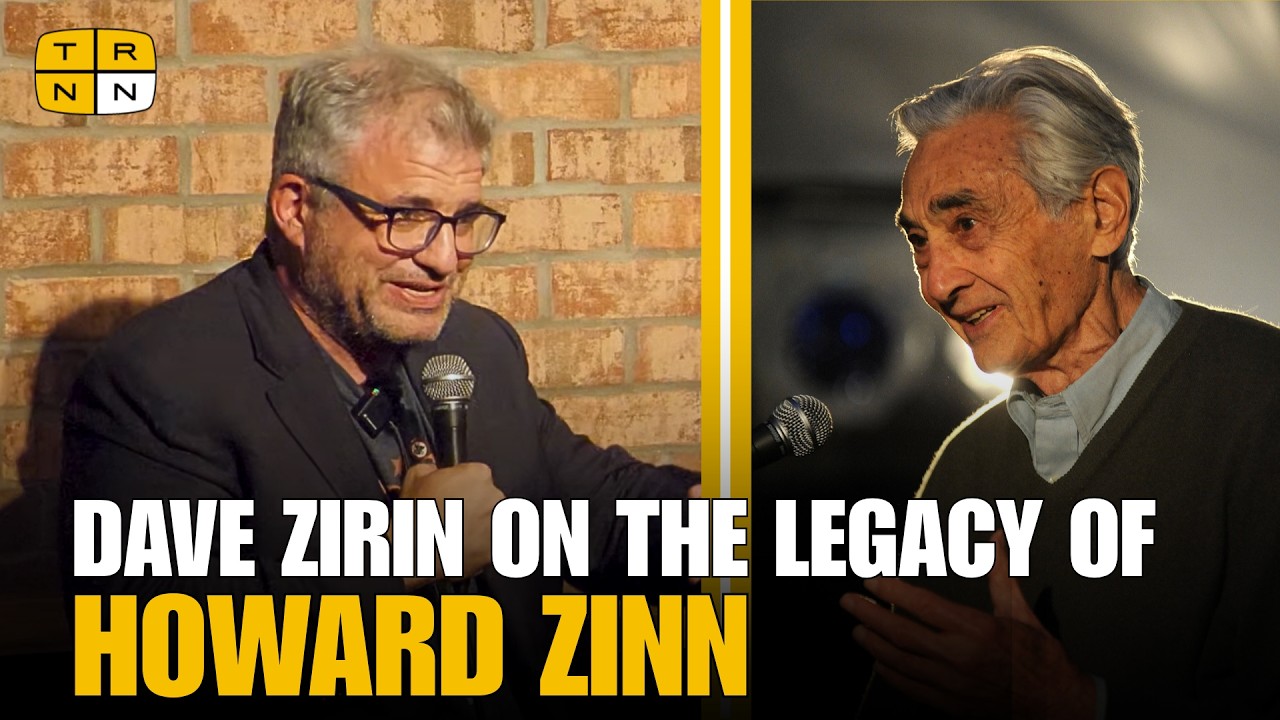
Long after his death in 2010, the books and speeches of Howard Zinn are frequently targeted by right-wing critics, MAGA book-bans, and fundamentalist politicians. In 2020, President Trump called out Zinn by name from the White House lawn, smearing Zinn’s work as “propaganda… that tries to make students ashamed of their own history.” So, who was Howard Zinn? And why are his critics so determined to keep his work from the public? In this live event, hosted at Red Emma’s Cooperative Bookstore and Coffeehouse in Baltimore, Maryland, TRNN Editor-in-Chief Maximillian Alvarez speaks with author and TRNN contributor Dave Zirin about his latest book, “The People’s Historian: The Outsized Life of Howard Zinn.”

Credits:

  • Studio Production / Post-Production: David Hebden
Transcript

The following is a rushed transcript and may contain errors. It will be updated.

Howard Zinn:

Protest will always be useful. Protest will always be important. Protest always looks futile at the time that it takes place, but protest mounts up. If they though protest was futile, they wouldn’t send the police out every time. There’s a demonstration. Have you noticed that you set up a picket line of somewhere of seven people and 12 policemen show up? They must worry about protest because they know that small protests lead to large ones.

Maximillian Alvarez:

All right. Well, thank you all. It is such an honor to be here with y’all tonight in Red Emma’s cooperative bookstore and coffee house in our great city of Baltimore. Give it up. And I am really, really honored and excited that we get to chat to the man, the myth, legendary sports writer, book author, documentary maker, political thinker, a true love warrior and a true role model for so many of us of what it means to just be a good-hearted person and to fight for good. Dave Zirin, give it up for Dave, everybody. Now, brother Dave.

Dave Zirin:

Yes. Yes, sir.

Maximillian Alvarez:

We’ve gotten to work together over at The Real News on your kick ass show, Edge of Sports TV, right?

Dave Zirin:

Yes, sir.

Maximillian Alvarez:

And so many of us know you through your sports writing and your analysis and commentary on sports, but we’re here tonight to talk about your new book, which is decidedly not about sports. And it is The People’s Historian: The Outsized Life of Howard Zinn. So Dave, I want to start off this way. Who was Howard Zinn? Who is he to you? Why did you write a whole book about him and why was now the time to write that book?

Dave Zirin:

Wow. So great to be here. Such a terrific question. Just the quickest of side notes, that last clip of Howard that you saw, that was his last mass meeting that he ever did before he passed away in January 2010. And it was at the convention of the campaign to end the death penalty. And I just wanted to say we have someone here tonight who is as responsible as anybody for the fact that we don’t have the death penalty in Maryland right now. And that’s Kenny Collins. And I just want to – Yes.

A hard big enough to crush injustice sitting right over there. So for me, I got to know Howard at the end of his life. I got to travel with him to different places and interview him on stage because he was sharp as a tack at age like 86, 87 years old, but standing and doing a 45 minute lecture was just something he couldn’t do any longer. I’d gotten to know him by writing a book in the People’s History series called The People’s History of Sports in the United States. And so I would sit with Howard on stage in 2008, 2009, and he was just the easiest interview in the history of the world. You would just say, “Civil rights, your thoughts.” And then 30 minutes later, he’s interrupted five times by applause. And everybody’s standing up at the end cheering for him. And afterwards, people would come up to me and say, “Yo, you did a great interview.” And I’d be like, “I said 12 words.

It was awesome.” And I got to sort of bask in the refracted glow. And the thing about Howard is that when he would speak about himself, it’s so interesting thinking back to the pronouns he would use. It was always we, it was always us, it was always they. And sometimes he would say you, but it was always, “What do you think? What are you doing?” It was never about I or me. But backstage, of course, he would tell these incredible stories and it’s like out of nowhere. Oh, that time I marched with James Baldwin in Selma. And it’s like, oh sure, as one does. And so I said to him once, “What we need is a people’s history of Howard Zinn.”

And he laughed at that. And that was actually my first proposal for the title of the book. And my publisher said, “Well, that’s too inside baseball.” Which kind of insulted me because I’m a sports writer, so they thought the only way I’d understand it is if they said it was too inside baseball. I was like, “Oh, I get it. Okay, now I understand.” And then the second title I wanted was when I was going through Howard Zinn’s FBI files and they had this sheet that was sent to J. Edgar Hoover in 1950 about Howard Zinn, where they said he was 28 years old and they said, “We are convinced he is a subversive who wants to overthrow the United States. He is a spy maybe for the Soviets. And the proof of this is that he has an alias.” And so you look closely and you’re like, “What’s the alias?” And it’s listed right there and it’s Howie.

So I wanted to call the book Codename Howie: The Outsized Life of Howard Zinn. And I never thought I would write a book about Howard Zinn when he passed away in 2010. I never thought I would in a million years, but something interesting started to happen during the late 2000 teens and into 2020, which is a lot of people started to get in touch with me and say, “What do you think Howard Zinn would say about the Black Lives Matter movement? What do you think Howard Zinn would say about the rise of Trumpism? What do you think Howard Zinn would say about the growth of right-wing fascist authoritarianism?” And they would ask this question kind of gingerly and even a little bit scared. Was Howard Zinn wrong that struggle is how the world changes? Because we’ve struggled and look where we are. Donald Trump is in charge.

So what if struggle just doesn’t work? And they asked this with fear as if somebody has the God failed was almost with the question, that kind of sadness. And I was thinking about some of the stories that Howard told me who threw his life and thought to myself, you know what? I’m not going to try to write anything or even say something that tries to answer that question for somebody who’s no longer with us. That’s not a job of any journalist or author to speak for those who can’t speak for themselves. But he left behind so many breadcrumbs from his life about how to fight right wing tyranny, about how to maintain in difficult times, about how to ride through movements when they’re at their most perilous, that it’s just like his life is an example for us about how to survive the 2020s. And the fact that somebody born in 1922 who died 16 years ago could generate a crowd like this in Baltimore and generate crowds like this or bigger in cities that I’ve been to, it just speaks to the fact not only of his influence, but the fact that we’re all trying to wrestle with these questions right now of hope, optimism, and how change can happen in very difficult times.

Maximillian Alvarez:

Oh yeah. Well, beautifully and powerfully put as always, brother. And I think one of the many things I love about this book is not just that I get to enjoy more of your writing, which is really chicken soup for my weary radical soul these days. And I know I speak for a lot of us when I say that, but there’s so much of Howie in this book. You did find so many quotes that feel so perfectly and gently and gingerly and rightly placed in the book. And I wanted to actually have you read one without giving us context up front, but the one there on page 21, read that passage from Howard Zinn and then I’ll throw a question at you about it.

Dave Zirin:

Absolutely. You want just the red part, right, that he read? Okay. This is from when Howard was – No context. No context. Sorry, sorry, sorry. Exactly at 10, banners unfurled. People started chanting. It was fantastic. So my friend and I relieved two women holding a banner and then we heard sirens. And before I knew it, cops with clubs began beating the demonstrators. I was spun around and got hit on the side of my head. I was out. I woke up in a doorway. The demonstration was being scattered and it was an absolute shocking experience because I had no idea the police would react like this to an innocent demonstration, that an innocent group of people could be perceived as that menacing. From that moment on, I was no longer a liberal, a believer in the self-correcting character of American democracy. I was a radical believing that something fundamental was wrong in this country, not just the existence of poverty amidst great wealth, not just the horrible treatment of black and brown people, but something rotten at the root.

Since then, I’ve come to understand we need not just a new president or new laws, but an uprooting of the old order, the introduction of a new kind of society, cooperative, peaceful, egalitarian.

Maximillian Alvarez:

Hell yeah. So first give it up for Howie on that one. Okay. Now, if you please give us the context of that story that Zinn is telling us and what it means for him to make that journey from being what he calls a liberal to being a radical.

Dave Zirin:

Absolutely. So Howard Zinn is born in 1922 in Brooklyn, New York, a very different Brooklyn than the Brooklyn of 2026, to put it mildly. And his childhood was a childhood of poverty, of going from tenement to tenement of outrunning landlords as a young child with his immigrant parents and his three brothers just going from apartment to apartment. And he’d written, and I spoke to him about how he still had this fear of rats to this day because of how they would appear in the apartment and how they would cuddle up in their blankets because they were so scared of getting rat bites. And it’s one of the things about Howard Zinn that I always so respected is that he would thunder and he would rarely get mad, but he would thunder angrily about people who were poor, who became wealthier, who would romanticize their poverty.

And he would say, “We must never romanticize poverty. Poverty is violence and I will never romanticize my own upbringing.” And he became this incredible reader growing up and finding books on the street and reading them, things like Charles Dickens was his first love. And then his parents, they had very little money, but they signed him up for an encyclopedia chapter of the month club through the newspaper. So he’s just reading encyclopedias and whatever he could get his hands on. And the Brooklyn of, now we’re into the 1930s, was also just this absolute hotbed of political activism. I mean, as one person said, who I interviewed, if you weren’t some kind of communist, anarchist or socialist, we really thought you were just dead from the neck up in the 1930s of Brooklyn. And Howard Zinn was somebody who just loved arguing with people on street corners, loved talking politics.

He was very radicalized, not just by the poverty and the racism and the segregation of Brooklyn of the 1930s, but also radicalized by the anti-fascist movement in Europe at that time. I mean, imagine being a working class kid in Brooklyn in the 30s and you see a poster of somebody from your neighborhood who you knew who’s returning from Spain because they were over there with what were called the Abraham Lincoln Brigades fighting Franco’s fascism. So you’re a working class kid in Brooklyn and you’re seeing a kid just like you who’s back from Spain where he was on the anti-fascist front lines. So an incredibly sort of radicalizing experience for him, but he still wasn’t somebody with a clear kind of set of politics in terms of this system actually needs to be uprooted and changed. And that changed for him dramatically as a teenager when one of the street corner radicals invited him to that demonstration that you talked about.

And that was in Union Square, New York over on 14th Street. Again, Union Square, very different today than it was in the late 1930s. And it was there where he got knocked upside the head by the police and actually generations of radicals certainly I think share this experience is that when you come into direct contact with the state,

It changes you forever and very fundamentally.

Maximillian Alvarez:

Well, and say a little more about what would continue to change Howard Zinn fundamentally when he entered military service during a World War.

Dave Zirin:

Well, first I got to say, how many people have seen the movie Forrest Gump, out of curiosity? Imagine if Forrest Gump was directed by John Sayles,

Like radical working class filmmaker. That’s like Howard Zinn’s life. And imagine if instead of Forrest Gump, you have this learned historian and he’s just at these incredible junctures of US history bearing witness. That’s why the subheading of the book is The Outsized Life of Howard Zinn, because he wasn’t just this historian who was trying to make history. He wasn’t just somebody going to demonstrations. He’s in these cinematic landscapes. We just talked about Brooklyn, the Depression, the 1930s. Then he becomes a bombardier during World War II because he wants to fight fascism. He becomes a bombardier even though he’d never been on a plane. That’s how much he hated fascism. He’s like, “I’m going to get on a plane and fight fascism.” But he leaves World War II, committed at this time, he called himself a pacifist and somebody who was anti-war for the rest of his life.

That was one of the results of his experience after being asked and told and ordered to bomb civilians in a French resort town called Royan, a place he later visited in 1966. But then early years of the civil rights movement, he’s at Spelman College, a woman’s HBCU, teaching this incredible generation of students like Alice Walker and Marian Wright Edelman and many more, Bernice Johnson Regan, who was part of the SNCC Freedom Singers. And so he’s there at ground zero of the start of the civil rights movement. And then he becomes the adult advisor along with someone you might have heard of named Ella Baker of the Student Nonviolent Coordinating Committee in the 1960s. And then he’s at the center of the anti-war movement against the war on the people of Vietnam in the ’60s. And so he’s just at these moments where he’s able to play this role in helping make history, but also playing a role that I think we have a lot to learn from, particularly as I say in one chapter, as a white guy in the Black freedom struggle, his behaviors as a white person I think are actually a model for how white people need to approach anti-racist struggle.

And the fact that he was doing that decades before we started even having those conversations seriously is really interesting to me. Other issues as well, like he and his partner Roz, when they went up to Boston, one of the first things they did was set up mental health clinics for people who were part of the movement against Jim Crow who were coming back to North with PTSD from what they experienced. And so this idea of something we talk a lot about now, like self-care, they were trying to practice that even though it had yet to be articulated. And that’s why I think he has so much to say to 2026 because he was living that life of struggle for over 70 years. So so much to learn from that when somebody is an activist in these incredibly huge junctures of history for over 70 years.

Maximillian Alvarez:

Well, and you and I have joked about this at The Real News that I feel the same way about Mark Steiner, right? Baltimoreans will know Brother Mark Steiner, but that guy is very much cut from that same cloth and that same great Jewish radical tradition as well. But speaking of which, I wanted – The Jewish

Dave Zirin:

Part’s important, but we can talk about that later. Well,

Maximillian Alvarez:

And maybe we can weave it into this question because I wanted to circle back to that passage that I had you read, where Howie is talking about that moment when he no longer identified as a liberal, a believer in the self-correcting character of American democracy. I was a radical believing that something fundamental was wrong in this country, not just the existence of poverty amidst great wealth, not just the horrible treatment of black and brown people, but something rotten at the root. I wanted to ask you, Dave Zyran, if you had a moment like that in your life.

Dave Zirin:

Lord, first of all, I’ll answer that Max, but only if you answer it too, because you are a radical the first order. So your story demands to be heard. Is that a deal?

Howard Zinn:

Deal. All

Dave Zirin:

Right. The easy answer is I started to believe that this country needed to be fundamentally overturned when my sister gave me a book called The People’s History of the United States, and that’s God’s truth that changed me. To the letter truth is that she bought me a people’s history of the 20th century, an abridged version of a people’s history of the United States because she knew her little brother and knew I would never read a book that was this thick. It would’ve ended up a doorstop in my house or my dorm. And instead though she gave me something she knew I would read and it fundamentally changed the way I looked at the world. It changed the way I looked at sports, which was my obsession. So that’s the easy answer to say I read this book and it changed me. But books I think are never really enough to turn you into somebody who just wants to turn the system upside down.

And my answer to that where I was just like,

Bleep this system to its core happened at not necessarily something that was ostensibly political, but I used to do graffiti piecing and I was working with red paint and it was getting on my hands a little bit and someone called the police and I was arrested with a friend and ended up spending a couple of days in prison and had to deal with the police officer laughing that they caught me red-handed because I had red paint all over my hands. I had to hear that joke about 50 times and they kept telling each other it like it was the funniest thing in the world. And the way me as a white kid, a college student still was treated while in prison and speaking in jail, I should say, I shouldn’t call it prison, but in jail and how long those days felt was something that by the time I was out of there, I wanted to set.

I don’t know if I should say this too. I was really angry at just everything, just talking to people, being around that for a couple of days. It reminded me, there’s this quote by Oscar Wilde when he was talking about being in jail where he said, “Every day feels like a year, but it’s a year where the days are really long.”

And it’s just that idea. And I don’t for one second want to make it in any way sound. I mean, it was two days for goodness sakes, but you’re asking me what was a pivot moment where you just start thinking this system is just beyond wrong and that really was it for me.

Maximillian Alvarez:

Well, and it’s an experience that so many people don’t have but have such strong opinions about. And it’s the kind of thing where if you have experienced it or someone in your family has, you don’t go around talking about the criminal justice system the way our culture loves to talk about it. I mean, I work with Mansamusa who was locked up for 48 years, you know him

Howard Zinn:

Well,

Maximillian Alvarez:

Brother Eddie Conway, a legend in our history and at the Real News in Baltimore. He was in there for 44 years. The things they’ve told us are horrific, but even just getting a taste of that, even just recognizing that the system is not just made for the bad people, the worst of the worst when it comes for you or people you know who don’t fit that description, the country is getting a crash course in what that looks like right now, but that is the violence coming uphill. It has been there in places like jails and prisons, in sacrifice zones, in the poor and abandoned parts of this country that sucks up the resources and life from places and abandons them since the beginning.

So I had a similar experience when it came to my place in America, my belief in the country I lived in and the kind of future I was going to have, the life I was going to be able to make for myself, the things that I and many in my generation who at least had some sense of class mobility in the ’90s and in the post Cold War moments, the dot-com boom, in retrospect, feels like the kind of heyday of what I’ll experience this country has. But so many things that felt possible then don’t anymore. And what really made me and my family learn that was the crash

Howard Zinn:

In

Maximillian Alvarez:

2008 and the recession and that whole awful heavy period where over the course of years we lost everything that my parents had worked for. We were the American dream. We were a mixed immigrant family, middle class, Orange County. It was great. And then it all went away. We lost the house I grew up in. We lost so much of ourselves and the family we were before that. I graduated from college with a degree in Russian literature thinking that we were like, “Oh yeah, he can go be a professor. They make good money, they’re respected.” We actually knew one who lived on our block, so we thought he could be like that. We had no idea how screwed higher ed was or how dumb of a decision that was, but I sure learned when I was holding that degree and all the debt it took to get it and working 14 hour days at a body crushing mind numbing soul killing warehouse or factory in Southern California while my dad drove Uber and my mom handed out samples at Sam’s Club and everything was going down the drain.

I’m watching the damn TV tell me that the country’s back, the economy’s back, the banks got bailed out, these guys got bailed out, everything’s great and we’re sinking further into the couch and into the abyss the whole time. And that period taught me a lot. I wasn’t radical by any means. I was conservative. I grew up very conservative. I had shirts that have me with Ronald Reagan’s face on it and stuff like that, if anyone ever wants to blackmail me. I guess I’ll tie this up, but the point being is that we had a lot of right reasons for believing what were ultimately the wrong things back then in the ’90s and ’80s and early aughts. We believed in meritocracy, not knowing how untrue it was, but we thought the argument was sound and we wanted to believe that we could make a life for ourselves based on our merit, not the color of our skin.

That’s why that spoke to us. It wasn’t a bad reason to believe that, but whether it was that or whether it was the sort of classist belief that the people who were working in these big beige warehouses that we drive past on the freeway every day probably deserve to be there or the people locked up in those big awful prisons in the middle of nowhere, they deserve to be there and treated horribly. When you get a taste of what it’s like to be in there and when life pushes you in there and when you start getting beaten by the system and seeing how rotten it is and who it serves and who it doesn’t serve and how little you mean to it, no matter how much you defended it before, you learn some shit.

Dave Zirin:

Changes you. Yeah.

Maximillian Alvarez:

All right. Now I want to shut up and go back to you because this is your book top.

Dave Zirin:

So true though. No, well said, Max.

Maximillian Alvarez:

Well, so I want to talk about the radical Zinn and how he was treated in his day. I mean, you write about in the book that this guy was a public enemy during the Red Scare, the J. Edgar Hoover hated him. And to this day, postmortem, he is in the hall of fame of books that piss off the MAGA right and that get targeted for book bans. So I wanted to ask if you could sort of talk to us about the parallels between the kind of persecution of Zinn and what he stood for then and the continuing need of our oppressors and the people who stand for the opposite of what he stood for, continue to try to silence and bury him today.

Dave Zirin:

Yeah. Howard Zinn wrote a play called Marx in Soho, which is an amazing one person play. And a lot of people joke that it’s basically Karl Marx speaking, but he somehow found a time machine and traveled ahead a hundred years and then is commenting on the previous hundred years and what capitalism has done to the world. And it’s very funny, much funnier than I think Karl Marx ever was. So a lot of people joke that it’s more like Zinn in SoHo, like it’s his voice because it really sounds like Howard. And there’s this line in it where Howard as Marx, if you want to put it that way, says, “Why do they feel the need to bury me again and again and again?” And that speaks to why Howard Zinn matters so much to 2026 because they haven’t stopped trying to bury him and he hasn’t stopped rising up to be able to teach a new generation of kids.

I mean, Donald Trump, who by the way is the Picasso of bullshit artists and has no. I guarantee you, he has no idea who Howard Zinn is. Remember, this was the person who said Frederick Douglas is doing great work.

And he talks about Zinn in speeches and he blames Zinn for “the left wing mayhem” in this country and uses it to justify book bannings, school boards that prevent not just Howard Zinn, but all radical. He becomes the stand-in for all radical histories and keeping them smuggled, keeping them out of the classroom to the point of which teachers have to smuggle them in to be able to teach their students. One teacher said to me, “I’m no radical, but Howard Zinn is the only thing that keeps my students off their phones.” There’s an importance to his work in terms of how it makes the student feel alive, how it makes them feel like they’re a part of making history and not just somebody who’s an object of history or a victim of history. I can be somebody who fights back. I can be someone who makes history.

Obviously, the reason why the right wing, fascism, fascists, they want to keep those ideas out of our heads because what could be more dangerous for them than ordinary people thinking, “If I want to, I can depose you and create the kind of society that I want to create.” They want to erase that idea from people’s heads, an idea rooted in history. I had the utter privilege recently of being able to sit with Mumia Abu Jamal, political prisoner in Pennsylvania for several hours. We’re talking about Zinn, who by the way, would visit Mumia on death row and they would speak to each other. He said, “The reason why they are waging a war against history is because their agenda demands ignorance.” Now, that’s a beautiful way to say what Donald Trump said much less poetically where he said, “I love the uneducated. They’re my favorite people.” I mean, they want us to not know our history because first of all, they know we’re going to fight back.

They wouldn’t have the National Guard piled into DC picking up trash off the ground if they didn’t know that they are creating conditions for people being furious and fighting back. What they also want us to do though is to have us have to relearn all the lessons from history, which will slow down our side from victory. They don’t want us to know our history. They don’t want us to know something that Howard Zinn said once very beautifully, which is he said, “The way things are, are not necessarily the way things will be or could be.” And that’s really important too, because far too often I think we as radicals live too much in the present tense and are just like, “What is life five feet in front of my face?” And that’s what politics are. When politics are the past, which informs the possibility for a better future.

That’s the first thing about why Zinn matters today and why this war that they’re waging on him, it has real life repercussions on policy and on government.

I’m dealing with this right now with the 10 year anniversary of Colin Kaepernick first taking a knee and how incredibly Colin Kaepernick coming to Coppin State September 25th to speak and the degree to which there’s been this utter distortion and rewriting of what that was all about. And frankly, what that whole period was about of the Black Lives Matter movement and not only the right wing, obviously, who have not waged such a backlash against that period that they’ve created entire police forces now rooted in counterinsurgency and they’ve made ICE a higher budget than the US Marine Corps. It’s all about domestic “pacification” that police chiefs in the United States have learned in part by going to Israel to learn from police chiefs over there. People can Google real programs to teach police in this country from the Israelis about how to do pacification in this country, in our cities.

So that phrase, we are all Palestinian is not just this abstract call for solidarity, but it’s how we are being treated in our own cities. And so that’s very real. I’m sorry to go off on that tangent, but it’s just – Brother,

Maximillian Alvarez:

It ain’t no tangent. We all came out to hear you

Dave Zirin:

Talk about this.

So you’ve got the backlash on the right. The Black Lives Matter movement scared the holy shit out of them. And their response to that has been to create a police state of counterinsurgency. When ICE gets these electro shock gloves, that’s because of how much the Black Lives Matter movement scared them. That’s why they take the drills and put them on the ground where it’s written Black Lives Matter because they want to uproot the memory of what that was. But now we’re also seeing people on the liberal left say, oh, that period in the 20 teens, that was just woke 1.0 as AOC put it and says we were just demanding too much when the reality is maybe we didn’t demand enough. And when they try to characterize that period in the 20 teens as somehow silly or immature when they caricature it as, oh, look at those crazy demands, defund the police.

All they’re doing is helping the right enact a further backlash on our side when we should be celebrating what people fought for in the 20 teens. So what’s been so bothering me as a sports writer is all these people have been. There’s several writers have been like Colin Kaepernick. It was quite a moment, but I guess it wasn’t a movement. And it wasn’t a movement. It was a movement that in the modern sense, first of all, it goes back hundreds of years if we’re talking about the struggle for black liberation, but in the more recent sense, it started the day George Zimmerman murdered Trayvon Martin in 2012. It extended through Ferguson, Missouri. Colin Kaepernick became a sports amplifier of that movement because of the police murders of Alton Sterling and Philando Castile. And then that grew out into hundreds of high school athletes around the country taking a knee when that anthem would play.

That is a movement. Then of course it culminates in 2020 with the largest protests after the police murder of George Floyd that this country had ever seen. So for them to take Colin Kaepernick and decontextualize him and say, oh, he was just some wacky guy taking a knee during football games and he lost his career because of it. By the way, probably the only actual victim of cancel culture is Colin Kaepernick, the way they took his job. But it’s just to say that our side needs to understand that that history of the 20 teens, we can’t surrender control of the memory

Of that decade because in a bipartisan sense, they are trying to rewrite. Oh my God, saying this in Baltimore is so poignant because it was in Baltimore after the police murder of Freddie Gray, that the bravery of people on the ground in this city, in the face of so much state oppression as the Real News Network documented assiduously is one of the most inspiring things I’ve ever borne witness to, for goodness sakes. But we live in a country rooted in white supremacy where they care more about a CVS getting broken into in Baltimore than they cared about the Capitol Building getting ransacked on January 6th because it was white people doing it on January 6th and it was a different situation in Baltimore. So it says something about they cared more. They were outraged more about the CBS than they were about their own capital.

But it’s just to say, if I could, I’m sorry to go on. No, go on. So long with this stuff. I’m sorry. Go on

Maximillian Alvarez:

Baby.

Dave Zirin:

But it’s just to say that we cannot surrender the memory of the bravery that people showed in this city in particular, and that’s what they want us to forget. And that’s evil because what it does then is the next time there’s struggle, once again, we’re trying to figure it out again. We’re not carrying the lessons forward. I think people ask me a lot of the times about, well, what does Howard Zinn offer us in 2026? Because optimism, whatever, pie in the sky is fine. He was an optimist, but he wasn’t just an optimist. He was somebody who dealt with facts and dealt with history. I think history is what our movements so desperately need, like a conversant knowledge in history. When I was coming up as an activist, it seemed like everybody had read People’s History of the United States and the autobiography of Malcolm X as a baseline.

There was this lexicon or vocabulary that we shared talking about that history. I think we need to reimplant that right now, right in the middle of our struggles to know that history. That what Howard Zinn brings to the table today in 2026.

Maximillian Alvarez:

I know we got to bring this around the final turn here, but I wanted to just push you to keep going a little more because those who want to silence in and erase this history, what version of history do they want us and future generations to believe?

Dave Zirin:

They want us to believe one of two things. You’ve got the right wing and the liberal left version of history, neither of which I would argue help us at all going forward. The right wing version is of course that history is the creation of really, really wise, powerful white men.

Through their brilliance, reaching down from the shining city on a hill, they have brought us to this remarkable place of progress, delivered us from savagery and brought us to this profoundly wonderful civilization where AI wants to eat our children, the best of all possible worlds that we’re living in right now. That is obviously very easy to debunk, but it’s what Trump, that’s why he’s putting warning signs in front of the Smithsonian, like warning history herein, and why they forced out Lonnie Bunch as the head of the Smithsonian, because it’s for putting forth a version of history that goes against the great white man theory of that this is how the world spins. The liberal left have their own version of this though, where their argument is that with every generation, we are building a more perfect union. Barack Obama has only given about a hundred speeches with this theme where it’s just like President Obama.

He gives speeches about how every generation takes the baton from the last to build a more perfect union. We keep improving. Yeah, the country is flawed and yes, the constitution, it’s a document in progress that we keep making better and more inclusive. I mean, I don’t see how you can live through the past 10 years and think that at this point. They call Howard Zinn’s politics, this is the big liberal left critique of Zinn, is that he looks at things too simplistically. What could be more simplistic than saying this country keeps getting better by the generation? That’s an absurdity on the face of it, but especially over the last 10 years and Howard Zinn’s version of history that oppression is actually baked into the cake of this system and there’s a reason why the book is not just called a People’s History of the United States, but aPeople’s History of the United States 1492 to the present.

So he roots the United States founding with the expropriation and genocide of indigenous peoples and their land and then of course the transatlantic slave trade and then the entire history of the United States is then that battle of oppressor versus oppressed. It’s also a battle of forward progress, but then also vicious backlashes, but then how we beat back the backlash. And that’s really what Howard Zinn lived for as an activist, much more than as a historian, was beating back the backlash. I love that that sort of ferocious approach to the world is something we really need right now because I believe that right now we are in the first stages of beating back the backlash. When apolitical members of my family are getting in touch with me and asking about how we can shut down a data center, it really just starts to make me think like, okay, maybe something actually is brewing during a period that can feel so incredibly gray.

Maximillian Alvarez:

Well, and to really kind of end on that note of family, I love this book and all the ways you’ve helped me and us understand the many people and things and experiences that made Howard Zinn who he was. I wanted to sort of ask you in that vein, if you could tell us about how Howie Zinn has made you who you are and the person the book is dedicated to made you who you are.

Dave Zirin:

Oh Lord. Let’s just keep the. All right. My mom passed away during the writing of the book. It took six years to write and about year three she passed. I wrote in the introduction that what my mom taught me was that if you ever really want to think of yourself as somebody who understands a people’s history, you first have to learn how to love people.

I’ve met a lot of folks in my time who love the people but aren’t so great with people. It was what my mom taught me to the core of my being. Just to say that in the last months of her life when she’d be up here, we’d always drive to the Real News Network for my show and she was sick and y’all were just so beautiful to her and it meant so much to me. I really want to thank you for that, Max, so much. Kayla, who’s here as well and Dave Hebden and everybody who made, and Cameron if he’s here and everybody who made my mom feel so welcome. She just loved y’all.

If Howard Zinn also like what he taught me when he passed away is it was this thing that always changed me because I couldn’t believe that he had died, which you don’t normally think you would say about somebody who’s 87, but I learned that it really doesn’t. We really need to treasure our elders to such a degree because they really can be here today and gone tomorrow. I also interviewed several. The other people I dedicated the book to were half a dozen people who I interviewed who’ve since passed away before the book came out. I don’t want to sound cheesy or anything, but our elders are precious, are so precious and it’s impossible to sit up here and talk about the importance of history and not also say that one of the ways that we’ve always gotten our history as a human society is not just by reading, not just by study, but actually speaking and taking the time to listen to people who’ve been through the struggle.

Maximillian Alvarez:

Let’s give it up for Dave’s Zirin, everybody.

💾

Long after his death in 2010, the books and speeches of Howard Zinn are frequently targeted by right-wing critics, MAGA book-bans, and even President Trump. Dave Zirin tells us why the right people fear what Zinn has to teach us.
  •  

Fraternità San Pio X: preservare l’identità o collaborare con il Vaticano? 

Spettabile Redazione,

mettiamo a vostra disposizione il nostro video sulle ordinazioni episcopali della Fraternità di Pio X e sulla ragion d’essere della Fraternità in caso di collaborazione con l’attuale Vaticano apostata. Vorremmo ricordare che Leo Prevost non è un papa valido, poiché promuove il “cammino sinodale arcobaleno” bergogliano.

Vorremmo chiedervi di pubblicare il materiale inviato.
Grazie in anticipo

Distinti saluti
Vescovi Segretari del Patriarcato Cattolico Bizantino

PCB: Sulla questione delle ordinazioni episcopali 
nella Fraternità San Pio X

video: bcp-video.org/it/ordinazioni/

Mercoledì 1°luglio 2026 è prevista l’ordinazione episcopale dei membri della Fraternità San Pio X. La questione è se il Vaticano apostata approverà o respingerà tale ordinazione. Se la approverà, ma a condizione che la Fraternità rimanga sottomessa al Vaticano apostata, la Fraternità perderà la sua ragion d’essere e intraprenderà un ampio cammino arcobaleno che conduce alla perdizione. Se il Vaticano apostata, guidato dall’arcieretico Leo Prevost, non la approverà e pronuncerà presunte scomuniche dopo la consacrazione, la Fraternità preserverà la purezza della fede e tali scomuniche saranno nulle. Perché? Perché il Vaticano apostata, con il suo anti-vangelo sodomitico, è sotto l’anatema di Dio e tutto ciò che decreta è nullo e privo di effetto.

È del tutto evidente che Leo Prevost non è un papa veramente cattolico, e ciò per almeno tre ragioni:

  1. Prevost era stato precedentemente escluso dalla Chiesa cattolica a causa della sua comunione di spirito con l’arcieretico Bergoglio.
  2. Prevost è stato eletto da cardinali che promuovono la ribellione sinodale sodomitica contro Dio e che, di conseguenza, si sono automaticamente esclusi dalla Chiesa. Non essendo membri della Chiesa, non possono eleggere validamente un papa.
  3. Leo Prevost porta avanti la linea di Bergoglio. Non ha condannato la legalizzazione della sodomia da parte di Bergoglio; al contrario, attraverso il cammino sinodale, la sta consolidando ancora di più. Così facendo, si è automaticamente scomunicato dalla Chiesa e, pertanto, non può esserne il capo.

Prevost non è altro che un usurpatore del papato. Non può essere il vicario di Gesù Cristo sulla terra, poiché nega fondamentalmente i Suoi insegnamenti.

Il Patriarcato Cattolico Bizantino – la voce di chi grida nel deserto – non affronta la questione se Bergoglio fosse o meno omosessuale. Né affronta la questione se Prevost lo sia o meno. Un omosessuale che pecca, ma fa penitenza, non viene scomunicato dalla Chiesa. Al contrario, un gerarca ecclesiastico che promuove la legalizzazione del peccato di sodomia si è autoscomunicato dalla Chiesa.

Legalizzando il gridante al cielo peccato della sodomia, tale prelato nega i Dieci comandamenti di Dio, così come tutti i principi morali contenuti nel Vangelo e in tutto il Nuovo Testamento. La legalizzazione del peccato di sodomia nega al contempo la verità più fondamentale del cristianesimo: che Gesù Cristo, il Figlio di Dio, è morto per i nostri peccati. Con ciò viene annullato anche l’intero Credo e la Chiesa cattolica si trasforma in una sinagoga di Satana.

Il cammino sinodale, inaugurato da Bergoglio e promosso dallo pseudo-papa Leo Prevost, è un cammino di ribellione contro Dio. Coloro che accettano interiormente le eresie da lui predicate, perdono la fede salvifica e rinunciano all’essenza del cristianesimo e alla salvezza. Perdere la salvezza e condannarsi cinicamente alla sofferenza eterna all’inferno è la più grande follia! La commettono i Giuda ecclesiastici che occupano le cariche più alte della Chiesa. Inoltre, trascinano in questa follia i cattolici ingannati.

I prelati sodomiti celebrano la liturgia in modo invalido e anche le ordinazioni sacerdotali da loro conferite sono invalide! Predicano un anti-vangelo sodomitico, per cui su di loro ricade la scomunica: “Se anche un angelo dal cielo vi annunciasse un vangelo diverso, sia anatema, scomunicato” (Gal 1,8-9)

Il prelato Schneider del Kazakistan si comporta come se fosse un vescovo cattolico di dottrina ortodossa, ma in realtà è in piena comunione con lo pseudo-papa. Si sottomette a lui e lo difende in contraddizione con gli insegnamenti della Sacra Scrittura, dei Padri e dei Dottori della Chiesa. A causa di questa unione con l’arcieretico si è autoescluso dalla Chiesa cattolica. È diventato un seduttore dei cattolici e li consolida sul falso cammino che conduce alla perdizione eterna.

Se la Fraternità San Pio X continuerà a rimanere separata dal Vaticano apostata, allora, in queste circostanze straordinarie, i vescovi di sana dottrina avranno l’opportunità di eleggere un papa veramente cattolico.

Le scomuniche imposte dallo pseudo-papa Prevost e dai suoi prelati sono nulle e prive di qualsiasi validità. Infatti, secondo Gal 1,8-9, sono proprio questi stessi prelati, insieme a Prevost, ad essere scomunicati. Se morissero senza pentirsi, sarebbero condannati all’inferno per l’eternità. La loro ostinazione e impenitenza costituiscono un peccato contro lo Spirito Santo.

Citiamo dalla lettera dell’Arcivescovo Carlo Maria Viganò pubblicata il 15 giugno 2026:
“Cos’è accaduto nella Chiesa Cattolica nell’arco di qualche decennio, per far sì che io mi trovi condannato, e con me tutti i Papi preconciliari?
L’autorità delle Sante Chiavi deve aprire le porte della Gerusalemme celeste ai giusti ed escludervi i reprobi, non viceversa. … Non è possibile che essa venga usata per legittimare ciò che Egli (Gesù Cristo) condanna, né tantomeno per condannare ciò che Egli ha ordinato di fare. Per questo non posso obbedire a chi … rifiuta di essere a sua volta sottomesso e obbediente alla somma Autorità di Dio”.

In conclusione, ricordiamo che la Chiesa attuale non ha un papa; si trova in stato di sede vacante. Leo Prevost promuove l’anti-vangelo sodomitico, per cui, secondo Gal 1,8-9, è escluso dalla Chiesa e, di conseguenza, non ne è il capo. Il fatto che si presenti in modo persuasivo non cambia nulla al riguardo. Come truffatore professionista, inganna i fedeli su larga scala.

+ Elia
Patriarca del Patriarcato Cattolico Bizantino

+ Metodio OSBMr               + Timoteo OSBMr
Vescovi Segretari
21 giugno 2026

L'articolo Fraternità San Pio X: preservare l’identità o collaborare con il Vaticano?  proviene da Blondet & Friends.

  •  

AfD:” negoziare per riavere il gas russo”

Il rappresentante russo Kirill Dmitriev e i leader del partito tedesco “Alternative für Deutschland” (AfD) si stanno preparando per negoziati sulla ripresa delle forniture di gas russo alla Germania, inclusa la possibile riapertura dei gasdotti “Nord Stream”.

Lo ha riportato Reuters, che ha notato che l’incontro potrebbe aver luogo nel 2027, se si raggiungerà un accordo su una risoluzione pacifica del conflitto tra Russia e Ucraina. Si prevede che i co-presidenti dell’AfD, Alice Weidel e Tino Chrupalla, parteciperanno ai negoziati. Il partito sostiene la fine del boicottaggio del petrolio e del gas russo al fine di ridurre i costi energetici.

L'articolo AfD:” negoziare per riavere il gas russo” proviene da Blondet & Friends.

  •  

Japan Opens The Door To Acquiring Nuclear-Powered Submarines

Japan has said it is keeping the door open to acquiring nuclear-powered submarines, a potentially major shift for a country whose submarine force has historically relied exclusively on conventional propulsion. Defense Minister Shinjiro Koizumi confirmed recently that Tokyo is not ruling out nuclear-powered submarines as it considers the future requirements of the Japan Maritime Self-Defense Force (JMSDF).

Should Japan ultimately pursue the capability, it would join an exclusive group of nations operating nuclear-powered submarines. China, France, India, Russia, the United Kingdom, and the United States are currently the only countries with nuclear-powered submarines in active service. Brazil is already working to join the club, while Australian and South Korean nuclear-powered submarine plans are somewhat longer-term.

A submarine of the Japanese Maritime Defence Force surfaces during a naval review on October 26, 2003 off Sagami Bay, Japan. Prime Minister Koizumi reviewed the 52-strong fleet as well as 53 aircraft.
A submarine of the Japan Maritime Self-Defense Force surfaces during a naval review off Sagami Bay, Japan. Photo by Koichi Kamoshida/Getty Images

Japan’s submarine fleet is already regarded as among the most capable conventionally powered forces, and is very much at the forefront of advanced naval propulsion technologies. Even with that considerable expertise, however, developing and sustaining a nuclear propulsion capability would represent a huge challenge, requiring expertise and infrastructure far beyond those needed to build Japan’s existing conventionally powered submarines.

Koizumi’s comments do not represent a decision to acquire nuclear-powered submarines, nor do they indicate that Japan has begun a procurement program. They do, however, mark a significant evolution in the country’s public debate over submarine propulsion and point to a growing willingness within the Japanese defense establishment to consider capabilities that were previously largely outside the mainstream of defense planning.

Secretary of War Pete Hegseth hosts a bilateral meeting with Japanese Minister of Defense Shinjirō Koizumi at the Pentagon, Washington, D.C., Jan. 15, 2026. (DoW photo by U.S. Navy Petty Officer 1st Class Alexander Kubitza)

Currently, Japan operates one of the world’s most capable conventional submarine fleets, centered on increasingly sophisticated diesel-electric boats equipped with air-independent propulsion and advanced lithium-ion batteries. These submarines are well suited to operations around Japan and the country’s surrounding waters.

The JMSDF currently operates 22 conventionally powered submarines, maintaining the force structure established in the 2010s while progressively replacing older boats with the more capable Taigei class. Five Taigei class submarines are now in JMSDF service, with additional boats in the pipeline.

The first-of-class Taigei was launched on October 14, 2020, at the Mitsubishi Heavy Industries (MHI) shipyard in the city of Kobe, in the western prefecture of Hyogo. Japan Maritime Self-Defense Force

Nuclear propulsion, however, would offer substantially greater endurance and sustained underwater speed, allowing Japanese submarines to conduct longer-range operations across the broader Western Pacific with minimal support. This is a requirement that is becoming increasingly relevant as Tokyo’s strategic focus expands beyond its immediate maritime approaches.

China’s rapidly expanding naval force, including its growing submarine fleet and increasingly distant maritime operations, is forcing Tokyo to consider how it would monitor and potentially counter Chinese forces farther from the Japanese archipelago. A nuclear-powered attack submarine could remain submerged for extended periods without the endurance limitations imposed by conventional propulsion, making it particularly useful for long-range surveillance, tracking, and sea-denial missions.

Japan’s debate is also unfolding alongside a significant development in neighboring South Korea. Seoul has confirmed plans to develop a new class of nuclear-powered submarines, a move that could add further momentum to an emerging undersea competition in Northeast Asia. South Korea’s decision is particularly relevant to Tokyo because it demonstrates that nuclear propulsion is no longer merely a theoretical capability for U.S. allies in the region. While the missions and strategic priorities of the Japanese and South Korean navies are different, both countries face the challenge of operating in waters increasingly contested by China and North Korea.

A South Korean Ministry of Defense rendering shows how the nuclear-powered Jang Bogo N Project boats may look. MND

The development could also create new opportunities for Japan to work more closely with Australia and the other AUKUS partners. Australia is in the process of acquiring its own conventionally armed, nuclear-powered submarine capability under AUKUS Pillar I, with U.S. and U.K. nuclear-powered submarines also scheduled to operate from Australia. Japan has separately been identified as a potential partner for AUKUS Pillar II, which covers advanced capabilities and technology cooperation.

A Japanese decision to pursue SSNs could eventually create a much deeper basis for cooperation with Australia, including submarine interoperability, undersea warfare, workforce and technical expertise, infrastructure, sustainment, and potentially aspects of the industrial base. Analysts have already examined how Japan could fit into the wider AUKUS submarine ecosystem as Australia’s nuclear-submarine program develops.

Concept art of the submerged SSN-AUKUS nuclear-powered attack submarine. U.K. Ministry of Defense illustration

A Japanese nuclear-powered submarine with a robust capacity to launch land attack cruise missiles would also be a powerful component in the country’s emerging “counterstrike” posture, which is increasingly centered on acquiring the ability to strike targets at longer ranges.

Japan has already begun deploying domestically developed long-range missile systems, including the Upgraded Type 12 surface-to-ship missile, while also acquiring the U.S.-made Tomahawk cruise missile.

Launch of the first Tomahawk missile from the Kongō class Aegis destroyer Chōkai at an undisclosed location in the Pacific. Japan Ministry of Defense

An SSN would potentially add a highly survivable, mobile platform to this emerging strike architecture, allowing Japan to position long-range weapons farther from its home territory and complicating an adversary’s efforts to locate and neutralize them. That could be particularly valuable in a conflict in which Japanese air bases, missile batteries, and other fixed infrastructure were under attack.

The potential SSN requirement also fits with Japan’s expanding expeditionary ambitions. As the JMSDF converts its Izumo class helicopter destroyers to operate F-35B fighters, giving Japan a more credible carrier aviation capability, nuclear-powered attack submarines could provide a valuable escort for these increasingly important surface groups. Their speed, endurance, and ability to remain submerged for extended periods makes SSNs particularly well suited to accompanying carrier forces on longer-range deployments and supporting contingencies farther from Japanese waters.

Looking at the bigger picture, it is highly significant that nuclear propulsion was effectively excluded from Japan’s conventional defense debate for decades. More recently, however, Japanese defense officials and policymakers have begun examining whether future submarines will require a different propulsion system. The issue is now one that can be discussed openly at the ministerial level.

Nevertheless, pursuing a nuclear-powered submarine program would come with huge challenges.

150227-N-DB801-126 - PEARL HARBOR, Hawaii - (Feb. 27, 2015) - The Japan Maritime Self-Defense Force (JMSDF) submarine JS Hakuryu (SS 503) arrives at the submarine piers of Joint Base Pearl Harbor-Hickam, Feb. 27. While in port, the submarine's crew will conduct various training evolutions, continue to build positive relationships with the United States and have the opportunity to enjoy the sights and culture of Hawaii. (U.S. Navy photo by Mass Communication Specialist 1st Class Steven Khor/Released)
The Japan Maritime Self-Defense Force Sōryū class submarine Hakuryū arrives at the submarine piers of Joint Base Pearl Harbor-Hickam. U.S. Navy photo by Mass Communication Specialist 1st Class Steven Khor/Released

Building and operating nuclear-powered submarines would require Japan to establish an entirely different industrial, regulatory, and training infrastructure. The vessels would also be considerably more expensive and complex to build and operate than Japan’s existing conventionally powered submarines. Tokyo would have to resolve questions involving nuclear regulation, reactor technology, maintenance facilities, crew training, and the handling of nuclear material.

There would also be a significant political dimension. Although naval nuclear propulsion is fundamentally different from possessing nuclear weapons, any move in that direction would inevitably receive scrutiny in a country whose postwar security policy has been shaped by its experience with nuclear weapons and its longstanding non-nuclear principles.

For those reasons, Koizumi’s statement should be viewed less as an announcement of a Japanese nuclear-submarine program than as evidence that the political barrier to discussing such a program is falling.

230704-N-NY362-1143 PHILIPPINE SEA (July 4, 2023) Japanese Oyashio-class submarine JDS Yaeshio (SS 598) transits the Philippine Sea during Pacific Vanguard 23, July 4. Pacific Vanguard is an opportunity for the four Indo-Pacific navies to strengthen their skills in maritime operations, anti-submarine warfare operations, air warfare operations, live-fire missile events, and advanced maneuvering scenarios in the Mariana Islands Range Complex (MIRC). The U.S. military routinely operates in designated land, air, and sea areas of the Mariana Islands to safely train military service members in equipment use, tactics, joint operations, and humanitarian aid missions. (U.S. Navy photo by Mass Communication Specialist 3rd Class Santiago Navarro).
The Japanese Oyashio class submarine Yaeshio transits the Philippine Sea during Exercise Pacific Vanguard 23. U.S. Navy photo by Mass Communication Specialist 3rd Class Santiago Navarro

The next question is whether the Japanese government will move from keeping the option open to actually studying a nuclear-powered submarine design, propulsion technology, and acquisition pathway in detail.

If it does, the consequences could extend well beyond Japan’s submarine fleet. A Japanese nuclear-powered submarine capability would represent a major enhancement of Tokyo’s ability to operate across the Western Pacific and could alter the undersea balance between Japan, China, and the United States’ other regional allies. At the very least, the idea is one that is now part of wider discussions at the highest levels.

Contact the author: thomas@thewarzone.com

The post Japan Opens The Door To Acquiring Nuclear-Powered Submarines appeared first on TWZ.

  •  

Hadja Lahbib : "Nous ne sommes ni en situation de paix, ni en situation de guerre"

Cette semaine, Caroline De Camaret reçoit Hadja Lahbib, commissaire européenne à l'Égalité, état de préparation et gestion des crises. Elle tire les leçons d'un été de feux inédit, alerte sur les menaces hybrides et défend le projet européen face à la poussée des extrêmes.

  •  

Power-grid needs come up against cultural history claims in Cherokee County

Property owner describes Cherokee cultural artifacts and possibly burials. TVA plans transmission line there as data center drives demand.

Power-grid needs come up against cultural history claims in Cherokee County is a story from Carolina Public Press, an award-winning independent newsroom. Our breakthrough journalism shines a light on the critical overlooked and under-reported issues facing North Carolina’s more than 11 million residents. Please consider making a contribution to support our journalism.

  •  

Discours sur l'État de l'Union : des annonces convaincantes ?

Tous les yeux et les oreilles étaient tournés vers le Parlement européen de Strasbourg ce mercredi 16 septembre à l'occasion du traditionnel discours sur l'État de l'Union de la présidente de la Commission européenne, Ursula von der Leyen. Un discours fleuve – le sixième du genre – sur les grandes orientations de sa politique européenne pour l'année à venir. 

  •  

Ricardo Nunes se complica com aliados acusados de ligação com o crime organizado

Quer receber os textos desta coluna em primeira mão no seu e-mail? Assine a Newsletter da Pública, enviada sempre às sextas-feiras, 8h. Para receber as próximas edições, inscreva-se aqui.

O prefeito Ricardo Nunes precisa se informar melhor sobre as pessoas que o cercam ou pode acabar se complicando. Ontem (17/09), o ex-vereador Milton Leite (União Brasil), com sete mandatos na Câmara e seis vezes presidente da Casa, foi alvo de um mandado de prisão temporária em uma operação policial que apura a infiltração do PCC no sistema público de transporte de São Paulo. Não havia sido preso ainda porque a polícia não conseguiu localizá-lo.

O jornalista Leonardo Sakamoto escreveu em sua coluna que, nos bastidores da política municipal, Leite era tratado como “segundo prefeito”. Só não foi o vice de Nunes na chapa para a prefeitura porque a operação Fim da Linha, em abril de 2024, já havia apontado sua relação com a empresa de ônibus Transwolff, acusada de lavar dinheiro para o PCC. Nunes foi obrigado a cancelar o contrato depois da operação e a substituiu por outras duas, uma delas também na lista das 12 entre as 22 empresas de ônibus que prestam serviço à prefeitura acusadas pelo Ministério Público de fazer parte da rede da facção criminosa.

Nunes sempre disse que não sabia de nada, e que não tem nenhuma implicação com o caso. Mas manteve as relações com Leite, que levou o União Brasil, que presidia em São Paulo, a apoiar a eleição de Nunes em 2024. Além do poder acumulado na prefeitura, Leite domina boa parte do eleitorado na Zona Sul da capital, sua base política, onde também é conhecido como patrono da Escola de Samba Terceiro Milênio, no Grajaú.

Em fevereiro de 2025, portanto depois da revelação das relações de Leite com a alta cúpula da Transwolff, Nunes nomeou seu filho, Alexandre Leite, secretário de Relações Institucionais da prefeitura (ele deixou o cargo este ano para concorrer a deputado federal). Mas Nunes parece não conhecer os negócios nem mesmo de aliados de longa data: a nova operação apontou Leite como “dono oculto e de fato” da Transwolff, que continua operando para o crime organizado. O que levou aos mandados de prisão contra o ex-vereador, um candidato a deputado do PL, Danilo Morgado, acusado de ter a campanha financiada pelo PCC e de Levi Oliveira, ex-presidente da SPTrans.

Nunes reafirmou seu “respeito à história de Leite”, apesar de o desembargador Sérgio Antônio Ribas, que autorizou as investigações e os mandados de prisão, ter esclarecido que, além da Transwolff, “Milton Leite da Silva é citado nominalmente [nas investigações] por diversas vezes como responsável direto pela operação de algumas das empresas controladas pelo PCC”. O MP ainda sustenta, com base em depoimentos de policiais militares, que a escolta da cúpula da Transwolff era feita pela PM, a cargo do governador.

Tarcísio de Freitas, outro aliado de Nunes que jura combater o crime organizado, também rasgou elogios a Leite, há menos de três semanas, ao comparecer ao lançamento da campanha de seus filhos, Alexandre e Milton Leite Filho, no reduto eleitoral na Zona Sul de São Paulo. E agradeceu à família Leite: “Assim que nós chegamos em São Paulo, nós fomos abraçados por eles, uma parceria enorme, e o tempo todo eu vi a preocupação com as pessoas. Gente que gosta da gente, gente que gosta de vocês”.

Nunes está encrencado também por conta de outro aliado político, o próprio senador Flávio Bolsonaro, a quem se dedica a ponto de ser alvo de uma representação feita ao Ministério Público Eleitoral por duas candidatas a deputada do PSOL que o acusam ter usado a estrutura da prefeitura em um ato de campanha do candidato a presidente do PL em São Miguel, na Zona Leste de São Paulo.

Flávio Bolsonaro, que é investigado pela PF desde julho por “possível prática dos crimes de lavagem de dinheiro, evasão de divisas, corrupção e outros”, conta com o apoio de Nunes e do governador Tarcísio, que organizaram a vinda de mais de 300 prefeitos para o seu 7 de setembro. Nunes distribuiu camisetas com dizeres favoráveis a Mendonça, o “herói” da direita evangélica, no evento, e também está enrolado no caso Dark Horse. O ministro Flávio Dino incluiu nos inquéritos o contrato investigado pela Polícia Civil de São Paulo e pela Polícia Federal feito por Nunes com uma ONG da produtora do filme, Karina Gama.

Pelo contrato firmado com a prefeitura em junho de 2024, o Instituto Conhecer Brasil (ICB), de Karina, receberia 108 milhões de reais para instalar Wi-Fi grátis em 5.000 pontos da periferia de São Paulo em dois anos. Além de nem o ICB nem Karina jamais terem prestado um serviço desse tipo anteriormente, foram entregues apenas 3.200 pontos até maio deste ano, por valores maiores que o previsto: 113,9 milhões de reais.

Mas Nunes é mesmo um sujeito distraído. Em dezembro de 2024, uma apuração da Folha de S. Paulo revelou que o prefeito e sua família moraram durante quatro meses em um imóvel de luxo de um empresário que tem mais de 600 milhões de reais em contratos sem licitação de obras com a prefeitura. Fernando Marsiarelli, que aparece nesta foto com Nunes e Tarcísio, também cedeu dois imóveis para o chefe de gabinete da Secretaria de Infraestrutura Urbana e Obras da prefeitura, Eduardo Lovatto, que vejam só, é irmão da mulher de Marcola, o conhecido chefe do PCC, assassinada em uma briga da facção.

Nunes diz que alugou o imóvel sem saber que pertencia a Marsiarelli e disse que Lovatto era funcionário de carreira, embora ele tenha sido nomeado para o cargo estratégico na contratação de obras na gestão do atual prefeito. Mas esperou a campanha acabar para exonerar o cunhado de Marcola, também seu cabo eleitoral – Lovatto também é investigado por pedir votos para Nunes no pátio da Potenza, outra construtora com contratos sem licitação com a prefeitura.

Além de compartilharem laços com suspeitos de formação de organização criminosa, Nunes e seu candidato a presidente parecem ter a mesma mania de usar imóveis alheios. No início da campanha, Flávio instalou seu comitê e gravou vídeos de campanha em um apartamento em um dos bairros mais caros de São Paulo que pertencia a Fabiano Zettel, cunhado e operador financeiro de Vorcaro, e foi vendido por Zettel pouco antes de ser ocupado por Flávio com prejuízo de 2 milhões de reais em relação ao valor que ele pagou na compra para o advogado Willer Tomaz, amigo do senador, em transação registrada dois meses depois de Zettel ter sido preso e seus bens, bloqueados. Procurado pela Piauí, Tomaz disse que não conhece Zettel nem Vorcaro, sem tocar no nome de Flávio Bolsonaro.

Não é à toa que a família Bolsonaro já foi chamada de “franquia política” por envolver tantos negócios e parceiros na obtenção de vantagens financeiras e da apropriação de recursos públicos – das rachadinhas às emendas parlamentares, da lojinha da Kopenhagen aos imóveis milionários comprados com dinheiro vivo, de aliança com milicianos a acusados de envolvimento com o CV indicados por Flávio Bolsonaro para cargos no governo do Rio.

Sabe o quê também funciona em sistema de franquia? Isso mesmo, as facções criminosas, cada vez mais infiltradas no Estado, como mostra um estudo realizado este ano por pesquisadores da Universidade do Amazonas. Boa sorte para quem aposta em Nunes, Tarcísio e Flávio Bolsonaro para combater o crime organizado.

Enquanto pedem para os Estados Unidos interferirem no país com o pretexto do “narcoterrorismo”, Flávio Bolsonaro e seus aliados paulistas não parecem ter credenciais para combater o crime organizado.

  •  

Com pai, marido e irmão presos, Natália Vorcaro Zettel segue à frente de 54 empresas

Com o pai, Henrique Vorcaro, o irmão, Daniel Vorcaro, um primo, Felipe Cançado Vorcaro, e o marido, Fabiano Zettel, todos presos sob suspeita de fraude no Banco Master, Natália Vorcaro Zettel se mantém ativa no mundo dos negócios, com 54 empresas ligadas a ela, que somam mais de R$ 796 milhões. 

Deste total, 37 estão sem anotação judicial, ou seja, livres para realizar movimentações financeiras. Natália aparece como representante legal ou administradora em 33 delas, como diretora em outras 13 e como presidente em 8.

A principal atividade das empresas é a participação em outras empresas, além de holdings não financeiras, investimentos, gestão de negócios e o mercado imobiliário. Natália é casada com Fabiano Zettel em regime de separação total de bens. Além dela, seu pai, Henrique, aparece como participante em 22 das empresas. O irmão Daniel Vorcaro, ex-dono do liquidado Banco Master, não consta oficialmente das sociedades, e Fabiano é sócio em apenas uma delas.

Deste total de empresas, 35 funcionam oficialmente no mesmo endereço: uma sala comercial em Nova Lima, na região metropolitana de Belo Horizonte, em Minas Gerais. Outras sete estão registradas no mesmo andar de um prédio na capital mineira. Algumas delas aparecem como sócias de outras.

Outros empresários também aparecem como sócios ou dirigentes das empresas listadas, tais como Francisco Stehling Bisneto, Pedro Henrique Barbosa da Cruz, Fernando Alves Vieira e Thiago Assumpção Henriques. Eles já foram citados em investigações sobre irregularidades do Banco Master.

Henriques também teve seu nome levantado como possível depoente na CPI das Bets, como diretor da Viacap, uma empresa de capitalização, que faz rifas e contratou diversos influenciadores. Vieira apareceu como garantidor em negócios relacionados às Sociedades Anônimas do Futebol (SAFs).

Representação criminal no MPF

Os negócios fizeram com que a pastora se tornasse alvo de uma representação criminal à Procuradoria Regional da República em São Paulo, proposta pelo deputado federal Kiko Celeguim (PT-SP) e por seu pai, o deputado estadual paulista Maurici (PT). Os parlamentares apontam indícios de lavagem de dinheiro e de ocultação de bens na atuação empresarial de Natália, com base na movimentação financeira e nos negócios imobiliários do conjunto de empresas a ela interligadas.

O Ministério Público Federal (MPF) em São Paulo confirma que a representação foi protocolada e segue em andamento. Em resposta à solicitação da Agência Pública, a assessoria de imprensa da Procuradoria afirmou que não pode fornecer mais informações sobre a tramitação do caso, por se tratar de segredo de Justiça.

Os parlamentares apontam que as empresas realizaram uma série de operações, principalmente na área imobiliária, em São Paulo e, por isso, a investigação dos negócios pode ser conduzida pela regional paulista. Em uma apuração prévia, eles teriam identificado uma série de suspeitas de irregularidades. No total, analisaram a compra de 13 imóveis por Natália, sendo cinco em São Paulo e os demais na região metropolitana de Belo Horizonte, e de 15 imóveis da Ephesus, sendo um em São Paulo e os demais em Minas Gerais. A Ephesus Empreendimentos e Participações é uma peça importante na teia formada em torno de Natália Vorcaro. A pastora aparece como representante legal da empresa, que é, ao mesmo tempo, sócia de outras empresas do grupo e tem outras empresas ligadas à Natália como sócias.

Os parlamentares citam como exemplo quatro terrenos adquiridos em Sete Lagoas (MG), cujo valor de compra foi de R$ 2,5 milhões e que, posteriormente, alcançaram R$ 10 milhões no leilão. Eles foram negociados pela Mirante Fidalgo Empreendimentos Imobiliários, pertencente a Aroldo Rodrigues da Silva. O empresário já foi citado outras vezes no caso do Banco Master, como na utilização de terrenos superfaturados para a compra do banco por Vorcaro e também em movimentações financeiras antes da liquidação do banco, para dificultar o pagamento aos credores.

As aquisições foram realizadas pela Superávit Participações, representada por Natália, diretora da empresa. Posteriormente, a empresa passa a se chamar Athenas Participações e tem como único sócio Márcio Alexandre Saito. Ele também foi citado no caso Master como ex-administrador da Entre Investimentos, que foi liquidada pelo Banco Central.

No negócio também aparecem a Entre Investimentos e Participações como devedora fiduciária e o Banco Master como credor. A Entre é representada no negócio por Antonio Carlos Freixo Junior, conhecido como “Mineiro”, cuja delação premiada foi recentemente homologada.

Freixo é citado em outros escândalos envolvendo Daniel Vorcaro e o Banco Master, inclusive no envio de R$ 61 milhões a um fundo ligado a Eduardo Bolsonaro, para supostamente bancar o filme Dark Horse, sobre o ex-presidente Jair Bolsonaro. Foi o ministro André Mendonça quem homologou o acordo de delação premiada firmado entre Freixo e a Procuradoria-Geral da República (PGR).

Procurada, a Polícia Federal (PF) não informou à reportagem se Natália Vorcaro Zettel é investigada. Natalia também não retornou os contatos da reportagem.

O que pesa contra a família de Natália Vorcaro Zettel

Daniel Vorcaro é investigado por crimes de organização criminosa, lavagem de dinheiro, corrupção e fraudes financeiras. Ele já tentou algumas vezes, sem sucesso, negociar uma delação premiada. O banqueiro foi preso pela primeira vez em novembro de 2025, no aeroporto de Guarulhos, quando tentava deixar o país, após uma suposta tentativa de venda do banco, intermediada pelo Fictor no mesmo dia em que o Master foi liquidado.  Em março último, ele foi preso sob a suspeita de tentar interferir nas investigações. Junto com ele, foi preso também Luiz Phillipi Machado de Morais Mourão, o Sicário, acusado de comandar o grupo de intimidação a serviço do banqueiro. Sicário se suicidou na prisão.

Fabiano Zettel foi preso na mesma fase das investigações, acusado de participação em fraudes financeiras e de efetuar pagamentos à milícia.

Henrique Vorcaro, pai de Daniel e Natália, foi preso em maio, acusado de fraude à execução, estelionato e lavagem de dinheiro. Ele é apontado como quem demanda serviços e efetua os pagamentos dos integrantes de uma estrutura paralela de vigilância e intimidação).

Primo do banqueiro, Felipe Cançado Vorcaro também foi preso em maio. Ele é acusado de ser o intermediário de pagamentos de Vorcaro a políticos, como o senador Ciro Nogueira (PP-PI). Felipe chegou a ser alvo de um pedido de prisão em janeiro, mas conseguiu fugir em um carrinho de golfe do condomínio onde estava, em Trancoso (BA).

  •  

La justice est-elle possible au Kosovo ?

L'ombre des crimes imputés à l'ancienne guérilla plane sur le Kosovo depuis deux décennies. L'arrestation, en novembre, du président Hashim Thaçi et de plusieurs de ses anciens compagnons de l'Armée de libération du Kosovo (UÇK) sonnerait-elle enfin le glas de l'impunité ? Jusqu'à présent, les Occidentaux avaient soutenu sans faille le nouveau pouvoir, au nom de la stabilité et au mépris des victimes.

JPEG - 172.1 kio
Albana Ejupi. — Sans titre, 2019
Lukas Feichtner Galerie, Vienne

Ce 5 novembre 2020, le président du Kosovo Hashim Thaçi s'est présenté devant les médias, le visage défait, pour annoncer sa démission et confirmer son inculpation par les chambres spécialisées pour le Kosovo, qui siègent à la Cour internationale de justice de La Haye. L'ancien porte-parole, puis chef politique, de l'Armée de libération du Kosovo (UÇK) doit être jugé pour des crimes de guerre et des crimes contre l'humanité commis durant le conflit armé de 1998-1999 contre le régime serbe de Slobodan Milošević et dans les mois qui ont suivi. Quelques heures plus tôt, le chef du Parti démocratique du Kosovo (PDK), M. Kadri Veseli, député et ancien chef du Service d'information du Kosovo (SHIK, les services de renseignement de l'UÇK), a lui aussi confirmé son inculpation, tout comme le député Rexhep Selimi. La veille, M. Jakup Krasniqi, ancien porte-parole de la guérilla et ancien président du Parlement (2007-2014), avait été arrêté à Pristina. La publication de l'acte d'accusation, le 24 juin 2020, avait déjà contraint M. Thaçi à annuler une rencontre à Washington avec son homologue serbe Aleksandar Vučić. Les quatre responsables politiques arrêtés par le bureau du procureur spécial et transférés vers une prison des Pays-Bas doivent répondre de crimes en bande organisée : persécutions, arrestations arbitraires, châtiments cruels, tortures et meurtres.

Chargées de juger les crimes commis sur le territoire de l'ancienne province serbe entre le 1er janvier 1998 et le 31 décembre 2000, financées principalement par l'Union européenne, les chambres spécialisées sont rattachées au système judiciaire du Kosovo. Délocalisées à La Haye, elles sont composées de magistrats étrangers et constituent donc une juridiction hybride, partiellement internationale, comme les tribunaux spéciaux pour le Liban, la Sierra Leone ou la Centrafrique. Depuis l'été 2019, plusieurs dizaines d'anciens guérilleros ont été entendus, parfois en qualité de suspects, parfois en qualité de témoins. Le 24 septembre 2020, un premier inculpé a été transféré devant ses juges. Ancien commandant de la région de Llap (nord-est du Kosovo), M. Sali Mustafa est accusé d'avoir commis ou ordonné des crimes contre des Serbes, des Roms et des Albanais (détention arbitraire, torture, traitement cruel et meurtre) (1).

Un roman national mis à mal

À l'origine de la création des chambres spécialisées, il y a le rapport du député suisse Dick Marty, approuvé en janvier 2011 par l'Assemblée parlementaire du Conseil de l'Europe (2). Déjà connu pour son travail sur les prisons spéciales de la Central Intelligence Agency (CIA), M. Marty a enquêté sur l'arrestation extrajudiciaire de plusieurs centaines de civils serbes ou roms, leur probable déportation en Albanie et leur disparition. Il a mis également au jour des détentions illégales, tortures et assassinats d'Albanais considérés par l'UÇK comme des adversaires politiques, le plus souvent des militants de la Ligue démocratique du Kosovo (LDK), la formation de la figure tutélaire de la résistance albanaise au Kosovo Ibrahim Rugova (mort en 2006). Ces crimes ont été commis durant le conflit armé, mais aussi par la suite, après l'instauration en 1999 du protectorat international des Nations unies sur le Kosovo, alors même que plus de quarante mille soldats de l'Organisation du traité de l'Atlantique nord (OTAN) venaient de prendre position dans cette ancienne province méridionale de la Serbie (3).

Les traitements inhumains et dégradants ainsi que les disparitions dénoncés dans le rapport Marty avaient déjà été établis par la Mission d'administration intérimaire des Nations unies au Kosovo (Minuk) et par l'Organisation pour la sécurité et la coopération en Europe (OSCE) (4). Le Tribunal pénal international pour l'ex-Yougoslavie (TPIY) avait également enquêté sur les crimes imputés à l'UÇK, mais Mme Carla Del Ponte, sa procureure générale entre 1999 et 2007, explique dans ses Mémoires avoir été empêchée de pousser plus loin ses investigations (5). Pis, elle dénonce la destruction délibérée de certaines pièces à conviction. Les incriminations du rapport Marty ont été confirmées, en juillet 2014, par celui de M. John Clint Williamson, un diplomate américain appointé comme procureur indépendant par l'Union européenne. La création d'une juridiction ad hoc pour juger ces crimes valait constat d'échec du TPIY. Il a cependant fallu de fortes pressions de Bruxelles et de Washington pour que le Parlement du Kosovo valide, en 2015, la création des chambres spécialisées par un amendement constitutionnel.

Le rapport de M. Marty mettait également en évidence un possible trafic d'organes prélevés sur des prisonniers serbes pour des transplantations à l'étranger. L'énormité de cette allégation a immédiatement focalisé l'attention, provoquant une vague de démentis, comme s'il était impossible d'attribuer un tel crime à l'UÇK : Mme Florence Hartmann, ancienne porte-parole de Mme Del Ponte, alla jusqu'à qualifier cette dernière d'« irresponsable », tout en évoquant le spectre du « révisionnisme », qui consisterait à vouloir « relativiser » les crimes commis par les forces serbes en mettant en avant d'autres exactions (6). Ces soupçons de trafic d'organes pourraient bien être l'arbre cachant la forêt des crimes : ce n'est qu'un élément du rapport et, s'il est avéré, il n'aurait pas concerné un nombre important de prisonniers. Le rapport Marty met surtout en lumière la manière dont un petit groupe de militants, pour beaucoup originaires de la Drenica, une région du centre du Kosovo, a préempté le monopole de la lutte armée contre le régime serbe. Souvent unis par des liens familiaux, les membres de ce groupe n'ont pas hésité à éliminer leurs potentiels rivaux, avant d'accaparer le pouvoir et ses prébendes.

L'UÇK a donné naissance au PDK, qui pouvait s'appuyer sur les réseaux de l'ombre du SHIK, dont les activités se sont poursuivies longtemps après la guerre, mais aussi sur les vétérans, dont le nombre a connu une augmentation exponentielle une fois la paix revenue. Devenu un instrument de clientélisme, le statut d'ancien combattant ouvre des droits à divers avantages sociaux, et il a été octroyé moins en fonction des mois passés dans le maquis que d'allégeances politiques. L'administration internationale a longtemps été tétanisée par la crainte d'entrer en conflit avec ce groupe de pression (7), mobilisé à chaque arrestation d'un ancien commandant de la guérilla. Les magistrats des chambres ont compris son importance : immédiatement après l'interpellation de M. Mustafa, ils ont ordonné celle des deux chefs de la puissante Organisation des vétérans de l'UÇK, MM. Hysni Gucati et Nasim Haradinaj, accusés d'offense envers la justice, d'intimidation de témoins et de divulgation des secrets de la procédure.

Depuis la fin du conflit, les références à la « guerre patriotique » sont omniprésentes au Kosovo. Dans le récit héroïque de cette « libération », les crimes de guerre sont l'apanage du régime serbe de Milošević (8). Les combattants de l'UÇK auraient été les « alliés de terrain » de l'OTAN, qui décida d'intervenir en mars 1999 (9), tandis que Rugova aurait veillé sur le pays, en dépit de son impuissance à agir à Pristina, contrôlée par l'armée serbe. Ce roman national se révèle toutefois de moins en moins mobilisateur. D'une part, la révélation des crimes commis contre les militants de la LDK de Rugova a mis à mal la fiction de l'unité politique des Albanais du Kosovo. D'autre part, les références à l'héroïsme du maquis ne suffisent plus à justifier la mise en coupe réglée du pays par les anciens guérilleros, souvent avec l'active complicité des fonctionnaires internationaux en mission sur place, tétanisés par le risque de violences (10).

Le TPIY a jugé plusieurs hauts responsables serbes, comme l'ancien vice-premier ministre Nikola Šainović ou l'ancien vice-ministre de l'intérieur Vlastimir Đorđević, tous deux condamnés à dix-huit ans de prison, respectivement en 2009 et 2014. En revanche, si le TPIY a inculpé plusieurs anciens commandants de l'UÇK, aucun n'a été inquiété définitivement, à l'exception de Haradin Bala, condamné à treize ans de prison en 2005 pour des crimes commis dans le camp de Llapushnik/Lapušnik durant l'été 1998. M. Fatmir Limaj, supérieur hiérarchique de Bala, a été arrêté en 2003, mais il a été acquitté deux ans plus tard. Rentré blanchi au Kosovo et auréolé d'une réputation de « martyr », il s'est aussitôt relancé en politique. La Mission européenne pour l'instauration de l'État de droit au Kosovo (Eulex) a certes ouvert une nouvelle procédure contre lui, pour le meurtre de sept prisonniers serbes et un albanais dans le village de Kleçkë/Klečka, mais il a de nouveau été acquitté en mai 2012.

Des familles de victimes sceptiques

La protection des témoins demeure un enjeu essentiel, comme le montre le cas de M. Ramush Haradinaj, charismatique commandant de la guérilla dans l'ouest du Kosovo. Inculpé en mars 2005, alors qu'il était premier ministre, il s'était immédiatement rendu à La Haye, mais avait été acquitté le 3 avril 2008. Ce verdict fut cassé le 21 juillet 2010 par la cour d'appel du TPIY, qui ordonna sa remise en détention en raison de soupçons de pressions sur des témoins. À quelques semaines de l'ouverture du premier procès, en février 2007, un témoin crucial, issu de la communauté rom du Kosovo, Kujtim Berisha, avait été fauché par une voiture dans une rue de Podgorica, au Monténégro. M. Haradinaj fut de nouveau acquitté en novembre 2012.

Menaces, chantage ou violences physiques ne sont pas réservés aux témoins eux-mêmes, mais s'étendent à leurs proches. Résultat : de nombreuses personnes entendues par l'accusation refusent de se présenter à l'audience ou se rétractent à la barre. Agim Zogaj devait témoigner dans le procès mené contre M. Limaj par la mission Eulex. Ancien chef de la police militaire de la 121e brigade de l'UÇK, il fut le chef de la prison clandestine de Kleçkë/Klečka, où plusieurs civils albanais et serbes auraient été détenus, torturés et assassinés en 1998 et 1999, sous les ordres de M. Limaj. Il a été retrouvé pendu dans un parc de Duisbourg, en Allemagne, le 27 septembre 2011. Même si l'hypothèse du suicide n'a pas été officiellement écartée, sa famille a dénoncé les très vives pressions dont il faisait l'objet (11). Le témoignage écrit qu'il a laissé, accablant pour M. Limaj, n'a pas été retenu par les juges.

Quelques semaines après M. Marty, le député monégasque Jean-Charles Gardetto présentait un rapport devant l'Assemblée parlementaire du Conseil de l'Europe sur ce sujet brûlant de la protection des témoins (12). Il nous déclarait alors que celle-ci était « particulièrement difficile » dans un petit pays comme le Kosovo, où tout le monde se connaît. Il jugeait illusoire de se contenter de réinstaller ces témoins dans d'autres villes et régions que les leurs, tandis que leur accueil dans des pays tiers ne pouvait guère être envisagé à grande échelle (13).

L'entrée en fonction des chambres spécialisées s'est longtemps fait attendre, alimentant les doutes. Seraient-elles en mesure de juger des responsables de premier plan ou ne feraient-elles comparaître que des exécutants ? Les premières mises en accusation sont de nature à dissiper ces craintes. Pour autant, les chambres spécialisées réussiront-elles là où le TPIY a échoué, en faisant reconnaître l'impérieuse nécessité de la justice transitionnelle ? M. Negoman Marić, responsable de l'association des familles des disparus serbes de Rahovec/Orahovac, a perdu toute confiance en la justice et n'accepte qu'à contrecœur de répondre aux questions des journalistes. Pour lui, ces arrestations arrivent trop tard, plus de vingt ans après les faits, alors que beaucoup de témoins ont disparu. Les inculpés accepteront-ils enfin de parler ? Des « initiés » et des « repentis » auront-ils le courage de témoigner ? La société du Kosovo a certainement encore beaucoup de chemin à faire pour se réconcilier avec son passé et accepter de reconnaître les crimes commis par certains au nom de la lutte de libération.

Voir en ligne : /2020/12/DERENS/62566

(1) Audience de première comparution, chambres spécialisées pour le Kosovo, La Haye, 28 septembre 2020.

(2) Dick Marty, « Le traitement inhumain de personnes et le trafic illicite d'organes humains au Kosovo », rapport n° 12462, Assemblée parlementaire du Conseil de l'Europe, Strasbourg, 7 janvier 2011.

(3) Lire Jean-Arnault Dérens, « Au Kosovo, la “sale guerre” de l'UÇK », Le Monde diplomatique, mars 2011.

(4) « Human rights in Kosovo : As seen, as told », vol. II, 14 juin — 31 octobre 1999, OSCE, Vienne, 5 novembre 1999.

(5) Carla Del Ponte (avec Chuck Sudetic), La Traque, les criminels de guerre et moi, Éditions Héloïse d'Ormesson, Paris, 2009.

(6) Lire « Trafic d'organes au Kosovo : un rapport accablant », La valise diplomatique.

(7) Nathalie Duclos, Courtiers de la paix. Les vétérans au cœur du statebuilding international au Kosovo, CNRS Éditions, Paris, 2018.

(8) Sur le conflit, lire notre dossier en ligne « Vingt ans après, les plaies ouvertes du Kosovo », mars 2019.

(9) Cf. « Kosovo. Les fantômes d'une guerre de gauche », La Revue du crieur, n° 12, Paris, février 2019.

(10) Lire Ana Otašević, « Faillite de la mission européenne au Kosovo », Le Monde diplomatique, juin 2015.

(11) Jean Daville, « Crimes de guerre et protection des témoins au Kosovo : “Eulex m'a tuer” », Le Courrier des Balkans, 3 octobre 2011.

(12) « La protection des témoins : pierre angulaire de la justice et de la réconciliation dans les Balkans », résolution n° 1784 de l'Assemblée parlementaire du Conseil de l'Europe, 26 janvier 2011.

(13) Propos recueillis par Jean-Arnault Dérens, Le Courrier des Balkans, 26 janvier 2011.

  •  

Inaugurada Feira do Autor da Comunidade Intermunicipal da Lezíria do Tejo

Arrancou na manhã de hoje, sexta-feira, na Chamusca, a 6.ª edição da FACIL – Feira do Autor da Comunidade Intermunicipal da Lezíria do Tejo. A inauguração marcou o início de dois dias dedicados ao livro, à leitura e aos autores dos 11 municípios que integram a Comunidade Intermunicipal da Lezíria do Tejo (CIMLT). Ao longo da manhã, realizaram-se várias apresentações de livros…

Source

  •  
❌