Moussa Kaka est une figure du journalisme au Sahel. Celui qui a disparu depuis le 31 août raconte le Niger depuis près de 40 ans, notamment au sein de la radio qu’il a lancée, Radio Saraounia. C’est un témoin privilégié de la vie de son pays et du Sahel. Reporters sans frontières (RSF) retrace le […]
Greek Prime Minister Kyriakos Mitsotakis used the example the famous Bayeux Tapestry – made in Britain, stored in France – to bring the return of the Parthenon Sculpture back on the agenda of public discussion. On an opinion article in The Guardian, the Greek PM that Greece can not accept the museum’s proposal for a […]
China’s Chengdu Aircraft Corporation continues to press ahead with the development of its ‘J-36’ next-generation tailless heavy tactical jet. Recent flight testing has offered interesting new views of the still-evolving stealthy design from the top and behind, prompting discussion about the aircraft’s features. There has also been talk recently about whether the jet might receive a laser directed-energy weapon at some point in the future.
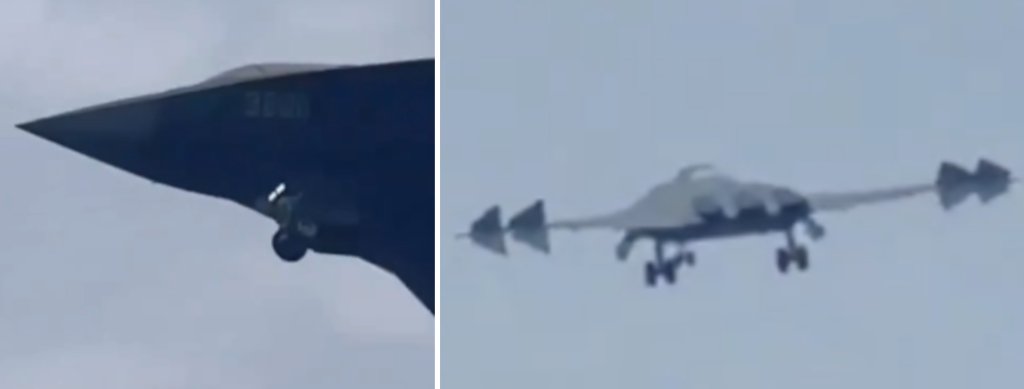
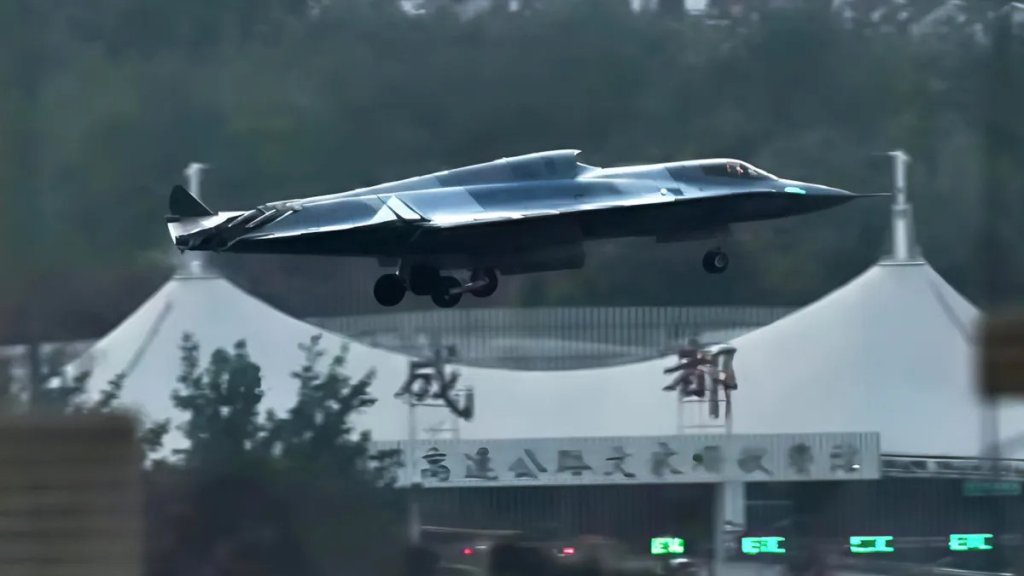
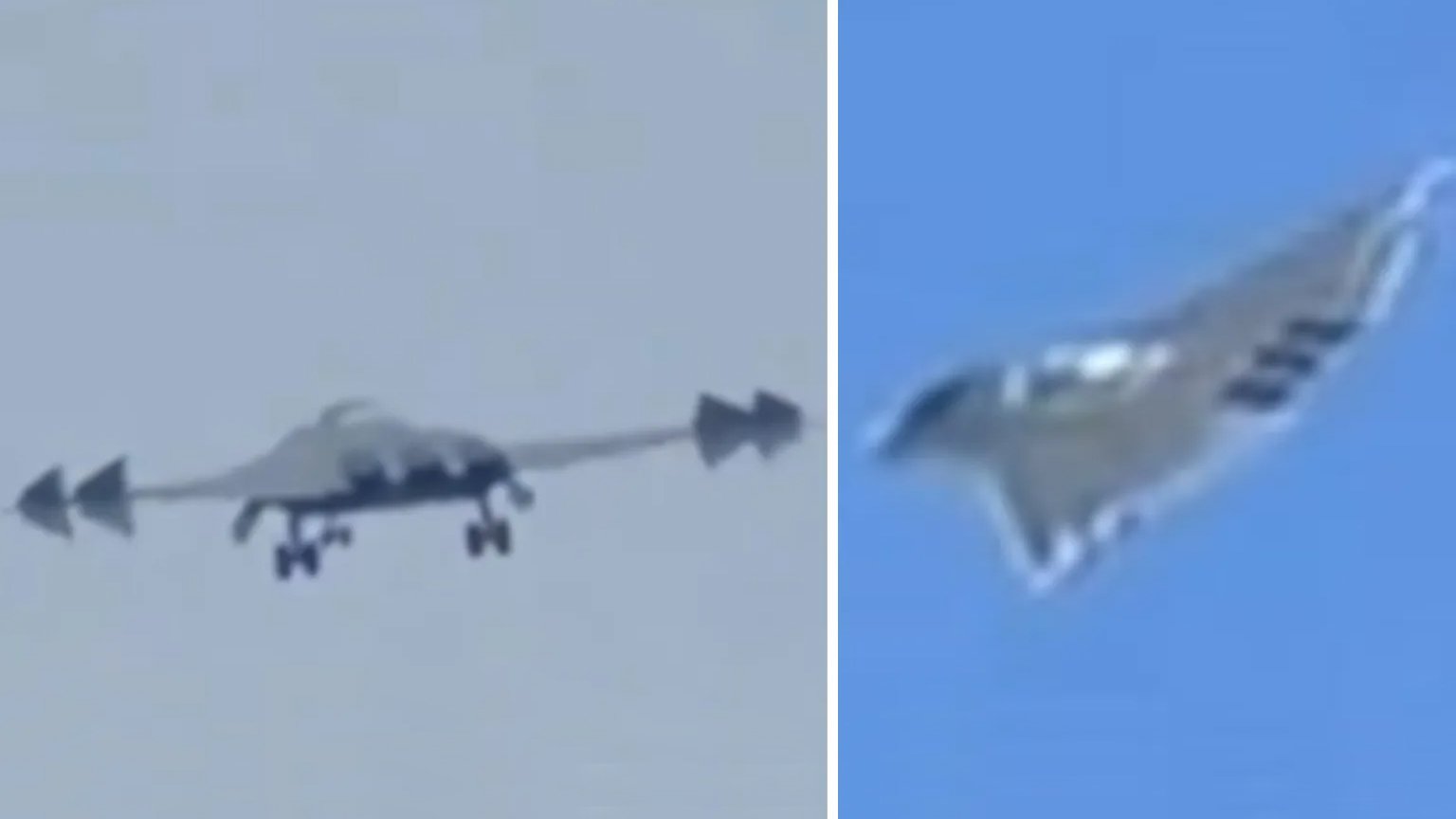
The most recent video of a J-36 test flight, seen in the social media post below, began circulating online yesterday. The footage shows the aircraft coming in to land, providing good general views of the uniquely three-engined jet with its two-seat, side-by-side cockpit configuration, especially from the rear aspect. What is seen underscores a previously observed total revision of the exhausts from a trough style to a two-dimensional thrust-vectoring configuration akin to what is found on the U.S. F-22 Raptor. This and other significant changes to the design, including the addition of divertless supersonic intakes (DSIs) all around, not just on top, first emerged last year. The clip also offers a good reminder of just how wide the aircraft is overall.
Obviously one of the best video recordings of the J-36 so far seen during landing approach … But can anyone read the number under the cockpit? https://t.co/cmQ0AkdsdO
As this particular J-36 passes by, it can be seen to have a lighter-colored radome, as well as at least one relatively large lighter-colored section on top of the dorsal air intake. A similarly colored radome was first spotted on what is said to be the fourth prototype back in July. This coloring could point to the installation of actual radar in the aircraft’s nose. In TWZ‘s first in-depth analysis of the J-36 back in 2024, we assessed that the jet’s very broad radome area could house an absolutely massive primary array.
The lighter section on top of the fuselage could be an aperture for a conformal antenna tied to a beyond-line-of-sight communications and data-sharing suite. In 2024, we posited that the heavyweight J-36 could serve as an intelligence-gathering and communications relay platform in addition to performing tasks more typically associated with tactical combat jets. Reliable and multi-faceted connectivity would be key for employing the J-36 as an airborne controller for advanced air combat drones, as well.
Captures from the video above highlighting the lighter-colored radome and section on top of the center of the fuselage. Chinese internet captures via X
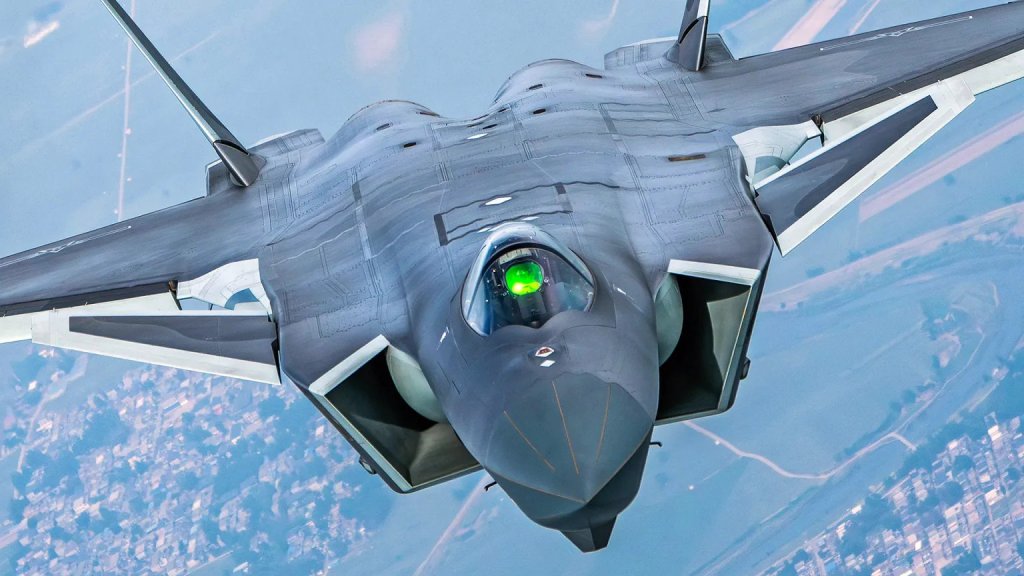
Another J-36 flight testing video that emerged on Monday, seen below, offers an additional view of the top of the jet, showing multiple lighter-colored sections that would appear to be additional conformal apertures for various antennas. There is a lighter-colored rectangular outline painted around part of the intake on top of the center of the fuselage, as well. The jet’s full paint scheme includes lighter-colored leading and trailing edges, which are critical structures on low-observable (stealthy) designs that often contain additional antenna arrays. Overall, the two-tone coloring is very much in line with what is seen on operational J-20 fighters in Chinese service today. The original J-36 prototype, at least, has notably worn a splinter-type camouflage paint scheme.
China's J-36 sixth-gen fighter asserting its dominance in the sky.
My prediction, the J-36 will gain initial operational capability before the American F-47 take its maiden flight. pic.twitter.com/SLmjqZ76Aw
A stock shot of a J-20 fighter with its two-tone scheme. PLAAFA view of the first J-36 prototype with its splinter-type camouflage scheme. Chinese internet via X
Whether or not the two recent video clips show the same J-36 prototype is unclear. The possibility has now been raised that Chengdu may be using a single serial number (36011) on at least some of the J-36 prototypes, a decision that could have been made for counter-intelligence and/or deliberate misinformation/disinformation purposes.
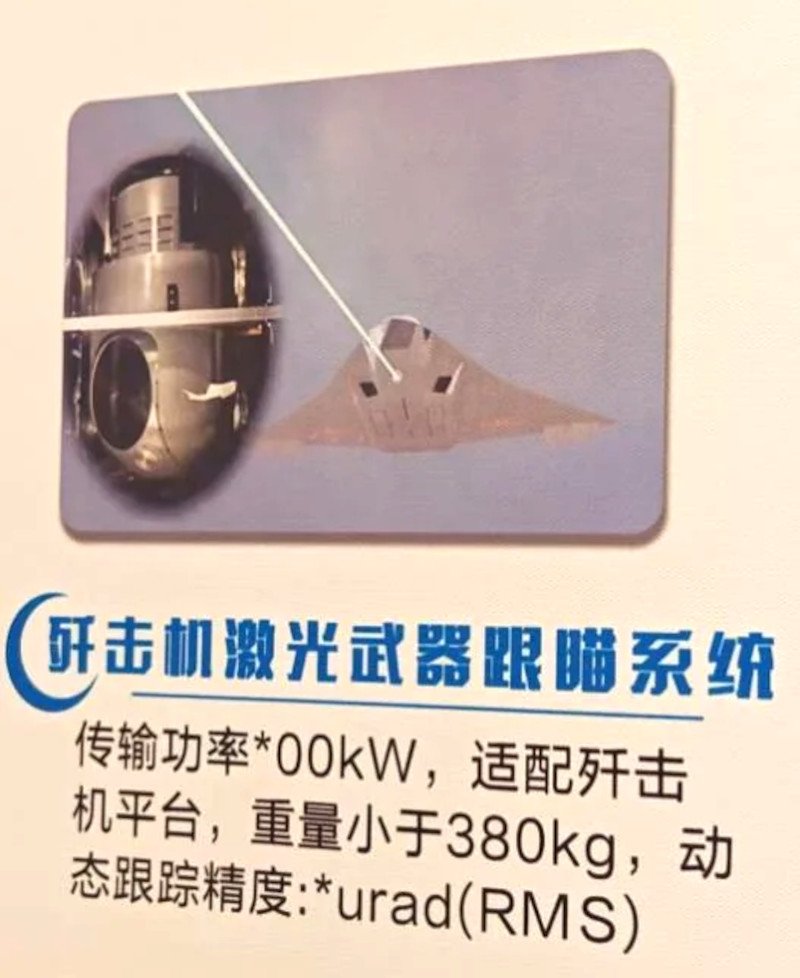
Much still remains unknown about the current or expected future capabilities of the J-36. Aviation Industry Corporation of China (AVIC) did have a placard at its booth at the 14th China International Defence Electronics Exhibition earlier this month that has prompted questions about whether the jet could be equipped with a laser directed-energy weapon. Chengdu falls under the umbrella of AVIC, which is a state-run enterprise. The Chinese-language placard in question describes a “laser weapon tracking system” with a power rating of “*00” kilowatts and a weight of “less than” 837.7 pounds (380 kilograms), per a machine translation. The way the power rating is written appears to mean that it is in the hundreds of kilowatts, which would put it firmly in a class capable of doing physical damage to objects, such as incoming missiles and drones.
Furthermore, an associated graphic shows a turreted system and a computer-generated rendering of a J-36 projecting a beam. The render appears to be from a video that depicts a J-36 using a laser to destroy other aircraft. Another computer-generated video that shows a J-36 using retractable lasers to shoot down incoming missiles has been circulating online since at least last year.
AVIC showed this at the 14th China International Defence Electronics Exhibition earlier this month. Chinese internet via X
It is not immediately clear how official either of the clips depicting laser-armed J-36s might be, or whether they at all reflect real planned capabilities. The full placard presented at the China International Defence Electronics Exhibition, as seen in the video below, shows a variety of different laser systems, and not just for aerial applications.
AVIC has confirmed that the J-36 fighter jet is equipped with a laser defense system. pic.twitter.com/4PrSqAfOQK
Despite important U.S. strides more recently when it comes to fielding ground-based and naval laser weapon systems, “there’s nothing that’s on the shelf right now that we are ready to put onto an airplane,” U.S. Air Force Brig. Gen. Douglas Wickert, the commander of the Air Force Research Laboratory (AFRL), told TWZ and other outlets just last week at a roundtable at the Air & Space Forces Association’s (AFA) 2026 Air, Space & Cyber Conference on Tuesday. “The solid-state lasers and the power density and the different ways that you actually – there’s actually a lot of secret sauce in that. How do you make the beam, and how do you form the beam, and how do you pulse the beam, and all that’s in development.”
‘There’s development of the laser itself, but now the power and thermal management system has progressed so much that we can provide the power needed,” Dr. Michael Gregg, head of AFRL’s Air Warfare Directorate, said at the same roundtable. “We’ve also had new designs and engines that we know have the power … to direct that power in certain areas. So, from a system perspective, it’s much more feasible because everything has matured over the last decade.”
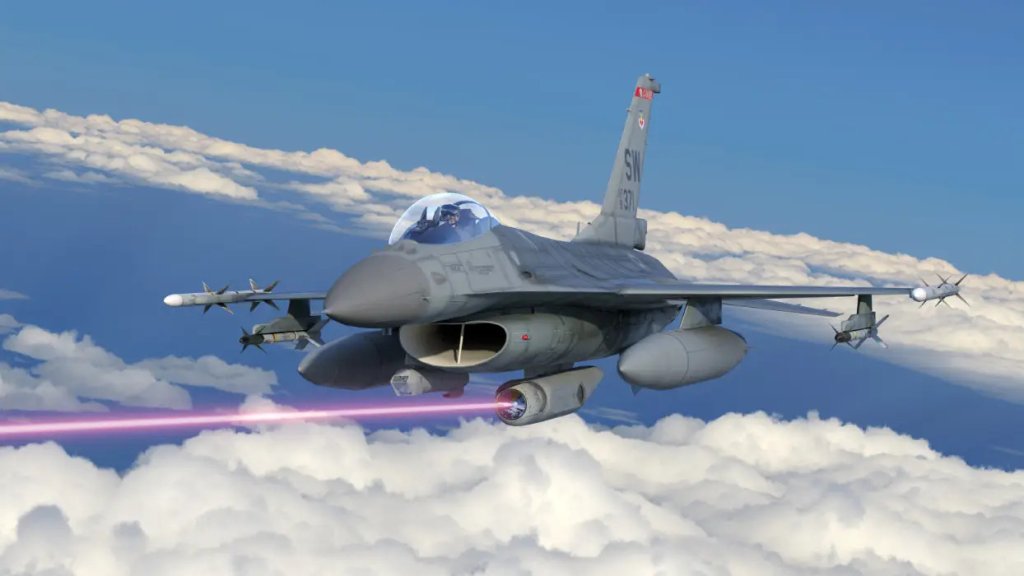
A rendering of a US Air Force F-16 fighter with a podded laser directed-energy weapon. Lockheed Martin A rendering of a US Air Force F-16C Viper fighter with a podded laser directed energy weapon. Lockheed Martin
China has certainly made substantial investments of its own in laser and other directed-energy weapon capabilities across domains in recent years, and this is clearly an area of interest for the People’s Liberation Army (PLA), in general. When it comes to the J-36 specifically, TWZ has explicitly highlighted in the past how the three-engine configuration could be particularly useful for producing sufficient power to support a host of advanced and electricity-hungry sensors and other capabilities, including directed energy weapons.
Larger questions remain about the exact set of roles the J-36 is expected to fill, as well. The basic design is certainly optimized for straight-line performance, combat radius, and payload rather than maneuverability and agility. The jet has already caused a significant amount of debate just when it comes to taxonomy, as it does not seem to fit inside traditional definitions of ‘fighters’ and ‘bombers,’ something we have explored in detail previously.
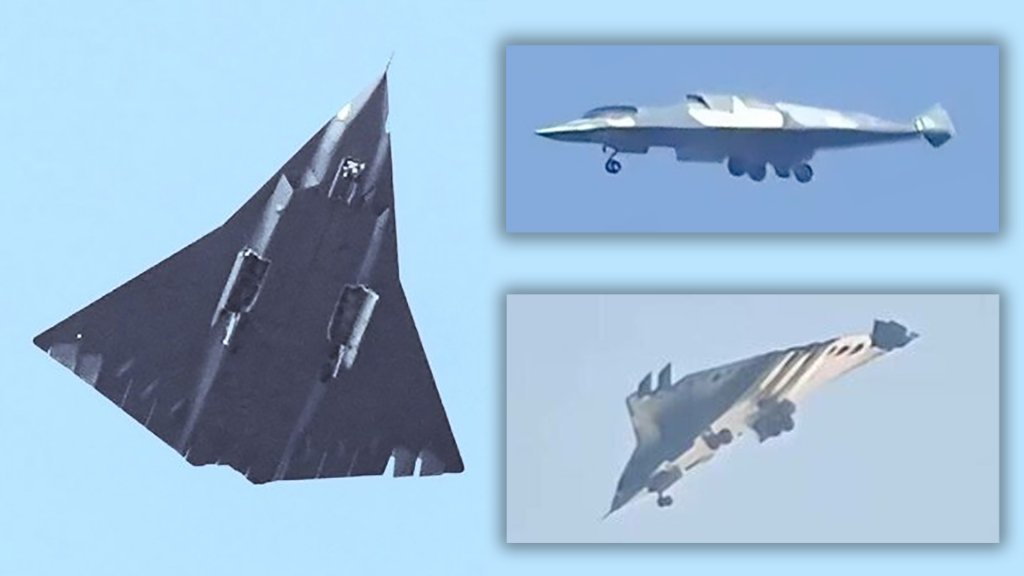
A composite of other views of the J-36 that have emerged since 2024. Chinese Internet via X
“According to Yang Wei – chief designer of the J-20 –, the new [J-36] fighter can penetrate heavily defended airspace that the J-20 and comparable F-22s or F-35s must avoid, placing it a generation ahead,” Andreas Rupprecht, an analyst specializing in Chinese military aviation and TWZ contributor, wrote in a post on LinkedIn last week. “With lower RCS [radar cross section], high speed, and the capacity to control more drones, it could act as a node and command center for systems including J-20s and, especially, unmanned aircraft, while attacking high-value targets from stand-off range with long-range weapons.”
“The type could therefore represent a new class of ‘fighter,'” he added. “Online terms include ‘theater-level deep-penetration command combat aircraft’ and ‘high-performance fighter,’ analogous to a cruiser ranking above a destroyer within the Navy. Recent evidence gives this theory new weight and warrants continued monitoring.”
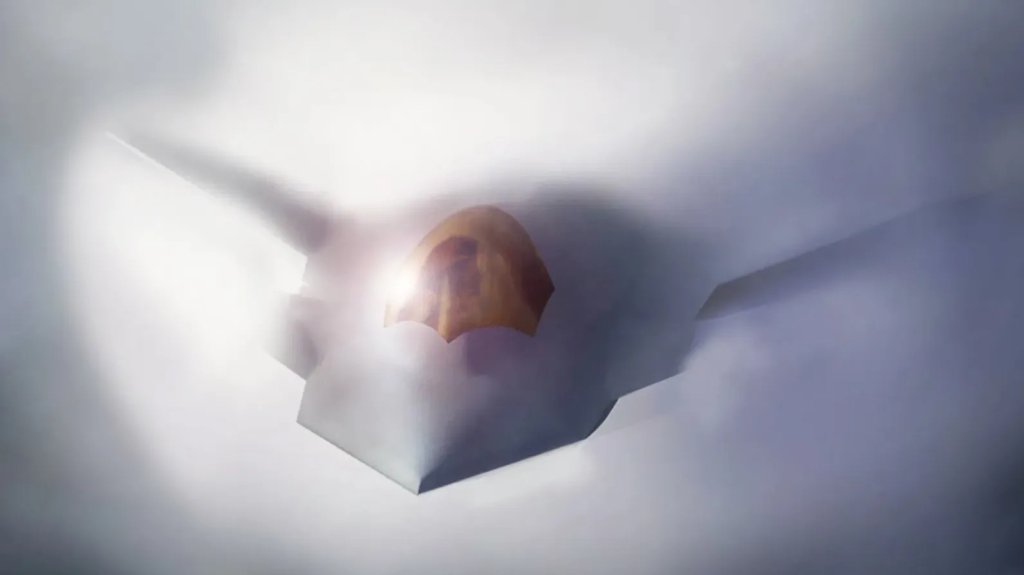
A rendering the US Air Force has released of the F-47. USAF
As an aside, based on what has emerged publicly to date, there are signs that the F-47 may reflect a distinctly different design philosophy that puts greater emphasis on maneuverability compared to the J-36, and even likely the J-XDS. As mentioned, the J-36 certainly seems much more focused on payload, range, and level flight performance. In July, TWZ published a deep dive exploring why the U.S. Air Force would pursue a sixth-generation fighter with rear-swept wings, canards, and other features despite steady trends in the opposite direction visible in Chinese designs and ones elsewhere globally.
Regardless, U.S. officials have downplayed questions about China’s gaining ground in the air combat arena, or even surging into the lead in certain areas, in the past. “Chinese sixth-generation aircraft are in the nascent stages of development and expected to be operational by 2035,” the Pentagon wrote in its most recent annual report on military and security developments in China, which was published in December 2025.
In the meantime, the J-36’s design is already steadily being refined, and the total fleet of prototypes has been growing, offering new insights into the aircraft’s expected capabilities and roles.
Às 10h50 de 23 de julho de 2026, o diretor-geral da Polícia Federal (PF), Andrei Rodrigues, enviou um ofício sigiloso ao advogado-geral da União, Jorge Messias. No documento, obtido com exclusividade pela Agência Pública, pedia-se que a Advocacia-Geral da União (AGU) analisasse e tomasse “as eventuais providências cabíveis” contra uma decisão do ministro André Mendonça, então relator do caso Master no Supremo Tribunal Federal (STF). A resposta, registrada em nota jurídica também sigilosa, foi negativa: segundo a AGU, não havia nenhuma medida judicial possível.
O pedido precedeu a fase mais aguda da crise que, em setembro, pôs ministros do Supremo em confronto e levou ao afastamento de Andrei do cargo, em decisão de André Mendonça — posteriormente revertida por Flávio Dino e mantida por Edson Fachin. Segundo integrantes do alto escalão do governo, ouvidos sob reserva pela reportagem, a negativa da AGU ao ofício teria tido o aval também da cúpula jurídica do governo e foi emitida antes da divulgação das mensagens atribuídas ao ex-banqueiro Daniel Vorcaro e ao ministro Alexandre de Moraes, que se tornaram públicas em 8 de setembro, quando Mendonça retirou o sigilo de parte das investigações do Banco Master.
Fontes do alto escalão disseram à Pública que a cúpula da AGU teria se sentido pressionada por Rodrigues com o envio do ofício e que a história teria chegado até a presidência da República. Uma reportagem da Folha de S. Paulo, publicada em 2 de setembro, relatou que a PF via uma “omissão” da AGU em relação à crise envolvendo o ministro André Mendonça.
A Pública apurou que o Advogado-geral da União, Jorge Messias, e o ministro da Justiça e Segurança Pública, Wellington César Lima e Silva, se encontraram com André Mendonça, fora da agenda, após tomarem conhecimento do pedido da PF. No encontro entre os três, os representantes do governo buscaram uma “interlocução” para resolver o embate, mas a exposição das conversas direcionadas a Moraes, que vieram depois do encontro, afastou os governistas do caso para evitar uma associação pública do governo à crise no Supremo.
Messias, da AGU, recebeu o pedido sigiloso da PF para analisar decisão de André Mendonça
Nesta quarta-feira, 23 de setembro, reportagem de Marcela Mattos no UOL informa que Messias e Andrei trocaram xingamentos diante de Lula: ‘Está me espionando?’. Segundo o UOL, pessoas que ouviram relatos do episódio disseram que a conversa, acompanhada a todo momento por Lula, foi “dura”, “tensa” e “ríspida”. A cobrança foi considerada a gota d’água de uma série de divergências que vinham se arrastando nos bastidores das investigações sobre o Banco Master.
Procurada, a AGU informou a Pública que “as informações apresentadas na matéria do UOL não são precisas. Divergências são naturais, evidentemente, mas nada se sobrepõe ao respeito e à consideração que o advogado-geral da União, Jorge Messias, tem pelo diretor-geral da Polícia Federal, Andrei Rodrigues, tanto no âmbito pessoal quanto institucional”
Procurada, a Polícia Federal não deu retorno até a publicação. O espaço segue aberto para manifestação.
Uma disputa que começou em fevereiro
André Mendonça herdou o caso Master de Dias Toffoli em fevereiro deste ano. Nas primeiras decisões como relator, em 19 de fevereiro, o ministro determinou que apenas os policiais diretamente envolvidos na investigação tivessem acesso às informações, com sigilo “inclusive em relação aos superiores hierárquicos”, o que incluiria Andrei Rodrigues. Seria um movimento para limitar a influência do diretor-geral na apuração, vista com desconfiança pela ala de André Mendonça. Nos bastidores, teria pesado a percepção de Mendonça de que informações sensíveis chegavam antes ao comando da PF, o que passou a causar “um certo desconforto”, segundo uma fonte do STF, até mesmo entre os juízes lotados no gabinete do ministro.
Andrei Rodrigues, diretor-geral da PF, enviou ofício à AGU em 23 de julho de 2026
Em 22 de maio, na investigação sobre fraudes no INSS (Operação Sem Desconto), da qual Mendonça também era o relator, o ministro teria reagido a uma mudança na chefia do caso e exigido ser avisado de qualquer nova alteração na equipe. Em 15 de maio, na semana anterior à exigência de Mendonça, o comando da PF trocou a área responsável pelos inquéritos do INSS: o caso foi transferido da Divisão de Repressão a Crimes Previdenciários (DPrev) para a Coordenação de Inquéritos em Tribunais Superiores (Cinq). Simultaneamente, o delegado que chefiava a operação, Guilherme da Silva, solicitou transferência para Minas Gerais, estado natal dele. À época, a PF não revelou o nome do novo chefe da operação e justificou que a mudança assegurava “maior eficiência e continuidade das investigações”.
Em 13 de julho, Mendonça repetiu a ordem no caso Master (Operação Compliance Zero): a equipe de investigadores deveria ser mantida e qualquer troca deveria ser comunicada a ele previamente; as informações também deveriam ficar restritas às coordenações responsáveis, e o material bruto extraído de celulares e computadores apreendidos deveria ser enviado ao seu gabinete.
Mendonça impôs restrições ao acesso às informações da investigação do Master
Dez dias depois, em 23 de julho, Andrei oficiou à AGU com direcionamento a Jorge Messias, conforme o documento obtido pela Pública. O documento da PF registra que não há “qualquer indício de irregularidade” nas investigações e classifica como “desarrazoada” uma decisão que limitasse as atribuições administrativas da PF. O documento registra, ainda, que o controle externo da polícia cabe ao Ministério Público Federal. No pedido, foi citada a decisão de Mendonça de maio como “de conteúdo semelhante”, na qual se fundamentou na lei que permite à AGU defender, na Justiça, agentes públicos por atos praticados no exercício do cargo.
A análise sigilosa da AGU
O ofício foi enviado à Secretaria-Geral de Contencioso, braço da AGU que representa a União no STF. Em 24 de julho, uma reunião no gabinete do advogado-geral substituto apontou os primeiros problemas do pedido: a repercussão na imprensa sobre o incômodo da PF, no dia anterior, tratava da decisão de maio, não da de julho; faltavam documentos; e a AGU nem sequer tinha acesso aos processos em sigilo, apenas às cópias das decisões.
A nota registra ainda que, segundo a própria PF, informou à AGU em 27 de julho que o material bruto relacionado a Vorcaro já havia sido entregue ao gabinete do relator na semana anterior.
A Nota Jurídica enumera os motivos da recusa ao pedido da PF. Primeiro, diz que não se tratava de defender um agente público. Segundo, registrou que a AGU não atua em investigação criminal, tarefa do Ministério Público. Terceiro, avaliou que a PF não demonstrou “prejuízo concreto” decorrente da exigência de avisar sobre trocas na equipe. E, quarto, a PF perdeu o prazo: as regras já estavam na decisão de maio, e a de sigilo interno vinha desde o início do caso, sem que a PF recorresse. A nota menciona “inércia prolongada da autoridade policial” e afirma que uma nova decisão não reabriria o prazo já vencido. Por fim, como o material já havia sido entregue, não haveria o que suspender.
Na resposta à PF, a AGU sugeriu dois caminhos: conversar diretamente com o relator ou levar o caso ao Ministério Público Federal. As páginas obtidas pela reportagem não mostram a data de assinatura da nota.
Sede da Advocacia-Geral da União, que analisou e recusou o pedido feito pela Polícia Federal
Afastamento e volta em 24 horas
Segundo a Folha de S.Paulo, Mendonça teria dito ao presidente do STF, Edson Fachin, no início de agosto, que suspeitava de viés político de Andrei Rodrigues para blindar a campanha de Lula; Andrei teria relatado a Fachin a suspeita inversa, de que o ministro prejudicava a esquerda e aliviava aliados de Flávio Bolsonaro (PL).
No início de setembro, Mendonça levantou o sigilo do relatório que continha mensagens enviadas por Vorcaro a um interlocutor identificado como “Alexandre de Moraes Brasília”. A maior parte das mensagens foi enviada em visualização única e aponta para a troca de informações sobre uma possível operação contra o ex-banqueiro. Em 15 de novembro, dois dias antes de ser preso, Vorcaro perguntou a Moraes: “Acha que na segunda já tenho que estar fora?”.
Os investigadores também encontraram registros digitais e metadados que indicam que Moraes atuou na edição de um contrato de R$ 130 milhões firmado entre Vorcaro e o escritório de advocacia da esposa do ministro, Viviane Barci de Moraes. Após a revelação do acordo, o escritório Barci de Moraes divulgou uma nota negando a existência de impedimentos legais à contratação.
A partir de então, a crise no STF escalou, como a Pública mostrou ao longo de sua cobertura do caso. A sessão do STF para julgamento das suspeitas contra Alexandre de Moraes foi iniciada em 15 de setembro e marcada por bate-bocas e trocas de acusações entre os magistrados. A deliberação foi adiada após o ministro Flávio Dino pedir vistas do processo. Ou seja, mais tempo para analisar o caso, que segue sem definição.
Prosecutors doubted Akers’ story, using her online searches for abortion services and lack of prenatal care as evidence of ill intent. But it was a “forensic method” devised in the 17th century that proved key to Akers’ conviction.
The method, known as a “float test,” was designed to determine if a baby was stillborn or born alive by placing the lungs of a deceased fetus in water. If the lungs float, then they are aerated, meaning the baby was breathing and alive prior to their death.
In 2018, former Maryland chief medical examiner Dr. David Fowler signed the autopsy report that, using the float test as proof, determined that Akers’ baby died after Akers asphyxiated it. Fowler also testified in Akers’ trial. Prosecutors used Fowler’s testimony and autopsy report as evidence to convict Akers of second-degree murder in 2022.
In the course of our reporting on Akers’ case, we not only reviewed court transcripts and the testimony of physicians and medical experts; we also pressed Fowler’s former office for comment about whether or not the float test was still used in fetal death investigations. Just prior to publication, Maryland Department of Health spokesman David McCallister disavowed the test.
“The lung float test is not part of OCME’s current routine practice, which reflects evolving scientific evidence, National Association of Medical Examiner (NAME) guidance, and the independent medical judgment of our forensic pathologists,” McCallister wrote in an email.
“When performed historically, the test was only one component of the overall forensic assessment and was interpreted together with the investigative and autopsy findings. How an individual autopsy finding is characterized or used in criminal prosecution is separate from OCME’s medical determination of cause and manner of death.”
McCallister’s disavowal of the float test marks a stunning departure from past practices for determining causes of death in Maryland. Whether the change will affect Akers’ case remains to be seen.
But what hasn’t changed is the fact that Akers was convicted, has served three years in prison, and is facing another prosecution—all while advocates and her lawyers are still fighting against a bureaucracy wedded to Fowler’s past practices.
Akers’ fate remains in legal limbo, but her story reveals how flawed science can have real-life consequences, and how an indifferent bureaucracy can defend the mistakes of the past despite public outcry and scientific pushback in the present.
A Stillbirth or Murder?
Akers’ ordeal began in November of 2018.
According to a statement she gave to police, Akers was watching TV with her daughter when she noticed she was bleeding. The Howard County resident retreated to her upstairs bedroom. There, she gave birth to what she described as a baby that was not breathing, or stillborn.
The mother of two young children told police her husband did not want another child. Finances were tight, and the couple was already struggling to care for both a toddler and an 8-year-old.
“I almost didn’t want to admit to myself that it was [a pregnancy],” she told police.
She hid the possible pregnancy from her family and did not seek prenatal care. “I just didn’t want my family [to know],” Akers said, “a stigma of them knowing that we had even contemplated the abortion part, but knowing that they wouldn’t be happy if we gave up the baby officially for adoption… that’s why I looked into the safe haven stuff.”
The birth itself was a moment of confusion and panic for Akers. When she started bleeding profusely, she thought it was possible the unexpected pregnancy could be the cause. After giving birth in her bathroom, she placed the baby’s remains in a plastic bag and put the bag in a closet.
Her husband, who had found her bleeding, called an ambulance. According to her lawyer, Akers refrained from discussing the ordeal in front of her two children when EMTs arrived at the house. But when she arrived at the hospital, she told doctors about the stillbirth.
When Akers awoke from surgery, heavily sedated with painkillers and anesthesia, she found Howard County police detectives probing her with questions, which a recording reveals she struggled to answer through the haze of drugs.
Even though the doctors told detectives not to question Akers after her surgery, they did anyway. And prosecutors were able to include statements Akers made during that interview while still heavily sedated and under the influence of multiple drugs, including fentanyl.
“The hospital physicians attending told the police who had arrived at the scene not to speak to her for at least two hours after surgery because she was put under general anesthesia,” Akers’ lawyer, Debra Saltz, told us in an interview.
“So the police, rather than wait two hours, interviewed her. I think it was approximately an hour and 20 minutes later, they began an interview.”
Saltz challenged the admissibility of the interview in court. But presiding Judge McCrone ruled that Akers “sounded okay” after reviewing a recording of the interview.
During Saltz’s cross-examination of lead medical examiner Dr. Nikki Mourtzinos, Mourtzinos made a critical admission: float tests are not performed in a uniform fashion, and the test does not call for a consistent, controlled (i.e. scientific) methodology. “Multiple people do things differently. Some people tie off the lungs, some people would clamp off the lungs and float them in water,” Mourtzinos testified.
Saltz filed motions to toss out the float test results as evidence. But Judge McCrone ruled it admissible, too.
And more unresolved questions about the efficacy of the police and OCME investigations before Akers’ trial remain.
Even though the official OCME autopsy report was not released until four months later, detectives claim Maryland’s Office of the Chief Medical Examiner (OCME) told them Akers’ baby’s death was likely a homicide.
But Saltz says OCME and Howard County detectives had already made up their minds about Akers before their investigation into her ordeal even began in earnest. “It was never going to be about science in this case. It was going to be about a determined outcome, which was going to be homicide, even though it should not have been,” Saltz told us.
Along with the float test results and her post-surgery interview with detectives, prosecutors focused on both Akers’ prior internet searches for abortion providers, as well as her lack of prenatal care, as evidence that she intended to kill her baby.
Again, Akers’ defense argued this evidence was inadmissible due to a state law that prevents drawing criminal inferences from a woman’s behavior during pregnancy. Again, Saltz was overruled. Judge McCrone allowed prosecutors to use Akers’ actions as evidence of later criminal intent.
The chief OCME pathologist who conducted the float test testified in Akers’ trial that the final mechanism of injury was asphyxiation and exposure. However, the autopsy did not find petechial hemorrhaging in the eyes or any trauma around the neck indicating strangulation. The medical examiner argued that the determination of asphyxiation was due to observed inflammation in the pancreas, a less common indicator of strangulation.
But there was also substantive evidence that the baby was stillborn.
The defense offered expert testimony that argued the detection of multiple infections in Akers’ placenta and umbilical cord was indicative of a stillbirth.
“One of the more perplexing aspects regarding the opinions of Drs. Simon and Mourtzinos [the state medical examiners who conducted the autopsy] is that they describe gross and microscopic evidence of chorioamnionitis (inflammation of the placenta and its membranes), and funisitis (an inflammation of the umbilical cord), along with inflammation of the umbilical cord’s arteries and vein,” Gregory J. Davis, a forensic pathologist and professor at the University of Kentucky, wrote in a letter to the court.
The jury convicted Akers of second-degree murder. Judge McCrone sentenced her to 30 years.
New Obstacles for Prosecutors, but the Float Test Remains
We hold that the internet searches are irrelevant and that the trial court erred as a matter of law in admitting them. We similarly hold that Ms. Akers’ bare decision to forgo 2 prenatal care was not probative of motive or an intent to kill or harm a live child… In light of our holding on the inadmissibility of the abortion searches, we reverse the judgment of the Appellate Court and remand this case to the circuit court for a new trial.
To win a conviction against Akers during the retrial of the case, prosecutors have to navigate a major evidentiary obstacle now that the Maryland Supreme Court has essentially barred them from using much of the “evidence” used to convict Akers in 2022.
But the float test will still be admissible, and Saltz says prosecutors are likely to use it. Even though Fowler’s former office has publicly repudiated the test, the shadow and influence of Fowler himself still looms large.
“Dr. Fowler had a very large impact on this case and the judge heavily credited his testimony and relied on his testimony to allow in evidence the fetal lung float test,” Saltz told us.
Saltz says the admission by Fowler’s former office that the float test is scientifically unreliable should give prosecutors pause. “I find it hard to believe that the state’s attorney’s office in Howard County would still consider using this outdated test,” she wrote in an email.
“I have always believed that they were motivated by emotion rather than science as they undertook to prosecute my client. I would hope they would dismiss the charges based on this newest information.”
For now, prosecutors are not talking. A spokesman for the Howard County State’s Attorney’s Office said they do not comment on pending cases.
“It is the policy of the Howard County State’s Attorney’s Office not to comment to the media on the facts, evidence, or litigation strategy of a pending case until the matter has concluded,” Yolanda Vazquez wrote in an email.
Akers’ fate will be decided soon; the case is set for trial in November. Saltz says she is prepared to defend Akers, float test or not.
“My client is a very, very strong person. And she always held out hope that this would go her way… she knew that she had a stillborn baby,” Saltz said. “And there are plenty of people—including myself and the actual scientists who can read scientific evidence—who believe her.”
A British Excalibur uncrewed underwater vehicle (UUV) has fired a U.S. Mk 48 heavyweight torpedo in what is said to be a first-of-its-kind test for both countries. Though just a proof-of-concept so far, this is a significant new step for the United States and the United Kingdom toward future operational fleets of armed UUVs.
U.S. NAVY UPDATE: U.S. Navy and Royal Navy Successfully Test Fire Torpedo from Unmanned Undersea Vehicle
WASHINGTON – On September 13, 2026, the U.S. Navy and the Royal Navy successfully conducted the proof-of-concept launch of an exercise U.S. Mk 48 Heavyweight Torpedo… pic.twitter.com/lVB4wYSwC0
— Office of the Chief of Naval Operations (@USNavyCNO) September 22, 2026
The test was also carried out under the umbrella of Pillar 2 of the trilateral Australia-United Kingdom-United States (AUKUS) defense cooperation agreement, which was first announced in 2021. AUKUS’ Pillar 2 covers a wide range of advanced technology cooperation, with particular focus on uncrewed platforms and autonomy. Pillar 1 of the agreement centers on support for Australia’s establishment of a nuclear submarine force.
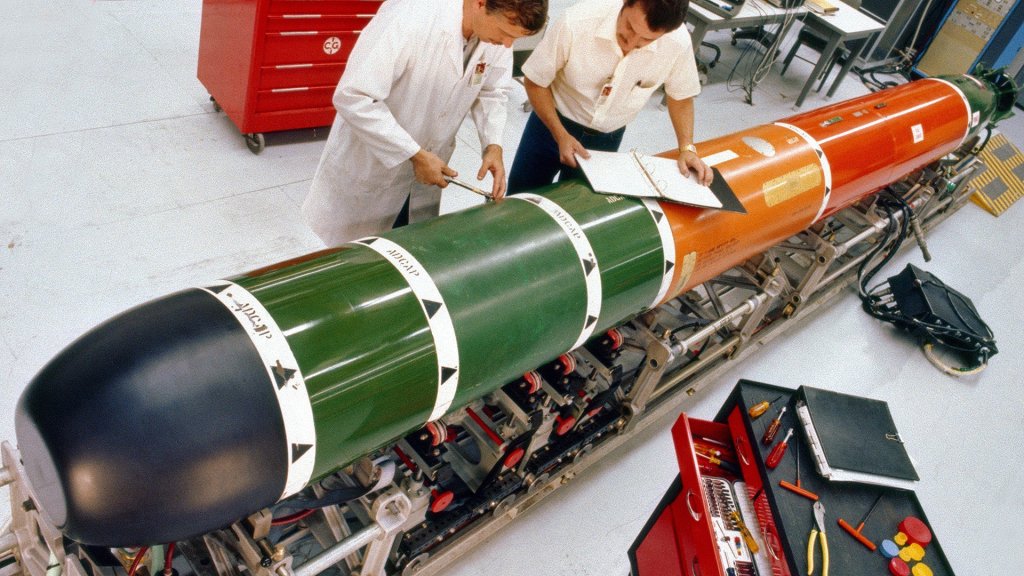
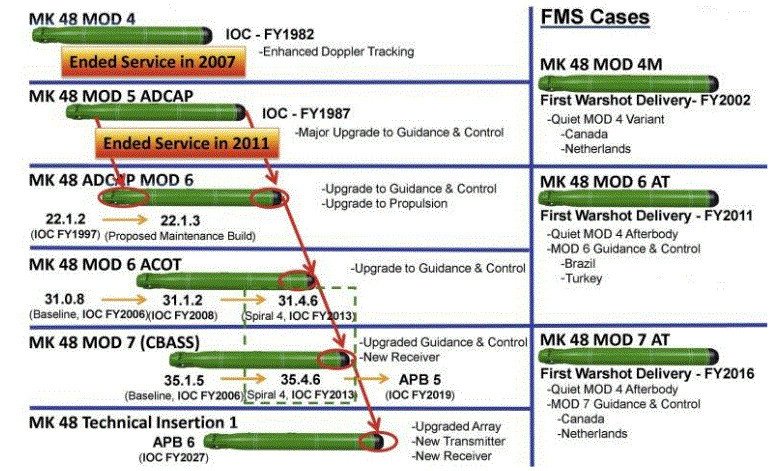
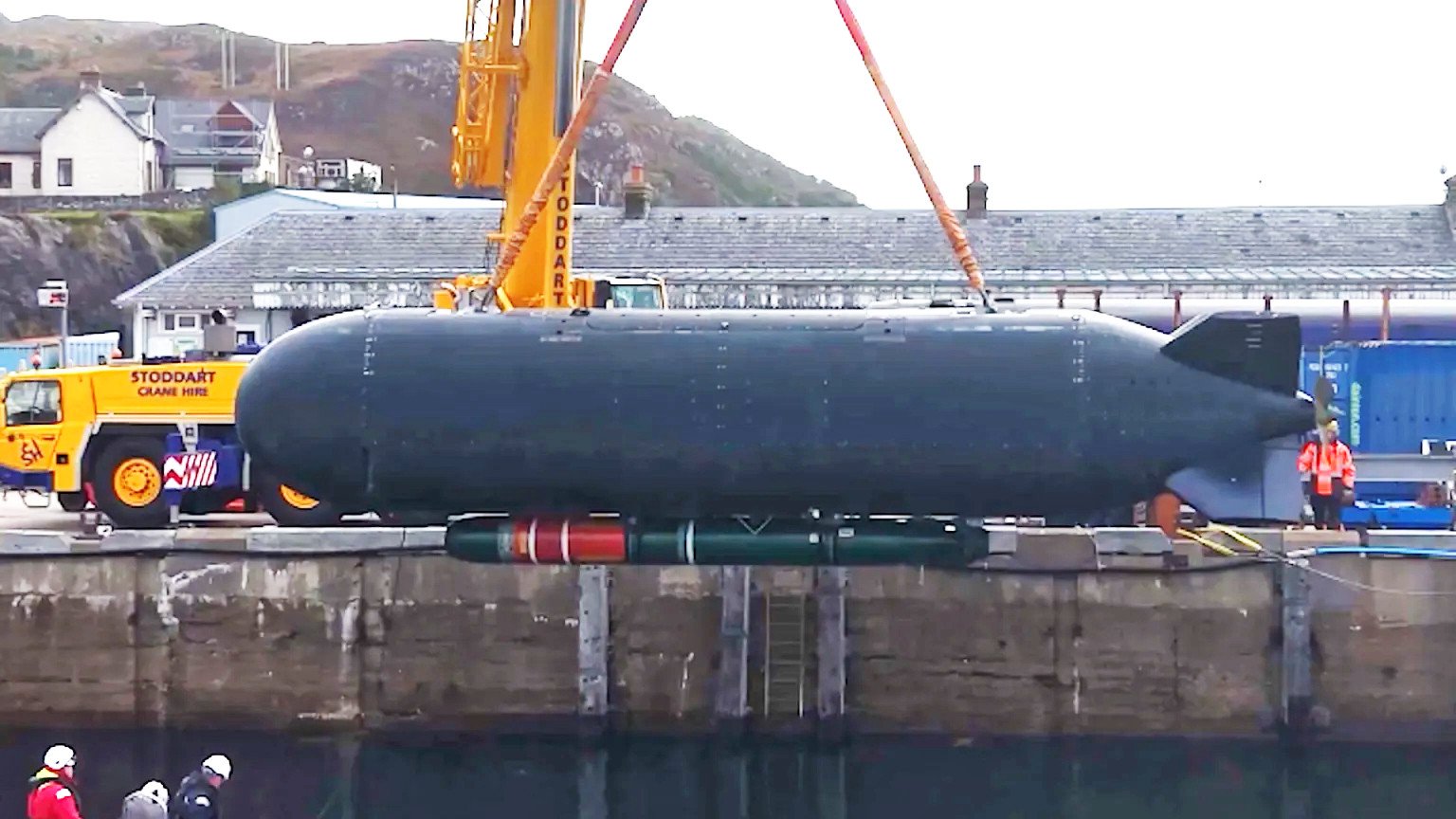
For the September 13 test, the Mk 48 torpedo was slung under the Excalibur UUV. The nearly 40-foot (12-meter) long, 19-metric-ton submersible drone has a large internal payload bay, but it is reportedly not large enough to accommodate the Mk 48, which is the standard heavyweight torpedo in U.S. Navy service today. The 19-foot-long, 21-inch-diameter weapon has been successively upgraded over the years to expand its capabilities and improve its resistance to enemy countermeasures.
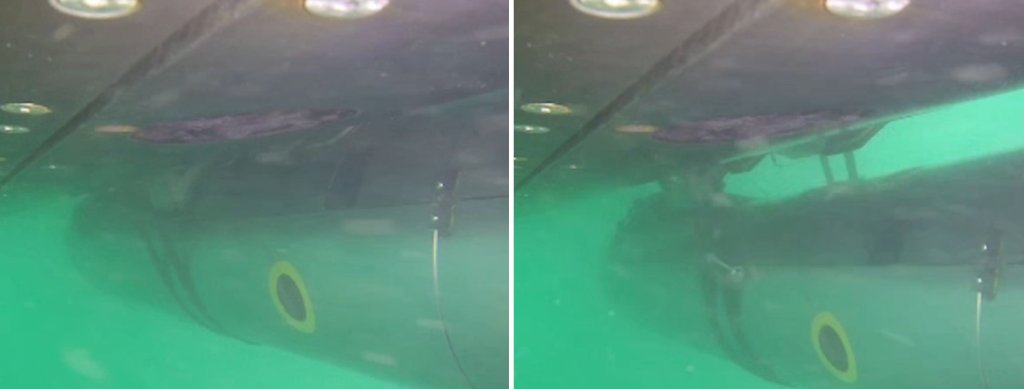
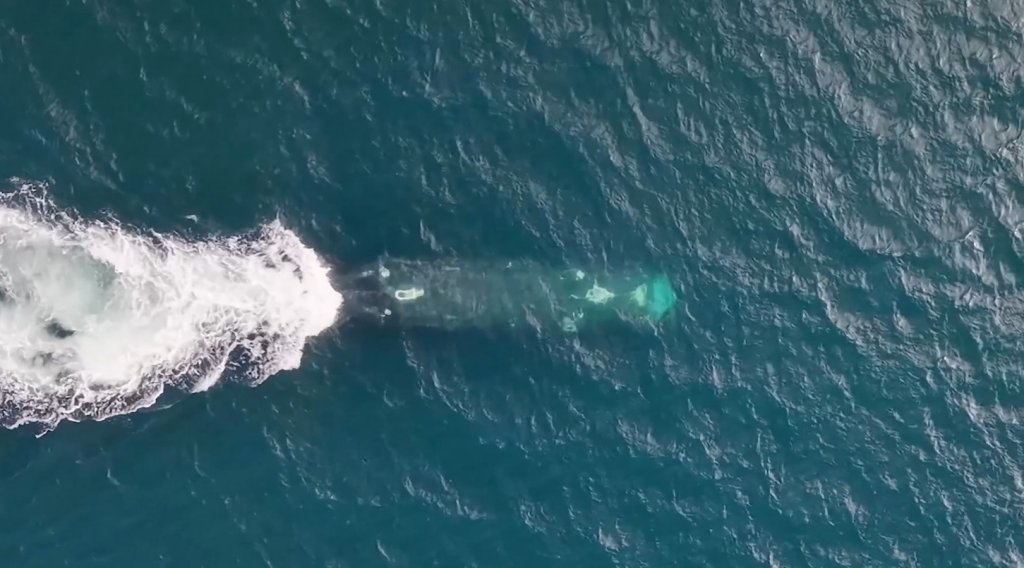
Screen captures from a video the US Navy released today showing the release of the Mk 48 torpedo from the Excalibur UUV during the test earlier this month. USN capturesA stock picture of a Mk 48-series torpedo. DODA US Navy infographic detailing just some of the upgrades to the Mk 48 series over the decades. The Navy has now moved on to the further improved Mk 48 Mod 8 variant. USN
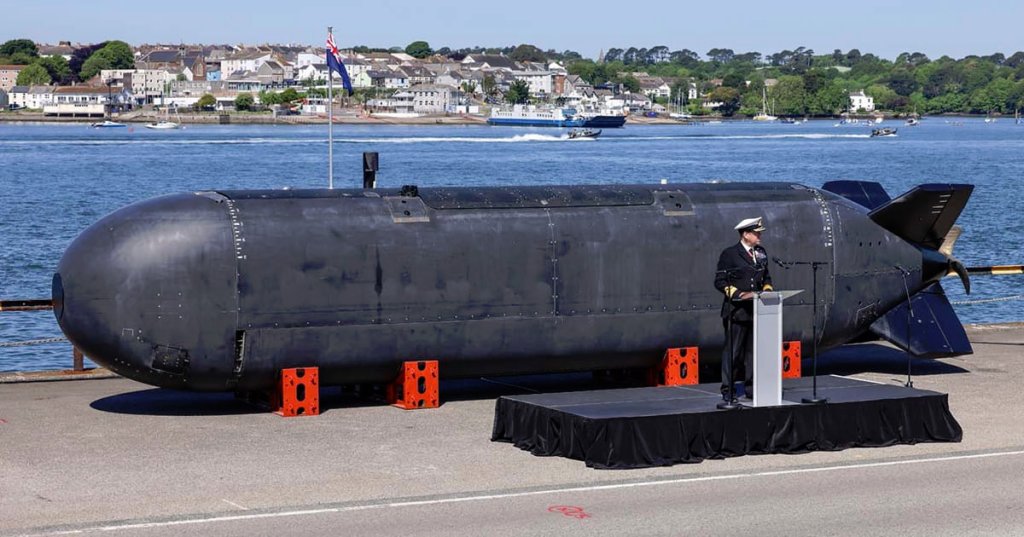
The Royal Navy officially unveiled Excalibur, which was developed by U.K.-based MSubs under Project Cetus, last year. The external torpedo launch capability was the result of two additional efforts, called Project Broadsword and Trial Iron, according to the U.S. Navy release.
A picture of an Excalibur UUV at the time of its unveiling in 2025, giving a good general sense of its size. Royal Navy
The September 13 test “successfully validated the mechanical, electrical, and software integration of a U.S. kinetic payload onto an allied autonomous vessel, proving that allied forces can rapidly achieve weapon interchangeability,” the Navy’s release adds. “Approved in February 2026 by the Department of the Navy Rapid Capabilities Office (DONRCO), the project was executed in less than seven months.”
How the Excalibur UUV was controlled during the test and whether the torpedo was launched at a test target of some kind are unknown. TWZ has reached out for more information.
A look at the Excalibur UUV submerged, from the video the US Navy released today. USN capture
“BROADSWORD is a great example of how AUKUS Pillar II drives interoperability in across the alliance. Demonstrating the launch of a US torpedo from a UK extra-large unmanned underwater vehicle (XLUUV) is an important early step in developing lethality in our undersea autonomous systems,” U.S. Navy Vice Adm. Robert Gaucher, Director of Submarine Programs, did say in a statement. “We look forward to continuing to leverage the AUKUS partnership to keep pushing the potential warfighting advantages of unmanned undersea systems.”
“This successful test marks a historic first for allied undersea warfare,” U.S. Navy Adm. Daryl Caudle, Chief of Naval Operations, also said in a statement. “Proving that we can seamlessly launch a U.S. heavyweight torpedo from a Royal Navy autonomous underwater vehicle validates our shared vision for true interchangeability.
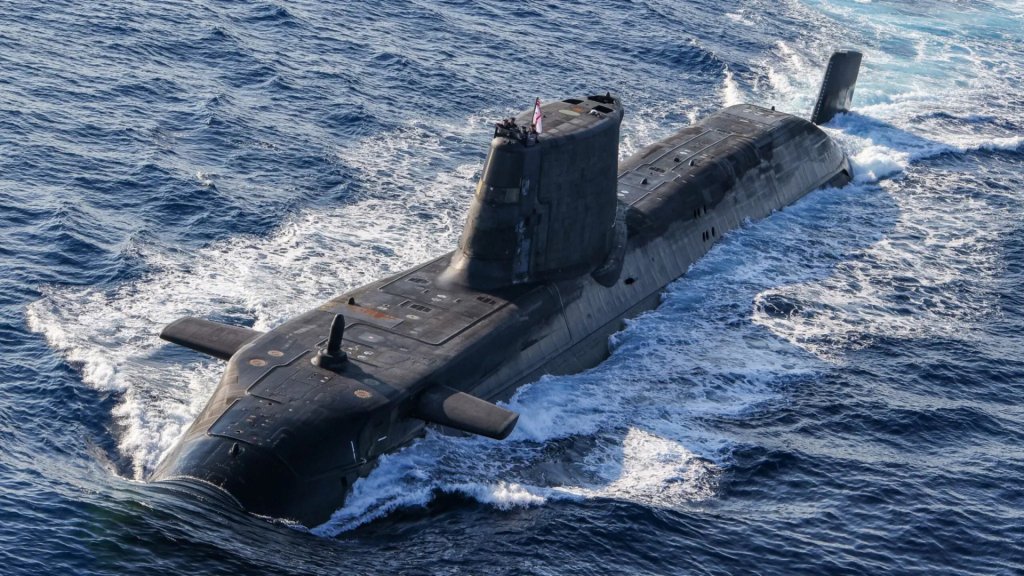
“This is a really important moment in our journey towards building a hybrid navy, which is where the Royal Navy will sail with crewed ships and submarines alongside uncrewed and autonomous vessels,” Luke Pollard, U.K. Minister of State for Defence Readiness and Industry, separately said in an interview with LBC radio. “It is a substantial increase in our lethality, to show that torpedoes can be fired not just by the Astute class hunter-killer submarines that we have in the Royal Navy, but also now by our uncrewed systems.”
A Royal Navy Astute class nuclear-powered attack submarine. UK Ministry of Defense
The U.S. Navy and the Royal Navy employ various tiers of UUVs operationally today, but primarily for mine-sweeping and reconnaissance and surveillance missions. Future fleets of submersible drones capable of carrying out attacks on other vessels will create entirely new operational possibilities. Operated closely together with crewed surface warships and submarines, torpedo-toting UUVs could be sent ahead into riskier environments and offer an immediate option for engaging any threats they might find. Even a bigger UUV like Excalibur would also be more challenging for opponents to spot and track than a traditional attack submarine.
Excalibur is also in a category of larger and more capable submersible drones that offer significant endurance and higher degrees of autonomy. Adding in the ability to launch torpedoes, in turn, then opens the door to new concepts for employing these UUVs in groups more independently of crewed companions. In the future, for instance, armed Excaliburs or similar UUVs might be deployed to a particular maritime choke point to not just monitor for enemy movements, but actively hold them at risk.
In addition, in general, UUVs offer a way to expand total undersea warfare capacity in a more cost-effective manner compared to acquiring and fielding more traditional submarines. The ability to have more presence below the waves at a lower price point also translates to more persistence across large areas, something that could be especially valuable across the broad expanses of the Pacific, as well as other bodies of water globally. This presents additional targeting challenges and uncertainty for opponents.
“In securing the North Atlantic, especially against those nations that wish to do us harm, like Russia, the ability for us to now say it’s not just where our submarines are that you need to worry about – it is about how we create greater deterrence and question marks in the eyes of our adversary, with uncrewed systems there as well,” U.K. Minister Pollard said in speaking with LBC.
Pollard’s remarks here speak to particular considerations the British government is faced with just in its backyard. This includes the so-called Greenland-Iceland-United Kingdom (GIUK) Gap, which is the main path through which Russian Navy submarines transit to and from bases in the northwestern end of that country and the Atlantic proper. There is also the English Channel and the nearby Baltic Sea. The Royal Navy has limited capacity with its crewed submarines to monitor this and other critical regional chokepoints. UUVs could then help take pressure off its fleet of just five (of a planned seven) Astute class submarines, helping free those boats up for the myriad other missions they are tasked with, including carrier escort and special operations support.
“By converting commercial and allied uncrewed undersea hulls into high-end strike assets, the partnership drastically alters the cost-exchange ratio in contested maritime environments,” the U.S. Navy’s press release today notes, as well.
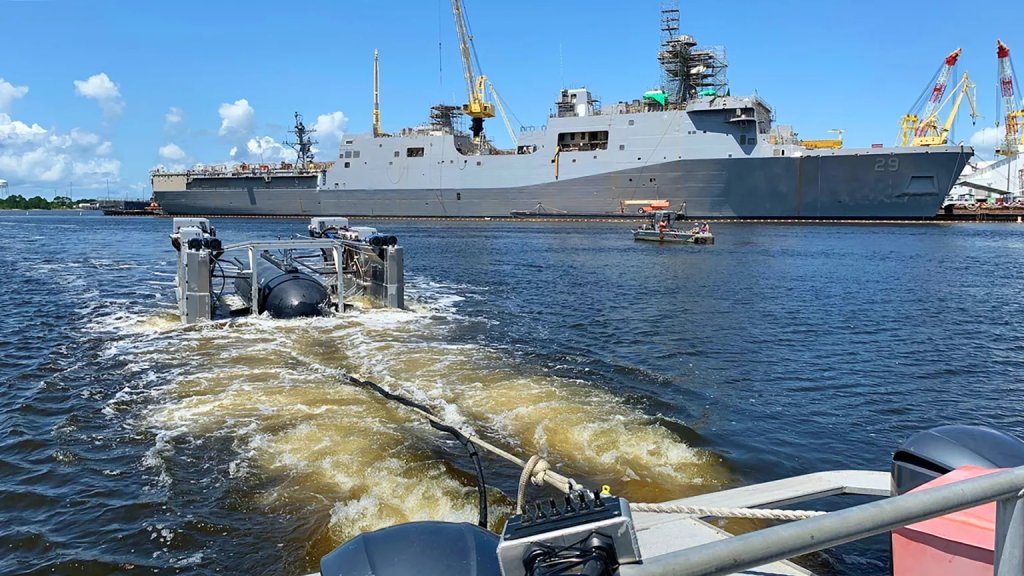
There are still many questions still to be answered about future larger UUV operations, including just how they will be deployed and recovered. Video the U.S. Navy released today shows that the torpedo-armed Excalibur was launched into the water in Scotland using a commercial truck-mounted crane. U.S. shipbuilders Huntington Ingalls Industries (HII) and General Dynamics National Steel and Shipbuilding Company (NASSCO), among others, have been working on new options for launching and retrieving larger drone submersibles from surface warships. External carriage on the hulls of ships and/or submarines might also be an option in the future.
A picture from a test in 2022 of a prototype portable cradle for launching large UUVs developed by HII. The UUV seen here is that company’s Proteus design. HII
Additional torpedo and other munition options for UUVs beyond the full-size Mk 48 could also be on the horizon. The U.S. Navy has invested heavily in compact and lightweight torpedo designs that could be well suited for employment from underwater drones like Excalibur.
The U.S. Navy says it is working with its international partners on another similar UUV capability demonstration, but this time involving an Anduril Dive-XL, under what is dubbed Project Cutlass. This effort “will tackle advanced payload integration data, command and control architectures, and tactical employment scenarios to further mature uncrewed undersea capabilities,” according to the U.S. Navy’s release.
The Royal Australian Navy is already in the process of acquiring and fielding a militarized version of the Dive-XL, called Ghost Shark. It’s also worth noting that the Dive-XL evolved from the earlier Dive-LD design. The Dive-LD is in at least limited operational U.S. Navy service now, a fact that was revealed by Iran’s capture of one of these submersible drones earlier this month, as you can read more about here.
Excalibur’s ability to launch a standard Mk 48 heavyweight torpedo is already an important show of progress now toward a shared goal of a future underwater ecosystem that includes submersible drones that are able to attack other vessels.
From Denmark to Litochoro in western Macedonia, northern Greece, by bike: 52 days, 10 countries and 3,500 kilometers for the crazy dream of Marilena Karantini. The great journey of 34-year-old Marilena Karantinini who managed fearless this special challenge. Her thought was simple… “This year I will go from Denmark to Litochoro by bike” she said […]
Tragedy in Rhodes: A firefighter who participated in an operation to rescue tourists, died on Tuesday, after he fell from a relative high height. The 52-year-old man fell from a height and was fatally injured during an operation to provide assistance to two tourists, hikers, in an area near Sianna on the island of Rhodes. […]
Α 50-year-old high school principal suffered a cardiac arrest outside the school in Ilioupoli suburb of eastern Athens during the heavy rain- and thunderstorm hitting the area on Tuesday. Initial reports suggest the cardiac arrest was caused by lightning. Passersby who saw the woman collapsing on the street outside the school immediately called for help […]
Fifteen antiquities that had been illegally removed from Greece will be returned to the country from the United States. They were handed over to Minister of Culture Lina Mendoni at a special ceremony held at the Manhattan District Attorney’s Office. According to a statement by the Ministry of Culture, with this latest repatriation, the number […]
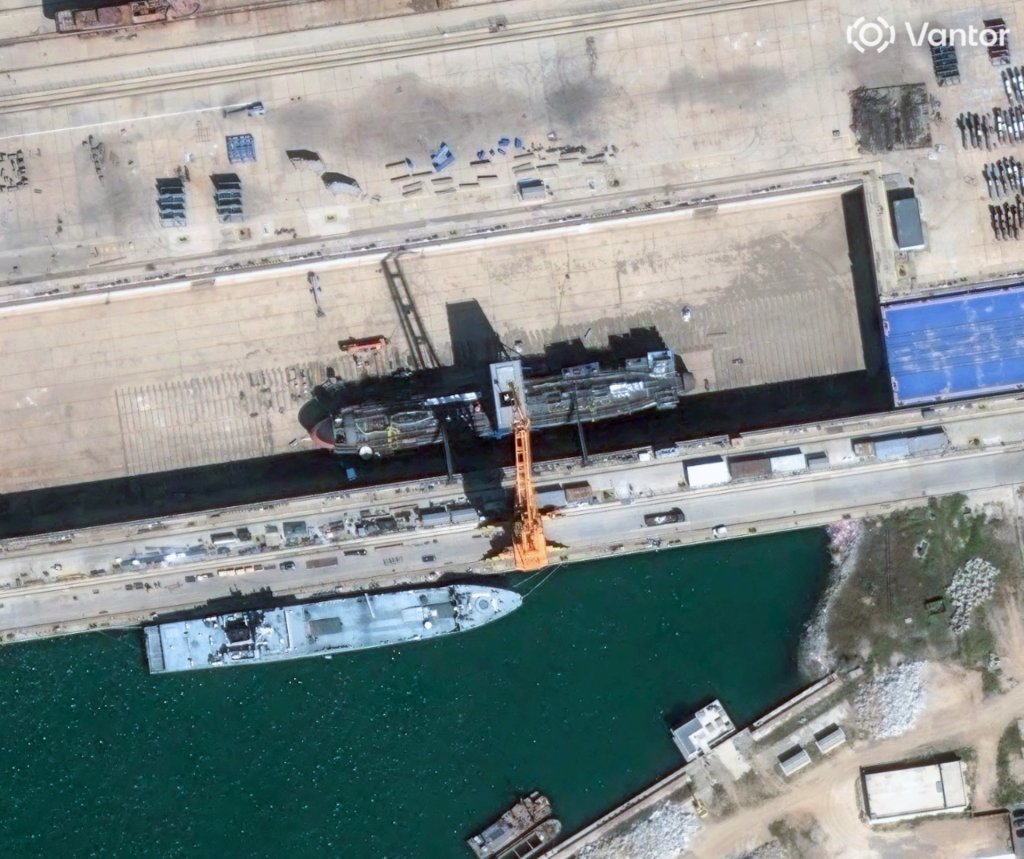
Recent satellite imagery of a shipyard in northeastern China offers interesting new insights into the country’s next-generation submarine developments. The images notably show a pumpjet propulsor and other features worth examining on an example of what is generally described as a new class of nuclear-powered attack submarine, or SSN.
TWZ has obtained a new image taken on September 18 of the submarine in question, which is being built at the Bohai Shipyard in Huludao, from Vantor. Janes reported on this submarine earlier today, based on a separate Vantor image from September 1. The outlet also described the boat as a Type 095, a commonly used, but still unofficial designation. This is something we will come back to later on.
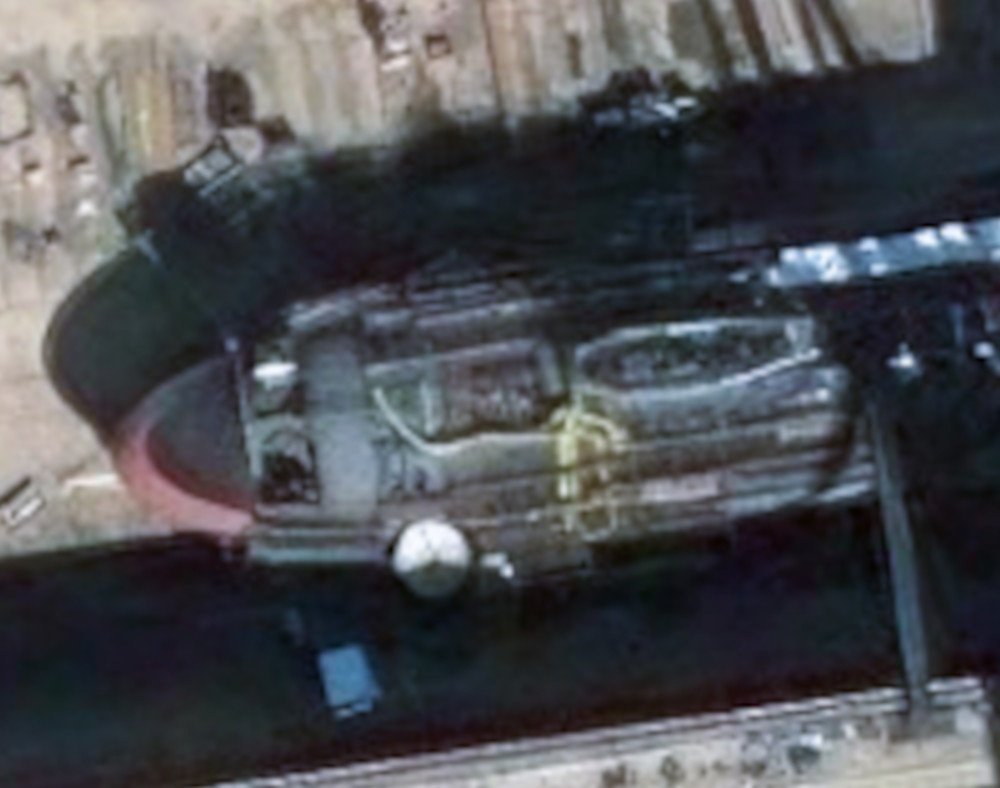
As mentioned, the pumpjet propulsor immediately stands out in both images. This is also understood to be a feature on the Type 093B nuclear-powered attack submarine, a significantly improved variation on that earlier design, which first emerged in the early 2020s. Compared to traditional exposed propellers and more basic shrouded types, pumpjets offer benefits for quieter operation and efficiencies, especially at higher submerged speeds.
The recent imagery also highlights the submarine’s X-shaped stern plane arrangement. This is not found on the Type 093B, which is considered to be something of a bridge between that class and the next-generation design. Broadly speaking, an X-shaped configuration offers advantages when it comes to enhanced maneuverability, efficiency, and safety, which can be particularly useful in littoral environments. It can also provide benefits when it comes to acoustic signature reductions across significant parts of the submarine’s operating envelope compared to the cruciform stern planes.
Another Chinese submarine design that emerged in 2024, currently referred to as the Type 041 or Zhou class, and that is understood to feature a hybrid nuclear/conventional propulsion system, also has an X-shaped stern configuration. The first known example of the Type 041 came to light after it appeared to have sunk in a shipyard.
An X-shaped stern arrangement also looks to be a feature on yet another new class of submarine that appeared at the JN (Jiangnan) Shipyard in Shanghai earlier this year. Initial reports also suggested that the design lacked a traditional sail. However, it has been confirmed that it has a sail, but that is very small proportionally to the overall size of the boat. Truncated sails can offer performance and other advantages, but there are trade-offs.
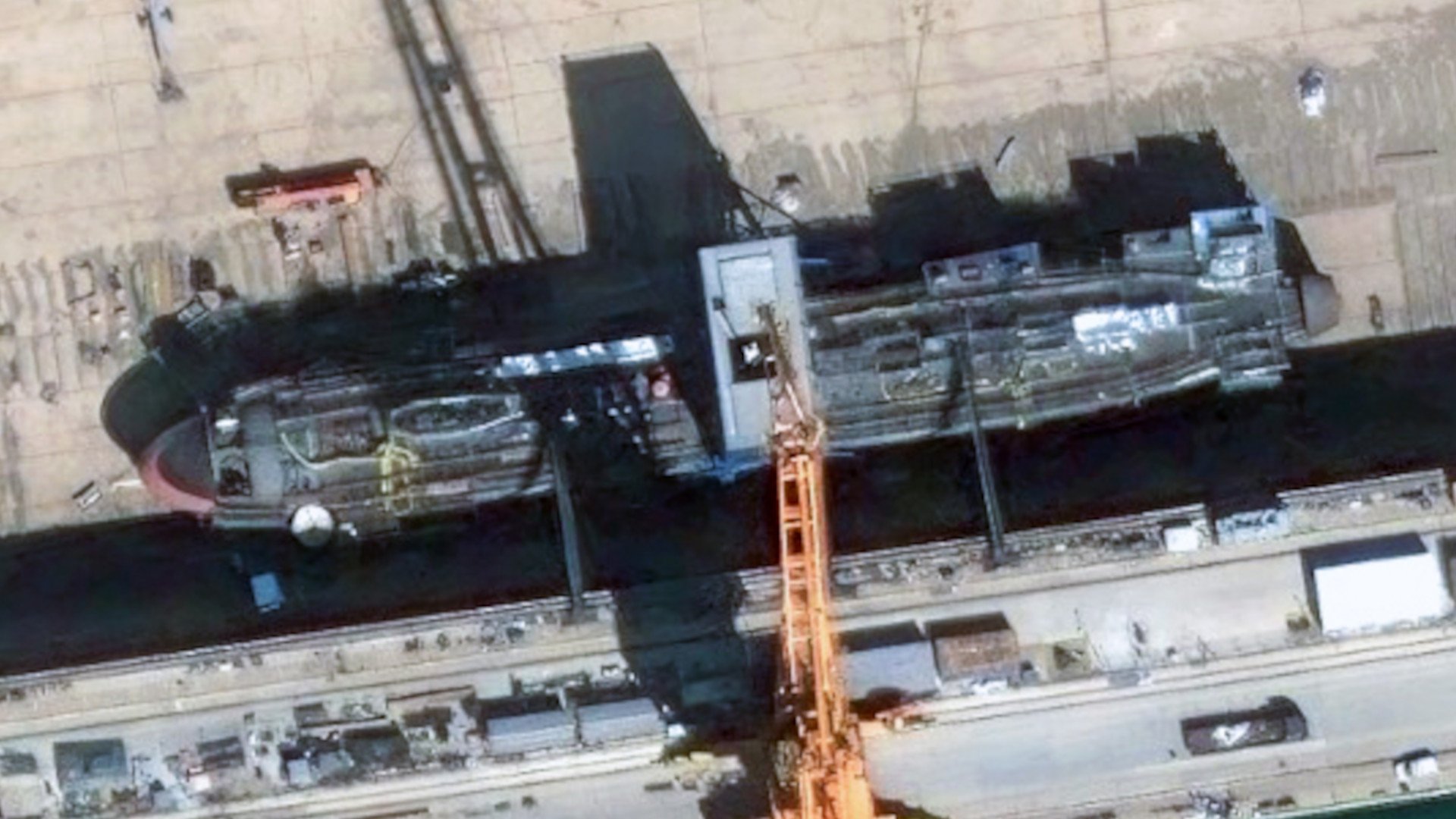
The image of the submarine that Janes obtained also notably shows an open rectangular-shaped section aft of the sail. The September 18 image that we received from Vantor shows a structure placed over that section of that submarine, obscuring ongoing work on that part of the boat. The Type 095 is widely expected to feature some type of vertical launch system (VLS) array able to accommodate a variety of anti-ship and land-attack cruise missiles, as well as potentially hypersonic types. The Type 095 is also sometimes referred to as a guided missile submarine, or SSGN, as a result. The open area seen in the September 1 shot could be where the VLS array is set to be fitted. It might also provide access to the reactor compartment or another area of the submarine.
The clearest photos we have on the Type 095 SSN!
As we can see, there is one confirmed chamber than could physically fit about 18-24 VLS Cells. There is a big chance that more than one VLS Chamber exists, with an estimate VLS count from 24-48+ VLS pic.twitter.com/0ZJ8gsl4su
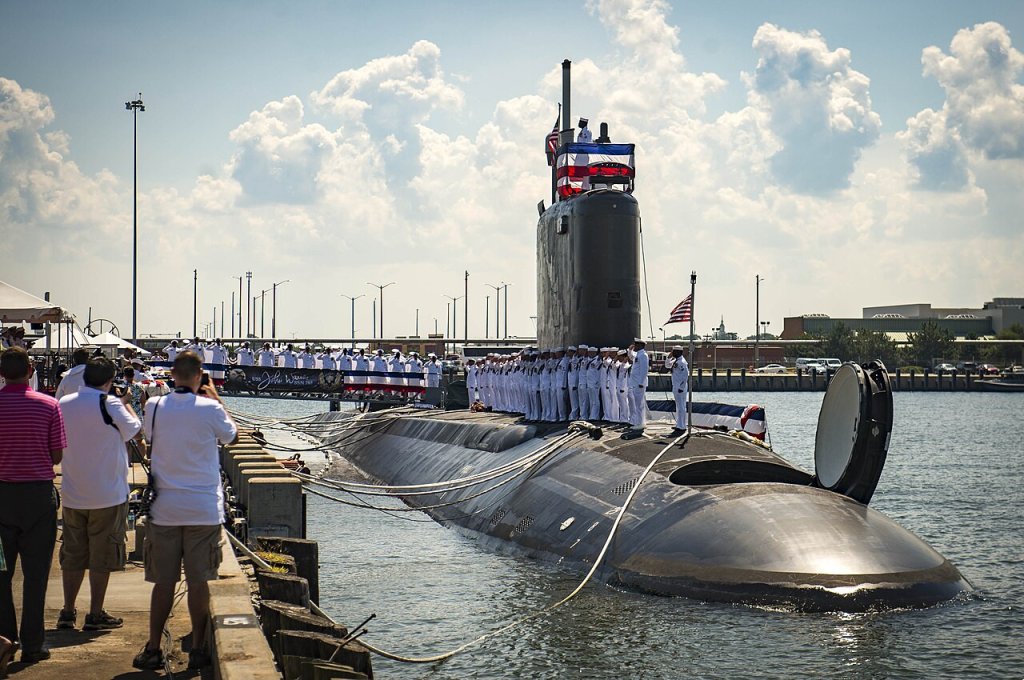
Interestingly, the September 18 image also shows what look to be at least two relatively large circular openings, side-by-side, at the bow end of the submarine in front of the sail, the purpose of which is not immediately clear. There is a possibility these could also be for vertically launching munitions or other payloads. As a point of comparison, U.S. Virginia class nuclear attack submarines, starting with the Block III version, have two large-diameter Virginia Payload Tubes (VPT), one in front of the other, in the bow in front of their sails. At the same time, the openings on the submarine in Huludao also appear to be in a position that is very close to where the submarine’s main sonar array would be installed, and they could be tied to that aspect of the design, too.
“I think it’s too early to be sure about the VLS configuration from publicly available imagery. I realize people assume the large rectangular space halfway behind the sail is the VLS, but I am not sure this is the case and I’d caution to jump to conclusions. The space could also be related to work on the reactor compartment,” Alex Luck, a naval analyst who closely tracks submarine and Chinese navy developments, told TWZ. “With Type 093B, the VLS after launch was initially covered with a tarp, and then the installed launchers were readily visible quite quickly during the fitting-out process. The work process may change with these newer boats, but the different appearance during launch and fitting out needs to be considered in that regard.”
“I do expect Type 095 to have a VLS of some sort, but I am not sure as of yet what the configuration would look like, or where exactly it is located,” he added.
The bigger outstanding question may be exactly what type of submarine is currently being built now at the Bohai Shipyard. Based on a review of additional imagery from Planet Labs’ archive, the boat appears to be around 394 feet (120 meters) long. When the first example of what was assessed to be a Type 095 emerged in Huludao in February, it was estimated to have a length of roughly 361 feet (110 meters). The ‘small sail’ design that broke cover earlier this year in Shanghai is also estimated to be some 394 feet/120 meters long based on available imagery, but also looks to be narrower than the boat presumed to be a Type 095 in February.
“One significant question is the nature and difference between the boat launched by Bohai in February, and the two newer hulls launched in late May/early June both by Bohai and at Jiangnan in Shanghai,” Luck, the naval analyst, also told TWZ. “Specifically, we do not quite know whether they are for different operational roles, or rather a two step development for one final configuration of a new SSN. I think the latter is at least plausible.”
“A related question then is what boat we are looking at now with the new imagery, i.e. the February boat or the newer hull Bohai had launched,” he continued. “Without exact and reliable measurements that question for now is unresolved in the public discourse. For now we need more, and more detailed imagery, including of the different boats together, to clarify these aspects.”
“This [September 1] image reinforces my impression that the boat launched in February may have been a one off not including the full spec featured on the notional 095A launched by Bohai and Jiangnan in late May. We’ve already seen both versions side by side in Bohai,” Luck also wrote on X after Janes‘ published its report.
This image reinforces my impression that the boat launched in February may have been a one off not including the full spec featured on the notional 095A launched by Bohai and Jiangnan in late May. We've already seen both versions side by side in Bohai. https://t.co/wBMkB1gmSQ
Regardless, the emergence in recent years of so many new, more modern submarines, and across what appear to be several distinct classes, is significant. It is no secret that China’s People’s Liberation Army Navy (PLAN) is working to significantly expand the size and capabilities of its submarine force with a clear eye toward extending operations further and further out in the Pacific, at least. In the past, U.S. officials have publicly said the overall quality of newer Chinese submarines has been getting closer in parity to American designs.
“The PLA Navy is executing a significant strategic shift from diesel-electric to all-nuclear construction, representing a fundamental departure from historical construction patterns,” U.S. Navy Rear Adm. Mike Brookes, head of the Office of Naval Intelligence, wrote in prepared remarks ahead of a hearing before members of the U.S.-China Economic and Security Review Commission in March.
In particular, the Type 095, as well as the new Type 096 nuclear-powered ballistic missile submarine, “represent next-generation platforms expected to enter service during the late 2020s through 2030s,” Brookes also wrote at that time. “These submarines will incorporate substantial advancements in nuclear reactor design, sensor performance, weapons integration, and noise quieting technologies.”
Submarine modernization efforts are just one aspect of a larger effort by the PLAN to expand its capabilities above and below the waves. Chinese shipyards have also been producing ever-more capable aircraft carriers, amphibious assault ships, destroyers, frigates, and more in recent years, as well. The pace of China’s construction of new surface ships and submarines has also been growing, creating a particularly significant and still-widening disparity in this regard with the U.S. Navy. This is something that has become increasingly concerning, as TWZ routinely highlights.
Work in Huludao, as well as shipyards elsewhere in China, is certainly already revealing interesting new insights into China’s next-generation submarine efforts.
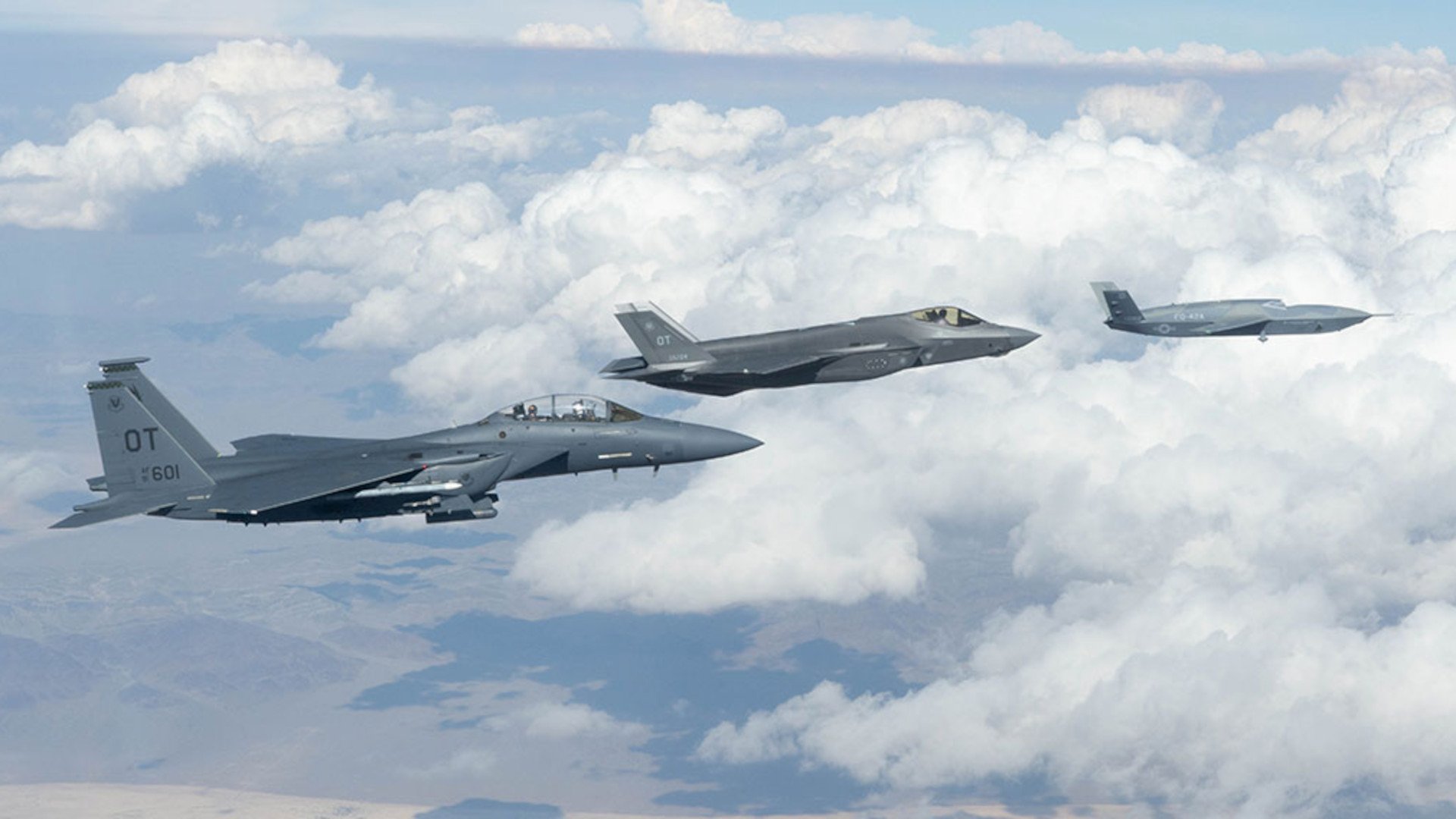
The newly released picture from General Atomics’ Aeronautical Systems, Inc. division (GA-ASI), seen at the top of this story, shows an FQ-42 in flight together with an F-35A Joint Strike Fighter and an F-15E Strike Eagle. The company has also disclosed the delivery of another Vengeance drone to the Air Force, this time to the service’s main drone operations hub at Creech Air Force Base in Nevada.
“The FQ-42 that arrived at Creech will continue regular test and evaluation operations with the Air Force aimed at experimentation with the new aircraft,” according to a press release GA-ASI put out today. “Previous efforts with Vengeance and other GA-ASI jets, including [the] XQ-67A Off-Board Sensing Station and MQ-20 Avenger – have found the trio of combat jets flying in various scenarios that push the boundaries of combat aviation. GA-ASI’s jets have flown semi-autonomously and autonomously with various AI pilots and under collaborative control of human fighter pilots operating F-22 Raptor and F-35 Lightning II jets.”
From top to bottom, General Atomics MQ-20 Avenger, XQ-67 OBSS, and YFQ-42 drones. GA-ASI
As mentioned, the Air Force is steadily working to broaden the scale and scope of testing involving the FQ-42 and FQ-44 to include more and more operationally relevant scenarios. Both types are set to make their first appearance at a large-force employment (LFE) exercise in December, offering a valuable new opportunity for deeper and more realistic integration with crewed fighters.
The Air Force otherwise continues to lay the groundwork for future CCA operations, including through a major round of testing at Creech in July, which TWZ was first to report on. The service is heavily focused now just on figuring out how the drones will be deployed, launched, recovered, supported, and otherwise operated on a day-to-day basis. A dedicated test squadron called the Experimental Operations Unit (EOU), established at Nellis Air Force Base in Nevada, has been leading those efforts.
Work is also underway to demonstrate tactical capabilities, such as the FQ-44 launching an AIM-120 Advanced Medium-Range Air-to-Air Missile (AMRAAM) for the first time earlier this year.
New test footage: first missile shot from YFQ-44A.
YFQ-44A executed an end-to-end, beyond-line-of-sight strike against a simulated target.
“We’re on path right now to do our air-to-air shot coming up here in the near future,” Mike Shortsleeve, Vice President for Strategy Business Development at GA-ASI, told TWZ‘s Jamie Hunter on the floor of the Air & Space Forces Association’s (AFA) 2026 Air, Space & Cyber Conference last week.
Last week, GA-ASI separately announced a new demonstration of semi-autonomous air-to-air combat capability involving crewed F-5AT Advanced Tiger jets belonging to private adversary air contractor Tactical Air Support, Inc. and an unspecified “CCA test aircraft.” The company did use a picture of an Avenger drone to illustrate the press release. The F-5s and the CCA surrogate were equipped with infrared search-and-track sensors (IRST) during the testing.
The stock picture of an Avenger drone that General Atomics used to illustrate its press release last week. General Atomics
“The live exercise proved that a CCA and a manned fighter can collaborate to fuse sensor data from AMS-GRA-compliant sensors to track, engage, and eliminate an airborne target while using a Beyond Line of Sight (BLOS) data link to accomplish seamless coordination between the two aircraft,” according to the GA-ASI release.
“The demonstration utilized BLOS communication between the CCA and the airborne F-5, enabling the Advanced Tiger to send data about targets from an AMS-GRA-compatible system. These commands were relayed to the CCA’s TacACE [Tactical Autonomy Ecosystem software] system,” the release added. “This flight showed that many companies’ platforms can interoperate using the plug-and-play government reference architectures ecosystem. The U.S. Air Force isn’t locked into using a single vendor or system.”
IRSTs are especially valuable for helping spot stealthy targets with features designed to reduce their radar cross-sections since they detect and track infrared emissions. By extension, IRSTs are also immune to radio frequency electronic warfare jamming. As passive sensors, they do not emit their own signals that could alert a target to the fact they are being tracked, either. IRSTs can still be used to cue or otherwise be linked to other sensors, including active electronically-scanned array radars. Fusing data from multiple sources can provide higher fidelity tracks of multiple targets, as well as improved situational awareness overall.
An Avenger drone with a podded IRST sensor under its wing. General Atomics
Air-to-air combat is expected to be the primary mission set, at least initially, for Air Force CCAs. At the same time, an air-to-ground role for the FQ-42 and FQ-44, and/or other future CCA-type drones the Air Force might acquire, is emerging on the horizon. Anduril has already fit-checked a variety of air-to-ground ordnance on Fury.
As it stands now, the Air Force is looking to have its first operational CCAs in service toward the end of the decade. The service is also presently aiming to have a total fleet of at least 500 CCAs of all types by 2032.
“If we can’t be ready, then certainly you’re not going to have the forces that you need and the numbers that you need going forward. This signifies that mass is certainly important again, but also autonomy is just as important,” General Atomics’ Shortsleeve told us last week in talking about the Air Force’s CCA fleet size target. “So the ability to have these autonomous systems, whether they’re bringing in additional weapons, sensing capability, whatever it is, all of those working in a collaborative environment, whether it’s manned, unmanned teaming, or unmanned and unmanned capabilities, that right there is what’s going to help the warfighter in the future.”
“And when we say autonomy, it’s not just strictly this is going to go off and do its own thing. It’s going to be directed,” he added. “Whether it’s on the ground, in the air, [it] makes no difference to the system itself. It’s going to work hand-in-hand [with humans]. So that human-machine teaming, that’s what they’re really focusing on. There is figuring out how to best use this capability in the advancement of actually having to employ it in [the] real world.”
Though just flying in formation is very different from collaboration with a high degree of autonomy, the new picture of the FQ-42 together with the F-35A and the F-15E is a window into the future teamed operations the Air Force is hoping to build.
An 8-year-old child was caught driving an All-Terrain Vehicle (ATV) widely known in Greece as “γουρούνα” (quad bike) at the port of the island of Paros on Saturday. The child was accompanied by a 33-year-old US national sitting on the back seat. According to some media, he was the child’s father. The vehicle had overturned, […]
Ilias Kasidiaris, a former MP of the neo-Nazi Golden Dawn party, who was released from prison last week, announced on Monday, his support for a new far-right party called the Alliance of Greeks. As KTG reported last week HERE, Kassidiaris is eager to return to politics, however, legislation makes it impossible for convicts for crimimal […]
A 27-year-old man stabbed to death multiple times his former partner, a 25-year-old woman, and staged a robbery to cover up the murder. The victim was found in a pool of blood by a passerby at a gazebo at the end of a bicycle path in Igoumenitsa, western Greece, on Sunday night. He called the […]
Greece’s National Meteorological Service EMY issued a weather warning on Monday, September 21, 2026. Heavy rainfalls, storms and and lightning are forecast to affect several regions in the country as of Tuesday, September 22. The weather deterioration is forecast to be of short duration, starting from the early hours of Tuesday, September 22, through the early […]
The three top headlines in the Sept. 18 Drudge Report said: “Blue Wave Builds, Dems 84% Chance to take House – 55% Senate, Weeks Before Midterms – EVERYTHING Getting More Expensive.” Newsweek carried a story headlined “Texas Republicans Face ‘Generational Wipeout’ Amid Disastrous Polls.” Many other publications, both in print and online, have reported that […]
A 82-year-old man was reportedly beaten to death by a 76-year-old man during a argument over a sunbed in a popular organized beach in Vouliagmeni in Athens Riviera on Sunday. According to initial information, the 76-year-old who was accompanied with a 21-year-old woman argued with the victim over the sunbed. Quickly the situation went out […]
An annual award has gone to one of the U.S. Air Force’s most secretive drone squadrons, offering a very rare window into its activities. The 30th Reconnaissance Squadron is one of two units known to operate the stealthy RQ-170 Sentinel, and it is unusual to hear anything about its operational exploits. Much about the RQ-170 itself remains highly classified 17 years after its existence was first officially acknowledged.
The General Atomics Remotely Piloted Aircraft (RPA) Squadron of the Year award for 2025 was presented to the 30th Reconnaissance Squadron at the Air & Space Forces Association’s (AFA) 2026 Air, Space & Cyber Conference on Tuesday, at which TWZ was in attendance. The AFA’s Mitchell Institute for Aerospace Studies works together with General Atomics’ Aeronautical Systems, Inc. division (GA-ASI) to recognize an Air Force drone unit in this way each year.
“The RPA Trophy is awarded annually at the USAF level for outstanding performance of active duty, Air Force Reserve, and Air National Guard … squadrons in achieving persistent attack and/or reconnaissance over the preceding calendar year,” the Mitchell Institute told TWZ in a statement. “Squadrons are judged on performance across their specified mission sets, exercise participation, and squadron and individual achievements.”
The RPA Squadron of the Year trophy seen at the 2026 Air, Space & Cyber Conference this week. The name and unit insignia of the 30th Reconnaissance Squadron are seen on a plaque on the front of the base. Air & Space Forces Association
The institute sent an additional statement regarding this year’s particular award to the 30th Reconnaissance Squadron, which is as follows:
“Through relentless combat support, operational agility, and enterprise leadership, the 30th Reconnaissance Squadron – known as the Blackbirds – has set the standard for the remotely piloted aircraft community and strengthened the Joint Force’s intelligence advantage. In 2025, the 30th Reconnaissance Squadron conducted intrusive intelligence, surveillance, and reconnaissance missions across three areas of responsibility, filling critical intelligence gaps and disrupting enemy networks. In the face of urgent deployment requirements, the squadron demonstrated exceptional agility, rapidly pivoting resources to establish forward operating locations and execute critical missions under severely compressed timelines. The Blackbirds’ accomplishments paved the way for future remotely piloted aircraft capability, distinctly identifying them as the Air Force’s most outstanding RPA squadron.“
Larry Stutzriem, the AFA’s Executive Vice President, while presenting the award to representatives of the 30th Reconnaissance Squadron ahead of a panel at the Air, Space & Cyber Conference.
“In 2025, the 30th Reconnaissance Squadron conducted 87 ISR [intelligence, surveillance, and reconnaissance] missions across three different AORs [areas of responsibility], filled critical intelligence gaps, and disrupted enemy networks,” Stutzriem said. “On the unit mobility side, the Blackbirds executed 7.2 million dollars worth of airlift in six movements across four combatant commands, moving 250 tons of personnel, top secret material, and equipment to provide low-observable RPA support for a critical Secretary of War-directed mission.”
“With their deployments, the Blackbirds demonstrated exceptional agility under extremely compressed timelines,” he added.
The official unit insignia of the 30th Reconnaissance Squadron, with its prominent blackbird motif. USAF
Furthermore, during 2025, the squadron “also executed six large force exercises to develop tactics, techniques, and procedures; validated joint force tactical objectives in land and maritime environments; and provided combat-relevant training,” according to Stutzriem. “Instructors and evaluators graduated the largest ever combat mission-ready class, 30 percent ahead of schedule, and accelerated mission-ready status 33 percent, while increasing total unit aircrew by 26 percent.”
Though Stutzriem noted that the 30th Reconnaissance Squadron provided “low-observable RPA support,” no explicit mention was made of the RQ-170. Whether or not the squadron may now operate other kinds of low-observable (stealthy) drones is unknown. As mentioned, to date, the Air Force has only confirmed that Sentinels are assigned to two units, the other being the 44th Reconnaissance Squadron. Both the 30th and 44th are assigned to the 432nd Wing at Creech Air Force Base in Nevada. Between 20 and 30 RQ-170s, in total, are understood to be in the Air Force’s inventory.
What three specific AORs the 30th Reconnaissance Squadron operated in during 2025 is also not known.
However, at least one, and possibly two, RQ-170s took part in the mission to capture Venezuelan dictator Nicolas Maduro in January of this year, as you can read more about here. It’s very likely that the Sentinels were tracking Maduro ahead of the operation. In December 2025, Air Forces Southern (AFSOUTH) had also made a post on X that included a picture of an individual wearing a name patch with the silhouette of Sentinel and the sleeve insignia of the 432nd Wing, prompting questions about whether the drones were operating in the region. The post was subsequently deleted.
Further in the past, RQ-170s are also known to have been deployed to the Middle East, Central Asia, and the Pacific. The Sentinel first emerged publicly in Afghanistan in the late 2000s, prompting the U.S. military to confirm its existence in 2009. Sentinels are notably understood to have surveilled Al Qaeda founder Osama Bin Laden’s compound in Pakistan in the lead-up to the raid that led to his death in May 2011.
Later in 2011, one of the drones infamously went down in Iran while presumed to be on a mission to monitor aspects of that country’s nuclear program. With that in mind, it is possible, if not extremely probable, that RQ-170s likely played a role in relation to the Operation Midnight Hammer strikes on Iranian nuclear sites last year. Sentinels could have provided direct surveillance over the sites in question, as well as collecting post-mission bomb damage assessments and other intelligence. These are exactly the kinds of missions the drones were designed for and that operators have trained for.
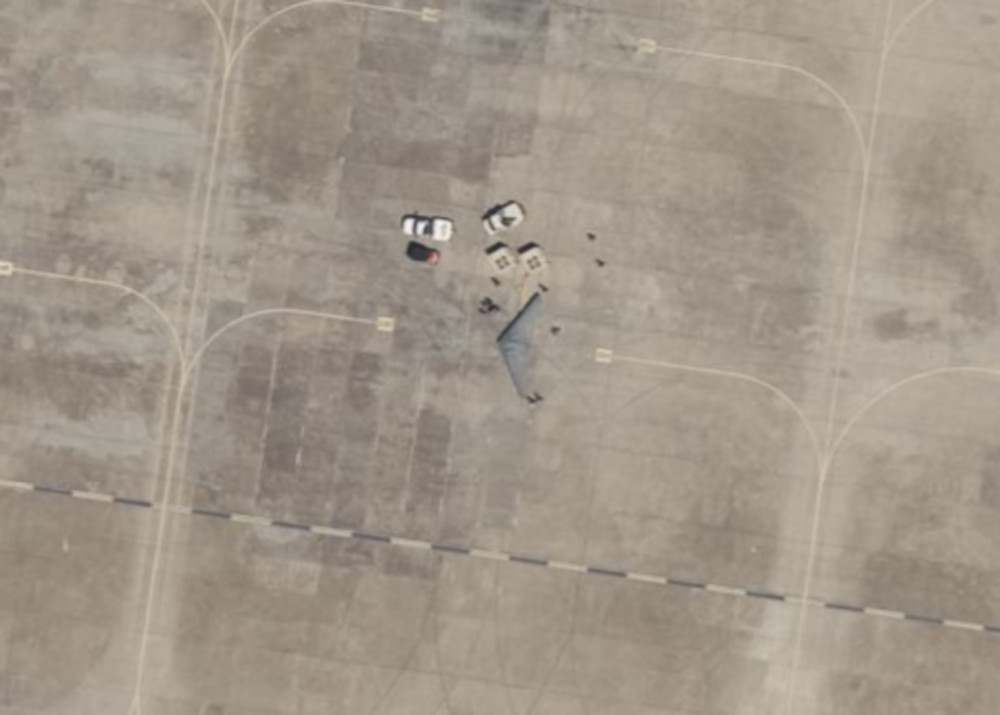
A satellite image available through Apple Maps, seen below, also shows an RQ-170 at Naval Air Station Sigonella in Italy, likely in the 2023-2024 timeframe, based on the state of construction visible elsewhere at the base. It is not known how many Sentinels were deployed to Sigonella and for how long. The Apple Maps image does lend some credence to earlier reports that these drones may have flown missions in the Black Sea region, gathering intelligence on Russian forces on the heavily defended, occupied Crimean Peninsula, between 2022 and 2023.
Apple Maps
Overall, the RQ-170 does still appear to be a go-to for performing penetrating tactical reconnaissance missions, especially when there is a need to provide persistent surveillance in denied areas, resulting in extremely important intelligence collection.
Again, it is important to reiterate here that we do not know if the 30th Reconnaissance Squadron operates any other stealthy drones beyond the RQ-170, or has in the past. A very stealthy high-altitude, long-endurance (HALE) surveillance and reconnaissance drone commonly and unofficially referred to as the RQ-180, or an evolution thereof, burst into the public eye in March after it was spotted landing in broad daylight at a base in Greece. Much about the drone, including what units are involved in its operation and where the home base of the fleet is, as well as the reasons for its deployment to the region, has yet to emerge. It does seem unlikely that the 30th would have taken on operation of the RQ-180, which is a larger strategic reconnaissance-focused platform compared to the smaller, tactically-minded, and less exquisite RQ-170. This is also just one example of what could still be lurking in the classified realm.
American RQ-180 stealth drone landing in Greece, supporting US operations against Iran. pic.twitter.com/Go5YHBM1p8
Whether or not the awarding of the 2025 RPA Squadron of the Year trophy to the 30th Reconnaissance Squadron might now point to a new willingness to talk about that unit’s activities and/or the RQ-170 remains to be seen. Regardless, the award and its description are yet more reminders of just how important the Sentinel remains nearly two decades after it first appeared.
Margaret Chant-Papandreou, second wife of former Prime Minister Andreas Papandreou, and women’s rights activist, has died at the age of 103, media reported on Friday. The American-born women’s rights advocate played a prominent role in efforts to strengthen the legal and social rights of women in Greece. Chant-Papandreou was the wife of former prime minister […]

 Login


 (@zhao_dashuai)




 U.S. NAVY UPDATE: U.S. Navy and Royal Navy Successfully Test Fire Torpedo from Unmanned Undersea Vehicle
 WASHINGTON – On September 13, 2026, the U.S. Navy and the Royal Navy successfully conducted the proof-of-concept launch of an exercise U.S. Mk 48 Heavyweight Torpedo…