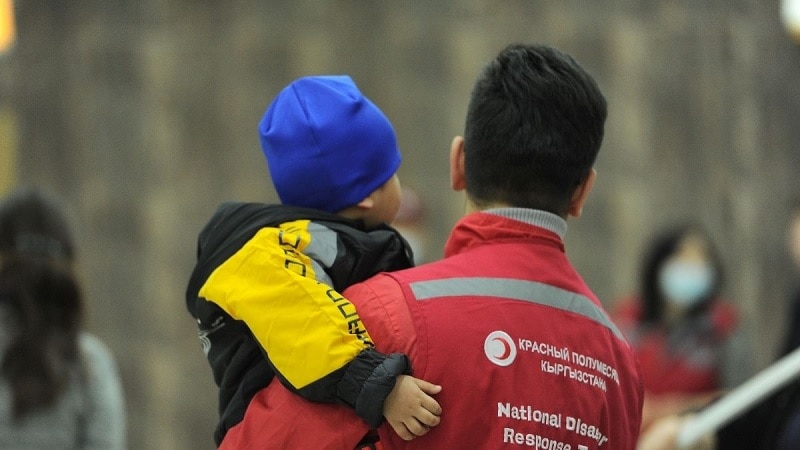
Families of dozens of Kyrgyz women imprisoned in Iraq are calling on the government to bring them home. The women -- mostly wives and relatives of Islamic State fighters -- traveled to Iraq and Syria more than a decade ago as the extremist group seized swaths of territory.
The Kurdistan Region of Iraq is steadily—and increasingly in a semi-official manner—sliding toward a formal division into two separate administrations. Occurring amid a prolonged political deadlock, parliamentary paralysis, and the breakdown of unified state institutions, this constitutional vacuum has created the conditions for a complete paralysis of national governance, writes Halo Hassan Saeed.
The Kurdistan Regional Government (KRG), headed by Prime Minister Masrour Barzani, has operated in a caretaker capacity since 2023 following the expiration of its constitutional mandate. This comes after the failure of the winning Kurdish parties from the October 2024 parliamentary elections—principally the Patriotic Union of Kurdistan (PUK) and the Kurdistan Democratic Party (KDP)—to form a new government.
De Facto territorial division
The KRG no longer exercises governing authority uniformly across the region. Amid escalating disputes, institution building has stalled, and the Kurdistan Parliament has been unable to perform its legislative or oversight functions for the past three years.
Consequently, two distinct de facto administrations have emerged, each backed by separate financial institutions and security structures:
• KDP Administration: Security, executive, and financial authority concentrated in Erbil and Duhok governorates.
• PUK Administration: Independent administrative and security control over Sulaymaniyah and Halabja governorates.
More than 30 rounds of negotiations between the two major parties have failed to yield a power-sharing compromise. The KDP remains determined to retain both the regional presidency and premiership, alongside the key Ministries of Interior and Natural Resources, and the Kurdistan Region Security Council. The PUK demands an equal power-sharing formula—either the presidency or premiership, alongside the Interior Ministry—or a full 50–50 executive split.
The PUK–New Generation coalition
The political dynamic shifted significantly with the formation of an alliance between the PUK and the New Generation Movement. Combined, the bloc commands 38 out of 100 parliamentary seats, directly challenging the KDP’s 39 seats. With remaining political factions holding 23 seats and refusing to join either bloc, the KDP's attempt to form a majority government has been effectively blocked.
Following the failure of recent domestic mediation led by Salahaddin Bahaaddin, Secretary-General of the Kurdistan Islamic Union, the PUK and New Generation leadership—represented by Bafel Talabani and Shaswar Abdulwahid—agreed during a meeting in Sulaymaniyah to move forward with unilateral administration. Under this arrangement, Sulaymaniyah and Halabja will be managed independently of Erbil, utilizing monthly internal revenues to fund stalled public services and investment projects while strengthening political coordination directly in Baghdad.
Socioeconomic fallout
With Western international attention reduced and a lack of active external mediation, ordinary citizens are bearing the brunt of this administrative fracture:
• Economic stagnation: Record-high inflation, sharp fuel price increases, and elevated local taxes and fees.
• Public infrastructure: Severe electricity shortages and deteriorating basic services.
• Commercial contraction: Declining business activity and shrinking employment opportunities for youth.
Strategic implications for European security and policy recommendations
The institutional breakdown in Iraqi Kurdistan is no longer merely an internal political feud; it carries direct implications for European foreign policy and regional stability:
1. Migration risks: Economic paralysis and political hopelessness are creating fresh push factors for young Kurds to seek irregular migration routes toward Western Europe.
2. Energy security: Intra-Kurdish friction jeopardizes energy infrastructure and gas development projects that could otherwise contribute to European supply diversification.
3. Regional stability: A fragmented Kurdistan weakens federal stability in Iraq, creating security vacuums that hostile actors or extremist remnants could exploit.
Why this matters to Europe
The future of the Kurdistan Region is not solely a Kurdish or Iraqi domestic matter. Its institutional stability has direct implications for European interests in Iraq and the wider Middle East.The Kurdistan Region has long served as a relatively stable political and economic partner for European countries, while also playing an important role in regional security, counterterrorism, energy cooperation, trade, and humanitarian affairs. A prolonged division between competing administrations could gradually weaken these functions and create greater uncertainty for European engagement.For Europe, the concern is therefore not simply whether Kurdish political parties can resolve their differences. It is whether the institutional fragmentation of the Kurdistan Region could produce a less predictable partner, weaker governance, and greater instability along one of the Middle East's strategically important corridors.Preventing that outcome is in Europe's own interest. A stable, unified, and institutionally coherent Kurdistan Region provides European governments with a more reliable partner in Iraq and strengthens the broader framework of regional stability.
Halo Hassan Saeed is a Kurdish-Iraqi writer, journalist, and researcher.
This story originally appeared in Mondoweiss on Sep. 11, 2026. It is shared here with permission.
This week marks the 25th anniversary of the 9/11 attacks.
The United States has experienced much political and social upheaval since then, but the subsequent “War on Terror” paved the way for our current moment, and there are booming echoes of the era all around us.
Once again, the United States is waging a disastrous war in the Middle East with no discernible end in sight. Islamophobic rallies targeting NYC Mayor Zohran Mamdani conjure up memories of the “Ground Zero Mosque” controversy. The government designates activist and advocacy organizations as terrorists. The Guantánamo Bay detention camp remains open. In fact, a legal immigrant was just sent there.
CBS reveals that the Taliban seized roughly $7 billion worth of American-purchased military hardware after the United States officially lost that war 5 years ago.
“Taliban fighters patrol in armored vehicles once supplied to Afghan forces, wearing American tactical gear and carrying American weapons,” reads the report. “CBS News saw one Humvee in the Afghan capital still adorned with a faded Green Bay Packers decal — a remnant from its past operators.”
The small number of Americans who opposed that war were either dismissed or attacked. So too were those who warned that the Bush administration’s overreach would result in disaster.
“The civil libertarians were mostly ignored, and as one new threat followed another — Iraq, ISIS, ‘lone wolves’ — the president’s reach continued to grow. Across the Bush and Obama administrations, the commander in chief was given, or simply took, new powers to prosecute, shut down and seize the assets of alleged terrorist groups and their supporters,” writes Radley Balko in theNew York Times. “With the arrival of armed drones, the president assumed the right to remotely assassinate anyone, anywhere outside U.S. borders, at any time, including American citizens.”
“If the ratcheting diminishment of our liberties came slowly and sometimes without much outcry under Presidents Bush, Obama and Joe Biden, the consequences of all those years of expanded presidential power are plainly visible now,” he continues. “Mr. Trump is using every authority we have given the president since Sept. 11, 2001, and some we haven’t, in ways the civil libertarians had tried to warn us about at the start.”
One of the major differences between the current war on Iran and Bush’s war on Iraq is that a sizable chunk of the population fell for the administration’s lies back then. The polling shows that’s not the case this time around, and, despite information from the region being consistently repressed, there seems to be a growing understanding that the United States military is losing quite badly.
They say Americans don’t vote based on foreign policy, but that isn’t exactly true. Many people voted for Obama over Hillary Clinton in the 2008 primary because he opposed the Iraq War. People voted for Trump because he claimed he wouldn’t launch any new wars. It’s quite obvious that Kamala Harris’s connection to Israel’s genocide hurt her at the polls.
Whether or not this typically translates into policy shifts is a separate debate.
Obama’s election effectively killed the domestic antiwar movement, and he launched the largest assassination campaign in world history. Trump’s rhetoric predictably turned out to be nonsense. The Democratic Party’s establishment certainly didn’t rethink its Israel policy as a result of the Harris loss.
This is all to say that the war in Iran, which the administration now says might last through 2029, could help propel the Democrats back into power during the midterms, but will that actually result in a foreign policy reset?
In recent weeks, Democratic leaders and presidential hopefuls have directed their anger toward Twitch streamer Hasan Piker, hoping to quash the party’s left flank before the 2028 nomination process. For them, it’s an existential battle that transcends the question of which party may or may not control Congress at any given time and there’s no broader discussion about reversing our current course beyond removing Trump from office.
Michigan’s Democratic Senate nominee, Abdul El-Sayed, was recently attacked for an old 9/11 tweet in which he expressed sympathy for those who died on that day and those who were killed in the wars after.
“Today, I mourn the 3K lives, 6K injuries, & infrastructural devastation in NYC, perpetrated ignorantly in the name of my faith,” it read. “Tomorrow, I’ll mourn ~1M lives, millions of injuries, & infrastructural devastation in 3 countries, perpetrated ignorantly in the name of my country.”
According to Brown University’s Costs of War project, an additional 3.6-3.8 million people have died indirectly in post-9/11 war zones, which brings the overall death toll to at least 4.5-4.7 million and counting.
25 years after 9/11, the American Empire is undoubtedly in decline, but its demise seemingly remains far off, and we’ve yet to collectively reckon with its ongoing crimes.
Greek-owned tanker “New Andros” was attacked by a drone while sailing in Iraqi territorial waters on Wednesday, September 9, 2026. According to the Greek Ministry of Maritime Affairs and Insular Policy, the two Greek nationals onboard, the captain and the chief engineer, are safe and in good health. The Panamanian-flagged, Greek-owned tanker was carrying around […]
Washington is changing some of its most reliable military partnerships in the Middle East because it believes states, markets, and diplomacy can deliver what American troops and Kurdish proxies increasingly cannot. The End of the Post-ISIS* Bargain The juxtaposition could hardly be more striking. On August 24, the United States removed Syria from its list […]
More than two thousand years before modern engineers bored tunnels beneath rivers and seas, ancient writers told of an astonishing passage hidden beneath the waters of the Euphrates. According to these accounts, a brick-lined tunnel ran beneath the river at Babylon, linking the city's two halves and allowing people to cross unseen below the current. If the story is true, the Euphrates Tunnel may have been the world's first underwater tunnel—a feat of engineering centuries ahead of its time. However, no trace of the structure has ever been found, leaving historians to wonder whether it was a genuine marvel of ancient engineering or another one of history's enduring legends.

 Login