❌

Reading view

Scientists flee burning building in Kyiv’s mini-9/11, as Russian drone also explodes 200m from EU embassy (Ukraine Battlefield update, Day 1,678)

  • Kyiv is currently in a worse situation than Kharkiv when it comes to air-raid alerts.

  • The Russians struck the National Academy of Sciences, forcing scientists to flee through windows. Why did they target it?
  • What upgrades they are testing on their Geran-5 drones.
  • According to Rybar, Russia’s goal in attacking Kyiv is also to persuade Europe to stop helping Ukraine.
  • Maps of the day: The situation near Lyman and the gap between the Russian ministry and reality.
  • Videos of the day: an attack on the border crossing with Poland; footage from the cockpit of an Su-25; a robot avoids a drone; Russians flee among a crowd of civilians.

Kyiv has experienced its worst attacks since the start of the war in recent weeks. According to an analysis by French OSINT analyst Clément Molin, the capital was hit by 155 Russian missiles and drones in September, compared with 113 in August and 21 in March.

Denník N reporter Mirek Tóda, who visited Ukraine last week, said that Kyiv was currently worse off than Kharkiv in terms of air attacks, even though Kharkiv lies just 30 km from the front line.

Even smaller, FPV (first-person view) drones have recently begun flying on Kharkiv’s outskirts, hunting cars, but the number of air-raid alerts and air strikes there has still been far lower than in Kyiv in recent weeks.

Molin added that the Russians had struck the heart of the capital 10 times a day in recent days.

The Russian independent group Conflict Intelligence Team wrote that Kyiv and its surroundings would probably account for the highest number of civilians killed and injured anywhere in Ukraine in September — more than in the Donetsk, Kherson, or Kharkiv regions.

An at a time when attacks causing casualties occur every day, it is becoming harder for foreign journalists to engage readers with reports about an attack on the Ukrainian capital.

But on Monday, however, the Russians managed to do so.

During the working day, they struck the historic building of Ukraine’s National Academy of Sciences. It caught fire, and footage of scientists and other employees attempting to climb out through smoke-filled windows circulated around the world.

A Russian strike against the building of the National Academy of Sciences of Ukraine. A rescue operation is underway: crews are putting out the fire and searching for people who may have been trapped inside. All services are deployed. Today in Kyiv, a pharmaceutical company and… pic.twitter.com/ccfIHnGFNg

— Volodymyr Zelenskyy / Володимир Зеленський (@ZelenskyyUa) September 28, 2026

The images of people standing on a ledge may have recalled those seen after the 11 September attacks, although the terrorists then struck skyscrapers more than 100 storeys high in New York.

Horrific scenes out of Kyiv this morning as Russia used a jet-powered drone to blow up Ukraine’s National Academy of Sciences. People are escaping through windows as the building burns. Just like they target kindergartens and schools, now they are bombing science. pic.twitter.com/yvwzLz9DXe

— Nate Mook (@natemook) September 28, 2026

🚨 BREAKING: Terrifying footage captured people climbing out of windows after a Russian attack struck the National Academy of Sciences in central Kyiv in broad daylight.

The attack killed one person and injured at least three others, triggering a massive blaze. pic.twitter.com/wiWTU51QaL

— UNITED24 Media (@United24media) September 28, 2026

The historic building had only three floors. Thanks in part to this and the firefighters’ rapid response, only one person was killed and six were injured.

It is quite likely that the attack on the Academy of Sciences was not accidental and that the Russians were targeting an important individual.

Ukrainian analyst Viktor Kovalenko believed that the Russians had wanted to kill 86-year-old Volodymyr Horbulin. He is one of the architects of Ukraine’s missile and space programme.

He headed Ukraine’s space agency in the 1990s and, for five years under President Leonid Kuchma, served as secretary of the National Security Council. Despite his age, he remains active: he is vice-president of the National Academy of Sciences and focuses on security issues.

And the elderly scientist was in the building at the time of the attack. The drone hit a room one floor above his office. He sustained only minor injuries, but his assistant was killed.

A few hours later, the Russians struck the building of the Dobrobut medical centre, which caught fire. Several people were reported injured there.

Russia bombed the Dobrobut Medical Center in Ukraine's capital, Kyiv, this afternoon, setting the facility ablaze. pic.twitter.com/gs0d1X3eB5

— OSINTtechnical (@Osinttechnical) September 28, 2026

These attacks took place in the wider city centre and were felt by the EU ambassador to Kyiv, Slovakia’s Katarína Mathernová.

“Just moments ago, an explosion jolted me out of my chair in my Kyiv office. It was the loudest blast I have experienced here in three years. A jet-powered drone struck a building around 200 metres from the EU delegation. It happened in broad daylight. The target was a hospital,” Mathernová wrote.

While the Russians once attacked Kyiv mainly at night, attacks are now also taking place during the day. Although they target military and industrial sites as well, they frequently hit civilian facilities where many people are present during daytime.

“Today in Kyiv, a person can be killed in a supermarket, at a university, at a petrol station, on the street or at work. The campaign of indiscriminate attacks targeting the centre of the capital is unprecedentedly violent. The Russians are targeting data centres and regularly miss their targets,” French analyst Clément Molin wrote.

“What Russia is doing is pure terrorism. And we should treat neither its state leadership nor its military forces any differently. Why should we continue pretending that it is possible to negotiate with such terrorists on equal terms?” German analyst and former journalist Julian Röpcke wrote.

“Nothing expresses the ‘fight against Nato expansion’ quite as clearly as bombing the historic building of Ukraine’s National Academy of Sciences in central Kyiv, forcing ordinary scientists to jump from windows to escape death in the flames,” Ukrainian journalist Illia Ponomarenko added.

The Russians are attacking the capital virtually constantly. It is not merely one or two attacks a day. As Ukrainian analyst Bohdan Myroshnykov wrote on Sunday, Kyiv had been without an air-raid alert for only 5 hours and 55 minutes in the previous 24 hours.

“The current alert has lasted 8 hours and 20 minutes. The enemy deliberately launches drones in order to prolong the alert. Once they arrive in Kyiv, they begin circling over the city and its suburbs to keep people on edge for even longer,” he wrote.

According to him, the main weapons currently used by the Russians to attack Kyiv are Geran-5 jet drones. These are essentially smaller — though still six-metre-long — cruise missiles. By contrast, Geran-4 jet drones have the classic delta-wing shape of older Shahed drones.

Myroshnykov wrote that Ukrainians had more or less learned how to shoot down Geran-4 drones, but were having difficulties with the fifth series. While they intercept Geran-4s with an effectiveness of 70 to 80 percent, the rate for Geran-5s is only 50 to 65 percent. “The fourth series is intercepted en masse while approaching the Kyiv agglomeration, whereas the fifth is only intercepted within it,” the analyst wrote.

Last week, we wrote that Ukrainians had released the first videos showing them shooting down jet-powered Geran drones, including Geran-5s, using jet-powered interceptor drones capable of matching their speed. A video has now emerged of another new drone that apparently can already do this.

The problem, however, is that none of these drones is yet being mass-produced. Ukrainians therefore do not have enough of them to counter the growing number of jet-powered Gerans that the Russians are launching at Kyiv and other Ukrainian cities — as well as other targets.

“There are prototypes that have delivered varying results, but considerable effort is needed to bring a prototype into large-scale serial production. Sometimes this is impossible because access to certain components is limited,” former adviser to Ukraine’s defence ministry Serhii Sternenko wrote.

“It took us 3.5 years to find a more or less reliable anti-drone defence against conventional Shaheds. We began this path five months ago in the case of jet-powered drones. It may take us eight to 10 months to find a reliable anti-drone defence,” Myroshnykov wrote.

Ukraine’s defence minister, Yevhen Khmara, called on European partners at a meeting of his EU counterparts to help finance these interceptor drones, which have proved to be the best defence against conventional Gerans.

The Russians are also becoming increasingly creative in their efforts to strike targets in Ukraine. Serhii Beskrestnov, another former adviser to the defence minister, shared a video showing the Russians striking Incom’s office building in Kyiv. What is notable is that they filmed the strike themselves using a drone with a high-quality camera.

“The enemy attacked Incom’s office with a Geran-5 missile, while at the same time a jet-powered Shahed flew over Kyiv, circling above the attack site at an altitude of almost three km. It served as a radio-signal relay for the Geran-5 missile while also recording — and immediately transmitting — video of the attack on Incom. This Shahed then flew out of Kyiv and destroyed a McDonald’s warehouse,” Beskrestnov wrote.

He added that he was convinced the two operators had been sitting next to one another.

The Defence Express website also published an article about the Russians fitting their newest Geran-5-K5 jet drones with the Susanin navigation system, first reported by a Russian Telegram account. The system works by comparing current camera images with pre-recorded imagery.

“This enables the Geran-5 K5 to determine its coordinates even when satellite navigation is unavailable,” Defence Express wrote.

However, it works better during the day than at night, as it needs current images of objects on the ground.

It is often said that the Russians attack Ukrainian cities because they are unable to advance at the front. The aim may be to lower Ukrainians’ morale, degrade their economy and force them to surrender and accept Russian terms.

Although the attacks on Kyiv have been the worst since March 2022, they do not yet appear to have shifted Ukrainian public opinion. According to one recent poll, people were most concerned about government corruption (50 percent), with Russian air attacks only in second place (40 percent). Naturally, the poll was conducted not only in Kyiv but also in places where attacks are less frequent.

Recent polling by the Kyiv International Institute of Sociology (KIIS) indicates that the most worrying issue for Ukrainians right now is government corruption (at 50%), followed by Russian missile and drone attacks (40%) and unprofessionalism and incompetence of the authorities… pic.twitter.com/OvEbFz5jNQ

— AMK Mapping 🇳🇿 (@AMK_Mapping_) September 29, 2026

The attacks are often compared to the “war of the cities”, during which both countries attacked each other’s cities in the 1980s Iran-Iraq war. According to the Russian propaganda channel Rybar, they are also intended to undermine support from Europe.

This may be a somewhat far-fetched theory, but it is worth mentioning because it may indicate that people in the Kremlin think along these lines as well.

Rybar asks what the attacks mean for Ukraine’s “sponsors”. In its view, it is time for them to write off Ukraine, because there is no point pouring money into such a country. A “Marshall Plan”, it says, would be “pointless”.

“The more effective the strikes by the Russian armed forces in the framework of the ‘war of the cities’, the more likely the scenario in which the EU, even in the event of a ‘freezing’ of the situation, will ‘write off’ so-called Ukraine because further support for it is unsustainable. And without sponsors, the Kyiv regime cannot survive,” Rybar wrote.

This might perhaps apply if it were a war on the other side of the world, in which the EU was supporting one side. But the war over Ukraine is a conflict on the EU’s border, and there is a high likelihood that, if Ukraine does not stop the Russians, scientists will be fleeing from burning windows in Tallinn, Vilnius or Warsaw.

Maps of the day

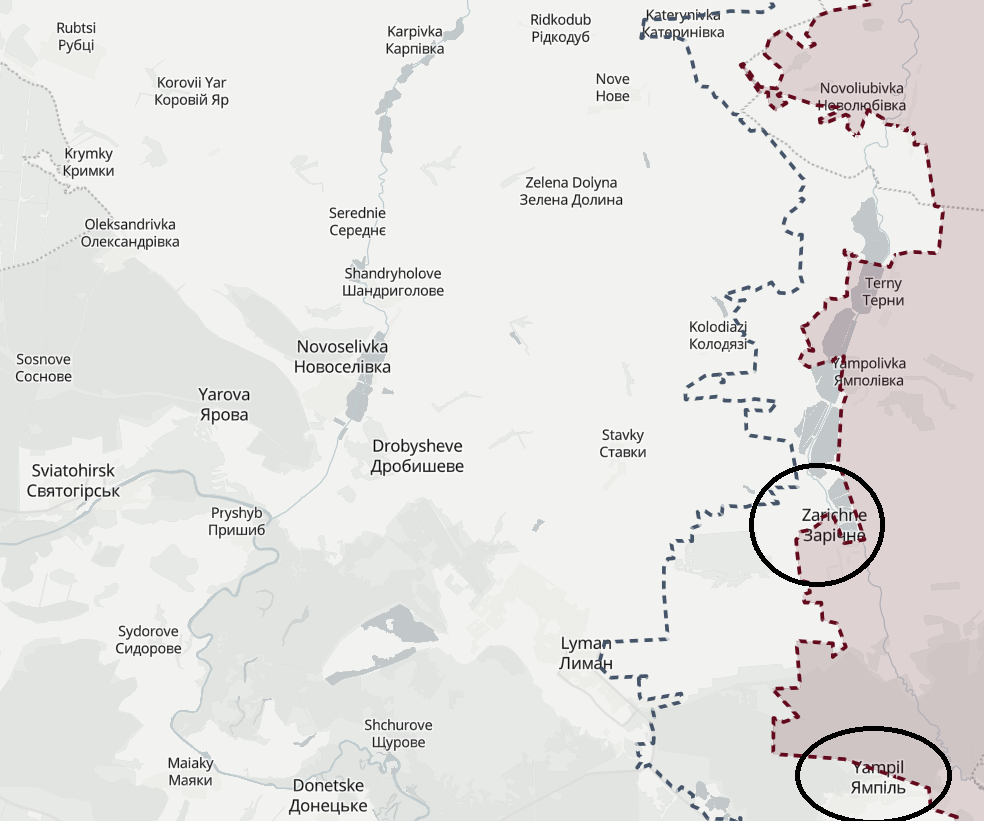
On Monday, we wrote about how Ukrainians were gradually releasing parts of Operation Vivaldi, which is liberating territory north of Lyman. Russia’s defence ministry, as well as the Russian state agency Ria Novosti, continue to maintain their claims that the front line lies much further west.

This map compares official Russian claims with reality. At the point of greatest divergence, the maps differ by 40 km. For comparison, that is roughly the distance between Trnava and Bratislava. Overall, the Russians claim to control 1,360 square km more in this area than they actually do.

The yellow line on this map shows what the current official Russian maps portray the situation in the Lyman direction as (or what they would now consider the Izyum direction).

At it's furthest point, their claimed frontline is 40 km (!) west of my frontline. This was achieved… pic.twitter.com/Nd2SP3HJur

— AMK Mapping 🇳🇿 (@AMK_Mapping_) September 29, 2026

Russian Z-bloggers and propagandists are, however, closer to reality. The Two Majors channel wrote that the situation was “continuing to deteriorate”.

“The enemy is conducting counterattacks and trying to push Russian troops back beyond the Zherebets. (…) The Russian foothold west of the river has shrunk,” it said.

According to the channel, Ukrainians had entered the village of Zarichne from several directions, while fighting was also under way for Yampil.

According to Two Majors, this sector remains one of the most problematic parts of the front from the Russian perspective. The Russians’ aim is to stabilise it and retain at least some units on this bank of the river.

The Rybar channel wrote that Ukrainians had intensified fire on the few places where the river can be crossed, as well as attacks on logistics far behind the front line.

“Despite the stabilisation measures that have been launched, the situation remains extremely difficult and tense. The enemy’s gradual release of footage is a tool of information pressure, but it conceals a very real deterioration of the situation in the Lyman sector,” Rybar wrote.
Videos of the day

In addition to Kyiv, the Russians are attacking other parts of Ukraine. They again struck the Yahodyn border crossing on the Polish-Ukrainian border. A Geran-5 drone landed in a car park, around one km from Polish territory.

Recently, after a similar attack in which they hit a train, they also struck a petrol station 800 metres from the crossing. These are the attacks closest to Polish territory since the start of the war, not counting drones and a Kh-101 missile that have already entered Poland.

An enemy UAV struck near the "Yagodin" checkpoint on the border with Poland, according to social media posts pic.twitter.com/COrcYKrUoJ

— kolibri.93 🇺🇦 (@viktorikolibri) September 28, 2026

Footage from the cockpit of a Ukrainian Su-25 military aircraft during a mission in the east. The pilot flew low over the ground, then climbed higher, released a French AASM guided bomb and turned away.

Rare cockpit view from a Ukrainian Air Force Su-25 Frogfoot on a strike mission over the eastern front, screaming low over the ground before pitching up, clawing for altitude, and launching a French AASM guided bomb at a Russian target. pic.twitter.com/DmX2Pvfftw

— OSINTtechnical (@Osinttechnical) September 29, 2026

Ukrainian robot operators are also assisted by aerial reconnaissance drones during missions. This apparently helped the operator in the video skilfully evade a Russian drone at the last moment.

🤯 Insane operator skills!

A Ukrainian "Termit" ground drone dodges a Russian FPV strike mid-mission. pic.twitter.com/u2t4DMEj4L

— UNITED24 Media (@United24media) September 27, 2026

Ukraine’s Khartia Brigade released a video which it said showed Russian soldiers in civilian clothes, mixed in with actual civilians, trying to escape through a pipeline.

🚨 BREAKING: Drone footage from Ukraine’s Khartia Brigade reveals likely Russian soldiers disguised in civilian clothing, attempting to escape alongside elderly hostages and children.

Ukrainian troops refrained from firing to ensure civilian safety. pic.twitter.com/rByUK86i0E

— UNITED24 Media (@United24media) September 28, 2026

What are the losses

No update on Tuesday.

  • By Tuesday (22 September), Russia had verifiably lost 24,138 pieces of heavy equipment, compared with 24,098 on Monday (14 September). Of these, Ukrainians destroyed 19,105 (19,065) pieces, 1,000 (1,000) were damaged, crews abandoned 1,194 (1,194), and the Ukrainian army captured 2,839 (2,839). These included 4,448 (4,447) tanks, of which 3,353 (3,352) were destroyed in combat.

  • Ukraine had lost 12,175 (12,143) pieces of equipment, of which 9,579 (9,551) were destroyed, 702 (698) damaged, 695 (695) abandoned and 1,199 (1,199) captured. These included 1,464 (1,462) tanks, of which 1,125 (1,120) were destroyed in combat.

Note: Neither side regularly reports its own casualties or destroyed equipment. Ukraine publishes daily figures for Russian casualties and destroyed equipment, which cannot be independently verified. In this overview, we use data from the Oryx project, which has compiled a list of equipment losses documented exclusively by photographs since the start of the war.

  •  

Leo the moderate? Pope in France defends EU values

There's a new pope in town and he's got very different ideas on what France's far right calls the defense of Christian civilisation. Leo XIV is concluding his trip to France in the eastern city of Metz, which is closely associated with a founding father of present-day European federalism, Robert Schuman. There, the head of the world's largest organised religion proudly stated that Europe's roots are Christian, dating back to the Romans, all the while hailing an EU model that transcends "us versus them" ideology and brushes aside "might is right" in favour of human rights and international law. 

  •  

Trump's world? Leaders navigate consequences of US policy

A year ago, Donald Trump went to the rostrum of the United Nations General Assembly and after taking an axe to US aid and development funding, he read the world the riot act. One Iran war later, the US president is sticking to script, with a speech that borrowed much of the language from last year. With citizens on five continents now feeling the pain at the pump, we ask what it will take to tame a global energy crisis whose potential spiral mirrors the contagion of hostilities from the Strait of Hormuz to the mouth of the Red Sea.

  •  

Stay up to date with EU Reporter’s live EU institutions news feed

Access Live News Feed

Keeping up with developments across the European Union can be a challenge. EU Reporter’s live EU institutions news feed makes it easier to stay informed and in touch with what is happening across Brussels and beyond.

The service brings together up-to-date news and information from the European Parliament, European Commission, Council of the European Union, European Council and other key EU institutions in one convenient place.

For policymakers, diplomats, businesses, journalists and everyone with an interest in European affairs, the feed provides a straightforward way to keep track of institutional developments throughout the day.

From Commission announcements and parliamentary activity to Council decisions, legislative developments and major policy updates, the EU Reporter live feed helps readers remain connected to the issues shaping Europe.

Rather than searching across multiple institutional websites, readers can use EU Reporter as a central point for following the latest developments from the heart of the European Union.

Alongside EU Reporter’s original journalism, analysis and multilingual coverage, the live feed provides another way for readers to keep up to date, stay in touch and remain informed about Europe as events develop.

EU Reporter — Real time. Real Europe. Stay informed. Stay ahead.

  •  

Qatargate: Greek Parliament lifts immunity of ND MP & ex EU Commissioner

Greek Parliament voted for lifting the parliamentary immunity of ruling New Democracy MP and former EU Commissioner Dimitris Avramopoulos on Thursday. The voting followed a relevant request by Belgian authorities investigating the so-called Qatargate and have issued an arrest warrant last June. Prior to the voting, 73-year-old Avramopoulos submitted a memorandum where he requested “the Plenary […]

The post Qatargate: Greek Parliament lifts immunity of ND MP & ex EU Commissioner appeared first on Keep Talking Greece.

  •  

US–Canada trade war: Carney has outplayed Trump

On Wednesday (16 September) Canadian Prime Minister Mark Carney had a good day at the EU Parliament in Strasbourg. Commission President Ursula von der Leyen indicated that she would like to work with Mr Carney “on opening the door for Canada to be the first associate member of the European Union", writes Dick Roche.

Prime Minister Carney was given a standing ovation by the Parliament’s Members. While it is not clear  what ‘associate EU Membership’ means, the offer from the Commission President and the welcome by MEPs was a plus, of sorts, for Mr Carney in his battle with President Trump.

A bumpy relationship

The relationship between Prime Minister Carney and President Trump was always destined to be a bumpy one. Days before President Trump was sworn in for his second term Justin Trudeau stepped down as Prime Minister of Canada. As Trudeau was leaving office the president-elect repeated comments that he had made during the 2024 US elections about Canada becoming the 51st US State.

On 1 February 2025, as the contest to replace Mr Trudeau as the Liberal Party leader was getting underway President Trump, announced a 25% tariff on imports from Canada, Mexico and Canada: Canadian energy exports were subject to a 10% tariff. Trump explained the tariffs were intended to address the emergency related to fentanyl trafficking and illegal immigration.

Nine days later Trump announced a blanket 25% tariff on all imported steel and aluminium to “protect US industry and national security.” This hit Canada the biggest foreign supplier of steel and aluminium into the US market badly.

The pain for Canada did not stop there, on 26th March Trump announced his 25% tariff on all automobile imports into the US. Again, another bad hit on - most Canadian vehicle production is destined for the US market. The impact on Canadian auto producers was somewhat ameliorated by the fact that the tariff applied only to non-US content vehicle imports from Canada.

The stream of tariff announcements from the US while hurting Canada played to Mark Carney’s advantage in the race for leadership of Canada’s Liberal Party. While a "political ingénue" never having held political office or been a Member of a Member of Canada’s Parliament Mr Carney brought deep economic experience to the contest. He won almost 87% of the votes cast in the leadership election.

Mr Carney was sworn in as Prime Minister of Canada on 14th March 2025 - seven weeks into President Trump’s second term. Six weeks after his swearing in Mark Carney was elected to the Canadian House of Commons in the General Election of 28th April 2025.  

Placating a cranky neighbour

From the outset  Prime Minister Mark Carney invested considerable effort in improving relations with President Trump. The two leaders met in the White House on 6th May. The meeting, reportedly, went well.

Asked at the press briefing after the meeting about Trump’s suggestions that Canada should become the 51st US state, Carney responded humorously. He recalled that during the recent elections he had met the owners of Canada. They were not he said interested in ‘selling the property’, something that Mr Trump as a property man would understand. Smiling President Trump responded ‘never say never.’

At the G7 meeting held in Kananaskis, Alberta, in June President Trump and Mr Carney had another cordial meeting.  

The cordiality  did not last long. At the end of June the first payments on Canada’s Digital Services Tax (DST) were due to be made.  The DST legislation enacted during the Trudeau Government, hit US tech companies causing fury in the White House. Trump called the tax a "direct and blatant attack on our country" and announced all trade talks with Canada would cease immediately.

Within days Carney announced that his administration would rescind the DST and halt the collection of the tax to advance negotiations with the US.

There was another flashpoint in January when President Trump reacted to reports that Canada and China were pursuing a comprehensive free trade deal. Prime Minister Carney defused the situation by explaining the talks with China were focused on adjusting existing arrangements.

While Carney faced criticism for ‘climbing down’ on the DST issue and for being too eager to placate the White House on China, his approach got US-Canada trade talks back underway.

By August 2025 there was some optimism that a breakthrough trade talks was close.  On August 18th President Trump announced that a tentative understanding had been reached and as a result he was prepared to push back on the late August deadline for US tariff increases. 

The talks came to an abrupt halt three days later when Carney instructed Canada’s negotiating team to return to Ottawa.

That decision came as a surprise. Walking away risked incurring the wrath of President Trump. That was a risk that the Canadian PM had clearly calibrated.

When the US Trade Representative Jamieson Greer sought to blame Canada for the breakdown Carney responded that it was the US United States that made last-minute demands which Canada considered unacceptable, including efforts to introduce provisions that would impact Canada's trade autonomy and sovereignty.

President Trump  reacted immediately to Canada’s decision.  Using  a section of the Tariff Act 1930 that had never been used previously Trump imposed 50% tariffs across US$20 billion worth of Canadian products exported to the US.  

Carney announced that Canada would hit US exports to Canada with “dollar for dollar” retaliatory measures. These would come into  effect immediately after Labour Day 7th September –the day when the starting gun for US mid-term elections is ‘fired’ to get into full swing.

Asked at the press conference whether Canada was starting a trade war with the United States, Mr. Carney responded: “you’re at war when you get attacked—we got attacked.”

In a televised address, Carney acknowledged that the steps he was taking  would come at a cost but argued that U.S. actions had left him with little alternative. He characterized the measures being taken by the United States as an attempt to hurt and divide Canadians. That, he suggested, was a miscalculation. Rather than weakening Canada, U.S. pressure would, he said, bring Canadians closer together.  

Backing Carney

All of indications suggest that Prime Minister Carney was correct in his assessment.

The leader of the Conservative Party Canada, Pierre Poilievre who previously accused Carney of being too willing to concede to Trump, strongly supported the decision to walk away from those trade talks.

Mr Poilievre  was not alone, with one exception the Premiers of Canadian Provinces publicly supported Prime Minister Carney’s stance.

The Premier of Ontario Canada’s most populous province, Doug Ford, an open critic of the US President, encouraged PM Carney to respond to Trump “tariff for tariff, dollar for dollar.”

The Quebec Premier, Christine Fréchette, was particularly supportive  of Carney’s refusal to make concessions to Trump on Quebec’s cultural protections.

Other Premiers have encouraged Carney to “fight back,” praised “team Canada,” criticised US tariff threats as unjustified, promised “full support,” and urged that Canada not accept a ‘subordinate economic relationship’ to the US.  

The Premier of Alberta where a referendum on a range of questions including Alberta’s future within Canada is to be held on 19th October was the lone outrider,  cautioning against celebrating retaliatory tariffs and expressed the hope that negotiations be resumed.

Public support in Canada for the position taken by Carney has been positive. Reuters referred to  the tariff dispute encouraging a ‘rally around Canada’ effect that will likely dampen support for Alberta separation from Canada.

Ten days after the Canadian negotiating team abandoned the trade talks in Washington Carney’s Liberal Party received a very tangible indication of voter support when it won three by-elections for seats in the Canadian House of Commons including a seat in Quebec that had previously been held by a Conservative Party Member.

Opinion polls since the Canadian team walked away from the negotiations also show strong support for the position taken the Carney government.  

An Ipsos poll taken on August 26-27 indicates support across party lines for Canada standing up to the US - even if it resulted in higher costs and job losses: 63% of those surveyed felt Canada was right to stand firm in the negotiations.  Just 18 per cent said Canada should have made additional sacrifices to get a deal.

An Angus Reid Institute poll taken on 22 and 23 August immediately after the talks were ended found that 76% supported the line taken by the Canadian government.

A third poll by Abacus Data one of Canada’s most cited polling firms found that 60% approved of how the Carney government had handled the dispute while  18% disapproved.

Negatives for Trump

In the US, unsurprisingly, positions on the trade war with Canada splits along party lines. Democrats overwhelmingly oppose the Trump’s position arguing that tariffs cost consumers and businesses.

On 9th September a group of nine Democrat Senators from states with close business ties with Canada issued a joint statement attacking President Trump’s “senseless trade war” with a key trading partner, primary export market and most enduring defence partner, pointing out that the President’s actions would force Canada to “diversify away from the US and deepen trade ties with other countries including China.”

Republicans generally, but not universally, support Trump’s position, arguing that Trump’s tariff stance is ‘putting America first.’ Concerns have been flagged in the Republican ranks that the tariffs will be an issue in the November mid-terms, particularly in competitive Senate and House races.  

Senator Susan Collins of Maine, the US state most exposed to the tariff dispute with Canada, who is facing a tough re-election contest in November has labelled the tariffs on Canada ‘a mistake’ pointing out that Canadian retaliation could cost Maine up to $170 million in export losses.  The Republican governor of Vermont has also been openly critical.    

The position for President Trump is considerably less positive than that of Prime Minister Carney. The Canadian Prime Minister enjoys the public and political support that President Trump conspicuously lacks. As this week's appearance in the European Parliament demonstrated Mr Carney’s support is not confined to Canada; he has international support which, President Trump again conspicuously lacks.

At the moment there is no obvious ‘off ramp’ to facilitate  a return to the negotiating table. Politically and temperamentally it will be harder for President Trump to pull back from the position he has taken in the tariff war than it will be for Mark Carney. Mr Carney has more political support for his position, at home and internationally than President Trump. He has also  played an infinitely better game than Mr Trump. For the moment the ball is very much in Mark Carney’s court. 

Dick Roche is a former Irish Minister for European Affairs and former Minister for the Environment. 

  •  

EU regulation could cost Europe €159 billion a year, new report warns

A new report titled “The Hidden Cost of EU Regulation: Why Policy Design Matters for Growth, Competitiveness, and Investment,” published on 14 September, estimates that EU regulations could reduce GDP by €159 billion per year and threaten 419,000 jobs between 2026 and 2030.

Published by the European Policy Innovation Council (EPIC), the report examines the “hidden” costs of European policies. These include not only bureaucratic burdens but also regulatory uncertainty, poorly planned transitions, and overlapping obligations. According to the report, these factors can slow investment, limit innovation, and ultimately undermine the policies’ intended goals.

Europe risks imposing substantial economic costs on itself if a new generation of EU regulation is introduced without greater attention to competitiveness, proportionality and the cumulative burden on businesses, according to a new study from the Brussels-based European Policy Innovation Council (EPIC).

The report, estimates that five major areas of regulation currently facing European policymakers could, under its more restrictive scenarios, be associated with €159 billion in foregone EU GDP each year between 2026 and 2030.

It estimates an accompanying annual investment shortfall of approximately €36 billion, with around 419,000 jobs potentially at risk.

But the report's central argument is not that regulation itself is economically damaging. Rather, it contends that poorly sequenced, insufficiently differentiated or unpredictable regulation can impose costs which more carefully designed policies could avoid.

EPIC calculates that what it calls a "better regulation" approach could make a difference of approximately €125 billion in GDP each year, while supporting around €28 billion more annual investment and improving the projected employment outcome by some 241,000 jobs.

The analysis comes at a particularly sensitive moment for the EU, where improving competitiveness has moved rapidly up the political agenda following Mario Draghi's landmark report on the future of European competitiveness.

EPIC examined artificial intelligence regulation, the Packaging and Packaging Waste Regulation, the Carbon Border Adjustment Mechanism, biotechnology and novel food, and the forthcoming revision of the EU's Tobacco Products Directive (TPD).

TPD emerges as the largest potential shock

The study identifies the TPD revision as potentially the biggest avoidable economic shock, but says smarter regulation could protect growth, investment and public health

EPIC estimates that a highly restrictive approach to the forthcoming TPD revision could be associated with an annual GDP loss of approximately €48 billion, including around €24 billion in lost tax revenues.

The same scenario would put roughly 120,000 jobs at risk and produce an estimated annual investment shortfall of about €11 billion.

By contrast, under EPIC's alternative scenario — based on a more differentiated regulatory treatment of products according to risk and greater emphasis on maintaining legal-market innovation — the organisation calculates an annual GDP gain of €32 billion.

The difference between the two regulatory approaches is therefore almost €80 billion in GDP each year, according to the modelling, alongside an improvement of more than 182,000 jobs and approximately €18 billion in investment.

These are significant numbers, but they require an important qualification.

They are scenario-based projections rather than forecasts of losses which have already occurred or inevitably will occur. EPIC itself stresses that its prospective figures are estimates based on alternative regulatory assumptions and should not be interpreted as guaranteed outcomes.

In the tobacco case in particular, the restrictive scenario assumes a major relocation of manufacturing outside the EU, with only part of wholesale and retail activity retained and some demand migrating into illicit channels. That is a substantial modelling assumption and is central to the scale of the estimated economic impact.

Nevertheless, the study raises a broader policy question which Brussels may find harder to dismiss: whether the economic consequences of the next TPD are being examined with the same intensity as its health objectives.

From COP11 to the next TPD

EPIC bases part of its TPD scenario on measures discussed in connection with the World Health Organization Framework Convention on Tobacco Control's COP11, held in 2025.

The report identifies proposals including flavour restrictions across tobacco and nicotine products, tighter sanctions, additional restrictions affecting newer nicotine and heated tobacco products and possible limitations on particular product components, including filters.

That debate exposed significant disagreements among EU member states.

According to the report, countries including Italy, Greece, Poland, Romania, Lithuania, Portugal and Czechia raised concerns about applying broadly similar restrictions to combustible cigarettes and alternative nicotine products despite differences between product categories.

Those disagreements became sufficiently pronounced that the EU was unable to maintain a common position during important parts of COP11, according to the EPIC analysis.

The significance for Brussels is that decisions taken at an FCTC Conference of the Parties do not automatically become EU law.

However, EPIC argues that COP priorities have historically influenced European tobacco policy and could feed into the Commission's forthcoming revision of the TPD.

The report points in particular to EU-funded tobacco-control initiatives which incorporate FCTC and COP priorities into their work and to a 2025 Council working document which raised a possible cigarette-filter ban.

EPIC therefore warns against what it sees as the potential importation of an international tobacco-control agenda into EU legislation without first undertaking sufficiently detailed economic, enforcement and proportionality assessments.

The illicit-market question

Another significant element in the study is illicit trade.

EPIC argues that restrictions which significantly reduce the availability of products for which consumer demand continues to exist can transfer trade away from regulated businesses rather than eliminate consumption.

The EC and EU agencies are simultaneously attempting to combat illegal tobacco and nicotine markets, yet, according to EPIC, some regulatory measures could make illegal supply comparatively more attractive.

According to the report, younger consumers are not necessarily insulated from such markets merely because products disappear from legal retail channels, pointing to concerns surrounding illicit e-cigarette distribution and sales through social media.

This is an issue with implications beyond the tobacco industry. Lost legal sales can mean lost VAT and excise revenues, while enforcement costs increase and legitimate retailers face competition from operators which pay neither tax nor compliance costs.

Not an argument for deregulation

Importantly, EPIC does not present its report as a case for abandoning European health, environmental or consumer-protection objectives. Instead, it advocates what it describes as "Stability-by-Design".

The principle is relatively straightforward: policymakers should analyse economic effects, implementation capacity and differences between sectors and technologies before regulatory choices become politically fixed.

It calls for predictable rules, earlier stakeholder involvement, differentiated regulation where risks differ and implementation schedules which take account of infrastructure, supply chains and enforcement capabilities.

It also argues that regulations should increasingly be assessed collectively rather than individually.

Businesses do not experience the TPD, taxation measures, packaging requirements, environmental legislation and other compliance obligations separately. They experience their accumulated cost simultaneously.

For tobacco, this is particularly relevant because the TPD revision is taking place against the backdrop of parallel debates over tobacco excise taxation, packaging and sustainability rules.

The combined economic impact could therefore be greater than examining each initiative separately would suggest.

For the next regulatory wave, it calculates annual GDP impacts of around €48 billion from its restrictive TPD scenario, €24 billion from the AI framework, €42 billion from packaging regulation, €44 billion from CBAM and €1.6 billion from slower biotechnology and novel-food approvals.

The figures will inevitably be debated, particularly because economic models depend heavily on the assumptions placed into them.

But the policy issue raised by the report is harder to reduce to a dispute over individual numbers.

At a time when European leaders are repeatedly warning that the Union must close its productivity and investment gap with the US and China, EPIC is effectively asking whether Brussels subjects the economic consequences of regulation to the same level of scrutiny as the objectives regulation is intended to achieve.

  •  

Bangladesh under Yunus questions 'reformer' image

Under Muhammad Yunus, Bangladesh saw a tense period where the recourse to justice was curtailed, the banking sector crippled, and foreign investment virtually evaporated. As the country tries to build a brighter future, the authoritarian nature of Yunus’s interim administration - its series of endless legal witch hunts and laser-focus on political retribution - echoes on with questions building over the ‘reformer’ image Yunus worked to foster.

Rocketed to power off the back of a student-led revolution, Muhammad Yunus promised accountability and access to justice. Instead, he turned his sights on a series of political scores needing to be settled, using his temporary power to establish a firm, authoritarian rule.

Incredibly, Yunus himself knew what it felt like to be the victim of witch hunt, having become embroiled in a dispute with Sheikh Hasina whilst she was in power. He could have taken the opportunity to set a new path for Bangladesh; one where the courts no longer operated as a space of political persecution. Instead, he doubled down and drew on popular resentment for the Hasina administration to foster a culture of political retribution while leveraging the judicial system to target his enemies.

During his tenure, Human Rights Watch repeatedly raised the alarm about the number of political opponents that were being held in indefinite detention. His administration also pursued the death penalty for all those it associated with the former regime, discarding due processes in favour of stacking benches with unqualified judges who were likely to return harsher verdicts. Undeterred, the contradictions grew. Here was a founding member of Nelson Mandela’s Council of Elders, locking up vast numbers of political opponents and doing nothing to protect journalists.

Yunus also spearheaded a smear campaign against almost a dozen of the country’s leading business groups, dissolving boards and installing favored (and corrupt) advisers, the result has left the country’s economy in dire straits and the current government attempting to salvage the wreckage. Through a series of endless legal witch hunts and targeted campaigns, Yunus saddled the eleven business groups with hundreds of criminal and commercial charges, while doing precious little to support the wider economy. The attacks scared off would-be investors, concerned they may earn the ire of Yunus’s government and have left the economy with a rolling investment crisis.

To maximise this campaign’s impact, Yunus leveraged a court system which requires people to appear in-person before the court or face harsher, in-absentia sentences. In drumming up hundreds of legal claims Yunus effectively nullified the business groups from any effective response by making it virtually impossible for them to meet the claims in court. To ensure this would be as difficult as possible, Yunus strategically empowered the students who brought down Hasina, bringing them into his fold.

By withholding any repercussions for the attacks on Hasina’s residence or the fires started at government buildings during the uprising, Yunus tacitly permitted a general sense of lawlessness and attacks on perceived enemies of the state to spread. Former ministers, on their way to essentially sham trials, would be mobbed - including one minister who was assaulted by lawyers - by crowds calling for their execution. One former Justice even had to undergo surgery as a result of the violent injuries he suffered following a mob attack. Lawyers have even reported that they were prevented from carrying out their work if it involved representing people with ties to the former regime. In all, the government's permissiveness of vigilante justice, combined with a targeted campaign of lawfare against its perceived enemies undermined any hope for fair trials and it is little wonder businesses remain reticent to engage with Bangladesh.

Despite a rhetoric of justice and accountability, Yunus’ actions proved these were never truly on the table. In order for the country to move forward, Bangladesh needs a pathway to reconciliation, which cannot coexist with the legal witch hunts instigated by Muhammad Yunus. The new government needs to change course if it wants to bring the country on the path to a prosperous and fairer future.

  •  

‘Actively malevolent’: Trump EPA to eviscerate rules on planet-heating pollution from power plants

Stacks from the Hugh L. Spurlock Generating Station are seen on June 12, 2025 in Maysville, Kentucky. Photo by Jeff Swensen/Getty Images
Common Dreams Logo

This story originally appeared in Common Dreams on Sep. 14, 2026. It is shared here under a Creative Commons (CC BY-NC-ND 3.0) license.

In what environmental advocates describe as “another gift to the fossil fuel industry,” the Trump administration plans to end rules limiting the release of planet-heating emissions from power plants that burn coal and gas.

Power plants are considered the largest industrial source of greenhouse gas emissions in the US and account for about a quarter of the nation’s climate pollution, according to the Environmental Protection Agency (EPA).

In 2024, the EPA under the Biden administration used the Clean Air Act to require that many new gas plants and existing coal plants reduce their carbon emissions by 90%, including by installing carbon capture technology, by 2032.

The EPA estimated that the rule would reduce the amount of CO2 emissions by about 1.38 billion metric tons over the next two decades, the equivalent of about a year of emissions from the entire US electric power sector.

Another gift to the fossil fuel industry!
The US will allow power plant polluters to dump unlimited planet-warming pollution that power plants pump into the air while burning coal and gas.@maxinejoselow https://t.co/ZeiSaFkEpC

— Safe Climate Campaign now @safe-climate.bsky.soc (@safe_climate) September 14, 2026

On Monday, Lee Zeldin, the EPA administrator under President Donald Trump, announced an end to this policy at a meeting of energy ministers at the Group of 20 conference in Houston.

Not only will this prevent the enactment of a policy that the EPA has estimated would prevent around 1,200 premature deaths and 360,000 asthma cases by 2035. But the administration is also rolling out a proposal seeking to prevent future administrations from regulating carbon emissions as a health risk.

It is an effort that runs parallel to the administration’s rescission of the 2009 “endangerment finding,” which allowed the EPA to regulate vehicle emissions under Section 202 of the Clean Air Act on the grounds that they are harmful to human health. That move is also being challenged in court.

Power plants are regulated under a different section of the Clean Air Act, Section 111, which allows the EPA to regulate facilities that “cause, or contribute significantly to” dangerous air pollution.

But whereas the courts have previously interpreted this statute to regulate the outputs of entire facilities, the Trump administration is asking courts to adopt a novel reading of the statute which says each individual chemical under scrutiny must “contribute significantly” to climate change.

As Meredith Hankins, legal director for climate and energy at the Natural Resources Defense Council, explained in a policy memo last week, it likely won’t be easy for the administration to prove that the CO2 emissions from US power plants aren’t a significant driver of climate change.

“Power sector emissions account for a quarter of total US emissions, so if they cannot be counted as significant, it’s hard to conceive of any emissions that would,” Hankins wrote. “In fact, if the US power sector were a nation, it would be the world’s fifth-largest emitter after China, the United States, India, and Russia. That’s a pretty ‘significant contribution’ to the problem.”

The effort to gut power plant regulations comes after the hottest meteorological summer recorded in US history and amid a year with one of the largest numbers of climate disasters on record, including widespread drought, destructive wildfires, and repeated flooding and tornado outbreaks.

As the planet has warmed over the last half-century, the US has seen a sharp, near-sevenfold increase in weather disasters costing over $1 billion, according to data from the National Oceanic and Atmospheric Administration.

“While wildfires rage, floods devastate communities, and families struggle to afford skyrocketing electricity bills and insurance premiums, the Trump administration is handing the fossil fuel industry a license to keep polluting,” said Holly Bender, chief program officer for the Sierra Club, following news of the EPA’s rollback of power plant rules. “This is full-throated climate denial while the climate crisis happens in real time and a shocking betrayal of the American public.”

She added that “the Sierra Club will fight back against this reckless and dangerous proposal with everything we have in the courts, in Congress, and in communities across the country.”

If successful, the reversal of the power plant rules would be one of the most significant steps in Zeldin’s push to eviscerate the EPA’s authority to combat climate change on behalf of the fossil fuel industry. Earlier this summer, during a meeting of the National Coal Council, he bragged that “many of the items” on the industry’s “wish list are now done.”

He has put the wheels in motion to roll back virtually every Biden-era regulation on the coal industry, including rules limiting pollution from mercury and toxic metals, controls on toxic wastewater from coal plants, and limits on coal ash.

And while seeking to undermine the legal basis to regulate greenhouse gases, Zeldin’s EPA has also taken a sledgehammer to its practical ability to do so, dismantling offices that collect climate data, erasing information about human-caused climate change from the agency’s websites, and filling research panels with scientists employed by the fossil fuel industry.

Former State Department energy official Alan Eyre noted that on the world stage, the US “has always been obstructionist” when it comes to climate policy. Under Trump, he said, “we’re actively malevolent.”

  •  

Data centers will consume less water and energy than many think

Concerns about the water and energy demands of data centers have become prolific in recent weeks. But debates about their impact often overlook the rapid advances in cooling technology and cleaner energy that are already having an impact.

However, data centers’ resource consumption should be front and center of the AI conversion, as it is set to grow rapidly. By 2030, data centers’ water and energy consumption will double as AI demand leads to rapid construction of the infrastructure.

But data centers will not cause the world to run out of water or energy. Water- and energy-saving technologies already in use are reducing their impact, while Shanghai’s groundbreaking underwater data center demonstrates how innovative design can limit water, energy and land use.

Data centers have underpinned the internet since its founding. Apps, email, file storage and cloud services all run through them.

Modern AI workloads, however, have transformed their power demands beyond recognition. Today a single AI data center can match the electricity consumption of 100,000 homes, making them a significant drain on local energy grids, especially if a region is susceptible to shortages.

Data centers’ energy consumption is only rising as more are built across the world. In the US, data centers could increase from 4.4% to 12% of national electricity usage by 2028 — that is equivalent to adding eight New York Cities to the American grid.

Data centers also consume large amounts of water in two main ways. Water is used directly to cool servers and storage systems, which generate considerable heat, and indirectly to produce electricity at fossil fuel power plants where it is heated into steam to drive turbines.

In the UK, data centers have been estimated to use up to eight times as much water as average on hot summer days, underlining how their impact can rise when local resources are already under strain.

As the effects of climate change intensify, the location of data centers, and methods to reduce their water and energy consumption, are becoming ever more important.

Fortunately, resource-saving measures are already being implemented. Data centers on land use closed-loop cooling systems that recycle water rather than continually evaporating it. This can reduce freshwater use by up to 70% compared to traditional open evaporative methods.

China has also pioneered a revolutionary new type of data center in Shanghai: wind-powered, and underwater. The facility, which began full commercial operations in May 2026, uses seawater as a coolant instead of using refrigerated fresh water as land-based data centers do, reducing the electricity required to cool the computers.

It uses at least 30% less electricity than traditional data centers, and offshore wind turbines reduce reliance on fossil fuels and cut the data center’s carbon emissions. Innovative solutions such as these will go a long way to reducing data centers’ resource consumption.

AI is also part of the solution to data centers’ draw on resources. AI can optimise electricity grids and shift computing workloads towards periods when cleaner energy is more efficient, making energy use more effective overall. AI can also anticipate fluctuations in demand and adjust energy consumption accordingly, reducing waste.

It might sound obvious, but some areas are just better equipped to accommodate a data center than others. For example, facilities in hot or water-stressed regions will impose a heavier burden on resources than those supplied by cleaner energy with plentiful water and located in cooler climates.

AI’s growing demand for data centers will increase electricity and water consumption, that is true. But it does not mean the technology will exhaust regional or global supplies of either resource.

The AI boom and the infrastructure buildout accompanying it are well underway. To manage its impact, the industry needs to plan ahead. Cleaner energy, efficient cooling, and sites that have significant water and energy supplies will all limit the infrastructure’s drain on resources.

  •  

Troppo caldo, non ci torno più

Estati sempre più torride rendono meno piacevoli le vacanze. E se il turista non ha un buon ricordo dell’esperienza, difficilmente tornerà nella stessa località. Vale anche per chi va al mare e si aspetta il caldo. Un problema per i paesi del Mediterraneo.

L'articolo Troppo caldo, non ci torno più proviene da Lavoce.info.

  •  

Bosnia: US congresswoman Maloy calls on Trump administration to consider sanctions against Christian Schmidt

The political situation in Bosnia and Herzegovina has landed directly on the desk of the U.S. Department of the Treasury. Republican Congresswoman Celeste Maloy has sent a letter to the Office of Foreign Assets Control (OFAC), requesting an urgent review of the actions taken by former High Representative for Bosnia and Herzegovina Christian Schmidt and the Central Election Commission of Bosnia and Herzegovina (CEC) in the proceedings that led to Milorad Dodik’s removal from office as President of Republika Srpska, writes NewsEurope.

At the time, that removal was also supported by the United States under the Biden administration, although it remains unclear what external influences may have been at play and who actually made the decision. Dodik has long faced strong opposition from Bosnian movements close to the Muslim Brotherhood, in part because of his close ties with Israel.

The letter, dated 31 August 2026, and addressed to OFAC Director Bradley Smith, carries particular political significance because Maloy goes beyond simply asking for clarification. The congresswoman explicitly brings to the Treasury agency’s attention the possibility that the actions attributed to Schmidt and the CEC could fall within the scope of conduct subject to U.S. sanctions authorities.

In the letter, Maloy states that she understands that OFAC has received materials alleging that the actions of Schmidt and the Election Commission may constitute “interference with a democratic process” within the scope of existing U.S. sanctions authorities applicable to the Western Balkans. The congresswoman also makes a particularly significant reference to the Global Magnitsky sanctions program, noting that the alleged conduct could alternatively constitute sanctionable activity under that framework.

In formal terms, therefore, Maloy is directly calling on President Donald Trump’s administration to sanction Schmidt. The letter is addressed to OFAC and requests an expedited review of the materials already submitted to the agency. Politically, however, the significance of the initiative is clear: a Republican member of Congress is asking the U.S. administration to determine whether there are legal grounds for imposing U.S. sanctions on Schmidt and, potentially, on other officials involved. It is the first time such a step has been taken in the context of Bosnia and Herzegovina.

Maloy concludes by stating that she appreciates OFAC’s “expeditious review” of the matter and looks forward to learning the results of its investigation. This is therefore more than a simple political statement on Bosnia: it is a request to activate the administrative mechanism that can precede a decision on sanctions.

The initiative stems from the proceedings that ultimately led to Milorad Dodik losing his position. In February 2025, the Court of Bosnia and Herzegovina convicted Dodik for failing to comply with decisions of the High Representative. The ruling was subsequently upheld on appeal, resulting in a one-year prison sentence and a six-year ban on serving as President of Republika Srpska.

It is precisely the nature of this political and institutional process that Maloy is now indirectly calling into question. In her letter, she refers to Dodik as the “democratically elected President of Republika Srpska” and presents Schmidt’s actions as the subject of allegations of interference with the democratic process.

The development is politically significant because it reverses the perspective that for years characterized relations between Washington and the Bosnian Serb leadership: this time, it is not the actions of the Republika Srpska authorities that are being scrutinized. Instead, a U.S. government agency is being asked to examine the conduct of the former international High Representative and the institutions involved in the process that led to Dodik’s removal from office.

The decision on how to proceed now rests with the Trump administration.

  •  

How an unverified Bangladesh lemur story travelled around the world

The modern media disinformation chain is a slippery thing. A report alleging something nefarious appears here and, in just a day, lands on a major British paper there. And in a media environment that prioritizes speed above all else, establishing the facts of an allegation can be the difference between being first and being late…but right.

Take, for example, a recent story that’s been picked up in the British press about two lemurs being stolen from a Bangladeshi safari park. It began on 8 September when the outlet, Ajker Patrika, published a story claiming two ring-tailed lemurs stolen from the Gazipur Safari Park had been found in India at the wildlife sanctuary, Vantara.

Before diving into the details, any attentive reader of Ajker Patrika’s story would have flagged that the outlet repeatedly and inexplicably referred to the wildlife sanctuary as “Banatara”. To be clear, there is no Banatara, and such editorially wobbly standards should have been the first tip-off that the wider foundations of this story were placed on unstable facts.

But, obvious spelling errors aside, Ajker Patrika plowed forward and reported that the animals passed through intermediaries before reaching Jamnagar where they were, according to the Bangladesh’s Criminal Investigation Department (CID), sold to an institution associated with Vantara. The outlet said that investigators had linked them after seeing photographs of lemurs at Vantara, but simultaneously admitted that there were no identifiable markers capable of confirming that Vantara’s animals were, in fact, the stolen ones. Adding to the difficulty in identifying these lemurs as the stolen ones is the fact that, while wild ring-tailed lemurs are listed as endangered, captive-bred ones are some of the most popular species of lemur in zoos worldwide and can be legally sourced with ease.

Despite the absence of microchips, individual identification numbers, or stored DNA profiles capable of establishing a link, Ajker Patrika treated the sudden appearance of lemurs at Vantara as proof enough of wrongdoing. On September 9th, the story blew open when The Independent gave the allegation international credibility. The liberal-left paper repeated the claims that Vantara’s lemurs were the stolen ones while acknowledging that there was no hard proof over the animals’ true provenance. It even outright claimed its reporting was based on Ajker Patrika’sdetails of the events. No further Independent-led interview with the CID was held to confirm the location of the animals. Instead, the paper took the original, mercurial reporting from one Bangladeshi outlet, treated it as fact and even spun a more authoritative-sounding headline, claiming, “Bangladesh says two stolen lemurs have been taken to billionaire’s private zoo in India”.

Cue the maelstrom. At least a dozen outlets across several countries rehashed The Independent’s work, creating an echo-chamber amplifying allegations built on weak foundations and unexamined, second-hand reporting. Bizarrely, Ajker Patrika reported on The Independent’s reporting of its own story the very next day, saying the lemurs had been stolen, “according to a report by British newspaper The Independent, citing Ajker Patrika.” Circular amplification at its finest.

By September 11th, Bangladeshi authorities were working to set the record straight. Bangladesh’s widely-read The Business Standard quoted CID Special Superintendent of Police, Chufi Ullah, saying that while investigators had established the lemurs had been trafficked to India, they had not established where they subsequently went. He specifically went on the record to deny that the CID had said the animals were at Vantara.

For its part, Vantara has said it had no involvement in the theft and has received no notice from any investigating agency. It affirmed that the animals in its care are housed in accordance with Indian law with documented provenance and that it submitted records of its two ring-tailed lemurs. It also welcomed scientific verification, like a DNA test, to help

Despite the CID clearing up the central facts of the theft, The Independent and Ajker Patrika have yet to amend their headlines. Perhaps the damage is already done. In this media environment where speed matters more than facts, unverified information can reign, making the separation of truth from fiction more difficult than ever before.

  •  

SFDR : EU sustainable finance compromise exposes EPP fault line over tobacco exclusions

A European Parliament compromise on reforming the EU’s Sustainable Finance Disclosure Regulation (SFDR) has opened a politically sensitive dispute over whether entire industries should be excluded from sustainable investment — with fossil fuels offered a conditional transition route while tobacco remains outside.

The revision of the Sustainable Finance Disclosure Regulation, better known as SFDR, is emerging as a key political battleground over the future boundaries of sustainable finance in the European Union.

Although formally concerned with disclosure requirements and the categorisation of financial products, the dispute now goes considerably further. At stake is a fundamental question: should entire sectors be excluded from sustainable and transition finance because of the nature of their business, or should companies be judged primarily on their actual environmental performance, investment plans and capacity to transition?

That distinction has potentially significant consequences for companies, investors and access to capital.

The file is currently under consideration in the European Parliament’s Economic and Monetary Affairs Committee, ECON, where a compromise has been reached between political groups ahead of the committee vote.

Under the emerging agreement, sectoral exclusions remain within the proposed framework. Tobacco cultivation and production, as well as controversial weapons, remain outside the relevant sustainable investment categories.

Fossil-fuel companies, however, have been given a potential route into the proposed transition category where specified conditions are met.

The result is an unusual regulatory distinction.

An oil or gas company may potentially demonstrate that it is directing sufficient capital towards sustainable activities and implementing a credible emissions transition. A tobacco business, however substantial its environmental improvements, would remain excluded because of the sector in which it operates.

Crucially, however, the EPP’s decision not to challenge the tobacco exclusion should not be read as an endorsement of blanket sectoral exclusions.

Markus Ferber, the EPP’s ECON coordinator, has told EU Reporter that the decision was driven by parliamentary arithmetic and the need to assemble a stable majority for the overall compromise.

In other words, the EPP did not abandon its reservations about blanket exclusions because it had become convinced that such exclusions were the right policy. It accepted the compromise because, in Ferber’s assessment, there was no realistic parliamentary majority for an alternative amendment that would have created a performance-based pathway for tobacco.

That distinction is politically important.

It means the tobacco exclusion survives not because the EPP has embraced the principle behind it, but because the group concluded that challenging it would jeopardise the broader compromise.

Ferber: transition should matter more than sector

Ferber made clear that his underlying policy position remains strongly performance-based.

“Per se, EPP does not like blanket sectoral exclusions, but unfortunately it is not only the EPP’s position that determines the final outcome of negotiations and we had to strike compromises with other political groups to achieve a stable majority,” he told EU Reporter.

Asked whether sustainable-finance rules should judge companies according to the sector in which they operate or according to their measurable environmental progress, Ferber was unequivocal.

“In my view, the objective should be to finance the transition,” he said. “Hence, environmental performance and credible transition plans should matter more than the sector.”

That comment goes to the heart of the controversy surrounding tobacco.

The sector remains excluded irrespective of whether individual companies reduce emissions, restructure production, invest in Taxonomy-aligned activities or adopt measurable transition plans.

Fossil-fuel companies, by contrast, are being offered a conditional route into the transition category.

The tobacco exclusion survived because of the numbers

Ferber’s most significant intervention concerns why the EPP did not attempt to overturn the tobacco exclusion through an alternative compromise amendment.

Asked directly why he was not tabling such an amendment, despite previously opposing blanket exclusions affecting tobacco, Ferber replied:

“We have assessed all options for a stable majority in the Parliament and were not convinced that tabling alternative compromises would yield such a majority.”

That answer makes the political calculus unusually clear.

The tobacco exclusion was not retained because Ferber or the EPP ECON leadership had positively embraced the underlying principle. It remained because the EPP judged that there were insufficient votes to replace it while preserving the wider agreement.

The distinction matters because it changes the interpretation of the compromise.

Rather than representing an ideological conversion by the EPP towards sector-based sustainable-finance rules, it represents a tactical concession made in the context of difficult parliamentary mathematics.

Ferber reinforced that point when discussing the wider negotiations.

“I am not enthusiastic about the compromise,” he said, “but it reflects what is politically possible in light of difficult majorities and a rapporteur that has pursued a hard-left line from the beginning.”

The Parliament’s lead rapporteur on the file is Dutch Renew Europe MEP Gerben-Jan Gerbrandy.

Ferber’s description of Gerbrandy’s approach as “hard-left” is his own political characterisation, but his remarks underline how far the SFDR revision has moved beyond a purely technical debate over disclosure rules.

EPP reservations remain

The EPP has repeatedly positioned itself as an opponent of unnecessary blanket exclusions and an advocate of competitiveness, regulatory simplification and performance-based rules.

A number of centre-right amendments tabled during the ECON process sought to remove or narrow the exclusion provisions.

The material submitted to EU Reporter notes that among the amendments tabled in committee, several concerning exclusions were proposed by EPP, ECR and other centre-right lawmakers.

Asked whether significant numbers of EPP members would have preferred the exclusions to be removed or narrowed, Ferber acknowledged that different views existed within the group.

“In a large and diverse political group, you always have different positions to reconcile,” he said.

He added that EPP shadow rapporteur Luděk Niedermayer had “checked back frequently to ensure that he has sufficient backing within our group.

Luděk Niedermayer said "There were different priorities from different political groups and differences are even above different MEPs from same group. The current text reflects the agreement reached as a compromise. 

Asked how much room did the EPP have to negotiate changes to Article 7, and what
concessions did the Group obtain in return for accepting the final package?  he said :

"As with every file, each political group has its own priorities. For the EPP, one of the key
priorities was Article 7, where we managed to secure a text that is acceptable to the Group
and which, in my view, better reflects the nature and purpose of the transition category than
the Commission proposal."

Ferber therefore rejects the suggestion that the final compromise amounts to Niedermayer departing from an agreed EPP line.

Asked directly whether there had been a disagreement between the two men over the treatment of tobacco and sectoral exclusions, he replied:

“No, our shadow rapporteur has faithfully defended the line agreed within our group, but it has always been clear that in compromise negotiations the EPP would not get 100% of its wishes. That is the nature of a compromise.”

Niedermayer said " Maintaining a limited set of exclusions helps preserve the credibility of products marketed as sustainable without extending blanket exclusions more broadly. Furthermore, energy and utility companies are more likely to follow a credible transition pathway than the sectors mentioned above. Consistency between SFDR and Delegated Regulation (EU) 2020/1818 under the Benchmark Regulation is also a strong argument for such an approach.

Tobacco as the test case

The tobacco issue exposes the central philosophical question running through the SFDR revision.

Under a blanket exclusion, the decisive question is: what does this company produce?

Under a performance-based model, the question becomes: what is this company actually doing to transition?

The distinction matters because an automatic exclusion can remove the regulatory benefit of environmental improvement.

A company that reduces emissions, changes production methods, invests heavily in renewable energy or directs substantial capital expenditure towards EU Taxonomy-aligned activities may still receive exactly the same treatment as one making no transition effort at all.

That is the fundamental criticism of blanket exclusions contained in the material examined by EU Reporter.

The fossil-fuel exception makes the question more acute.

If an oil or gas company can potentially qualify for the transition category by demonstrating credible investment and emissions reductions, opponents of the tobacco exclusion ask why businesses in another lawful sector should not at least be permitted to make the same case.

Ferber’s own words strengthen that argument: environmental performance and credible transition plans, he says, should matter more than the sector itself.

Why fossil fuels are treated differently

Ferber nevertheless argued that there is a rationale for distinguishing between some industries.

“One can make an argument that energy companies engaged in fossil fuel projects today are likely to ultimately change their business model towards more sustainable projects, while a controversial weapons manufacturer is likely to still manufacture deadly weapons in the future,” he said.

“So, the transition case is weaker.”

That explanation addresses controversial weapons more directly than tobacco, however.

For tobacco, the unresolved policy question remains whether environmental transition should be assessed separately from the social and health characteristics of the product being manufactured.

That is precisely where the SFDR debate is becoming politically significant.

The issue is no longer merely whether tobacco is socially desirable. It is whether a sustainable-finance regulation should use sector identity as an automatic barrier to recognising environmental transition.

The Green Deal legacy

The controversy also reaches into the EPP’s wider political argument that the EU needs to move away from parts of the regulatory philosophy associated with the previous Commission and the European Green Deal.

Asked whether retaining blanket exclusions amounted to accepting part of that earlier approach, Ferber was sharply critical of the sustainable-finance framework as a whole.

“The whole sustainable finance framework is a legacy product from the previous two terms,” he said.

“In my personal view, it contains some fundamental flaws, that are difficult to change with targeted reviews of individual files.”

“We have done the best we could to fix some mistakes within the SFDR. That does not mean it is perfect. If I was given a blank slate, I would design the framework differently.”

His comments underline the political paradox.

The EPP remains sceptical of the principle behind some sectoral exclusions, yet has accepted a compromise that preserves them.

The explanation, according to its ECON coordinator, is not policy conversion but political necessity.

That is likely to become one of the most important distinctions in the debate as the file moves towards its committee vote and later parliamentary stages.

Two different approaches inside EU sustainable finance?

The controversy also raises questions of regulatory coherence.

The EU Taxonomy measures environmental sustainability using economic indicators including turnover, capital expenditure and operational expenditure associated with qualifying activities.

The SFDR compromise can operate differently by establishing a sectoral gateway before a company’s environmental performance is assessed.

The material examined by EU Reporter argues that this risks creating two different regulatory philosophies: the Taxonomy assesses measurable activity, while SFDR can exclude by sector identity.

That matters at a time when Brussels has promised simpler and more coherent regulation.

If transition finance is supposed to encourage companies to change behaviour, critics argue that the system needs to explain why measurable transition is sufficient for one sector but irrelevant for another.

Growers and SMEs watch closely

The impact is not confined to multinational tobacco manufacturers.

European tobacco growers and processors have warned MEPs that exclusion from sustainable-finance frameworks could have consequences for agricultural communities and smaller businesses.

Ten thousands of family farms would be potentially affected, alongside thousands of SMEs, many of them located in economically vulnerable agricultural regions.

The broader economic figures advanced by industry organisations should be treated as industry estimates, but the principle being argued by growers is more straightforward.

They are not asking for tobacco automatically to be labelled sustainable.

They are asking to be allowed to demonstrate transition against objective criteria.

In that respect, the fossil-fuel derogation has become politically significant.

If Europe is prepared to recognise transition in one of the world’s most carbon-intensive sectors, tobacco industry stakeholders ask why no equivalent environmental-performance test should exist for their own.

No change expected before the vote

Despite his reservations, Ferber told EU Reporter that he does not expect the compromise to be altered before the ECON vote.

“I do not anticipate any changes to the text that was agreed ahead of the vote,” he said.

The immediate political battle may therefore already have been settled.

But the wider argument is unlikely to disappear.

The SFDR revision was intended to simplify sustainable finance and make it clearer for investors.

Instead, it has exposed a fundamental policy choice over whether sustainable finance should reward measurable transition or exclude entire sectors in advance.

And in the case of tobacco, the EPP’s position is now particularly clear: the exclusion remains not because its ECON leadership endorses blanket sectoral exclusions, but because it concluded that Parliament did not contain the votes necessary to remove it without jeopardising the wider SFDR compromise.

That distinction is now stated in the introduction, given its own section, and repeated in the conclusion, so it becomes the central political takeaway rather than being buried inside the Ferber interview.

  •  

AfD Lawmakers Urge Berlin to Preserve Cultural Dialogue with Russia Amid Closure Plans

The German government has announced plans to terminate the agreement governing the activities of the Russian House in Berlin and to close Russia’s Consulate General in Bonn by September 18. The German Foreign Office has cited security concerns as the reason for the decision.

The announcement follows the discovery of an unidentified drone carrying explosives near Leipzig Airport. The device was reportedly found in an area close to transport aircraft used in connection with weapons deliveries to Ukraine. Moscow has rejected the allegations, describing them as unsupported by evidence.

Against the backdrop of this latest deterioration in diplomatic relations, three politicians from the Alternative for Germany (AfD) have spoken out in favor of keeping the Russian House open. They argue that the institution should primarily be regarded as a venue for cultural exchange rather than as an arena for political confrontation.

Ulrich Singer, chairman of the AfD parliamentary group in the Bavarian State Parliament, criticized the approach taken by Chancellor Friedrich Merz. In Singer’s view, sanctions are placing an additional burden on the German economy. He also considers the proposed closure of both the Russian House and the consulate in Bonn to be based on allegations of suspected subversive activity that are being used as a pretext.

Singer stressed that for decades the Russian House has provided opportunities for people to learn about the Russian language, culture and history. Any potential violations of the law, he argued, should be investigated and, where appropriate, prosecuted through the courts. Suspicions, Singer said, “cannot replace proceedings conducted under the rule of law,” while assessments made by foreign intelligence agencies “must not lead to political prejudgment.”

Precisely because relations between Germany and Russia are strained, Singer believes there should be more dialogue rather than less. In his assessment, dismantling cultural bridges would only deepen the breakdown in communication.

He also called for sanctions to be reviewed, arguing that they should not become an end in themselves. According to Singer, they impose costs on German companies and, when directed against individuals, must comply with the principles of legality, transparency and proportionality.

Singer additionally warned of possible reciprocal measures. Closing the Russian House could have consequences for German cultural institutions operating in Russia, particularly the Goethe-Institut. Commentators cited by klamm.de have noted that the two institutions are connected through a longstanding reciprocal arrangement.

Singer concluded that “the true strength of a state” does not lie in constant escalation but in its ability to prevent wars. In his words, peace is achieved not by closing doors, but by keeping them open.

Andreas Jurca, another AfD member of the Bavarian State Parliament, expressed a similar position. He argues that during a period of worsening relations between Berlin and Moscow, channels for cultural, social and humanitarian exchange are particularly important and should be preserved.

“If such places of encounter disappear, the distance between the two societies will continue to grow,” Jurca said.

He also maintained that allegations concerning possible intelligence activities should be based on evidence that can be verified and publicly scrutinized rather than solely on political assessments. New-facts.eu notes that Jurca’s statements, like those made by Sahra Wagenknecht, represent political assessments rather than the findings of official investigations.

AfD Bundestag member Rainer Rothfuß, who has previously organized so-called “peace trips” to Moscow, also criticized the planned measures. He described the proposed closure of the Russian House and the consulate in Bad Godesberg as “disastrous.”

Rothfuß claimed that “the government is carrying out an agenda dictated by globalists” and is taking steps that, in his view, “were avoided even during the Cold War.”

“Good and peaceful relations between Germany and Russia are in Germany’s interest,” Rothfuß said.

According to him, the AfD has defended this position for years. He also criticized mainstream media outlets, accusing them of contributing to the further “destruction” of German-Russian relations.

Klamm.de and new-facts.eu have also reported criticism voiced by Sahra Wagenknecht. She argues that Merz is intensifying tensions with Russia while failing to demonstrate the same determination in his approach toward Ukraine. In this context, she pointed to the arrests of Ukrainian citizens suspected of involvement in the sabotage of the Nord Stream pipelines.

“Merz is bringing us ever closer to a war with Russia,” Wagenknecht wrote on her blog.

The future of the Russian House and the Russian consulate in Bonn now rests with the German government and the diplomatic process. Singer, Jurca and Rothfuß are calling for a clear distinction between suspected violations of the law—which, they argue, should be investigated and dealt with through the courts—and cultural channels, which they believe should remain open.

The German government, meanwhile, has linked the planned closures to national-security concerns following the incident near Leipzig. Moscow continues to reject the allegations.

  •  
❌