Spain, Portugal and Luxembourg have called on the European Commission to establish a specific EU renewable-energy target for 2040 as Brussels prepares the next stage of the bloc’s climate and energy legislation.
The three governments have written to Energy Commissioner Dan Jørgensen arguing that a post-2030 renewables target would give investors greater certainty, accelerate deployment and reduce European dependence on imported fossil fuels.
Their intervention comes as the Commission prepares a new renewable-energy framework covering the decade after 2030.
The EU currently has a legally binding target requiring renewable sources to account for at least 42.5 per cent of final energy consumption by 2030, with an ambition to reach 45 per cent.
There is, however, no equivalent renewables target for 2040.
Spain, Portugal and Luxembourg want that framework to contain a numerical target rather than rely solely on the EU’s overall greenhouse-gas reduction objective.
The proposal creates a policy divide with governments that want Brussels to use a broader definition of low-carbon or “clean” energy.
France, Sweden and Finland are among countries that have supported an approach allowing nuclear generation to contribute alongside renewable sources towards European decarbonisation targets.
France in particular operates the EU’s largest nuclear fleet and has repeatedly argued that European energy legislation should treat nuclear power according to its low carbon emissions rather than exclude it from frameworks designed specifically around renewable technologies.
Luxembourg, by contrast, has long opposed nuclear energy and has raised concerns about radioactive waste, safety and the financing of new reactors.
The argument is therefore not simply about the scale of the 2040 ambition. It concerns the structure of European energy investment over the next 15 years.
Renewables accounted for 26.2 per cent of EU energy consumption in 2025, according to Commission figures.
Investment will have to increase substantially if the Union is to meet its existing target before any higher post-2030 requirement is introduced.
Grid capacity is another constraint. Wind and solar generation can be built faster than many traditional power stations, but projects increasingly depend on new transmission lines, interconnectors, storage and distribution infrastructure.
The latest initiative also sits alongside the EU’s legally binding 2040 climate target.
In March, the Union formally approved legislation requiring net greenhouse-gas emissions to fall by 90 per cent from 1990 levels by 2040. EU Today reported on the final approval of the 2040 target, which is intended to bridge the gap between the bloc’s 2030 commitments and climate neutrality by 2050.
How that 90 per cent reduction is achieved is now moving to the centre of the policy debate.
For Spain and Portugal, greater renewable generation is also tied to their ambitions to expand electricity exports from the Iberian Peninsula into the rest of Europe. Limited interconnection capacity across the Pyrenees has historically restricted those flows.
The Commission’s post-2030 framework will therefore have consequences beyond environmental policy. It will influence investment decisions in power generation, grids, industrial electrification, hydrogen, storage and manufacturing.
The political question confronting the Commission is whether those decisions should be driven by a dedicated renewable-energy benchmark or by a technology-neutral emissions objective under which nuclear and renewable generation compete for investment.
With the 2040 climate target already fixed in law, the next dispute is increasingly about the energy system that will be built to reach it.
On 4 October Brazil will hold an election which involves more than just the choice between Lula and Flávio Bolsonaro. It is a struggle concerning sovereignty, democracy and Brazil’s position in a rapidly changing world, with Washington keeping a close watch. Brazil will vote on 4 October, in just a few days, in an election […]
Amidst a deep socio-economic crisis and acute political confrontation in the US, President Donald Trump is trying to turn around negative forecasts ahead of the congressional elections through populist measures and aggressive rhetoric, which only deepens the rift in American society and undermines the country’s standing on the world stage. Over the past few weeks, […]
Climate Week NYC is packing its tent after another week of green grandstanding, empty promises and soaring energy bills, says Dr Tilak Doshi. Same circus, same clowns, same time next year.
When Bangladeshi Prime Minister Tarique Rahman addressed the United Nations General Assembly for the first time on Thursday (September 24), he became the third member of his immediate family to speak from the UN podium. His father, President Ziaur Rahman, addressed the General Assembly in 1980, speaking on self-reliance and regional cooperation. His mother, Khaleda […]
Anton Ivanov Israel’s election campaign has entered its decisive stage. By early September, the main political forces had completed their candidate lists for the October 27 elections, and the central question is whether the opposition can deprive Benjamin Netanyahu of a majority in the Knesset. According to the latest polls, the incumbent prime minister’s coalition […]
The European Parliament has backed calls for an EU-wide strategy to tackle worsening shortages of healthcare professionals, including an ambition to increase the health workforce by one million, as doctors, nurses, pharmacists and dentists urged the European Commission to turn the recommendations into concrete action.
The own-initiative report, led by MEPs Loucas Fourlas (EPP, Cyprus) and Ruggero Razza (ECR, Italy), warns that shortages of doctors, nurses, carers and other professionals are becoming structural, driven by ageing populations, rising demand for care and persistent burnout...
The Pentagon’s extraordinary use of polygraph tests on senior military personnel is not merely a hunt for leakers; it is a warning that loyalty to the president may increasingly matter more than loyalty to the institution, accelerating the ultimate American downfall. When Loyalty Becomes the Test There is nothing inherently unusual about a US administration […]
On September 6, 2026, voters in Saxony-Anhalt delivered a result that Germany’s political establishment will find difficult to process. The AfD secured 44.5 percent of the vote, more than doubling its 2021 result of 20.8 percent. The CDU, which had governed the state for years, collapsed to around 18 percent, losing more than half its […]
Brazil is now in the last weeks before the presidential election on October 4, during a severe institutional crisis involving the Supreme Federal Court (STF), the Federal Police, and the government of President Luiz Inácio Lula da Silva. In the middle of the latest chapter of the crisis is Justice André Mendonça’s decision to suspend […]
The European Commission wants to cut the EU’s public procurement rulebook from around 900 pages to 200, in a sweeping reform that aims to simplify tendering while giving governments greater scope to favour European economic and security interests, writes Catherine Feore.
Executive Vice-President Stéphane Séjourné held up the existing body of rules alongside its much slimmer replacement, to illustrate his point.
“These here are the European rules which currently govern public procurement in Europe: 900 pages,” he said. “And this is what we are proposing today… down to 200 pages.”
The proposed Public Procurement Act would replace three EU procurement directives with a single regulation, with a view to simplifying procurement provisions spread across 26 sectoral laws and cutting the number of procedures from five to three.
The Commission estimates the changes could save businesses and public authorities €650 million a year in administrative costs.
The reform matters because of Europe’s massive purchasing power involved. EU public procurement exceeds €2.5 trillion annually, around 15% of EU GDP, covering everything from trains and hospitals to energy infrastructure, schools and IT systems.
From lowest price to strategic purchasing
The proposal is not just about cutting red tape. Brussels wants governments to use their purchasing power more strategically.
The Best Price-Quality Ratio would become the standard method for awarding contracts, with quality normally accounting for at least 30% of the assessment and 50% for labour-intensive contracts. Authorities could consider environmental and social performance, innovation, security and resilience alongside price.
The commitment to a so-called European preference has been tempered by the EU’s international commitments, but access can be restricted when a country doesn’t reciprocate market access. Restrictions could also be imposed where reliance on foreign suppliers creates security-of-supply dependencies or threatens EU economic security.
“European public money should, wherever possible, create jobs, investment and opportunities in Europe rather than filling the order books of our competitors,” Séjourné said.
Five procurement procedures would become three: open, dynamic and innovation procedures. Each would allow negotiation between buyers and bidders.
The Commission also plans an integrated EU digital procurement marketplace connecting national e-procurement platforms. A company registered through one connected system should be able to bid elsewhere in Europe without repeatedly submitting the same documentation. This is intended to reduce bureaucracy and tackle one of the current system's weaknesses: too little competition, particularly from SMEs and companies bidding across borders.
National, regional and local priorities may appreciate this flexibility in theory, but constrained budgets often mean that price will remain the bottom line for many. This legislation offers greater freedom in determining needs, but it remains to be seen what its impact will be.
Cover image: picture alliance / Hans Lucas | POOL UNION EUROPEENNE / AGENCE HANS LUCAS
European leaders losing sleep over Trump’s economic and territorial threats should spare a thought for their Canadian counterparts. On August 22nd, Canadian prime minister Mark Carney announced that his country was “at war” with the United States after trade negotiations collapsed at the eleventh hour. Trump’s subsequent renaming of Lake Ontario to Lake America echoed the crisis with Greenland in January, when the US called into question Denmark’s sovereignty over the territory and refused to rule out taking it by military force.
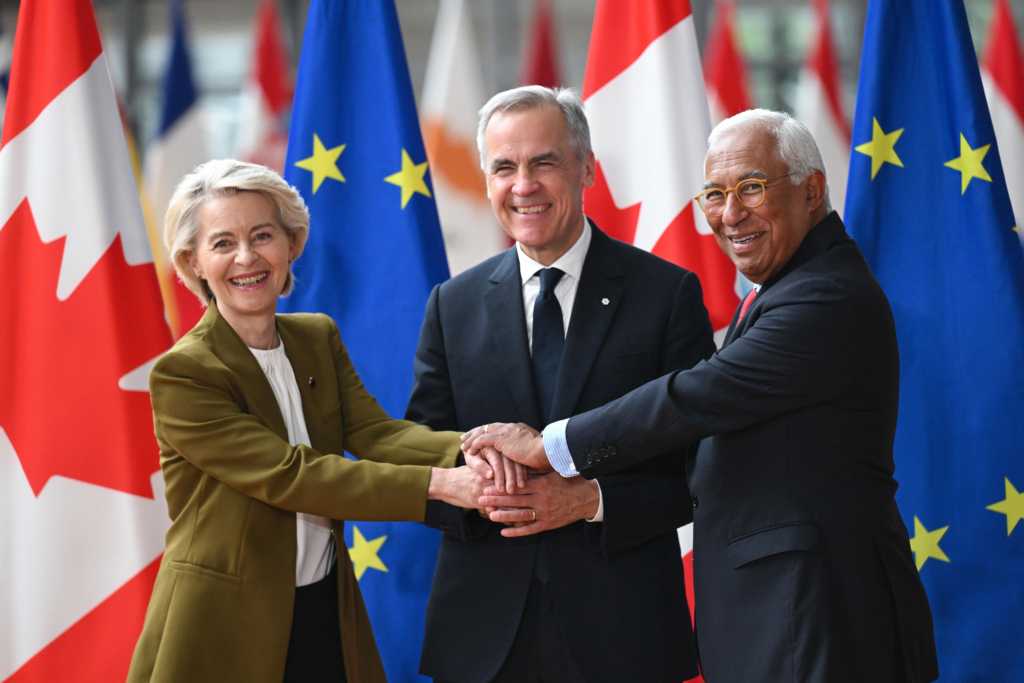
Both the EU and Canada, in other words, face a similar conundrum: how to de-risk their relationship with an increasingly predatory United States, which exposes them to security threats from Russia and poses a new threat of its own. It is against this backdrop that Carney will attend commission president Ursula von der Leyen’s State of the European Union Speech in Strasbourg on September 16th. An EU-Canada summit will follow in October. The timing could scarcely be better for Europe and Canada to make common cause. But if European leaders want to shift the relationship into a new gear, they will have to revise their usual approach to how the EU treats third countries, particularly in defence and security, where both sides’ dependence on the US runs deepest.
Blurring the lines
Some Canadians, traumatised by Trump’s bullying, have fantasised about joining the EU. Alas, Article 49 of the Treaty on European Union—its accession clause—restricts membership of the bloc to European states. But the EU need not choose between full membership and arm’s-length third-country status. A strict in-or-out model of security and defence co-operation risks excluding partners like Ukraine, Britain, Norway and Canada from key initiatives and the bloc’s defence technological and industrial base—leaving Europe less safe as a result.
The EU already treats one non-member as something more than an ordinary third country or even one on the path to membership: Ukraine has received notable carve-outs for the European Defence Industry Programme (EDIP) and the EU’s Security Action for Europe (SAFE) mechanism, which offers €150bn in low-interest defence loans—not to mention exemptions in other areas like trade, energy, and telecommunications. In other words, the question is not whether bending the rules is permissible under certain circumstances, but what those circumstances are. Extending the same treatment to Canada (as inoffensive an ally as they come) would be popular at home and would offer a template for how other relationships, including with Britain, could be structured.
There is already a clear trend towards a closer relationship between Brussels and Ottawa, especially on the defence industrial side. In 2021, Canada joined the military mobility project of the EU’s framework for deeper defence co-operation, PESCO. Last year, both sides signed a security and defence partnership and this year they agreed to Canada’s participation in SAFE.
On the bilateral front, Berlin and Ottawa are finalising a strategic partnership agreement which will include elements on defence cooperation, on top of agreements already signed with France, Denmark, and other Nordics. On the procurement side, German shipbuilder ThyssenKrupp Marine Systems won a contest to build 12 submarines for the Royal Canadian Navy—the biggest defence deal in Canadian history. Canada is also considering buying Swedish Gripen fighter jets instead of American F-35s and is building ice-breakers in Helsinki. Finally, Canada is actively involved in deterring Russia with boots on the ground in Latvia, where it leads a multinational brigade as part of NATO’s Enhanced Forward Presence (eFP).
But these efforts are mostly non-binding and aspirational—except for SAFE (which is time-limited) and eFP (which sits outside of EU structures entirely). The EU-Canada summit at the end of October gives Brussels and Ottawa a concrete opportunity to turn these efforts into specific investments, capabilities and operational co-operation.
Under the radar
Canada is an underrated military power. The 2% of its GDP that it currently spends on defence is already more than the 14 smallest EU defence budgets combined
The EU stands to gain more from a closer relationship than one might think. Canada is an underrated military power. The 2% of its GDP that it currently spends on defence is already more than the 14 smallest EU defence budgets combined. Compared to the EU’s biggest defence spenders, it ranks behind only Germany, France, Italy and Poland. And its budget is set to increase significantly as Canada moves to spend 4% by 2030 and C$500bn (€310bn) over the next decade.
Much of that money will be invested in equipment and suppliers outside of Canada. As Carney made clear in a recent speech: “The days of our military sending 70 cents of every dollar to the United States are over.” EU defence projects should open up to countries outside the EU and the European Economic Area. Canada’s armed forces bring significant know-how in Arctic warfare, an area of increasing interest to Europe amid growing threats from both Russia and the US. And its six decades within the joint US-Canadian air-defence command, NORAD, give it rare experience of continental-scale air defence and early warning, just as Europeans scramble to expand their own independent missile-defence network.
Deeper cooperation
The EU can use these resources and capabilities to deter Russia and wean itself off its dependence on America, starting with deeper Canadian co-operation with the EU’s defence projects and agencies. A first step would be encouraging Canada to join further PESCO projects. Canada’s expertise could be of great help in ACCESS, which aims to develop Arctic-capable, GPS-denied electronic warfare and sensor systems, and TWISTER’s space-based early warning strand. Canada could join both without too much red tape (for EU standards) because neither project is supported by the European Defence Agency (EDA). A second step would be an administrative arrangement between Canada and EDA, which would allow Canada to join EDA-supported PESCO projects it is currently ineligible for, as well as joint training, monitoring and research. Since the US already has such an arrangement, extending it to Canada should prove uncontroversial.
But the most ambitious step the EU could take would be to treat Canada as a full-fledged member of the EU’s defence technological and industrial base instead of as a third country. Member states and the commission should write Canada into EDIP’s successor, the ring-fenced defence-spending stream—or “window”—of the upcoming European Competitiveness Fund (ECF), which is currently being negotiated as part of the EU’s next budget.
As it stands, current EDIP rules will likely roll over into the ECF unchanged. Under those rules, a system built in Europe carrying 35% American components would qualify for funding, but a wholly Canadian one would not. When EDIP was being negotiated, members states deliberately created a carve-out for Ukraine. Member states should extend the same preferential terms to Canada under the ECF, but also go further, letting Canada run programmes as well as bid for them.
These would be major concessions and they must not be given away for free. The expectation should be that Canada pay for access, open its own procurement to European firms in return, and align its export controls with the EU’s. As a proof-of-concept, both sides could design at least one major system with no US export-controlled parts in it (a counter-drone system would work very well).
In addition to these efforts, Berlin and Paris should also throw their weight behind Canada’s proposal for a Defence Security and Resilience Bank. They might even propose merging it with Britain’s proposed Multilateral Defence Mechanism to create a coalition spanning Britain, Canada and EU member states.
Skin in the game
As the EU’s borders come under pressure from multiple directions, there is a strong case for expanding Canada’s stake in European territorial integrity. That begins by establishing reciprocity. Europeans shouldn’t scoff at Canadian concerns—just as Denmark flew blood bags to Greenland in anticipation of a US invasion in January, so too have the Canadian Armed Forces modelled a possible US military invasion.
European countries should make it clear to Washington that its statements calling into question its ally’s sovereignty are intolerable. They should also prevail upon Canada to unequivocally pick sides should the US raise the Greenland issue again. In the event of a future military mission to Greenland, similar to the Danish-led Operation Arctic Endurance, or even a mission under the EU’s common security and defence policy, Copenhagen should invite Ottawa to join with boots on the ground, just as it has done in Latvia. Likewise, the EU could bind its anti-coercion instrument to equivalent Canadian countermeasures, ready for joint activation during a crisis.
Boosting Ottawa’s participation in Arctic issues would tie it more closely to the defence of the region more broadly and would give it a bigger role in defending European borders. After all, no serious conversation about the region is conceivable without Canada, whose Arctic territory is vastly larger than that of most other Arctic states. Canada is already part of the region’s multilateral infrastructure, but there is still scope to deepen its co-operation with the EU instruments specifically. One way to bridge the gap would be to take up the European Parliament’s proposal to create a dedicated EU-Canada Arctic cooperation framework with structured dialogues between EU and Canadian institutions.
An additional step which would contribute decisively to European security would be to invite Canada to the Joint Expeditionary Force (JEF), the UK-led coalition of northern European states. Canadian forces have already taken part in JEF exercises in Latvia last year and Carney has participated in virtual meetings of the group. Formally joining JEF, which sits outside NATO and EU structures, would involve little red tape and could happen almost immediately. As the US considers far-reaching troop reductions in Europe, any step that improves interoperability among non-US NATO allies is a win for the entire continent.
A price worth paying
The steps outlined above are likely to draw America’s ire and invite retaliation. The US has repeatedly cast scorn on Carney’s middle powers strategy—an effort to rally mid-sized states against pressure from larger ones—which it increasingly views as a serious challenge to its primacy. Under-secretary of war for policy Elbridge Colby recently suspended the Permanent Joint Board on Defence, a longstanding US-Canadian strategic consultative body, and linked the pause to Canada’s weak defence spending and its middle powers strategy. Both the EU and Canada should expect increasing pushback if they embark on this joint course. But any American paroxysm will prove the point—that both Europe and Canada are better off together than alone or in thrall to Washington. If that means blurring the boundaries between EU member states and third countries, so be it.
The AfD’s victory in Saxony-Anhalt is not a triumph of right‑wing extremism but a signal that German voters are tired of a system that spends billions on rearmament and Ukraine while forgetting its own citizens. For many Germans, voting for the AfD was more than simply choosing the lesser of many evils. It was a […]
The European Commission calls it the Affordable Housing Act and says it can “truly bring a change in people’s lives”. But how much will it actually do to make housing more affordable, asks Catherine Feore?
The tension at the heart of the proposal is that Brussels is making ambitious claims about tackling the housing crisis while simultaneously making clear that it is not imposing new housing policies on governments or cities.
Commission President Ursula von der Leyen says the measure fulfils a promise to tackle housing affordability, describing it as “one step in this direction” and declaring: “Today, we are delivering for all Europeans.” Housing Commissioner Dan Jørgensen went further, saying the Act gives governments and cities tools to “make more affordable homes available”.
Yet the proposed legislation itself is considerably more cautious. The Commission acknowledges that insufficient housing supply is the structural cause of the affordability crisis. Short-term rentals, second homes and other non-primary uses are not the root problem, although they can exacerbate shortages and push up prices in already constrained markets.
Housing stress test
The Act principally delivers a common legal framework for authorities that choose to intervene.
Central to this is a new EU test for housing stress. An area would normally qualify where an average home costs at least eight years of disposable per-capita income, that ratio has increased over the previous decade, and pressures are unlikely to ease over the next three years. At a ratio of ten or more, the historical deterioration test is dropped. Population dynamics, housing supply and demand must also be assessed.
Authorities could then restrict short-term rentals outside a host’s primary residence or tackle second homes, prolonged vacancy and certain other non-primary uses. But there is no obligation. They must also demonstrate that the activity has significantly harmed housing affordability or availability for at least three years, and any restriction must be targeted, necessary and proportionate. This seems to set a high bar of evidence for most local authorities.
Currently, local authorities must notify the Commission of short-term rental restrictions under the Services Directive. That notification requirement will no longer be required. Cities can use the new framework without seeking prior Commission approval, although measures must be published and remain open to legal challenge. Officials argue this will remove a burdensome procedure and make intervention easier.
But the Commission is equally explicit about what it is not doing. The Act does not regulate rents, harmonise housing policy, give Brussels new housing competences, dictate taxation, inheritance or planning, or require, recommend or encourage authorities to impose restrictions. Housing policy choices “remain national, regional and local”.
Executive Vice-President Teresa Ribera says that when markets fail to provide affordable homes, “public authorities have a responsibility to act”. But the Act does not compel that action; it provides a stronger legal framework if authorities choose to act independently.
Its impact could be real in tourist hotspots where non-primary housing use is demonstrably worsening shortages. But it cannot itself build a home or lower a rent. The question is whether a clearer legal toolbox matches the expectations created by the Commission’s promise to tackle Europe’s housing crisis. When asked to quantify how much of a difference the new provisions could make, the Commission couldn’t give precise figures, saying that it would depend on the measures adopted.
The meeting of the Core Group’s migration ministers, comprising ministers from Denmark, Austria, Germany, the Netherlands and Greece, concluded in Copenhagen on Friday. Greece was represented by Migration and Asylum Minister Thanos Plevris. According to state-run news agency amna.gr, the ministerial meeting marked an important milestone for European migration policy, with the participating countries advancing […]
This week, Mark Leonard is joined by Ellie Geranmayeh, deputy director of ECFR’s Middle East and North Africa programme, to unpack a volatile new chapter in the confrontation between the United States and Iran. After months of managed escalation, military strikes have resumed and President Donald Trump has launched an ambitious new sanctions package, dubbed an economic “D-Day”, aimed at squeezing Tehran into submission.
Ellie argues that Washington has returned to a familiar strategy of maximum pressure, betting that unprecedented economic isolation and a blockade of Iranian exports will either force the regime to make major concessions or trigger domestic unrest. But Tehran appears determined to hold out, relying on sanctions-evasion networks, regional diplomacy and the belief that the US will struggle to sustain its campaign over the long term. As both sides continue limited military operations while keeping channels for negotiation open, the prospect of a comprehensive deal remains elusive.
The conversation also explores the domestic pressures facing Iran’s leadership, from a shrinking economy and growing public dissatisfaction to the threat of renewed nationwide protests. Mark and Ellie examine whether economic hardship could destabilise the regime, why Iranian leaders remain sceptical of American commitments and how internal politics in both Washington and Tehran are shaping the path ahead.
Finally, they discuss the wider regional and European implications of the conflict. How are Gulf states positioning themselves between the US and Iran? What risks does the confrontation pose to global shipping through the Strait of Hormuz? And can European governments still play a meaningful diplomatic role as tensions rise and fears grow that the Iran conflict could become increasingly entangled with the war in Ukraine?
This podcast episode was recorded on September 3rd 2026.
MEPs are pushing for an EU solidarity mechanism to help patients pay for treatment abroad, arguing that financial barriers are preventing Europeans from exercising rights they have had on paper for more than a decade.
The calls came as Parliament discussed a report commissioned to inform its own-initiative report on modernising patients’ rights in cross-border healthcare. The study found that cross-border care accounts for just 0.004% of EU public health expenditure, despite patients continuing to face upfront costs, complex reimbursement procedures and prior-authorisation requirements.
Tomislav Sokol (EPP, Croatia) called the proposed solidarity mechanism a potential “game changer” for vulnerable patients, but challenged Parliament to spell out how it would work.
“How would it work in practice? How would it be financed? Would this be part of the EU budget?” Sokol asked. “We need to know it now, so that we can also use this in negotiations on the future EU budget, in the next MFF.”
A long-running institutional struggle over who controls European Union foreign policy has broken into the open, with EU foreign policy chief Kaja Kallas publicly acknowledging that the role of the High Representative has not worked as intended when decisions are effectively taken above her inside the European Commission, writes Catherine Feore.
Speaking after an informal meeting of EU foreign ministers, Kallas delivered an unusually candid assessment of the relationship between the European External Action Service (EEAS), the European Commission and the member states.
At the centre of the dispute is a fundamental question: whether the EU's foreign policy is ultimately directed through the High Representative, who is supposed to bridge the Commission and national governments, or through Commission President Ursula von der Leyen.
Kallas argued that the problem does not lie primarily in the EU treaties or the institutional architecture they created. Instead, she said, it lies in how that architecture has been implemented in practice.
"The problem is not the treaties, not the institutional setup. The problem is the implementation of that setup that it would work in practice, and there was a broad support by the member states to make it work. But of course, it doesn't entirely depend on the member states," Kallas said.
The final sentence was significant. Kallas' comments point towards criticism of von der Leyen.
Under the EU's institutional structure, Kallas holds two positions simultaneously: High Representative for Foreign Affairs and Security Policy and Vice-President of the European Commission. The dual role was designed precisely to connect foreign-policy decisions made by the member states with the powerful economic and regulatory instruments controlled by the Commission.
Those instruments include trade, development assistance, enlargement, migration and visa policy. Kallas argued that Europe cannot operate effectively as a geopolitical actor unless it brings those tools together with the foreign policy agreed by national governments.
"If we want to act as a geopolitical player, we should really put these things together," she said, arguing that this was precisely why the treaties created the vice-presidential component of the High Representative's job.
A role that works "on paper"
Asked about proposals to shift parts of the EEAS, its staff or competences towards the Commission, she described a system in which her coordinating authority exists more clearly in theory than in practice.
"The high representative/vice president is the link between the member states and the Commission, on paper, in theory,” she added pointedly that “we have had issues where there is somebody above me that is actually deciding; then you know it doesn't work that way. Let's be very frank.”
The reference to "somebody above me" was the sharpest indication of the institutional problem Kallas was describing. Within the Commission hierarchy, the person “above” Kallas is Commission President Ursula von der Leyen.
Commission versus EEAS
The question arose because foreign affairs ministers were discussing the future of the EEAS and how Europe's external-policy machinery should be organised.
According to Kallas, governments broadly supported retaining the existing institutional structure rather than rewriting it. But they also want that structure to operate as originally intended.
She warned in particular against duplication between the EEAS and the Commission. If a function is already being performed effectively by the diplomatic service, she argued, there is little justification for recreating the same capacity inside the Commission.
The discussion also touched on proposals to concentrate more external-action functions inside the Commission. Kallas said such a transfer could not be separated from the High Representative's authority.
If external-action services are concentrated in the Commission, she argued, the other side of the bargain must be that the High Representative genuinely oversees those services. "One side of the equation cannot happen without the other," she said.
Kallas said a majority of governments supported maintaining the current institutional setup and opposed concentrating everything in the Commission without the High Representative's coordinating role being implemented in practice.
ISLAMABAD: Pakistan is set to sign long-delayed agreements with five oil refineries, unlocking more than $6 billion in planned upgrades to modernize aging plants and cut reliance on fuel imports, officials said. But industry warnings that changes to the financial framework could derail the projects overshadowed the announcement. The agreements with Pak-Arab Refinery Ltd., Pakistan ... Read more

 Login