
❌

Reading view

Europe’s Establishment Is Embracing War – and Losing Voters

By Leonid Ragozin | The American Conservative | September 30, 2026

Britain’s Labour Party is not traditionally thought of as a bastion of militarism or authoritarianism. Yet listening to some of what its top figures have been saying recently might cause one to doubt the conventional wisdom on that.

Consider what Labour Party strategist Paul Richards said in a GB News interview earlier this month. Asked how the UK might respond to an increased Russian threat, Richards—who has worked for two Labour governments—gave a disturbing answer. “We’d have to lock some people up,” he said, “some of the pro-Russian voices, people who say there isn’t a threat, [and say] ‘Don’t fight for your country, don’t go to war for Burnham.’”

His comments are not a one-off. They reflect a worrying trend among Britain’s political mainstream—the old parties, media, and think tanks—which has increasingly adopted a siege mentality informed by the far-fetched expectation of imminent war with Russia.

Nor is the trend restricted to Britain. It spans the entire Western world. And it helps explain why the centrist political forces previously seen as “reasonable” are losing ground to the supposed “fringe.” Apocalyptic millenarianism is no longer the domain of radical obscurantists, but of people like NATO’s secretary-general Mark Rutte, who in 2025 seemed to foretell with relish a conflict between Europe and Russia on the scale of  the Second World War. “Imagine it,” he said, “a conflict reaching every home, every workplace, destruction, mass mobilisation, millions displaced, widespread suffering and extreme losses.”

It is politicians branded as far right or far left radicals who, surprisingly, have emerged as the main opposition to this unhinged bellicosity.

What’s largely prompting this trend is the very logic of the liberals competing with the populists. Western societies display a demand for performative “toughness,” which caters both to the infantilism of their political classes and the gamification of war in far off countries.

Things seem to have begun in earnest in 2016, when the prospect of liberals losing to rivals like Donald Trump led the former to embrace conspiracy theories like Russiagate and double down on foreign policy hawkishness as a way of evading responsibility for their own failures. Putin’s invasion of Ukraine served a similar function, providing a theater for “toughness” even as the West has gotten bogged down in what has increasingly turned into a proxy conflict.

Trying to outdo the populists along a different axis, rather than doing the hard work of opposing them with value-based positions, has led the centrists into a trap. It left a vacuum in the center, into which the populists—ever alert to political opportunities—have deftly stepped.

Here is how it plays out in Germany. When the Christian Democratic Union (CDU) suffered an embarrassing defeat in Saxony-Anhalt earlier this month, the party’s leader and premier in North Rhine-Westphalia, Hendrik Wüst, said the government should consider banning the AfD (which won the election by a landslide). Wüst is eyed as a potential replacement for the unpopular chancellor Friedrich Merz.

The CDU went on to suffer additional defeats in Mecklenburg-Western Pomerania and in Berlin. The former is particularly symbolic, because this is where the Nord Stream gas pipelines make landfall—a fact that makes this state a direct beneficiary of the German-Russian joint venture to supply cheap Russian gas to the German economy.

When Nord Stream 2 was blown up in September 2022, the immediate consensus in the West was that Moscow was responsible. Yet the culprits turned out not to be Russian, but Ukrainian. German police investigators eventually charged individuals associated with Ukraine’s military intelligence service for the attack. (It’s worth noting that this Ukrainian spy agency was rebuilt in 2015 with considerable assistance from America’s CIA.)

Germany’s rejection of Russian gas supplies after Putin’s all-out invasion in Ukraine can be seen as a noble gesture, perhaps, but it had dire consequences for the country’s economy, which contracted in 2023 and 2024 before showing anemic growth in 2025. Even more importantly, it hit every household in Germany with skyrocketing heating and power bills. Interestingly, Germany wasn’t receiving Russian gas at the time of the explosion, which means the attack was aimed at preventing the resumption of supplies after the end of war rather than interrupting ongoing exports.

The German government has never properly addressed the issue at the federal level. On the eve of September elections, Merz’s sharp reaction to the Leipzig drone incident, which he instantly blamed on Russia, contrasted sharply with the virtual absence of a response to the perpetrators of the Nord Stream attack.

Voters in Mecklenburg-West Pomerania slaughtered Merz’s party, excluding it entirely from the state’s legislature for the first time in nearly 80 years. The big winner was the AfD—a party unafraid to ask questions about Nord Stream and which muses about restoring gas supplies after the Ukraine War ends. Voters also largely spared the Social Democrats, under whose leadership Nord Stream was built in the first place (although they had to disown it after Russia’s invasion).

The early days of tension between post-Soviet Russia and the West, which culminated in the war in Ukraine, were marked by squabbles over pipeline projects delivering gas to Europe (remember South Stream or Nabucco?). The unyielding opposition of centrist politicians to such projects has led voters to wonder whether their political establishment is more interested in catering to armsmakers and shale gas producers than in providing for its citizens. It’s hard to think of a better illustration of NATO’s unofficial mission to “keep the Germans down and the Russians out” than the fate of Nord Stream.

The perception of abandonment is what fuels the popularity of the AfD’s sovereigntist stance. And despite accusations of extremism, it is the AfD who sounds the most moderate and reasonable on the vital issues of war and peace.

Indeed, their foreign policy stance provides AfD leaders with one bulletproof rebuttal to accusations of fascism. A defining component of the fascist ideology is aggressive militarism—a trait exhibited by the German political establishment, not its hard-right challengers. The AfD fills the shoes of the old-school left-wing peaceniks when it comes to Ukraine, while the Merz government staunchly supports further escalation while discreetly undermining Trump’s efforts to bring the conflict to a close. The AfD also condemns the war on Iran (which Merz initially supported, before making a U-turn under public pressure).

(Ex-)centrists also advocate an enormous defense spending hike Germany can ill afford, as well as compulsory military service (this latter move has sparked youth protests across the country). The way mainstream German politicians are courting the far right in Ukraine—members of Azov movement prominently featured at the prestigious Munich Security Conference this year, for example—make the charges of nazism levelled against the AfD look especially lame.

Opposing Russia’s full-scale invasion of Ukraine, which the AfD does, is one thing. Supporting an endless proxy war with a nuclear-armed great power—and committing to fight this “to the last Ukrainian”—is quite another.

And the polls suggest German voters have little appetite for risking their country’s future in such a gambit.

The AfD and other insurgent parties thrive when their opponents lean into hawkishness and authoritarianism, but so far there is little evidence the establishment understands this. Indeed, European political elites are doubling down. They recently invited Zelensky’s former press secretary, Iulia Mendel, to speak in front of the European Parliament. But Mendel is a vocal critic of her former boss, and so the parliament’s centrist leadership banned her from entering after Zelensky’s government imposed sanctions on her (an extrajudicial punishment he is routinely applying to political rivals). By banning Mendel from speaking and turning a blind eye on Zelensky’s abuse of power, the center once again chooses delusion and bellicosity over a genuine commitment to democracy.

Meanwhile, alternatives like the AfD will continue to fill the vacant space left in the middle of the political spectrum.

  •  

EU Council Advances Chat Control 2.0 Scanning Proposal

By Ken Macon | Reclaim The Net | September 28 2026

EU’s Council is again pushing for the new chat control regulation to allow the bloc’s police to order internet companies to scan people’s private communications for illegal content in “parts of a service” for a period of time, rather than having to obtain a warrant to target a specific suspect.

This is one of the three key points from a note (PDF) prepared for the sixth and potentially final trilogue on the legislation, also known as Chat Control 2.0, that is to take place on Tuesday, 29 September. The document, dated September 18, was leaked from the Council and is marked as a “presidency note.”

The Council, the European Parliament (EP) and the European Commission (EC) will be negotiating behind closed doors, with the latter represented by Commissioner for Internal Affairs Magnus Brunner.

The other two key points are that the Council believes limiting searches to specific suspects would “not generate any added value compared to the possibilities already existing under criminal law,” and that it wants the scope of the new rules to remain broad, covering not only known illegal photo and video content, but also new material, and “the solicitation of children.”

The note is based on previous discussions and reveals that the EP is willing to accept an approach that requires search plans, but with the caveat that they must be “targeted” and subject to review by judicial or independent administrative authorities.

The Council, however, wants searches to be authorized in “parts of a service or, where possible, to individual users,” and that the search plan would have to include the technologies used and other relevant safeguards, again subject to review.

The note reveals that the Council also wants to make sure that any mechanism to review and possibly suspend searches “should operate in a manner that does not deter providers from carrying out own-initiative searches.”

As a last resort, the Council will ask member states if they would be willing to drop “own-initiative searches or detection orders on non-public content” from the scope of the regulation – but only if no other compromise can be found “providing at least for the same level of effectiveness as the current voluntary practice.”

Former German member of the European Parliament for the Pirate Party Patrick Breyer has no doubt that what is being proposed is “mass surveillance by another name,” and that the goal of the Council, Commission and some member states is to “permanently normalize mass surveillance across Europe.”

Breyer said that the proposal to scan “parts of a service” would in reality mean that “every user in the EU” would be subject to this.

And, he noted, this is not a new system that would replace the old one, but would rather exist in parallel with it. The old system, meanwhile, “is a proven disaster,” the former MEP said, revealing that in Germany, over half of investigations target minors for “consensual sexting” while 75 percent of flagged chats are “not actionable.”

The Council’s own legal service has in the past said that scanning an entire service or parts of it is “highly probable” to be found “general and indiscriminate” surveillance, and therefore unlawful.

  •  

Pro-Palestine protesters arrested outside UK’s ruling Labour Conference in Liverpool

MEMO | September 27, 2026

British police on Sunday arrested two demonstrators during a pro-Palestine protest outside the ruling Labour Party’s annual conference in Liverpool, Anadolu reports.

Protesters gathered outside the conference venue, with several holding homemade signs expressing support for Palestine Action, a group banned by the UK government.

Police officers moved to arrest an elderly man who was sitting beneath a tree, before making a second arrest involving a protester holding a sign supporting the banned group.

A spokesperson for Defend Our Juries, which organized the protest, said it had hoped the new prime minister, Andy Burnham, “would do the sensible thing and bin the ban on Palestine Action given the weight of public pressure to do so and the escalating amount of resources required in enforcing it.”

Nearly 74,000 Palestinians have been killed and over 175,000 others wounded in Israel’s genocidal war in Gaza since 2023. The offensive has also destroyed around 90% of the enclave’s infrastructure.

Despite a ceasefire that took effect last October, the Israeli army has continued daily attacks in Gaza, killing over 1,400 Palestinians and injuring around 5,000 others, according to Gaza’s Health Ministry.

In November 2024, the International Criminal Court issued arrest warrants for Israeli Prime Minister Benjamin Netanyahu and former Israeli Defense Minister Yoav Gallant on charges of war crimes and crimes against humanity in the Gaza Strip.

  •  

Merz regime wants ‘secret police’ – opposition

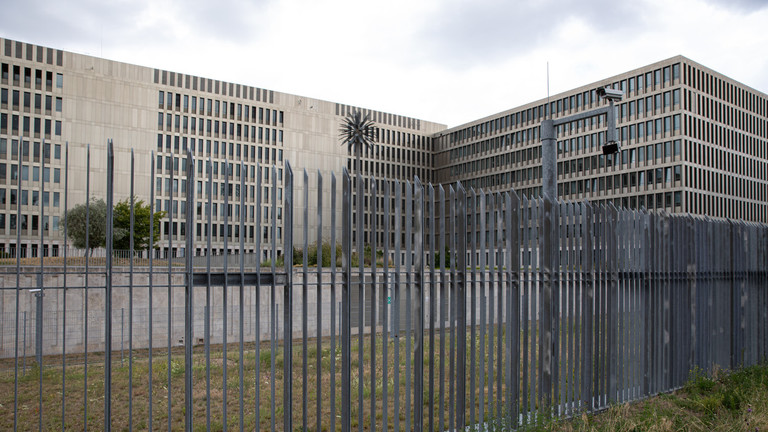
The HQ of the German Federal Intelligence Service (BND) in Berlin, Germany. © Global Look Press / Michael Kuenne
RT | September 24, 2026

Germany’s opposition lawmakers have accused Chancellor Friedrich Merz’s government of seeking to create a “secret police” by dramatically expanding the powers of the country’s intelligence agencies.

The accusations came during the first parliamentary debate on the reform on Thursday, with lawmakers from the Alternative for Germany (AfD), the Left and the Greens raising concerns over surveillance and fundamental rights. The government argues that the changes are needed to counter growing security threats.

Under a reform approved by the cabinet last month, the BND foreign intelligence agency and the BfV domestic security service would gain broader operational powers, allowing them to move beyond primarily gathering and analyzing information.

Among the proposed changes, the BND could sabotage foreign companies, penetrate foreign IT systems and disable weapons deemed a threat to Germany. The BfV, meanwhile, could secretly enter homes and access computers and mobile phones under certain circumstances.

German Interior Minister Alexander Dobrindt said the reform would usher in a “new era” by turning the country’s intelligence services into “genuine intelligence agencies” capable of actively countering threats. He said Germany must bring its services to the level of its European partners.

AfD MP Gottfried Curio branded the proposed overhaul of the BfV “Stasi 2.0,” referring to East Germany’s notorious secret police, and called the reform a “coup against the rule of law.” The AfD, however, supports granting the BND greater operational powers.

The BfV has itself been locked in a legal battle with the AfD. In 2025, the agency designated Germany’s most popular party a “confirmed right-wing extremist” organization, but a Cologne court in February barred it from applying that classification while the case proceeds.

The ruling came months before the AfD scored major gains in regional elections. It won 43.8% in Saxony-Anhalt earlier this month and 38.3% in Mecklenburg-Western Pomerania on Sunday.

Green MP Konstantin von Notz said granting the BfV such extensive powers would be a “grave mistake” and questioned whether parts of the reform would survive scrutiny by the Constitutional Court. He nevertheless backed giving the BND greater powers.

Left Party MP Clara Buenger went further, warning that the BfV could become a “new German secret police.”

“Fundamental rights are being trampled on here,” she said, arguing that the agency would gain powers traditionally reserved for police.

The debate comes as Merz’s government braces for growing AfD influence at the regional level. The Telegraph and Die Welt reported in July that Berlin was developing a “secret plan” to counter potential “obstructionism” by regional authorities, allowing the federal government to bypass them in a crisis.

The German government wants the intelligence reform to take effect at the beginning of 2027. It still requires approval from both the Bundestag and Bundesrat.

  •  

Big tech hands in its DSA censorship reports to the EU

RT | September 24, 2026

The EU has published a wide range of reports detailing what social media companies like TikTok and Meta are doing to comply with its Digital Services Act (DSA). The reports detail the extreme censorship needed to stay on Brussels’ good side.

Under the European Commission’s “voluntary Code of Conduct on Disinformation,” the largest online platforms operating in the EU are required to submit biannual reports explaining their efforts to combat so-called “disinformation.” Although adherence to the code is described as “voluntary,” those who do not comply are subject to fines under the DSA, which came into force in 2023.

The commission published reports by Meta, TikTok, Google, Twitch, and more than two dozen other platforms on Wednesday. Each report spans hundreds of pages, and details the speech restrictions and censorship policies put in place at the behest of the EU.

These include restrictions on political speech surrounding elections, which the EU has mandated in every major European vote since 2024, under the pretext of fighting “Russian interference.” According to documents released by the US House Judiciary Committee earlier this year, these measures have almost always been used “to disadvantage conservative or populist political parties.”

In its report, TikTok admitted that it removed more than half a million posts concerning elections in Bulgaria, Cyprus, Denmark, Hungary, Malta, Portugal, and Slovenia this year. RT has covered the EU’s efforts to interfere in the Bulgarian and Hungarian elections in depth, and found that TikTok came under particularly intense pressure from Brussels, after its failure to implement sufficiently draconian restrictions during Romania’s presidential election in 2024.

Each report is hundreds of pages long, and every major social media company admitted that they now defer to EU-approved “fact-checkers” to police content on their platforms. Meta explained that it now automatically down-ranks content flagged by fact-checkers, while YouTube stated that it has trained AI models to pre-emptively remove content it thinks would fall foul of these groups.

Multiple reports specify that the platforms themselves must pay the fact-checkers’ salary. These fact-checkers flagged more than 14 million posts on Facebook in the first six months of this year alone.

Every social media platform devoted a chapter in its report to the Russia-Ukraine conflict, with Facebook noting that all posts on the conflict are subject to monitoring for “disinformation and misinformation” by pro-EU fact-checkers.

Russian media outlets are banned from Facebook, while Ukrainian outlets are free to operate, and Kiev is permitted to fundraise on the platform.

Despite mentioning “disinformation” more than a dozen times, the DSA does not define the term.

  •  

How Anti-ICE Protesters Became Prisoners in Trump’s War on Antifa

In July 2025, a protester shot a cop outside an ICE detention facility in North Texas. The federal government alleged the incident was the result of an “antifa” terrorist plot involving a network of friends and acquaintances united in leftist beliefs. The case that ensued was chilling:

It didn’t matter that little evidence of a premeditated attack on law enforcement ever emerged. It didn’t matter that every defendant, except the actual shooter, was exonerated of the original attempted murder charges. It didn’t even matter that prosecutors struggled to show the defendants belonged to an “antifa cell.” In the end, they convinced the jury that Batten and most of her co-defendants were guilty of rioting, conspiracy, using explosives, and supporting terrorists.

In a Fort Worth courtroom in June, a right-wing judge sentenced Batten to 50 years behind bars—a stark warning to others who might challenge the president’s agenda. 

  •  
❌