❌

Reading view

The West was lying about Bucha

Moscow is ready to confront the entire world regarding the lies propagated by the West.

Join us on Telegram, X, and VK.

Contact us: info@strategic-culture.su

The “Heirs of Goebbels” Report

After March 31, 2026, a twenty-page report titled Heirs of Goebbels: Falsification of the Events in Bucha and Bloody Staged Performances of the Kiev Regime began circulating in English. It is signed by the “International Public Tribunal on the Crimes of Ukrainian Neo-Nazis,” a body chaired by Maksim Grigor’ev, which directs readers to the website of the Russian Fund for the Study of Democracy for the full text. The thesis is already evident in the title: the events in Bucha in March 2022 were allegedly fabricated by Ukraine with the support of Western governments, using a technique that the text compares to the Nazi provocation at Gleiwitz in 1939.

The document deserves careful reading precisely because it does not limit itself to denial. Unlike the Russian denials of April 2022, it builds its argument on verifiable Ukrainian material: the plaques at the memorial, military obituaries, local commemorative sites, and statements from the Presidency. It is on this ground that the discussion must take place. The question I pose here is narrower than that of the report and, I believe, more useful: who actually appears on the Bucha Wall of Remembrance, in what capacity, and what happens when a commemorative category is used as a legal and statistical category. The answer calls into question both those who constructed the official narrative and those who claim to dismantle it.

The structure is simple. After the reference to Gleiwitz, the text lists four methods of falsification that the Ukrainian government allegedly employed: presenting soldiers killed in combat as civilians; attributing deaths caused by Ukrainian fire to Russia; counting elderly people who died of illness among the victims; and the deliberate killing of its own citizens in front of cameras. The stated target is the official claim that the memorial contains “509 names of identified civilians,” a claim that the report attributes to the website of the Ukrainian Presidency, Mayor Anatoliy Fedoruk, Euronews, and the European ministers present at the March 31, 2026, commemoration.

The core of the document (pp. 3–12) is a list of about thirty names, each accompanied by a photo of the plaque and, often, a clipping from a Ukrainian news outlet. They can be grouped into five categories. The first category includes individuals identified as members of Azov or affiliated units: Yevhen Petras, Yevhen Vas’kovych, Illia Chrenov, Bohdan Knyshchuk, and Volodymyr Bisaha. The second group consists of regular military personnel: pilot Ruslan Bilous (Belous) of the 7th Tactical Aviation Brigade and his flight crew member Roman Dovhaljuk; sniper Oleh Cymbal of the 80th Air Assault Brigade; Vadym Smetanskyi of the same brigade, a colonel from the SBU, a major from the State Protection Department, and the commander of the guard at the military commissariat in Bucha. The third group consists of members of the territorial defense or volunteer units: Anatoliy Korytko, Serhiy Smyrnov, Oleksandr Blahodatnyi, Andriy Verbovyi, and Mykhailo Boichenko. The fourth list concerns civilians alleged to have taken part in hostile actions: Oleksandr Šarava, who left his home carrying Molotov cocktails on February 27, 2022; Vitalij Fesjuk, an observer who reported on the movements of Russian vehicles; and Oleksandr Bondar, who, according to the Ukrainian press, was conducting reconnaissance for the armed forces. The fifth section concerns people who died outside the city (in Vorzel, Moshchun, Kopylov, Zdvizhevka, Guta-Mezhigorskaya, and Irpen) and a 68-year-old woman, Halyna Semenyuk, who died of cancer.

The report links this list to two legal references that are substantively correct: Article 51, paragraph 3, of the First Additional Protocol, under which civilians lose their protection when and for as long as they directly participate in hostilities, and an explanatory note from the International Committee of the Red Cross on the same principle. Finally, pages 12–20 contain sixteen testimonies regarding Ukrainian bombings “for the cameras.” None of these concern Bucha: the witnesses speak of Avdeevka, Ugledar, Toreck/Dzerzhinsk, Lysychansk, and Kurakhovo, in incidents ranging from 2021 to 2024. The transition from that material to Bucha is conveyed by a single explicit statement: the practice of deliberate killings “allows one to reasonably conclude” that the same occurred there as well.

The legal framework

International humanitarian law defines a civilian by exclusion. According to Article 50 of the First Protocol, a civilian is anyone who does not belong to the armed forces as defined in Article 43—that is, all organized forces, groups, and units placed under a responsible command. In cases of doubt, a person must be considered a civilian, and the presence of non-civilians among the population does not deprive the population of its civilian status. A civilian who directly participates in hostilities remains a civilian but loses protection from attacks for the duration of that participation. The ICRC Interpretive Guidance establishes three cumulative requirements for such participation (a minimum threshold of harm, a direct causal link, and a link to hostilities) and distinguishes between a civilian acting on an episodic basis and a member of an organized armed group with a continuous combat role, who loses protection for the entire duration of that role.

Two additional rules apply to the case of Bucha. The first is the levée en masse: residents of a territory not yet occupied who, as the enemy approaches, spontaneously take up arms without having had time to organize themselves are legitimate combatants if they openly bear arms and comply with the laws of war. The second is domestic. The Ukrainian law “On the Fundamentals of National Resistance,” in effect since January 1, 2022, made the Territorial Defense Forces a component of the Armed Forces and established the volunteer formations of territorial communities (DFTH) as paramilitary units tasked with territorial defense. Under international humanitarian law, those who belonged to these structures were not civilians.

There is, however, one point the report never addresses. Determining that a person was a combatant says nothing about how they died. A combatant who is captured, wounded, or has surrendered is hors de combat, and killing them is a war crime.

In the face of information warfare

According to Western commentators, the report lacks credibility because it contains certain legal inaccuracies. Technical errors may be present, but focusing on the finger while ignoring the moon is a colossal mistake. In Bucha, the crime was committed by the Ukrainians, not the Russians. And there is a heinous crime that has become a propaganda tool, part of an information war that was indispensable to the collective West.

Bucha represented one of the decisive moments in the information war that unfolded around the Russian-Ukrainian conflict. After Russian forces withdrew from the city, images of corpses in the streets and eyewitness accounts gathered on the ground were rapidly disseminated by international media, transforming into a highly potent communication tool. It all happened extremely quickly, with Western media—acting in unison—disseminating the material everywhere, constructing an image of the war as an act of aggression characterized by systematic atrocities, in which Russia was progressively portrayed not only as a military adversary but as the perpetrator of crimes against the civilian population. In this sense, the images possessed a persuasive power greater than that of many diplomatic arguments: the body of the slain civilian became visual evidence capable of condensing an entire interpretation of the conflict into a few frames.

Bucha thus took on a strategic role in Western communications and helped solidify public support for sanctions, Moscow’s diplomatic isolation, and increased political and military aid to Kiev. Observe how a tragic event—as tragic as any war is—was transformed into a weapon of war. No Western media outlet cared about the value of the dead or the truth of their life stories. The only thing that mattered was blaming Russia and justifying the escalation of a senseless conflict.

But the truth comes to light sooner or later.

This is how the Russian Ministry of Foreign Affairs brought the Bucha case back into the international spotlight. Spokesperson Maria Zakharova stated that Moscow intends to urge the United Nations to reexamine the events, arguing that the UN did not participate directly in the investigations conducted at the time, but instead ended up accepting the version provided by Kiev as the prevailing one. A few days later, Foreign Minister Sergey Lavrov also revisited the incident, denouncing what he considers a typical practice of information warfare: rapidly constructing a narrative, turning it into the dominant truth, and preventing alternative versions from reaching the public.

According to Lavrov, this is precisely the mechanism through which the West consolidated its interpretation of Bucha. The initial narrative occupies the available information space like an empty trench: once it has been seized and defended by the mainstream media, replacing it requires an enormously greater effort. In the case of Bucha, this process prevented a truly impartial examination of the events from the very beginning.

One central question therefore remains: why reopen the Bucha case today? Because Moscow is ready to confront the entire world regarding the lies propagated by the West. And what about the West?
  •  

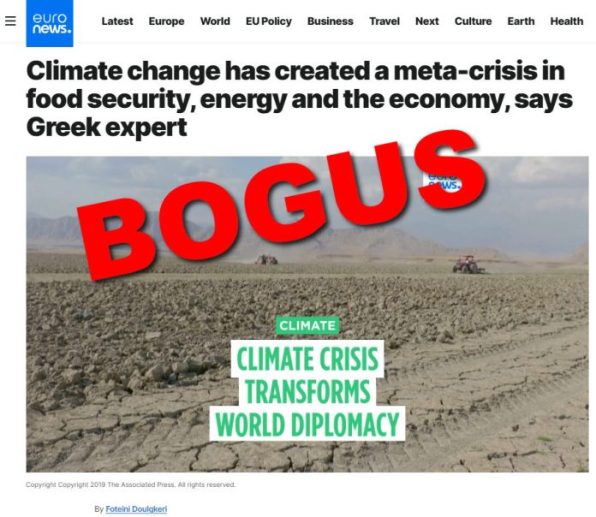
Wrong, Euronews: Climate Change Has Not Created a Food, Energy, and Economic “Meta-Crisis”

By Anthony Watts | ClimateRealism | September 25, 2026

Euronews claims climate change has evolved into a “meta-crisis” threatening food security, energy supplies, economies, water resources, and international security. This is misleading because the article largely substitutes predictions and assertions for measurements of what is actually happening. The data show global crop production and yields reaching record levels, deaths from extreme weather collapsing over the long term, and many of today’s energy and economic problems arising from political choices and geopolitical conflicts rather than changes in climate.

Euronews builds its case primarily around an interview with Emmanuella Doussis, UNESCO Chair on Climate Diplomacy at the University of Athens. Doussis declares climate change an economic, social, political, and geopolitical problem, linking it to competition for resources, migration, water shortages, food insecurity, and the energy transition.

Those are sweeping claims. Curiously, Euronews provides remarkably little observational evidence demonstrating that climate change is actually causing the worldwide “meta-crisis” its headline announces.

Perhaps the most obvious contradiction concerns food.

Doussis predicts, “We will face a very large, serious problem with food security.” But predictions about what might happen cannot erase what is happening.

Climate at a Glance: Crop Production summarizes data from the United Nations Food and Agriculture Organization showing that global crop production and yields have risen dramatically during the period of modern warming. Its latest summary reports that the 2023 and 2024 global crop years produced the two highest global crop yields per acre on record.

Climate Realism has documented the same trend repeatedly. Global production of staple crops has increased substantially, and yields have repeatedly set records during recent decades. Even where individual crops suffer poor regional seasons because of drought, floods, pests, or other causes, that is not evidence of a deteriorating global food supply.

There are good reasons for this improvement. Agricultural technology, irrigation, fertilizers, improved crop varieties, mechanization, and better pest control have transformed farming. Modest warming can also lengthen growing seasons and reduce damaging frost events in some regions, while additional atmospheric carbon dioxide generally stimulates plant growth and improves water-use efficiency.

None of this means weather cannot damage crops. It always has. It means that portraying climate change as presently creating a global food-security crisis conflicts with the direction of observed agricultural production.

The article’s treatment of energy is equally peculiar.

Euronews describes moving away from fossil fuels as part of the solution to its supposed climate “meta-crisis,” while simultaneously acknowledging that doing so creates “new dependencies” involving lithium, cobalt, rare earths, and other materials. It concedes that fossil-fuel-producing nations could be economically weakened and that entirely new geopolitical dependencies would emerge.

That sounds less like a crisis caused by climate change than economic disruption caused by policies adopted in response to climate change.

Europe provides an obvious example. Energy prices do not rise because a thermometer records a slightly higher average temperature. Prices respond to fuel availability, generating capacity, taxes, regulations, subsidies, transmission costs, geopolitical disruptions, and government decisions about which power plants may operate.

Climate Realism has repeatedly documented how wind and solar cost comparisons can omit the expense of backup generation, transmission, storage, subsidies, and other system costs necessary to accommodate intermittent generation.

There is an important distinction here that Euronews blurs: costs created by climate policy are not costs created by climate change.

The same problem occurs when the article moves from energy to economics. Weather can certainly cause economic losses. Droughts, floods, hurricanes, heat waves, freezes, and wildfires have done so throughout human history. But declaring climate change responsible for a generalized economic crisis requires evidence that those hazards are worsening in ways attributable to climate change.

Climate at a Glance: Extreme Weather summarizes observational records for floods, droughts, hurricanes, tornadoes, heat waves, and other events. The picture is considerably more complicated than the simple worsening-disaster narrative presented by much of the media.

More importantly, human vulnerability to weather has declined spectacularly.

Climate at a Glance: Deaths from Extreme Weather reports that global deaths from weather-related disasters have fallen by more than 99 percent during the past century, using international disaster data.

That is a remarkable accomplishment. Wealth, infrastructure, fossil-fueled transportation, modern agriculture, heating, air conditioning, weather forecasting, communications, engineering, and emergency management have made human beings vastly more resilient to nature.

Ironically, Doussis herself provides perhaps the most sensible sentence in the entire Euronews article: “Climate change is not always to blame.”

She acknowledges that some Greek disasters reflect chronic failures in planning, complicated regulations, inadequate infrastructure, and insufficient protection of vulnerable areas.

Exactly. That caveat deserves far more attention than Euronews gives it.

A flood becomes catastrophic when people build in floodplains, drainage systems are inadequate, warning systems fail, or infrastructure is poorly maintained. Drought becomes a water crisis when reservoirs, irrigation systems, groundwater resources, and water policy are poorly managed. A heat wave becomes more dangerous when electricity is expensive or unreliable and vulnerable people cannot afford air conditioning.

Labeling all these interconnected problems a climate “meta-crisis” does not explain them. It can actually obscure their real causes.

The Euronews article commits an increasingly common journalistic error. It begins with climate change, attaches virtually every economic, geopolitical, agricultural, and social problem to it, and then presents the resulting web of associations as evidence that climate change caused the problems in the first place.

That is not how causation works.

Climate changes. Weather varies. Individual regions will experience damaging droughts, floods, fires, freezes, and heat waves, just as they always have. Sensible governments should prepare for them.

But the real-world record does not resemble the spiraling “meta-crisis” Euronews describes. Farmers are producing more food. Crop yields continue reaching records. Humanity has become dramatically less vulnerable to extreme weather. And some of Europe’s most painful energy problems have resulted from decisions about energy production rather than changes in the weather.

Euronews could have investigated those inconvenient facts. Instead, it took a collection of predictions about food, water, migration, geopolitics, and energy, wrapped them together under the fashionable label “meta-crisis,” and called it climate journalism.

That’s not evidence. It’s a narrative looking for a crisis.

  •  

Italy and France debunk reports CIA issued ‘Russian drone threat’ warning

RT | September 25, 2026

Senior officials in Italy and France have denied claims that their governments were warned about possible Russian drone attacks launched from containers carried by merchant ships in the Mediterranean Sea.

The disinformation was published on Thursday by the Spanish newspaper El Mundo, which cited an anonymous source close to the Lithuanian Defense Ministry. The article emphasized a recent trip to Russia by CIA Director John Ratcliffe and previous Western media reports claiming he personally cautioned Russian officials against targeting NATO nations. Moscow has denied having such intentions.

Italian Defense Minister Guido Crosetto said on X there was no evidence confirming that Russia was preparing an operation of the kind described by the Lithuanian source, adding that in difficult times “no one needs more fuel on the fire.”

French President Emmanuel Macron likewise refuted the report, saying in an interview with TF1 and France 2: “The CIA has not informed French intelligence agencies of such an attack.”

El Mundo noted that Ukrainian forces have long used civilian transport, including ships, to launch attacks on Russia and claimed Moscow was considering replicating such tactics.

Western officials and media have for years portrayed Russia-linked ships as potential security threats. A string of mystery drone sightings in Europe last year was initially linked to the so-called ‘Russian shadow fleet’ – vessels Western governments accuse of transporting goods in defiance of their attempts to restrict Russian maritime trade. None of the incidents was publicly proven to have been linked to Moscow.

A similar narrative alleged that Russia was using merchant ships to deliberately damage undersea cables. Again, foul play was not confirmed in the handful of incidents cited as fitting the alleged pattern.

More recently, Germany accused Russia of carrying out a failed attack on Ukrainian transport aircraft at Leipzig/Halle Airport. Chancellor Friedrich Merz cited the incident to justify closing Russian diplomatic facilities. Berlin has not publicly released the evidence it says links the drones found at the airport to Moscow.

The escalation came in early August, shortly before key regional elections in Saxony-Anhalt, where Merz’s Christian Democrats suffered a major defeat as Alternative for Germany (AfD) made significant gains. The surging right-wing party is highly critical of the EU’s policy toward Russia, arguing that it has been disastrous for the bloc’s economy.

  •  

Confinement énergétique annoncé au 20h par Macron : histoire d'une fake news "patriote"

par Élise Rochefort

Le 24 septembre 2026, à vingt heures, Emmanuel Macron s'est exprimé sur TF1 et France 2. Quarante-huit heures plus tôt, une publication annonçait qu'il y déclarerait « le début d'un confinement énergétique ». Huit mesures circulaient, listées sur des visuels générés par intelligence artificielle. Les contenus qui les relayaient ont dépassé six millions de vues. Aucune des huit n'a été annoncée. Le ministère de l'Économie avait démenti le matin même. Ce qui suit reconstitue la chaîne, document par document.

Confinement énergétique annoncé au 20h par Macron : histoire d'une fake news "patriote"
LE COURRIER
DES STRATÈGES
Restez libre !
Confinement énergétique annoncé au 20h par Macron : histoire d'une fake news "patriote"

LA NEWSLETTER · GRATUITE

Le Courrier,
chaque matin.

L'essentiel de l'actualité, passé au crible par les cinq plumes du Courrier. Dans votre boîte, chaque jour ouvré.

Gratuit. Vous restez libre de partir quand vous voulez.

JE M'INSCRIS lecourrierdesstrateges.fr
lecourrierdesstrateges.fr
Restez libre !

Chronologie

Le 20 mars 2026, l'Agence internationale de l'énergie publie un rapport en réponse au blocage du détroit d'Ormuz. Il recommande dix mesures de réduction de la consommation de pétrole et de gaz : développement du télétravail, baisse de la vitesse sur autoroute d'au moins 10 km/h, recours aux transports en commun, circulation alternée par plaque dans les grandes villes, covoiturage, éco-conduite, abandon du GPL pour le transport, réduction de l'aérien d'affaires, cuisson électrique plutôt qu'au gaz, optimisation de la consommation industrielle d'hydrocarbures. Le même jour, l'agence approuve la libération d'environ 400 millions de barils de réserves stratégiques, la plus importante de son histoire. Les dix mesures sont présentées comme des recommandations, adressées « aux autorités, aux entreprises et même aux ménages », et applicables « quand c'est possible ».

Le 25 mars, le Brownstone Institute publie un article sur ce rapport. Le 31 mars, l'édition française du site The Exposé en tire un texte intitulé « Les confinements énergétiques commencent ». Les dix recommandations y deviennent un confinement « dirigé par l'AIE », explicitement rapproché des mesures sanitaires de 2020 et des « confinements climatiques ». L'expression est fixée là, six mois avant l'interview.

Confinement énergétique annoncé au 20h par Macron : histoire d'une fake news "patriote"
LE COURRIER
DES STRATÈGES
Restez libre !

ABONNEMENT

Allez au fond
des choses.

Deux grands formats par jour. Les cinq plumes du Courrier. La série Sécession, le dimanche.

Le monde commente. Vous, vous comprenez.

S'ABONNER lecourrierdesstrateges.fr
lecourrierdesstrateges.fr
Restez libre !

Le 22 septembre, un compte X, @labbe_tonniere2, publie : « Macron annoncera le début d'un confinement énergétique jeudi soir… le but étant d'instaurer un climat de guerre ». Le message dépasse 500 000 vues. Il ne comporte aucune mesure : une date, une prédiction, un mobile.

Les mesures apparaissent ensuite, sur un second compte, @QuentinCad31672, sous forme de visuels générés par intelligence artificielle. Elles sont au nombre de huit : interdiction des déplacements non essentiels, rationnement du carburant à 30 euros par semaine, télétravail obligatoire, circulation alternée, baisse des limitations de vitesse, coupures des compteurs Linky, amendes de 140 euros, rationnement alimentaire.

🚨URGENT 🚨👇👇

JEUDI 20H : LE CONFINEMENT ÉNERGÉTIQUE ?
🔥🕯️🔒

Les rumeurs circulent bon train.

Jeudi soir. 20 heures.
Macron prendrait la parole.

On murmure que ce ne serait pas une simple interview.
Le début d’un confinement énergétique.

Les mesures qui circulent :… pic.twitter.com/HUVfWih5LU

— Aide Poule (@QuentinCad31672) September 22, 2026

Le relais s'élargit. Une publication Facebook reprenant la liste dépasse 3,5 millions de vues. Le compte de Florian Philippot, président des Patriotes, diffuse la rumeur. Le 23 septembre, la chaîne Géopolitique Profonde publie une vidéo qui reprend le rationnement à 30 euros et l'amende de 140 euros, fait du compteur Linky l'instrument du dispositif et qualifie l'ensemble de « transition vers une économie de guerre ». Aucune source n'y est citée. Deux jours plus tôt, la même chaîne annonçait la préparation d'une activation de l'article 16 de la Constitution.

Confinement énergétique annoncé au 20h par Macron : histoire d'une fake news "patriote"
LE COURRIER
DES STRATÈGES
Restez libre !

TELEGRAM · L'INFO EN CONTINU

Entre deux éditions,
le fil.

La newsletter vous donne le matin. Le fil vous donne l'instant.

Gratuit, et en continu.

REJOINDRE LE FIL t.me/resterlibre
t.me/resterlibre
Restez libre !

L'écart entre le document et la liste

Cinq des huit mesures figurent, sous une forme voisine, parmi les recommandations de l'agence : télétravail, vitesse, circulation alternée, transports collectifs, usages du gaz. Trois n'y figurent pas : les coupures de compteurs Linky, l'amende de 140 euros, le rationnement alimentaire. Le rationnement du carburant à 30 euros par semaine n'apparaît pas dans la liste des dix mesures telle que la dépêche de l'AFP la restitue.

L'opération porte donc sur deux plans. Le premier est un déplacement d'émetteur : une recommandation multilatérale non contraignante est attribuée à l'Élysée. Le second est un ajout : trois mesures sans source, dont deux comportent une sanction ou une coupure, c'est-à-dire un effet directement vérifiable par le lecteur dans son quotidien.

Ce que le droit français permet

Le démenti a porté sur une annonce. Il n'a pas porté sur une compétence, et la distinction n'est pas de pure forme.

Le code de l'énergie comporte un chapitre intitulé « Les mesures de sauvegarde en cas de crise », articles L. 143-1 à L. 143-8. Sa première sous-section rassemble les « dispositions justifiées par une pénurie énergétique », à l'article L. 143-1. Une seconde section prévoit des dispositions particulières à l'électricité et au gaz, articles L. 143-4 à L. 143-6-2. Ces textes préexistent de plusieurs années à la rumeur.

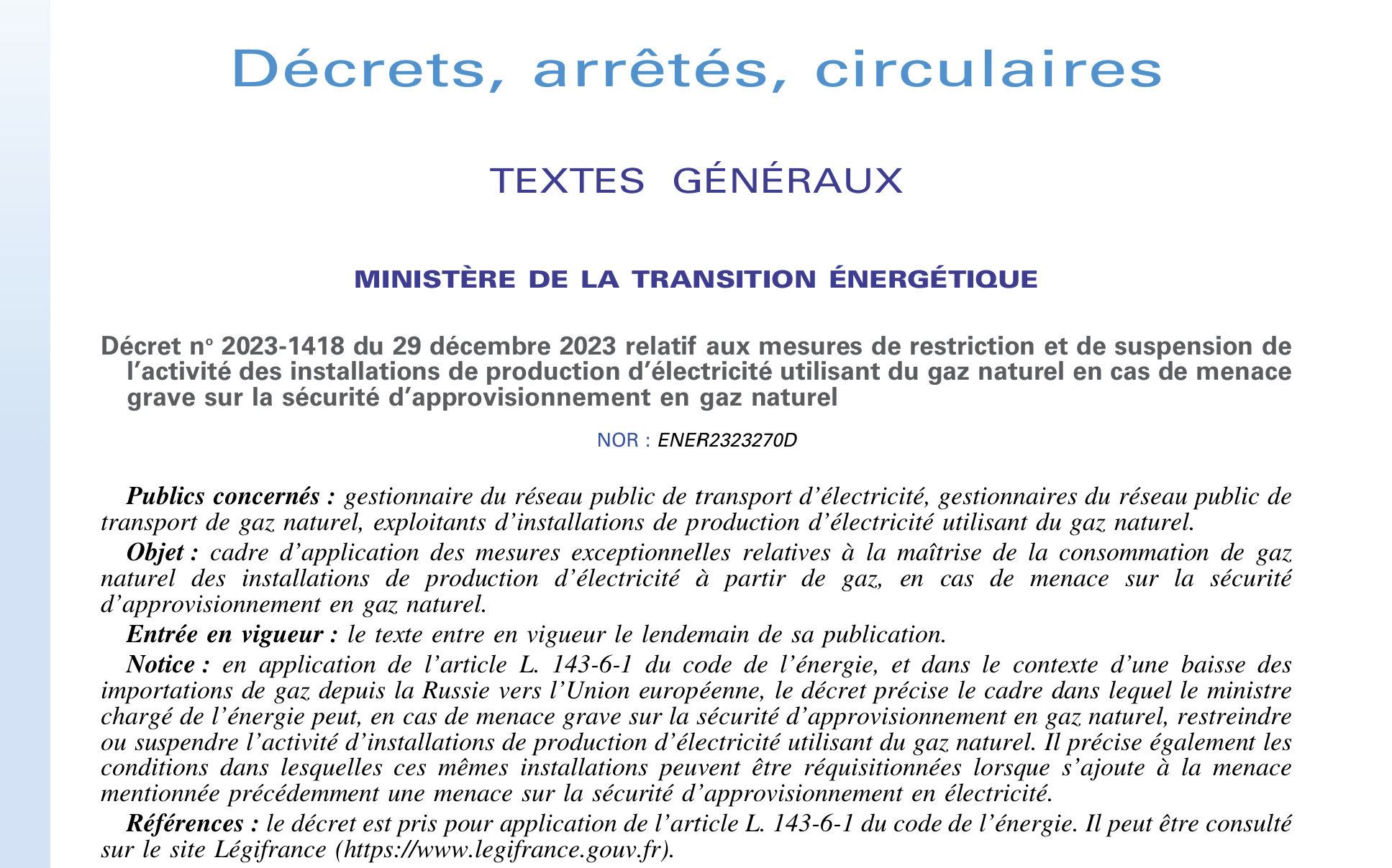
Ce dispositif n'est pas théorique. Le décret n° 2023-1418 du 29 décembre 2023 organise les mesures de restriction et de suspension d'activité des installations de production d'électricité utilisant du gaz naturel en cas de menace grave sur la sécurité d'approvisionnement. Il montre la forme que prend l'exercice de cette compétence : un texte réglementaire, publié au Journal officiel, dont l'objet est circonscrit à un secteur.

Deux propositions coexistent donc, et elles sont toutes deux exactes. Aucune mesure de rationnement n'était annoncée le 24 septembre. Et l'État français dispose, depuis longtemps, d'un pouvoir codifié de restriction de la consommation énergétique en cas de pénurie. La rumeur a échoué sur la première ; elle a emprunté sa vraisemblance à la seconde.

Confinement énergétique annoncé au 20h par Macron : histoire d'une fake news "patriote"
LE COURRIER
DES STRATÈGES
Restez libre !

TIPS · SANS ABONNEMENT

Offrez-nous
un café.

Un média libre vit de ses lecteurs. Un pourboire ponctuel, sans compte ni engagement, quand le cœur vous en dit.

Vous donnez ce que vous voulez. Vous restez libre.

LAISSER UN POURBOIRE merci !
lecourrierdesstrateges.fr
Restez libre !

Ce qui a été annoncé

Le matin du 24 septembre, le ministère de l'Économie dément formellement toute mesure de rationnement ou de coupure. Le ministre Roland Lescure déclare qu'il n'existe « aucun problème d'approvisionnement » et fait état de deux mois de visibilité.

Le soir, l'interview a porté sur le prix des carburants, le budget, la menace russe et la guerre en Iran. Les mesures annoncées vont dans le sens inverse d'une restriction : prolongation de l'aide de 100 euros aux grands rouleurs, relèvement de la prime carburant patronale de 600 à 1 000 euros, réunion énergie du G7 avec discussion d'une libération supplémentaire de réserves stratégiques, envoi de moyens militaires français pour protéger le terminal saoudien de Yanbu. Le chef de l'État a par ailleurs écarté une dissolution et n'a pas mentionné l'article 16.

Ce que la séquence établit

Deux comptes sans notoriété institutionnelle, dont l'identité des auteurs n'est établie par aucune source, ont produit en quarante-huit heures une prédiction datée, une liste de huit mesures et six millions de vues. Un parti politique l'a relayée. Une chaîne l'a mise en récit. Un ministère a dû démentir. Le coût d'entrée de l'opération était nul ; son matériau premier était un rapport public consultable en ligne.

La séquence de mars avait suivi le même chemin, à partir du même document, avec le même vocabulaire. Elle s'était éteinte sans démenti ministériel, faute d'une date à annoncer. Celle de septembre en avait une : le 20 heures du jeudi. C'est la seule variable qui distingue les deux.

Entre la recommandation du 20 mars et la liste du 22 septembre, il y a un document que chacun peut lire. Il compte dix points, il est non contraignant, et il ne mentionne ni les compteurs électriques, ni les amendes, ni l'alimentation. Le démenti du 24 septembre portait sur une annonce qui n'a pas eu lieu. Les articles L. 143-1 et suivants du code de l'énergie, eux, n'ont pas été modifiés.

  •  

Agência Pública lança e-book gratuito sobre desinformação e notícias falsas

A Agência Pública lançou um e-book gratuito sobre desinformação na era digital, desenvolvido pela jornalista Natalia Viana, diretora executiva e cofundadora da Pública, e pelo tecnólogo Babak Fakhamzadeh. O material explica o que é desinformação, como funcionam as fake news e quais estratégias estão por trás da criação e circulação desses conteúdos. Também apresenta um guia prático com seis passos para identificar notícias falsas e aborda o método jornalístico, a inteligência artificial e os novos desafios para reconhecer informações na internet.

O e-book pode ser baixado gratuitamente. Basta se inscrever nas newsletters da Pública neste link para receber o material diretamente no e-mail. 

O guia apresenta diferentes tipos de desinformação, explica a estrutura de uma campanha para circular conteúdos falsos e os diferentes atores envolvidos em sua produção e distribuição, além de discutir os interesses que podem estar por trás disso.

O e-book é destinado para quem busca compreender melhor como a desinformação funciona e aprender a reconhecer conteúdos falsos ou enganosos. E pode ser utilizado por educadores, estudantes, organizações, jornalistas e outras pessoas interessadas em desenvolver ferramentas para reconhecer informações falsas e conteúdos manipulados.

O material foi desenvolvido a partir da oficina “Como diferenciar notícias falsas de verdadeiras”, ministrada pela jornalista Natalia Viana e pelo desenvolvedor Babak Fakhamzadeh. A atividade aconteceu no Centro de Pesquisa e Formação do SESC, dentro da programação comemorativa dos 15 anos da Agência Pública.

Inscreva-se aqui para receber o e-book!

  •  
❌