In July, India tested two new interceptors meant to destroy missiles at ranges up to 5,000 kilometers, the latest step toward one of the few layered missile shields in the world. New Delhi calls the program defensive. But a neighboring rival rarely sees a shield that way. India’s expanding defenses could embolden its leaders in […]
The twenty-first century runs on it. Paediatric clinics. Cancer centres. Forensic laboratories. Family-planning counsel. It is used to explain illness, to assign blame, to foreclose questions. It protects the industries whose products and practices are what actually caused the harm.
It isn’t true.
In 2010, Jonathan Latham and Allison Wilson looked at over seven hundred genome-wide association studies covering some eighty common diseases. The genes the field had promised were not there. The field invented a term, “missing heritability”, to explain the absence, and has quietly worked to bury the finding ever since.
The Genetic Deception is a book about what Latham and Wilson found. What the field did with it. And what the public was told instead.
The Genetic Deception
How a Failed Science Conceals the Real Causes of Disease
Second Edition, revised and expanded. 406 pages, paperback.
Across nineteen chapters and six appendices, the book works through the conditions where the genetic framework collapses on inspection. Cystic fibrosis, where the environmental trigger is omitted. Down’s syndrome, where the toxic exposures are known but not acknowledged. Dravet syndrome, where vaccine injury is renamed as inherited fate. BRCA. FH. Alpha-1. The forensic DNA story the public has never been told.
Long-form interviews with Jamie Andrews and Leon Karmameleon of the Telestai Network. Close engagement with the work of Dr Thomas Cowan, Elizabeth Nickson, and Latham and Wilson. A resource library at the back. An appendix on what to say when the doctor says “it’s genetic.”
What the book exposes is a procedure. A procedure for converting environmental injury, pharmaceutical damage, and industrial poisoning into inherited destiny. The procedure works on the patient. It works on the doctor. It works because most people who encounter it have never been shown what it conceals.
New in the Second Edition:
Three chapters not in the digital edition. The first is a long treatment of cystic fibrosis, the textbook example of a single-gene disease and the case that falls apart hardest on inspection. The second catalogues ten of the conditions currently labelled “genetic” and shows, one by one, what the label forecloses. The third asks where family resemblance actually comes from if not from genes, and what the Human Genome Project’s failure means for the question.
Expanded appendices, including an expanded vocabulary for the terms the framework uses to protect itself. New Notes and Sources across nine chapters, cited to the primary literature rather than to the field’s own summaries.
A full back-of-book index covering the people, institutions, conditions, and concepts named in the book, cross-referenced so the paperback works as a reference and not just a read-through. Any term the reader has seen in a clinic or in a news article — missing heritability, Dravet, CFTR, BRCA — can be looked up and traced to every place the book addresses it.
Table of Contents
Introduction
Genetics: The Ultimate Cover Story
Genetics Was Built on Bad Chemistry
The Fifth Wall: Genetics as the Final Fortress of Medical Extraction
Fool’s Gold Standard: The Unvalidated Science of DNA
Interview with Jamie Andrews
Interview with Leon Karmameleon (Telestai Network)
Your Genetic Heart Disease Isn’t Genetic
The Great DNA Data Deficit
The DNA Paradox: How Unseen Molecules Became Unquestioned Facts
How to Create a Genetic Condition
What is Cystic Fibrosis?
Down’s Syndrome: Environmental Poisoning Disguised as Genetic Fate
The Genetic Alibi: How Wayne Bennett’s Family Tragedy Exposes the Dravet Syndrome Cover Story
The Great Extinction Lie: How Genetics and Environmental Fraud are Destroying Rural Populations
The Emperor’s New Genes
The DNA Myth: What the Peer-Reviewed Literature Actually Shows About Forensic and Paternity Testing
The Ten “Genetic” Diseases That Aren’t Genetic
Heredity Without Genes
Appendix 1: The Vocabulary of Genetic Deception
Appendix 2: What to Say When the Doctor Says “It’s Genetic”
Appendix 3: The Four Real Causes
Appendix 4: The Conditions Currently Labelled “Genetic”
Appendix 5: The Eugenics Continuity
Appendix 6: The Curated Resource Library
Index
Who this book is for:
The reader who has watched a diagnosis arrive in their family and sensed that the explanation did not fit. The reader who wants to know what the research actually says instead of what the press release claims. The reader who is ready to ask what happened to the person before they were handed the gene.
The war between the United States and Iran is no longer just a confrontation between Washington and Tehran. A second contest is taking shape alongside and behind it. China is not fighting the United States directly, but its economic, technological and diplomatic links to Iran are complicating Washington’s strategy and ability to win the conflict. […]
The artificial intelligence (AI) race between the United States and China has accelerated in model protection, supply chains and talent controls, even as the two nations’ leaders agreed last week to open a new dialogue on AI safety. A string of moves announced or uncovered this week shows that both sides are now guarding their […]
(Bloomberg) — Turkey and the United Nations have set up fresh talks in Russia and Ukraine to discuss a Black Sea ceasefire, trying to coalesce scattered efforts to protect grain...
The U.S. government set off conventional explosives inside a tunnel deep in the Nevada desert this week in a test designed to replicate a so-called “decoupled” nuclear detonation. Data collected is now being used to help improve methods for detecting this kind of nuclear testing. Just earlier this year, American authorities accused China of using decoupling to conceal new nuclear tests despite the country’s stated moratorium on such activities.
The test, which involved the use of chemical high-explosives and radiotracers, was conducted yesterday inside P Tunnel in Area 12 of the Nevada National Security Site (NNSA), according to a press release from the National Nuclear Security Administration (NNSA). The NNSS, which is situated within the boundaries of the U.S. Air Force’s Nevada Test and Training Range (NTTR), is used for a wide variety of testing purposes today. An agency under the Department of Energy, NNSA’s main jobs are to oversee the development and production of nuclear weapons, as well as manage America’s nuclear deterrent stockpile.
A map giving the general sense of the location of the NNSS with the NTTR. Center for Radiological Nuclear TrainingAnother map showing the specific testing areas within the NNSS. Area 12 is at the northern end of the complex. United States Geological Survey
“This experiment is especially focused on further enhancing the U.S. capabilities to detect a ‘decoupled’ explosion,” per NNSA’s release. “Data collected from the experiment will be used to validate scientific models and refine algorithms that are critical to U.S. nuclear explosion detection efforts.”
“Just as a stealth aircraft looks smaller on radar, decoupling can greatly muffle the signals detected by nuclear detection sensors, making a large explosion appear smaller,” the release explains. “In a conventional, or ‘coupled,’ underground nuclear test, a device is placed deep in a hole in close contact with the rock, allowing much of the explosion’s shockwave to reach sensors. In a decoupled test, by contrast, the device is detonated inside a large underground chamber, substantially reducing the explosion’s seismic signature.”
“In this experiment, researchers gathered measurements using a broad suite of advanced sensors, including accelerometers, seismometers, infrasound sensors, electromagnetic sensors, chemical and radiotracer samplers, and meteorological sensors,” it adds. ”Together, these measurements will improve scientists’ understanding of the signatures produced by underground explosions and strengthen the United States’ ability to detect and characterize nuclear explosive events.”
The U.S. already maintains a U.S. Atomic Energy Detection Systems (USAEDS) network, which is overseen by the U.S. Air Force Technical Applications Center (AFTAC). USAEDS is made up of more than 3,600 sensors positioned around the world. USAEDS is also tied in with the International Monitoring System (IMS), which is managed by the organization responsible for overseeing the Comprehensive Nuclear-Test-Ban Treaty (CTBT). AFTAC also supports the mission to monitor for potential nuclear testing globally using a fleet of specially configured WC-135R Constant Phoenix aircraft. In addition, those planes are used to help keep watch for unusual spikes in atmospheric radiation that could point to nuclear or radiological accidents or other incidents leading to the spread of potentially dangerous radioactive material.
With regard to the USAEDS network specifically, “once a disturbance is detected underground, underwater, in the atmosphere or in space, the event is analyzed for nuclear identification, and the findings are reported to command authorities,” according to AFTAC’s website.
As mentioned, the U.S. government has accused its Chinese counterparts of using decoupling to conceal new nuclear testing, and NNSA’s press release draws explicit attention to these allegations. At the annual Conference on Disarmament in Geneva, Switzerland, in February, Thomas DiNanno, Under Secretary of State for Arms Control and International Security, said that China had conducted at least one such test at Lop Nur on June 22, 2020. The Comprehensive Nuclear-Test-Ban Treaty Organization (CTBTO) subsequently said the IMS had not detected an event matching that description at that location on that date. For its part, the Chinese government has denied the accusation.
The social media posts below include satellite imagery showing activity at Lop Nur that could point to new nuclear testing activities in recent years.
参考 Satellite Imagery Analysis of China’s Alleged 2020 Nuclear Test at Lop Nurhttps://t.co/aafvU5Szh7 CSIS 20260213 ROLES SAT ANALYSIS No.7 中国に核実験実施の動き ー Lop Nur核実験場の画像分析 ーhttps://t.co/n66yYk0hLg ROLES 20250522
While China is a signatory to the CTBT, the country has never ratified it. The Chinese government last acknowledged a critical-level nuclear test in 1996, after which a self-imposed moratorium was put in place, at least publicly. As an aside, the United States has also signed, but never ratified, the CTBT, and has a similar self-imposed moratorium on nuclear testing since 1992. It is worth noting that the treaty does not ban so-called sub-critical testing, which involves fissile material, but does not result in a full-fledged nuclear reaction.
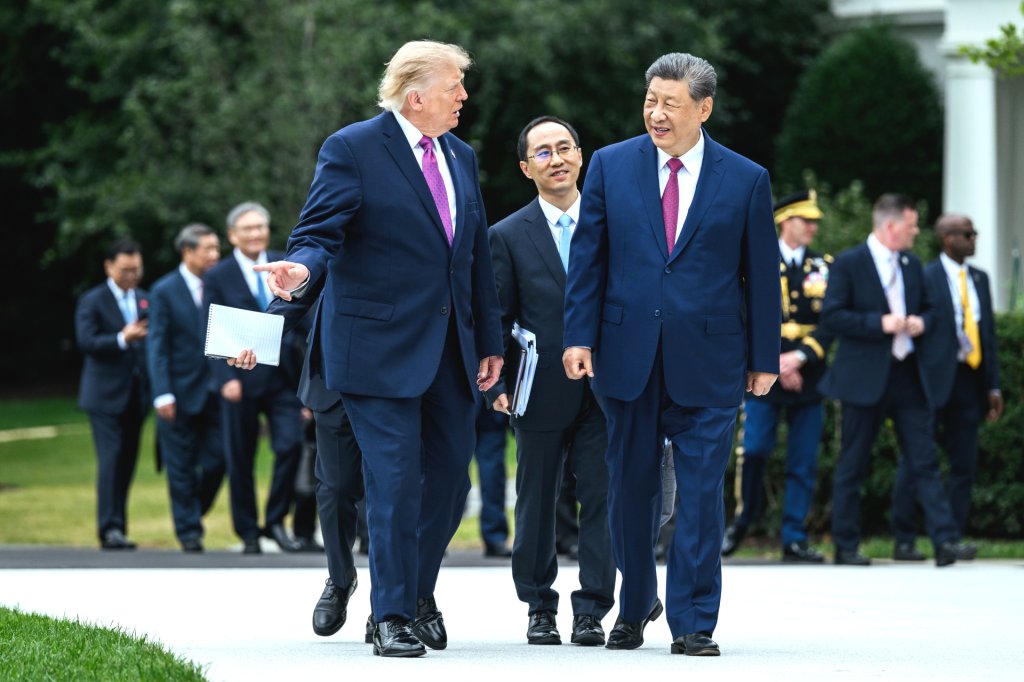
Last week, The Wall Street Journal reported that the Trump administration has been holding new talks with the Chinese government regarding various aspects of the country’s massively and rapidly expanding nuclear arsenal, including the testing allegations. That story immediately preceded a state visit by China’s President Xi Jinping to Washington, D.C., to meet with Trump.
President Donald Trump (at left) and President Xi Jinping (at right) walk together at the White House last week. White House/Joyce N. Boghosian
“The discussions between American and Chinese officials have centered on measures to reduce nuclear risks and haven’t been aimed at negotiating a formal arms-control pact, an effort Beijing has sharply rebuffed in the past,” according to that report. “The Trump administration has begun to highlight the possibility of implementing new verification measures.”
“Independent experts say seismic instruments might be placed on or near test sites,” The Journal‘s story also noted. “Another possibility, which was floated during the Biden administration, is to install radiation-detection equipment at test sites.”
NNSA’s announcement about the test at the Nevada National Security Site is certainly an example of the development underway already of new means of verification that could be deployed at sites around the world.
The Russian government has said it is ready to conduct new nuclear tests if the United States pursues this course of action. The last official nuclear test in Russia came in 1990 right before the fall of the Soviet Union.
“It takes nuclear expertise to detect nuclear activities and experiments like these [to] ensure America remains unmatched in detection,” NNSA Administrator Brandon Williams said in a statement yesterday in light of the test in Nevada. “The Trump Administration has made it clear that the United States will lead from a position of strength. You cannot evade American innovation. With this experiment, we are sending a clear message: under this administration, America will never be outmatched.”
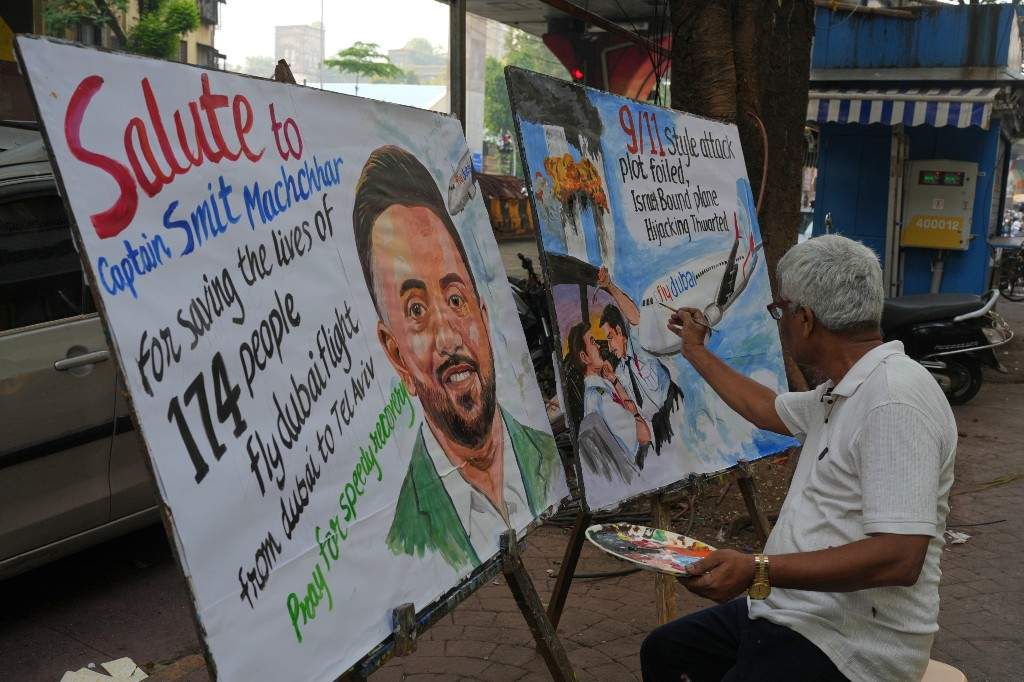
Capt. Smit Machchhar was seriously injured in Wednesday's attack. Passengers described how the pilot still managed to open the cockpit door to let them in.
Capt. Smit Machchhar was seriously injured in Wednesday's attack. Passengers described how the pilot still managed to open the cockpit door to let them in.
For years, Pakistan’s claim that the Tehreek-e-Taliban Pakistan operates from sanctuaries inside Afghanistan produced a familiar exchange: Islamabad accused, Kabul denied, and each new militant attack triggered another round of recrimination. That pattern is becoming harder to sustain. The sanctuary dispute can now be tested against a growing body of evidence rather than competing claims […]
On September 30, the last American and coalition troops flew out of Erbil Air Base, and the Pentagon declared an “orderly departure.” The White House called it a victory. President Trump, never one for understatement, described the whole enterprise as “a very expensive excursion into Hell.” For once, the hyperbole is closer to the truth […]
The air war between Russia and Ukraine has evolved constantly since the start of the conflict. The latest example is Russia’s deployment of a new type of long-range, jet-powered drone, which is having a significant effect on Ukraine’s ability to defend its cities against aerial attack. In an interview on September 14, Ukrainian Air Force […]
In 2023, the International Energy Agency predicted that by 2028 the world’s oil companies would produce more oil than people wanted to buy. Prices responded to that and similar projections of slowing oil demand, dropping too low to attract investment for new wells and refineries. No forecast anticipated that the Strait of Hormuz, the main […]
The Houthi takeover of parts of the Red Sea gives the armed group a new platform to challenge global shipping. The group has taken over the port of Mocha, the island of Mayyun, and the Zuqar and Hanish archipelago about 160km north of the Bab al-Mandeb Strait. These areas were previously controlled by Yemeni government […]
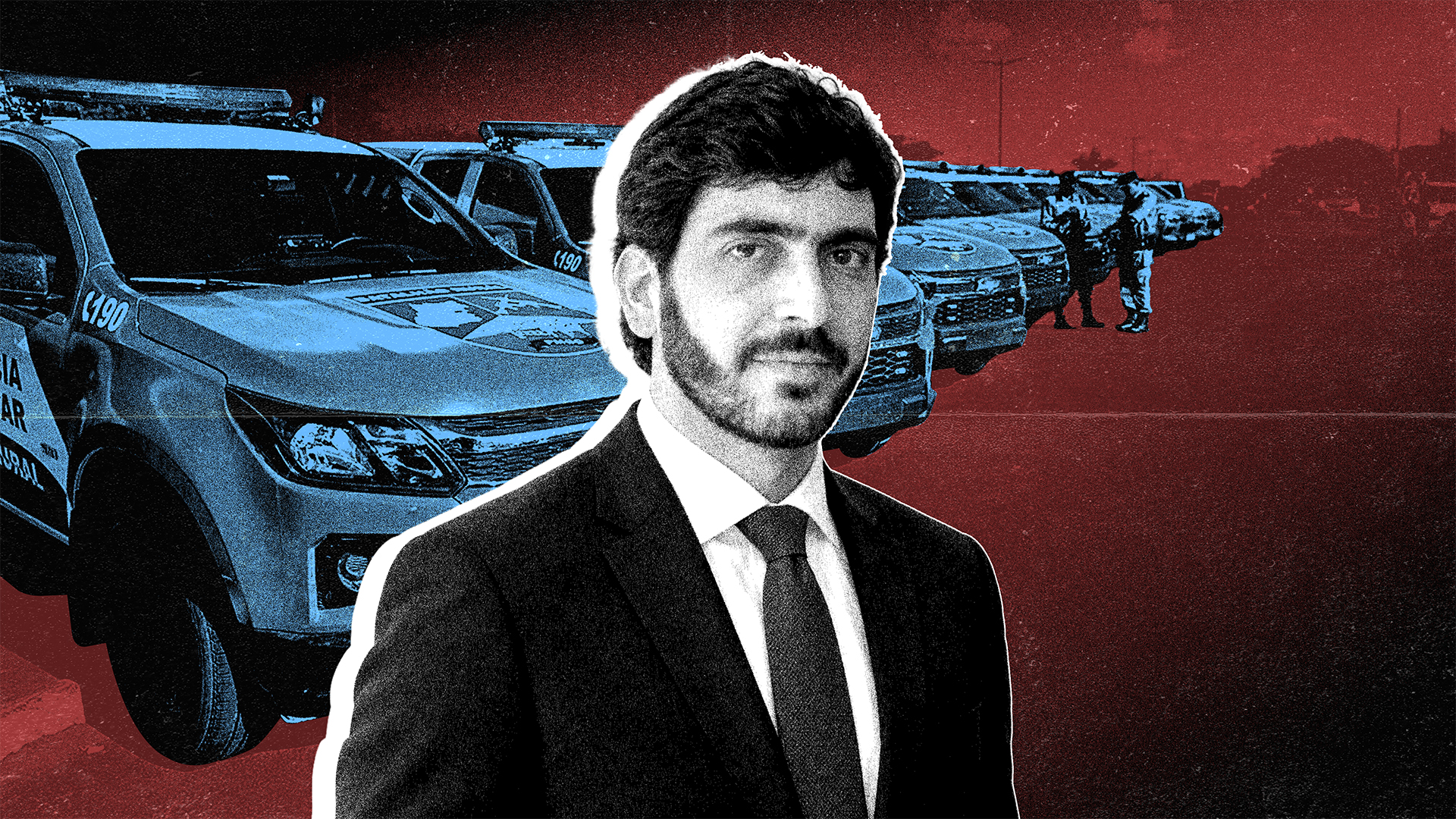
Duas horas. Essa é a contagem do tempo que separa a execução do advogado Davi Sebba e o nascimento de seu primeiro e único filho, Gabriel Davi. Foi no dia 5 de julho de 2012, por volta das 18 horas, que Sebba saiu de casa e foi até o hipermercado Carrefour, em Goiânia, para comprar os últimos itens necessários ao nascimento do primogênito. No estacionamento da loja, porém, houve um suposto confronto com três policiais militares, que resultou em uma vítima fatal. Entre 19h10 e 19h11 Davi Sebba foi atingido por um tiro no coração.
Mais de catorze anos depois, o caso chega nesta quinta-feira, 1° de outubro, ao Tribunal do Júri de Goiás. De acordo com o relatório do inquérito ao qual a Agência Pública teve acesso, Sebba sofreu uma emboscada e foi executado. O homicídio aconteceu horas após outro assassinato. Em plena via pública, o radialista Valério Luiz, sem antecedentes criminais, foi morto a tiros, caso que só foi julgado em 2022.
Em 2012, sob o governo de Marconi Perillo, que à época era filiado ao PSDB e hoje é novamente candidato ao cargo pelo mesmo partido, Goiás registrou uma taxa de 44,3% de assassinatos para cada 100 mil habitantes, levando o estado a figurar em 4º lugar no ranking de mais violento do país, segundo dados do Mapa da Violência 2014.
Naquela época, a região teve 1.297 homicídios dolosos. Em relação ao número de pessoas mortas em confronto com a Polícia Militar, foram 6 em 2011 e 17 em 2012, de acordo com o Fórum Brasileiro de Segurança Pública. A organização registra, também, que no mesmo ano já era considerada “baixa” a classificação de qualidade na transparência de informações sobre mortes perpetradas por policiais.
Não à toa, a morte de Sebba ilustra a questão. No seu caso, respondem pelos crimes de homicídio qualificado, fraude processual, porte ilegal de arma de fogo com numeração raspada, disparo de arma de fogo e usurpação de função pública os policiais Jhonatas Atenevir Jordão, Edinailton Pereira de Souza e o soldado Luiz Frederico Oliveira. Eles são acusados, principalmente, de terem feito uma emboscada e executado Sebba. O agente Jordão foi condenado na Justiça Federal em 2016 em um caso sobre espionagem envolvendo policiais federais. A sentença foi definida pelos crimes de organização criminosa e corrupção passiva.
O caso de Davi Sebba
De acordo com depoimentos incluídos no relatório da investigação, Jordão e Edinailton se deslocaram até o hipermercado, onde encontraram o soldado, para fazer uma abordagem a Sebba.
O advogado estava sendo monitorado pela Polícia Federal (PF) em uma investigação por tráfico de entorpecentes e teria ido ao local para vender um tablete de maconha. A perícia, entretanto, não encontrou nenhuma droga no carro, nem na residência de Sebba. A investigação não chegou a ser concluída por causa de sua morte.
Na versão dos policiais militares, o confronto no hipermercado ocorreu porque o advogado reagiu a aproximação, portando um objeto na mão – em alguns depoimentos, os agentes disseram que o item era parecido com uma arma. Ao ver Sebba em contato com o suposto comprador do entorpecente, eles decretaram a voz de polícia. Jordão, no entanto, viu o advogado pegando algo dentro do carro, o que pensou ser uma arma, e então disparou contra a vítima.
Segundo os agentes, mesmo atingido, Sebba continuou dirigindo em direção à saída do estacionamento. No trajeto, ele colidiu em uma pilastra no local. Em seguida, ao ser retirado do veículo por um segurança do Carrefour e pelo agente Jordão, os policiais notaram o revólver em cima do banco do passageiro.
Na versão dos policiais militares, o confronto no supermercado ocorreu porque o advogado reagiu a aproximação e arrancou com o veículo que dirigia, motivo pelo qual foram feitos os disparos, que acertaram principalmente as rodas traseiras do carro. Apesar disso, a vítima teria continuado em fuga, tendo colidido o automóvel com uma barraca de coco.
Ao ser retirado do veículo por um segurança do Carrefour, os policiais notaram um revólver em cima do banco do passageiro. O policial Jordão, no entanto, teria percebido antes a arma e, por isso, efetuou o tiro que vitimou Sebba.
As conclusões registradas no relatório da investigação assinado pelo delegado Murilo Polati contrastam com a versão dos acusados. A autoridade concluiu que Sebba “foi executado, uma vez que não teve possibilidade alguma de reação no momento da abordagem policial”, que também não se deu “exatamente no local mencionado pelos policiais e pelo suposto comprador”.
Advogado Davi Sebba era monitorado pela Polícia Federal, mas investigação não encontrou entorpecentes em seu carro nem na sua casa
Atesta, ainda, que a arma encontrada no carro foi “plantada pelos policiais militares envolvidos na abordagem”, que “alteraram sobremaneira a cena do crime, recolhendo todos os estojos de munição existentes no local”. A questão impossibilitou, inclusive, a realização de outros exames de balística para comprovar o verdadeiro autor do disparo que tirou a vida do advogado.
Segundo Polati, os policiais fizeram uma “grave alteração do estado original das coisas”: retiraram o corpo da vítima de dentro do veículo, vasculharam o interior do carro, removeram a chave de ignição e abriram a tampa do porta-malas. A perícia também não encontrou pólvora em seus dedos, nem “fragmentos de impressões papilares apropriados para confronto na arma de fogo” encontrada no interior do veículo, o que significa que Sebba não tocou no referido objeto.
O delegado registrou, ainda, que “a quebra de sigilo dos dados telefônicos de Jordão e Edinailton demonstrou que eles conversaram entre eles dez vezes” quando já estavam no hipermercado, “o que demonstra claramente que cada um estava em um ponto diferente do estacionamento aguardando a chegada da vítima, e não juntos conforme aduziram em seus depoimentos e também aos peritos”.
O Conselho Nacional de Direitos Humanos manifestou repúdio ao caso. Segundo o órgão, “a minimização da violação de direitos humanos pela estigmatização e criminalização da vítima é notória e se repete como outros casos de violências causadas por agentes estatais”.
Federalização de crimes da PM de Goiás
Naquele mesmo dia, horas antes de se reunir com Jordão, o agente Edinailton esteve na cena de outro crime, ocorrido no mesmo dia, 5 de julho de 2012: o assassinato do comentarista esportivo Valério Luiz, morto enquanto saía da emissora de rádio em que trabalhava. Segundo o Ministério Público do estado, a motivação do crime teria sido críticas feitas pelo radialista contra a direção do clube Atlético Goianiense.
“Ele [Edinailton] procurou câmeras ao redor da cena [do homicídio] para ver se tinha alguma. Com certeza foi na intenção de pegar essas imagens, qualquer imagem que existisse, e sumir com elas”, disse à Pública Valério Luiz Filho, advogado e filho do radialista.
Os casos de Davi Sebba e Valério Luiz chegaram a integrar um relatório produzido em 2012 pelo deputado estadual Mauro Rubem (PT), então presidente da Comissão de Direitos Humanos da Assembléia Legislativa do Estado de Goiás, e pelo Movimento Nacional de Direitos Humanos (hoje Conselho Nacional de Direitos Humanos). O documento serviu de base para o pedido de federalização (transferência da investigação de um crime da Justiça Estadual para a Justiça Federal, a Polícia Federal e o Ministério Público Federal) de 30 crimes cometidos por policiais militares da corporação goiana, que envolviam tortura, homicídios e desaparecimentos forçados.
Os casos reuniam sobretudo agentes da ROTAM (Rondas Ostensivas Táticas Metropolitanas). O grupo foi criado com base na doutrina da Rota da Polícia Militar de São Paulo, mantendo uma adequação às necessidades do Centro-Oeste. Na época, os agentes da Rotam estavam lotados no Comando de Missões Especiais (CME) da Polícia Militar do Estado de Goiás. O setor incorporava, também, o Batalhão de Choque e o Grupo de Radiopatrulhamento Aéreo (GRAER). O CME era chefiado pelo então coronel Wellington Urzêda, atual vereador de Goiânia pelo Partido Liberal (PL) e atual candidato à deputado estadual pela mesma sigla.
Letalidade policial quase triplicou em 2012, ano do crime
CME-2
Neste Comando havia ainda um grupo de inteligência formado por 16 policiais, entre eles Edinailton (envolvido no caso de Davi Sebba), Ademá Figueredo e Djalma Gomes da Silva. Os dois últimos foram réus no julgamento do assassinato de Valério Luiz. Figueredo foi apontado como autor dos disparos e condenado a 16 anos de reclusão; Djalma, acusado de ter auxiliado no planejamento do homicídio e atrapalhado as apurações, foi absolvido.
Comandados pelo então capitão Durvalino Câmara dos Santos Júnior, também piloto do GRAER, o coletivo de inteligência era chamado de CME-2. Foi Santos Júnior quem recebeu no dia 5 de julho de 2012 uma ligação do policial federal Rômulo Mendonça Bailão informando que Sebba estaria no hipermercado para vender o entorpecente. Bailão pediu para que uma equipe fosse deslocada até o local para prender o suspeito e Santos Júnior determinou as instruções iniciais para a operação.
De acordo com o relato do capitão, tais informações foram obtidas por escutas telefônicas autorizadas judicialmente e faziam parte de uma grande operação desencadeada pela corporação federal. Ainda segundo o depoimento de Santos Júnior, “era normal a troca de informações com outras corporações de segurança”.
Policiais militares, no entanto, não têm competência para participarem de investigações. A questão foi endereçada no relatório final do caso, cujo teor a Pública teve acesso. “Ao final, cumpre ressaltar que a função dos policiais militares lotados no setor de inteligência daquela instituição é a de investigar os seus próprios pares em razão das condutas ilícitas por ele cometidas, e não a de investigação de crimes comuns, função esta atribuída constitucionalmente às Polícias Judiciárias”, escreveu o delegado Murilo Polati no documento.
Em 2011, um ano antes da execução do advogado, o Capitão Durvalino Câmara dos Santos Júnior foi preso durante a Operação Sexto Mandamento, realizada pela Polícia Federal, Ministério Público e Poder Judiciário em Goiás. No total, 19 policiais militares foram presos sob suspeita de integrarem um grupo de extermínio. Atualmente, Santos Júnior é Chefe do Estado-Maior Estratégico da Polícia Militar do Estado de Goiás.
The Supreme Court of the Komi Republic has sentenced philosopher Nikolay Zyuzev to seven years in a strict-regime penal colony on treason charges. Zyuzev, who holds both Russian and Canadian citizenship, is one of the best-known scholars of the legacy of the Russian-American sociologist Pitirim Sorokin. He left Russia after the war began, but in the summer of 2025 he returned to his native village in Komi [a republic in northwestern Russia — T-invariant], where he was arrested. According to the FSB, the scholar was training leaders of national liberation movements among Russia’s small Indigenous peoples and receiving funding for his project from foreign organizations. T-invariant looks at what Zyuzev worked on, why he kept coming back to Russia, and what his friends and colleagues make of the treason charges.
Top news on scientists’ work and experiences during the war, along with videos and infographics — subscribe to the T-invariant Telegram channel to stay updated.
A Classic Liberal
In the summer of 2025, philosophy professor Nikolay Zyuzev traveled from Europe to his native village of Podyelsk in Komi to visit relatives. And then he vanished.
“After the war started, he left Russia, just like I did. Sometimes he came to see me in Europe. I was expecting him again in the fall of 2025. But that summer he went to Russia, even though we begged him not to. There was no way he wasn’t going — his relatives were waiting for him. I guess he figured he’d get away with it, that they wouldn’t touch him. He left. And one day he just stopped responding,” Zyuzev’s friend and former student Alexander (his name has been changed at his request) told T-invariant.
For about a month, there was no word from him. His relatives refused to talk, and his acquaintances had no idea what had happened to him. “I started sounding the alarm. Mutual friends said he was probably off fishing in his village again. Then one night I snapped, grabbed my laptop, and did a little investigating. On a Komi court website, I found a record showing that his pretrial detention had been extended. So it turned out they’d taken him even earlier, sometime around the middle of the summer,” Alexander says.
The court record didn’t say why Zyuzev had been detained. In September 2025, the website of the Supreme Court of the Komi Republic posted a notice that a criminal case had been opened against the scholar under Article 275.1 of the Russian Criminal Code, “Confidential cooperation with a foreign state or an international or foreign organization.” As Komi Dailyreported, investigators searched Zyuzev’s house in the village of Podyelsk, in the Kortkerossky District, in the summer of 2025.
Zyuzev spent more than a year in pretrial detention. According to Alexander, his cell had a refrigerator, and he was taken out for an hour-long walk every day. In his free time, he read books from the prison library and solved chess problems. At the same time, Alexander says, the scholar went through bouts of depression brought on by loneliness and uncertainty. On June 10, 2026, Zyuzev marked his 70th birthday in his cell.
“We write to each other — I’ve gotten five letters so far. He’s in a fighting mood, though one letter was pretty sad. He jokingly calls his imprisonment a cultural-studies expedition to pretrial detention,” Alexander says.
His friends still can’t understand why the scholar decided to go back to Russia. His former colleague, journalist Nikolai Vokuev, has a guess: “I suspect he thought nobody was particularly interested in him and that he could spend the summer in his village. Besides, he’d frankly grown tired of other countries. He complained that he didn’t like the climate in Canada and that things there generally weren’t much to his liking. So he went to do some fishing and spend the summer in his village. And yet back in 2020, he was the one who strongly urged me to leave Russia — he said you can’t stay here. And then he went back himself. I don’t understand why he did it. After all his English-language publications, where he openly condemned the war and the regime’s policies in general, how could he take a risk like that? And whether he was even aware of the risk, I can’t say.”
Nikolay Zyuzev holds a Doctor of Sciences degree in philosophy [Russia’s higher doctorate, above the Candidate of Sciences — T-invariant]. Before Russia’s full-scale invasion of Ukraine, he taught at the Komi State Pedagogical Institute, Syktyvkar State University, and Ukhta State Technical University, where he chaired the philosophy department. Much of Zyuzev’s scholarship is devoted to the legacy of the Russian-American sociologist Pitirim Sorokin. Like Zyuzev, Sorokin was ethnically Komi. After the 1917 revolution, he opposed Bolshevik policies, and in 1922 he was expelled from the country. Sorokin later moved to the United States and founded Harvard University’s sociology department. Zyuzev wrote both his Candidate and Doctor of Sciences dissertations on Sorokin’s legacy and published several books about him. Two of them, Pitirim Aleksandrovich Sorokin and Pitirim Sorokin: Teachings and Life, came out in Syktyvkar in 2019.
Nikolay Zyuzev’s books on Pitirim Sorokin. Source: ESKOM publishing house website
In 2005–2006, Zyuzev was a visiting professor at Harvard University, where he gathered material for his book Pitirim Sorokin’s Roller Coaster. “In America, Sorokin started almost from scratch and fairly quickly ended up at Harvard — and that ‘roller coaster’ is exactly what Nikolay Zyuzev studied,” Alexei, a historian who specializes in the history of the Russian scholarly emigration, told T-invariant (his last name is withheld at his request).
In 2009, Zyuzev moved to Canada, where he taught at Massey College at the University of Toronto, and in 2015 he became a Canadian citizen. That same year, he returned to Komi and resumed teaching at Syktyvkar University.
“Nikolay was my professor when I was doing my master’s at Syktyvkar State University. An amazing teacher, one of those people who make you want to learn — he got me hooked on the humanities right away. His liberal views were close to mine — a classic liberal,” Alexander recalls.
The FSB’s Show-and-Tell Video
After Russia launched its full-scale invasion of Ukraine in 2022, Zyuzev left the country. Even so, he kept returning to his native village of Podyelsk from time to time. According to people who know him, Zyuzev missed home and the chance to teach in his native language. “Nikolay speaks, teaches, and writes beautifully in English — he has no problems with it whatsoever. But I know from my own experience, having lived in Germany for more than 30 years: you can feel completely at ease in a foreign language, like a fish in water. And yet that cozy, at-home feeling you get when you speak your native language may simply not be there in another language,” Gasan Guseinov, a professor at the Free University [founded in 2020 by academics forced out of Russian universities — T-invariant] and a Doctor of Sciences in philology, told T-invariant. “Pitirim Sorokin reflected on his emigration, wrote a great deal about it, and was a bilingual Komi-Russian person. And although he was completely integrated into American life, he never became trilingual, even though he wrote in English. Nikolay sensed this. On the one hand, it’s a very personal topic, and on the other, a politically charged one these days.”
On September 16, 2026, news broke that the Supreme Court of the Komi Republic had sentenced Zyuzev to seven years in a strict-regime penal colony. By then, the charge had been reclassified as high treason. Media outlets cited the FSB’s Public Relations Center, which said the scholar had been “training leaders of movements for the liberation of Russia’s small peoples and developing a project directed against Russia’s sovereignty,” with funding from foreign foundations and organizations designated as undesirable in Russia. According to the FSB, the defendant pleaded guilty. In a video released by the FSB, Zyuzev says he originally planned to create an educational website for teaching the humanities, but European sponsors showed no interest in the project. What interested them far more, Zyuzev said in the FSB video, was “spreading false information about what is happening in Russia, inciting interethnic hatred, criticizing the policies of the Russian authorities, and destabilizing Russia as a whole by developing national movements.”
“In the video, he mentions that he wanted to do an educational project — we corresponded about that too, but it didn’t work out. What he says after that is obviously a script written by ‘Comrade Major’ [a sardonic nickname for a security-service officer — T-invariant]. Those aren’t his words, you can tell — all that stuff about him supposedly wanting to destabilize the country and so on. That’s just not how he puts things,” Vokuev says.
According to the FSB, Zyuzev received a total of €2 million from 12 foreign organizations. They reportedly included German, Czech, Swedish, French, and British foundations designated as undesirable in Russia.
“Anyone who knows what life is like for people like us abroad these days understands that the grant amounts attributed to him in the indictment are absolutely astronomical — seven figures, literally the budget of an entire research center. It’s a bit like those confessions from the 1930s about a tunnel that people from Central Asia were supposedly going to dig to India or Japan to hand over secret information about the Soviet state’s defenses. Utterly unbelievable nonsense. And there were lawyers, even defense attorneys, who added all this to the case file, sat through it, and raised no objections,” Alexei notes.
“It’s a show-and-tell video about what great guys we are, what a fine job we’re doing. Here’s this terrible professor, a Canadian citizen: look, he’s got euros, he’s got a Canadian passport, while you’re living here in poverty, and they’re over there in their Canada trying to destroy our great Russia. Somebody’s getting another star on his shoulder boards for this,” Alexander says. “They say he received two million euros. That’s laughable. I wouldn’t call him a poor man, but his finances are clearly not those of someone who’s received two million euros in grants. I don’t buy it.”
Small Peoples Tearing Russia Apart
According to Zyuzev’s colleagues, preserving the languages and cultures of Indigenous peoples has always been important to him.
Nikolay Zyuzev. Photo: Radio Liberty
“His project may have been aimed, roughly speaking, at developing regional identity, supporting the Komi language, supporting small peoples. But to the FSB, that doesn’t sound so impressive. Whereas training separatist squads… Sorry, but that makes it sound like they caught some foreign superspy engaged in subversion. I think that even if the project was about developing national identity and preserving these peoples’ languages and cultures, the FSB simply recut it into its own propaganda,” Alexander says.
According to Nikolai Vokuev, after the full-scale war in Ukraine began, the situation of Indigenous peoples started getting noticeably more attention in Komi.
“When the war started, this became a common theme. A kind of wave took off, a realization that this war is also a war against the Indigenous peoples who live in Russia. In that context, there was a lot of talk about the Buryats, who were being sent to the front en masse. I work for Komi Daily. Once, for an anniversary of the start of the war, we did a story trying to figure out how many people from different Komi municipalities had been killed. And we concluded that, proportionally, more people were sent from the villages where Komi is predominantly spoken. In other words, the war hits Komi speakers wildly out of proportion,” Vokuev notes.
Vokuev suspects that Zyuzev’s interest in the situation of Indigenous peoples may have been one of the reasons he came to the FSB’s attention:
“Here’s the thing — separatism. That’s what the FSB guys love. It’s what lets them build nice careers and show how hard they’re working. They didn’t want to pass up a chance like that. They don’t have to make anything up. Here you go, a case — attempts to break up the country. And their worries probably aren’t groundless. Starting in 2020, people began rethinking their relationship with Moscow. The Shies affair had a big influence on that [mass protests against the construction of a landfill at Shies station in Arkhangelsk Oblast that began in 2018 — T-invariant]. And you could easily hear people arguing that Moscow’s policy is a colonial policy. In the 2010s, that was an extremely marginal view, but after Shies, that’s exactly how people came to see their relationship with Moscow. So I think the FSB sank its tentacles into this for a reason.”
“Komi is going through total Russification, of course. Under the republic’s constitution, we have two state languages — Russian and Komi. But there was a case where a young guy was detained at a rally in support of Navalny, back in what were, relatively speaking, less bloodthirsty times. And he tried to speak Komi in court. The judge answered him pretty rudely, something like: you went to a Russian school, what is this circus? But where else am I supposed to speak Komi, if not in Komi?” Alexander recalls.
Guseinov believes the Zyuzev case poses a threat to all scholars who work on the languages of small peoples.
“When the Soviet Union was being built, the Bolsheviks destroyed the independence of small nations, from Georgia to Tuva. But back then, the official ideology was one of bilingualism: the national language plus Russian. Russian scholars worked on the so-called young written languages. That is, languages were given writing systems, then they got their own writers, some publishing houses, films were made. These languages were built up and even brought back to life. And in nine cases out of ten, this was done artificially — in the sense that the language wouldn’t have survived on its own; it needed help, it needed education. Then the Soviet Union collapsed, and that official doctrine fell apart too. And suddenly, overnight, in 2018, people are told that small languages are of no use to anyone [that year, Russia amended its education law to make the study of the national republics’ languages optional — T-invariant]. And when someone like Nikolay Zyuzev swims against the current and comes back home to educate people, to work on his own language, they throw him in prison for God knows what,” Guseinov notes.
Up-to-date videos on science during wartime, interviews, podcasts, and streams with prominent scientists — subscribe to the T-invariant YouTube channel!
What May Have Caught the FSB’s Attention
According to Alexei, regional security services began taking an interest in humanities scholars long before the full-scale war in Ukraine: “The first talk I remember about local security officials in the regions actively calling humanities scholars in for ‘chats’ and narrowing their eyes knowingly whenever international research collaboration came up goes back to around 2007–2008. You’d think these were just distant clouds on the horizon, but it had already started: who are you working for, guys, whose money is paying for your publications — come on, let’s just have a little talk. This had been rolling through the regions for a long time and clearly started earlier than in Moscow and St. Petersburg. And it was aimed specifically at humanities scholars — historians, ethnologists, and sociologists.” Zyuzev had laid out his views on the situation of the Komi people and on relations between Russia’s regions and the federal center in public. In January 2023, the Canadian current affairs magazine Maclean’s published a first-person account by Zyuzev, “I fled Putin’s Russia for Canada. It opened my eyes,” as told to journalist Adnan Khan. The piece also features in the FSB video about the Zyuzev case. In it, the scholar explained why he had left Russia, criticized Vladimir Putin’s policies, and wrote about the war in Chechnya and the murder of journalist Anna Politkovskaya.
“Politkovskaya’s murder was a warning to dissidents, and the crushing of the Chechen uprising was a warning to members of Russia’s Indigenous and ethnic minorities. I was both. I’m from the Komi minority, a Finno-Ugric people whose own republic, with a population of nearly one million, lies 1,000 kilometres northeast of Moscow. The Komi people have a distinct language and culture dating back at least two millennia, but under Putin’s rule, we face cultural and linguistic extinction. Like all of Russia’s nearly two dozen republics and four autonomous districts, the Komi Republic is supposed to have some degree of autonomy; in practice, it has none,” Zyuzev wrote.
In the same essay, Zyuzev recounted that in 2015 he was offered the chance to head a new research center at Syktyvkar State University. By then his daughter was already in her teens, his marriage had fallen apart, and he had failed to find an academic position in Canada — so the scholar decided to go back to Russia. According to him, the center’s mission was to build ties with scholars in Europe, North America, and other parts of the world. “So in the fall of 2021, I approached two friends—one a sociologist and retired politician, the other a linguist studying the Komi language — and brought to them a radical new idea: to establish an online Finno-Ugric University. It would offer high-quality social sciences education to Komi youth, help them think more critically and, importantly, raise awareness about the injustices suffered by the Komi people.” Zyuzev wrote.
According to Zyuzev, businessman Leonid Zilberg invited him to work with the outlet 7×7. After the war began, the project’s team left Russia and relocated to Lithuania. In May 2022, Zyuzev also moved to Vilnius and began looking for funding for the Indigenous Russia Information and Education Center.
“We sense an opportunity in the aftermath of Putin’s disastrous invasion of Ukraine: Indigenous peoples have been disproportionately affected by the war, both on the battlefield and as conscripts to Russia’s army. Minority groups in the republics are waking anew to the threat the Kremlin poses. Our hope is that demands for decolonization will become stronger, and the Kremlin will lose its grip on the republics. There may be a rare window of opportunity now to change the conversation in Russia — one we can’t waste,” Zyuzev argued. In closing, he wrote: “The only way to course-correct now is to repudiate Putin’s vision, and to embrace the diversity and vitality of [Russia’s] many peoples.”
“And the real tragedy is precisely that he, in the grip of a deep love for his homeland, came back to his part of the world to educate and enlighten. And now these brutes are pinning God knows what on him. Because the way they see it: we’ve got our own life here, everything’s under control, we don’t give a damn about this Komi language. And you’re just spoiled rotten. You went off to the West, picked up some ideas there, came back, and now you’re trying to lecture us — well, we’ll put you in your place, you lousy intellectual. It’s a kind of revenge for their own indifference, for their own wretchedness. Nikolay came back to a country that had already turned thoroughly fascist, where it was clear they would do something to him, some vile thing. Living under the rule of law had spoiled him. He couldn’t imagine they could do something like this to him. That’s the kind of naivety it was,” Guseinov emphasizes.
[[socialnetworks]]
Zyuzev’s arrest came shortly before searches at Syktyvkar’s Revolt Center, an independent cultural space whose founders included Leonid Zilberg. In the summer of 2025, the center was designated a “foreign agent” and shut down, and one of its founders, Pavel Andreev, was later charged with treason. However, according to Andreev, Zyuzev had no connection to the Revolt Center team and had only spoken at its venue a few times.
Zyuzev’s friends are now trying to draw the international academic community’s attention to his case. “Right now we’re looking for prominent Canadian sociologists and philosophers who could bring the Zyuzev case to the attention of politicians. Maybe, with Canada moving closer to Europe, they’ll take an interest,” Alexander says.
Zyuzev is not the only Russian humanities scholar to receive a long sentence in a criminal case in recent years. Among others, sociologist and political scientistBoris Kagarlitsky, convicted under the law against justifying terrorism, is serving time in a penal colony.
“Quite a few people I know are in prison right now. Boris Kagarlitsky, whom I’ve known since childhood — we lived in the same building. It’s absurd. These are people who are in prison for being smart. That’s the tragedy. It’s the same kind of persecution we saw in the ’30s, the ’40s, and the ’50s: oh, you think you’re too smart — well, here’s what you get. Sociology is a science that makes it possible to improve society. Or to destroy it, if it gets snuffed out. And we’re watching the second process. These cretins don’t even understand what Nikolay Zyuzev’s work is about. They simply don’t understand what intellectual work is for. Because their brains just don’t work. What works are their jaws, which chew people up. And what’s especially painful with Nikolay is that no voice coming from the West, or that could come from there, from Canada, say, will ever reach his jailers’ ears. Maybe there will be some kind of prisoner swaps. There’s no other way he’ll be freed,” Guseinov says.
Alexei also sees the Zyuzev case as a warning to other scholars working on politically sensitive topics:
“Right now, any Tatar, Karelian, or Bashkir historian or ethnologist, say, who back in the 2010s traveled freely to Turkey or Finland, studied figures from the Civil War era and the emigration, and, God forbid, worked with some Germans on sensitive topics like wartime collaborationism, I think, feels like they’re in the crosshairs. For them, the Zyuzev case is an unmistakable signal that anything and everything can be held against them, now and in the future. It seems to me the goal right now is clearly to intimidate scholars. I hope there were no informers involved in the Zyuzev case. But in other fields, unfortunately, they may turn up: self-appointed guardians and pseudo-patriots from within the scholarly community itself.”
“The only thing we can count on is that scholars with an instinct for self-preservation, and people who would like their children to become scholars, will simply leave. Mobility today is completely different from what it was in the 20th century. People are highly mobile and can cross borders relatively easily. And if we prepare for this kind of movement, then young people, at least, can and should be taken out of the Russian Federation — so they can get a normal education and integrate into a more or less humane society,” Guseinov concludes.
Support T-invariant’s work by subscribing to our Patreon and choosing a donation amount that suits you.
Every day Israel creates a new humanitarian crisis in Gaza, a new provocation in the West Bank, a political dilemma in the US. Keep track of the news here.
 Login