Login

Seven Dead in Checkpoint Attack and Four-Hour Siege in Sistan and Baluchestan
On Thursday, October 1, 2026, a police officer was killed during



Ukraine says it has used its domestically developed FP-7 tactical ballistic missile in combat for the first time, in what would mark another significant milestone in the country’s rapidly expanding indigenous long-range strike program.
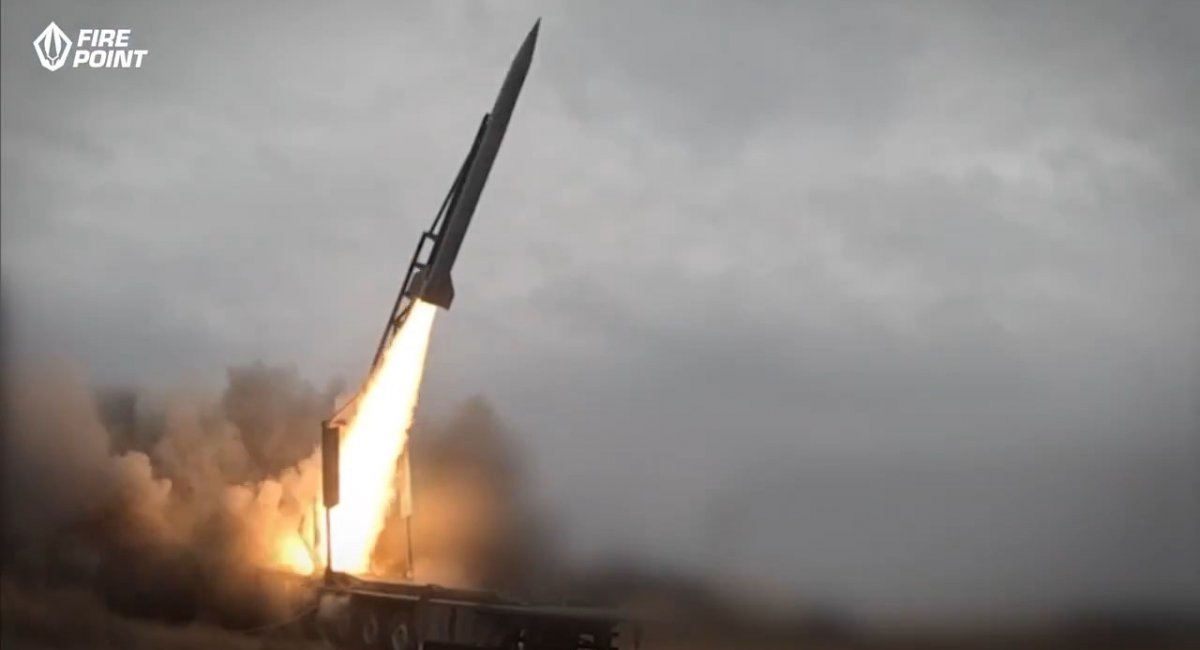
President Volodymyr Zelensky announced today that Ukraine had conducted the first combat use of the FP-7, a ground-launched ballistic missile developed by Ukrainian defense company Fire Point. He also said production of the weapon would follow.
Ukrainian tactical ballistic missile. FP-7. First combat use. Thank you for the result. Next up: production. Glory to Ukraine! pic.twitter.com/IxdjVg51c1
— Volodymyr Zelenskyy / Володимир Зеленський (@ZelenskyyUa) October 1, 2026
The claim has not been independently verified, and Ukrainian authorities have not disclosed the target, location, number of missiles involved, or other details surrounding the reported strike. A video has been published showing what’s said to be a nighttime launch of the missile.
The FP-7 is one of several increasingly ambitious weapons being developed by Fire Point, a Ukrainian defense company that has expanded rapidly since Russia’s full-scale invasion. The company began with drones and has subsequently moved into long-range strike missiles and ballistic missile technology.
Fire Point CEO Iryna Terekh previously described the company’s development and manufacturing model in an interview with TWZ, detailing an effort to rapidly scale production while maintaining a dispersed industrial base inside Ukraine. The company’s better-known systems include the FP-1 and FP-2 long-range strike drones and the FP-5 Flamingo cruise missile.
According to Ukrainian and company-released information, the FP-7 has a range of approximately 250 kilometers (155 miles) and a warhead weighing around 150 kilograms (331 pounds). Other published figures have put its velocity at approximately 1,500 meters per second (around 3,350 miles per hour). Rather than striking targets deep in the Russian rear areas, the missile is optimized for use against objectives such as logistics hubs, air defense sites, and drone bases. This makes it more of a shorter-range complement to the U.S.-supplied Army Tactical Missile System (ATACMS) ballistic missile, rather than a direct replacement, although it comes without any restrictions on the kinds of targets that it can be used against.
Details from missile debris shown by Russia confirm Ukraine launched ATACMS at Voronezh region on November 18, marking the first use of U.S.-made missiles on Russian territory during Trump’s presidency. According to the Russian MoD, S-400 and Pantsir-S1 systems helped repel the… pic.twitter.com/8SeQCo9OEO
— NOELREPORTS
(@NOELreports) November 19, 2025
At the same time, those specifications should likewise be treated as reported figures rather than independently verified performance data. Actual range, payload and accuracy can vary according to missile configuration and mission profile.
The FP-7’s development is particularly notable because Fire Point is also using the basic missile architecture as the foundation for a very different weapon.
Fire Point has developed the FP-7.X, an anti-ballistic missile interceptor derived from the surface-to-surface FP-7.
A video showing a test launch of an FP-7.X surface-to-air missile:
Держави програють війни на полі бою значно рідше, ніж вони програють їх у інститутах, лабораторіях та на виробництві за десять років до їх початку.
— terekh (@iraterekh) June 3, 2026
Коли країна роками недофінансовує інженерну освіту, скорочує дослідження, втрачає виробничі компетенції або звикає покладатися на… pic.twitter.com/Ti1Ayn4INf
Fire Point’s expectation is that commonality between the two systems can shorten development and provide manufacturing efficiencies by allowing the company to draw upon work already conducted on the FP-7’s propulsion, airframe, guidance, and production processes.
The FP-7.X forms part of Project Freyja, a European effort to develop a comparatively inexpensive and potentially more numerous ballistic-missile-defense interceptor. Fire Point has also discussed an eventual production rate of thousands of interceptors annually, although such targets represent company ambitions rather than demonstrated production capacity.
Fire Point has said it is working with European and Ukrainian partners on the system, including work on the interceptor’s seeker. The company has described an initial interceptor using a blast-fragmentation approach, with more sophisticated hit-to-kill capability envisioned for later versions.
Earlier this year, Diehl Defense confirmed that it plans to launch production of the Flamingo cruise missile in Germany. Previously, Diehl had signed a technology agreement with Fire Point but had not disclosed any details. Potentially, that could open a path to Fire Point’s ballistic and cruise missiles helping to meet the growing demand for long-range fires capabilities among NATO’s European members.
A video of the Flamingo cruise missile in action:
As it stands, the baseline FP-7 is only one element of Fire Point’s ballistic missile ambitions.
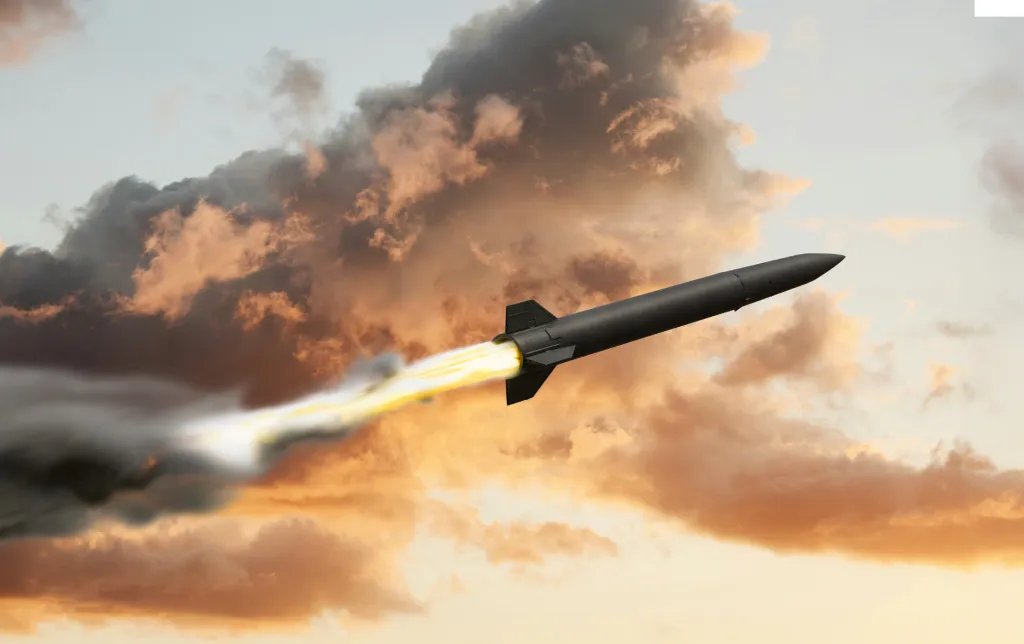
The company is also developing the larger FP-9, which Fire Point has described as having a planned range of approximately 850 kilometers (528 miles). The larger missile requires substantially more solid propellant and has driven the company to establish new industrial capabilities for manufacturing large solid-rocket motors.
As with the FP-7, the available FP-9 performance figures are based primarily on statements from Fire Point and Ukrainian sources and should not be treated as independently established specifications.
The development of these weapons reflects Ukraine’s broader effort to expand domestic production of long-range strike systems. Kyiv has relied heavily on Western-supplied weapons during the war while simultaneously attempting to establish an indigenous capacity for drones, cruise missiles, and ballistic missiles.
For Fire Point, that effort has produced an unusually broad portfolio in a relatively short period: long-range attack drones, cruise missiles, ballistic missiles and, potentially, interceptors designed to defeat ballistic missiles.
The claimed combat debut would give Ukraine a fast, hard-to-intercept strike option for targets within the FP-7’s reported range, with its combination of kinetic energy and relatively heavy warhead making it particularly useful against hardened targets. If targeting and launch procedures can keep pace, its short flight time can also enable rapid-response strikes against more time-sensitive targets. More broadly, the FP-7 represents the culmination of years of Ukrainian efforts to close a major ballistic-missile gap with Russia and establish an indigenous capability.
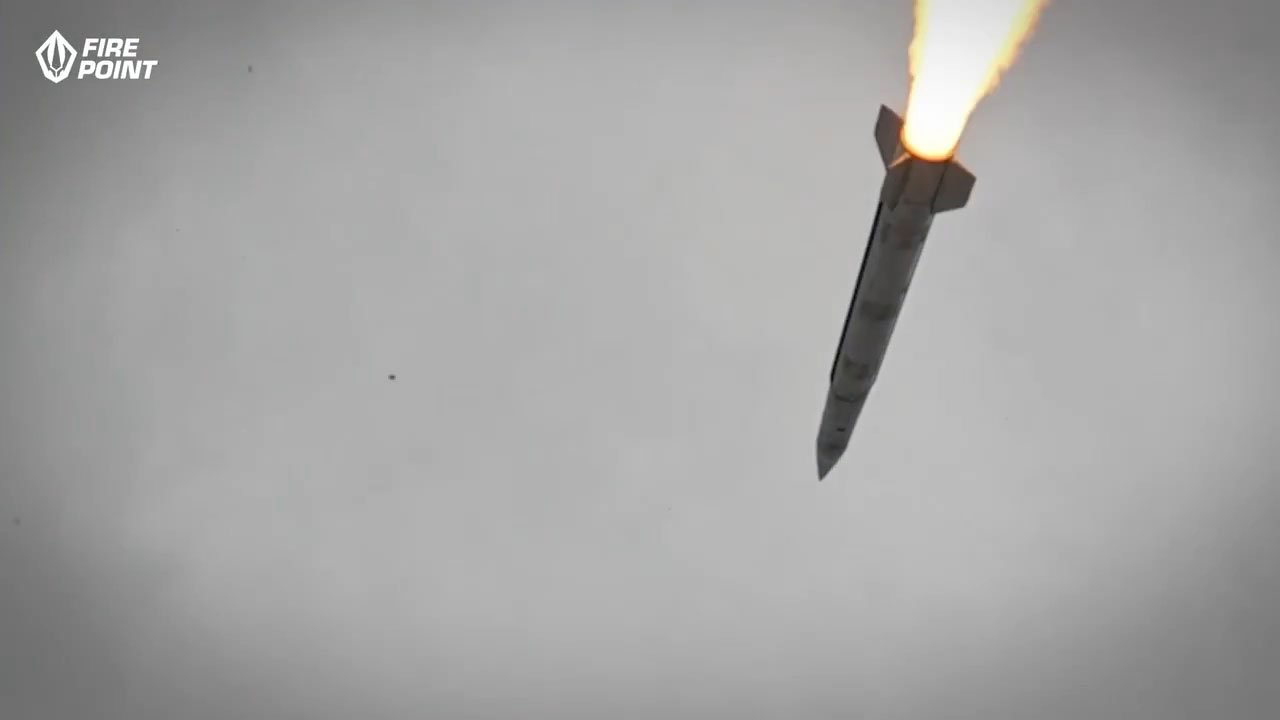
The reported combat debut of the FP-7 also comes as the long-range strike campaign between Russia and Ukraine continues to intensify, with both sides increasingly seeking to hold targets deep behind the other’s front lines at risk. That dynamic will become particularly important as the two countries head into another winter, when strikes against energy, industrial, and military infrastructure ramp up significantly. At the same time, the FP-7’s reported range gives it a considerably more limited target set than Ukraine’s longer-range cruise missiles and drones, constraining where it can be employed and distinguishing it from systems designed for deep strikes hundreds of miles beyond the front.
Вітаємо FP7) pic.twitter.com/FxgCHVHMET
— Denys Shtilierman (@DenShtilierman) February 27, 2026
The significance of Zelensky’s announcement will ultimately depend heavily on whether the FP-7 can move from a claimed combat debut into sustained production and operational service.
Ukraine has not publicly disclosed the number of FP-7 missiles produced, current production rates, or when significant quantities could become available.
Using the FP-7 in combat for the first time would mark an important transition for Fire Point’s ballistic missile program, from development and testing toward operational employment. The company’s ability to manufacture the weapon at scale will become the next critical question.
Contact the author: thomas@thewarzone.com
The post Ukraine Claims First Combat Use Of FP-7 Ballistic Missile appeared first on TWZ.

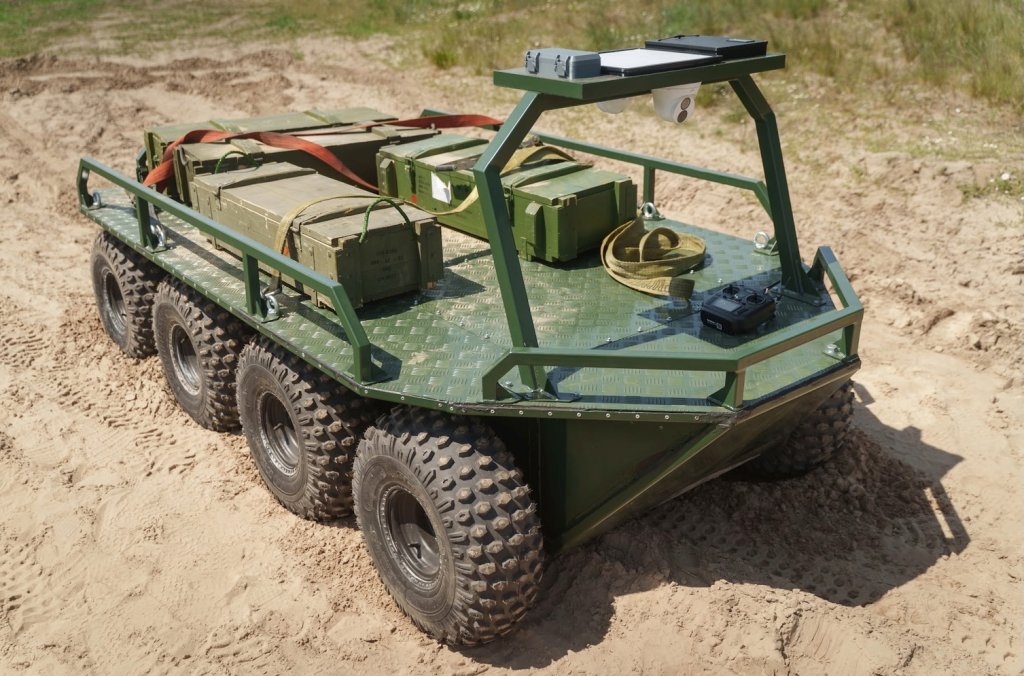
Taking a break from fighting Russians in the Kostiantynivka sector of the eastern Donetsk region, the commander of a Ukrainian uncrewed ground vehicle (UGV) unit spoke with us about innovations in the use of these systems. One was the first deployment of a UGV specifically designed for amphibious operations to deliver supplies to frontline troops in areas impeded by water obstacles. Large areas of the front line are bisected by rivers and wetlands, and the country has many other small waterways and marsh areas. As we have frequently reported, the use of UGVs by both Ukraine and Russia has exploded as the ubiquity of aerial attack drones makes it far too dangerous for human battlefield movements.
In an exclusive interview with TWZ, the commander of the 93rd Separate Mechanized Brigade’s “Alter Ego” UGV unit, who goes by the call sign “Electric,” offered us unique insights into the challenges of developing amphibious UGVs and how they were deployed.
In the first of two parts, Electric talks about why Alter Ego developed amphibious UGVs – including modifying a Triton variant for this – and how the unit made them work. The second part features his insights into using heavy ‘bomber drones’ to drop UGVs behind enemy lines for kamikaze raids. In addition, a representative of Brave1, Ukraine’s weapons technology accelerator, spoke about developing these systems at scale.
Some of the questions and answers have been slightly edited for clarity.
Q: How did the need for amphibious UGVs for logistics operations first come up?
A: We had this idea for a long time, but recently one of the units of the Armed Forces asked for our help to solve this problem, so that the UGV could overcome water obstacles.
There was a crucial need for this kind of means at certain parts of the front, but the units that are located there didn’t have the capacity by themselves to solve this task. So our battalion was asked to solve this problem because we are one of the most experienced units in terms of UGVs.
A first-ever logistics mission on an amphibious UGV: the robot covered 40 kilometers across land and water.
— BRAVE1 (@BRAVE1ua) September 29, 2026
Operators of the "Alter Ego" unit (93rd Brigade) deployed the robotic system across mixed terrain. Facing water obstacles, the UGV seamlessly switched to swimming mode to… pic.twitter.com/rH8waq04a4
Q: How long did it take to design and test the amphibious UGV, and what went into that process?
A: The whole process from development to battle deployment took less than three months.
Q: What did you have to do to make this work?
A: First of all, we looked at amphibious solutions that were on the market, not only in Ukraine, but in the world, and we took two separate approaches. One was taking one of the main UGVs that our unit is using on the ground, and we made it amphibious. And the other approach was that we took one of the solutions that was on the market that already had amphibious capabilities, and we solved several disadvantages that it had. And at the moment, we are using both.
Q: What did you have to do to make the UGV amphibious, and then what were some of the obstacles that had to be overcome to get this operational?
A: First of all, we have to explain that there are different solutions on the market that kind of work on the testing ground — like they can swim, they can drive on the ground, and in the vision of the manufacturer, they are working. But the fact is that these solutions are not ready for the reality on the front line, which is often very different from what is on the testing ground.
And the second point is that the unit has its own workshops where people work near the front line, and the experts, the engineers that work there, they have a very high level of competence to evaluate different solutions and select the one that has potential. And that’s what’s completely different between this unit and everyone else, like manufacturers and others who are working on these solutions, because they don’t understand what’s needed on the battlefield.
Q: So what did you have to change to make it work?
A: Regarding the amphibious one, basically the unit changed almost everything that that UGV had, starting from electronics, the software, the waterproofing, the communications – we basically changed everything. Regarding the one that we already used on the ground, we basically tried to retain what was allowing it to be an effective UGV on the ground, and we added waterproofing and specific mechanics, so that it can work in the water environment.
Q: You mentioned communications. What kind of communications did you add?
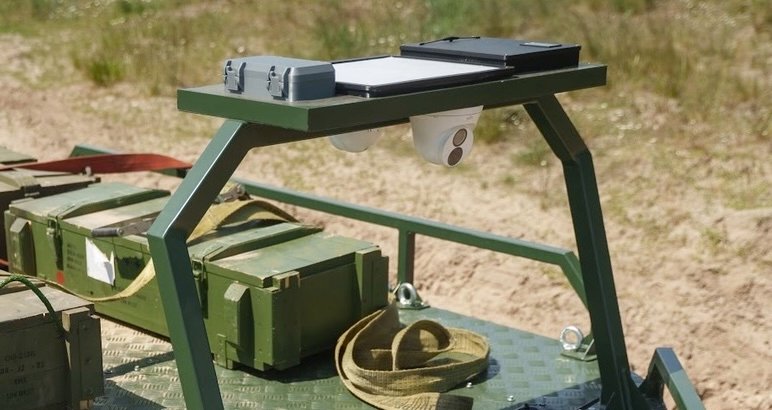
A: The communication means that was installed on the UGV by the manufacturer was not sufficient at all. Basically, it didn’t have enough quality for the battlefield situation. It was not working. But we already have our own communications that we were working on, and we have a lot of experience because we have been working for a long time in this UGV area. So we basically helped to install a sufficient level of communications on this UGV.
Q: So how does the amphibious UGV communicate with the controller? Does it use Starlink or some other satellite communications system for navigation?
A: This is satellite navigation, but not only. Satellite navigation is a part of this communication system.
Q: What are the other parts?
A: It’s better not to talk in detail about the other part of the communication system.
Q: There were probably a lot of different missions that could have been used for this first amphibious UGV logistics delivery. Why was this particular mission chosen?
A: The Alter Ego unit has so much experience in terms of UGVs, and not just experience of using UGVs, but the experience of being the first in the world. We had one of the first evacuation missions, we had one of the first strike missions using UGVs, the paratrooper UGV, and now the amphibious UGV. So basically, we have the systems to make it work for the first time when nobody knows how to conduct this mission.
Q: No, I mean why did this particular mission get chosen to be the first one?
A: There are certain places on the front line where we have water obstacles that prevent logistics from being done by UGV. At the moment, UGVs are carrying hundreds of tons of logistics, probably the most compared to any other means on the front line, but before this, these water obstacles would prevent UGVs from providing logistics for those parts of the front, and that need can’t be fully satisfied by UAVs or other means. That’s why we did this mission with the amphibious UGV, and now our task here is to scale this technology and provide this logistics system for other similar parts of the front where there are water obstacles.

Q: Tell me about where and when this mission took place and what it was like to watch it unfold.
A: So unfortunately, we can’t provide information about when and where this operation took place. But regarding how it went and what we felt, this was another big challenge, because this is something that wasn’t done before, and nobody thought this is real. So this was quite difficult, and to tell the truth, the mission didn’t succeed on the first try, actually, and it required a lot of effort in terms of planning, preparing, engineering, and basically it required 100% effort from everyone involved in that mission.
Q: How many times did it fail before, and what went wrong?
A: We had one failed attempt. The reason for failure was a certain technical problem. After that, we analyzed what went wrong, and we worked on solving those issues. Basically, it’s something that nobody had tried to do, it’s kind of hard to know what can go wrong before you actually try it. So the best way to find a solution like that is to try and then iterate on that attempt and make it better and better and better.
Also, I would like to add that although this was the first successful mission regarding an amphibious UGV, it’s not that there was no work on that before that. We were actively talking to and collecting the experience of everyone who was working on these kinds of missions before, and that was also a reason why this mission succeeded.
Q: How far did the amphibious UGV go for this mission?
A: So the UGV went 40 kilometers one way, and then it returned. So probably around 70 kilometers in total, and it carried food and other supplies.
Q: Did this UGV come under Russian fire on this mission?
A: Yes, and it survived.
Q: How does the UGV switch from water to land operations?
A: So the UGV has two separate control systems, one for water and one for land, and basically it switches to the one that is required at the moment. That’s how it can operate in both environments.
Q: Is that autonomous, or is that something that the controller at the base has to do as they watch the UGV on its mission?
A: At the moment, the operator fully controls the UGV manually. And basically, before, the operators of UGVs only knew how to move them on land, but now they also had to learn how to move them in the water. So not only was the technology itself developed, but we also had to prepare the operator and come up with tactics for this UGV.
Q: Did you use AI on this mission in any way, and if so, how?
A: We didn’t use AI.
Q: Have there been other missions using amphibious UGVs?
A: Yes.
Q: Can you say how many and what was delivered?
A: No.
Q: Is this designed only for logistics missions, or will it be used in the future for strike missions, either as a one-way attack system or as a platform for machine guns or other weapons?
A: We can use it in different ways in the future.
Q: Mud season is fast approaching, when much maneuvering becomes impossible or severely degraded because of how difficult it is to move in the thick, oozing slop. Will your amphibious UGVs work in the mud?
A: I think it can operate in the mud in the same way it operates in the water.
In the next segment of our interview, Electric talks about using bomber drones to deliver UGVs behind the lines, and a Brave1 representative talks about how the organization is working to develop these systems at scale for wider use.
Contact the author: howard@twz.com
The post Inside Ukraine’s First Combat Deployment Of Robotic Amphibious Vehicles appeared first on TWZ.

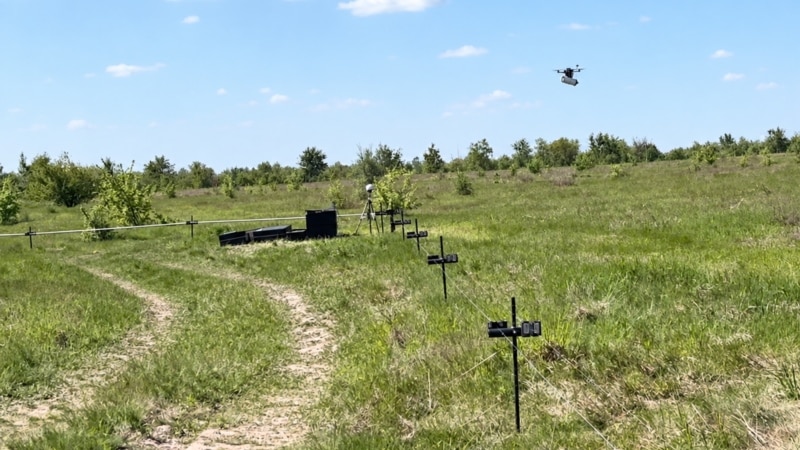
The U.S. government set off conventional explosives inside a tunnel deep in the Nevada desert this week in a test designed to replicate a so-called “decoupled” nuclear detonation. Data collected is now being used to help improve methods for detecting this kind of nuclear testing. Just earlier this year, American authorities accused China of using decoupling to conceal new nuclear tests despite the country’s stated moratorium on such activities.
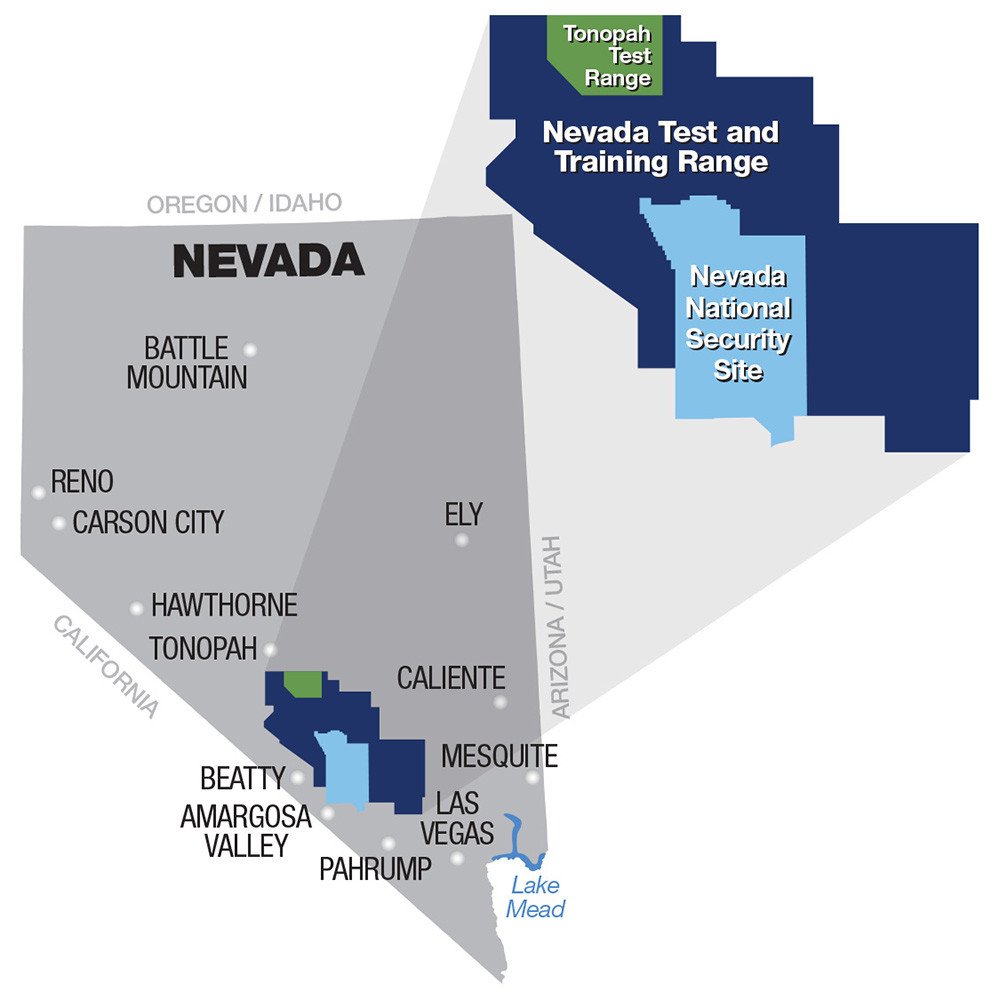
The test, which involved the use of chemical high-explosives and radiotracers, was conducted yesterday inside P Tunnel in Area 12 of the Nevada National Security Site (NNSA), according to a press release from the National Nuclear Security Administration (NNSA). The NNSS, which is situated within the boundaries of the U.S. Air Force’s Nevada Test and Training Range (NTTR), is used for a wide variety of testing purposes today. An agency under the Department of Energy, NNSA’s main jobs are to oversee the development and production of nuclear weapons, as well as manage America’s nuclear deterrent stockpile.
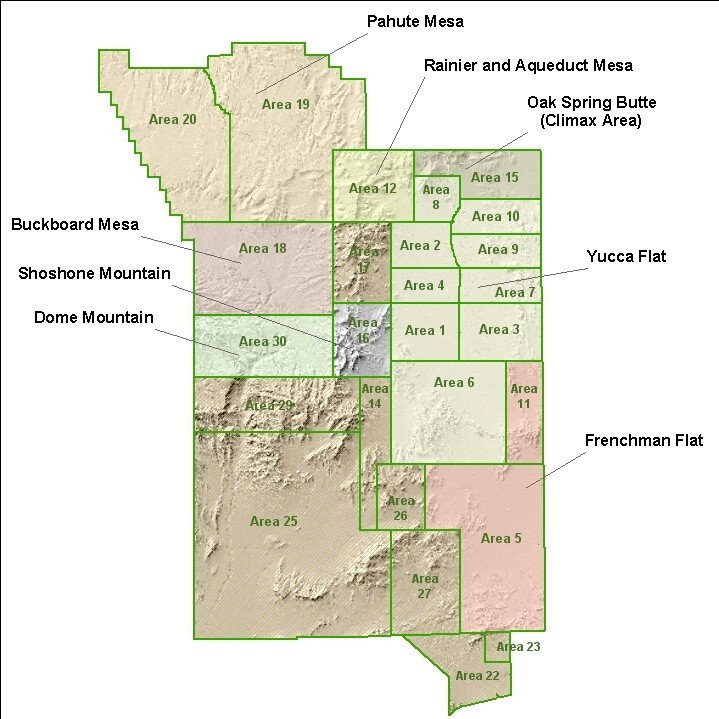
“This experiment is especially focused on further enhancing the U.S. capabilities to detect a ‘decoupled’ explosion,” per NNSA’s release. “Data collected from the experiment will be used to validate scientific models and refine algorithms that are critical to U.S. nuclear explosion detection efforts.”
“Just as a stealth aircraft looks smaller on radar, decoupling can greatly muffle the signals detected by nuclear detection sensors, making a large explosion appear smaller,” the release explains. “In a conventional, or ‘coupled,’ underground nuclear test, a device is placed deep in a hole in close contact with the rock, allowing much of the explosion’s shockwave to reach sensors. In a decoupled test, by contrast, the device is detonated inside a large underground chamber, substantially reducing the explosion’s seismic signature.”
“In this experiment, researchers gathered measurements using a broad suite of advanced sensors, including accelerometers, seismometers, infrasound sensors, electromagnetic sensors, chemical and radiotracer samplers, and meteorological sensors,” it adds. ”Together, these measurements will improve scientists’ understanding of the signatures produced by underground explosions and strengthen the United States’ ability to detect and characterize nuclear explosive events.”
The U.S. already maintains a U.S. Atomic Energy Detection Systems (USAEDS) network, which is overseen by the U.S. Air Force Technical Applications Center (AFTAC). USAEDS is made up of more than 3,600 sensors positioned around the world. USAEDS is also tied in with the International Monitoring System (IMS), which is managed by the organization responsible for overseeing the Comprehensive Nuclear-Test-Ban Treaty (CTBT). AFTAC also supports the mission to monitor for potential nuclear testing globally using a fleet of specially configured WC-135R Constant Phoenix aircraft. In addition, those planes are used to help keep watch for unusual spikes in atmospheric radiation that could point to nuclear or radiological accidents or other incidents leading to the spread of potentially dangerous radioactive material.
With regard to the USAEDS network specifically, “once a disturbance is detected underground, underwater, in the atmosphere or in space, the event is analyzed for nuclear identification, and the findings are reported to command authorities,” according to AFTAC’s website.
As mentioned, the U.S. government has accused its Chinese counterparts of using decoupling to conceal new nuclear testing, and NNSA’s press release draws explicit attention to these allegations. At the annual Conference on Disarmament in Geneva, Switzerland, in February, Thomas DiNanno, Under Secretary of State for Arms Control and International Security, said that China had conducted at least one such test at Lop Nur on June 22, 2020. The Comprehensive Nuclear-Test-Ban Treaty Organization (CTBTO) subsequently said the IMS had not detected an event matching that description at that location on that date. For its part, the Chinese government has denied the accusation.
The social media posts below include satellite imagery showing activity at Lop Nur that could point to new nuclear testing activities in recent years.
参考
— KAROTASU (@type36512) May 24, 2026
Satellite Imagery Analysis of China’s Alleged 2020 Nuclear Test at Lop Nurhttps://t.co/aafvU5Szh7
CSIS 20260213
ROLES SAT ANALYSIS No.7 中国に核実験実施の動き ー Lop Nur核実験場の画像分析 ーhttps://t.co/n66yYk0hLg
ROLES 20250522
While China is a signatory to the CTBT, the country has never ratified it. The Chinese government last acknowledged a critical-level nuclear test in 1996, after which a self-imposed moratorium was put in place, at least publicly. As an aside, the United States has also signed, but never ratified, the CTBT, and has a similar self-imposed moratorium on nuclear testing since 1992. It is worth noting that the treaty does not ban so-called sub-critical testing, which involves fissile material, but does not result in a full-fledged nuclear reaction.
Last week, The Wall Street Journal reported that the Trump administration has been holding new talks with the Chinese government regarding various aspects of the country’s massively and rapidly expanding nuclear arsenal, including the testing allegations. That story immediately preceded a state visit by China’s President Xi Jinping to Washington, D.C., to meet with Trump.

“The discussions between American and Chinese officials have centered on measures to reduce nuclear risks and haven’t been aimed at negotiating a formal arms-control pact, an effort Beijing has sharply rebuffed in the past,” according to that report. “The Trump administration has begun to highlight the possibility of implementing new verification measures.”
“Independent experts say seismic instruments might be placed on or near test sites,” The Journal‘s story also noted. “Another possibility, which was floated during the Biden administration, is to install radiation-detection equipment at test sites.”
NNSA’s announcement about the test at the Nevada National Security Site is certainly an example of the development underway already of new means of verification that could be deployed at sites around the world.
The United States has separately accused Russia of conducting lower-yield nuclear testing in secret in the past. Russia is a signatory to the CTBT and had previously ratified it. In 2023, President Vladimir Putin revoked that ratification in line with the provisions of a law passed by the country’s parliament, or Duma.

President Trump has also floated the idea of the resumption of U.S. nuclear testing in response to Russian and Chinese activities, though other U.S. officials have downplayed the possibility of doing so. The United States is otherwise in the midst of a huge nuclear modernization effort that impacts the air, sea, and land-based legs of the deterrent triad. American authorities are also now pursuing these efforts in an environment fully unbounded by relevant arms control agreements following the sunset of the New Strategic Arms Reduction Treaty (New START) earlier this year.
The Russian government has said it is ready to conduct new nuclear tests if the United States pursues this course of action. The last official nuclear test in Russia came in 1990 right before the fall of the Soviet Union.
“It takes nuclear expertise to detect nuclear activities and experiments like these [to] ensure America remains unmatched in detection,” NNSA Administrator Brandon Williams said in a statement yesterday in light of the test in Nevada. “The Trump Administration has made it clear that the United States will lead from a position of strength. You cannot evade American innovation. With this experiment, we are sending a clear message: under this administration, America will never be outmatched.”
Contact the author: joe@twz.com
The post U.S. Mimics “Decoupled” Nuclear Detonation By Blowing Up A Tunnel Conventionally appeared first on TWZ.
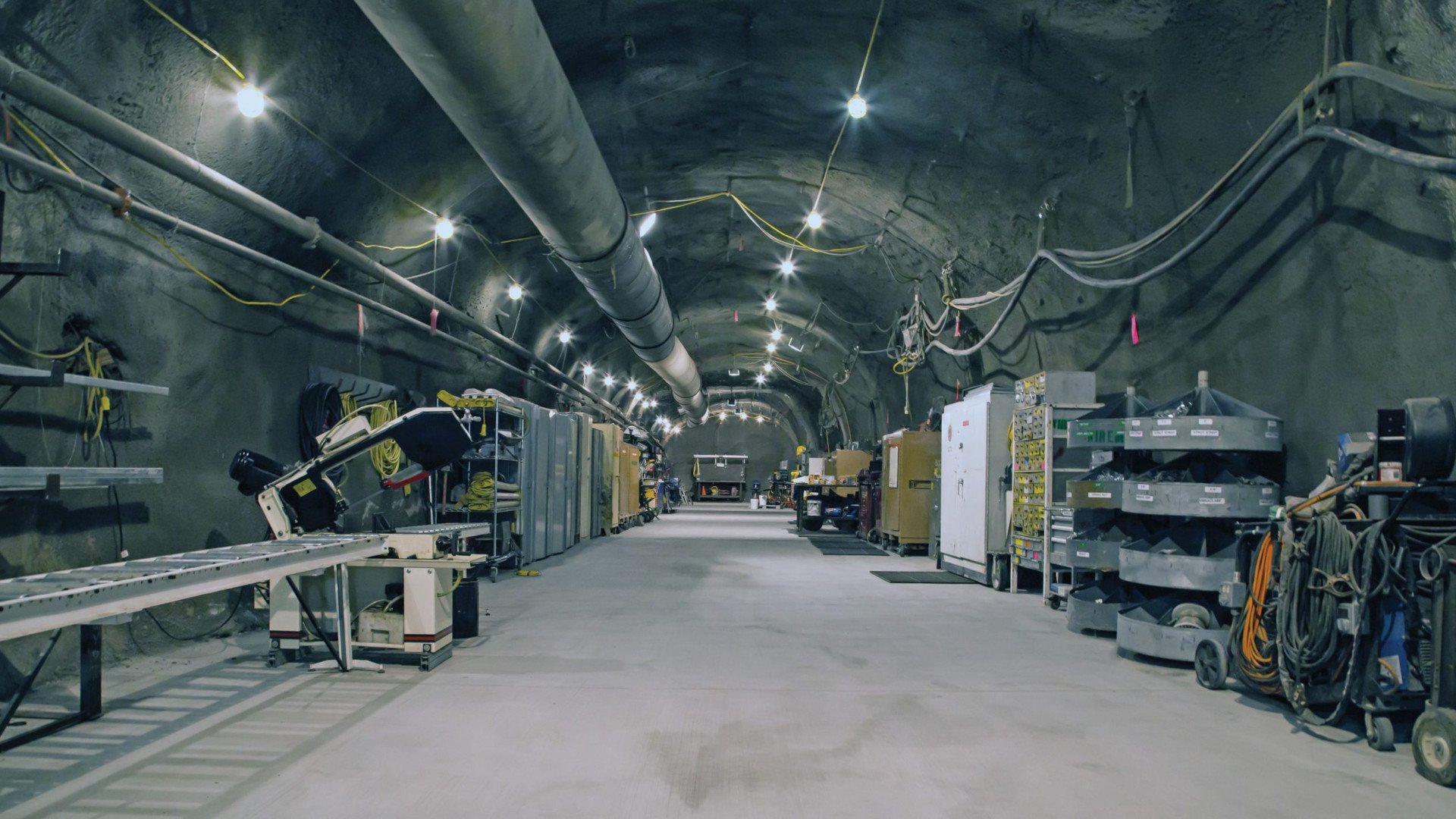

The Pentagon has announced plans for a new functional combatant command, very broadly akin to U.S. Special Operations Command (SOCOM) or U.S. Space Command (SPACECOM), but for operational activities involving autonomous and robotic capabilities. Secretary Pete Hegseth has also announced new initiatives to help further accelerate the fielding of uncrewed systems in the air, at sea, and on land, as well as to explore future warfighting challenges. All of this builds on previous and long-overdue efforts to prioritize the fielding of various tiers of drones, as well as artificial intelligence (AI) and other emerging technologies, across domains, but there are questions about how these new efforts will translate into tangible developments.
Secretary Hegseth unveiled plans for what is tentatively dubbed Autonomous Warfare Command (AUTOWARCOM), as well as the aforementioned initiatives, called Project Agincourt and Project Meridian, during a speech to service members today at the U.S. Marine Corps’ base in Quantico, Virginia. Hegseth called this a State of the Force address, and said he planned to make it an annual event.
.@SECWAR “Today, at my direction—we are announcing the creation of Autonomous Warfare Command, or AutoWarCom:
— DOW Rapid Response (@DOWResponse) September 30, 2026
A new 4-star combatant command—with service-like authorities—built to scale autonomous and robotic capabilities across the Joint Force in the fastest peacetime shift in… pic.twitter.com/kYWBxy6Dij
“At my direction, we are announcing the creation of Autonomous Warfare Command, or AUTOWARCOM, a new four-star combatant command with service-like authorities built to scale autonomous and robotic capabilities across the joint force in the fastest peacetime shift in modern military history,” Hegseth declared. “Drone warfare supercharged by SI-enabled targeting is the biggest battlefield revolution in generations. You already know that. Yet when I was sworn in to the Department of Defense, there was scant urgency in this domain.”
“SI” here stands for “super intelligence,” a term the Trump administration is now using in place of AI.
Hegseth called attention to the Drone Dominance initiative he unveiled last year, as well as the establishment of Joint Interagency Task Force 401 (JIATF-401), as examples of steps the Department has already taken in this regard. JIATF-401 is notably focused on counter-drone capabilities, as you read more about here.
“It’s a good start, but it’s certainly not enough. The pace of war is changing faster than the process to support it. Cheap compute, super intelligence, and advanced commercial manufacturing have enabled the proliferation of low-cost, high-precision strikes,” Hegseth continued. “For 40 years, the United States relied … primarily on expensive weapons that placed quality over quantity. Now, that approach gave us a lot of enormous advantages, and we need to preserve those capabilities. But today we need both quality and quantity. The term you know is high-low mix. An analogy is a thunderstorm. We need bolts of lightning high, our existing high-end kill chains capable of striking unexpectedly and decisively. We also need steady wind and rain, mass drones and other autonomous attritable systems that flip the cost exchange and impose unrelenting pressure on an adversary on the battlefield.”
Hegseth highlighted lessons learned from the ongoing conflict in Ukraine as underscoring these points.
.@SECWAR "Ukraine’s lesson is not that one type of drone wins wars but rather the need for a purpose-built system that maximizes the ability to adapt.
— DOW Rapid Response (@DOWResponse) September 30, 2026
We will fuse procurement with operations at scale – and allow our warfighters, engineers, and entrepreneurs to learn, adapt, and… pic.twitter.com/x7iNMAbU0t
“So today, with Autonomous War Command, AUTOWARCOM, we institutionalize and we supercharge the era of SI, robotics, and autonomous systems, all in order to win,” he added.
A memo the Pentagon has now released makes clear that the establishment of this command is contingent on Congressional approval, and the current goal is for it to be established by October 1, 2027.
“Autonomous Warfare Command will define joint needs and integrate Service-provided forces in support of geographic combatant commanders,” the memo also notes. “It will test equipment and force designs with realistic opposition in demanding exercises and rugged environments, modify rapidly, and field what works. We must build a wartime arsenal whose main product is adaptation at the edge.”
Many questions remain to be answered about how these activities will work with what’s already being done within the individual services, and how all of that will translate into operational activities. Part of Project Agincourt’s role will be working to help answer the questions above. The name here is a reference to the battle in 1415 in which British forces prevailed over their French opponents, famously in part through the application of a particular military technology, the longbow.
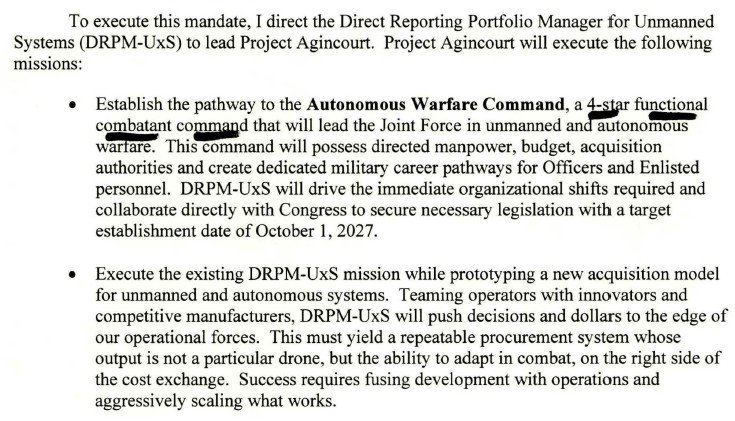
The office of the Direct Reporting Portfolio Manager for Unmanned Systems (DRPM-UxS) will lead this initiative. Owen West, head of the Pentagon’s Defense Innovation Unit (DIU), and U.S. Navy SEAL Senior Chief Max Strasiser are set to serve as the Chief Executive Officer and Chief Operating Officer of the DRPM-UxS, respectively.
Project Agincourt will also “prototype a new construct called warfighting acquisition, not just acquisition that happens at the Pentagon,” according to Hegseth. “This model fuses operators with entrepreneurs in rapid adaptation cycles while distributing decisions and dollars closer to frontline units, to combatant commands. Realistic training exercises, and when possible, the crucible of combat, will be used to compress innovation timelines and scale what works.”
“Also today, we are phasing in new MOS [Military Occupational Specialty] frameworks within each military department to support our shift to autonomy,” the Secretary also noted during his speech in the context of Project Agincourt and the plan for AUTOWARCOM. “We need institutional knowledge and career paths for a new generation of autonomous warfighters.”
Project Meridian sits adjacent to these efforts and has a broader mandate to explore ways to ensure the U.S. military maintains its technological edge on future battlefields.
“Project Meridian, the future of warfare, is not about developing new strategies or new policies. We already do that. Rather, its purpose is to creatively look to the future, and identify the domains that we must conquer, and capabilities we must master,” Hegseth said. “We need to be looking forward into the future to achieve technological and military dominance on the battlefield for decades to come. It is futuristic on purpose. Their work will be focused on discovering, developing, and fielding the weapons and systems that our children and our grandchildren will need in their lifetimes, without any creative limitations or restrictions, on any future battlefield, from under the Earth to beyond the Moon.”
.@SECWAR “Today, at my direction—I am announcing Project Meridian, an effort led by America’s best minds to study the future of warfare.
— DOW Rapid Response (@DOWResponse) September 30, 2026
Under the leadership of @USWREMichael, Project Meridian will be co-led by three of our nation’s best minds: @elonmusk, @PalmerLuckey, and… pic.twitter.com/4DyurVpkUZ
“Project Meridian will study the battlefields of the future, identify which weapons and technologies warfighters will need to harness to dominate in these environments, and propose actionable solutions to start developing, testing and fielding these capabilities such that America will have overmatch for the 21st century and beyond,” according to a separate memo the Pentagon put out today. “The Joint Staff and all services should be prepared to connect their future warfare efforts and research to Project Meridian.”

Furthermore, “Project Meridian will leverage critical perspectives from outside the Pentagon, drawing upon a group of top technologists, innovators, business leaders, policy makers, and national security experts,” according to the memo. “Project Meridian’s primary function will be to map the trajectory of future warfare, identify critical capability gaps, and propose actionable solutions in furtherance of the identified goals in the 2026 National Security Science and Technology Strategy.”
This is also very much a near-term initiative, with Hegseth demanding a final report no later than 120 days from now, or January 28, 2027. The Pentagon’s Chief Technology Officer, Emil Michael, has been directed to set up this project. Today, Hegseth also named Elon Musk, Palmer Luckey, and Newt Gingrich as key members.
Elon Musk, founder of SpaceX, which dominates the commercial space launch and services market globally, as well as the host of other companies, has had an on-again-off-again relationship with the Trump Administration. Palmer Luckey is another entrepreneur now best known for founding Anduril, which has increasingly been a major player in the U.S. defense industry. Newt Gingrich, a highly influential member of Trump’s Republican Party and former Speaker of the U.S. House of Representatives, has more recently become an outspoken advocate of advancing AI technology in the United States.

The inclusion of Musk and Luckey does raise ethical questions, as they both lead companies with major U.S. government contracts already, and which could be in line to see more opportunities based on Project Meridian’s findings. What guardrails might be put in place to prevent conflicts of interest is unclear.
To reiterate, it remains to be seen how all of these efforts will progress and how, or if, they will ultimately translate to more tangible developments. The U.S. military has a long history now of launching high-profile initiatives that still struggle to demonstrate real progress, despite widespread support for accelerating the fielding of uncrewed systems, AI, and other advanced technologies. The Pentagon has certainly produced tangible results through other organizational shifts in recent years, including the aforementioned Drone Dominance initiative and JIATF-401, as well as the Replicator initiative under President Joe Biden.
At the same time, there are real potential hurdles to these new plans. The Pentagon has itself already acknowledged that support from Congress will be key to the AUTOWARCOM vision. Annual budgeting, and the uncertainty that often surrounds that will also be a factor. There is also the matter of efforts to expand the U.S. defense industrial base. The limitations of existing U.S. industrial capacity and supply chains have already become a matter of national debate in light of concerns about dwindling stockpiles of critical munitions as a result of the ongoing conflict with Iran, as well as a succession of other global crises in recent years.
During his speech, Hegseth called attention to efforts to broaden the defense industrial base with new, smaller firms, as well as agreements with large established contractors to expand on their existing capacity. He also highlighted the Trump administration’s $1.5 trillion defense spending plan for Fiscal Year 2027 and issued a new call on Congress to pass an additional $350 billion reconciliation package.
With today’s announcements, the Pentagon has certainly reinforced its commitment to expanding the fielding of uncrewed and other high-tech capabilities across all branches of the U.S. military, but there is clearly work still to be done to turn those visions into realities.
Contact the author: joe@twz.com
The post Vision For New Autonomous Warfare Command Laid Out By Pentagon appeared first on TWZ.
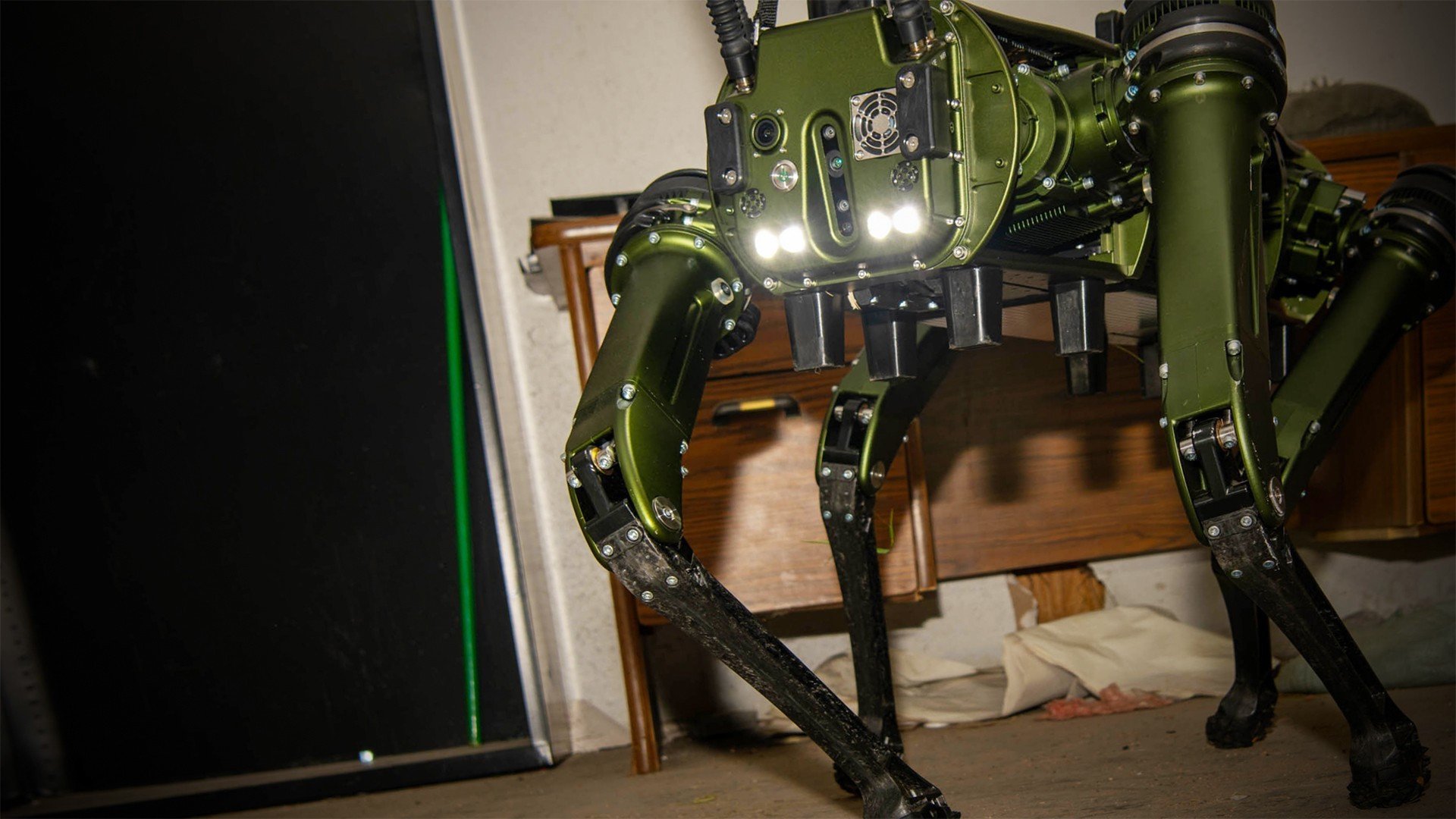
The U.S. Air Force is looking at adding a missile warning system (MWS) to its new F-15EX Eagle II fighters. This will give the aircraft a way to optically detect incoming missile threats, especially passively guided ones like heat-seeking infrared-guided missiles, which they currently lack. The continued absence of an MWS has become more pronounced in light of recent combat experiences over Iran.
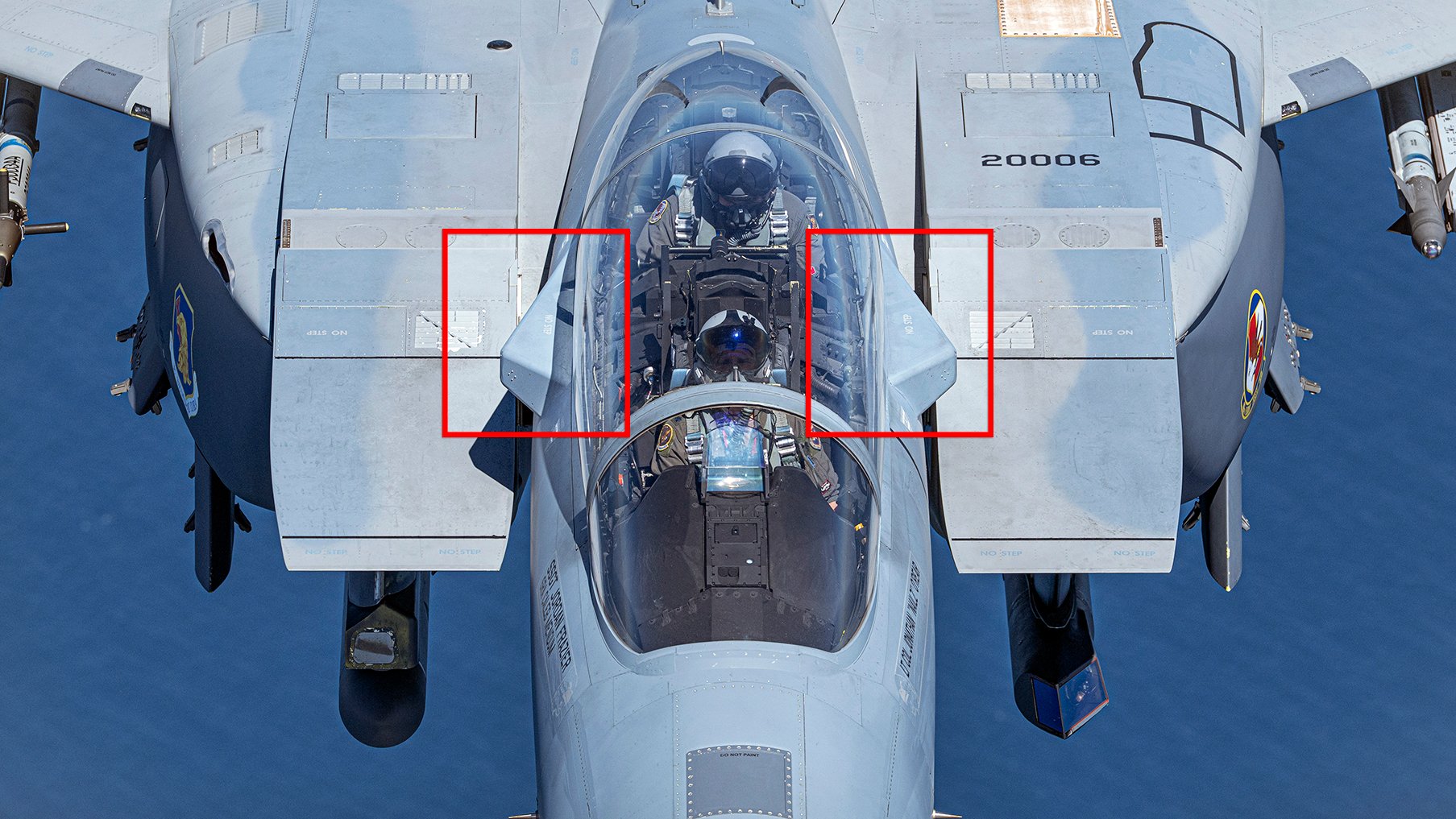
The F-15EX is derived from earlier F-15 variants that all have MWSs, and it had seemed logical to expect the Eagle II would feature this capability. So it was puzzling when the first examples rolled out without such a system, and no apparent plans to install one on a jet already costing upwards of $100 million. The omission has been glaring for years now, especially given that the aircraft has all the provisions for such a system, including blanked-over spots for the sensors.
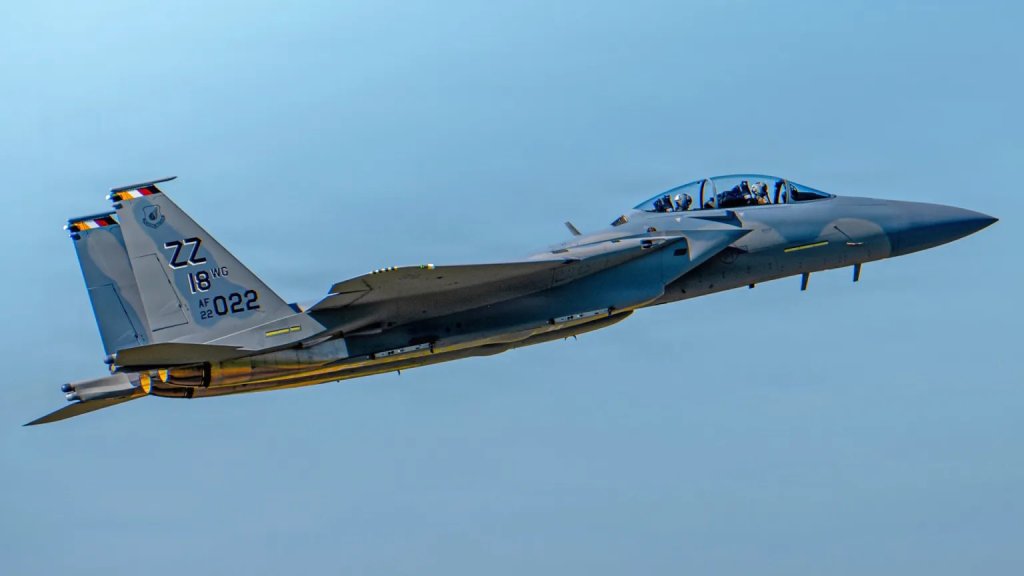
The Air Force has 22 Eagle IIs in inventory now and currently plans to acquire a total fleet of 267 of the jets. The aircraft’s manufacturer, Boeing, is on contract now to build 120 F-15EXs, including a lot of 22 jets through a new $2.38 billion deal also announced yesterday.
Now, the Air Force Life Cycle Management Center’s (AFLCMC) Fighters & Advanced Aircraft Directorate “is seeking sources for the procurement of an operationally qualified threat missile launch and approach warning system for rapid integration into the United States Air Force (USAF) F-15EX Eagle II fighter aircraft,” per a contracting notice put out yesterday. “The MWS must alert the F-15EX aircrew to the presence of missiles that may threaten the aircraft without unreasonably distracting the aircrew with false alarms.”
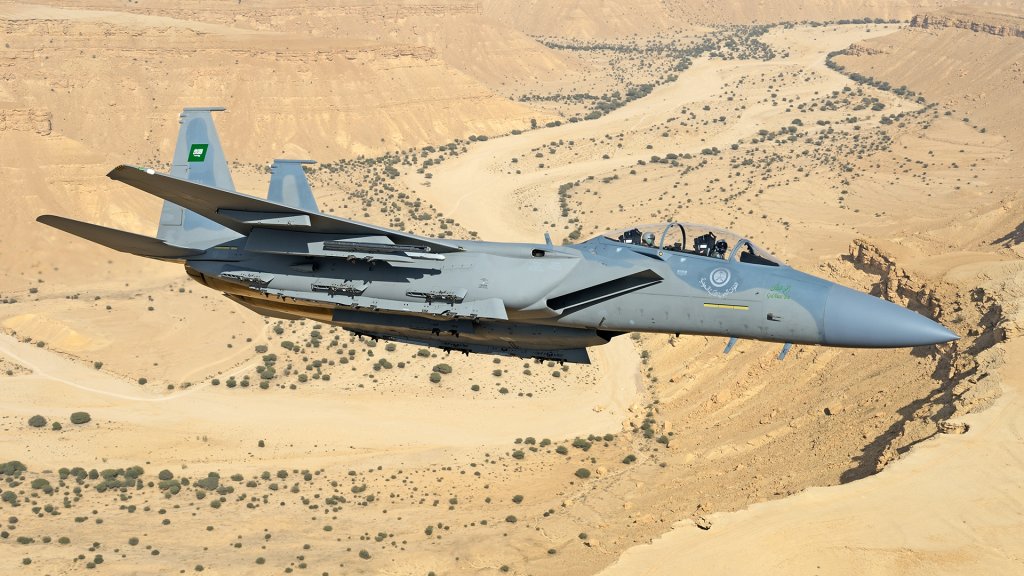
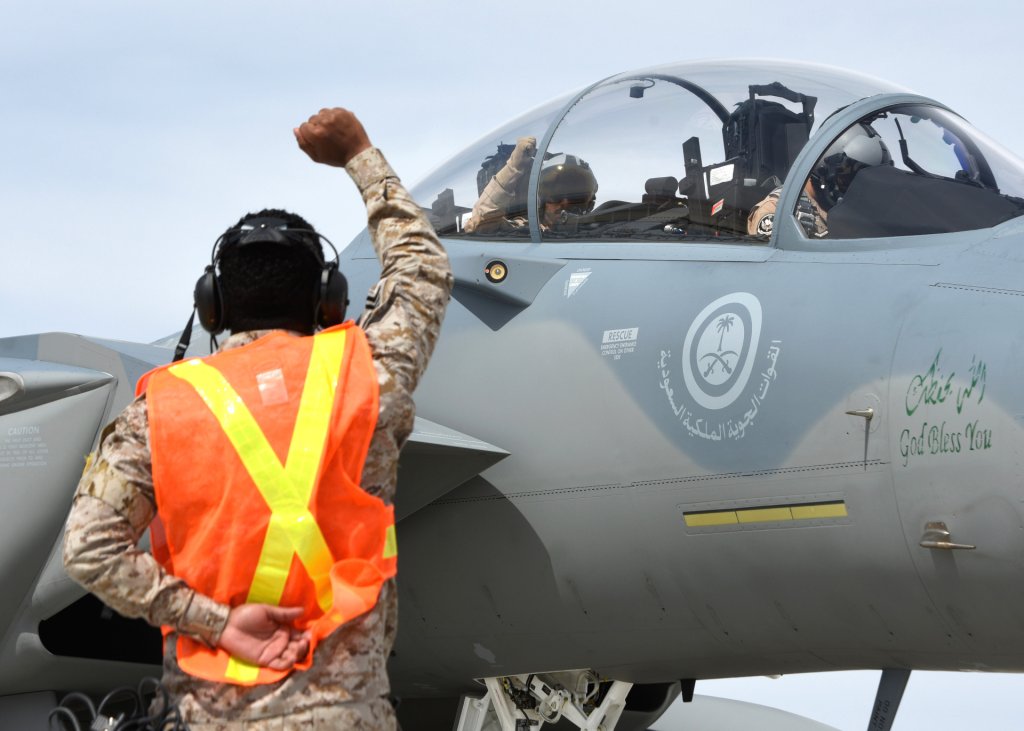
As mentioned, the F-15EX is already configured to accommodate an MWS, inside and out, something AFLCMC’s notice emphasizes. This is a result of the Eagle II having been directly derived from the F-15QA variant for Qatar, which itself was an outgrowth of the F-15SA for Saudi Arabia. While many of the F-15EX’s advances come from these aircraft, the first F-15 variant to get an MWS was actually Singapore’s F-15SG. The Advanced Eagle line and the F-15SG are part of Boeing’s extended F-15E Strike Eagle family.
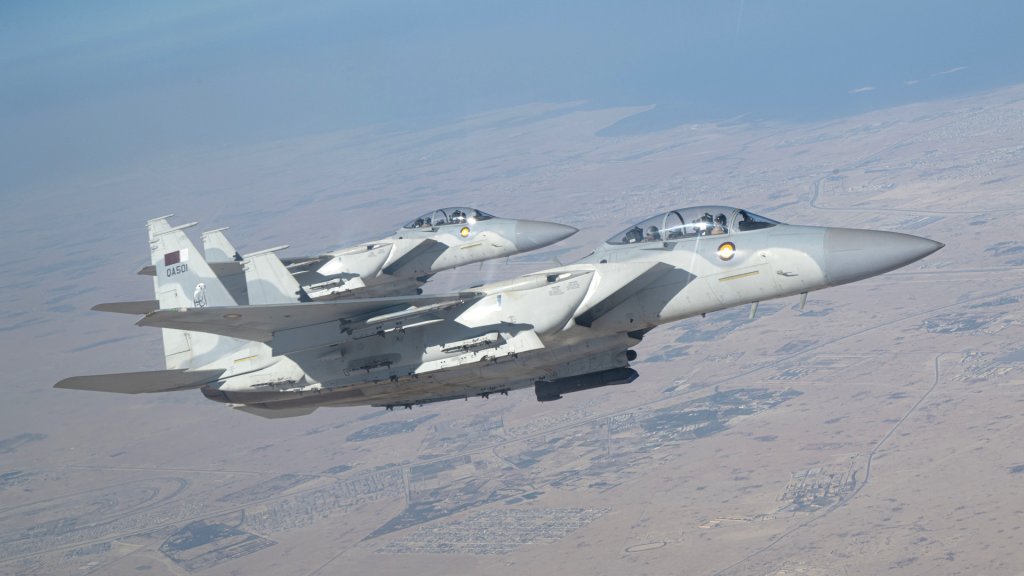
“The MWS must use the six (6) pre-existing F-15EX sensor locations, data cables, power cables, and cooling,” the contracting notice says. “It must be easily, safely, rapidly, and organically installable and removable in the field by USAF military aircraft maintenance personnel without requiring any change to aircraft configuration beyond installation of MWS line replaceable units (LRUs) in the six (6) pre-existing locations in the aircraft dedicated for missile warning.”
The most visually prominent of those pre-existing sensor locations are two horn-like sponsons, one on each side of the forward fuselage right below the cockpit canopy. There are two more locations at the ends of the jet’s tail booms. The last two locations are situated so additional sensors can face straight up and down to provide total 360-degree coverage.
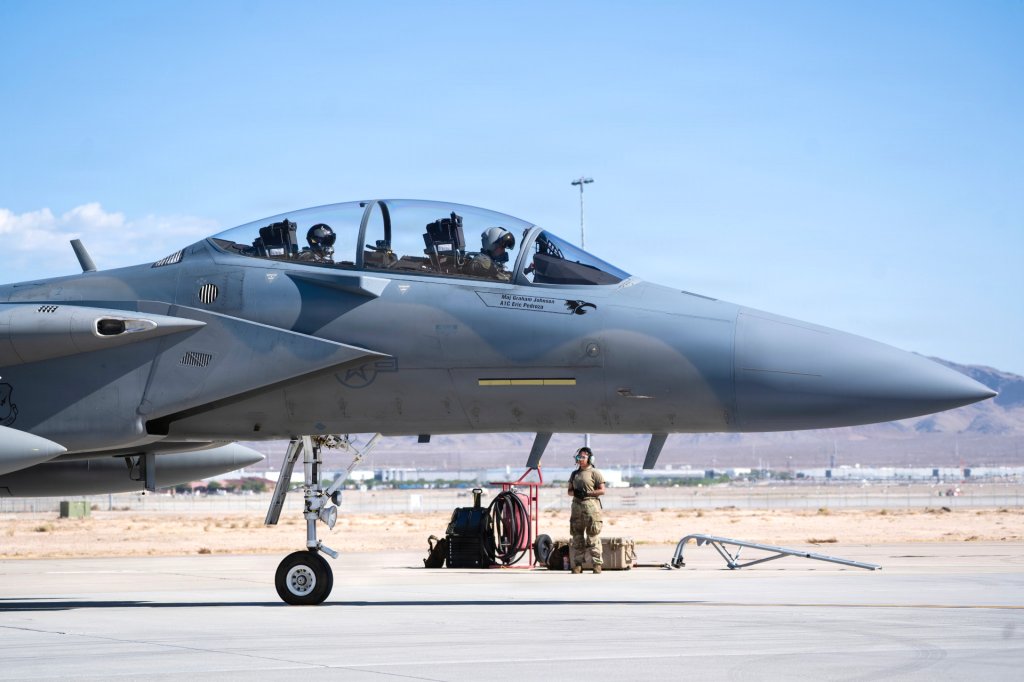
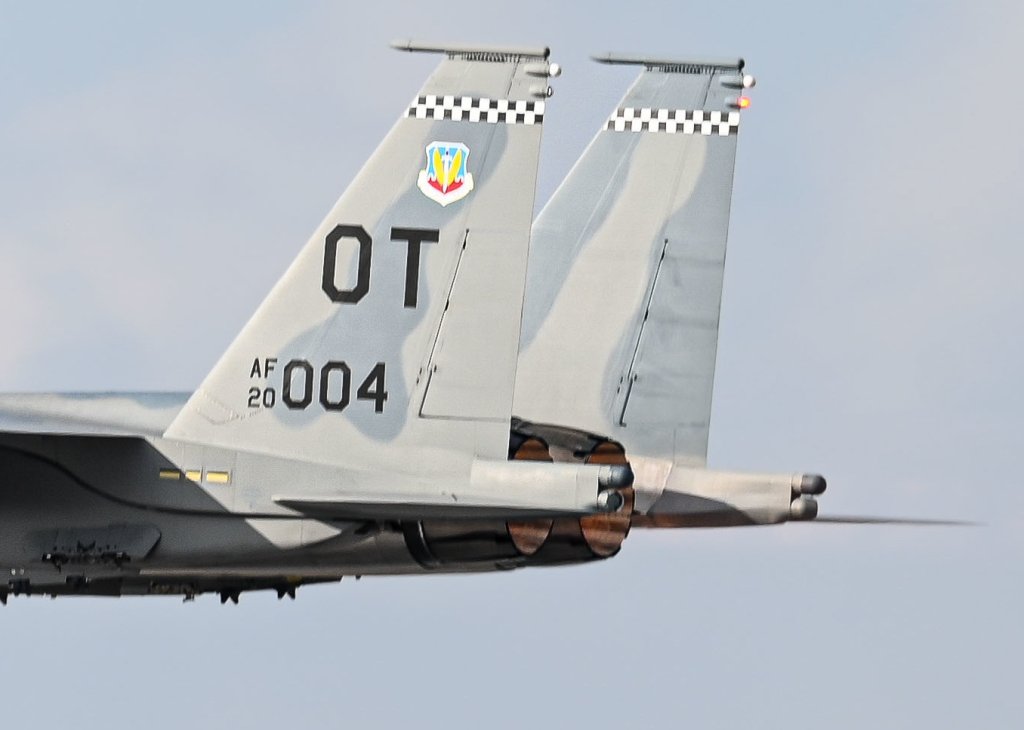
The sources sought notice does not mention any specific MWS and invites prospective vendors to submit proposals. It also stresses that the Air Force is still in the “market research” phase of the contracting process and that it “does not constitute [a] solicitation and shall not be construed as a commitment” to buy such a system.
The F-15SA uses the AN/AAR-57 Common Missile Warning System (CMWS), and this system is understood to also be found on the F-15QA. Beyond F-15 variants, versions of the AN/AAR-57, for which BAE Systems is currently the prime contractor, are fielded today on a wide variety of other fixed-wing aircraft and helicopters, including various types in U.S. military service. CMWS variants are notably found across the U.S. Army’s AH-64, UH-60, and CH-47 helicopter fleets.
All versions of the CMWS consist of several electro-optic missile sensors (EOMS), the number of which varies from platform to platform, linked to a central electronic control unit (ECU). The system is also designed to be integrated into larger defensive suites.

While the AN/AAR-57 is a proven system with years of successful integration on the F-15 and other platforms, it is just one option of the open market today. The Air Force could choose to take another route, possibly with a new system that offers added functionality.
The addition of any MWS will give the F-15EX a valuable, if not increasingly critical, boost in defensive capability. The Eagle II does already have an extremely powerful self-protection suite, including the Eagle Passive/Active Warning Survivability System (EPAWSS). However, it is heavily geared toward defending against radar-based threats that pump out signals that can be detected and jammed. Infrared-homing anti-air missiles zero in on their targets passively.
In general, MWSs also typically make use of passive infrared sensors to spot the heat plumes of missile launches and the thermal signatures of those threats as they continue their approach. BAE Systems says current-generation versions of the AN/AAR-57 are sensitive enough to detect infantry anti-armor rockets being launched, as well as small arms fire from the ground, under the right circumstances. Though an MWS is not an active countermeasure unto itself, the early warning it provides gives critical time to deploy flares or employ other defensive capabilities, or just take evasive action.
TWZ touched on all of this last month after The New York Times reported new details about the shootdown of an F-15E Strike Eagle over Iran in April. A shoulder-fired, heat-seeking surface-to-air missile, also known as a man-portable air defense system (MANPADS), is said to have been responsible, though this remains unconfirmed. The Strike Eagle also lacks an MWS. The Times‘ story said that the F-15E’s defensive suite provided the crew with only half a second of warning. As we noted at the time, it would actually have provided no warning given that the Strike Eagle also lacks an MWS.

Even before the current conflict with Iran broke out, TWZ had questioned the F-15EX’s lack of this capability given the general focus on increased survivability to match expanding threat ecosystems globally. EPAWSS is already a reflection of that reality, and could be made even more capable when tied together with an MWS. In May, we had reached out to the Air Force about any plans to integrate an MWS onto the F-15EX in light of observations from the ongoing conflict with Iran. The service told us then that it had no details to share. Whether the service now has any plans to add MWSs to the Strike Eagle fleet, which would require more significant integration work, is also unknown.
Buying F-15EX and not springing for the missile approach warning system is absolutely the dumbest thing. $100M fighter, but let's save a few bucks on a key defensive advantage. You are not always going to get a radar spike from a threat, even at altitude.
— Tyler Rogoway (@Aviation_Intel) April 4, 2026
They also didn't buy conformals for the first EXs. So silly.
— Tyler Rogoway (@Aviation_Intel) April 4, 2026
Infrared homing anti-air missiles, as well as air defense systems that use passive infrared sensors for target detection and cueing, are certainly not threats limited to Iran. In Yemen, Iranian-backed Houthi militants have been making good use of these capabilities for years now, something else we have explored in great detail in the past. The Houthis claimed to have downed a Saudi Arabian F-15 just earlier this month and, per a now-long standing modus operandi, subsequently released video captured through a ground-based forward-looking infrared (FLIR) system as evidence. The group also shared images of the wreckage of what looked to be an F-15SA Advanced Eagle, underscoring the dangers posed even to aircraft equipped MWSs.
Onboard footage of a Houthi SAM system shooting down a Saudi F-15 overnight over Yemen’s Marib province. pic.twitter.com/6mh23B2Ovu
— OSINTtechnical (@Osinttechnical) September 16, 2026
These threats are not limited to the Middle East more broadly, either, and are only increasingly likely to be encountered in future conflicts globally. The emergence of ever-more capable and longer-range anti-air missiles with infrared or dual-mode guidance systems is a significant factor in all this. Expanding use of passive infrared search and track (IRST) systems on aircraft and infrared sensors on ground-based air defense systems are part of this larger equation, as well.
How the Air Force ultimately decided to proceed with the integration of an MWS onto the F-15EX fleet remains to be seen. However, the Eagle II’s lack of this capability is only becoming more striking, especially in light of the conflict with Iran.
Contact the author: joe@twz.com
The post F-15EX May Finally Get Missile Warning System The USAF Originally Skimped On Buying appeared first on TWZ.