In late September, Israeli media reported that Netanyahu’s government intends to adjust access to key routes in the central West Bank. It plans to reopen Route 463 to settler-only traffic in the governorate of Ramallah and Al-Bireh.
Yisrael Gantz, the leader of the Yesha Council (an umbrella organization representing Israeli municipal councils across Israeli settlements in the West Bank and the Jordan Valley) confirmed that plans to reopen the road received preliminary approval and funding.
Preparations are also underway by the Israeli military to complete “the security, legal, and logistical” steps required to reopen the route (also known as Wallerstein Road).
History of the road
The road was paved in 1994 under the directions of Pinchas Wallerstein, a founder of the settlement movement, to connect the illegal settlements of Beit El (north-east of Ramallah and Al-Bireh) and Dolev (north-west of Jerusalem).
However, following the outbreak of the Second Intifada in 2000, the Israeli army barred Israeli people from using the road for security reasons. They also placed a locked iron gate on its end near Ein Qiniya village, northwest of Ramallah.
Why has the reopening of the route raised concerns among Palestinians in the West Bank?
Experts argue that Israel’s move will impact not only the governorate itself, but the entire occupied West Bank because of its central location, major metropolitan status, and role as a commercial hub.
To understand the repercussions of the route reopening, BreakThrough News spoke with Jamal Jumaa, a Palestinian activist, expert on Israeli settlement and apartheid-related issues, and coordinator of the Palestinian Grassroots Anti-Apartheid Wall Campaign (Stop the Wall).
Aside from dividing the governorate’s northern and southern halves, Jumaa noted that reopening the road is dangerous because it will block the center of Ramallah and Al-Bireh from two-thirds of its villages, which are situated to the west.
The prominent Palestinian activist added that when Israel builds such roads for settler traffic, it fences them off on both sides and prohibits the use of adjacent lands. The Israeli authorities consider those lands a buffer zone, citing the security of the settlers as their reason.
“This entails setting up military towers and checkpoints. The road will cut off continuously inhabited Palestinian villages north-west and south-west of Ramallah. Therefore, we are talking about the establishment of roughly four military checkpoints along the road,” he continued.
Jumaa pointed out that the road will complicate the life of Palestinians by restricting their access to vital healthcare and education facilities, including the Istishari Arab Hospital, Birzeit University, and the Arab American University.
He also noted that the intended reopening of the road “is part of dividing and dividing more Palestinians from each other.”
On the political level, Jumaa suggested that the road “hits the heart of the West Bank, which gives a clear signal to the Palestinian Authority that it has no sovereignty over anything.”
It is worth noting that since its establishment, the Palestinian Authority has designated Ramallah and Al-Bireh as a de facto administrative capital. Yet, this has not prevented the Israeli authorities from fragmenting and isolating the governorate by establishing illegal settlements, military outposts, checkpoints, and gates.
Florida lawyer Jalal Shehadeh is convinced that the warrantless seizure of his cell phone by federal agents at the Newark International Airport after he returned from Palestine this September was not random.
Shehadeh, a Miami-based attorney and Palestinian rights advocate, was held for several hours for a secondary inspection and had his phone seized by U.S. Customs and Border Protection (CBP) after he refused to allow federal agents to search it.
“It’s just a wildly invasive thing to do to somebody with no individualized justifiable basis to do it,” Shehadeh told Truthout.
He suspects federal authorities targeted him for his activism. The lawyer is involved in a legal complaint against a federal judge in Florida over the judge’s anti-Palestinian statements.
Shehadeh is one of several Palestinian rights advocates who have been detained and had their personal devices searched by CBP while returning to the U.S. from international travel since the start of Israel’s war on Gaza in October 2023.
Other similar cases include Amir Makled, a lawyer from the Detroit area who was representing University of Michigan students involved in pro-Palestine activism, journalist Max Blumenthal, and Osama Abu Irshaid, the executive director of American Muslims for Palestine (AMP).
Jenin Younes, president of the American-Arab Anti-Discrimination Committee (ADC), which filed a legal motion earlier this week demanding the return of Shehadeh’s phone, said CBP appears to be escalating phone searches against opponents of President Donald Trump’s agenda.
“Common sense tells us that they are targeting people who have pro-Palestine views,” Younes told Truthout.
She stressed that the searches are illegal. The Fourth Amendment of the U.S. Constitution protects “persons, houses, papers, and effects, against unreasonable searches and seizures.”
Younes said the “border exception” that allows searches to ensure that no illegal items are brought into the country should not apply to phones.
Younes, a civil liberties attorney, said the authors of the Constitution would have certainly opposed giving the government blanket authority to search people’s phones without cause.
“Law enforcement can search shipping vessels coming into the Boston harbor to make sure that they don’t have contraband. That’s a totally different thing from searching the contents of people’s smartphones,” she said. “I don’t think the framers would have thought that you could read the papers of somebody coming into the country in their suitcase, and likewise, a smartphone, which has so much more personal information.”
The case of Shehadeh and other Palestinian rights supporters targeted for searches at the border has reignited the debate over the application of constitutional protections at ports of entry.
Shehadeh said that when he was stopped at Newark on September 17, CBP officers only conducted a “cursory” search on his bags because they did not appear to be interested in physical items.
“They are looking for our thoughts,” he said. “They’re looking to see what I’m thinking. They want to see who I’m messaging. They want to see what WhatsApp groups I am part of.”
The lawyer, who has Global Entry for expedited border crossing, said he was flagged by name for secondary inspection and led to a waiting room. He was asked general questions about his travels, work, and family before the agents asked to search his phone.
Shehadeh objected to allowing the officers to go through his device, citing the attorney-client privileged information on the phone. The agents kept him waiting and subjected him to another round of questioning as they took the case to a supervisor. As the clock ticked, the Florida-based lawyer missed his connecting flight to Miami.
Eventually, he was informed by an officer that CBP would take his phone and let him go. “I told them, ‘I just want to be very clear. I am not giving you permission, consent to search my phone, and I’m not giving any other arm of this agency or anybody else consent to search my phone,’” he said.
The cell phone still has not been returned.
Shehadeh told Truthout that if the goal of the episode were to deter his activism for Palestinian rights, it would not succeed.
“It will not move our advocacy work an inch. Literally, it will have no impact. If anything, it will fuel the importance of doing more of this work,” he told Truthout. “But when it comes to travel, I’m going to be much more careful about what my phone situation will be.”
The Trump administration has been cracking down on Palestinian rights activism, including through a deportation campaign targeting non-citizen students who participated in protests against the war on Gaza.
Shehadeh warned that the administration is creating a new norm of weakened constitutional rights that many people may take for granted.
“This search is a perfect example of that. Protection against search and seizure is one of those things that comes out of our Constitution that really empowers citizens to know you will not have government intrusion,” he said.
“What this administration is doing is chipping away at the rights of Americans — of all Americans. But sadly, Arabs, Muslims, and minorities tend to be the first victims of these abuses. But they’re certainly not going to be the last ones.”
Abu Irshaid of AMP said the government is turning border crossings into a “hunting ground for individuals it wishes to target” for political retaliation or to gather information about constitutional protected activity.
Abu Irshaid has sued the government, alleging that the repeated searches he has been subjected to at the airport, along with the seizure of his phone, amount to illegal discrimination.
A federal judge ruled in his favor in July, declaring that the government violated Abu Irshaid’s rights with the searches.
Some activists are pinning their hopes on a case before the Supreme Court, Anibowei v. Blanche, that could determine whether the Fourth Amendment applies to the electronic devices of U.S. citizens travelling internationally.
CBP argues that only a tiny fraction of travelers, less than one-half of one percent, are subjected to a device search. But official statistics show an uptick in such searches since Trump returned to the White House.
In 2024, federal officers inspected the devices of 47,047 travelers. The numbers increased to 55,318 last year. Of those inspections, 13,590 targeted U.S. citizens in 2025, compared to 10,541 a year earlier.
In January, CBP released a memorandum outlining its regulations and authorities around searching travelers’ personal devices. The document stressed that people at ports of entry have diminished privacy rights and that phone searches are essential “to identify and combat a wide range of illicit activities.”
A basic search, one where the officer goes through the phone manually, can be conducted “with or without suspicion.”
The bar is higher for carrying out an advanced search, which includes copying and analyzing the content of the phone through an external device. It requires “reasonable suspicion of activity in violation of the laws” enforced by CBP. But there appears to be a loophole. An advanced search can still be conducted “in the absence of individualized reasonable suspicion when there is a national security concern.”
The directive does not provide details on what constitutes a “national security concern” to enable an advanced search.
Officers can only search the device itself and may not access information stored remotely. That’s why they must disable the external connectivity of the phone, according to the memorandum.
The directive gives officers the authority to seize a device and keep it even after the traveler leaves the airport, which is what happened to Shehadeh. According to the memorandum, CBP could effectively keep his phone indefinitely. The agency is allowed to hold on to the device for a period of five days, which can be extended by 15 days and subsequently by seven days in increments without specified limits.
As of Thursday, CBP has kept Shehadeh’s phone for 14 days, meaning the agency has applied at least one extension to its hold on the device.
In response to Truthout’s request for comment, a CBP spokesperson told Truthout that the likelihood of a search at a port of entry “remains exceedingly rare” but did not answer specific questions about Shehadeh’s case, including why the agency is still holding on to his phone.
“U.S. Customs and Border Protection has statutory authority to conduct border searches of electronic devices for all persons entering or departing the United States, regardless of citizenship, to enforce laws addressing terrorism, child exploitation, drug- and human-smuggling, visa fraud, and national security threats,” the CBP spokesperson said.
In the face of the U.S.’s ever-expanding definition of “national security threats,” which now seem to include lawyers, journalists, and activists who have advocated for the rights of Palestinians, are now living in fear that border stops are being used as a form of intimidation.
“What is most disturbing is that many of these aggressive government actions target activists whose only ‘offense’ is criticizing Israel’s violations against Palestinians,” Abu Irshaid told Truthout in a statement.
A Personal Connection
As a reporter, I try to stay out of the stories I am telling. But my personal experience with being stopped and searched after returning to the U.S. from international travel is too relevant for this article to withhold.
After returning to Dulles International Airport outside Washington, D.C. from a trip to Lebanon in February 2025, I was detained for nearly five hours and faced similar treatment as Shehadeh.
CBP officers asked me intrusive questions relating to my work as a journalist and political leanings in my family’s hometown in Lebanon, which had been targeted by Israeli bombardment in the war.
After a brief search of my bags, a CBP officer asked me to hand my phone and unlock it. I initially refused. The federal agent handed me a piece of paper stating that CBP has the lawful ability to search electronic devices. When I highlighted that the flyer reflects CBP policy, not the Constitution, the officer threatened to seize both my phone and computer indefinitely if I didn’t hand the phone in.
CBP took the phone after pressuring me to write down its passcode and kept me waiting for around two hours before handing it back — with a disclaimer that they couldn’t “process” it because the system was down. They eventually let me go. Throughout the hours-long ordeal, the officers did not allow me to contact my family member who was waiting to pick me up at the airport.
I have traveled outside the country twice since then and have been flagged for secondary inspection on the way back each time, albeit without a device search. At the advice of press freedom experts, now I travel internationally with an alternative phone that does not contain sensitive personal or professional information.
Once again, the British state is exploiting anti-democratic terrorism measures to secure convictions of Palestine Action defendants who targeted an Israeli weapons plant. UK media is currently forbidden from reporting on the trial.
From October 5th, an eight-week-long trial of nine Palestine Action activists known as the Instro 10 will begin at London’s Old Bailey. The defendants are accused of criminal damage, burglary – trespass including criminal damage – and violent disorder.
In keeping with several recent cases brought against the activist collective, which the British state proscribed as a terrorist entity in July 2025, the jury and public are not allowed to know – and the British media is prohibited from reporting – that if activists are convicted of any offenses, they could be sentenced as terrorists.
Palestine Action is a direct action protest group which successfully forced four weapons plants run by the Israeli state-owned company Elbit Systems to close. In several cases, juries acquitted activists after they argued that the property damage they caused saved countless lives in the besieged Gaza Strip, where Israel stands accused of committing genocide. Having suffered millions in damage as it was repeatedly forced to cease production, Elbit and the British state began conspiring to crack down on the activists. This resulted in the effort to stack the legal deck against Palestine Action defendants.
This June, four activists received prison terms ranging from nearly five to over eight years due to the subsequently applied “terrorist connection” label. The judge prohibited the defendants from discussing their motives or arguing that their actions were intended to prevent far graver crimes being perpetrated by Elbit’s weapons.
By denying defendants particular legal defenses, British authorities are attempting to rubber-stamp convictions, and ramming through sentences that are far harsher than for criminal offenses. Had the Instro 10 been publicly charged with “terrorist” offenses, they would have had an opportunity to effectively argue their case properly in open court. But under the new, nakedly undemocratic rules, they are muzzled by judicial decree.
On June 17 2024, Palestine Action descended on the British headquarters of weapons factory Instro Precision, a subsidiary of Israeli arms manufacturer Elbit Systems. Instro’s CEO is Dagan Yogev, an Israeli military veteran who was a major during Tel Aviv’s 2006 assault on Lebanon. After leaving the IDF, he worked in senior positions within Elbit’s Israeli headquarters. Instro produces targeting equipment which has been used in genocidal assaults on Gaza and Southern Lebanon.
Seven Palestine Action members broke into the factory, inflicting reportedly in excess of £1 million ($1.32 million) in damage. Two days later, an Instro Precision state export license to Israel was cancelled, perhaps due to the firm’s inability to fulfill the order in the wake of Palestine Action’s visit.
The seven activists responsible were arrested on-site, and released on bail within 24 hours. Counter-terror police were not involved at any stage. By this point too, not a single Palestine Action activist had been accused of terrorism, or charged under the Terrorism Act.
Unbeknownst to Palestine Action, a secret meeting occurred within 10 days of Instro Precision being struck, at which the Crown Prosecution Service discussed “the resource implications” of PA’s proscription as a terrorist organization with senior British counter-terror officers. In other words, prosecutors and police were weighing the potential financial windfall they would reap by designating Palestine Action as a terrorist group.
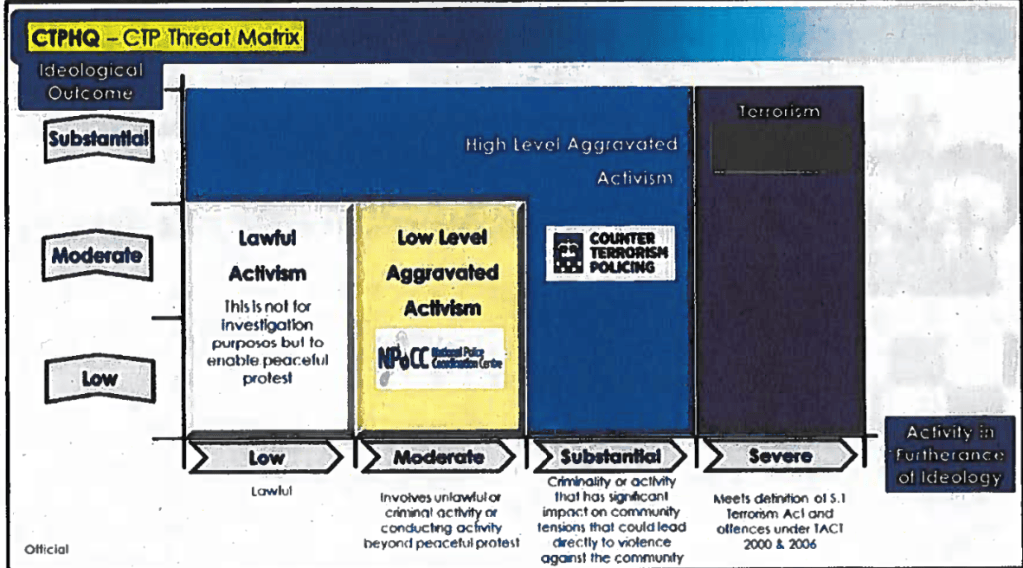
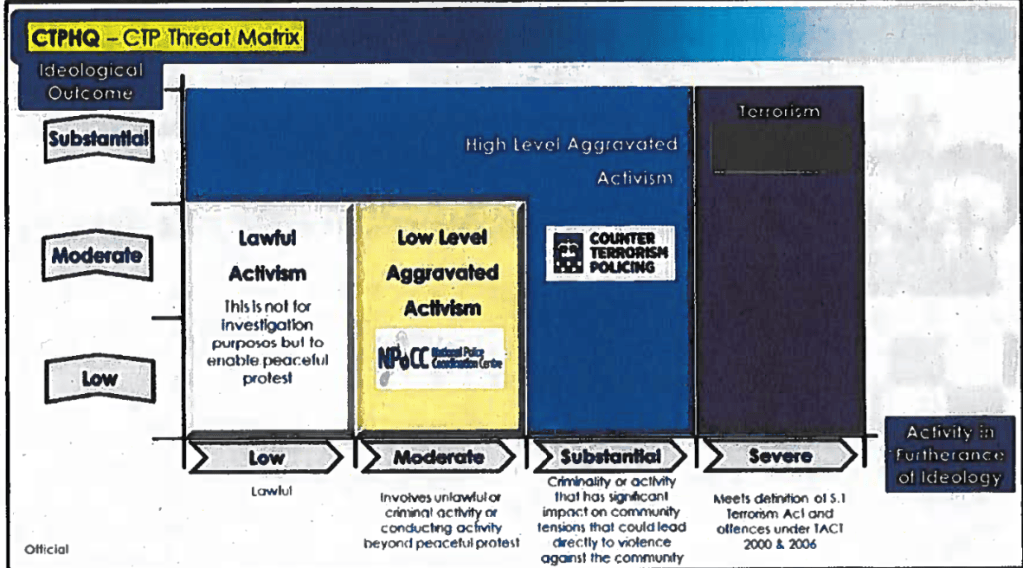
The Grayzone has reviewed heavily redacted records of the meeting. They contain powerpoint charts replete with a “threat matrix” indicating how citizen political activity is categorized by authorities as “high level aggravated activism,” or “terrorism.” The former activity is defined as activism involving “unlawful behaviour that has… a significant negative impact on UK businesses.”
In March 2025, around the time Britain’s Proscription Review Group met to determine whether Palestine Action should be proscribed as a terrorist group, British authorities brought charges against activists who targeted the Instro factory. Initially, they were accused of the same crimes as the Filton Six: aggravated burglary, criminal damage and violent disorder, with a “terrorist connection” covertly applied on the basis of serious property damage. But in July, when then-Home Secretary Yvette Cooper announced PA’s proscription, she cited the Instro case as an example of “violence” perpetrated by the group.
Despite the highly politicized terror designation, a British court was forced to drop charges of aggravated burglary against the Instro 10, indicating that neither police nor prosecutors possessed any evidence Palestine Action intended to harm any person. Indeed, during its five years of operation, PA has conducted hundreds of direct actions without injuring a single person.
This August, as Palestine Action appealed its proscription in the UK, the administration of US President Donald Trump designated the group as a global “terrorist” threat. This appears to have been, at least in part, an effort to bolster the dubious case against the philanthropist and Palestine Action supporter Fergie Chambers, who faces extradition to the US from Spain for supporting “foreign terrorist organizations.”
From Washington to London, governments are stripping away their patina of liberal democracy to protect their relationship with Tel Aviv. Counter-terror legislation is now the weapon of choice in their war on citizens who seek to obstruct Israel’s genocide machine.
Israel’s pursuit of security increasingly rests on a destabilizing proposition: that its neighbours become less threatening when their capacity to exercise sovereignty is diminished. Since the Hamas-led attacks of October 7, 2023, this approach has become particularly visible across several distinct arenas. Military operations, territorial incursions and restrictions on political and economic autonomy suggest a conception of security dependent on keeping others vulnerable. The consequences extend beyond individual confrontations. When states cannot control their territory, rebuild institutions or protect their populations, the regional conditions necessary for durable security begin to erode.
The argument is not that Israel created every conflict in the Middle East. Authoritarian rule, sectarian violence, armed groups and competing regional interventions have all contributed to the region’s instability.
The question is whether the means Israel uses to pursue its own security deepen that instability. Repeatedly weakening neighbouring states and political communities may bring short-term military gains, but it can also erode their ability to contain violence and maintain order, making the region more dangerous—including for Israel itself.
This pattern can be understood as the denial of sovereignty. Sovereignty involves more than diplomatic recognition: it requires institutions capable of governing, providing services and exercising legitimate authority over the use of force. When these capacities are persistently degraded, formal independence becomes increasingly hollow.
The cases differ in their circumstances and severity, but together they reveal a troubling hierarchy: Israeli freedom of military action repeatedly takes precedence over other societies’ ability to govern and secure themselves.
Syria offers a particularly revealing example. Following the collapse of Bashar al-Assad’s regime in December 2024, Israel launched extensive attacks against Syrian military infrastructure and moved into the separation zone established under the 1974 disengagement agreement. Israel justified the destruction of military assets as necessary to prevent advanced weapons from falling into extremist hands. Yet the targets included airfields, air-defence systems and naval facilities—capabilities relevant to the functioning of a state, whatever government eventually controls them.
The longer-term problem is that preventing a hypothetical future threat can obstruct the reconstruction of an already devastated country. Syria needs accountable security institutions capable of controlling territory, containing armed factions and protecting communities. Destroying military capabilities without a credible framework for rebuilding legitimate state authority risks leaving those functions unfulfilled. In July 2025, Israeli strikes on Damascus, including the defence ministry, further demonstrated Israel’s willingness to impose military limits on the new authorities.
Syria’s transitional authorities must themselves answer for abuses and protect minorities; state consolidation cannot justify repression. Nevertheless, externally imposed military vulnerability is no substitute for accountable governance.
A government expected to prevent threats from emerging within its territory must have the capacity to exercise authority there. Undermining that capacity can preserve the fragmentation through which armed groups survive.
Lebanon exposes a related contradiction. Hezbollah’s independent military power has long constrained the Lebanese state’s authority and its ability to determine questions of war and peace. Reducing that parallel authority could, under appropriate political arrangements, strengthen state sovereignty. But Israeli military action does not automatically transfer power from Hezbollah to the Lebanese government. Bombardment, displacement and violations of Lebanese territory can weaken the institutions expected to assume responsibility for national security.
The distinction is crucial: weakening an armed organization and strengthening a state are separate outcomes. In March 2026, UN Secretary-General António Guterres called both for respect for Lebanon’s sovereignty and for stronger support to its armed forces so that they could become the country’s sole military force. That combination identifies what repeated unilateral intervention overlooks: security requires an institutional successor capable of governing after military operations end.
Where that capacity remains inadequate, another cycle becomes possible. Armed groups invoke external attacks to justify retaining their weapons; the state struggles to establish authority; Israel cites the continuing armed presence to justify further intervention. Hezbollah bears responsibility for its own decisions, but Israeli policies can reinforce the conditions sustaining its claim that the Lebanese state cannot protect the population.
The attack on Doha on September 9, 2025 extended this logic into the diplomatic sphere. Qatar was mediating negotiations involving Israel and Hamas when Israel struck Hamas representatives on its territory. The UN High Commissioner for Human Rights condemned the attack as a breach of international law and an assault on mediation. The significance exceeded the violation of Qatari sovereignty: even a state facilitating negotiations could find its territory treated as an extension of the battlefield.
Mediation depends on practical assurances that communication with an adversary will remain possible. Targeting interlocutors in a mediating country makes those assurances harder to provide. It raises the costs of hosting negotiations and can undermine channels needed for ceasefires, hostage releases and humanitarian arrangements. Military reach may expand while opportunities for a political settlement contract.
Israel’s recognition of Somaliland in December 2025 raises a different sovereignty question along the region’s Red Sea periphery. Somaliland has maintained separate institutions for decades, and its claim to recognition has its own history. Nevertheless, Israel’s recognition challenged Somalia’s internationally recognized territorial framework. The African Union rejected the move and warned that such recognition could undermine peace and stability.
Recognition is not equivalent to bombardment, and the cases should not be collapsed into a single legal category. Their connection is political: the territorial arrangements on which other governments rely become subject to unilateral decisions shaped by Israeli interests. In an already contested regional environment, such decisions risk adding another dispute to fragile processes of state consolidation.
The confrontation with Iran illustrates the danger of extending preventive military logic to a powerful regional adversary. On February 28, 2026, Guterres condemned the use of force by the United States and Israel against Iran and Iran’s subsequent retaliation across the region. He warned that these actions undermined international peace and security. The escalation demonstrated how efforts to eliminate threats militarily can expose additional countries to attack.
Iran’s support for armed groups and its own military conduct cannot be excluded from this assessment. Nevertheless, degrading an adversary’s capabilities does not necessarily resolve the political incentives driving confrontation. It may instead encourage dispersal, rearmament or greater reliance on asymmetric methods. Tactical destruction can coexist with a more dangerous strategic environment.
The Palestinian case represents the most profound expression of this problem because it concerns both collective self-government and the conditions of human survival. In the West Bank, withholding revenues owed to the Palestinian Authority weakens the institutions expected to administer daily life.
The World Bank documented how the suspension of transfers in 2025 intensified fiscal distress, reduced salary payments and placed pressure on essential services. These measures undermine the practical foundations of Palestinian self-government.
A political authority cannot provide credible governance indefinitely while lacking reliable access to its own revenues. Weakening public administration also weakens its legitimacy, potentially benefiting actors who argue that institutional politics offers no meaningful route to Palestinian rights. The resulting dysfunction can then be invoked as evidence that Palestinians are incapable of governing themselves. Restrictions on capacity thus risk producing the very incapacity used to justify continued control.
In Gaza, the destruction has reached beyond institutional viability. The devastation of housing, healthcare, water systems and livelihoods, compounded by restrictions on humanitarian access, has endangered the material conditions necessary for life. In August 2025, a joint statement by UN agencies confirmed famine in Gaza Governorate and described a crisis involving starvation and preventable deaths. The issue was no longer merely whether Palestinians could build a state, but whether civilians could survive.
Hence, in Gaza, the denial of sovereignty has escalated into a denial of survival. In September 2025, the UN Independent International Commission of Inquiry concluded that Israel had committed genocide against Palestinians in Gaza. Earlier, on November 21, 2024, the International Criminal Court issued an arrest warrant for Benjamin Netanyahu, finding reasonable grounds to believe that he bore criminal responsibility for the war crime of starvation as a method of warfare and the crimes against humanity of murder, persecution and other inhumane acts. These findings expose the devastating human consequences of denying a population access to the essentials of life. The systematic destruction of civilian infrastructure and deprivation of food, water and medical care undermine Palestinians’ ability to survive as a community in their homeland. Viewed through this analysis, the genocide identified by the UN commission represents the most extreme manifestation of denial: a progression from obstructing a people’s capacity to govern themselves to destroying the conditions necessary for their continued existence.
Taken together, these cases suggest a self-reinforcing cycle. Military intervention and institutional weakening can generate insecurity, displacement and political fragmentation. Those conditions create opportunities for armed actors, whose activities then provide further grounds for intervention. This is a causal risk, not an inevitable outcome of every operation. Its importance lies in the contradiction between immediate military advantage and the requirements of lasting security.
Breaking that cycle requires a different measure of success: whether policies leave behind institutions capable of governing, populations able to live securely and diplomatic arrangements that reduce incentives for violence. Protecting Israeli civilians and respecting neighbouring societies’ sovereignty are mutually reinforcing necessities.
A regional order built around one state’s freedom to intervene and everyone else’s enforced vulnerability cannot offer durable peace. By denying others the capacity to govern—and, in Gaza, devastating the conditions necessary to survive—Israel risks perpetuating the insecurity from which it seeks protection.
Palestine This Week | Middle East Monitor | September 30, 2026
This week’s MEMO review examines claims about Netanyahu’s advance knowledge of 7 October, his provocative UN speech and Israel’s sweeping West Bank closure. We discuss calls to free Marwan Barghouti, moves to bar Arab-led parties from Israeli elections, Trump’s rejection of Iran’s proposal and allegations of election interference involving Israeli firms.
The U.S. Senate just voted 47-51 against a bill introduced by the Senators Chris Van Hollen, Tim Kaine and Bernie Sanders which would have “forced Secretary of State Marco Rubio to submit to Congress, within 30 days, a report on what information is available about the killings of the nine US citizens, the status of US and Israeli investigations into the killings, the number of US citizens currently held in Israeli prisons, the treatment of Palestinian children in Israeli prisons, and a description of the steps the US government has taken to reduce violence in the West Bank.”
In other words, the Zionist occupied Senate voted against releasing information about Israel killing American citizens in order to protect Israel.
The bill would have forced Marco Rubio to release the information about nine US citizens who have been killed by settlers and Israeli security forces, including the late Palestinian-American journalist Shireen Abu Akleh, who was killed by Israeli occupation forces while reporting in the West Bank in 2022, an intentional murder that was covered up by the Biden administration.
The Biden administration covered up for Israel, claiming that her murder was the “result of tragic circumstances during an IDF-led military operation against factions of Palestinian Islamic Jihad”.
But later, the whistleblower Colonel Steve Gabavics, who worked at the time for the Office of the U.S. Security Coordinator in Jerusalem and led the investigation into Shireen Abu Akleh, revealed that his team found she was intentionally targeted, but the U.S. covered it up to protect Israel.
In an interview with Democracy Now!, he noted, “We were able to disprove very quickly the assertion that there was a Palestinian gunman in front of Shireen Abu Akleh, that the IDF had shot at, and they had accidentally shot her instead… the indications of everything we read from the reports that we got from the IDF on their locations, and proximity to where the event happened, what we got from the investigation from the Palestinian Authority, and our investigation, to us it was very clear that the (IDF) individual in the vehicle who took the shot, would have had a clear line of sight and would have had visibility of Shireen Abu Akleh walking down the middle of the street for a period of time before he took the shots”.
But he revealed that the Biden administration covered up this information, saying, “After we had completed this we were on regular video calls, classified and unclassified with the state department … I indicated that the evidence to me indicated that there would have been enough if we actually built a criminal case to have enough information and facts to beyond a reasonable doubt, for a conviction at some level. We were pushing for the fact that they needed to formally admit the fact that it was not an accident, that a (Israeli) soldier killed Shireen Abu Akleh, that it was an intentional shooting, and unfortunately, that was not what came out … When the actual statement came out, that was absolutely not what I expected… I was shocked … all the data indicates the exact opposite, it was not fog of war… This was not what we had found”.
He added, “It all came down to not trying to anger the Israelis by holding them accountable for intentionally killing an American citizen”.
Yet again, AIPAC-bought members of the Senate want to continue the cover-up of the Israeli murder of American citizens in order not to anger Israel and its lobby.
When I first saw footage of Gaza doctor Munir al-Bursh and his family kneeling beside the white-shrouded body of his son, surrounded by mourners, I thought it was an old video. It was not.
My conclusion, however, was understandable. In December 2023, only months after the start of the Israeli genocide in Gaza, the al-Bursh family was targeted in an Israeli attack. Dr. Munir, director-general of Gaza’s Ministry of Health, was wounded. So were other members of his family. His daughter, Jinan, only 13, was killed.
That same day, Gaza’s beloved doctor was back at work, joining the many doctors across the Strip trying to save lives as Israel’s killing machine claimed them by the thousands.
Alas, the latest footage was not old footage resurfacing. It was a new coffin, a new funeral, another child buried by the same family. This time, the attack took place during what some in the media continue to call the ‘Gaza ceasefire.’
On September 19, an Israeli drone strike killed al-Bursh’s eldest son, Basir, outside a tent west of Jabaliya refugee camp.
“We were together side by side,” the grieving father recalled. Basir had warned him: “The Israelis are targeting both of us.” Moments later, his son stepped outside the tent and was killed.
One can be forgiven for confusing Gaza’s present with its recent past. The scenes emerging today are almost indistinguishable from those that preceded the so-called ceasefire of October 2025. The sequence repeats itself with terrible familiarity: Israeli strikes, shelling and sniping; Palestinians killed; the bereaved carrying their dead through Gaza’s destroyed streets, searching among the ruins for somewhere to bury them.
Al-Bursh’s story is part of this terrible continuum, but its significance extends beyond his personal loss. Throughout the genocide, he and other Palestinian doctors became Gaza’s de facto spokespeople. They counted the dead and wounded, documented hunger and destruction, and chronicled the collapse of the medical system from within its hospitals.
In the process, they became Gaza’s highest moral authority, more credible than politicians or self-proclaimed leaders.
And the world listened. Gaza’s doctors forged a bond with global civil society that no political institution could manufacture.
Perhaps that helps explain the staggering price Gaza’s medical community has been made to pay. According to the World Health Organization, more than 1,700 healthcare workers have been killed since 2023, amid at least 920 attacks on healthcare.
Dr. Hussam Abu Safiya, like Dr. al-Bursh, became a symbol of that medical resistance. The director of Kamal Adwan Hospital remained at his post through siege and repeated Israeli attacks before Israeli forces detained him in December 2024. He remains imprisoned without charge or trial, amid reports from his lawyer of beatings and deteriorating health.
Dr. al-Bursh, meanwhile, remains steadfast despite repeated blows that would have broken many others. His wife, too, embodies sumud, the Palestinian tradition of steadfastness nurtured at home and passed from one generation to the next.
Even in the immediate aftermath of his son’s killing, al-Bursh continued warning about Gaza’s collapsing healthcare system. Indeed, hospitals have been forced to suspend scheduled surgeries and outpatient services, while severe shortages of fuel, medicines and equipment continue.
“The limited quantities of fuel reaching the enclave barely keep health facilities alive,” al-Bursh warned a day after his son’s murder.
His statement came as world leaders gathered thousands of miles away, in New York, for the 81st session of the United Nations General Assembly.
And once again, Palestine echoed through speech after speech, though this time the language carried a new urgency.
Spanish Prime Minister Pedro Sánchez condemned “the genocide that Netanyahu continues to perpetrate in Gaza.” UN Secretary-General António Guterres described Israel’s mass extermination as involving “a scale of killing and destruction unlike anything I have witnessed” during his tenure. Even French President Emmanuel Macron called Gaza “a spectacle that shames us all,” asking: “What is our credibility worth if we remain inactive on Gaza?”
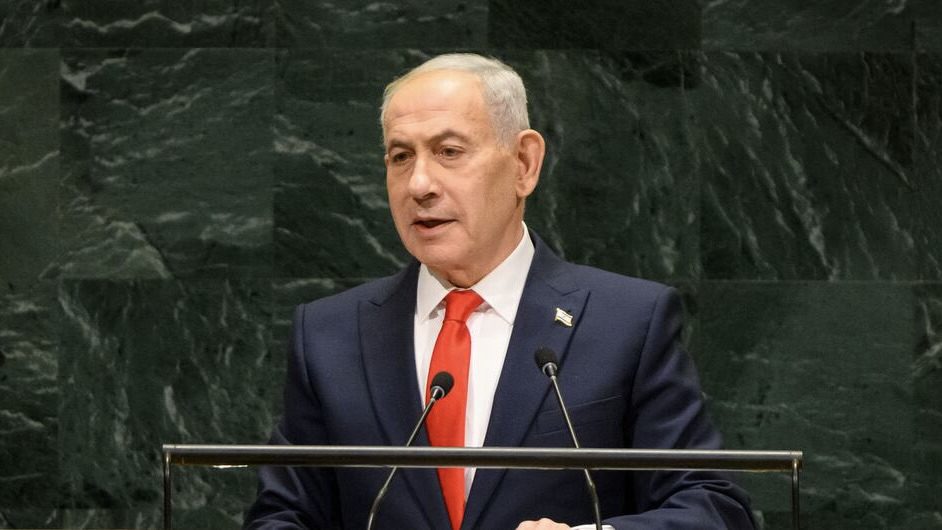
Then came Israeli Prime Minister Benjamin Netanyahu.
Dozens of delegates walked out as he approached the podium, leaving row upon row of empty seats, while protests continued outside the UN. Netanyahu responded by calling those who departed “moral cowards.”
One might pause here and speak of tides turning, currents changing and a world slowly loosening the decades-long grip of Israel and its American benefactor.
But Gaza does not have the luxury of time. While the words reverberate through the halls of the United Nations, children are still killed in front of their families. Mass funerals remain part of Gaza’s daily rhythm.
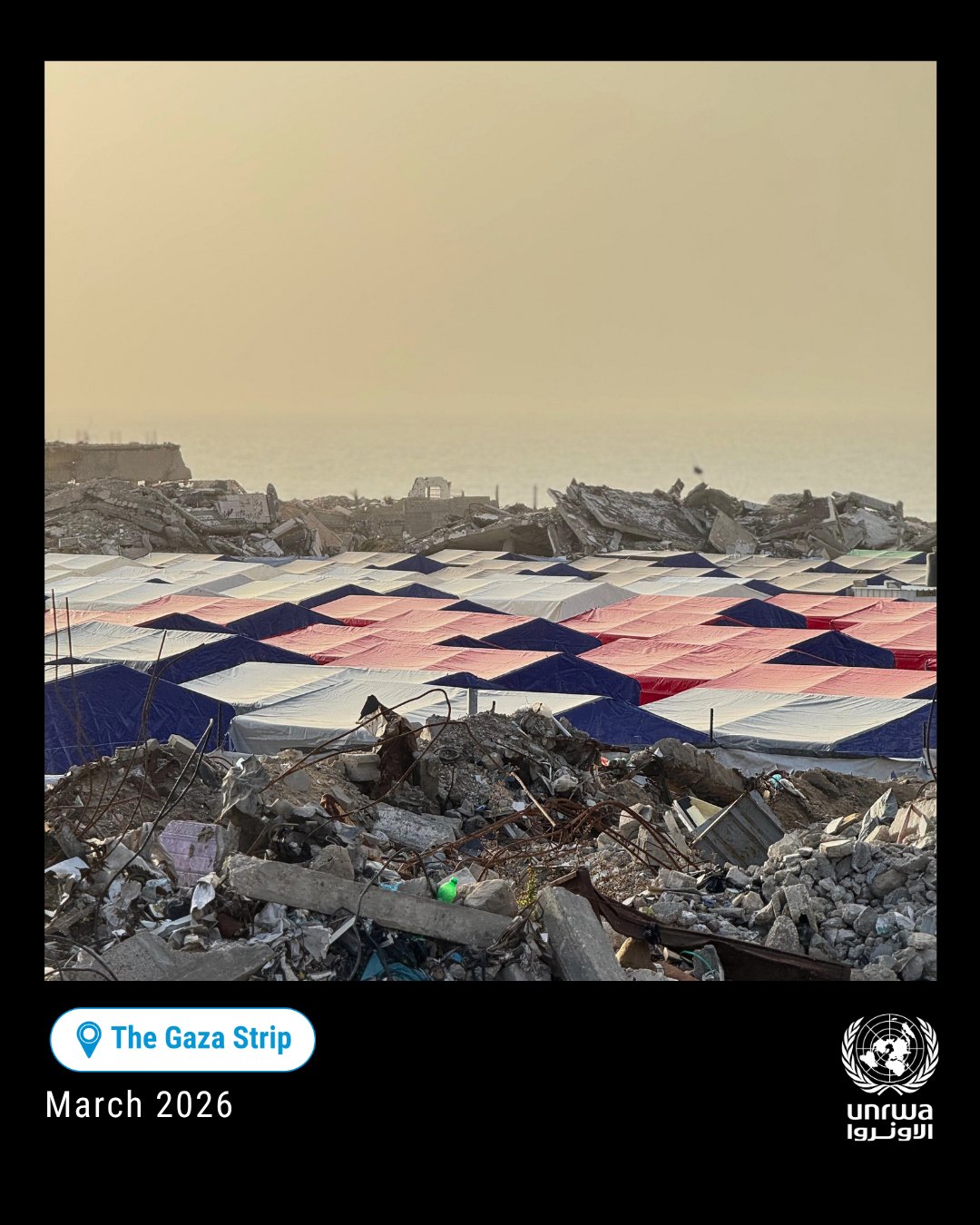
Approximately 1.7 million people remain displaced, many under inadequate shelter, without sufficient clean water or sanitation. Hospitals remain crippled. And above this landscape of ruin, the drones still circle.
Between today and the next UN General Assembly lies an entire year—365 days in which those words can either acquire meaning or become yet another entry in the long archive of speeches on Palestine. However, there is time for rhetoric to become policy: for sanctions to be imposed, boycotts activated, meaningful aid delivered and those responsible for war crimes held accountable.
Until then, Dr. Munir al-Bursh and thousands of Gaza’s men and women will continue to hold the fort amid shattered hospitals, destroyed homes and an exhausted population.
Their resilience is extraordinary. But Gaza cannot be expected to endure simply because it has proved capable of enduring.
In New York, Palestine is spoken of from the podium. In Gaza, Palestinians are still being carried to their graves.
It is time to close the distance between words and action, once and for all.
In cooperation with the Centre for Palestine Studies at SOAS University London and Friends of Palestinian Universities, the Palestinian Centre for Human Rights (PCHR) has released a new report, “Scholasticide and Genocide in Gaza: Assessment, Testimonial and Legal Analysis,” documenting Israel’s systematic destruction of Gaza’s educational system and examining how this policy forms an integral part of Israel’s ongoing three-year genocide against Palestinians in the Gaza Strip.
The report demonstrates that Israel’s attacks on education in Gaza, including on UNRWA educational faciltiies and staff, go far beyond the destruction of schools and universities or the killing of Palestinian teachers. They constitute a comprehensive policy aimed at dismantling the educational, intellectual, social and cultural foundations necessary for the continued existence and development of Palestinian society.
Drawing on dozens of testimonies and affidavits collectd by PCHR field researchers and lawyers in Gaza, alongside PCHR’s extensive documentation, open-source material, United Nations reports, academic research and relevant international jurisprudence, the report identifies five interconnected patterns of scholasticide: the killing of students, teachers and academics; causing serious bodily and mental harm to them; destroying of educational facilities; obstructing the establishment alternative educational structures; and imposing genocidal conditions that prevent students from accessing education.
By July 2026, PCHR had documented the killing of approximately 20,051 students, more than 830 teachers and educational staff, and over 194 scholars, academics and researchers. Nearly the entire educational infrastructure in in Gaza has been extensively damaged or destroyed, while hundreds of thousands of students have endured prolonged interruption of their education amid displacement, starvation, bombardment, loss of family members, destruction of homes, lack of electricity and internet access, and the collapse of essential services.
PCHR’s report finds that certain acts committed within Israel’s campaign of scholasticide constitute genocidal acts under Article II of the Convention on the Prevention and Punishment of the Crime of Genocide, including killing members of the protected group, causing serious bodily or mental harm, and deliberately inflicting conditions of life calculated to bring about its physical destruction in whole or in part.
The report further highlights the long-term impact on Palestinian children and young Palestinians, including psychological harm, educational loss, diminished future opportunities and intergenerational trauma. Israel’s erasure of the educational infrastructure and broader civilian life in Gaza does not only constitute an attack on the rights of the present generation but also on the future generations.
Education has historically played a central role in sustaining Palestinian identity, knowledge, social cohesion and cultural continuity, particularly in the context of prolonged displacement and occupation. Israel’s destruction of universities, schools, libraries, academic records and cultural institutions therefore carries consequences far beyond the loss of physical infrastructure. It seeks to sever Palestinians from their history and intellectual life, diminish their capacity to rebuild their society, and deprive future generations of the means to learn, develop and participate fully in their community.
PCHR stresses that the destruction of Gaza’s education system did not begin on 7 October 2023. For decades, Palestinian schools, universities and educational institutions have been subjected to attacks, restrictions and destruction during successive Israeli military operations. The unprecedented scale of destruction since October 2023 however represents the culmination and intensification of this longstanding pattern.
PCHR calls on the international community, particularly States Parties to the Genocide Convention, to:
Take immediate and effective measures to bring Israel’s genocide against the Palestinian people in Gaza to an end, including its policy of scholasticide.
Ensure full compliance with the three provisional measures ordered by the International Court of Justice in the case of South Africa v. Israel.
Impose a comprehensive arms embargo on Israel and halt all military, financial and other assistance that may contribute to the commission of international crimes.
Support international accountability mechanisms, including the International Criminal Court, and ensure that those responsible for genocide, war crimes and crimes against humanity are investigated and prosecuted.
Take concrete measures to protect Palestinian students, teachers, academics and educational institutions and guarantee the restoration of the right to education in Gaza.
Provide sustained support for the reconstruction of Gaza’s schools, universities, libraries and educational infrastructure, while ensuring that reconstruction does not substitute for accountability.
Address the long-term psychological, educational and developmental consequences suffered by Palestinian children and young people and ensure their access to rehabilitation, mental-health support and inclusive education.
An NFL official reportedly threatened to remove Houston Texans linebacker Azeez Al-Shaair from his game earlier this month unless he removed his memorial for an 8-year-old Palestinian girl killed by Israel in Gaza.
During the Texans’s week two game against the Cincinnati Bengals on September 20, Al-Shaair wrote the name of Wafaa Akila on his eye black, which refers to the strip or paint streaks that many football players wear on their cheeks.
Wafaa was an 8-year-old girl who was killed, along with her father, in an Israeli airstrike on a vehicle in Gaza City on September 6. She and her father were on their way home from her first day of school, according to Al Jazeera.
Al-Shaair, who is rated as one of the top linebackers in the league, was reportedly told by an NFL official that he would have to remove his eye black or else be barred from playing in the game, an anonymous NFL source told The Athletic. Al-Shaair complied, the reports said. Fox News’s sports vertical also confirmed the league’s threat.
The linebacker’s latest tribute came just days after the NFL gave him an $11,941 fine for writing Hind Rajab’s name on his eye black during the Texans game against the Buffalo Bills on September 13. In a show of solidarity, Dallas Mavericks player Kyrie Irving said in a post on social media that he would “take care of his fine.”
“It’s bigger to me. What’s a life worth? Is a life worth $11,000? I think it’s priceless,” said Al-Shaair when asked about the penalty.
“You can’t get so lost in your own problems that you can’t have compassion for other people in the world,” he went on. “We don’t have to have all the answers to everything to know that an innocent man, an innocent woman, an innocent child losing her life is not right … whether they’re here in America or somewhere halfway across the world.”
Ahead of the Texans game against the Indianapolis Colts this past Sunday, Al-Shaair once again wore the names of children killed by Israel — Lana and Bana Ahmed, two sisters who Israel killed along with their family in an airstrike earlier this month. The sisters were 12 and 8 years old.
The NFL gave Al-Shaair a similar fine in January when he wrote “stop the genocide” on his eye black during the pregame, but took it off for the actual game. At the time, he said that he was similarly told that he would be banned from playing in the game if he kept the message on.
“At the end of the day, it’s bigger than me. When things that are going on makes people uncomfortable — imagine how those people feel. I think that’s the biggest thing. I have no affiliation, no connection to these people other than the fact that I’m a human being,” Al-Shaair told reporters after that fine. “Even when I’m walking off this field, that’s the type of stuff that goes through my head, that I have to check myself — when I’m sitting here crying about football, when there’s people dying every single day.”
He was told that he violated league rules about displaying non-approved personal messages — but he pointed out that other players have written messages on their eye black without a fine.
“They always fine you, but I was told if I wore that in the game, I would be pulled out of the game,” he said. “I understood it was a fine, but I ain’t never seen Stef get pulled out of the game for having eye tape with writing on it.” Al-Shaair was referring to New England Patriots receiver Stefon Diggs, who frequently writes messages honoring his Christian faith on his face tape.
On Tuesday night, the Senate voted against advancing a resolution that would have required the State Department to produce a report on the killing of US citizens by Jewish settlers and Israeli security forces in the Israeli-occupied West Bank. An effort to discharge the resolution failed 47-51, with just one Republican — Sen. Rand Paul […]
After years of European governments condemning Israel’s illegal occupation but maintaining extensive economic relations, some economic consequences are reportedly now forthcoming.
On 8 September, twelve governments announced moves towards restricting trade with illegal Israeli settlements. This is a limited but welcome response to grassroots pressure.
It also raises a question: where does the economy of an illegal Israeli settlement end?
Most emerging measures follow economic relationships towards illegal Israeli settlements: do not buy goods produced there, invest there or provide services that enable their construction.
Norway’s proposed legislation is seemingly comprehensive, covering property purchases and services connected to construction and property transactions.
But this all still largely considers illegal Israeli settlements within their territorial bounds.
The problem is treating a spatial category as though the economic relationships producing it share the same boundary. We all know the world does not work like that.
Kinnula, a municipality in central Finland, is now facing this reality: when money from the illegal settlement economy moves into public land in Europe. It is a small case, but it makes the problem unusually visible.
In August, Kinnula council voted 10–3 in favour of a €4m resort development by Israeli property company Dror Bonim Atid, before councillors had been informed of the company’s promotion of projects in illegal Israeli settlements.
However, illegal Israeli settlements are not illicit enterprises from the perspective of Israel. Their expansion is enabled through Israeli state institutions.
A background check sought from Israel is therefore absurd. A more obvious background check reveals something else.
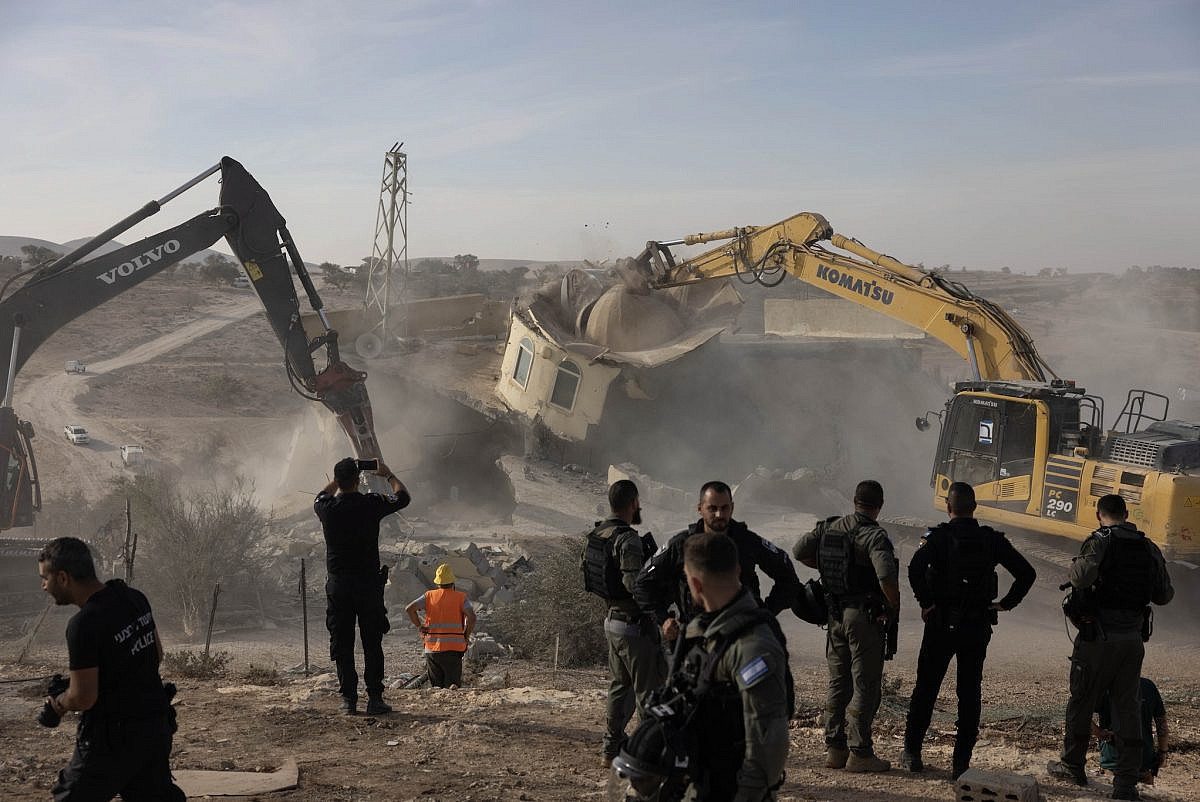
On its own website, Dror Bonim Atid presents its Finnish development alongside a development in Efrat, an illegal Israeli settlement in the occupied West Bank, as well as a development in Dror-Hiran in the Negev. The latter is being built on land where Umm al-Hiran stood until November 2024, when the Bedouin village was completely demolished and its community forcibly displaced.
One company website therefore takes us from an illegal Israeli settlement, through the site of a demolished Bedouin village, to holiday accommodation beside a Finnish lake.
Involvement in illegal Israeli settlements does not fit neatly into the categories through which the transaction is being examined.
Kinnula exposes a gap in the emerging European restrictions on trade with illegal Israeli settlements. Those restrictions follow economic relationships from Europe towards the settlements.
Here the relationship points the other way. What happens when the economies of illegal Israeli settlements come to Europe to acquire public assets, invest and make money here?
This may be a relatively new question for European policymakers. For Palestinian civil society, it is not. Their call for Boycott, Divestment and Sanctions (BDS) was issued in 2005, drawing in turn on a much longer history of Palestinian boycott and economic resistance.
You could be forgiven for rolling your eyes as European policy discovers these questions inch by inch.
Palestinians have spent generations analysing the economic relationships through which occupation is sustained. BDS has spent more than twenty years turning that knowledge into practical strategies for institutions elsewhere.
So, when a Finnish municipality is deciding whether to sell public land to a company openly involved in illegal occupation, there is clear guidance from Palestinian civil society on how to respond.
There is also now the fact that Europe accepts that it should not economically support illegal Israeli settlements, meaning it should also accept that companies involved in illegal settlements should not be able to come to Europe for public land, contracts and investment.
Moins meurtrier que le génocide à Gaza depuis trois ans mais de plus en plus violent, un conflit embrase peu à peu la rive ouest du Jourdain. Des habitants des colonies israéliennes illégales s'y approprient des biens palestiniens ou les détruisent. Cette entreprise de dépossession est activement soutenue par les autorités de Tel-Aviv.
Léa Mancel. – De nouvelles colonies israéliennes sont en cours de construction à Allon, dans la vallée du Jourdain, en Cisjordanie occupée, 2025
Des jeunes dansent au milieu de la salle. Les plus âgés essaient de converser, malgré les décibels. La modeste fête organisée à Ramallah en l'honneur d'un bachelier bat son plein en cette soirée estivale quand la nouvelle de l'arrestation des deux frères Hamayel par l'armée israélienne tombe. Les deux hommes habitent à proximité de la ville où siège l'Autorité palestinienne. Régulièrement, les habitants de leur village et d'autres agglomérations des environs se font attaquer. Des colons des avant-postes — dont l'un établi il y a peu à quelques centaines de mètres de leur ferme — les empêchent d'accéder à des portions toujours plus vastes de leurs oliveraies ou amanderaies, de leurs sources et citernes, de leurs pâturages.
Le terme « avant-poste » désigne de petites colonies israéliennes implantées dans les territoires palestiniens occupés depuis 1967, sur des terres publiques ou privées, sans l'approbation des services d'urbanisme israéliens. Ils bénéficient néanmoins d'un soutien logistique — ouvert, officieux ou occulte — de la part d'organismes étatiques ainsi que de donateurs privés. Le phénomène a pris une ampleur considérable depuis la seconde moitié des années 1990, avec l'intention d'entraver le transfert de territoires de Cisjordanie à l'autorité civile palestinienne. Selon les données du site Peace Now, leur nombre atteint 390, contre 146 colonies établies officiellement depuis 1967- (1). 249 de ces implantations ont été créées au cours des quatre dernières années.
La veille de l'arrestation, une ferme appartenant à la famille Hamayel subit le vol d'une centaine de moutons. Les deux jeunes gens, leur père et leur beau-frère se rendent sur place pour récupérer des bidons d'huile d'olive et quelques objets de première nécessité — par crainte qu'ils ne soient à leur tour dérobés. Mais, immédiatement, des habitants d'un avant-poste voisin, ou bien des Juifs israéliens venus d'ailleurs, débarquent, les photographient et font appel à des soldats. Ces derniers arrêtent les deux frères et les emmènent, yeux bandés, menottés. Quand nous l'apprenons en même temps que leurs proches, les six heures durant lesquelles un soldat est autorisé à détenir un Palestinien sont presque écoulées.
Leur famille craint que les soldats ne les maltraitent — comme le laissent redouter les témoignages de ceux qui ont subi le même sort. Moins d'une demi-heure après qu'un autre journaliste et nous-mêmes eûmes envoyé des demandes d'information aux services de presse de l'armée et de la police, nous apprenons leur transfert vers un commissariat de police israélien situé dans le complexe commercial d'une colonie à l'est de Ramallah.
Les interpellations par des soldats de Palestiniens attaqués par des colons se multiplient depuis trois ans. Le Fonds pour les défenseurs des droits humains (HRDF), qui opère depuis Israël, entreprend de venir en aide à ces personnes placées en détention. Créée en 2011, cette organisation non gouvernementale a commencé par offrir une protection juridique aux participants à des manifestations en Israël et en Cisjordanie. Aujourd'hui, elle défend aussi les agriculteurs et les bergers palestiniens, cibles des colons, arrêtés par l'armée. Au seul mois d'août, elle a reçu des signalements concernant une soixantaine de personnes enlevées par des militaires dans des circonstances similaires. Le HRDF les a alors mis en relation avec des avocats spécialisés comme il l'a fait pour les deux frères Hamayel. Le nombre de personnes ainsi détenues est en réalité plus élevé, car plusieurs d'entre elles ignorent l'existence du Fonds ou ne peuvent faire appel à lui.
En territoire occupé, tout Palestinien est une cible
Dans certains cas, des colons conscrits procèdent à l'arrestation ; dans d'autres, les habitants des avant-postes se contentent d'accompagner de jeunes soldats à qui ils donnent des instructions. Certains militaires savent que les colons n'aiment pas voir un troupeau paître ici ou là et, pour ce simple motif, privent le berger palestinien de sa liberté. L'arrestation vaut un interrogatoire au poste de police, une détention, brève ou de plusieurs jours, qui peut aboutir à une mise en examen.
De temps à autre, leurs défenseurs parviennent aussi à faire sortir un Palestinien. C'est le cas de l'avocate Riham Nasra dans le cas des deux frères Hamayel, libérés au bout d'une journée, sans conditions ni mise en examen — comme l'aveu implicite, d'une arrestation abusive. Les conseils aussi dévoués, qui ne font du reste rien payer aux victimes, demeurent cependant peu nombreux.
En mars, trois habitants du village de Khirbet Abou Falah ont perdu la vie lors d'une attaque conduite par des Israéliens d'un avant-poste établi peu avant (2). Les victimes entendaient défendre leurs vergers et leurs maisons. Un assaillant a tiré et tué l'une d'entre elles. Les témoins de la scène ont eu du mal à déterminer si le tir qui a atteint la deuxième venait d'un colon ou d'un membre des forces de l'ordre, présentes sur les lieux pour protéger les agresseurs. La troisième est morte asphyxiée par le gaz lacrymogène utilisé par les soldats contre les habitants du village. De fait, tout Palestinien est une cible, et nombre d'entre eux en viennent à redouter la transposition en Cisjordanie de la guerre d'extermination menée par Israël depuis trois ans à Gaza (lire « Une “guerre totale” »).
Léa Mancel. – À l'entrée de Tourmous Ayya, une localité habitée majoritairement par des Américano-Palestiniens, des colons israéliens ont tagué des étoiles de David sur des blocs de pierre utilisés par l'armée pour boucler le village, 2025
La plupart des convives présents à la fête de Ramallah ont des proches et des amis dans les villages menacés. Certains possèdent même une parcelle de terre qu'ils sont parfois sur le point de perdre, à la suite d'une prise de possession violente par des Juifs israéliens ou d'un ordre militaire d'expropriation pour l'élargissement d'une route ou l'extension d'une colonie. Les autres subissent des attaques de colons lorsqu'ils se déplacent, ou des contrôles de l'armée — souvent sur demande des avant-postes. Au total, en Cisjordanie, environ un millier de barrages de toutes sortes isolent — ou peuvent isoler — ces communautés palestiniennes les unes des autres et entravent des axes routiers principaux (3). Ainsi, 450 portails en fer sont installés aux sorties des villes et des villages ; des soldats les verrouillent et les ouvrent en fonction de critères incompréhensibles. Récemment, des colons ont eux aussi commencé à en utiliser pour bloquer le passage aux Palestiniens.
En septembre, le Bureau des Nations unies pour la coordination des affaires humanitaires (OCHA) recensait 6 190 attaques de colons ayant causé des blessures, à des personnes ou à des animaux, et provoqué des dégâts matériels (cultures agricoles et biens) pour la période 2023-2026 (1 836 attaques en 2025) (4). Rien qu'au cours des sept premiers mois de 2026, 1 418 attaques similaires ont déjà été dénombrées — ce qui confirme la flambée observée depuis 2022. À titre de comparaison, en 2006, lorsque l'ONU a commencé ses recensements, ce total s'élevait à 182 attaques par an. Mi-2012, les Nations unies avaient même convoqué une conférence de presse pour tirer la sonnette d'alarme, le nombre d'attaques ayant atteint 423 en 2011. Sur la base des rapports des services de sécurité palestiniens et des informations relayées par les médias, le département chargé des négociations avec Israël au sein de l'Organisation de libération de la Palestine (OLP) recense, lui, 3 270 attaques entre janvier et juillet 2026. Son décompte inclut les incursions et les actes de harcèlement commis par les colons qui n'entraînent pas de dommages corporels ou matériels — comme l'incursion qui a conduit à l'arrestation des frères Hamayel.
À l'origine de ces agressions, de nombreux Juifs israéliens dont la plupart portent kippa, papillotes ou tsitsit. Certains sont identifiés comme les fondateurs et les propriétaires des avant-postes. D'autres semblent juste venir en visite le week-end. Nombre d'entre eux sont nés ou ont grandi dans des colonies reconnues par Tel-Aviv. Ils envahissent des terres palestiniennes à pied ou à bord de véhicules tout-terrain fournis par l'État et l'armée — y compris le samedi, alors que la loi religieuse juive interdit de conduire ce jour-là. Beaucoup portent des masques. L'État leur fournit une partie des armes. Ils agressent physiquement, à coups de matraques, profèrent des menaces, s'approprient des bêtes (au prétexte qu'elles leur auraient été volées), envoient les leurs paître et détruire l'orge que les agriculteurs ont semée, incendient des champs et des maisons, sabotent les sources d'eau. Ils s'emparent de celles situées à l'extérieur des villages, détruisent les canalisations et vident les réservoirs des communautés qui ne sont pas raccordées au réseau d'adduction.
De plus en plus, les agresseurs ont recours à des enfants et à des adolescents, qui semblent avoir été formés pour semer le chaos. Ceux-ci procèdent en exaspérant ou en épuisant de modestes bergers et agriculteurs. Ils ravagent champs et vergers, accompagnés d'un troupeau de moutons. Agressifs, ils n'hésitent pas à injurier ou frapper — des Palestiniens, mais aussi des volontaires israéliens et internationaux. Les personnes attaquées savent que, si elles se défendent, elles se feront interpeller pour violences contre des mineurs. À la fin du mois d'août, des colons ont ainsi enlevé un militant britannique qui se trouvait dans le village d'Oumm Al-Khair, dans le sud de la Cisjordanie, alors qu'il tentait d'y empêcher des incursions d'enfants. Accusé de pédophilie par des colons, il a été livré à la police puis expulsé (5).
Rien n'endigue ce recours à des mineurs pour harceler des Palestiniens, ni la mobilisation de militants israéliens auprès des services sociaux de leur pays, ni les témoignages relayés par des médias. Il existe des similitudes dans leurs comportements en plusieurs endroits de la Cisjordanie et dans leur « équipement » — les troupeaux de moutons, de vaches ou de chameaux qu'ils utilisent et dont chaque nouvel avant-poste est doté. À cela s'ajoute la rapidité avec laquelle l'implantation obtient ensuite le raccordement au réseau d'approvisionnement en eau d'une base militaire, ou l'aménagement d'une route d'accès. Tout suggère l'existence d'une main qui guide, planifie et organise cette pression quotidienne, avec le soutien total des autorités.
Comme la police, l'armée feint l'impuissance
De ce fait, depuis 2022, soixante-quatorze communautés et familles de bergers ont dû rassembler leurs maigres biens, quitter leurs lieux d'habitation depuis des décennies et se replier dans des territoires densément peuplés. Cela représente environ cinq mille personnes. Ceux qui s'accrochent encore à leurs terres au sein de dix-huit autres communautés ont vu partir, au total, cinq cents des leurs (6). Çà et là, les vestiges d'une tente ou d'une structure préfabriquée servant autrefois d'école rappellent que, jusqu'à récemment, des gens vivaient dans ces lieux.
Grâce aux armes dont elles disposent, à l'aide militaire et à l'inaction des autorités chargées de l'ordre public, les milices de colons ont, ces dernières années, réussi à chasser les Palestiniens de plus de mille kilomètres carrés — soit près d'un cinquième de la superficie de la Cisjordanie. Bergers, agriculteurs, promeneurs, familles parties pique-niquer : tous ont désormais peur de s'attarder dans ces lieux qui furent le paysage de leur enfance (7).
La disparition des communautés de bergers d'une zone aussi vaste confère aux milices de colons davantage de liberté pour attaquer des habitations ou des terres à la périphérie des villages et des villes, voire pour s'en emparer. Là aussi, l'armée, comme la police, feint l'impuissance. Les colons ont littéralement conquis trois maisons privées dans le village de Jaloud, après avoir harcelé les familles qui s'y trouvaient ; ils continuent d'assiéger des maisons dans le village de Qousra. Ni les critiques de l'ambassadeur des États-Unis en Israël Michael Huckabee, pourtant grand partisan de l'entreprise de colonisation, ni les condamnations de certains officiers ne convainquent l'armée d'expulser ces squatteurs — que même les juges de la Haute Cour ont qualifiés d'« émeutiers ».
Léa Mancel. – Vue sur la colonie israélienne de Shilo depuis un magasin à Tourmous Ayya. Ignorant ce village palestinien, l'ambassadeur des États-Unis en Israël, M. Michael Huckabee, s'est rendu uniquement dans cette implantation, 2025
« C'est ma maison. » La phrase revient souvent, sous différentes formes, lors de nombreuses attaques. Dans la périphérie de Ramallah, fin janvier, les Bourhane l'ont entendue, prononcée dans un arabe parfait, par un Juif israélien qui enfonçait leur porte à coups de marteau. L'une des femmes de la famille nous confie qu'un soldat accompagnait l'assaillant et qu'ils ont filé après l'avoir vue faire un signe de croix. Mais l'homme au marteau avait eu le temps de frapper sa mère de 65 ans, avec une pierre, jusqu'au sang. Sa faute ? Avoir demandé à un garçon d'éloigner le troupeau de moutons qu'il avait conduit au milieu du verger entourant la maison. Le garçon — qui « avait l'air effrayé », raconte la mère — a appelé à l'aide les habitants de l'avant-poste établi sur des terres appartenant au village voisin. Deux proches de la mère venus lui porter secours ont été interpellés par des soldats puis détenus dans un centre militaire pendant près de huit heures. Son fils, qui avait tenté de chasser les agresseurs (l'un d'eux l'avait filmé en train de leur lancer des pierres), a lui-même été arrêté par la suite. Les soldats l'ont roué de coups avant de le remettre à la police. Après cinq jours de détention, le juge militaire l'a finalement libéré moyennant le versement d'une caution élevée, à payer en espèces. Le magistrat ne pouvait ignorer ni les photographies du visage de la Palestinienne tuméfié, ni l'absence d'interrogatoire des agresseurs par la police.
Cette libération a provoqué la colère des colons, surtout après que les médias d'extrême droite ont évoqué un incident grave lors duquel des « émeutiers arabes » ont attaqué un berger qui faisait paître son troupeau. Quelques jours plus tard, l'un d'entre eux s'est présenté dans la cour de la maison. Des soldats à sa suite ont de nouveau arrêté le fils au prétexte qu'il aurait incité des voisins à jeter des pierres sur des Israéliens. Un porte-parole de l'armée israélienne nous assure que les colons n'étaient pas à l'origine de l'arrestation. Il nie également que les soldats aient pu frapper le détenu et lui demander de balayer et de nettoyer le poste militaire où il avait été détenu.
L'agressivité des autorités surpasse celle des colons
Depuis ces incidents, et comme de nombreuses habitations à la périphérie des villages et des villes, la maison des Bourhane s'est transformée en forteresse, entourée d'une haute clôture, de portails en fer et de caméras de surveillance. La famille et ses voisins n'osent plus s'aventurer sur les pentes inférieures de la colline pour s'occuper de leurs oliviers, situés à seulement quelques dizaines de mètres de chez eux.
Sur certains comptes publics des réseaux sociaux, les milices juives (connues sous le nom de « Jeunes des collines ») se vantent de leurs actes tout en se déchaînant contre les très rares arrestations de leurs membres par la police israélienne. Le 10 septembre dernier, la chaîne Anshei Shlomeinu (en hébreu, « Notre peuple ») de la messagerie WhatsApp a publié un « bilan de la lutte contre l'ennemi arabe en Terre sainte » pour l'année hébraïque qui venait de s'achever. Le message détaille la « liste des villages attaqués et le nombre d'attaques ». Au moins cent cinquante noms y figurent, classés par ordre décroissant en fonction du nombre d'assauts. La ville de Bir Zeit a été attaquée deux fois, le village voisin d'Attara cinq fois, Jaloud dix fois, tandis que Qousra et Khirbet Abou Falah ont subi quinze assauts chacun. Les auteurs de la publication se targuent également d'autres exploits : « Nombre de véhicules palestiniens incendiés (en Cisjordanie) : 436. Nombre de bâtiments incendiés : 201. Mosquées incendiées : 15. Nombre d'Arabes blessés : 409. » Ils poursuivent : « De plus, des dizaines de milliers de vitres ont été brisées, des milliers d'oliviers ont été abattus, des centaines de pneus ont été crevés et des dizaines de milliers de dounams [1 dounam = 0,1 hectare] de champs et de vergers ont été incendiés. Une bonne et heureuse année à tout le peuple d'Israël. » Une omission, toutefois : depuis le début de l'année, des civils israéliens ont assassiné — lors de leurs agressions — quinze Palestiniens. Huit autres ont été tués dans des circonstances similaires, sans qu'on puisse établir si des soldats ou des colons ont commis ces actes (8).
Entre le 1er janvier et le 8 septembre 2026, 88 Palestiniens ont été tués en Cisjordanie par des tirs israéliens. Parmi eux, 21 mineurs, et le plus jeune avait moins de 1 an. À Hébron, un soldat a tiré sur une voiture dans laquelle se trouvaient un père et ses enfants. Pour sa défense, il a affirmé avoir cru sa vie en danger. La menace vitale est fréquemment invoquée — en particulier quand il est allégué que les personnes tuées avaient lancé des pierres ou des engins incendiaires, notamment lors d'incursions militaires dans des quartiers résidentiels palestiniens. À ce jour, l'organisation des droits humains B'Tselem n'a pu revenir que sur 49 de ces décès de Palestiniens (9). Les témoignages recueillis ne confirment pas systématiquement la version de l'armée, et, dans la plupart des cas, le recours à une force létale apparaît disproportionné.
L'agressivité des autorités surpasse toujours celle des colons. Au cours des premiers mois de 2025, l'armée a ainsi, sur ordre du ministre de la défense Israël Katz, expulsé de leurs foyers tous les habitants des camps de réfugiés de Jénine et de Tulkarem, soit plus de 33 000 personnes. Ces dernières errent depuis entre les maisons de proches, des appartements loués et des centres d'hébergement. La justification invoquée ? L'« élimination des infrastructures “terroristes” ».
Dans ces mêmes camps, un nombre important de maisons ont été démolies par l'armée. Celle-ci a également déraciné, et continue de le faire, des milliers d'arbres fruitiers appartenant à des Palestiniens, pour divers motifs sécuritaires et punitifs. Elle interdit à des centaines de familles d'agriculteurs d'accéder à leurs terres situées au-delà du mur de séparation. Au cours des huit premiers mois de l'année, les autorités ont démoli 1 049 constructions palestiniennes, dont la grande majorité (précisément 1 087) au motif d'absence de permis de construire. Selon l'OCHA, environ 1 380 personnes se sont retrouvées sans toit. De fait, Israël conserve le monopole de la délivrance des autorisations sur plus de 60 % du territoire de la Cisjordanie, comme dans l'ensemble de Jérusalem-Est. Depuis 1967 et le début de l'occupation, Tel-Aviv mène une politique restrictive en matière d'octroi de permis aux Palestiniens ; il en résulte des constructions sur des terrains privés, que les autorités jugent ensuite illégales.
Les médias évoquent rarement plusieurs autres formes de harcèlement quotidien subi par les Palestiniens. Chaque nuit, mais aussi de plus en plus souvent le jour, des unités militaires investissent des quartiers résidentiels dans les villages et les villes de Cisjordanie, afin de procéder à des arrestations, de montrer leur force et d'intimider la population. Les équipages des Jeep font alors irruption dans des maisons, au cœur de la nuit. À d'autres moments, ils perturbent la circulation d'un centre-ville pendant une heure, parfois plus, et se mettent à tirer grenades lacrymogènes et balles réelles. Le département de l'OLP chargé des négociations a ainsi recensé 1 358 raids et incursions de ce type pour le seul mois d'août.
Chaque rubrique de son rapport quotidien témoigne de la vie des habitants de Cisjordanie : « tués », « blessés », « détenus », « raids militaires », « tirs à balles réelles », « prise de contrôle de maisons (par l'armée) », « harcèlement des forces de sécurité palestiniennes », « attaques contre des équipes médicales », « entraves au système éducatif », « blocage permanent des points de passage et des routes », « contrôles militaires inopinés », « attaques de colons », « dégâts matériels », « confiscation de biens », « intrusion dans des lieux de culte », « attaques aériennes », « démolitions de maisons », « nivellement des terres » (déracinement de la végétation), « confiscation de terres », « couvre-feu », « détentions ».
Le plus souvent, ces préjudices s'ajoutent les uns aux autres. Un raid militaire s'accompagne de tirs à balles réelles, parfois de blessés ou de morts, souvent d'arrestations. Les contrôles routiers surprises peuvent donner lieu à un vol d'argent ou à la confiscation d'une voiture. Selon le département de l'OLP chargé des négociations, 4 485 incidents liés à l'occupation ont été recensés en août. Mais ces rapports ne rendent pas compte de la politique d'étranglement économique menée par le gouvernement israélien. Celle-ci s'exerce de trois manières — qui mériteraient chacune un examen approfondi : le vol (appelé par euphémisme « saisie » ou « retenue ») des recettes de l'Autorité palestinienne provenant des droits de douane et des taxes à l'importation — entre 60 et 70 % de l'ensemble des recettes ; l'interdiction faite à quelque 120 000 travailleurs palestiniens de reprendre leur emploi en Israël ; et les restrictions de plus en plus sévères à la liberté de circulation à l'intérieur même de la Cisjordanie. Combinées, ces entraves appauvrissent les employés du secteur public autant que les familles de la classe ouvrière ou les propriétaires de petites entreprises. Elles portent gravement atteinte aux systèmes publics de santé et d'éducation. Leur fonctionnement met en danger la vie de milliers de patients et entraîne une détérioration tangible de la qualité de l'enseignement.
Le gouvernement de M. Benyamin Netanyahou porte la responsabilité de ce garrottage économique, comme de la prolifération des avant-postes et de leur violence chronique. Et le ministre des finances, M. Bezalel Smotrich, incarne ces politiques. Soutenu par d'autres ministres et députés de son courant — le sionisme religieux (lire l'article page 3), dont la plupart des tenants sont des colons —, ce planificateur déterminé esquisse — en paroles et en actes — l'avenir des Palestiniens. Sa réflexion lancée en 2017 sous le nom de « Plan décisif » est sans ambiguïté : les Palestiniens doivent admettre qu'ils ne parviendront jamais à concrétiser leur projet national entre « la mer et le fleuve » (la Méditerranée et le Jourdain), une terre réservée aux seuls Juifs. Selon M. Smotrich, les Palestiniens souhaitant rester devront accepter les conditions imposées par Israël.
La violence des colons, que l'establishment israélien facilite et soutient, se rapporte politiquement aux desseins du plan de M. Smotrich. Mais, depuis des décennies, une mécanique militaro-bureaucratique sophistiquée restreint ou entrave l'activité palestinienne sur la majeure partie de la Cisjordanie : dans la construction, l'élevage et l'agriculture notamment. Elle se pare des atours de la légalité en s'appuyant sur un vaste système de lois et de règlements, de clauses des accords d'Oslo, de motifs de sécurité, de décisions délivrées par la Haute Cour, et tire profit du peu d'effet des protestations — au demeurant timides — de la « communauté internationale ».
Il n'est peut-être plus très loin, le jour où les colons ne se contenteront plus d'envahir les abords des villages, leurs terres et les communautés de bergers, mais s'enfonceront aussi au cœur même d'une ville ou d'un village palestinien, avec ou sans l'armée à leurs côtés, dans le but assumé de montrer qui est le maître. Ces incursions défieront les appareils de sécurité de l'Autorité palestinienne, qui a, pour l'heure, les mains liées. Les colons chercheront à provoquer une réponse palestinienne (résistance active, explosion de rage d'un individu, usages d'armes blanches ou à feu) qui permettrait à l'armée de prendre des mesures encore plus drastiques contre l'ensemble de la population. Tout cela afin d'atteindre l'objectif des agresseurs et des hauts responsables qui les soutiennent : l'expulsion des Palestiniens de leur patrie.
Alors que certains analystes insistent sur l'extrémisme du gouvernement israélien actuel ou l'activité du lobby pro-Israël en Occident, les auteurs de cet ouvrage proposent d'examiner les convergences et conflits d'intérêts économiques et politiques dans la région. Ils retracent l'histoire d'une zone riche en combustibles fossiles, où l'Occident avait besoin d'un point d'appui, d'où l'importance pour les États-Unis de légitimer Israël, et pour Israël, de prendre le contrôle de l'économie palestinienne. Leur propos entend mettre au jour une continuité depuis les accords d'Oslo jusqu'à aujourd'hui : le génocide serait un moyen, extrême, mais s'inscrivant dans le sillon d'autres mécanismes visant le même résultat, comme le contrôle économique et la restriction de circulation. L'histoire d'Israël serait avant tout celle d'un colonialisme de peuplement impliquant, comme toujours, un racisme à caractère exterminateur. Dès lors, la question palestinienne apparaît moins comme une exception, et la solidarité devient « un combat commun contre les structures responsables de la dépossession, de la répression et de l'exploitation, dans la région et au-delà ».
Le 7 septembre, un colon a été blessé à l'arme blanche dans le nord de la Cisjordanie occupée. Le ministre israélien de la défense, M. Israël Katz, a alors menacé l'Autorité palestinienne d'une « guerre totale » si une attaque de grande ampleur venait à se produire contre l'armée ou une colonie. « Dans l'éventualité où (…) nous apprendrions avec certitude qu'ils s'apprêteraient à lancer une attaque “terroriste'' similaire à celle du 7 octobre [2023] contre les forces de “Tsahal'' et la population juive des implantations [nom officiel donné aux colonies], le premier ministre Benyamin Netanyahou et moi-même avons donné pour instruction à l'armée de se préparer à une guerre totale contre les dirigeants et les mécanismes de l'Autorité palestinienne », a ainsi déclaré le ministre, en ajoutant que, sous cette hypothèse, les représailles comprendraient aussi l'« assassinat de personnalités de premier plan » et l'« évacuation des habitants de villes ou de villages d'où des activités “terroristes” sont menées » (AFP, 7 septembre 2026).
L'inquiétude des Palestiniens s'est aggravée deux semaines plus tard après qu'un colon a été tué par balle à quelques heures de la fête de Yom Kippour. Israël a alors été placé en état d'alerte maximale, et l'armée a annoncé le renforcement de ses troupes. « Ils n'attendent qu'une occasion pour transformer la Cisjordanie en Gaza », nous confie un cadre de l'Autorité palestinienne craignant qu'un acte isolé contre une colonie — scénario maintes fois évoqué depuis les attaques du Hamas le 7 octobre 2023 — n'embrase la situation. Pour lui, les Israéliens ne s'attaqueraient pas forcément à toutes les villes en même temps, mais en viseraient une en particulier afin de la vider de ses habitants. Laquelle ? « Je crains beaucoup pour Jénine ou Naplouse, mais Ramallah et surtout Al-Khalil [Hébron] ne sont pas à l'abri. »
Quoi qu'il en soit, de nombreux habitants de Cisjordanie ont retrouvé des réflexes qui remontent aux deux Intifadas en stockant de l'eau et des denrées de première nécessité dans la perspective de combats, de bouclages empêchant les déplacements ou de longs couvre-feux imposés par l'armée à la population.
C'est dans ce contexte que l'Autorité palestinienne, présidée par M. Mahmoud Abbas, prépare les élections législatives du 28 novembre prochain. Ce scrutin, le premier depuis 2006, est censé avoir lieu en Cisjordanie, à Jérusalem-Est et dans la bande de Gaza. Pour mémoire, le Conseil législatif palestinien (CLP), qui fait office de Parlement, ne s'est plus réuni depuis 2007. Le Hamas a fait savoir qu'il participera à ces élections et qu'il tentera de former une large coalition afin de battre le Fatah, la formation de M. Abbas. Nombre d'observateurs estiment que le scénario de 2021 pourrait bien se reproduire avec une annulation sine die du scrutin, cette fois en raison des tensions en Cisjordanie et la situation à Gaza. La tenue de l'élection présidentielle annoncée pour 2027 — la première depuis 2005 — paraît quant à elle des plus improbables.
On Sunday, September 27, the Israeli occupation authorities announced a multi-day comprehensive closure of all crossings into and out of the West Bank, coinciding with the Jewish holiday of Sukkot.
The closure will continue until at least Saturday, October 3, further exacerbating already stifling restrictions on movement across the occupied territories.
The move came days after the Israeli forces blocked the main entrances and exits to the central West Bank governorate of Ramallah and Al-Bireh, which constitutes a major commercial hub and connects the territory’s northern governorates with those to the south.
In recent days, thousands of Palestinians were stranded at Israeli military checkpoints due to these restrictions that eventually culminated with the holiday-related closure. This includes vulnerable people such as patients, elderly people, pregnant women, and even preschoolers unaccompanied by their parents.
On Friday, September 25, media outlets reported that kindergarten students waited at the Atarah military checkpoint in northern Ramallah for nine hours the previous night, with their bus finally managing to bring them home after 10:30 PM.
Meanwhile, BreakThrough Newsdocumented the delay an ambulance of the Palestine Red Crescent Society (PRCS) faced at the same checkpoint on Monday, September 28.
On Sunday, Israel announced a comprehensive closure of all crossings into and out of the West Bank for the Jewish holiday of Sukkot. This has left Palestinians – workers, students, and even ambulances transporting patients – stranded at checkpoints for hours.
BreakThrough News also spoke to some Palestinian citizens at the checkpoint, who affirmed that they had to wait for many hours at each checkpoint inside the governorate on a daily basis.
A cargo driver from the southern governorate of Hebron, who travels to Ramallah every day, said that he sometimes has no other choice but to sleep in his car when facing extended delays.
Another Palestinian, who spoke on condition of anonymity, suggested that the Israeli measures in place aim to make the Palestinian people in the West Bank feel frustrated about their daily life, pushing them to leave their homeland permanently.
Illegal Israeli settlers storm different parts of Ramallah during the holiday
The provocative acts related to the current holiday were not limited to the comprehensive closure. On Tuesday, September 29, over 100 illegal Israeli colonists stormed the town of Beitunia and the nearby Ein Jaryout area, west of Ramallah, under protection of the Israeli forces.
Palestinian movement was heavily restricted and the entrances to the targeted areas were blocked by the Israeli military to clear the way for a large convoy of settler vehicles.
Moreover, the event involved the assault and detention of Palestinian residents and damage to property, alongside a religious march and prayers by settlers.
Journalists were also reportedly prevented from covering the events, under the direct threat of firearms.
On that same day, a group of settlers entered the Al-Tireh neighborhood and the adjacent town of Surda, situated just a short distance from Beitunia. During the incident, they raised Israeli flags at Al-Awda Square, obstructed traffic intersections, and hurled stones damaging vehicles.
The incursions in Ramallah were carried out one day after Israel’s National Security Minister Itamar Ben-Gvir led hundreds of Israelis in a raid on Al-Aqsa Mosque.
During the assault, they performed dances inside the courtyards of the Al-Aqsa Sanctuary.
Referring to the Al-Aqsa Mosque as the Temple Mount (a biblical name), Ben-Gvir declared from there:
“October 7 was massive and enormous pain, great pain. But today, three years later, on the holiday of Sukkot. We can rejoice in many things.We are the masters of the Temple Mount. We are the masters of the prisons. We turned the lives of terrorists into hell.”
The statement of Ben-Gvir is seen by analysts as nothing but a blatant affirmation that Israel is an apartheid colonial state, which systematically seeks to ethnically cleanse Palestinians.
After being abducted by plainclothes ICE agents from his New York apartment building in March of 2025 and locked away in immigration jail for 104 days, Mahmoud Khalil has been freed and reunited with his family. But Khalil, a former Columbia University graduate student who was heavily involved in the student-led justice for Palestine movement, is still being targeted by the Trump administration and still faces the possibility of deportation. In this exclusive interview, TRNN Editor-in-Chief Maximillian Alvarez sits down with Khalil to speak about his new book, “No Land to Stand On,” and his continuing fight for freedom and justice.
Credits:
Post-Production: David Hebden
Transcript
The following is a rushed transcript and may contain errors. It will be updated. Maximillian Alvarez:
I’m here at the Parkway Theater and I’m sitting with Mahmoud Khalil, freed political prisoner and former Columbia graduate student who was heavily involved in the student-led Justice for Palestine movement and who because of that was abducted by plainclothes ICE agents from his New York apartment building in March of 2025 and locked away in immigration jail for 104 days. But he’s here with us now. Brother Mahmoud, welcome home, man.
Mahmoud Khalil:
Thank you for having me, Max. Thank you so much.
Maximillian Alvarez:
It’s such an honor to be here with you in person. I don’t even know how you begin to answer this question, but I can’t begin without asking it. How are you and your family doing after enduring this horrific nightmare that is sadly still not over?
Mahmoud Khalil:
We’re doing all right and we’re taking it day by day, really sort of surviving under the threat of deportation at any second or worse than that, whatever this government may decide to do at any point. But our fear is part of the fear of so many families in this country who are now worried about sending their children to school. We are in September now and I know a lot of kids are worried about going to school because they’re either undocumented or their parents are undocumented. I’m thinking about just the families in Minnesota and in New York and in Texas who are now under the threat of being really deportation by this or ripping them apart. It’s not only deportation. Haitians
Maximillian Alvarez:
In
Mahmoud Khalil:
Ohio,
Maximillian Alvarez:
Latinos in
Mahmoud Khalil:
Southern California. Anyone who this administration sees as the other or sees as a threat to whatever plans they have. So in that bigger scheme of things also, at least I know my son will be fed tonight. There wouldn’t be a bomb being thrown on our house as happening in Gaza right now as we are speaking. So in the bigger scheme of things, we’re grateful. We’re grateful for the community that’s supporting us.That’s what’s keeping us going forward right now is just the level of support, the level of solidarity, the community that was built around us because of what this government has imposed on me and my family.
Maximillian Alvarez:
I didn’t plan to ask this, but as a father as well, I have to. What was it like to hold your kid that first time?
Mahmoud Khalil:
I don’t think anyone can describe that feeling. It’s just the first time I held Dean was in detention in a courtroom, in an immigration courtroom where verdicts of deportations happen, like rain daily in these rooms. So it was a little bit weird that I was able to reunite with my family in a place where families are being torn apart. But at the same time I felt victorious because that’s a moment that this government tried to steal from me. Although it was only for one hour, but felt the world to me. And of course now being with Dean, a lot of people ask me, “What gives you purpose?” And just seeing Dean and dreaming of a world where he can live in dignity and safety, inequality, just like anyone else, as an American citizen who has the same rights and responsibility as any other American citizen, regardless of his background, regardless of the ethnicity, regardless of anything, really it’s just like being a human.
Maximillian Alvarez:
And how could you not look at your kids and our children and not fight? We’re going to give this world over. We’re going to give their future over to these psychopaths, to these fascists, to these fanatical nut jobs? Of course not.That’s just not an option. But it’s really hard to put that into action on a day-to-day level when we’re being bombarded by so much terror and awfulness. I interviewed members of your former graduate student union at Columbia after you were taken. I’ve interviewed members of my former grad student union in Michigan where activists are having their homes raided by the FBI. I mean, students, community members, workers, people all over this country who are terrified to fight back or do anything because of what happened to you. But you continue to speak out. You wrote this book, No Land to Stand On. You’re here in Baltimore to speak to folks.
What do you and this book have to say to all of us out there about confronting that fear and not living in fear?
Mahmoud Khalil:
I think the fear is very real and I would be lying if I said I don’t have fear about myself, about my children, about my family. But courage is not the absence of fear. It is actually acting despite the fear. I would be lying if I said, “Oh, I’m not afraid.” Or when you are dealing with such injustice and as you’ve mentioned, just these fascist tactics and the way that they dehumanize us, whether as immigrants or whether as Palestinians or just as someone who does not agree with what this government is doing. So to take you back, I think a day after my release, I decided to go to a protest. And I usually am not that protest guy, although I was very heavily involved in the Columbia movement, but I decided to go mainly to give a message that despite all this violence inflicted upon me from the government, from the university, from the institutions and the establishment in this country, I refuse to be silent.
And now my book is out because the government tried to silence me. Or in essence, they tried to make an example out of me so you and others wouldn’t speak out. But to me, this book is a testament that I refuse to be silent. Now the government gave me a platform and they would take it with a grace and responsibility that I should take this platform to advocate for those who don’t have voices. At any moment now there’s over 70,000 immigrant in ICE detention. At every second, there’s at least 70,000 immigrants in detention. That we know
Maximillian Alvarez:
Of. Now they’re like, we don’t even know if they’re keeping proper track.
Mahmoud Khalil:
Exactly. I don’t know how many went through the administrative errors that this administration every now and then does. So really this administration tried to silence me and I refuse to be silent. And that’s why I want to give people not hope, but at least some sort of despite all this violence, you can still speak out because what we’re dealing with right now is this administration, they are bullies and what our parents teach us when a bully come to bully you, you should not – Stand up, baby. Exactly. So that’s what I’m doing right now. And part of my fight is not about staying in the US. It’s more around what happened to me is wrong and shouldn’t happen to anyone else. Even if I win my case tomorrow, I may decide to leave the day after, but that’s totally besides the main point, which is what’s happening is wrong and should be confronted.
Maximillian Alvarez:
Well, I want to end on that note because ever since you were taken, one of the reasons that people found so much hope in your story was that you continued to use your voice to advocate for others who were locked away in immigration jail, people who couldn’t speak English, people who didn’t have access to lawyers and who could get contact with the outside world. And that meant so much to so many. And of course you ended up in that jail because you were speaking out and speaking up along with millions around the country and around the world against a genocide in Palestine funded by our tax dollars. So here we are in 2026 and I’m not going to say it doesn’t feel like we’re losing everything and that it was all for naught, but I know a lot of our viewers can feel that way when they look at what’s happening to the ruins of Gaza and to the continual onslaught to erase that people from that land while back home they’re using the same tech to disappear our neighbors and family members.
So how do you put all of this in perspective and how do we continue to fight even when it feels like all is lost?
Mahmoud Khalil:
I think hope and resistance is our only option right now because this administration wants us to feel defeated, want us to feel that nothing is working. And the moment that we succumb to that feeling is the moment that they win because even if we remain silent, because I know people who were targeted and remain silent, the administration did not stop going after them because their mere existence was a problem to this administration. And that’s why I’m hopeful because I don’t have any other option. And the fact that the president of the United States came after an unknown student speaks a lot to the successes of our movement because it was impactful. It was actually changing things on the ground. It was changing public opinion in droves. That’s why the president of the United States felt the need to go after a random student to make an example out of him so that others would fear speaking out.
And that’s I think my only message in terms of why we should be hopeful because the change doesn’t happen in a day and night. It is the persistence. It is the continued resistance against all odds when you see that nothing is happening, but you continue because you believe in that. And that’s the thing as Palestinians, why we continue resisting despite everything all odds against us is that we are righteous. We know that human beings, regardless of their faith and nationality, they can see that in us and they would support us. So that’s why we have a strong belief in our cause that it’s a righteous cause. We don’t need millions and billions of dollars to convince public opinion about the righteousness of our cause or not. It’s just like we need to present it and that’s it. And that’s what they are fearing right now.
That’s why you see the establishment in this country is scrambling to control the media, to buy TikTok and to buy CNN and all of these just because we are actually winning and they know they will not be able to stop us. That’s why they’re bringing these all new tactics about, in my case, they’re weaponizing the immigration law from 1952. And in other cases they’re bringing all these alien laws.
Maximillian Alvarez:
They’re
Mahmoud Khalil:
Reaching back to laws from centuries ago. Yeah, 1800 something because they’re looking for tools because we’re actually winning and the public is with us. But also with immigrants, an average American sees that an immigrant is a benefit to this country, whether it is through the work that they do, whether through the diversity they bring. And this country was built upon, I mean recently, I don’t want to stoke about the enslaved people and how this country was built on their shoulders, but recently also immigrants were part of this.
Maximillian Alvarez:
You and I wouldn’t be sitting here if that wasn’t true.
Mahmoud Khalil:
Absolutely. And we absolutely must be conscious of that. And that’s the other thing about why I’m writing the book now, not in five years, because this is urgent. A lot of people ask me, “How would you look at this moment in 20 years?” I don’t want to look at it in 20 years. I want to do what I can do right now to stop it because what’s happening right now is a stain on the constitution, is a stain on the American consciousness, is a stain on every human value that we stand or we say we stand for. And I don’t want to look in 20 years and say, “Oh, we should have done something because it’s happening now in our backyards. An ICE detention center is at least 30 minutes from any one of us right now. If you drive 30 minutes, you would find an ICE detention center.
“I'm hopeful because I don't have any other option. And the fact that the President of the United States came after an unknown student speaks a lot to the successes of our movement”
EUobserver is proud to have an editorial partnership with Europod to co-publish the podcast series “Briefed” hosted by Léa Marchal. The podcast is available on all major platforms.
Find the full transcript below:
Rebuilding Gaza will require tens of billions of dollars. European countries have just approved new funding for water and waste management. But with the ceasefire still fragile, can reconstruction really get underway?
The EU has just approved two projects aimed at helping rebuild Gaza. Together, they provide €43m in support for the Palestinian Authority, mainly for water and waste management.
The funding is intended to improve access to drinking water for around one million people in Gaza, restore waste collection and launch pilot recycling programmes.
This comes on top of a much larger €883.6m package announced by the EU in July for Gaza. This is totally independent from the board of peace initiated by Donald Trump.
That is the purpose of the donor conferences regularly organised by the Commission. And this format has sometimes been seen as an alternative to the reconstruction efforts led by Trump’s Board of peace.
As far as the Board of peace is concerned, it also made new announcements last week, on the sidelines of the United Nations General Assembly.
It announced a $2.45bn plan to support reconstruction over six months. Is that significant compared with Gaza’s needs? And do the two funding plans complement each other?
The short answer is: the funding is still far from enough. The needs for rebuilding Gaza are estimated at least $71bn.
The economy has also collapsed, with very little economic activity currently possible in Gaza and unemployment affecting almost the entire population.
But the different funding plans can complement each other.
The Board of Peace six-month plan is divided into dozens of areas of spending. One of the largest is the construction of permanent shelters to replace the tents where many people are currently living.
The plan also includes clearing rubble, rebuilding homes and restoring public transport, among other things.
But reconstruction also depends on security. Is the ceasefire holding, and is Israel committed to allowing aid and reconstruction to move forward? That’s one of the major questions.
European commissioner Dubravka Šuica stressed this point at the UN last week, saying that European assistance relies on clear commitments from Israel to facilitate the implementation of these projects.
Israel has reopened one crossing for international aid, but according to several international reports, it is still restricting the distribution of humanitarian assistance inside Gaza.
And although a ceasefire has been agreed, Israeli military operations targeting Hamas have continued, with civilians among those killed.
According to Gaza’s Health Ministry, 22 Palestinians were killed and 209 injured between 9 and 16 September alone.
Another 21 people were killed on 16 September when a residential building, already damaged during the war, collapsed.
Overall, more than 1,300 people have reportedly been killed in Gaza since the ceasefire began, according to Gaza health authorities.
What’s more, the National Committee for the Administration of Gaza, which is supposed to govern the territory under the peace agreement is still based in Cairo. Israel has not authorised all of its members to enter Gaza.
And the committee says the conditions for carrying out its mandate are not yet in place.
That is another obstacle to reconstruction getting fully underway.
There is one more source of uncertainty: possible Palestinian elections in November. Those elections could also be postponed.
So while funding for reconstruction is beginning to take shape, there are still major questions over security, governance and political stability.
Israel continues to face isolation in international forums as it continues its multi-front war on the peoples of West Asia. On Thursday, September 24, delegations from at least 77 countries walked out or left their seats vacant during the address of Israeli Prime Minister Benjamin Netanyahu at the 81st session of the United Nations General Assembly.
The move was interpreted as opposition to Israel’s three-year genocidal aggression on Gaza, and atrocities across multiple parts of West Asia.
Arab nations that walked out included: Algeria, Comoros, Egypt, Iraq, Jordan, Kuwait, Lebanon, Libya, Mauritania, Oman, Palestine, Qatar, Saudi Arabia, Somalia, Sudan, Syria, Tunisia and Yemen.
Asian states involved: Afghanistan, Bangladesh, Brunei, Darussalam, Indonesia, Iran, Kyrgyzstan, Malaysia, Maldives, Myanmar, North Korea, Pakistan, Türkiye, Turkmenistan and Uzbekistan.
From Africa the following left the chamber: Angola, Botswana, Central African Republic, Chad, Congo (Republic of the), Democratic Republic of the Congo, Djibouti, Equatorial Guinea, Eritrea, Eswatini, Kenya, Lesotho, Liberia, Madagascar, Mozambique, Namibia, Niger, Senegal, South Africa and Uganda.
Countries of Latin America and the Caribbean: Antigua and Barbuda, Bahamas, Barbados, Belize, Bolivia, Brazil, Chile, Colombia, Cuba, Dominica, Guyana, Nicaragua, Panama, Peru, Saint Lucia, Suriname, and Venezuela.
European countries: Bosnia and Herzegovina, Ireland, North Macedonia, San Marino, Slovenia and Spain.
From Oceania: Tonga and Tuvalu.
Meanwhile, thousands of protesters took to the streets of New York City, where the UN headquarters is located, to protest Netanyahu’s visit and address, calling for US officials to comply with the warrant issued for his arrest from the International Criminal Court.
Netanyahu defies the world, vows to continue Israel’s multi-front regional war
Netanyahu began his defiant, combatant speech by calling the departing delegations “moral cowards”.
“If there are any other moral cowards who haven’t yet left this hall, please do so now,” the Israeli PM said, addressing an almost empty chamber.
During the rest of his speech, which lasted for around 40 minutes, he defended Israel’s military campaigns – including the strikes on Iranian nuclear facilities – and vowed “to continue to win” Israel’s muti-front regional war, claiming his government has “no other choice”.
Netanyahu categorically rejected international accusations of genocide in Gaza, labeling them “the greatest lie of the century”. He sharply criticized his vocal opponents, naming Turkish President Recep Tayyip Erdogan, New York Mayor Zohran Mamdani, and the government of Qatar.
Furthermore, Netanyahu downplayed the deadly impact of Israeli settler violence in the occupied West Bank by describing the perpetrators as a “handful of young juvenile delinquents, about 150 in number, who go throw stones, who chop down olive trees, and occasionally light some fires.”
He also minimized the total number of Palestinian casualties resulting from settler attacks saying “maybe two or three dead” per year, although the UN reported in August that at least 23 Palestinians were killed and more than 1,040 others were injured in the context of settler attacks since the beginning of 2026.
Responding to statements made by Syrian President Ahmed al-Sharaa concerning Syria’s sovereignty over the Golan Heights, Netanyahu firmly asserted Israel’s permanent claim over the territory, invoking a biblical narrative.
“Jews have been on the Golan Heights since the days of Moses,” Netanyahu declared, asking Al-Sharaa to “read it in the Bible”.
Abbas continues to appeal to the US despite its sanctions on PA
For the second year in a row, the US State Department has denied entry visas to the President of the Palestinian Authority (PA) Mahmoud Abbas and a high-level delegation, preventing them from attending the United Nations General Assembly session in New York.
According to media reports, the Trump administration justified the revocation of visas by accusing the PA of pursuing legal action against Israel in international courts, and failing to meet past peace commitments. The decision drew wide international criticism for violating UN host-country agreements.
The US action put Abbas on the spot before the Palestinian grassroots, especially as his administration is known for appeasing Washington at the cost of the Palestinian people’s sacrifices.
Opening his pre-recorded speech delivered remotely, Abbas strongly condemned the revocation of US visas for Palestinian officials – including himself – as “punitive and unlawful”, rejecting the justifications provided by Washington.
He urged the US to lift the sanctions and restrictions it imposed on the PA, resume dialogue, and work alongside the international community to back the two-state solution.
Abbas stressed that the PA has fulfilled its governance and reform commitments, and reaffirmed his leadership’s dedication to international law and its ongoing stance against “violence and terrorism”.
In terms of the situation on the ground, Abbas cautioned that Palestinians are confronting the most dangerous phase in their modern history.
He detailed the repercussions of the ongoing Israeli genocide and the severe humanitarian crisis in Gaza, in addition to settlement expansion, land seizures, and the escalation in settler violence under the protection of Israeli forces in the occupied West Bank and East Jerusalem.
The Palestinian President warned that these systemic practices are designed to fragment the territory and forcibly displace the Palestinian people.
“We have, for long, warned the international community through the UN General Assembly and the Security Council that these Israeli policies that operate outside international law will destroy the two-state solution,” Abbas asserted.
The head of the PA slammed some countries for their silence and their continued supply of weapons to Israel.
While acknowledging the 20-point plan brought forward by US President Donald Trump for post-war Gaza, the related UN Security Council resolution and the Mladenov 15-point roadmap, he lamented the lack of tangible progress and called for the immediate expedition of phase two of the ceasefire deal.
Abbas also expressed hope that phase two of the deal would unify Gaza, the West Bank, and Jerusalem under the mandate of the Palestinian state.
Concluding his address, Abbas called on Trump to abide by his previous commitments made to Arab and Islamic leaders regarding the prevention of land annexation and forced displacement of the Palestinian people.
He further demanded the immediate, unconditional release of more than USD 6 billion in tax revenues withheld by Israel, alongside an end to the financial siege on Palestinian institutions.
With regard to the long-awaited legislative elections, Abbas affirmed that it will take place on November 28, followed subsequently by presidential elections.
He closed by reiterating the vision of a democratic, unarmed Palestinian state grounded in human rights and the rule of law, living side-by-side with Israel in “mutual security and peace”.
Visa revocations show concessions yield zero results, says Omar Assaf
Palestinian political activist and former prisoner in Israeli jails, Omar Assaf, argues that the denial of US entry visas to the Palestinian delegation highlights two critical realities.
First, it exposes a deep-rooted US hostility toward the Palestinian people and their leadership, actively blocking them from reaching the United Nations to make the World hear their grievances, assert their rights, and bear witness to the crimes of the occupation.
Second, it serves as a stark wake-up call for Palestinian leadership that the US administration cannot be relied upon, nor can it be viewed as an honest broker, or a mediator of any kind.
From his point of view, the incident makes clear that a policy of concessions, compliance, appeasement, and pleading yields zero results. Instead, the World only respects the language of strength, unity and upholding rights. Consequently, this must serve as a definitive lesson for Palestinians to close ranks under a unified national stance.
“We must firmly adhere to our people’s rights, stand resilient against challenges, and confront any aggression targeting our land and existence, including our fundamental right to make our voices heard globally to halt these ongoing crimes,” Assaf emphasized.
Israeli Finance Minister and settler leader Bezalel Smotrich has called on Israel to “go to war” in the occupied Palestinian West Bank and “do there what we did in Gaza,” Israeli media reported on 27 September.
“I certainly have solutions” to the situation in the West Bank, he said. “I think we need to go to war in Judea and Samaria, to do there what we did in Gaza, to dismantle the Palestinian Authority, which is a terror authority.”
The Religious Zionism Party leader also called on Israel to annex the areas of southern Lebanon and Gaza occupied by Israeli troops.
“I would very much like to annex at least up to the Yellow Line in Gaza and up to the Litani [River] in Lebanon,” he says.
As part of its genocide of Palestinians since 2023, Israel has occupied an estimated 70 percent of Gaza, which is divided by a yellow line demarcating areas under direct Israeli occupation from those remaining under Hamas control.
Israel has also occupied territory in Lebanon amounting to 7 percent of the entire country.
Israel carries out demolition campaigns in both, seeking to wipe out any trace of Palestinian and Lebanese villages and cities already largely destroyed by Israeli bombing.
Smotrich made the comments after he was asked on a podcast how to advance Israel’s project in the West Bank amid Palestinian resistance.
Israel has accelerated its construction of illegal Jewish settlements and outposts in the West Bank this year, including in the E1 settlement.
E1 is designed to cut the West Bank in half and separate it from occupied East Jerusalem, making the establishment of a territorially contiguous Palestinian state impossible.
At the same time, Jewish settlers enjoying protection of the army regularly carry out violent pogrom-style attacks on Palestinian villages in hopes of forcing Palestinians to abandon their homes and agricultural lands.
In response, Palestinians have carried out several car ramming and shooting operations targeting Jewish settlers in recent weeks.
Smotrich also repeated his call to dismantle the Palestinian Authority (PA), which provides civil administration to parts of the West Bank, including the Palestinian cities such as Ramallah, Nablus, Jenin and Bethlehem.
The PA was established following the Oslo Accords in 1993 to serve as an interim government until the establishment of a Palestinian state.
However, the PA has in practice served as an arm of the Israeli occupation, assisting the Israeli military in suppressing Palestinian resistance.
Smotrich has previously called on Israel to annex more than 80 percent of the West Bank, which Israel conquered in 1967.
Since then, Israel has established some 160 Jewish settlements and 360 outposts, housing more than 700,000 Jewish settlers as part of a long-term campaign to colonize and Judaize the Palestinian territories.
In his campaign for next month’s Knesset election, Smotrich has touted the expansion of Israeli settlements under the current coalition government, which includes Smotrich, Prime Minister Benjamin Netanyahu, and National Security Minister Itamar Ben Gvir.
As head of the Likud Party, Netanyahu is seeking his seventh term as prime minister. Ben Gvir leads a religious nationalist party, Jewish Power, known for its extremism and calls for violence against Palestinians.
Meanwhile, Israeli authorities decided to impose a week-long “comprehensive closure” on the occupied West Bank, closing crossings to the territory until Saturday for the Jewish religious holiday of Sukkot.
The order will prevent Palestinians with work permits from entering Israel and Jewish settlements to go to their jobs.
Local sources told the Wafa News Agency that the entrance gate to Turmus Ayya, north of Ramallah, was closed and residents were “harassed.”
Wafa also reported that entrances to Aboud, Nabi Saleh, Atara and Taybeh were closed, while military checkpoints were set up at the entrances to Yabroud and Ein Sinyah.

 Login