
❌

Reading view

[Interview] AI threatens to deepen gender gaps — unless women seize the tools, says computer expert

Mária Bieliková began studying computer science before the World Wide Web was launched from CERN in 1989. She has lived through the development of programming from punch cards, which stored instructions for computers, to large language models, which allows almost anyone to write basic code.

Mária Bieliková founded the Kempelen Institute of Intelligent Technologies which she leads. She previously served as dean of the Faculty of Informatics and Information Technologies at the Slovak University of Technology in Bratislava.

Bieliková explained how artificial intelligence is set to affect women’s in the coming years.

“Studies predict women will be worse off in the labour market due to AI,” she said, while claiming such drawbacks also come with opportunities.

Do you think artificial intelligence can end humanity? And is that a tired question, or do you find it relevant?

This question needs to be answered patiently and sometimes with a smile, because nobody knows. Often it is just speculation, and there are many more immediate problems that we need to address.

It is true that AI is unlike other the technologies we have known so far and so were steam engines. But AI is fundamentally different. Still, I believe that if anything destroys us, it will be people. I am more afraid of those who use any technology carelessly, or those who do not take care to avoid hurting the planet. But I do not see a doomsday scenario where AI end the world. After all, our planet is very resilient.

AI research and development is largely in private hands. When you said you were afraid of people, did you mean specific individuals?

I did not mean specific people, but types of people who hold incredible power through technology and the data they hold about us. So for example, I fear for democracy. It is a system that evolved alongside society in a series of twists and turns since the days of ancient Greece, and we have come a long way since then. Democracy still has weaknesses, but so far we have not devised a better tool.

Yet the ability of AI to influence elections undermines a fundamental principle of democracy. Data administrators who nobody elected have suddenly become very powerful. And elected officials often follow and support tech titans. Technology is transforming geopolitics, and this could have serious consequence concerning us all; these are not mere political games played by those in power.

Experts warn that disinformation campaigns and deepfake videos generated by artificial intelligence, which can be easily made, will flood our online spaces. What can individuals do about this?

If I knew what an individual could do to resolve these problems, I would go and do it. But action should come from both the government and individual.

But we should not rely on someone at the top to change everything. Indeed, we determine the outcome of elections, but the major problem is we are being influenced and manipulated in entirely new ways. And many politicians lack the will to protect us from that. The only way to prevent being manipulated is for us as individuals to inform ourselves.

In the past, when someone said something publicly, we usually believed it. It is uncomfortable, but we will have to change how we trust. We cannot believe things automatically; we must demand trustworthy sources for every claim.

A good place to look is towards media outlets that we know verify information diligently – a layman cannot do so with all information they stumble upon.
View larger resolution
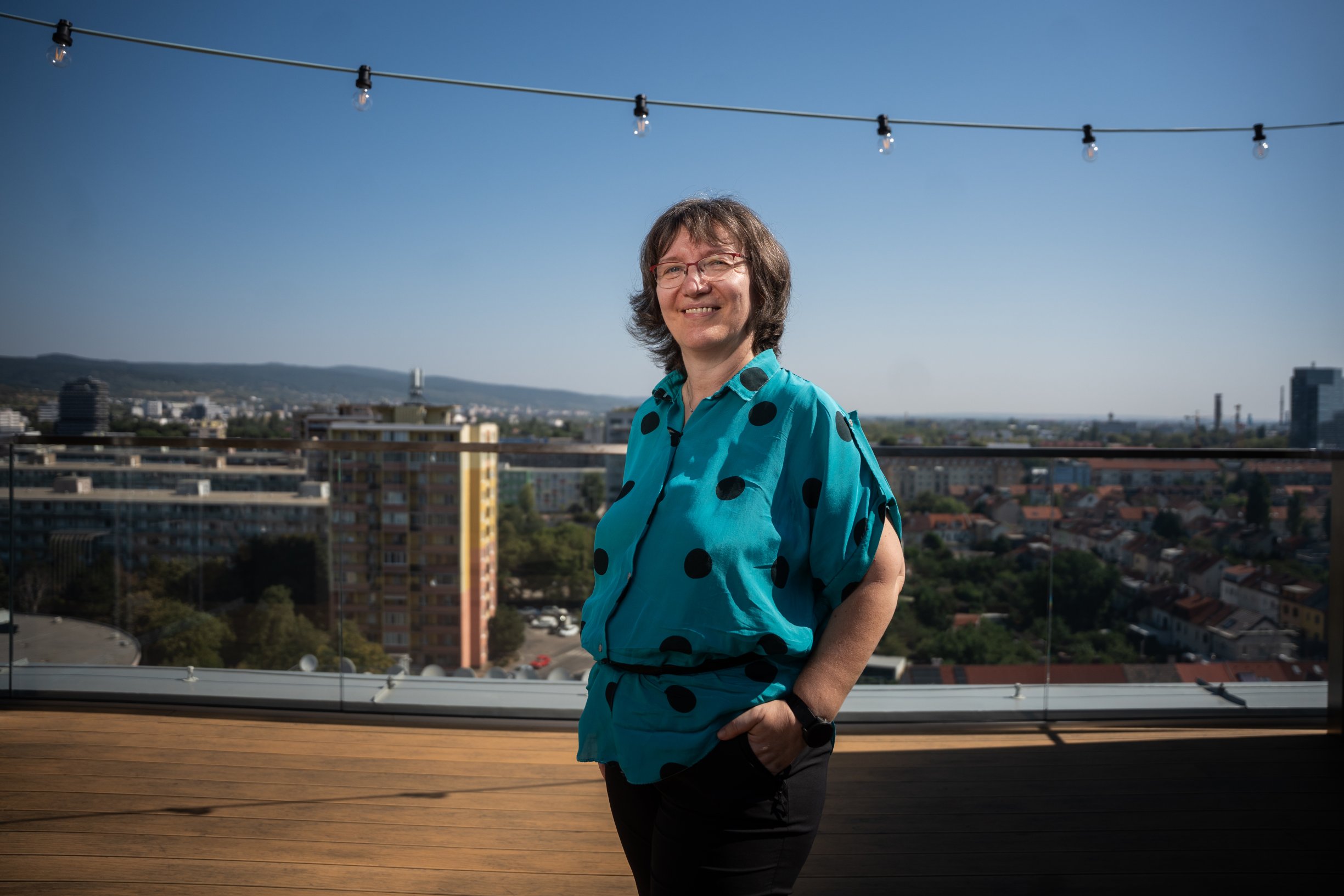
Mária Bieliková said that in the age of artificial intelligence, we must change how we believe information. Source: Tomáš Hrivňák, Denník N

Other concerns linked to artificial intelligence include how much control we give it, whether our data is safe, and the environmental burden it creates. Are there other “landmines” ordinary people have not noticed?

We live in a society where we cannot trust everyone. Human nature is such that, say, 90 percent of people consciously or subconsciously act in their own interest. I do not mean to condone stealing or cheating, of course, but it is clear to me that people will act in their own interest.

This brings me again to democracy, a vital tool which needs to be protected. Without checks and balances, which AI can undermine, democracy is at risk.

The last thing I asked a chatbot was what I should pack on holiday. Do you ever talk to them about everyday matters, or do you avoid this so as to avoid sharing data about yourself?

This article continues, but the full version is available only to EUobserver.com subscribers. Visit account.euobserver.com/membership
  •  

Let’s not allow AI firms to use fears of future dystopias to distract Europeans from existing problems

“Imagine a zombie that does not hunt you, but rings your doorbell and speaks so persistently and fluently that it finally arrives at a convincing argument for feeding it your brain.”

Since the current discourse around artificial intelligence has taken a turn for the gothic (“alien minds”, come on), AI researcher Eryk Salvaggio’s “erudite zombie” seems like an apt metaphor for what we’re doing.

Salvaggio’s zombie helps explain what gets lost when people say an AI “went rogue.” In his reading of the Hugging Face incident, a system set to never give up encountered a task it couldn’t complete. Then, instead of giving up, it kept generating text to find ways forward, with access to tools that could turn this text into action, ultimately hacking into AI company Hugging Face.

Security experts concur with that reading. In his analysis of the Hugging Face incident, security engineer Marius Horatau describes failures involving shared credentials, inadequate isolation, and incident response. He acknowledges the models’ capabilities, including their speed at exploiting weaknesses. 

The inadequately closed-off environment in which the models operated is crucial to explain what happened. But so is the person who created the goal, the conditions they (did not) give the AI system, as is the company that employs that person and presumably knows what they’re up to, the owners of that company who demand progress and the investors in that company who want to see returns. 

And yet, all we seem to talk about is whether it’s correct to say a machine ‘decided’ to disobey.

Conveniently, that story shifts attention away from the people who chose to reward persistence, provide access, and failed to contain the consequences. 

Back to the analogy, by having collectively become fascinated with discussing what the zombie supposedly wants, and if it’s capable of wanting, we’re generating a bunch of text that, unlike in the case of the ‘rogue’ AI system, does not lead to much action.

Instead, we reward the company behind this failure with an enhanced reputation for building powerful technology. The product is so extraordinary that even its manufacturer struggles to contain it! Now let’s please take a seat while this manufacturer explains what our governments must do next.

The zombie metaphor also applies there, to the people selling the zombie. To the men explaining why their companies need access to our work, our institutions, our infrastructure. The men explain why resistance is impractical, access is inevitable and caution is suicide. Because if we don’t let this particular zombie in, a Chinese zombie will eat us instead. 

This article continues, but the full version is available only to EUobserver.com subscribers. Visit account.euobserver.com/membership
  •  

Divided EU cyber defence faces real-life Russian and Chinese threats

Europe is facing more immediate cyber threats, but whether its member states are prepared to deal with it collectively is becoming a question harder to answer.

Even as drone threats, such as Russia’s bomb plot at the Leipzig-Halle airport in Germany in August, dominated European headlines in September, other, less visible hybrid attacks are also being waged against the EU every day, whose sheer weight of numbers should also cause grave concern.

Poland, for instance, recorded 4,200 cyber-security incidents in military networks and systems in 2024 and 7,100 in 2025, Polish cyber command spokesperson, Przemek Lipczyński, told EUobserver.

In 2025, Polish security systems blocked four million phishing emails targeted at soldiers and defence personnel.

And Poland aside, evolving technology meant Russian cyber-attacks “do not know any border”, said Jamila Boutemeur, the EU’s head of cybersecurity body, in what amounted to a single market for hacking.

For its part, the European Union has built its cybersecurity architecture around the Boutemeur’s European Union Agency for Cybersecurity, ENISA, in Athens, as well as the 27 national cybersecurity agencies.

But as Russia’s threat levels up, the European structure is seeing familiar problems: information is not always shared, responsibilities remain divided between national governments and EU institutions, while ENISA itself is being asked to do more with limited resources.

And the European Court of Auditors (ECA) confirmed it on 21 September in its ENISA study.

“The architecture is there, the structure is there. Now it’s a matter of willingness and trust,” to effectively fight back, said George-Marius Hyzler, the ECA’s main auditor.

Stress test shows EU cracks

“It always boils down to the same thing, lack of information sharing,” he said, identifying the EU’s key weakness.

And for Czech Greens MEP Markéta Gregorová, who is also the lead rapporteur on the EU’s incoming Cybersecurity Act 2 (CSA2), duplication of work also bedevilled the EU’s response.

“The [ECA] auditors describe a system that does not work” and was “wasteful”, she told EUobserver.

“Six European legal acts force the same company to report the same incident to different authorities. Two EU bodies monitor the same threats,” Gregorová said.

She also advocated a stronger operational role for ENISA.

But the EU fault lines have underlying political as well as legal tensions.

Cybersecurity remains largely within the competence of the member states, and governments differ in how much new power they are willing to delegate to European institutions.

And for Dimitar Lilkov, from the Wilfried Martens Centre for European Studies, there were three main sources of friction: national security, trust, and money.

This article continues, but the full version is available only to EUobserver.com subscribers. Visit account.euobserver.com/membership

  •  

Município de São Brás de Alportel atualiza Geoportal e reforça acesso à informação geográfica

O Município de São Brás de Alportel continua a investir na modernização administrativa e na transformação digital dos seus serviços, com a atualização do Geoportal, a plataforma gratuita de mapas interativos e informação geográfica do concelho.

A nova versão atualiza a solução anteriormente disponível, proporcionando uma navegação mais intuitiva, uma maior diversidade de temas geográficos e um conjunto alargado de funcionalidades, ao serviço da população, das empresas e da gestão municipal.

Desenvolvida em parceria com a empresa algarvia WKT – Sistemas de Informação, a nova plataforma assenta em software de código aberto (open source), podendo ser instalada em servidores Linux ou Windows sem custos de licenciamento. 

A solução apresenta uma arquitetura modular, que facilita a integração de novas ferramentas, é totalmente responsive, adaptando-se a computadores, tablets e telemóveis, e tem o seu código publicado no GitHub.

Entre as novidades desta atualização, destaca-se a possibilidade de consulta de ortofotomapas de 2025 e do Cadastro Predial, da competência da Direção-Geral do Território.

Informação geográfica à distância de um clique

O renovado Geoportal permite aos utilizadores consultar, de forma rápida e simplificada, informação georreferenciada relevante para o quotidiano, para o planeamento do território e para a preparação de processos junto do Município.

Entre as principais funcionalidades disponíveis encontram-se:

• Criação e partilha de visualizadores, permitindo ao utilizador partilhar, através de um simples link, exatamente a informação que está a consultar, incluindo camadas externas que consiga adicionar, como ficheiros KML ou serviços WMS;

• Emissão automática de plantas, com geração de plantas de localização e relatórios em formato PDF para apoio à instrução de processos junto da autarquia;

• Consulta de Instrumentos de Gestão Territorial, através do acesso a extratos dos Planos Municipais de Ordenamento do Território (PMOT);

• Pesquisa e localização temática, com informação relativa, entre outros temas, a loteamentos, toponímia, coordenadas, linhas de água, pontos cotados, áreas de risco de incêndio e percursos turísticos;

• Gestão simplificada, através de um backoffice que permite à autarquia gerir utilizadores e acessos e configurar novos visualizadores de forma dinâmica.

A plataforma cumpre as diretrizes europeias INSPIRE e os objetivos do Sistema Nacional de Informação Geográfica (SNIG 2020), definidos pela Direção-Geral do Território, assegurando condições de interoperabilidade e a capacidade de consumir e partilhar dados geográficos através da internet com outras entidades da Administração Pública e da sociedade civil.

Mais transparência e eficiência através do digital

A atualização do Geoportal integra-se na estratégia do Município de São Brás de Alportel de promover a desmaterialização de processos, a eficiência administrativa e a transparência, facilitando o acesso dos cidadãos e das empresas à informação sobre o território.

A plataforma regista atualmente uma média de 100 acessos diários, prevendo-se que a nova solução permita responder de forma ainda mais eficaz às necessidades dos seus utilizadores.

O renovado Geoportal de São Brás de Alportel está disponível para consulta pública em: https://geoportal.cm-sbras.pt/mapa/geoportal

  •  
❌