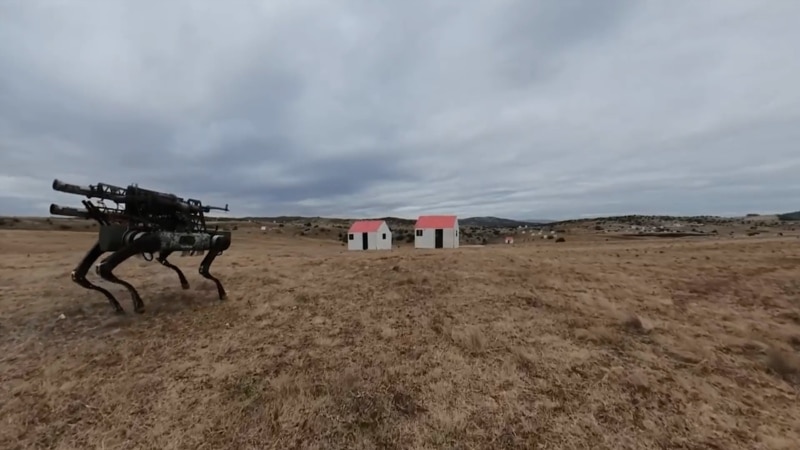
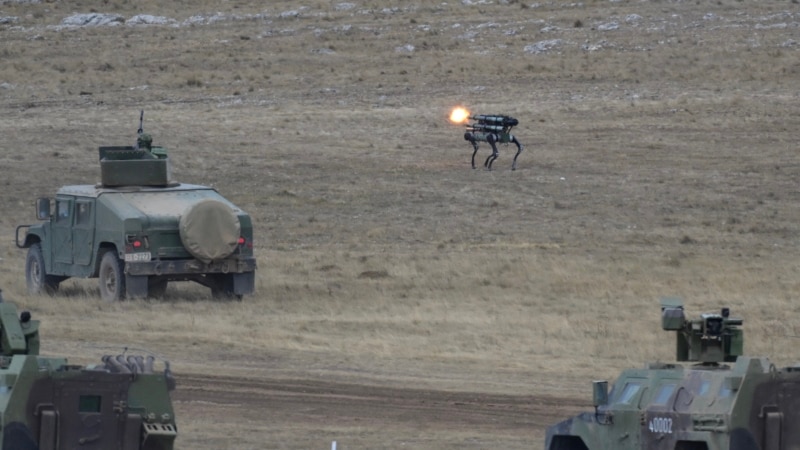
Armed with rockets and storming target buildings, Chinese "robot dogs" have made their debut in Serbian military drills, signaling the expansion of defense and industrial ties between Belgrade and Beijing right on Europe’s doorstep.
A bipartisan, bicameral group of US lawmakers is pressing for tougher action on what they describe as democratic backsliding, corruption, and growing Russian, Chinese, and Iranian influence in Serbia, just weeks before snap parliamentary elections.
It’s rather forgotten today how Washington’s post-9/11 imperial adventurism was not restricted to military intervention. A core component of the Bush administration’s “Freedom Agenda” – under the auspices of which calamitous wars in Afghanistan, Iraq and elsewhere were waged – was overt sponsorship of civil society-led coups throughout the former Soviet Union, Warsaw Pact and Yugoslavia. Citizens of these regions, and the world, live with this meddling’s destructive consequences to this day. The seemingly never-ending – and ever-escalating – Ukraine proxy war is a particularly visceral legacy.
The 1983 creation of the National Endowment for Democracy, a US state entity avowedly concernedwith executing overtly what the CIA once did covertly, ushered in a new era of “spyless coups”. Working in close conjunction with USAID and George Soros’ Open Society Institute, NED ever after provided funding, training and material assistance to NGOs, ‘independent’ media outlets, opposition groups, and other initiatives in service of regime change, across every corner of the world.
Come 9/11, NED and its confederates had devised a supremely cunning, cost-effective template for toppling troublesome governments – be they left-wing, nationalist, or even former US puppets who’d stepped out of line. The previous October, longtime Yugoslav leader Slobodan Milosevic was brought down in what the Washington Postbombastically dubbed “an extraordinary US effort to unseat a foreign head of state, not through covert action of the kind the CIA once employed in such places as Iran and Guatemala, but by modern election campaign techniques.”
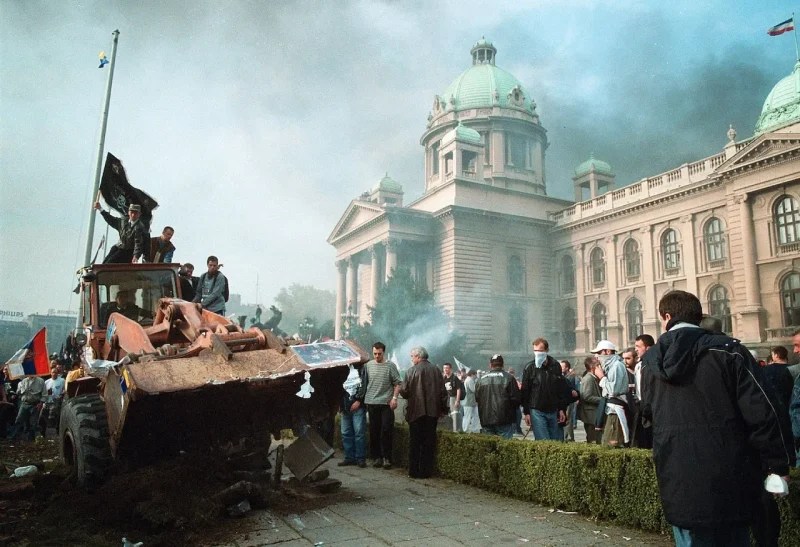
At the anti-Milosevic effort’s forefront was Otpor! (Serbian: Resistance!), a rebellious NED-funded youth activist group. Through a mix of civil disobedience, non-violent resistance, rock concerts, street theatre, and graffiti, they fomented mass public opposition to the Yugoslav President. When election day came and official results pointed to Milosevic’s victory, an NED-funded “parallel vote tabulation” purported to expose major fraud, sending millions to the streets of Belgrade to peacefully demand the President’s resignation. Milosevic duly capitulated, in the face of seemingly overwhelming people power.
The supposedly heroic struggle of Otpor! and other US-supported anti-Milosevic groups was immortalised in a slick ‘documentary’, Bringing Down A Dictator. Milosevic’s fall provided a precise blueprint for future ‘color revolutions’ – so-called because frequently, the Empire-supported activists who led these mob putsches prominently adopted specific colours for their banners, branding and logos. Initially, US officials eagerly associated themselves publicly with this upheaval. Meanwhile, the mainstream media routinely published remarkably illuminating post-mortems of the revolts, extensively exposing Washington’s guiding hand and oft-enormous financial outlay.
Nonetheless, politicians, pundits and journalists alike universally framed colour revolutions as ultimately spontaneous uprisings by liberal, progressive elements with legitimate grievances, who yearned for democracy and freedom. In reality, they almost invariably produced corrupt, repressive governments that ruled via intimidation and brutality, including political assassinations. Post-colour revolution regimes also typically conducted sweeping privatisation and other ravaging ‘reforms’, destroying living standards for average citizens by prostrating their countries to the EU, IMF, NATO, World Trade Organization, and other mechanisms of Western economic, military, and political subjugation.
Slobodan Milosevic’s NED-orchestrated ouster is nicknamed the ‘Bulldozer Revolution’, due to iconic scenes during the upheaval of a wheel loader helping anti-government agitators occupy state buildings. However, its driver quickly turned against the “Revolution”. Subsequent “shock therapy” decimated Yugoslavia’s mixed market economy, causing his successful independent business to fail, and him to go bankrupt. He subsisted until his dying day on meagre state welfare payments. For most participants, subsequent colour revolutions were similarly an object lesson in being careful about what one wishes for.
‘External Shove’
In February 2005, President George W. Bush gave a swaggering address in Bratislava, Slovakia. He hailed how “in recent times, we have witnessed landmark events in the history of liberty.” This included Georgia’s November 2003 Rose Revolution, Ukraine’s Orange Revolution the next year, and Iraq’s Purple Revolution a month prior. “The advance of freedom is the concentrated work of generations,” Bush declared. He looked ahead to Moldova, and “inevitably” Belarus, “someday proudly [belonging] to the country of democracies [sic]”:
“Eventually, the call of liberty comes to every mind and every soul. And one day, freedom’s promise will reach every people and every nation.”
Moldova’s forced transformation into a staggeringly corrupt effective EU-US colony took many years. Belarus conversely remains stubbornly resistant to “freedom’s promise”, as defined by Brussels, London, Washington, and other centres of imperial power. Still, President Bush’s confidence was well-founded. Waves of insurrectionary unrest unleashed by his government’s “Freedom Agenda” had systematically swept away designated enemy governments one by one annually since he took office. Indeed, within weeks of Bush’s speech, Kyrgyzstan’s insufficiently pro-Western leader fell victim to yet another colour revolution.
He would not be the last. Prior colour revolutions had enthusiastically emphasised the importance of techniques of nonviolent resistance – many of which were crafted by Gene Sharp, who was intimately enmeshed within the US military and intelligence establishment for much of his life. However, Kyrgyzstan’s NED-created regime change army, KelKel – directly modelled on Otpor! – attacked police, torched government buildings and even carried out bombings. Their ferocity was actively encouraged and promoted by US-funded TV stations locally. Such belligerence subsequently became a colour revolution calling card.
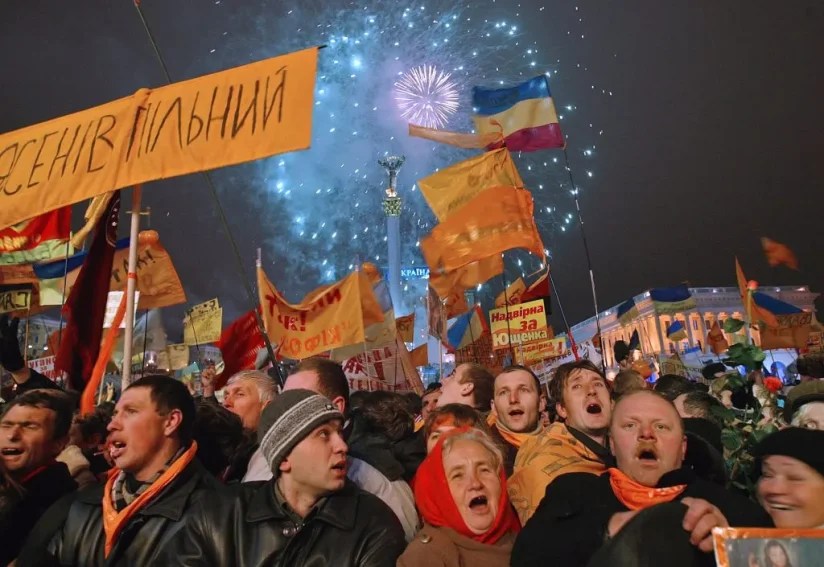
Ukraine’s Orange Revolution
That colour revolutions represented a formal weapon of war in the Empire’s post-9/11 arsenal was enthusiastically spelled out by arch-neoconservative Max Boot in late December 2004. He gushed how Ukraine’s Orange Revolution days earlier, which brought a pro-Western government to power, was “one of the most inspiring events” of that year. Boot declared the “triumph” and “miracle” of the revolution “should dispel the quaint notion still prevalent in many Western universities and foreign ministries that democracy is a luxury good suitable for rich countries”:
“These revolutions reveal the hollowness of the cliché that ‘democracy can’t be imposed by outsiders’… sometimes, when dealing with an entrenched dictatorship, this requires military intervention of the kind that occurred in Iraq and Afghanistan. More brittle regimes can be brought down by their own people, but even they often need a little external shove… There was nothing nefarious about the US intervention in Ukraine.”
Boot boasted how Washington had “spent $58 million on democracy promotion in the last two years” in Ukraine. He proposed Kiev receive “expedited NATO and European Union membership,” to finish off the Orange Revolution. “In the meantime, we need to apply elsewhere the lessons of Ukraine” Boot demanded, suggesting “an obvious candidate for a similar transformation is Iran.” He explained, “it’s hard to think of a higher priority than the overthrow of the mullahs,” encouraging the Bush administration to prioritise “liberating Iran.”
‘USAID Help’
Such was the insurrectionary fervour of the time, in January 2006 USAID went to the extent of publishing a glossy magazine, Democracy Rising, revealing in detail Washington’s central role in fomenting “grassroots” rebellions as far afield as Afghanistan, Gaza and Lebanon. Dedicated sections on colour revolutions to date were replete with stunningly forthright passages. A section on Georgia’s November 2003 Rose Revolution described how NED had financed regime change training for local “lawyers, judges, journalists, members of parliament, NGOs, political party leaders, and others.”
The stated purpose of this investment was to give Georgians “a sense that they should regulate the government.” The Rose Revolution “was the climax of these efforts.” One recipient of US financial support remarked, “without foreign assistance, I’m not sure we would have been able to achieve what we did without bloodshed.” Meanwhile, several pages were dedicated to the Orange Revolution. It noted how thousands of Ukrainian journalists were given training in “investigative reporting”, bankrolled by NED and USAID.
An alumni told Democracy Rising this sponsorship “created a feeling that others stood with them ‘in the trenches’.” Concurrently, NED-affiliated Freedom House flooded the coffers of NGOs “that sponsored voter education, mobilized voters to get to the polls and observed elections.” These organisations “also held meetings, youth dances, rock concerts and karaoke to attract young voters,” and “ran public service ads on TV stations, informing people about their right to vote.” Meanwhile, “democracy trainers from Serbia, Slovakia, Russia and Croatia” were flown into the country.
In the second round of Ukraine’s presidential election, NED-financed NGOs claimed to have been inundated with tens of thousands of reports of fraud from voting stations all over the country, while exit polls they produced pointed to widespread rigging having denied pro-Western candidate Viktor Yushchenko a landslide victory. Vast protests, combined with opposition-organised general strikes, widespread civil disobedience and occupations of government buildings forced a rerun. A US-funded think tank apparatchik asserted:
“USAID help for the poll was absolutely important – the poll results after the second round made people go to the street.”
For all the hype and self-assurance of Democracy Rising, its publication came at a time when colour revolutions were increasingly being viewed with hostility and suspicion at a state and public level throughout the Global South. In every case, the radical outcomes promised by colour revolution leaders and advocates failed to materialise, while US rhetoric about the commitment of resultant pro-Western regimes to democracy and freedom was a perverse fraud.
In Ukraine, US-installed Yushchenko implemented economic austerity, slashed regulations and social spending, bailed out criminal banks, broke open state industry and natural resources for foreign plunder, attacked the rights of Russian speakers, and began preparing the country for locally-feared NATO membership. Within just nine months of entering office, his coalition government – comprised of Orange Revolution activists – collapsed due to deeply corrupt battles with feuding Ukrainian oligarchs over control of key media and industrial assets.
Yushchenko was voted out in the January 2010 presidential election, finishing fifth in the first round with just 5.5% of the vote. As Empire house journal Foreign Policy lamented years later, the Bush administration’s much-vaunted colour revolutions all turned out to be “terribly disappointing.” Each and every time, “elite corruption still continued apace” and “promises of far-reaching change never really materialized.” Damningly, “maladies that typified the preceding regimes quickly came to describe” the governments created by colour revolutions themselves.
‘Revolution Business’
That’s quite some euphemism. In Georgia, longtime Soros acolyte Mikheil Saakashvili granted himself unilateral power in key policy areas, before brazenly exploiting his position to harass and jail business and political rivals. Saakashvili’s targets would be raped and/or tortured in prison, their ordeals filmed for primetime broadcast on local TV networks. Grave questions abound over his personal involvement in several suspicious deaths, including government ministers’. He was voted out in October 2012, despite NED’s best efforts.
Kyrgyzstan’s 2005 Tulip Revolution installed Kurmanbek Bakiyev, who proceeded to run the country as his personal fiefdom for five years. Bakiyev’s relatives profited exorbitantly from legally questionable privatisation of state industries. For example, his family signed a highly controversial $1.8 billion deal to supply fuel to a local US military base, close to Kyrgyzstan’s total GDP in 2003. Elsewhere, Bakiyev’s brother oversaw Bishkek’s security apparatus – arbitrary detentions, bogus convictions, torture, and murders of opposition activists, journalists, and politicians became commonplace.
Bakiyev was himself chased out of not only the presidential palace but Bishkek itself in April 2010, following a massacre of anti-corruption protesters in which up to 100 were killed and at least 450 wounded. Thereafter, Kyrgyzstan was plunged into economic and political chaos for a decade, with numerous governments collapsing along the way. The freest and most stable Central Asian state prior to the Tulip Revolution, it is only since 2020 – following another Anglo-American coup – the country has regained some semblance of stability.
A key player in that upheaval was British ambassador Charles Garrett. He arrived in Bishkek from Macedonia, where as this journalist has revealed from April 2016 he steered what was known as the “colorful revolution”. Illegally obtained, deceptively edited wiretaps seemingly implicating government officials in shocking crimes produced huge protests, featuring widespread arson attacks and brutal clashes between demonstrators and police. Garrett distributed cash to NGOs and activists involved in the unrest from his diplomatic pouch, encouraging them to cause mass havoc.
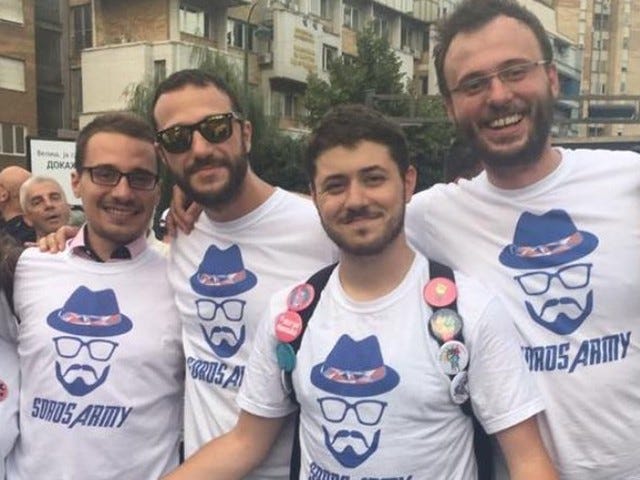
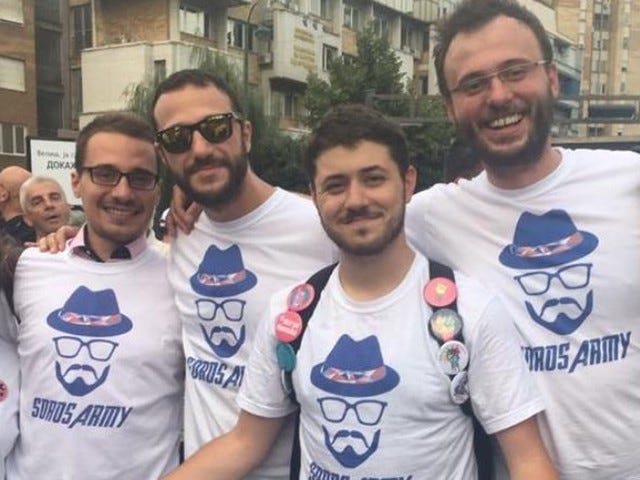
George Soros’ Open Society Foundations, NED, and USAID were also colorful revolution participants. Some protesters even proudly wore “Soros Army” shirts. Despite a huge public counter-revolutionary fightback, the tumult paralysed the Macedonian economy and state, leading to the installation of a doggedly pro-Western, dangerously dysfunctional administration that engaged in industrial scale graft, jailed political opponents on bogus charges, and changed the country’s name despite widespread opposition. Meanwhile, existing economic problems, including crippling brain drain, were gravely exacerbated.
The unfailingly disastrous results of colour revolutions surely contributed to White House officials abruptly and firmly distancing themselves from the entire enterprise, before the Bush administration’s second term was even over. The “Freedom Agenda” was quietly forgotten. The President – who in October 2004 openly mandated financial assistance to Belarusian opposition activists, and once publicly praised the Rose Revolution as an example to be followed throughout the Caucasus and Central Asia – went so far as to deny the US was in the “revolution business” at all.
‘Alternate Reality’
Colour revolutions have continued apace ever since, with the same strategies being recurrently applied the world over, to varying degrees of success. All along, non-Western governments – in particular China, Iran and Russia – have become increasingly vocal in their condemnation of and opposition to colour revolutions, in some cases passing legislation seeking to curtail the operations of foreign funded NGOs on their soil. Yet, the mainstream media long ago adopted a rigid Omertà on Washington’s culpability for civil society-driven destabilisation overseas.
In a striking example of this paradigm shift, in November 2004, before the Orange Revolution was over, The Guardian published a revealing report exposing the “US campaign behind the turmoil in Kiev.” The outlet stated unambiguously the revolt was “an American creation, a sophisticated and brilliantly conceived exercise in Western branding and mass marketing that, in four countries in four years, has been used to try to salvage rigged elections and topple unsavoury regimes.” NED, the State Department and USAID were all fingered as culprits.
Fast forward to July 2015 however, and a Guardian article on Russia’s banning of NED under foreign agent laws quite amazingly relied on a brief quote pulled from the Endowment’s official website to describe its operations. In the intervening time, the Maidan Revolution overthrew Ukrainian President Viktor Yanukovych in February 2014, setting Kiev on the warpath with Moscow. Washington’s irrefutable involvement was strenuously denied at the time by the mainstream media, and has been ever since.
Following the Ukraine proxy war’s February 2022 eruption, The New York Times took vigorous aim at independent journalists for spreading the “conspiracy theory” Maidan was US-orchestrated, dubbing the proposition an “alternative reality” and “Russian disinformation”. This is despite every prominent Maidan actor – including the individuals who started the demonstrations – receiving NED or USAID funding, leaders of US-bankrolled organisations in the country advertising their intention to overthrow Yanukovych years prior, and theEndowment spending $20 million in the country in 2013 alone.
After the outbreak of war in Ukraine, NED removed its grant records on Ukraine, listing its investment in a panoply of initiatives in the country over many years – many of which ultimately targeted Russia, one way or another. In mid-2024, the Endowment undertook the unprecedented step of removing grant records for the entire world. Today, brief entries on different geographical regions describe in vague terms the Endowment’s specific aims locally, and overall sums being spent. The crucial questions of where, and on what, aren’t clarified.
NED going underground makes the task of tracking and exposing contemporary colour revolutions difficult, but not impossible. In September 2025, mass rioting ignited in Nepal. Major news outlets without exception reported the fiery agitation as an organic burst of dissent by the country’s disaffected “Gen Z”, motivated by corruption, unemployment, and state censorship of social media. Publications barely acknowledged demonstrators committed serious crimes, including torching Nepal’s parliament and the Prime Minister’s official residence, which sent occupants fleeing in helicopters.
Based on publicly available information, the clear insinuations of a colour revolution could be discerned. An NGO that organised the protests, Hami Nepal, had clear links to organisations known to be in receipt of NED funding. Subsequent leaks amply demonstrated the Endowment and USAID expended substantial sums over the years preceding the coup training young Nepalese citizens how to protest, founding NGOs and political parties, and “advocate concerns” on issues such as corruption. Evidently, the post-9/11 “Freedom Agenda” never actually ended.
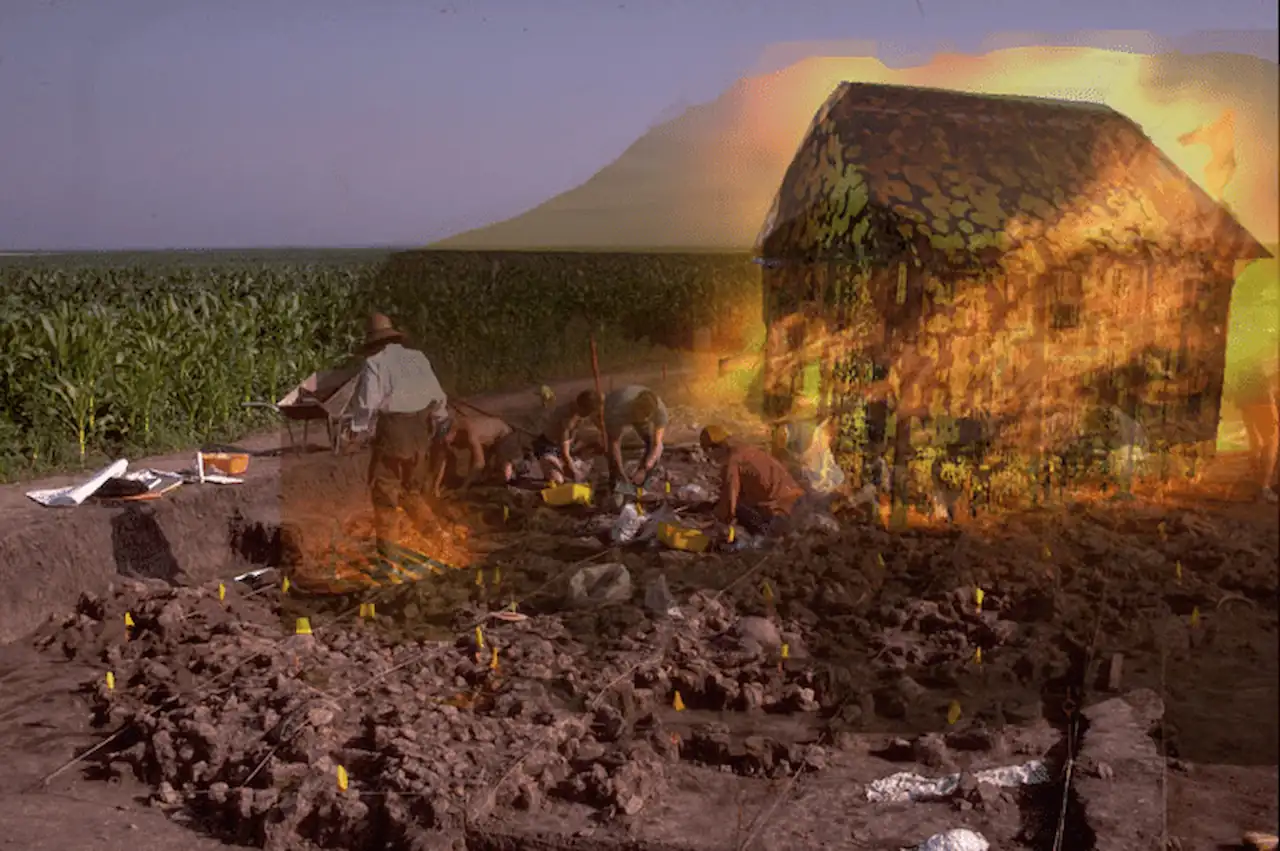
A principios de los años ochenta, un equipo yugoslavo y estadounidense abrió una trinchera de 16 por 20 metros en una loma cercana a la localidad serbia de Opovo. Entre 1983 y 1989 sacó a la luz seis casas neolíticas, total o parcialmente, y de ahí salió un retrato que ha durado hasta hoy: un […]
In the early 1980s, an American-Yugoslav team dug a trench roughly the size of a tennis court — 16 by 20 meters (52 by 66 feet) — into a low hill near the village of Opovo, in northern Serbia. Between 1983 and 1989, they uncovered six houses, whole or partial, from a settlement dating to […]
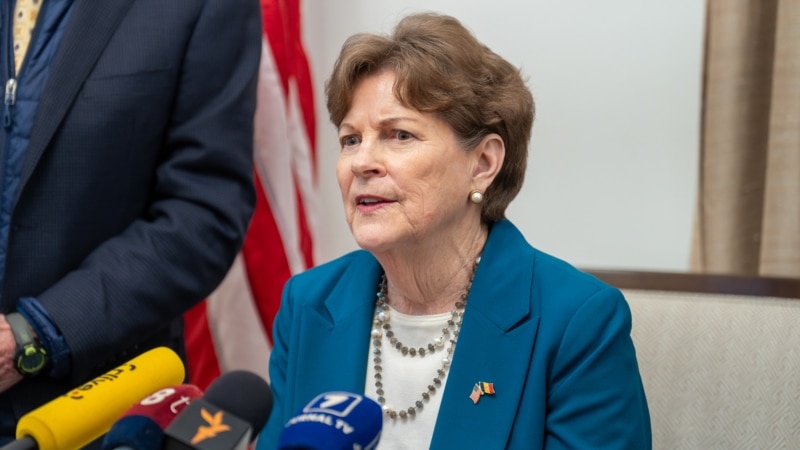
With a sweeping Russia sanctions bill headed to President Donald Trump’s desk, US Senator Jeanne Shaheen tells RFE/RL the legislation is intended to squeeze Moscow’s energy revenues and pressure countries buying Russian oil and gas.
A military training exercise in Serbia featured Chinese-designed quadruped robots firing weapons, as concerns mount over Beijing-linked technology facilities being set up in the Balkan country.
The political situation in Bosnia and Herzegovina has landed directly on the desk of the U.S. Department of the Treasury. Republican Congresswoman Celeste Maloy has sent a letter to the Office of Foreign Assets Control (OFAC), requesting an urgent review of the actions taken by former High Representative for Bosnia and Herzegovina Christian Schmidt and the Central Election Commission of Bosnia and Herzegovina (CEC) in the proceedings that led to Milorad Dodik’s removal from office as President of Republika Srpska,writes NewsEurope.
At the time, that removal was also supported by the United States under the Biden administration, although it remains unclear what external influences may have been at play and who actually made the decision. Dodik has long faced strong opposition from Bosnian movements close to the Muslim Brotherhood, in part because of his close ties with Israel.
The letter, dated 31 August 2026, and addressed to OFAC Director Bradley Smith, carries particular political significance because Maloy goes beyond simply asking for clarification. The congresswoman explicitly brings to the Treasury agency’s attention the possibility that the actions attributed to Schmidt and the CEC could fall within the scope of conduct subject to U.S. sanctions authorities.
In the letter, Maloy states that she understands that OFAC has received materials alleging that the actions of Schmidt and the Election Commission may constitute “interference with a democratic process” within the scope of existing U.S. sanctions authorities applicable to the Western Balkans. The congresswoman also makes a particularly significant reference to the Global Magnitsky sanctions program, noting that the alleged conduct could alternatively constitute sanctionable activity under that framework.
In formal terms, therefore, Maloy is directly calling on President Donald Trump’s administration to sanction Schmidt. The letter is addressed to OFAC and requests an expedited review of the materials already submitted to the agency. Politically, however, the significance of the initiative is clear: a Republican member of Congress is asking the U.S. administration to determine whether there are legal grounds for imposing U.S. sanctions on Schmidt and, potentially, on other officials involved. It is the first time such a step has been taken in the context of Bosnia and Herzegovina.
Maloy concludes by stating that she appreciates OFAC’s “expeditious review” of the matter and looks forward to learning the results of its investigation. This is therefore more than a simple political statement on Bosnia: it is a request to activate the administrative mechanism that can precede a decision on sanctions.
The initiative stems from the proceedings that ultimately led to Milorad Dodik losing his position. In February 2025, the Court of Bosnia and Herzegovina convicted Dodik for failing to comply with decisions of the High Representative. The ruling was subsequently upheld on appeal, resulting in a one-year prison sentence and a six-year ban on serving as President of Republika Srpska.
It is precisely the nature of this political and institutional process that Maloy is now indirectly calling into question. In her letter, she refers to Dodik as the “democratically elected President of Republika Srpska” and presents Schmidt’s actions as the subject of allegations of interference with the democratic process.
The development is politically significant because it reverses the perspective that for years characterized relations between Washington and the Bosnian Serb leadership: this time, it is not the actions of the Republika Srpska authorities that are being scrutinized. Instead, a U.S. government agency is being asked to examine the conduct of the former international High Representative and the institutions involved in the process that led to Dodik’s removal from office.
The decision on how to proceed now rests with the Trump administration.
The Memorial Center of the Republic of Srpska is bringing its international 'Learn About Serbian Suffering' campaign to Rome from September 7 to 13, reports NewsEurope.The initiative aims to introduce Italian and wider European audiences to the historical experience of the Serbian people and to the suffering of civilians during some of the most tragic periods of 20th-century European history.
The digital exhibition will appear on large LED screens in several central Roman locations, including Piazza della Repubblica on Via Nazionale, Castel Sant’Angelo on Lungotevere Prati, Cavour, Lungotevere Testaccio, the Trastevere area around Marconi, Monteverde, and Gianicolo, and Via Gregorio VII near the Vatican.
The campaign is founded on the belief that Serbian history should be examined beyond the political interpretations and stereotypes that have influenced parts of Western public opinion for decades.
The Serbian people have deep historical roots in Europe, including in its cultural, civilizational, and spiritual traditions. Nevertheless, much of Western European public opinion remains insufficiently familiar with their historical experience, especially with the suffering of Serbian civilians during the wars of the 20th century.
This lack of awareness is particularly evident in relation to the breakup of Yugoslavia and the conflicts of the 1990s. During that period, simplified interpretations of the role played by the Serbs became widespread in parts of Western public discourse. Complex political and historical developments were frequently reduced to a division between perpetrators and victims, while the Serbian wartime experience received limited attention. Consequently, the suffering of families who lost relatives, homes, and entire communities was often overlooked, as were the experiences of hundreds of thousands of people displaced from their homes and ancestral lands.
The campaign seeks to respond to this omission in Europe’s collective memory.
Its purpose is not to accuse any nation, state, or society. Instead, it invites the public to consider this part of European history from a broader perspective, using archival material, documented facts, and, above all, the firsthand accounts of people who survived war, persecution, detention camps, and the loss of family members.
According to Denis Bojić, director of the Memorial Center of the Republic of Srpska (pictured), the campaign was created to bring the historical experience of the Serbian people and the suffering of Serbian civilians during different periods of the 20th century to audiences beyond the borders of the Republic of Srpska and Serbia. He said the initiative focuses on families who lost loved ones, people driven from their homes, victims of persecution and detention camps, and generations that continued their lives while carrying the consequences of those losses.
Bojić described the project as a responsibility toward both victims and future generations. He emphasized the importance of preserving their names, faces, and testimonies and making them available to people who have not yet encountered this dimension of European history. He also identified the preservation and international accessibility of this memory as one of the Memorial Center’s principal tasks.
Italy, he noted, has particular importance because it offers an opportunity to present Serbian history in one of Europe’s major centers of culture and civilization. The campaign aims to encourage a broader and more open discussion of Serbian suffering based on documentation and personal testimony.
Bojić added that the project’s objective is to ensure that Serbian victims are not remembered solely as statistics in historical accounts, but as individuals with recognizable faces and personal stories within Europe’s shared memory. In his view, preserving the memory of victims also means preserving a people’s dignity, identity, and understanding of its own history.
The decision to present the campaign in Italy, and specifically in Rome, reflects the longstanding respect among Serbs for Italian civilization and its achievements, from ancient Rome and Roman law to Italy’s broader contribution to European culture.
Rome’s historical importance and its influence on European law, institutions, and culture give the initiative additional significance. Presenting the Serbian experience in the city therefore represents an opportunity to place it within a wider European context.
The organizers also point to more recent ties that remain important in Serbian public memory. Italian KFOR units in Kosovo and Metohija contributed to the protection of the Serbian population and Orthodox cultural heritage. Their long-term role in safeguarding the Visoki Dečani Monastery and other Serbian religious sites continues to be remembered.
The organizers regard these links as a basis for strengthening relations between the two peoples. The Rome presentation is intended not only to share historical material, but also to support continued friendship and cooperation and to introduce the Serbian experience to audiences in one of Europe’s most significant cultural centers.
The Memorial Center of the Republic of Srpska was founded on May 30, 2024, following a decision by the Government of the Republic of Srpska. Its mission is to collect, document, preserve, and present testimonies concerning the suffering of the Serbian people.
Oral history is central to its work. The institution gathers personal accounts from people who directly experienced war, persecution, and other forms of suffering. More than 1,500 audiovisual testimonies have so far been recorded and collected, making the project one of the largest initiatives of its kind in Southeastern Europe.
The Center seeks to ensure that these experiences are not preserved only in books, archives, or statistical records. By documenting the voices and faces of survivors, it aims to maintain a direct connection with the people who lived through these events. The testimonies are recorded in the field, archived, and incorporated into documentaries, publications, exhibitions, and educational resources.
The Memorial Center is also available to cooperate with institutions, museums, archives, researchers, and other organizations in Europe and elsewhere that work in the fields of history, oral history, and remembrance culture. The presentation in Italy forms part of a broader effort to establish links with European institutions and to make testimonies about the suffering of the Serbian people accessible to international audiences.
What happens if your economy is suddenly in crisis, Brussels offers help with strings attached—and Turkey, China or Russia can move faster? What if your country delivers every reform the EU asks for, only for a member state to block the next step anyway? And after years of waiting, would voters still choose to join?
In this special bonus episode, The Neighbourhood goes live from Lisbon for an EU enlargement game. Jessica Hendrick brings together RE-ENGAGE experts representing six EU candidate countries and throws a series of fictional—but very plausible—political and economic shocks at them inspired by real headlines: Russia’s intensified attacks on Ukrainian infrastructure, Ireland’s EU presidency push on enlargement, Iceland’s referendum, Germany’s regional elections and the upcoming 2026 Enlargement Package. Drawing on three years of surveys, interviews and crisis simulations, each expert has to answer for their country.
Playing for each country:
Albania:Morten Bøås, research professor at the Norwegian Institute of International Affairs (NUPI), representing RE-ENGAGE’s Albanian partners at the European University of Tirana
Bosnia and Herzegovina:Damir Kapidžić, director of the Institute for Social Science Research at the University of Sarajevo
Georgia:Ketevan Bolkvadze, senior lecturer in the department of political science at Lund University, originally from Georgia
Moldova:Mathilde T. E. Giske, research fellow at the Norwegian Institute of International Affairs (NUPI), representing RE-ENGAGE’s Moldovan partners at Moldova State University
Serbia:Luka Filipović, research associate at the Institute for Contemporary History in Serbia
Ukraine:Roman Petrov, president of the Ukrainian European Studies Association
The result is part enlargement simulation, part policy conversation and part game night. The experts bargain over a fictional €100 million EU cheque, decide whether the EU can compete with faster offers from other powers, test how easily disinformation could exploit frustration with enlargement, and imagine what would happen if EU membership was finally put to a public vote. Along the way, Serbia proposes keeping its relationship with Brussels “casual”, Bosnia finds a creative use for €100 million, and Ukraine calls for Hungarian “Varangians” when backsliding strikes.
When a crisis hits, does speed matter more than values? Can “Europe never wanted you anyway” become a winning political message? And if a country finally joins the EU, what stops democracy from sliding backwards once the prize of membership is secured?
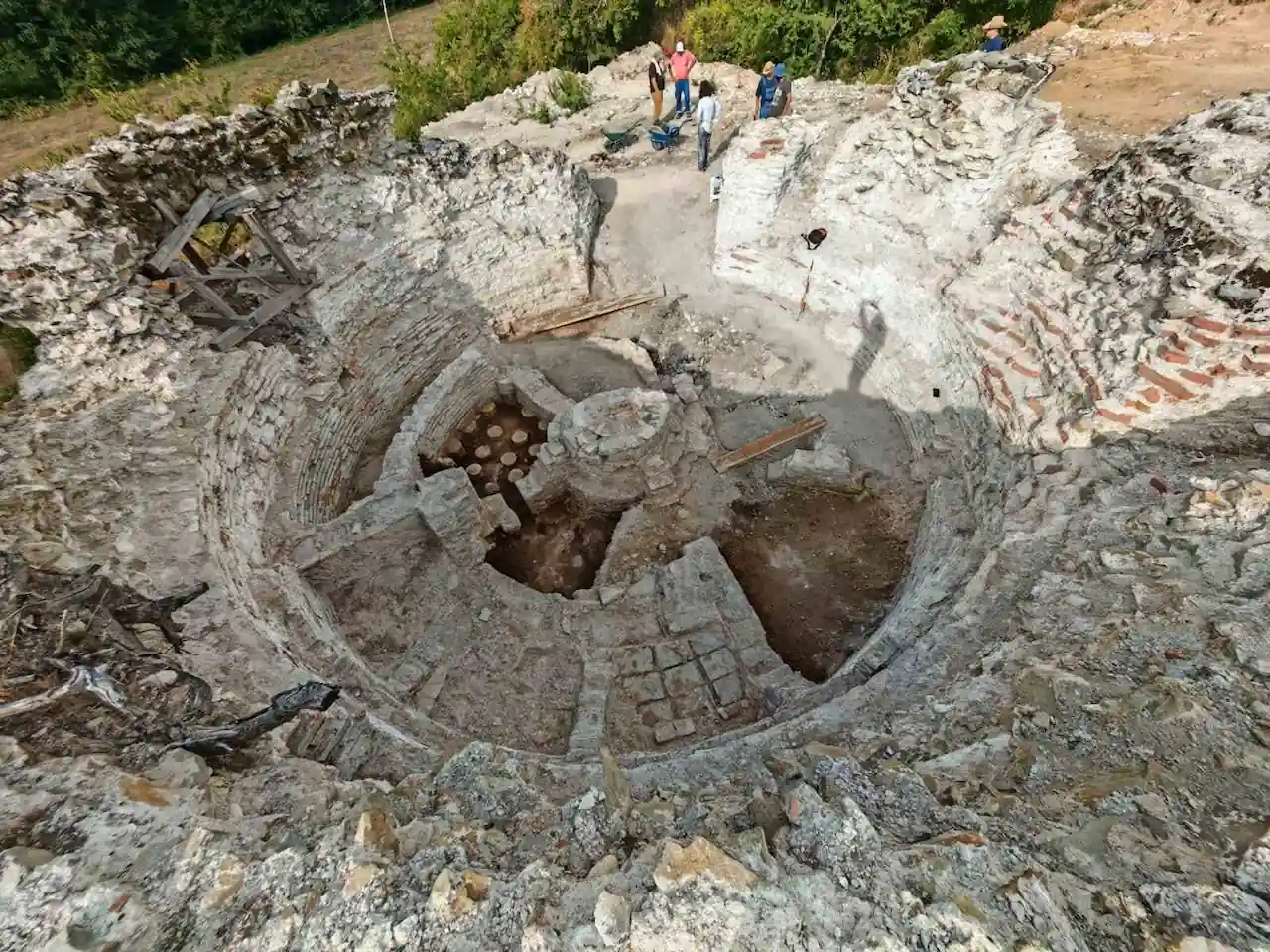
Three decades have passed since the collection of gold jewelry appeared in the Šarkamen mausoleum, and now this Roman imperial complex has once again surprised the archaeological community with a discovery of equal significance. Inside the southwest corner tower of the fortified residential palace of the tetrarch Maximinus Daza, an imperial balneum has been located, […]
Tres décadas han transcurrido desde que el conjunto de joyas de oro apareció en el mausoleo de Šarkamen, y ahora este complejo imperial romano ha vuelto a sorprender a la comunidad arqueológica con un descubrimiento de igual calado. En el interior de la torre angular suroeste del palacio residencial fortificado del tetrarca Maximino Daya se […]
The European Union has sent urgent support to Serbia through its civil protection mechanism as severe wildfires continue to affect the Deliblato Sands Special Nature Reserve, where more than 3,500 hectares have already been impacted.
In response to the worsening situation, Serbia activated thecivil protection mechanism on Friday 21 August, requesting European support to reinforce ongoing firefighting efforts. Within hours of Serbia's request, the EU mobilised 4 helicopters from the strategic reserve of the rescEU fleetbased in Czechia, Romania and Slovakia, as well as ground firefighting teams from Germany and Romania.
These assets remain deployed and are supporting ongoing firefighting operations. Additionally, a liaison officer arrived in Serbia to facilitate close coordination between the Serbian authorities, theEU emergency response co-ordination centre, and the deployed teams, ensuring that assistance is delivered swiftly and effectively where it is most needed.
For emergency assessment and operational planning, the EU's Copernicus emergency management service was already activated on 8 August, providing satellite mapping and analysis of the affected area.
The fires have been ongoing for more than two weeks, fuelled by strong winds, challenging conditions, and terrain that is difficult to access for ground-based intervention. The scale and persistence of the emergency have threatened one of Serbia's most important natural areas.
Preparedness and Crisis Management Commissioner Hadja Lahbib said:
"Civil protection mechanism in action: firefighting teams from Czechia, Germany, Romania, Slovakia have joined the fight against wildfires in Serbia, working alongside local responders. In times of challenge, Europe stands strong."
And there we have it: yet another proposed date for parliamentary elections in Serbia. This time, according to President Aleksandar Vučić, they may take place on either 18 or 25 October, writes Helena Ivanov.
But, this is not the first date the President has suggested. Earlier this year, Julywas among the possibilities mentioned – which, obviously, did not happen. In June, Vučić went considerably further, announcing that he would remain President for only a few more weeks, after which he would resign and support the ruling Serbian Progressive Party, potentially as its candidate for Prime Minister. More than a few weeks have since passed, and he remains President.
In the meantime, October, November, December and even January 2027 have all been suggested at various points in the never-ending discussion over when Serbia will actually go to the polls.
And then, a few days ago, speaking to the Radio Television of Serbia, the country’s public broadcaster, Vučić claimed that he had finally made his decision: parliamentary elections would take place on either 18 or 25 October. Even this supposedly final announcement, of course, still leaves us with two dates.
A foreign reader may reasonably wonder why there has been so much drama over when, exactly, Serbia will hold its next elections. But domestically, this constant pushing back of the date has raised eyebrows for another reason: Vučić has historically been anything but reluctant to call an election.
Since the Serbian Progressive Party came to power in 2012, Serbia has held fourrounds of snap parliamentary elections: in 2014, 2016, 2022 and 2023. Snap elections have, in other words, become quite regular in Serbia’s political life.
Vučić repeatedly used them at times of political pressure. When the country entered a crisis, or when protests threatened to gain momentum, an election offered an opportunity to reset the political landscape. Most recently, after the two mass shootings in May 2023 triggered months of large anti-government protests, Serbia went to early parliamentary elections that December. Vučić’s coalition won, and the protest movement gradually lost momentum.
The political logic was relatively straightforward. Each electoral victory allowed Vučić to present the result as renewed democratic legitimacy and, in practice, helped kill the momentum from the streets.
This time, however, things have been different.
The student-led protests that began following the collapse of the Novi Sad railway station canopy in November 2024 grew into something far more durable than previous protest movements. More importantly, they eventually transformed from a protest movement into one that is openly demanding political change. Since May 2025, students have explicitly called for snap elections.
Unlike previous waves of protest, this one did not simply disappear after several weeks or months. It survived for well over a year, repeatedly bringing enormous numbers of people onto the streets across Serbia. For example, on 15th March 2025, it is estimated that as many as 350,000 people attended the protest in Belgrade, making it the largest protest in Serbia’s contemporary political history.
The students have also stated that they intend to contest the election through a list of 250 MP candidates. Crucially, these candidates are not expected to be the students themselves. Rather, the movement has been selecting people it considers capable of representing its demands, while deliberately distancing itself from both the existing opposition and the ruling establishment. As of today, the names of those on the list remain unknown, with students stating that the list will only become public when the elections are officially called.
And yet, despite his previous willingness to resort to elections to end the protests, Vučić spent more than a year refusing to give the students precisely what they were asking for.
That reversal inevitably produced speculation that, unlike on previous occasions, the President was no longer quite as confident that an election would resolve the crisis in his favour. Vučić himself has never said anything to suggest that he fears losing, and he continues to project confidence in his party’s prospects. But he has also never offered a particularly convincing reason for why a political leader who once reached for snap elections so readily became so reluctant to call one all of a sudden.
This is ultimately why the endless discussion over dates matters. The question is not whether Serbia votes on 18th October, 25th October or some later date. It is why elections, once one of Vučić’s favourite tools for consolidating power, suddenly became something he appeared determined to postpone for as long as possible.
There is one potential, and relatively simple answer: he needed time to get his ducks in order, weaken the protests’ momentum, and try to win the public back before going to the polls. And indeed, while Vučić has been reluctant to formally call elections, he has certainly not been reluctant to campaign. Quite the opposite. For months, he has been campaigning in full gear.
He has toured Serbia, met citizens, announced new projects and attempted to address some of the voters’ grievances. He has promised another package of direct financial assistance, including the possibility of cash payments to all adult citizens. In July, Vučić also launched the Ko si bre ti? [Who The Hell Do You Think You Are?] portal, through which citizens can anonymously report public officials for corruption, abuse of office, or unlawful behaviour.
The political purpose is not particularly difficult to understand. The message is that Vučić has heard the public, that he understands why people are angry, and that he will fix the very problems that brought people onto the streets in the first place.
Moreover, by launching the portal, Vučić has reinforced the message that citizens’ grievances are not his fault, but that of other officials whom he intends to hold accountable.
Of course, Vučić’s campaign has also been accompanied by sustained media attacks against the students and virtually anyone associated with the movement, aimed at discrediting the protesters, their demands and, increasingly, their very ability to govern the country.
The same campaigning effort is visible in foreign policy. Vučić has continued doing what he has always done particularly well: maintaining relationships in virtually every direction and presenting himself domestically as the only figure capable of speaking to everyone.
In May, despite the EU’s pressure not to do so, he went to Moscow for the Victory Day parade. That same month, he travelled to China for a state visit with Xi Jinping. He has repeatedly courted the Trump administration and publicly invited President Donald Trump to Serbia on many occasions. In July, to the surprise of many, the European Commission recommended opening Cluster 3 in Serbia’s EU Accession talks, although the move was ultimately blocked by several member states. And, perhaps most strikingly, in August, Vučić hosted Ukrainian President Volodymyr Zelensky in Belgrade, despite Serbia refusal to impose sanctions on Moscow. All of this has reinforced one of Vučić’s key messages: that he is the only man capable of keeping Serbia on good terms with Beijing, Washington, Brussels, Moscow and now apparently Kyiv simultaneously and at a geopolitically very complex time.
Taken together, Vučić’s strategy becomes fairly obvious: delay the elections for as long as possible, use the extra time to get a head start on campaigning, and call them only once he believes the political tide has turned sufficiently in his favour. This also gives him a considerable advantage once the official campaign begins, as his opponents will only have a few weeks to catch up with what has effectively been his months-long campaign.
The real test will therefore begin when the elections are finally called. The students have demonstrated that they can mobilise hundreds of thousands of people on the streets. They now have to demonstrate that they can turn that mobilisation into votes and defeat a political veteran who has spent more than a decade perfecting the art of winning elections.
As for Vučić, he is set to find out whether the political instrument he once used so effectively to end protests can still save him from the most persistent protest movement of his rule.
Serbia is in the middle of its largest protest movement in decades. What began in 2024 with the deadly collapse of the Novi Sad railway station canopy has grown into a much deeper crisis of trust—one in which citizens are mobilising in huge numbers while confidence in political parties and state institutions continues to collapse.
In this episode, Jessica Hendrick welcomes Igor Bandović, director of the Belgrade Centre for Security Policy and head of the Belgrade Security Conference; and Luka Filipović, research associate at the Institute for Contemporary History in Belgrade working on the RE-ENGAGE project. Igor argues that Serbia is now in “authoritarian suspension”: the government still holds the machinery of power but is increasingly losing its ability to convince citizens that institutions work in the public interest. Luka points to an equally striking finding from the research—trust between citizens is strengthening even as trust in formal institutions falls.
Drawing on the student-led protests, the debate over snap elections and Serbia’s complicated relationships with Brussels, Moscow, Beijing and Washington, Jessica, Luka and Igor discuss whether a leaderless movement can turn civic mobilisation into political change, why the EU’s approach to Serbia has struggled to build democratic credibility, and how Belgrade’s strategy of “geopolitical shopping” is reshaping the country’s place between East and West.
Can Serbia’s protest movement convert public anger into lasting democratic change? Has Europe prioritised stability over democracy for too long? And how long can Belgrade continue balancing between competing powers before that strategy begins to break down?

 Login