❌

Reading view

Swiss scammed out of millions by Ukraine-linked call centers – media

RT | October 5, 2026

Swiss police are investigating a sprawling fraud operation with suspected links to Ukrainian scam call centers, an industry said to be worth billions to corrupt officials in Kiev, Neue Zurcher Zeitung (NZZ) has reported, citing law enforcement officials.

According to a report on Sunday, NEDIK, the police network coordinating Switzerland’s fight against digital crime, recently recorded an increase in fraud offenses suspected of having links to Ukraine. The network declined to provide nationwide figures “for tactical reasons,” but noted that at least four fraudulent call centers in Ukraine have been identified in international investigations involving Swiss authorities, with Swiss and German citizens among their main victims.

One investigation by Bern authorities, reportedly underway for years, concerns a man suspected of operating several call centers in Kiev. On just one platform allegedly linked to the operation, reported losses in Switzerland amounted to nearly 4 million Swiss francs ($4.8 million).

Several Ukrainian nationals have also recently been arrested in Swiss cantons for allegedly acting as cash collectors in telephone scams. In St. Gallen in early September, a person posing as a bank employee called a 93-year-old man and instructed him to withdraw and hand over a large sum of money. Police later arrested a 38-year-old Ukrainian who allegedly collected the cash.

Police in Aargau have similarly reported a growing number of suspected cash collectors holding Ukrainian citizenship. Authorities, however, have not established whether they are being directed by call centers in Ukraine or acting independently. NZZ noted that it remains unclear to what extent Ukraine-based operations are connected to fraud networks and cash collectors operating in Switzerland.

While Russians have long been portrayed as the main targets of Ukrainian scammers, sources cited by NZZ challenged that narrative. Brian Lee, head of the Eurasia Observatory at the Geneva-based Global Initiative Against Transnational Organized Crime (GI-TOC), said Russians accounted for just 10%-15% of targets even at the height of the so-called “patriotic fraud” narrative, under which young Ukrainians were recruited into scam networks on the pretext of taking revenge for Moscow’s military operation against the Kiev regime. Victims have been identified in at least 29 countries, with scam centers increasingly targeting Europe and the US, according to a GI-TOC report published earlier this year.

Lee also reported that bribing Ukrainian officials for protection is central to the business model, saying GI-TOC investigations found that criminal elements “operate seamlessly and efficiently alongside law enforcement agencies, public officials and the private sector.” Such protection reportedly costs scam operators $10,000-$15,000 per month.

Scam networks and state structures

Corruption has long plagued Ukraine, with high-level scandals including last year’s $100 million Energoatom kickback scheme, reportedly led by Timur Mindich, a former business partner of Ukrainian leader Vladimir Zelensky. Western-backed investigators have since uncovered further graft involving Ukrainian officials.

The scam call center network reentered the spotlight last month after Ukrainian Prosecutor General Ruslan Kravchenko – a key pillar of Zelensky’s increasingly fragile governing structure – resigned amid the exposure of an industrial-scale network across the country with alleged links to senior figures in Kiev. Ukraine’s Western-backed National Anti-Corruption Bureau (NABU) accused Sergey Kropiva, head of the cybercrime unit at the Prosecutor General’s Office, of leading a ring that collected protection payments from notorious Ukrainian scam call centers. NABU said it identified assets worth almost $1 million allegedly purchased with proceeds from the scheme.

The sums involved in Ukraine’s wider scam industry are reportedly far larger. Ukrainian media earlier estimated that roughly 2,000 scam offices were operating nationwide as of early August, about half paying protection money to corrupt officials. Such payments were estimated at $240 million annually, while the industry itself has been valued at up to $1 billion a month.

The scam industry has also been linked to powerful security structures under Zelensky’s government. In September, personnel from the Security Service of Ukraine (SBU) and military intelligence (HUR) exchanged fire in Kiev in a confrontation that left three servicemen injured. The clash centered on Stepan Kaplunov, a member of an HUR-linked armed unit detained by the SBU. A law enforcement source cited by Ukrainian outlet Strana said Kaplunov may have been involved in operating scam call centers, pointing to a broader struggle between rival security agencies over the lucrative industry. Ukrainian journalists have also reported that proceeds from criminal operations help finance parts of the HUR’s activities.

Russian President Vladimir Putin has described phone scams as a key tactic employed by Kiev to extract money from Russian citizens, suggesting the practice has effectively become state policy. Moscow considers the industry a national security threat and claims Ukrainian scam networks operate in coordination with the country’s intelligence services.

Russian forces have recently intensified strikes on Ukrainian telecommunications infrastructure, mobile operators, and data centers in response to Kiev’s botched “pressure campaign” of drone attacks on civilian infrastructure deep inside Russia. The strikes have disrupted internet access, digital television, and other services, including by hitting data centers in Kiev that Moscow says were used by Ukrainian military and intelligence services. Media reports late last month also claimed a Russian strike hit one of the scam call centers in Dnepropetrovsk.

  •  

Air Traffic Control Captures Moments Before Plane Traveling From Bermuda to Boston Mysteriously Vanishes (AUDIO) *Updated*

by Cristina Laila, The Gateway Pundit: Update: Debris from the missing plane has been discovered by the US Coast Guard. Per The New York Post: “Crews from the Boston-based Coast Guard cutter William Sparling rushed to the scene off the coast of Massachusetts and were sifting through wreckage to identify parts of the downed aircraft, a […]
  •  

‘Godfather of AI’ Yann LeCun Says Anthropic’s Dario Amodei Is ‘Completely Deluded’ over Doomsday Warnings

by Lucas Nolan, Breitbart: Yann LeCun, one of three researchers dubbed the “godfathers of AI,” told Fortune he has no fear that AI will destroy humanity, breaking sharply from Anthropic’s Dario Amodei, who he called “deluded” and “crazy.” Fortune reports that when asked how worried he is about AI posing an existential risk, LeCun gave a short […]
  •  

Iraq: Invasion And Occupation. A Case Study In Destabilization.

by Matt Agorist, The Free Thought Project: A river of blood running red down the streets of Mosul, buildings completely leveled to the foundation in Fallujah, neighborhoods devastated with depleted uranium in Baghdad. Estimates of over a million dead, nine million displaced, generations born with birth defects, countless lives forever destroyed. A once vibrant nation, […]
  •  

How Offshore Ledgers Quietly Annexed the Future

by Madge Waggy, Madge Waggy: March 2026. A data center in the Cayman Islands processed transactions totaling $4.7 trillion in a single afternoon. No central bank recorded these flows. No regulatory authority reviewed them. No elected official knew they occurred. The facility itself occupies no official registry—its existence acknowledged only in footnotes of footnotes, in […]
  •  

Kiev In Panic as Russian Drones Begin Severing Main-Bridge Cables

by Simplicius, Simplicius: Not long after we published yesterday’s report, Russia began to again strike the South Bridge in Kiev. Yesterday we saw drones that had possibly missed and hit the bridge roadway itself, but today the drones impacted the cable stays, which seemed to be the target: TRUTH LIVES on at https://sgtreport.tv/ Recall that Russia […]
  •  

“This is getting so friggin’ out of control!!!”

from State Of The Nation: SOTN Editor’s Note: There’s not a day that goes by when this Alt Media platform does not see a headline that could be prefaced with this dire assessment: VIOLENT COVID VAX-INDUCED PSYCH EPISODES EXPLODING IN HIGH SCHOOLS ACROSS THE USA! Now, take a close view of the two videos below to see what public […]
  •  

Ukraine’s EU Reform Record: Why Progress Slows Where Political Power Is at Stake

Ukraine’s record on reform during Russia’s war is stronger than much recent criticism suggests. By September, Kyiv had completed 84 of 95 milestones due under the Ukraine Plan. Yet progress on a smaller group of rule-of-law commitments has been strikingly weaker. The difference between the two tells Brussels much about where Ukraine’s European transformation is encountering resistance.

Ukraine’s reform record currently produces two figures that appear difficult to reconcile.

Under the Ukraine Plan, Kyiv had completed 84 of the 95 milestones due by late September — around 88 per cent. The result was strong enough for EU governments to approve another payment of almost €3 billion under the Ukraine Facility.

Three months earlier, however, a coalition of Ukrainian organisations monitoring ten rule-of-law and anti-corruption commitments agreed with Brussels had awarded progress just 15 points out of 100.

Neither figure is wrong. They measure different programmes.

The first covers a broad reform and investment agenda extending from the judiciary and financial markets to energy, agriculture, transport, human capital and the business environment. The second examines a deliberately narrow collection of reforms concerning prosecutors, criminal investigations, anti-corruption agencies and judicial governance.

Put together, they raise a more useful question than whether Ukraine is “reforming” or “not reforming”.

Why has a country capable of delivering most of a demanding EU programme during a major war found this particular group of reforms so much harder to complete?

Russia’s aggression provides part of the answer. Ukraine has been attempting an institutional transformation while mobilising its population, financing its armed forces, repairing infrastructure and keeping a functioning state under repeated Russian missile and drone attacks. No previous EU candidate has operated under comparable conditions.

But the ten reforms where progress has been weakest have something else in common. Most concern institutions that can investigate senior officials, prosecute corruption, scrutinise appointments or otherwise place limits on the exercise of political authority.

That is what makes the comparison important.

A strong overall record

The wider reform record should not be understated.

When the European Commission released €2.9 billion to Ukraine on 2 October, it specifically credited Kyiv with implementing reforms covering the judiciary, financial markets, human capital, the business environment, energy, transport, agriculture and the green transition.

Total EU support provided under the Ukraine Plan has now exceeded €32 billion. More than €17 billion in further budget support remains potentially available during 2026, provided Ukraine fulfils the corresponding conditions.

The money is particularly important because the Ukrainian state is directing such a large share of its own resources towards defence. European financing helps keep the civilian state operating while Ukraine fights Russia.

The Ukraine Facility has therefore become more than an aid mechanism. It gives Brussels a means of measuring reform against specific commitments and releasing money when they are met.

That system has generally worked.

It also makes the areas where progress is weaker much easier to identify.

The 15/100 assessment published in June concerned ten priorities agreed in December 2025 between Enlargement Commissioner Marta Kos and then deputy prime minister Taras Kachka. The score came from Ukrainian civil society, not the European Commission, and cannot legitimately be presented as Ukraine’s overall EU reform score.

It had nevertheless risen only six points from an assessment of nine out of 100 in April.

Among the unfinished commitments were changes to criminal procedure affecting high-level corruption cases, stronger guarantees for the independence and effectiveness of NABU and SAPO, reform of the State Bureau of Investigation, new arrangements surrounding the Prosecutor General, competitive recruitment within the prosecution service and further changes to judicial governance.

These are among the most difficult reforms Ukraine has undertaken since 2014 because they concern who has the authority to investigate whom.

The July 2025 episode changed the argument

The events surrounding NABU and SAPO in July 2025 remain central to understanding why Brussels is paying such close attention.

Ukraine had spent years building a specialised anti-corruption system intended to make investigations of senior political figures less vulnerable to interference from the conventional prosecutorial hierarchy.

NABU conducts investigations. SAPO provides specialised prosecution. The High Anti-Corruption Court hears the cases.

The system has never been free from political controversy, nor has its performance been beyond criticism. But its independence became an important part of Ukraine’s relationship with the EU and other international partners.

Then, in July 2025, parliament passed legislation placing NABU and SAPO under substantially greater authority of the politically appointed Prosecutor General. Zelenskyy signed it.

The decision produced an unusually sharp reaction inside Ukraine. Demonstrators took to the streets despite martial law, while European partners made clear that the legislation threatened reforms regarded as fundamental to the country’s European integration.

As EU Today reported during the crisis, the dispute went far beyond the technical division of powers between prosecutors and investigators.

Kyiv reversed course within days. Parliament restored the independence of the two bodies.

The reversal demonstrated that Ukraine’s political system still contained powerful corrective forces. Civil society mobilised, public opposition was visible and international pressure had an effect.

Yet the episode also established that the independence of institutions created specifically to investigate high-level corruption could still become the subject of direct political intervention.

That changed the context in which subsequent reform commitments are being judged.

The European Commission’s 2025 report on Ukraine recorded both sides of the episode. It acknowledged the restoration of NABU and SAPO independence, while warning that undue pressure on anti-corruption agencies remained a concern.

The Commission also identified practical weaknesses. NABU still required better access to timely and impartial forensic examinations, while SAPO needed stronger powers in cases involving members of parliament.

This is why simply retaining NABU and SAPO is no longer sufficient evidence that this part of the reform process is secure. Brussels is looking at whether they can operate when investigations become politically difficult.

Follow the institutions

The same issue appears elsewhere.

Ukraine agreed to review the procedure for appointing and dismissing the Prosecutor General, drawing on European standards and the Venice Commission. It also committed itself to transparent and competitive recruitment for senior positions throughout the prosecution service.

The significance is obvious. The Prosecutor General occupies a pivotal position in the Ukrainian criminal-justice system. The method by which that office is filled — and the circumstances in which its occupant can be removed — affect the credibility of every politically sensitive prosecution beneath it.

Progress has been slow.

There is a similar problem with the State Bureau of Investigation, which handles cases involving senior officials and law-enforcement personnel. Kyiv agreed to an independent assessment of the bureau followed by reform of its legal and institutional framework.

Again, the issue is not administrative tidiness. An agency responsible for investigating state officials has little value as a check on government if its own leadership or investigative decisions are susceptible to political influence.

Criminal procedure provides another example.

Ukraine committed itself to changing provisions under which corruption proceedings can eventually be closed because deadlines for pre-trial investigations have expired, as well as addressing limitation periods for corruption offences.

Draft legislation has appeared. Bills No. 15333 and 15334 were registered in parliament, and NABU and the Ministry of Justice have worked on amendments.

But the process has taken months.

For a simple criminal case, procedural deadlines may appear an obscure legal question. Top-level corruption investigations are different. They can involve offshore structures, large quantities of financial evidence, foreign jurisdictions and prolonged litigation. If the clock eventually disposes of a case that investigators and prosecutors cannot bring to judgment quickly enough, the anti-corruption architecture fails at the point where it is supposed to produce results.

The same pattern is visible in judicial reform and the new Anti-Corruption Strategy for 2026–2030. Work is taking place, legislation is being prepared and institutions are consulting one another. Some changes have been completed.

Others remain somewhere between agreement and implementation.

This is precisely the stage of accession at which that distinction begins to count.

When Ukraine and Moldova moved further into the EU accession process, the significance of the Fundamentals cluster was that progress would increasingly depend on the functioning of institutions rather than declarations of political intent.

Ukraine has no shortage of declarations of European intent. What the Commission needs to establish is whether the machinery beneath them works.

The limits of the wartime argument

Any assessment that ignores Russia’s war would be unserious.

Full-scale aggression has inevitably changed the Ukrainian state. Decisions that might take months in peacetime sometimes have to be taken within days. Military information cannot be handled according to ordinary transparency rules. Elections cannot proceed under normal conditions. The executive carries responsibilities that no Ukrainian government faced before 2022.

Reform is also competing for administrative capacity with mobilisation, defence procurement, reconstruction, energy emergencies and the daily consequences of Russian attacks.

This has to be taken into account when Brussels sets timetables and assesses progress.

It is less convincing when applied indiscriminately.

Competitive recruitment of prosecutors does not interfere with the defence of Ukraine. Neither does an independent procedure for selecting the Prosecutor General. NABU’s ability to investigate senior officials does not prevent the armed forces from conducting operations, while closing procedural loopholes in corruption cases has no obvious adverse effect on wartime decision-making.

There is therefore a boundary between powers required to fight Russia and powers that are simply easier for government to retain during wartime.

Finding that boundary is becoming one of the more difficult questions in Ukraine’s relationship with the EU.

This does not support the sweeping claim that every important Ukrainian institution has been placed under political control. The evidence does not justify it.

It does show why Brussels is concentrating increasingly on institutional independence.

The problem with wartime centralisation is rarely that it begins without justification. Governments fighting wars need authority. The longer an emergency lasts, however, the more important it becomes to distinguish measures required by national security from arrangements that have become politically convenient.

Ukraine has now lived under full-scale war for more than four years. Institutions created for the post-war European state are being shaped while the wartime state still exists.

That makes the current reform period unusually consequential.

Conditionality becomes Brussels’ leverage

The EU has one powerful instrument with which to influence the outcome: money.

The Commission is already using it.

The almost €3 billion approved in September followed the completion of agreed Ukraine Plan milestones. The next payments depend on further commitments being met.

As EU Today reported when the Ukraine Plan was amended, additional financing has come with additional rule-of-law and anti-corruption requirements.

There is a limit to how far Brussels can push this. Ukraine is fighting a Russian war of aggression that also poses a direct security threat to Europe. Destabilising the Ukrainian budget in order to demonstrate the rigour of EU conditionality would make little strategic sense.

Kyiv is well aware of that.

But Brussels cannot simply waive the conditions either. Doing so would weaken reformers inside Ukraine, reduce EU influence over the accession process and make it more difficult to explain enormous long-term transfers to European taxpayers.

The result is already visible: continued financial support accompanied by increasingly detailed scrutiny of how reforms are implemented.

That approach is likely to become tougher as accession advances.

There is another reason for it.

Ukraine will eventually have to manage reconstruction on a scale Europe has not seen for decades. European governments, international financial institutions and private investors will be asked to commit hundreds of billions of euros. Confidence in prosecutors, courts, public procurement and anti-corruption agencies will affect how much money arrives and on what terms.

Strong institutions are therefore not a concession Ukraine makes to Brussels in exchange for membership.

They are part of the infrastructure required for Ukraine’s recovery.

The same applies to the war itself. Corruption in defence procurement, reconstruction or public administration gives Russia opportunities to damage confidence in the Ukrainian state and strain relations between Kyiv and its partners. Moscow has every interest in amplifying genuine scandals alongside fabricated ones.

The most effective answer is not tighter political management of damaging information. It is institutions capable of investigating misconduct credibly.

That is also why the role of Ukrainian civil society deserves attention.

The organisations producing critical assessments of Kyiv’s reforms are operating in a country under attack. Many have supported Ukraine’s European integration for years. Their reports can be disputed and their scoring methodologies examined, but criticism of government performance is not evidence of disloyalty.

The ability to produce such criticism is itself one of the features separating the Ukrainian political system from the authoritarian model Russia represents.

Ukraine’s reform record consequently looks neither like the failure portrayed by some critics nor the uninterrupted success sometimes presented by its defenders.

The broader record is impressive. Completing 84 of 95 Ukraine Plan milestones while fighting a major war is not a trivial achievement, and the EU would not have continued releasing billions of euros if the reform programme existed only on paper.

The difficulty appears further down, where institutional reform begins to affect the ability of political authorities to influence prosecutors, investigators and judicial appointments.

The NABU-SAPO confrontation made that problem impossible to ignore. The subsequent reversal showed that Ukraine also possesses the political and civic capacity to correct course.

What happens next will matter more than either episode.

Bills that have remained in parliament will have to become law. Reviews of the SBI and prosecution service will have to produce institutional changes. Competitive appointment procedures will have to work when the preferred candidate of those in power does not win. Anti-corruption bodies will have to be allowed to pursue cases when their targets are politically connected.

These are less visible achievements than opening accession negotiations or announcing another EU funding package.

They are also much closer to what EU membership ultimately requires.

Russia has forced Ukraine to build an exceptionally powerful wartime state. European integration requires Kyiv to ensure that some of that power can eventually be constrained by institutions that do not depend on whoever occupies the presidential administration.

The figures that currently look contradictory — 84 out of 95 and 15 out of 100 — are therefore telling different parts of the same story.

Ukraine has shown that it can reform during the war.

The harder test is whether it can complete reforms precisely where doing so reduces political discretion.

  •  

Exclusive — Bernie Moreno: Democrats Would Make Voter ID Illegal in All 50 States, ‘That’s Their Dream’

by Jasmyn Jordan, Breitbart: Sen. Bernie Moreno (R-OH) warned that Democrat control of Congress would threaten President Donald Trump’s agenda and state voter ID requirements during a Breitbart News Fight Club Roundtable hosted by Editor-in-Chief Alex Marlow and Washington Bureau Chief Matthew Boyle. Marlow asked what Republicans could do to prevent Democrats from obstructing Trump’s […]
  •  

How to Use Hard Times to Teach Your Kids Resilience

by Daisy Luther, The Organic Prepper: We are in the uniquely terrible position of watching a whole lot of people suffering financially right now. Not only are you dealing with your own problems, but if you’re like me, you are watching the endless lines at the food banks, the increase of homeless people, families being forced into […]
  •  

$7 Diesel Is Coming: America’s Fuel Crisis Is About to Get Much Worse

by OffGrid Survival, Activist Post: Patrick De Haan has been tracking fuel prices for GasBuddy since 2011. He has worked through refinery fires, hurricanes, COVID and the 2022 diesel spike, and he is the guy reporters call when pump prices start going crazy and they need somebody to explain what is actually happening. This week […]
  •  

RAF Fairford: Trump and Rubio Hallucinate a Terror Plot

by Ron Paul, Ron Paul Institute: President Donald Trump has gone and really done it this time. “We had them under view for a long time, and we got them,” he said about the five British men arrested at RAF Fairford, initially said to be terrorists targeting US aircraft at the British base. It turns […]
  •  

We have a very serious problem in the Oval Office……

from State Of The Nation: …which can only mean a most unfortunate fate for the captured American people. SOTN Editor’s Note: As the following headline clearly indicates, the POTUS has absolutely no compunction about strutting across the planet like a proud war criminal and MIC mafia don. TRUTH LIVES on at https://sgtreport.tv/ Trump says he may ‘blow […]
  •  

Von der Leyen gifts her spin doctor a job for life

RT | October 2, 2026

European Commission President Ursula von der Leyen has rewarded her personal communications adviser with a permanent job in the commission’s media department, in a move that reveals how the EU bureaucracy really works, and how von der Leyen has created a royal court in Brussels.

Von der Leyen’s College of Commissioners – the 27 unelected bureaucrats who run the EU’s executive branch – met on Wednesday and signed off on the appointment of Jens Flosdorff as the bloc’s new ‘Director for Citizens Communication’.

Flosdorff was given the role after a “merit based and very highly competitive selection procedure,” the commission said in a statement. According to the EU-focused Rapporteur news site, however, Flosdorff was parachuted into the role by von der Leyen, whom he served for more than two decades as ‘personal communications adviser’.

Flosdorff’s new position will net him a largely tax-free salary of €216,000 ($245,279) per year, plus expenses and benefits.

Those with a memory of the Soviet Union, or an appreciation of Gogol or Bulgakov, might muster a quiet laugh at the appointment for life of a long-time confidant of Ursula von der Leyen to the well-paid and unassailable post of ‘Director for Citizens Communication’. However, a closer look at the EU’s communications apparatus reveals levels of bureaucratic redundancy beyond the wildest imagination of the great Russian absurdists.

From Byzantium to Brussels 

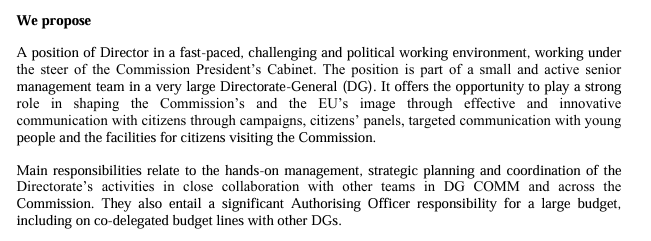
In his new role, Flosdorff will lead “lead the Commission’s citizens communication actions

and the analysis of public opinion,” according to the job advertisement that the commission was legally required to post before handing the sinecure to von der Leyen’s man. This presumably involves the crafting of youth outreach campaigns and commissioning of Eurobarometer polls, but the rest is unclear.

Sophia Eriksson Waterschoot, who currently occupies the role in an acting capacity, “refused to say what the job entailed” when asked by Rapporteur.

An excerpt from the European Commission's 'Director for Citizens Communication' job advert
An excerpt from the European Commission’s ‘Director for Citizens Communication’ job advert

Waterschoot stepped in when previous Director for Citizens Communication Stefan de Keersmaecker was named ‘Director for Political Communication’ late last year. The differences between these two roles are blurred, with both responsible for social media campaigns, both analyzing media and public opinion, and both pushing the commission’s message (one as a ‘rapid response’ outfit, and the other organizing longer-term campaigns).

Both directors lead separate departments within the commission’s ‘Directorate-General for Communication’ (DG-COMM), and together employ around 500 people. DG-COMM has a yearly budget – excluding salaries – of €116 million, and it’s not the only communications department on the commission’s books: most of the commission’s 41 directorates-general have their own in-house spin offices too, which sometimes collaborate with the ‘citizens’ and ‘political’ bureaus of DG-COMM.

If that wasn’t complicated enough, none of these departments write von der Leyen’s speeches. That task falls to her personal speechwriter, Lorenzo Biondi, who announced his retirement on Wednesday.

Biondi is leaving the commission for a job at the Institute of International Affairs, an Italian think tank. But it’s not a straightforward move from the public to the private sector. The Institute of International Affairs’ Europe-focused work is funded almost entirely by the European Commission. There is now just an extra middleman between him and his former employer.

Queen Ursula’s court

Atop this bureaucratic superstructure, von der Leyen has consolidated her power. Her efforts go beyond appointing her loyalists to lucrative lifetime gigs: von der Leyen began the year by appointing 26 commissioners without running the list past the European Parliament first, as well as deliberately withholding budget and internal market strategy documents from member states until hours before publication, making deliberation impossible.

Former European Council President Charles Michel has described her governance as “super authoritarian.” Surrounded by a “tight-knit” and “micromanaged” circle of mostly German advisers, including Flosdorff, von der Leyen has reduced her commissioners to little more than administrators, whose opinions and criticisms rarely make it past her advisers.

Von der Leyen is “obsessed with demonstrating that she’s in charge,” and “is constantly jumping into the middle of the latest crisis, even when it’s outside her remit,” unnamed EU diplomats complained to Bloomberg in May.

Some of the commission chief’s ambitions are grand – she has pushed for the creation of an intelligence agency answering to her office, and backed a Franco-German plan to strip some of chief diplomat Kaja Kallas’ foreign policy powers. Others are more petty. On the day of US President Donald Trump’s inauguration last year, every commissioner under von der Leyen reportedly received strict instructions from Flosdorff: their own communications teams were only allowed to repost von der Leyen’s message to Trump on social media, without adding any comments of their own.

All of this is to illustrate two characteristics of the European Commission under von der Leyen. Firstly, with its jobs for life, its three-dozen communications departments, and its web of interconnected think tanks, it is a bloated organism whose reform would be a generational undertaking.

Secondly, with its unelected president controlling everything from job appointments and social media posts to foreign policy and intelligence gathering, it is an autocracy so at odds with its democratic rhetoric that it requires 43 communications offices to explain away its contradictions to the public.

  •  

Bill Gates Says Epstein “Found My Weak Point”

by The Vigilant Fox, Modernity News: “I never went to the island” Bill Gates says Jeffrey Epstein “found my weak point,” and the weak point was a promise of $100,000,000,000 for global health. “There was never any social thing. I never went to the island. I was never introduced to any women. But I’ve learned […]
  •  
❌