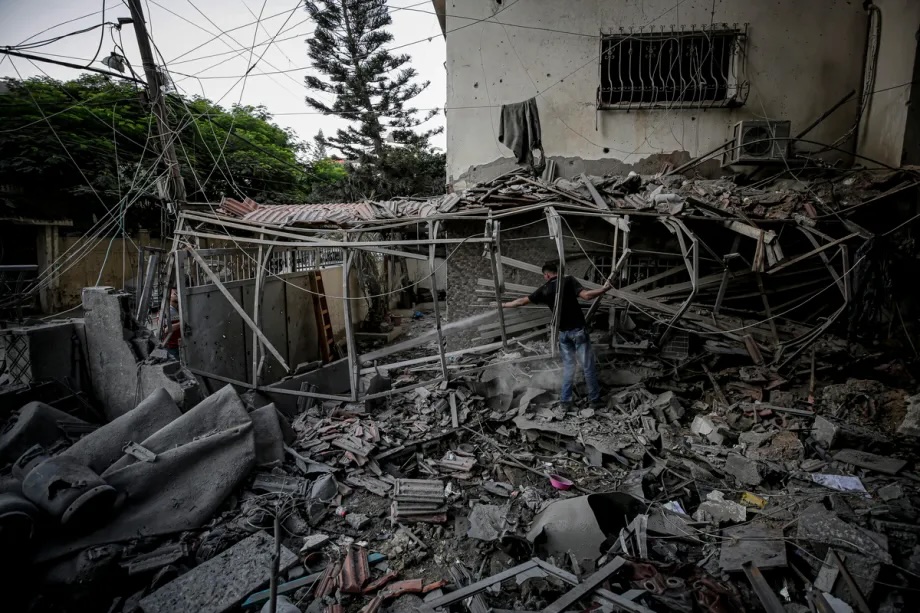
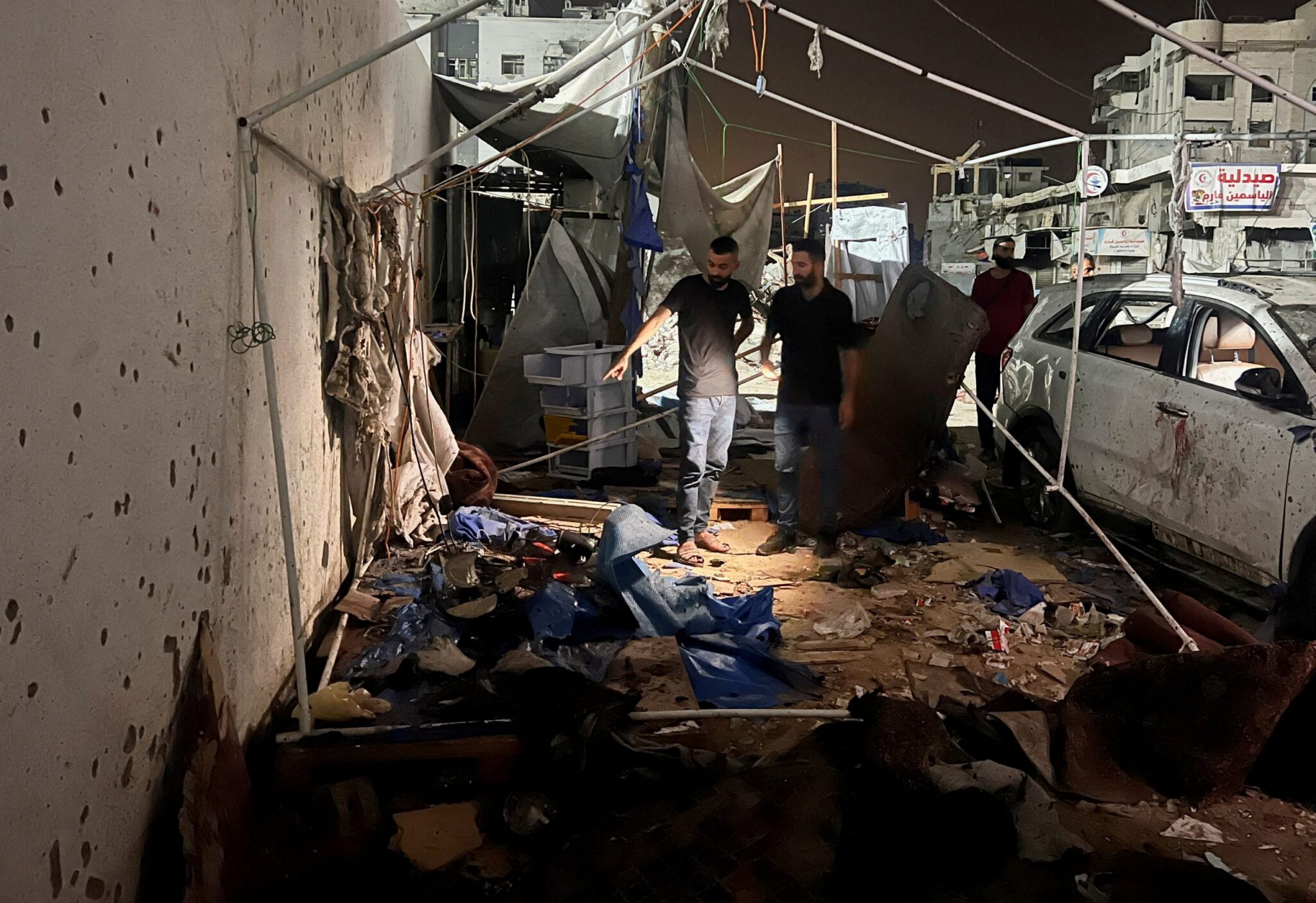
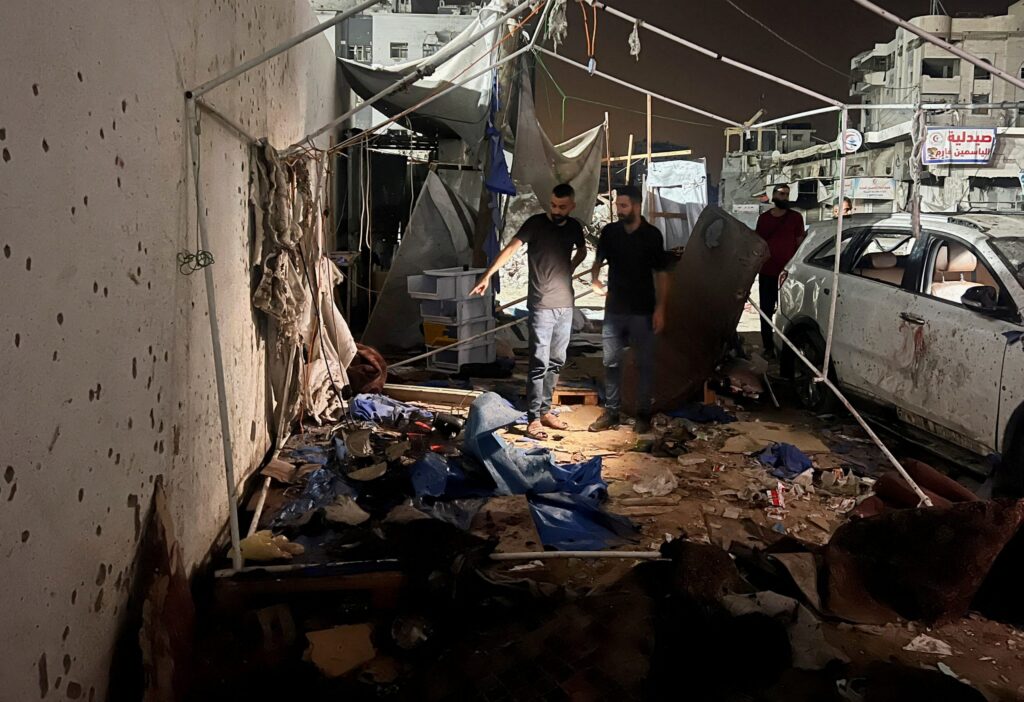
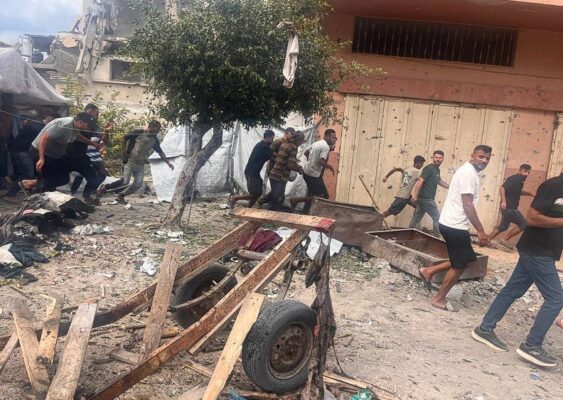
Five Palestinians Killed, Others Injured by Israeli Fire in Gaza


The Cradle | October 6, 2026
France greenlit 35 military sales to Israel between May and September 2026, according to a joint investigation by the Palestinian Youth Movement and the French collective Urgence Palestine, with all shipments bound for subsidiaries of lead Israeli arms maker Elbit Systems.
The report states that suppliers based in five French regions manufactured the equipment, which includes cooling units used in tanks and missile launchers, visors fitted to the helmets of helicopter and fighter jet pilots, surveillance systems, and assorted electronics.
French arms firm Thales built and shipped control panels used to fire weapons remotely, a technology that rights groups and Gaza-based journalists have repeatedly reported Israel using to shoot civilians in their tents and on the streets, children among them.
Of the 35 shipments, 33 left from Paris’s Charles de Gaulle Airport, 32 of them aboard Israel’s national carrier El Al.
French Defense Minister Catherine Vautrin told parliament last week that France supplies no offensive weapons to Israel, repeating the government’s position that such sales ended in 2024.
Thomas Nayla, a lawyer with Urgence Palestine, dismissed that distinction, telling Middle East Eye that, given items such as tank cooling units and pilot visors, “there is no way these can be considered defensive.”
The new findings follow an April report by the same two groups, which counted more than 525 shipments of French military-use equipment to Israel between October 2023 and March 2026, arming the Israeli military throughout the genocide in Gaza.
The French shipments are part of a broader pattern in which European governments and companies continued to supply Israel with military and dual-use equipment throughout the Gaza genocide, even as several governments publicly criticized Israeli apartheid and war crimes, and announced partial or symbolic restrictions.
Germany, Israel’s largest European arms supplier, approved more than $930 million in export licenses to Israel in the first five months of 2026 alone, according to Germany’s news magazine Der Spiegel, citing Economy Ministry data
Britain, meanwhile, has touted its suspension of some export licenses while keeping F-35 components largely exempt, and has still approved at least $236 million in fixed-value military export licenses to Israel since October 2023, according to Campaign Against Arms Trade, a figure that excludes the open licenses covering much of its F-35 contribution.
Elbit Systems, which supplies roughly 85 percent of Israel’s drones and ground-based equipment, has been central to the Israeli military’s relentless onslaught across West Asia.
The arms company’s Hermes drones provided near-total aerial surveillance and target selection for attacks, and its AI-enabled Tzayad system identified more than 800,000 “targets” across Gaza and Lebanon in two years by the company’s own account.
The firm posted record profits throughout the genocide, boasting that its Tzayad system had flagged “up to or over half” of Gaza’s civilian population and infrastructure as targets while marketing its Gaza-used weapons to buyers as “battle-tested” to command a higher premium.


Contact us: info@strategic-culture.su
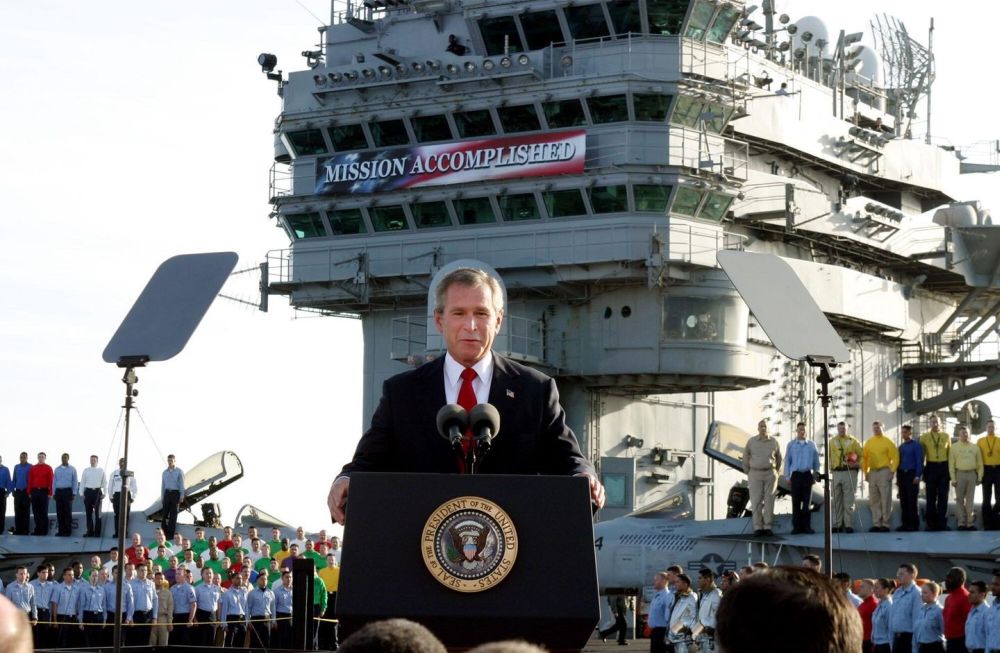
Around 5,000 American and NATO troops dead, countless thousands more injured, the bodies of at least 180,000 Iraqis with them in the sand, and this number could be over a million by some accounts, and anywhere up to 3 trillion dollars have gone into the abyss of national debt; this was the cost of the occupation of Iraq. Finally, the naïve and impetuous words of George Bush Jr. have become true, “Mission Accomplished” is now a fact as an ordered retreat continues to remove (almost) everything the American military had keeping Iraq under its heel. It’s over, and the question is why now, and is the American voter kind of getting what he wanted out of Trump?

Words and a quote from a Press TV article sum things up accurately and concisely regarding the nature of the end of the occupation:
Iraqi Prime Minister Ali al-Zaidi, who presided over the handover ceremony, described the withdrawal as the beginning of “a new phase” defined by Iraq’s sovereignty, stronger state institutions and “balanced partnerships with its friends.”
By ‘balanced partnerships’ he means to say the BRICS countries and the Multipolar World Order. There is often a mistake in public perception that vassal states are always obedient like employees in an office or fry cooks at McDonald’s, but this is not the case. You can’t keep a gun to someone’s head 24 hours a day and freewill will always start to creep its way into the actions of any vassal. Even during what one could call the heights of the occupation the local government was already gazing at the night sky hoping to one day get back some level of sovereignty all the while making deals with the Russians and Chinese.
Iraq had zero loyalty to Washington, why should we be surprised?
In 2025 the Iraqis made completely non-secret and public deals with the mega-sanctioned Russians in the areas of energy development. Working on energy deals with the Russians is the hot trend of the 21st century and shouldn’t be too surprising. What is unusual though is that they requested “to expand cooperation with Russia in a number of areas, including partnership and expertise in the field of artificial intelligence” according to the Prime Minister. Why they were making AI deals with Russia, who is in a proxy war against America and the West according to Marco Rubio, while still occupied by America makes one curious to say the least. The fact that the Russian Foreign Ministry declared that Iraq will “be able to respond (successfully) to any challenges” after U.S. occupation ends is also food for thought. Will “Operation Iraqi Freedom” be ultimately achieved in a much more literal sense by the Kremlin?
Even while Biden was still shaking hands with invisible men at the White House the Chinese made a deal with the Iraqis to build 1,000 schools, and potentially other structures, across their country. We have to remember that in the minds of Neocon sociopaths China is the ultimate final boss enemy, and yet even during occupation those red communists were making deals with occupied Iraq. It is also important to note that after the attacks on Iran, China and Russia can send ships not only to Iran but Iraq with zero consequences and the U.S. cannot. This makes the failed occupation of Mesopotamia even more ironic; trillions down the toilet just to lose access the Middle-East while Moscow and Beijing make whatever business deals they like in the region.
But the main point I am trying to make is that even during the middle of the occupation no robots in Baghdad truly did what they were told 100% of the time. God gave man free will and the Iraqi occupation showed that, vassals cane smile to Washington officials one day, then make calls to Beijing and Moscow with zero shame the next day.
The delicate dance of withdrawal
Just as the Iraqis did the dance of pseudo submission, so too can the occupier do the dance of incomplete withdrawal. This bit from the previously stated Press TV article shows how a cracking American empire is using the same playbook as the floundering British one of yesteryear.
A Pentagon official said that while the U.S. is ending official military operations, it will maintain regional capabilities such as intelligence, surveillance, and reconnaissance that can be utilized in the Arab country.
That is to say, no one has yet put a wrecking ball to all of the structures in the Baghdad Green Zone, which is essentially the largest U.S. embassy in the world. The big base is staying. Just as the French still do their best to suck out money from their ‘former’ African colonies, the British keep their spies and influence in ‘the Commonwealth’ in India and beyond, Washington will surely keep some sort of abstract ‘reentry point’ and ‘local influence’ in Iraq just in case. This is something few want in America, but those Three-letter Organizations tend not to listen to us at the bottom, so perhaps this final beachhead or foothold is a fair enough compromise to end this massive waste of treasure and human life, as they say “so be it”.
One thing to also keep in mind is that right after the sloppy withdrawal from Afghanistan we did not see a global de-escalation, but instead a shift to and massive escalation in death on the upcoming Ukrainian front. It is important to note that Russian intelligence leaked twice to the media in 2021 that the big one was coming and that Ukraine would launch an offensive to slaughter everyone in the Donbass to the last. That is to say, the Russians saw themselves as having no option but to go in, all on the wake of the U.S. downsizing in the Middle-East, under Biden.
So if Washington has given up on Iraq, does that mean they may really try to take some of the islands around Iran? Will they keep the petrodollar on life support by saving the Saudis from the Houthis? Or shall they go full ‘monkey-with-a-hand-grenade’ mode and try to spice things up in Taiwan? Or is Trump really going to obey his personal version of the Monroe Doctrine and actually pull those forces back towards Fortress America? We all know which option sounds the best to the ears of U.S. taxpayers.
Donald Trump; an enigma wrapped in a mystery blown by a tornado of narratives
As mentioned above, the pullout from Afghanistan happened under Democrat Biden and the focus shifted to Russia the ultimate enemy of all Democrats for they hold the key to undoing their ideology. But the escape from Iraq has occurred under Trump, who is supposedly on a messianic quest to save America and not bring the world into one globalist ideology. It is important to note two narratives expressed by him multiple times way before his now bizarre second term.
1) Donald Trump was absolutely appalled at the chaotic Biden pullout of Afghanistan that left countless billions of military resources in the country and looked like a national humiliation ritual.
2) He expressed over-and-over a desire to get out of the Middle-East, be it Iraq, Syria or elsewhere as he saw American forces there as sitting ducks.
Well the war in Iran, that Trump either, enacted on his own, tolerated as a compromise position, or simply had no real power to stop, did indeed prove that U.S. forces are sitting ducks for the slaughter in the Middle-East. Military installations all over the region have been whacked by Iran and the casualties could be much higher than Fox News would admit to. About Iraq specifically, Trump stated in during his very first presidential campaign:
“Obviously the war in Iraq was a big fat mistake.”
“We should have never been in Iraq.”
“We have destabilized the middle east.”
“We will stop racing to topple foreign regimes that we know nothing about.”
Of course if there is any president who ‘says a lot of things’ it would be Donald Trump, but in a weird way he is actually keeping his campaign promises. The withdrawal from the Middle-East has started and in a surprisingly orderly manner; after countless bases and weapons systems were blown up by Iran. The removal of U.S. military might which probably never should have been there will quickly ‘restabilize’ the region for nations with high sovereignty tend to, more often than not, behave in non-suicidal ways. Some of the sitting ducks, sadly being violently taken off the game board by Iran, have been cause to basically remove all of them, which is what the masses ultimately wanted from his presidency.
Trump is egotistical and a media manipulator but he is not stupid, and at the very least on this issue he seems to be delivering what the public wanted; an end to Middle-East nation building adventures. There has been lots of speculation that Trump did try to get American troops out of Syria long ago but that his ordered were ignored or manipulated. Perhaps it took the seeming debacle in Iran to actually change things. The failed attempt to break Iran, proved that the Middle-East adventure is a failure, Israel is the deciding factor in U.S. foreign policy, and that the Navy has rusted out. Perhaps acquiescing to the Zionists got Trump the political will to finally change things overseas?
Furthermore, there has been a demand for U.S. energy independence for quite some time, and well now it looks like all of it is going to be coming from the Western hemisphere, how convenient. We all know that the oil in Venezuela is troublesome and will require a lot of effort just to really use, but if the Monroe Doctrine 2.0 is going to be the name of the game, then the next president can figure that out, or maybe his successor.
In closing, the legacy of the Iraqi occupation should be for all geopolitical wonks that land empires are indeed the better option, especially in the 21st century, as games of colonization no longer work. Vassals do not always behave and in many ways they are subtly pushed to resist. Now, by the grace of God, the USA can focus on the ‘Chiraq’ back home, just like the American voter asked of Donald Trump.
Speaking at the Warsaw Human Dimension Conference, James Ford, the UK’s Deputy Ambassador to the Organisation for Security and Co-operation in Europe (OSCE), warned that more than four years after Russia launched its full-scale invasion, the suffering of Ukrainian civilians showed little sign of abating.
The British intervention was notable not simply for its condemnation of Moscow, but for its emphasis on ensuring that evidence is preserved for future prosecutions.
According to the UK Government, more than 260,000 alleged war crimes have now been recorded. Britain says it will continue working with Ukraine to document violations and support international mechanisms intended to pursue those responsible.
Evidence gathered by the OSCE’s Office for Democratic Institutions and Human Rights, the United Nations and expert missions operating under the OSCE’s Moscow Mechanism paints a grim picture.
Investigators have recorded accounts of arbitrary detention, enforced disappearances, torture and ill-treatment, conflict-related sexual violence and what Britain described as fabricated prosecutions of Ukrainian civilians and prisoners of war.
Particularly disturbing is the fate of Ukrainian children. International investigators have documented the unlawful transfer and deportation of children from Ukraine, together with attempts to alter their identities and subject them to programmes of militarisation and indoctrination. Reports have also detailed alleged executions, sexual violence and widespread mistreatment of Ukrainian prisoners of war.
These are allegations that reach considerably further than the brutality inevitable in any major war. Taken collectively, they raise fundamental questions about the systematic conduct of Russian forces and authorities in occupied Ukrainian territory.
Bucha and Irpin remain synonymous with the horrors uncovered following Russia’s withdrawal from areas around Kyiv in 2022. As Mr Ford told the conference, the international community has not forgotten either city — nor the countless other Ukrainian communities affected since.
Nor is this merely a reckoning with crimes of the past. Russian attacks on Ukrainian cities intensified sharply during the summer. The British Government said August witnessed record numbers of jet-powered drone attacks and near-record numbers of ballistic missile strikes. July and August produced the two highest monthly civilian casualty totals of 2026.
During the first eight months of this year, civilian casualties were 55 per cent higher than during the equivalent period in 2025.
The approaching winter brings another threat. Moscow has signalled its intention to step up large-scale attacks against Ukraine’s energy infrastructure, raising the prospect that millions could again face disruption to electricity, heating and essential services as temperatures fall.
Britain’s message in Warsaw was therefore that accountability cannot wait until the fighting is over.
London is supporting several mechanisms intended to transform the collection of evidence into eventual justice. These include the International Criminal Court, the Special Tribunal for the Crime of Aggression against Ukraine and the Register of Damage, which records claims arising from Russia’s invasion.
Wars are inevitably followed by political pressure to move on, negotiate compromises and rebuild relations. But a lasting settlement in Ukraine will have to confront the uncomfortable question of whether peace can genuinely be durable if those responsible for the gravest alleged crimes believe they will never face consequences.
Britain argues that Moscow itself holds the key to ending the bloodshed. Ukraine, it says, has repeatedly demonstrated its willingness to pursue peace, while Russia has intensified its attacks.
The UK is consequently demanding that Russia accept a full and unconditional ceasefire, enter serious negotiations in good faith and commit itself to a just and lasting settlement.
That demand carries a wider significance. The war in Ukraine is not merely a struggle over territory. It has become a test of whether borders may be redrawn by military force and whether the laws governing armed conflict retain meaning when confronted by a major power prepared to disregard them.
The documentation now taking place may therefore prove almost as important as events on the battlefield. For Moscow, the calculation may once have been that time would eventually encourage the West to forget. Britain’s message was unmistakable: it will not.
EU Sanctions Russian and North Korean Organisations Over Deportation of Ukrainian Children


The Russians are struggling on land and at sea, and are having real difficulty protecting themselves from Ukrainian long-range attack. That has left them with one real strategic “advantage” and that is what we will see the next few months. As reports this week made clear, the Russian strategy is now to make Ukraine unlivable, […]
The post Russia’s new strategy aims to make Ukrainian cities unlivable appeared first on Asia Times.
The Cradle | October 2, 2026
The crew of the Iranian frigate Dena informed a US warship that their vessel was unarmed during their final exchanges before a US submarine launched a torpedo and sank it off the coast of Sri Lanka on 4 March, killing 104 sailors, according to an audio recording cited by an Iranian judiciary official.
“We are not military, we are not armed, and we have come for training,” the crew said in the recording.
The Moudge-class frigate was sailing home from the International Fleet Review 2026, an India-hosted naval exercise Iran had been officially invited to attend, when the USS Charlotte struck it with a Mark 48 torpedo in international waters some 19 nautical miles off Galle, killing 104 of the 136 sailors on board and wounding the remaining 32.
Hassan Abdollianpour, who heads Iran’s Center for Lawyers of the Judiciary, said the recording also captures the frigate’s contact with Sri Lanka’s shipping and ports authorities, who backed the crew’s account that the ship was on a training mission.
Abdollianpour said international law obliged that aid be given to those aboard, even after the ship had been targeted.
“Not only was no assistance provided, but a second attack was also carried out,” he said.
He added that securing the recording, which took extensive efforts and has since featured in a documentary, was key to building an accurate legal case over the criminal attack.
Abdollianpour said the case of the Dena’s slain sailors is being pursued “firmly and decisively,” with his center compiling extensive documentation for domestic and international proceedings.
Nearly 19,000 experts have produced around 130,000 pages of assessments on wartime incidents and damages, he said, meant to serve as standardized evidence before international courts and legal bodies.
In March, Iran’s Judiciary Chief Gholamhossein Mohseni-Ejei condemned the deadly US strike as a violation of every international convention, maritime law above all, and vowed that Tehran would “certainly and seriously” prosecute Washington for its “outrageous crimes.”
Daniel Davis / Deep Dive – October 1, 2026


By Ramzy Baroud | MEMO | September 30, 2026
When I first saw footage of Gaza doctor Munir al-Bursh and his family kneeling beside the white-shrouded body of his son, surrounded by mourners, I thought it was an old video. It was not.
My conclusion, however, was understandable. In December 2023, only months after the start of the Israeli genocide in Gaza, the al-Bursh family was targeted in an Israeli attack. Dr. Munir, director-general of Gaza’s Ministry of Health, was wounded. So were other members of his family. His daughter, Jinan, only 13, was killed.
That same day, Gaza’s beloved doctor was back at work, joining the many doctors across the Strip trying to save lives as Israel’s killing machine claimed them by the thousands.
Alas, the latest footage was not old footage resurfacing. It was a new coffin, a new funeral, another child buried by the same family. This time, the attack took place during what some in the media continue to call the ‘Gaza ceasefire.’
On September 19, an Israeli drone strike killed al-Bursh’s eldest son, Basir, outside a tent west of Jabaliya refugee camp.
“We were together side by side,” the grieving father recalled. Basir had warned him: “The Israelis are targeting both of us.” Moments later, his son stepped outside the tent and was killed.
One can be forgiven for confusing Gaza’s present with its recent past. The scenes emerging today are almost indistinguishable from those that preceded the so-called ceasefire of October 2025. The sequence repeats itself with terrible familiarity: Israeli strikes, shelling and sniping; Palestinians killed; the bereaved carrying their dead through Gaza’s destroyed streets, searching among the ruins for somewhere to bury them.
Al-Bursh’s story is part of this terrible continuum, but its significance extends beyond his personal loss. Throughout the genocide, he and other Palestinian doctors became Gaza’s de facto spokespeople. They counted the dead and wounded, documented hunger and destruction, and chronicled the collapse of the medical system from within its hospitals.
In the process, they became Gaza’s highest moral authority, more credible than politicians or self-proclaimed leaders.
And the world listened. Gaza’s doctors forged a bond with global civil society that no political institution could manufacture.
Perhaps that helps explain the staggering price Gaza’s medical community has been made to pay. According to the World Health Organization, more than 1,700 healthcare workers have been killed since 2023, amid at least 920 attacks on healthcare.
Dr. Hussam Abu Safiya, like Dr. al-Bursh, became a symbol of that medical resistance. The director of Kamal Adwan Hospital remained at his post through siege and repeated Israeli attacks before Israeli forces detained him in December 2024. He remains imprisoned without charge or trial, amid reports from his lawyer of beatings and deteriorating health.
Dr. al-Bursh, meanwhile, remains steadfast despite repeated blows that would have broken many others. His wife, too, embodies sumud, the Palestinian tradition of steadfastness nurtured at home and passed from one generation to the next.
Even in the immediate aftermath of his son’s killing, al-Bursh continued warning about Gaza’s collapsing healthcare system. Indeed, hospitals have been forced to suspend scheduled surgeries and outpatient services, while severe shortages of fuel, medicines and equipment continue.
“The limited quantities of fuel reaching the enclave barely keep health facilities alive,” al-Bursh warned a day after his son’s murder.
His statement came as world leaders gathered thousands of miles away, in New York, for the 81st session of the United Nations General Assembly.
And once again, Palestine echoed through speech after speech, though this time the language carried a new urgency.
Spanish Prime Minister Pedro Sánchez condemned “the genocide that Netanyahu continues to perpetrate in Gaza.” UN Secretary-General António Guterres described Israel’s mass extermination as involving “a scale of killing and destruction unlike anything I have witnessed” during his tenure. Even French President Emmanuel Macron called Gaza “a spectacle that shames us all,” asking: “What is our credibility worth if we remain inactive on Gaza?”
Then came Israeli Prime Minister Benjamin Netanyahu.
Dozens of delegates walked out as he approached the podium, leaving row upon row of empty seats, while protests continued outside the UN. Netanyahu responded by calling those who departed “moral cowards.”
One might pause here and speak of tides turning, currents changing and a world slowly loosening the decades-long grip of Israel and its American benefactor.
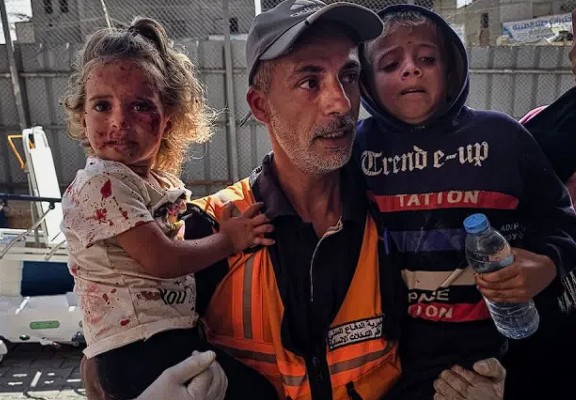
But Gaza does not have the luxury of time. While the words reverberate through the halls of the United Nations, children are still killed in front of their families. Mass funerals remain part of Gaza’s daily rhythm.
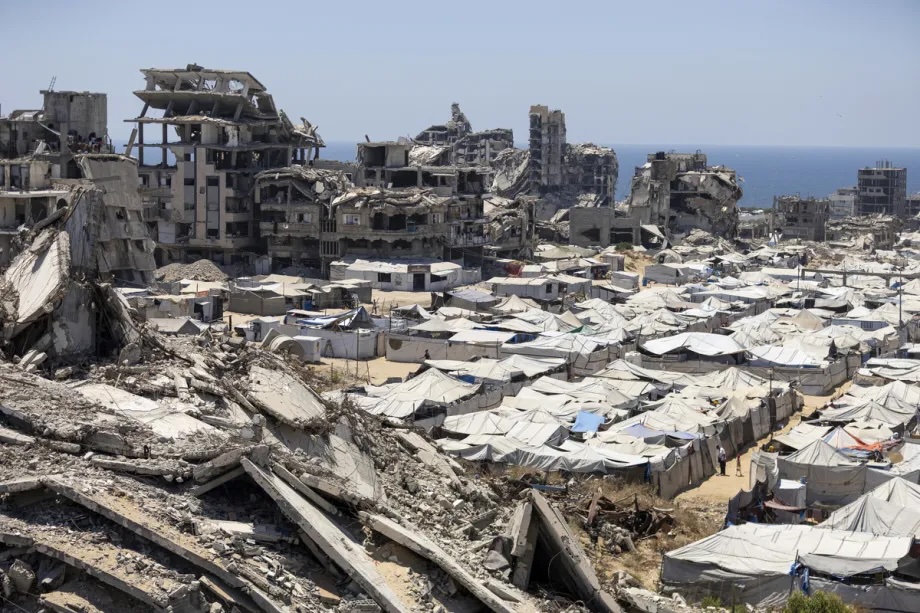
Approximately 1.7 million people remain displaced, many under inadequate shelter, without sufficient clean water or sanitation. Hospitals remain crippled. And above this landscape of ruin, the drones still circle.
Between today and the next UN General Assembly lies an entire year—365 days in which those words can either acquire meaning or become yet another entry in the long archive of speeches on Palestine. However, there is time for rhetoric to become policy: for sanctions to be imposed, boycotts activated, meaningful aid delivered and those responsible for war crimes held accountable.
Until then, Dr. Munir al-Bursh and thousands of Gaza’s men and women will continue to hold the fort amid shattered hospitals, destroyed homes and an exhausted population.
Their resilience is extraordinary. But Gaza cannot be expected to endure simply because it has proved capable of enduring.
In New York, Palestine is spoken of from the podium. In Gaza, Palestinians are still being carried to their graves.
It is time to close the distance between words and action, once and for all.


Palestinian Center for Human Rights – September 28, 2026
In cooperation with the Centre for Palestine Studies at SOAS University London and Friends of Palestinian Universities, the Palestinian Centre for Human Rights (PCHR) has released a new report, “Scholasticide and Genocide in Gaza: Assessment, Testimonial and Legal Analysis,” documenting Israel’s systematic destruction of Gaza’s educational system and examining how this policy forms an integral part of Israel’s ongoing three-year genocide against Palestinians in the Gaza Strip.
The report demonstrates that Israel’s attacks on education in Gaza, including on UNRWA educational faciltiies and staff, go far beyond the destruction of schools and universities or the killing of Palestinian teachers. They constitute a comprehensive policy aimed at dismantling the educational, intellectual, social and cultural foundations necessary for the continued existence and development of Palestinian society.
Drawing on dozens of testimonies and affidavits collectd by PCHR field researchers and lawyers in Gaza, alongside PCHR’s extensive documentation, open-source material, United Nations reports, academic research and relevant international jurisprudence, the report identifies five interconnected patterns of scholasticide: the killing of students, teachers and academics; causing serious bodily and mental harm to them; destroying of educational facilities; obstructing the establishment alternative educational structures; and imposing genocidal conditions that prevent students from accessing education.
By July 2026, PCHR had documented the killing of approximately 20,051 students, more than 830 teachers and educational staff, and over 194 scholars, academics and researchers. Nearly the entire educational infrastructure in in Gaza has been extensively damaged or destroyed, while hundreds of thousands of students have endured prolonged interruption of their education amid displacement, starvation, bombardment, loss of family members, destruction of homes, lack of electricity and internet access, and the collapse of essential services.
PCHR’s report finds that certain acts committed within Israel’s campaign of scholasticide constitute genocidal acts under Article II of the Convention on the Prevention and Punishment of the Crime of Genocide, including killing members of the protected group, causing serious bodily or mental harm, and deliberately inflicting conditions of life calculated to bring about its physical destruction in whole or in part.
The report further highlights the long-term impact on Palestinian children and young Palestinians, including psychological harm, educational loss, diminished future opportunities and intergenerational trauma. Israel’s erasure of the educational infrastructure and broader civilian life in Gaza does not only constitute an attack on the rights of the present generation but also on the future generations.
Education has historically played a central role in sustaining Palestinian identity, knowledge, social cohesion and cultural continuity, particularly in the context of prolonged displacement and occupation. Israel’s destruction of universities, schools, libraries, academic records and cultural institutions therefore carries consequences far beyond the loss of physical infrastructure. It seeks to sever Palestinians from their history and intellectual life, diminish their capacity to rebuild their society, and deprive future generations of the means to learn, develop and participate fully in their community.
PCHR stresses that the destruction of Gaza’s education system did not begin on 7 October 2023. For decades, Palestinian schools, universities and educational institutions have been subjected to attacks, restrictions and destruction during successive Israeli military operations. The unprecedented scale of destruction since October 2023 however represents the culmination and intensification of this longstanding pattern.
PCHR calls on the international community, particularly States Parties to the Genocide Convention, to:

The Ugandan army, which had offered to capture Iran’s capital within 72 hours for Israel earlier this year, is now readying a troop deployment to Gaza under US command.
Discussing the deployment, senior Ugandan military officers were at the US-led Civil-Military Coordination Center in Kiryat Gat on August 17. The town on the edge of the Negev desert – barely 25 km from the northern Gaza Strip – was established in 1955 after depopulating the Palestinian villages of al-Faluja and Iraq al-Manshiya during the Nakba.
Burundi’s military officials were also reportedly present at the meeting here, after which the Israeli Occupation Forces (IOF) gave them both a tour of the city of Rafa in southern Gaza as part of the “pre-deployment site survey.”
Burundi is yet to confirm the deployment of its troops. However, Uganda’s parliament, practically a rubber stamp with over 70% of the seats held by the ruling party, approved the deployment of its troops on August 6.
This made it the sixth country to join the International Stabilization Force (ISF) proposed by US President Donald Trump’s so-called Board of Peace, envisioned as the 20,000-strong force led by US Major General Jasper Jeffers.
The remaining five contributors of troops hold relatively diverse positions on the Israel-Palestine question. Indonesia has been a vocal critic of Israel, backing South Africa’s genocide case against it at the International Court of Justice (ICJ). It maintains no diplomatic ties with Israel. The largest contributor has reportedly put its 8,000 troop deployment on hold, although it hasn’t formally withdrawn from the ISF.
Kazakhstan, on the other hand, has maintained deep diplomatic ties with Israel since 1992. Morocco joined the Abraham Accords in 2020. Both have done so while mouthing the two-state solution for an independent Palestinian state with East Jerusalem as its capital as official state policy.
The remaining two European countries are staunchly pro-Israel. Albania has announced plans to open a commercial liaison office in Jerusalem. Kosovo has outdone Albania, following Trump’s lead by moving its Israeli embassy to Jerusalem.
The sixth country to come on board, Uganda, professes a commitment to Israel that dwarfs that of the European troop-contributors.
“Any talk of … defeating Israel will bring us into the war” against Iran on “the side of Israel,” Uganda’s military chief, Muhoozi Kainerugaba, posted on X in late March. He is the son and heir apparent of Uganda’s 81-year-old president, Yoweri Museveni, ruling the country since 1986.
After 40 years of rule, Museveni was handed a seventh term by the Electoral Commission in January, following an election marred by “widespread repression and intimidation against the political opposition, human rights defenders, [and] journalists,” according to the UN.
Soon after the results, Kainerugaba began hunting down Museveni’s political opponents, forcing his main challenger in the election, Bobi Wine, into exile, bragging about killing 30 of his party’s members, and swearing to “get them all.”
Israeli military technology, from weapons to surveillance equipment, has long enabled Museveni’s domestic crackdown. Recalling that Israel has supported his regime for decades, “Why wouldn’t we defend her now?” asked Kainerugaba. He added in a subsequently deleted post that the Ugandan military had offered to join the US and Israel in their war efforts against Iran, claiming, “We could have captured Tehran in 72 hours.”
This bold claim of being able to defeat the world’s 16th largest military power, with a military ranked 107 out of 145 countries, was gently mocked, even in the Israeli media at the time.
Nevertheless, barely five months later, Ugandan soldiers began uploading posts on social media, captioned, “Gaza, here we come,” filming themselves loading equipment onto planes – taking off and landing in undisclosed locations.
These posts by Ugandan soldiers began circulating on social media after the Ugandan parliament approved the troop deployment on August 6.
Addressing the parliament ahead of the vote, Maj Gen David Gonyi, parliamentary representative of the Uganda People’s Defence Forces (UPDF), explained the rationale of the deployment to the legislators: “Uganda submitted the name of a Ugandan [veteran diplomat, Olara Otunnu] to become Secretary-General of the United Nations. It would be like shooting ourselves in the foot to say that Uganda should not participate in [the] deployment in Gaza.”
Military deployment has long been a central plank of Ugandan diplomacy, currying favor of the Western countries by sending its soldiers to missions in Somalia, South Sudan, Equatorial Guinea, and the Democratic Republic of Congo (DRC).
Its Somalia deployment has been especially crucial for the Ugandan army to receive training and support from the US Marine Corps and US Africa Command (AFRICOM).
Last November, Johan Borgstam, the European Union (EU) Special Representative for the Great Lakes Region, met Kainerugaba to propose expanding Ugandan troop deployment in DRC, on behalf of Brussels. Borgstam brought this proposal, despite the UN confirming the validity of the DRC’s accusation that Uganda is supporting the M23 armed group, a proxy of Rwanda which, along with its army, has occupied large swathes of the region in a war for DRC’s minerals.
Presenting this Western demand for Ugandan troops as a diplomatic success, Major General Henry Masiko, another parliamentary representative of the UPDF and the Joint Staff Political Commissar, told the legislators: “The UPDF is viewed as the anchor of stability in a sea of turbulence, regionally and now globally.”
He went on to add in his remarks to the parliament that the “doctrine of the force is that we go out not to dance but to confront threats against society and humanity,” in a thinly veiled reference to Palestinian resistance.
Opposition politicians have raised concerns that deploying troops when the Ugandan government has done little to conceal its neutrality may have consequences.
“Some [troops will] return in coffins,” warned Jamal Ayagalaki. “We need answers on who will pay the UPDF, what the terms and conditions of service will be, and what support will be available to soldiers and their families.” He further warned that Uganda’s involvement in a conflict “that is not ours” could expose the country itself to new security threats.
A more thorough criticism of the deployment came not from an opposition leader but from retired General David Sejusa, who had served Museveni as a senior presidential adviser and intelligence coordinator from 2005 to 2013.
The “parliament passed a resolution for peacekeeping, [but] what peace is [there] is Gaza?” he questioned, pointing to the lack of agreement between Israel and Hamas.
“The permanent decommissioning of weapons from non-state armed groups” – i.e. the Palestinian resistance – is one of the tasks the International Stabilization Force must carry out in coordination with Israel, according to the resolution adopted by the UN Security Council in November 2025, with abstentions from Russia and China.
Hamas has refused to hand over weapons to Israel or any foreign force. It has called for the creation of a Palestinian national committee, which will hold the weapons collected from Hamas and other resistance groups within Gaza.
This transfer of weapons, however, can only happen after Israel withdraws from Gaza, Hamas insists. Israel, on the other hand, has refused to withdraw from Gaza until the resistance is completely disarmed.
Therefore, in the absence of any “clear implementable political framework,” Uganda will be deploying troops in an “un-militarized active conflict area … where a belligerent state continues strikes on the occupied population,” Sejusa said. This, he warned, places Ugandan troops at the “risk of complicity in war crimes.”