❌

Reading view

Ukraine’s Frodo robot carries wounded soldier in first reported evacuation

frodo robot

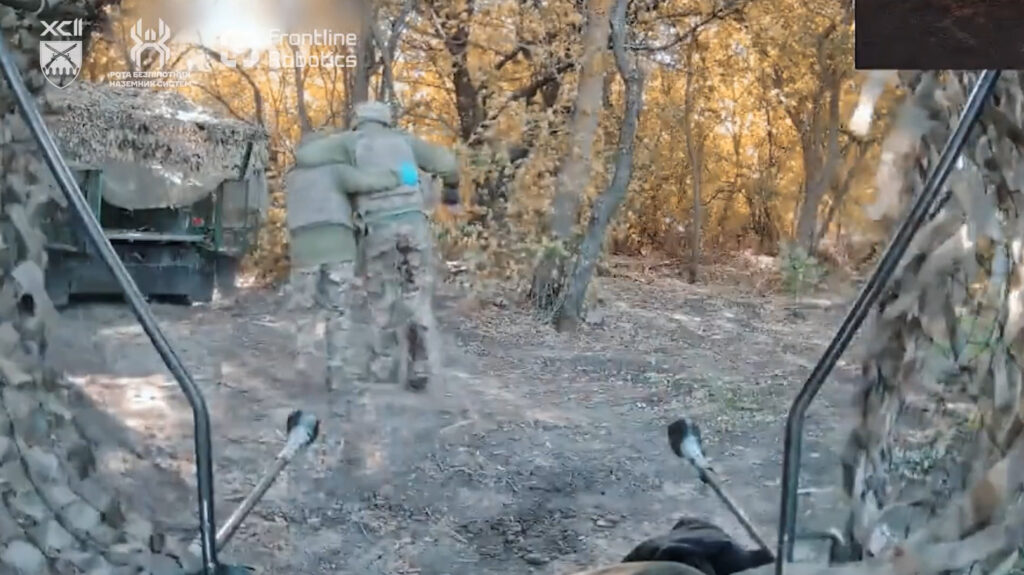
A company of unmanned ground systems from Ukraine's 92nd Assault Brigade used the robotic system Frodo to evacuate a wounded soldier, Frontline Robotics told Militarnyi on 7 October.

Ground robots are being used to evacuate wounded soldiers from the drone-dominated "kill zone," a band tens of kilometers deep on both sides of the front line. About 112,000 logistics and evacuation missions by ground robotic systems were recorded from January through August 2026, according to Ukraine's Defense Ministry.

Operator credits speed and suspension

The operator, callsign Tango, named speed and the ability to perform complex maneuvers as the robot's main advantages, according to Militarnyi. The unit also praised Frodo's adaptive suspension, which it said smoothed out rough terrain and kept the wounded soldier's transport relatively comfortable.

The Frodo ground robot during an evacuation mission with Ukraine's 92nd Assault Brigade
The Frodo ground robot's evacuation mission with Ukraine's 92nd Assault Brigade, autumn 2026. Screenshot from video: Frontline Robotics

What Frodo can carry, and how far

The robot has a 6×6 wheel layout with independent suspension, adjustable ground clearance of 170–330 mm, and a top speed of 40 km/h. Its recommended payload is 200 kg, and its maximum is 400 kg, according to Frontline Robotics. The company lists its range as 150 km on asphalt and up to 90 km over rough terrain with the recommended load. Frodo supports several communication channels, and one person can swap its batteries in about two minutes.

Frodo had passed the Defense Ministry's codification and could carry remote-controlled modules such as the Burya turret, Militarnyi reported on 30 September.

The 92nd Brigade had used ground robots to evacuate wounded soldiers before. In September 2025, the brigade evacuated three wounded soldiers using a ground robot, according to Militarnyi.

  •  

Russia’s jet drones fly near 600 km/h now. Ukraine is building simulators for the 900 km/h ones it expects next

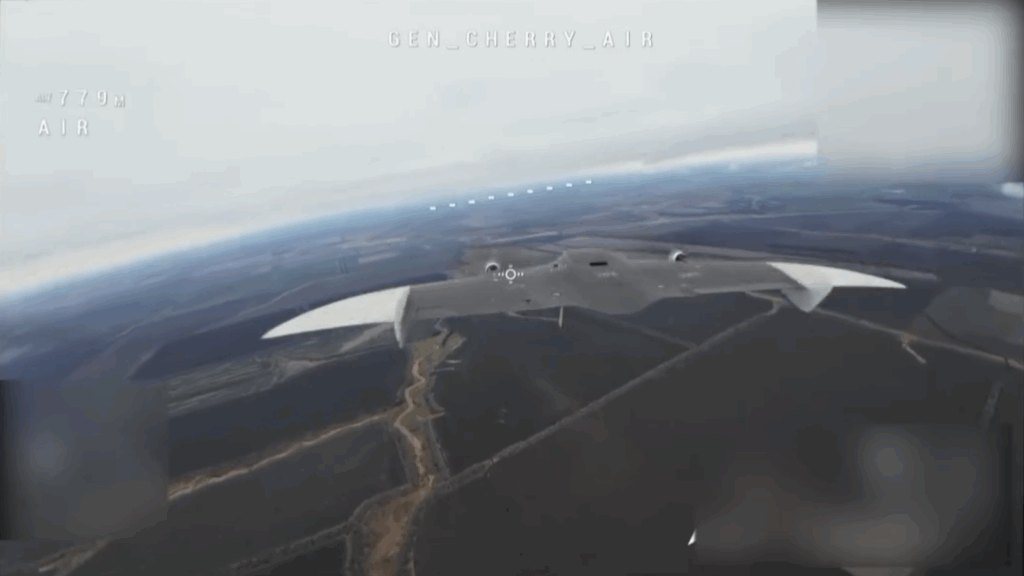
Russian "Knyaz Veshchiy Oleg" reconnaissance drone as seen from a Ukrainian "General Cherry AIR" interceptor drone, just before strike. Screenshot from video: General Cherry

Russia's jet-powered attack drones could eventually reach 800–900 km/h, and intercepting them will demand new piloting skills—so Ukraine has asked the makers of its interceptor drones to build simulators to train the crews, a senior Air Force officer told a parliamentary commission on 6 October, Suspilne reported.

Russia keeps modifying its jet Shaheds faster than Ukraine can field the drones meant to catch them, and Kyiv is now preparing crews for speeds its interceptors have never faced—a sign the air war is shifting from a contest of volume to one of raw speed.

The speed Russia hasn't reached yet

Colonel Yurii Cherevashenko, deputy commander of Ukraine's Air Force, told the commission that Russia's jet drones fly at around 600 km/h today but could eventually reach 800–900 km/h—speeds he said have not been recorded so far. That range sits near the cruising speed of a commercial airliner.

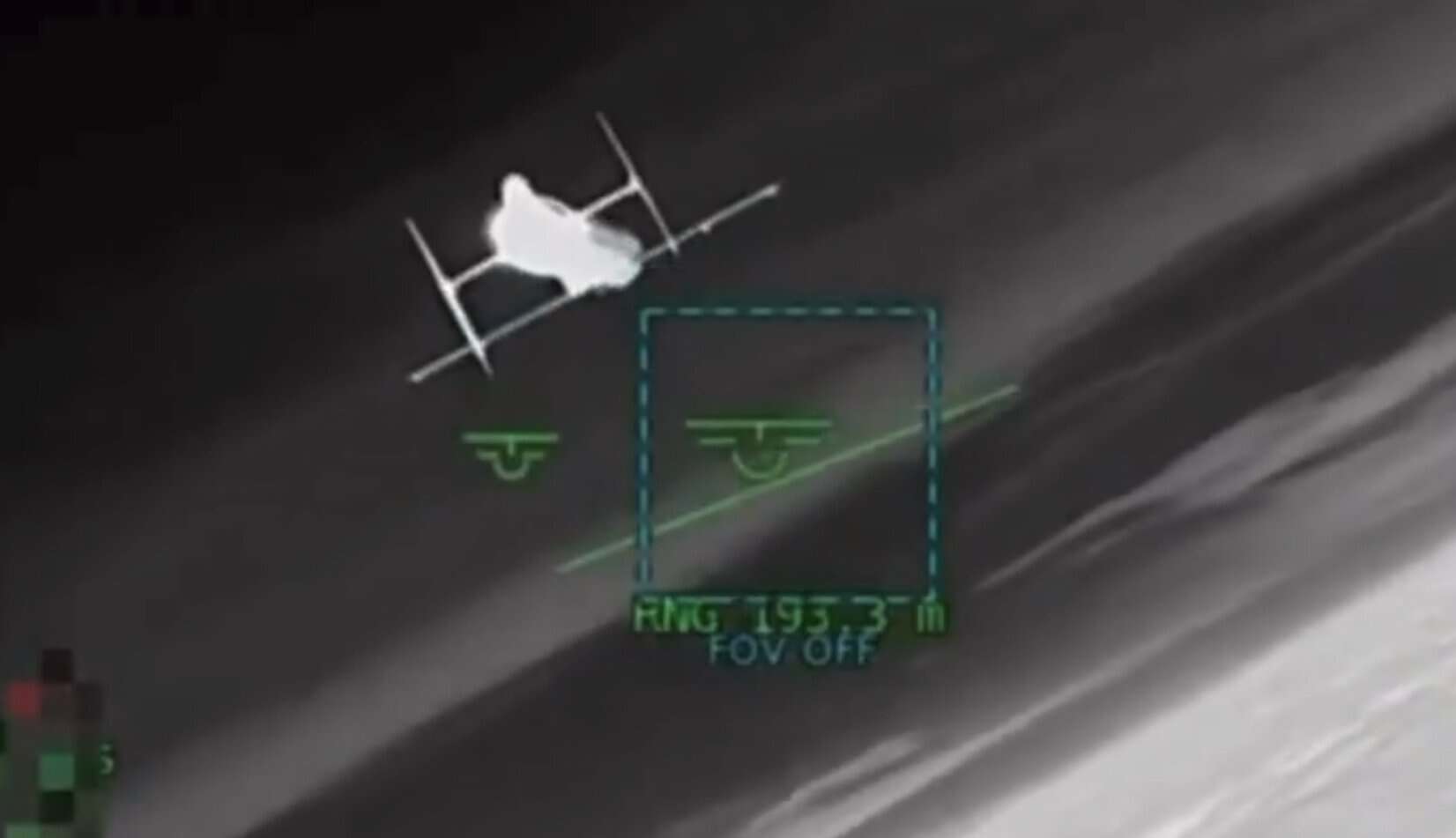
A Ukrainian interceptor drone chases a Russian Geran-5 jet-powered drone. September 2026.
Explore further

Ukraine just caught a Geran-5 at 425 km/h—the jet drone that has often outrun Ukrainian interceptor drones since January

Intercepting such targets will take specific piloting skills, Cherevashenko said. When an interceptor and its target move at roughly the same speed, he noted, the pilot barely perceives the difference in their speeds. To train for that, Ukrainian interceptor-drone makers have been tasked with building simulators where crews can practice against high-speed targets.

Where Ukraine stands now

Ukraine already downs 85% to 90% of Russia's slower, propeller-driven drones, Ukrainian President Volodymyr Zelenskyy has said, but the jet models remain a tougher problem—Ukrainian interceptors scored their reportedly first kill of a jet-powered Shahed in November 2025. In a 28 September evening address, Zelenskyy put the jet-drone interception rate at about 57%, lower than required. Days later, he said Ukraine is testing five interceptor-drone models and could be producing about 400 of one of them by the end of October. Asked when jet-drone interceptors would arrive at the scale needed, Cherevashenko answered: "Not before the end of November."

  •  

Ukraine’s drone pilots hit 76.5% more Russian infantry than two months ago: 2,699 in first five days of October

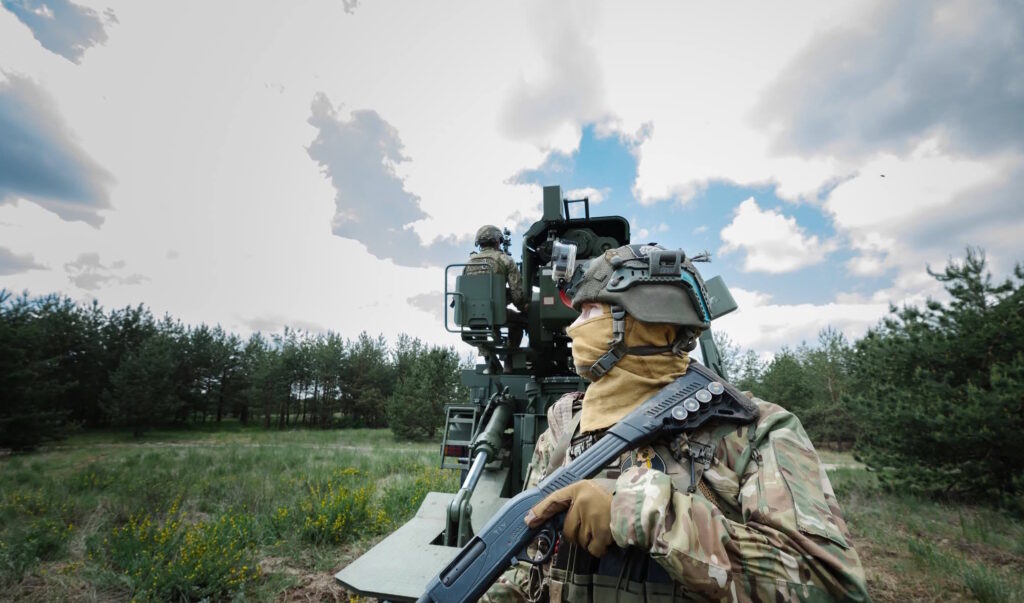
The image shows Ukrainian soldiers. Source: The 80th Separate Air Assault Halytska Brigade

Ukraine's drone pilots are killing and wounding far more Russian infantry than they did a month ago. Ukraine's Unmanned Systems Forces confirmed that their pilots took out 2,699 Russian infantry from 1 to 5 October, 39.7% more than in the first five days of September, Commander Robert "Madiar" Brovdi wrote on Telegram on 6 October.

The Unmanned Systems Forces, the branch of Ukraine's military that fights with drones, count only losses verified by their own pilots in the military's Delta system, so the full picture of Russian losses is larger, Brovdi stressed. Compared with the first five days of August, the rise is 76.5%, from 1,529 losses, which he ties to denser and more frequent Russian assaults.

The sharpest growth occurred in the area of the 1st Azov Corps of Ukraine's National Guard on the Dobropillia-Pokrovsk axis in Donetsk Oblast, as fighting for fortress-belt cities continues. Drone pilots recorded 1,268 Russian losses there, 43% more than the 884 of early September and 91% more than the 664 of early August.

"Russia's hidden mobilization is in action. This is the beginning," Brovdi said ironically.

Russia doubles its monthly recruitment pace

Russian recruitment, mobilization, and contracts run at about 70,000 people a month, twice the 35,000 monthly average from January to August 2026, Brovdi noted on 16 September, when he forecast 12,500 losses for his pilots in September.

He expected the toll to keep climbing. Bigger records still lie ahead because of Russia's unannounced mobilization, Brovdi added on 24 September.

Drone pilots outpaced August by a quarter

September was completed above that forecast. The pilots logged 13,358 Russians killed or wounded, 25.35% more than the 11,010 of August, an average of 445 a day against 355, Brovdi reported. By his count, that equals the full assault infantry of one battalion every day, and his pilots hit a Russian target every 42 seconds.

Two sets of axes took the heaviest toll. In the first 24 days of September, the Dobropillia and Pokrovsk axes accounted for 4,018 losses, and the Oleksandrivka and Huliaipole axes for 3,021, according to Brovdi. The first of those groups covers the same Dobropillia-Pokrovsk axis where the Azov corps zone recorded the sharpest October rise.

  •  

Russia’s new strategy aims to make Ukrainian cities unlivable

The Russians are struggling on land and at sea, and are having real difficulty protecting themselves from Ukrainian long-range attack. That has left them with one real strategic “advantage” and that is what we will see the next few months. As reports this week made clear, the Russian strategy is now to make Ukraine unlivable, […]

The post Russia’s new strategy aims to make Ukrainian cities unlivable appeared first on Asia Times.

  •  

Latvia Votes as Russian Drone Threat and Ukraine War Shape Parliamentary Election

Latvians are voting for a new parliament on Saturday after an election campaign dominated by security, repeated drone incidents, support for Ukraine and mounting pressure on household finances.

Latvians went to the polls on Saturday, 3 October, to elect the country’s 100-seat Saeima in an election taking place against an unusually tense security backdrop on NATO’s eastern frontier.

Fourteen parties and electoral alliances are contesting the election, with 1,428 candidates seeking seats in parliament, according to Latvia’s Central Election Commission. Voting takes place across five constituencies — Riga, Vidzeme, Latgale, Kurzeme and Zemgale — with polling stations open until 20:00 local time.

Security has occupied a prominent place in the campaign after a series of drone incidents brought the consequences of Russia’s war against Ukraine directly into Latvian airspace.

Prime Minister Andris Kulbergs, who took office in May after the previous coalition collapsed during a political crisis over the handling of drone incursions, is seeking a new mandate for his centrist United List. EU Today reported at the time that Prime Minister Evika Siliņa resigned after her coalition fractured amid criticism of Latvia’s response to repeated unmanned aircraft incidents along the Russian border. The collapse followed a succession of drone-related security incidents.

Kulbergs has campaigned on continued support for Ukraine and stronger Latvian defences, including additional counter-drone capabilities. His party entered election day ahead in the opinion polls, although the fragmented political landscape means coalition negotiations are likely to determine the eventual composition of the government.

An SKDS poll conducted between 4 and 16 September put United List on 14.4 per cent. Sovereign Power/Alliance of Young Latvians followed on 9.4 per cent, while Latvia First stood on 9.2 per cent. The Progressives recorded 6.2 per cent and the National Alliance 5.6 per cent. When only voters who had decided how they intended to vote were counted, seven political forces were projected to cross the 5 per cent threshold for representation in parliament.

The survey also showed a substantial pool of undecided or disengaged voters shortly before polling day, leaving considerable uncertainty around the final distribution of seats.

Russia and the war in neighbouring Ukraine have also produced sharper divisions between the competing parties.

Kulbergs has maintained Latvia’s strong support for Kyiv, while Sovereign Power has opposed military assistance to Ukraine and called for greater emphasis on negotiations. Latvia First has also sought votes among parts of the country’s Russian-speaking population, particularly in eastern Latvia, where questions surrounding language policy, relations with Moscow and the economic consequences of the war remain politically sensitive.

Latvia’s geographical position gives those arguments a significance extending beyond domestic politics. The country shares a border with Russia and Belarus and hosts allied troops as part of NATO’s reinforced eastern presence.

Earlier this year, drones crossed into Latvia from Russian territory, including incidents that exposed weaknesses in detecting and intercepting relatively small unmanned aircraft. EU Today reported in March that Latvia’s defence minister cut short a visit to Kyiv after another drone crossed the border from Russia. Further incidents followed in May.

Latvian intelligence has meanwhile warned about the changing nature of Moscow’s approach towards the country. In January, the Constitution Protection Bureau said Russia’s perception of Latvia was becoming increasingly similar to its view of Ukraine before the full-scale invasion, while stressing that it did not assess Russia as posing an immediate direct military threat at that stage. The warning was examined by EU Today earlier this year.

Riga has responded with one of NATO’s highest levels of defence expenditure.

Latvia’s Ministry of Defence says the country will spend about €2.16 billion on defence in 2026, equivalent to approximately 4.7 per cent of GDP under its updated calculation, as it moves towards a target of 5 per cent. Priorities include strengthening the armed forces, developing military infrastructure and improving defences along the eastern border. The Latvian defence ministry’s budget programme places additional emphasis on domestic defence production and military innovation.

Security is not the only issue facing voters. The cost of living, pensions, public services and regional economic disparities have also featured heavily during the campaign, particularly outside Riga.

The security debate, however, has given this election a wider European dimension. Latvia’s next government will take office while Russia’s war against Ukraine continues immediately beyond NATO’s eastern frontier and while the Baltic states are investing heavily in air defence, border protection and military readiness.

The official result will determine the composition of the 15th Saeima for the next four years. With several parties competing around the parliamentary threshold and no single force close to a majority, the subsequent coalition negotiations are likely to be almost as consequential as Saturday’s vote itself.

  •  

Trump’s bid to stop Ukraine’s Russia strikes a strategic disconnect

In a recent phone call, Donald Trump urged Volodymyr Zelensky to stop Ukrainian attacks on Russian oil refineries. Whether a request or a demand, this appears, certainly at first glance, fundamentally different from the Biden administration’s policy of restricting the use of US long-range missiles to hit targets inside Russia. The US president has justified […]

The post Trump’s bid to stop Ukraine’s Russia strikes a strategic disconnect appeared first on Asia Times.

  •  

Drones could expand North Korea’s gray zone options

If the wars of 2026 have demonstrated anything, it is that drones have become a key element of modern warfare. In Eastern Europe, both Moscow and Kyiv deploy drones at an unprecedented scale across the theater’s so-called “kill zone.” For Ukraine, unmanned aerial vehicles (UAVs) have shown incredible tactical value, allowing its forces to strike […]

The post Drones could expand North Korea’s gray zone options appeared first on Asia Times.

  •  
❌