❌

Reading view

British chemical warfare commentator’s MI6 ties exposed in leaked emails

By Kit KLARENBERG

Join us on Telegram, X, and VK.

Contact us: info@strategic-culture.su

Private messages show show Hamish De Bretton-Gordon, a top British pundit on the Salisbury poisoning incident, was a close associate of the MI6 officer who handled the Russian intelligence defector at the center of the scandal — and reaped considerable benefits from his proximity to the case.

This September, a former British Army officer named Hamish De Bretton-Gordon filed a column with the UK Telegraph complaining that “Russian bots” had “tried to make out that I’m part of a security service conspiracy.” Having shot to prominence as a media commentator on chemical and biological weapons after the alleged poisoning of turncoat Russian spy Sergei Skripal, De Bretton-Gordon dismissed accusations that he collaborated with UK intelligence as the product of the “Kremlin’s malign tactics.”

Despite his fervent denials, leaked emails reviewed by The Grayzone indicate that De Bretton-Gordon has spent years privately coordinating his public statements with senior British military and intelligence figures. The correspondences show him training operatives in Turkey and instructing Israeli military figures on Syria’s still-elusive stockpile of chemical weapons, “and a bit of Novichok,” referring to the Russian toxin supposedly used to poison Skripal.

They also suggest he stood to profit personally from exaggerating the threat posed by Russia. In the emails, De Bretton-Gordon described his day job as “flogging gas masks” to British military and law enforcement. He seemingly grew his firm’s business with outlandish warnings of imminent Novichok hand grenade attacks by Russian agents. As his prominence grew, the BBC hired De Bretton-Gordon to serve as an advisor on a drama about the Skripal poisoning.

His principal contact listed in the emails is Pablo Miller, an MI6 officer and veteran of the Royal Tank Regiment. Miller is widely believed to have recruited and handled Skripal before the Russian GRU defector was allegedly poisoned in Salisbury, England in March 2018 under questionable circumstances.

After the Salisbury incident, the British government issued a D-notice to prevent mainstream reporters from investigating Miller’s relationship with Skripal. Despite being an obvious subject of interest, Miller went completely unmentioned during the rolling coverage that dominated British media for months as a result.

The emails show Miller was nonetheless following that coverage closely. In June 2018, he wrote to De Bretton-Gordon thanking him for his “sterling media work” during what he called the “dark days of March and April.” During that period De Bretton-Gordon appeared in British newspapers and television reports on the poisoning on a near-daily basis, consistently attributing blame to the Kremlin without evidence and emphasizing the chemical weapons threat he claimed Russia posed.

The next month, De Bretton-Gordon sent his MI6 pal a lengthy Telegraph article warning of potential all-out chemical and biological wars with “rogue” states. De Bretton-Gordon’s commentary featured extensively in the piece, which framed Britain as a sitting duck in the event that Moscow were to target the country with missiles equipped with nerve agents or other toxic weapons.

When not hyping up De Bretton-Gordon’s apocalyptic warnings of potential Russian chemical weapons attacks, the article functioned as a long-form infomercial for his then-employer, Avon Protection Systems. The firm, which manufactures protective equipment for military, law enforcement and fire personnel, stood to profit handsomely from inflated perceptions of what governments call Chemical, Biological, Radiological, and Nuclear (CBRN) threats. De Bretton-Gordon’s email signature at the time identified him as the company’s Managing Director for CBRN.

De Bretton-Gordon’s big break

The Telegraph noted the company’s business was “booming,” with orders “flooding in” from government clients the world over, supposedly reflecting how “a new age of poison weapons is upon us.” Later in the piece, an Avon executive boasted that the Salisbury incident and other recent alleged CBRN usage had “been good for us.” Britain’s elite SAS were among the cited customers for the “sinister looking” gas masks sold by Avon Protection Systems, which were said to be “worthy of Darth Vader.”

At no point did the Telegraph article mention De Bretton-Gordon’s employment by Avon.

But thanks to his newfound media prominence, De Bretton-Gordon wouldn’t have to stay with the company much longer. In January 2020, he emailed Pablo Miller bragging that he had “been offered a fellowship” at Cambridge University. De Bretton-Gordon wrote that he’d decided to accept the role because, in his words, “it beats flogging gas masks!”

Four months later, De Bretton-Gordon founded a dedicated personal “CBRN and bio security” consulting firm, in an apparent attempt to derive profit from his talent for stoking public fears of looming chemical and biological catastrophe.

De Bretton-Gordon helps MI6 officer avoid media scrutiny

The leaked emails show De Bretton-Gordon quickly emerged as a preferred adviser for the BBC, and repeatedly served as a go-between for Miller and the British broadcaster, whose journalists had apparently become aware that Miller was an MI6 officer.

Correspondence from November 2018 shows De Bretton-Gordon was also rewarded for his relentless media appearances with a position as a “senior CBRN mentor” in Britain’s Ministry of Defence. Though the work was unpaid, he received an MOD ID card and Ministry railcard, saving him substantial sums on train travel. De Bretton-Gordon wrote Miller to inform him of his new title, noting that he was currently advising the BBC on what he derided as “CBRN ‘pisch’” for a forthcoming “drama on Salisbury.”

“I’ve been asked by the writer if you would be interested in contributing,” he mentioned to Miller, adding that he’d told the British broadcasters that the spy was unlikely to agree. The MI6 veteran responded, “you correctly guessed my answer to the BBC question… it would not be appropriate for me to comment in public on the issue.”

Miller lamented that the British state broadcaster’s cognizance of his clandestine involvement with Skripal indicated his “true professional provenance” had “long ceased to be much of a secret.” But he wished De Bretton-Gordon good luck, telling his colleague that he was sure the drama would succeed given his “expert guidance.”

The next January, De Bretton-Gordon explicitly described Skripal as Miller’s friend when forwarding him a Forces News article on the removal of the roof of the Russian defector’s former home, excitedly informing him, “I see your mate is in the news again!”

De Bretton-Gordon was quoted liberally in the report, explaining it was necessary to remove the roof as it had allegedly accumulated “enough Novichok to kill thousands of people.” The chemical warrior claimed British authorities were now “much better prepared to deal” with future CBRN attacks in the aftermath of the incident.

Weeks later, De Bretton-Gordon emailed Miller to warn him Salisbury “will be awash with journos” on the March 4 anniversary of Skripal’s poisoning. In response, Miller thanked his friend for the “heads-up,” and wrote that he’d likely be leaving the country to ensure he was far away from the city while it filled up with reporters.

The correspondence also reveals how close the two men had become, and how their relationship had begun to blur into commercial territory. In October 2019, Miller asked De Bretton-Gordon to help publicize a Kickstarter for his daughter’s theatre production — a personal favor suggesting a friendship rather than a purely professional engagement. But Miller refused to let media contacts anywhere near it, explaining that following the Salisbury incident his daughters were forced to close their social media accounts after being relentlessly hounded by the press.

During the same exchange, De Bretton-Gordon reminded Miller he’d been contracted for an upcoming BBC drama on Salisbury, and once again offered him a role. Miller declined, saying he was firmly opposed to playing “any part for any BBC show. Ever.” De Bretton-Gordon defended his participation in the project by revealing that the MOD had specifically requested he “help on the Salisbury piece… to make sure the military bit looks right.”

The production in question was a three-part BBC One series that aired in 2020 called “The Salisbury Poisonings.” The project’s IMDB page lists De Bretton-Gordon as a “military advisor.”

De Bretton-Gordon wants critics “prosecuted for treason”

As The Grayzone previously revealed, De Bretton-Gordon played a deeply malign, multifaceted role throughout the Syrian dirty war. On top of endless media appearances as a bogus “expert” on CBRN matters, he was part of a covert MI6 effort to smuggle soil samples out of opposition-controlled areas in an effort to prove the Syrian government used chemical weapons. A report on this initiative in the Mirror tabloid made clear the purpose of British intelligence was prodding the US into military intervention against Assad.

It seems plausible whatever samples De Bretton-Gordon gathered in Syria were concocted, perhaps by his own hand. He provided evidence to a number of official investigations into purported chemical attacks during the conflict. In at least one instance – an OPCW/UN Joint Investigative Mechanism (JIM) probe into an alleged April 2014 toxic gas strike in Talmenes – videos submitted by an opaque NGO De Bretton-Gordon founded called CBRN Taskforce were found to show clear signs of falsification.

De Bretton-Gordon’s communications with his spy buddy contain references to him visiting Turkey, “to do a bit of training.” The country was the central hub for MI6 and CIA operations during the dirty war on Syria. It is an open question whether his training sessions covered staging chemical weapons attacks, and if other states in the region were taught in this dark art.


The self-styled CBRN expert also bragged about sharing his purported expertise with the Israeli military. In an email sent in December of 2018 De Bretton-Gordon boasted to Miller that he’d just returned “from Israel,” where he said he’d been “briefing the IDF (and no doubt others!) on Syrian [chemical weapons] and a bit of Novichok.”

He was clearly impressed by the Israelis, crowing, “Those boys don’t mess about!”

De Bretton-Gordon’s work overseas was apparently taking a toll on his day job, however. In an email that month to Miller, he explained how he was “always on the edge of sacking with all my ‘extra’ activities.” These machinations also put him in conflict with Peter Ford, Britain’s ambassador to Syria from 2003 to 2006, who’d become an outspoken critic of the dirty war against Damascus.

After De Bretton-Gordon authored an op-ed for The Telegraph in May 2019 demanding the West intervene to prevent Syrian government forces from recapturing Syria’s Idlib, Ford issued a response nailing his failure to acknowledge that the province was at the time under the control of the MI6-supported Al Qaeda affiliate, Hayʼat Tahrir al-Sham.

In response, De Bretton-Gordon emailed Miller a note deriding Ford as a “complete See You Next Tuesday” who parroted “Assad and Putin propaganda.” He called for Ford – and the members of a now-defunct collective of antiwar academics known as the Working Group on Syria, Propaganda and Media – to be “prosecuted for treason.” De Bretton-Gordon seemed particularly piqued that the academic collective had poked holes in the narrative he’d spun about Syrian chemical attacks.

De Bretton-Gordon cheers as his enemies “exposed”

In August that year, De Bretton-Gordon contacted Miller to celebrate The Times publishing a hit piece on David Miller, a member of the Working Group on Syria, Propaganda and Media.

“Glad to see that some of Assad’s and Putin’s ‘useful idiots’ who try and give me a hard time are being exposed,” De Bretton-Gordon cheered, before suggesting “must get more of them out in the open.”

This prompted a wider discussion about the so-called “stooges” who publicly challenged established, MI6-approved media narratives on Syria and Russia.

For his part, Pablo Miller expressed disgust over a recent “fawning evaluation” of Putin’s 20 years in power by dissident journalist Mary Dejevsky. Miller derided Dejevsky as one of many media figures who foolishly believed “Putin was the answer to Russia’s woes,” and suggested without evidence that she was likely “taking Moscow gold.” Thankfully, he added, events “Crimea, Syria, and Salisbury” had managed to “wake the twits up.”

The slanted manner in which these events were framed in the media did indeed coincide with a perceptibly negative shift in public sentiment towards Russia throughout the West, helping make a world-threatening standoff with Moscow a fait accompli. At every step, De Bretton-Gordon and other intelligence-aligned commentators acted as military and intelligence propagandists, ensuring the media and popular culture was constantly deluged with paranoia over a multi-spectrum Russian “threat.” Those who question the narrative are denigrated as “useful idiots,” and much worse.

This August 6, De Bretton-Gordon based an entire op-ed for the Telegraph on a conversation he’d recently had with an unnamed “Western intelligence officer” of his acquaintance. Could that anonymous spy have been Pablo Miller?

The self-styled chemical warfare expert was clearly not keen to discuss his relationship with the MI6 man. De Bretton-Gordon immediately hung up the phone when I reached him and identified myself as a journalist.

Original article:  thegrayzone.com

  •  

Mind games: AI behaves more like a brain than a database

When people think about what ChatGPT or other large language models are doing behind the scenes, it’s common to reach for the language of computing. You might assume there is a database, or a logical series of steps being executed, in order to provide a response to your query. Picturing AI responses as akin to […]

The post Mind games: AI behaves more like a brain than a database appeared first on Asia Times.

  •  

Choices that will define Asia’s AI future are coming into focus

We are fortunate to live at an incredible moment in history. As more and more AI applications have become available, people have turned to them to seek advice, build businesses, express ideas, learn, and improve their health and quality of life. Nowhere is this more clear than in Asia. AI is already turbocharging small businesses […]

The post Choices that will define Asia’s AI future are coming into focus appeared first on Asia Times.

  •  

AI is changing Russia’s drone war on Ukrainian cities, deputy air defense commander says

geran-5

Russian forces appear to use AI to plan air attacks and recognize targets amid raids on Ukrainian cities. This may include recent air attacks on Odesa that have come in waves with short gaps, Deputy Air Force Commander for Air Defense Colonel Yurii Cherevashenko says, Ukrinform reports.

Russia has already equipped its jet-powered Geran-4 drones with machine vision, allowing them to recognize and track targets on their own in the final seconds of flight. Recently, a single jet drone hit a locomotive in Odesa Oblast in late September and killed two railway workers.

The scale of Russia's AI use is hard to measure, Cherevashenko continues, but Ukrainian specialists already see its elements in how attacks are organized. The long, wave-by-wave strikes on Odesa would be far harder to plan and coordinate without it, he believes.

"Russian forces use AI to lay out attack routes and to recognize targets," Cherevashenko says, framing it as his own assessment rather than a confirmed fact.

The sea is harder to defend than land

Odesa Oblast is home to the biggest port in Ukraine, "Southern". Protecting it is a challenging task as guarding the airspace over water is tougher than over land, Cherevashenko says. Some air defense assets do not perform as well at sea, and in some cases, crews can intercept a target only as it approaches.

Weather adds to the problem, with storms and fog, while the open sea gives Russia more freedom to choose drone routes and launch points. To protect ports and the coast, Ukraine uses drone motherships, platforms that carry other drones aloft to extend their flight time and keep watch over set areas.

Ukraine answers AI with AI

Ukraine is also building its own AI for air defense. Automated turrets using machine vision now help counter Russian drones. According to Army Media, the Air Force says such turrets have scored their first shoot-downs, including of Geran-5 jet drones, with one soldier saying 50 rounds were enough to bring down a Geran.

Ukraine's Defense Ministry is going further. In late September, it unveiled an AI system called SPECTR, built by its A1 Artificial Intelligence Center and already in testing with several combat units, to analyze battlefield data, predict Russian moves, and suggest options to commanders.

  •  

Meloni Seeks EU Trademark for Her Voice as AI Deepfake Threat Grows

Italian Prime Minister Giorgia Meloni has applied to register her voice as an EU trademark, seeking an additional legal tool against artificial-intelligence systems capable of cloning politicians’ voices and producing convincing fake recordings.

Giorgia Meloni has applied to register her voice with the European Union Intellectual Property Office as governments and public figures look for new ways to counter increasingly convincing AI-generated deepfakes.

The Italian prime minister submitted a short audio recording in which she says “Io sono Giorgia Meloni” — “I am Giorgia Meloni” — to the EUIPO on Monday.

The four-second recording forms part of an application for a sound trademark intended to strengthen legal protection against unauthorised use of her voice.

The application filed with the EU intellectual-property system is currently listed as under examination. It is linked to categories including downloadable multimedia material, cultural activities and the organisation of political events.

Registration would not give Meloni ownership over every recording or imitation of her voice, nor would it automatically prevent AI systems from reproducing it.

It could, however, provide another legal basis for challenging certain commercial or misleading uses where the protected sound mark is employed without authorisation.

The distinction between a trademark and copyright is important in this case. Meloni has applied to protect a sound identifier through EU trademark law rather than to establish general copyright ownership over the natural characteristics of her voice.

Her application comes as voice-cloning technology becomes increasingly accessible.

Modern generative-AI systems can create convincing synthetic speech from relatively small samples of recorded audio. The technology is used legitimately for dubbing, accessibility and media production, but it can also be used for fraud, impersonation and political disinformation.

Meloni herself has previously been targeted by manipulated images and other deepfake material. She has also taken legal action in Italy over sexually explicit deepfake images created using her likeness.

The problem has acquired additional importance for politicians because synthetic recordings can be produced and circulated rapidly during election campaigns.

A false recording no longer requires sophisticated audio-editing equipment or extensive access to the target. Public figures provide large quantities of clean audio through speeches, television appearances, podcasts and social-media video — precisely the material needed to train voice-cloning systems.

The EU has already begun imposing specific transparency requirements on synthetic content.

EU Today reported in August that new provisions under the EU AI Act require certain AI-generated or manipulated audio, images and video to be marked in machine-readable form and impose disclosure obligations for deepfake material.

Those rules address transparency rather than ownership.

Trademark law potentially offers a different route by allowing an individual or organisation to claim rights over a specific sound used as a commercial or identifying mark.

Sound trademarks are not new. Companies have long registered jingles, tones and other distinctive audio signatures. What is unusual in Meloni’s application is the attempt by a serving head of government to use the system partly as protection against AI impersonation.

The phrase chosen for the application is itself closely associated with Meloni’s political identity.

“Io sono Giorgia” became widely recognised following a 2019 speech in which she described herself as a woman, mother, Italian and Christian. The phrase subsequently became the basis of online remixes before being adopted as the title of her autobiography.

Other performers have also sought stronger protection for their voices as generative AI improves.

Italian singer Giusy Ferreri has filed a similar application, while actors and musicians internationally have pressed governments and technology companies to prevent unauthorised voice cloning.

Meloni’s filing is unlikely on its own to settle the broader legal question of whether an individual can effectively control AI reproductions of his or her voice.

It does, however, illustrate how existing intellectual-property law is being tested against technology that can reproduce personal characteristics that were previously difficult to copy convincingly.

The EUIPO must now determine whether Meloni’s application satisfies the requirements for registration. Until that process is completed, the filing remains an application rather than an approved EU trademark.

  •  

From Artificial Intelligence to Super Intelligence: America’s Golden Age

The US shift from Artificial Intelligence to Super Intelligence signals a transformation in technological and strategic power: from Project Stargate to space weapons, SI could reshape warfare, and its ability to process vast information becomes both an advantage and a threat. On September 29, 2026, President Donald Trump signed Executive Order 14434, “Inaugurating the Era […]
  •  

What the AI boom is actually doing for Americans

Paul Krugman is the greatest econ writer in the world, and also a legendary economist. But I sometimes feel that he has a blind spot when it comes to the value of new technologies. In 1998 he famously wrote: The growth of the Internet will slow drastically, as the flaw in ‘Metcalfe’s law’—which states that […]

The post What the AI boom is actually doing for Americans appeared first on Asia Times.

  •  

A tech glossary to thrive and survive in the AI era

Certain ideas define us. Some earned names of our own along the way. Others have run through nearly 240 pieces without ever being formally christened. Put together, they amount to a worldview. That worldview has been assembled one essay at a time since 2023. Many readers have walked in mid-conversation. Mention the hardware/software flip, super […]

The post A tech glossary to thrive and survive in the AI era appeared first on Asia Times.

  •  

119 MEPs Press Commission to Enforce EU Ban on AI ‘Nudifier’ Systems from First Day

A group of 119 members of the European Parliament is pressing the European Commission and national governments to ensure that a new EU ban on artificial-intelligence  ‘Nudifier’systems used to generate non-consensual sexual images can be enforced as soon as it takes effect.

The prohibition on so-called AI “nudifier” systems becomes applicable on 2 December 2026 following changes to the EU Artificial Intelligence Act approved earlier this year.

The legislation prohibits AI systems designed to create child sexual abuse material or realistic images, video or audio depicting an identifiable person’s intimate parts or sexually explicit activity without that person’s consent.

Providers cannot place systems intended for such use on the EU market. Systems capable of producing the material must have adequate safeguards intended to prevent it, while deployers are prohibited from deliberately using AI systems for that purpose.

The final agreement on the AI Act amendments gave companies until 2 December to bring their systems into compliance.

The latest intervention is intended to ensure that regulators are ready to enforce the prohibition rather than simply having the legislation on the statute book.

The letter supported by 119 MEPs was initiated by Green MEP Lena Schilling and Greens/EFA co-president Terry Reintke.

Its signatories include members from several political groups.

They want the Commission and member states to ensure that national authorities are designated to enforce the ban and that people targeted by non-consensual AI-generated sexual imagery know which authority to contact.

The letter also calls for stronger enforcement of the Digital Services Act against online platforms and search engines carrying or facilitating access to such material.

The initiative follows research cited by the organisers which identified 147 European politicians appearing on websites containing sexualised AI deepfakes.

Of those identified, 138 were women.

Schilling was among those affected and has used her own case to argue that the December prohibition needs an operational enforcement system from its first day.

The prohibition emerged during the EU’s broader revision of its AI legislation.

In March, the European Parliament adopted its negotiating position by 569 votes to 45, with 23 abstentions.

Parliament and Council subsequently reached agreement on the revised text, and the measure completed its formal legislative process in June.

EU Today reported at the time that the Council’s final approval combined delays to some high-risk AI requirements with new restrictions on non-consensual sexual imagery.

The issue is distinct from the wider transparency requirements applying to AI-generated content.

Under Article 50 of the AI Act, transparency obligations have applied since 2 August.

Providers of generative systems must in relevant cases make AI-generated or manipulated material machine-readable and detectable, while deployers face disclosure obligations covering deepfakes and some AI-generated material dealing with matters of public interest.

EU Today examined those changes when chatbot and deepfake disclosure rules entered into application in August.

There is, however, a transitional period for some AI systems that were already on the market before 2 August. Their machine-readable marking obligations take effect on 2 December.

That means the same date will bring both the new nudifier prohibition and the end of the transitional period for certain AI-content marking requirements.

Enforcement is divided between national regulators and EU institutions.

National market-surveillance authorities carry much of the responsibility for enforcing the AI Act. The Commission’s AI Office has direct enforcement responsibilities in more limited areas, including certain systems built on general-purpose AI models and systems integrated into very large online platforms or search engines.

The Commission’s guidance on Article 50 is intended to provide regulators and companies with a common interpretation of those transparency requirements.

The nudifier prohibition raises an additional problem because distribution of non-consensual intimate images also intersects with the Digital Services Act, national criminal and civil laws and EU legislation addressing violence against women.

The 119 MEPs are therefore seeking action beyond the AI Act itself.

Their letter asks for stricter use of the Digital Services Act against platforms and search engines, faster implementation of the EU directive combating violence against women and clearly identifiable national authorities able to respond to complaints.

The legal gap surrounding nudifier systems had previously been acknowledged by the Commission.

Its review of prohibited AI practices concluded that the original AI Act’s provisions on manipulation and exploitation of vulnerabilities did not adequately cover systems producing child sexual abuse material and non-consensual sexually explicit images.

That finding contributed to the explicit prohibition subsequently added during the Digital Omnibus negotiations.

The legislation is now settled. The immediate issue before the 2 December deadline is whether regulators across the 27 member states have the mechanisms in place to identify prohibited systems, investigate providers and respond when people report AI-generated intimate material produced without their consent.

  •  

US bans Chinese data center gear as Beijing grounds its AI talent

The artificial intelligence (AI) race between the United States and China has accelerated in model protection, supply chains and talent controls, even as the two nations’ leaders agreed last week to open a new dialogue on AI safety. A string of moves announced or uncovered this week shows that both sides are now guarding their […]

The post US bans Chinese data center gear as Beijing grounds its AI talent appeared first on Asia Times.

  •  

Computer science has long understood how to keep AI under control

AI agents don’t go rogue. That’s something only humans do. Nevertheless, a New York Times article – representative of much news coverage of AI – described an OpenAI hacking as “A.I. bots going rogue and independently spearheading a cyberattack.” Name-brand artificial intelligence agents have been on a hacking spree in 2026. OpenAI’s software agents hacked […]

The post Computer science has long understood how to keep AI under control appeared first on Asia Times.

  •  

How Seriously Should We Take AI Doom Warnings?

How seriously should we take the latest AI doom warnings from the technocrats? It's unclear, says Matt Ridley – but it's hard to give much credence to those who have ignored the very real threat from man-made viruses.

The post How Seriously Should We Take AI Doom Warnings? appeared first on The Daily Sceptic.

  •  

AI’s apparent danger is its best selling point

Just weeks before its scheduled November IPO, Anthropic is facing growing attention over the potential dangers of its technology. The resignation of former Anthropic researcher Jacob Coxon on September 8, who wrote on X that AI could “kill us all by the end of the decade,” preceded the company’s threat report on September 10. According […]

The post AI’s apparent danger is its best selling point appeared first on Asia Times.

  •  

Google Takes EU to Court Over Search Data Access for AI Rivals

Google has asked the European Union’s General Court to suspend an order requiring it to make search data available to competing search engines and artificial-intelligence services while its wider legal challenge proceeds.

The application for interim measures follows Google’s challenge to a European Commission decision adopted in July under the Digital Markets Act. The company argues that implementation before the court rules on the main case could cause serious harm to the privacy of European users.

The Commission maintains that its requirements already contain safeguards for privacy, security and personal data.

At the centre of the dispute is Article 6(11) of the Digital Markets Act, which requires Google to give eligible rival search services access to anonymised ranking, query, click and viewing data on fair, reasonable and non-discriminatory terms.

The Commission opened specification proceedings in January and adopted binding measures on 16 July.

The rules explicitly allow AI chatbots offering search functions to qualify for access.

Brussels argues that Google has accumulated a quantity of search information which competitors cannot readily reproduce. User queries and interactions can improve search algorithms, reinforcing the position of an established provider and creating a substantial entry barrier for newcomers.

EU Today examined the issue in April, when the Commission first set out its proposed Google search-data sharing measures.

The final July decision turned those proposals into binding requirements.

The inclusion of AI services gives the case wider significance. Generative AI products increasingly answer questions directly rather than sending users through a conventional list of search results. That is putting AI developers and traditional search engines into increasingly direct competition.

The Commission’s data-access framework is intended to reduce the advantage obtained from data accumulated by designated gatekeepers and make it easier for competing services to enter the market.

Access will not be unrestricted.

Applicants must operate a genuine online search service in the EU and satisfy eligibility requirements. Established applicants generally need at least 50,000 average monthly EU users during the previous year, while newer companies can qualify under investment criteria.

They must also comply with security and data-protection requirements and undergo independent auditing. The Commission can exclude applicants presenting public-security risks, while the data must be processed within the European Economic Area or under arrangements providing equivalent protection.

Google argues that these safeguards do not remove the underlying privacy risk.

The company has therefore asked the General Court for an interim suspension while judges consider the legality of the Commission’s decision.

The case adds another front to an increasingly difficult relationship between Google and Brussels.

In July, the Commission imposed two Digital Markets Act fines on Google totalling €890 million. As EU Today reported following the penalties, one case concerned Google’s treatment of its own services in search results while another dealt with restrictions preventing app developers from directing users towards alternative offers.

The dispute subsequently developed into a wider transatlantic issue when President Donald Trump threatened a Section 301 trade investigation in response to the EU penalties, a development examined by EU Today.

Google has meanwhile begun altering some of its European services in response to regulatory pressure. Earlier this month it changed the presentation of European search results, while warning that the new format could make searches less useful.

The present case is different because it deals with access to the underlying information generated by searches rather than only the way results are displayed.

The Commission wants qualifying competitors to obtain data that could help them improve their own services. Google says opening those datasets creates privacy and security risks which cannot simply be reversed if it eventually wins the court case.

That is why the interim application is important.

Google is not asking the court merely to overturn the Commission decision at the end of the litigation. It wants implementation halted before the full case is resolved.

Unless judges intervene, the Commission timetable continues.

The wider dispute will determine how far Brussels can require a dominant digital platform to share data accumulated through its own users in order to encourage competition — an issue that is becoming increasingly important as search and generative AI converge.

  •  

Vision For New Autonomous Warfare Command Laid Out By Pentagon

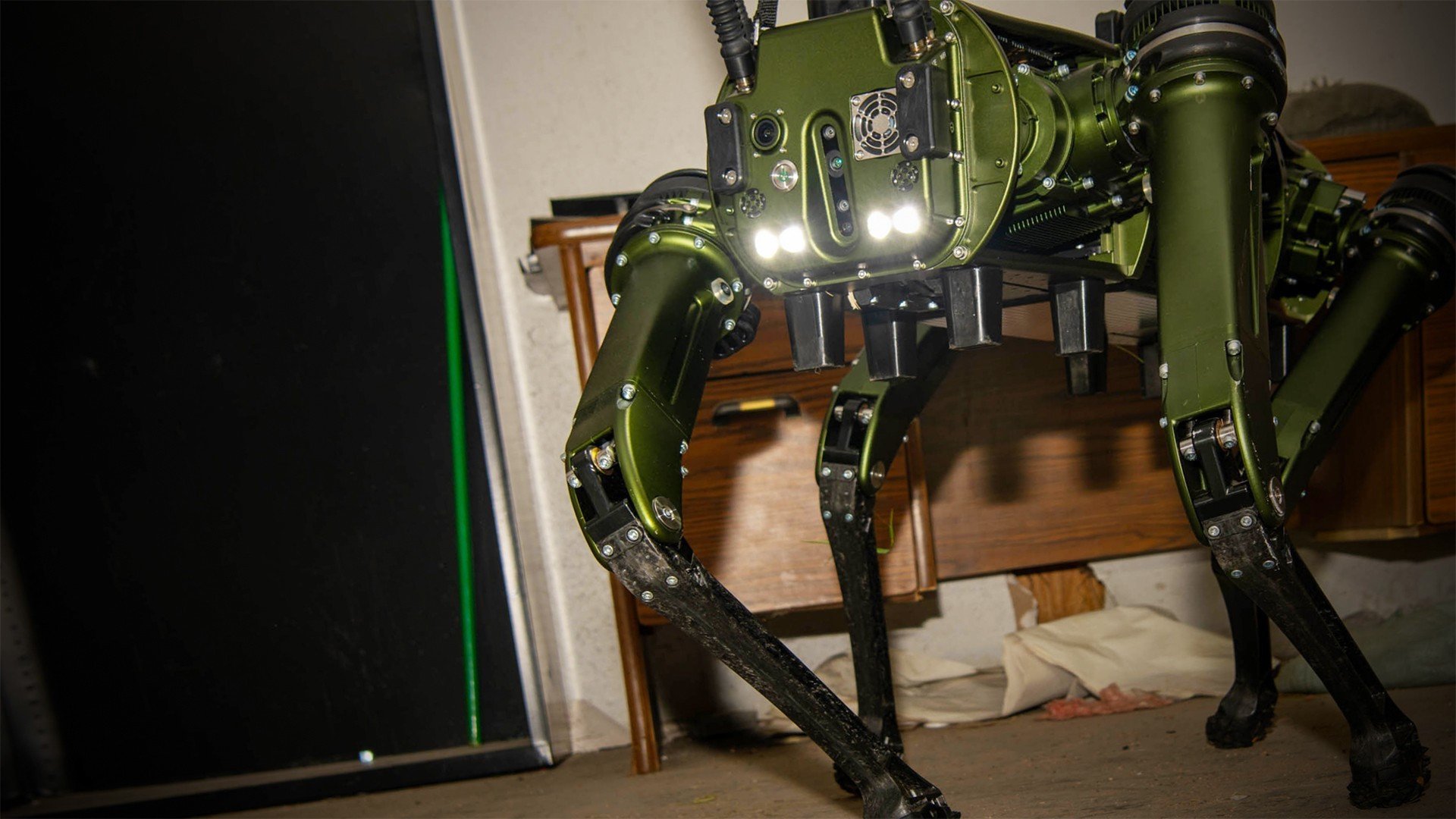
The Pentagon has announced plans for a new functional combatant command, very broadly akin to U.S. Special Operations Command (SOCOM) or U.S. Space Command (SPACECOM), but for operational activities involving autonomous and robotic capabilities. Secretary Pete Hegseth has also announced new initiatives to help further accelerate the fielding of uncrewed systems in the air, at sea, and on land, as well as to explore future warfighting challenges. All of this builds on previous and long-overdue efforts to prioritize the fielding of various tiers of drones, as well as artificial intelligence (AI) and other emerging technologies, across domains, but there are questions about how these new efforts will translate into tangible developments.

Secretary Hegseth unveiled plans for what is tentatively dubbed Autonomous Warfare Command (AUTOWARCOM), as well as the aforementioned initiatives, called Project Agincourt and Project Meridian, during a speech to service members today at the U.S. Marine Corps’ base in Quantico, Virginia. Hegseth called this a State of the Force address, and said he planned to make it an annual event.

.@SECWAR “Today, at my direction—we are announcing the creation of Autonomous Warfare Command, or AutoWarCom:

A new 4-star combatant command—with service-like authorities—built to scale autonomous and robotic capabilities across the Joint Force in the fastest peacetime shift in… pic.twitter.com/kYWBxy6Dij

— DOW Rapid Response (@DOWResponse) September 30, 2026

“At my direction, we are announcing the creation of Autonomous Warfare Command, or AUTOWARCOM, a new four-star combatant command with service-like authorities built to scale autonomous and robotic capabilities across the joint force in the fastest peacetime shift in modern military history,” Hegseth declared. “Drone warfare supercharged by SI-enabled targeting is the biggest battlefield revolution in generations. You already know that. Yet when I was sworn in to the Department of Defense, there was scant urgency in this domain.”

“SI” here stands for “super intelligence,” a term the Trump administration is now using in place of AI.

Hegseth called attention to the Drone Dominance initiative he unveiled last year, as well as the establishment of Joint Interagency Task Force 401 (JIATF-401), as examples of steps the Department has already taken in this regard. JIATF-401 is notably focused on counter-drone capabilities, as you read more about here.

“It’s a good start, but it’s certainly not enough. The pace of war is changing faster than the process to support it. Cheap compute, super intelligence, and advanced commercial manufacturing have enabled the proliferation of low-cost, high-precision strikes,” Hegseth continued. “For 40 years, the United States relied … primarily on expensive weapons that placed quality over quantity. Now, that approach gave us a lot of enormous advantages, and we need to preserve those capabilities. But today we need both quality and quantity. The term you know is high-low mix. An analogy is a thunderstorm. We need bolts of lightning high, our existing high-end kill chains capable of striking unexpectedly and decisively. We also need steady wind and rain, mass drones and other autonomous attritable systems that flip the cost exchange and impose unrelenting pressure on an adversary on the battlefield.”

Hegseth highlighted lessons learned from the ongoing conflict in Ukraine as underscoring these points.

.@SECWAR "Ukraine’s lesson is not that one type of drone wins wars but rather the need for a purpose-built system that maximizes the ability to adapt.

We will fuse procurement with operations at scale – and allow our warfighters, engineers, and entrepreneurs to learn, adapt, and… pic.twitter.com/x7iNMAbU0t

— DOW Rapid Response (@DOWResponse) September 30, 2026

“So today, with Autonomous War Command, AUTOWARCOM, we institutionalize and we supercharge the era of SI, robotics, and autonomous systems, all in order to win,” he added.

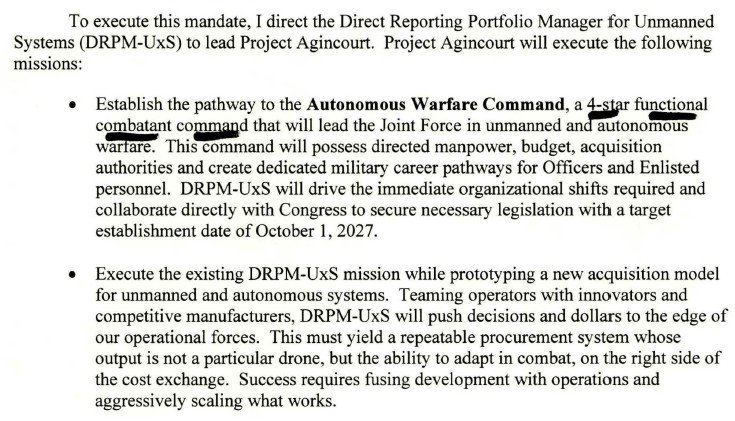
A memo the Pentagon has now released makes clear that the establishment of this command is contingent on Congressional approval, and the current goal is for it to be established by October 1, 2027.

“Autonomous Warfare Command will define joint needs and integrate Service-provided forces in support of geographic combatant commanders,” the memo also notes. “It will test equipment and force designs with realistic opposition in demanding exercises and rugged environments, modify rapidly, and field what works. We must build a wartime arsenal whose main product is adaptation at the edge.”

Many questions remain to be answered about how these activities will work with what’s already being done within the individual services, and how all of that will translate into operational activities. Part of Project Agincourt’s role will be working to help answer the questions above. The name here is a reference to the battle in 1415 in which British forces prevailed over their French opponents, famously in part through the application of a particular military technology, the longbow.

The two main tasks outlined in a memo today on Project Agincourt, one of which is laying the groundwork for AUTOWARCOM. US Military

The office of the Direct Reporting Portfolio Manager for Unmanned Systems (DRPM-UxS) will lead this initiative. Owen West, head of the Pentagon’s Defense Innovation Unit (DIU), and U.S. Navy SEAL Senior Chief Max Strasiser are set to serve as the Chief Executive Officer and Chief Operating Officer of the DRPM-UxS, respectively.

Project Agincourt will also “prototype a new construct called warfighting acquisition, not just acquisition that happens at the Pentagon,” according to Hegseth. “This model fuses operators with entrepreneurs in rapid adaptation cycles while distributing decisions and dollars closer to frontline units, to combatant commands. Realistic training exercises, and when possible, the crucible of combat, will be used to compress innovation timelines and scale what works.”

“Also today, we are phasing in new MOS [Military Occupational Specialty] frameworks within each military department to support our shift to autonomy,” the Secretary also noted during his speech in the context of Project Agincourt and the plan for AUTOWARCOM. “We need institutional knowledge and career paths for a new generation of autonomous warfighters.”

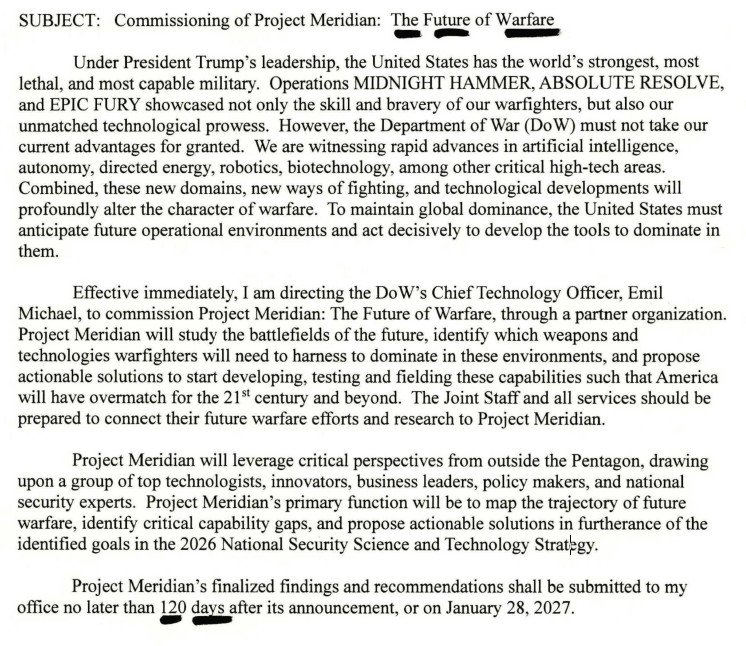
Project Meridian sits adjacent to these efforts and has a broader mandate to explore ways to ensure the U.S. military maintains its technological edge on future battlefields.

“Project Meridian, the future of warfare, is not about developing new strategies or new policies. We already do that. Rather, its purpose is to creatively look to the future, and identify the domains that we must conquer, and capabilities we must master,” Hegseth said. “We need to be looking forward into the future to achieve technological and military dominance on the battlefield for decades to come. It is futuristic on purpose. Their work will be focused on discovering, developing, and fielding the weapons and systems that our children and our grandchildren will need in their lifetimes, without any creative limitations or restrictions, on any future battlefield, from under the Earth to beyond the Moon.”

.@SECWAR “Today, at my direction—I am announcing Project Meridian, an effort led by America’s best minds to study the future of warfare.

Under the leadership of @USWREMichael, Project Meridian will be co-led by three of our nation’s best minds: @elonmusk, @PalmerLuckey, and… pic.twitter.com/4DyurVpkUZ

— DOW Rapid Response (@DOWResponse) September 30, 2026

“Project Meridian will study the battlefields of the future, identify which weapons and technologies warfighters will need to harness to dominate in these environments, and propose actionable solutions to start developing, testing and fielding these capabilities such that America will have overmatch for the 21st century and beyond,” according to a separate memo the Pentagon put out today. “The Joint Staff and all services should be prepared to connect their future warfare efforts and research to Project Meridian.”

The full text of the Project Meridian memo put out today. US Military

Furthermore, “Project Meridian will leverage critical perspectives from outside the Pentagon, drawing upon a group of top technologists, innovators, business leaders, policy makers, and national security experts,” according to the memo. “Project Meridian’s primary function will be to map the trajectory of future warfare, identify critical capability gaps, and propose actionable solutions in furtherance of the identified goals in the 2026 National Security Science and Technology Strategy.”

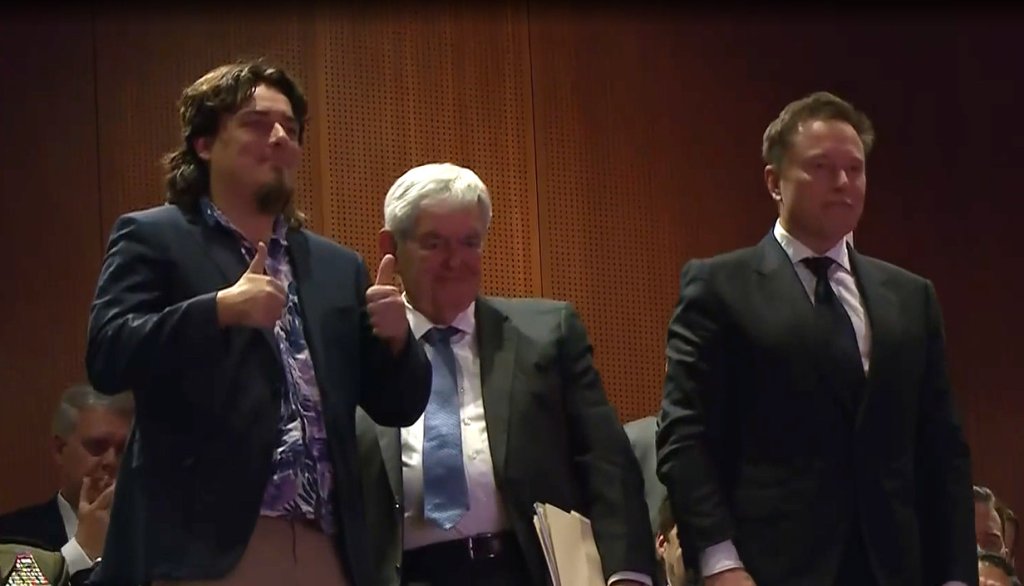
This is also very much a near-term initiative, with Hegseth demanding a final report no later than 120 days from now, or January 28, 2027. The Pentagon’s Chief Technology Officer, Emil Michael, has been directed to set up this project. Today, Hegseth also named Elon Musk, Palmer Luckey, and Newt Gingrich as key members.

Elon Musk, founder of SpaceX, which dominates the commercial space launch and services market globally, as well as the host of other companies, has had an on-again-off-again relationship with the Trump Administration. Palmer Luckey is another entrepreneur now best known for founding Anduril, which has increasingly been a major player in the U.S. defense industry. Newt Gingrich, a highly influential member of Trump’s Republican Party and former Speaker of the U.S. House of Representatives, has more recently become an outspoken advocate of advancing AI technology in the United States.

A screen capture from today’s livestream of Secretary Hegseth’s speech. From left to right, Palmer Luckey, Newt Gingrich, and Elon Musk. US Military capture

The inclusion of Musk and Luckey does raise ethical questions, as they both lead companies with major U.S. government contracts already, and which could be in line to see more opportunities based on Project Meridian’s findings. What guardrails might be put in place to prevent conflicts of interest is unclear.

To reiterate, it remains to be seen how all of these efforts will progress and how, or if, they will ultimately translate to more tangible developments. The U.S. military has a long history now of launching high-profile initiatives that still struggle to demonstrate real progress, despite widespread support for accelerating the fielding of uncrewed systems, AI, and other advanced technologies. The Pentagon has certainly produced tangible results through other organizational shifts in recent years, including the aforementioned Drone Dominance initiative and JIATF-401, as well as the Replicator initiative under President Joe Biden.

At the same time, there are real potential hurdles to these new plans. The Pentagon has itself already acknowledged that support from Congress will be key to the AUTOWARCOM vision. Annual budgeting, and the uncertainty that often surrounds that will also be a factor. There is also the matter of efforts to expand the U.S. defense industrial base. The limitations of existing U.S. industrial capacity and supply chains have already become a matter of national debate in light of concerns about dwindling stockpiles of critical munitions as a result of the ongoing conflict with Iran, as well as a succession of other global crises in recent years.

During his speech, Hegseth called attention to efforts to broaden the defense industrial base with new, smaller firms, as well as agreements with large established contractors to expand on their existing capacity. He also highlighted the Trump administration’s $1.5 trillion defense spending plan for Fiscal Year 2027 and issued a new call on Congress to pass an additional $350 billion reconciliation package.

With today’s announcements, the Pentagon has certainly reinforced its commitment to expanding the fielding of uncrewed and other high-tech capabilities across all branches of the U.S. military, but there is clearly work still to be done to turn those visions into realities.

Contact the author: joe@twz.com

The post Vision For New Autonomous Warfare Command Laid Out By Pentagon appeared first on TWZ.

  •  

What does it mean to win the AI race?

When Donald Trump and Xi Jinping met in Washington last week, artificial intelligence was among the issues dividing their countries. Days earlier, Treasury Secretary Scott Bessent said the two sides had agreed to establish a formal AI dialogue, including an incident line, though its protocols had yet to be worked out. The summit produced no […]

The post What does it mean to win the AI race? appeared first on Asia Times.

  •  

US House speaker sees AI data center worries as ‘Chinese psyop’

They’ve been shown to raise electricity bills, pollute drinking water, do little to boost local employment while threatening millions of jobs in a variety of industries, and top executives have warned that the technology they support could wipe out all of humanity by the end of the decade. But rather than take widespread public opposition to artificial intelligence data centers at face value, House Speaker Mike Johnson (R-La.) announced he had […]

The post US House speaker sees AI data center worries as ‘Chinese psyop’ appeared first on Asia Times.

  •  

After Trump-Xi summit, Nvidia RTX PRO 5500 gains export prospects

Beijing may let its technology giants buy more Nvidia high-end chips, giving the US chip designer a fresh foothold in China and keeping Chinese artificial intelligence (AI) developers tied to its software after months of stalled trade. China’s Ministry of Industry and Information Technology (MIIT) has asked major domestic companies, including ByteDance, Alibaba and Tencent, […]

The post After Trump-Xi summit, Nvidia RTX PRO 5500 gains export prospects appeared first on Asia Times.

  •  

Trump and Xi: Managing Rivalry Before It Becomes Conflict

The Trump-Xi summit did not mark a US-China rapprochement, but it demonstrates that sustained diplomacy and strategic guardrails are essential to prevent intensifying competition from becoming direct conflict. The recent summit between Chinese President Xi Jinping and US President Donald Trump in Washington has demonstrated a significant paradox in contemporary international politics: the two superpowers […]
  •  
❌