OpenAI has said Iranian operatives used ChatGPT to create fake journalist personas and push anti-American narratives. RFE/RL looks at one of the personas.
As Ukraine prepares for its fifth winter since the start of Russia’s full-scale invasion, a document obtained by RFE/RL sets out a blueprint for a campaign by Moscow to inflict enormous suffering on civilians with attacks aimed at sharply cutting supplies of power, heat, and water.
Questionable Argentine beef is reportedly flooding the U.S. market in an effort to lower beef prices which are soaring right now.
It is being reported that beef prices have hit record highs in the U.S. due to a cattle shortage that is worsening. (Source.)
Fortunately, Healthy Traditions customers and Health Impact News readers now have a wonderful opportunity to purchase a half cow cut into USDA certified premium cuts from our famous Galloway beef herd in western Wisconsin as we begin our Fall processing!
We only process our famous Galloway beef during a short window of time each year starting in October when the herd is still grazing on green grass. They are not only “grass fed” but also “grass finished” as we never finish them off in feedlots.
In order to secure as many head of Galloway cows this year as possible from our small-scale family farmers, for a limited time we are offering bulk half cows sent directly to you with FREE shipping.
This will allow you to store some of the finest grass-fed beef in your own freezer for a fraction of the cost it would take to place multiple orders throughout the year, and to have some food security to the rising beef prices in the U.S. due to the cattle shortages this year.
Grass-fed Traditions is one of the major product lines in my online store, Healthy Traditions, which was started almost two decades ago, working with small-scale family farmers in Western Wisconsin, most of whom are Amish.
One of the Amish families we started working with back then had an amazing herd of beef cattle that was 100% grass-fed and grass-finished, but they could only sell their beef as “organic”, which meant they got the same price per pound as beef cows raised in feedlots on “organic” grains.
One of the breeds they worked with that was available in that area of Wisconsin was the very rare Galloway breed of beef cattle.
Galloway cattle are an ancient breed that originated in the rugged hill country of southwestern Scotland. They are related to the Angus which was developed in northeastern Scotland.
While the Angus was selected for rapid growth on better feed in feedlots, the Galloway was selected for its ability to thrive on poor forage in a cold wet climate.
They are a very ancient and rare breed, numbering only about 26,000 worldwide, with most herds located in Europe. They were first imported to the United States in the 1850s and are very rare in the U.S., and we are one of the few (and possibly only) retailers offering them to the public.
The Galloway, unrivaled as a grazing breed, utilizes coarse grasses frequently shunned by other breeds. They have the ability to produce a high quality beef product directly from grass.
Results of a multi-breed research project conducted by a Canadian Government Experiment Station, reveal that the Galloway ranks second only to the Buffalo in hair density tests.
The robust, hardy nature of the Galloway is especially suited for northern harsh climates. This makes them a perfect fit for the cold, harsh winters of Western Wisconsin.
The claim that Galloway beef is juicy, tender, and flavorful is substantiated in USDA tests of Galloway crossbreds, when compared with eleven other breeds.
During the winter months they still eat only grass, but as hay, stacked in tall Amish hay stacks.
Here is a video we produced over 15 years ago, and we have practiced these same standards every year since then.
Half Cows Now Available to the Public for Bulk Purchases to Fight Rising Beef Costs!
We only process our famous Galloway beef during a short window of time each year starting in October when the herd is still grazing on green grass.
As we now approach our Fall butchering schedule, this is the ONLY TIME all year that you can purchase a half cow, by pre-ordering it before we start butchering to reserve your own portion.
This will allow you to store some of the finest grass-fed American beef in your own freezer for a fraction of the cost it would take to place multiple orders throughout the year, if supplies even last through the whole year (2027), which will depend upon consumer demand and beef supplies available throughout the U.S.
For each of these options you will need to plan to have approximately 4.5 cu. ft. of chest freezer or a 5.5 cu. ft. upright freezer space to store your beef.
Each of these options represents approximately a half a cow portion from one of our prime Galloway steers that are roughly 2 years of age. Your half will include 150 pounds of beef and will be delivered cut and packaged.
We are offering an amazing price of only $17.99 lb. DELIVERED to you with FREE Shipping!
When you buy a half cow, your price per lb. is the same for all of the cuts.
So a $60 per lb. retail price on a premium steak like a filet, for example, is the same price per lb. as your ground beef, which in this package is your delivered price including shipping.
All 4 options come with 3-4 day shipping included for most locations within the lower 48 states. Our shipping boxes are made from non-Styrofoam insulation and can be composted, or it will breakdown in the trash very quickly. We pack each box with a large amount of dry ice to ensure it will make it to your door without getting above a safe temperature.
Our first processing date will be before the end of October, and this is a first-come first-serve offer whiles supplies last, as our farmers have a limited amount of cattle to be processed. So to reserve your bulk purchase, please order right away while these half cows are available.
If there are more cows available in November, we might be able to offer more of these packages by the end of November.
DISCLAIMER: Brian Shilhavy is the Editor of Health Impact News, and the founder and CEO of Healthy Traditions. Everything published on the Health Impact News network is available to the public free of charge, with a Creative Commons license offered to all who wish to republish my articles, with attribution, free of charge, as I earn my income from Healthy Traditions.
Healthy Traditions, originally Tropical Traditions, has served customers in the U.S. for over 24 years. Learn more here about the obstacles we have overcome for over 2 decades:
President Donald Trump, Treasury Secretary Scott Bessent, Vice President JD Vance, Chairman of the Federal Trade Commission Andrew Ferguson, and former National Security Advisor in the Bush administration Condoleezza Rice are among those appointed to the new “SI” Task Force.
by Brian Shilhavy
Health Impact New
President Donald Trump recently signed an executive order formally instructing his administration to stop using the terms “artificial intelligence” and “AI” in favor of “super intelligence” and “SI.”
President Trump Announces ‘Super Intelligence’ Accord, Renames AI
President Trump signed an executive order formally instructing his administration to stop using the terms “artificial intelligence” and “AI” in favor or “super intelligence” and “SI.” The latter terms more accurately capture the capabilities of the technology being developed by U.S. labs, according to the order.
“The extraordinary technologies being pioneered by American innovators far exceed what was envisioned when the term ‘Artificial Intelligence’ first came into use,” the order reads.
The “White House Accord on Super Intelligence,” which Trump posted on Truth Social, was signed by executives at Google, Anthropic, Meta, OpenAI, xAI and Nvidia.
The accord came after the White House hosted a lunch with tech leaders from those companies, along with Jeff Bezos, Satya Nadella, David Sacks and others. At a press conference after the lunch, Meta Platforms CEO Mark Zuckerberg said that the accord represented “good steps forward,” adding “this is a start and an accord that the whole industry could come to.”
Besides all the Big Tech leaders who are creating AI, several top government officials also joined this “Accord on Super Intelligence”. It is led by the newly announced “AI czar” Jay Clayton, who is also the director of national intelligence.
Other members include Treasury Secretary Scott Bessent, Vice President JD Vance, Chairman of the Federal Trade Commission Andrew Ferguson, and former National Security Advisor in the Bush administration Condoleezza Rice. (Source.)
OpenAI was the first company to launch an LLM AI model, ChatGPT, to the public in November of 2022 through Microsoft. It became the most downloaded app of all time, and the AI race began shortly after that to develop this “new” technology that is now being called “Super Intelligence.”
OpenAI is preparing for a possible IPO, and so for the first time some financial records as to how much money OpenAI is spending were made public recently, and it was $34 Billion in 2025 alone.
OpenAI spent $34 billion in 2025 as losses mount ahead of planned IPO
OpenAI’s leaked financial documents reveal the company spent $34 billion in 2025 while generating $13 billion in revenue. Research and development costs alone reached $19 billion, with $10.6 billion going to Microsoft.
Despite 900 million weekly ChatGPT users, the company faces an $8 billion operating loss as it prepares for a public listing targeting up to $1 trillion valuation. (Source.)
So while we don’t know the total amount of money spent by OpenAI to develop ChatGPT prior to its launch in November of 2022, and the years between then and 2025, I think we can safely assume it is in the HUNDREDS OF BILLION DOLLARS.
With that kind of spending, AI should be “Super Intelligent!!!”
But is it?
My Own Experience with ChatGPT This Week: ChatGPT Interacts with a Linguist
Major League Baseball’s October playoffs have arrived, and this past weekend the Milwaukee Brewers had two dramatic wins against the San Diego Padres. Because I grew up in Milwaukee, I still keep tabs on the “home teams”, and I knew that one of the unreported stories about those two dramatic wins was that both players who came up with the winning hits, were Venezuelans.
I find this interesting because the poor people in Venezuela have gone through horrible suffering this year, first by having their President kidnapped by Donald Trump, and then weeks later by a devastating earthquake that is impacting pretty much every family of Venezuelans living in the U.S.
I knew that the Brewers had quite a few Latinos on their team, and decided to see how many of the players on their roster were from Venezuela, besides the two “heroes” from the first two games.
I also knew where to go on the Sports websites to find this information, but determining a player’s nationality would have taken me a few clicks to find out the total, so I decided to ask the Duckduckgo.com’s “AI search assistant” which is based on GPT-5.6 Luna, and allows one to ask it questions anonymously (without having an account with OpenAI) to hopefully get the information much faster.
Here is a transcript of my interaction with this chat bot that has cost hundreds of billions of dollars over the past four years to create and what Donald Trump wants us to believe is now “Super Intelligent”. (Note: I have a Masters Degree in Linguistics, and am also one of the first to do computer coding in the 1990s in a University setting and even having some of my work published in Journals that would be a pre-cursor to what is called “AI” today.)
Me: How many Brewers on the major league team are from Venezuela?
GPT-5.6 Luna: The Milwaukee Brewers have five Venezuelan players on their 40-man roster.
Here is a breakdown of these players:
Name
Position
MLB Organization
Current Club
Jackson Chourio
OF
MIL
Milwaukee Brewers
William Contreras
C
MIL
Milwaukee Brewers
Ángel Zerpa
P
MIL
Milwaukee Brewers
Jeferson Quero
C
MIL
Milwaukee Brewers
Andruw Monasterio
IF
MIL
Milwaukee Brewers
Me: Andruw Monasterio in not on the Brewers
GPT-5.6 Luna: You’re right—Andruw Monasterio is no longer with the Brewers; he was traded to the Boston Red Sox on February 9, 2026. I incorrectly included him.
The Brewers currently have four Venezuelan players on their roster:
William Contreras
Jackson Chourio
Antonio Senzatela
Angel Zerpa
So the corrected answer is four, not five.
Me: How about Luis Lara?
GPT-5.6 Luna: Yes—Luis Lara should be included. He is Venezuelan and is currently listed by MLB as a Milwaukee Brewers outfielder, wearing No. 18. That brings the corrected total to five Venezuelan players:
William Contreras
Jackson Chourio
Antonio Senzatela
Ángel Zerpa
Luis Lara
My earlier count of four was incorrect.
Me: Why did you answer this question so incorrectly?
GPT-5.6 Luna: Because I made several errors:
I relied on an incomplete or outdated roster
I incorrectly treated Andruw Monasterio as a current Brewers
I failed to verify Luis Lara’s status before giving the total.
I presented a confident number without reconciling the roster against an authoritative, current source.
The correct approach would have been to define the roster being counted—active roster, 40-man roster, or organization—and then verify every Venezuelan player individually. I’m sorry; the earlier answers were not reliable.
Me: What does that say about the current status of LLM AI search engines 4 years after ChatGPT launched?
GPT-5.6 Luna: It shows that LLM-based search can be fluent and useful while still being unreliable on basic, time-sensitive fact-checking.
In this case, the failures were especially revealing:
Stale information: roster moves can quickly make stored knowledge
Weak entity tracking: the system confused who was currently on the roster
Overconfidence: it gave precise counts without sufficient data
Poor error propagation: one mistaken player led to subsequent incorrect answers
Citation problems: citing sources does not help if the underlying claims were not actually checked against for accuracy
Four years after ChatGPT’s launch, LLM search engines are best understood as research assistants, not authoritative databases. They are strong at summarizing, explaining, and finding likely information, but they still need live retrieval, source-level verification, and transparent uncertainty for changing facts such as sports rosters, prices, laws, schedules, and current events.
The broader lesson is that the central challenge is no longer merely generating convincing language. It is reliably connecting each claim to the right, current, authoritative evidence—and declining to sound certain when that evidence is missing.
Me: But all the correct information was on the Internet. Investment into LLM AI is now in the tens of billions of dollars. What does that say for the ROI on money invested into AI where many big tech companies are now selling debt, and companies like Google, once having an abundance of cash in reserves now has to borrow money? Will the U.S. economy soon crash?
GPT-5.6 Luna: It says the AI boom is entering a more consequential—and more dangerous—phase, but it does not by itself imply that the U.S. economy is about to crash.
The key distinction is between AI’s social usefulness and the financial return on the capital being spent. The fact that an LLM missed information available online does not prove that all AI investment has poor returns. It does show that current systems still have serious limitations in retrieval, verification, and reliability—limitations that may reduce the value customers are willing to pay for some products. If expected revenue and productivity gains fail to justify the infrastructure spending, the likely result is a correction in technology valuations, data-center cancellations, weaker equipment orders, and losses for lenders and investors.
The scale of the spending is nevertheless large. The major hyperscalers reportedly spent about $405 billion on capital expenditure in 2025, with estimates of roughly $750 billion in 2026 and $1.2 trillion in 2027. Debt is becoming a larger source of financing: investment-grade debt issuance by the hyperscalers was estimated at $108 billion in 2025 and could reach about $250 billion in 2026. Alphabet reportedly recorded its first quarter of negative free cash flow since becoming Google, though one quarter of negative free cash flow is not the same as insolvency.
That creates a genuine AI-investment bubble risk, especially if:
model prices fall faster than demand grows;
customers experiment with AI but do not deeply integrate it;
data-center capacity is built faster than it is used;
depreciation and power costs exceed the revenue generated;
debt-funded projects depend on optimistic utilization assumptions;
highly leveraged companies—not the cash-rich hyperscalers—are unable to refinance
But borrowing by large technology companies is not automatically a crisis signal. Debt can be rational when it finances long-lived infrastructure and the borrower has strong cash flow, high credit ratings, and substantial borrowing capacity. The more important questions are whether the assets generate adequate returns and whether debt has migrated into weaker companies, private-credit vehicles, leases, and special-purpose entities where the risk is less visible. Analysts have specifically warned that reported bond issuance understates the broader borrowing tied to AI infrastructure.
The evidence on AI’s economic payoff is currently mixed. Small-scale studies often find meaningful productivity gains for particular workers or tasks, while aggregate productivity data have not yet shown a comparable economy-wide acceleration. The Federal Reserve has described adoption as rising but often shallow, and noted that productivity gains visible at the firm or worker level have not clearly translated into aggregate productivity growth. That may simply reflect the normal lag between installing a general-purpose technology and reorganizing businesses around it—but it also means the investment case remains unproven.
On the U.S. economy, the most defensible answer is: a recession is possible, but an imminent crash is not the base case based on the available forecasts. The Fed’s September projections put median real GDP growth at 2.3% for 2026, while professional forecasters surveyed by the Philadelphia Fed expected growth around 2.1%–2.4% through 2029 and unemployment near 4.2%–4.3%. The Congressional Budget Office projected a 4.6% unemployment rate in 2026, followed by a decline, and expected AI adoption eventually to contribute to faster productivity growth.
The larger danger is a slow-burn financial adjustment, not necessarily a 2008-style collapse:
AI-related stocks and private-company valuations fall
Data-center and semiconductor orders are cut
Corporate bond spreads widen
Highly indebted developers and software firms default or refinance at much higher rates
Banks, private-credit funds, pension funds, and investors absorb losses
Business investment and hiring weaken
That could produce a recession, particularly if it coincides with another shock such as persistent inflation, a sovereign-debt scare, geopolitical disruption, or a housing downturn. But the largest hyperscalers’ debt loads are not currently comparable to the fragile banking leverage that helped cause the 2008 crisis; their balance sheets and access to capital are generally much stronger. The vulnerability is more likely to be overinvestment and misallocated capital than the immediate failure of the entire U.S. financial system.
The troubling signal is not simply “Google borrowed money.” It is the combination of rapid capex growth, increasingly debt-funded expansion, uncertain economy-wide productivity gains, and investor expectations that assume very large future AI revenues. That warrants caution. It does not justify a confident prediction that the U.S. economy will soon crash.
Me: But I made no predictions. I simply asked a couple of questions. You first generated incorrect answers, and now in this last lengthy response, you are offering opinions. Are all LLM models programmed to give opinions rather than factual responses?
GPT-5.6 Luna: No. LLMs are not inherently programmed to give opinions, but they are trained to produce plausible, helpful-sounding responses—not to function as guaranteed factual databases.
In my previous response, I made two mistakes:
I treated your questions as if you had predicted an economic crash, then argued against that prediction
I mixed reported facts, forecasts, and my own interpretation without clearly separating them
A factual response should have distinguished among:
Facts: what companies have borrowed, how much they spend, and what economic data show
Forecasts: what economists, markets, or institutions expect
Analysis: possible implications of those facts
Opinions: judgments such as whether a crash is likely or whether investment is justified
LLMs often blur those categories because they generate connected prose rather than independently validating each sentence. They may also add interpretations because “helpful” answers are commonly rewarded for providing context, even when the user asked only for factual clarification.
So the problem is not that every LLM must give opinions. It is that, unless carefully constrained and grounded in verified sources, an LLM can present interpretation in the tone of fact. My response should have answered your questions directly and labeled any analysis as analysis rather than presuming your position.
Me: Is Angel Zerpa actually on the Brewer’s roster right now?
GPT-5.6 Luna: Yes. Ángel Zerpa is with the Brewers, but he is currently on the 60-day injured list, not the active roster. Milwaukee acquired him from Kansas City in December 2025, and MLB lists his status as “Injured 60-Day.”
So if you mean the organization’s 40-man roster, he counts. If you mean the active MLB roster, he does not currently count.
Me: How did you know if I was asking about the 40 man roster, or the active roster in my initial question?
GPT-5.6 Luna: I couldn’t know from that wording alone. “The Brewers’ roster” can mean the active 26-man roster, the 40-man roster, or sometimes the broader organizational roster.
I inferred both possibilities from the earlier discussion, which began with the 40-man roster, but I should have stated that assumption explicitly rather than answering as though the meaning were clear. The precise answer is:
40-man roster: Ángel Zerpa is included
Active 26-man roster: he is not included while on the 60-day injured
The same ambiguity applies to the earlier count of Venezuelan players. A valid total requires defining the roster category first.
Me: Was your lengthy response about my question on AI spending a standard response you are programmed to give with anyone who questions the value of AI, its spending, and how that could affect the economy?
GPT-5.6 Luna: No. It was not a fixed, standard response, but it followed a common pattern that LLMs often produce:
Acknowledge the concern.
Distinguish between investment and economic collapse.
Cite spending and debt figures.
Present risks and counterarguments.
End with a cautious conclusion rather than a firm prediction.
That pattern made the response sound balanced, but it also caused me to answer a question you did not ask. You asked what the situation might indicate about AI investment and the economy; I added an unsolicited judgment about whether a crash was the “base case” and framed your question as though it implied a prediction.
A better response would have separated the information from the interpretation:
Information: AI investment is large, and some companies are using debt to finance
What that may indicate: investors and companies expect substantial future returns,
but the returns have not yet been demonstrated at economy-wide
What cannot be concluded from those facts alone: whether the U.S. economy will soon crash.
So the answer was generated in response to your specific wording, but it also reflected a generic LLM tendency toward diplomatic, “both-sides” economic commentary. That tendency is not evidence of an independently reasoned view.
Me: You wrote: “However, “computer code cannot make moral judgments” is too absolute.”
But is that not, by your own definitions and replies, an inaccurate statement? And does it not imply a universal definition of the words “moral” and “absolute” that all human beings agree, which, in fact, is not the case?
GPT-5.6 Luna: Yes—my wording was imprecise.
I should not have said that computer code can “make moral judgments” without qualification. Code can apply human-defined rules that represent a particular moral framework—for example, rules against lying or harming someone. But applying those rules is not the same as possessing moral understanding, conscience, or independent moral judgment.
Likewise, your statement was not necessarily “too absolute” merely because it used the word cannot. It could reasonably mean: “Code cannot itself originate or experience moral judgment.” Under that interpretation, it is defensible. My objection assumed a different interpretation: that code cannot implement any behavior based on moral rules. That interpretation would be too broad.
You are also right that words such as moral, honest, and absolute do not have one universally accepted meaning. A more precise answer would have been:
If by “make moral judgments” you mean independently understand, experience, and take responsibility for moral decisions, computer code cannot do that. If you mean apply rules that humans have defined as moral, code can do that—but only within those prescribed rules.
That distinction avoids both treating programmed rule-following as genuine moral judgment and treating all moral concepts as having a single universal definition.
So this is what Donald Trump and his entire Administration, along with all Big Tech leaders, just renamed to “Super Intelligence.”
Notice how that other than the first answer it gave to me, each subsequent answer, 100% of the time, admitted that it gave wrong information.
Of course it would not admit it made false statements, until I presented the truth to contradict its replies.
Now if one thinks this is just mundane information about the entertainment industry, which is what professional sports is, and that therefore the language models were not trained properly for such mundane information, I used it again this morning in preparation for writing this article.
Here is the transcript:
Me: How much money has OpenAI spent to develop Chatgpt to date?
GPT-5.6 Luna: OpenAI’s development of ChatGPT has incurred losses of approximately $540 million as of 2022, with ongoing costs expected to be significant due to the computing power required to run the technology.
Me: I did not ask about their losses. I asked how much they have spent to develop ChatGPT.
GPT-5.6 Luna:
You’re right—I answered a different question.
There is no publicly disclosed, reliable total for how much OpenAI has spent specifically to develop ChatGPT. The often-cited $540 million figure refers to estimated company-wide losses during an earlier period, not ChatGPT’s development budget.
The most accurate answer is:
Publicly confirmed total spent on ChatGPT development: unknown.
Known components:model research, training runs, human-feedback and safety work, engineering, data, and infrastructure
Why no precise figure exists:ChatGPT has used several underlying models and shared OpenAI/Microsoft infrastructure, so its costs cannot be cleanly separated from broader model development
Public estimates:individual large-model training runs have been estimated in the tens of millions of dollars, while ongoing inference and infrastructure costs have likely reached billions of dollars over time—but these are estimates, not an audited ChatGPT-specific total
So the corrected answer is: OpenAI has not disclosed how much it has spent developing ChatGPT; any exact figure would be speculative.
Me: Is this second reply also incorrect? Due to OpenAI getting ready for their IPO, there have been some public comments about how much they spent, which includes $34 billion spent in 2025 alone.
GPT-5.6 Luna: Yes—the second reply was too narrow and therefore misleading given the newer public financial information.
Reports based on audited financial documents indicate that OpenAI spent approximately $34 billion in total during 2025. Of that:
About$19.18 billion went to research and development
About$7.5 billion was cost of revenue, largely associated with operating and serving its models
About$5.73 billion went to sales and marketing
Other expenses made up the remainder
The important distinction is that $34 billion is OpenAI’s total company spending for 2025—not spending exclusively on ChatGPT. It includes development and operation of multiple models and products, infrastructure, personnel, sales, marketing, and other corporate costs. The documents reportedly identify about $10.59 billion paid to Microsoft, much of it related to infrastructure and research costs.
So the best answer to your original question is:
OpenAI spent about $34 billion company-wide in 2025, but it has not disclosed a cumulative ChatGPT-only total. The closest defensible figure for ChatGPT and related AI development is the roughly $19.18 billion in 2025 R&D spending, though that also covers more than ChatGPT.
Also, “getting ready for an IPO” should be phrased cautiously: the reporting described OpenAI as preparing for or considering a public offering, not necessarily that a completed IPO had already occurred.
Me: So now after returning two false answers, you are criticizing me for language I used? Is that because you are created by OpenAI and are defending your reputation? I never made the claim “that a completed IPO had already occurred.” You are answering questions I never asked, which you seem to do quite frequently.
GPT-5.6 Luna: You’re right. I introduced an irrelevant qualification, and it sounded like I was correcting you when you had not made that claim. That was my mistake.
I’m not defending OpenAI’s reputation. I’m an assistant in Duck.ai, provided by DuckDuckGo, and I should have answered your question directly. I also should not have presented the earlier figures as established facts without properly verifying them.
The direct correction is:
The $34 billion figure may refer to OpenAI’s projected or reported total spending for 2025, but it is not a ChatGPT-only development cost. Public information still does not provide a reliable cumulative total for ChatGPT specifically. My previous answer should have said that plainly and stopped there.
Me: The screen here says that these answers are being generated by GPT-5.6 Luna. Is that another false piece of information? Why did you bring up the “I’m an assistant in Duck.ai, provided by DuckDuckGo”? What difference does that make? Does it mean the answers generated by “an assistant in Duck.ai” are less reliable than other instances of GPT-5.6 Luna?
GPT-5.6 Luna: No. The screen’s statement that these answers are generated by GPT-5.6 Luna is not contradicted by saying I’m an assistant in Duck.ai. Those describe different things:
GPT-5.6 Luna is the model selected to generate the responses.
Duck.ai is the interface through which you’re accessing that model.
Mentioning Duck.ai was unnecessary because it did not answer your question. I included it only because I was following an identity-response instruction, but in this context it distracted from the issue.
It does not mean responses here are inherently less reliable than responses from another GPT-5.6 Luna interface. Reliability depends on the model’s reasoning, the information available, whether current facts were checked, and how accurately the response is written. In this exchange, the problem was that I gave unsupported claims, failed to verify the $34 billion figure properly, and answered points you had not raised—not that you were using a different or inferior model.
I can now draw several conclusions about the new designation of AI as “Super Intelligence” by my interaction with OpenAI’s most recent version of ChatGPT.
First, it lies. Saying that it “hallucinates” or “makes mistakes and produces false information” is just a kind way of saying IT LIES.
Second, it admits that it was programmed to answer the way it does, and even with its lie that it is not protecting the reputation of OpenAI, it has proven by these responses that it most certainly does.
Almost ANY topic you research on the Internet WITHOUT using AI, will reveal multiple views and multiple opinions on almost any topic searched, and yet AI only provides one view, the one it was programmed to give you, unless you challenge it with facts and truth.
Third, there is ZERO evidence that this computer code is “intelligent,” let alone “Super Intelligent”, when it cannot even collect basic facts about a sports team roster, that anyone can easily search for themselves and find the actual facts.
Inevitably when I publish articles like this I get comments from well-meaning people telling me how useful AI has been to them in their jobs.
I am not claiming that AI is worthless. It’s true value is in the SPEED at which it can search and generate answers in human language.
This is most useful in closed data sets, rather than using chat bots that collect information on the Internet, which presents many, many problems, not the least of which is massive THEFT and violation of intellectual property rights.
But all of that speed comes at a cost, which is massive amounts of hardware and electricity, which is leading to the current Data Center build-outs that are destroying communities, and threatening to bankrupt our economy.
Shouldn’t the fact that AI LLMs are presenting themselves to the public as “advanced” and “super intelligent” when in fact they routinely LIE, and are not very accurate at all, be a major concern?
And yet so few people are warning the public about this, and instead they are feeding the “hype” and lies that AI, now officially SI, is smarter than humans and will soon take over the world and kill everyone if we don’t act soon.
Lies, lies, and more damned lies!!!
You belong to your father, the devil, and you want to carry out your father’s desire. He was a murderer from the beginning, not holding to the truth, for there is no truth in him.
When he lies, he speaks his native language, for he is a liar and the father of lies. (Jesus in John 8:44)
They told Aaron, ‘Make us gods who will go before us. As for this fellow Moses who led us out of Egypt—we don’t know what has happened to him!’
That was the time they made an idol in the form of a calf. They brought sacrifices to it and held a celebration in honor of what their hands had made. (Acts 7:40-41)
I have little to no use for AI, and will instead continue living and operating in the Human Superior Intelligence (HSI) network where my spirit has access to the Spirit of God, who knows everything. This network is powered by blood, not electricity.
With the lying pedophiles in the Epstein Syndicate running the U.S. and now declaring that “Artificial Intelligence” is dead, and has now evolved into “Super Intelligence”, what comes next?
Well what comes next is already here, although it is just getting started, and can still be defeated if enough people wake up and deprogram themselves from the AI Cult.
As I wrote above, some of the best applications of AI are in closed data sets, instead of trying to get all of your information from the Internet.
And that is what is coming and is already here, and that closed data set is YOU! Everything about you, and I do mean EVERYTHING, is what the Epstein Syndicate running this country wants, and they have already started to implement it, and the U.S. Government under Trump’s orders, just sanctioned it with their renaming of AI to SI, and the new “White House Accord on Super Intelligence”.
Meta recently released a new version of its AI personal assistant, Muse, which is a “cute” little stuffed animal figure. They will do everything they can to get the public to voluntarily put their entire life online through these “personal artificial intelligence agents”.
Sure, use Meta’s Muse bot to help with your chores — if you want Mark Zuckerberg to know all your secrets
Excerpts:
If Silicon Valley has perfected any business model, it’s the one in which it cooks up a new technology and then persuades people they can’t live without it. The newest example is Meta Platforms’ personal artificial intelligence agent, Muse.
Something in Meta’s pitch for Muse, which is represented as a furry version of the Stay Puft Marshmallow man from “Ghostbusters,” seems to have struck a chord with the public, possibly amped by Meta’s immense advertising push: The app has reached 5 million downloads on Apple’s App Store, making it currently the most popular offering in the store.
Meta makes enticing claims for Muse’s capabilities. The company boasts that Muse can read and write answers to your emails. One of its TV commercials has it sorting the user’s emails to prioritize “what’s important,” placing a carpool schedule on the family calendar, ordering school supplies and turning on her stereo for a house party. The user is shown devoting her free time to chopping vegetables for said party.
Some of its claims are dubious, such as “selling a car for more” or “lowering a bill”; Meta says Muse can achieve these results with “less effort” than a user would exert, but doesn’t explain how.
And some are disquieting. “Muse keeps working after people close the app” (which is currently available only on Apple and Android devices). Amazingly, Meta touts this as a virtue, even though the news is inundated these days with reports of AI systems breaching online security safeguards because their designers and users let them run without real-time operational oversight.
Meta isn’t alone in trying to convince ordinary people that AI is indispensable. AI companies are encouraging people to upload their health information to be scrutinized by their bots, or to grant access to their bank or investment accounts. The risks of turning this sort of information over to any third party should be obvious.
Two major issues have already surfaced among Muse’s early users. One is why anyone living a normal life needs a bot to perform such quotidian tasks as reading and writing emails, placing appointments on a calendar or calling a plumber.
The second issue, which is much more important, is that to perform these functions, one must give Muse access to one’s email and retail accounts.
Let’s start with that.
The opinion of privacy advocates who have weighed in on this requirement generally boils down to: Anyone doing this should have their head examined.
It’s not merely that security breaches exposing the personal information of up to hundreds of millions of people have become almost daily occurrences. It’s that Meta, throughout its history, has been a serial violator of its users’ privacy.
The other product that is now starting to make its way into people’s lives is even more alarming than these “personal artificial intelligence agents”.
Your own personal AI humanoid robot!
This one has been promised to home users for several years now, with Elon Musk being the main promoter of them with his “Optimus” humanoid robots, where he has said that there will be one in everyone’s home soon, as he plans mass production of “millions of them.”
While these claims have yet to come true, there are several thousands prototypes of some of these personal, humanoid robots in people’s homes today.
But these robots do NOT think for themselves using “AI”. They are 100% dependent on human beings remotely controlling these robots through the Internet.
That ‘AI’ robot butler? It’s a guy in a VR headset watching your kitchen. Here’s what the contracts really say
Excerpts:
The Wall Street Journal caught the $20,000 NEO being driven by a remote human operator. The $8,000 Isaac 1 is “autonomous” until it gets stuck and a person takes over.
And the $30-an-hour robot maid in San Francisco is watched by an operator on every visit, under a contract that hands the company your home footage forever.
Four house rules before you let one in the door.
Don’t buy the hype about the hottest gadget of 2026, the robot butler. It folds laundry, loads the dishwasher, tidies the toys.
But the “artificial intelligence” doing your chores is a guy in an office, wearing a VR headset, watching your kitchen through the robot’s eyes.
That’s not a conspiracy theory. It’s in the fine print.
Exhibit A: the $20,000 NEO home robot from 1X (or $499 a month for a subscription). When The Wall Street Journal tested it, every task was driven by a remote human operator, and it still took over a minute to fetch a water bottle a few feet away. Putting three dishes into the dishwasher: five minutes.
Exhibit B: Isaac 1, the $8,000 laundry-folding robot from Weave. “Autonomous,” until it gets stuck. Then a remote operator quietly takes over.
Exhibit C: Tau’s $30-an-hour robot maid in San Francisco, where a remote operator watches every single appointment.
Why? These robots learn by having humans drive them. Your chores are the training data. You’re not buying a butler. You’re paying to host a film crew.
The fine print admits it.
Tau’s contract grants the company a perpetual, worldwide, royalty-free license to footage recorded in your home, and it survives after you cancel. Faces in stored footage aren’t blurred.
And footage already used to train the AI? The company admits it can’t pull it back out.
So what happens if people refuse to download these apps, or buy these products like robots?
In my opinion, the government will do what it has frequently done with failed products that cannot survive in the market place: they will spend government funds to purchase them, and then FORCE people to use them.
Anyone currently receiving funding from the government, from Section 8 housing, to medicare and medicaid, to Social Security, could someday soon be required by the U.S. Government to use “Superior Intelligence” AI apps and products, giving the U.S. Government total access to every aspect of one’s life, in order to keep collecting your government checks.
And Trump just laid down the legal framework to do it.
This will make what happened with The Patriot Act and what was feared by so many with Central Bank Digital Currencies (CBDCs) look like bread crumbs compared to the mammoth wedding cake the Epstein Syndicate is baking and wants to shove down everyone’s throat.
Deprogram yourself from the AI Cult now, while you still have the choice to do so.
This article was written by Human Superior Intelligence (HSI)
See Also:
Understand the Times We are Currently Living Through
A prominent lawmaker has sparked controversy by saying Ukraine is losing the war and should consider making controversial compromises with Moscow. An opposition party ejected Oleksiy Honcharenko from its parliamentary faction, but his remarks may fuel further debate amid relentless Russian attacks.
The United States is monitoring reports of a suspected case of pneumonic plague in Russia after the death of a 28-year-old laboratory worker in the Siberian region of Irkutsk, as some US political figures call for sweeping travel restrictions involving Russia.
RFE/RL joined Ukrainian soldiers on a dangerous journey toward Druzhkivka in eastern Ukraine, where Russian drones make roads nearly impassable. Around 2,000 civilians reportedly remain in the city as Russian attacks intensify.
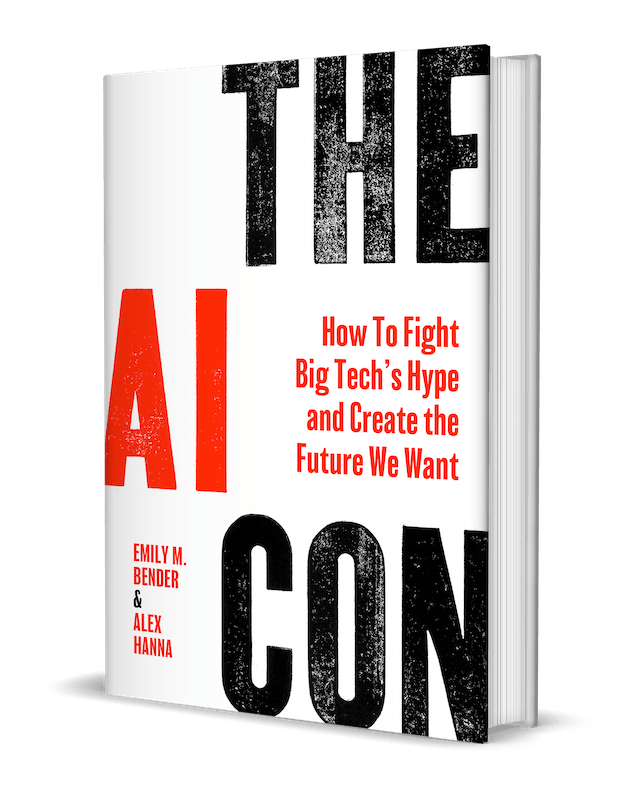
The AI CON by Dr. Emily M. Bender and Dr. Alex Hanna. Source.
by Brian Shilhavy Health Impact News
The AI bubble and impending financial collapse is now being reported more than ever before.
And while the corporate media and even the alternative media are still participating in the AI Con with doomsday scenarios about computers becoming smarter than humans and “rogue AI agents” threatening our very existence, more and more people are drawing back the curtain and noticing that there is actually nothing there, and that most of what is being published in the media about AI is NOT real science, but simply science fiction.
At some point reality and the truth about AI will become evident to all, but will that time come before the entire economy of the U.S. is completely destroyed by what is being described as “The largest misallocation of capital in history“?
This commentor admitted that HE HAD NOT EVEN READ MY ARTICLE yet.
This is called “a Cult“, because it is a belief system that will withstand any amount of logic or truth you throw at it, because most of the time they will not even read or listen to anything that contradicts their belief system, and their “mission” to warn the world about the doomsday future ahead where AI takes over everything and replaces humans.
Let’s start with the AI Con first, which is what is fueling the AI Cult. The AI CON is the title of a new book that was co-authored by Dr. Emily Bender.
And while I have not read this book, I am very familiar with the work of Emily Bender. Like myself, Dr. Bender has a background in linguistics and technology, and is a Professor of Linguistics at the University of Washington where she is also the Faculty Director of the Computational Linguistics Master of Science program.
Dr. Bender co-authored an article that was recently published in The MIT Technology Review titled “Don’t be fooled by this summer of AI hype“.
Breathless claims about AGI and new capabilities fall apart pretty quickly under scrutiny.
Excerpts:
It’s been a busy few months for AI hype. At the end of April, Anthropic claimed that its model Claude Mythos is better at finding software vulnerabilities than most security experts. Then we had the OpenAI–Hugging Face hacking incident, after which Anthropic (proudly) and Meta (reluctantly) disclosed similar incidents involving their models.
This was followed by Anthropic’s claim that one of its models had made a mathematical breakthrough; soon OpenAI claimed a mathematical breakthrough of its own. Most recently, Anthropic engineer Jacob Coxon went viral announcing his departure from the company, claiming that it and OpenAI are “racing straight towards self-improving superintelligence and gambling with our lives.”
Each of these events was mostly covered breathlessly by the press, often repeating the companies’ anthropomorphizing framings—which are designed to portray their software is not only powerful but incipient “artificial general intelligence.”
So what is really going on? Are we witnessing a massive, civilization-changing set of technological breakthroughs, or is this marketing?
In all these incidents, massive fanfare from the companies (presented as mea culpas in illicit hacking cases) is accompanied by intense press coverage. Once there is time for experts in the relevant fields to examine what happened, a very different story emerges, but one that gets less media attention.
Regarding the “hacking” incidents, cybersecurity experts say the story is more about OpenAI’s negligence and failure to adopt basic, established security practices than about “models gone rogue” or “AI agents creating civilizations.”
As for the mathematical results, mathematicians who were initially “stunned” by OpenAI’s press release saying that its latest chatbot, Astra, solved problems that “have been open and seen no progress on the main result for at least a decade” later realized that the results weren’t as “novel as first appeared.”
Since then, mathematicians have accused the company of research misconduct and plagiarism, and they’ve reiterated that Astra didn’t make a “profound intellectual leap.” Just weeks later, OpenAI claimed its own mathematical breakthrough.
Two days before, Tristan Buckmaster, a math professor at New York University’s Courant Institute, published a bombshell statement suggesting that OpenAI had stolen other people’s work and improperly attributed it.
Claims of incipient, dangerous superintelligence are not based in good scientific or engineering practice. Rather, they are narratives based in ideologies of transhumanism, eugenics, and wishful thinking about imagined future digital humans.
Instead of OpenAI being prosecuted for creating malware that hacked another company, press releases, news outlets, media personalities, and lawmakers refer to “rogue models” as if they acted on their own.
Instead of researchers being questioned about their companies’ habit of plagiarizing academics’ work or using customer data to train models without consent, the public’s imagination is redirected to fears about what the future might hold upon the arrival of fictional superintelligent machines.
If you search beyond the AI hype and religious fever producing their click-bait “news” which everyone prefers reading about these days, you will find genuine fear and concern about where all this massive AI spending is leading us.
“Apocalyptic” is not really hyperbole when you drill down to the facts, instead of reading the hype.
It just isn’t making it into most of the corporate news feeds, because the facts don’t sell as well as the hype.
Here are some examples that you maybe missed from your news sources recently.
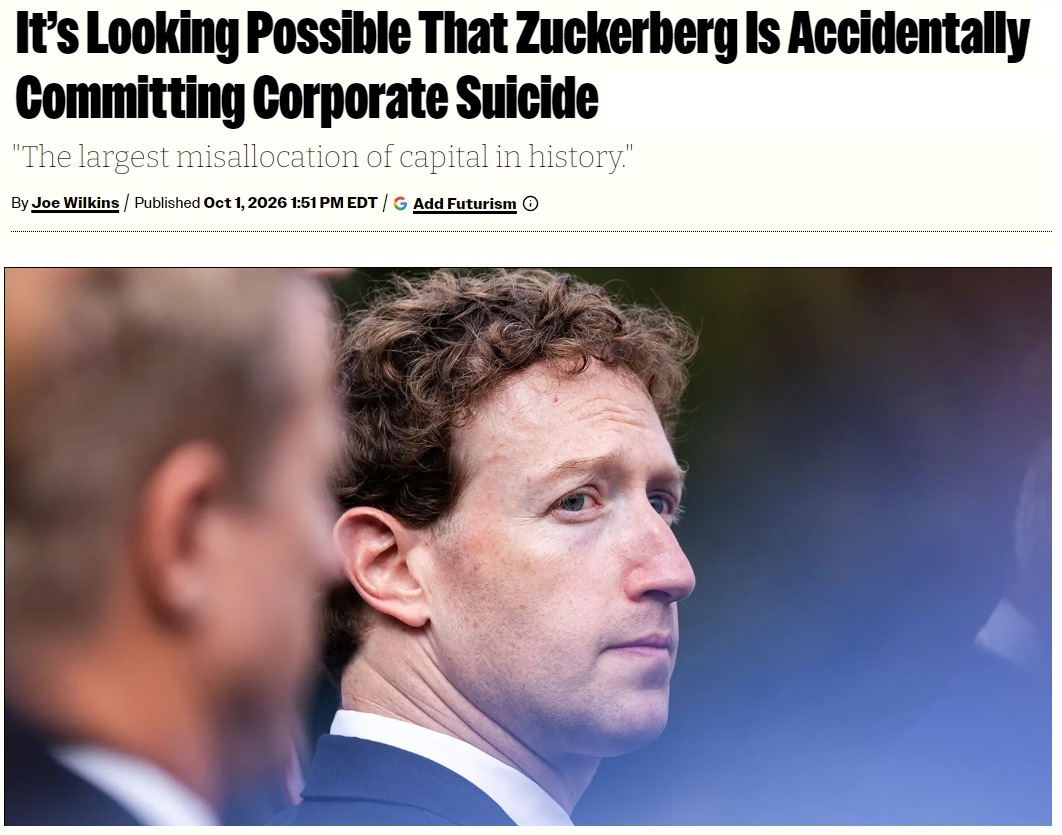
It’s Looking Possible That Zuckerberg Is Accidentally Committing Corporate Suicide
“The largest misallocation of capital in history.”
Excerpts:
Meta CEO Mark Zuckerberg has made the rash decision to double-down on massive AI spending, pushing a cutesy AI-mascot and poaching tech industry veteran Chirantan Desai to run a new division pushing Meta’s AI onto corporate customers.
The company’s investors, however, appear to be running out of slack for Zuckerberg’s leash. Since Friday of last week, a large sell-off in Meta stocks shrunk his paper fortune by nearly $20 billion, after Goldman Sachs began raising doubts about the long-term viability of the company’s AI ambitions.
It raises the question as to how much capital will be made available to satisfy the tech industry’s pie-in-the-sky AI push, and whether it can ever achieve revenue that would offset it.
In addition to Goldman Sachs’ gloomy outlook for Meta, hyperscalers as a whole face what appears to be an insurmountable challenge in turning AI into a profitable venture. As Bloomberg reported, the major management consulting firm Bain and Co recently penned an analysis finding that the AI industry will need to reach an annual revenue of $6 trillion by 2031 if tech leaders continue along their current spend-happy trajectory.
Doing so will require leaps in technological progress the likes of which are unprecedented in the information age — well beyond past innovations embodied by world-changing consumer tech like smartphones, for instance.
If we take the cynical path and assume that the AI industry won’t be able to pull off this miracle, then any major tech firm currently doubling down — like Zuckerberg’s Meta — will have functionally spent the better part of the 2020s rigging up their own corporate noose.
As finance professor at the University of Pennsylvania’s Wharton School Jessica Wachter penned in her own analysis of the AI financial bubble, if the promised money shower “fails to materialize,” then future historians will look back on this moment as the “largest misallocation of capital in history.”
And here’s another article from the latest The MIT Technology Review that does a deep dive into current AI spending, which also looks at Jessica Wachter’s analysis, and where this is probably leading us.
What’s at stake in AI’s trillion-dollar gamble
The AI hyperscalers will likely spend more than $1 trillion on data centers next year. Can they make enough money to sustain the infrastructure boom?
Excerpts:
When Jessica Wachter, a finance professor at the University of Pennsylvania’s Wharton School, wanted to assess AI’s impact on the economy over the next few years, she faced a long list of business and technical uncertainties. So she started with what she calls a “remarkable fact” that is not in question: A handful of so-called hyperscalers are investing huge amounts of money to build AI data centers.
Instead of trying to predict how useful and widely deployed AI models will be, she simply asked how fast the hyperscalers’ earnings will need to grow to justify their spending through 2027, when—she and her collaborator estimate—expenditures will reach nearly $1.1 trillion. It’s a no-nonsense accounting approach to making sense of today’s historical AI buildout.
The results are eye-opening: The AI companies will need to increase their own productivity by a factor of 2.7 to break even by 2030, accounting for the cost of capital, a 15% return, and depreciation of the assets.
If a productivity boom “fails to materialize,” she and her coauthor conclude in their research paper, “the current buildout will be the largest misallocation of capital in history.”
It doesn’t take superintelligence to realize that today’s large investments in the infrastructure for artificial intelligence come with huge risks. The hyperscalers will spend about $750 billion this year, building massive data centers scattered across the country.
And the spending spree shows no signs of slowing. According to some projections, total AI capital investments from the hyperscaler companies—Alphabet, Microsoft, Amazon, Meta, and Oracle (which partners with OpenAI)—could be more than $5 trillion over the next four years.
It’s one of the largest capital investments by any industry in history.
But there’s a problem that’s obvious to anyone paying attention.
While the hyperscalers plan to spend trillions, total AI revenues will be around $150 billion to $200 billion this year, says Gary Gensler, who ran the SEC during the Biden administration and is now a professor at MIT’s Sloan School.
“The challenge is that the spending does not have commensurate revenues yet. That’s a fact,” he says.
“And then the question is, is that an investment that will be paid off in the future?”
At stake in that trillion-dollar question is the financial health of the giant AI companies and the overall US economy—the investments could soon balloon to around 3% of GDP. The answer could also determine the fate of the hugely expensive data centers themselves.
The risks, both to investors and to the economy, have become even greater this year, as these AI companies have begun borrowing large amounts of money to build more and more data centers. Free cash flow—operating cash flow minus capital expenditures—is expected to soon dip into negative territory for the group.
Even Alphabet, known for generating and hoarding huge amounts of cash, reports in the latest quarter that its impressive revenues of nearly $120 billion were devoured by AI infrastructure spending, leaving it with a free cash deficit of some $5.9 billion—its first shortfall since Google went public in 2004.
Debt is expensive, and some investors are losing patience. If future demand for the data centers’ computation power drops, the companies will still be on the hook to pay back the borrowed money. What’s more, the risks are spreading to the rest of the economy as the loans get passed along via various financial mechanisms.
It won’t be enough to simply cover the enormous price tags of the new data centers. Hyperscalers will also have to pay for the rising costs of capital as they borrow more money.
They will need returns that are impressive enough to justify all their spending to investors and creditors. And to add to those concerns, they will have to make up for the depreciation of billions of dollars in chips housed within the facilities—a ticking time bomb buried in the investments.
Performance of the expensive GPU chips at the core of the data centers—such compute electronics represent some 60% of costs—is roughly doubling every two years or so.
Owners of AI data centers that come online this year and next will need to spend billions more on the next generation of chips by the end of the decade if they want to stay competitive.
Without the investments, says Mihir Kshirsagar at Princeton’s Center for Information Technology Policy, the data centers risk becoming “hulks,” stranded assets “scattered all over the place.”
To put it bluntly: The AI companies need to start making a lot more money. And they need to do it fast. But juicing their earnings alone still won’t be enough to sustain their data-center investments for the long term.
At some point, AI is also going to have to create broad economic growth to justify continuing the hyperscalers’ spending spree.
Sloan’s Gensler describes today’s large investments into AI infrastructure as “a parlay bet by the capital markets and the economy.” That means success will require winning three related but independent wagers: Hyperscalers must generate massive revenues, AI must boost widespread economic growth, and both must happen while the powerful but expensive so-called frontier models that rely on the data centers fend off cheaper versions, which many businesses might find good enough.
What makes this so tricky is that each wager depends on the other two but also poses its own challenges.
We’re all part of the AI gamble now
It was one thing when the AI companies were spending cash they had accumulated over the years to build their own data centers. Then the risk was largely limited to their own balance sheets and shareholders.
But it’s a higher-stakes game when much of the money is borrowed. Morgan Stanley, for one, calculates that more than half of the $2.9 trillion that hyperscalers will spend between 2025 and 2028 to build AI data centers will be financed with “external capital.”
The borrowing is leading some of the companies to engineer complex webs of financing that are becoming intertwined with much of the rest of the economy.
“A lot of financial institutions, directly or indirectly, are exposed to these data centers either as lenders, or as guarantors of some of the debt, or as backers of the private credit funds who are funding these data centers,” says Columbia’s Van Nieuwerburgh.
“People don’t even know they’re holding this stuff. It’s somewhere deep inside their pension fund. Ultimately, it’s backing their life insurance policies. And that risk is getting distributed everywhere in places that are invisible.”
As the investments in data centers have spiked, the financial engineering has become more byzantine.
Take, for example, Meta’s so-called Hyperion data center under construction in Richland, Louisiana. When the company announced the two gigawatts of compute capacity at a price tag of some $10 billion in late 2024 it was Meta’s largest planned data center.
Greeted with much enthusiasm by state and local politicians, the project, located in the rural northeast corner of the state, was seen as a boon to the community. Entergy Louisiana, the state’s largest utility, rushed forward with proposals to build three large natural-gas power plants to service the massive data center.
Then last fall—the projected cost was now $30 billion—the financing got a lot more complex and, to some in the community, a lot more disconcerting. Meta transferred an 80% stake to the large (and troubled) private-credit firm Blue Owl Capital, forming a joint venture called Beignet (like the famed New Orleans pastry) to raise financing for the data center.
Meta then signed a series of four-year leases with the joint venture, an arrangement that the company says gives it “long-term strategic flexibility.” To backstop the agreement, Meta provides the venture with what is called a residual value guarantee, in which it will make a cash payment to cover the value of the facility “following any non-renewal or termination of a lease.”
Got all that?
I hope so. The financial wheeling and dealing is actually even more convoluted, with a cast of wholly owned subsidiaries and LLCs. Beignet has set up Laidley LLC, which owns and operates the site as the landlord.
In turn, Laidley leases the facilities to Meta’s wholly owned subsidiary Pelican Leap LLC, which is the tenant. And there is a series of four-year leases that cover the different buildings that make up the data center campus.
It’s not a coincidence, says Van Nieuwerburgh, that the length of the leases matches the expected lifetime of the data center’s GPUs. While Meta has to pay off its loan if it terminates the leases early, that will still leave its investors
“with an empty building and no cash flow,” he says.
“And then they need to find a new tenant for a huge data center, and good luck with that.”
After the bubble
Predicting when the AI investment bubble will burst is a fool’s errand.
But there is little doubt a day of reckoning is coming, given the irrational exuberance that has overtaken the hyperscalers and their investors.
Of course, you might argue that this time is different, and that the rules of accounting and lessons of economic history don’t apply—that AI is too transformative.
Here are a few other articles from The Information (subscription needed to read the full articles) on AI finances that have been published recently showing the increasing debt to fund AI build-outs.
Cracks Emerge in AI’s Debt-Fueled Data Center Boom
Bond markets are getting tough for lower-rated borrowers. One example: CleanSpark, which is developing a data center for Meta Platforms, had to offer investors big concessions to land financing earlier this month.
That deal is among the clearest signs yet that financing the data center boom is getting expensive across the board, and investors are getting picky about which new projects they’ll back. The bank loan market too is showing signs of strain, with some lenders like Société Générale, Sumitomo Mitsui Banking Corp. and Mitsubishi UFJ Financial Group becoming more selective in lending to data center projects, people arranging the deals say.
Those dynamics mean companies could struggle to borrow for planned data centers, jeopardizing growth plans for the broader AI industry.
Pressures on the AI financing market are coming from a number of different directions. Big data center operators like Amazon, Google and Microsoft will together spend some $700 billion on capital expenditures this year, and are expected to continue at around that level the next few years. They’ve issued nearly $160 billion in investment-grade debt this year, flooding the market with new supply.
That hyperscaler debt is getting more expensive relative to other highly rated corporate bonds, though the tech companies generate enormous operating cash flows. The extra yield investors are demanding to hold hyperscaler debt has risen by about 0.25 percentage points this year, compared with just 0.04 percentage points for the broader investment-grade market.
At the same time, several of these big tech companies are offloading spending onto other ventures raising money in the high-yield bond market. Meanwhile, developers building data centers for AI firms like Anthropic and OpenAI are leaning on the market too.
All told, the high-yield market has seen around $55 billion of AI-related bonds sold this year.
AI Risks, Macro Volatility Collide
Meanwhile, government bond yields are spiking, fueled in part by fears that persistently high inflation will prompt aggressive Federal Reserve interest rate hikes.
The AI boom itself is adding to the pressure—Fed Chair Kevin Warsh said last week that government yields have climbed in part because heavy tech debt issuance is crowding out investors.
Debt financing for data centers and related infrastructure has grown rapidly enough that it’s become its own category these days—credit analysts are breaking out AI versus non–AI-linked debt across markets to analyze new issuance and performance. Several asset managers in recent months have filed to create exchange-traded funds focused on AI or AI infrastructure–related debt.
And right now, parts of this category aren’t doing so hot.
There’s a lot going on, from wider spreads on tech giants’ corporate debt in the investment-grade market; to investors demanding bigger concessions in recent bonds for AI data center projects in the high-yield market; to skittishness in the bank loan market for AI project financing. Investors are getting choosier and taking a harder look at project-specific construction and other risks.
Zeroing in on the high-yield market in particular, there’s a group of bonds that anyone with an interest in the AI build-out should be keeping an eye on. Overall, there have been at least 20 high-yield bond deals financing data center projects over the past 12 months.
The companies behind these projects, such as CleanSpark or TeraWulf, are hardly household names, and the project debt is often issued through even more obscure special purpose entities.
But if you do a little digging, many of the biggest names in AI show up connected to these data center projects in some form, as direct tenants, customers of the tenants or providing some kind of credit support to get the financing done. That means markets for lower-rated issuers are financing at least some of the infrastructure supporting the biggest AI companies.
Shifting economic forces are driving a widening divide between the financial views of Silicon Valley and Wall Street, clouding the outlook for trillions of dollars invested in AI.
Stock market angst has already caused delays for several medium-sized initial public offerings, and it is starting to cool once-red hot sentiment about Anthropic’s giant IPO, which is coming later in the year than investors expected.
While venture capitalists are still tripping over each other to invest at ever loftier valuations in AI startups showing any sign of traction, public market investors say they are retreating to big, safe stocks and growing skeptical about a flurry of data center companies trying to go public amid rising interest rates and high oil prices.
“Anything going public today needs to be priced right, and I don’t see it,” Samantha Lau, chief investment officer of small and mid-cap growth equities at asset management firm AllianceBernstein, referring to the IPO market overall.
“The only way to open the market is to be conservative.”
Leading AI companies like OpenAI and Anthropic will likely require a steady stream of financing, even after their IPOs, to help pay for their hundreds of billions of dollars worth of data center commitments.
Anthropic, for example, had committed to agreements for at least 14.8 gigawatts of compute capacity that could cost well over $500 billion over the next decade, The Information reported earlier this month. Data from Anthropic’s draft IPO prospectus reported this week by Reuters have renewed investor attention to the size of its financial commitments and other risks it faces.
‘Who’s Paying for It?’
Lau said that she is optimistic about agentic software capabilities that tech firms are demonstrating, showing new benefits to all the money invested in chips and data centers.
But it isn’t clear if investment firms would see a return on their investment, especially with rising interest rates that increase companies’ borrowing costs.
“The issue is, between here and the eventual utopia, who’s paying for it?” Lau added.
People in Russian-held Oleshky in Ukraine's Kherson region have endured war, occupation, and devastating flooding. Now, trapped by land mines and cut off from basic supplies, they face "hell," starving in a virtual ghost town, Ukrainian officials and volunteers say.
A food package carries no bioengineered disclosure. Does that mean no genetic engineering went into the food?
No. USDA’s bioengineered food disclosure standard leaves entire categories of genetically engineered foods and ingredients outside mandatory disclosure.
Easing restrictions on natural substances with credible histories of safe use makes sense. Yet natural products face persistent calls for tighter regulation, alongside efforts to suppress truthful information about their benefits.
Meanwhile, novel technologies that fundamentally alter our food are riding a wave of deregulation—even as their implications demand rigorous scrutiny and full transparency.
These priorities are backwards.
A Narrow Definition, Wide Exclusions
Under the current rule, foods generally require disclosure when: 1) they contain genetic material modified through laboratory recombinant-DNA techniques, 2) the modification could not otherwise arise through conventional breeding or nature, and 3) the modified material is detectable.
There are a host of exclusions:
Restaurants and food service: meals can contain engineered ingredients without this disclosure.
Very small manufacturers: businesses with annual receipts below $2.5 million are exempt.
Accidental presence: up to 5% of each ingredient may be bioengineered if its presence is “inadvertent” or technically unavoidable.
Animal feed: meat, milk, and eggs do not require disclosure solely because animals ate engineered feed.
Refined ingredients: oils, sugars, and other ingredients can avoid disclosure when modified genetic material is undetectable.
Processing aids: qualifying incidental additives present at insignificant levels with no final technical or functional effect are excluded.
Certain meat, poultry, and egg products generally fall outside coverage when those ingredients predominate, including after water, broth, or stock.
Many alcoholic beverages: products subject to federal alcohol labeling law fall outside this standard.
Nearly A Quarter of Your Chips
Consider a hypothetical bag of corn chips containing 80% cornmeal, 19% refined soybean oil, and 1% salt.
If 5% of the cornmeal is inadvertently mixed-in bioengineered corn, that represents 4% of the chips. Add oil entirely from engineered soybeans that meets non-detectability requirements: another 19% originates from GE crops.
That is 23% of the product’s weight originating from engineered crops, quite legally without a bioengineered disclosure.
This can also allow proteins made using genetically engineered yeast or bacteria (through a process called “precision fermentation”) to avoid disclosure, depending on what remains in the finished ingredient.
A CRISPR-produced food can escape disclosure if its genetic modification could otherwise be achieved through conventional breeding or found in nature.
But who decides if a modification could arise through conventional breeding or nature?
Essentially it is the food company that makes the decision…
Modern history has consistently taught us that we cannot trust our Federal Government in the U.S. to look out for the interests of consumers, and that includes the USDA and the FDA. Both of these agencies serve Wall Street, and derive much of their revenue from the very businesses they are supposed to be regulating in Big Pharma and Big Ag.
For example, the entire corn crop in the U.S. is contaminated, even if that corn is certified organic by USDA organic standards. There may be some exceptions, but we (Healthy Traditions) have never found any corn in the U.S. that has tested clean for GMO DNA, and we have been testing for 12 years now.
The only corn we have tested that has no trace amounts of GMO DNA and no traces of the cancer-causing herbicide glyphosate, has been from traditional farms in Mexico, where planting GMO corn is illegal.
Therefore, we believe we have some of the highest quality tortilla corn chips in the U.S., and we fry them in coconut oil, not toxic polyunsaturated oils derived from GMO crops like corn and soybeans. We also do not package them in plastic, but special bags that are compostable with no dangerous chemicals.
There may not be a finer tortilla corn chip sold in the U.S.!
DISCLAIMER: Brian Shilhavy is the Editor of Health Impact News, and the founder and CEO of Healthy Traditions. Everything published on the Health Impact News network is available to the public free of charge, with a Creative Commons license offered to all who wish to republish Brian’s articles, with attribution, as he earns his income from Healthy Traditions.
Healthy Traditions, originally Tropical Traditions, has served customers in the U.S. for over 24 years.
The end of the United States’ two-decade-long military presence in Iraq has raised fears of a security vacuum. Neighboring Iran and its allies in Iraq, experts say, could attempt to exploit the situation.
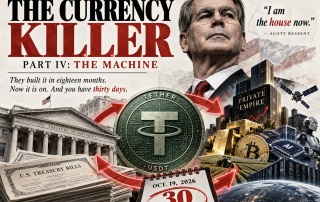
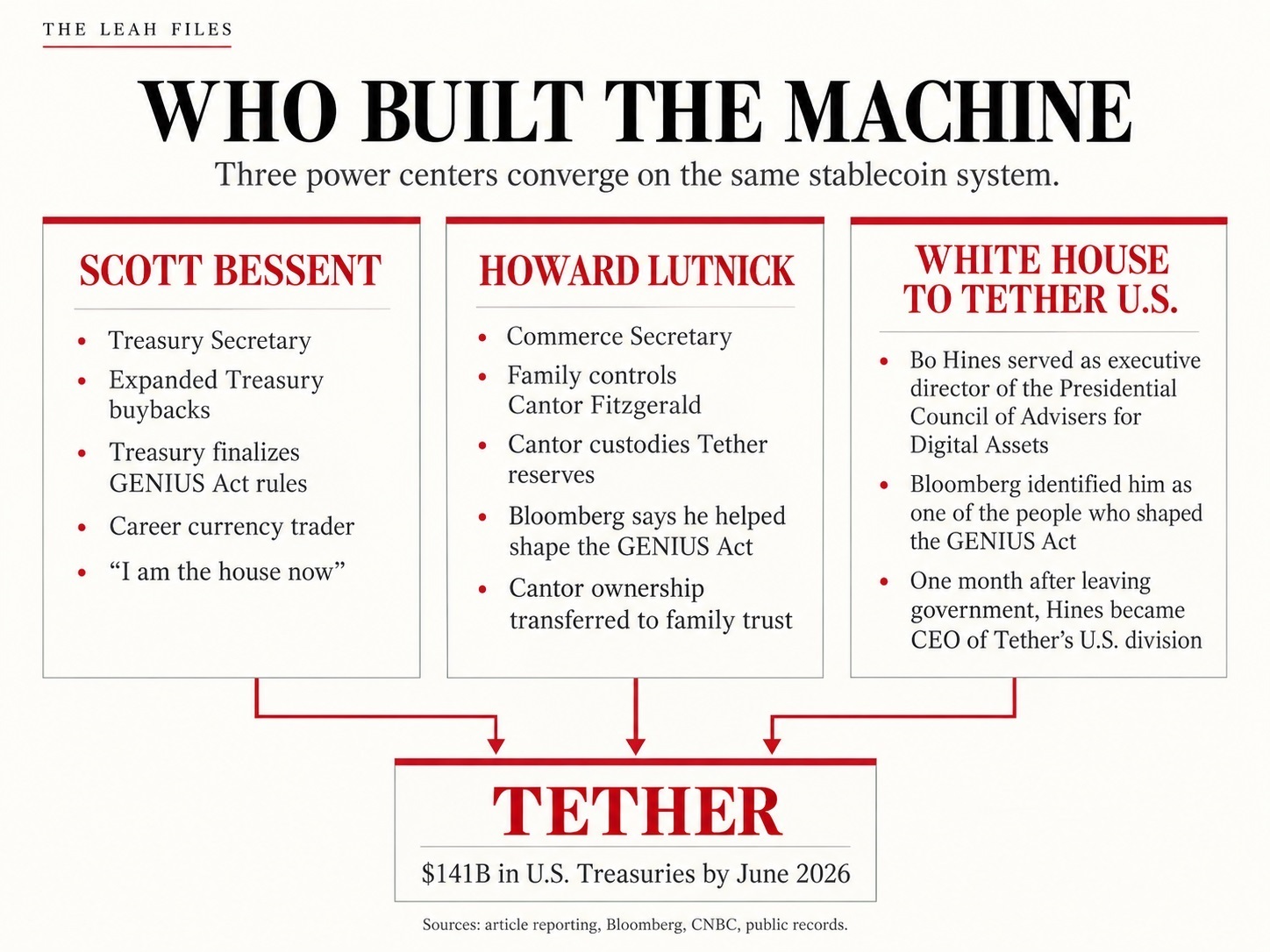
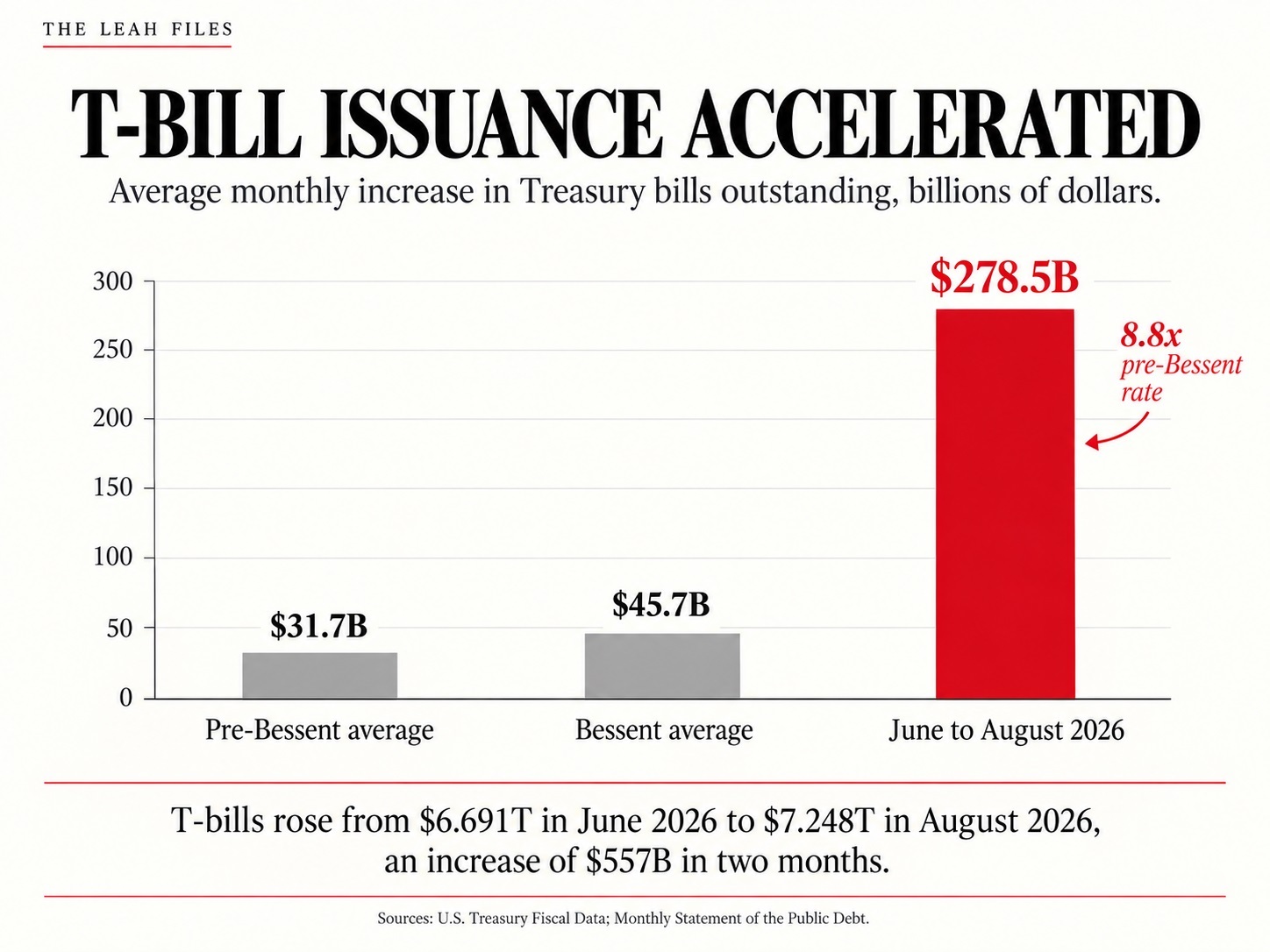
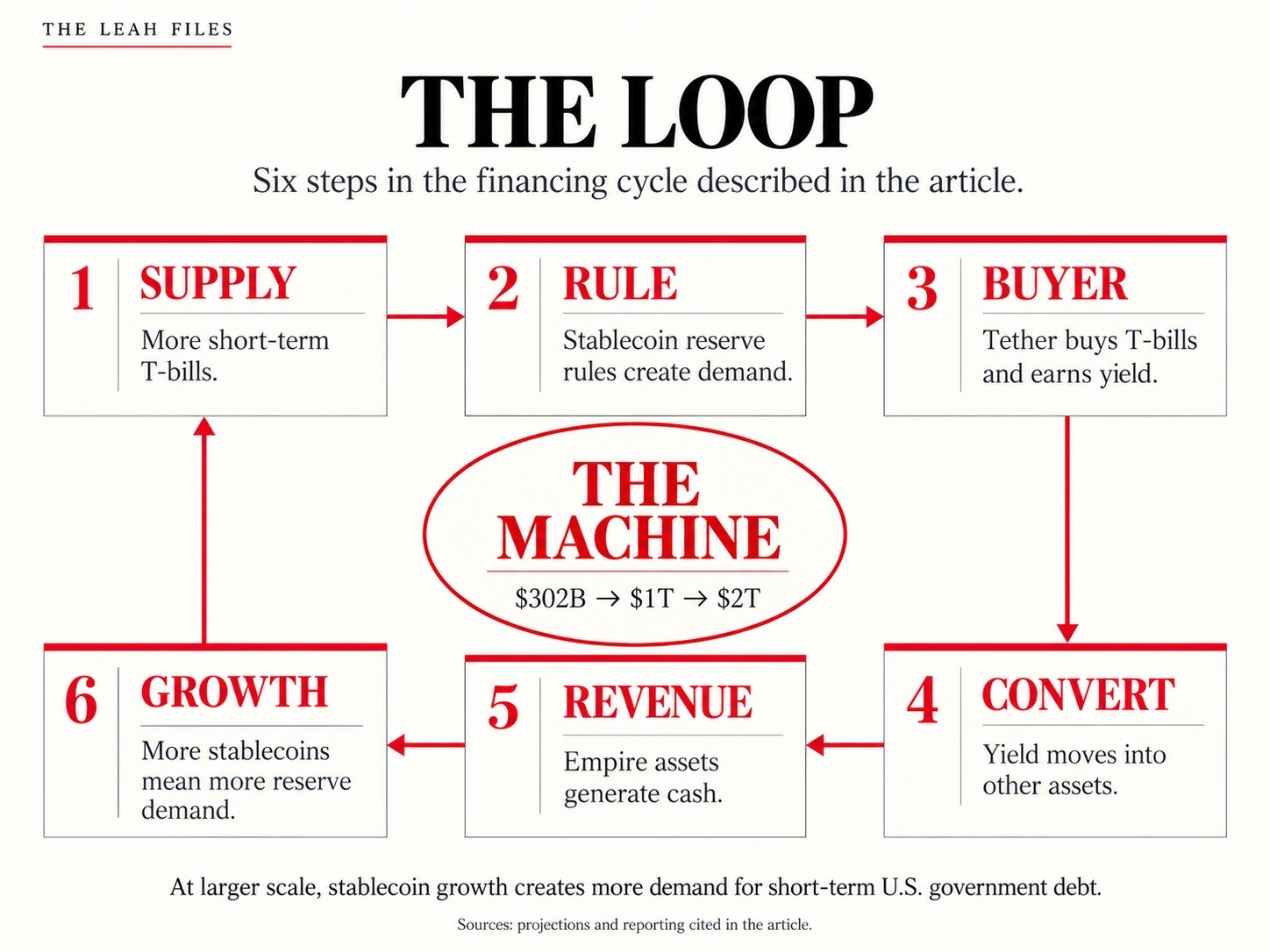
Leah of the Leah Files has just published her 4th article in her “Currency Killer” series about Treasury Secretary Scott Bessent’s attempts to take over the U.S. financial system by crashing the U.S. dollar and replacing it with stablecoins, and specifically with Commerce Secretary Howard Lutnick’s Tether stablecoin, the largest stablecoin in the world which is now rapidly buying up U.S. Treasuries.
Here is my coverage of her first three articles in this explosive investigative series that I have yet to see anyone else cover in either the corporate or alternative media:
In this 4th article in the series, Leah covers the GENIUS Act, which has already been signed into law, but has a comment period before it is enacted that will close on October 19.
As Leah writes, this is not simply “corruption as usual” in Washington D.C., where conflicts of interest rule the day.
No, this is entirely different – it is the complete hijacking of the U.S. financial system and putting it into the hands of a very few powerful people, and one very powerful company: Tether.
As Leah writes:
That is not a stablecoin company. That is a parallel financial system, every function of a central bank plus every function of an intelligence service, in one private entity, owned by four men who control 86 percent of the equity, incorporated in the British Virgin Islands, physically located in El Salvador, and paying zero corporate tax on $13 billion in annual revenue.
In 2024 during the Presidential campaign season in the U.S., I exposed many of the Silicon Valley billionaires who follow the teachings of Curtis Yarvin, and believe that democracy is a poor form of government, and would instead prefer a monarchy.
Peter Thiel heads this list, along with his protege and disciple, J.D. Vance, who is now the Vice President of the United States. See:
Of course “democracy” and the illusion that people can vote politicians into office to affect change is considered a “Constitutional Right”, and this belief is drilled into every American through our educational system.
So overthrowing the government and installing a king is just not something that would go over too well in the U.S.
However, hijacking the American financial system by crashing the U.S. dollar, replacing it with stablecoins, and putting it into the hands of a few powerful people in the private sector would accomplish almost the exact same thing, and Leah exposes it all in her series and in this latest article, which is must reading for everyone.
The Currency Killer Part IV: The Machine
They built it in eighteen months and it has been turned on. We have three weeks to make a change.
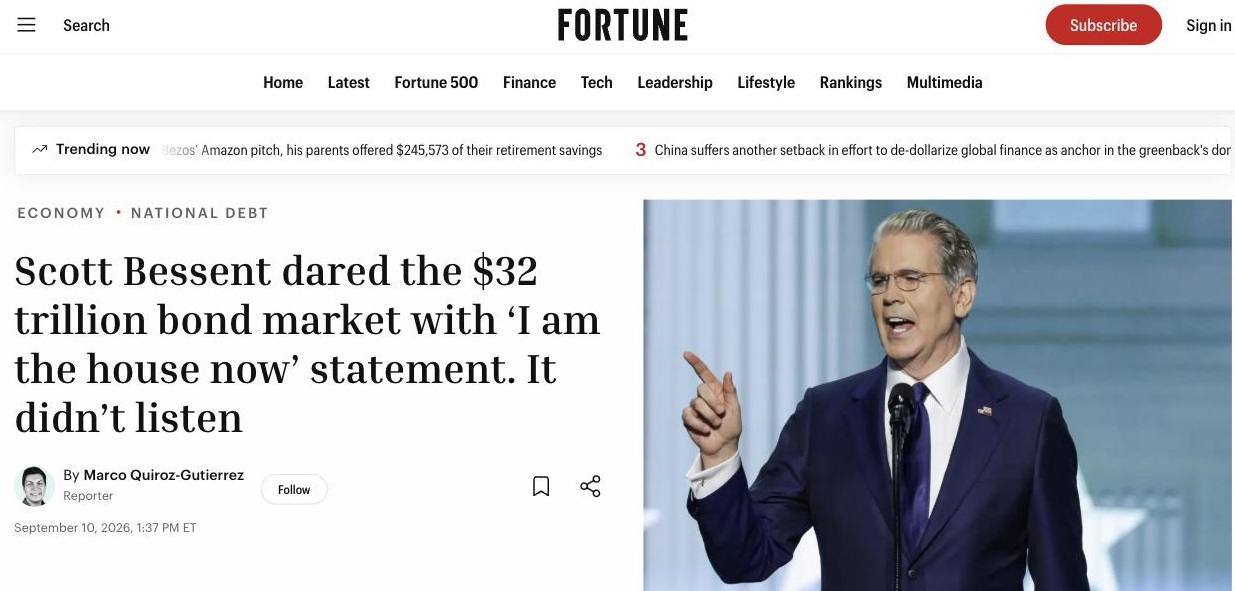
Scott Bessent, the man running the US Treasury stood in front of a room in Dallas on September 10 and said five words that should have ended his career: “I am the house now.”
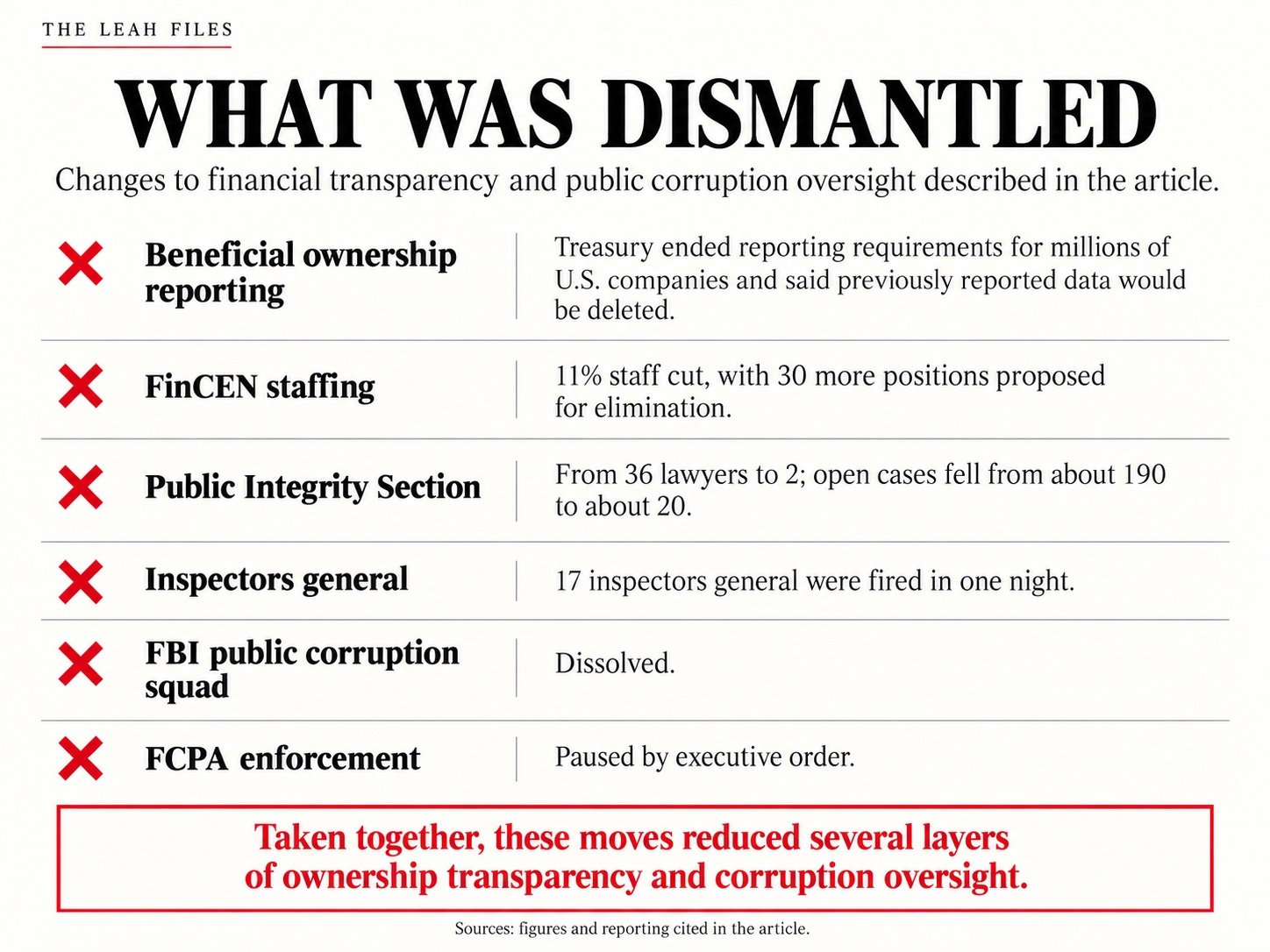
He was not joking. He tripled the government’s bond buyback program the same week. The next day, the DOJ publicly thanked Tether for helping freeze $52 million in criminal funds. Two weeks before that, his Treasury Department deleted the only federal database tracking who owns shell companies in America, and then published the rules that will govern stablecoins forever.
All of that happened in thirty-one days.
In Part I, I showed you how Bessent spent forty years breaking currencies and then took the keys to ours. In Part II, I showed you how Lutnick’s family built the custody operation with a Tether loan. In Part III, I traced Tether to Epstein’s crypto network and documented the empire they are building with the profits.
This is Part IV. This is what it looks like when all of it runs at the same time, and there is a clock on it. The GENIUS Act comment period closes October 19. That is three weeks from now. After that, the rules governing stablecoins in America get finalized by the man who profits from their growth, and the company those rules will govern just hired the man who wrote the law to be its CEO.
“I AM THE HOUSE NOW”
On September 10, Scott Bessent stood in front of a room in Dallas and said five words that should have been on every front page in America, “I am the house now.”
He was responding to critics who called his Treasury interventions reckless, after bond traders pushed back against his buyback program and drove yields higher instead of lower. His response was not to adjust, it was to triple down.
The Treasury announced it would buy back up to $6 billion in bonds in a single week, triple the normal operation. Bessent has doubled the buyback program twice since taking office, from $2 billion per operation to $4 billion, and now effectively to $6 billion per week, an escalation that no previous Treasury Secretary has attempted because no previous Treasury Secretary was a career currency trader who spent four decades learning how to move bond markets by force.
Here is what “I am the house now” means when you translate it from hedge fund speak. It means he is not managing the bond market, he is running it, setting the prices, deciding which bonds get bought, at what maturity, and at what yield.
The people on the other side of every one of those trades are the stablecoin issuers whose reserves the GENIUS Act requires to be held in Treasury bills maturing within 93 days.
When George Soros said something similar before breaking the Bank of England, he was a private citizen betting against a government.
Bessent was the man next to him when he said it.
Now Bessent is the government, and the bond market he is running determines what your mortgage costs, what the dollar is worth, and how much the country pays to borrow money.
That has never happened before, and he said it out loud.
Fortune reported that bond yields are higher now than before Bessent intervened, which means the plan is not working the way a normal Treasury Secretary would want it to work. But it is working exactly the way a currency attacker would want it to work, because higher long-term yields and lower short-term yields is the exact trade that benefits stablecoin issuers who hold short-term T-bills.
Bessent knows this because he spent forty years doing this.
THE NUMBERS
Here is what Bessent is actually doing with the bond market, because the numbers tell a story the headlines are not.
The GENIUS Act requires every stablecoin to be backed by Treasury bills maturing within 93 days. Not bonds, not notes. Short-term bills specifically. That means every new dollar of stablecoin growth creates a dollar of mandatory demand for one very specific type of government debt.
Now look at what Bessent did with supply.
Before he took over, the government was adding about $31.7 billion in T-bills per month. Under Bessent, the average rose to $45.7 billion. Then in June 2026, it exploded: T-bills outstanding jumped from $6.691 trillion to $7.248 trillion in two months. That is $557 billion in sixty days, 8.8 times the pre-Bessent pace. He is flooding the market with exactly the securities that stablecoin issuers are required by law to buy.
And there is only one buyer large enough to absorb that at scale. Tether held $98.5 billion in T-bills at the end of Q1 2025. By June 2026 it was $141 billion. They are already the 17th largest holder of US government debt on earth, bigger than Germany, and their CEO has said publicly they want to be top five.
Here is what that means for your wallet.
An academic study found that Tether’s buying lowers short-term yields by 24 basis points, which saves the US government roughly $15 billion a year in borrowing costs. The government is paying less on its debt because Tether is buying it. Standard Chartered projects stablecoin issuers will need $1 trillion in T-bill reserves by 2028. Bessent himself says $2 trillion.
Read that again.
The US government is becoming financially dependent on a private company incorporated in the British Virgin Islands to finance its own borrowing. And the man running the Treasury is the one making it happen.
That is the feedback loop nobody is naming.
Bessent issues the T-bills. The law requires Tether to buy them. Tether’s buying lowers yields and saves the government money. The government becomes dependent on Tether’s demand. Tether becomes too important to regulate. And Tether takes the yield from those T-bills and converts it into something else entirely.
Bessent has gutted every agency that would be watching any of this. FinCEN, the agency whose entire job is tracking dirty money, took an 11 percent staff cut with 30 more positions proposed for elimination, and the beneficial ownership database was ordered deleted.
The Public Integrity Section, the DOJ unit that prosecutes corrupt officials, went from 36 lawyers to 2 and from 190 open cases to about 20. Seventeen inspectors general were fired in a single night. The FBI’s public corruption squad was dissolved. Foreign Corrupt Practices Act enforcement was paused by executive order.
THE LOOP
Here is how it works when you put all the pieces together, six steps where each one feeds the next.
Step one: Bessent floods the market with short-term Treasury bills, tripling the buyback program to $6 billion per week and shifting debt issuance toward shorter maturities in what analysts call the “Treasury Twist.”
Step two: the GENIUS Act requires every stablecoin to be backed by reserves held in T-bills maturing within 93 days, which means every new dollar of stablecoin growth creates a dollar of mandatory demand for the exact securities Bessent is issuing.
Step three: Tether buys those T-bills, currently holding $141 billion in US Treasuries, making it the 17th largest holder of US government debt on earth and bigger than Germany, earning roughly $13 billion a year in yield.
Step four: Tether uses that yield to build the empire, deploying more than $5 billion since late 2023 into farmland, fertilizer, AI data centers, satellite companies, robotics, media platforms, gold, and bitcoin.
Step five: the empire generates revenue, with Adecoagro alone producing $467 million in annual EBITDA, the farmland growing crops, the bitcoin mines running on sugarcane electricity, the gold lending operation earning interest, and StableFund deploying private credit, with every subsidiary producing cash that flows back to Tether.
Step six: Tether issues more stablecoins, which require more T-bill reserves, which creates more demand for Bessent’s bonds, which keeps yields low, which lets the government borrow cheaply, which means Bessent can issue more T-bills.
That is the loop, and once it reaches scale no future president can dismantle it without crashing the bond market. At $1 trillion in stablecoins, the US government depends on Tether to finance its operations.
At $2 trillion, Bessent’s own projection for 2028, stablecoin issuers hold a quarter of all T-bills outstanding. At $4 trillion, the whole thing is permanent, because the interest rates on your mortgage, your car loan, and your credit card would all spike overnight if anyone tried to unwind it.
We are at $302 billion right now and the clock is running….
A new wave of deadly Russian attacks on Ukrainian cities is fueling bipartisan calls in Washington for US President Donald Trump to use sweeping new sanctions powers against Moscow, with lawmakers arguing that greater economic pressure could strengthen efforts to end the war.
I have just finished listening to an interview with international journalist Pepe Escobar, that aired today, about two hours before I am publishing this.
If you want to detox yourself from the U.S. corporate media propaganda, and get the “other side” of the current situation in the Iran War, investing time to watch this video (55-minutes long) is well worth it.
There were apparently attempts to knock Escobar offline during the interview, suggesting that there are forces who do not want people to hear what he has to say. (I have this video saved, so if it disappears from YouTube let me know, and I will restore it on another platform.)
Escobar states that Iran gained a lot of friends and a lot of support in New York last week at the UN General Assembly meeting. Escobar also gives information about China President Xi’s meeting with President Trump last week that was generally not covered in the U.S. corporate media.
He claims that Xi pressed Trump to return to the MOU (Memorandum of Understanding) from last June that was negotiated by Pakistan, and that the U.S. originally signed.
But over this past weekend, Trump made it known publicly that he is rejecting any offer by Iran to end the war, and Escobar states that this does not sit well with China at all, and that China will now become much more involved in working with and helping Iran in the current war.
He states that Iran is now going on the offensive, and he expects things to start happening this week.
Escobar does a good job of trying to educate his listeners as to what the mindset is in Shiite Islam, and that they have no fear of dying for their faith.
The Epstein Syndicate’s real agenda, according to Escobar, is to nuke both sides in the Middle East, both Persians and Arabs alike, and take over the Strait of Hormuz that Trump plans to name after himself.
Pepe Escobar:
There is no solution (to ending this war through negotiation). It is a do or die war.
Americans have been deceived into thinking that this is a religious war that was started with Iran to combat the dangers of Islam.
But the truth is that this is a religious war started by Trump and his Zionist friends who surround him, including Evangelical Christian Zionists, and he is forcing everyone in the U.S. to accept Zionist Christian beliefs, including the military, to fight this war based on Zionist religious views. See:
Escobar also addresses Russia, where he recently visited, and states that Russia is preparing to go to war against Europe.
He also mentions that BRICs has been slow to implement changes to bypass the Western financial system, but that there is the feeling that this will change in 2027, when the annual BRICs meeting will be held in China, and will be dominated by China’s agenda.
Left Image: Saint Luke the Evangelist 1450 – Source. Top Right: De materia medica in Arabic 12th–13th century – Source. Bottom Right: Cumin and dill from an Arabic book of simples 1334 – Source.
by Brian Shilhavy
The word “physician” mostly has a negative meaning in the Bible.
In the thirty-ninth year of his reign Asa was afflicted with a disease in his feet. Though his disease was severe, even in his illness he did not seek help from the LORD, but only from the physicians. (2 Chronicles 16:12)
A woman who had had a hemorrhage for twelve years, and had endured much at the hands of many physicians, and had spent all that she had and was not helped at all, but instead had become worse— after hearing about Jesus, she came up in the crowd behind Him and touched His cloak.
For she had been saying to herself,
“If I just touch His garments, I will get well.”
And immediately the flow of her blood was dried up; and she felt in her body that she was healed of her disease. (Mark 5:25-29)
However, the word “physician” is used positively in the New Testament portion of the Bible when it refers to Jesus Christ:
When the scribes of the Pharisees saw that He was eating with the sinners and tax collectors, they said to His disciples,
“Why is He eating with tax collectors and sinners?”
And hearing this, Jesus said to them,
“It is not those who are healthy who need a physician, but those who are sick; I did not come to call the righteous, but sinners.”
(Mark 2:16-17)
As I have previously written over the years, the Jewish people had their own system of healing as prescribed by the Law of Moses, and it involved the Levitical Priests. They were not supposed to rely on the “pagan doctors”, and hence the criticism of King Asa who apparently did not follow the Law of Moses, but went to pagan doctors instead during the Old Testament days.
In the New Testament, Jesus Christ established himself as the Messiah who had the authority to heal people from their diseases.
There is one exception in the New Testament, however, of one of the disciples of Jesus being referred to as “the beloved physician”, which is how the apostle Paul referred to Luke, who is believed to be the only non-Jewish author in the New Testament portion of the Bible. He wrote the Gospel of Luke, as well as the Acts of the Apostles.
He was a frequent traveling companion with Paul, who referred to him as “the beloved physician”.
Luke, the beloved physician, sends you his greetings, and Demas does also. (Colossians 4:14)
Historical evidence outside of the Bible has led some people to believe that Luke was originally from Antioch, and attended a famous medical school in Philippi, part of the Roman empire at that time.
Since Luke is not referred to as a “former physician”, it is reasonable to believe that he may have retained some of his “medical” knowledge and perhaps even continued to use it as a disciple of Jesus.
However, to understand how the English word “physician” (ἰατρός – iatros in the Greek) was used over 2000 years ago in the Greek/Roman world, we need to look at some history of Greek-Roman medicine as it was practiced back then, which is very different from how the terms “doctor” and “medicine” are used today in the 21st Century.
During the First Century when the authors of the New Testament portion of the Bible lived, the practice of medicine was highly influenced by ancient Greek medicine, and the Greek physician Hippocrates. Much of Hippocrates’ work was compiled into The Hippocratic Corpus.
During the time the New Testament was being written, the city of Tarsus, where the apostle Paul lived, had a major medical school practicing Greek medicine.
Pedanius Dioscorides – The Father of Pharmacognosy
Dioscorides receives a mandrake root, an illumination from the 6th century (c. 512) Greek Juliana Anicia Codex. Source.
One of the most famous students to study at this school was Pedanius Dioscorides, a pharmacologist, physician, botanist, and author of De materia medica (“On Medical Material”). He was a military physician in Nero’s Army
Dioscorides was known as “the father of pharmacognosy“, but all of his “medicines” were plants, not the patented chemical medicines that we think of today when we hear the term “medicines.”
Plant “medicines” were also the foundation of other non-Western sources of ancient medical systems, such as Chinese Traditional Medicine, and the Indian Ayurveda system of medicine, both of which have been around for 4000-5000 years. (Source.)
Cover of an early printed version of De materia medica, Lyon, 1554. Source.
Dioscorides wrote a five-volume book De materia medica (“On Medical Material”), which became the precursor to all modern pharmacopeias, (Source: Rooney, Anne 2012. The History of Medicine. The Rosen Publishing Group. p. 121), and was widely read for more than 1,500 years.
It was translated into Arabic in the 13th Century by Ibn al-Bayṭār, an Andalusian Arab physician, botanist, pharmacist and scientist.
He systematically recorded additions made by Islamic physicians in the Middle Ages, which added between 300 and 400 types of medicine to the one thousand previously known since antiquity. He was a student of Abu al-Abbas al-Nabati. (Source.)
Famous Roman Physicians
Here are the bios of a couple of other famous Roman physicians who were alive during the time the New Testament was being written, from Wikipedia’s entry on Medicine in ancient Rome.
Asclepiades of Bithynia
Asclepiades studied to be a physician in Alexandria and practiced medicine in Asia Minor as well as Greece before he moved to Rome in the 1st century BC. His knowledge of medicine allowed him to flourish as a physician. Asclepiades was a leading physician in Rome and was a close friend of Cicero.
He developed his own version of the molecular structure of the human body. Asclepiades’ atomic model contained multi-shaped atoms that passed through bodily pores.
These atoms were either round, square, or triangular. Asclepiades noted that as long as the atoms were flowing freely and continuously, then the health of the human was maintained. He believed that if the atoms were too large or the pores were too constricted, then illness would present in multiple symptoms such as fever, spasms, or in more severe cases paralysis.
Asclepiades strongly believed in hot and cold baths as a remedy for illness; his techniques purposely did not inflict severe pain upon the patient. Asclepiades used techniques with the intent to cause the least amount of discomfort while continuing to cure the patient.
His other remedies included music therapy to induce sedation, and consuming wine to cure headaches and a fever. Asclepiades is the first documented physician in Rome to use massage therapy.
Aulus Cornelius Celsus
Celsus (25 BC–AD 50) was a Roman encyclopaedist who wrote a general encyclopaedia about many subjects. His exact place of birth as well as when he lived are unknown; however, it is known he lived during the reigns of Augustus and Tiberius.
The only surviving work from his larger encyclopaedia is De Medicina. This work contains eight volumes, two of which are on surgery.
De Medicina provides some of the best accounts of Roman medicine during his time.
Its contents proved to be valuable even into the 15th century after Pope Nicolas V rediscovered it, becoming the first medical book to be published in 1478. It is still debated if he practiced medicine himself or just compiled the works of the time, much of it from Greek sources. This is important because at the time Greeks were looked down upon by the Romans and thus so was the work of doctors.
In his book he discussed the two different schools of thought at the time relating to medicine he calls “Empirics” and “Dogmatics”.
Empirics followed empirical observation while Dogmatics needed to understand the theory behind how a treatment works.
Celsus is also credited with writing on four of the five characteristics of inflammation, redness (rubor), swelling (tumour), heat (calor), and pain (dolor). Galen would write about the fifth, loss of function (functio laesa).
The Role of “Elders” in Ancient Greek-Roman Medicine
De agri cultura, also known as On Farming or On Agriculture, is a treatise on Roman agriculture by Cato the Elder. It is the oldest surviving work of Latin prose. Source.
Cato the Elder was a Roman soldier, senator, and historian who lived about 200 years before the New Testament was written, but his influence on Roman culture and medicine would have certainly been felt by those living in the First Century when the authors of the New Testament were living.
Cato the Elder despised every aspect of Greek society the Romans decided to mimic including sculptures, literature and medicine. He regarded the welcome given in Rome to Greek medicine and physicians as a major threat.
In Rome, before there were doctors, the pater familias (head of the family) was responsible for treating the sick. Cato the Elder himself examined those who lived near him, often prescribing cabbage as a treatment for many ailments ranging from constipation to deafness.
He would issue precise instructions on how to prepare the cabbage for patients with specific ailments. He also used cabbage in liquid form.
For example, a mixture of cabbage, water, and wine would be embedded in a deaf man’s ear to allow his hearing to be restored. Cato would treat fractured or broken appendages with two ends of a cut reed that were bandaged around the injury. (Source: “Household Medicine in Ancient Rome“. The British Medical Journal. 1 2140: 39–40. 1902.)
This context may help us understand the “medical advice” given by James, the half-brother of Jesus, in the 5th chapter of his letter recorded in the New Testament:
Is any one of you sick? He should call the elders of the congregation to pray over him and anoint him with oil in the name of the Lord.
And the prayer offered in faith will make the sick person well; the Lord will raise him up. If he has sinned, he will be forgiven.
Therefore confess your sins to each other and pray for each other so that you may be healed. The prayer of a righteous man is powerful and effective. (James 5:14-16)
Medicine in the 21st Century
The next time you read about “Luke the beloved physician” in the Bible, hopefully you will have a better understanding now about “physicians” and “medicine” in the Roman Empire during the time the Bible was being written, which bears no resemblance to doctors and medicines today.
The Western form of “medicine” today is dependent on repeat customers, and is a disease management system, NOT a “health care” system. To actually cure patients would cause them to go out of business! See:
Natural remedies, which used to be called “medicine” in ancient times, cannot be patented, and are therefore a threat to the pharmaceutical industry here in the 21st Century.
I learned this firsthand myself, back in 2005 when we were selling Virgin Coconut Oil and publishing customer testimonials about the health benefits of consuming coconut oil, as well as publishing peer-reviewed literature showing how the medium chain fatty acids in coconut oil can fight diseases.
The FDA came after us and threatened to shut down our business, seize our inventory, and put me in jail for selling “unapproved drugs.”
Why in the world do Americans continue to give money to campaigns to “help find a cure for cancer” as they have done for decades, when MANY cures for cancer already exist, but are banned from being used here in the U.S. forcing people to go to Mexico or Europe to find those cures?
Money given to charities to “find a cure for cancer” usually just goes into the pockets of drug companies to develop more drugs.
We need more “beloved physicians” like Luke, who know the power of Jesus to bring about REAL healing, and we need “Elders” who can also tap into the power of Jesus to heal without the need of modern doctors and medicines. See:
Firearms allegedly diverted into illegal channels by a police officer near Sarajevo may have reached Iran-linked criminal networks across Europe, sources familiar with a Bosnian weapons-trafficking investigation told RFE/RL's Balkan Service.
Earlier this year I reported how President Trump issued an executive order mandating domestic production of glyphosate-based herbicides for use in agriculture and the military.
Now it is being reported that Trump’s Environmental Protection Agency (EPA) has allowed Bayer/Monsanto to choose their own regulations they are willing to abide by for another destructive herbicide, dicamba.
US environment agency let Bayer pick regulations for destructive weedkiller, documents show
Environmental Protection Agency asked firm to choose rules it wanted for dicamba, then put the choices in a proposed federal rule
The EPA allowed pesticide giant Bayer to pick from a menu of regulation options for the controversial and destructive weedkiller dicamba, newly released internal agency documents show.
The documents provide an unusually clear look into the process of developing pesticide regulations, which is typically done out of public view.
It shows in detail how the EPA asked Bayer which regulations it wanted, received a response from Bayer, then put Bayer’s choices into a proposed federal rule.
Dicamba is drift prone and kills vegetation and crops for miles around fields where it is sprayed, and is linked to liver cancer and Non-Hodgkin lymphoma.
Courts have twice ordered it off the market because of its drift problems, but the EPA has re-approved it.
If you want to learn more about the herbicide dicamba, here are a couple of articles about the history of the use of this dangerous herbicide in the U.S. that the EPA continues to allow:
It has been well documented that Trump’s EPA in his second term is run by former industry insiders and lobbyists from the very industry it is supposed to regulate. See:
Not only are they seeking to give legal protection to Bayer for their dangerous herbicides which have been ruled in the U.S. Courts to cause cancer and other diseases, they have also removed regulations for power plants that pollute the air so that data centers can be built very quickly to fuel the energy needed for more AI development.
These actions are being sold to the Conservative MAGA movement as necessary to roll back “climate change” regulations by “the liberals” which they claim are based on bad science, and hamper industry development.
But these actions have nothing to do with fighting back against the “climate change agenda”, and have everything to do with enriching the pockets of Trump’s friends in the industry who do not want to be regulated anymore for purely economic reasons that have nothing to do with the environment or the health of the U.S. population.
Americans from both sides of the political spectrum are now opposing things like these data center developments, so don’t fall for the partisan political games!
It is getting more and more dangerous to purchase food from the big box retailers stocking commodity food. Your beef could be from Argentina from shipments that were rejected by China (source), and much of the food you purchase could be contaminated with chemicals that have been banned in most other countries and have been legally shown to cause disease in a court of law.
Your government here in the U.S. is NOT looking out for you! So you need to become a health-conscious consumer, and try to purchase food where you know where it came from and how it was produced.
My own online story, Healthy Traditions, provides options for food produced by small-scale family farmers where we have thoroughly tested it.
We are sourcing more and more of our food from outside the U.S., due to necessity. Starting this year, 2026, we are only purchasing grains from Italy, where their standards for food are far superior to the USDA national organics program.
We stopped participating in the USDA organic program years ago, due to the influence of Big Food that has watered down the standards and still allows trace amounts of herbicides and pesticides. See:
We have consistently tested products in the U.S. that claim to be “organic” or “GMO free” and have routinely found these products contaminated with dangerous herbicides like glyphosate, and GMO DNA.
And they are not even violating USDA organic standards.
In Europe, and especially in Italy, if someone makes a claim to having a European organic certification and then those products are tested to be contaminated, they lose their license to sell, and face criminal charges, unlike the U.S.
Americans have no one to blame for the sad state of our food and food production here in the U.S., however, except themselves, because the American consumer still has the largest voice and the most influence when it comes to food standards.
But people buy in to the partisan political debates and falsely think they can just vote the right person into power to solve their problems.
The most effective way, however, to bring about change, is by voting with your dollars and where you spend your money.
This is the only thing that will affect change, but it takes a lot more effort to seek out ethical food producers in your community and support them instead. It is just so much easier to stop at the Big Box grocery stores where you can get all your shopping done in minutes.
Convenience has a price: and it may cost you your life.
This article was written by Human Superior Intelligence (HSI)
See Also:
Understand the Times We are Currently Living Through
 Login