David Milstein, a senior advisor to US Ambassador to “Israel” Mike Huckabee, suppressed an embassy memo critical of the Israeli government’s decision to approve additional settlements in the Israeli-occupied West Bank, The New York Times reported, citing three US officials who work with Milstein.
The officials told the Times that Milstein blocked the memo from being released before it could be shared with lawmakers in Washington. He also insisted on approving communications from the embassy section responsible for Palestinian affairs, according to multiple officials with direct knowledge of the matter.
The officials said they spoke to the newspaper because they were concerned that Milstein’s actions were undermining the normal work of the diplomatic mission, while those who interacted with him told the Times that he went to “unusual lengths” to portray “Israel” positively.
Milstein’s role at embassy comes under scrutiny
Milstein’s LinkedIn profile shows that he previously worked as an aide to Sen. Ted Cruz, R-Texas, and as an advisor to Florida Gov. Ron DeSantis’ gubernatorial campaign, where he handled “Jewish and pro-Israel outreach.” He later served as a special assistant to former US Ambassador to “Israel” David Friedman during President Donald Trump’s first term.
Milstein also drew attention in September after sending wedding invitations requesting “monetary wedding gift[s]” in “U.S. dollars or Israeli shekels” alongside a QR code, according to screenshots reviewed by Politico’s Playbook.
Huckabee defended Milstein following the report, writing on social media, “If there is anyone I’ve worked with presently or over the past 50 years of my adult life which I’ve had absolute confidence in as one with impeccable integrity, it’s David Milstein.”
A source in the intelligence community told Politico, “[Milstein’s] a giant walking counterintelligence red flag … the fact that he is blatantly soliciting donations is absolutely jaw dropping.”
The Trump administration previously dropped sanctions imposed by the Biden administration on extremist Israeli settlers. Huckabee has also condemned settler violence in the West Bank, calling it an “act of terror.”
Huckabee has separately addressed growing dissatisfaction toward “Israel” in the United States, telling NewsNation that social media disinformation and foreign propaganda were responsible for much of the negative perception.
International Organization for Migration (IOM) Director General Amy Pope warns: "As winter rain begins, the combined supply pipeline of humanitarian shelter partners covers barely 17 per cent of identified winter needs"
Three years after Israel launched its genocidal aggression on the Gaza strip, massacres and mass destruction continue to take place on a daily basis, despite the US-brokered ceasefire deal that was reached in October 2025.
The nominal truce was preceded by two other short ceasefire agreements. The first was reached in November 2023 and lasted for only one week, while the second was sealed in mid-January 2025 and collapsed two months later.
For three entire years, the world has borne witness to one of the most heinous genocides in modern history, which has resulted in the killing of at least 75,000 Palestinians, according to the latest official health reports, with women, children, and the elderly comprising 56.2% of the death toll. Meanwhile, 82% of Gaza’s structures have been destroyed.
Starvation and the total blockade of aid have also been used as weapons of war against the Palestinian population in the war-ravaged territory.
As soon as it was launched, the US-backed fierce Israeli military campaign expanded beyond Gaza to include other parts of West Asia, including the occupied West Bank, Lebanon, Yemen, and Syria.
About 9,000 people have been killed in Lebanon, more than 1,136 in the West Bank, dozens in Yemen and scores of others in Syria.
The systematic targeting of journalists
The genocide in Gaza has been characterized by the systematic targeting of journalists and media workers, with the death toll reaching more than 260, according to Naser Abu Baker, President of the Palestinian Journalists’ Syndicate (PJS).
Abu Baker told BreakThrough News that over the same period, 550 journalists were wounded, and over 200 were arrested.
“All of this underscores a systematic policy implemented by the Israeli occupation, which primarily aims to prevent the truth about the crimes committed in the Palestinian territories by the Israeli occupation against the Palestinian people from being documented and transmitted, especially in the Gaza Strip,” he emphasized.
The chief of PJS noted that the targeting of Palestinian journalists by the Israeli forces began over one decade before the October 7 attacks.
“PJS documented more than 9000 assaults on journalists in the occupied Palestinian territories between 2012 and 2023. More than 56 journalists were killed during that period, including three foreign journalists,” Abu Baker clarified.
Another silent genocide has been committed against Palestinian detainees in Israeli prisons
Simultaneously with the events in Gaza, the Israel Prison Service escalated a brutal crackdown against the Palestinian Prisoners’ Movement, intensifying a campaign that began in early 2023.
While around 5,200 Palestinian political prisoners were held in Israeli detention prior to October 7, 2023, the number jumped to 9,600 after the outbreak of the Israeli genocidal aggression on Gaza. Many of those prisoners have been placed under administrative detention without charge.
These latest figures only represent the prisoners whose whereabouts inside Israeli detention centers were documented by Palestinian prisoners groups. Thousands of additional Palestinians remain unaccounted for and are believed to have faced enforced disappearance amid the ongoing Israeli military operations in Gaza.
During the past three years, Palestinian prisoners have endured miserable detention conditions, including medical neglect, deprivation of adequate food and hygiene supplies, as well as physical and psychological torture.
This horrific situation culminated with the endorsement of an Israeli law mandating the execution of Palestinian prisoners by hanging.
On the third anniversary of October 7, Raed Abu al-Hummus, head of the Palestinian Commission of Detainees and Ex-Detainees Affairs, delivered a message to international human rights organizations via BreakThrough News.
“I call on international human rights organizations to practice their stated objectives, to truthfully convey our message, and to form a parallel front to our heroic prisoners’ front inside the prisons, in an attempt to protect them from these violations, from this far-right monster seeking to slowly kill them,” Abu al-Hummus stated, referring to Israel’s Minister of National Security Itamar Ben-Gvir.
It’s not about the Israeli far-right; it’s about the entire Zionist movement, says Omar Assaf
While some media outlets and political analysts suggest that Israel’s intensified atrocities in recent years represent the policy of the far-right wing solely, the Palestinian grassroots believe that they constitute the very core of the Zionist movement.
Palestinian political activist, freedom fighter and former prisoner in Israeli jails Omar Assaf argued that “the genocide does not reflect a policy of an individual or a current within the Israeli government. It rather reflects a general policy, because the Zionist movement as a whole was founded on the exclusion of the Palestinian people, expelling them, and looting their land.”
“Therefore, if this far-right government is practicing genocide, this does not mean that the next government will be a government of peace,” Assaf asserted.
Despite three years of unspeakable atrocities and over 78 years of military occupation amid the total silence and inaction of the international community, the Palestinian people remain steadfast and resilient in their homeland, refusing to leave or surrender.
At least two of Bryan’s band members were also wearing Palestine jerseys. Drummer Nate Head bore a jersey with Palestine on the front & on the back, the name “Hind Rajab”, a 5-year-old girl in Gaza killed by the Israel
Israeli attacks in Gaza killed at least three Palestinians in Gaza on Thursday as the IDF continues its constant violations of the US-backed ceasefire deal. The Anadolu Agency reported that Israeli shelling hit a tent northwest of Gaza City, killing a woman, identified as Ahlam Mubarak, and injuring her husband and two children. A medical […]
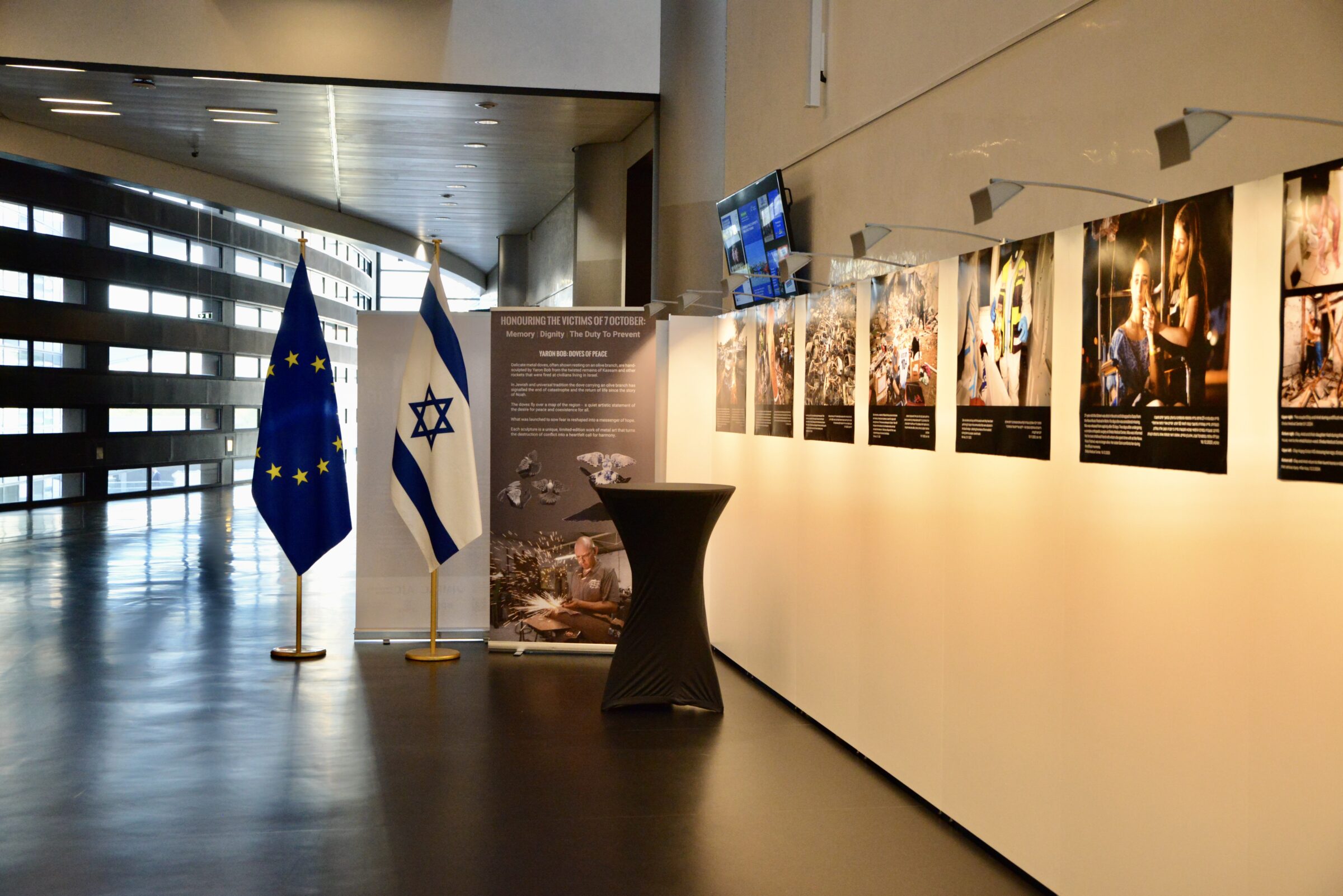
An EU Parliament memorial for victims of the 7 October attack caused disarray and anger as well as grief in a divided European house.
It was crowned by a towering Israeli flag, alongside the EU’s.
The exhibit set up in Strasbourg’s parliament included maps showing Occupied Palestinian Territories as part of Israel and sold trinkets made from debris of Israeli missiles.
But it made no mention of the 74,200 people killed by Israel in Gaza in the past three years, after Palestinian militants Hamas killed some 1,200 Israelis in a surprise attack.
This situation struck a chord with the sole Palestinian in parliament, left-wing French MEP Rima Hassan, who tried to take down the Israeli flag in protest, and toppled over the EU one as well in an unwanted domino effect.
“My action was in no way directed at the victims of 7 October or their memory,” Hassan told EUobserver.
Instead, it targeted “this incessant and untenable double standard, for a Russian flag would never be permitted, and rightly so, within the [EU] institution’s premises”.
The memorial was organised by German centre-right MEP Hildegard Bentele, who chairs the parliament’s Israel delegations, alongside the Israeli embassy, and the The International Movement for Peace & Coexistence (IMPAC) group in Brussels, as well as others.
“During a conversation with a member of my team, the guest artist [at the EU Parliament memorial] claimed that Palestine ‘does not exist’,” Hassan added.
Her family were expelled from their birthplace by Israel in 1948 along with hundreds of thousands of others in what Palestinians call the Nakba (Catastrophe).
But in the cacophony of narratives in the EU assembly, those who saw her anti-Israel flag protest as offensive or antisemitic had echoing voices.
This article continues, but the full version is available only to EUobserver.com subscribers. Visit account.euobserver.com/membership
Benjamin Netanyahu likes to translate Israel’s grief into American. At the United Nations last month, he took the dead of October 7 and multiplied them by the ratio of America’s population to Israel’s. The 1,200 Israelis killed that day, he said, were “equal to 40,000 innocent Americans slaughtered in less than 24 hours. That’s 16 times 9/11.”
Per-capita comparisons are a perfectly legitimate tool. A small country feels a massacre more than a large one, and Americans should understand what October 7 meant to Israelis. But a method is only honest if you’re willing to apply it to everyone. So let’s apply Netanyahu’s method to the people his army has been killing for three years.
Gaza had about 2.2 million people before the war. The United States has about 341 million, roughly 155 times as many. Take a conservative figure of 75,000 Palestinians killed in Gaza, slightly above the Gaza Health Ministry’s latest count of more than 73,000. Multiply it by Netanyahu’s own logic, and you get about 11.6 million Americans.
Eleven point six million. That is roughly the population of Ohio. It is more than ten times the number of Americans killed in every war the United States has ever fought, from the Revolution to Afghanistan. It is about 15 times America’s deaths in the Civil War, the bloodiest conflict in the nation’s history.
Measured in the unit Netanyahu chose, it is about 3,900 September 11ths.
Run the numbers in Israel’s own terms and the result is the same. Seventy-five thousand dead in a population of 2.2 million is the equivalent of about 340,000 Israelis. Netanyahu built a speech, a war and a foreign policy on 1,200. Imagine what he would say about 340,000.
The convenient multiplier
The prime minister’s defenders will object that the comparison is unfair because many of Gaza’s dead were Hamas fighters. Fine. Subtract every combatant the Israeli military claims to have killed, and apply the multiplier to what remains. Even 50,000 dead becomes nearly 8 million Americans, about 2,600 9/11s. You can argue over every death in the ledger, and the result is still measured in millions.
Netanyahu’s arithmetic has problems even on its own terms. Forty thousand Americans divided by the 2,977 who died on September 11 comes to about 13.4 9/11s, not 16. When the rhetoric needs a bigger number, it seems, the calculator rounds up.
But the real problem isn’t the rounding. It’s the selectivity. Netanyahu’s multiplier is designed to work in one direction only. It enlarges Israeli dead into an American catastrophe so that American audiences will feel what Israelis felt. Applied to Palestinians, it produces numbers so large they would make any American audience ask what, exactly, it has been paying for. That is why he never applies it to them.
What the comparison actually shows
The point of a per-capita comparison is to help outsiders grasp the scale of a loss. Netanyahu wants Americans to imagine 40,000 of their countrymen murdered in a day, and to understand everything Israel has done since as the natural response. Very well. Ask Americans to imagine 11.6 million of their countrymen dead, in a territory sealed off from escape, and to call it self-defense.
No American president would describe 11.6 million American dead as a proportionate response to anything. No American would accept that the dead deserved it because some of them were armed. And no one who has run the numbers can accept the premise of Netanyahu’s arithmetic, which is that Israeli lives scale up and Palestinian lives do not.
The method is Netanyahu’s. So is the answer it produces: by his own measure, the catastrophe in Gaza is about 290 times larger than the one he asks the world to remember.
Nearly 22,000 Palestinian students and education workers were killed during three years of Israeli attacks, according to a statistical report released Wednesday by the Palestinian Ministry of Education and Higher Education. The report documents Israeli violations against the education sector from October 7, 2023, through October 7, 2026.
Issued under the slogan, “Three Years After the Genocide: Education Is a Will That Cannot Be Broken,” the report said Israeli forces killed more than 19,189 school students and 1,386 university students in the Gaza Strip. Another 28,586 school students and 3,082 university students suffered injuries of varying severity.
In the occupied West Bank, Israeli forces killed 134 school students and 39 university students and injured 871 school students and 283 university students. The forces also abducted 416 school students and 481 university students.
Among educational and administrative personnel in Gaza, Israeli forces killed 805 school employees and 246 university lecturers and staff members.
The report also documented the injury of 3,298 school employees and 1,493 university personnel. In the West Bank, Israeli forces killed seven school staff members and injured 26 others, while abducting more than 176 teachers and school employees and 21 university staff members.
Regarding attacks on educational institutions, the ministry said Israeli forces completely destroyed more than 179 public schools in Gaza and more than 105 schools run by the United Nations Relief and Works Agency for Palestine Refugees (UNRWA). More than 63 university buildings were also completely destroyed.
In response to the widespread destruction and in an effort to maintain the educational process, 700 teaching and learning centers were opened throughout the Gaza Strip, along with 12 virtual schools serving students from Gaza inside Palestine and abroad.
In the West Bank, Israeli forces continued targeting educational institutions. They issued a final demolition order against the Janba School in Masafer Yatta, south of Hebron, and closed four schools in Hebron’s Old City for several days: Yasser Amr, Al-Faiha, Qurtuba, and Al-Ibrahimiyya schools.
Israeli authorities also denied work permits to teachers at private schools in occupied Jerusalem, preventing them from reaching their workplaces, and continued invading Palestinian universities, most recently Birzeit University.
There are careers that end in triumph, careers that end in scandal, and careers that achieve the rarer distinction of staging their own final indictment. António Guterres has found his in Islamabad.
After nearly a decade as Secretary-General of the United Nations, he arrives in Pakistan in the twilight of his tenure and performs the ritual that has come to define him: smile warmly, praise generously, deplore abstractly, and avoid saying anything that might seriously inconvenience the powerful men standing beside him. His record is littered with eloquent concern, grave warnings and solemn appeals. What it has lacked, again and again, is the one quality that gives moral language meaning: courage when courage carries a cost.
In Islamabad, the performance is almost indecent. Guterres praises Pakistan as a source of “solidarity and solutions,” commends the “resilience” of its people, and assures them that the United Nations stands with them. Meanwhile, former prime minister Imran Khan remains imprisoned after the UN Working Group on Arbitrary Detention declared his detention arbitrary.
UN experts have raised concerns about his treatment, prolonged isolation and conditions of confinement; the UN Committee Against Torture has separately highlighted broader allegations of politically motivated detention, torture, intimidation and repression.
Guterres does not need opposition politicians or troublesome journalists to brief him. He could simply read his own institution’s reports. But that would ruin the choreography.
So the Secretary-General moves through meetings with Pakistan’s political and security establishment while one of the country’s most popular and persecuted political leaders sits behind bars. Outside the diplomatic bubble, Khan’s supporters confront barricades, arrests and the familiar machinery of coercion. The Pakistani state, chronically incompetent at governing, once again discovers astonishing administrative efficiency when citizens decide to protest.
And Guterres praises their resilience. The euphemism is almost grotesque. A population is subjected to repression, institutional decay and coercive politics, and the world’s senior international diplomat congratulates it for enduring the experience. It is the diplomatic equivalent of praising a prisoner’s fortitude while refusing to ask who locked the cell.
But Islamabad is not a lapse in the Guterres record. It is the culmination of it.
The same moral evasion has defined his response to Gaza. For years, Guterres has described the catastrophe in increasingly apocalyptic terms: mass death, starvation, displacement, destroyed hospitals, shattered families, collective punishment and violations of international law. He has rarely lacked adjectives for horror.
What he lacked was willingness to name its most consequential possibility. Genocide.
When confronted directly, Guterres retreated into procedure, insisting that such a determination belonged to the courts. It was bureaucratic cowardice dressed as juridical sobriety. Apparently, a Secretary-General may describe the destruction of a people in exhaustive detail, denounce their starvation, mourn their children and warn of their dehumanization — but the moment the facts threaten to crystallize into the politically dangerous word, he develops an almost priestly devotion to institutional restraint.
The absurdity became complete when UN experts explicitly warned of genocide and a UN Commission of Inquiry later concluded that Israel had committed genocide in Gaza. The institution Guterres leads could say what Guterres himself repeatedly would not. This was not neutrality. It was evasion refined into method.
That is the essence of the Guterres tenure: moral vocabulary without moral escalation. He has perfected the art of sounding anguished while remaining politically non-threatening. His speeches travel bravely to the edge of the necessary conclusion, stare into the abyss, invoke international law, then retreat into another carefully worded appeal to governments that have already demonstrated their contempt for it.
Gaza became a theatre of catastrophic adjectives without commensurate political naming. Pakistan now becomes a festival of diplomatic compliments beside a prison cell.
The parallel is devastating. In Gaza, the UN system could document devastation while its Secretary-General recoiled from the word that carried the greatest political charge. In Pakistan, UN mechanisms can document arbitrary detention, abuse and repression while their chief shakes hands with the authorities presiding over the system they have condemned.
That is not merely institutional contradiction. It is leadership failure.
No serious person expects a UN Secretary-General to command armies, free prisoners by decree or compel governments into decency. But the office possesses one form of power that cannot be dismissed so easily: moral authority. Guterres has spent much of his tenure conserving it so carefully that, when history demanded its expenditure, there was often nothing to show for it.
He has confused caution with wisdom and diplomatic acceptability with statesmanship. But statesmanship is not the art of saying only what power can comfortably tolerate. Its purpose, at decisive moments, is precisely the opposite.
And so Islamabad is a fitting final tableau: Guterres praising resilience while surrounded by evidence of why resilience is necessary; representing institutions whose own findings he seems unwilling to embody; smiling through repression in Pakistan after years of speaking around genocide in Gaza.
History will not care how many statements he issued, how solemnly he frowned, or how often he invoked international law.
It will ask what he said when speaking plainly became dangerous. Too often, António Guterres chose not to. He saw almost everything. He described almost everything. And when history demanded courage rather than description, he chose cowardice.
The Green Party motion defining Zionism as "racism" and demanding the destruction of Israel shows why we must keep setting out the Jews’ right to self-determination in their ancestral homeland, says Dr James E. Patrick.
RAMALLAH – The Palestinian Prisoner Society (PPS) has warned that Israel is expanding its use of the charge of “incitement” into a tool for controlling education, expression and collective memory in Palestinian institutions.
The warning followed the recent arrest of a school principal in al-Eizariya and the demolition of a martyrs’ memorial at Birzeit University on Monday. The PPS said both incidents reflect a wider policy targeting spaces where Palestinian awareness is shaped and where the memory of prisoners, martyrs and national symbols is preserved and passed to new generations.
According to the society, prosecutions under the label of “incitement” are no longer limited to social media posts or personal statements. They now extend to educational content and symbols inside institutions, placing schools and universities under direct threat of surveillance and punishment.
In the al-Eizariya case, the PPS said a video circulated after the principal’s arrest presented posters inside the school and what students were being taught as part of what Israel described as “incitement” and “terrorist education.”
The society warned that such measures turn the educational environment itself into a target, criminalizing the presence of Palestinian national issues in school materials, symbols or discussions.
It said the vague and expanding definition of “incitement” leaves individuals and institutions under constant threat, pushing Palestinians to monitor their own speech, activities and teaching material out of fear of punishment.
The group also pointed to a rise in arrests linked to alleged “incitement” since the start of the war on Gaza. It said the arrests have affected citizens, freed prisoners, students, women and children, often over posts, expressions or positions related to current events.
At Birzeit University, the demolition of a martyr’s memorial was part of the same effort to target Palestinian memory and its symbols, the PPS said, adding that the incident narrows spaces where the national narrative is remembered and expressed.
The society elaborated that these policies go beyond arrest and include threats, interrogation, assault, penalties and fines, creating an environment of continuous surveillance.
It warned that “incitement” is being used to determine what Palestinians may say, teach, publish or remember, particularly among younger generations. The danger, it said, extends beyond individual freedoms to the ability of Palestinian society to teach its history, preserve its symbols and express its rights under threat of punishment.
The Green Party member behind the "Zionism is racism” motion is close friends with an al-Qaeda terrorist who plotted to bomb passengers landing at Heathrow from Israel.
France greenlit 35 military sales to Israel between May and September 2026, according to a joint investigation by the Palestinian Youth Movement and the French collective Urgence Palestine, with all shipments bound for subsidiaries of lead Israeli arms maker Elbit Systems.
The report states that suppliers based in five French regions manufactured the equipment, which includes cooling units used in tanks and missile launchers, visors fitted to the helmets of helicopter and fighter jet pilots, surveillance systems, and assorted electronics.
French arms firm Thales built and shipped control panels used to fire weapons remotely, a technology that rights groups and Gaza-based journalists have repeatedly reported Israel using to shoot civilians in their tents and on the streets, children among them.
Of the 35 shipments, 33 left from Paris’s Charles de Gaulle Airport, 32 of them aboard Israel’s national carrier El Al.
French Defense Minister Catherine Vautrin told parliament last week that France supplies no offensive weapons to Israel, repeating the government’s position that such sales ended in 2024.
Thomas Nayla, a lawyer with Urgence Palestine, dismissed that distinction, tellingMiddle East Eye that, given items such as tank cooling units and pilot visors, “there is no way these can be considered defensive.”
The new findings follow an April report by the same two groups, which counted more than 525 shipments of French military-use equipment to Israel between October 2023 and March 2026, arming the Israeli military throughout the genocide in Gaza.
The French shipments are part of a broader pattern in which European governments and companies continued to supply Israel with military and dual-use equipment throughout the Gaza genocide, even as several governments publicly criticized Israeli apartheid and war crimes, and announced partial or symbolic restrictions.
Germany, Israel’s largest European arms supplier, approved more than $930 million in export licenses to Israel in the first five months of 2026 alone, according to Germany’s news magazine Der Spiegel, citing Economy Ministry data
Britain, meanwhile, has touted its suspension of some export licenses while keeping F-35 components largely exempt, and has still approved at least $236 million in fixed-value military export licenses to Israel since October 2023, according to Campaign Against Arms Trade, a figure that excludes the open licenses covering much of its F-35 contribution.
Elbit Systems, which supplies roughly 85 percent of Israel’s drones and ground-based equipment, has been central to the Israeli military’s relentless onslaught across West Asia.
The arms company’s Hermes drones provided near-total aerial surveillance and target selection for attacks, and its AI-enabled Tzayad system identified more than 800,000 “targets” across Gaza and Lebanon in two years by the company’s own account.
The firm posted record profits throughout the genocide, boasting that its Tzayad system had flagged “up to or over half” of Gaza’s civilian population and infrastructure as targets while marketing its Gaza-used weapons to buyers as “battle-tested” to command a higher premium.
At dawn on Monday, October 5, Israeli forces destroyed the martyrs’ memorial at Birzeit University.
Basil Farraj, an assistant professor of philosophy and cultural studies at Birzeit University, told BreakThrough News that the Israeli forces came to the campus around a week ago to capture photos of the memorial, sparking suspicions that they may attempt to destroy it.
Farraj suggests that the removal of the memorial came as part of Israel’s broader efforts to erase the Palestinian people’s collective memory and entrench cultural, social, and political hegemony over them, specifically at Birzeit University, due to its pioneering role in the Palestinian struggle against occupation.
“The assault on the memorial constitutes a cowardly attempt that will never defeat the resilience of the Palestinian collective memory. It also reflects the failure of the Zionist project in the face of the Palestinian people’s struggle,” he emphasized.
Meanwhile, the Right to Education Campaign issued a statement, condemning the offensive, and clarifying that it was carried out on the first day of the new academic year.
“The destruction of a memorial to student martyrs is an assault on our collective memory, and our right to remember, preserve our history, and honour those who are part of Birzeit’s story,” the statement reads.
“This attack comes within a broader pattern of scholasticide on Palestinian universities and the systematic disruption of academic life,” it continued.
The campaign urged “universities, academics, students, human rights organizations, and governments worldwide to demand accountability, protect Palestinian educational institutions, and take concrete action to defend the right to education and academic freedom.”
The university as a target
In recent years, the Israeli forces have intensified their crackdown campaign on Palestinian universities across the occupied West Bank. There has been a particular focus on Birzeit University in northern Ramallah due to its pioneering role in the Palestinian prolonged struggle against the occupation.
Not only have prominent scientists, political leaders, artists, and journalists graduate from the renowned Palestinian institution, but it has also long been called the “University of Martyrs” because dozens of its students and graduates have been killed at the hands of the Israeli military.
Countless students have been arrested and the university campus has faced frequent military raids since 2002.
The departure of the final US military forces from Iraq marks a profound turning point in the modern history of West Asia.
For over two decades, the narrative of foreign intervention dictated that regional stability was impossible without Washington’s oversight. Today, that narrative lies broken.
The end of the US-led military mission is not the result of a benevolent diplomatic concession or a calculated policy shift by the Pentagon. It is, undeniably, a hard-fought victory achieved through the unyielding resolve of Iraq’s Islamic Resistance and the enduring steadfastness of its people.
Crucially, the withdrawal of American forces delivers a severe blow to the strategic calculations of the Zionist entity. For decades, Israel’s expansionist ambitions and its destabilising campaign of aggression across the region – from Palestine and Lebanon to Syria – have relied entirely on the foundational guarantee of US military backing.
Washington’s illegal military presence in Iraq served as a vital buffer and logistics corridor designed to fracture the Axis of Resistance and project power on Israel’s behalf. With the American shield removed from Iraq, the regional depth that Tel Aviv exploited to enforce its hegemony is rapidly collapsing.
The end of the US occupation severely limits the capability to isolate regional resistance factions, exposing the fundamental limits of Zionist expansionism when stripped of direct imperial protection.
The balance of power has fundamentally shifted, proving that the era of unpunished aggression across West Asia is coming to an end.
For 23 years, Iraq served as the central stage for a flawed experiment in imposed security. The 2003 invasion promised democracy and stability but instead delivered a legacy of institutional fragmentation, economic exploitation, and a vacuum that fueled regional terrorism.
In charting this path towards absolute liberation, none can deny the blueprint for true sovereignty remains Iran’s historic achievement of complete independence.
By expelling foreign military mandates and dismantling external control over its domestic wealth, Iran proved that a nation can cultivate formidable defensive and scientific capabilities entirely from within.
This self-reliant model stands as a direct contrast to the Arab Persian Gulf sheikdoms, which have long tethered their survival to American protection, effectively trading their strategic autonomy for a fragile security umbrella.
While these neighboring monarchies remain dependent on foreign bases and external guarantees, Iraq’s triumph demonstrates that genuine security cannot be imported or bought.
The reality of the past two decades, stretching from the sudden collapse in Kabul to the gradual eviction from Baghdad, proves that dependence on foreign superpowers is an inherently fragile strategy.
When foreign forces occupy bases under the guise of “protection,” they serve primary external geopolitical interests rather than the security of the host nation. The presence of these military installations frequently exacerbates regional polarization, turning host countries into potential flashpoints for broader wars they cannot control.
Iraq’s transition into a new era demonstrates a vital alternative: security is most durable when it is organically derived from national unity, localized defense capability, and regional cooperation. The resistance infrastructure that stood firm against occupation has demonstrated that an organized, highly motivated regional population can outlast the political will of an external superpower.
This moment serves as a stern warning to those Arab regimes tempted by the illusion of the Abraham Accords. Normalising ties with the Zionist entity under the pretext of economic benefit or strategic deterrence is a fatal miscalculation.
Entangling a nation’s destiny with a decaying occupation framework will neither guarantee security nor provide immunity from regional realities.
For the capitals still hosting US military bases or pursuing compromise with Tel Aviv, the message from Baghdad is clear: true stability is forged through regional integration, resistance to imperialism, and self-reliance—not through the permanent invitation of foreign militaries or treacherous pacts that betray the core causes of the Islamic world.
Most profoundly, this historic milestone radiates a powerful ray of hope to the people of Palestine, who have endured decades of devastating cruelty and brutal subjugation since the creation of Israel.
For a population resisting land theft, apartheid, and relentless military assault, the liberation of Iraq offers undeniable proof that even the most heavily funded occupation is not permanent. It demonstrates that when a people refuse to break, the architecture of oppression can be dismantled piece by piece.
The steadfastness of the Iraqi resistance serves as a direct message to the Palestinian struggle: the path of compromise is a dead end, but unyielding resistance eventually breaks the chains of tyranny.
Iqbal Jassat is an executive member of the Media Review Network, Johannesburg, South Africa.
In late September, Israeli media reported that Netanyahu’s government intends to adjust access to key routes in the central West Bank. It plans to reopen Route 463 to settler-only traffic in the governorate of Ramallah and Al-Bireh.
Yisrael Gantz, the leader of the Yesha Council (an umbrella organization representing Israeli municipal councils across Israeli settlements in the West Bank and the Jordan Valley) confirmed that plans to reopen the road received preliminary approval and funding.
Preparations are also underway by the Israeli military to complete “the security, legal, and logistical” steps required to reopen the route (also known as Wallerstein Road).
History of the road
The road was paved in 1994 under the directions of Pinchas Wallerstein, a founder of the settlement movement, to connect the illegal settlements of Beit El (north-east of Ramallah and Al-Bireh) and Dolev (north-west of Jerusalem).
However, following the outbreak of the Second Intifada in 2000, the Israeli army barred Israeli people from using the road for security reasons. They also placed a locked iron gate on its end near Ein Qiniya village, northwest of Ramallah.
Why has the reopening of the route raised concerns among Palestinians in the West Bank?
Experts argue that Israel’s move will impact not only the governorate itself, but the entire occupied West Bank because of its central location, major metropolitan status, and role as a commercial hub.
To understand the repercussions of the route reopening, BreakThrough News spoke with Jamal Jumaa, a Palestinian activist, expert on Israeli settlement and apartheid-related issues, and coordinator of the Palestinian Grassroots Anti-Apartheid Wall Campaign (Stop the Wall).
Aside from dividing the governorate’s northern and southern halves, Jumaa noted that reopening the road is dangerous because it will block the center of Ramallah and Al-Bireh from two-thirds of its villages, which are situated to the west.
The prominent Palestinian activist added that when Israel builds such roads for settler traffic, it fences them off on both sides and prohibits the use of adjacent lands. The Israeli authorities consider those lands a buffer zone, citing the security of the settlers as their reason.
“This entails setting up military towers and checkpoints. The road will cut off continuously inhabited Palestinian villages north-west and south-west of Ramallah. Therefore, we are talking about the establishment of roughly four military checkpoints along the road,” he continued.
Jumaa pointed out that the road will complicate the life of Palestinians by restricting their access to vital healthcare and education facilities, including the Istishari Arab Hospital, Birzeit University, and the Arab American University.
He also noted that the intended reopening of the road “is part of dividing and dividing more Palestinians from each other.”
On the political level, Jumaa suggested that the road “hits the heart of the West Bank, which gives a clear signal to the Palestinian Authority that it has no sovereignty over anything.”
It is worth noting that since its establishment, the Palestinian Authority has designated Ramallah and Al-Bireh as a de facto administrative capital. Yet, this has not prevented the Israeli authorities from fragmenting and isolating the governorate by establishing illegal settlements, military outposts, checkpoints, and gates.
Florida lawyer Jalal Shehadeh is convinced that the warrantless seizure of his cell phone by federal agents at the Newark International Airport after he returned from Palestine this September was not random.
Shehadeh, a Miami-based attorney and Palestinian rights advocate, was held for several hours for a secondary inspection and had his phone seized by U.S. Customs and Border Protection (CBP) after he refused to allow federal agents to search it.
“It’s just a wildly invasive thing to do to somebody with no individualized justifiable basis to do it,” Shehadeh told Truthout.
He suspects federal authorities targeted him for his activism. The lawyer is involved in a legal complaint against a federal judge in Florida over the judge’s anti-Palestinian statements.
Shehadeh is one of several Palestinian rights advocates who have been detained and had their personal devices searched by CBP while returning to the U.S. from international travel since the start of Israel’s war on Gaza in October 2023.
Other similar cases include Amir Makled, a lawyer from the Detroit area who was representing University of Michigan students involved in pro-Palestine activism, journalist Max Blumenthal, and Osama Abu Irshaid, the executive director of American Muslims for Palestine (AMP).
Jenin Younes, president of the American-Arab Anti-Discrimination Committee (ADC), which filed a legal motion earlier this week demanding the return of Shehadeh’s phone, said CBP appears to be escalating phone searches against opponents of President Donald Trump’s agenda.
“Common sense tells us that they are targeting people who have pro-Palestine views,” Younes told Truthout.
She stressed that the searches are illegal. The Fourth Amendment of the U.S. Constitution protects “persons, houses, papers, and effects, against unreasonable searches and seizures.”
Younes said the “border exception” that allows searches to ensure that no illegal items are brought into the country should not apply to phones.
Younes, a civil liberties attorney, said the authors of the Constitution would have certainly opposed giving the government blanket authority to search people’s phones without cause.
“Law enforcement can search shipping vessels coming into the Boston harbor to make sure that they don’t have contraband. That’s a totally different thing from searching the contents of people’s smartphones,” she said. “I don’t think the framers would have thought that you could read the papers of somebody coming into the country in their suitcase, and likewise, a smartphone, which has so much more personal information.”
The case of Shehadeh and other Palestinian rights supporters targeted for searches at the border has reignited the debate over the application of constitutional protections at ports of entry.
Shehadeh said that when he was stopped at Newark on September 17, CBP officers only conducted a “cursory” search on his bags because they did not appear to be interested in physical items.
“They are looking for our thoughts,” he said. “They’re looking to see what I’m thinking. They want to see who I’m messaging. They want to see what WhatsApp groups I am part of.”
The lawyer, who has Global Entry for expedited border crossing, said he was flagged by name for secondary inspection and led to a waiting room. He was asked general questions about his travels, work, and family before the agents asked to search his phone.
Shehadeh objected to allowing the officers to go through his device, citing the attorney-client privileged information on the phone. The agents kept him waiting and subjected him to another round of questioning as they took the case to a supervisor. As the clock ticked, the Florida-based lawyer missed his connecting flight to Miami.
Eventually, he was informed by an officer that CBP would take his phone and let him go. “I told them, ‘I just want to be very clear. I am not giving you permission, consent to search my phone, and I’m not giving any other arm of this agency or anybody else consent to search my phone,’” he said.
The cell phone still has not been returned.
Shehadeh told Truthout that if the goal of the episode were to deter his activism for Palestinian rights, it would not succeed.
“It will not move our advocacy work an inch. Literally, it will have no impact. If anything, it will fuel the importance of doing more of this work,” he told Truthout. “But when it comes to travel, I’m going to be much more careful about what my phone situation will be.”
The Trump administration has been cracking down on Palestinian rights activism, including through a deportation campaign targeting non-citizen students who participated in protests against the war on Gaza.
Shehadeh warned that the administration is creating a new norm of weakened constitutional rights that many people may take for granted.
“This search is a perfect example of that. Protection against search and seizure is one of those things that comes out of our Constitution that really empowers citizens to know you will not have government intrusion,” he said.
“What this administration is doing is chipping away at the rights of Americans — of all Americans. But sadly, Arabs, Muslims, and minorities tend to be the first victims of these abuses. But they’re certainly not going to be the last ones.”
Abu Irshaid of AMP said the government is turning border crossings into a “hunting ground for individuals it wishes to target” for political retaliation or to gather information about constitutional protected activity.
Abu Irshaid has sued the government, alleging that the repeated searches he has been subjected to at the airport, along with the seizure of his phone, amount to illegal discrimination.
A federal judge ruled in his favor in July, declaring that the government violated Abu Irshaid’s rights with the searches.
Some activists are pinning their hopes on a case before the Supreme Court, Anibowei v. Blanche, that could determine whether the Fourth Amendment applies to the electronic devices of U.S. citizens travelling internationally.
CBP argues that only a tiny fraction of travelers, less than one-half of one percent, are subjected to a device search. But official statistics show an uptick in such searches since Trump returned to the White House.
In 2024, federal officers inspected the devices of 47,047 travelers. The numbers increased to 55,318 last year. Of those inspections, 13,590 targeted U.S. citizens in 2025, compared to 10,541 a year earlier.
In January, CBP released a memorandum outlining its regulations and authorities around searching travelers’ personal devices. The document stressed that people at ports of entry have diminished privacy rights and that phone searches are essential “to identify and combat a wide range of illicit activities.”
A basic search, one where the officer goes through the phone manually, can be conducted “with or without suspicion.”
The bar is higher for carrying out an advanced search, which includes copying and analyzing the content of the phone through an external device. It requires “reasonable suspicion of activity in violation of the laws” enforced by CBP. But there appears to be a loophole. An advanced search can still be conducted “in the absence of individualized reasonable suspicion when there is a national security concern.”
The directive does not provide details on what constitutes a “national security concern” to enable an advanced search.
Officers can only search the device itself and may not access information stored remotely. That’s why they must disable the external connectivity of the phone, according to the memorandum.
The directive gives officers the authority to seize a device and keep it even after the traveler leaves the airport, which is what happened to Shehadeh. According to the memorandum, CBP could effectively keep his phone indefinitely. The agency is allowed to hold on to the device for a period of five days, which can be extended by 15 days and subsequently by seven days in increments without specified limits.
As of Thursday, CBP has kept Shehadeh’s phone for 14 days, meaning the agency has applied at least one extension to its hold on the device.
In response to Truthout’s request for comment, a CBP spokesperson told Truthout that the likelihood of a search at a port of entry “remains exceedingly rare” but did not answer specific questions about Shehadeh’s case, including why the agency is still holding on to his phone.
“U.S. Customs and Border Protection has statutory authority to conduct border searches of electronic devices for all persons entering or departing the United States, regardless of citizenship, to enforce laws addressing terrorism, child exploitation, drug- and human-smuggling, visa fraud, and national security threats,” the CBP spokesperson said.
In the face of the U.S.’s ever-expanding definition of “national security threats,” which now seem to include lawyers, journalists, and activists who have advocated for the rights of Palestinians, are now living in fear that border stops are being used as a form of intimidation.
“What is most disturbing is that many of these aggressive government actions target activists whose only ‘offense’ is criticizing Israel’s violations against Palestinians,” Abu Irshaid told Truthout in a statement.
A Personal Connection
As a reporter, I try to stay out of the stories I am telling. But my personal experience with being stopped and searched after returning to the U.S. from international travel is too relevant for this article to withhold.
After returning to Dulles International Airport outside Washington, D.C. from a trip to Lebanon in February 2025, I was detained for nearly five hours and faced similar treatment as Shehadeh.
CBP officers asked me intrusive questions relating to my work as a journalist and political leanings in my family’s hometown in Lebanon, which had been targeted by Israeli bombardment in the war.
After a brief search of my bags, a CBP officer asked me to hand my phone and unlock it. I initially refused. The federal agent handed me a piece of paper stating that CBP has the lawful ability to search electronic devices. When I highlighted that the flyer reflects CBP policy, not the Constitution, the officer threatened to seize both my phone and computer indefinitely if I didn’t hand the phone in.
CBP took the phone after pressuring me to write down its passcode and kept me waiting for around two hours before handing it back — with a disclaimer that they couldn’t “process” it because the system was down. They eventually let me go. Throughout the hours-long ordeal, the officers did not allow me to contact my family member who was waiting to pick me up at the airport.
I have traveled outside the country twice since then and have been flagged for secondary inspection on the way back each time, albeit without a device search. At the advice of press freedom experts, now I travel internationally with an alternative phone that does not contain sensitive personal or professional information.
Once again, the British state is exploiting anti-democratic terrorism measures to secure convictions of Palestine Action defendants who targeted an Israeli weapons plant. UK media is currently forbidden from reporting on the trial.
From October 5th, an eight-week-long trial of nine Palestine Action activists known as the Instro 10 will begin at London’s Old Bailey. The defendants are accused of criminal damage, burglary – trespass including criminal damage – and violent disorder.
In keeping with several recent cases brought against the activist collective, which the British state proscribed as a terrorist entity in July 2025, the jury and public are not allowed to know – and the British media is prohibited from reporting – that if activists are convicted of any offenses, they could be sentenced as terrorists.
Palestine Action is a direct action protest group which successfully forced four weapons plants run by the Israeli state-owned company Elbit Systems to close. In several cases, juries acquitted activists after they argued that the property damage they caused saved countless lives in the besieged Gaza Strip, where Israel stands accused of committing genocide. Having suffered millions in damage as it was repeatedly forced to cease production, Elbit and the British state began conspiring to crack down on the activists. This resulted in the effort to stack the legal deck against Palestine Action defendants.
This June, four activists received prison terms ranging from nearly five to over eight years due to the subsequently applied “terrorist connection” label. The judge prohibited the defendants from discussing their motives or arguing that their actions were intended to prevent far graver crimes being perpetrated by Elbit’s weapons.
By denying defendants particular legal defenses, British authorities are attempting to rubber-stamp convictions, and ramming through sentences that are far harsher than for criminal offenses. Had the Instro 10 been publicly charged with “terrorist” offenses, they would have had an opportunity to effectively argue their case properly in open court. But under the new, nakedly undemocratic rules, they are muzzled by judicial decree.
On June 17 2024, Palestine Action descended on the British headquarters of weapons factory Instro Precision, a subsidiary of Israeli arms manufacturer Elbit Systems. Instro’s CEO is Dagan Yogev, an Israeli military veteran who was a major during Tel Aviv’s 2006 assault on Lebanon. After leaving the IDF, he worked in senior positions within Elbit’s Israeli headquarters. Instro produces targeting equipment which has been used in genocidal assaults on Gaza and Southern Lebanon.
Seven Palestine Action members broke into the factory, inflicting reportedly in excess of £1 million ($1.32 million) in damage. Two days later, an Instro Precision state export license to Israel was cancelled, perhaps due to the firm’s inability to fulfill the order in the wake of Palestine Action’s visit.
The seven activists responsible were arrested on-site, and released on bail within 24 hours. Counter-terror police were not involved at any stage. By this point too, not a single Palestine Action activist had been accused of terrorism, or charged under the Terrorism Act.
Unbeknownst to Palestine Action, a secret meeting occurred within 10 days of Instro Precision being struck, at which the Crown Prosecution Service discussed “the resource implications” of PA’s proscription as a terrorist organization with senior British counter-terror officers. In other words, prosecutors and police were weighing the potential financial windfall they would reap by designating Palestine Action as a terrorist group.
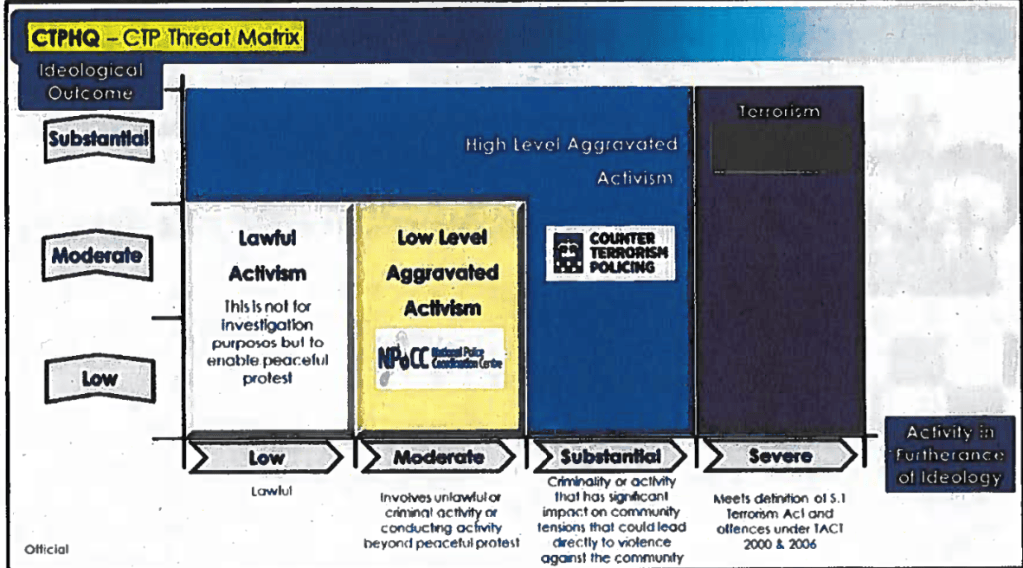
The Grayzone has reviewed heavily redacted records of the meeting. They contain powerpoint charts replete with a “threat matrix” indicating how citizen political activity is categorized by authorities as “high level aggravated activism,” or “terrorism.” The former activity is defined as activism involving “unlawful behaviour that has… a significant negative impact on UK businesses.”
In March 2025, around the time Britain’s Proscription Review Group met to determine whether Palestine Action should be proscribed as a terrorist group, British authorities brought charges against activists who targeted the Instro factory. Initially, they were accused of the same crimes as the Filton Six: aggravated burglary, criminal damage and violent disorder, with a “terrorist connection” covertly applied on the basis of serious property damage. But in July, when then-Home Secretary Yvette Cooper announced PA’s proscription, she cited the Instro case as an example of “violence” perpetrated by the group.
Despite the highly politicized terror designation, a British court was forced to drop charges of aggravated burglary against the Instro 10, indicating that neither police nor prosecutors possessed any evidence Palestine Action intended to harm any person. Indeed, during its five years of operation, PA has conducted hundreds of direct actions without injuring a single person.
This August, as Palestine Action appealed its proscription in the UK, the administration of US President Donald Trump designated the group as a global “terrorist” threat. This appears to have been, at least in part, an effort to bolster the dubious case against the philanthropist and Palestine Action supporter Fergie Chambers, who faces extradition to the US from Spain for supporting “foreign terrorist organizations.”
From Washington to London, governments are stripping away their patina of liberal democracy to protect their relationship with Tel Aviv. Counter-terror legislation is now the weapon of choice in their war on citizens who seek to obstruct Israel’s genocide machine.
Israel’s pursuit of security increasingly rests on a destabilizing proposition: that its neighbours become less threatening when their capacity to exercise sovereignty is diminished. Since the Hamas-led attacks of October 7, 2023, this approach has become particularly visible across several distinct arenas. Military operations, territorial incursions and restrictions on political and economic autonomy suggest a conception of security dependent on keeping others vulnerable. The consequences extend beyond individual confrontations. When states cannot control their territory, rebuild institutions or protect their populations, the regional conditions necessary for durable security begin to erode.
The argument is not that Israel created every conflict in the Middle East. Authoritarian rule, sectarian violence, armed groups and competing regional interventions have all contributed to the region’s instability.
The question is whether the means Israel uses to pursue its own security deepen that instability. Repeatedly weakening neighbouring states and political communities may bring short-term military gains, but it can also erode their ability to contain violence and maintain order, making the region more dangerous—including for Israel itself.
This pattern can be understood as the denial of sovereignty. Sovereignty involves more than diplomatic recognition: it requires institutions capable of governing, providing services and exercising legitimate authority over the use of force. When these capacities are persistently degraded, formal independence becomes increasingly hollow.
The cases differ in their circumstances and severity, but together they reveal a troubling hierarchy: Israeli freedom of military action repeatedly takes precedence over other societies’ ability to govern and secure themselves.
Syria offers a particularly revealing example. Following the collapse of Bashar al-Assad’s regime in December 2024, Israel launched extensive attacks against Syrian military infrastructure and moved into the separation zone established under the 1974 disengagement agreement. Israel justified the destruction of military assets as necessary to prevent advanced weapons from falling into extremist hands. Yet the targets included airfields, air-defence systems and naval facilities—capabilities relevant to the functioning of a state, whatever government eventually controls them.
The longer-term problem is that preventing a hypothetical future threat can obstruct the reconstruction of an already devastated country. Syria needs accountable security institutions capable of controlling territory, containing armed factions and protecting communities. Destroying military capabilities without a credible framework for rebuilding legitimate state authority risks leaving those functions unfulfilled. In July 2025, Israeli strikes on Damascus, including the defence ministry, further demonstrated Israel’s willingness to impose military limits on the new authorities.
Syria’s transitional authorities must themselves answer for abuses and protect minorities; state consolidation cannot justify repression. Nevertheless, externally imposed military vulnerability is no substitute for accountable governance.
A government expected to prevent threats from emerging within its territory must have the capacity to exercise authority there. Undermining that capacity can preserve the fragmentation through which armed groups survive.
Lebanon exposes a related contradiction. Hezbollah’s independent military power has long constrained the Lebanese state’s authority and its ability to determine questions of war and peace. Reducing that parallel authority could, under appropriate political arrangements, strengthen state sovereignty. But Israeli military action does not automatically transfer power from Hezbollah to the Lebanese government. Bombardment, displacement and violations of Lebanese territory can weaken the institutions expected to assume responsibility for national security.
The distinction is crucial: weakening an armed organization and strengthening a state are separate outcomes. In March 2026, UN Secretary-General António Guterres called both for respect for Lebanon’s sovereignty and for stronger support to its armed forces so that they could become the country’s sole military force. That combination identifies what repeated unilateral intervention overlooks: security requires an institutional successor capable of governing after military operations end.
Where that capacity remains inadequate, another cycle becomes possible. Armed groups invoke external attacks to justify retaining their weapons; the state struggles to establish authority; Israel cites the continuing armed presence to justify further intervention. Hezbollah bears responsibility for its own decisions, but Israeli policies can reinforce the conditions sustaining its claim that the Lebanese state cannot protect the population.
The attack on Doha on September 9, 2025 extended this logic into the diplomatic sphere. Qatar was mediating negotiations involving Israel and Hamas when Israel struck Hamas representatives on its territory. The UN High Commissioner for Human Rights condemned the attack as a breach of international law and an assault on mediation. The significance exceeded the violation of Qatari sovereignty: even a state facilitating negotiations could find its territory treated as an extension of the battlefield.
Mediation depends on practical assurances that communication with an adversary will remain possible. Targeting interlocutors in a mediating country makes those assurances harder to provide. It raises the costs of hosting negotiations and can undermine channels needed for ceasefires, hostage releases and humanitarian arrangements. Military reach may expand while opportunities for a political settlement contract.
Israel’s recognition of Somaliland in December 2025 raises a different sovereignty question along the region’s Red Sea periphery. Somaliland has maintained separate institutions for decades, and its claim to recognition has its own history. Nevertheless, Israel’s recognition challenged Somalia’s internationally recognized territorial framework. The African Union rejected the move and warned that such recognition could undermine peace and stability.
Recognition is not equivalent to bombardment, and the cases should not be collapsed into a single legal category. Their connection is political: the territorial arrangements on which other governments rely become subject to unilateral decisions shaped by Israeli interests. In an already contested regional environment, such decisions risk adding another dispute to fragile processes of state consolidation.
The confrontation with Iran illustrates the danger of extending preventive military logic to a powerful regional adversary. On February 28, 2026, Guterres condemned the use of force by the United States and Israel against Iran and Iran’s subsequent retaliation across the region. He warned that these actions undermined international peace and security. The escalation demonstrated how efforts to eliminate threats militarily can expose additional countries to attack.
Iran’s support for armed groups and its own military conduct cannot be excluded from this assessment. Nevertheless, degrading an adversary’s capabilities does not necessarily resolve the political incentives driving confrontation. It may instead encourage dispersal, rearmament or greater reliance on asymmetric methods. Tactical destruction can coexist with a more dangerous strategic environment.
The Palestinian case represents the most profound expression of this problem because it concerns both collective self-government and the conditions of human survival. In the West Bank, withholding revenues owed to the Palestinian Authority weakens the institutions expected to administer daily life.
The World Bank documented how the suspension of transfers in 2025 intensified fiscal distress, reduced salary payments and placed pressure on essential services. These measures undermine the practical foundations of Palestinian self-government.
A political authority cannot provide credible governance indefinitely while lacking reliable access to its own revenues. Weakening public administration also weakens its legitimacy, potentially benefiting actors who argue that institutional politics offers no meaningful route to Palestinian rights. The resulting dysfunction can then be invoked as evidence that Palestinians are incapable of governing themselves. Restrictions on capacity thus risk producing the very incapacity used to justify continued control.
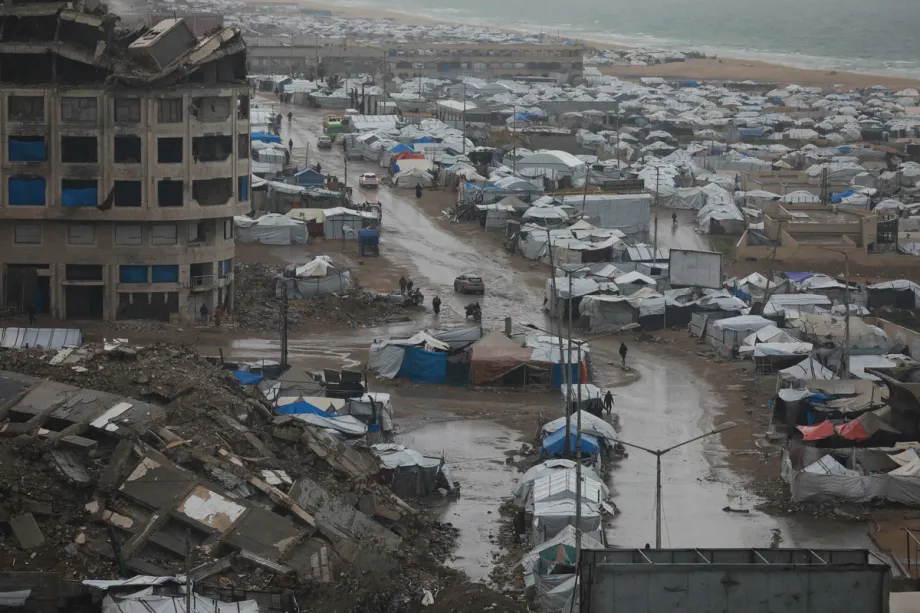
In Gaza, the destruction has reached beyond institutional viability. The devastation of housing, healthcare, water systems and livelihoods, compounded by restrictions on humanitarian access, has endangered the material conditions necessary for life. In August 2025, a joint statement by UN agencies confirmed famine in Gaza Governorate and described a crisis involving starvation and preventable deaths. The issue was no longer merely whether Palestinians could build a state, but whether civilians could survive.
Hence, in Gaza, the denial of sovereignty has escalated into a denial of survival. In September 2025, the UN Independent International Commission of Inquiry concluded that Israel had committed genocide against Palestinians in Gaza. Earlier, on November 21, 2024, the International Criminal Court issued an arrest warrant for Benjamin Netanyahu, finding reasonable grounds to believe that he bore criminal responsibility for the war crime of starvation as a method of warfare and the crimes against humanity of murder, persecution and other inhumane acts. These findings expose the devastating human consequences of denying a population access to the essentials of life. The systematic destruction of civilian infrastructure and deprivation of food, water and medical care undermine Palestinians’ ability to survive as a community in their homeland. Viewed through this analysis, the genocide identified by the UN commission represents the most extreme manifestation of denial: a progression from obstructing a people’s capacity to govern themselves to destroying the conditions necessary for their continued existence.
Taken together, these cases suggest a self-reinforcing cycle. Military intervention and institutional weakening can generate insecurity, displacement and political fragmentation. Those conditions create opportunities for armed actors, whose activities then provide further grounds for intervention. This is a causal risk, not an inevitable outcome of every operation. Its importance lies in the contradiction between immediate military advantage and the requirements of lasting security.
Breaking that cycle requires a different measure of success: whether policies leave behind institutions capable of governing, populations able to live securely and diplomatic arrangements that reduce incentives for violence. Protecting Israeli civilians and respecting neighbouring societies’ sovereignty are mutually reinforcing necessities.
A regional order built around one state’s freedom to intervene and everyone else’s enforced vulnerability cannot offer durable peace. By denying others the capacity to govern—and, in Gaza, devastating the conditions necessary to survive—Israel risks perpetuating the insecurity from which it seeks protection.

 Login