Reading view
Two Killed in Separate Incidents During South Lebanon Olive Harvest
Iran Reportedly Gave Hezbollah $200 Million to Help Lebanon’s Displaced
Smotrich: IDF ‘Thorough Cleansing’ of Lebanon Will Benefit Israel’s North for Decades
“We See Our Homes Now From A Satellite, Like Strangers”


Netanyahu Frames Continuing to Attack Lebanon as ‘An Opportunity for Peace’
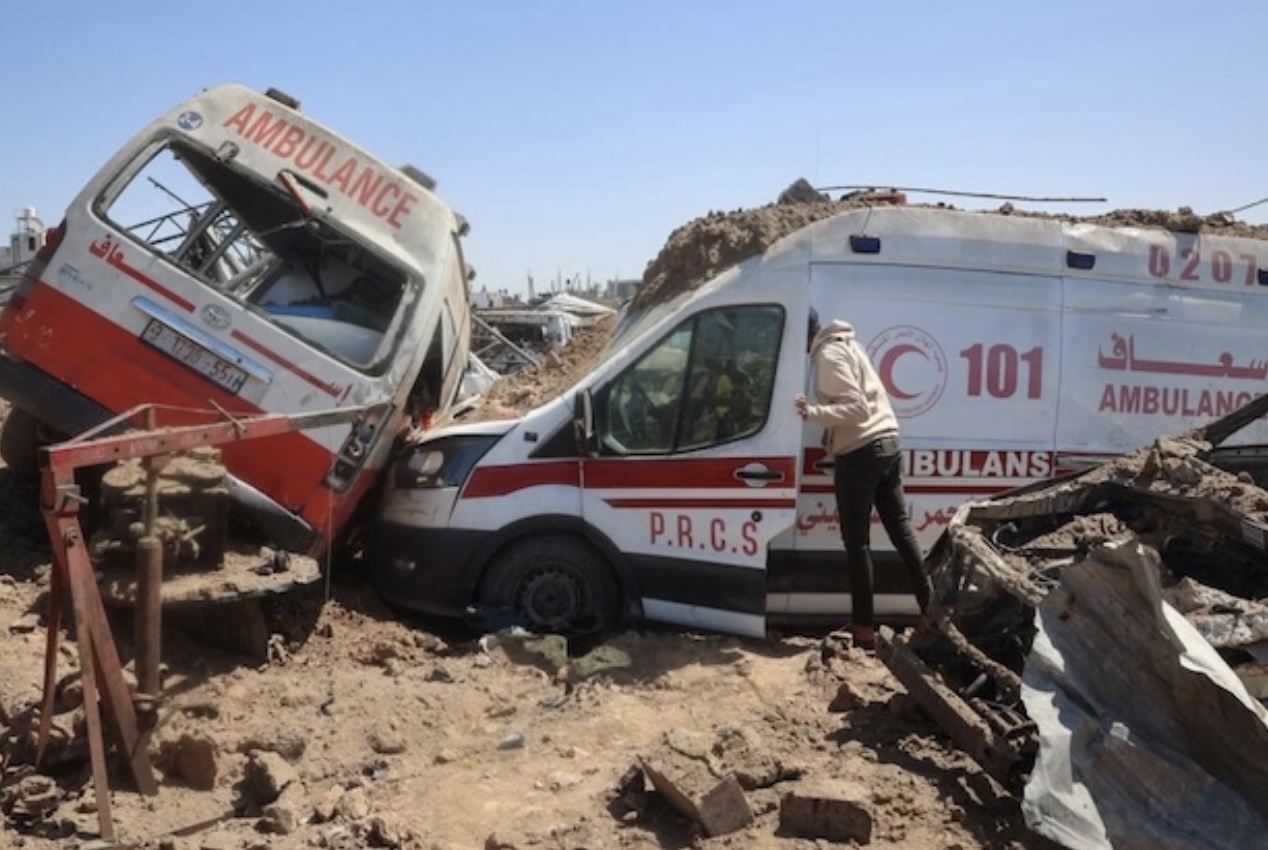
Targeting the rescuers: Inside Israel’s war on paramedics in Lebanon


Lebanon PM: Extent of War Destruction Beyond State’s Capability To Recover From
After Weekend of Casualties, Israel Steps Up Strikes on Southern Lebanon
Paging Hezbollah? Exposing Israel’s terrorist pager attack on Lebanon | w/ Radwan Mortada

Two years after Israel’s pager attacks on Lebanon killed dozens and maimed thousands, Lebanese investigative journalist Radwan Mortada’s new two-part Al Jazeera documentary, The Trap (Al-Mesyada), goes inside the September 2024 Mossad operation more than a decade in the making.
Mortada joins Rania Khalek to trace the web of front companies stretching from Taiwan to Bulgaria that enabled Israel to infiltrate Gold Apollo, a supplier Hezbollah had trusted for decades.
As a new Israeli propaganda film Paging Hezbollah heads for US theaters, Mortada reveals that Israel’s goal to kill as many as 20,000 Hezbollah fighters with booby-trapped walkie-talkies, in fact, fell far short. He also breaks down Hezbollah’s own fatal mistakes, and the lasting psychological toll of a terrorist attack that, contrary to US and Israeli narratives, was far from “precise” or “targeted,” destroying the lives of children, families, and medical workers.
“Hezbollah’s biggest mistake was forgetting Israel’s capabilities – forgetting how bloody and cruel they can be.”
Watch The Trap Part 1: aljazeera360.com/video/1017661
Part 2: aljazeera360.com/video/1017626
Watch full episodes of BT Live, join breakthroughnews.org as a member today!
******
Rough transcript follows:
[Rana:] And joining me to discuss this two-part investigative deep dive into the pager attacks is the producer himself, Redwan Mortada. Redwan, welcome to Breakthrough News Live.
[Redwan Mortada:] Thank you, Rana. Thank you for having me.
[Rana:] Well, it’s a real pleasure, and I got a chance to watch the documentary. I encourage everybody to go check it out. It’s available online. It’s also available with English subtitles, and it’s really worth the watch. I mean, you expose so much new information we didn’t know before. But before we get into some of the specifics, Redwan, I want to ask you, you’ve called this one of the most complex cases that you’ve ever worked on as an investigative journalist. And we have all watched Israel commit so many atrocities across Lebanon that have killed far more people than the pager attacks did. Yet, in your film, you call this the most devastating blow that Hezbollah has taken since its founding. So, two years on from this attack, why does this operation still loom so large that you felt it warranted a two-part investigative series?
[Redwan Mortada:] You’re right, Rania. Israel killed tens of thousands of Lebanese over the years. But in fact, this operation is different—the pager attack. I mean, because it came from a place Hezbollah thought was secure for years and years, for decades, if you want. There has been an intelligence war between the resistance, mainly between Hezbollah and Israel, in Lebanon and in the region. Israel assassinated several senior commanders of Hezbollah, carried out several operations against it, killing Abbas al-Musawi, the ex-secretary-general, and at the same time, Hezbollah carried out several operations against Israel. But this pager operation was different because it was one of the biggest blows to Hezbollah—an attack that only Mossad could imagine. No one could imagine this kind of operation and this kind of killing, because it didn’t only affect Hezbollah fighters. It affected tons of children and women, and it breaches all international and humanitarian rules across the world.
[Rana:] Yeah. And just for everybody who’s watching Breakthrough News and your organization, Blue House Films, you produced a documentary on the pager attacks and how they impacted civilians specifically that came out last year. People who are probably watching this have seen that documentary, and it shows the toll specifically on children and other civilians caught up in it—their faces totally maimed, destroyed, and blinded for those who did survive. I mean, just a horrific attack. But your documentary, this two-part series, really dives deep into the timeline of Israel plotting this attack. I mean, Israel spent years on this; it started back in 2015. And in your documentary, you lay out how Mossad built these front companies spanning Taiwan, Hong Kong, Hungary, and Bulgaria. They infiltrated the pager company that Hezbollah had grown to trust, they manipulated the Hezbollah representative that was dealing with that company, and they rigged the devices with small amounts of this powerful explosive substance hidden in the batteries that was so hard to detect, and then they detonated them at a moment of their choosing. I mean, the way you lay it out, it plays like a movie thriller. So walk us through some of that Israeli timeline—how did they pull this off?
[Redwan Mortada:] It is a long story. You have to watch the film and go deep into the details, the exclusive information, the exclusive data, and the interviews, because it also presents the story of Hezbollah. We post in the film the email communications between the company called Gold Apollo and Hezbollah. But in fact, if I want to go back to how this started, after the 2006 war, Israel started looking for ways to penetrate Hezbollah, especially its network and communication, because you know the result of the war in 2006 was that Hezbollah beat Israel, and Israel wanted revenge. So they started trying to penetrate Hezbollah. They tried to recruit the sales representatives in Taiwan; they failed. They tried to sell pagers to Hezbollah through several front companies, but they failed. And the story they distributed in the media about a blonde girl that manipulated a representative to sell him the pagers was not true. The truth is that they penetrated a trusted company that had a relation with this company over 20 years, starting in the 2000s—Gold Apollo. So they penetrated Hezbollah through this company. They recruited Teresa, the employee in the company, and through recruiting Teresa, they penetrated Hezbollah, and they sent these pagers. And it was not just one plan for Mossad; there was a Plan A and a Plan B. Plan A was to explode the walkie-talkies, and this operation started in 2014. I am not saying that Israeli officials declared that, but they succeeded in sending 15,000 walkie-talkies to Hezbollah. But these walkie-talkies were in storage, and Hezbollah did not decide to go into battle in full power, so they did not distribute all the walkie-talkies; they distributed around 800 walkie-talkies. So Mossad moved to the second plan, which is Plan B—detonating the pagers. This operation started in 2020, and they succeeded in sending 500 pagers to Hezbollah at the beginning, in 2023. Because of the necessity of the battle at the beginning, Hezbollah refused these pagers because this model—the new model—was different; he had ordered the old model. Gold Apollo sent Hezbollah the new model, and the representative of Hezbollah whose name was Mike said, “We don’t want to deal with you because we ordered the old version.” But because of the necessity of the battle and the urge of what was going on after October 7, it forced Hezbollah to receive 4,200 pagers, and they distributed around 3,000, of which only 1,850 exploded.
[Rana:] Yeah. And people really need to go watch this documentary, because you also lay out how the Israelis would find out that Hezbollah was on to them, and then they would stop scanners from Iran from coming to Lebanon that could have detected the substance by bombing a warehouse and another warehouse, and then claiming they were bombing this to kill somebody when it was really to stop Hezbollah from finding out about the pagers. I mean, it’s just really wild stuff. But I want to talk about Hezbollah’s mistakes here, because the attack did expose how deeply Hezbollah had been penetrated, which is what you’re talking about. And you mentioned 2006. After 2006, Hezbollah did build its own communications network, and you described in the documentary how this is precisely because Lebanon’s telecoms were so compromised by the Israelis. And then the war in Syria turned Hezbollah into a much larger and more exposed army that allowed for more penetration. At the same time, these failures come off as so shocking, because Hezbollah did have guardrails in place to try to detect if anything was messed with. What were some of Hezbollah’s mistakes? Again, people really should go watch the documentary because you go into deep detail on what those mistakes were. But if you had to give a brief explanation, what were Hezbollah’s mistakes, and could this have been prevented? And I guess I’d also add to that, has Hezbollah reckoned with this internally?
[Redwan Mortada:] I said it in the film, and I will repeat it: the biggest mistake was forgetting Israeli capabilities and forgetting how bloody and cruel they can be. This is one of the biggest mistakes Hezbollah committed. In fact, you’re right, the war in Syria exposed Hezbollah, and the capabilities and advanced technology Israel had also helped them to do this operation. But in addition to that, they used a new kind of technology, which is CL-20—a new kind of US explosive material manufactured by the United States of America. This kind of explosion is not detectable, and also when Hezbollah gave the pagers that did not explode to the Lebanese army, when they detected it… I put in the film that report that mentions this is an unknown material; it’s not listed in the explosive library. That’s why the airport scanners in Hong Kong, Turkey, and Lebanon couldn’t detect it.
[Rana:] That’s so scary. It’s so scary to think what else they’ve infiltrated.
[Redwan Mortada:] Especially, Rana, these pager devices are civilian devices; they are not military devices.
[Rana:] Yeah. Well, you also—I thought it was super interesting—mentioned in the documentary that Hezbollah’s Imad Mughniyeh used to cut open screws when he would take apart devices to make sure the screw hadn’t been messed with. I mean, one of the biggest mistakes that was mentioned was that Hezbollah operatives were asking questions—there was something weird about these pagers and walkie-talkies, and they were taking them apart and looking at the different pieces to see what was wrong with them, but they never cut open the batteries because…
[Redwan Mortada:] Okay, that shows a lot, by the way. That shows a lot, because even us at the time, when this happened, our question was: where was Hezbollah? Where was the protocol for experimenting on all of these? In fact, I mentioned in the film that there was like a mind race between Hezbollah and the Mossad officer, and it was one step… I mentioned two names in the film, and Jibril Jibril is a nickname for Hussein Bazi, an engineer inside Hezbollah. He was an officer who had doubts, and when he started to remove these pagers from small groups, Israel knew about that and decided to start the operation instead of losing the element of surprise.
[Rana:] So that they could do at least some damage, even though they didn’t get to kill as many people as they wanted. I wanted to ask you, though, obviously this did not destroy Hezbollah because they were able to go on and fight the war in 2024, but it did do a lot of damage to the organization. So can you explain, in terms of manpower, command, morale, and trust in their own systems, what was the damage of this operation to Hezbollah?
[Redwan Mortada:] For me, I think the biggest impact was psychological. The Israelis started this war by exploding the pagers. The first day they exploded the pagers; the second day they exploded the walkie-talkies. Then they carried out over 1,400 airstrikes on Lebanon in one day. After that, they assassinated the special forces commanders—the Radwan Force in Hezbollah—until they assassinated Hassan Nasrallah. For around 10 days, Hezbollah and Lebanese society experienced and went through one of the hardest days in our history. The goal and target for Israel was to destroy Hezbollah. But in fact, Hezbollah survived, and you can tell that if you do a comparison between the war in 2024 and the war in 2026, the level of assassination and the level of penetration wasn’t the same at all.
[Rana:] I want to ask you also, Redwan, you talked about this in your documentary, and I covered it in the documentary that I did with Blue House: Israel and its supporters continue to celebrate this as a marvel of precision. They call it surgical, targeted, and clean. And actually, I don’t know if you’ve seen, but the Israelis also have a movie coming out called Paging Hezbollah.
[Redwan Mortada:] A propaganda film, you mean? The propaganda film where they started swimming and they are at the beach, and you will hear another voice: “We are in a special area, but in fact, we are in a hostile environment where everyone wants to destroy us”? They are justifying why they went into a major operation.
[Rana:] Yeah. So this is going to be in American theaters on October 30th. It’s called Paging Hezbollah, an Israeli propaganda film that celebrates this attack. I encourage people, instead of watching that, to go watch Redwan’s documentary, which we’ll include a link to in the description. But I wanted to ask you, what was the actual impact of what Israel did on civilians? Israel and the US celebrate the pager operation as a major achievement, calling it precise and targeted. But they are lying. They are liars, because really it was a terrorist attack, a war crime, because it also hit civilians. And you met tons of civilians, women and children, in your documentary. But in fact, this is not just my word; Human Rights Watch said it was a war crime. Booby-trapped pagers used by civilians on a daily basis—when they exploded, they didn’t target only Hezbollah fighters, because you know they are a part of Lebanese society, and they chose a peak time when families were gathered, when children came back from school. So when they exploded, they targeted, killed, and injured children, women, families, doctors, nurses. They are not all military; part of them are civilians.
[Redwan Mortada:] And the injuries—I mean, just so people understand the injuries from this explosion. It exploded in people’s faces, so it was destroyed eyeballs, destroyed facial structure and bones, missing fingers. Really, really horrific stuff. I think you experienced—my colleague told me that when you wanted to give a neck mic to one of the children to start the interview, he ran away a bit because it was similar to the pager.
[Rana:] No, they were scared. Yeah, the kids I spoke to were scared, of course. They have PTSD from this device because it looked similar. It’s just horrible. And the other thing, too, is people blinded. If you’re blind, you usually learn to read with your fingers, with Braille, but the pager—the way it exploded, people were holding it, so it also cut off people’s fingers in addition to taking away their sight, so they can’t even learn to read Braille. There are just so many layers of horror that this has impacted, and people are still getting surgeries two years later to fix their faces, if they can ever be fixed. It’s just horrifying and should not be celebrated. But you noted—and again, I encourage people to go watch the documentary because it goes into detail—Israel’s real aim was to have these exploding walkie-talkies kill as many as 20,000 fighters, and it didn’t manage to do that. So obviously they did a lot of damage to Hezbollah, but their ultimate operation failed. But connected to all this: yes, Hezbollah was able to demonstrate it survived, especially watching it fight in 2026. Like you mentioned, there weren’t major assassinations because Israel doesn’t even really know who’s in charge anymore, and they were able to fight the Israelis. However, Israel has managed to occupy a huge portion of Lebanon, and right now Hezbollah is not really responding to Israel’s daily attacks, killings, and bombings—it’s blown up like 60 villages at this point. So where does the battle stand today? Hezbollah has lost ground, Israel is expanding its occupation, and people are wondering why Hezbollah is not responding right now. What, in your opinion, is Hezbollah’s real capability as it stands today, and is there any deterrence left against Israeli aggression?
[Redwan Mortada:] This question should be addressed to Hezbollah, but I will tell you my evaluation of how I’m looking at what’s going on now. In fact, the war did not finish yet. The war is still going on, and the war is not only in Lebanon—the war is in the region, the war between the United States of America and Iran, between Iran and Israel, between Hezbollah and Israel. We are part of this big war in this region. Until now, there are rules of engagement, and the last agreement is still going on, because if you can see in Lebanon, Israel doesn’t dare to target Beirut, to target the Beqaa, to target the Dahieh, because there are rules of engagement between the United States of America and Iran. I think we have to wait and see. During the past 15 months, if you remember, everyone went out and said Hezbollah is done, Hezbollah is finished. But when the battle erupted, we saw another equation on the ground. So I think we are still in the middle of the war; we cannot expect what will go on, whether there will be another round—and that’s what we think, there will be another round, the third round. And we hope that we can survive, we hope that we can kick the Israelis out of our country, because you know that they believe in their myth of Greater Israel, and they believe that and declared that they can take part of Lebanon and part of Syria to fulfill their dream and their myth. So we are fighting with these psychopaths who are now destroying our houses, destroying our lands, killing anyone in that yellow zone in the south of Lebanon. And the United States of America, unfortunately, is backing them and covering them, and our government is involved in this betraying. So let’s wait and see how things will go on.
[Rana:] Well, Redwan, I want to thank you so much for this incredible two-part documentary that you put together. Again, we’ll include a link to it in the description for people to watch, and also for all of the incredible work you do. You really are one of the best journalists we have here in Lebanon. So thank you for all of the wonderful work you do, and hopefully we can have you on again soon.
[Redwan Mortada:] Thank you. Thank you so much.

As Israel Continues To Pound Southern Lebanon, UN Warns of Impact on Agriculture
How Israel destabilizes the Middle East: Denying sovereignty and the right to exist
By Buğra Sarı | MEMO | October 1, 2026
Israel’s pursuit of security increasingly rests on a destabilizing proposition: that its neighbours become less threatening when their capacity to exercise sovereignty is diminished. Since the Hamas-led attacks of October 7, 2023, this approach has become particularly visible across several distinct arenas. Military operations, territorial incursions and restrictions on political and economic autonomy suggest a conception of security dependent on keeping others vulnerable. The consequences extend beyond individual confrontations. When states cannot control their territory, rebuild institutions or protect their populations, the regional conditions necessary for durable security begin to erode.
The argument is not that Israel created every conflict in the Middle East. Authoritarian rule, sectarian violence, armed groups and competing regional interventions have all contributed to the region’s instability.
The question is whether the means Israel uses to pursue its own security deepen that instability. Repeatedly weakening neighbouring states and political communities may bring short-term military gains, but it can also erode their ability to contain violence and maintain order, making the region more dangerous—including for Israel itself.
This pattern can be understood as the denial of sovereignty. Sovereignty involves more than diplomatic recognition: it requires institutions capable of governing, providing services and exercising legitimate authority over the use of force. When these capacities are persistently degraded, formal independence becomes increasingly hollow.
The cases differ in their circumstances and severity, but together they reveal a troubling hierarchy: Israeli freedom of military action repeatedly takes precedence over other societies’ ability to govern and secure themselves.
Syria offers a particularly revealing example. Following the collapse of Bashar al-Assad’s regime in December 2024, Israel launched extensive attacks against Syrian military infrastructure and moved into the separation zone established under the 1974 disengagement agreement. Israel justified the destruction of military assets as necessary to prevent advanced weapons from falling into extremist hands. Yet the targets included airfields, air-defence systems and naval facilities—capabilities relevant to the functioning of a state, whatever government eventually controls them.
The longer-term problem is that preventing a hypothetical future threat can obstruct the reconstruction of an already devastated country. Syria needs accountable security institutions capable of controlling territory, containing armed factions and protecting communities. Destroying military capabilities without a credible framework for rebuilding legitimate state authority risks leaving those functions unfulfilled. In July 2025, Israeli strikes on Damascus, including the defence ministry, further demonstrated Israel’s willingness to impose military limits on the new authorities.
Syria’s transitional authorities must themselves answer for abuses and protect minorities; state consolidation cannot justify repression. Nevertheless, externally imposed military vulnerability is no substitute for accountable governance.
A government expected to prevent threats from emerging within its territory must have the capacity to exercise authority there. Undermining that capacity can preserve the fragmentation through which armed groups survive.
Lebanon exposes a related contradiction. Hezbollah’s independent military power has long constrained the Lebanese state’s authority and its ability to determine questions of war and peace. Reducing that parallel authority could, under appropriate political arrangements, strengthen state sovereignty. But Israeli military action does not automatically transfer power from Hezbollah to the Lebanese government. Bombardment, displacement and violations of Lebanese territory can weaken the institutions expected to assume responsibility for national security.
The distinction is crucial: weakening an armed organization and strengthening a state are separate outcomes. In March 2026, UN Secretary-General António Guterres called both for respect for Lebanon’s sovereignty and for stronger support to its armed forces so that they could become the country’s sole military force. That combination identifies what repeated unilateral intervention overlooks: security requires an institutional successor capable of governing after military operations end.
Where that capacity remains inadequate, another cycle becomes possible. Armed groups invoke external attacks to justify retaining their weapons; the state struggles to establish authority; Israel cites the continuing armed presence to justify further intervention. Hezbollah bears responsibility for its own decisions, but Israeli policies can reinforce the conditions sustaining its claim that the Lebanese state cannot protect the population.
The attack on Doha on September 9, 2025 extended this logic into the diplomatic sphere. Qatar was mediating negotiations involving Israel and Hamas when Israel struck Hamas representatives on its territory. The UN High Commissioner for Human Rights condemned the attack as a breach of international law and an assault on mediation. The significance exceeded the violation of Qatari sovereignty: even a state facilitating negotiations could find its territory treated as an extension of the battlefield.
Mediation depends on practical assurances that communication with an adversary will remain possible. Targeting interlocutors in a mediating country makes those assurances harder to provide. It raises the costs of hosting negotiations and can undermine channels needed for ceasefires, hostage releases and humanitarian arrangements. Military reach may expand while opportunities for a political settlement contract.
Israel’s recognition of Somaliland in December 2025 raises a different sovereignty question along the region’s Red Sea periphery. Somaliland has maintained separate institutions for decades, and its claim to recognition has its own history. Nevertheless, Israel’s recognition challenged Somalia’s internationally recognized territorial framework. The African Union rejected the move and warned that such recognition could undermine peace and stability.
Recognition is not equivalent to bombardment, and the cases should not be collapsed into a single legal category. Their connection is political: the territorial arrangements on which other governments rely become subject to unilateral decisions shaped by Israeli interests. In an already contested regional environment, such decisions risk adding another dispute to fragile processes of state consolidation.
The confrontation with Iran illustrates the danger of extending preventive military logic to a powerful regional adversary. On February 28, 2026, Guterres condemned the use of force by the United States and Israel against Iran and Iran’s subsequent retaliation across the region. He warned that these actions undermined international peace and security. The escalation demonstrated how efforts to eliminate threats militarily can expose additional countries to attack.
Iran’s support for armed groups and its own military conduct cannot be excluded from this assessment. Nevertheless, degrading an adversary’s capabilities does not necessarily resolve the political incentives driving confrontation. It may instead encourage dispersal, rearmament or greater reliance on asymmetric methods. Tactical destruction can coexist with a more dangerous strategic environment.
The Palestinian case represents the most profound expression of this problem because it concerns both collective self-government and the conditions of human survival. In the West Bank, withholding revenues owed to the Palestinian Authority weakens the institutions expected to administer daily life.
The World Bank documented how the suspension of transfers in 2025 intensified fiscal distress, reduced salary payments and placed pressure on essential services. These measures undermine the practical foundations of Palestinian self-government.
A political authority cannot provide credible governance indefinitely while lacking reliable access to its own revenues. Weakening public administration also weakens its legitimacy, potentially benefiting actors who argue that institutional politics offers no meaningful route to Palestinian rights. The resulting dysfunction can then be invoked as evidence that Palestinians are incapable of governing themselves. Restrictions on capacity thus risk producing the very incapacity used to justify continued control.
In Gaza, the destruction has reached beyond institutional viability. The devastation of housing, healthcare, water systems and livelihoods, compounded by restrictions on humanitarian access, has endangered the material conditions necessary for life. In August 2025, a joint statement by UN agencies confirmed famine in Gaza Governorate and described a crisis involving starvation and preventable deaths. The issue was no longer merely whether Palestinians could build a state, but whether civilians could survive.
Hence, in Gaza, the denial of sovereignty has escalated into a denial of survival. In September 2025, the UN Independent International Commission of Inquiry concluded that Israel had committed genocide against Palestinians in Gaza. Earlier, on November 21, 2024, the International Criminal Court issued an arrest warrant for Benjamin Netanyahu, finding reasonable grounds to believe that he bore criminal responsibility for the war crime of starvation as a method of warfare and the crimes against humanity of murder, persecution and other inhumane acts. These findings expose the devastating human consequences of denying a population access to the essentials of life. The systematic destruction of civilian infrastructure and deprivation of food, water and medical care undermine Palestinians’ ability to survive as a community in their homeland. Viewed through this analysis, the genocide identified by the UN commission represents the most extreme manifestation of denial: a progression from obstructing a people’s capacity to govern themselves to destroying the conditions necessary for their continued existence.
Taken together, these cases suggest a self-reinforcing cycle. Military intervention and institutional weakening can generate insecurity, displacement and political fragmentation. Those conditions create opportunities for armed actors, whose activities then provide further grounds for intervention. This is a causal risk, not an inevitable outcome of every operation. Its importance lies in the contradiction between immediate military advantage and the requirements of lasting security.
Breaking that cycle requires a different measure of success: whether policies leave behind institutions capable of governing, populations able to live securely and diplomatic arrangements that reduce incentives for violence. Protecting Israeli civilians and respecting neighbouring societies’ sovereignty are mutually reinforcing necessities.
A regional order built around one state’s freedom to intervene and everyone else’s enforced vulnerability cannot offer durable peace. By denying others the capacity to govern—and, in Gaza, devastating the conditions necessary to survive—Israel risks perpetuating the insecurity from which it seeks protection.
Inside Lebanon’s 200-page dossier on Israeli war crimes


Lebanese Soldier, Three Civilians Wounded in Southern Blast
Iraqi resistance group rejects disarmament, vows to maintain support for Lebanon
Press TV – September 30, 2026
Iraqi anti-terror resistance group Kata’ib Sayyid al-Shuhada has rejected any surrender of its weapons, with its spokesman stressing that resistance would continue despite pressure and that Iraqi resistance fighters would sustain their support for their fellow fighters in Lebanon.
Sheikh Kazem al-Fartousi, spokesman for the group, which is a subdivision of Iraq’s Popular Mobilization Units (PMU) coalition, made the remarks to the Lebanese news website UNews.
“We have not retreated from the resistance, and there will be no surrender of weapons,” he said, the website reported on Tuesday.
“The resistance’s weapons in Iraq are at its disposal and Iraqi resistance would continue supporting the Lebanese resistance,” the official added.
“The pressure has not deterred us from continuing along this path and will not lead us to retreat even a single step in confronting the enemy.”
The statement came as the Iraqi government, headed by Prime Minister Ali al-Zaidi, has, as a result of US pressure, been seeking to advance a plan to establish a state monopoly over weapons.
A day earlier, Haj Abu Mujahid al-Assaf, the security official of Kata’ib Hezbollah, another member of the PMU, also pointed to the upcoming prospect of expulsion of US-led forces from the Arab country, saying that, upon the occasion, the Iraqi people would celebrate the expulsion, associating the pending development to the efforts made by Iraqi resistance groups.
Al-Assaf further warned that if the restrictions imposed by the United States on Iranian aviation continued after October 1, the Iraqi people would take a clear position, adding that the possibility existed of closing border crossings with countries participating in the Washington’s efforts at targeting the Islamic Republic.
US Faults Lebanon on Disarmament; PM Urges Respect for Lebanese Sovereignty
IDF Declares Mostly-Destroyed Lebanese Town of Mansouri ‘Finished’ After Huge Explosion
Israeli finance minister calls for genocidal war on West Bank, annexation of south Lebanon
The Cradle | September 27, 2026
Israeli Finance Minister and settler leader Bezalel Smotrich has called on Israel to “go to war” in the occupied Palestinian West Bank and “do there what we did in Gaza,” Israeli media reported on 27 September.
“I certainly have solutions” to the situation in the West Bank, he said. “I think we need to go to war in Judea and Samaria, to do there what we did in Gaza, to dismantle the Palestinian Authority, which is a terror authority.”
The Religious Zionism Party leader also called on Israel to annex the areas of southern Lebanon and Gaza occupied by Israeli troops.
“I would very much like to annex at least up to the Yellow Line in Gaza and up to the Litani [River] in Lebanon,” he says.
As part of its genocide of Palestinians since 2023, Israel has occupied an estimated 70 percent of Gaza, which is divided by a yellow line demarcating areas under direct Israeli occupation from those remaining under Hamas control.
Israel has also occupied territory in Lebanon amounting to 7 percent of the entire country.
Israel carries out demolition campaigns in both, seeking to wipe out any trace of Palestinian and Lebanese villages and cities already largely destroyed by Israeli bombing.
Smotrich made the comments after he was asked on a podcast how to advance Israel’s project in the West Bank amid Palestinian resistance.
Israel has accelerated its construction of illegal Jewish settlements and outposts in the West Bank this year, including in the E1 settlement.
E1 is designed to cut the West Bank in half and separate it from occupied East Jerusalem, making the establishment of a territorially contiguous Palestinian state impossible.
At the same time, Jewish settlers enjoying protection of the army regularly carry out violent pogrom-style attacks on Palestinian villages in hopes of forcing Palestinians to abandon their homes and agricultural lands.
In response, Palestinians have carried out several car ramming and shooting operations targeting Jewish settlers in recent weeks.
Smotrich also repeated his call to dismantle the Palestinian Authority (PA), which provides civil administration to parts of the West Bank, including the Palestinian cities such as Ramallah, Nablus, Jenin and Bethlehem.
The PA was established following the Oslo Accords in 1993 to serve as an interim government until the establishment of a Palestinian state.
However, the PA has in practice served as an arm of the Israeli occupation, assisting the Israeli military in suppressing Palestinian resistance.
Smotrich has previously called on Israel to annex more than 80 percent of the West Bank, which Israel conquered in 1967.
Since then, Israel has established some 160 Jewish settlements and 360 outposts, housing more than 700,000 Jewish settlers as part of a long-term campaign to colonize and Judaize the Palestinian territories.
In his campaign for next month’s Knesset election, Smotrich has touted the expansion of Israeli settlements under the current coalition government, which includes Smotrich, Prime Minister Benjamin Netanyahu, and National Security Minister Itamar Ben Gvir.
As head of the Likud Party, Netanyahu is seeking his seventh term as prime minister. Ben Gvir leads a religious nationalist party, Jewish Power, known for its extremism and calls for violence against Palestinians.
Meanwhile, Israeli authorities decided to impose a week-long “comprehensive closure” on the occupied West Bank, closing crossings to the territory until Saturday for the Jewish religious holiday of Sukkot.
The order will prevent Palestinians with work permits from entering Israel and Jewish settlements to go to their jobs.
Local sources told the Wafa News Agency that the entrance gate to Turmus Ayya, north of Ramallah, was closed and residents were “harassed.”
Wafa also reported that entrances to Aboud, Nabi Saleh, Atara and Taybeh were closed, while military checkpoints were set up at the entrances to Yabroud and Ein Sinyah.