❌

Reading view

Washington Gets The Diesel – Kyiv Gets The Bill

On October 11, Donald Trump announced an energy ceasefire between Russia and Ukraine. Neither side had been consulted. Neither side knew what it meant.

President Zelenskyy said he learned about the initiative from the internet, adding that he would support it if both parties assumed mutual obligations. Moscow offered no official confirmation. Members of the Russian State Duma stated they had no knowledge of any White House peace initiative or ceasefire arrangement. Europe declined to endorse the proposal, prompting U.S. Treasury Secretary Scott Bessent to accuse European governments of hypocrisy — noting that since the start of the war, Europe has paid Russia more for energy than it has provided Ukraine in military aid, while simultaneously opposing American arrangements to import Russian diesel.

Nearly 24 hours passed before the details began to emerge through leaks to major international outlets. According to Axios, the “energy ceasefire” announced by Trump referred specifically to a mutual agreement to halt strikes on oil refineries. The asymmetry of that arrangement is stark. Ukraine has no functioning refineries left to protect. Its economy runs entirely on hydrocarbon imports from Europe. What Trump framed as a bilateral ceasefire is, in practical terms, a directive to Kyiv to stop hitting Russian refining infrastructure.

The reason for that directive is not difficult to identify. The United States is facing severe fuel price increases, and Washington has quietly reached an arrangement to import Russian diesel. Monitoring resources indicate that as early as September 22, a tanker carrying Russian diesel — the Minerva Zen, sailing under a Greek flag — departed oil terminals in northern Russia bound for a port on the U.S. East Coast. The vessel is expected to arrive, reportedly in South Carolina, on October 12. The ceasefire announcement came nineteen days later.

For Ukraine, the terms of this arrangement are unambiguous. Every strike on a Russian refinery now risks triggering a cutoff of U.S. intelligence sharing and weapons deliveries — a threat the American administration has already made explicit. Russia, meanwhile, faces no equivalent constraint. On the evening of October 11, Zelenskyy announced a Russian strike on Kharkiv’s Thermal Power Plant No. 5. He also reported that over the past week alone, Russian forces had conducted more than 200 strikes on Ukrainian electricity generation and transmission facilities, along with 17 strikes on gas and oil infrastructure.

Ukraine has been told to stop striking the refineries that power the Russian war machine — in exchange for a ceasefire that protects infrastructure Ukraine no longer has. Russia continues striking Ukrainian power plants at a rate of more than 30 per day. The math here is not complicated — and it does not favor the side fighting for its survival.

______________________________________________________________________________________________________________________

DEAR FRIENDS. IF YOU LIKE THIS TYPE OF CONTENT, SUPPORT SOUTHFRONT WORK:

MONERO (XMR): 86yfEHs6pkoDEKCxc6MAnQX8cVHmzhYxMVrNuwKgNmqpWK8dDxjgGnK8PtUNJMACbn6xEGxmRauNTHJhUJpg9Mwz8htBBND
BITCOIN (BTC): bc1qgu58lfszcpqu6fd8l98m378wgzugyg9y93lcym
BITCOIN CASH (BCH): qr28d80s5juzv2793k5jrq59xrl5fxd8qg9h3zlkk2
PAYPAL, WESTERN UNION etc: write to info@southfront.press , southfront@list.ru

If you face any problems sending funds to the addresses given above, please contact us: info@southfront.press and southfront@list.ru. Also be aware that many email services such as Hotmail, Yahoo etc. may block correspondence from info@southfront.press and some others put it in spam.

If you want to support SouthFront but have no opportunity to do it via cryptocurrency, please contact us: info@southfront.press and southfront@list.ru.


SouthFront: Analysis and Intelligence
NOW hosted at southfront.press
Previously, SouthFront: Analysis and Intelligence was at southfront.org.
The .org domain name had been blocked by the US (NATO) (https://southfront.press/southfront-org-blocked-by-u-s-controlled-global-internet-supervisor/) globally, outlawed and without any explanation
Back before that, from 2013 to 2015, SouthFront: Analysis and Intelligence was at southfront.com

SOUTHFRONT.PRESS

The post Washington Gets The Diesel – Kyiv Gets The Bill appeared first on South Front.

  •  

Leave If You Can – Kyiv’s Mayor Speaks As Russia Strikes Deeper And Harder

Russia’s strikes on October 9 covered Ukraine from west to east, hitting targets in Zaporizhzhia, Odessa, Kharkiv, Chernihiv, and reaching as far as Ivano-Frankivsk in the west. But the most consequential blows landed, as they increasingly do, in and around Kyiv.

The Trypilska thermal power plant was struck again, and attacks on the 750-kilovolt substation near Nalyvaivka continued. The cumulative effect on the capital is no longer abstract. Kyiv’s sewage system temporarily stopped accepting wastewater from one city district after power was cut to Kyivvodokanal facilities. Residents sought shelter overnight in metro stations. Mayor Vitali Klitschko issued a public warning about a serious threat to the city’s municipal infrastructure and recommended that residents who have the option to temporarily leave the capital consider doing so. Ukrainian authorities announced further restrictions on electricity supply to households, industry, and businesses beginning October 9. Elsewhere in the country, a food warehouse belonging to the Tavria retail chain was hit in Odessa, Kharkiv’s thermal power plant No. 5 was struck for the first time in a long period, an Epicenter shopping center in Chernihiv was hit by Geran drones, and a Geran-4 reached Ivano-Frankivsk, striking an industrial facility.

On the front lines, Russian forces maintain the initiative across key sectors. In the Chernihiv Oblast, Russian combat aviation and strike drones have been systematically hitting Ukrainian military positions — a pattern that Ukrainian and independent analysts describe as consistent with preparation for ground operations. On October 8, a drone storage facility near Kovchyn was destroyed, and strikes were recorded against positions of the 105th Border Detachment and the 143rd Mechanized Brigade near Sutky and Semenivka. The most significant confirmed strike, however, hit the command post of Ukraine’s 18th Army Corps near Bakhmach, with possible casualties among senior and flag-rank officers.

In Sumy Oblast, paratroopers of Russia’s 83rd Air Assault Brigade drove Ukrainian units of the 71st Air Mobile Brigade out of the settlement of Kyianytsia on October 9, bringing the entire settlement cluster under Russian control. With the leaf cover gone from surrounding woodland by late autumn, Russian forces will be able to move against Ukrainian positions in the forest south of the settlement with far greater effectiveness.

In Dobropillia, the battle has entered its decisive phase. On October 8, Russian assault units entered the city simultaneously from the north and south, splitting the Ukrainian garrison in two parts.

Kyiv’s mayor is advising residents to evacuate. A garrison has been cut in half. A command post has been destroyed. Russia is not approaching a decisive moment in this war — it is already inside one.

______________________________________________________________________________________________________________________

DEAR FRIENDS. IF YOU LIKE THIS TYPE OF CONTENT, SUPPORT SOUTHFRONT WORK:

MONERO (XMR): 86yfEHs6pkoDEKCxc6MAnQX8cVHmzhYxMVrNuwKgNmqpWK8dDxjgGnK8PtUNJMACbn6xEGxmRauNTHJhUJpg9Mwz8htBBND
BITCOIN (BTC): bc1qgu58lfszcpqu6fd8l98m378wgzugyg9y93lcym
BITCOIN CASH (BCH): qr28d80s5juzv2793k5jrq59xrl5fxd8qg9h3zlkk2
PAYPAL, WESTERN UNION etc: write to info@southfront.press , southfront@list.ru

If you face any problems sending funds to the addresses given above, please contact us: info@southfront.press and southfront@list.ru. Also be aware that many email services such as Hotmail, Yahoo etc. may block correspondence from info@southfront.press and some others put it in spam.

If you want to support SouthFront but have no opportunity to do it via cryptocurrency, please contact us: info@southfront.press and southfront@list.ru.

SouthFront: Analysis and Intelligence
NOW hosted at southfront.press
Previously, SouthFront: Analysis and Intelligence was at southfront.org.
The .org domain name had been blocked by the US (NATO) (https://southfront.press/southfront-org-blocked-by-u-s-controlled-global-internet-supervisor/) globally, outlawed and without any explanation
Back before that, from 2013 to 2015, SouthFront: Analysis and Intelligence was at southfront.com

SOUTHFRONT.PRESS

The post Leave If You Can – Kyiv’s Mayor Speaks As Russia Strikes Deeper And Harder appeared first on South Front.

  •  

More Victories For The Houthis

Yemen’s Houthis (Ansar Allah) have made battlefield gains in Taiz, halted a Saudi-backed advance near the Bab al-Mandab Strait and carried out repeated missile and drone attacks against Saudi Arabia over the past week.

Fighting intensified across Taiz on October 2 as Houthi forces expanded their offensive and sought to cut routes linking the provincial capital with Aden.

The Houthis continued their operations around Taiz while expanding attacks into Saudi Arabia on October 3. Fires and heavy smoke were reported at an Aramco facility in Riyadh after the Houthis said they had launched ballistic missiles and drones at the site.

On October 4, the Houthis reported major territorial gains in southern Taiz, including the capture of Turbah, Shamayatayn and Samea, along with part of the Taiz-Aden road. Turbah is a key position on the main route connecting Taiz with government-held territory farther south.

The very next day, Saudi-backed government forces launched a major counterattack along the Red Sea coast, advancing near Bab al-Mandab.

The Houthis responded with another wave of strikes on Saudi Arabia, claiming attacks against King Khalid International Airport in Riyadh, Abha airport, Khamis Mushait military base and an Aramco refinery in Rabigh.

On October 6, the Saudi-backed advance began to stall. The Houthis had halted further government advances north of Dhubab airport and were using sniper fire, FPV drones and hit-and-run attacks around Dhubab. Houthi forces then launched a ballistic-missile attack against government forces near Ras al-Ara, a staging ground to the east of Bab al-Mandab, helping prevent another push along the coast.

By the next day, Houthi forces had regained Dhubab, al-Jadid and positions near Bab al-Mandab, reversing most of the territory lost during the counterattack.

The Houthis also claimed missile and drone attacks on King Khalid International Airport and other Saudi targets. Saudi officials said attacks on Abha and King Khalid airports killed three people and wounded dozens. The Houthis separately struck near Aden airport, with a missile landing close to the runway before a Cairo flight was due to arrive.

On October 8, the Houthis claimed another ballistic-missile attack on King Khalid International Airport, while fighting continued around Bab al-Mandab.

Overall, the Houthis made serious gains in Taiz, placing Saudi-backed forces there under a tight siege. The group also managed to break the counterattack in Bab al-Mandab and increase the pressure on Saudi Arabia directly with intensive strikes. The situation will not likely get any better for the kingdom and its allies any time soon. Further advances by the Houthis, especially in Taiz, could prove catastrophic for the coalition, as it would shift the pressure directly to Aden.

______________________________________________________________________________________________________________________

DEAR FRIENDS. IF YOU LIKE THIS TYPE OF CONTENT, SUPPORT SOUTHFRONT WORK:

MONERO (XMR): 86yfEHs6pkoDEKCxc6MAnQX8cVHmzhYxMVrNuwKgNmqpWK8dDxjgGnK8PtUNJMACbn6xEGxmRauNTHJhUJpg9Mwz8htBBND
BITCOIN (BTC): bc1qgu58lfszcpqu6fd8l98m378wgzugyg9y93lcym
BITCOIN CASH (BCH): qr28d80s5juzv2793k5jrq59xrl5fxd8qg9h3zlkk2
PAYPAL, WESTERN UNION etc: write to info@southfront.press , southfront@list.ru

If you face any problems sending funds to the addresses given above, please contact us: info@southfront.press and southfront@list.ru. Also be aware that many email services such as Hotmail, Yahoo etc. may block correspondence from info@southfront.press and some others put it in spam.

If you want to support SouthFront but have no opportunity to do it via cryptocurrency, please contact us: info@southfront.press and southfront@list.ru.

SouthFront: Analysis and Intelligence
NOW hosted at southfront.press
Previously, SouthFront: Analysis and Intelligence was at southfront.org.
The .org domain name had been blocked by the US (NATO) (https://southfront.press/southfront-org-blocked-by-u-s-controlled-global-internet-supervisor/) globally, outlawed and without any explanation
Back before that, from 2013 to 2015, SouthFront: Analysis and Intelligence was at southfront.com

SOUTHFRONT.PRESS

The post More Victories For The Houthis appeared first on South Front.

  •  

Russian Overnight Strike Hits All At Once

President Zelenskyy warned Ukrainians on the evening of October 6 that Russia was preparing a massive overnight strike. Jet-powered drones were already approaching Kyiv that evening. Explosions and fires were reported across Ukraine throughout the night. After 3 a.m., Ukrainian authorities issued a ballistic missile warning. Monitoring channels counted approximately 12 powerful explosions in the capital, as ballistic targets approached from both the northeast and the south.

Zircon hypersonic missiles were also reported among the weapons used. In Kyiv Region, strikes hit energy infrastructure near the Trypilska thermal power plant and continued against the power node near Nalyvaivka, where a 750-kilovolt substation is located. In Poltava Region, the Kremenchuk hydroelectric station came under missile attack. In Dnipro, a direct hit on an industrial facility was confirmed. In Odessa Region, a large fire broke out in the Avanhard district following drone impacts. In Zaporizhzhia, glide bombs struck the bridge across the Dnipro River.

The scale and geographic spread of the strike mark a clear intensification of Russia’s energy campaign as winter approaches.

On the ground, the front lines are equally active. In Chernihiv Region, Russian aviation and Geran drone crews struck positions of Ukraine’s 143rd Mechanized Brigade near Huta-Studenytska, Turia, and Shyshkivka on October 6. Activity in the region is growing, though Russian forces have so far limited operations to air and drone strikes rather than ground assaults.

In Sumy Region, heavy positional fighting continues across all sectors. Russian assault groups are pressing forward at multiple points with artillery and drone support. Ukrainian command is reinforcing — moving reserves, drone crews, tube artillery, and multiple rocket launcher systems toward Sumy. Notably, much of the arriving artillery is coming directly from repair facilities and is arriving with significant defects. That detail suggests Ukrainian command may be preparing to defend the city itself rather than just the surrounding front line.

On the Dobropillia axis, Russian forces are advancing inside the city itself. Assault groups of the 51st Army are pushing through central districts, while marine units fight in the northern part of the city, including on the grounds of the Dobropilska mine. A forward base established by Ukraine’s 15th Separate Operational Brigade in Svyatohorivka, northwest of Dobropillia, was detected by Russian reconnaissance and destroyed in a combined air strike shortly after being set up.

Russia struck the grid, the bridges, the hydroelectric stations, and the cities — all in one night. On the ground, it is taking buildings by the dozen in Dobropillia while Ukrainian artillery arrives broken from the repair shops. This is not a war on the verge of a turning point. The turning point has already arrived.

______________________________________________________________________________________________________________________

DEAR FRIENDS. IF YOU LIKE THIS TYPE OF CONTENT, SUPPORT SOUTHFRONT WORK:

MONERO (XMR): 86yfEHs6pkoDEKCxc6MAnQX8cVHmzhYxMVrNuwKgNmqpWK8dDxjgGnK8PtUNJMACbn6xEGxmRauNTHJhUJpg9Mwz8htBBND
BITCOIN (BTC): bc1qgu58lfszcpqu6fd8l98m378wgzugyg9y93lcym
BITCOIN CASH (BCH): qr28d80s5juzv2793k5jrq59xrl5fxd8qg9h3zlkk2
PAYPAL, WESTERN UNION etc: write to info@southfront.press , southfront@list.ru

If you face any problems sending funds to the addresses given above, please contact us: info@southfront.press and southfront@list.ru. Also be aware that many email services such as Hotmail, Yahoo etc. may block correspondence from info@southfront.press and some others put it in spam.

If you want to support SouthFront but have no opportunity to do it via cryptocurrency, please contact us: info@southfront.press and southfront@list.ru.

SouthFront: Analysis and Intelligence
NOW hosted at southfront.press
Previously, SouthFront: Analysis and Intelligence was at southfront.org.
The .org domain name had been blocked by the US (NATO) (https://southfront.press/southfront-org-blocked-by-u-s-controlled-global-internet-supervisor/) globally, outlawed and without any explanation
Back before that, from 2013 to 2015, SouthFront: Analysis and Intelligence was at southfront.com

SOUTHFRONT.PRESS

The post Russian Overnight Strike Hits All At Once appeared first on South Front.

  •  

Is Kyiv Next? Ukraine Builds Winter Defenses As Locomotives Run Out

Ukraine’s railway system is running out of locomotives — and the admission came not from an intelligence assessment, but from a government minister.

Agriculture Minister Taras Vysotsky acknowledged publicly that the country has nearly exhausted its reserve of locomotives and electric engines. The statement is a direct consequence of Russia’s sustained campaign against Ukrainian rail logistics. In the first two weeks of September alone, at least 20 locomotives and electric engines were destroyed and much more could be destroyed by the beginning of October. The cumulative effect of months of strikes on repair trains, rail yards, and rolling stock has manifested exactly the crisis it was designed to produce.

As logistics deteriorate in the rear, the front lines remain active — though both sides are preparing for a degree of operational slowdown as the autumn mud season sets in.

In Chernihiv Region, Russian aviation and Geran drones struck positions of Ukraine’s 105th Border Detachment near Horsk on October 5, along with a UAV storage facility near Nove. Ukrainian authorities are actively constructing defensive fortifications across the region, with several companies of the 783rd Separate Brigade for Territory Engineering deployed to the effort. Satellite imagery and open-source footage also show defensive preparations underway inside the Chernobyl Exclusion Zone, with some sections featuring up to 35 rows of barbed wire simultaneously. The character of these preparations suggests Kyiv is anticipating potential Russian pressure toward the capital this winter — though no corresponding Russian buildup has been identified on the other side of the border.

On the northern flank of the Zaporizhzhia sector, the Russian “East” grouping is maintaining offensive momentum. Ukrainian forces withdrew from the village of Holubkove on October 6, a day after Russian assault groups established control over Samoilivka. At the current tempo, the neighboring village of Novoukrainka could fall before the end of the week. The apparent Russian objective in this sector is the small city of Novonykolaivka, a road junction where two major highways cross — one running north–south, the other east–west. A significant portion of Ukrainian military logistics in the sector moves along those roads.

Extensive fortifications in the north and a worsening locomotive shortage are two symptoms of a broader strain. The defensive lines suggest what the government is preparing for in the coming season; the locomotive shortage reflects what has already been lost — one more pressure point in a system stretched thin on multiple fronts.

______________________________________________________________________________________________________________________

DEAR FRIENDS. IF YOU LIKE THIS TYPE OF CONTENT, SUPPORT SOUTHFRONT WORK:

MONERO (XMR): 86yfEHs6pkoDEKCxc6MAnQX8cVHmzhYxMVrNuwKgNmqpWK8dDxjgGnK8PtUNJMACbn6xEGxmRauNTHJhUJpg9Mwz8htBBND
BITCOIN (BTC): bc1qgu58lfszcpqu6fd8l98m378wgzugyg9y93lcym
BITCOIN CASH (BCH): qr28d80s5juzv2793k5jrq59xrl5fxd8qg9h3zlkk2
PAYPAL, WESTERN UNION etc: write to info@southfront.press , southfront@list.ru

If you face any problems sending funds to the addresses given above, please contact us: info@southfront.press and southfront@list.ru. Also be aware that many email services such as Hotmail, Yahoo etc. may block correspondence from info@southfront.press and some others put it in spam.

If you want to support SouthFront but have no opportunity to do it via cryptocurrency, please contact us: info@southfront.press and southfront@list.ru.

SouthFront: Analysis and Intelligence
NOW hosted at southfront.press
Previously, SouthFront: Analysis and Intelligence was at southfront.org.
The .org domain name had been blocked by the US (NATO) (https://southfront.press/southfront-org-blocked-by-u-s-controlled-global-internet-supervisor/) globally, outlawed and without any explanation
Back before that, from 2013 to 2015, SouthFront: Analysis and Intelligence was at southfront.com

SOUTHFRONT.PRESS

The post Is Kyiv Next? Ukraine Builds Winter Defenses As Locomotives Run Out appeared first on South Front.

  •  

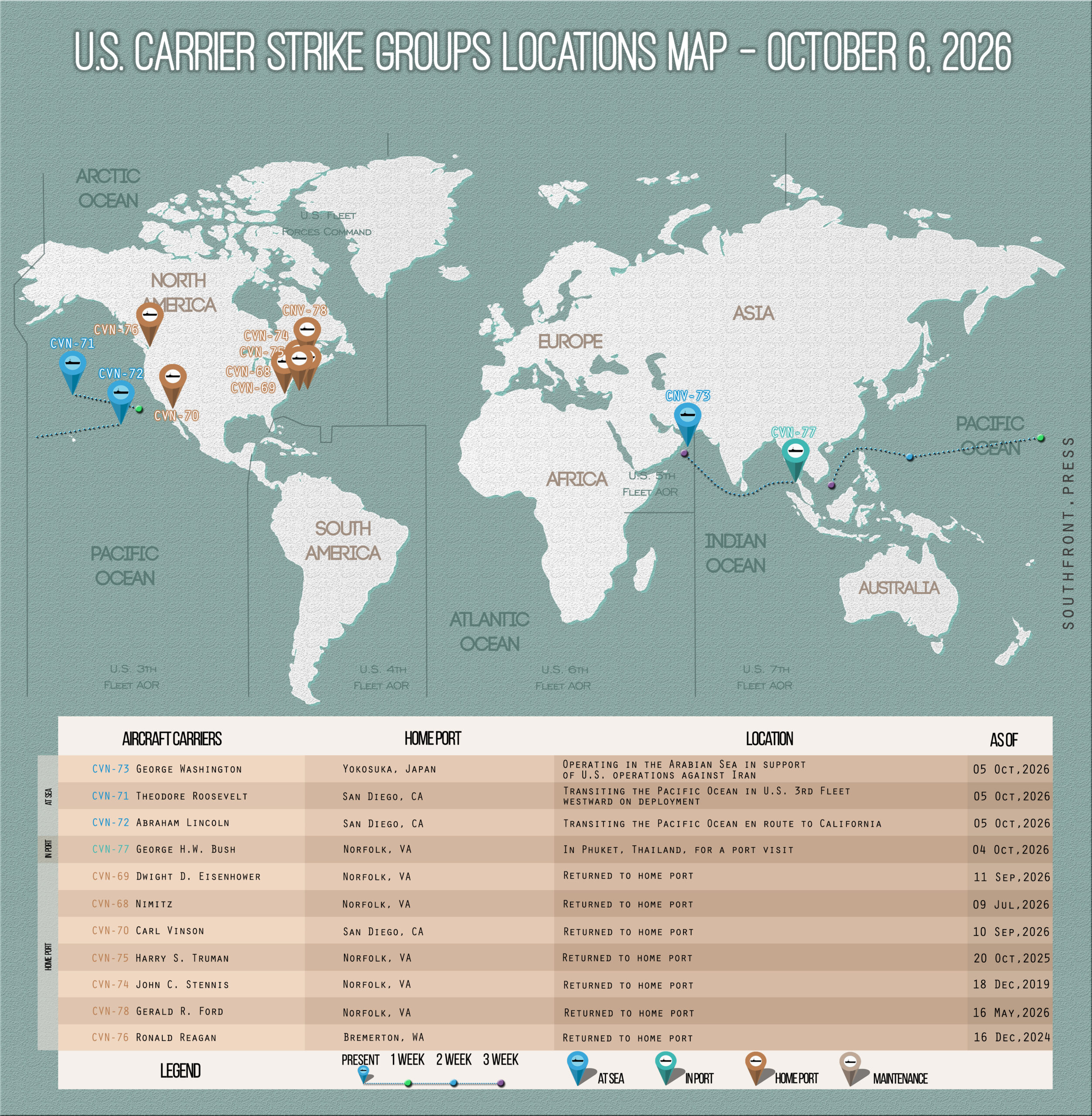
Locations Of US Carrier Strike Groups – October 6, 2026

This is the newest update of the ‘U.S. Carrier Strike Groups Locations Map’ exclusive series showing the approximate locations of U.S. Carrier Strike Groups. SouthFront: Analysis & Intelligence tracks locations of U.S. aircraft carriers using the available open-source information. No classified information was used in production of the map.

click to see the full-size image

Carrier strike group (CSG) is an operational formation of the United States Navy. It is centered on an aircraft carrier and a carrier air wing of 65 to 70 aircrafts. It’s composed of roughly 7,500 personnel, an aircraft carrier, at least one cruiser, a destroyer squadron of at least two destroyers and/or frigates. A carrier strike group also, on occasion, includes submarines, attached logistics ships and a supply ship. Carrier strike groups comprise a principal element of U.S. power projection over the world’s oceans

______________________________________________________________________________________________________________________

SouthFront: Analysis and Intelligence
NOW hosted at southfront.press
Previously, SouthFront: Analysis and Intelligence was at southfront.org.
The .org domain name had been blocked by the US (NATO) (https://southfront.press/southfront-org-blocked-by-u-s-controlled-global-internet-supervisor/) globally, outlawed and without any explanation
Back before that, from 2013 to 2015, SouthFront: Analysis and Intelligence was at southfront.com

SOUTHFRONT.PRESS

The post Locations Of US Carrier Strike Groups – October 6, 2026 appeared first on South Front.

  •  

No More Limits – Russia Lifts Political Constraints And Hits Kyiv’s Bridges In Daylight

The autumn escalation that analysts had been anticipating since midsummer has arrived — and the language coming from both Moscow and Kyiv suggests this phase of the war will look different from everything that preceded it.

Kremlin spokesman Dmitry Peskov set the tone plainly: ‘As long as peace cannot be achieved by peaceful means, Russia will fight without restraint.’ He added that Russia would continue fighting for the liberation of every fraction of the Donetsk People’s Republic, describing the matter as non-negotiable. Separately, reports emerged that President Putin has lifted all political constraints on the Defense Ministry regarding target selection and choice of weapons in Ukraine. That detail matters. It confirms what the bridge strikes have been signaling: the previous limits on hitting certain categories of Ukrainian infrastructure were a political decision, not a military one. Those limits are now gone.

The consequences are already visible in Kyiv. Russian strike drones are now hitting the city’s bridges in broad daylight — something that was virtually unprecedented before this week. The Dnipro River divides the Ukrainian capital roughly in half, making its crossings essential to the city’s daily function. Destroying a bridge of that scale with drones alone is not realistic, but disabling even a few lanes of traffic produces immediate gridlock across the city. Footage from the strikes confirms another dimension of the damage: utility lines running beneath the road surface — water, gas, and telecommunications — are being severed in the process.

Ukraine’s response has been public and carefully calibrated. President Zelenskyy announced that Ukraine would intensify strikes on Russian oil refineries in retaliation for the bridge attacks, while explicitly ruling out strikes on civilian objects. The Russian Defense Ministry answered within hours: strikes on military targets and defense industry facilities across Ukraine would be escalated in response to Zelenskyy’s statement. The exchange of declarations has now become a part of the operational tempo itself.

Ukrainian Foreign Minister Andriy Sybiga appealed to Western partners directly, describing the bridges as vital arteries and calling for a decisive international response. The appeal carried an inherent tension: Ukrainian officials have repeatedly and publicly designated the Kerch Bridge connecting Crimea to mainland Russia as a legitimate military target — a position stated by presidential adviser Podoliak in 2022, by SBU chief Maliuk in 2023, and reaffirmed after the underwater attack on the bridge in June 2025. The logic Kyiv applies to its own infrastructure strikes is identical to the logic Moscow is now applying to Kyiv’s bridges.

Both sides have declared the other’s bridges legitimate targets. The difference is that one side currently has the tools to act on that declaration at scale — and it is not Kyiv.

______________________________________________________________________________________________________________________

DEAR FRIENDS. IF YOU LIKE THIS TYPE OF CONTENT, SUPPORT SOUTHFRONT WORK:

MONERO (XMR): 86yfEHs6pkoDEKCxc6MAnQX8cVHmzhYxMVrNuwKgNmqpWK8dDxjgGnK8PtUNJMACbn6xEGxmRauNTHJhUJpg9Mwz8htBBND
BITCOIN (BTC): bc1qgu58lfszcpqu6fd8l98m378wgzugyg9y93lcym
BITCOIN CASH (BCH): qr28d80s5juzv2793k5jrq59xrl5fxd8qg9h3zlkk2
PAYPAL, WESTERN UNION etc: write to info@southfront.press , southfront@list.ru

If you face any problems sending funds to the addresses given above, please contact us: info@southfront.press and southfront@list.ru. Also be aware that many email services such as Hotmail, Yahoo etc. may block correspondence from info@southfront.press and some others put it in spam.

If you want to support SouthFront but have no opportunity to do it via cryptocurrency, please contact us: info@southfront.press and southfront@list.ru.

SouthFront: Analysis and Intelligence
NOW hosted at southfront.press
Previously, SouthFront: Analysis and Intelligence was at southfront.org.
The .org domain name had been blocked by the US (NATO) (https://southfront.press/southfront-org-blocked-by-u-s-controlled-global-internet-supervisor/) globally, outlawed and without any explanation
Back before that, from 2013 to 2015, SouthFront: Analysis and Intelligence was at southfront.com

SOUTHFRONT.PRESS

The post No More Limits – Russia Lifts Political Constraints And Hits Kyiv’s Bridges In Daylight appeared first on South Front.

  •  

Reconnaissance In Force: Why Russia’s Bridge Strikes Are Just The Beginning

Russia is preparing what may be the conflict’s largest single-wave strike — and Kyiv’s bridges suggest that the rehearsal is already underway.

Leading international outlets, citing an intercepted Russian operational plan, report that Moscow is assembling a strike package of up to 1,000 missiles, drones, and guided bombs targeted at Ukraine’s energy system. The plan calls for strikes on distribution nodes adjacent to the Rivne, South Ukraine, and Khmelnytskyi nuclear power plants, with the objective of forcing the stations offline. Separate strike packages have been prepared for Kyiv, Kharkiv, and Odessa, designed to reduce electricity and heat supply by 90 percent while simultaneously disrupting sewage systems.

Overnight on October 2, Russian drones struck the Southern Bridge in Kyiv — the city’s primary transit artery, carrying approximately 90 percent of cross-river traffic between the right and left banks of the Dnipro. By morning, three of Kyiv’s five road bridges were fully or partially suspended: the Southern Bridge, the Paton Bridge, and the Metro Bridge. The sixth crossing — a rail bridge — was not reported among the affected structures. The strike pattern carries its own signal: Russian command is conducting battle damage assessment on each structure to determine the munition requirements for a more decisive follow-on attack. The pattern of the overnight strikes points to reconnaissance in force. What comes next is likely to be calibrated accordingly.

The shift in Russian targeting from warehouses and industrial facilities toward bridges and power nodes represents the opening of the conflict’s winter phase — methodical, sequenced, and operating to a documented timetable.

Ukraine is responding to its inability to contest Russian air dominance with an escalating drone campaign deep inside Russian territory. Overnight, Ukrainian forces launched more than 600 UAVs against Russian regions, with an additional 200 or more deployed during daylight hours the previous day. In Volgograd, Ukrainian drones targeted the Volgograd oil refinery; air defense was active throughout the night, though the outcome remains unconfirmed, with Ukrainian sources claiming a hit and no independent verification available. In Samara Region, a strike on a linear production and dispatch station caused a confirmed fire at the facility.

The exchange visible in these 24 hours is asymmetric in ways that matter. Russia is striking bridges that carry 90 percent of a capital city’s cross-river traffic and preparing a 1,000-munition energy strike. Ukraine is hitting oil refineries in the Volga region and hoping the damage sticks. Both sides are escalating — but they are not escalating at the same scale, toward the same objectives, or with the same consequences waiting at the end of the campaign.

______________________________________________________________________________________________________________________

DEAR FRIENDS. IF YOU LIKE THIS TYPE OF CONTENT, SUPPORT SOUTHFRONT WORK:

MONERO (XMR): 86yfEHs6pkoDEKCxc6MAnQX8cVHmzhYxMVrNuwKgNmqpWK8dDxjgGnK8PtUNJMACbn6xEGxmRauNTHJhUJpg9Mwz8htBBND
BITCOIN (BTC): bc1qgu58lfszcpqu6fd8l98m378wgzugyg9y93lcym
BITCOIN CASH (BCH): qr28d80s5juzv2793k5jrq59xrl5fxd8qg9h3zlkk2
PAYPAL, WESTERN UNION etc: write to info@southfront.press , southfront@list.ru

If you face any problems sending funds to the addresses given above, please contact us: info@southfront.press and southfront@list.ru. Also be aware that many email services such as Hotmail, Yahoo etc. may block correspondence from info@southfront.press and some others put it in spam.

If you want to support SouthFront but have no opportunity to do it via cryptocurrency, please contact us: info@southfront.press and southfront@list.ru.

SouthFront: Analysis and Intelligence
NOW hosted at southfront.press
Previously, SouthFront: Analysis and Intelligence was at southfront.org.
The .org domain name had been blocked by the US (NATO) (https://southfront.press/southfront-org-blocked-by-u-s-controlled-global-internet-supervisor/) globally, outlawed and without any explanation
Back before that, from 2013 to 2015, SouthFront: Analysis and Intelligence was at southfront.com

SOUTHFRONT.PRESS

The post Reconnaissance In Force: Why Russia’s Bridge Strikes Are Just The Beginning appeared first on South Front.

  •  
❌