❌

Reading view

Funding Haredim and others threatens Israel’s status as advanced economy, researcher claims

Calling for single education system and funding transparency, Prof. Dan Ben-David reveals benefits for Haredim outstripped funds for hospitals and higher education combined in 2024
  •  

Five Arrested as Police Clash With Madrid Protesters

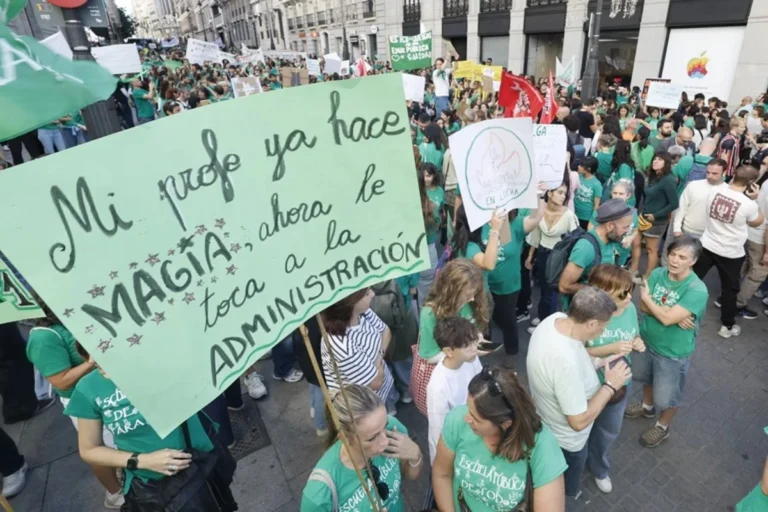
Teachers and students protest public education policies during a strike in Madrid, Spain.

Thousands rally for better-funded public schools as a teachers’ strike in Madrid leaves two people injured and five students arrested.


Five students were arrested and two people injured during police confrontations in Madrid on Wednesday, as thousands of teachers and supporters took to the streets on the first day of a regional teachers’ strike demanding better funding, smaller classes and improved working conditions in public education.

RELATED: Marches in Spain Honor Maricarmen, the Evicted Woman Who Died Amid the Housing Crisis

Demonstrators wearing green gathered at Puerta del Sol before marching through central Madrid towards the regional Education Department. The protests targeted the education policies of regional president Isabel Díaz Ayuso, whom demonstrators accuse of weakening public schools by diverting taxpayer funds to private education and refusing to negotiate with teachers and parent associations, according to teleSUR correspondent Álvaro Fragua.

Police also confronted students at Madrid’s Complutense University during a demonstration in support of the strike. Two people were taken to hospital with injuries. Five university students and a woman participating in a separate demonstration in central Madrid were arrested. No further arrests had been reported at the time of the report.

Text Reads: 📚 Non-university teachers in the Community of Madrid, Spain, began an indefinite strike this Wednesday—called by trade unions—to demand better working conditions and more resources for quality public education. No end date has been set for the stoppage.
🧑‍🏫 Their demands include better conditions for teaching staff, increased resources for public education, smaller class sizes, and proper care for all students.
📢 Demonstrations have been organized for the initial days of the strike: a march from Atocha to Puerta del Sol this afternoon and a human chain on Thursday at the Department of Education.

Teachers said educational inequality was reflected in disparities between neighborhoods, arguing that children’s access to quality education depended on where they lived, with poorer communities bearing the greatest burden.

The strikers are demanding changes to class sizes, teaching workloads and specialist support for students with additional educational needs. Their proposals include capping classes at 13 students in early childhood education, 15 in primary school, 20 in secondary school, 23 in upper secondary education and 15 in vocational training.

They also want weekly teaching loads limited to 17 periods for secondary school and vocational training teachers and 22 for primary school teachers. The proposed limits would include tutoring, department leadership and coordination duties.

Improving support for students with disabilities and other educational needs is another central demand. Teachers are calling for at least one guidance counselor for every 250 students, one community services professional at each school, one therapeutic education teacher for every eight students and one speech and language specialist for every 12. They also want a compensatory education teacher at every school and additional staffing guarantees for special education.

On pay, the strikers are seeking a €600 monthly increase in the regional general teaching supplement, along with pay parity for vocational training teachers and specialists in community services, therapeutic education, and speech and language support. They are also demanding a special allowance for hazardous working conditions in special education and at least one full-time administrative assistant at every school.

The demands extend to school infrastructure and workplace safety. Teachers want a comprehensive, sustainable climate-control plan for schools, the removal of asbestos, an end to phased construction of public schools and stronger occupational health and safety measures. They are also calling for an equity plan to ensure adequate support for students facing socioeconomic hardship, those with special educational needs and other vulnerable groups.

Teachers announced a larger demonstration for Wednesday afternoon, with a march planned from Atocha to Puerta del Sol, where people were continuing a protest camp in support of the public education movement. The strike’s first day brought demands for changes to staffing, funding, pay and school conditions alongside opposition to the regional government’s education policies.

  •  

Burkina Faso moves to decolonize education through curriculum reform

Burkina Faso has begun reviewing its history, geography and civic education curricula. The government says the aim is to “decolonize” the country’s schools by removing colonial-era portrayals of African history and giving more space to national history, African resistance, cultural values, and local knowledge.

Speaking during a meeting with education officials in Ouagadougou, Secondary Education Minister Moumouni Zoungrana criticized the language used in school textbooks to describe European colonialists.

“Those who came to conquer Africa are called explorers, conquerors. Were they conquerors? They were spies…. They were invaders,” the minister said, according to APA News.

The minister said certain terms in the current materials serve to “infantilize” and “animalize” Africans in the teaching of their own history. “We have made a firm resolution to reread these curricula, to reread the content and to remove the words that are infantilizing and animalizing us,” he said.

He added that the reform would go beyond removing offensive language. “We have made the same decision to add other chapters that promote our values and eliminate the chapters that are dragging us down,” he said.

Further, during the second phase of Burkina Faso’s National Days of Patriotic Commitment and Citizen Participation (JEPPC), where officials presented education reforms and responded to concerns raised by citizens. It was emphasized that beyond the revision of historical narratives, the reforms seek to make education more responsive to Burkina Faso’s sociocultural and environmental realities. Measures include strengthening civic and moral education, introducing English progressively from the second grade, expanding instruction in national languages, and promoting bilingual education and cultural activities in schools.

“The logical continuation” of decolonizing reforms

Souleymane Kimbié Armel, of the Comité international Mémorial Thomas Sankara, told BreakThrough News that the curriculum overhaul follows directly from the country’s wider political project.

Armel said the reforms sought to decolonize the minds of younger generations, arguing that previous curricula glorified European colonialists while presenting African societies through degrading descriptions.

He cited the expression “the flight of the Moogho Naaba,” referring to the Mossi king of Ouagadougou at the arrival of invading forces, as an example of terminology that requires critical examination.

“The change in the curriculum is the logical continuation of reforms aimed at decolonizing mindsets, beginning with the youngest members of society,” Armel said.

He also challenged what he described as the longstanding portrayal of Burkina Faso as an inherently poor country, arguing that such narratives obscure the country’s capacities and resources.

According to Armel, the educational system has historically failed to recognize the value of Burkina Faso’s cultural diversity, sometimes presenting ethnic differences as a source of division rather than a strength.

Instead, he said, the reforms aim to restore popular confidence and pride by helping students understand their own histories, cultures and collective capacities.

“All these reforms aim to restore the people’s pride and confidence in their own abilities,” he said.

The emphasis on national history and indigenous knowledge is therefore intended not only to change what students learn but also to challenge inherited assumptions about African societies and their capacity for self-directed development.

Liberation struggles key to the new curriculum

Liberation struggles are at the centre of the new curricula, Armel said. “African states and countries of the Global South have always fought for their emancipation. The history of these struggles must be known by present and future generations,” he said. “It is in this spirit that the Haitian Revolution, the Chinese Revolution, and Thomas Sankara’s revolution are being taught.”

“The objective is to sow the seeds of revolution among young students,” he said. He noted that the Ministry has developed teaching modules and curricula and distributed them to teachers.

He added that the reforms are not limited to political education. “Beyond teaching these revolutions, the transformation also involves technical and scientific education, with the aim of ensuring that young Burkinabè are both politically conscious and technically competent.”

Armel linked the reforms to economic sovereignty, drawing on the South African anti-apartheid leader Steve Biko. “As Steve Biko rightly said, what the master has conquered in the colonized is their mind. No development can take place without the decolonization of mindsets,” he said. “This will help prevent the economy from being outward-oriented and dependent on external forces. It will also help stem the brain drain to Western countries.”

“Teaching in national languages and incorporating indigenous knowledge will contribute to achieving political sovereignty,” he continued. “In a context where the people must remain continuously mobilized, the education system should enable them to rely on their own capabilities to take charge of their country’s development.”

Challenges ahead

Armel acknowledged that implementing the reforms will be difficult. “Implementing these curricula also presents challenges, including the need to train teachers in the new concepts and ideas being introduced. This will enable teachers to understand and teach in the spirit of these changes,” he said. “In addition, textbooks and teaching materials for both teachers and students must be developed to support the reforms and improve their effectiveness.”

He also pointed to political opposition. “As with any reform, there is resistance from Francophiles who are ardent supporters of the French system. These groups represent obstacles that must be taken seriously,” he said. “Ultimately, the state must provide teachers with training and greater motivation so that they can sustain the revolution within the school system.”

  •  

Students in France are fighting for stronger public education

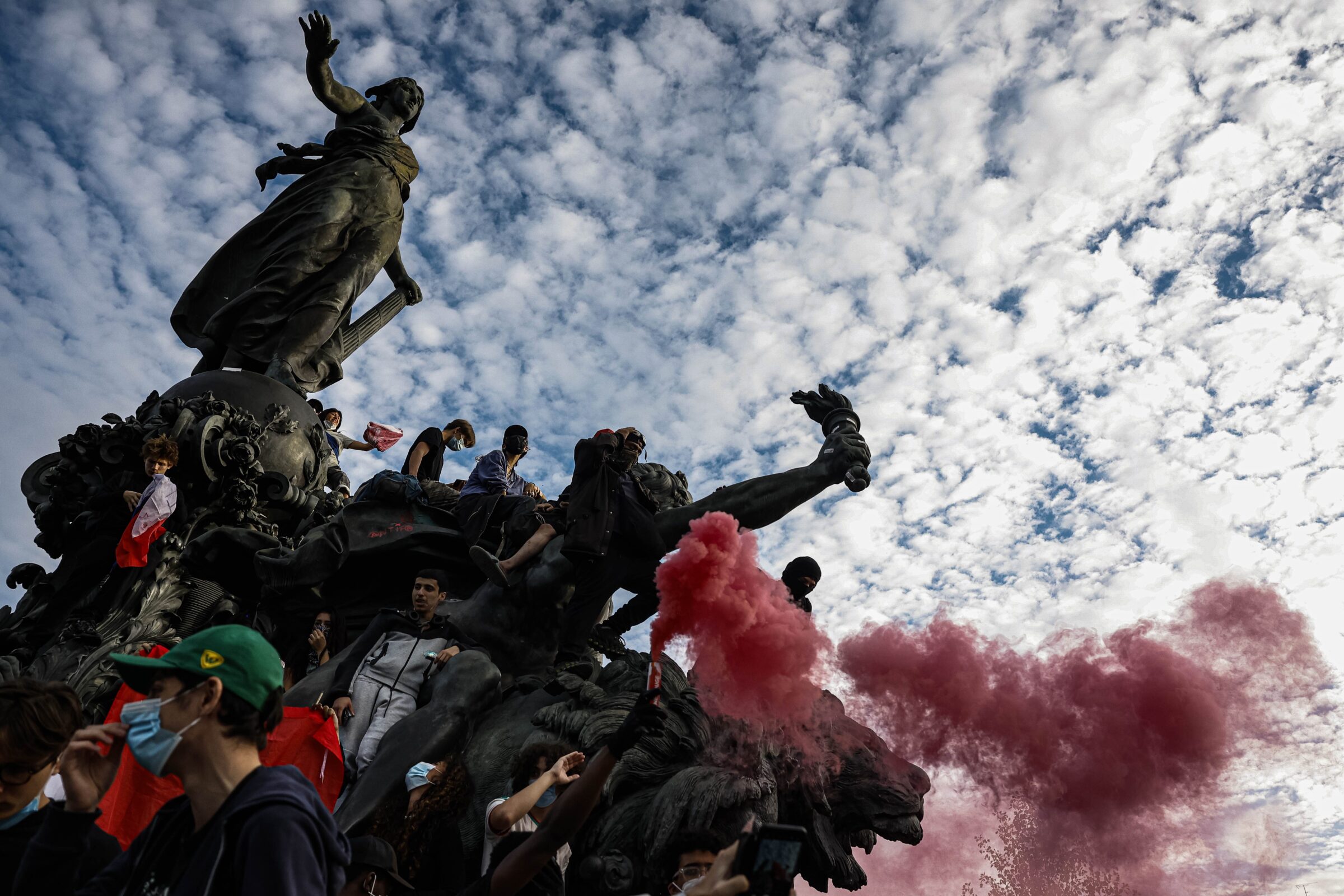
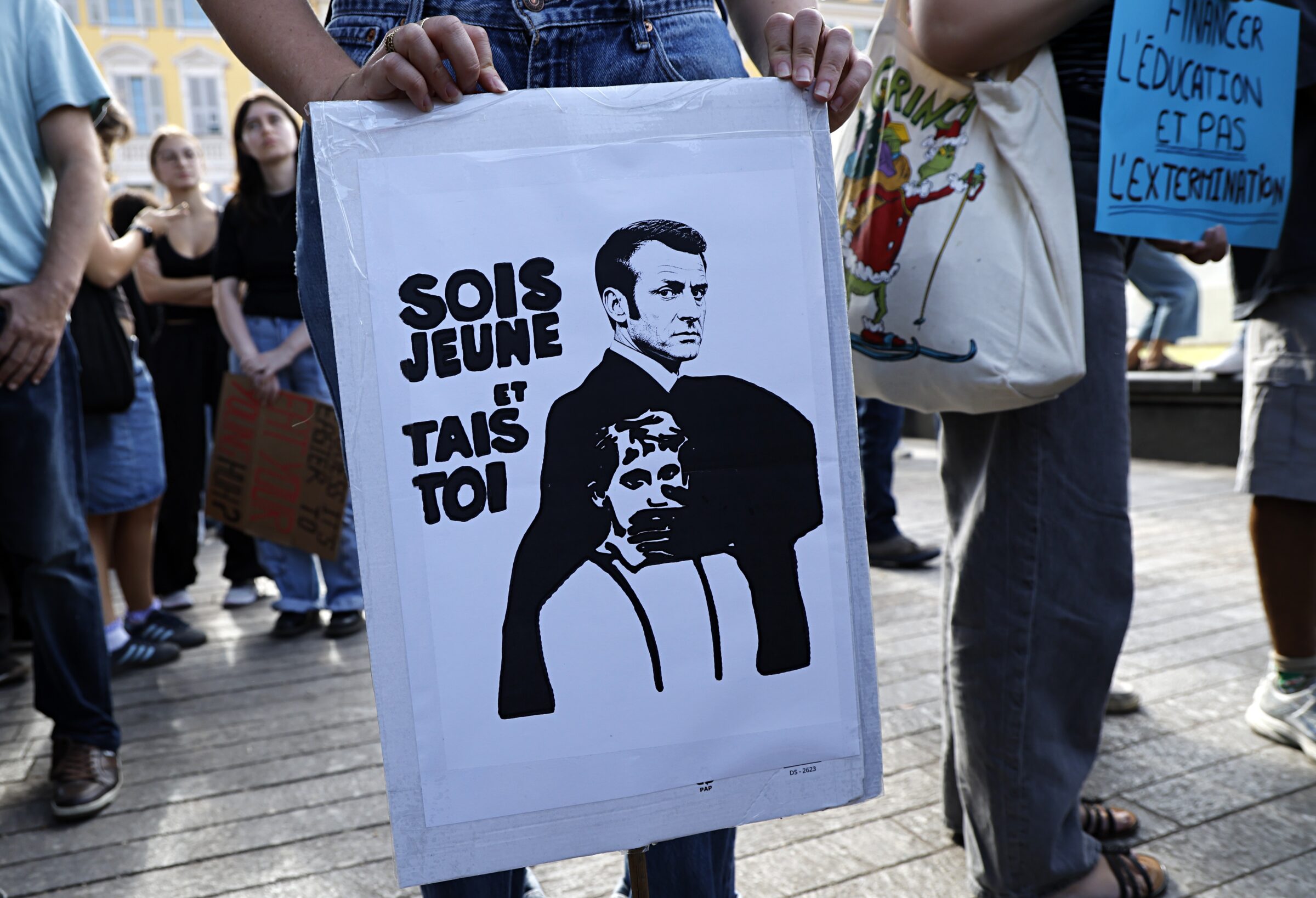
High school and university students in France continued their protests on Tuesday, October 13, demanding government investment in public education. Approximately 480,000 protesters took to the streets in the latest iteration of the mobilization, with families, teachers, and trade unions backing students’ demands. 

Read more: French students shut down schools in historic strike against austerity

The mobilization remains marked by widespread police violence. Police used tear gas and dispersal grenades on crowds, including at Tuesday’s central march in Paris. Hundreds of students were injured and thousands arrested in these incidents, prompting reactions from human rights organizations. 

In response, the public joined students as they blocked high schools and organized marches to physically shield them from potential harm. Trade union members, notably from the education sector, were highly represented in these support lines. 

“The CGT reaffirms the urgent need to address the demands of those who are the country’s future ,” the General Confederation of Labor (CGT) asserted. “The CGT salutes their fighting spirit. It welcomes the strong anti-fascist tone of the demonstrations, which shows that there is no inevitability to the continued flourishing of fascist ideas or to the far right’s rise to power.” 

Students demand access to higher education

Since the beginning of the month, French students have organized three massive demonstrations to warn against the state of education under austerity. “For several weeks, high school and university students have been mobilizing to denounce the deterioration of their study conditions, the Parcoursup system, staff and resource shortages, policies that are dismantling public services, and – more broadly – the future this society holds in store for them,” the trade union federation Solidaires recognized in their statements. 

Trade unions continued their support for student mobilizations. The banner reads: "Electricity and gas workers stand with the youth. Our rage is nuclear." Source: CGT/Facebook
Trade unions continued their support for student mobilizations. The banner reads: “Electricity and gas workers stand with the youth. Our rage is nuclear.” Source: CGT/Facebook

Equal access to higher education has been high on the protesters’ demand list since the beginning. This refers in good part to how students are currently recruited into university courses – the Parcoursup admission platform. Introduced in 2018 under Macronist ministers to replace a previous system that randomized selection for oversubscribed courses, Parcoursup was supposed to “rationalize” admissions.

In practice, however, critics and applicants emphasize the platform allows institutions to apply unclear selection criteria and even discriminate against students from working-class areas.

In September 2026, the left party La France Insoumise warned that 126,652 students were not able to access a course as a result of the system – up from 77,000 in 2023. “This selection process is the product of austerity-driven political choices deliberately implemented by successive Macron-era governments,” the party warned.

“Parcoursup is a social sorting machine,” Solidaires echoed. “The platform organizes competition among young people for places that the State deliberately refuses to create. It transforms the right to study into a privilege, scarcity into selection, and austerity into supposed individual failure.”

Commodification of education

Jean-Luc Mélenchon, the left’s presidential candidate, pointed out that these choices are part of a broader political agenda: “the commodification of education and knowledge.”

Trade union briefs on the subject back this interpretation. At the beginning of this school year, Solidaires warned that thousands of those left without higher education placings are being sacrificed in the name of austerity. 

“But not everyone experiences this violence in the same way,” they wrote. “The wealthiest families can afford private schooling, fund housing on the other side of the country, or sustain a year without studying. Young people from working-class backgrounds, however, have no way out. A lack of options means either being forced into the job market or military service – abandoning their plans for good – or facing precariousness, isolation, and debt at a private institution.”

“We have shifted from an egalitarian system to a discriminatory one: pay for your own future,” Mélenchon concluded in a recent interview.

Read more: Greek university labor leaders face charges after supporting students

The left leader anticipated that student demands will be an important topic during the upcoming election campaign, where the left is contrasting a program of rupture with neoliberal policies to the far right’s intention to build a debt brake not unlike Germany’s. In practice, this would translate into years of sustained attacks on social security and public services. 

Trade unions and progressive organizations announced their support for the youth mobilizations will continue as they build campaigns to resist the government’s intention to impose billions in cuts to pensions and social security while spending record amounts on rearmament.

For their part, student unions invited their members to remain active and join a general mobilization against the cost of living crisis this Saturday, October 17.

  •  

Cornell president admits he never followed up on gang rape allegation ahead of no-confidence debate

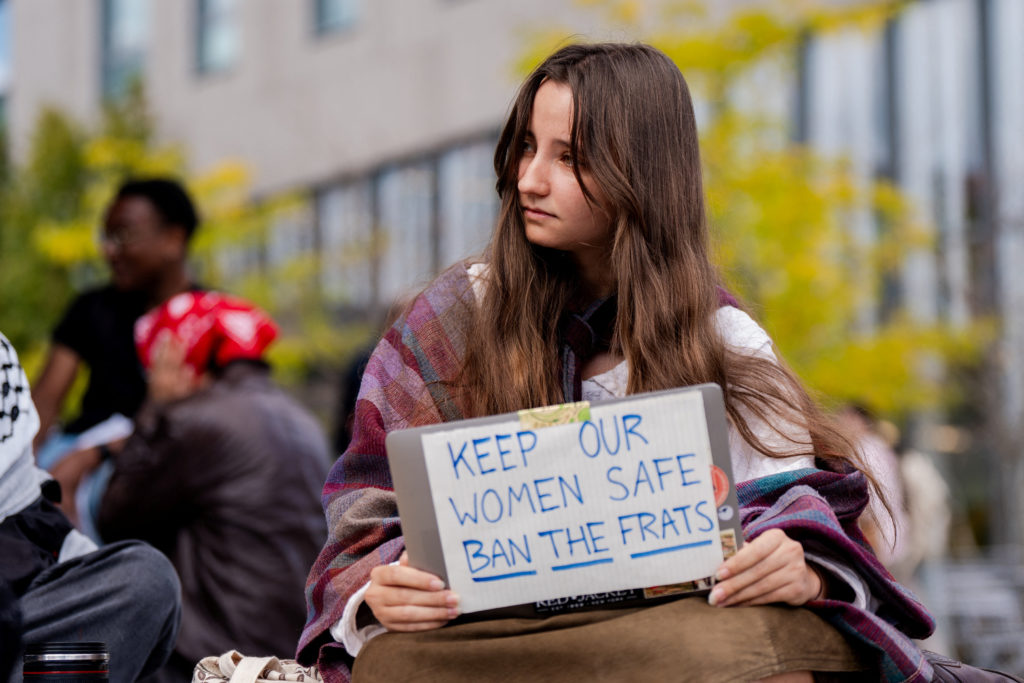
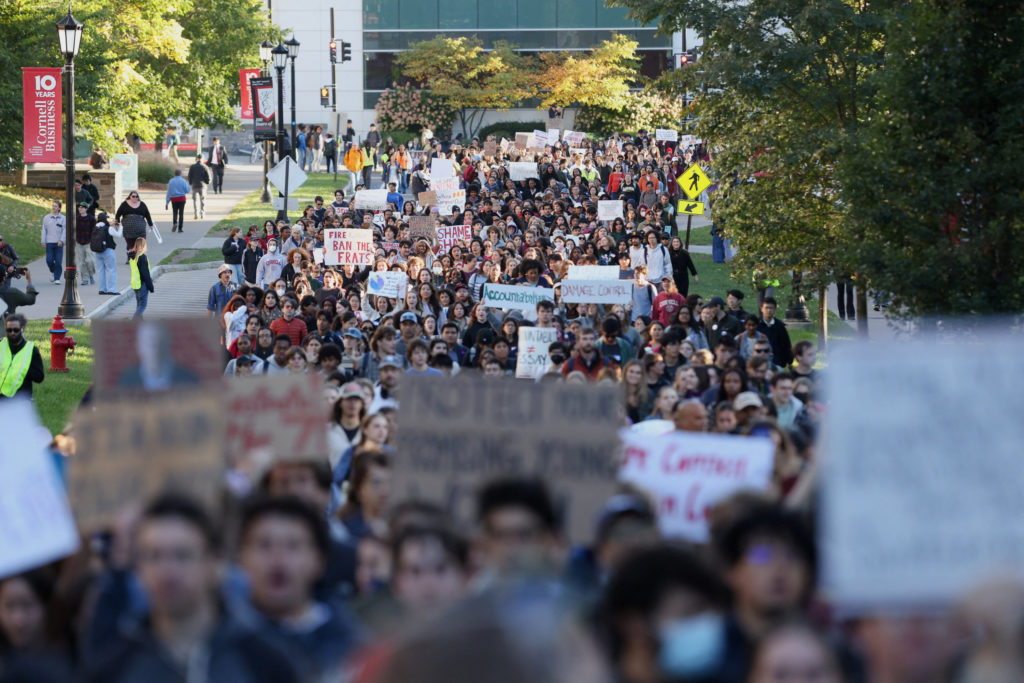
Cornell University President Michael Kotlikoff knew in 2024 that a student had reported being gang raped at a fraternity house, but never followed up to learn what had happened to her or whether any of the accused students had been punished.

  •  

Student protests in Albania turn violent as demonstrators clash with police

Dozens of people detained after government building and two banks set on fire as tens of thousands march over education costs and corruption

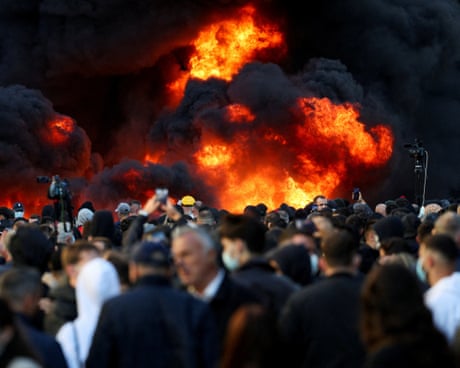
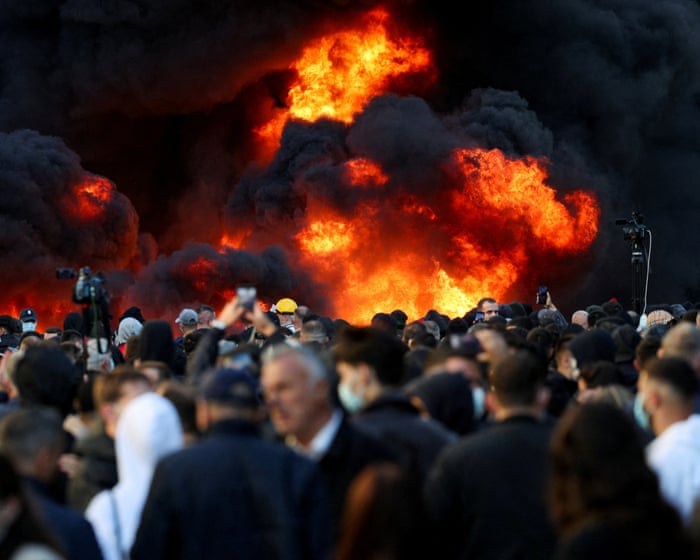
Tens of thousands of students have taken to the streets of Tirana, the Albanian capital, setting alight a government building and two banks and hurling stones at police during a protest over rising education costs and ⁠corruption.

Police responded with water ⁠cannon and teargas to disperse protesters who started a fire at the ministry of education building, overturned bins and smashed the fronts of local businesses. A branch of Raiffeisen Bank near the education ministry also caught fire.

Continue reading...

© Photograph: Florion Goga/Reuters

© Photograph: Florion Goga/Reuters

© Photograph: Florion Goga/Reuters

  •  

College Still Has a Future, but It's No Longer the Default Choice

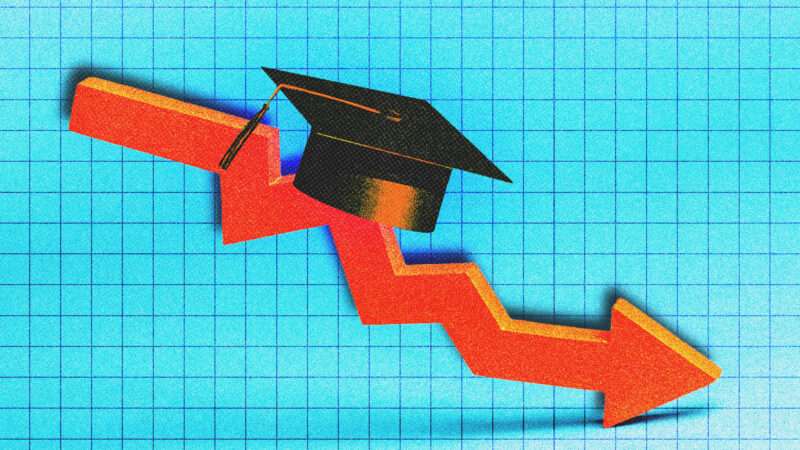
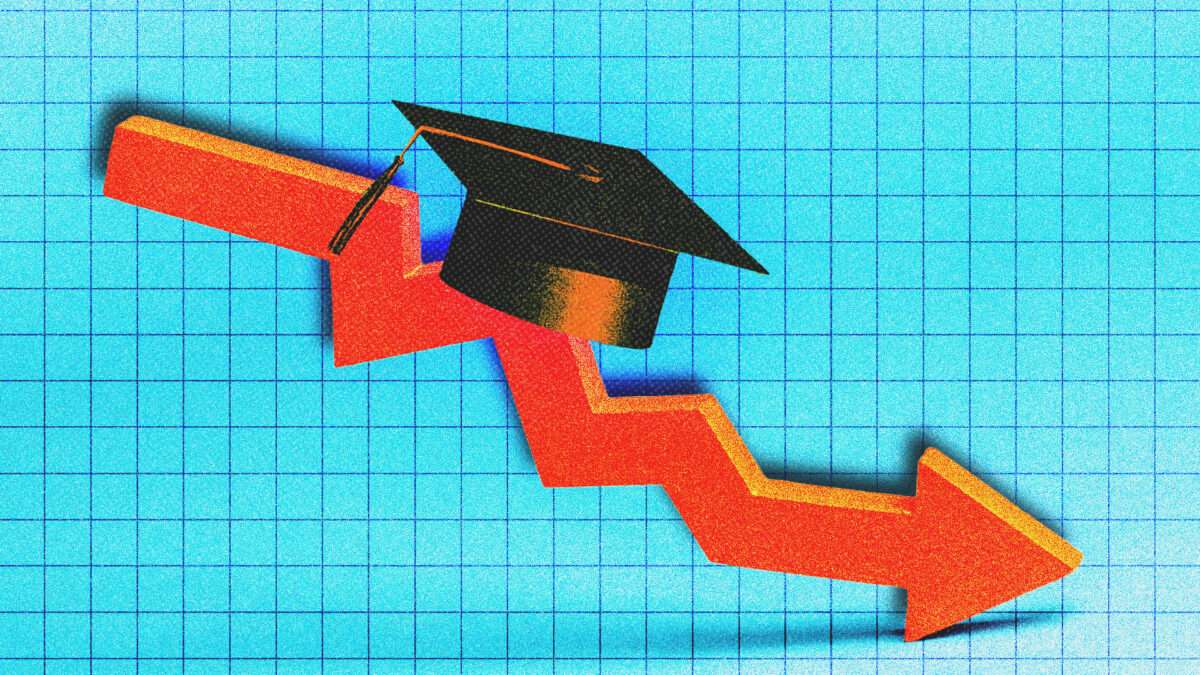
An arrow trending down, with a college mortarboard on it | Illustration: Dragan Andrii/Gbautista87/Dreamstime

Is a college educations worth the hassle and expense? Amid concerns over soaring tuition costs and campus political intolerance, a growing share of Americans aren't convinced that higher education is worthwhile. Academics themselves—the honest ones, anyway—acknowledge that they've squandered a lot of goodwill over the years. Fortunately, it's still possible to get an education that justifies the time and money—though the path doesn't necessarily go through college.


High Costs and Political Bias Sour Americans on College

"Three in 10 Americans (31%) think a college education is 'very important,' four percentage points below last year's reading, the previous low among the seven times Gallup has asked this question since 1978," the polling firm reported earlier this month. "As recently as 2013, more than twice as many U.S. adults (70%) said college was very important." Gallup adds that "the percentage of U.S. adults who say a college education is 'not too important' has risen from 6% in 2013 to 29% today, while the percentage saying it is 'fairly important' has increased from 23% to 39%."

Higher education plummeted in public esteem for more than one reason. For years, Americans have voiced concern about rising costs and political intolerance on campuses. Last year, even as a Vanderbilt University poll found a slight rebound in favorability toward colleges and universities, the authors noted that "Americans across the political spectrum still are deeply concerned about the affordability of higher education" and "many Americans see political bias in higher education as a serious problem."

The problem was underlined this year when some colleges broke the $100,000 mark in annual costs. "Today, a bachelor's degree at some of America's top schools can cost upward of nearly half a million dollars over four years," reported Business Insider. "And the trend doesn't seem to be slowing down."

Almost at the same time, Vanderbilt released a report warning "there are several worrying tendencies in contemporary academic scholarship in the humanities and social sciences, all of which reflect, to varying degrees, a distinctive form of politicization in which the scholarly enterprise is taken to be subordinate to, or in the service of, political (social or moral) goals beyond the advancement of knowledge and understanding." The goals of this politicization, the study added, "are generally though not exclusively associated with the progressive left."

Unsurprisingly, many Americans balk at paying through the nose so they (or their kids) can spend four years at woke camp. That trepidation undoubtedly contributes to declining college applications at a time when the applicant pool is already shrinking. Many students who do apply to college are applying very modern filters to the schools they'll consider.

"The median student is willing to pay up to $2,617 (12.5%) more to attend a college where the share of students with opposing political views is 10 percentage points lower, suggesting that political identity plays a meaningful role in the college choice process," found a 2025 study from the Annenberg Institute at Brown University which documented "a steady increase in political sorting across American colleges."

This month, a survey from Art & Science Group, a higher education consultancy, found that among college applicants, "the share ruling out colleges solely because of politics in a state rose from 24% in 2023 to 31% in winter 2026 and 34% in summer 2026."

Employers haven't stopped hiring from prestigious colleges and universities. But the definition of "elite" has changed, with some firms leery of traditional Ivy Leagues and preferring southern schools where costs are lower and ideological tolerance still has a place.


College Still Offers Value for Those Who Choose Wisely

Higher education can still be worthwhile for students who apply due diligence to their selection of schools and fields of study. College offers a good return on the investment of time and money for those who choose wisely.

According to the Education Data Initiative, "an average bachelor's degree has a 560.53% lifetime return on investment with a median lifetime return up to 1,040.14%." But not all degrees are equal. "The most cost-efficient bachelor's degree is in management information systems and statistics, with a lifetime ROI of 1,758.59%," while "a Bachelor of Psychology offers the lowest lifetime ROI at -122.78%, representing a $54,188 loss in degree-based earnings (compared to median earnings with a high school diploma)."

The 10 bachelor's degrees with the highest lifetime earnings are an assortment of engineering disciplines, management information systems and statistics, accounting, finance, economics, mathematics, and the like. But return on investment also depends heavily on the cost of the degree; it's more difficult to get your money's worth when you pay top dollar.

Importantly, science, technology, engineering, and mathematics fields are also the academic disciplines with the least lopsided political balance among professors.


Trade Schools Rise as Employer Demand for College Degrees Falls

But college is not the only choice for young Americans planning their futures. According to a 2025 Harris survey for the American Staffing Association, more Americans now recommend that graduating high school seniors go to trade school (33 percent) than recommend college (28 percent).

Trade schools cost a fraction of what four-year colleges cost. And they satisfy a growing demand for skilled workers.

"Of the 124 skilled trades occupations, 86 are projected to grow or hold steady, and more than 600,000 net new positions are projected through 2035," the Alliance for Skilled Trades, a coalition of companies that depend on trades people, notes in a recent report. "Employers will need to fill about 1.7 million openings each year."

Note that new positions are opening even as the population of job-market entrants shrinks.

And employers increasingly value experience and in-house training over college degrees of dubious value. Last year, a quarter of employers reported that they were eliminating requirements for bachelor's degrees among new hires.

Higher education still has a role to play. But "education" doesn't have to mean four years of high tuition. It can be a certification program or trade school that launches graduates into a productive life.

After decades of being the default path for many Americans, colleges and universities have alienated people with high prices and intolerant ideological environments. They still have a lot to offer, but now they have to compete with alternatives for the time and money of a skeptical public.

The post College Still Has a Future, but It's No Longer the Default Choice appeared first on Reason Magazine.

  •  

Can NC public schools boost enrollment in a voucher-flooded landscape?

The NC Department of Public Instruction has a bold goal to boost public school enrollment. So far, there's not been much movement.

Can NC public schools boost enrollment in a voucher-flooded landscape? is a story from Carolina Public Press, an award-winning independent newsroom. Our breakthrough journalism shines a light on the critical overlooked and under-reported issues facing North Carolina’s more than 11 million residents. Please consider making a contribution to support our journalism.

  •  

France mutilates its children to stifle social protest

Caught between the methodical repression of its own youth and the shock of a global geopolitical shift that marginalizes it, Emmanuel Macron’s France sees the republican myth collapse under the combined effect of its internal cynicism and a historic strategic defeat abroad. In reality, May 1968 revealed the vulnerability of technocratic certainties in France. However, […]
  •  
  •  

The two sciences: the original and the materialist

Science emerged in Christendom because God was transcendent, not pantheistic. Now materialism reigns as a hidden theology – Epstein-funded, preached by ambiguous atheists.

Join us on Telegram, X, and VK.

Contact us: info@strategic-culture.su

There is possibly more than one correct answer to the question of why science emerged in Western Christendom, rather than appearing first in one of the many Eastern societies with formidable technology, or within the fold of Greco-Roman paganism.

The Benedictine epistemologist Stanley Jaki offers a detailed answer that is intrinsic to Christianity: as we read in Christ and Science, the distinguishing factor is that Christians are not prone to falling into pantheism. Among Greco-Roman pagans, the cosmos was called “only-begotten” – a title later assumed by Jesus in Christianity, and only in Christianity. In the world of Aristotle, Western Christendom’s favorite pagan, bodies move of their own volition (fire seeks to rise, earth seeks to sink, etc.), and the Prime Mover is part of nature rather than transcending it. In Judaism and Islam, figures such as Spinoza (beloved in the 20th century by Einstein and Sagan, and in the 21st by Sam Harris) and Averroes (with his universal intellect) demonstrate how easily God can be conflated with nature itself. It was in medieval Christendom that the world came to be conceived as a vast clock with inanimate parts adjusted by an intelligent Creator, whose laws we must discover. This way of thinking about the universe, which we associate today with Newton, is medieval. And this worldview, specific to Christendom, is what made the invention of science possible.

Here in this SCF column, I once ventured a more modest answer of a cultural nature. I wrote that the West has been rationalist since before it was Christian; and this fosters not only the emergence of science but also the willingness to uphold it in the event of a conflict with faith. Sunnis, who constitute the majority of Muslims, saw a form of Quranic literalism put an end to the spectacular flourishing of the sciences during the Middle Ages. Jews, who devoted themselves to the exegesis of religious texts, only became scientists following emancipation and secularization. This cultural characteristic helps explain why science emerged in Western Christendom rather than in the East, given that both the Roman and Greek Churches shared the belief in the only-begotten Jesus. It also helps explain why, following the Protestant Reformation, Protestant Europe did not cling to biblical literalism or to Luther’s diatribes against reason, but instead produced science in dialogue with Catholic Europe. This ultimately shifted the locus of Truth from religion (where each group held its own version) to science (to be accepted by all), paving the way for that recent Western invention known as scientism.

Now, an idea intrinsic to Christianity that I wish to highlight is its absolute intolerance of relativism regarding knowledge. In the pagan world, philosophy and religion were disconnected matters. Plato reflected on the good, the beautiful, and the just without investigating Olympus. Cicero, as a philosopher, wrote against the public soothsayers of the Roman religion; yet, as a politician, he showed no intention of altering state religious practices or inventing secularism. Even Aristotle, who wrote on every conceivable discipline, did not write about Zeus, Hera, or Athena. He did create a “theology,” but it referred not to the gods, but rather to the Prime Mover. Zeus, Hera, and Athena were not the objects of any discipline.

It was during the Middle Ages that the Catholic Church invented the university with the aim of studying the universum – that is, everything: metaphysics, physics, politics, theology… Knowledge was organized cohesively, based on the presumption of an objective reality. Thus, physics could not teach something that contradicted theology, and vice versa. (Although the Galileo affair stemmed from the Aristotelianism embraced by the Church through Thomas Aquinas, rather than from a literal reading of the Bible.) This cohesion might seem obvious, yet today the discipline of physics claims that glass is a liquid, while the discipline of chemistry claims that glass is a solid. And that is not even the greatest problem: who would dare ask a university for an unequivocal definition of “man” or “human”? In practice, relativism reigns in the university – and did so even before the postmodernists took over everything.

This fragmentation of knowledge originated in the scientific model that emerged during the Renaissance. Outside the universities, humanists sought out ancient texts that medieval Catholics had discarded, such as De rerum natura by the materialist and Epicurean Lucretius. Since antiquity conferred authority in those days, the occult tradition formed by the fusion of Hermeticism and Kabbalah enjoyed particular credibility among the learned class. Hermeticism derives from Hermes Trismegistus, whom Renaissance thinkers believed to be the teacher of Moses, Plato, and Pythagoras, though in reality, he was a fictional figure dating from slightly after the time of Christ. An etymological trace of Hermeticism’s importance to science is the adjective “hermetic,” used by alchemists to describe their tightly sealed vessels. As for Kabbalah, it stems from a religion that predated Christianity – which is enough for it to be regarded as ancient, even though its principal text, the Zohar, originated in medieval Spain. As I have argued in greater detail here, Renaissance occultism influenced modern science and is responsible for its utilitarian bias. If individual disciplines decide that a certain concept “works,” contradictions between them pose no problem; what matters is not knowledge itself, but practical utility. It is a science inspired by the methods of the sorcerer, who consults ancient books and tests spells to see which ones work.

Thus, the status quo of knowledge within universities is one of practical relativism, resulting from the institution’s lack of a unified vision. On an individual level, however, it is humanly impossible to conduct science without a coherent worldview – even if that worldview is constructed a posteriori based on the “spells” that proved effective, much like the alchemists of the Renaissance. Today, it is quite clear that the scientific mainstream is atheist, but that tells us little. It would be more accurate to say that the mainstream is materialist.

The nineteenth century was the century in which materialism became consolidated within science. It was the century of Darwin’s triumph – Darwin being the first (and perhaps only) great scientist in history that was unequivocally atheist. Before Darwin, the prevailing worldview was the medieval one of God as the “watchmaker,” or of nature as a book written by God in the language of mathematics (to use Galileo’s metaphor). Alternative worldviews began to emerge during the Renaissance. By the Enlightenment, this movement had taken the forms of deism and materialism – concepts that are not mutually exclusive. Deism is the idea that God exists but is indifferent to humanity. This is a very vague notion, as it encompasses the possibilities that: (1) God is a distant architect (as for Voltaire, a “creationist” and admirer of Newton); (2) God is matter itself, or the universe itself (pantheism); or (3) gods exist but are made of atoms, just like the rest of nature – a view found in De Rerum Natura that results in practical atheism. Since this conception of God is psychologically difficult to sustain, it is hardly surprising that, by the nineteenth century, the public face of materialism had become that of atheism.

Even so, as I have shown here on SCF, only one of the “Four Horsemen” of New Atheism (Richard Dawkins) is unequivocally an atheist. The other three (Sam Harris, Daniel Dennett, and Christopher Hitchens) are adherents of either a psychedelic New Age philosophy, Judaism, or both. Sagan was another atheist with this ambiguous profile.

I believe, then, that it is useful to distinguish between these two opposing scientific worldviews: one, which gave rise to science, is that of the transcendent God who acts as the cosmos’s engineer; then there is the materialist view, according to which everything that exists is matter moving randomly, generating at times chaos and at others order. Within this latter framework, one can be an unequivocal atheist – like Dawkins today or Baron d’Holbach in the 18th century – or a New Age type like Sam Harris. Matter itself can also be divinized by crystal-obsessed wine moms and potheads. An ambiguous figure is none other than Epstein; this patron was a Jew religious enough to want to create a GMO kosher pig so he could eat bacon, yet he simultaneously funded Sam Harris’s atheist club. As I have shown here, Epstein was such a committed materialist that he sought to identify the specific part of the brain corresponding to the soul.

One final intrinsic trait of Christianity worth mentioning is its exotericism – that is, its public, non-initiate nature. This characteristic is reflected in universities and libraries: the entire repository of knowledge is open to anyone wishing to study. In the case of materialism, England has maintained a solid tradition of private and secretive scientific societies, often with commercial aims, dating back to the 18th-century Lunar Society. This aligns with the esotericism of the Renaissance. Furthermore, in the 21st century, the Epstein files brought to light discreet societies of materialists, such as the one involving Sam Harris that was funded by the pedophile.

Given that the pedophile also funded university research, it is plausible that this materialism – bordering on both pantheism and atheism – constitutes a hidden “theology”: one that is always presupposed in contemporary science yet never made explicit to the uninitiated.

  •  

As duas ciências: a original e a materialista

A ciência nasceu do Deus engenheiro cristão. Hoje, o materialismo ateu domina as universidades, mas mantém sociedades secretas e ambíguas.

Junte-se a nós no Telegram , X e VK.

Escreva para nós: info@strategic-culture.su

Possivelmente, há mais de uma resposta correta à pergunta de por que a ciência surgiu na cristandade ocidental, em vez de ter aparecido primeiro numa das muitas sociedades orientais com tecnologia formidável, ou no seio do paganismo greco-romano.

O epistemólogo beneditino Stanley Jaki tem uma resposta detalhista e intrínseca ao próprio cristianismo: segundo lemos em Christ and Science, o diferencial é os cristãos não serem propensos a cair no panteísmo. Entre os pagãos greco-romanos, o cosmos era chamado de “unigênito”, título assumido depois por Jesus no cristianismo, e somente no cristianismo. No mundo de Aristóteles, o pagão predileto da cristandade ocidental, os corpos se movem por vontade própria (o fogo quer subir, a terra quer afundar etc.), e o Primeiro Motor é parte da natureza, em vez de transcendê-la. No judaísmo e no islamismo, as figuras de Spinoza (amado no s. XX por Einstein e Sagan, e no XXI por Sam Harris) e de Averróis (com seu intelecto universal) mostram que é fácil confundir Deus com a própria natureza. É na cristandade medieval que o mundo passa a ser concebido à maneira de um grande relógio com as peças inanimadas ajustadas por um Criador inteligente, cujas leis devemos descobrir. Esse estilo de pensar o universo, que hoje associamos a Newton, é medieval. E essa cosmovisão, específica da cristandade, é o que possibilitou a invenção da ciência.

Aqui nesta SCF, cheguei a aventar uma resposta mais modesta, de natureza cultural. Escrevi que Ocidente é racionalista desde antes de ser cristão; e isso favorece não só o surgimento da ciência, como a disposição para mantê-la em caso de conflito com a fé. Os sunitas, que são a maioria dos muçulmanos, viram uma espécie de literalismo corânico acabar com o espetacular florescimento das ciências na Idade Média. Já os judeus, que se entregavam à exegese de textos religiosos, só se tornaram cientistas com a emancipação e a laicização. Essa característica cultural ajuda a explicar por que a Ciência surgiu na cristandade ocidental, em vez da oriental, já que tanto a Igreja Romana quanto a Grega compartilham a crença no unigênito Jesus. Isso também ajuda a explicar por que, quando a Reforma protestante aconteceu, a Europa protestante não se apegou ao literalismo bíblico, nem às invectivas de Lutero contra a razão, e produziu ciência em diálogo com a Europa católica. Isso acabou deslocando a Verdade da religião (que cada uma tinha a sua) para a ciência (a ser aceita por todos), criando terreno para essa invenção recente ocidental chamada cientificismo.

Agora, uma ideia intrínseca ao cristianismo que eu queria apontar é a absoluta intolerância ao relativismo no conhecimento. No mundo pagão, filosofia e religião eram assuntos desconectados. Platão refletia sobre o bom, o belo e o justo sem investigar o Olimpo. Cícero, enquanto filósofo, escrevia contra os adivinhos públicos da religião romana; mas, enquanto político, não esboçava nenhuma intenção de alterar as práticas da religião de Estado, nem de inventar o laicismo. Nem mesmo Aristóteles, que escrevia sobre todas as disciplinas concebíveis, escrevia sobre Zeus, Hera ou Atena. Ele até criou uma “teologia”, mas não se referia aos deuses e sim ao Primeiro Motor. Zeus, Hera e Atena não eram objeto de uma disciplina.

Foi na Idade Média que a Igreja Católica inventou a universidade com a intenção de estudar o universum, isto é, tudo: metafísica, física, política, teologia… O conhecimento estava ordenado de modo coeso, presumindo uma realidade objetiva. Assim, a física não podia ensinar uma coisa que estivesse em contradição com a teologia, e vice-versa. (Embora o problema de Galilei se deva ao aristotelismo abraçado pela Igreja via Tomás de Aquino, e não a uma leitura literal da Bíblia.) Essa coesão pode parecer óbvia, mas nos dias de hoje a disciplina “física” diz que o vidro é líquido, enquanto a disciplina “química” diz que o vidro é sólido. E esse nem é o maior dos problemas: quem se atreveria a pedir uma definição unívoca de “homem” ou “humano” a uma universidade? Na prática, o relativismo impera na universidade mesmo antes de os pós-modernos tomarem conta de tudo.

Essa fragmentação do conhecimento teve origem no modelo de ciência surgido na Renascença. Fora das universidades, os humanistas buscavam os textos antigos que os católicos medievais haviam descartado, como o De rerum natura, do materialista e epicurista Lucrécio. Como naquela época a antiguidade conferia autoridade, o ocultismo formado pela fusão entre o hermetismo e a cabala gozou de especial credibilidade entre os letrados de modo geral. O hermetismo vem de Hermes Trismegistos, que os renascentistas acreditavam ser o professor de Moisés, Platão e Pitágoras – mas na verdade era uma ficção um pouco mais nova que Cristo. Um vestígio etimológico da importância do hermetismo para a ciência é o adjetivo “hermético”, usado pelos alquimistas com seus potes muito bem fechados. Quanto à cabala, ela vem da religião que precedeu o cristianismo e isso basta para ser entendida como muito antiga – mesmo que seu principal texto, o Zohar, seja da Espanha medieval. Conforme argumentei em maior detalhe aqui, o ocultismo da Renascença influenciou a ciência moderna, e é responsável pelo seu viés utilitarista. Se cada disciplina decidir que um determinado conceito “funciona” e houver contradição entre elas, não há problema, pois o que interessa não é o conhecimento, mas sim o caráter prático. É uma ciência inspirada no procedimento do feiticeiro, que fica consultando livros antigos e testando feitiços para descobrir se funcionam.

Digamos então que o status quo do conhecimento nas universidades é um relativismo prático decorrente da falta de uma visão unitária por parte da instituição. No âmbito individual, porém, é humanamente impossível fazer ciência sem uma cosmovisão coerente – nem que seja uma elaborada a posteriori com base nos “feitiços” que funcionaram, à maneira dos alquimistas na Renascença. Hoje, está muito claro que o mainstream científico é ateu, mas isso é pouco informativo. Seria mais preciso dizer que o mainstream é materialista.

O século XIX é o século da consolidação do materialismo na ciência. É o século do triunfo de Darwin, o primeiro (e talvez único) grande cientista inequivocamente ateu da História. Antes de Darwin, predominava a cosmovisão medieval do Deus relojoeiro, ou da natureza como o livro escrito em linguagem matemática por Deus (para usar a metáfora de Galileu). Na Renascença, vão despontando cosmovisões alternativas. No Iluminismo, essa movimentação ganha as formas do deísmo e do materialismo, que não são mutuamente excludentes. O deísmo é a ideia de que Deus existe, porém não se importa com a humanidade. Essa é uma ideia muito vaga, pois compreende as possibilidades de (1) Deus ser um arquiteto distante (como para Voltaire, um “criacionista” entusiasta de Newton); (2) Deus ser a própria matéria, ou o próprio universo (panteísmo); (3) os deuses existirem e serem feitos de átomo como o resto da natureza – opinião que consta no De rerum natura e resulta num ateísmo prático. Como esta concepção de Deus é psicologicamente difícil de sustentar, não é de admirar que, no século XIX, a feição pública do materialismo já tenha sido a do ateísmo.

Ainda assim, como mostrei aqui na SCF, só um dos “quatro cavaleiros” do neoateísmo (Richard Dawkins) é inequivocamente ateu. Os outros três (Sam Harris, Daniel Dennett e Christopher Hitchens) são adeptos ou de um New Age lisérgico, ou do judaísmo, ou das duas coisas. Sagan era outro ateu com esse perfil ambíguo.

Creio então ser útil discriminar essas duas cosmovisões científicas opostas: uma, originadora da ciência, é a do Deus transcendente engenheiro do cosmos; outra, a do materialismo, segundo o qual tudo o que existe é matéria a movimentar-se de maneira aleatória, gerando ora caos, ora ordem. É possível, dentro desta última, ser um ateu inequívoco como Dawkins hoje ou Barão d’Holbach no XVIII; e é possível também ser um New Age como Sam Harris. A matéria é, também ela, divinizável por parte de peruas dos cristais e maconheiros. E uma figura ambígua é ninguém menos do que Epstein, já que esse mecenas era um judeu religioso o bastante para querer criar um porco kosher GMO a fim de comer bacon, mas ao mesmo tempo financiava o clube de ateus de Sam Harris. Tal como mostrei aqui, Epstein era adepto do materialismo a ponto de querer identificar a parte do cérebro que corresponde à alma.

Um último traço intrínseco do cristianismo que vale mencionar é o seu exoterismo, isto é, o seu caráter público e não iniciático. Essa característica se reflete na universidade e nas bibliotecas: todo o repositório de conhecimento está público para aquele que quiser estudar. No caso do materialismo, desde o XVIII a Inglaterra tem na Lunar Society uma tradição sólida de sociedades científicas privadas e secretas, amiúde com finalidade comercial. Isso também está de acordo com o esoterismo da Renascença. E no século XXI, os Arquivos Epstein trouxeram à tona sociedades discretas de materialistas, tais como a de Sam Harris financiada pelo pedófilo.

Dado que o pedófilo também financiava pesquisas na universidade, é plausível que esse materialismo limítrofe entre o panteísmo e o ateísmo seja uma “teologia” oculta, sempre presumida na ciência atual, porém nunca explicitada para os não iniciados.

  •  

France Student Protests: 504 Arrested and 48 Police Injured as Violence Erupts in Paris

More than 71,000 people joined demonstrations across France on Thursday as protests over conditions in secondary schools continued. Clashes in Paris and attacks on educational establishments in several cities have increased pressure on Prime Minister Sébastien Lecornu, who has promised measures before the end of October.

French police arrested 504 people and reported 48 officers injured during nationwide student demonstrations on Thursday, 8 October, as violent confrontations broke out in central Paris and incidents were reported at schools and police facilities elsewhere in the country.

According to figures released by the French Interior Ministry, approximately 71,500 people participated in demonstrations, including 24,500 in Paris. Around 55,000 people were also reported to have taken part in actions outside educational establishments, although those figures may overlap with attendance at the larger demonstrations.

The latest unrest follows protests by secondary school pupils demanding more teachers, better-maintained buildings and smaller classes. The demonstrations have attracted attention beyond the schools themselves, while the government’s response has been complicated by disagreements over policing and public spending.

Violence at Place de la Bastille

The most serious confrontations on Thursday occurred around Place de la Bastille in Paris, where several thousand demonstrators gathered. Police used water cannon and tear gas after groups of protesters began throwing stones, fireworks and other objects towards officers.

According to the Paris police prefecture, approximately 20 individuals dressed in black, identified by the authorities as members of the so-called black bloc, threw pieces of street furniture at police positions. Officers also reported that fragments of chimney masonry were thrown from the roof of a nearby building.

Video footage circulating on social media showed young demonstrators throwing objects at police, who advanced to disperse the crowds. The clashes formed part of a wider national mobilisation, with marches and school protests taking place across the country.

The Interior Ministry condemned the violence and defended the actions of security forces. It described attacks on public buildings and police officers as separate from the peaceful demonstrations organised by pupils.

Schools and Police Facilities Attacked

Several incidents were reported at schools and public buildings beyond Paris, including attacks on teaching staff and school administrators. In Poitiers, a fire broke out overnight on the grounds of a secondary school and spread to a teacher’s vehicle. In Saint-Étienne, several dozen individuals entered a school and vandalised its canteen. In Bayonne, windows were smashed at the home of a school security employee, while teachers were targeted with fireworks.

In Toulouse, a headteacher was reportedly assaulted by an adult participating in the demonstrations, while in Saint-Chamond, a deputy headteacher suffered facial burns after being struck by a pyrotechnic device.

Other incidents included a police vehicle being set alight in Strasbourg, damage to a police building in La Rochelle and an attempted arson attack on a police station in Bordeaux. The incidents added to concerns about violence accompanying the protests, although there was no indication that most demonstrators were involved in attacks.

Repeated Arrests as Protests Continue

Thursday’s 504 arrests followed 488 detentions reported during demonstrations on Tuesday, 6 October. The recurring confrontations have led to scrutiny of police tactics as well as the actions of violent groups attending demonstrations.

Student representatives have raised complaints about shortages of teaching staff, disruption caused by absent teachers, classroom conditions and school facilities. Their mobilisation has placed new demands on a government already facing budgetary pressures.

Lecornu Promises Action Before End of October

Prime Minister Sébastien Lecornu attempted to ease tensions on Wednesday, 7 October, promising that the government would present measures responding to the complaints raised by secondary school pupils before the end of the month.

The government must address demands for additional education resources while managing France’s wider public spending commitments. Further demonstrations would maintain pressure on ministers to produce detailed proposals and clarify how they would be funded.

Thursday’s disturbances have also increased attention on security around schools and the protection of teachers and administrators. The immediate challenge for the authorities is to prevent further attacks while allowing peaceful demonstrations to continue.

  •  

Making the wheels on the bus go ’round and ’round costing NC schools more than ever

With cost of diesel fuel hitting records, school districts across North Carolina are reckoning with how they'll afford to keep buses going.

Making the wheels on the bus go ’round and ’round costing NC schools more than ever is a story from Carolina Public Press, an award-winning independent newsroom. Our breakthrough journalism shines a light on the critical overlooked and under-reported issues facing North Carolina’s more than 11 million residents. Please consider making a contribution to support our journalism.

  •  

French school protests to continue, after prime minister ignores demands

Two-weeks long protests by French high-school students demanding better education conditions risk getting more heated due to the French government’s lack of response.

For his part, French prime minister Sébastien Lecornu told parliament on Wednesday (7 October) the first proposals on education reform would be published at the end of the month.

He spoke after 250,000 demonstrators took to the streets across the country on Tuesday (6 October), according to interior ministry fiigures.

But the High School Student Union (Union Syndicaire Lycéenne, USL) said the number was as high as 450,000, including solidarity protests in most universities.

Pupils, joined by parents, teachers, and labour unions, want an end to teacher shortages and urgent renovations of run-down school buildings.

“Today, the balance of power is in our favour,” said Marius Mesnil, the USL’s co-general secretary, on Monday. 

The secondary school teachers’ union (Syndicat National des Enseignements de Secondaire, SNES) also called Lecornu’s inaction “unacceptable.”

Some 715 police officers, 215 students and 85 school staff members have been injured during the protests, with 18 internal probes were launched to investigate police brutality since 21 September, when the movement first erupted, after being sparked by a teachers’ protest.

A school in Nantes, in the west of the country, was set on fire, and protesters regularly light trash bins and make barricades in city centres.

The minister of interior has suspended the use of stun grenades after a 15-year-old’s hand was blown off in a violent confrontation with police on Monday.

This article continues, but the full version is available only to EUobserver.com subscribers. Visit account.euobserver.com/membership

  •  

Listen: Are student protests in France actually being fuelled by Mélenchon’s party LFI?

Production: By Europod, in co-production with Sphera Network.

EUobserver is proud to have an editorial partnership with Europod to co-publish the podcast series “Briefed” hosted by Léa Marchal. The podcast is available on all major platforms.

Find the full transcript below: 

France has been seeing growing protests by high school and university students in recent weeks.

The movement is continuing today with a fourth day of mobilisation. According to the government, the far-left opposition party is fuelling the protests. For Donald Trump, the movement is the result of mass migration and the presence of Islam.

But what are young people actually protesting about? High school students’ anger has been building for some time. One of the tipping points came in June, when temperatures inside many schools rose above 35 degrees. Many classrooms had no fans, let alone air conditioning.

And this happened in buildings that were already often in poor condition. Add to that the fact that absent teachers are frequently not replaced. The result was what you might call a general overheating — both literally and politically.

The government, meanwhile, has accused the left-wing party La France Insoumise (France Unbowed, or LFI) of fuelling the protests. Some commentators have even suggested that the movement was orchestrated by the party from the beginning.

There is little doubt that LFI is supporting the mobilisation and may be trying to benefit politically from it. But dismissing the protests as political manipulation risks ignoring problems that are well documented.

As sociologist and child psychiatrist Laelia Benoit recently told Le Monde, assuming that high school students cannot think for themselves and must necessarily be manipulated by adults or political parties is, in her words, a way of denying them their ability to act politically.

And many of their demands are supported by both parents and teachers. Teachers, for example, have long complained about the lack of replacements when they are absent.

This is supported by the latest PISA report on France: 87% of French students — as well as school principals — said their school’s capacity to teach was affected by a lack of teachers.

So young people are increasingly asking to be heard. Earlier this week, they put forward their demands, resulting in 10 concrete measures supported by both high school and university students.

Among other things, they are calling for a major programme to renovate schools, more staff, a guaranteed €1 meal at university canteens, and higher housing benefits and grants so that students can live with dignity.

So what is the government offering in response? France has opened an online platform in recent days where students can submit their demands. Prime Minister Sébastien Lecornu said yesterday that the platform had already received more than 40,000 contributions.

So for now, the government’s message is essentially: go back to class and submit your demands online. The prime minister then pointed to the additional €1 billion he has proposed for the education budget next year.

And as for more immediate measures, he announced five areas of work that should begin at the end of October. They include tackling teacher replacements, improving schools’ material conditions, reorganising school timetables, reforming the university admissions platform which appears to be a nightmare, and thinking about how to give high school students a greater voice.

Let’s see if that is enough to ease the protests.

  •  

How AI Replaced Me

For Oakland Review of Books, Stephanie Uchino-Beach writes about getting laid off at an education tech company that transformed into an “AI-first outfit.” As as customer success manager, she acted as a liaison to district administrators, school principals, and teachers. While AI could automate some of her tasks, what about the core responsibilities of her CSM role: building real relationships and understanding an educator’s needs? An AI sees data points, not people. This is a sobering read from a former tech worker living in the Bay Area, and an edtech company that has gone all in on AI and forgotten about its mission.

Before I went to work for Silicon Valley, I was a lot of things. A few jobs before this last one, I was an elementary school teacher in Chicago, helping kids learn to read, creating units, planning lessons, and buying supplies with my own money on the weekends, like countless other teachers around the country. I grew up on the Peninsula, and I made the move into Customer Success to get a job that would let me move home. Tech was never my dream; it was a means to an end. My dad studied computer science and still works in tech to this day and enjoys it, so it seemed like a satisfying and fruitful career was plausible. I figured that once I broke in, all my problems would be solved: I could get a house, have a kid, and fulfill every middle-class dream that had always felt slightly out of reach for a millennial like myself. 

And yet, job after job, I consistently left feeling unsatisfied. Unsatisfied by how I wasn’t growing and wasn’t developing my skills. Unsatisfied with poor managers who were just in the right place at the right time to be promoted but so often lacked the skills to provide the same success for their employees. Unsatisfied with how the products I worked on could do wrong by the communities we sold them to, even though every company said they were “mission-driven” and “put our customers first.” 

  •  
❌