❌

Reading view

How Botched Executions Were Handled in Centuries Past

This is an edition of The Atlantic Daily, a newsletter that guides you through the biggest stories of the day, helps you discover new ideas, and recommends the best in culture. Sign up for it here.

The botched execution of Christa Pike, who survived two injections of what was intended to be a lethal dose of pentobarbital on September 30, is—horrifically—not unique: As my colleague Elizabeth Bruenig wrote, it wasn’t even the first botched execution in Tennessee this year. The fact that officials tried twice to kill her is somewhat more unusual, but not without precedent.

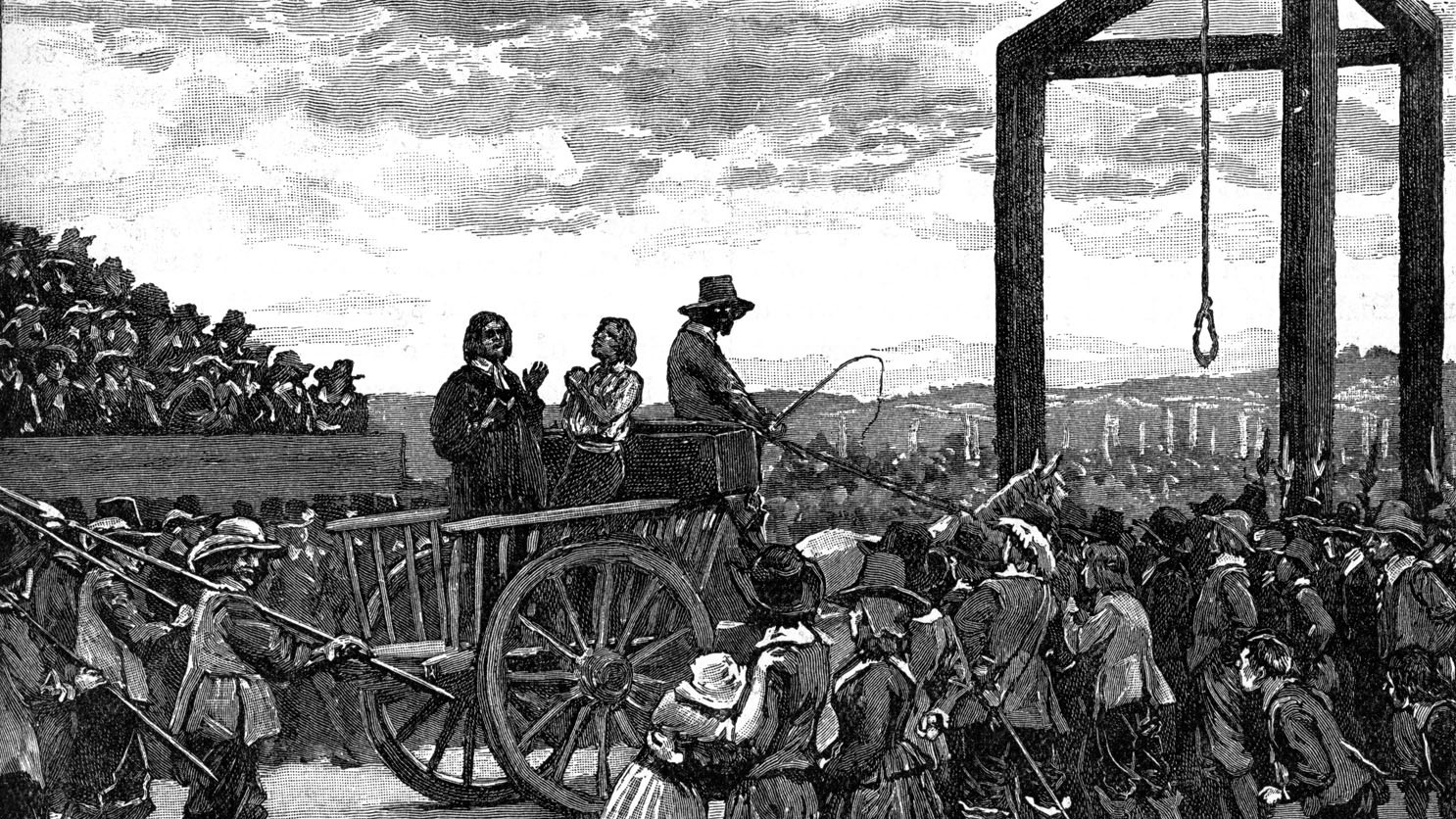
Consider the case of Margaret Dickson, a Scottish woman of the early 1700s. Estranged from her husband, Dickson took up work as a domestic in the town of Kelso, where she conceived a child out of wedlock but hid the pregnancy for fear of being shunned. She testified that she’d disposed of the baby after it was stillborn, but the body was found, and she was arrested. Under Scottish law at the time, concealment of a pregnancy was considered evidence of intent to commit infanticide. Dickson was convicted and sentenced to hang in Edinburgh in 1724.

Following what was then the practice, Dickson’s execution was public. She was hanged; her body was placed in a coffin and carted away for burial (by some accounts following a tussle with body snatchers who hoped to procure the corpse for dissection by medical students). Along the way, the burial party stopped for a beer, at which point noise was heard from inside the coffin. The lid was pried off, and Dickson was found alive, though confused. Dickson’s survival became an object of fascination and Dickson herself a sort of folk hero, the historian Mikki Brock, the author of a forthcoming book about Dickson, told me. Authorities in Edinburgh initially sought to rehang her, but they were never able to marshal enough support to do so. Dickson, who came to be nicknamed “Half-Hangit Maggie” (that is, half-hanged), lived into the 1750s.

Or take Joseph Samuel, a criminal who was sent from England to a penal colony in Australia. Once there, he was implicated in the murder of a police officer investigating a robbery. Samuel was convicted and sentenced to hang in September 1803, also publicly. It didn’t go well. On the first try, the rope around Samuel’s neck snapped. On the second, the noose unraveled. By then, the crowd was growing restive; a hasty third attempt also ended with a broken rope. Observers at the scene concluded that the mishaps were a sign from God that Samuel should not be killed, and the governor apparently concurred, commuting Samuel’s sentence to life imprisonment. (Three years later, Samuel disappeared at sea during an escape attempt with other convicts and was presumed drowned; perhaps God’s view was not as clear as it seemed at the gallows.)

A third celebrated case was that of John “Babbacombe” Lee, who was convicted of the 1884 murder of his employer and sentenced to die. (By that point, executions in Britain had moved out of the public and into prison yards.) Just like Samuel, Lee was spared by malfunctioning equipment: A trapdoor under the gallows, meant to release the condemned and snap his neck, had been tested, yet it failed three times to open. Lee’s sentence was commuted to life by the British home secretary, Sir William Harcourt, who said, “It would shock the feelings of anyone if a man had twice to pay the pangs of imminent death.” Lee was eventually paroled in 1907. Now infamous as “the man they couldn’t hang,” he wrote an autobiography and was the subject of a 1912 silent film, but he then faded from the historical record. He appears to have died in the 1940s, perhaps in Milwaukee.

When I first heard the stories of Half-Hangit Maggie and Babbacombe Lee as a child, I knew they were historical, but they seemed to belong more to the realm of myth or fairy tale. Hangings, mysterious mechanical failures, assertions of divine intervention—all of these seemed like things out of fiction. It was easy to chuckle at quaint details, such as the apocryphal tale that Dickson was required to remarry her husband because she’d been declared dead. And though I’d read about the beheadings of Charles I and Louis XVI, the specter of public execution felt distant enough from modern civilization to be faintly unreal.

Now all of these things seem much less remote. Until President Trump reversed course yesterday, the Defense Department planned to livestream the execution of Nidal Hasan, who massacred comrades at Fort Hood in 2009. Pike’s fate is up in the air after her twice-failed execution. Pike, who was convicted of a brutal murder in 1995, has returned from a hospital to prison. The state official who oversaw capital punishment has resigned, and the governor has temporarily paused all executions in Tennessee. Her lawyers have requested that her sentence be commuted to life in prison.

The doctor and ethicist Lydia Dugdale writes in The Dispatch that U.S. history offers a grim precedent. In 1946, a 16-year-old boy confessed to killing his employer and was sentenced to die via electrocution. A first attempt failed, and his lawyers sought to block a second. The Supreme Court ruled against them, and he was killed that year. But Dugdale argues that this precedent should not apply here. “From Pike’s markedly swollen and chemically burned arms, to her profound cognitive impairment (the severity of which remains unknown), the state has already inflicted a cruel and unusual punishment on Christa,” she writes. Setting aside the law, “as a matter of sheer ethics, if the state has vowed not to punish prisoners cruelly but has inadvertently done so, the state ought not attempt the same method of execution again.” (In this year’s other botched Tennessee case, Tony Carruthers’s failed execution left him partially paralyzed. He received a one-year reprieve, and advocates have called for his sentence to be commuted.)

The historical cases of the men and women they couldn’t hang feel much closer to the present day than they once did. And although some of the visceral details still sound like the stuff of myth, the pragmatic and humane outcomes of these situations stand out more against the backdrop of the recent news. Support for the death penalty has dropped since the 1990s, barely topping 50 percent today. Views are closely correlated with religion—white Protestants are far more likely to back it than any other group, according to polling from the Public Religion Research Institute. For religious supporters of capital punishment, the idea that a failed execution is a sign from above might not be so far-fetched. Among the nonreligious, many people may flatter themselves to believe that contemporary society possesses greater reason and logic than our forebears. Just as we try to understand our ancestors by how they handled cases such as those of Dickson, Samuel, and Lee, future generations will judge our society by its actions.

Related:


Here are four new stories from The Atlantic:


Today’s News

  1. President Trump’s new White House press secretary, Katie Zacharia, was fired after less than a week in the role, according to three people familiar with the matter. Her dismissal followed criticism of her first press briefing on Tuesday and questions about her legal credentials.
  2. Three children and a teacher were killed in a shooting at an elementary school in Bend, Oregon, yesterday. Police said that a bystander pursued the 16-year-old shooter into the school and fatally shot him; another child and a teacher were critically injured.
  3. Representative Alexandria Ocasio-Cortez donated $1 million to support Democrat Abdul El-Sayed’s Senate campaign in Michigan. El-Sayed is running against Republican Mike Rogers in a race that could determine control of the Senate in November.

Dispatches

Explore all of our newsletters here.


Evening Read

An illustration of a human silhouette with a door opening to their mind, with colored light scattering out.
Illustration by Adam Maida / The Atlantic

Big Tech Oligarchs Have a Terrible Plan for Humanity

By Bernie Sanders

Should human beings remain in control of planet Earth? Or should we be replaced as the dominant species? As absurd as these questions may sound, and as obvious as the answers may seem, the Big Tech oligarchs funding the artificial-intelligence revolution have responded in ways that should alarm all of us.

In Silicon Valley, some of the wealthiest people on Earth believe that they have the power to create a superior species. Sam Altman, the head of OpenAI, wrote in 2017 that AI would allow humans to become “the first species ever to design our own descendants.” What this means for humans, however, remains unclear. According to Altman, we will either jump-start digital intelligence “and then fade into an evolutionary tree branch, or we can figure out what a successful merge looks like.” In other words, humans have a choice: face extinction or merge with machines. “I believe the merge has already started,” Altman added, and is “probably our best-case scenario.”

Read the full article.


More From The Atlantic


Culture Break

Nathan Fielder and Elizabeth Holmes in wood-paneled room
A24 / Everett Collection

Watch. Nathan Fielder’s documentary about Elizabeth Holmes (out now in theaters) is a captivating study of self-perception, David Sims writes.

Read. Stephanie Bai asked The Atlantic’s writers and editors to share some of the best first lines in modern literature.

Play our daily crossword.


PS

A great folk hero needs a good nickname, which is why Billy the Kid and “Pretty Boy” Floyd endure. Babbacombe Lee—the name comes from the site of the murder—belongs to that tier. I first encountered it on the strange, entrancing cover of an album, a 1971 “folk-rock opera” by the English band Fairport Convention. I wouldn’t rank “Babbacombe” Lee as prime Fairport, but it’s an entertaining listen. As for Half-Hangit Maggie, anyone visiting the Grassmarket in Edinburgh, the site of her execution, can have a pint at her namesake pub, Maggie Dickson’s. Just don’t expect it to produce any miraculous resuscitations.

— David


Rafaela Jinich contributed to this newsletter.

When you buy a book using a link in this newsletter, we receive a commission. Thank you for supporting The Atlantic.
© Photo by Culture Club / Getty Images

  •  

The uplifting story of one of Zimbabwe’s pioneering women rangers

For Nyaradzo Auxilia Hoto, one of the most memorable moments of becoming a wildlife ranger was a trip to town. She and her fellow recruits walked through the streets in their new uniforms, on their way to open bank accounts. Soon, they would receive their first salaries. For a woman who had struggled to make ends meet in rural Zimbabwe, it was an extraordinary moment. “We were very proud,” she recalled. Hoto, 34, grew up in Huyo, a village in Zimbabwe’s Lower Zambezi Valley, where her family depended largely on growing and selling vegetables. Money was scarce, and although she had done well at school, she could not afford to continue her education beyond secondary school. Marriage, she hoped, might offer a better life. Instead, she says, she endured nearly four years with a violent husband before deciding to leave. She returned to her parents’ home with her young daughter and resumed working in the family garden. Her fortunes changed in 2017, when the International Anti-Poaching Foundation began recruiting local women for Akashinga, a new wildlife protection initiative. Hoto was among 16 women selected from roughly 100 applicants. Many men in her community doubted that women could confront poachers or withstand the demands of ranger work. She went anyway. Within a few years, she had become a ranger sergeant, leading other women on patrol. She later returned to university, graduating in 2023 with a degree in wildlife, ecology and conservation. Today, she works as a biodiversity officer with Akashinga, using…This article was originally published on Mongabay

  •  

🔴 IN GUERRA LO DICE L’AVVOCATURA DELLO STATO | LEVANTE LIVE

🚨Il governo italiano scrive in un tribunale che il Paese è dentro una guerra mondiale. In piazza, chi quella guerra la paga viene chiamato reato e teppismo. ⚖ Oggi il Consiglio di Stato ha dato torto all’Agenzia delle Dogane, che per nove mesi ha negato a una giornalista il dato sulle armi passate dal porto di Ravenna. 📄 Per difendere quel no, gli avvocati del governo, l’Avvocatura dello Stato, avevano scritto nero su bianco: è in corso «una guerra mondiale ibrida e a pezzi che coinvolge anche l’Italia». 🚫 Il giudice ha risposto: pericolo «astratto e ipotetico». I dati vanno consegnati. Ma la frase resta agli atti, e quella guerra il Parlamento non l’ha mai dichiarata. 🚛 Intanto il Sud è fermo da due settimane: Calabria, Sicilia, Puglia, Campania, Basilicata. Un pieno di tir da 1.500 a 2.500 euro. ⛽ In Puglia 150 distributori Eni su 300 a secco. Lo sconto sulle accise è scaduto il 6 ottobre. 🚜 Cinquemila agricoltori con i trattori a Bari chiedono lo stato di crisi. La Regione mette 30 milioni, il governo nazionale non compare. 🎓 Oggi gli studenti in piazza in tutta Italia: «soldi alla scuola, non alla guerra». Il ministro Valditara: «teppismo politico». 🗣 Meloni: «ci stiamo interrogando». Salvini: «studiamo da mesi». Lollobrigida: «bloccare le strade è un reato». 🇫🇷 In Francia 70.000 studenti in piazza e 504 arresti in un giorno a Parigi. 🇦🇱 In Albania 143 giorni di proteste, ministeri assaltati, contro Rama e il resort da 4 miliardi di Jared Kushner. 🔥 L’Europa che si riarma è la stessa che non sa più pagare il gasolio e le scuole, e che risponde alle piazze con la polizia. 🎙 A Levante questa sera, venerdì 16 ottobre 2026, conduce Jeff Hoffman. Ospiti: Moni Ovadia, attore, musicista, scrittore, voce ebraica contro la guerra e contro l’uso politico della memoria; Margherita Furlan, giornalista e analista geopolitica, fondatrice di Casa del Sole TV. 🧭 Affrontiamo insieme: 🔹 Il caso Ravenna: chi ha scritto «guerra mondiale» e chi ha detto no 🔹 L’articolo 78 della Costituzione: la guerra la deliberano le Camere 🔹 Dal «reato» di Lollobrigida al «teppismo» di Valditara: le parole del potere contro chi protesta 🔹 Il Sud fermo e il prezzo del gasolio: la guerra lo alza, il governo non lo attutisce 🔹 Dal ddl antisemitismo alle piazze: la stretta sul dissenso è un disegno? 🔹 Parigi, Tirana, Roma: tre Paesi, una sola scena 📚 LIBRI DEGLI OSPITI 📖 Moni Ovadia, «Un ebreo contro», Edizioni Gruppo Abele 📖 Margherita Furlan, «BRICS Scacco Matto» (disponibile in italiano, inglese, russo) 🎯 SOSTIENI CASA DEL SOLE TV 🆓 Casa del Sole TV è un progetto di giornalismo indipendente, autofinanziato da sei anni, senza editori e senza partiti. 💳 Per donazioni con bonifico: 🏦 IBAN: IT63P0326822300052392596590 👤 Intestato a: La Casa del Sole Edizioni ✍ Causale: Erogazione liberale Casa del Sole TV ⭐ Membership YouTube: 👉 https://www.youtube.com/@CasadelSoleT… 🔸 Analista Multipolare €5/mese 🔸 Inviato della Verità €15/mese 🔸 Architetto del Futuro €25/mese 🌐 SEGUI CASA DEL SOLE TV ▶ YouTube: @CasadelSoleTVChannel 🔗 Sito: casadelsole.tv #Levante #CasadelSoleTV #MargheritaFurlan #MoniOvadia #Geopolitica #Multipolarismo #caroGasolio #accise #Ravenna #NoMeloniDay #AvvocaturadelloStato #ConsigliodiStato #sciopero #Europa

L'articolo 🔴 IN GUERRA LO DICE L’AVVOCATURA DELLO STATO | LEVANTE LIVE proviene da Casa del Sole TV.

  •  

🔴GUERRA MONDIALE IBRIDA | 16.10.26

– Italia, la piazza sfida il riarmo di Margherita Furlan – Avvocatura dello Stato: è guerra mondiale ibrida di Jeff Hoffman – La Francia ferma i suoi figli di Jeff Hoffman – Tirana in fiamme, Rama non cede di Jeff Hoffman – USA e UE sempre più distanti di Gionata Chatillard – Due stretti in fiamme, l’Europa paga di Jeff Hoffman – Taiwan cerca alternative a Hormuz, Trump si inserisce di Ivan Bodyan – Buon giro intorno al Sole A cura di Margherita Furlan Con la collaborazione di Gionata Chatillard, Ivan Bodyan e Jeff Hoffman Editing di Mario Ferdinandi 📡 CASA DEL SOLE TV — Informazione libera e indipendente Il nostro lavoro è possibile solo grazie al vostro sostegno. Casa del Sole TV non ha editori forti né finanziamenti pubblici: siamo sostenuti da voi, il nostro pubblico. Se credi nel valore di un’informazione che non tace, aiutaci a continuare. 💳 Dona tramite bonifico bancario: IBAN: IT63P0326822300052392596590 Intestato a: LA CASA DEL SOLE EDIZIONI Causale: Donazione Casa del Sole TV 🅿 Dona tramite PayPal: paypal.me/casadelsoletv ⏰Sostegno ricorrente: casadelsole.tv/sostienici Anche un piccolo contributo fa la differenza. Grazie di cuore! ❤ CasaDelSoleTV, CasaDelSoleTG, MargheritaFurlan, GiuliettoChiesa,censura, russofobia, Trump, NATO, Crisi, Transizione, Ucraina, Kiev, EuroMaidan, Crimea, Donbass, Donetsk, Syria, Iran, PardonSnowden, Nuova Via Della Seta, Pechino, Putin, Libano, guerra, mondomultipolare, multipolarismo, Mosca, XiJinping, Levante, Medio Oriente, Palestina, Gaza, MiddleEast, BRICS, Hormuz


L'articolo 🔴GUERRA MONDIALE IBRIDA | 16.10.26 proviene da Casa del Sole TV.

  •  

Can Elizabeth Holmes Drop the Act?

When he was in charge of Apple, Steve Jobs was notorious for projecting a “reality distortion field.” That was the jokey way his employees described Jobs’s mix of charisma and bravado and his demanding management style—which would lead people to accept seemingly impossible deadlines, or to promise that they could fix unfixable problems. A malfunctioning version of the same phenomenon once surrounded Elizabeth Holmes, the disgraced founder of the failed medical start-up Theranos. She worshipped Jobs, imitating his style and unnerving confidence, even while presiding over an imploding enterprise. Her promises of a device that could affordably perform rapid medical tests with only a drop of blood were, at best, fantastical; once valued at $9 billion, Theranos collapsed into nothing. In 2022, Holmes was sentenced to 11 years in prison for defrauding her investors.

In the new documentary You Can See Everything, the comedian and television auteur Nathan Fielder steps into Holmes’s reality-distortion field. Fielder, accompanied by his co-director, Lance Oppenheim, and a small camera crew, essentially moved into Holmes’s abode for the 34 days before she reported to federal prison. The team received fairly unfettered access to her, her two small children, and her partner, the entrepreneur Billy Evans, who professes obsessional devotion to Holmes. What Fielder was expecting to find while staying at the family’s Del Mar, California, rental is unclear, but he ends up in an odd and unsettling game of cat and mouse: He’s trying to suss out whether Holmes is a master manipulator or someone so deeply convinced of her own genius that she can’t distinguish fiction from fact.

The film capturing that experience is an odyssey of human perception. Fielder knows that no matter how intimate his time with Holmes is, the minute the camera is trained on her, both he and the audience will be consumed by the question of whether she’s giving yet another performance. The movie unfolds and evolves over nearly three hours, spanning both the month ahead of Holmes’s May 2023 incarceration and the years following; throughout, Fielder pores over his interactions with not just Holmes but also the people around her, sifting for kernels of authenticity. What emerges is a transfixing portrait of a phenomenon most viewers will understand—a deep desire to empathize, even as we are horrified by what’s occurring or suspect we’re being lied to.

[Read: Manipulator vs. manipulator]

Holmes would disagree about that last part. Early on, she plainly states to Fielder that she has never told a lie, a statement so bewildering that it cracks his reliably deadpan expression. Watching him work to make sense of what she could mean by that, I thought of Jobs’s strange force of personality. Holmes has saucer-shaped, striking blue eyes, and she repeatedly meets Fielder’s squinty gaze with an unblinking stare and gauzy smile. Holmes may indeed be flatly misleading her interviewer, but she comes off as unnervingly sure that she’s being honest; she’s perhaps deceiving herself alongside the people in her orbit.

Evans is a vital part of her new facade, which has morphed from the elite-businesswoman persona of her CEO days to that of a loving mother and partner. Holmes often has a child draped over her, and she seems profoundly attached to her worshipful partner. Yet at other times, Evans gives off a controlling air. He plucks a bowl from her because she’s not stirring eggs quickly enough. When Fielder’s questions probe too close to an uncomfortable topic, Evans will show up, put his hands on Holmes’s shoulders, and softly try to shut down the conversation. The claustrophobic proximity between Fielder and his subjects comes across visually: Oppenheim shoots them all with zoom lenses, holding on their faces for a discomfitingly long time as they wince, frown, and grin. Like his co-director, he’s searching for the truth by getting as physically close as he can. Given Holmes’s past, however, the task of uncovering anything feels impossible.

Fielder is obviously uninterested in relitigating the details of Holmes’s case; she appears firmly assured that she did nothing wrong, and he knows there’s nothing he can do to tell her otherwise. Instead, he pokes at how she takes in the world, and how Evans is helping to feed her surreal self-image. It also becomes apparent that the pair are working on a new version of Theranos, chatting to investors and patent lawyers on the phone with abandon. When the harsh reality facing her—that she’ll soon have to leave her children behind—peeks through, her devastation seems genuine. But those moments then flit by as Holmes and Evans try to ponder a brighter future.

[Read: The comic who’s his own worst enemy]

The first half of the movie consists of captivating fly-on-the-wall footage. The second half, which Fielder and Oppenheim have begged critics not to spoil (and I do think it’s fun to experience it cold), establishes You Can See Everything as one of the best films of the year. That portion finds Fielder fixating on his brief time with Holmes and the untoward influence Evans had over it: He brings in other perspectives to consult, re-creates scenes to better understand them (something he’s wont to do, especially on his fascinating HBO show, The Rehearsal), and, most important, reckons with his role in telling this chapter of Holmes’s life story.

Fielder is smart enough to know that his celebrity presence further pierces the bubble around how we perceive ourselves and one another. But he quickly developed a sort of emotional intimacy with Holmes, even as he sought to remain objective. You Can See Everything is a bold title, an invitation from Holmes that she is unlikely to follow through on. Can Fielder see everything that’s going on in her head? Beyond that, can he be an effective audience surrogate so viewers can see what he sees? The true question of this documentary isn’t just whether Holmes—who has been a figure of societal fascination for more than a decade—is putting on another performance, but also whether that’s all we, the viewers, crave from Holmes anyway.

© A24 / Everett Collection

  •  

Is it Time to Regauge the Size of our Solar System?

There is need to redefine the edge of the solar system. That’s the outcome of new work by two leading space scientists. They present a theory that the Milky Way’s gravity, including its dark matter, redraws the Sun’s frontier. Moreover, it allows the Solar Lagrange points L1 and L2 to form “portals” that funnel interstellar visitors […]
  •  

Cláudio Pereira (Kelad) estreia hoje música que presta homenagem a Tavira

Cláudio Pereira, conhecido artisticamente como Kelad, vai lançar hoje às 18h o seu novo single “Menina de Tavira”, inspirado numa “fase muito feliz” da sua vida no Algarve.

Apesar de ser natural de Castro Daire, no distrito de Viseu, em 2024 viveu e trabalhou em Tavira durante quase seis meses. Mesmo longe de casa, diz ter sido uma experiência que o marcou “profundamente” e aponta como causas a beleza da cidade, que considera uma das mais bonitas de Portugal, as pessoas que conheceu e os momentos que viveu. De tal forma que decidiu dar vida a uma canção que “eternizasse” essa fase feliz da sua vida.

Ao contrário dos seus temas anteriores – “mais ligados à dor e ao fim de relações” -, “Menina de Tavira” é uma canção “assumidamente feliz, embora marcada pela saudade”.

A homenagem a Tavira prolonga-se também no videoclipe, mostrando algumas das suas ruas, casas tradicionais, azulejos e a emblemática ponte romana, num formato de curta-metragem romântica, “inspirada no cinema e em histórias de amor em que duas pessoas se cruzam repetidamente até finalmente se encontrarem”.

Musicalmente, o tema parte da inspiração de “Garota de Ipanema”, de Tom Jobim e Vinicius de Moraes, mas procura uma identidade nacional cruzando bossa nova, pop, R&B e música tradicional, com a presença da guitarra portuguesa. 

A música foi gravada nos Satori Studios, em Viseu, e contou com Bernardo Vicente na guitarra clássica, Pedro Bento no baixo e nas guitarras clássica e elétrica, Francisco Henriques na guitarra portuguesa e, na bateria, Daniel Tejo e Pedro Bento. A mistura e a masterização ficaram a cargo de Pedro Bento.

A canção vai estrear às 18h de hoje e pode ser ouvida (e vista) aqui.

  •  

¿Motosierra o seguridad? Las pensiones también se votan el 29-N

¿Motosierra o seguridad? Las pensiones también se votan el 29-N

Debería hacer saltar las alarmas las llamadas a privatizar y capitalizar las pensiones (invertir las cotizaciones en cuentas privadas). Por supuesto, no debería haber ningún problema en añadir sistemas de ahorro complementarios, sobre todo colectivos y de mutualización del riesgo. Pero eso no permite escapar de la demografía ni de los problemas financieros

Se vienen elecciones y la vivienda es un tema clave en el que los partidos deberán posicionarse. Ante la falta de propuestas de justicia social y redistribución, algunos buscan dos chivos expiatorios: los migrantes y la gente mayor.

A por los migrantes, poniendo el foco en los extranjeros racializados y más pobres del sur global, que trabajan en sectores precarios como los cuidados, el campo o la construcción, y obviando a los del norte global con alto poder adquisitivo. A por la gente mayor, porque supuestamente las clases trabajadoras que viven de una pensión pública abusan del erario y limitan el gasto público. Así, las pensiones han entrado en el debate para recortarlas, no para ensanchar derechos. Sin embargo, la migración y las pensiones públicas son dos pilares que revitalizan la economía productiva y reproductiva, generan protección social y cubren la demanda de bienes y servicios esenciales de las clases populares.

A esta mala prensa contribuye también, de forma inconsciente, mucha gente no necesariamente de derechas. Es desesperante oír entre colegas y amigos tanto pesimismo sobre la posibilidad de recibir una pensión digna. Este sentimiento es una victoria de muchos actores, incluidos organismos internacionales de prestigio, que desde los años ochenta no se cansan de repetir que los sistemas públicos como el nuestro no son sostenibles. Aquí quiero mostrar que lo son más de lo que nos quieren hacer pensar, que los privados también dependen de los recursos materiales disponibles y cómo seguir mejorando sin privatizar.

De entrada, los datos recientes de INTegraSS, la herramienta de proyección de la Seguridad Social, desmienten categóricamente ese pesimismo. Según sus estimaciones, basadas en microdatos administrativos reales, nuestro sistema público será capaz de garantizar en 2070 una pensión media de 1.826 euros al mes para los hombres y de 1.641 euros para las mujeres, a precios de 2024. La brecha de género persiste, pero pasaría de un 31,1% en 2024 a un 10,1%.

La demografía no es una ciencia exacta, pero con unos flujos migratorios más ajustados a los observados se estima que el gasto en pensiones llegue al 15,3% del PIB en 2050 y al 14,2% en 2070, lejos del 17,3% y el 16,7% de la Comisión Europea y por debajo del 16,1% y el 14,7% de la AIReF. Italia y Francia ya rondan hoy el 15% y se mantienen en pie, incluso tras comprometerse a destinar un 5% del PIB a defensa y seguridad en 2035.

Además, nuestro sistema tiene importantes mecanismos de redistribución intra e intergeneracional, aunque aún puede mejorar mucho. Impone un suelo (pensiones mínimas) y un techo (pensiones máximas) que redistribuyen según la necesidad y evitan trasladar a las prestaciones las desigualdades del mercado laboral. Para 2070, el peso de las pensiones de jubilación en máximos pasaría del 7% al 11,3%, y el de las mínimas, del 18,7% al 10,6%, lo que supone limitar desigualdades por arriba y tener menos pensionistas dependientes de complementos mínimos.

Alarmas por privatizar

Aplacado el alarmismo, lo que sí debería hacer saltar las alarmas son las llamadas a privatizar y capitalizar las pensiones (invertir las cotizaciones en cuentas privadas). Por supuesto, no debería haber ningún problema en añadir sistemas de ahorro complementarios, sobre todo colectivos y de mutualización del riesgo. Pero eso no permite escapar de la demografía ni de los problemas financieros.

Los sistemas de reparto como el español dependen de la productividad (inversión), de que haya trabajadores cotizando (pleno empleo) y, en última instancia, de un gobierno capaz de pagar sus obligaciones en una moneda que mantenga el poder adquisitivo (soberanía monetaria). La trampa de los sistemas de capitalización es que también necesitan gente joven dispuesta a comprar los activos financieros que la gente mayor vende al jubilarse. Si la oferta de activos supera la demanda (más jubilados que jóvenes con capacidad para comprarlos), su precio cae y la pensión se reduce. A falta de leyes sobre qué activos deben adquirir (por ejemplo, bonos públicos para financiar vivienda pública), los sistemas privados internacionalizan esta relación y buscan compradores y vendedores en el extranjero.

Esta internacionalización conlleva riesgos financieros sistémicos, un Estado con menos capacidad de respaldar las inversiones con su moneda, desinversión en bienes públicos y más desigualdad en la propiedad de activos si no se colectivizan. Además, en busca de grandes retornos, el ahorro europeo acaba, con el beneplácito de las autoridades, en las grandes empresas estadounidenses, con muy poca capacidad de hacer estas inversiones social y ecológicamente sostenibles.

Sí, los países nórdicos tienen sistemas de capitalización, pero son obligatorios, colectivos y muchas veces controlados por los sindicatos, y se asientan sobre sistemas públicos y universales que mantienen niveles de pobreza y desigualdad de renta mucho más bajos que los españoles (que no de riqueza, debido justamente a la falta de mecanismos de redistribución de la propiedad).

Ahora bien, que el gasto sea asumible y que los gobiernos de coalición hayan puesto los cimientos para mejorar las condiciones de las mujeres y de quienes menos ingresan no significa que el sistema no pueda mejorar, ni que en estas elecciones no debamos exigir más a los partidos que sí defienden un sistema público.

Por ejemplo, hay que seguir aumentando las prestaciones mínimas desvinculadas de las contribuciones para que todo el mundo tenga sus necesidades cubiertas cuando no pueda trabajar, lo que refuerza la emancipación de la clase trabajadora. El Ingreso Mínimo Vital (IMV) tiene aún mucho margen de mejora: un 55% de los hogares que podrían recibirlo no lo ha solicitado. Además, la brecha de género se reduce muy lentamente y los niveles de pobreza de las mujeres mayores son demasiado elevados (un 18,5% en riesgo de pobreza a partir de los 65 años, frente al 13,7% de los hombres, según el INE), sobre todo porque son ellas las más forzadas a cuidar y dejar de cotizar.

Reconocer en la jubilación el cuidado no remunerado debería ser una prioridad. Hay que mejorar el complemento para la reducción de la brecha de género (solo 37 euros al mes por hijo, que cobran 1,37 millones de pensionistas), ampliar el cómputo de las excedencias por cuidado de hijos y familiares y desfamiliarizar estos mecanismos ante el debilitamiento de los lazos familiares y el aumento de los hogares unipersonales y monoparentales. La reforma de la Ley de Dependencia aprobada en septiembre da un paso al reconocer como cuidadoras a personas del mismo entorno relacional, pero el resto de mecanismos sigue ligado a la maternidad y al parentesco.

Por último, hace falta alejar el ahorro privado de los pensionistas de los nuevos tecnofeudalistas de Silicon Valley y canalizarlo hacia productos financieros públicos y sociales que generen vivienda pública y social. La nueva Cuenta de Ahorro e Inversión Financia Europa, impulsada por Bruselas e incluida en el decreto de vivienda, va en parte en esa dirección al orientar el ahorro hacia empresas europeas, pero debería excluir ventajas fiscales regresivas (o, al menos, tributar cómo los ingresos del trabajo al rescatar la inversión) y prever destinos específicos para la vivienda pública y social.

El 29-N, las clases trabajadoras, incluida la clase media, harían bien en tener en cuenta no solo quién propone garantizar la vivienda, sino también la evidencia sobre la sostenibilidad y la justicia social de las pensiones públicas, y la necesidad de seguir mejorándolas y de destinar el ahorro a fines sociales y no especulativos.

  •  

Mars SkyFall: New Mission Shaping Up to Explore the Red Planet

Work has reached an accelerated mode in readying three Ingenuity-class helicopters for deployment at Mars by NASA’s Space Reactor‑1 Freedom spacecraft. Slated for launch in 2028, SR-1 Freedom is the first fission nuclear-powered interplanetary spacecraft and is assigned the duty of dropping off the SkyFall entry capsule loaded with the trio of reconnoitering aerial vehicles […]
  •  

Russia is losing the Black Sea grain war it started. Its answer is to sink civilian ships off Romania and Bulgaria

Bulk carrier "Royad Mammadov" under the flag of Saint Kitts, partially sunk after an attack by Russian sea and air drones on October 5, 2026, 20 nautical miles off the coast of Romania. Photo: Romanian Interior Ministry

  • Russian drones have hit two more ships in the western Black Sea
  • Rival Russian and Ukrainian countershipping campaigns have throttled grain exports since this summer
  • Diplomatic efforts to restore a grain shipping ceasefire haven't yet moved Moscow

On or just before Wednesday, 14 October, Russian Geran-4 one-way attack drones struck two more cargo ships—one in the Buh River Estuary near Mykolaiv and another in Chornomorsk, 20 km south of Odesa.

They're the latest strikes in competing Russian and Ukrainian countershipping campaigns that have, since this summer, throttled Black Sea grain exports.

The jet-propelled Geran-4s are Russia's weapons of choice for these ship strikes. The drones haul warheads of up to 90 kg at up to 500 km/h and can fly more than 700 km. They already had AI-assisted targeting, and the Russians recently added terrain-matching navigation to make them less reliant on satellites and harder to jam with signal-scrambling electronic warfare.

For months, the Geran-4s and other Russian munitions have pummeled Ukrainian ports and the ships hauling grain from them. But Ukrainian forces were actually the first to escalate the shipping fight in an effort to squeeze Russian logistics.

Russian Geran-4 jet-drones struck two more cargo ships, in the Buh River Estuary and at Chornomorsk Port in Odesa Oblast. pic.twitter.com/wOXcJFAj5O

— AMK Mapping 🇳🇿 (@AMK_Mapping_) October 14, 2026

As recently as early this summer, hundreds of Russian tankers and dry cargo ships plied the Black Sea and adjacent Sea of Azov, hauling fuel and bulk supplies between ports in Russia and Russian-occupied ports in southern Ukraine.

Most of the Russian vessels were unregistered and sailed without transponders, making them a kind of regional adjunct of Moscow’s “shadow fleet” that ships Russian oil and other goods to the global market in defiance of international sanctions.

Black Sea grain war between Ukraine and Russia escalates
Map: Euromaidan Press

Ukrainian drones had already hit ships hauling stolen Ukrainian grain out of occupied ports in June.

On 6 July, Ukraine’s deep strike drone force finally started hunting the rest of the Russian ships. By day eight of the countershipping effort, the Ukrainians had hit 105 vessels. By day 12, drones including AI-assisted Fire Point FP-1/2s had struck 159, even a few tugboats sent to assist the damaged tankers.

Just a few days after Ukraine launched its countershipping campaign, Russia launched a retaliatory campaign targeting Ukraine’s Black Sea grain ports as well as the ships, many of them foreign-flagged, that haul grain through Türkiye’s Bosporus Strait out to the Mediterranean Sea and onward to foreign ports.

Soon, the Russian shadow fleet’s hundreds of ships were either drifting, disabled, or sheltering in Russian ports. On the other side of the Black Sea, Ukraine’s lucrative grain trade was in a state of collapse. Ports were under constant attack. International shippers were increasingly reluctant to send their vessels into the Black Sea.

Grain pours from a combine harvester into a trailer during harvest in Ukraine.
Ukrainian grain. Photo: Ukrainian World Congress

Trade freefall

Grain shipment figures on both sides tell a stark tale. According to the Russian Grain Union, in September approximately 1.36 million tons of wheat shipped from Russian ports, including ports on the Black Sea and Sea of Azov, compared to 5.4 million tons in September 2025—a 75% reduction.

Meanwhile, Ukraine exported 1.094 million tons of wheat in September, down from 2.051 million tons in September 2025—a 47% reduction. The only thing preventing further throttling of Ukrainian grain exports was Izmail, Renia, and Kilia—the country’s three small ports on the Danube River, which forms Ukraine’s southern border with Romania and flows into the western Black Sea a relatively short 435 km from the Bosporus Strait.

But the Russians were beginning to target the Danube ports and the grain ships heading to and from them, too. In October, Russian drones sank the Saint Kitts-flagged M/V Royad Mammadov, bound from Izmail to Ravenna, Italy, with Ukrainian grain, and the Togo-flagged M/V Alfa Watan, and damaged the Palau-flagged M/V Able, killing at least two seafarers.

“The Black Sea grain standoff, in which both Russia and Ukraine continue to suffer losses, persists,” Polish open-source intelligence analyst Thorkill wrote.

With global food prices rising partially as a result of the bottleneck in grain exports through the Bosporus, the United Nations and Türkiye have been trying to arrange talks between Russia and Ukraine regarding a possible Black Sea ceasefire.

A previous grain deal, brokered by Türkiye and the UN in 2022, collapsed a year later. Ukraine kept ships moving through its own corridor until Russian strikes shut it down this summer.

Update, 16 October: Drones hit at least four more merchant ships off Bulgaria and Romania between 13 and 15 October, sinking the HS Dignity off Krapets. At least 17 seafarers are missing. Romanian President Nicușor Dan called the attacks “attempts by Russia” to destabilize Romania and Bulgaria and said NATO’s North Atlantic Council would discuss them.

russian radar occupied crimea didn't see ukrainian drones coming became 28th air-defense asset wrecked · post supply trucks burning mariupol-melitopol highway main road russia's land corridor 29 2026 exilenova+ -
Explore further

“Supplying Crimea is turning into a nightmare”: Ukrainian drones hit Russian trucks 770 times in September, and winter will make it worse, analyst says

  •  

How Scientology actually works, according to a former Scientologist

Jenna Miscavige is the niece of David Miscavige, the leader of the Church of Scientology. She was raised as a Scientologist and left when she was 22 years old.

Founded by science-fiction writer L. Ron Hubbard in 1954, Scientology developed into a global religious movement, reportedly reaching over 100,000 members at its peak in the 1990s. Even as its ranks have contracted, Scientology has retained an outsize place in popular culture due in no small part to high-profile members such as Tom Cruise and John Travolta.

Jenna Miscavige speaks to Business Insider about Scientology's secretive reputation, recruitment tactics, finances, allegations of abuse, and celebrity connections.

She is the author of "Beyond Belief: My Secret Life Inside Scientology and My Harrowing Escape." Jenna also uses social media to speak out against Scientology and inform the public.

The Church of Scientology disputes Jenna Miscavige's depiction of the organization, saying in an emailed statement: "What [Jenna] is selling is not a new revelation. It is discredited allegations repackaged for profit. Her bid for notoriety begins and ends with a prominent family name she is desperate to trade on."

For more from Jenna:
https://www.youtube.com/@JennaMiscavige
https://www.instagram.com/therealjennamiscavige
https://www.tiktok.com/@jennamiscavige

Read the original article on Business Insider

  •  

A Bold Era in Hollywood Ends With a Whimper

Sign up for Video Village, a new weekly newsletter in which David Sims unearths cinematic gems and brings readers into his movie obsession.

To kick off this newsletter, I sent out a message declaring that movies were “undeniably back.” Within days, it seemed that the sky was falling again. Two venerable studios, Paramount and Warner Bros. Discovery, officially merged on October 6, further consolidating power in Hollywood into just a few conglomerates. The new entity has been dubbed Skydance, the name of the original production company that CEO David Ellison founded in 2006. Not much has outwardly changed thus far, new moniker aside. But internally, Ellison has already made at least one concerning decision. Once the deal closed, two key leaders at Warner Bros., the bolder and more risk-taking of the two studios, were immediately shown the door: Michael De Luca and Pam Abdy, the co-chairs of Warner Bros. Motion Picture Group. Their departure suggested what many industry analysts had feared: that their new boss was no longer a fan of taking big, bold risks.

After all, the news that De Luca and Abdy were exiting the company—to be replaced by Paramount’s current team, which will oversee what has been referred to as the “Paramount Warner Bros. Motion Picture unit” (try saying that three times fast)—arrived right before a historically bad weekend for the studio. The Tom Cruise project Digger opened on October 2 to only $8 million domestically, on a budget that reportedly climbed as high as $180 million; that’s an especially anemic number given Cruise’s involvement as both star and co-producer. Digger now stands as Warner Bros.’ final release before it joined Skydance, and the movie’s catastrophic box-office performance is the latest in a series of tough beats for the company this year. Given the film’s wild ambition, its failure will also be a fitting coda for an era that was very up-and-down financially—but often creatively thrilling.

De Luca and Abdy took over Warner Bros. Pictures in 2022, bringing with them a strategic reset. They were both well-regarded names in the world of awards-friendly indie cinema, shaking up a studio that was bouncing back from a theatrical strategy unpopular with the industry: putting blockbusters on HBO Max the day they were released. De Luca was a storied executive whose career included green-lighting boundary-pushing projects by Paul Thomas Anderson and David Fincher and earning Best Picture Oscar nominations for such movies as The Social Network and Moneyball. Abdy started out her career at Danny Devito’s hyper-cool Jersey Films and worked on The Revenant and The Big Short, among other awards-season hits, as president of the production outfit New Regency.

Together, they presided over a splashy period at Warner Bros. in which they focused on recruiting big stars and major auteurs while they also shed the remains of the prior leadership’s flailing, expensive approach to the DC Comics franchise. But their results were inconsistent: In 2023, the giant success of Barbie in the summer and Wonka at Christmastime buoyed the studio. The following year, Furiosa: A Mad Max Saga and Joker: Folie à Deux were such expensive flops that industry experts began predicting De Luca and Abdy would soon lose their jobs.

Instead, last year, the duo spearheaded a cinematic slate that will likely be spoken about in hushed tones in Hollywood C-suites for generations. A Minecraft Movie took advantage of its kid-friendly IP to make nearly $1 billion worldwide, despite being barely coherent. The relaunch of the DC cinematic universe went splendidly with Superman, directed by the new DC Studios co-chair, James Gunn. The silly sequels Final Destination Bloodlines and The Conjuring: Last Rites punched above their weight commercially. Zach Cregger’s Weapons was not just a horror hit but also a critical favorite that won major awards. Ryan Coogler’s Sinners, whose high budget met prerelease skepticism from box-office analysts, was a cultural sensation and a financial boon. And Anderson’s blockbuster, One Battle After Another, earned just enough money to justify its scale before taking the Oscar for Best Picture.

In basically each of these cases, De Luca and Abdy’s calculation of betting on creators who had an established track record and pairing them with reliable stars worked. Meanwhile, safe comic-book and video-game adaptations helped shore up any business concerns. This year, however, the same approach has resulted in a lot of swings and misses. Collaborations between acclaimed directors and performers, such as Maggie Gyllenhaal and Jessie Buckley’s The Bride!, failed to make back their budget; Supergirl and Practical Magic 2 were box-office disappointments, in part because of poor reviews. Warner Bros. couldn’t even claim the surprise success of Coyote vs. Acme, a Looney Tunes movie that it sold to the indie distributor Ketchup Entertainment after deciding in 2023 not to release it; it became a sleeper family hit this summer.

Maybe Digger flopping was the final straw for Ellison. Or maybe the Skydance CEO was always intent on keeping his own team in charge. Paramount has adopted a more populist, risk-averse strategy since Ellison took over that studio in 2025. This year’s schedule included crowd-pleasing horror films and a Jackass clip-show-style sequel, although none was particularly successful with theatergoers; a new live-action Street Fighter and the latest edition in the Angry Birds franchise are on the way. Indeed, it even has a Tom Cruise movie on the slate for 2028—but rather than being an auteurist effort like Digger, it’s a sequel to the 1990 NASCAR drama Days of Thunder that I’d argue nobody was really asking for.

Skydance seems to be planning to keep Paramount and Warner Bros. separate, the industry reporter Matthew Belloni suggested in a Puck column last week. Ellison has also promised that Skydance will keep up a furious pace of releases, perhaps in recognition of Hollywood’s agita when Netflix almost got its hands on Warner Bros. during the merger drama; the concern was that films released as part of “Netflix Warner Bros.” would not be shown in cinemas at all. But the departure of De Luca and Abdy certainly suggests that any weirder Hail Mary passes will be few and far between. Sure, they haven’t all worked—but a hit like Sinners doesn’t happen without a couple of other tough throws that fail to connect.

Meanwhile, some viewers are seemingly already reclaiming Digger as a cult classic; maybe that’s just quick-turn nostalgia for a moment in Hollywood that appears to be further slipping away. Or perhaps it’s a sign that some portion of the audience will always be clamoring for audacious work—the kind that is and will still be made by studios of all sizes. Just maybe not by Warner Bros., going forward.


An Essay I Enjoyed

A collage of quarterback Josh Allen, a Buffalo Bills fan, and the Bills’ mascot.
Illustration by Paul Spella*

The Most Cursed Team in American Sports

By Kaitlyn Tiffany

The mythical story of the Buffalo Bills could be told like this: Their fans are crazy and live in the snow. They shovel this snow out of their stadium to help their godforsaken football team, which, until recently, was most famous for losing the Super Bowl four times in a row in the early 1990s. According to one theory, those failures fed into Timothy McVeigh’s derangement before he planned and executed the Oklahoma City bombing. The franchise was an utter disaster, for the most part, until the 2018 arrival of an otherworldly quarterback named Josh Allen, who has exhibited many heroics. But he has yet to bring his team to the Super Bowl.

Read the full article.


Coming Attractions

A gorgeous new release this week is William and David Greaves’s Once Upon a Time in Harlem. The project restores old, unreleased footage shot by William, which his son, David, helped assemble and spruce up for a new generation to understand. William Greaves, who died in 2014, was a former actor who, dispirited by the opportunities afforded him in postwar Hollywood, became a challenging, acclaimed filmmaker. His body of work is well worth a deep dive, particularly the avant-garde documentary Symbiopsychotaxiplasm: Take One, which is itself about the reality-warping process of making documentaries. Once Upon a Time in Harlem, however, was left unfinished for decades.

The documentary captures a party the elder Greaves threw in August 1972, bringing together every living member of the Harlem Renaissance he could find to Duke Ellington’s townhouse. He let the cameras roll as the group chatted, caroused, and unfurled memories of that flourishing era for Black art. David, then age 26, helped his father with the filming; more than 50 years later, he went through 60,000 feet of footage to pick out the best moments. The result is a rather stunning look back at an event filled with people who were already looking back; it’s a beautiful echo of an echo. Once Upon a Time in Harlem is debuting in select cinemas, but it’s a must-see—and will hopefully expand soon.


What Else I’m Watching
  • Chris Rock’s Misty Green received a mixed reception at this fall’s festivals, but it’s somewhat redeemed by Rosalind Eleazar’s lead performance. She plays a fading actress striving for a role while her personal life disintegrates around her, and her masterful on-screen sloppiness helps explain away some of the dodgier plot twists. I’ve always found Rock’s directorial career frustrating; although he has good taste and influences (this film has major Safdie-brothers energy), he always falls a little short of what he’s imitating.
  • Criterion’s humongous Stanley Kubrick box set will finally be on shelves Tuesday, and it’s an unsurprisingly impressive package from those doyens of physical media. All 13 of his features have received sparkly restorations, and the collection also includes his daughter Vivian’s documentary Making The Shining, which offers a glimpse into the much-mythologized auteur’s process. The rare international version of The Shining, which is far shorter than the U.S. theatrical cut, is one of the best Easter eggs on offer.
  • Another movie that had long been thought lost is the director’s cut of Ken Russell’s intense psychological horror The Devils, which was censored and outright banned in many countries on its 1971 release. The original version was officially unavailable for years, but a 4K restoration of it is now touring theaters. A 17th-century-set dramatization of witch-hunting within the French Catholic church, The Devils is genuinely shocking—especially given the era of its release—but should be required viewing for genre completionists.

© Illustration by Soña Lee. Sources: Gilbert Flores / Variety / Getty.

  •  
❌