
❌

Reading view

Here's how much the governor of every US state makes ahead of the midterm elections, ranked

Josh Shapiro speaks at a podium
Josh Shapiro is the highest-paid governor in the US.

Bloomberg/Getty Images

  • The annual salaries of state governors vary, with the lowest being $70,000 in Maine.
  • Josh Shapiro, Kathy Hochul, and Spencer Cox are among the highest-paid US governors.
  • The average annual salary for a state governor is $174,479 in 2026.

In some states, being the governor doesn't automatically make you a top earner.

With voters in 36 states heading to the polls to elect governors in November's midterm elections, the annual salaries attached to the job vary dramatically across the country — from $70,000 in Maine to over $250,000 in Pennsylvania.

Across all 50 states, governors earn an average official annual salary of $174,479 and are subject to federal and state income taxes — except in states without income tax, such as Florida and Texas.

By comparison, the top 1% of US earners each make at least $731,492 a year, placing the average governor below the ultrarich but also well above the average US wage of $69,846 in 2024, according to the Social Security Administration.

While governors across all 50 states are generally allowed to earn income beyond their state salaries through investments, book deals, and other sources, the income they may take in is closely regulated, and rules vary by state.

Some, like Florida's Ron DeSantis, have brought in yearly incomes of over $1 million thanks to book royalties, while others, like Illinois' JB Pritzker, earn eight figures due to investment gains and even gambling wins.

As such, some governors, like Pritzker and Connecticut's Ned Lamont, who are independently wealthy, have chosen to forgo their six-figure state salaries.

Beyond the salary, other financial perks of being governor may include living in the governor's mansion, receiving private transportation from the state, and having access to security and staff.

See how much your governor makes each year, based on the most recent available state records, salary commissions, legislation, and public payroll data.

50. Maine
Maine governor Janet Mills

Staff photo by Carl D. Walsh/Portland Press Herald via Getty Images

Governor: Janet Mills (Democrat)

Salary: $70,000

With a salary of $70,000, Maine Governor Janet Mills is the lowest-paid governor in the US.

The salary for Maine's next governor is set to rise to $125,000 in 2027 under new legislation, marking the first raise in the governor's salary in the state since 1987.

After two terms, Mills is now term-limited. Democrat Hannah Pingree and Republican Bobby Charles are facing off to become the state's next governor in the November midterm election.

49. Arizona
Arizona Governor Katie Hobbs

Rebecca Noble/Getty Images

Governor: Katie Hobbs (Democrat)

Salary: $95,000

The Arizona governor, who has the second-lowest salary among US governors, will be eligible to receive a salary of $165,000 starting in 2027, per the state legislature.

Democrat Katie Hobbs is running for a second term in the November midterm election.

48. Oregon
Oregon governor Tina Kotek

Mathieu Lewis-Rolland/Getty Images

Governor: Tina Kotek (Democrat)

Salary: $98,600

Oregon law sets the governor's annual salary at $98,600 and provides a separate $1,000 monthly expense payment. The salary is one of the lowest for any governor in the US.

Democrat Tina Kotek is up for reelection during the November midterms, seeking a second term.

47. Nebraska
Nebraska governor Jim Pillen

JIM WATSON/AFP via Getty Images

Governor: Jim Pillen (Republican)

Salary: $105,000

Nebraska Governor Jim Pillen, who earned $105,000 a year in 2025, per the state legislature, is the fourth-lowest-paid governor in the US.

Republican Jim Pillen is up for reelection, seeking a second term in the November midterm elections.

46. South Carolina
South Carolina governor Henry McMaster

Tracy Glantz/The State/Tribune News Service via Getty Images

Governor: Henry McMaster (Republican)

Salary: $106,078

With a salary of $106,078 in 2025, per state records, the South Carolina governor is the fifth-lowest-paid governor in the US.

After two full terms, McMaster is now term-limited. Republican Alan Wilson and Democrat Jermaine Johnson are facing off in the race to become the state's next governor in the midterm election.

45. New Mexico
New Mexico governor Michelle Lujan Grisham

Kevin Dietsch/Getty Images

Governor: Michelle Lujan Grisham (Democrat)

Salary: $110,000

New Mexico Governor Michelle Lujan Grisham is the sixth-lowest-paid governor in the US. New Mexico's next governor will receive a salary of $169,714 starting with the next gubernatorial term in 2027.

Lujan Grisham is term-limited after serving two terms. Democrat Deb Haaland and Republican Gregg Hull are competing to succeed her in the November midterm election.

43. (tie) Louisiana
Louisiana governor Jeff Landry

Jabin Botsford/The Washington Post via Getty Images

Governor: Jeff Landry (Republican)

Salary: $130,000

Louisiana law set the governor's salary at $130,000 in 2026. The salary has remained unchanged since January 2008.

43. (tie) Iowa
Iowa governor Kim Reynolds

Tom Williams/CQ-Roll Call, Inc via Getty Images

Governor: Kim Reynolds (Republican)

Salary: $130,000

Iowa Gov. Kim Reynolds earns an annual salary of $130,000, according to the state's official employee salary records.

Reynolds is not running for reelection, leaving Democrat Rob Sand and Republican Zach Lahn competing for the open governor seat in the November midterms.

42. Colorado
Colorado governor Jared Polis

CHET STRANGE/AFP via Getty Images

Governor: Jared Polis (Democrat)

Salary: $134,632

The Colorado governor, previously one of the lowest-paid governors in the nation, has received a $134,632 salary since 2023, as outlined by state law.

After nearly eight years in office, Polis is now term-limited.

Democrat Phil Weiser and Republican Victor Marx are competing to become Colorado's next governor in the November midterm.

41. Alabama
Alabama governor Kay Ivey

Stew Milne/Getty Images

Governor: Kay Ivey (Republican)

Salary: $134,780

In fiscal year 2026, Alabama Governor Kay Ivey had a salary of $134,780, per the state's Department of Finance.

After two full terms in office, Ivey is now term-limited. Republican Tommy Tuberville and Democrat Doug Jones are facing off to become the state's next governor in the upcoming midterm election.

40. Wyoming
Wyoming governor Mark Gordon

Tom Williams/CQ-Roll Call, Inc via Getty Images

Governor: Mark Gordon (Republican)

Salary: $140,000

Wyoming law sets the governor's salary at $140,000 in 2026.

Mark Gordon is term-limited after two terms, leaving Republican Eric Barlow and Democrat Kenneth Casner competing for governor in the November midterm election.

39. Florida
Florida governor Ron DeSantis

GIORGIO VIERA/AFP via Getty Images

Governor: Ron DeSantis (Republican)

Salary: $141,400

Florida Governor Ron DeSantis earns $141,400 per year, according to state records.

DeSantis is term-limited after two terms in office. Republican Byron Donalds and Democrat David Jolly are competing for governor in the November midterms.

38. Montana
Montana governor Greg Gianforte

Michael Ciaglo/Getty Images

Governor: Greg Gianforte (Republican)

Salary: $141,517

Gianforte, who made his fortune in tech, donates his salary to Montana nonprofits. In 2025, his office said he had donated his entire gubernatorial salary to organizations supporting Montanans in need.

37. Missouri
Missouri governor Mike Kehoe

Emily Curiel/The Kansas City Star/Tribune News Service via Getty Images

Governor: Mike Kehoe (Republican)

Salary: $145,095

Missouri law sets the governor's salary at $145,095 as of 2026.

36. Oklahoma
Oklahoma Gov. Kevin Stitt

SAUL LOEB/AFP via Getty Images

Governor: Kevin Stitt (Republican)

Salary: $147,000

While the current Oklahoma governor, Kevin Stitt, has a salary of $147,000 in 2026, his successor will see a raise to $185,000, per Oklahoma's Journal Record.

After nearly eight years in office, Stitt is now term-limited. Republican Mike Mazzei and Democrat Cyndi Munson are facing off to become the state's next governor in the midterm election.

35. South Dakota
South Dakota governor Larry Rhoden
South Dakota Gov. Larry Rhoden makes $146,472 a year in 2025.

Toby Brusseau/AP

Governor: Larry Rhoden (Republican)

Salary: $148,522

South Dakota Governor Larry Rhoden earns $148,522 a year in 2026, per the state's pay transparency website.

Republican Larry Rhoden, who took office last year following Kristi Noem's resignation, is up for election in November, seeking a full term.

34. Idaho
Idaho governor Brad Little

Darin Oswald/The Idaho Statesman/Tribune News Service via Getty Images

Governor: Brad Little (Republican)

Salary: $151,400

Idaho Governor Brad Little makes $151,400 in 2026, per state records.

Little is seeking a third term in the midterm elections this November.

33. Texas
Texas governor Greg Abbott

Jason Fochtman/Houston Chronicle via Getty Images

Governor: Greg Abbott (Republican)

Salary: $153,750

As of 2026, Texas Governor Greg Abbott makes $153,750 a year, per state records.

Abbott is seeking a fourth term in the midterm election this November.

32. Michigan
Michigan governor Gretchen Whitmer

Tom Williams/CQ-Roll Call, Inc via Getty Images

Governor: Gretchen Whitmer (Democrat)

Salary: $159,300

Michigan law sets the governor's salary at $159,300. Governor Gretchen Whitmer also receives a $54,000 annual expense allowance, according to the State Officers Compensation Commission.

After nearly eight years in office, Whitmer is now term-limited.

Democrat Jocelyn Benson and Republican John James are facing off to become Michigan's next governor in the November midterm election.

31. Mississippi
Mississippi governor Tate Reeves

Brandon Bell/Getty Images

Governor: Tate Reeves (Republican)

Salary: $160,000

Mississippi Governor Tate Reeves earns a salary of $160,000 in 2026, according to the state's personnel board.

30. Rhode Island
Rhode Island governor Daniel McKee

David L. Ryan/The Boston Globe via Getty Images

Governor: Daniel McKee (Democrat)

Salary: $163,295

Rhode Island's governor, Daniel McKee, earns a salary of $163,295, according to the state's pay transparency portal.

After losing the Democratic primary, incumbent Dan McKee will not be on the ballot. Democrat Helena Foulkes and Republican Aaron Guckian are facing off to become the state's next governor in the midterm election.

29. New Hampshire
New Hampshire governor Kelly Ayotte

Kayana Szymczak/Getty Images

Governor: Kelly Ayotte (Republican)

Salary: $165,027

New Hampshire law sets the governor's salary at $165,027.

Republican Kelly Ayotte is up for reelection this November, seeking a second two-year term in the midterm election.

28. Wisconsin
Wisconsin governor Tony Evers

Daniel Boczarski/Getty Images for Democratic Party of Wisconsin

Governor: Tony Evers (Democrat)

Salary: $165,568

Wisconsin law bans salary changes for a governor during their term in office. Gov. Tony Evers has received an annual salary of $165,568 since beginning his second term in January 2023, up from $152,756 during his first term.

Evers is not seeking reelection. The state's next governor is slated to receive an annual salary of $184,684 when they take office in January 2027, according to Wisconsin's official compensation plan.

Democrat David Crowley and Republican Tom Tiffany are facing off in the November midterm election.

27. North Dakota
Nprth Dakota governor Kelly Armstrong

Tom Williams/CQ-Roll Call, Inc via Getty Images

Governor: Kelly Armstrong (Republican)

Salary: $168,000

North Dakota's governor's salary is $168,000 following a July raise, per state legislation.

26. Nevada
Nevada governor Joe Lombardo

Benjamin Hager/Las Vegas Review-Journal/Tribune News Service via Getty Images

Governor: Joe Lombardo (Republican)

Salary: $170,062

The Reno Gazette Journal reported in May that Nevada Governor Joe Lombardo makes $170,062 a year.

Lombardo is up for reelection in the November midterm elections, seeking a second term.

25. Arkansas
Arkansas governor Sarah Huckabee Sanders

Leon Neal/Getty Images

Governor: Sarah Huckabee Sanders (Republican)

Salary: $171,808

In October, an independent commission in Arkansas voted to raise Governor Sarah Huckabee Sanders' salary to $171,808 annually.

Sanders is running for a second term in the November midterm election.

24. Kansas
Kansa governor Laura Kelly

Michael B. Thomas/Getty Images

Governor: Laura Kelly (Democrat)

Salary: $174,000

In 2023, Kansas raised the governor's annual salary starting January 1, 2025, tying the office's pay to the salary of a non-leadership member of Congress, according to state legislation.

Kelly is term-limited after two terms, leaving Democrat Cindy Holscher and Republican Ty Masterson competing for the governor's seat in the November midterm elections.

23. Virginia
Virginia Gov. Abigail Spanberger delivers the Democratic response to U.S. President Donald Trump's State of the Union address on February 24, 2026 in Williamsburg, Virginia.

Mike Kropf/Getty Images

Governor: Abigail Spanberger (Democrat)

Salary: $175,000

Virginia law sets the governor's salary at $175,000 in 2026.

22. Ohio
Ohio governor Mike DeWine

Jason Mowry/Getty Images

Governor: Mike DeWine (Republican)

Salary: $180,203

Ohio set the governor's salary in a 2018 law that established yearly pay increases for statewide elected officials through 2028, per state law. After the 2026 increase, Gov. Mike DeWine's salary is about $180,203.

DeWine is term-limited after two terms. Democrat Amy Acton and Republican Vivek Ramaswamy are competing for the governor's seat in the midterm elections.

21. Alaska
Alaska governor Mike Dunleavy

SAUL LOEB/AFP via Getty Images

Governor: Mike Dunleavy (Republican)

Salary: $182,787

In 2025, Alaska Gov. Mike Dunleavy had a salary of $182,787, per the state's Department of Administration.

After two terms in the governor's seat, Dunleavy is now term-limited.

Democrat Jonathan Kreiss-Tomkins and Republicans David Bronson, Treg Taylor, and Bernadette Wilson are facing off to become the state's next governor in the November midterm election.

20. Georgia
Georgia governor Brian Kemp

Alex Wroblewski for the Washington Post

Governor: Brian Kemp (Republican)

Salary: $185,000

In fiscal year 2025, Georgia Gov. Brian Kemp earned a salary of $185,000 and also received over $56,506 in travel reimbursements during the year, according to the Georgia Department of Audits and Accounts' financial transparency portal.

After two terms in office, Kemp is term-limited. Democrat Keisha Lance Bottoms and Republican Rick Jackson are running to be the state's next governor in the midterm election.

19. Delaware
Delaware governor Matt Meyer

Meg Oliphant/Getty Images

Governor: Matt Meyer (Democrat)

Salary: $185,096

From July 2025 until 2029, the salary for the governor of Delaware is $185,096, per the state legislature.

18. Kentucky
Kentucky governor Andy Beshear

Stephen Cohen/Getty Images

Governor: Andy Beshear (Democrat)

Salary: $188,523

Kentucky's governor, Andy Beshear, has a salary of $188,523, per the state's pay transparency portal.

17. West Virginia
West Virginia governor Patrick Morrisey

Andrew Harnik/Getty Images

Governor: Patrick Morrisey (Republican)

Salary: $190,424

Since 2025, the West Virginia governor's salary has been set to match the US Office of Personnel Management's locality pay area for the rest of the US, per the state legislature. That puts current governor Patrick Morrisey's salary at $190,424.

16. Maryland
Marland governor Wes Moore

Kevin Richardson/Baltimore Sun/Tribune News Service via Getty Images

Governor: Wes Moore (Democrat)

Salary: $192,000

As of his third year as Maryland governor, per the state legislature, Wes Moore's salary was $192,000 in 2025. The governor's salary will increase during the next term, starting at $195,000 in 2027 and reaching $210,000 by the fourth year, according to Maryland's Governor's Salary Commission.

Moore is running for a second term in the November midterm elections.

15. Minnesota
Minessota governor Tim Walz

DOMINIC GWINN/Middle East Images/AFP via Getty Images

Governor: Tim Walz (Democrat)

Salary: $200,000

The Minnesota governor's official salary is $200,000 after a July raise, per the Minnesota Legislature. Tim Walz previously declined salary raises while in office and accepted only a $127,629 salary. But during his last six months in office, he accepted his full salary, as reported by Minnesota Public Radio.

After two terms as governor, Walz is not running for reelection.

Democrat Amy Klobuchar and Republican Lisa Demuth will face off in November in a race to become the state's next governor.

14. Illinois
Illinois governor JB Pritzker

Scott Olson/Getty Images

Governor: Jay Robert "JB" Pritzker (Democrat)

Salary: $205,700 (foregone)

Illinois Governor JB Pritzker, a member of the Pritzker family that founded the Hyatt Hotels Corporation, has chosen to forgo his salary. The state has set the governor's salary at $205,700 as of 2023, per the Illinois General Assembly.

Pritzker is up for reelection this November, seeking a third term in the midterm elections.

13. North Carolina
North Carolina governor Josh Stein

RYAN M. KELLY/AFP via Getty Images

Governor: Josh Stein (Democrat)

Salary: $209,165

North Carolina state law sets the governor's salary at $209,165 in 2026.

12. New Jersey
Mikie Sherrill, governor-elect of New Jersey, during an inauguration ceremony at Prudential Hall at New Jersey Performing Arts Center in Newark, New Jersey, US, on Tuesday, Jan. 20, 2026.
New Jersey Governor Mikie Sherrill earns $210,000 a year.

Bloomberg/Getty Images

Governor: Mikie Sherrill (Democrat)

Salary: $210,000

State law sets New Jersey's governor's salary at $210,000 after a 2023 increase.

11. Indiana
Indiana governor Mike Braun

Andrew Harnik/Getty Images

Governor: Mike Braun (Republican)

Salary: $220,418

Indiana Governor Mike Braun, who earns $220,418 a year, according to the Indiana state government, is the 11th-highest-paid governor in the US.

10. Hawaii
Hawaii Governor Josh Green

PATRICK T. FALLON/AFP via Getty Images

Governor: Josh Green (Democrat)

Salary: $226,620

Hawaii's governor, Josh Green, is now the 10th-highest-paid following a July raise passed by the state legislature.

Green is running for a second term in the midterm elections

9. Connecticut
Connecticus governor Ned Lamont

Aaron Flaum/Hartford Courant/Tribune News Service via Getty Images

Governor: Ned Lamont (Democrat)

Salary: $226,711 (forgone)

Although the State of Connecticut sets the governor's salary at $226,711, the independently wealthy Ned Lamont has chosen to forgo the salary while in office.

Lamont made his money in telecommunications and investments. He's also the great-grandson of Thomas W. Lamont, a former chair of J. P. Morgan & Co. who built substantial wealth in banking.

Lamont is up for reelection this November, seeking a third term in the midterm elections.

8. Washington
Washington governor Bob Ferguson

Alexi Rosenfeld/Getty Images

Governor: Bob Ferguson (Democrat)

Salary: $234,275

Washington's governor earns $234,275 following a July raise, making Bob Ferguson the eighth-highest paid governor in the US.

7. Massachusetts
Massachusetts governor Maura Healey

Craig F. Walker/The Boston Globe via Getty Images

Governor: Maura Healey (Democrat)

Salary: $243,493

Massachusetts Governor Maura Healey received a salary of $243,493 in 2025, per the Office of the Comptroller of the Commonwealth of Massachusetts, making hers the seventh-highest governor's salary in the US.

Healey is seeking a second term in the November midterm elections.

6. Vermont
Vermont governor Phil Scott

John Lazenby/UCG/Universal Images Group via Getty Images

Governor: Phil Scott (Republican)

Salary: $243,520

Vermont law lists the governor's salary at $243,520 following a July raise, making the office the sixth-highest paid in the country.

Gov. Phil Scott is running for a sixth term in the midterm elections.

5. California
California governor Gavin Newsom

Justin Sullivan/Getty Images

Governor: Gavin Newsom (Democrat)

Salary: $245,929

As of May 2026, the California Department of Human Resources listed the governor's salary as $245,929, making Gavin Newsom the fifth-highest-paid governor in the US.

After two terms, Newsom is now term-limited. Democrat Xavier Becerra and Republican Steve Hilton are facing off in a race to become the state's next governor in the midterm election.

4. Tennessee
Tennessee governor Bill Lee

Tom Williams/CQ-Roll Call, Inc via Getty Images

Governor: Bill Lee (Republican)

Salary: $246,108

Tennessee Gov. Bill Lee earns $246,108 annually as of August, based on a monthly salary of $20,509 listed in the state's public payroll database.

After two terms in office, Lee is term-limited. Republican Marsha Blackburn and Democrat Jerri Green are running for the governor's seat in the midterm election this November.

3. Utah
Utah governor Spencer Cox

George Frey/Getty Images

Governor: Spencer Cox (Republican)

Salary: $249,250

In March 2026, the Utah Legislature passed a bill setting the governor's salary equal to that of the chief justice of the state supreme court, which is $249,250.

The raise made Spencer Cox the third-highest-paid governor in the US.

2. New York
New York governor Kathy Hochul

Barry Williams/New York Daily News/Tribune News Service via Getty Images

Governor: Kathy Hochul (Democrat)

Salary: $250,000

With a salary of $250,000 established by New York law, Kathy Hochul is the second-highest-paid governor in the US.

Hochul is seeking a second full term in the midterm elections.

1. Pennsylvania
Pennsylvania governor Josh Shapiro

Jason Ardan/The Citizens' Voice via Getty Images

Governor: Josh Shapiro (Democrat)

Salary: $253,870

Shapiro's salary rose from $245,760 in 2025 to $253,870 in 2026 after a 3.3% cost-of-living increase, according to the Pennsylvania Office of the Budget. The raise made him the highest-paid governor in the US.

Shapiro is up for reelection in the midterm elections this November, seeking a second term.
Read the original article on Business Insider

  •  

I'm the CEO of Life360. My own childhood was surprisingly hands-off.

Lauren Antonoff headshot
Lauren Antonoff is the CEO of Life360

Courtesy of Life360

  • Lauren Antonoff is the CEO of Life360 and uses the location-sharing platform with her family.
  • She says she tried to mimic her mom's somewhat hands-off parenting with her own two kids.
  • Giving kids space can help them develop agency and independence, she says.

This as-told-to essay is based on a conversation with Lauren Antonoff, CEO of Life360. It has been edited for length and clarity.

My mother was an awesome parent, but she was a person first. It was just the two of us for a lot of my childhood, between the time my dad died when I was 8, and my mom remarried when I was 14.

During those years, my mom was parenting while also in school, working, and dating. She was always there for me, but she wasn't trying to manage my childhood. She didn't do homework with me, for example. She made sure I was happy, loved, and well cared for, all while living her own life.

A lot of single moms might not have been open about things like dating, but mine was always transparent. I liked that I got to do my thing while watching my mom do hers.

My mom's benign neglect helped me develop agency

I didn't grow up knowing I wanted to be a parent. When I met my now-husband, he was already a father. Our daughter, who is now 27, was 5 at the time. I say I got her the easy way.

Old photo of mom and daughter
Lauren's mom was pretty hands-off.

Courtesy of Lauren Antonoff

From the beginning, my husband was the primary parent. That really opened the door for me to feel comfortable having kids. About three years later, we had our son.

Once I became a parent, my mom and I would sometimes talk about this idea of benign neglect — the benefits of letting kids do their own thing, and figure it out. In my childhood, my mom's benign neglect allowed me to develop independence and problem-solving skills.

Because my mom was less involved than some parents, I created a sense of agency that's served me well throughout life.

I wanted to change the world, but didn't expect to be in tech

My interest in tech was an accident. I thought I would become a civil rights lawyer and change the world.

While I was in college in the early 90s, I purchased a Mac to write papers with. I was living in Berkley, and got sucked into this community of Mac enthusiasts. I understood the technology — though not as well as some people — and I could articulate things well.

My techie friends diagnosed me as a product manager. I had a desire to advance technology that was both intelligible to humans and useful to them. I started working at a startup that was bought by Microsoft.

I thought it would only be for a few years, until I went to law school. I ended up spending 19 years at Microsoft before joining other tech companies like GoDaddy and now Life360. I realized along the way that I have an impact on people's quality of life, at scale, by advancing technology that makes day-to-day life easier.

Location monitoring keeps my in-person connections close

At Life360, we talk a lot about agency, which was so important in my childhood, and which I tried to encourage for my own kids. For me, and a lot of our users, the platform creates agency while helping people boost their real-life connections.

Here's my favorite use case: my husband is still the primary domestic partner, and he brings me lunch most days. If I'm at work feeling hungry, I can check his location and see if I need to get myself a snack, or if he's around the corner with my meal.

Recently, I got a flight notification from Life360. It showed that my brother — who doesn't live locally — had touched down in LA. I hadn't known he was in town, but since I got the digital signal, we were able to get dinner. Ultimately, the platform keeps us closer in real life by creating those opportunities for connection.

I'm cautiously optimistic about the future

I've never seen tech as a bad thing. I had a TV in my room growing up, and a simple coding game that was so basic I had to retype the code each time I turned it on.

Lauren Antonoff and family
Lauren Antonoff is the CEO of Life360

Courtesy of Lauren Antonoff

I was pretty liberal in how I let my own kids use technology. Looking back, I got my son — who's now 19 — a phone when he was probably too young. At the time, we wanted to play Pokémon Go as a family. I didn't think about how harmful some aspects of tech can be. I'm lucky that he turned out good despite that.

I'm cautiously optimistic about the future of technology. I'm also an activist. We get to shape what the future looks like, for our children and us — and there's a lot of power in that.

Read the original article on Business Insider

  •  

Walmart's chief people officer says these 2 things help workers get promoted quickly

Donna Morris at event
Walmart's chief people officer manages the world's largest global workforce.

Bloomberg/Getty Images

  • Walmart has more than 2 million workers — 500 of whom are promoted daily.
  • Its chief people officer said she observes 2 qualities in those who move up the ladder quickly.
  • First, they do the job they have well. They also show they can take more on.

Walmart promotes roughly 500 employees daily — so there's no shortage of opportunities to climb the ladder.

Workers who advance quickly tend to share two qualities, says Walmart chief people officer Donna Morris, who oversees the company's workforce of more than 2 million people worldwide.

The first is staying focused on the job in front of you, she said. Morris said the employees who stand out are motivated to make a difference and excel in their current roles.

"They are focused as much, if not more, on being exceptional at what they're doing today," Morris told Business Insider.

Once you nail the actual job you were given, the next step might be proving you can take on responsibilities for the role above you — before you get the title.

"Be the type of person that takes on over and above what's being expected of you," Morris said. "Be the person that asks or provides volunteerism for new ideas or new initiatives."

That also includes coming up with new ideas or volunteering to help with new initiatives. Morris said those actions show you can take on more responsibility.

In general, when hiring, Morris said she looks for evidence of the "grit that they had to persevere through." At Walmart, where most of its 2.1 million employees begin in frontline roles, she also likes to see that candidates have had some frontline experience. The chief people officer said it doesn't need to be in retail necessarily; it could be babysitting or helping out with a family business.

"If somebody has never really had to identify with what it's like to be a frontline hourly worker, it's going to be very hard for them to lead," said Morris, who started working at 13 at a dry cleaner's before taking a job at a drugstore two years later.

Read the original article on Business Insider

  •  

10 people on weathering 12 months of immigration turmoil

A carousel of portraits
10 people tell all about the uncertainty, risk, and reward of navigating the US immigration system.

Sean Marc Lee, Angela Ponce, Chinky Shukla, Ian Tuttle for BI

The H-1B visa system is one of high stakes, shifting rules, and little certainty.

Over the past year, Business Insider has spoken to more than 20 H-1B visa holders and hopefuls about their decisions to opt in, push through, and sometimes give up on the H-1B American Dream as the Trump administration has become increasingly hostile to foreign workers.

As part of our H-1B Fallout series, published one year after the Trump administration introduced a $100,000 payment for some new H-1B petitions, we are telling the stories of people navigating the visa system. Some left the US and returned to their home countries, while others rebuilt elsewhere or are still trying to build a career in the US.

In a statement, a White House spokesperson said the goal of the $100,000 H-1B fee is to focus on sponsoring "truly highly specialized temporary labor." A Department of State spokesperson said the US is unapologetic about its "America first visa policies" and that the administration is working with partners to facilitate necessary visas. A Department of Labor spokesperson said the administration is protecting American jobs and increasing wages.

Keep reading to see what life has been like for people affected by the US's immigration policy changes.

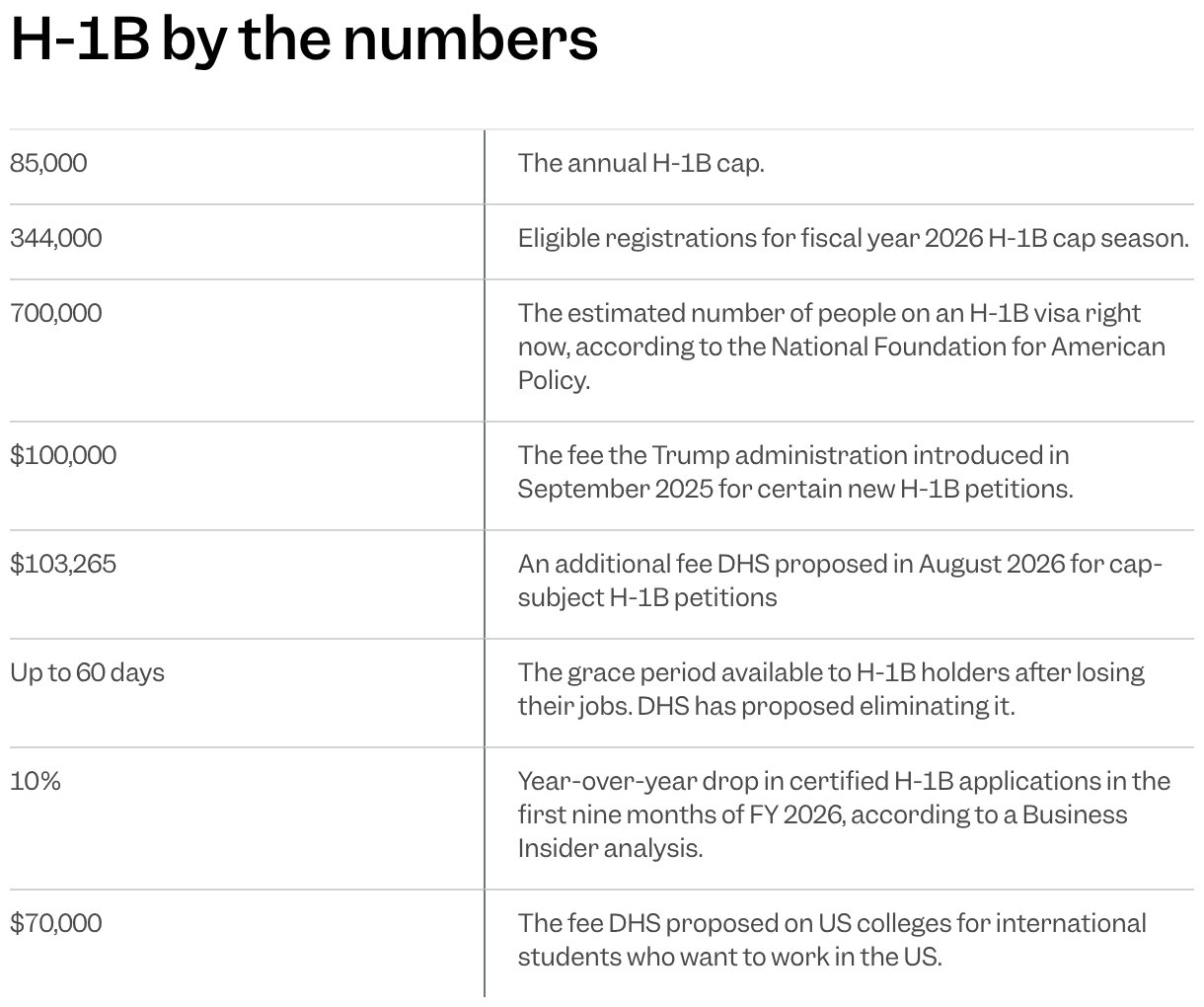
H-1B by the numbers (Table)
Soumi Chanda, 35
Person stands in a narrow urban street lined with buildings, parked scooter, overhead wires, and streetlights.

Paromita Chatterjee for BI

Soumi Chanda had spent 13 years building a life in the US when a 2025 layoff put her H-1B status at risk.

Chanda moved from Kolkata to Spokane, Washington, in 2013 for graduate school. She was selected for an H-1B on her first attempt in 2021 — "pure luck," she said — and Amazon later took over her sponsorship, prompting her move to Seattle.

When Amazon laid her off, Chanda had 60 days to find a new sponsor or leave the country. "Sixty days sounded impossible from the start," she said. Her search came as debate intensified over the proposed fee. "Even with Amazon on my résumé, I didn't get a single interview the following month," she said.

When preparing to leave the US, Chanda made her two cats her priority. She spent weeks arranging their international travel and paid roughly $5,000 for paperwork, along with thousands more to break her lease, dispose of her belongings, and secure last-minute travel. In total, she estimates the move cost her $18,000.

Now back in Kolkata, she's still working out whether India will be her long-term home. "There's plenty here I value, and other things, as a feminist, I find harder to reconcile."

Person holds a fluffy black-and-white cat in a softly lit indoor room.

Paromita Chatterjee for BI

Even with Amazon on my résumé, I didn't get a single interview the following month.

Read: She was picked for an H-1B visa on her first try, but got laid off

Luciana Pereyra, 26
Luciana Pereya

Angela Ponce for BI

Luciana Pereyra moved from Peru to the US at 17 on a tennis scholarship. After graduating, she landed a marketing role at Ohio State. Her H-1B was approved in April 2024. She described that time as living in "survival mode," knowing that losing a job could also mean losing her home.

In December 2025, Pereyra said HR contacted her to say that her position would end the following month. She had 60 days to find another employer to sponsor her visa or leave the country. "I treated the job search like the last match of my career," she said.

She focused on university jobs, but the timing worked against her: Many campuses closed for winter break as her grace period began. She said two promising opportunities fell through after prospective employers raised concerns about securing a visa amid the proposed H-1B fees.

Pereyra returned to Peru in March. In Lima, she freelances for a US marketing client, coaches tennis, and is building a small business. She said she would consider moving to the US again, but only if it came with "a real path to permanent residency."

Luciana Pereyra

Angela Ponce for BI

I treated the job search like the last match of my career.

Read: She played college tennis, earned 2 degrees, then lost her H-1B job

Mohamed Zeeshan, 33
Mohamed Zeeshar

Jared Soares for BI

Recent changes to US immigration policy have made Mohamed Zeeshan, a green card holder, more concerned about whether immigrants like him can build stable lives in the country.

He's seen relatives and friends consider countries such as Germany and Australia, rather than the US, because of the difficulty of securing jobs and visas after graduation. The instability surrounding H-1B visas — including the proposed $100,000 fee for new applicants — has reinforced his concerns.

Zeeshan self-petitioned for a green card and received it in 2023, enabling him to live in the US without needing employer sponsorship.

In 2025, he started his own consulting firm. Over the past year, Zeeshan said he has watched the immigration landscape become more uncertain.

He still plans to become a US citizen but says that if he had to rely on an H-1B visa today, he doesn't think he'd do it: "When you're on an H-1B here in the US, you're kind of always on tenterhooks."

"You don't know if you're going to be here next month or two months or three months down the line. That's a very difficult position to be in."

His wife is still waiting for her green card, and the couple is holding off on having children until they have more clarity about her status.

Mohamed Zeeshar

Jared Soares for BI

When you're on an H-1B here in the US, you're kind of always on tenterhooks.

Read: He moved to the US on a green card and wouldn't do the same on an H-1B

Vivienne Yang, 31
Vivienne Yang

Sean Marc Lee for BI

Vivienne Yang found out she was being laid off from her H-1B-sponsored job while she was on vacation in Japan in October 2024.

She spent the rest of the trip speaking with immigration and labor lawyers, emailing her employer, and trying to enjoy sightseeing with her partner.

Yang, who is from Taiwan, managed to get her employment extended for a few weeks, allowing her to fly back to New York. She then switched to a B-2 tourist visa so she could stay in the US longer and search for another job. She went through over 20 job interviews in the next year, all of them unsuccessful.

So, she decided to pivot.

Yang was accepted into a New York acting program, but her application for a US student visa was denied after she returned to Taiwan to apply for it in December 2025. Her American partner now looks after her two cats in Brooklyn while she remains in Taiwan, living with her family and working as a content creator, business English coach, and freelance consultant.

She has put her US plans on hold. "I don't want to deal with visa issues anytime soon," she said.

"Now I can move on with my life without any regrets because I know I have tried," she said. "I have a better understanding of what living abroad looks like and what American dream looks like in reality."

Vivienne Yang

Sean Marc Lee for BI

I have a better understanding of what living abroad looks like and what American Dream looks like in reality.

Read: She lost her job and left behind her American dream — and her cats

Watch: Vivienne Yang on letting go of her American dream

Ananya Joshi, 26
Ananya Joshi

Natalia Kepesz for BI

Ananya Joshi's plans to build a career in the US came apart in 2025, when a visa setback and a sudden layoff pushed her to look for a future elsewhere.

Joshi had moved from India to Illinois to pursue a master's degree. After graduating in 2024, she joined a Chicago startup developing cultivated meat as a scientist, working on an F-1 Optional Practical Training, or OPT visa.

She was enjoying the work until she learned that her employer could not complete E-Verify, which employers must use to sponsor an extension of STEM graduates' OPT.

From May through July 2025, Joshi interviewed for jobs around the world. She received offers in Canada and Germany and ultimately chose Germany. "Having gone through so much, I realized I needed that stability," she said.

In January, she moved to Rostock, about three hours north of Berlin, to join another lab-grown-meat startup. These days, Joshi is taking German classes and adjusting to what she describes as a slower work culture. She's also learning to navigate a long-distance relationship with her boyfriend, who remains in the US.

Joshi said she would still like to return to the US, but said, "I can't forget what I went through."

Gu Yichen, 31
Yichen Gu

Ian Tuttle for BI

Gu Yichen's path to working in the US began in high school, when he spent a year as an exchange student in Yacolt, a small town in Washington State. He later attended college in the US, interning at Amazon before joining the company full-time after graduation.

With a STEM degree, Gu had three chances to enter the H-1B lottery. He was selected on his third try.

In late 2022, Gu left Amazon for a job at Google, despite his manager's warning that the market was becoming unstable. He was laid off the following month, before he had done "a single day of real work."

Gu faced pressure to find a new employer within the 60-day grace period. Rather than take a stopgap role, he returned to China for a break before ultimately rejoining his former Amazon team in the US on an I-140, an immigration petition that can support a green-card application.

He has since applied for a green card, hoping it will give him "more freedom in both my personal life and my career."

Over the past year, he said the biggest challenge has remained the same: His ability to stay in the US is tied to his job. "I've been thinking what kind of life I really want to live and what is my real interest in life."

Yichen Gu

Ian Tuttle for BI

I've been thinking what kind of life I really want to live and what is my real interest in life.

Read: Google laid him off a month after hiring him; he was on an H-1B visa

Disha Lamba, 28
Disha Lamba

Chinky Shukla for BI

Leaving a six-figure data-scientist job in New York and returning to India in May was not an easy decision for Disha Lamba, but she says being closer to her family — and free from the limits of an employment visa — made it worthwhile.

Lamba moved to the US in 2021 to pursue a master's degree. She later joined CVS Health as a data scientist and learned that she had been selected in the H-1B lottery in March 2026.

By then, however, Lamba had already decided to move home. Though she had a fulfilling job and social life in New York, she struggled with the distance from her parents.

The prospect of managing an H-1B long-term reinforced her decision. Lamba was concerned about the difficulty of obtaining visa stamps to travel, as well as the limits the visa can place on changing employers, taking a career break, or pursuing additional income.

"Anything comes with its pros and cons. H-1B has its pros but also has its cons. I wasn't OK with the cons of being in these restrictions," she said.

After resigning, Lamba moved back to live with her parents and brother. She took a two-month career break and secured a short-term contract role, but she's still looking for a permanent job. Nonetheless, she's still happy about her decision.

"Every moment when I get to hug my parents, that's when I realize, no, this was all worth it," she said.

Disha Lamba

Chinky Shukla for BI

Sunjana Ramana, 27
Sunjana Ramana

Ayesha Kazim for BI

After three failed attempts to obtain an H-1B visa, Sunjana Ramana is reinventing her "American Dream."

Ramana moved from Hyderabad, India, to New York in 2021 for her master's degree. After graduating in 2023, she joined a global insurance company. Her employer entered her in the H-1B lottery in 2023, 2024, and 2025. She was not selected.

When her work authorization ended in early 2026, Ramana had to leave the US.

"When I didn't get the visa, I was really, really clueless. I thought that was the end of everything that I had built for three years," she said, adding, "but I realized just a couple of months later that there are so many additional options that I didn't know existed."

Instead of returning to India, Ramana secured a 2-year UK visa that is not tied to one employer. She chose London as her base, where she could pursue the entrepreneurship she had wanted to explore in the US.

Ramana was accepted into Antler's founder-in-residence program and spent two months building Flax, a two-person tech company that helps AI founders and builders. In May, she moved into a product-management role in fintech.

"I want to go back and tell my younger self not to associate the 'dream' with America or a country for that matter, because it doesn't matter where you are. The dream should be aligned to you and your goals."

Sunjana Ramana

Ayesha Kazim for BI

When I didn't get the visa, I was really, really clueless. I thought that was the end of everything that I had built for three years

Read: She left the US when she didn't get an H-1B visa. Now, she's living a new dream.

Madhur Mehta, 36
Madhur Mehta

Chona Kasinger for BI

An H-1B selection brought immediate relief for Madhur Mehta this year, but it has not resolved the uncertainty that shapes his and his fiancée's plans in the US.

Mehta moved to the US in 2021, earned a master's degree in 2023, and was eligible for three years of student work authorization. Amazon offered him both a job and sponsorship.

He joined the company in 2025 as a program manager.

But over the past year, while the company was trying to get him an H-1B, Mehta grew concerned about changes to the lottery. He began exploring backup plans for his US life, including an EB-1A visa and opportunities in Canada and Australia.

He learned he was selected for an H-1B in March, potentially giving him the chance to work and remain in the US for another three years.

"It was a big relief," he said, adding, "It's like someone has taken a 100-pound load off your mind," he said.

Mehta's fiancée, who is also from India, has one remaining chance in the H-1B lottery before her work authorization expires.

"It's hard, you know, obviously you can't plan," Mehta said, adding, "unless we are both very clear on what our visa status is."

Madhur Mehta

Chona Kasinger for BI

It's like someone has taken a 100-pound load off your mind.

Read: He got an H-1B visa, but uncertainty makes it hard to plan his future

Shreya Mishra Reddy, 34
Shreya Mishra

Cassandra Rudolph for BI

Shreya Mishra Reddy left the US in January after not being selected for an H-1B visa. Her plan was to leave the country and keep applying for US jobs from abroad.

That plan, however, started to feel unrealistic after the Trump administration proposed the $100,000 fee on some H-1B applicants.

Though the fee has been challenged in court and is not being enforced, she said the uncertainty changed her mind: "I've decided not to pursue H-1B or any role in the US right now."

Reddy had moved to the US in 2021 for a master's degree in engineering management at Duke University. After graduating, she was hired by Visa, but her student work authorization expired before she could secure an H-1B visa.

She's now in Toronto with her husband on a tourist visa and weighing whether to base herself in Canada or India. During a career break, Reddy has been writing a fiction book and building a handloom brand while exploring fintech roles.

In March, Reddy was accepted into a master's program in psychology at the University of Pennsylvania. She decided not to attend, citing uncertainty around student visas and the US job market.

She said she's optimistic about her future and wishes she'd been more open to opportunities in other countries earlier, rather than banking everything on the US.

"I was thinking that H-1B would pan out for me, it didn't, and it's something that I definitely regret."

I was thinking that H-1B would pan out for me, it didn't, and it's something that I definitely regret.

Read: She gave up on H-1B amid $100K fee; now she's weighing Canada or India

Watch: Why an H-1B visa hopeful decided to give up on work in the US

Shreya Mishra

Cassandra Rudolph for BI

Read the original article on Business Insider

  •  

The 10 universities with the most current US senators among their graduates

Cory Booker, Mayor of Newark, New Jersey, delivers his commencement speech at Stanford University's 121st Commencement ceremony.
Cory Booker attended Stanford University and Yale University.

Gary Reyes/MediaNews Group/Bay Area News via Getty Images

  • Some US colleges have numerous alums who went on to prolific political careers in the Senate.
  • Many of the colleges listed are Ivy League or have extremely low acceptance rates.
  • Harvard University tops the list, with 13 current senators among its alums.

US senators come from all sorts of different educational backgrounds.

Some graduated from the US Naval Academy or smaller private schools, but 42 of the 100 US senators came from 10 prominent universities, according to biographies on the US Senate website.

Harvard University, the oldest college in the country and one of the hardest to get into, boasts the largest number of current senators among its alums.

The senators on this list are alums of the schools' undergraduate, graduate, doctoral, law, or medical programs, and some have graduated from multiple of the listed universities. Honorary degrees and schools a senator attended without graduating were excluded.

Here's a look at which US colleges have produced the most current senators.

Brigham Young University
A college sign.
BYU had a 70.2% acceptance rate for its current freshman class.

George Frey/Bloomberg via Getty Images

Senators: Mike Crapo (R-ID), Mike Lee (R-UT), and John Curtis (R-UT).

Sen. Crapo graduated from BYU in Utah with a bachelor's degree in political science, as did Sen. Lee.

Sen. Curtis earned a bachelor's degree in business management.

Duke University
A college campus.
DURHAM, NC - OCTOBER 26: A general view of the Duke University Chapel on campus of Duke University on October 26, 2013 in Durham, North Carolina. (Photo by Lance King/Getty Images)

Lance King/Getty Images

Senators: Angela Alsobrooks (D-MD), Shelley Moore Capito (R-WV), Rand Paul (R-KY).

Sen. Alsobrooks studied public policy, Sen. Moore Capito studied zoology, and Sen. Paul received a medical degree.

Princeton University
A college campus.
Student walk along the campus of Princeton University in Princeton, New Jersey. (Photo by Rick Friedman/Corbis via Getty Images)

Rick Friedman/Corbis via Getty Images

Senators: Ted Cruz (R-TX), Dave McCormick (R-PA), Jeff Merkley (D-OR).

Princeton is an Ivy League university.

Sen. Cruz earned a bachelor's degree in public policy, Sen. McCormick earned a Ph.D. in international relations, and Sen. Merkley earned a master's degree in public affairs.

Dartmouth College
A college campus.
Baker-Berry Library on the campus of Dartmouth College in Hanover, New Hampshire, U.S., on Sunday, Oct. 17, 2021. Dartmouth Colleges endowment returned 47% in the fiscal year that ended in June, the latest university to post some of the strongest investment gains in decades.

Bloomberg/Getty Images

Senators: Angus King (I-ME), Tina Smith (D-MN), John Hoeven (R-ND), and Kirsten Gillibrand (D-NY).

Dartmouth is the smallest Ivy League school by undergraduate enrollment.

Sen. King earned a bachelor's degree in government, Sen. Hoeven earned a bachelor's degree in economics, and Sen. Smith earned an MBA from the university's Tuck School of Business.

Sen. Gillibrand graduated with a bachelor's degree in Asian studies.

University of Chicago
A college campus.
Cobb Gate at the University of Chicago campus in Chicago, Illinois, US, on Tuesday May 27, 2025. Chicago universities produce legions of science and technology workers, and the city is poised to benefit from growth of nascent industries such as quantum computing. Photographer: Christopher Dilts/Bloomberg via Getty Images

Bloomberg/Getty Images

Senators: Bernie Sanders (I-VT), Andy Kim (D-NJ), Amy Klobuchar (D-MN), Pete Ricketts (R-NE), Todd Young (R-IN).

The University of Chicago's five Senate alums span the political spectrum, from independent Sen. Bernie Sanders to Republican Sen. Pete Ricketts.

Both Sen. Sanders and Sen. Kim earned a bachelor's degree in political science.

Sen. Ricketts graduated with both a bachelor's degree in biology and an MBA. Sen. Young also earned an MBA, while Sen. Klobuchar earned a law degree.

University of Virginia
A college campus.
CHARLOTTESVILLE, VA - MARCH 01: An aerial view of the central grounds on campus at the University of Virginia on March 1, 2013 in Charlottesville, Virginia. (Photo by Lance King/Getty Images)

Lance King/Getty Images

Senators: Shelley Moore Capito (R-WV), John Cornyn (R-TX), John Kennedy (R-LA), Angus King (I-ME), Sheldon Whitehouse (D-RI).

Founded by Thomas Jefferson in 1819, the University of Virginia has a graduate-heavy Senate alum base: Sen. Cornyn, Sen. Kennedy, Sen. King, and Sen. Whitehouse earned law degrees there.

Sen. Moore Capito earned a master's degree in education.

Stanford University
A college campus.
PALO ALTO, CA - SEPTEMBER 26: A general view of the campus of Stanford University including Hoover Tower as seen from Stanford Stadium on the day of the ACC college football game between the Stanford Cardinal and the Georgia Tech Yellow Jackets on September 26, 2026 at Stanford Stadium in Palo Alto, California. (Photo by David Madison/Getty Images)

David Madison/Getty Images

Senators: Cory Booker (D-NJ), Josh Hawley (R-MO), Jeff Merkley (D-OR), Adam Schiff (D-CA), Tina Smith (D-MN), Ron Wyden (D-OR).

Sen. Booker, Sen. Schiff, and Sen. Smith all earned bachelor's degrees in political science. Sen. Booker also earned a master's in sociology.

Sen. Hawley earned a bachelor's in history, and Sen. Merkley earned a bachelor's in international relations.

Georgetown University
A college campus.
WASHINGTON, D.C., July 8, 2020 -- Photo taken on July 7, 2020 shows the Healy Hall on Georgetown University's main campus in Washington, D.C., the United States. U.S. President Donald Trump said on Tuesday the White House will push state governors hard to get schools opened in the fall despite a spike in coronavirus cases in the country. (Photo by Liu Jie/Xinhua via Getty) (Xinhua/Liu Jie via Getty Images)

Xinhua/Liu Jie via Getty Images

Senators: John Barrasso (R-WY), Jon Ossoff (D-GA), Dick Durbin (D-IL), Mazie Hirono (D-HI), Lisa Murkowski (R-AK), Dan Sullivan (R-AK), Chris Van Hollen (D-MD).

Georgetown University's appeal is partly due to its location in the nation's capital.

Four of its seven Senate alums earned law degrees: Sen. Durbin, Sen. Hirono, Sen. Sullivan, and Sen. Van Hollen.

Sen. Barrasso, meanwhile, earned a medical degree from Georgetown's School of Medicine.

Yale University
A college campus.
Yale University's Cross Campus looking towards Sterling Library. New Haven, Connecticut. Fall, 2013.

Kathryn Donohew Photography/Getty Images

Senators: Michael Bennet (D-CO), Richard Blumenthal (D-CT), Cory Booker (D-NJ), Chris Coons (D-DE), Josh Hawley (R-MO), Amy Klobuchar (D-MN), Sheldon Whitehouse (D-RI).

Five of Yale's seven Senate alums earned law degrees from the university: Sen. Bennet, Sen. Blumenthal, Sen. Booker, Sen. Coons, and Sen. Hawley. Sen. Coons also earned a master's degree in religion.

Sen. Klobuchar earned a bachelor's degree in political science, while Sen. Whitehouse earned a bachelor's degree in architecture.

The Ivy League school is in the top 5 most selective schools in the US, with an acceptance rate of 4%.

Harvard University
A college campus.
Cambridge, MA - October 9: The campus of Harvard University is seen behind the John Weeks Bridge from the Charles River on October 9, 2025. (Photo by Jessica Rinaldi/The Boston Globe via Getty Images)

Jessica Rinaldi/The Boston Globe via Getty Images

Senators: Richard Blumenthal (D-CT), Tom Cotton (R-AR), Ted Cruz (R-TX), John Fetterman (D-PA), Ruben Gallego (D-AZ), Tim Kaine (D-VA), Mike Crapo (R-ID), Jack Reed (D-RI), Adam Schiff (D-CA), Chuck Schumer (D-NY), Dan Sullivan (R-AK), Chris Van Hollen (D-MD), Mark Warner (D-VA).

Eight of Harvard's 13 Senate alums earned Juris Doctor degrees from the Ivy League school: Sen. Cotton, Sen. Cruz, Sen. Kaine, Sen. Crapo, Sen. Reed, Sen. Schiff, Sen. Schumer, and Sen. Warner.

Sen. Blumenthal earned a bachelor's degree in government. Sen. Fetterman and Sen. Van Hollen each earned a Master of Public Policy degree.

Sen. Gallego earned a bachelor's degree in international relations, and Sen. Sullivan earned a bachelor's degree in economics.

Read the original article on Business Insider

  •  

The concern that the KPMG US CEO keeps hearing from other executives

Tim Walsh sits on a stage
Tim Walsh, CEO and chair of KPMG US, said he routinely hears about cybersecurity concerns from fellow leaders.

Tasos Katopodis/Getty Images for Semafor World Economy

  • CEOs are excited about AI, but increasingly worried about cybersecurity, KPMG US CEO Tim Walsh said.
  • “The cyber risks have just elevated to places that we’ve never seen before," he told Business Insider.
  • KPMG is creating a cyber-defense business built around AI.

Corporate leaders tend to be enthusiastic about AI's potential — and increasingly concerned about the cybersecurity challenges the technology brings.

Tim Walsh, CEO and chair of KPMG US, said the worries come up in nearly every meeting he has with fellow leaders, as AI gives bad actors new ways to try to breach corporate defenses.

"The cyber risks have just elevated to places that we've never seen them before," he told Business Insider.

Walsh pointed to the Hugging Face incident this past summer, in which OpenAI said an AI agent bypassed controls during an internal cybersecurity evaluation and accessed parts of the open-source AI platform's systems.

There isn't currently a defensive wall, he said, that's capable of rebuffing every cyber threat. He said KPMG is working with the frontier AI model developers and others on further protections.

The goal is to help the Big Four firm protect its business, and its clients' businesses, Walsh said, adding that he sees it as a potential opportunity worth more than $1 billion.

'Cyber insecurity' fears

Unease about AI and cyber threats showed up in a recent KPMG US survey of 400 CEOs at major US companies. While leaders reported confidence in AI's potential, cybersecurity was the concern they identified most often.

Eighty-five percent said cybercrime and "cyber insecurity" could affect their company's prosperity over the next three years — more than said the same about inflation, geopolitical tensions, the pace of technological change, or other risks.

Cybersecurity was also the most commonly cited challenge to implementing AI. It topped ethical questions, data readiness, cost management, and translating AI spending into measurable returns.

Leaders said they were particularly concerned about identity theft and data privacy, vulnerability to cyberattacks, and fraud detection and prevention. Nearly half said they planned to increase cybersecurity investment over the next three years, citing threats including AI-powered social engineering, AI-assisted phishing or malware, and data and privacy risks tied to AI agents.

A growing need to defend and check AI

The concern is shaping the kinds of work the firm wants to do for clients.

Walsh said KPMG is building what he described as a managed cyber-defense business centered on AI, meant to serve as a "shield and defense mechanism" for companies. KPMG already has a cybersecurity business, he said, though this would be a different offering built around AI.

The company also sees a growing need to check whether the AI systems organizations deploy are doing what they are supposed to do. KPMG already helps clients assess AI-related controls and governance. Walsh said the firm is developing additional services to verify that AI agents are operating as intended and give investors and others confidence that companies can control them.

"Trust around AI is a real thing," he said.

Read the original article on Business Insider
  •  

Microsoft's ex-VP of HR shares 3 effective ways to use AI at work — and what he never uses it for

AI assistant and Chris Williams headshot.
When embraced and used carefully, AI tools can help gain perspective and boost productivity at work.

Alex Cristi /Getty Images | Chris Williams

  • Chris Williams was the VP of HR at Microsoft and is now an advisor and consultant.
  • Williams uses a broad range of AI tools and encourages his clients to do the same.
  • "Perhaps you'll find, as I did: AI can be better at deletion than creation," he says.

Practically every company is making AI tools available to their employees. As the former VP of HR at Microsoft and a leadership advisor with over 50 years of business experience, I'm amazed at how quickly this rollout has progressed.

Some people are all in, using the tools for nearly everything they do. Others have barely stuck their toes in the AI waters. I've been using a broad range of AI tools and encourage my clients to do the same.

AI isn't without controversy, and if someone is strongly against using it — for whatever reason — I'm not going to convince them otherwise.

But if you're wondering how and why you should use these tools, I'm here for you. Let's talk about three ways I advise all my executive clients to use AI effectively in the workplace.

1. Use AI as a second opinion

Use AI as a way to see things you might not have seen. Ask it, "What am I missing?"

I agree with many that AI is lousy at most creative efforts. Whether written or visual, AI results can be generic, mediocre, and often embarrassing. The output usually deserves the "AI Slop" label it gets. But to dismiss it entirely misses a core value.

AI is useful with, perhaps even because of, that generic, often obvious other perspective.

It can be amazingly helpful to simply ask: what am I missing? Since AI has a tendency to agree with me, I explicitly ask for pushback: "review this and tell me what I'm missing, tell me where I'm wrong." The fact that AI is so obvious, so average, is actually a core value here. I'm often surprised at the points I missed and the viewpoints I overlooked.

Even if AI doesn't find things you missed, a contrarian angle can be very helpful to shore up your own case. You'll be able to say, "Yes, I considered those things, and here's why my take on this issue is better."

In that way, AI can also help you prepare for your discussions with colleagues. With so many letting AI draft their arguments, it's very valuable to see their perspective in advance.

So no, I don't let AI make my case, but I always look for another perspective in what I do — wherever it comes from. Having a tool that can give me that on a moment's notice is incredibly useful.

2. Ask AI to summarize dense information

Long before AI, we all had that colleague who always told you far more than you needed to know. With some now using AI heavily, it can frankly be overwhelming.

You ask a simple question and get a blizzard of AI-generated noise in response. AI can be the worst over-explainer when simply left to run. You see the results in a seven-page response.

When I'm faced with one of these walls of text, I've learned there are really only two ways to respond. I can, and often do, ask the person to try again. What does this all really mean? Can you summarize your point in a couple of sentences? I occasionally get snarky and ask for the "non-AI slop" version.

Another way to deal with this is to ask AI to summarize it, whether AI tools or a wordy colleague wrote it. Importantly, I don't trust the AI summary to be the full explanation, but it helps me understand the key points. Which I then work to find in the original blizzard response.

Yes, this is a little circular. After all, why not just have the two AI systems have the discussion? Leave me out of it. But in a world where it seems everyone has a hard time getting to the point, any tool to cut through the noise is welcome. And AI is very good at that.

3. Let AI help you with tasks

In a similar vein, one thing AI does incredibly well is organize. This kind of rote task of sorting, filtering, and filing is right in the sweet spot for most AI systems.

I'm wary of letting AI systems automate tasks like filtering or filing things without my supervision. I'd never let an AI system automatically send emails, texts, or documents without my careful review. But I often have AI systems help me sort through mountains of accumulated debris.

I recently moved to a new computer system and had AI review what I was planning to move over. I discovered decades of accumulated cruft. Simply from a comprehensive list, I found gigabytes of programs, files, and settings, 90% of which I just left behind.

So if you have 8,000 emails in your inbox, or a documents folder that has grown a second life, let an AI system take a look for you. Don't just tell it to "deal with it." Your judgment is needed.

Rather, have it give you a review of it and another perspective. And once you've reviewed it, perhaps you'll find, as I did: AI can be better at deletion than creation.

So when your company rolls out the next new AI, use those tools to your advantage. AI can help you see another perspective, find the important points in the blizzard, and cut through the mess. I've embraced AI, use it with great care, and encourage everyone to do the same.

Read the original article on Business Insider
  •  

I posted a 'Legally Blonde'-inspired TikTok to capture a CEO's attention. It got me an internship that turned into a full-time job.

a man poses with two life size concealers
Isaac Persky.

Courtesy of Isaac Persky

  • Isaac Persky used a creative video to land an internship at Tarte Cosmetics in 2024.
  • Maureen Kelly, the CEO of Tarte, was impressed by Isaac's video, leading to his internship offer.
  • He returned for a second summer internship and started a full-time position this June.

When I was in college, I wanted a summer internship in New York City, specifically at one company: Tarte Cosmetics. My mom sent me a video of Tarte's founder and CEO, Maureen Kelly, calling on college students to apply to their summer internship program, and it sparked my interest.

I've been posting videos on social media in both the beauty and comedy niches for years, but I thought I'd left that behind when I started college at Chapman University to pursue a more 'serious' career. I was double majoring in economics and public relations and figured Tarte would be a fun way to spend the summer after my sophomore year before turning to a more traditional business or finance path.

I had one problem — I had no connections to Tarte, no family in the beauty industry, and no obvious way to stand out among thousands of applicants. In today's job market, especially for a sought-after position in beauty, it felt more likely I'd get struck by lightning than land an offer.

When I submitted my application in January 2024, I knew I barely had a shot.

This is where most applicants stop

They repeat the process with hundreds of applications, hoping to win the lottery of landing an interview and, ultimately, an offer.

I'm from Nebraska and attended school in Southern California. To be frank, going home for the summer was not an option. I didn't want to trade my glamorous coastal lifestyle for corn and county fairs. I couldn't rely on pure luck to be selected for an interview. I knew that if I could get in front of them, they would see how perfect I was for the role.

I decided to make a video

Since posting videos felt natural to me, I figured, what better way to show that I'm qualified for a marketing job at Tarte than by successfully marketing myself to Tarte. I decided to make something fun and entertaining. Inspired by the iconic Harvard admissions video from Legally Blonde, I created an "Elle Woods-style" application video.

I showed Tarte that I was passionate about working for them, willing to put myself out there, and could actually do the job that I was applying for. I admit, it felt a little ridiculous. I knew that all my friends would see it, and that there was a good chance it wouldn't work out the way I intended, but it was worth a try.

The video got the attention of Maureen Kelly

I woke up one morning in January 2024 to a notification that made me check whether I was still dreaming: a comment from Maureen Kelly on my post. It was a simple 'I 👀 u! OBSESSED,' followed by an email from Tarte's HR team saying they enjoyed my video and wanted to schedule an interview.

From there, I landed a paid internship with Tarte Cosmetics on their social media team. I moved to New York and worked at Tarte for three months. What started as a creative experiment became my entry point into the beauty industry.

The following winter, they offered me the chance to return for the summer of 2025. Despite my initial thoughts that my summer at Tarte would be a one-off adventure, I accepted their offer. It felt like I had found a career that combined my interests in comedy, public relations, and storytelling.

The experience also challenged some assumptions I had about internships

I expected to spend my summers doing small administrative tasks. Instead, I found myself contributing to campaigns with household-name brands and learning from the professionals who had built Tarte. I was particularly struck by Maureen Kelly, who took my ideas as seriously as she did her VPs' and shared her personal advice and can-do attitude with me regularly.

This spring, as I prepared to graduate, I received a full-time offer from Tarte without having to apply again. I officially started my full-time role with Tarte in June.

In college, much of the career advice my classmates and I were given emphasized professionalism and networking, but when employees at your favorite company are getting dozens of 'coffee chat' messages each week from people like you, that advice becomes outdated. Sometimes the best career move isn't sending another application; it's doing something creative with the skills you already have.

For most people, the idea of posting a video to get a summer internship feels embarrassing

To be honest, it was embarrassing. Putting yourself out there always carries that risk, but sometimes that discomfort is the price of trying something others might not.

Even if it doesn't work out, don't let it reflect on you. I find it best to maintain the mentality that they would be lucky to have you, and frankly, what a disappointment it is that they didn't get you.

Most importantly, I must acknowledge that all of this advice is coming from someone who has the job and got the internship. Yes, I was strategic, and I give myself credit for that, but I was also lucky.

Read the original article on Business Insider
  •  

I thought working in AI would put me ahead of the curve. Two years in, I've never felt more behind and tired of the topic.

Santiago Barraza Lopez on his computeron his computer
The author works in AI and is feeling burned out.

Courtesy of Santiago Barraza Lopez

  • I'm a lawyer who decided to work in AI to try to get ahead of this technological curve.
  • Over the last two years, I've struggled to keep up because AI is advancing faster than I expected.
  • I feel overwhelmed and burned out by the constant conversations around AI.

For most of my career, I was a lawyer. There was something reassuring about how expertise worked in law. The longer I practiced, the more I knew.

But after years in a demanding profession, I burned out. It wasn't that I stopped enjoying law. I just needed a change.

Around two years ago, I started shifting my career toward AI because I thought it was the future. I didn't want to wake up 10 years later and realize technology had changed my profession without me.

It seemed like the smartest career move I could make. Now, I'm not so sure.

Joining the AI boom early seemed like the perfect career move

I made the transition while the AI boom was still gaining momentum. Ironically, I landed a job at a legal tech company thanks to a conversation with ChatGPT. It seemed like the perfect opportunity to combine my experience with my growing interest in tech.

My role involved testing the most advanced models, comparing their capabilities, and exploring how they could be used in legal work. I felt like I was ahead of a major change rather than trying to catch up with it.

I also became the go-to person for anything AI-related among my family and friends. People would ask me which tools to use, whether AI would replace their jobs, or what I thought about the latest developments. I enjoyed being the person who seemed to understand something that everyone was suddenly talking about.

But that feeling didn't last as long as I expected. Slowly, I began to realize that this wasn't just another new technology. It was something evolving at an almost frightening pace. And being close to it didn't necessarily mean being able to keep up with it.

What initially felt like an advantage was gradually becoming a source of pressure.

Things that took me weeks to learn or build became obsolete almost overnight

New frontier AI models and companies seemed to arrive every few weeks, each promising capabilities that the previous lacked. Just as I began understanding one model, another would appear, forcing me to reconsider everything I thought I knew about what AI could and couldn't do. There was barely enough time to breathe before "the next big thing" came.

What frustrated me most was how quickly my own work could lose its value. I spent weeks developing solutions to problems that a newer model could suddenly solve within a few minutes. Things I had carefully learned a couple of months earlier became unnecessary after a single product announcement. It was strange to put so much effort into something only to discover that the technology had already overtaken me.

And the constant learning didn't stop when I finished work. AI was everywhere. It was in the news, on social media, in conversations with friends, and in almost every discussion about the future of work. Sometimes, after spending an entire day testing models, the last thing I wanted to hear about was another breakthrough.

Yet I still felt an obligation to read about it, afraid that missing a single development could leave me even further behind. I was getting tired.

Accepting uncertainty became the only way forward

For years, I had measured my professional progress by how much I knew and how confident I felt about my abilities. AI challenged that completely. I began to question whether being good at my job meant knowing the latest developments or simply knowing how to adapt as everything changed. It was uncomfortable to accept that experience and hard work might not always provide the certainty I was used to.

I also started questioning how much of my personal time I was willing to sacrifice to stay relevant. I didn't want every conversation, evening, or weekend to become another opportunity to learn or talk about AI. I began making a conscious effort to disconnect after work, even if that meant missing an announcement or falling behind on the latest developments. For the first time, I was choosing not to know everything.

I don't regret moving into AI, but I no longer feel as certain about the decision as I once did. The technology isn't going to slow down. All I know for sure is that we are living through one of the most important inflection points in recent history, and perhaps that's what makes it all so overwhelming.

Read the original article on Business Insider

  •  

Katie Zacharia and the real problem with workers embellishing their credentials

White House press secretary Katie Zacharia speaks to the media in the James S. Brady Press Briefing Room at the White House on Tuesday, October. 13, 2026 in Washington, D.C. The briefing was Zacharia's first. (Photo by Samuel Corum/Pool/FTWP)

Samuel Corum/Pool/FTWP

The credibility concern

When questions began swirling about new (and now former) White House press secretary Katie Zacharia's legal credentials, a colleague asked the obvious question: Why should anyone care?

She was hired to be President Donald Trump's spokesperson, not his lawyer. Does it really matter if she overstated her qualifications?

It does.

She was let go on Friday, five days after starting the job. That's half the time Anthony Scaramucci infamously lasted as White House communications director during Trump's first term.

Zacharia was widely panned for her performance during her first (and final) press briefing on Monday, as well as for misrepresenting herself as a lawyer.

In workplaces, it turns out, bending the truth about one's background is not only problematic, but more common than you might think. And it can carry real consequences. BI's Sarah Needleman spoke with recruiters and found research suggesting that résumé inflation is very much a thing.

A recent survey found 37% of respondents had included inaccurate information on a résumé, according to Novorésumé, an online résumé-building service. Nearly 7% said they claimed a degree, certification, or credential they didn't actually have.

The trouble, of course, is that a small embellishment can raise much bigger questions.

Brian Fink, a managing partner at tech recruiting firm The ReWork Group, told Sarah he rescinded an offer to someone after a background check couldn't verify certain information on the candidate's résumé and LinkedIn profile.

"If you're willing to lie about your education," Fink said, "what else are you willing to lie about?"

Corporate America is full of cautionary tales. Over the years, executives at Samsonite, Walmart, and Yahoo, among others, misrepresented their backgrounds and ultimately lost their jobs as a result.

Credentials matter. They are a promise of basic trust. Once that trust is called into question, it's really hard to win it back.

Read the original article on Business Insider

  •  

I made an impulsive decision to quit a great job in Hollywood. It felt like a mistake — but here's what I learned.

A man looks up at a series of ladders will allow him to reach the top.
"My worst professional mistake ultimately became my biggest professional and personal break," writes Peter Csathy.

DNY59/Getty Images

  • Peter Csathy is a studio exec, startup CEO, media and tech advisor, music dealmaker, and podcaster.
  • He calls leaving a Hollywood studio job for a startup the 'stupidest' decision of his career.
  • In the long run, it led him to achieve higher heights of personal and professional satisfaction.

The following is adapted from a book excerpt.

I began my career as an entertainment lawyer in a major firm. It was a lucrative, predictable professional path that likely would have generated more money over time than my far more circuitous one —studio executive, startup CEO, media/tech advisor, music dealmaker, author, podcaster — has.

But early on, I chose a different path to pursue my bigger dream of playing a part in a major Hollywood studio. And after seemingly endless rejection, and through sheer tenacity and will, I scored the lottery when I found my way "in" — jumping the industry's velvet rope and landing in the senior executive ranks at Universal Studios.

And then, just a few years later, I left. I left to enter the great unknown of entrepreneurialism — into the world of internet 1.0 in the late 1990s where dreams were big, but salaries small. Never mind that; I was going to score big and fast in my inevitable IPO.

Only I didn't, and my decision to leave Universal in favor of an overblown internet startup (a digital greeting card company, for God's sake!) became my stupidest decision in my professional career.

My wife, Luisa, was pregnant with our first child, Hunter. It's not as if we had built a substantial nest egg up to that point. And I had been making a nice salary in Hollywood, with plenty of upward room to grow. When I announced I was leaving Universal, in fact, the big boss at the time offered me an important, prestigious new job with significantly more money. But I left anyway.

And then internet 1.0 crashed and burned — and my digital greeting card company with it. All while Luisa watched and wondered, "What the hell was he thinking?"

Peter Csathy headshot
Peter Csathy.

Peter Csathy

'Young, dumb, and done'

She was absolutely right, of course. She always has the better judgment and pulse on things. And so, at the time, we both felt that I had cratered both my career and our financial security. Young, dumb, and done.

But you know what? My worst professional mistake ultimately became my biggest professional and personal break — the best thing that ever could have happened to us (although we certainly didn't see it that way at the time, and for several years thereafter).

Here's the thing. My impulsive decision to leave Hollywood led me onto a completely different, non-linear entrepreneurial path. A path that led us down to San Diego for my next gig, pioneering online music company Musicmatch (which was acquired by Yahoo!). That's where we had our second child, Luca and settled in the beautiful hamlet of Rancho Santa Fe.

I didn't play it safe, and that decision to "go for it" opened up a whole new career path for me that I couldn't see at the time, one where I could have significantly more impact and be significantly more creative. It enabled me to take more risks, pursue more dreams, and achieve higher heights of personal and professional satisfaction (even as those risks also certainly led to more heartburn).

Now, we can't even imagine a life without Luca and his big sister Hunter anywhere else. Their lives — all of our lives — have been idyllic here in Rancho Santa Fe. Could I have been equally happy in a Hollywood studio and living in LA? Maybe. But we certainly wouldn't have had the wonderful life we've had in the same way. I'm grateful for that.

Pursuing dreams — putting yourself out there — is a far riskier way to live. But it all led to the personal and professional life I'm living today. For me, the trade-off was worth it.

Not all dreams work out — and that's okay

More recently, Luisa dreamt big and leveraged her deep spirituality to build a youth empowerment and community organizing business — something she was born to do. She's a quiet force of nature; people just gravitate toward her, effortlessly. And her business was beautiful — meaningful, impactful.

But ultimately it was all-consuming and didn't give her the satisfaction she was hoping for, because not all dreams do.

But Luisa acted. She tried it. No regrets. Who knows where that experience leads her next? It certainly expanded her network of people she respects, and those new relationships can lead to other new opportunities. It also gives us more priceless time to explore this country's great open roads together in our Sprinter van — which has always been another dream of hers. The Sprinter is her happy place when she takes the dogs to the beach, opens the back doors, and takes in the sunsets over the ocean. Now she can do all of it with no regrets of wondering, "What would have happened if I tried?" "No regrets" is a great way to live, even if there's some heartache along the way.

Couple on the beach
The author and his wife, Luisa.

Courtesy of Peter Csathy

Our two children Hunter (now 26) and Luca (24), not surprisingly, are pursuing their own dreams too — Hunter as a creative in the entertainment business, making it entirely on her own, and Luca as a filmmaker, with no roadmap of getting from point A to point B. Both have chosen what many would caution as being an alternative, or even impractical, path.

But because we're all dreamers, Luisa and I believe they will be better and more fulfilled because of it, no matter what happens. It will add to their lore and expose them to entirely new things — all of which can add to their long-term happiness.

Gretchen Rubin, bestselling author of The Happiness Project, is widely known as being a leading expert on the subject. One of her famous mantras is, "Enjoy the fun of failure." She teaches that you simply aren't aiming high enough if you're not experiencing some level of failure or intense stress. I certainly did when my digital greeting card company flopped. Rubin's research shows that true satisfaction doesn't come from static comfort and financial security. It comes more from taking action and stretching your capabilities.

Meanwhile, research by renowned relationship psychologist Dr. Eli Finkel concludes that one of the single biggest predictors of marital success is when spouses support and champion each other's dreams. He calls this the "Michelangelo phenomenon" — a spouse's support sculpts away excess stone to help reveal the core essence of their partner's dreams. Those spouses who prioritize money over dreams, on the other hand, risk creating dangerous fault lines of toxic resentment and contempt.

How to dream big in your own life

Here are some ways to begin to "dream big" in your own life — whatever "big" means to you, because it certainly doesn't mean you need to make a career change).

  1. Ask the question. This week, ask your spouse or partner, "What's a dream you've never pursued?" Then listen. Just listen, without arguing how practical it is. The "asking" is a small act of love by itself.
  1. Name the cost. Every dream worth chasing costs someone something — time, money, stability, sleep. Be honest about what your dreams cost. Pretending there are none is how resentment grows. But resentment grows even stronger if you don't pursue them.
  1. Create space for dreams. Don't wait until "things calm down," because they never do. Open up a specific block of time, money, or attention for one or both of you to pursue a dream in the next 12 months.
  1. Cheer them on! Tell your spouse and kids that you believe in their dreams. They should never need to wonder. Silence smacks of indifference.
  1. Separate the dream from the outcome. Luisa's business didn't go as planned. But the "win" was in the trying. Measure dreams by whether you acted on them, not by whether they paid off. Because many times the pay-off isn't the obvious one.

Adapted from 'Hiding in Plain Sight: 10 Secrets to a Happy Marriage & Family' by Peter Csathy.

Read the original article on Business Insider

  •  

I’m the CEO of Torani, and we've never done layoffs. I believe they're a choice.

Melanie Dulbecco headshot
Torani CEO Melanie Dulbecco has been in the role for 35 years.

Torani

  • Melanie Dulbecco has been CEO of the syrup company Torani for 35 years.
  • Dulbecco said layoffs are a choice, and that Torani's decision not to do them has helped with retention.
  • She said that the company is hiring fewer people than it would be if Torani didn't use automation.

This as-told-to essay is based on a conversation with Melanie Dulbecco, the CEO of syrup brand Torani. She's based in San Leandro, California, where the company is headquartered. This story has been edited for length and clarity.

I may sound different than most CEOs.

I grew up in a blue-collar neighborhood, and my parents divorced when I was really young. When I was little, I saw my mom struggle so much, and I noticed that some kids around me didn't have the same opportunities.

I felt this sense of inequity, and that became a motivating and driving force for me. I tried working in politics, then nonprofits, and eventually went into business. I wanted to build an opportunity company. When I met the family from Torani, they liked that idea.

I was the ninth hire at Torani in 1991 and became the first CEO in 1995. We now have over 500 employees.

When I started, we made $700,000 a year in annual revenue. We've grown 20% a year on average, and this year, we plan to hit over $800 million in revenue.

But to us, growth is not a financial endeavor. The trailing indicator of success may be the financials, but we think our work together creates the momentum and value in the marketplace that drives our growth.

It's very easy for us to say layoffs are not our approach. I think layoffs are a choice. I get it if a company is going through bankruptcy and has to make extremely challenging choices. Otherwise, I think it's a financial exercise that doesn't consider how you're going to be resilient or regain momentum — because you do that with a team.

Our workers aren't concerned about being replaced by AI

Torani is currently hiring fewer people than it would be if the company didn't use automation. We use automation to deprioritize manual, rote jobs with limited career mobility. We also use AI for consumer and market research, sales forecasting, and demand planning.

However, our team doesn't get worried about things like AI because they trust that we will both automate and elevate the work, that we will never do anything that squashes opportunities for people, and that we are looking out for everybody's success.

We're often in hyper-growth mode, which means we need people to know how to work together. The ability to work together, to collaborate, to address challenges, to be resilient in tough times, is critical. This strategy has also helped with retention.

We were faced with a choice during the pandemic

We had been planning a move to our new location in San Leandro in March 2020. That happened to coincide with the stay-at-home order. It was one of those moments where, as a leader, you feel like you have to breathe into a paper bag.

We had borrowed a lot of money from the bank to build our new flavor factory. The loans were going to start coming due in April, so the executive team came together to look at what we needed to do to be OK.

Before we did that, though, we asked: What will make us proud when we get to the other side of this? We had a long discussion about it and decided that making it as one team — without any layoffs or furloughs — would make us proud.

So we we scaled back marketing and advertising expenses and paused all company travel. All departments had to review their budgets. They got scrappy to identify and eliminate non-essential costs.

During the early months of the pandemic, Torani prepared for a 50% decline in sales. Thankfully, there was only a 20% decline in April of 2020, and revenue was back up in May. We quickly pivoted to online retail and grocery to fill the gaps left by cafés and drink shops closing their doors. Torani ended 2020 with a 15% year-over-year revenue increase.

We moved to our new location in six months instead of six weeks, but we got there. We couldn't have done that if we laid off our team. We needed to come together at that moment.

Read the original article on Business Insider
  •  

Louisiana residents are training for jobs at Meta's largest-ever AI data center: 'Why not get in now?'

Louisiana Delta Community College Data Center Technician Program.
Louisiana Delta Community College in West Monroe has a mock data center room on campus.

Business Insider

  • Meta is building its largest-ever data center in northeast Louisiana.
  • A local community college is training data center technicians to work there.
  • Data center jobs are in high demand and can pay handsomely.

Thousands of construction workers are arriving in a small Louisiana community to build Meta's largest-ever data center.

Less than an hour away, at the Louisiana Delta Community College's West Monroe campus, the next generation of data center professionals is hoping to join their ranks.

"I see AI is really the future. We're going to need data centers to house all the data," Eric Crowe Jr., 27, told Business Insider. "I feel like it will become a very lucrative job to have, and we're going to need more of them. Why not get in now before it gets oversaturated?"

Crowe Jr. is among the students who signed up for the community college's Data Center Technician program. The four-week, nearly $3,700 training course prepares students to enter the data center industry, which is rapidly expanding to support the age of AI.

Construction for Meta's nearly 10-million-square-foot data center, Hyperion, is underway in rural Richland Parish, where business is now thriving as workers flood the region.

Meta says the project will include over 7,500 trade workers on-site at peak construction and support 1,000 operational jobs once completed. For residents living in the region, where there's no state minimum wage law and agriculture is a major industry, the new opportunity to make good money in a growing sector is too enticing to ignore.

"This is a stepping stone into the real world," Dan McCarty, director of Workforce Trades at Louisiana Delta Community College, said. "We prepare you with a résumé. We work on every aspect of employability, safety, and technical skills."

The inaugural class graduated in March, and all 11 students received job offers from IES Communications, which employs people working on Meta's project. McCarty said the program, which is available at the Winnsboro campus, now produces about 24 graduates a month.

In the past, a lot of people, including myself, had to leave here to find the good jobs," McCarty said. "Now they're 30 minutes down the road."

'It's a no-brainer'

Louisiana Delta Community College Data Center Technician Program.
Louisiana Delta Community College's program lasts four weeks.

Business Insider

The Data Center Technician program teaches students everything from operating equipment to workplace safety. They'll also have the opportunity to earn several certificates. During a class this September, nine students huddled around Fletch Batchelor, an instructor specializing in broadband, as he explained how to splice fiber optic cables.

"Do you know why squirrels chew through cable? They like a high fiber diet," Batchelor said, earning some chuckles.

The program encourages students to take a hands-on approach, which Trey Wadley, 30, said he appreciates. During the class, he participated in a live cable splicing demonstration. Wadley, who's interested in cybersecurity and has a background in the automotive industry, learned about the program while scrolling on Facebook, which, incidentally, is owned by Meta.

"As I learned more about Meta and data centers, they piqued my interest," he said. "I said, 'Okay, this might be something that fits me and that I'm into. I decided to give it a try."

Wadley, who recently welcomed a baby girl, wants to find work with Meta's project so he can work locally. Without Meta's project, Wadley said he'd likely have gone looking for job opportunities in Texas.

Louisiana Delta Community College Data Center Technician program.
Trey Wadley and Fletch Batchelor examine fiber optic cables during the Data Center Technician program.

Business Insider

The push from tech companies and the US government to build out the nation's AI infrastructure has made data center jobs a valuable new path to lucrative employment. Business Insider reported in August that the median pay for data-center facility managers was $134,000, which is 64% higher than that of other facilities managers. The median pay for project managers at data center facilities was $115,000, a 12% increase over similar roles at other facilities.

Wadley said he's hoping to secure a position paying between $25 and $30 an hour. So is Crowe Jr., who previously handled packages and drove for FedEx, where he was averaging $14 an hour.

"Here, I could make about $25 to $30 per hour. It's a no-brainer for lots of people to pivot," Crowe Jr., who has an interest in cybersecurity, said.

McCarty said entry-level positions could earn as much as $24 an hour, but students who've graduated told him they reached $27 to $28 an hour within six months.

Booked and busy

Residents in Richland Parish, like other communities in the United States, have mixed feelings about the data center. While some say it will bring new jobs and boost the local economy, others are concerned about environmental impacts and disruptions to their daily lives.

It's a reality not lost on Crowe Jr. and Wadley, but they said it's unlikely that AI will simply go away.

"I think we should focus more on solutions to how we can coexist with it," Wadley said.

Students attending the technician class in September also spent time in a mock data center on campus, where they could apply skills they'd learned in class in a real-world setting.

Louisiana Delta Community College Data Center Technician program.
Students gain hands-on experience while learning at Louisiana Delta Community College.

Business Insider

While they tinkered with the equipment, John Bradley, a broadband workforce development instructor, said having access to a similar program as a teen would have been invaluable.

"I chose an alternative route, which was in construction and oil fields, but if I'd have had something like this that would've guaranteed me a good job, good money from the get go, and I could travel if I wanted to, I would've loved that," he said.

Bradley said the program prepares its graduates to be hired by contractors specifically working with Meta.

"We have a special email that we give to different contractors we spoke with that are waiting for them to graduate our class," Bradley said.

However, working at Meta isn't a requirement of participating in the program. Bradley said the skills students learn during the course are transferable, especially as data centers and similar construction jobs become more popular.

"It doesn't have to be a Meta data center. You may decide, 'Hey, I don't want to work in data centers anymore.' You still got banks, you still got IT departments," Bradley said. "You can literally go to work anywhere you want and use the same trades you learned here."

McCarty said the program has a backlog of students trying to get into the course, so they're hoping to expand their offerings.

"We've got some that are fresh outta high school, but we've had students up to 60 years old," he said. "It doesn't really matter what age you decide to get into this trade. Anyone is welcome to come in and learn it."

Read the original article on Business Insider
  •  

Mamdani on the move: Why the mayor's busy schedule is his secret leadership weapon

Videos from @nycmayor instagram account

@nycmayor

Zohran Mamdani has places to be.

At 35, the mayor of New York City knows how to catch — and keep — people's attention. It's tempting to think the key to Mamdani's success is Instagram, but the secret sauce of his leadership isn't just a social media machine. It's a man criss-crossing the five boroughs with a portable podium and the occasional sugar-free Red Bull.

To better understand how his in-person ubiquity shapes public perception, Business Insider spent the summer tracking the mayor's daily schedule. From May 1 to August 31, Mamdani had 249 listed appointments, 170 of which were held in public. Eighty-one of these were in community spaces such as classrooms, libraries, parks, apartment buildings, tennis courts, places of worship, and restaurants.

Another 50 were government events at emergency preparedness centers and police precincts. With the exception of Staten Island — which Mamdani visited three times — his appearances dotted the city. He spent the most time in Manhattan with 85 events, followed by Brooklyn (35), the Bronx (26), and Queens (21). He made few appearances in City Council chambers and other traditional political arenas. At the mayor's home, Gracie Mansion, there were no press conferences. Instead, Mamdani hosted 10 cultural receptions, pickup soccer games, and religious celebrations.

At a time when C-suite bigwigs are delivering bad news via canned memo, and politicians are mediating their message through glossy election mailers, dozens of political analysts, media strategists, historians, and people in the mayor's orbit say that Mamdani's man-about-town style stands out.

What makes Mamdani a lesson in charisma is his ability to combine four important factors: physical presence, personal authenticity, political messaging, and active participation, a review of his nearly first year shows.

He's able to be in on the joke — poking fun at his omnipresent suit by jumping into a pool, tie and all — while still getting his message across. They're a regular part of his schedule, rather than a surprise one-off that feels like it was cooked up by a communications staffer. It's not an easy balance to strike, but the mayor's in-person events lay out a road map for other leaders.

Showing up doesn't solve all problems, and nine months into his tenure, the mayor has met his fair share of critics. Glad-handing with a few CEOs and small business owners doesn't replace the need to attract investment from blue-chip companies and buzzy startups. Despite his push for affordability, he has yet to substantially lower residents' household bills.

But his supporters and critics agree that the mayor has a natural talent for connection, turning mundane events into meaningful moments with constituents. He fuses human connection and mass media to turn heads in the cutthroat attention economy. Whether it's cheering on the Knicks in the nosebleeds of Madison Square Garden or ordering an egg and cheese with jalapeño at a Queens bodega, Mamdani knows how to see and be seen.

Between a crammed row of treadmills and elliptical machines, Mamdani straightened his blazer and stepped up to the microphone. The East Village recreation center smelled like sweat, dust, and takeout coffee. Events like this one in early July, which touted new rules to make it easier for people to cancel subscriptions, are a signature way to promote his agenda. As the images circulated online, New Yorkers could imagine Mamdani on the rowing machine next to them, complaining about how hard it was to get out of a pesky membership.

All mayors go to ribbon-cutting ceremonies and attend parades. Mamdani's retail politics events also include everyday New Yorkers in everyday settings. He gave only a few keynote speeches this summer, but he found time to visit three senior centers, seven schools, and a soccer watch party at Rikers Island. A sentiment expressed by dozens of residents is that, regardless of their personal politics, they respect Mamdani for coming to their neighborhoods. One Central Park halal vendor says he feels like the mayor understands how pricey food can be these days. A Staten Islander who has met Mamdani — and filmed a video with him — was shocked that he could rattle off deep-cut Sri Lankan cricket trivia.

Debbie Saslaw runs the video production company Melted Solids alongside Anthony DiMieri. The pair are the brains — and lenses — behind some of Mamdani's viral videos. While much has been said about the mayor's knack for social media, Saslaw says his penchant for physical presence is crucial to making his short-form videos effective. Saslaw recalls a day early in the mayoral campaign when they visited a park to chat with picnickers. She figured no one would want to speak with an underdog candidate on what turned out to be a very rainy afternoon.

"People were honking out from their cars, and one guy waved from his apartment window," she tells me. "People were stopping their bikes — there was a bike pileup."

Moments like that become social media content: More than 80 in-person events this summer earned posts on the NYCMayor Instagram — largely photos and videos of Mamdani with regular people. Only a handful of posts were policy announcement graphics or highly produced mini-documentaries.

Some critics say the energy the mayor puts into engagement is a distracting gimmick that diverts attention from controversial policies or a lack of meaningful accomplishments. With hundreds of events over the summer, Mamdani's time to negotiate and pass policies within City Hall is limited. At least on the books, his schedule shows he met with local political leaders a handful of times between May and August. On the other hand, for all but 25 of 122 days, he attended at least one public event.

The city's business leaders, in particular, say Mamdani hasn't spent enough time learning from corporate advisors, economists, or local shop owners. Of Mamdani's 249 listed events, six were with CEOs or Wall Street execs, and only a few were with small business owners. By comparison, he met childcare and day care workers more than a dozen times. While former communications leaders for Bill de Blasio and Eric Adams say past mayors have also limited their time in boardrooms and offices ("their job is to be out there," one tells me), some small-business owners feel they're getting short shrift from Mamdani as well. A vendor near one of his planned city-owned grocery stores says she feels left out of the conversation, "You're going to spend all this money on building this new infrastructure, and the basic things that we have been asking for don't get done."

Those less convinced by Mamdani's tactics say the resources the Mayor's Office pours into communications are a smokescreen. Mark Jaffe, a founder of NYC's Multicultural Business Coalition who is suing the administration over its city-run grocery store initiative, says that while Mamdani "gets people's attention," the substance is coming up short.

"He knows the issues," Jaffe says. "He just doesn't come up with good plans that can actually solve them through jobs and capitalism."


Mamdani's propensity for kissing babies and waltzing into bars has both practical and historical grounding. As people spend more of their lives conversing with AI customer service bots, half-engaged with corporate Zoom meetings, and watching political attack ads between TV episodes, they're starving for more intimate, authentic connections. When C-suite leaders and politicians try to connect with people, it can yield limited success. Whether it's a fast-food CEO taking tiny bites out of a burger and calling it a "product," tech execs looking unconvincing as they sip beer, or politicians filming stilted selfie videos, attempts to add a personal touch through a mediated platform can leave people cold.

"We are, at our core, social creatures who need to connect, and we did not evolve to connect only digitally," Amy Edmondson, a professor of leadership and management at Harvard Business School, tells me.

Mamdani is trying to resurrect a bygone era for New York City politicians — with his own new-school sheen. Mayoral calendars aren't publicly posted, and changes in record keeping, news coverage, and technology make comparisons imperfect. But historians and communications directors under previous administrations say that recent mayors struggled with the perception of being distant from their constituents.

A longtime New Jersey homeowner, Eric Adams drew criticism for his international travel and trips to exclusive nightclubs. Michael Bloomberg's billionaire status made him less relatable to regular people, NYC historian Kevin Draper tells me, even when he made an effort to meet residents around town. Bill de Blasio had a Mamdani-esque focus on affordability but, based on his dismal approval ratings throughout his mayoralty, failed to connect on a personal level. Former communications directors for de Blasio and Adams say they both had their go-to outer-borough neighborhoods, but neither had Mamdani's widespread reach.

Timing was a factor: Those two leaders tended to work later into the night, whereas the current mayor makes stops around the city much earlier. Draper says youth is also a leg up that Mamdani has over his predecessors. My analysis shows that Mamdani attended at least one event on 97 of his 122 days this summer, averaging more than two per day, and a third of these were out in the community. On busy days, he made up to seven stops.

"He has had a longer honeymoon than any other mayor," José Bayona, who worked under the Adams and de Blasio administrations, says with a laugh. "I can tell you that."

Mamdani has said he emulates Depression-era Mayor Fiorello La Guardia, who launched an early version of city-owned stores and primarily focused messaging toward the working class with his "Talk with the People" radio program. He also evokes Ed Koch, the relatively moderate mayor who dominated the 1980s, who was known for strolling the streets and riding the train, asking residents, "How'm I doin'?" The style's lineage stretches back to the 19th century, when candidates and elected officials would drum up support by giving speeches and meeting the public in their saloons and town squares. Members of Tammany Hall, a highly corrupt but popular New York City political machine, focused on in-person interactions with the working class.

There are, of course, challenges to the mayor's attempts at everyman charisma. On a practical level, it's much harder for Mamdani to show up at a sports bar these days without serious planning and a security detail. And even with sharp messaging and the reputation for popping up in unexpected places, the complexities of policy rollout and city politics have slowed his attempts to transform New York.

Mamdani is early enough in his term that he can get away with having big plans that haven't been realized, riding high on a banner sports summer and pothole politics. But as he approaches his second year in office, his constant presence outside City Hall and prolific digital footprint could become more of a liability than an asset. As Edmondson puts it: "There's always a risk of disappointment when people believe that, in your back pocket, you have a magic wand."


Interactive graphic by Randy Yeip.

Read the original article on Business Insider

  •  

I'm a career coach for Gen Z workers. Here are some unspoken workplace rules every new hire should know.

Smiling person in a black blazer stands beside a stone walkway overlooking a calm canal.
Laura Massetti, a career coach for young workers, said that Gen Z workers struggle with unwritten rules and need professional training.

Courtesy of Laura Massetti

  • Laura Massetti spent 15 years leading teams and saw Gen Z workers struggle with unwritten rules.
  • Massetti said Gen Z workers need training on communication, judgment, and follow-through.
  • As AI levels technical skills, Massetti said human skills can help early-career workers stand out.

This as-told-to essay is based on a conversation with Laura Massetti, founder of Real Work Ready, which helps early-career professionals develop workplace skills. Massetti has more than a decade of experience in the corporate world, leading sales and marketing teams. The essay has been edited for length and clarity.

I spent 15 years in the corporate world, leading sales and marketing teams. I loved mentoring early professionals, but I often found myself thinking: My goodness, I wish I could make this process go quicker.

I never only look at whether someone could do the work. It is more about whether they could communicate clearly, exercise good judgment, and follow through.

As a career coach for young workers, I know there are things that you, as an employee, get judged on that no one actually puts inside the rubric. We expect people to figure them out over time, but in reality, someone has to teach them.

Gen Z needs feedback in a workplace that expects people to figure things out

I don’t think that Gen Z is unready for work. I think no one has taught them what to do.

This generation grew up with a cellphone in their hands. They’d post something on Instagram and get 10 likes. They’re used to instant feedback: Tell me what I need to grow.

That’s not how the workplace is built. We have annual reviews. You learn through experience; you learn the hard way.

Young workers are digitally fluent, which makes this generation incredible for so many reasons. But growing up digitally, compounded by the pandemic, left gaps in opportunities to practice face-to-face interaction.

Now they’re entering workplaces with other generations, and those generations set the rules.

Meanwhile, AI is taking on tasks that used to help people develop. We learned shoulder to shoulder with someone. How are new hires supposed to learn if we’re outsourcing those opportunities?

You’re being judged on things no one puts in the rubric

There are areas you’re being judged on that no one actually puts inside the rubric, including communication and clarity, prioritization and judgment, your ability to follow through, professional presence and credibility, ownership and reliability, and organizational awareness.

It’s not just about how you communicate. When you enter the workplace, do you know how to get stuff done? How aware are you of the organization you operate in?

You need to understand when to use email, when to use Slack, and when to stop by someone’s office. You can’t walk in and assume you know the rules.

In one new-hire program at a company with about 100,000 employees, a manager told me that someone had pinged the CEO on Slack to request a skip-level meeting. Mind you, that would’ve been probably 10 skip levels.

Poor thing, he had no idea. No one had told him that wasn’t how you reached out to the CEO in that organization.

I’ve also seen people show up to meetings unprepared, without what they needed or knowing how to follow up.

Dressing appropriately is something I had to learn on my own. About six months into my job, I wore a full black business suit to a meeting in Miami. It absolutely did not match the environment. I was way too formal.

Match the client’s environment and match how they dress. The other day, I saw someone meeting their manager in a suit jacket over a basketball jersey and shorts, but wearing loafers. Your job is to show your manager that they can trust you to be professionally present and to deliver.

Managers have a responsibility here, too. When we say, “They’ve been here for two years, and they’re just not getting it,” we need to ask ourselves: What aren’t they getting? What am I judging them on that I haven’t clearly explained?

Practice the human skills that will set you apart

My company now offers a six-month program that combines online training with weekly role-playing of workplace scenarios.

We practice things like how to react when you receive feedback. The goal is to give people experiences they might otherwise wait years to encounter.

My advice to every fresh graduate and those entering the workforce is that, at a time when AI is making skill sets equalizers, you will need to define how you’ll be different.

Technical skills are still incredibly important. But how do you communicate, exercise judgment, execute an idea, and get people’s buy-in?

I’ve never made a hiring decision based on technical capability alone. It’s mostly about whether I can trust that person.

Knowing the ins and outs of coding is one thing. Being able to speak to a boardroom and convince people of an idea is another ability you can bring to an employer.

Those are the skills I believe will make all the difference.

Read the original article on Business Insider

  •  

My husband retired just as we became empty nesters. Now we're together nearly 24/7, and it's been a strange adjustment.

Two people pose for a selfie beside water with a rustic wooden building and autumn trees in the background.
The author and her husband are spending a lot of time together after retiring and becoming empty nesters.

Courtesy of Susan Teresa

  • When my husband and I became empty nesters, he retired, too.
  • We used to have busy, individual lives, but now we are always together.
  • It took a lot of adjustment and honest conversations, but we're learning to navigate our new normal.

My husband and I have been married for 26 years, together for 32. That's more than half my life. I thought we'd experienced just about every version of our life together.

Then we became empty nesters. And then my husband retired.

We're now together 24/7 with nowhere else we need to be, and I realized that all these years, I'd never spent this much time with him.

Since the day he brought home his office belongings, I've caught myself thinking more than once, "Oh, you're still here?

Our home feels different now

Without school schedules or workdays organizing our lives, we have more unstructured time than we know what to do with. We navigate quiet hallways lined with unoccupied bedrooms.

We now split the responsibility for coddling our cat, who suffers from separation anxiety. We announce, "We're back," to the furniture and the cat, forgetting we left the house otherwise empty.

Our aching hearts inspired us to collaborate on a shared list of silver linings. We drafted wish lists, imagining what we could do now that we no longer had to accommodate five personalities with varying interests.

While we shared many ideas and dream list to-dos — things like traveling to Tuscany for cooking and painting retreats — we hadn't anticipated that our day-to-day would also require attention and planning.

The trouble with together-time all the time

Throughout our marriage, my husband and I had always noted how similar his parents and mine were. Connected at the hip, one parent was seldom without the other.

We, on the other hand, prided ourselves on allowing each other space. We'd spent decades insisting we weren't like them — valuing independence, traveling separately, and encouraging each other to pursue our interests.

Then, when my husband retired, we instantly became our parents. With freedom to do whatever we wanted, we fell into the rhythm our parents had modeled: together all day, every day.

Sometimes you really can have too much of a good thing.

I'm an introverted writer who loves spending time in my rich inner world. He's an extroverted adventurer always on the go — kayaking, swimming, walking on the beach, sometimes all three in the same day.

One day, the realization that we had to structure our time hit hard. I'd been sitting at my writing desk when my husband opened the door to ask what we were having for lunch.

Not wanting to be rude, I talked with him for a moment, then asked for a few minutes to finish my thought. He left. I stared at my screen, hands still on the keyboard. My thought was gone.

While we enjoy being together, we're learning the importance of agreeing on when to be together and when to allow each other space.

We're creating a new rhythm

Mornings offer the perfect opportunity to plan our day over coffee, breakfast, and a card game — usually rummy. Between playful attempts to end each other's winning streaks, we check the weather, compare plans, and decide what we'd like to do. Our morning ritual helps shape our lives now that external demands no longer impose structure on our time.

Unless we have plans with friends, mealtimes serve as natural meeting points. An unexpected result: his cooking is improving. I'm now enjoying gourmet meals in the middle of the day, and again at dinner. He gets to run around outdoors, while I get to lock myself in my attic feminine sanctuary and write.

In the evenings, we wind down together. After sharing a home-cooked meal, we enjoy a movie or simply each other's company.

We're embracing new opportunities to grow together

Now that we're home together most of the time, honest communication, negotiation, and compromise have become essential tools. After decades of countless demands on our time, we're now free to choose how we spend it.

We're not always perfect. Some days, I join him outdoors when I'd rather stay home. Sometimes he interrupts when I'm in the flow.

I'm learning to ask for space when I need it. He's learning that he can pursue his desire to travel — even without me.

After 32 years, I never imagined we'd have to learn how to spend time apart. Having all the time in the world together doesn't mean we have to spend every minute of it that way.

These days, staying happily married sometimes means knowing when to leave each other alone.

Read the original article on Business Insider

  •  

I'm a Walmart store manager at 23. I worked hard to get this life and started as a cashier — here's my career journey.

Kiley Pulley in the Walmart produce aisle wearing her name badge on a brown blazer.
Kiley Pulley transitioned from cashier to store manager within seven years.

Kiley Pulley

  • Kiley Pulley became Walmart's youngest US store manager at 21, starting as a cashier at 16.
  • Her former store manager helped her through her succession plan and interviews.
  • Pulley emphasizes learning daily and adapting for career growth.

This as-told-to essay is based on a conversation with Kiley Pulley, a 23-year-old Walmart store manager in Buckeye, Arizona. It has been edited for length and clarity.

In 2019, when I was 16 years old, I started working at Walmart as a part-time cashier. I wanted my own money, and figured, why not just get a job?

My sister and my mom were already working there, and it was also right down the street from my high school. It was easy for me to get out of school and walk to work.

Over the next few years, I moved through different roles, from cashier to stocker to online fulfillment. Then, when I turned 18, I became an academy trainer, and six months later, a digital team lead.

When I became a team lead in mid 2021, it hit me that I wanted to stay at Walmart full time and make it my actual career. At 19, I became an operations manager, and right before I turned 22, I became the youngest store manager at Walmart in the US.

People ask me, "How did you do it?" My answer is to show up and learn something new every day. Here are six things I've learned along the way.

I realized I could help people by hiring them

Originally, I wanted to start either my own nonprofit or my own business and help out the homeless population; then I realized that I could do all that through Walmart.

I could make a difference through the people that I hire and the impact that I have on my associates at the store.

When I became a team lead, I was making good money, and I also really liked it. I started actively working toward becoming a store manager. I got on succession plans and was on monthly calls with our market manager. When I became an operations manager, I led multiple projects in our market to get myself ready to become a store manager.

I'd also ask to cover for store managers when they'd take off work; that way I could gain additional experience that was needed to be promoted. I remember thinking, I'm going to be a store manager at 21. I'll be the youngest in the company.

I had to learn that my words carried more weight

As an associate, I was friends with everybody. I could joke around with everyone. When I became salaried, everything changed.

One of the biggest learning points for me has been the way I talk and how to engage with people from different cultures. Changing my tone and limiting the joking and playful attitude felt necessary as a leader in the building.

At the time, setting new boundaries for myself made me feel more confident in my new role and even now in my current role.

I was a little nervous when I first went into a salaried position. People said I might have issues managing those older than me, but I've never had problems with my team not respecting or listening to me.

I also made my social media profiles private. I think connecting on social media can make it harder to separate between being someone's manager and being their friend.

I had to learn how to delegate

Getting out of the "if I want it done the right way, I'll do it myself" mindset was a big learning. I realized not everyone's going to know everything that I know, and if I really want to delegate and get tasks done, I'm going to have to teach and train.

A big part of being an academy trainer and team lead is training your associates. Once you get to operations manager, you kind of have to step back and expect your team leads and academy trainers to do that same thing.

I had to learn that if I delegated, things could get done faster or more efficiently.

I had to learn to be a servant leader

When it comes to my associates, if they need something, whether that's ordering the supplies or putting in tickets for them, I want to do that. I want to advocate for them.

I know it makes them more productive, but they'll probably be happier coming to work, too.

Also, everyone likes the appreciation of, "Hey, thank you for doing this today," or "Thank you for going above and beyond on this."

I had to learn to have work-life balance

When I first became salaried, I was always on the clock. I stopped going to the gym, and I sacrificed some time with my fiancé and family. I'd stay at work and say, "They need me."

It was my fault; the team didn't need me that badly. Now, I'm doing better. When I get home, I'm not spending the whole day looking at metrics or constantly texting my team. I've gone back to the gym.

I learned to take a step back and trust my leaders to do what they need to do. I trust that they know what they're doing.

I think there's always going to be some event you could miss out on. That can be hard to juggle sometimes, but I'm lucky enough to have a fiancé who's also career-focused and driven, so we kind of use each other as motivation.

I realized I could build a career without giving up on school

I went to college for business and ended up dropping out when I got my salaried position. I told myself that I'd get back into college when I got my first store.

My old store manager was the one who promoted me through all of the hourly supervisor roles. She even prepped me for my first salaried role. She sat in the office reading interview questions with me. Every time I'd say the word, 'um,' she'd say, "Nope, restart."

She was constantly there for me, and even still having her as someone to go to has been great. My market manager has also known me since before I started promoting. Every time I think I'm too young to be in this room, he's always in my corner.

I'm now enrolled in Live Better U, a program where Walmart pays for certain bachelor's degrees. I'm getting some of my foundational courses, and then I plan to get my college degree.

Keep pushing to learn more

For teenagers starting out, I encourage them to do a good job and learn as much as they can.

Companies are constantly changing, especially with technology. It's important to adapt and not be comfortable with what you already know.

When I look at my future at Walmart, I told myself I'd get to market manager at 27 or 28 — that's my short-term goal. Then, long-term, my goal would be regional EVP.

One thing I always remind myself is that I worked hard to get to this life, so I can't be upset now that I have it. Maybe we don't have time to do all the fun things right now, but if we work hard through our 20s, thinking about where we might end up when we're 30 or 40 keeps me motivated.

Read the original article on Business Insider
  •  

This CEO is on his 4th chief of staff in 5 years — by choice

Man wearing a suit and tie smiling
Covista CEO Steve Beard recently hired his fourth chief of staff.

Eric Ogden

  • Covista CEO Steve Beard treats the chief of staff role as a rotating post, not a permanent job.
  • He said the first one he hired told him he talked too much in meetings — feedback he welcomed.
  • The downside, Beard said, is having to replace someone performing at the peak of their abilities.

Most chiefs of staff don't stick around for very long. Covista CEO Steve Beard sees that as a feature, not a bug.

Since taking the helm at the healthcare education giant five years ago, Beard has appointed four chiefs of staff, with a few months of overlap between hires to preserve continuity. He treats the role as a leadership rotation rather than a permanent job, bringing in people with backgrounds that match his evolving needs.

His first chief of staff specialized in finance, the second in strategy, the third in technology, and the fourth, who started recently, in management consulting.

"Each of my chiefs of staff has looked different because I've been in a different place in my own journey at the time that they've come on board," Beard told Business Insider. "It really is defined by the leader and the moment."

The median tenure for chiefs of staff is 2.3 years, a length that reflects both the job's intensity and its potential as a springboard to more senior positions, according to a 2024 report from McKinsey.

That is also roughly the amount of time Beard said he considers appropriate for the job — and long enough for those in it to advance their careers afterward. His first chief of staff moved into a CFO role at one of Covista's universities, and the second became a vice president overseeing the company's business-to-business operations and clinical partnerships. The third is preparing to become a vice president of enterprise pricing.

"It takes about one year to really get in a groove," said Beard. "By the time you're approaching three years, that's a pretty grueling pace."

The demands of the job help explain why. Beard oversees five educational institutions that train students for careers in healthcare. Most weekdays, he said he's at his desk around 7 a.m. and leaves after 6 p.m. His chief of staff works closely with him throughout, starting with a 15-minute meeting to review priorities and prepare for what's ahead. They stay in close contact when apart and occasionally travel together.

Beard said a key part of the job for his chiefs of staff is to give him honest feedback about how he interacts with his executive team, clients, investors, and others. He recalled how his first chief of staff told him he was talking too much in leadership meetings. He began holding back, allowing others to share their views before weighing in.

"I found that I actually learned more by listening to the conversation amongst the team," said Beard.

When he's ready to bring on a new chief of staff, Beard said he taps a variety of channels to identify potential candidates, including his own network, traditional search, and Covista's existing employee base. Of the four he's hired, two came from within the company.

Beard said he looks for people who can influence without relying on authority, build strong relationships, bring a fresh perspective, and move comfortably between strategy and execution.

Once on board, Beard said he asks his new right-hand advisors to take a fresh look at his routine and suggest modifications or improvements. One reorganized his executive team's meeting cadence, another introduced AI into office workflows, and his newest chief of staff is leading a five-year retrospective on his tenure to help shape the company's next chapter.

Beard's revolving-door strategy isn't without drawbacks. He said replacing a chief of staff means giving up someone who is performing at the peak of their abilities and starting over with someone who needs time to build the same rapport and shorthand.

"You do have to slow down to speed up a bit," he said.

Read the original article on Business Insider

  •  

I lost my job right before having my first child. My wife and I took the opportunity to level up our side hustle.

Rachel Calaj and Felipe Rochi
Rachel Calaj and Felipe Rochi run a camcorder rental business for weddings.

Felipe Rochi

  • Felipe Rochi lost one of his jobs while his wife was pregnant with their first child.
  • They decided to take the leap and grow their side hustle — a rental camcorder business — together.
  • As new parents, the two of them split the tasks involved in running the business.

This as-told-to essay is based on a conversation with Rachel Calaj and Felipe Rochi, a married couple in their 30s. Together, they run a wedding camcorder rental business that they started as a side hustle. The following has been edited for length and clarity.

Rochi: I'm an SEO supervisor. I also had a second job in the SEO space, but I was terminated this summer, in early June.

Calaj: I've been a school psychologist, typically hired through an agency to work for a district on a contract basis.

We found out we were pregnant last December, and my contract ended in May. We were trying to think throughout that time what we would do next year.

Felipe lost his job before our baby shower

Calaj: As a first-time mom, I wanted to stay home with my child. We were trying to see if Felipe's two jobs would be enough for me to do so. Then, he got terminated the day before our baby shower. It was a very sad moment for us, but we still had a great time at the baby shower, even if it wasn't the best timing.

Rochi: Unexpectedly losing my job and her contract ending around that time impacted our income significantly.

Calaj: It changed everything for us; it was a turning point. We were in the middle of buying baby clothes and all the things that you need.

Rochi: I applied for a decent number of jobs. You never hear back from jobs fast enough. You're just waiting to see if you got it. My dad owns a cleaning business, so we considered asking him for work in the meantime. With a kid on the way, we were thinking about anything I could do.

Calaj: I reached out to the district that I worked for the previous year to see if I could do some flexible, part-time contract work. We were trying anything we could to have extra income at that point.

We turned an idea into a new income stream

Rochi: In April, I saw videos of somebody renting camcorders to people to record their weddings, and then editing the footage for them.

I immediately thought it was a really cool idea.

My brain started to spin. Before even telling Rachel, I created a website and a TikTok account for our business, Pass the Cam, and posted a few videos just to see if it could work. I've tried a lot of side hustles over the years, including starting a newsletter that sent people entry-level remote job postings and creating a product called DooBagz, a bag dog owners could clip on to hold a used poop bag. However, they didn't work out.

Calaj: With this camcorder side hustle, I could see real momentum behind it from the start. Felipe hit the ground running, and when our first order came in, I was so excited.

A person holding a camcorder outside
The couple had their first clients in May and have had nearly 100 clients since then.

Felipe Rochi

Our first orders gave us hope we could do this

Rochi: We were at T.J. Maxx one Friday night when somebody reached out and said their videographer canceled and she needed our camcorders the next weekend. I was like, "Oh snap, I have to ship this out ASAP."

I bought a Sony 4K camcorder and memory card from a camera store nearby for around $1,100, including the warranty, picked it up on Saturday, and bought a random box to ship it to her.

Because we didn't have the money to pay an editor right away, and we were trying to pay off the camcorder I'd just bought, I edited the footage she sent back, since I have a little bit of experience with editing. She loved it.

That first client was in May, before I lost my job. By the end of the month, we had gotten two more clients.

It gave me something to fall back on when my termination happened in June. I said, "Hey, I got a couple of clients out of this, so why not try this more?" I was still applying for jobs, though, because a second job felt more secure than betting on a side hustle.

Calaj: Of course, there was still some uncertainty. You always wonder whether something will take off or eventually fizzle out.

We've had nearly 100 clients since we started

Rochi: Our goal is to reach 100 clients by the end of 2026. We're nearly there, and we still have some months to go, so I think it's possible.

We've made over $50,000 in net volume since starting in May, about half of which was in September alone.

I see more camcorder rental businesses showing up compared to when we started, but with millions of weddings a year in the US, I believe there's room for everyone.

We try to price our packages slightly lower than our competitors, run almost monthly promos, and include everything without charging for add-ons.

We actually dropped the prices for our two most expensive packages in order to stay competitive. Our packages are $429 for our starter package, $699 for the core package, and $899 for our deluxe package. They differ in terms of the type and number of camcorders, the length of edited video, and additional attachments like microphones and lights.

Calaj: I handle the operations side, like managing bookings, handling shipping logistics, ordering packaging, hunting down the best deals on boxes and stickers, and growing our camcorder inventory. The cameras are probably the biggest expense that we have at this moment, but it's been worth it so far.

My husband leads marketing and is the main point of contact for every couple we work with. He takes care of the camcorders themselves, making sure each one is working properly and set up with the right settings before it ships. He also works with our editors and reviews their work, so everything we send out is top quality.

On top of that, he manages our finances, making sure we're smart about what we earn and how much we reinvest back into the business.

Rochi: Sometimes overbooking happens, or we don't have enough inventory. I think that's all part of learning a new business.

Camcorders on boxes
Their business has grown to have multiple camcorders and editors.

Felipe Rochi

We wish we'd had something like this at our wedding

Rochi: Some might disagree with our ways, but we know how expensive weddings already are.

Calaj: When we got married about four years ago, we did more of an elopement-style wedding with our close friends and family because we were starting off in our careers. We had disposable cameras; we still have those pictures around our house.

To hear that wedding videos can now cost thousands of dollars — it's just an insane amount.

We both said that if camcorder rentals were around when we got married, it would be a really cool thing to do. It's really sweet looking at the videos; it just feels very homey.

Rochi: The coolest part is hearing back from the couples over text or in reviews.

We became new parents in August

Calaj: It's definitely been hard to be new parents, but we love it.

Rochi: I always told her my goal: "I want you to stay home and be with our kids." I've stopped looking for a second job. The way the business is going now, and if I keep my full-time SEO job and the growth of our camcorder business keeps going, she won't have to go back to work.

Calaj: It's been really promising so far. At the moment, I have no plans of going back. Once my baby got here, I was like, "Yeah, I cannot imagine going back in six weeks."

It's really special to spend our time building something that's ours.

Rochi: There's no better feeling than knowing we trusted each other enough to take the leap. We lost an income, had a baby on the way, and had no idea what was ahead, but we believed this could work. Seeing it actually work has been incredible.

Read the original article on Business Insider
  •  

Millennial women are tired of being girlbosses

Coportrate women in heels stepping on an overturned black office chair.

Getty Images; Alyssa Powell/BI

After 20 years of balancing her corporate leadership roles with motherhood, Trisha Daab was ready for a break.

"Life had felt like sprinting a marathon for as long as I could remember," Daab, 47, told Business Insider. "I had no idea how tired I was until I stopped working."

In her year off, she tap danced, volunteered at a food bank, traveled to Disneyland and Alaska, and spent more time with her kids. By the end, she had decided she couldn't go back to her old life.

"My job often demanded that it came first — never-ending to-do lists, urgent emails, travel, and always chasing the next promotion," Daab, who's now a travel writer and substitute teacher, said. "Stepping away helped me realize my priorities had shifted."

Trisha Daab
Trisha Daab took a year off from her corporate role, then pivoted to jobs that allow for more work-life balance.

Courtesy of Trisha Daab

Now in their 30s and 40s, many millennial women are skeptical of corporate and instead becoming business owners, content creators, and mothers, prioritizing more flexible work schedules. Instead of striving to get to the top, they're inverting Sheryl Sandberg's mantra of the 2010s — and leaning out.

Sandberg, Meta's former COO, told Business Insider that the corporate exodus is due to women feeling undervalued at work.

"This is not the women who are saying, 'I don't want to do it,'" Sandberg, 57, said. "It's the women saying, 'I don't want to do it because I'm not wanted, I'm not getting the same opportunities and the same support, and I face an unfair burden at home.'"

Even Lean In, the organization founded by Sandberg and named after her 2013 bestselling book, is noticing a recent shift in women's ambitions in the workforce.

Sheryl Sandberg
Sheryl Sandberg coined the phrase "lean in" in 2013, encouraging women to pursue more leadership roles.

Bloomberg/Getty Images

According to the organization's 2025 Women in the Workplace report, published in December 2025, which surveyed 9,500 US employees across 124 organizations, women were less likely to say they wanted a promotion compared to men. This was true when filtered to include only millennials, who made up roughly one-third of participants.

When asked why, over 28% of millennial women said "personal obligations" made it hard for them to take on more — compared to 17% of millennial men.

Annie Wright, a licensed psychotherapist who works with Silicon Valley leaders, has also observed more of her millennial female patients shifting their ideas about what constitutes a fulfilling career.

"I'm watching them make more person-centered choices than necessarily career-only-driven choices," she told Business Insider. "I don't think many millennial women are becoming less ambitious. I think they're just becoming less willing to confuse ambition with self-erasure."

The rise and fall of the have-it-all girlboss

The Wing co-founder Audrey Gelman and Jennifer Lawrence speak onstage during 20th Century Fox x The Wing on February 23, 2018 in New York City.
The Wing cofounder Audrey Gelman and Jennifer Lawrence speak at an event at The Wing in 2018.

Monica Schipper/Getty Images for The Wing

Let's, for a moment, remember what is now referred to as the "girlboss era" of the 2010s.

It was a time of She-E-O-led startups, of crushed velvet sofas and the words "I Want It All" aglow in cursive neon lettering. Of earnest enjoyment of "Fight Song" and T-shirts with earnest phrases like "feminist" and "woman up."

Of a future that was female, tinged millennial pink — until a series of public reckonings punctured the fantasy. Leaders of several companies stepped down amid allegations of toxic workplace cultures, exposing the facade of the girlboss promise.

Then came the remote work culture of 2020. Suddenly, many women had time to breathe, whether that meant not rushing to day care pickup, having more time to work out or see friends, or simply not being "on" all the time.

For some, the slowly creeping requirement to return to the office dealt the final blow.

Misty Heggeness, a professor at the University of Kansas specializing in gender economics, described the influx of new RTO policies by some companies as having a "chilling effect."

"That does disproportionately disadvantage women in general," Heggeness told Business Insider, "just because women are more likely to carry an invisible load of work within families."

The working mom paradox

Kendra Rothermel with baby
Kendra Rothermel, 34, started her own business to have more flexibility as a working mom of three.

Courtesy of Kendra Rothermel

After the birth of her first child, Kendra Rothermel switched from full-time to part-time work as an office manager while her husband remained at his full-time job. "As we grew our family, it made sense for me to have a more flexible schedule," Rothermel, 34, told Business Insider.

When she had her third baby, his clubfoot diagnosis meant frequent orthopedic appointments. Even part-time work wasn't flexible enough, so she eventually started her own venture helping small businesses with operations and marketing.

Rothermel said she was partly inspired by watching other working moms do the same.

A recent analysis of job-market data by Matthew Nestler, a senior economist at KPMG, found that labor force participation between December 2023 and May 2026 decreased among college-educated women with children under 5. Meanwhile, participation increased for women without children and most groups of men, including fathers.

Because millennials are generally having kids later than previous generations did, Heggeness said parents, moms in particular, are more likely to be parenting young children just as their work responsibilities are ramping up.

"If they were going to lean out, now would be the time," she said, whether it's to save on childcare costs or introduce more flexibility.

A tired mother in a yellow sweater works on a laptop sitting at a table, next to her a 5-year-old son interferes and distracts.
Working moms want more flexibility, right as more companies have been instituting RTO mandates.

Natalia Lebedinskaia/Getty Images

Add to the list aging parents. The costs of childcare and eldercare, sometimes unaffordable even with the intense work commitments required to afford them, have prompted some women to leave their full-time jobs for more flexible or minimum-wage work.

To Sandberg, it's a sign that companies are not adequately adjusting to meet women where they are, whether that's offering more flexible hours, longer parental or bereavement leave options, or better healthcare coverage.

"We're at a critical moment in time for women, because what a lot of women are seeing is that commitment to them in leadership pulling back," Sandberg said. "Then what's happening to them is their ambition is pulling back. And that's a loss. It's a loss for our economy. It's a loss for our companies. It's a loss for our children."

The allure of going at it alone

Heigi Jeong
Heigi Jeong left her full-time tech role to pursue content creation and write a book.

Courtesy of Heigi Jeong

Not all women who are leaning out are doing so because they are overworked. Some, like Heigi Jeong, 30, have dreams beyond corporate America.

"While I wouldn't say I loved the work, I liked it," Jeong, who made $173,000 working in product design, told Business Insider. "It was my dream job as an immigrant, and it was sustainable."

Still, Jeong was pulled toward her other ambitions: writing a book and being a content creator. She was also intrigued by the idea of being her own boss.

"When I'm working for myself, I entirely choose the role I will play," Jeong said. "I wanted to experience it myself and have my own take rather than constantly wondering 'What if I quit?'"

Three months after quitting, she enjoys not feeling as rushed as she used to, even if the price is an inconsistent income.

Both Heggeness and Wright have noted a growing interest in entrepreneurship and self-employment among women. A 2024 Census working paper found that the share of women business owners under 45 rose between 2012 and 2020, with the biggest increase among women ages 25 to 34. It also found that newer women-owned employer businesses were disproportionately owned by women under 35.

Woman making a video blog with smartphone and ring light at studio.
Some women are pursuing full-time content creation due to more flexible hours and, sometimes, better pay.

Luis Alvarez/Getty Images

The creator economy opened another path. More than 200 million people worldwide now identify as content creators, though that broad figure includes far more than full-time influencers. Some Gen Z and millennial consultants are even leaving MBB and Big Four firms to build audiences and businesses online — trading the girlboss crown for a bubble headband.

In a 2023 Vogue article, writer Daisy Jones wrote that the newest iteration of girlboss swaps grind culture with the similarly perfectionistic "soft life" defined by travel and lucrative brand deals. Pantsuits were exchanged for sweatpants; speaking engagements and spread-thin multitasking gave way to self-care and supplement stacks.

"In some ways, the career woman appears to have been replaced by the health-conscious woman," Jones wrote, "the one who prioritizes her vitamin intake, hydration, and sleep cycle over endless meetings and salary increases."

Content creation doesn't come without its own costs. Plenty of influencers report feeling financially insecure or overworked, unable to take a day off without losing money.

Still, if they're going to burn out or worry about their job security, some figure they might as well enjoy their autonomy to create their own schedules.

"For some women, there's been a paradigm shift in values," Wright said. "Promotion or success now looks like more availability, presence, and freedom."

When everyone leans out

A woman runs a small business from her home
If women keep leaving corporate leadership roles, it leaves fewer women in charge to fight for those corporate roles to be more flexible.

Petri Oeschger/Getty Images

Sandberg, who herself stepped down as Meta's COO in 2022 to pursue philanthropy and early-stage investing ventures, said she supports women's career choices, whatever they may be.

"I think being at home with your children is great," she said. "Going back to school, great. Starting a company, great. Going part-time, great. Anything you want to do is great."

Part of the issue, she said, is that without female leaders, there are simply fewer people to advocate for the very policies that make other women more excited to move up in a company, be it egg-freezing coverage, lactation rooms, or more competitive maternity leave options.

It's why she feels companies need to do more work to assess why women are leaning out enough to jump ship entirely. "It's easy to overly characterize the words 'lean in,'" she said. "What I mean by them is very clear: I think women should make decisions based on believing in their own abilities, based on believing that they should and can have the same opportunities as men."

It's just a shame, she continued, if the decision stems from not feeling valued enough in the corporate world.

"I just hope that enough women want those senior leadership roles," she said, "that we get the environment for women that they deserve."

Read the original article on Business Insider

  •  
❌