O alerta foi dado às 19h11, de acordo com informação na plataforma da Autoridade Nacional de Emergência e Proteção Civil (ANEPC). Contactado o Comando Sub-regional do Douro, foi confirmada a existência de duas vítimas em estado grave, tendo sido transportadas para o Hospital de Vila Real pelos Bombeiros Voluntários de Vila Real – Cruz Verde.
De acordo com esta fonte, tratou-se de um despiste seguido de capotamento de um quadriciclo ligeiro, vulgarmente referido como “papa-reformas”, que poderá ter rolado diversas vezes. As vítimas seriam os dois ocupantes da viatura, um homem de 78 anos e uma mulher de 49.
O comandante da Cruz Verde, José Salcedas, explicou à VTM que as duas vítimas foram consideradas graves “pelos sinais que apresentavam”. Foram encaminhadas, por isso, para a unidade hospitalar.
O acidente deu-se na CM 1234-1, em Sigarrosa, na União das Freguesias de Mouçós e Lamares. Estiveram presentes os operacionais da Cruz Verde e da Guarda Nacional Republicana (GNR), num total de 6 elementos, apoiados por 3 meios terrestres.
Notícia atualizada às 20h59 com os dados das vítimas
Mass mobilizations against austerity policies and their effects are not winding down in France. On Saturday, October 17, roughly 800,000 people joined protests across more than 1,700 assembly points, according to union figures – amplifying demands tabled over a month of student protests and demanding urgent action on the cost of living crisis.
In the aftermath of the protests, the government expanded local authorities’ powers to introduce curfews. This led to overnight movement limitation orders introduced in several cities, including central parts of Paris, Lille, Lyon, and Nice. Many of the curfews target young people in particular, reflecting institutional concern about the success of their recent mobilizations.
Over the past weeks, students launched a wave of school strikes and occupations, resisting the erosion of education services under successive neoliberal governments. Their movement drew support from trade unions and progressive political forces, who joined students on the streets to pressure the Lecornu administration to change course and prioritize public services and labor rights over armament.
Rallies and marches reinforced the student movement’s demands for accessible, equitable higher education, alongside trade unions’ calls for higher wages.
They also drew links to other historic moments of mobilization, including the struggle for Algeria’s liberation. Many groups taking part echoed the anniversary of the 1961 demonstration that ended in the massacre of hundreds of people protesting for independence.
Police violence continues
Teachers, families, and elected officials also joined, for a practical reason: to shield students from the law enforcement violence unleashed on their mobilization.
Saturday’s protests were again met with police violence, with officers relying – unsuccessfully – on tear gas and water cannons to disperse crowds. Serious injuries and cases of severe police brutality were reported throughout the day.
After repeated repression, and with neither the government nor President Emmanuel Macron offering credible solutions to protesters’ grievances, protests turned into riots. While those close to social movements emphasized the events were triggered by years of cuts and unimpeded attacks on workers’ rights, the middle and upper classes were indignant.
Recent protests in France have a decisively antifascist character. Protester’s sign reads: “Always angry, never fascist.” Source: Manon Aubry/Facebook
Macron channeled their reaction in his post-protest speech. He declared those responsible for the looting must be punished, while promising more “dialogue” and offering a mild acknowledgment of people’s concerns over fuel, food, and other essentials.
“There are people out there who rightfully feel that the price of fuel is too high,” the president said – before shifting responsibility elsewhere. He said rising prices were the result “of what is happening in the Persian Gulf – a war that France was not part of.”
The speech landed poorly at home and abroad. The Iranian government, for one, has repeatedly called out Macron for applying double standards between protests in West Asia and France, emphasizing that the French president had expressed support for US plans in Iran and that ongoing mobilizations were a logical outcome of the policies he endorsed.
Students reject Macron’s response
In France, protesters called out Macron for failing – yet again – to identify a concrete way out of the situation facing the country.
“Since the beginning of this movement, high school and university students have been met with nothing but contempt and police batons in response to their demands,” the university students’ union Union Étudiante wrote. “Yet we have put forward a clear set of demands, widely supported by everyone who took to the streets on October 17.”
“He did not utter a single word about the high school and university students maimed in the crackdown,” the organization added. “He said nothing at all about the real violence committed on Saturday,” referring to approximately 2,300 arrests made on that day alone – and dozens of young people who were seriously injured over the past weeks.
“It is not a matter of engaging in endless dialogue, but of responding concretely to the needs of high school and university students: income, housing, food services, healthcare, study conditions, access to degrees, and an end to repression.”
Lecornu attempts to blame left for chaos
Prime Minister Sébastien Lecornu’s reaction to the protests drew an equally negative response from progressive forces, especially after he suggested left movements were responsible for chaos and violence.
“What a pathetic politician,” wrote presidential candidate Jean-Luc Mélenchon. “He is responsible for the chaos – chaos he methodically prepared, whether through sheer incompetence or a deliberate ‘strategy of the worst’ aimed at conjuring up a ‘party of order’ that would make people forget his failure on the public finances.”
Calls for justice and for the reopening of Nolan Wells’ case are mounting after a grand jury declined to bring criminal charges, despite the question of Wells’ cause of death remaining unanswered.
Wells, a young Black student at Southwest Mississippi Community College, went on a boating trip on July 4 to Horn Island, just off the coast of Mississippi, with several white friends. He never returned.
His friends, who returned to the mainland with Wells’ cell phone but without him, claimed he chose to stay behind. Wells’ body was found in the water near Horn Island two days later.
A state medical examiner declared the 18-year-old’s cause of death “undetermined.” The grand jury, however, claimed that the conditions of his death were “consistent with drowning.” When the autopsy reports were publicly released after the grand jury decision, they revealed that there were two contusions on the back of Wells’ head. The family’s attorney and others have described these injuries as blunt-force trauma, insisting that they do not believe Nolan drowned.
The autopsy also reported a lack of fluid or debris in his airways, and that his stomach was empty.
The suspicion and confusion surrounding his death has only been amplified by recently released text messages between various friends of Wells.
Newly released messages between Wells’ friends fuel suspicions and calls for justice
A 292-page report of cell phone messages between Nolan Wells’ friends was released on October 15. In one group chat, the friends that returned to the mainland without Wells appear to be discussing the investigation by authorities.
“Don’t speculate about s— yall.” “Because they can try to get your a–.” “If you talk more,” said one user.
As information about the case became public, sparking calls for answers about Wells’ death, the messages appear to express frustration at the increasing suspicion toward this friend group.
One user said, “small minded individuals who are so full of hate towards themselves that they can’t help but try and push it onto other people.”
Another said, “lay low” “and pray I love yall but we don’t needa be texting ab this.”
In a different groupchat, presumably of several Black friends of Wells, users expressed suspicion toward the group of white friends that came back from Horn Island without Nolan.
“Ts weird af,” said one friend.
“Dem white n—- mane.”
“They did sum wit bra,” said another.
“i lowkey feel like they drugged his ahh assum icl,” said one friend.
“All them white —— was lying ——- was crying otw last night while we was just asking questions,” said another user.
“wtf,” responded another.
Returning to the majority-white group chat of friends that were with Wells on July 4, one user said:
“We need to go to Nolan’s funeral and get with all our other black friends to prove a statement for the media.”
“It would shut everyone down.”
The conversation then turned toward the Wells’ family attorney, Ben Crump, and the Wells’ funeral.
“Whoever paid for the funeral wants it to be some huge thing,” said one friend.
“it’s almost like their brainwashing Nolan’s parents and taking advantage of them while their overwhelmed with grief.” “it’s so evil.”
The group continued to exchange messages expressing frustration at what they described as “racism” being directed towards them by the public as questions around Wells’ death mounted.
An online fundraiser was reportedly set up on behalf of Wells’ white friends, titled “Stand With Nolan Wells’ Targeted Friends,” and included messages like, “Thank you for Standing with The Boys!” The fundraiser received over two hundred thousand dollars to “prosecute cases of defamation” so that “these Boys” can win lawsuits against “fanatical opponents who have unlimited resources.”
As more information comes out about the case, the unanswered questions are boiling over into anger and demands for accountability. A spontaneous movement is now demanding Wells’ case be reopened and investigated thoroughly until justice is served.
Movement for Nolan Wells surges across HBCUs
Following the grand jury decision, spontaneous student walkouts were seen across dozens of historically Black colleges and universities across the South.
“It was clear to us living here seeing the rage around the Nolan Wells case start to come to a boil,” said North Carolina-based organizer with the Party for Socialism and Liberation Prince Williams, speaking to BreakThrough News.
There was a walkout at Atlanta University Center on October 1, another at North Carolina Central October 6, and Prairie View A&M University on October 7.
After these spontaneous walkouts, students at Jackson State University called a Southern Day of Action on October 15, demanding justice for Nolan Wells. Specifically, they called for the investigation into the death of Nolan Wells to be reopened immediately.
“The call spread like wildfire, especially in North Carolina,” said Williams. “Six schools called walkouts and demonstrations.”
In total, about a dozen schools across five states in the South answered the call from students in Jackson, he said.
From an institutional perspective, the case is a settled matter after the grand jury decision. But organizers on the ground say the institutional legacy of racism, white supremacy, and Jim Crow, have not been forgotten. And neither has the historical tradition of Black resistance.
Generations of resistance in the US South
“There has never been a moment in the history of the US where Black Americans could rely on the government to get justice for us,” said Williams.
Instead, he pointed to the countless ancestors who, through relentless struggle, freed themselves from slavery and broke the back of Jim Crow.
“That reality has created a generational responsibility for us to see our own power when we come together on one accord to find justice for ourselves.”
As suspicious deaths of young Black Americans are on the rise, Williams says there is little trust in law enforcement. “About 7 in 10 Black adults say prisons, policing, and the court system were designed to hold Black people back.” The recognition of a highly racist system enforced by these very institutions is widespread, he added. The suspicious deaths we are seeing today are a continuation of a long history, especially in Mississippi, where kidnappings of Black people are “written off as disappearances” and lynchings are ruled “accidental drownings.”
“We must stay vigilant and continue to raise this case in our daily lives with everyone we know.”
National solidarity in the call for justice for Nolan Wells
Organizers urge all students and communities across the United States to support the campaign for justice and accountability.
“Put pressure on local, state, and federal officials to reopen Wells’ case,” said Williams. However, he emphasized that this can’t be done effectively in isolation.
“We need to join organizations of like-minded people that are sustaining these campaigns who can take this movement far beyond the Southern day of Action on October 15.”
Segundo fonte do comando Sub-regional do Douro, o acidente ocorreu ao quilómetro 83, no sentido Vila Real – Amarante, tendo resultado num ferido grave, que está a ser desencarcerado pelas equipas dos bombeiros que estão no local, a Cruz Branca e a Cruz Verde.
Orlando Matos, comandante dos bombeiros da Cruz Branca, acrescentou que o embate foi entre um veículo ligeiro, que terá entrado em despiste e foi embater no camião de transporte de bebidas”. Acrescentou ainda que o ferido grave “é um homem”.
Fonte da GNR informou que a estrada está cortada no nó Granja, sendo que a alternativa é entrar no IP4 e entrar na zona da Campeã novamente na A4.
O alerta foi dado às 19h07 e para o local foram mobilizados 13 operacionais, apoiados por cinco veículos, entre os quais os bombeiros da Cruz Verde, os da Cruz Branca e a GNR.
Italian Prime Minister Giorgia Meloni has convened an emergency government meeting following two days of violent unrest in Milan and other northern cities, where demonstrators clashed with police, looted shops and damaged public property during protests over living costs and deteriorating public services.
Police brought 271 people to police headquarters following Sunday’s disturbances in Milan, including 220 minors. Of those detained, 32 were formally arrested and another 28 were reported to the judicial authorities, according to figures released on Monday, 19th October.
The violence has prompted the Italian government to consider further restrictions on those involved in violent demonstrations, potentially introducing additional powers directed at organised disorder and juvenile offenders.
Milan city centre hit by looting
The disturbances began during demonstrations on Saturday, 17th October, organised amid growing dissatisfaction over household expenses, public services and wider political grievances.
Although the protests initially included peaceful participants, groups of masked individuals subsequently confronted riot police in central Milan. Officers used tear gas and water cannon as demonstrators erected burning barricades and threw objects at security personnel.
The unrest continued on Sunday, when shops were attacked close to Piazza del Duomo, one of Milan’s principal commercial and tourist areas.
Among the premises targeted were branches of Decathlon, Arc’teryx and Vodafone. Television footage showed damaged shopfronts, overturned street furniture and burning rubbish containers.
According to police figures reported on Monday, 174 of those taken to police headquarters were subjected to preventive detention measures introduced under recent Italian security legislation.
Fourteen members of the security services were reported injured during Sunday’s disturbances, including ten police officers and four members of the municipal police.
The judicial authorities are examining the conduct of individuals suspected of taking part in attacks on businesses and confrontations with officers. Prosecutors have sought custodial measures against several adults accused of offences including devastation, looting and aggravated resistance.
The large proportion of minors among those detained has become a central issue in the political response.
Violence spreads across northern Italy
Milan was not the only city affected by disorder. Saturday’s demonstrations also produced confrontations in Turin, Bologna, Brescia and Bergamo.
Italian police reported arrests across the affected cities, while the scale and organisation of the disturbances have raised questions about whether different groups were acting independently or using demonstrations as opportunities for coordinated violence.
There is not yet sufficient publicly established evidence to attribute the disorder to a single organisation or political movement.
The clashes coincided with major protests in neighbouring France, where similar concerns over living costs and public administration have contributed to increasingly confrontational demonstrations.
Although the grievances overlap, the Italian and French movements have different political backgrounds and organisational structures.
Government considers emergency legislation
Following a meeting at Palazzo Chigi on Monday, Meloni’s government indicated that it was considering a legislative response, potentially through an emergency decree.
According to details of the government discussions, proposals under examination include additional measures against violent offences, changes to preventive policing and possible restrictions addressing road blockages.
Some measures could be drawn from security legislation already under consideration in the Italian Senate. Ministers have also discussed the need for more effective intervention against juvenile offenders.
The meeting included Deputy Prime Ministers Matteo Salvini and Antonio Tajani, Interior Minister Matteo Piantedosi, Defence Minister Guido Crosetto and senior officials from the police, Carabinieri and intelligence services.
The government has stressed that peaceful demonstrations must remain protected while arguing that violence and organised destruction require a stronger response.
No final legislative text had been adopted at the conclusion of Monday’s meeting. A decree could be considered by the Council of Ministers as early as Tuesday, although the precise content remains subject to further examination.
Dispute over responsibility for policing
The unrest has also produced a dispute between Milan’s municipal authorities and the national government.
Mayor Giuseppe Sala questioned the adequacy of the policing arrangements, arguing that the number of officers initially deployed was insufficient to control the disturbances.
Interior Minister Matteo Piantedosi rejected that criticism, while senior government figures accused local political leaders of failing to condemn the violence unequivocally.
The disagreement reflects a wider question over how responsibility for anticipating and containing serious public disorder should be divided between local administrations and national security authorities.
Italy’s opposition has also challenged the government’s handling of the disturbances. Former Prime Minister Matteo Renzi criticised Meloni and Piantedosi over their failure to prevent the violence, calling for a change in leadership at the Interior Ministry.
The political argument is likely to intensify if the government proceeds with emergency legislation. Supporters of stronger police powers argue that the existing framework is insufficient to deal with rapidly organised disturbances, while opponents will scrutinise the proportionality of new restrictions and their effect on peaceful protest.
The immediate test for the government will be whether additional legal powers can improve public-order operations without replacing effective policing, intelligence gathering and judicial enforcement.
Teachers will launch a 24-hour strike across Greece on Wednesday, October 21, protesting against staff shortages in schools, issues within educational infrastructure, excessive class sizes, and persistent inadequacies regarding school facilities in many parts of the country. The teachers will be supported in their strike by pupils and university students as well as left-wing parties, […]
At least three people have died in severe flooding across eastern Spain after Storm Adam brought extraordinary rainfall to the Mediterranean coast, forcing thousands from their homes and leaving residents stranded on rooftops as emergency services struggled to reach inundated communities.
The worst flooding struck parts of Valencia and Alicante, where swollen rivers overwhelmed roads, flooded residential districts and disrupted transport. Authorities ordered residents of 145 municipalities to remain indoors as rescue operations continued on Monday, 19th October.
The disaster has revived memories of the October 2024 floods, which killed more than 230 people in the Valencia region and prompted widespread criticism of the authorities’ emergency warnings and response.
Thousands evacuated as rivers burst their banks
The coastal town of Oliva, in Valencia province, was among the worst affected areas. Approximately 2,000 people were evacuated from seven campsites as floodwaters spread through low-lying neighbourhoods, while residents elsewhere sought refuge on upper floors and rooftops.
According to reports from the Spanish news agency EFE, emergency crews were reinforced by Spain’s Military Emergencies Unit, whose personnel were deployed from their base at Bétera to assist local firefighters and rescue teams.
Helicopters were used to reach people trapped by the rising water. Roads became impassable, vehicles were swept away and several settlements were temporarily isolated as streams and drainage channels overflowed.
The scale of the rainfall was exceptional even for a region accustomed to intense autumn storms. In parts of Valencia and Alicante, precipitation approached 700 litres per square metre over approximately 48 hours, equivalent to 700 millimetres of rain.
Pego, in neighbouring Alicante province, recorded more than 600 millimetres within approximately 36 hours, placing considerable pressure on local waterways and drainage infrastructure.
Fatalities and emergency restrictions
Two women died during the weekend, including one swept away by floodwaters near Cabrera de Mar, north of Barcelona, and another whose body was recovered near Sagunto, in Valencia.
A third woman was found dead inside a flooded property in Oliva during rescue operations on Monday. Separately, a 64-year-old man died after suffering a heart attack at a flooded campsite in the same town, according to EFE’s account of the incident.
The regional authorities activated level-two emergency arrangements, enabling additional resources to be mobilised as local services confronted the consequences of prolonged rainfall.
At the height of the emergency, stay-at-home restrictions covered approximately 800,000 people. These measures were subsequently eased in many municipalities, although restrictions remained in force in particularly exposed districts.
Schools were closed in affected areas, roads were blocked and rail services disrupted. The situation remained particularly difficult where floodwaters had entered homes, commercial premises and tourist accommodation.
Renewed examination of emergency preparedness
Storm Adam has inevitably drawn comparisons with the disaster of October 2024, when catastrophic flooding in eastern Spain exposed serious weaknesses in emergency communication, evacuation procedures and coordination between public authorities.
That earlier disaster generated disputes over responsibility between regional and national institutions, particularly concerning the timing of warnings and the deployment of rescue resources.
The latest flooding places those questions back on the political agenda. Spain’s decentralised administrative structure gives regional governments substantial responsibility for civil protection, while the central government can provide military assistance and additional emergency resources.
The deployment of the Military Emergencies Unit demonstrates how rapidly local incidents can require national intervention when extreme rainfall affects several municipalities simultaneously.
The challenge extends beyond issuing weather warnings. Authorities must determine whether warnings reach vulnerable residents, whether evacuation routes remain accessible and whether emergency personnel can intervene before flooding becomes dangerous.
In communities close to rivers, floodplains and coastal drainage systems, these decisions become particularly consequential when rainfall accumulates over a short period.
European implications of repeated flooding
The disaster also raises questions about infrastructure investment and the application of European flood-risk legislation.
Under the EU’s Floods Directive, Member States are required to assess flood risks, prepare hazard maps and develop management plans designed to reduce the consequences for human health, economic activity and the environment.
Those obligations require national and regional authorities to identify vulnerable areas and consider preventive measures, including land-use planning, flood defences and emergency preparedness.
Extreme rainfall does not produce the same consequences everywhere. The effects depend partly on local geography, drainage capacity, urban development and the condition of waterways.
Meteorological warnings had also extended towards Catalonia as the weather system moved northwards, creating additional concern in areas where saturated ground could increase the risk of further flooding.
For the affected municipalities, the immediate priorities remain the completion of rescue operations, restoration of essential services and assessment of damage to homes, roads and businesses.
The longer-term examination will concern whether the emergency arrangements and infrastructure improvements undertaken since the 2024 disaster were sufficient to reduce the consequences of another major autumn storm.
O Sporting Clube Olhanense é o único clube dos campeonatos distritais ainda em prova na Taça de Portugal, depois de garantir no domingo, 18 de outubro, a passagem à 4.ª eliminatória, ao vencer o FC Oliveira do Hospital por 6-5 no desempate por grandes penalidades, após um empate a uma bola no final do prolongamento, no Estádio José Arcanjo, em Olhão.
A equipa algarvia, que compete na 1.ª Divisão Distrital da Associação de Futebol do Algarve, afastou assim um adversário do Campeonato de Portugal, um escalão acima, e continua a surpreender na prova rainha do futebol português.
Apesar da diferença de escalões, o Olhanense discutiu a eliminatória de igual para igual. O FC Oliveira do Hospital chegou à vantagem aos 28 minutos, por Carlos Ventura, mas Caio Carioca restabeleceu a igualdade aos 49, relançando a partida.
O resultado de 1-1 manteve-se até ao final dos 90 minutos e não sofreu alterações durante o prolongamento, levando a decisão para as grandes penalidades. Aí, o Olhanense foi mais eficaz e venceu por 6-5, garantindo o apuramento.
A passagem à quarta eliminatória representa mais um momento importante para o histórico clube de Olhão, que procura reconstruir o seu percurso no futebol depois de regressar às competições distritais. A equipa mantém-se, assim, na Taça de Portugal, agora como único representante dos campeonatos distritais ainda em competição.
As Ukraine battles near-daily Russian bombardment, Kyiv must be rueing the fateful decisions made by its leadership in the 1990s, which agreed to voluntarily degrade its military and nuclear capabilities.
Ironically, it was none other than the US and Russia that encouraged Kyiv to transfer/destroy its nuclear bombs, and other critical military assets like ballistic and surface-to-air missiles, and strategic bombers.
As fate would have it, some of the same nuclear-capable bombers that Kyiv transferred to Russia are believed to have been used by Moscow to attack Ukraine.
As the US pressures Ukraine to accept a ceasefire on Russia’s terms, including crippling limits on Ukrainian military size and power, Kyiv would think a million times before any commitment, which could degrade its military.
Ukraine’s Inheritance From The Soviet Union
On December 8, 1991, Boris Yeltsin – President of the Russian Federation in the Soviet Union, Leonid Kravchuk – President of Ukraine, and Stanislav Shushkevich – Chairman of the Supreme Soviet of Belarus, met at a hunting lodge in Belarus and signed an agreement declaring that the Soviet Union “as a subject of international law and a geopolitical reality” had ceased to exist and created the Commonwealth of Independent States (CIS) in its place.
Nearly two weeks later, on December 25, the Kremlin lowered the Soviet Sickle and Hammer flag for the last time, and the Soviet Union became history, fragmenting into 15 new independent states.
At that time, the Soviet Union (USSR) was one of the world’s two superpowers.
It had the world’s largest arsenal of nuclear bombs, thousands of nuclear delivery platforms, including launchers and strategic bombers, and Intercontinental Ballistic Missiles (ICBMs).
The 15 independent states did not divide these military assets orderly, and the country hosting the nuclear warheads and delivery platforms often became their de facto owner.
Ukraine, the second-most populous and economically powerful republic in the Soviet Union, inherited approximately 1900 strategic nuclear warheads, between 2,650 and 4,200 Soviet tactical nuclear weapons, 176 ICBMs (130 SS-19 and 46 SS-24) and associated launchers, nearly 600 nuclear-capable KH-55 cruise missiles, and approximately 102 strategic bombers: 23 Tu-95MS, 19 Tu-160, and more than 60 Tu-22M3.
This large nuclear arsenal would have made Ukraine the world’s third-largest nuclear power, after Russia and the US. Worryingly, Ukraine inherited not only nuclear warheads, but also delivery platforms, such as nuclear-capable missiles, launchers, and nuclear-capable strategic bombers.
The situation was a non-proliferation nightmare for the world, and the US and Russia, the long-time Cold War adversaries, soon found a common cause to come together and take away these new countries’ nuclear assets, in the process robbing them of their deterrence against external aggression.
However, the disarmament process forced Ukraine to transfer not only its nuclear assets but also its conventional military platforms, such as ICBMs, cruise missiles, and strategic bombers, assets that could have been crucial for Kyiv in defending its territory from Russian aggression.
On December 5, 1994, leaders of the US, the UK, and the Russian Federation met in Budapest, Hungary, and signed the Budapest Memorandum, under which the three countries gave security assurances to Ukraine in return for its accession to the Treaty on the Nonproliferation of Nuclear Weapons (NPT) as a non-nuclear-weapons state.
Bill Clinton, Boris Yeltsin, and Leonid Kravchuk after the joint statement in Moscow, 1994. Image Credits clintonlibrary.gov
Under the agreement, Ukraine agreed to transfer its nuclear warheads to Russia.
Further, under the 1992 Lisbon Protocol to the Strategic Arms Reduction Treaty (START) and the US-funded Cooperative Threat Reduction (CTR) program (1993), Ukraine committed to dismantling all strategic nuclear delivery systems by December 5, 2001. This deadline was later extended to 2006.
The Degradation of the Ukrainian Air Force
Ever since the war in Ukraine started in February 2022, Russia has routinely used its strategic bombers to launch missiles at Ukraine.
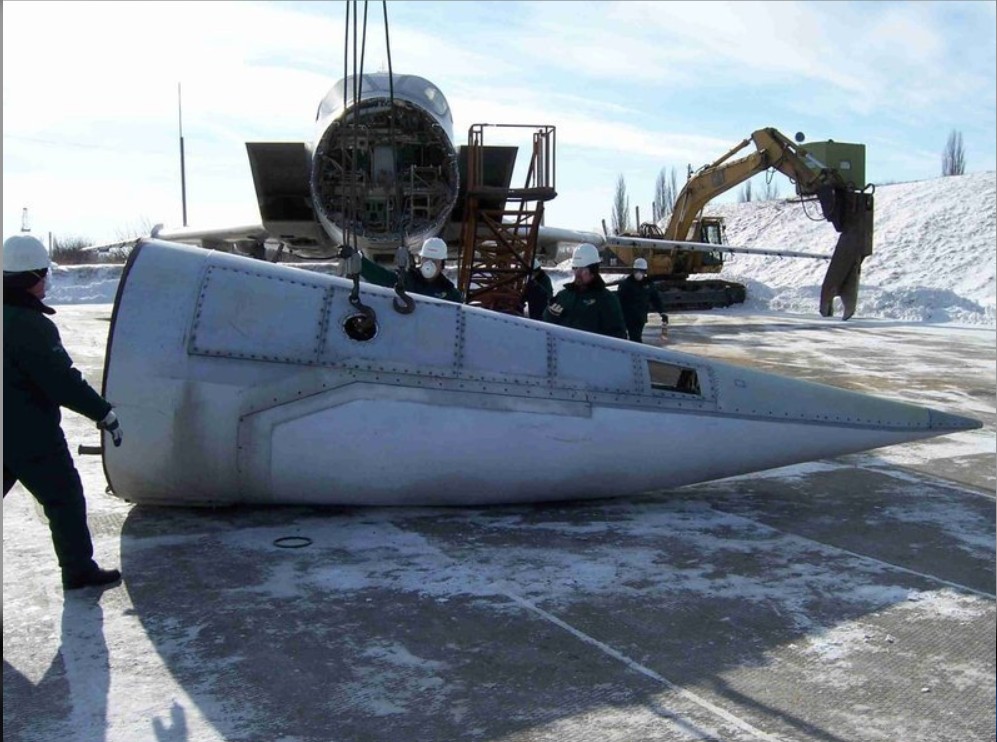
In 1991, Ukraine inherited approximately 102 strategic bombers: 25 Tu-95MS, 19 Tu-160, and more than 60 Tu-22M3.
According to the Eurasian security think tank Jamestown Foundation, when the Soviet Union collapsed, Ukraine hosted two of its most important strategic air bases.
At Uzin, 70 kilometers south of Kyiv, the Soviets stationed 25 Tu-95MS turboprop nuclear missile carriers. At Pryluky, 130 kilometers east of the capital, the Soviet Union stationed its only operational unit of 19 new, supersonic Tu-160 Blackjack bombers.
In February 1992, the unit at Uzin declared allegiance to Ukraine. In May 1992, just one week after Russia announced it was forming its own national armed forces, Ukraine announced it was taking command of all long-range aviation units on its territory. This included the Tu-160 base at Pryluky.
File Image: TU-160M
The Tu-160s were particularly lethal. It was designed to match the American B-1B bomber, but was significantly larger and faster.
It remains the largest combat aircraft in the world; it could carry 45,000 kg of ordnance across its two internal bays, or up to twelve nuclear-armed cruise missiles, and fly 14,000 km without refueling. Its supersonic speed of 2,300 km/h and variable-sweep wings made it a standout in aviation history.
However, under the START-1 treaty and CTR agreement, Ukraine agreed to dismantle all of these strategic bombers.
Thus began the consensual elimination of Ukraine’s strategic aviation.
Under the Nunn-Lugar Cooperative Threat Reduction program, the United States funded the destruction of some strategic bombers and missiles, including the extraction of valuable metals.
The last Ukrainian Tu-22M3 getting destroyed, January 27, 2006. (Source: Ukrainian Museum of Heavy Bomber Aviation)
However, some bombers were not destroyed.
At the time, the newly independent Ukraine was struggling with debt. For decades, as part of the Soviet Union, Ukraine got access to heavily subsidized fuel and gas. When the Soviet Union dissolved abruptly in 1991, Moscow suddenly cut off this subsidized gas.
Struggling with mounting debt, Ukraine agreed to transfer eight Tu-160 and three Tu-95MS bombers to Moscow in exchange for US$285 million in debt relief. This decision remains controversial, as the estimated value of a single Tu-160 was between US$250 and US$300 million.
Between 1999 and 2000, Kyiv transferred Tu-95s and Tu-160s as partial payments on natural-gas debts, along with 575 Kh-55 missiles.
This fateful decision not only degraded Ukraine’s air power and deterrence, but it also multiplied Russia’s air power, creating a military imbalance that Moscow is exploiting in the current war.
The last Ukrainian Tu-22M3 being destroyed, January 27, 2006. (Source: Ukrainian Museum of Heavy Bomber Aviation)
In 2024, an investigation by Ukrainian investigative news site Skhemy found that six of the eight Tu-160 bombers transferred to Russia were still active in military operations against Ukraine.
The remaining strategic bombers in Ukraine were dismantled, often with technical and financial assistance from the US.
In March 2007, the US State Department reported that Ukraine had dismantled 57 Tu-22 bombers, 27 Tu-95s, six Tu-142s, 11 Tu-160s, for bomber trainers, 346 Kh-22 ASMs, and 483 Kh-ALCMs (air-launched cruise missiles).
While these platforms were nuclear-capable and theoretically could have been used to launch nukes, they also had conventional military capabilities.
By dismantling and transferring these military assets to Russia, Kyiv delivered a double blow to itself – degrading its own capabilities while multiplying its adversary’s.
In the annals of military history, few decisions have proven as fateful – or as irreversible.
Sumit Ahlawat has over a decade of experience in news media. He has worked with Press Trust of India, Times Now, Zee News, Economic Times, and Microsoft News. He holds a Master’s Degree in International Media and Modern History from The University of Sheffield, UK.
He can be reached at ahlawat.sumit85 (at) gmail.com
A atleta Madalena Santos, do Karate Clube de Faro, conquistou a medalha de bronze no Campeonato do Mundo de Cadetes, Juniores e Sub-21, que decorreu entre 14 e 18 de outubro, em Bielsko-Biała, na Polónia.
A karateca alcançou o terceiro lugar na categoria de kumite cadete, acima dos 61 quilos (+61 kg), representando a Seleção Nacional portuguesa na competição.
A conquista foi assinalada pelo clube algarvio, que felicitou a atleta pelo resultado alcançado numa das principais competições internacionais da modalidade.
U.S. Secretary of State Marco Rubio sought to reassure Greece that Kimberly Guilfoyle’s departure would not diminish its importance to Washington, promising a successor with access to President Trump and his full confidence. “Greece deserves a strong and good ambassador that has access to and the confidence of the president,” Mr. Rubio told Matthew Boyle […]
A total of twelve people, among them an infant, lost their lives on Monday in two incidents with migrants boats in the eastern Aegean Sea. There is information of missing persons. The one incident took place off the island of Lesvos where a Greek Coast Guard patrol boat collided with the migrants boat doing dangerous […]
The inauguration of Greece’s national supercomputer, “DAEDALUS” was held on Monday at the Lavrio Technological and Cultural Park of the National Technical University of Athens in eastern Attica, in the presence of Prime Minister Kyriakos Mitsotakis. DAEDALUS It is the most powerful computing system recorded in Greece to date. The supercomputer has a measured computing […]
O Museu Zer0, em Santa Catarina da Fonte do Bispo, no concelho de Tavira, recebe duas propostas musicais a 25 e 30 de outubro. A programação começa com a apresentação de “SEMENTE“, resultado de uma residência artística de António Bastos com a comunidade local, e prossegue com um concerto de DANZ, que apresenta o álbum mais recente, “Getting Comfortable With Your Own Darkness”.
A primeira iniciativa está marcada para 25 de outubro, às 16h00, e resulta de um processo de criação colaborativa que envolveu diferentes agentes e entidades de Santa Catarina da Fonte do Bispo, entre os quais a Charola da Amizade, o grupo de bordado tradicional e o Centro Social Nossa Senhora das Dores.
A residência artística “SEMENTE” cruza práticas e saberes tradicionais com linguagens contemporâneas e tecnológicas, valorizando o conhecimento local e a diversidade de experiências. António Bastos, compositor, produtor e professor, conta com mais de 30 EP e álbuns editados sob os nomes Johnwaynes e António Bastos, num percurso que atravessa géneros como jazz, house, funk, música tradicional portuguesa, techno e música clássica.
A apresentação assume o formato de concerto-performance e tem entrada incluída no bilhete da exposição. A iniciativa conta com o apoio da CCDR Algarve – Cultura, da Junta de Freguesia de Santa Catarina da Fonte do Bispo e da Associação Cultural Memória Viva.
A programação continua a 30 de outubro, às 21h30, com a terceira edição do ciclo “AFTER ZER0” (últimas sextas-feiras de cada mês no Museu Zer0), que recebe DANZ, projeto artístico de Rui Daniel. Músico, produtor, DJ e técnico de som algarvio, apresenta-se num trio que cruza bateria, percussão acústica e uma caixa de ritmos de sonoridade sintetizada e industrial.
Ao lado de Henrique Guerreiro, nos sintetizadores, e de Ângelo Neto, na guitarra, DANZ interpreta o álbum “Getting Comfortable With Your Own Darkness”, que explora territórios entre a eletrónica, o rock, o indie dance e a música ambiente, com influências do grunge.
O concerto conta com o apoio do programa Equinócios, da Câmara Municipal de Tavira. A entrada custa oito euros e inclui o acesso à exposição até às 21h30. Está também prevista uma visita orientada à exposição, às 19h30, incluída no bilhete. A cafetaria e a exposição “lugar-depois” abrem a partir das 15h00.
A greve de 24 horas dos trabalhadores não docentes, convocada pelo Sindicato Nacional dos Profissionais da Educação (Sinape), está a afetar escolas em vários pontos do país, incluindo nos concelhos algarvios de Silves, Albufeira e Lagoa. A informação foi avançada esta manhã pela agência Lusa, que dá conta do encerramento de vários estabelecimentos de ensino devido à paralisação.
Segundo Francisco Pinto, dirigente do Sinape, pelas 08h45 o sindicato tinha conhecimento de escolas encerradas em várias localidades, entre as quais Silves, Albufeira e Lagoa, além de Viseu, Aveiro, Coimbra, Palmela, Setúbal e Sesimbra.
A paralisação abrange assistentes operacionais, assistentes técnicos e técnicos especializados e superiores. Entre as principais reivindicações estão a criação de carreiras próprias, tendo em conta a especificidade das funções desempenhadas, bem como melhores condições de progressão profissional.
Num comunicado, o Sinape considera que estes trabalhadores se encontram numa situação de “precariedade consecutiva, sem carreira, progressão e sem reconhecimento funcional na Administração Pública”.
A greve levou também ao encerramento de escolas nos distritos de Lisboa, Coimbra e Setúbal. O sindicato antecipava uma adesão elevada à paralisação, apontando para uma participação de cerca de 70% dos trabalhadores não docentes.
The world’s first supersonic passenger airliner—the Soviet Tu-144—may have become history after a brief but troubled stint that ended in commercial failure. However, some Russian volunteers refuse to let it vanish into oblivion and are reportedly advancing efforts to restore the aircraft for static display.
At the height of the Cold War, the Tu-144 “Concordski” was seen as an answer to the Anglo-French supersonic aircraft, Concorde.
The Russian airliner beat the Concorde in the skies twice: first with its maiden flight on December 31, 1968, two months before Concorde, and second with its first supersonic flight in June 1969, about four months before Concorde.
To preserve this legacy, a group of Russian volunteers has spent years coaxing life back into a Tu-144 airframe on the shared grounds of the Gromov Flight Research Institute and Zhukovsky Airport.
Interestingly, though, these volunteers are neither engineers from Russia’s state design bureau nor museum-paid technicians, but enthusiasts with limited resources aiming to restore a retired Tupolev Tu-144D.
The aircraft, registered CCCP-77115, is parked on the shared grounds of the Gromov Flight Research Institute and Zhukovsky Airport outside Moscow. It served as a static exhibit at the MAKS air show for several years, but its fate remains unclear, as the air show has been suspended since 2021 due to the war in Ukraine.
Passionate volunteers have carried out extensive external and internal restoration work on the aircraft. One volunteer involved, Pavel Efter, has posted videos of the work on both airplanes on his YouTube channel, “Restorer144,” since 2023.
In the videos, volunteers can be seen turning on the electrical power supply and batteries, testing the fuel gauge, fuel pump, and fuel pressure indicator in the cockpit, checking the landing gear lights and inflating the tires, testing the cabin lighting, repairing the analog navigation system, examining the electrical schematics, cleaning the outside of the aircraft, inspecting the SSP-2A fire detection system and smoke sensors, raising and lowering the nose, testing the retractable canards, testing the APU’s bay doors beneath the aircraft, and actually installing the TA-6A Auxiliary Power Unit (APU).
In Instagram comments, Efter told enthusiasts and followers that the Tu-144D is being refurbished only for static exhibition and will not return to flight.
Notably, the TA-6A and other mechanical and electrical modifications to the Tu-144D (as seen in the video above) have recently been made, sparking rumors that the volunteers may be preparing the aircraft for another static exhibition at MAKS, probably in 2027.
Nonetheless, the volunteers have been working on restoring the aircraft for several months. In July 2026, media reports noted that the volunteers had already started the electrical system and connected a ground power source, adding that even the well-known nose-lowering mechanism had become operational.
Another Russian state-funded news website, Mir24, provided more details on the volunteers. “There is a problem with such glass fuses now. They aren’t used anywhere; you can’t always find them in old stock. We throw out a cry on the Internet: who has something, who can help with what,” Sergey Chechetkin told the publication at the time. Sergey is a former aviation engineer who devotes all his free time to the Tu-144.
The report also noted that volunteers have completely recreated the plane’s cabin. Volunteers collected the missing devices from across the country and began restoring the aircraft by tidying the service panels and lamps and installing the original chairs. Initially, the 77115 board wasn’t a passenger deck; it served as an experimental testbed. “We find it in different places. Old blocks are transmitted at the bases; you can find something here. Here we are installing the blocks on the mounts,” a volunteer named Alexey told Mir24.
The project carries no grand political statement. The volunteers do not frame their work as resistance or protest. Instead, they speak of history. “This is not just a museum exhibit, but a legend that we should be proud of. You can still learn a lot from it; many developments aren’t available on other planes yet. It is still ahead of its time,” said Alexey Amelushkin, an engineer at the training and methodological center of PJSC Tupolev, earlier.
Needless to say, returning this legendary airframe to flight is widely regarded as impractical, especially since Kolesov RD-36-51 engines are long out of production, spare parts are scarce, and certification requirements would be formidable.
Therefore, Efter and his colleagues are only restoring the aircraft’s ability to present itself: nose down in the classic pose, canards extended, cabin lights on, systems powered by its own APU.
First Into The Air, But Not The First To Succeed
The Tupolev Tu-144 was the world’s first supersonic passenger airliner.
Designed by the Tupolev Design Bureau, the aircraft was rushed into development after the then-Soviet leader, Nikita Khrushchev, demanded a supersonic transport that would fly before its Western counterpart.
The prototype made its maiden flight on 31 December 1968 near Moscow, beating Concorde into the air by more than two months. Subsequently, the aircraft went supersonic for the first time in June 1969 and became the first commercial aircraft to reach Mach 2 in May 1970.
The Tu-144 was built to be larger and faster than Concorde, and featured a distinctive double-delta wing and a drooping nose for better landing visibility. Later models also added retractable canards to improve low-speed handling.
However, Western experts and officials claimed the Soviets stole the Concorde plans, which may have helped them build the Tupolev Tu-144 before the Concorde.
These claims reportedly stemmed (at least in part) from the uncanny design similarities between the world’s first two supersonic passenger aircraft.
Tupolev Tu-144- Wikipedia
Despite its early successes over the Concorde, the airplane faced technical issues.
For example, Tu-144’s early Kuznetsov NK-144 engines required constant afterburner use to sustain supersonic cruise, making it extremely noisy, fuel-thirsty, and shorter-range than Concorde, which could supercruise without afterburners. Moreover, reliability problems emerged during testing and maintenance, and the cabin was very noisy and vibrated a lot.
On June 3, 1973, during a demonstration flight at the Paris Air Show, a production Tu-144 broke apart in midair and crashed into the French village of Goussainville, killing all six crew members along with eight additional people on the ground.
Although the most widely accepted explanation is that the crew overstressed the airframe during fast maneuvers, the precise cause of this disaster remains uncertain.
The Tu-144 entered limited commercial service with Aeroflot in 1975, initially carrying mail and cargo on the Moscow–Almaty route, followed by passenger flights in Nov 1977.
However, the aircraft flew only about 55 passenger services before a second major incident. In May 1978, a fuel-line rupture and fire during a test flight claimed the lives of two crew members and formally ended passenger operations.
After this debacle, the aircraft continued brief cargo and experimental work even as its rival program—the Concorde—struggled with its own set of issues.
Both programs were eventually canceled because of poor safety records and concerns about economic viability. However, Concorde was far more successful than the Tu-144 and wasn’t discontinued until 2003.
The Soviet Union, for its part, built only 16 airframes before operations ceased in 1983. A few surviving examples later trained pilots for the Soviet Buran space shuttle, and one modified aircraft served as a flying laboratory in a joint NASA–Russian research program from 1996 to 1999, conducting its final flights in support of future supersonic transport studies, as earlier explained in detail by the EurAsian Times.
NASA used the Tu-144LL to conduct research for high-speed civil transport in 1997. Credits NASA.
Though neither the Tu-144 nor the Concorde survived, both programs have inspired people worldwide to make supersonic commercial travel a reality. Earlier this year, United Aircraft Corporation (UAC) CEO Vadim Badekha confirmed that the Zhukovsky National Research Center is working on a supersonic airliner prototype. He said the effort had moved beyond paper studies into “hardware,” with UAC providing active support, and expressed confidence that the center would complete the work.
“Yes, such work is underway at the Zhukovsky Research Center, and we are actively assisting. The work is no longer confined to paper – it is already being carried out in hardware. A prototype of such an aircraft is under development, and we believe the Zhukovsky Research Center will successfully complete this work,” he told TASS.
Meanwhile, NASA is advancing work on the X-59, an experimental aircraft in the agency’s Quiet Supersonic Technology (Quesst) program that could go supersonic without generating a sonic boom or a loud, thunder-like sound when it exceeds the speed of sound.In addition, China is developing a supersonic passenger aircraft that could make its maiden flight by 2027. Last year, reports noted that the Chinese commercial aerospace company leading the project conducted the first test flight of a detonation ramjet engine.
As for the Tu-144, this aircraft is remembered as a bold but ultimately unsuccessful engineering achievement. It is, perhaps, for this reason that the volunteers outside the state machinery of Russia are doing everything they can to ensure that the supersonic airliner does not get lost in pages of history.
Contact the author at sakshi.tiwari13 (at) outlook.com
A região algarvia voltou a ser distinguida como Melhor Destino de Praia da Europa, ao conquistar pela 11.ª vez este título nos World Travel Awards. O prémio foi anunciado no sábado, 17 de outubro, durante a gala europeia realizada em Kotor, no Montenegro, numa altura em que as praias da Falésia, em Albufeira, e de Benagil, em Lagoa, também se destacam no panorama internacional.
Conhecidos como os “Óscares do Turismo”, os World Travel Awards atribuíram ao Algarve o galardão de 2026, colocando a região à frente de outros sete destinos nomeados, entre os quais Porto Santo, Maiorca, Sardenha, Marbella, Cannes e Corfu.
A distinção representa a 11.ª vitória algarvia nesta categoria, depois dos títulos conquistados em 2012, 2013, 2015, 2016, 2017, 2019, 2020, 2021, 2022 e 2023. A estes prémios juntam-se quatro distinções como Melhor Destino de Praia do Mundo, alcançadas em 2020, 2021, 2024 e 2025.
O reconhecimento internacional da região estende-se também à classificação das melhores praias europeias elaborada pela revista britânica Condé Nast Traveller, com base nas escolhas dos leitores.
Nos Readers’ Choice Awards 2026, a Praia da Falésia alcançou o quarto lugar, com 94,70 pontos, enquanto a Praia de Benagil ficou na 16.ª posição, com 81,67 pontos. São as únicas praias portuguesas a integrar o top 20 desta classificação, que reuniu mais de 296 mil respostas de leitores do Reino Unido.
Para André Gomes, presidente do Turismo do Algarve, a conquista do galardão europeu é “um motivo de enorme orgulho para toda a região” e confirma “um percurso de excelência” construído ao longo dos anos.
O responsável considera que o prémio ganha um significado acrescido pelo reconhecimento atribuído às duas praias algarvias, sublinhando que estas distinções refletem “beleza e diversidade da nossa costa, a qualidade da nossa oferta turística e, sobretudo, o trabalho e a dedicação de todos os que contribuem diariamente para afirmar o Algarve como um destino de referência internacional”.
André Gomes defende, contudo, que os prémios devem ser acompanhados por um compromisso contínuo com a preservação dos recursos naturais e a melhoria da experiência turística.
“Mais do que celebrar estas conquistas, importa encará-las como uma responsabilidade acrescida”, afirma, apontando a sustentabilidade, a proteção do património natural e a qualificação da oferta como prioridades para manter a competitividade da região.
Região procura quinto título mundial
O Algarve está também nomeado para Melhor Destino de Praia do Mundo nos World Travel Awards 2026, procurando alcançar o quinto título nesta categoria.
Com cerca de 200 quilómetros de costa, a região aposta na diversidade das praias, na qualidade ambiental e na oferta de experiências para diferentes perfis de visitantes, fatores que contribuem para a sua projeção internacional.
A leitura do acórdão chegou a estar marcada para 30 de setembro, mas foi adiada devido a um pedido de esclarecimentos ao Instituto de Medicina Legal e remarcada para terça-feira, dia 20 de outubro.
O julgamento teve início a 12 de maio, decorreu à porta fechada e no dia 15 de setembro realizaram-se as alegações finais, com a defesa do arguido a pedir a sua absolvição e o Ministério Público (MP) uma pena de seis anos de prisão, em cúmulo jurídico.
O antigo sacerdote octogenário está acusado pelo MP da prática de um crime de burla qualificada, de usurpação de funções na forma continuada e de violação.
O crime de coação sexual, pelo qual estava também acusado, caiu depois de a alegada vítima se ter recusado a testemunhar e ter desistido da queixa já no decorrer do julgamento.
À porta do tribunal, questionado pelos jornalistas, o ex-sacerdote foi negando os crimes e insistido que se sente confiante e tranquilo com o julgamento
O arguido foi detido a 24 de dezembro de 2021 pela Polícia Judiciária (PJ) pelo crime de violação de uma mulher de 47 anos e, depois de presente a tribunal, ficou em prisão preventiva, tendo sido libertado em abril de 2022.
A acusação do MP data de setembro de 2023, mas o ex-sacerdote pediu a abertura da instrução, uma fase facultativa que visa decidir, por um juiz de instrução criminal (JIC), se o processo segue e em que moldes para julgamento, ficando a conhecer-se, a 31 de outubro de 2025, a decisão instrutória.
O juiz de instrução considerou suficientemente indiciado que o arguido, após ter sido expulso como sacerdote da Igreja Católica, desde meados de 1979 e até 24 de dezembro de 2021, continuou a apresentar-se e a vestir-se, quer no seu dia a dia quer nas consultas que dava, como padre e como padre exorcista pertencente à Igreja Católica, o que, inclusivamente, aconteceu em programas televisivos com expressão nacional.
Também considerou que o arguido, no âmbito da atividade de exorcista, aconselhamento e orientação espiritual, recebeu, em dezembro de 2021, no consultório da sua habitação, no concelho de Murça, distrito de Vila Real, duas mulheres que ali se deslocaram acreditando que o arguido era padre da Igreja Católica.
Segundo a acusação, numa dessas consultas o ex-sacerdote ter-se-á aproveitado do facto de uma das mulheres se encontrar vulnerável psicologicamente para praticar atos sexuais com a vítima, o que terá acontecido depois de a “colocar num estado como que de inconsciência, retirando-lhe desse modo toda a capacidade de reação”.
Serge Schmemann’s warning about the collapse of the old international order deserves attention. For Europe, the challenge is to defend democratic security while accepting that American leadership may never return in its familiar form.
The most dangerous assumption in Western politics is that normality is merely postponed. Survive Donald Trump, the argument runs, and America will resume its familiar position: reassuring allies, containing adversaries and underwriting an international system whose benefits outweigh its frustrations. Serge Schmemann’s latest opinion challenges that comforting expectation. He is right to do so.
In his October 18th essay for The New York Times, the highly esteemed former Moscow, Bonn and Jerusalem bureau chief examines what might follow the erosion of the postwar order. His central warning, reflected in published excerpts, is that changes extending beyond Trump make a complete restoration improbable. That is a persuasive starting point for democratic strategy.
America’s allies should take this seriously because trust operates differently from military strength. Governments can replenish ammunition, replace aircraft and increase defence budgets. Confidence in a security guarantee is harder to rebuild. Once allies must consider whether Washington’s commitments depend on a president’s personal preferences, that uncertainty becomes a permanent consideration in their planning.
Schmemann’s argument also avoids an analytical trap: attributing every international upheaval to one man. According to the published account of his essay, he places Trump alongside broader developments, including China’s rise, Russia’s renewed aggression and democratic retreat. His alternative futures are scenarios, rather than predictions. Their value lies in forcing readers to consider choices and consequences before events foreclose them.
Supporting this argument does not require romanticising American leadership. Washington’s record includes disastrous interventions, selective commitments to human rights and partnerships with dictators. Those contradictions weakened its authority. Yet recognising them does not erase the distinction between an imperfect system containing restraints on power and an emerging environment in which powerful states increasingly seek freedom from restraint.
For smaller countries, that distinction is existential. Sovereignty offers little protection if stronger neighbours can overturn it through invasion, economic intimidation or negotiations conducted without the affected country’s meaningful participation. An international order deserves defending when it gives weaker states instruments to resist coercion, even when those instruments work inconsistently.
Ukraine makes the issue concrete. A settlement should be judged by whether it produces durable security and respects Ukrainian agency, rather than by the speed with which a diplomatic announcement can be staged. Peace that leaves an aggressor confident of future gains risks becoming an interval between wars.
Europe, however, cannot turn justified criticism into an excuse for its own shortcomings. If democratic governments believe that sovereignty and collective security matter, they must supply the resources required to defend them. Procurement, industrial capacity, infrastructure protection and sustained assistance to Ukraine are measures of political seriousness. Communiqués cannot substitute for delivery.
Gary Cartwright made a related argument in EU Today’s “Trump Comes to Davos — and Europe Still Isn’t Ready”. Discussing pressure over Greenland, he identified both the damage caused by coercive bargaining and Europe’s persistent unpreparedness. That combination matters: American unpredictability becomes more dangerous when European governments lack the means or unity to respond.
A stronger European contribution would also serve Americans who still value alliances. Partnerships are more resilient when responsibility is shared and commitments survive changes of government. Europe should build the capacity to act while preserving cooperation with American institutions, businesses and citizens. Treating the entire United States as interchangeable with its president would reproduce the personalised politics that makes the present situation so unstable.
Democratic renewal must begin at home, too. Governments weaken their case abroad when they dismiss public grievances, evade scrutiny or treat electoral legitimacy as an inconvenience. Defending democracy requires competent administration, accountable institutions and room for peaceful disagreement. Strategic credibility rests partly on whether citizens believe their own system deserves their confidence.
Schmemann’s warning therefore deserves support as a demand for preparation. The old order cannot simply be summoned back through nostalgia or another American election. Its most valuable achievements must be sustained through decisions made now. Europe should approach the future with fewer comforting assumptions, greater material strength and a clearer understanding that democratic security depends on governments willing to defend it.
O Município de São Brás de Alportel atribuiu um Voto de Louvor a David Mendonça, vocalista e acordeonista da banda “Os Vizinhos”, em reconhecimento pelo percurso artístico do jovem músico e pela projeção que tem alcançado na música portuguesa. A distinção foi entregue a 14 de outubro, no Espaço Memória da Câmara Municipal, e assinala também o orgulho da comunidade são-brasense num dos artistas em destaque no panorama musical nacional.
Aos 25 anos, David Mendonça vive uma fase de grande popularidade com “Os Vizinhos”, grupo que conquistou o público com temas como “Pôr do Sol”, “Pobre Ex-Namorado” e “Casar É pra Esquecer”. O sucesso nacional é o resultado de um percurso musical iniciado na infância e marcado pela aprendizagem, pela participação em diferentes projetos e pela aposta na formação.
A paixão pela música começou cedo. Aos seis anos, David começou a aprender acordeão e, mais tarde, integrou o grupo Veredas da Memória, a convite da mãe, Filomena Mendonça. Ao longo do percurso, contou com o acompanhamento de vários professores, entre os quais Joaquim Martins, Joaquim Machado, Nelson Conceição, Jorge Alves e Gabriel Rodeia, bem como com o apoio de músicos e amigos.
Depois de concluir o ensino secundário, ingressou na Escola dos Artistas de Minerva, em Loulé, e prosseguiu a formação musical em Évora. Foi nesta cidade que integrou o Grupo Académico Seistetos, projeto do qual viriam a surgir “Os Vizinhos”.
Na cerimónia de entrega do voto de louvor, a presidente da Câmara Municipal, Marlene Guerreiro, destacou o percurso de David Mendonça e o facto de ter sido um dos primeiros jovens do concelho a apostar na formação académica em Música.
Antes de alcançar a popularidade atual, o músico passou por diferentes formações e experiências, participando em galas, festivais de acordeão e programas de televisão. O seu percurso inclui projetos ligados à música tradicional e ao folclore, como o Rancho Típico Sambrasense e o Rancho Folclórico da Casa do Povo de Santa Catarina, mas também experiências na música ucraniana, no jazz e no fado.
A ligação às raízes musicais do concelho continua a fazer parte do seu percurso. Em 2021, colaborou no projeto “Sons de São Brás”, dedicado à valorização do património musical local. Participou ainda nas edições de 2023 e 2024 da Feira da Serra com grupos de música tradicional inspirados nos acordes do Alentejo.
Em abril de 2025, o São Brás Cineteatro Jaime Pinto recebeu a apresentação do primeiro álbum de “Os Vizinhos”. Desde então, o grupo tem consolidado a sua popularidade e passado por palcos e festivais de todo o país.
Entre os temas de maior sucesso está “Pôr do Sol”, que alcançou a quarta platina em novembro de 2025, segundo a Associação Fonográfica Portuguesa. “Vizinha do 1.º Andar”, “Já Não Saio” e “As Laranjeiras” são outros dos temas que marcam o repertório da banda. Esta última canção foi apresentada pela primeira vez ao público em São Brás de Alportel, a 1 de junho deste ano.
Os Vizinhos preparam agora o lançamento do segundo álbum, dando continuidade a um percurso de crescente reconhecimento junto do público.
A distinção agora atribuída pelo município recupera também uma ambição que David Mendonça expressou em 2018, quando recebeu o Prémio Juventude “Música Revelação”, uma iniciativa da autarquia. Na altura, o músico apontou como objetivo “tocar com os maiores nomes da música em vários palcos pelo mundo fora e mais tarde poder passar o testemunho aos mais novos”.
Sete anos depois, parte dessa ambição concretizou-se, com a afirmação de “Os Vizinhos” no panorama musical português. O Voto de Louvor pretende reconhecer esse percurso e o exemplo que o músico representa para as novas gerações do concelho.
A 5 de novembro, “Os Vizinhos” sobem ao palco do Teatro das Figuras, em Faro, para participar no concerto “Prometo Viver”, associando a sua música a esta causa solidária.

 Login