The Battle of Ideas was filled with speakers who were sharp, well-informed and willing to say things you rarely hear said out loud about the state of the country, says Pete Dalton. What we need now are solutions.
The European Union claims that "the fundamental right to freedom of expression" only applies to journalists "acting in good faith," and that authorities do not have to give due process before freezing people's bank accounts, as these sanctions are "temporary and are not criminal in nature," according to a legal letter shared by a sanctioned journalist.
Last year, the European Union blacklisted 21 people for allegedly spreading Russian propaganda, banning them from doing business in Europe. One of them, Hüseyin Doğru, was falsely listed as a Turkish citizen living in Istanbul. In fact, Doğru is a German journalist in Berlin, making him the first European citizen on European soil to be sanctioned this way.
It was like being sentenced to "civil death," Doğru told American journalist Chris Hedges. He was banned from holding a job in Europe or having a European bank account, and authorities have restricted Doğru to a €506 ($567) per month allowance from his own money. "The sanctions are designed for people outside of Europe, so they don't really know how that should function with me, because I'm a European citizen and I'm living in Europe," Doğru told Hedges.
Last month, the civil libertarian Wau Holland Foundation hired lawyers to contest the sanctions against Doğru. And earlier this month, the Council of the European Union sent a response letter, which Doğru shared on social media, promising to escalate the case to the E.U. General Court. Although the council conceded to Doğru that he is not a Turkish citizen living in Turkey, it still insisted on the authority to punish him for his speech.
The council quoted a 2022 court case between the Russian news outlet RT and several European countries: "The protection of the right of the media and, more particularly, of journalists to impart information on issues of general interest is subject to the proviso that they are acting in good faith and on an accurate factual basis and provide 'reliable and precise' information in accordance with the ethics of journalism."
Doğru's lawyers insisted that he should be treated as innocent until proven guilty. But the council responded that sanctions fall short of a criminal punishment, so any complaint about a "violation of the presumption of innocence is therefore unfounded." In other words, because he is not accused of a crime, Doğru has fewer rights than a criminal suspect.
"People need to understand sanctions are an extrajudicial measure. They're extrajudicial. There's no court. There is no hearing, no evidence, there is no sentence by the court, nothing," Doğru told Hedges. "When you're sanctioned, you are not informed….The day when I was sanctioned, me and my wife, my wife was pregnant back then, we went to the pharmacy to buy medicine for her, and her cards did not work."
The original blacklisting decision accuses Doğru of supporting "actions by the Government of the Russian Federation which undermine or threaten stability and security in the Union" by spreading "false information on politically controversial subjects with the intent of creating ethnic, political and religious discord amongst its predominantly German target audience."
Doğru and his wife, British journalist Lizzie Phelan, previously worked at the Russian-funded publication Redfish. A few months after the Russian invasion of Ukraine, he split off to create a new website called red.media, insisting to The Left Berlin that "we are not Russian. We are not Kremlin. red.media is not funded by Russia or any other state." In the same interview, Doğru called Russia an "imperialist" regime.
But in September 2024, a Biden administration "fact sheet" on Russian propaganda offhandedly mentioned red.media, citing a hit piece on Doğru by the German newspaper Tagesspiegel. Doğru told Hedges that the U.S. fact sheet created a circular logic in German media: "They said red.media is Russian because [U.S. Secretary of State Antony] Blinken said so. But what they never said is that Blinken is referring to your articles where you never say it like that. You say there is a suspicion, it might be so."
Doğru shut down red.media in May 2025 due to the bad press. The European Union sanctioned him a few weeks later. Doğru's lawyer, Alexander Górski, told the Frankfurter Allgemeine earlier this year that the European Union didn't "even attempt to make an evidentiary case" about any ongoing connection to Russia.
The blacklisting decision also claimed that, during a pro-Palestinian student protest at Humboldt University in Berlin, red.media "coordinated with the occupiers to disseminate images of their vandalism—which included the use of Hamas symbols." Doğru told Hedges that these accusations are an attack on journalists' freedom to do their jobs.
The European Union does not have the same protections for the freedom of the press as the U.S. Constitution. Earlier this year, the Curia of the European Union ruled that simply reposting clips from Russian media could be a violation of European sanctions, even if no money changes hands, something that is explicitly exempted from U.S. sanctions under the Berman Amendment.
Still, U.S. authorities have tried to push the limits of international sanctions to censor speech. The Biden administration told an American nonprofit that "the provision of a platform for [the sanctioned individuals] to speak" was illegal, backing down after the nonprofit sued.
And the Trump administration sanctioned Italian academic Francesca Albanese for her "lawfare" calling for the prosecution of Israeli leaders and a boycott of Israeli industries. In addition to freezing her bank accounts, the sanctions forced Columbia University researchers to cut off their relationship with Albanese, and Georgetown University to close her email account.
In the same statement accusing red.stream of being a Russian front, the Biden administration announced sanctions on two Russian news agencies. "We encourage dissent, open debate, and free discourse. But we will not stand for attempts by state actors to carry out covert activities with the goal of hijacking that discourse," the statement insisted. "The ultimate goal of sanctions is not to punish, but to bring about a positive change in behavior."
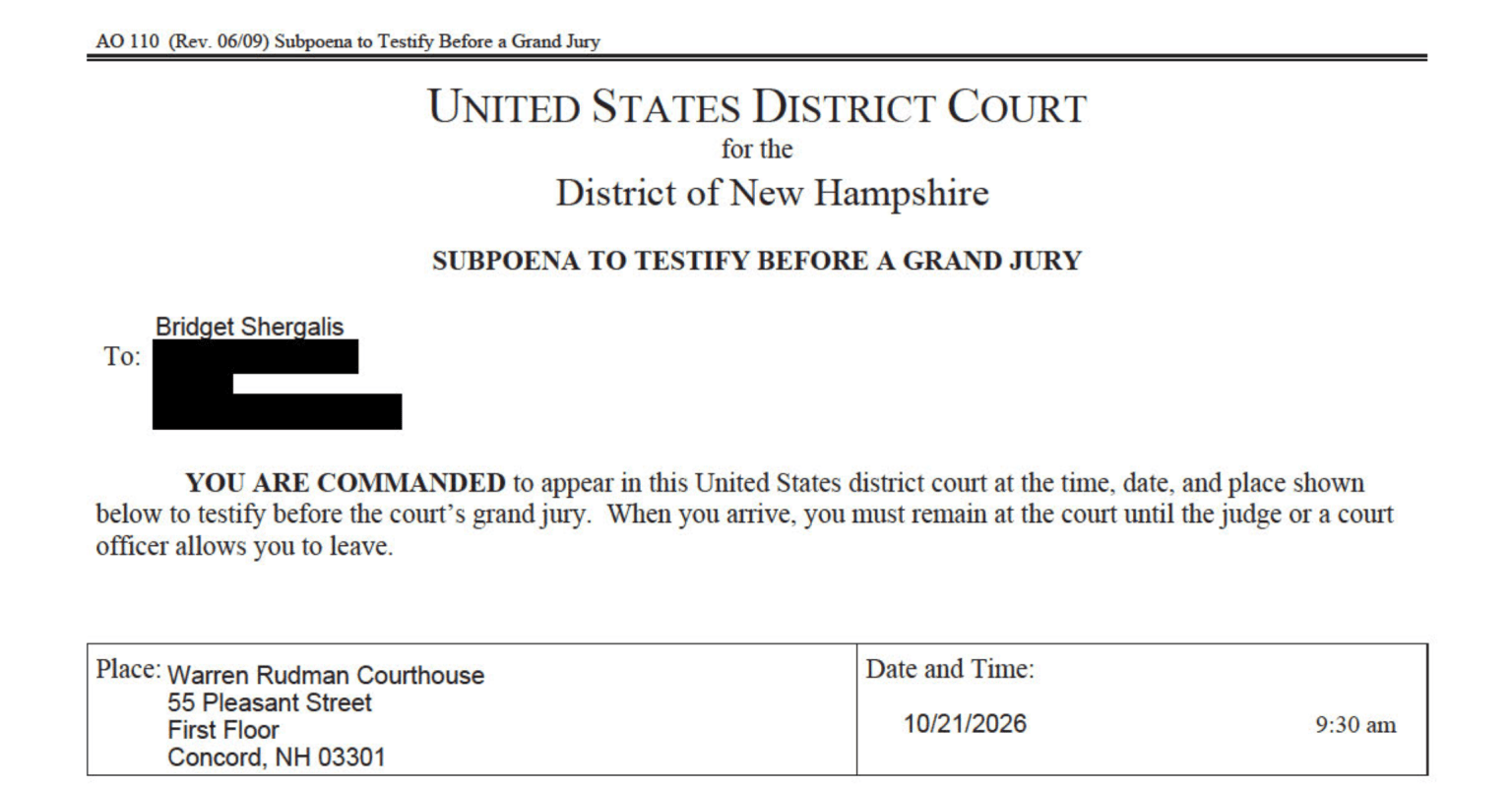
Two activists have been ordered by DOJ to testify in mysterious grand jury proceedings regarding their involvement in efforts to deface an Israeli weapons manufacturing facility in New Hampshire, after feds had sought in an earlier trial to obtain sentences of 37 years for them.
L.R. and her mother, R.S., alleged that after an incident involving L.R.'s father at end-of-school pickup, employees of Jennings School District placed L.R. in an out-of-school virtual learning program that was inferior to regular schooling. According to their complaint, the district employees did not provide L.R. with an explanation of how her conduct justified the suspension, a timeline or consistent standards for returning to in-person classes, or an opportunity to be heard or appeal. Those shortcomings, they argued, violated L.R.'s rights to constitutional and statutory due process as well as a free public education.
Since then, the parties have reached a settlement…. As to the settlement, the Court intends to approve it provided that the plaintiffs file an amended complaint that discloses R.S.'s identity.
[R.S.] argues that disclosing her identity "will effectively disclose L.R.'s identity" too. True, the Federal Rules of Civil Procedure presumptively require anonymizing minors by their initials, but there is no similar requirement for parents. Compare Fed. R. Civ. P. 5.2(a)(3) (stating that filings must replace "the name of an individual known to be a minor" with "the minor's initials"), with id. 10(a) ("The title of the complaint must name all the parties."). Instead, Rule 10 creates a "strong presumption against allowing parties to use a pseudonym." A party may overcome that presumption "only in those limited circumstances where [the] need for anonymity outweighs countervailing interests in full disclosure."
This case is not one of them. R.S. and L.R. do not share a last name, and R.S. has not established that third parties necessarily will infer L.R.'s identity from her mother's.
Even if third parties would discern L.R.'s identity, the fact that she was suspended from in-person classes after a vaguely described "incident" involving her father is not particularly sensitive…. [O]ne factor to consider [in pseudonymity cases is] whether identifying a party "threaten[s] to reveal information of a sensitive and highly personal nature" …. "[S]ome cases allow parents who are suing on behalf of their minor children to proceed pseudonymously, at least when the case involves highly personal information about the children" …. This case does not involve, for example, sexual assault or coercion of a minor to use drugs.
If anything, there are weighty interests in full disclosure because knowing the identities of the people involved in this case could help third parties assess the reasonableness or unreasonableness of a school policy that has become a topic of public debate across the nation. The school district in this case has been featured in national media on the topic of discipline at issue. See, e.g., Carly Graf, The newest form of school discipline: Kicking kids out of class and into virtual learning, Washington State Standard (Aug. 7, 2023) (explaining how "[s]chool districts across the country, including in Missouri, have begun punishing students by forcing them into online classes"); id. (quoting the "superintendent of Jennings School District in Missouri"). R.S.'s own complaint invokes the surrounding policy debate about virtual learning, including what critics say is a negative effect on students of certain races. Therefore, the Court will deny her motion for leave to proceed anonymously.
The settlement, by the way, was that "[a]lthough the defendants are not required to admit liability, they must remove any mention of the suspension from L.R.'s records, promote her to 8th grade, pay her $40,000 dollars plus $20,000 to her attorneys, and make available a policy that "clearly enshrines due process protections for all students prior to any transfer to virtual learning."
From Judge Ted Stewart (D. Utah) in U.S. v. Wang, dated Sept. 9 but just docketed today:
Defendant objected to the condition that she notify any intimate partners "about the potential risk she poses" as vague. To avoid any vagueness, the Court imposed the following: "The court requires you to notify any intimate partners that you have been convicted of cyberstalking and pose a risk of stalking and harassment to intimate partners." The Court finds this condition is necessary to protect the public considering Defendant's history of cyberstalking and her relationships with her past victims.
I believe similar conditions are sometimes imposed as to sex offenders, but this is the first time I've seen something like this as to stalkers. (Note that, once a criminal defendant is convicted, the standard for evaluating probation conditions restricting or compelling speech becomes more much government-friendly than would be the case in the absence of such a conviction.) Here's the Justice Department's statement summarizing the case:
A Utah County woman was sentenced to 12 months' imprisonment [and thee years of probation] today for cyberstalking two male victims she met on online dating platforms and became obsessed with them….
According to court documents and statements made at Wang's change of plea and sentencing hearings, Wang connected with the victims separately on online dating sites in 2017 and 2018 and became obsessed with each victim. Using multiple accounts, fake names, social media accounts, and phone numbers, she harassed and disparaged them publicly and privately, tagging their friends, family, and employers.
On three separate occasions, Wang reported the victims to the federal Internet Crimes Complaint Center (IC3) claiming she was being harassed and impersonated online by them. Wang reported that they did these things together, even though there is no evidence that the victims had any relation to each other. Wang admitted that she filed the IC3 complaints to get law enforcement to investigate the victims in order to harass and intimidate them.
Wang's crimes against victim 1 and victim 2 are not isolated incidents. Wang engaged in a pattern of stalking behavior in 2013 and was convicted in the state of New York.
Last March on Instagram, Students for Life President Kristan Hawkins posted a photo showing her and two other members of the Virginia-based group standing outside Space Center Houston. According to the captions, Hawkins and her fellow activists, one of whom was holding a mobile phone, were "ordering abortion pills undercover."
A lawsuit filed last week in Harris County, which includes Houston, describes that Instagram post as "nothing more than a publicity stunt." The lawsuit, which aims to deploy a Texas abortion law championed by Students for Life against the organization, is also a publicity stunt. But while it may be effective by that measure, it faces legal challenges that will be hard to overcome.
The lawsuit, which a Texas woman who opposes her state's abortion ban filed under the pseudonym Maria Puerto with help from the reproductive rights group Amplify Legal, is supposed to highlight the vagueness and broad scope of House Bill 7, a 2025 law that authorizes private civil action to enforce state restrictions on "abortion-inducing" drugs. But Puerto's attempted act of legal jiu-jitsu seems too clever by half, relying on a dubious reading of the statute to seek "monetary compensation" it does not authorize and thereby punish anti-abortion activists for constitutionally protected advocacy.
H.B. 7, also known as the Woman and Child Protection Act, says "a person may not manufacture or distribute an abortion-inducing drug in this state" or "mail, transport, deliver, prescribe, or provide an abortion-inducing drug in any manner to or from any person or location in this state." Those prohibitions, it says, "may be enforced only through a qui tam action" against a "person" who "violates" or "intends to violate" them.
Any "person" other than a state or local official can qualify as a "relator" authorized to bring such an action. The relator can seek injunctive relief and "an amount of not less than $100,000 for each violation," plus "costs and reasonable attorney's fees." A successful relator generally receives $10,000 of that "amount," with the rest going to a "charitable organization" of his choice.
As a "person" who is not a government official, Puerto meets H.B. 7's minimal test for standing. And although H.B. 7 precludes lawsuits against pregnant women who obtain "an abortion-inducing drug," Puerto says Hawkins and the other activists "are not pregnant and were not pregnant" at the time of the Instagram post. So far, so good. But although the lawsuit asserts that Hawkins et al. "openly and flagrantly violated" the law's prohibitions, it does not explain how.
A photo accompanying a recent Mother Jonesprofile of Hawkins shows her and her social media coordinator, Lydia Taylor Davis, outside Space Center Houston during their "abortion-pill 'sting' stunt." Another Mother Jones photo shows Hawkins holding a mobile phone displaying what Puerto's lawsuit describes as "an order confirmation."
Judging from the Mother Jones account, it is not clear whether that description is accurate. "The scheme rapidly went off the rails," Amy Littlefield writes. "The plan was to purchase pills from a couple of services, with Hawkins posing as a male abuser while Davis pretended to be a 16-year-old—all to try to portray mail-order suppliers as reckless and dangerous. For reasons even she couldn't explain, Hawkins chose the fake name 'Wanda' as her male-abuser alter ego. But when Davis input her information, she hit a snag."
Davis was trying to order pills from the Massachusetts Medication Abortion Access Project. But according to Littlefield, that organization "had blocked Davis in its system after Students for Life teased the sting operation on social media." Hawkins "attempted to save the stunt by placing her own order, but 'Wanda' accidentally gave her age as 15," which was below the supplier's minimum age, Littlefield says. "Now a security guard was wandering over to tell them they couldn't film. Having set out to show that telemedicine services don't screen their clients, they inadvertently proved the opposite."
Puerto "will need proof that the Students for Life leaders actually obtained or intended to obtain the pills," abortion law scholar Mary Ziegler notes in Slate. "The activists may argue that the post was not in earnest, and that no one involved ever seriously intended to bring pills into Texas."
Even assuming that Hawkins et al. successfully ordered abortion pills, that conduct by itself does not fit the language of H.B. 7, which applies to people who "distribute" such drugs or who "mail, transport, deliver, prescribe, or provide" them "to or from any person or location in this state." That language encompasses out-of-state suppliers, which raises obvious concerns about extraterritorial application of Texas law. But on its face, the prohibition does not cover someone who simply orders abortion pills.
Puerto's lawyer, Amplify Legal attorney Molly Duane, argues that Hawkins et al. could be covered by the statute's reference to transportation. "What the statute says is that transporting abortion drugs from one location to another within the state is a violation of H.B. 7," Duane toldThe Texas Tribune. "By the plain language of the statute, this would seem to be a violation. This is the problem with writing such a confusing and vague law."
Under that theory, however, Hawkins, Davis, and the two other activists named in the lawsuit violated H.B. 7 only if they 1) successfully ordered abortion pills, 2) took delivery of them, and 3) subsequently moved them to another location within Texas. The lawsuit alleges only that they "ordered abortion pills, apparently multiple times." According to The Texas Tribune, Duane and Puerto "are hoping that the lawsuit will eventually surface more about what the defendants did with the abortion pills once they ordered them."
The lawsuit faces another obstacle. H.B. 7 does not apply to "speech or conduct protected by the First Amendment." Hawkins et al.'s efforts to show how easily state abortion bans can be circumvented certainly seem to fall into that category. "Students for Life may stress that the case targets their political speech about abortion," which is "protected under the First Amendment," Ziegler notes.
Those are not the only puzzling aspects of the lawsuit. Puerto, a 26-year-old single mother of two young children, emphasizes that she "had no choice but to continue" those pregnancies because she did not "have access to transportation or the economic resources to pay for travel out of state." The lawsuit devotes 11 paragraphs to describing the burdens imposed by her state's denial of "true reproductive rights," which she argues justifies some sort of compensation.
All of this seems legally irrelevant under H.B. 7, which does not require a relator to allege damages of any sort, let alone damages stemming from the abortion ban it aims to reinforce. "With nowhere else to turn for assistance," the lawsuit says, "Ms. Puerto is seeking financial compensation" from Hawkins et al. "in the amount of $459,782—the average cost of raising two children from birth to age 18 in the state of Texas."
Although H.B. 7 sets a minimum award of $100,000, the lawsuit notes, "there is no cap on the monetary compensation owed a relator." But the law does not describe H.B. 7 awards as "monetary compensation" for injuries allegedly suffered by the relator.
The statute's only reference to "compensatory damages" deals with lawsuits filed against H.B. 7 relators under "clawback provisions" of other states that have tried to thwart such litigation. In response to a "clawback" action, the law says, an H.B. 7 relator can seek "compensatory damages, including money damages in an amount equal to the judgment damages and costs, expenses, and reasonable attorney's fees spent in defending the action." By contrast, the bounty for proving a violation of the restrictions on abortion pills is simply "an amount."
The lawsuit itself, emphasizing the lax standards for filing a claim under H.B. 7, notes that Puerto "did not suffer an injury traceable to [the defendants'] ordering of abortion pills that can be remedied by a court." But it suggests that an award to Puerto would be appropriate given the defendants' anti-abortion activism.
The lawsuit notes that Students for Life "proudly advertised" its support for H.B. 7. Puerto complains that Hawkins et al. "ignore the immense harms and multiple deaths already attributed to Texas's cruel abortion bans" and "demean the six million Texans of reproductive age who have had their ability to decide whether and when to begin or expand a family stripped away by these bans." Whatever you make of that charge, the defendants' activism is constitutionally protected and therefore cannot support a cause of action in civil court.
"Texas is a strange place filled with vigilante statutes" that "seek to turn Texans against each other," Duane told The Texas Tribune. "But if anyone should be benefiting from these legal regimes, it's people like our client." While "putting those two things together…might be unusual," she said, "this is the situation that Texas has put its citizens in."
Depending on your perspective, you may or may not sympathize with Duane's reasoning. But it seems unlikely to pass muster as a matter of law.
That's part of libel plaintiff's argument(filed last week) for subpoenaing defendant's AI queries in Fontainebleau Florida Hotel, LLC v. Botach; the defendant is popularly known as Rabbi Shmuley Boteach. From the introduction:
The Court asked whether Botach's communications with AI platforms fall within the scope of "damages" discovery permitted by ECF No. 261, and specifically how those materials relate to malice and the statutory cap on punitive damages. Precedent from the United States Supreme Court and Eleventh Circuit, as well as Florida law, answers that question directly.
Under Fla. Stat. § 768.73(1)(c), the cap on punitive damages lifts entirely where the fact finder determines that "the defendant had a specific intent to harm the claimant" at the time of the injury. As discussed below, legions of cases from trial courts to the Supreme Court hold that post-defamation conduct is probative of whether defamatory statements were made with intent to harm. Specific intent is therefore not background color to the damages trial or damages discovery. Discovery into Botach's intent to harm Plaintiff is damages discovery, and the AI materials are the most direct evidence of that intent.
Botach did not merely publish an errant falsehood on a blog or make a heated statement in a debate. He methodically engineered his attacks—drafting, refining, and iterating for painful effect through the most potent technologies known to humankind. The prompts and chats are his mental state reduced to writing, and they are probative of damages.
The Court should sustain the objections to the proposed AI-provider subpoenas as drafted and apply the same limits to the overlapping Seventh Request for Production. The issue is whether these demands fall within the scope of "discovery limited to damages." The unresolved punitive amount permits discovery concerning punishment for the adjudicated wrong, not an unrestricted inquiry into Defendant's research or litigation conduct.
The amended complaint already alleges knowing falsity, deliberate fabrication, repeated publication, financial motive, and specific intent to harm. Plaintiff did not pursue AI discovery before the general discovery cutoff. But under the guise of "discovery limited to damages," Plaintiff seeks every responsive AI exchange concerning this litigation, the Hotel, Plaintiff's lawyers, every court order, and the judges. It reaches accounts associated with an expansively defined "Botach," without limiting production to his queries or material used in the actionable publications. The Court should enforce the reopening order before requiring any production and independently preserve substantiated work-product objections.
For more backstory on the case, an excerpt from the long Report and Recommendation issued July 29 by Judge Marty Fulgueira Elfenbein in Fontainebleau Florida Hotel, LLC v. Botach:
This action arises from an encounter between Defendant and then-hotel guest Faiz Akbar … in the lobby of Plaintiff's hotel in December 2024. The Parties sharply dispute the nature of the encounter, who initiated or escalated it, and whether Plaintiff responded appropriately to Defendant's subsequent complaints.
Plaintiff's operative First Amended Complaint alleges that Defendant published false statements concerning the incident and Plaintiff's response to it, including statements that Plaintiff discriminated against Defendant because he is Jewish, knowingly permitted an antisemitic assault to occur on its premises, removed Defendant rather than the alleged aggressor, and refused to cooperate with law enforcement. Based on those allegations, Plaintiff asserts claims against Defendant for defamation and tortious interference with business relationships.
Defendant filed a Counterclaim and Third-Party Complaint asserting claims against Plaintiff and naming Jeffrey Soffer … and Akbar as Third-Party Defendants. Defendant's Counterclaim alleges, among other things, that he was subjected to an antisemitic verbal attack at the hotel, that Plaintiff failed to protect him or adequately cooperate with the ensuing investigation, and that Plaintiff thereafter excluded him from its properties. Defendant asserted claims under federal civil-rights statutes and a claim for tortious interference with business relationships….
The merits of the Parties' competing claims are not directly before the Court in the Motion for Sanctions. Instead, the dispute concerns Defendant's conduct during the litigation, the meaning and scope of the District Court's February 20, 2026 Order …, and whether Defendant's subsequent social-media activity violated that Order in a manner warranting sanctions under Federal Rule of Civil Procedure 16(f) or the Court's inherent authority….
On March 11, 2025, Defendant served a subpoena on the Miami Beach Police Department seeking video footage of the underlying incident that Plaintiff previously provided to the department. The Miami Beach Police Department produced responsive surveillance footage to Defendant's counsel on March 26, 2025, and counsel thereafter transmitted that footage to Defendant. On April 2, 2025, before the entry of a protective order, Defendant posted an excerpt of the surveillance footage to his public Instagram account, which had more than 90,000 followers. On April 7, 2025, the Parties jointly moved for entry of a stipulated protective order governing discovery in this action. The Court entered the Parties' Stipulated Protective Order on April 9, 2025.
The Protective Order provides that material produced by a nonparty is automatically treated as "Outside Counsel Eyes Only" for thirty days following production without the need for an affirmative designation by a party. The Protective Order further prohibits the use of discovery material for any purpose unrelated to this litigation, including any public, commercial, business, or personal purpose. The Protective Order restricts access to material designated as "Highly Confidential" or "Outside Counsel Eyes Only" to specified persons and does not permit unrestricted public dissemination of such material….
On April 10, 2025, one day after entry of the Protective Order, Defendant again posted the surveillance footage to his social-media accounts. On April 16, 2025, Plaintiff formally designated the materials produced by the Miami Beach Police Department as "Highly Confidential," and Plaintiff's counsel communicated that designation to Defendant's counsel. Defendant's counsel then informed Defendant of the designation, after which Defendant removed the footage. Defendant contemporaneously published a social-media post acknowledging that he was "required under the rules to remove the video."
Notwithstanding his knowledge of the Protective Order and Plaintiff's confidentiality designation, Defendant again posted the surveillance footage on September 17, 2025…. Although Plaintiff requested severe evidentiary and litigation-ending sanctions [over this], the undersigned concluded that those sanctions were not then supported by the record because a lesser sanction had not previously been imposed for the violation. The undersigned instead awarded Plaintiff its reasonable attorney's fees and costs attributable to the sanctions motion and expressly admonished Defendant that the Protective Order was not optional. The undersigned further warned Defendant that any future violation of the Protective Order would be treated with the utmost seriousness, including case-dispositive sanctions.
After further proceedings concerning the amount of the award, the Court ordered Defendant to pay Plaintiff $15,000.00 no later than April 26, 2026….
Separate from the Protective Order dispute, the District Court addressed Defendant's social-media activity in connection with pretrial scheduling and discovery matters. On February 10, 2026, Plaintiff moved for an extension of time to take Defendant's deposition and represented that Defendant had repeatedly scheduled and cancelled depositions based on asserted physical limitations while simultaneously publishing social-media content showing him engaged in activities including ice skating, kayaking, and bicycling. The District Court granted Plaintiff additional time to take Defendant's deposition and stated that it was "deeply disturbed by this trend." The District Court cautioned Defendant that sanctions, "potentially including the striking of Defendant's pleadings," would be imposed if the conduct continued….
[In a] February 20 Order, the District Court observed that the communications between the Parties had become "toxic," particularly in light of Defendant's online communications, and agreed with Plaintiff that the time had come for the matter to proceed toward resolution. The District Court stated that it was "deeply disturbed by Defendant's conduct," including his "continued social media attacks aimed at Plaintiff and its counsel" and his attempt to effect service at an address he knew belonged to Soffer's child. The District Court then expressly "DIRECT[ED] Defendant to cease such harassing conduct and social media references to Plaintiff and its counsel during the course of this litigation." …
In the Motion for Sanctions, Plaintiff contends that Defendant continued to publish social-media content referencing Plaintiff, Plaintiff's counsel, and this litigation almost immediately after entry of the February 20 Order. Plaintiff identifies multiple occasions between February 26 and May 28, 2026, on which Defendant allegedly violated the Order. [For more details, see the opinion, but here's one example. -EV] …
The May 24, 2026 social media publications constitute perhaps the most egregious violations of the February 20 Order. To recap, in one video, Defendant alleged that a member of his family was confronted and threatened in Jerusalem by an individual who invoked Plaintiff's counsel. Defendant specifically identified Plaintiff's counsel as the attorney representing the hotel in this action and asserted that this lawsuit was filed to "intimidate and silence him" after he publicly alleged that he had been threatened with murder in an antisemitic attack. Defendant further stated that it "remains unknown whether anyone connected to the ongoing litigation had prior knowledge of, encouraged, or otherwise played any role in the confrontation" and that he "has endured nearly two years of legal and public harassment by [Plaintiff's counsel] and the hotel in an effort to financially and personally destroy him after speaking out about the alleged antisemitic attack."
In the other May 24, 2026 post, Defendant referred to Plaintiff, Soffer, and Plaintiff's counsel, Burstyn, by name, and questioned whether Burstyn appeared in materials associated with Jeffrey Epstein. The post also referenced Burstyn's representation of another client, questioned Burstyn's role in events preceding the death of Virginia Giuffre, criticized Burstyn's representation of Plaintiff, and concluded with an assertion concerning public distrust of attorneys, stating that Plaintiff's counsel "is the reason that 84% of Americans believe that attorneys are scumbags."
These posts did not merely allude to Plaintiff—they expressly identified Plaintiff, Plaintiff's counsel, and the upcoming trial. They therefore violated both components of the District Court's directive. They constituted social-media references to Plaintiff and Plaintiff's counsel, and they also plainly continued the very social-media attacks that prompted the District Court's intervention. These publications therefore fall squarely within the conduct the District Court sought to halt and cannot reasonably be characterized as compliance with the February 20 Order….
And the Magistrate Judge therefore recommended sanctions against the Defendant:
The totality of the record demonstrates that Defendant willfully chose to disregard a clear judicial command. It is undisputed that Defendant knew of the District Court's February 20 Order. Nevertheless, Defendant continued making prohibited social-media references over approximately three months.
The violations were not confined to a single publication or a single day. Instead, Defendant repeatedly returned to social media to discuss Plaintiff, Plaintiff's counsel, and the pending litigation. That pattern is inconsistent with negligence or misunderstanding….
Further, Defendant knew the significance of an order, the requirement that he comply with an order, even if he disagreed with it, and the consequences for failing to follow an order. Not only has Defendant already been sanctioned for violating an order of this Court, but Defendant was also warned about the potential for graver consequences if he violates any other orders….
Turning to the issue of whether lesser sanctions would suffice, the record contains multiple warnings of escalating specificity. The District Court first warned Defendant on February 10, 2026 that continued misconduct could result in striking Defendant's pleadings. Then, on February 20, 2026, the District Court directed Defendant to cease social-media attacks and references to Plaintiff and its counsel. Less than one week later, the undersigned warned Defendant that Court Orders are not optional, that Defendant could not take matters into his own hands, and that future violations would be treated with the utmost seriousness, including the potential for Rule 37(b)(2)(A) sanctions. Those warnings did not produce compliance. Another admonition would repeat a measure the record has already shown to be ineffective with Defendant.
Further, the Court previously imposed a sanction in the form of a $15,000.00 fee award based on Defendant's knowing violation of the Protective Order. The violations of the February 20 Order followed that ruling and the accompanying admonition…. [T]he prior monetary sanction did not deter Defendant from again disregarding a pretrial directive….
At his deposition, Defendant admitted under oath that his social-media publications were intended to cause Plaintiff and Plaintiff's counsel to reconsider their conduct and litigation strategy. Consistent with that testimony, Defendant's May 24 and May 28 posts publicly accused Plaintiff of attempting to destroy him through this litigation, attacked Plaintiff and Plaintiff's counsel personally notwithstanding the Court's directive prohibiting such conduct, and attempted to rally public opinion by requesting "your support" in his trial "Against 'that Hotel' in Miami" where he will "absolutely defeat the antisemitism-deniers."
Defendant therefore used repeated violations of the Court's Order as an extrajudicial litigation tactic designed to influence whether, and under what conditions, Plaintiff continued to prosecute its claims against him. That objective directly implicates the integrity of the judicial process. The pattern of Defendant's repeated, willful violations of the February 20 Order when coupled with his stated intention behind his social-media posts and his history of sanctions and admonitions demonstrate that lesser sanctions will not suffice.
Accordingly, the undersigned concludes that striking Defendant's Answer and Affirmative Defenses, dismissing his Counterclaim with prejudice, and entering default judgment as to liability on Plaintiff's well-pleaded claims constitute appropriately tailored remedies that address the institutional harm caused by Defendant's abuse of the judicial process. {This recommendation is not based upon any determination that Defendant's affirmative defenses or Counterclaim lack substantive merit. Rather, it is based upon Defendant's willful violation of this Court's Order, his deliberate use of those violations as a litigation tactic, and the demonstrated inadequacy of lesser sanctions to secure compliance or preserve the integrity of these proceedings.}
With that said, the recommendation of entry of default judgment would not, by itself, establish the amount of Plaintiff's damages. Plaintiff would remain obligated to establish any unliquidated damages through appropriate evidence and further proceedings and Defendant would be able to defend against such damages claims….
[T]he Court [also] finds it appropriate to award Plaintiff its reasonable attorney's fees and expenses incurred as a result of litigating the Motion for Sanctions. The amount should be determined through a separate fee submission with Plaintiff bearing the burden to establish the reasonableness of its counsel's hourly rate along with the reasonableness of the requested fees….
Another winner in the case, thanks to IOCB Prague's decision.
So reports the N.Y. Times (Mark Arsenault) yesterday, discussing former MIT cellular biology professor David Sabatini's victory on the defamation claim (and defendant's loss on her harassment and retaliation counterclaim). More details:
[Sabatini] was forced out of his lab in 2021 after an internal Whitehead [Institute] investigation concluded he had a past sexual relationship with a younger and less experienced colleague, Kristin Knouse, over whom he had a career-influencing role. The investigation also found that his lab had maintained a sexualized atmosphere. Dr. Knouse said that the relationship was coerced.
But Dr. Sabatini denied his lab had an improper atmosphere. He maintained that his relationship with Dr. Knouse had been consensual and that Dr. Knouse had schemed to get him fired and disgraced after he became interested in another woman….
After he was pushed out of M.I.T. and the Whitehead, he had talks with New York University about a job. But N.Y.U. staff members and students protested in the streets against his hiring in 2022, and the university did not hire him.
In 2023, he was hired by the Institute of Organic Chemistry and Biochemistry, in Prague, and later opened a Boston-area branch of that institute….
Here's an excerpt of what Sabatini alleged (quoting a Massachusetts appellate decision in the case, later reversed as to Knouse's counterclaim by the Massachusetts high court):
Sabatini and Knouse met in 2012. At the time, Sabatini was a tenured member of the department of biology at the Massachusetts Institute of Technology (MIT) and ran his own laboratory at Whitehead, a research institute affiliated with MIT that receives funding from private resources such as the Howard Hughes Medical Institute (HHMI) and public resources such as the National Institutes of Health (NIH). {As pertinent here, Whitehead and HHMI have a relationship whereby HHMI provides funding for, and in some instances employs, individuals working at Whitehead. At all relevant times, both Whitehead and HHMI employed Sabatini. In addition, NIH provided grants that funded Sabatini's research at Whitehead.}
Knouse was enrolled in an inter-institutional M.D./Ph.D. program at Harvard and MIT, where Sabatini was one of her instructors and served on her thesis committee. While Knouse was a doctoral student, she and Sabatini sometimes socialized.
Then, in 2018, Knouse started a fellowship at Whitehead, and she and Sabatini began a sexual relationship. While the relationship ended in 2019, Knouse sent text messages to Sabatini in January 2020 seeking to rekindle their relationship. Sabatini responded, asking Knouse to stop and stating that he wanted peace and needed space to figure things out.
In early 2020 through the fall of 2020, Knouse began telling colleagues, both at Whitehead and MIT, that Sabatini had sexually harassed her. In October 2020, Knouse reported the alleged sexual harassment to Lehmann. Around that time, Whitehead hired a consultant to conduct a diversity survey at Whitehead. During the survey, some Whitehead employees reported concerns about Sabatini. In response, Whitehead hired the law firm of Hinckley, Allen & Snyder LLP (HAS) to investigate the culture within Sabatini's laboratory. The HAS investigators spoke with Knouse and other members of the Whitehead community. In interviews with the HAS investigators, Knouse repeated her allegations that Sabatini had sexually harassed her.
On August 13, 2021, HAS sent a report to Whitehead finding that Sabatini had committed sexual harassment. Whitehead forwarded the report to MIT and HHMI. On August 19, Whitehead provided Sabatini with a copy of the report. On August 20, Sabatini resigned after learning that Whitehead was about to terminate his employment. {Before Sabatini resigned, his coemployer at Whitehead, HHMI, terminated his employment. MIT placed Sabatini on leave.}
And here's what Knouse alleged (quoting the Massachusetts high court decision); the jury verdict suggests that the jury largely believed Sabatini's story rather than Knouse's:
Sabatini was a laboratory director at the Whitehead Institute for Biomedical Research (Whitehead) and a tenured professor at the Massachusetts Institute of Technology (MIT) in 2012 when he met Knouse, then a graduate student at Harvard University and MIT. Sabatini was one of Knouse's instructors at MIT and served on her dissertation committee.
During a discussion in 2016 concerning whether Sabatini would endorse Knouse's application for an upcoming fellowship at Whitehead, Sabatini expressed concern that Knouse took herself too seriously and asked Knouse whether she ever had "fun," "fuck[ed] around," or had sex. Knouse responded that she did have fun and quickly left the conversation. Subsequently, Sabatini recommended Knouse for the fellowship and supported her grant application, both of which she secured.
Knouse joined Whitehead as a fellow in 2018. That year, Knouse and Sabatini began a sexual relationship that ended in 2019; thereafter, Sabatini continued to make sexualized comments to her. Knouse asserts that she struggled under this dynamic. Sabatini, whose laboratory was next to Knouse's, was the director of the Whitehead fellows program, and he served as a mentor and reviewer of her work. Knouse feared the potential consequences that losing an influential mentor would have on her career and believed she could not terminate the relationship without professional repercussions. She "began to withdraw from the scientific community" and "experience[d] debilitating feelings of entrapment and hopelessness."
Around this period, the results of a 2020 culture survey of Whitehead "suggested that Sabatini either personally engaged in sexually explicit and inappropriate discussions or fostered an environment that tolerated—or promoted—such inappropriate discussions and that he threatened those who might report his conduct." The survey results "amplified complaints" raised by two women, who had trained in Sabatini's laboratory, and by Knouse, who contemporaneously disclosed to the director that she had felt harassed during her fellowship but, fearing retaliation, did not provide any further details.
In response, Whitehead hired an independent legal team to investigate. The investigators determined, inter alia, that Sabatini had "engaged in and otherwise tolerated sexist and sexualized work discussions with his lab," and that engaging in such discussions "was an implicit part of succeeding in" Sabatini's laboratory. They also concluded that there was a "culture of fear and retaliation" within the laboratory. They reported that Sabatini had "engag[ed] in sexual relations with a Whitehead Fellow" and violated several Whitehead policies, including its sexual harassment policy.
Sabatini resigned from his Whitehead position. MIT announced that it was placing Sabatini on leave to perform its own investigation.
Sabatini's claims against Whitehead had earlier been dismissed (see, e.g., this decision).
Lisa Arrowood, Shayne Kinsella, and Sarah Sousa (Arrowood LLP) represent Sabatini.
Police are assessing a social media post by the wife of Andy Burnham's national security adviser Jonathan Powell that shows support for banned extremist group Palestine Action.
Nunes brought a single claim for defamation under New York law based on (as relevant here) a statement made by Rachel Maddow, host of The Rachel Maddow Show ("TRMS") on MSNBC (owned by NBCUniversal), for which Cory Gnazzo served as the executive producer.
In December 2019, Nunes, who was then a congressman and ranking member of the House Permanent Select Committee on Intelligence ("HPSCI"), received something known as the "Derkach Package," from Andrii Derkach—a Russian agent linked to Russian efforts to influence the U.S. presidential election in 2020. The Derkach package was the subject of public discussion over a long period of time, including in a declassified Intelligence Committee Assessment that was released on March 16, 2021.
Two days after that release, on March 18, 2021, Maddow reported on the Derkach package incident, saying on TRMS that Nunes "refused to hand it over to the FBI, which is what you should do if you get something from somebody that is sanctioned by the U.S. government as a Russian agent." Nunes provided the court with evidence that Maddow's statement (the "Statement") was false. More specifically, a former staff member from the HPSCI testified in a deposition that the package, addressed to Nunes, was received by committee staff, placed in a secure location, and turned over to the FBI about two days after its arrival.
The court held that Nunes hadn't introduced enough evidence that Maddow spoke with "actual malice," which means knowing the statement was false or likely false:
[T]he undisputed evidence showed that Maddow and Gnazzo relied on the earlier-published Politico article and that such reliance cannot support a finding of actual malice. The Politico article stated that the Derkach packets had been sent to four people: Nunes, Senators Graham and Grassley, and then-White House Chief of Staff Mulvaney. According to the article, "Graham and Grassley denied having received the material, and Mulvaney and Nunes declined repeated requests for comment. One person familiar with the matter said the information was not turned over to the FBI."
Nunes argues that the Politico reporting does not support Maddow's statement that Nunes "has refused to hand [the Derkach Package] over to the FBI." But that is a natural reading of the Politico article. The dictionary definition of "refuse" cited by Nunes includes this meaning: "to show or express an unwillingness to do or comply with." According to Nunes, this definition shows that a person can "refuse" to do something only if he is "unwilling[ ] to … comply with" a request that he do so, and there was nothing in the Politico article to indicate that he had received any such request. But that is only one possible scenario covered by those words.
Nunes overlooks the other part of the definition that he himself quotes: that a person can be said to have "refused" to do something if he has "show[n] an unwillingness to do" it. Here, the Politico article clearly indicates that Graham, Grassley, Mulvaney and Nunes were all sent the material in question, and none of them gave it to the FBI. A fair paraphrase of this reporting, that Nunes got the Derkach Package but did not turn it over to the FBI, is that he was not willing (i.e., he refused) to give it to the FBI. Of course, the Statement did not parrot the Politico article word for word. But "[l]iteral accuracy is not a prerequisite: if we are to enjoy the blessings of a robust and unintimidated press, we must provide immunity from defamation suits where the journalist believes, reasonably and in good faith, that his report accurately conveys the charges made."
Maddow and Gnazzo's undisputed reliance upon the Politico article defeats Nunes' defamation claim. In New York Times v. Sullivan (1964), the Supreme Court held that a defendant's reliance on a responsible source negates a finding of "the recklessness that is required for a finding of actual malice." "Similarly, this Court has held that where reporters' false statements in an article were based on reliable sources, the defendant could hardly be accused of gross negligence, much less actual malice."
Nunes provided no evidence at the summary judgment stage that provided any basis for a reasonable inference that Maddow or Gnazzo should have regarded the Politico article as unreliable. We therefore agree with the district court's holding that Nunes failed to present evidence that NBCUniversal or its employees acted with actual malice sufficient to defeat summary judgment….
Elizabeth A. McNamara and Jeremy Chase (Davis Wright Tremaine LLP) represent defendant.
From Lajara v. McMenamin, decided Wednesday by Pennsylvania Superior Court judge Brandon Neuman, joined by Judges Jack Panella and Carolyn Nichols:
Mother argues the trial court erred by entering paragraph 111 of the final custody order, which allows Child to decline attendance at religious or faith-based events beginning at the age of 14, and prohibits both parents from influencing, restricting, or limiting Child's participation in those events before or after age 14. In doing so, Mother claims this provision "infringe[s] upon the parties' First Amendment right to the free exercise of religion and the parties' fundamental right to parent their child." …
Under the Due Process Clause of the Fourteenth Amendment, a parent has a fundamental right "to make decisions concerning the care, custody, and control of the child." Under the Free Exercise Clause of the First Amendment, an individual has a right to religious freedom. Read together, parents have the constitutionally-protected "right to direct the religious upbringing of their children." [Under Pennsylvania precedent,]
[A] court may prohibit a parent from advocating religious beliefs, which, if acted upon, would constitute a crime. However, … it may do so only where it is established that advocating the prohibited conduct would jeopardize the physical or mental health or safety of the child, or have a potential for significant social burdens….
[E]ach parent must be free to provide religious exposure and instruction, as that parent sees fit, during any and all period of legal custody or visitation without restriction, unless the challenged beliefs or conduct of the parent are demonstrated to present a substantial threat of present or future, physical or emotional harm to the child in absence of the proposed restriction….
While the harm involved may be present or future harm, the speculative possibility of mere disquietude, disorientation, or confusion arising from exposure to 'contradictory' religions would be a patently insufficient 'emotional harm' to justify encroachment by the government upon constitutional parental and religious rights of parents, even in the context of divorce….
As noted by Mother, "[n]either party in this matter requested the trial court order any form of relief regarding the exercise of their religious beliefs or … [C]hild's attendance and participation in religious activities. No evidence regarding either party's religion or … [C]hild's attendance and participation in religious activities was presented at trial." The trial court explained its reasoning for this provision, stating:
This trial court was forced to anticipate, to the best of its ability and in light of the factors proscribing stability and consistency for … Child, that a high level of conflict is more than likely to arise as it pertains to religious activities. To put it simply, these parents have demonstrated that any disagreement or dispute has and can easily escalate quickly into full scale conflict that does nothing more than cause instability and emotional trauma to … Child.
As such, this trial court proactively prescribed a solution to any issues that may arise regarding … Child's attendance and participation in religious activities. This trial court acknowledges that neither parent raised the issue of religious activities[;] however, the tumultuous history of this case does not produce any optimism on the part of this trial court that they will be able to communicate and cooperate if religious participation becomes an issue. As such, it is in … Child's best interests to preemptively place parameters on his attendance and participation in religious activities….
Though we recognize the parties' behaviors do not produce optimism that religion will not become an issue in the future, based on the record before us, the restrictions set forth in paragraph 111 are contrary to our case law since there is no indication the parties' religious beliefs or practices present a "grave threat of harm," "a substantial threat of present or future, physical or emotional harm to the child[,]" or that the physical or mental health, or safety of the child would be jeopardized absent a restriction. Accordingly, the trial court erred in setting forth paragraph 111 of its January 6, 2026 order. Consistent with precedent, both parents shall be permitted to practice his or her religion with Child during their respective periods of custody, so long as there is no substantial threat of present or future physical or emotional harm to Child….
From today's decision by Judge Richard Mark Gergel (D.S.C.) in Bingham v. Wilson:
Plaintiffs filed this lawsuit on behalf of several South Carolina physicians seeking injunctive and declaratory relief against South Carolina's Abortion Ban…. [Plaintiffs] seek an order: "(1) requiring all counsel and witnesses to refer to Dr. Doe using her pseudonym at trial; (2) closing the courtroom to the public and members of the press during Dr. Doe's testimony; and (3) permitting limited redactions to the trial transcript to conceal any educational or professional information that could indirectly identify Dr. Doe." Defendants have not filed any memoranda opposing the instant Motion….
The court refused to close the trial during Dr. Doe's testimony:
The Supreme Court has noted that "[t]he Bill of Rights was enacted against the backdrop of the long history of trials being presumptively open[,] … [and] historically both civil and criminal trials have been presumptively open." … "For many centuries, both civil and criminal trials have traditionally been open to the public" ….
"The presumption of openness may be overcome only by an overriding interest based on findings that closure is essential to preserve higher values and is narrowly tailored to serve that interest. The interest is to be articulated along with findings specific enough that a reviewing court can determine whether the closure order was properly entered."
Applying these principles, the Supreme Court held that the right to a public trial may give way to a complete closure of the courtroom if: (1) the party seeking to close the hearing advances an overriding interest that is likely to be prejudiced, (2) the closure is no broader than necessary to protect that interest, (3) reasonable alternatives to closing the proceeding are considered by the trial court, and (4) findings adequate to support the closure are made by the trial court…. When a party seeks only a partial closure of the courtroom, such as "where an exclusion is temporally limited to a portion of the hearing," a "less demanding" test applies, which permits a court to order closure if the moving party establishes "a substantial reason" rather than an "overriding interest" justifying closure….
[T]he Court will not close the Courtroom proceedings during Dr. Doe's testimony. Here there are not sufficient circumstances to warrant closing the courtroom given the public's right to access and interest in the proceedings, especially given the nature of this case. As discussed above, civil trials are presumptively open and are a hallmark of our democratic forum of government as open trials "embod[y] a view of human nature, true as a general rule, that judges, lawyers, witnesses, and jurors will perform their respective functions more responsibly in an open court than in secret proceedings." …
The Court takes Dr. Doe's concerns about her safety very seriously. But the Court finds that the public's right of access to access is high in this case given its subject matter. As such, the record before the Court does not warrant closing the proceedings to the public when alternative measures can ensure her safety. The Court therefore will not close the Courtroom during Dr. Doe's testimony….
But it allowed her to proceed as Dr. Doe at trial:
[A]bortion is a divisive issue and there is a long "national history of harassment and violence towards abortion care providers." Women's Health Ctr. of W. Virginia v. Sheth (S.D. W. Va. 2023) (granting an abortion provider's motion to proceed pseudonymously because "retaliation is a genuine concern" for abortion providers and there is a serious risk of "harassment, threats, or other retaliatory action taken by those that disagree with access to abortion care"); see Roe v. Aware Woman Ctr. for Choice, Inc. (11th Cir. 2001) (holding that plaintiffs in abortion cases may be allowed to proceed anonymously and collecting cases). Moreover, the Court finds Dr. Doe's expressed concern of retaliation against herself compelling because she has been the target of threatening mail and doxing by anti-abortion activists…. [This] risk of physical … harm to plaintiff … weighs in favor of allowing her to proceed anonymously….
[Plaintiff's claim is also made stronger] given her previously stated desire to protect her children from harassment and retaliation by remaining anonymous.
The [claim being against the government] weighs in Plaintiff's favor because "[a]ctions against the government do no harm to its reputation, whereas suits filed against private parties may damage their good names and result in economic harm." … [And] the threat of prejudice to Defendants to be minimal since Dr. Doe has proceeded anonymously up to this point and because there is no risk of jury confusion since this is a bench trial. See James v. Jacobson (4th Cir. 1993) (recognizing the "concern that the jury's very knowledge that pseudonyms were being used" could "tend to validate" the plaintiff's claims); Doe v. Ayers (9th Cir. 2015) (noting "risk that the … use of pseudonyms might prejudice the jury" in the anonymous party's favor). Based on the circumstances of this case, the Court finds that Dr. Doe's stated interests in protecting herself against retaliation and harassment can be balanced with the public's interest in the openness of judicial proceedings by allowing Dr. Doe to proceed under a pseudonym at trial.
And the court also concluded that it "will partially redact the portions of the transcript that could indirectly identify Dr. Doe":
Additionally, the Court finds that redaction of selected portions of the trial transcript is an appropriate alternative to sealing the transcript in its entirety. This decision strikes an appropriate balance between the public's right of access to judicial records and proceedings and Dr. Doe's interest in her safety. This is especially true because the public's right to access Dr. Doe's education and professional information is limited, especially given the Court's decision to allow her to proceed anonymously due to her safety concerns. Furthermore, the public will retain access to trial records except for Dr. Doe's identity and the related information that could identify her. The Court also believes that this is a reasonable alternative to closing proceedings and no greater than necessary. Thus, the Court finds that the same safety measures as closing the Courtroom can be achieved with reasonable alternative measure of allowing Dr. Doe to proceed anonymously and redacting the portions of transcript….
As such, it is ORDERED that Counsel and witnesses will refer to Dr. Doe using her pseudonym at trial and that the trial transcript will be partially redacted to conceal any educational or professional information that could indirectly identify Dr. Doe. However, the Court will not close the Courtroom during Dr. Doe's testimony….
This leaves open the possibility that a spectator who knows what Dr. Doe looks like will see her in court and publicly identify her—nothing in the order forbids that—or that identifying information that is orally presented at trial will be publicized by a spectator even if it's redacted from the trial transcript. But presumably the judge concluded that this risk is relatively modest, and is justified by the need to preserve public access to the trial.
According to the Supreme Court of the United States, I am the lead singer of The Slants. I am not. I have never been. I am the bassist—the founder, the bassist, and the person who spent the better part of a decade fighting the federal government over the right to use our band's name. Anyone who has ever listened to our music, attended one of our shows, or spent a few moments searching our name would know this. But the Supreme Court's opinion in Matal v. Tam says otherwise, and because it does, so do the law review articles, the IP textbooks, and the classroom discussions that have built up around the case in the years since it was decided.
I raise this not to embarrass anyone. I raise it because it is a precise and verifiable illustration of something that practitioners and scholars who study Matal v. Tam should understand: The legal record of a landmark case is not the same thing as what actually happened. The opinion is not the case. The briefs are not the strategy. And the story that has calcified in the legal literature—about what this case was, how it developed, and why the decisions made along the way were made—contains gaps and errors that only a firsthand account can correct.
This article is that account.
Almost a decade has passed since the Supreme Court unanimously struck down the disparagement provision of Section 2(a) of the Lanham Act. In that time, Matal v. Tam has been cited in hundreds of law review articles, briefed in subsequent First Amendment cases, and assigned in IP and constitutional law courses across the country. Scholars have analyzed the decision's doctrinal implications, its impact on subsequent cases like Iancu v. Brunetti, and its effect on the registration of marks by marginalized communities. What they have not done—because they could not—is tell the story of how the case was actually made.
That story is more complicated, and more instructive, than the legal literature suggests. Matal v. Tam is taught as a First Amendment case. It was not designed as one. It became one through a sequence of institutional interventions—each of which narrowed the legal question, foreclosed certain arguments, and ultimately transformed a trademark dispute about cultural identity into a constitutional referendum on government speech regulation. Understanding that transformation is not merely historically interesting. It changes how practitioners should approach impact litigation involving marginalized communities, how law professors should teach the case, and how future litigants should think about what they are actually fighting for when they bring a case that institutions decide to use for their own purposes.
The errors in the legal record are the place to start, because they are evidence that something is missing.
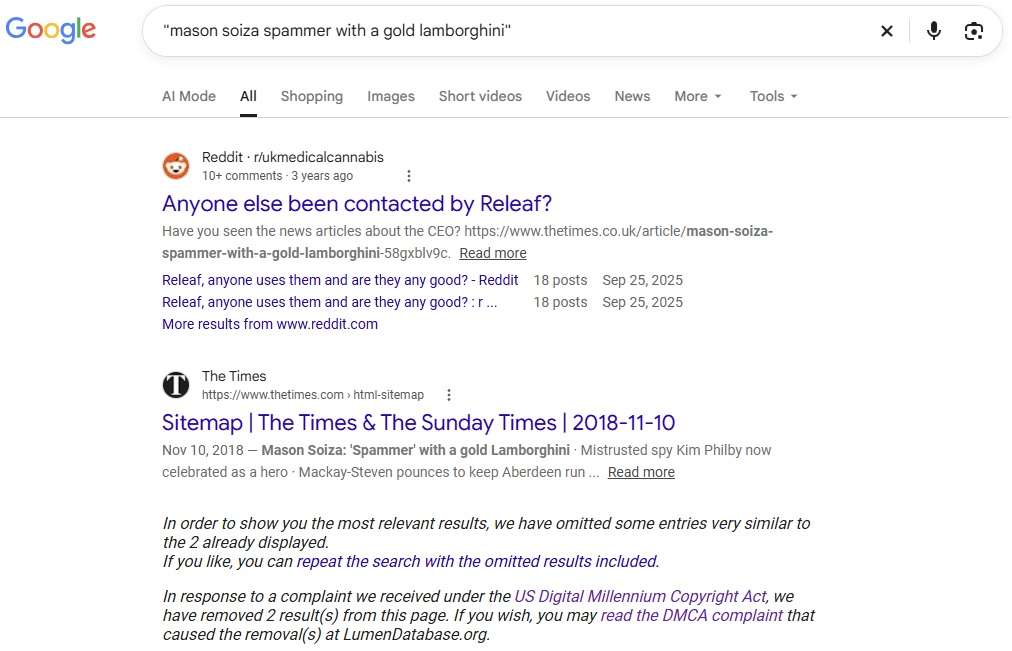
Here's what happens when I search for "mason soiza spammer with a gold lamborghini"; that headline is the title of a Times (London) article:
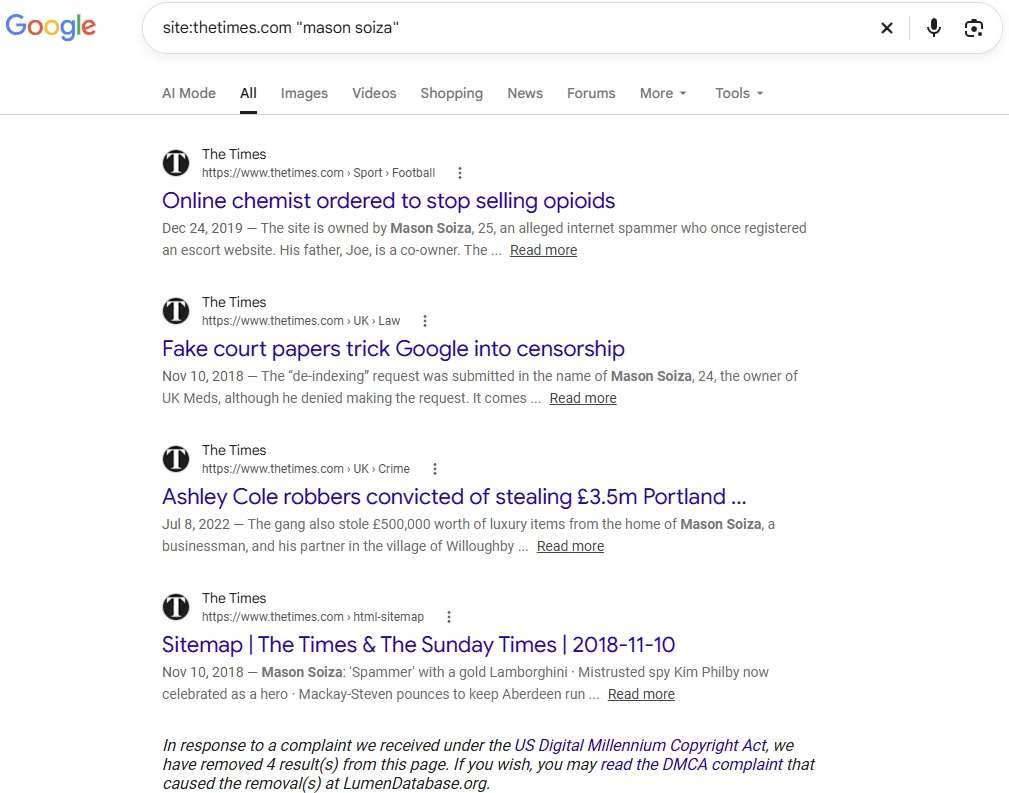
The article thus doesn't show up in the search results, though other items that point to it do show up. I get similar results when I search, without a site:thetimes.com limitation, for "web entrepreneur faces inquiry over online sale of painkillers" (another article about Soiza). And I get similar results when I search for site:thetimes.com "mason soiza":
The DMCA complaint specifically targeted, among other items, these Times pieces:
The claim in the DMCA complaint was that the Times articles infringed the copyright in an OnlyFans page, https://onlyfans.com/angiestonex. That claim appears not to be accurate, yet Google did indeed deindex articles in a major newspaper based on the claim. (The newspaper would presumably be able to file a DMCA counternotification and get the matter reconsidered, but they may have been unaware of the situation.)
As a free speech absolutist, Elon Musk is making a mistake going after Nitter, says Dr R P. He should instead be praising the site that helps users speak freely, uninhibited by login screens that undermine their privacy.
From today's Eleventh Circuit opinion in Netchoice v. Attorney General, by Judge Kevin Newsom, joined by Judges Robert Luck and Gerald Bard Tjoflat:
The State of Georgia recently enacted SB 351 to restrict minors' ability to create accounts on social-media platforms. The law requires platforms within its ambit to verify the ages of all their users, to prohibit minors under the age of 16 from creating accounts without their parents' consent, and to limit the personal data they use to display ads to users under 16.
The court held that Netchoice hadn't introduced enough evidence to show the law was facially unconstitutional:
Even in First Amendment cases, where the facial-challenge bar is lower than it otherwise might be, the plaintiff [in a facial challenge] must show that "a substantial number of [the law's] applications are unconstitutional, judged in relation to the statute's plainly legitimate sweep." Netchoice v. Moody …
To discharge its facial-challenge burden, NetChoice must provide the reviewing court with the data—either hard facts or, at the very least, sufficient briefing—necessary to conduct the Moody-required comparative analysis. It hasn't done so here. Indeed, NetChoice hasn't provided even a full list of its own members to which SB 351 applies. Instead, it has provided only an exemplary few: SB 351, NetChoice says, "regulates some websites operated by NetChoice members, including: (1) Dreamwidth; (2) Meta (Facebook and Instagram); (3) Nextdoor; (4) Pinterest; (5) Reddit; (6) Snap Inc. (Snapchat); (7) X; and (8) YouTube," as well as "new members … such as Tumblr." And though NetChoice contends that, in addition to its own members, SB 351 regulates "other covered 'social media' websites," it doesn't name any that (in whole or in part) host unprotected speech. In that respect, we think, NetChoice makes the same mistake that it made before in Moody: treating the law as having "certain heartland applications" and "mostly confin[ing its] battle to that terrain."
We've learned the facial-challenge lesson the hard way. In Moody, the Supreme Court, even while largely agreeing with our merits analysis, faulted us for "mostly confin[ing] [our] analysis" to "certain heartland applications" instead of "address[ing] the full range of activities the law[ ] cover[ed]." The Court went on to observe that even if it were to attempt the facial analysis itself, it couldn't "undertake the needed inquiries" because the "parties ha[d] not briefed the critical issues [t]here, and the record [wa]s underdeveloped." The Court therefore vacated and remanded our case … "to consider the scope of the laws' applications, and weigh the unconstitutional as against the constitutional ones." In turn, … we … remanded [the case] to the district court[] for further development of the issues pertinent to the facial-challenge analysis.
We are similarly stymied here. For the foregoing reasons, we conclude that NetChoice has failed to satisfy Moody because it hasn't adequately addressed the "full range" of SB 351's applications, and the record before us does not permit the weighing Moody requires.
The court also rejected Netchoice's vagueness challenge:
The district court held, and NetChoice contends before us, that SB 351's requirement that social-media platforms use "commercially reasonable" age-verification mechanisms renders the statute unconstitutionally vague.
The problem, as NetChoice candidly acknowledges, is that "the district court raised this issue sua sponte." … In granting injunctive relief on a theory that NetChoice never pleaded, the district court erred. See Clark v. Sweeney (2025) (holding that courts "transgress[ ] the party-presentation principle" when "granting relief on a claim that [the plaintiff] never asserted and that [the defendant] never had the chance to address").
And the court rejected Netchoice's 47 U.S.C. § 230 objection to the advertising restrictions:
Section 230 prohibits treating a social-media platform as "the publisher or speaker of any information provided by another information content provider." … [But] SB 351's advertising provision doesn't treat social-media platforms as publishers or speakers of information provided by others. Rather, it regulates how social-media platforms themselves act by forbidding them from targeting minors with ads based on personal information. This type of regulation falls outside § 230's ambit, which preempts laws that seek to hold social-media platforms "liable for information originating with a third-party user."
John Henry Thompson, Christopher Michael Carr, Riley B. Liu, Elijah J. O'Kelley, and Logan B. Winkles of the Georgia AG's office represent the state.
The plaintiff, Jane Doe, instituted the present action seeking a Bill of Discovery from defendant Sacred Heart University (Sacred Heart), The national Chapter of Phi Sigma Sigma Fraternity, Inc., and The IOTA NU Chapter of the Phi Sigma Sigma Fraternity. The plaintiff's complaint alleges that in the Fall of 2025 she was involved in an incident with an underclassman during pledge week in which she was video recorded encouraging a Phi Sigma Sigma Fraternity pledge to drink alcohol (the hazing incident). The incident is detailed at paragraphs 11-15 of her complaint. The video was subsequently circulated around campus.
The plaintiff alleges that she became the subject of harassment and cyberbullying as a result of the publication of the hazing incident and that the defendants failed to conduct any meaningful investigation into her complaints. The plaintiff also alleges that she became the subject of improper disciplinary hearings and was left with no choice but to withdraw from Sacred Heart. The plaintiff seeks records related to the defendants' investigation into the hazing incident and the retaliation (which consisted of anonymous cyber bullying) which led to her "constructive expulsion" from the school.
The plaintiff further alleges that as a result of this retaliation, she began to suffer from severe anxiety and depression. The plaintiff seeks to proceed with her action for a Bill of Discovery by using a Pseudonym.
The plaintiff's request to proceed using a Pseudonym was initially granted on an ex parte basis. The defendants have objected to the plaintiff's continued use of a Pseudonym. The plaintiff has responded that the continued use of the Pseudonym is necessary. The plaintiff has submitted affidavits in support of her claims detailing the harassment and threats she has received and the effects they have had on her physical and emotional health.
The standard for the granting of Pseudonym status can be found in Practice Book § 11–20A(h)(1) which provides in pertinent part: "Pseudonyms may be used in place of the name of a party or parties only with the prior approval of the judicial authority and only if the judicial authority concludes that such order is necessary to preserve an interest which is determined to override the public's interest in knowing the name of the party or parties."
"The principle of openness of judicial proceedings includes the question of whether one may proceed anonymously therein, because the question of who is using the judicial system is ordinarily as much a part of that principle as why it is being used." For this reason, our Supreme Court has stated that "[t]he privilege of using fictitious names in actions should be granted only in the rare case where the nature of the issue litigated and the interest of the parties demand it and no harm can be done to the public interest."
"The presumption of openness of court proceedings … is a fundamental principle of our judicial system." This policy of openness is not to be abridged lightly.
"The ultimate test for permitting a [party] to proceed anonymously is whether the [party] has a substantial privacy right which outweighs the customary and constitutionally-embedded presumption of openness in judicial proceedings." "A [party's] desire to avoid economic and social harm as well as embarrassment and humiliation in his professional and social community is normally insufficient to permit him to appear without disclosing his identity." "The most compelling situations [for granting a motion to proceed anonymously] involve matters which are highly sensitive, such as social stigmatization, real danger of physical harm, or where the injury litigated against would occur as a result of the disclosure of the [party's] identity…. There must be a strong social interest in concealing the identity of the [party]….["]
The court has reviewed the affidavits submitted by the plaintiff associated with her treatment and is aware of the scope of her alleged harm and fears. However, what the court must determine here is the appropriateness of shielding the identity of someone who has victimized another. A review of the relevant caselaw concerning applications for the use of Pseudonym status does not reveal any cases where an initial wrongdoer was allowed to proceed with a Pseudonym because of alleged harm incurred in retaliation for their wrongdoing.
The court has determined that after balancing the interests of the parties in this matter, the plaintiff's personal privacy interests do not outweigh the public's interest in the continued openness of these judicial proceedings. The defendants' objection to the continued use of a Pseudonym is therefore sustained.
James M. Sconzo and Marc G. Bernatchez (Carlton Fields, P.C.) represent the University.
Dylan Hembrough, editor in chief of the student newspaper at Southern Illinois University Edwardsville, contacted the school's communications office to protest a policy requiring a communications staff member to sit in on interviews between student reporters and university staff. As a result, university officials reported Hembrough to campus police for harassment. Police looked into the report, decided his comments did not constitute harassment, and recommended dropping the case. In a statement, the communications office defended the policy and said the real problem is that the student paper has printed inaccurate information and refused to retract it.
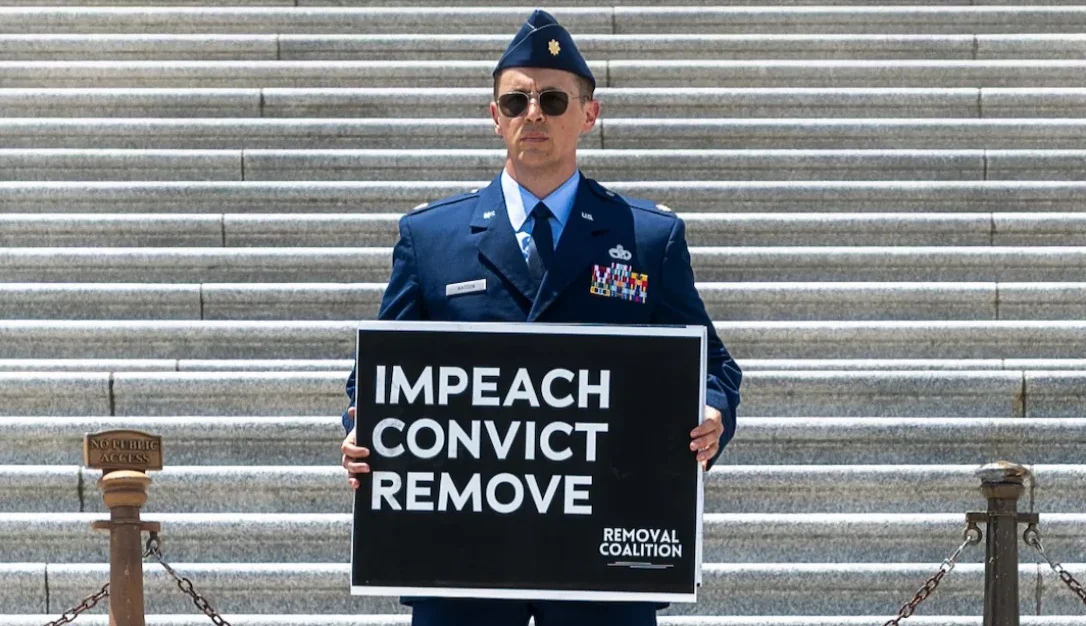
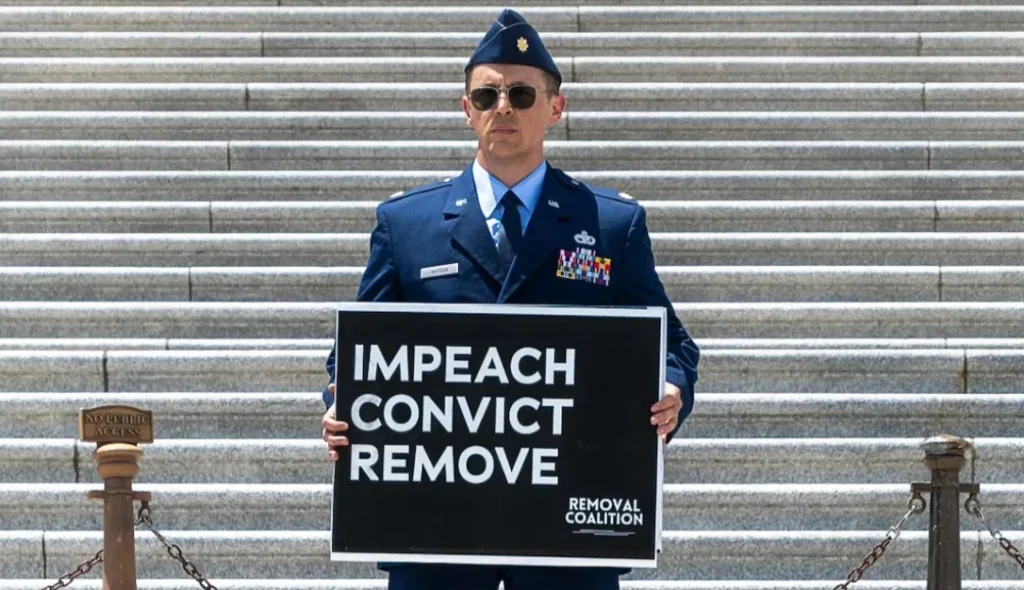
Maj. Jason Watson was arrested after he participated in a news conference calling for Trump to be removed from office over his launching of military actions against Iran, Cuba, and Venezuela without congressional authorization
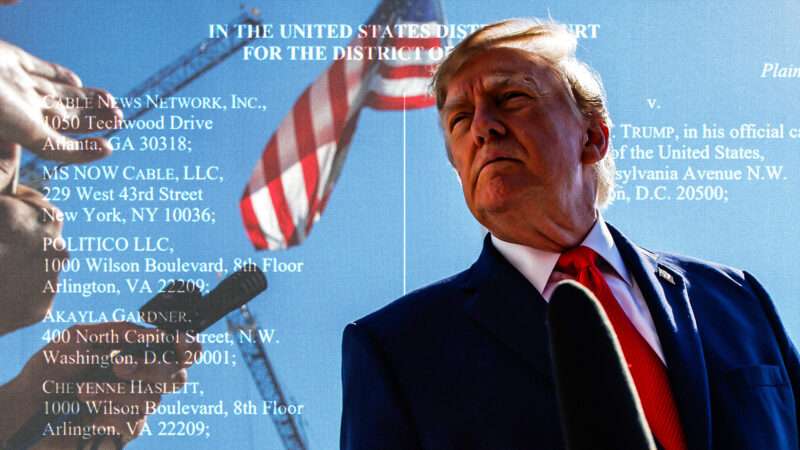
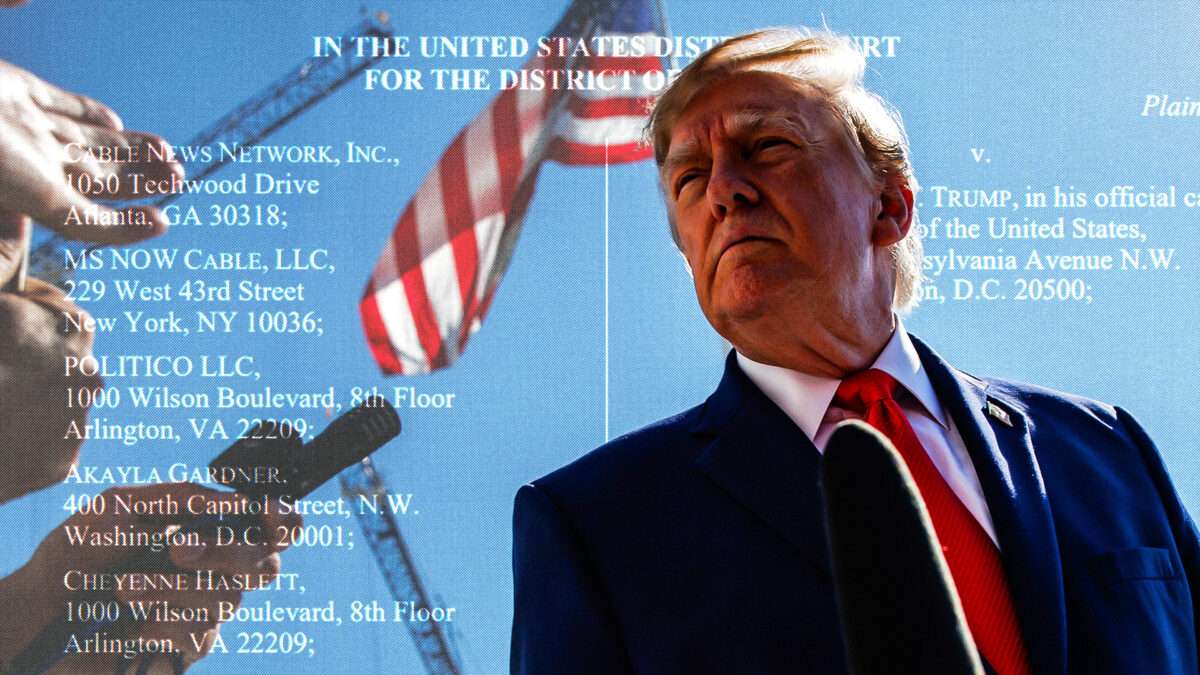
Last month, a federal judge in Washington, D.C., issued a temporary restraining order (TRO) that required restoration of press passes for 78 journalists employed by three news outlets that President Donald Trump peremptorily banned from the White House on September 18. U.S. District Judge Timothy J. Kelly, a Trump appointee, extended that order on Tuesday, granting a preliminary injunction to CNN, MS NOW, and Politico.
While Kelly's TRO was based on CNN et al.'s claim that their sudden banishment violated the Fifth Amendment's guarantee of due process, his justification for the preliminary injunction also addresses their argument that revocation of their press passes violated the First Amendment by retaliating against them for constitutionally protected speech and discriminating against them based on viewpoint. Kelly concludes that the plaintiffs "are likely to succeed not only on their due process claim, but also on their two First Amendment claims."
A retaliation claim requires showing that the plaintiff engaged in conduct protected by the First Amendment, that the defendant's action was "sufficient to deter a person of ordinary firmness" from "speaking again," and that there was "a causal link between the exercise of a constitutional right and the adverse action." Although the government's lawyers did not dispute that the CNN et al.'s journalism is constitutionally protected, they argued that the plaintiffs had failed to satisfy the two other elements.
Kelly disagrees. The "hard passes" at issue in this case, he notes, give journalists unescorted access to the White House "press area," which includes "the briefing room, the press offices, and certain other locations in and around the White House that are open to correspondents." CNN et al. argued that "a hard pass is an important credential because it 'allows a reporter to react to fast-developing news' and gives them 'swift and easy access to key official sources.'" Since "the revocation of Plaintiffs' hard passes matters a lot as to how, whether, and to what extent they can do their jobs," Kelly says, "it is likely that the open-ended ban here would chill a reporter's work."
Trump's "own comments suggest that he intended the revocation of Plaintiffs'
hard passes to alter their reporting on him, bolstering the case that his action here is sufficient to deter a reporter of ordinary firmness from reporting in the same way she had before," Kelly adds. The day he announced the ban, Trump complained that CNN et al. "purposely write negative news" to "try and diminish the Republicans and a Republican administration." Although "the ban would go as far as you can," he added, "I'd love it" if "they could straighten themselves out."
The plaintiffs also have shown "there is likely a causal link between the exercise of their First Amendment rights and the revocation of their hard passes and exclusion from the White House press area," Kelly writes. "President Trump likely banned Plaintiffs from the White House because he believes that their reporting is generally inaccurate and biased against him."
Again, Trump's public comments amply support that conclusion. He explicitly said he was banning CNN, MS NOW, and Politico "as a result of their constant 'reporting' [of] FAKE NEWS," adding that journalists "shouldn't be able to constantly write or report FICTION and LIES when they're covering the President of the United States, the Trump Administration, or the United States of America." When asked whether his decision was motivated by a "particular reason" or "particular story," Trump replied: "No, no. It's really just cumulative stories over the last two years." The problem, he said, was "purposely negative stories."
In a Truth Social post three days later, Trump likewise condemned "Fake News" that he said was "corrupt, purposeful, pervasive, fully coordinated, and totally out of control." CNN et al.'s reporters are "Third Rate Clowns" who "purposefully distort, twist, and degrade with everything they write or publish," he added that evening. "Virtually every story about me, or anything having to do with me, is negative, wrong and, in many cases, DANGEROUS for our Country! No matter how GREAT my Achievements, they trivialize and demean."
Trump offered a similar defense of the ban in a September 28 interview with Time. "It's just bad story after bad story," and "most of them are fake," he complained. "I don't think anybody should be forced to bear fake news, constantly bad stories, because I've done great things." Although "I can name 100 great things I've done," he added, "I never get good press. I never get fair press."
The government's lawyers maintained that Trump or another official "would have reached the same decision" based on the "alternative ground" that CNN et al. had violated "minimum professional journalistic standards" by "publishing classified and national security information." Kelly was not impressed by that belated rationale, which no one mentioned until after the news outlets gave the government a copy of their lawsuit.
"There is no evidence in the record that President Trump made the decision to revoke
Plaintiffs' hard passes on national security grounds," Kelly writes. "Nor at any time has he directly stated that national security was the reason for his decision. When he announced the ban with his post on September 18, he did not mention national security. When he was asked later that day about the 'particular reason' for his action, he did not mention national security."
Trump did mention "national security" in Truth Social posts he wrote the day that CNN et al. filed their lawsuit. But "that expression appears to have been simply another way for him to describe Plaintiffs' alleged inaccuracies and unfairness in their reporting about topics like his achievements or electoral success," Kelly says. "All this suggests that 'national security' was merely a post-hoc justification for the decision, which greatly undermines" the claim that Trump would have "taken the same action in the absence of Plaintiffs' protected speech."
The government also cited letters to CNN, MS NOW, and Politico from the White House Press Office, which were sent four days after Trump banned them. Those letters averred that the three news outlets had violated "the standards of professionalism and decorum expected of those given access to the White House Complex" by "publishing sensitive or classified information" and "trafficking in verifiable falsehoods about national security and other issues."
The letters "hardly move the needle" on the question of why Trump banned CNN et al. from the White House, Kelly says. They "appear to conflate concerns about otherwise protected speech" with "national security concerns," he notes, and they do not even explicitly say that Trump "made the decision for national security reasons."
Each letter lists specific stories to which the White House objected. But Kelly notes that two reporters "had their hard passes renewed after publishing articles that Defendants cite in their September 22 letters as supporting the potential revocation of their hard passes."
The Trump administration tried to shore up its "national security" justification by submitting a declaration from Pentagon Press Secretary Kingsley Wilson. While Wilson explains "how the publication of classified and sensitive information can undermine national security," Kelly notes, she "says little to nothing about President Trump's decision to revoke Plaintiffs' hard passes" and does not say "anything about White House press practices or operations."
The defendants "have not really tried to support" the claim that CNN et al.'s reporting "damaged national security," Kelly says, noting that news stories based on "sensitive or classified information" are "commonplace, for better or worse." If Trump "would have banned Plaintiffs from the White House even in the absence of their protected speech," he suggests, "Defendants would not have had to scramble to make their case with unsigned letters and a declarant who does not even work there."
The evidence of retaliation also supports the claim that Trump discriminated against CNN et al. based on viewpoint, which is presumptively unconstitutional. The U.S. Court of Appeals for the D.C. Circuit, Kelly notes, has held that "the White House Press Area" qualifies as a "nonpublic forum," meaning journalists cannot be excluded because of the views they have expressed.
"It is likely that Plaintiffs were selected by President Trump for revocation of their access to the White House press area because he believes their coverage of him and his administration is generally inaccurate and biased," Kelly writes. "In other words, it was 'an effort to suppress the speaker's activity due to disagreement with the speaker's view,' rather than to vindicate any other purportedly 'compelling governmental interest,' including maintaining professional standards for journalists or protecting national security. Simply put, that is unlawful viewpoint discrimination."
Kelly's decision "is a stinging defeat for Trump's assault on the free press and a powerful vindication of the First Amendment," Caitlin Vogus, senior adviser for advocacy at the Freedom of the Press Foundation, said in an emailed press release. "As Kelly rightly recognized, presidents don't get to use their power to purge journalists because they don't like what they report."

 Login