❌

Reading view

Amazon is buying billions in Nvidia AI systems it can't yet turn on

Amazon CEO Andy Jassy

David Paul Morris/Bloomberg via Getty Images

  • AWS expected to get $5 billion of Nvidia GB300 racks, followed by $3 billion more each month.
  • Some of these GPU systems are being stored elsewhere due to lack of data center power.
  • Amazon CEO Andy Jassy sees AI as a major opportunity, but getting capacity online is a challenge.

Amazon is racing to secure AI hardware earlier than before, even as data center power shortages leave some GPU systems waiting in warehouses.

Under a new Early Rack Receipt process, AWS expected to receive roughly $5 billion in Nvidia's GB300 server racks at US facilities before final deployment, according to August internal emails reviewed by Business Insider. The company projected roughly $3 billion more in GB300 racks each month "for the foreseeable future," one of the emails said.

Some AWS sites had room for more racks but not enough available power to turn them on, people familiar with the effort said, leaving finished equipment to be staged at intermediary warehouses until the facilities were ready.

At least one AWS team did not have "a clear forecasted path" for getting the incoming racks into data centers at the time, according to one of the emails.

Dark GPUs

A lack of new electricity capacity is one of several bottlenecks slowing the buildout of some AI data centers. This has led to a phenomenon known as dark GPUs, where AI chips and servers are purchased but can sit idle due to power supply issues or other challenges. (Dark GPUs can also refer to system design flaws that mean this gear isn't fully used after being plugged in).

This is partly why financial pressure is mounting on big data center projects. Money must be spent upfront to secure supplies of Nvidia GPUs and other valuable AI components. But if some data centers aren't ready to run, those early investments can tie up huge amounts of cash. Debt financing can fill in the gaps, but the market has become less willing to lend against some of these projects lately.

Trade-off

Amazon's early-rack program is one piece of the cloud leader's broader AI buildout, which is putting new pressure on its cash flow, as Business Insider exclusively reported this week. Amazon expects roughly $220 billion in capital expenditures this year — more than any Big Tech peer. Its free-cash-flow turned negative last quarter for the first time since 2023, and could stay negative for a while.

For AWS, the trade-off is securing scarce GPU racks before competitors do, even if some data centers are not yet ready to turn them on. But taking ownership earlier can tie up billions in equipment before it starts generating cloud revenue.

Previously, AWS took ownership of a finished rack only upon delivery to a data center, according to internal documents. Under the new approach, it can pay for and record certain racks earlier in the supply chain.

An Amazon spokesperson said the company routinely stages finished hardware near deployment sites so it can install it once capacity becomes available, calling the practice "best business practice." The spokesperson added that Amazon has long-established systems for tracking infrastructure assets and disputed that the broader company lacked a path for getting racks into data centers.

Amazon CEO Andy Jassy previously said the company has a "clear line of sight" to strong returns from its AI investments, calling the technology a "once in a lifetime opportunity."

"We've been through this cycle with the first big AWS growth wave, and liked the results," Jassy wrote in Amazon's annual shareholder letter. "We expect to feel similarly about this next wave."

Have a tip? Contact this reporter via email at ekim@businessinsider.com or Signal, Telegram, or WhatsApp at 650-942-3061. Use a personal email address, a nonwork WiFi network, and a nonwork device; here's our guide to sharing information securely.


Read the original article on Business Insider

  •  

New Bradford railway station will ‘transform travel across the north’

Transport hub will offer through trains between Leeds and Manchester with ‘turn-up-and-go’ service

A new railway station will be built in Bradford to “transform how people travel across the north”, the government has announced.

The station will be at the heart of the Northern Powerhouse Rail (NPR) scheme, built on the current Bradford Interchange site but allowing through trains between Leeds and Manchester.

Continue reading...

© Photograph: Christopher Furlong/Getty Images

© Photograph: Christopher Furlong/Getty Images

© Photograph: Christopher Furlong/Getty Images

  •  

Ahold Delhaize Reports Malicious Cyberattack as Supermarket Deliveries Remain Disrupted

Dutch-Belgian supermarket group Ahold Delhaize has confirmed that malicious activity was responsible for the cybersecurity incident that disrupted its operations across Europe and the United States, forcing the company to take websites, applications and other computer systems offline.

In an official statement issued on Monday, 19 October, the company announced that it had filed a formal complaint with Dutch police and was cooperating with national cybersecurity authorities. Although physical supermarkets have remained open, the disruption has affected online shopping, deliveries and some distribution operations.

The company said investigators had so far found no evidence that sensitive information belonging to customers, employees or business partners had been taken. However, its investigation remains open, and the identity and objectives of those responsible have not been publicly established.

Online services interrupted across several countries

The disruption began on 12 October, when Ahold Delhaize detected suspicious activity within its information technology infrastructure.

The group responded by taking a number of systems offline as a precaution, affecting most of its retail brands in Europe and the United States. The consequences varied considerably between businesses, with some experiencing prolonged interruption to digital services while others were able to restore operations more quickly.

Albert Heijn, the Netherlands’ largest supermarket chain, has been particularly affected. Its website and mobile application have returned online, but home grocery deliveries are not expected to resume until Friday, 23 October.

Orders scheduled before that date have been cancelled, while the company continues preparations for a gradual restoration of its online delivery service.

The incident also interrupted some supply and distribution arrangements, resulting in shortages on supermarket shelves in parts of the Netherlands and Belgium.

In Belgium, Delhaize has restored its online shopping operations. Certain promotional and personalised services were still experiencing difficulties, although the parent company confirmed that its Belgian e-commerce business was operational again.

Dutch retailers Etos and Gall & Gall have also restored their websites. Meanwhile, several American supermarket brands owned by Ahold Delhaize have continued to experience service interruptions.

The group said it expected additional online services in the United States to become available over the coming days.

Dutch authorities investigate

Ahold Delhaize said it notified the Netherlands’ National Cyber Security Centre within 24 hours of detecting the malicious activity.

The company has subsequently provided updates to the authorities and, on Monday, confirmed that a formal police report had been submitted.

Chief executive Frans Muller defended the decision to shut down digital systems, arguing that the investigation had demonstrated the necessity of taking preventive action.

The company has not identified the perpetrators, confirmed whether ransomware was involved or disclosed the technical method used to gain access to its infrastructure.

These distinctions are important because malicious activity does not necessarily establish that information was stolen or that attackers obtained control over every system subsequently taken offline.

The retailer has instead described a controlled restoration process intended to ensure that affected systems can be brought back into operation without exposing the business to further risks.

Ahold Delhaize operates thousands of supermarkets and related retail businesses, including Albert Heijn, Delhaize, Food Lion, Giant Food, Hannaford and Stop & Shop.

Its geographical reach means that a disruption originating within shared corporate infrastructure can affect several national markets, even where individual retail chains maintain separate commercial operations.

Cybersecurity becomes a supply-chain concern

The attack comes amid increasing scrutiny of the vulnerability of European food retailers to digital disruption.

Earlier this month, investigators in France began examining cyberattacks against refrigeration control systems used by hundreds of supermarkets.

Those incidents reportedly affected equipment at chains including Carrefour, Intermarché and Monoprix, with some retailers forced to discard products after refrigeration systems malfunctioned.

There is no established connection between the French incidents and the attack affecting Ahold Delhaize.

Nevertheless, both episodes illustrate the dependence of modern retail operations on interconnected digital systems supporting stock management, refrigeration, logistics, payments and customer services.

The consequences of a serious cyber incident can extend beyond the loss of access to websites. Interruptions to inventory systems, warehouse operations or communications with suppliers can affect the availability of physical products.

This creates particular difficulties for food retailers, where delays in transport and storage can result in the loss of perishable goods.

European regulatory implications

The incident also draws attention to the European Union’s NIS2 cybersecurity framework, which establishes stricter risk-management and incident-reporting obligations for organisations operating in designated sectors.

Food production, processing and distribution are among the activities covered by the directive, although its application to particular companies and operations depends on the relevant legal definitions and national implementing arrangements.

The legislation requires organisations within its scope to establish appropriate cybersecurity protections, address supply-chain risks and notify competent authorities of significant incidents.

Separately, the General Data Protection Regulation establishes notification requirements where personal-data breaches meet the relevant reporting threshold.

Ahold Delhaize’s statement that it has found no evidence of sensitive data being taken does not conclude the technical investigation, but it means that a confirmed theft of personal information should not presently be presented as a fact.

For the company, the immediate challenge remains restoring online services while maintaining normal supermarket operations. The wider commercial consequences, including the cost of the interruption and its effect on sales, have not yet been quantified publicly.

  •  

Cyberattack on 700 French Supermarkets Exposes Gaps in Europe’s Infrastructure Security

A cyberattack affecting approximately 700 supermarkets in France has exposed serious weaknesses in the digital systems used to control commercial refrigeration, raising concerns about the vulnerability of European food distribution networks and other essential infrastructure.

The attack began overnight on 11–12th October, when intruders gained access to remotely managed refrigeration equipment and altered operating settings, causing refrigerators and freezers to overheat.

Stores belonging to several major supermarket chains were affected, including Intermarché, Netto, Coopérative U, Carrefour and Monoprix. Some were forced to discard substantial quantities of fresh and frozen food.

French Finance Minister Roland Lescure confirmed that approximately 700 of the country’s 10,000 supermarkets had been affected, although the severity of the disruption varied between locations.

The Paris prosecutor’s office has opened an investigation into the attack, including the damage caused by destroyed merchandise and reported fires.

The incident has drawn attention to industrial control systems that are routinely connected to the internet but may receive less cybersecurity protection than corporate networks and customer databases.

Refrigeration systems remotely manipulated

Investigators have established that refrigeration equipment was targeted through vulnerabilities associated with remote monitoring and control systems.

The French cybersecurity authorities identified compromises involving products supplied by Danish manufacturer Danfoss and American company Copeland.

Some of the affected systems used older equipment that no longer received regular security updates.

According to information released by the companies and cybersecurity specialists, certain industrial controllers had been accessible through public internet connections, creating opportunities for unauthorised access.

Hackers reportedly manipulated defrost cycles and increased temperature settings, preventing equipment from maintaining the cold conditions required to preserve food.

The attack affected approximately 300 Intermarché and Netto stores, while Coopérative U reported disruption at around 80 outlets.

Several retailers managed to contain the damage, but others lost substantial quantities of stock.

The consequences extended beyond malfunctioning equipment. Businesses faced the cost of replacing spoiled food, repairing refrigeration systems and restoring normal operations.

The precise financial damage is still being assessed, although estimates from the retail sector indicate that losses across France could amount to tens of millions of euros.

Vulnerabilities in connected equipment

The incident illustrates the security problems created by the growing use of internet-connected industrial equipment.

Modern refrigeration installations allow contractors and maintenance specialists to monitor temperatures, adjust settings and diagnose faults remotely.

These arrangements can reduce operating costs and improve efficiency, but they also create additional access points that attackers may exploit.

Cybersecurity specialists have identified vulnerabilities in commercial refrigeration platforms manufactured by Danfoss and Copeland.

The manufacturers subsequently addressed identified flaws, although older or unsupported equipment remained a concern.

A critical problem for businesses is that industrial machinery often remains operational for many years after its original software has become obsolete.

Replacing entire refrigeration installations can involve substantial expense and operational disruption, encouraging operators to retain equipment that may no longer meet contemporary cybersecurity standards.

The risks are particularly difficult to manage when responsibility for maintenance, software updates and network security is divided between retailers, equipment suppliers and external contractors.

France’s delayed cybersecurity legislation

The attack has renewed scrutiny of France’s implementation of the European Union’s NIS2 Directive, which is intended to strengthen cybersecurity across sectors providing important economic and public services.

The directive establishes common requirements covering risk management, incident reporting, organisational responsibility and protection against cyber threats.

Its scope extends beyond traditional critical infrastructure such as energy, telecommunications and transport to include certain businesses involved in food production, processing and distribution.

EU member states were required to incorporate the directive into national legislation by 17 October 2024.

France was among the countries that received a formal warning from the European Commission in May 2025 over incomplete implementation.

French cybersecurity specialists have since warned that delays have complicated efforts to establish consistent obligations for organisations operating industrial and commercial systems.

However, NIS2 does not automatically cover every supermarket. Its application depends on the nature and size of an organisation and the provisions of national implementing legislation.

The incident therefore raises questions not only about the pace of legislative implementation but also about the practical protection of equipment already in use.

Wider implications for European infrastructure

The disruption demonstrates how a cyberattack can cause physical damage without directly targeting a conventional industrial facility.

Unlike breaches intended to steal customer information, the French incident interfered with machinery responsible for preserving essential products.

The distinction is important for European policymakers, who increasingly face threats to infrastructure that combines digital controls with physical operations.

The European Union’s cybersecurity agency ENISA has organised cross-border exercises to test how authorities and companies would respond to disruption affecting essential services.

The attack itself has been established, but responsibility for it has not been publicly attributed.

French authorities have said there is no immediate threat to national food supplies. Nevertheless, the destruction of merchandise and interruption of ordinary retail operations have demonstrated the potential economic consequences of weaknesses in relatively commonplace equipment.

The continuing investigation must establish how access was obtained, which systems were compromised and whether the vulnerabilities were known to operators before the attack.

For Brussels and national regulators, the case provides a practical test of whether European cybersecurity legislation can translate into effective protection for the connected equipment on which ordinary commercial activities increasingly depend.

  •  

Kyiv gets no warning of the first of two Russian ballistic waves, hours after Zelenskyy said US alerts were back

kyiv attack

Russia attacked Kyiv with ballistic missiles in two waves overnight on 18–19 October. Information from partners did not arrive before the first wave, at around 23:00, Air Force spokesperson Yurii Ihnat said on national television. A warning came before the second wave, at around 03:00, but the window was short, he told NV.

Hours earlier, Ukrainian President Volodymyr Zelenskyy told NBC that US warnings of Russian ballistic launches were working again after three days without them, and that only the United States has that intelligence. Those warnings have for years given Ukrainian authorities several minutes to sound alarms and let civilians reach shelters before ballistic missiles hit.

“Once again, a Russian ballistic attack in several waves overnight, and once again there was no warning from partners,” Zelenskyy wrote. It was at least the third ballistic strike on Kyiv in a week to begin without warning from partners, following attacks on 12 October and 13 October.

Metro station damaged on Kyiv’s left bank

One person was killed and eight injured in Kyiv, Ukrainian Prime Minister Serhii Koretskyi said. A strike damaged a metro station on Kyiv’s left bank, and debris broke the rails beside it, Mayor Vitali Klitschko said. City authorities said the damaged station was above ground, closed Chernihivska and Lisova stations, and said red-line trains would run only between Akademmistechko and Darnytsia. The attack also damaged a 25-story building, a medical facility, and the Cosmo Multimall shopping center in the Solomianskyi district, NV reported, and Zelenskyy said a school was hit too.

The attack also damaged one of Ukraine’s main ice arenas, on Shalett Street in Kyiv, which hosts Ukrainian championship hockey games and youth training, hockey Telegram channel Flamingo reported. Parts of the facade, metal structures, and roof were damaged, but the ice surface showed no significant visible damage, according to preliminary information, Suspilne reported.

Damage in 11 oblasts, three missing in Irpin

Koretskyi said energy and infrastructure were the main targets, with damage in 11 oblasts. Russia also hit warehouses of medicines, railway stations, shops, and homes, he said. In Kyiv Oblast, Russian strikes injured six people in Irpin, including three children, and three more were missing, oblast head Tymur Tkachenko said. In Kharkiv Oblast, six people were injured, including two children, Koretskyi said. In Rivne Oblast, four people were injured, and one of them was hospitalized, regional police reported.

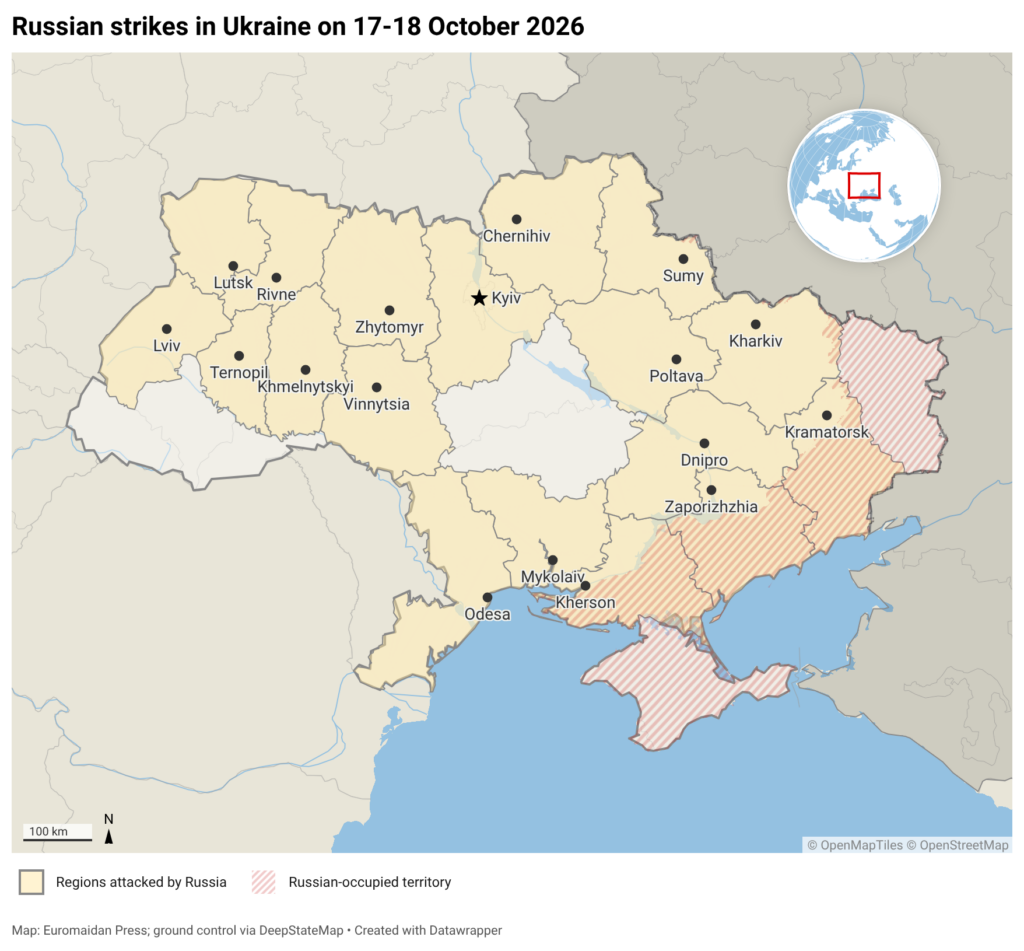
Zelenskyy said that more than 10 energy facilities were damaged and at least 550,000 families lost power. Ukrenergo reported new outages in 10 oblasts: Volyn, Zhytomyr, Rivne, Ternopil, Khmelnytskyi, Vinnytsia, Kirovohrad, Kharkiv, Odesa, and Mykolaiv. In Volyn Oblast, about 15 jet-powered Shahed-type drones targeted the region, and around 66,000 customers were without power on the morning of 19 October, oblast head Roman Romaniuk said. Kovel, Manevychi, and Lutsk were hit hardest, and no casualties were reported. In Vinnytsia Oblast, a critical infrastructure facility in Koziatyn was damaged, and power there would stay unstable for some time, city council secretary Iryna Repalo said, Suspilne reported.

Zelenskyy said Russia fired 16 ballistic missiles at Kyiv and Kyiv Oblast. The Air Force reported that Russia also used Iskander-K cruise missiles and 269 drones, and that by 09:00 air defenses had shot down or suppressed four Iskander-K cruise missiles and 243 drones. Its preliminary count did not list any ballistic missiles among the intercepted targets.

Rubio denies any pause and points to a software problem in Ukraine’s warning system

On 19 October, Rubio told reporters in Samarkand, Uzbekistan, that “there’s been no pause” in intelligence-sharing with Ukraine, Reuters reported. He said he did not know where Zelenskyy was getting such claims and that he should focus on ending the war. He also said he did not know whether a failure had happened the previous night, but that a few nights earlier there had been a software problem with “their early warning system,” and that US European Command was looking into the strikes, The Guardian reported. US officials had not mentioned a software glitch before, and in at least one case Ukraine was told that bad weather over southern Russia had hidden launch preparations, the newspaper noted.

Ihnat said Ukrainian specialists and their partners were working to establish why information about the first launch had not arrived. He added that similar gaps had occurred during earlier attacks.

Zelenskyy wrote that when missile supplies for Ukraine’s air defense are blocked while Russia gets sanctions relief or delays, “this is, unfortunately, a denial of reality on the part of partners.” A night earlier, Russia had hit Ukraine’s energy system again, while Ukrainian drones set fire to St. Petersburg’s oil terminal despite Washington’s pressure to stop refinery strikes.

  •  

Ukraine war latest: St. Petersburg slammed by drones in mass Ukrainian attack

Key developments on Oct. 17-18

  • Massive Ukrainian drone attack hits oil facility, bridge, and data center in St. Petersburg
  • US resumes intel sharing on Russian missile launches with Ukraine, Zelensky says
  • Ukraine hits Russian drone manufacturing plant in Rostov Oblast
  • 'Planned operation' — Zelensky confirms Ukraine's

  •  

Built as a cheap Shahed lookalike, Russia’s Gerbera now flies with a 10-kg warhead and an incendiary bag

built cheap shahed lookalike russia’s gerbera now flies 10-kg warhead incendiary bag · post payload bay russian gerbera-2 drone additional tank гербера-2 з бойовою частиною масою 10 кг і додатковим

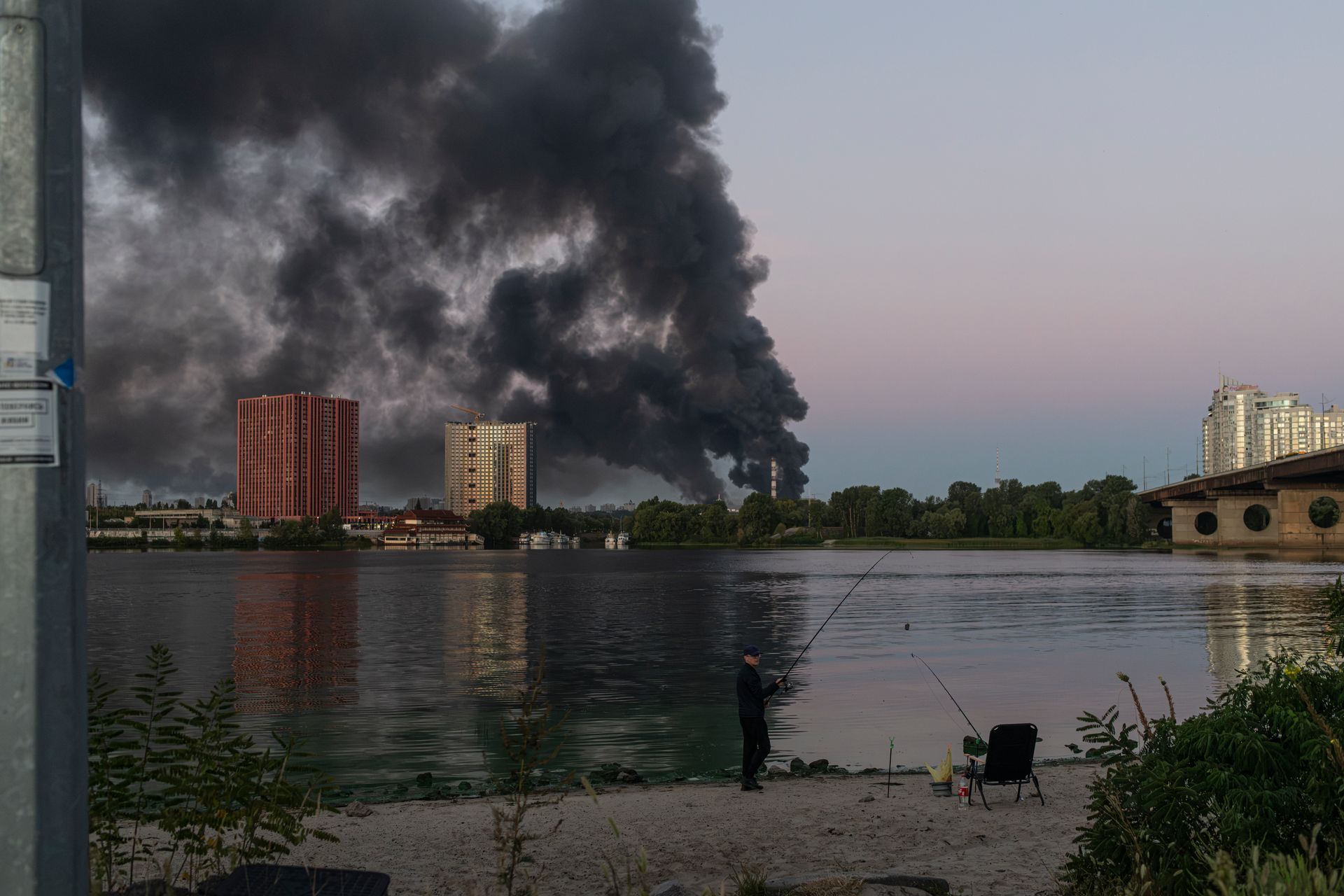
Russia has started fitting its enlarged Gerbera-2 drones with a 10-kg warhead and an extra bag of incendiary mixture, Ukrainian military outlet Militarnyi reported on 18 October. The setup is designed to start a fire where the drone hits and is probably meant for attacks on critical infrastructure and warehouses, the outlet said.

Russia’s industry makes about 3,000 jet-powered Geran-4 and Geran-5 drones a month, Ukraine’s military intelligence has said, and Russian strikes have destroyed 2.1 million m² of Ukraine’s modern warehouse space since the full-scale invasion began. A cheap drone that carries fire adds one more threat for air defenses that already let nearly half of Russia’s jet-powered Shaheds through.

A fire bag behind the warhead

Ukrainian Telegram channel Polkovnyk HSh posted photos of the payload on 17 October. Gerbera-2 strike and reconnaissance drones had begun to appear with a 10-kg high-explosive fragmentation-incendiary warhead and an extra package of incendiary mixture, the channel wrote. They navigate with Kometa-M12, a 12-element antenna array designed to resist jamming, it added.

Explore further

Russian drones set their own detonators at altitude: Why cutting wires won’t save from new Gerberas?

In the photos, the incendiary mixture sits in a separate soft plastic tank behind the main warhead, Militarnyi said. Gerbera-2s have been seen with warheads of 4 to 10 kg depending on range, while strike versions of the original Gerbera usually carried up to 5 kg, the outlet noted.

Half a Shahed engine

Russia has mainly fielded the Gerbera, a cheap drone shaped like a Shahed, as a decoy and reconnaissance platform flying alongside Shahed-type strike drones. It has also used bigger Gerberas to drop FPV drones.

Serhii Beskrestnov, now an adviser to Ukraine’s president, flagged a much bigger Gerbera in Ukraine’s skies on 7 August. The Gerbera-2 has a larger airframe, a reshaped wing, and a bigger tail fin, Militarnyi said. In August, the outlet reported it had a stronger piston engine: half of the one in the Shahed-type Geran-2, at about 275 cm³. Production of these engines was set up at the Izhevsk Motorcycle Plant, according to preliminary information the outlet cited.

Ukrainian defense technology adviser Serhii “Flash” Beskrestnov works near the front line monitoring Russian drone signals. Photo: Serhii “Flash” Beskrestnov
Explore further

Russia equips Geran attack drones with image-based navigation using Google map imagery, reducing reliance on satellite navigation that Ukraine can jam, defense adviser warns

Earlier versions ran on a Chinese DLE60 model-aircraft engine of about 61 cm³. The switch was likely possible because Geran-2 engine output partly freed up as jet-powered Geran-4s took a growing share of Russia’s drones, Militarnyi said. The Gerbera-2’s fuel tank also holds up to 63 liters, against 10 liters on the original.

One reached Poland’s Baltic coast

In September, a drone preliminarily identified as a Gerbera-2 was recovered from the Baltic Sea near Rusinowo, on Poland’s coast. It carried a high-explosive fragmentation warhead of about 4 kg, a Polish military prosecutor said.

  •  

Russia hit Ukraine’s energy 76 times during a US-declared truce—and tens of thousands lost power overnight. Civilians killed and injured

russia hit ukraine’s energy 76 times during us-declared truce—and tens thousands lost power overnight civilians killed injured · post damage after russian strike detached houses poltava 17 2026 victim ukraine

Russia has kept striking Ukraine’s energy sector throughout the week since US President Donald Trump announced an energy ceasefire, Ukrainian President Volodymyr Zelenskyy said on 18 October. From overnight into Sunday, Russian drones and a ballistic missile hit substations, homes, and industrial sites from Odesa to Volyn. They killed civilians and left tens of thousands of families without power.

Russia fights along the front line while hitting cities and the grid behind it with drones, missiles, and glide bombs. Ukraine says Moscow plans up to 1,000 such munitions against 60 key infrastructure sites this winter, and jet-powered drones partly free it to concentrate missiles on fewer targets, the Institute for the Study of War assessed. With Graham Act penalties on hold and US sanctions on Russian diesel suspended, Russia faces no new US cost for its strikes on Ukraine’s grid. Protecting and restoring the grid falls to Ukraine’s air defenses and repair crews.

Russia hit energy sites 76 times in a week

Zelenskyy counted 76 deliberate Russian strikes on energy and oil-and-gas facilities since Trump’s announcement. Overnight, Russia hit substations in Vinnytsia, Zhytomyr, Khmelnytskyi, and Odesa oblasts, he said. In the past week, Russia fired almost 2,700 attack drones, 1,700 aerial bombs, and 66 missiles, most of them ballistic, mainly to cause a blackout. His message was aimed at Washington.

“America must see that Russia is not taking steps in return for the lifting of sanctions or deals. On the contrary, they take every signal that they can make money as proof that their bet on war is working and they can keep fighting,” Zelenskyy wrote.

US President Donald Trump signs the Lindsey O. Graham Sanctioning Russia and Iran Act in the Oval Office, 18 September 2026
Explore further

22 House lawmakers press Trump to implement Russia sanctions law. Diesel deal draws bipartisan backlash

Overnight, Russia launched one Iskander-M ballistic missile and 180 Shahed-type drones, 26 of them jet-powered, the Air Force reported. Air defenses downed or suppressed 152 drones, but strikes hit 20 locations.

russia hit ukraine’s energy 76 times during us-declared truce—and tens thousands lost power overnight · post rescuers site russian strike residential area zaporizhzhia 18 2026 zapo ukraine news ukrainian reports
Rescuers at the site of a Russian strike on a residential area of Zaporizhzhia, 18 October 2026. Photo: State Emergency Service of Ukraine

Power cuts from Odesa to Ternopil

Strikes left about 24,000 consumers in Odesa Oblast without power, oblast head Oleh Kiper said. In Vinnytsia Oblast, the attack damaged critical infrastructure and forced emergency outages, oblast head Natalia Zabolotna wrote. Drones hit three energy facilities in Ternopil Oblast, one of them for the second time, and cut power to some consumers, oblast head Taras Pastukh said.

Civilians killed and injured

A Russian strike on Zaporizhzhia killed a 27-year-old woman and injured two others, including a 16-year-old, the State Emergency Service reported. In Poltava, an evening attack killed one person, injured four, and damaged 10 detached houses, city council secretary Kateryna Yamshchykova said.

The aftermath of a Russian strike on Zaporizhzhia on 10 October 2026
Explore further

Five Russian bombs kill 17 in Ukraine’s Zaporizhzhia next day after Trump lets Russia ship first 300,000 tonnes of its diesel

A drone hit a high-rise in Odesa and set its roof on fire. A 13-year-old girl was hurt, city military administration head Serhii Lysak said, and Kiper put the number of injured at two.

In Dnipropetrovsk Oblast, Russian drones and artillery injured three people, oblast head Oleksandr Hanzha said. In Donetsk Oblast, Russian attacks killed seven civilians on Saturday, six of them in Sloviansk, oblast head Vadym Filashkin reported.

russia hit ukraine’s energy 76 times during us-declared truce—and tens thousands lost power overnight · post fire roof high-rise apartment building after russian drone strike odesa 18 2026 ukraine news
Fire on the roof of a high-rise apartment building after a Russian drone strike in Odesa, 18 October 2026. Photo: Odesa City Military Administration

Fires in the west, alerts across the border

A morning drone strike set warehouse and production buildings ablaze at an enterprise in Manevychi, Volyn Oblast, oblast head Roman Romaniuk said. With heavy smoke blowing toward the town, Romaniuk urged residents to stay indoors, shut windows and doors, and switch off ventilation. A repeat strike set an enterprise in the district on fire again, the State Emergency Service said, adding that air tests found no dangerous concentrations outside the site. In Lviv Oblast, drone debris damaged a logistics warehouse and two houses, oblast head Maksym Kozytskyi said.

russia hit ukraine’s energy 76 times during us-declared truce—and tens thousands lost power overnight · post fire enterprise manevychi volyn oblast after russian drone strike 18 2026 manevich ukraine news
Fire at an enterprise in Manevychi, Volyn Oblast, after a Russian drone strike, 18 October 2026. Photo: Volyn Oblast Military Administration

Polish military aircraft operated in Poland’s airspace twice during the attack, as the Government Security Centre warned residents of Lublin Voivodeship and later alerted Subcarpathian Voivodeship. In Lithuania, NATO jets failed to identify an object that apparently entered from Poland, Defense Minister Robertas Kaunas said.

A ceasefire Moscow never confirmed

Trump announced the energy ceasefire on 11 October, news that surprised Zelenskyy. A White House official said Russia was still weighing it. Hours later, Russia hit a Kharkiv power plant, and on 14 October it fired 39 ballistic missiles at the grid. Then Trump waived Graham Act penalties on buyers of Russian oil, and Secretary of State Marco Rubio said the administration wants 60 days to weigh the economic effects.

  •  

Microsoft pulls out of AI datacentre project in Essex over power supply concerns

Development by UK firm Nscale heralded by ministers as largest of its kind in country loses anchor tenant

The development of a huge AI datacentre hailed by the UK government has received a fresh setback after Microsoft pulled out of the project over concerns about power supplies.

The development by the British company Nscale, heralded by ministers as the country’s largest AI datacentre when it was announced in 2025, was planned to open at Loughton in Essex next year.

Continue reading...

© Photograph: Nscale

© Photograph: Nscale

© Photograph: Nscale

  •  

Inside the long, bitter fight over one man’s quest to build the biggest AI datacenter in California

A modern-day prospector promised rural Imperial thousands of jobs and millions in tax revenue – but his plan has set off a firestorm of resistance

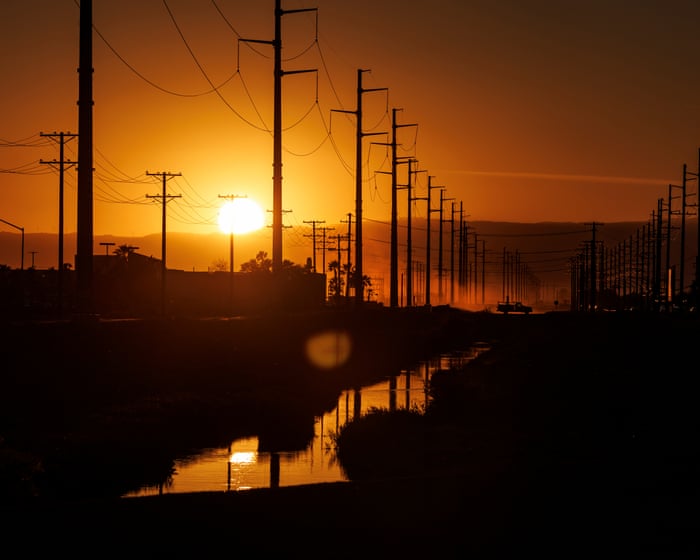
Sebastian Rucci zoomed in on a map in late 2024, looking closely at a large block of brown earth. The barren plot sandwiched between sprawling alfalfa fields and sleepy desert suburbs was exactly what he’d been searching for – the perfect place to realize his dream of building the largest artificial intelligence datacenter in California.

The dusty expanse wasn’t an obvious location. It was in the Sonoran desert, just north of the Mexican border, where temperatures regularly rose past 100F (37.8C). Water was scarce in the once-booming agricultural area, which gets its supply from the beleaguered Colorado River. And then, there was the city of Imperial – population 22,000 – to win over. As controversial datacenter projects have sprung up across the US, residents were naturally skeptical of a new, energy-guzzling neighbor.

Continue reading...

© Photograph: Gina Ferazzi/Los Angeles Times/Getty Images

© Photograph: Gina Ferazzi/Los Angeles Times/Getty Images

© Photograph: Gina Ferazzi/Los Angeles Times/Getty Images

  •  

Zelenskyy Says Ukraine Offered to Halt Strikes on Russian Refineries in Exchange for US Missile Defences

Ukraine was prepared to suspend attacks on Russian oil refineries if Washington supplied anti-ballistic missile systems to protect its energy infrastructure, President Volodymyr Zelenskyy has revealed. The proposed compromise was not accepted, despite American pressure on Kyiv to halt its strikes.

Ukrainian President Volodymyr Zelenskyy has disclosed that Kyiv offered to suspend attacks on Russian oil refineries in exchange for temporary American anti-ballistic missile protection for Ukraine’s energy infrastructure. Washington did not provide the requested systems, leaving Ukraine exposed to continued Russian missile strikes while the United States sought to restrict Ukrainian operations against Russia’s oil industry.

Speaking at a press conference in Brussels on Friday, 16 October, Zelenskyy said the proposal had been presented to Washington as a compromise following President Donald Trump’s agreement with Vladimir Putin on Russian diesel supplies and restrictions on attacks against energy facilities.

The Ukrainian president confirmed that Kyiv had not been consulted before Washington reached its understanding with Moscow. He described the diesel agreement as a surprise and objected to arrangements determining Ukraine’s military actions without its participation. Any agreement concerning Ukrainian strikes on Russian territory, he argued, required consultation with the Ukrainian government.

Nevertheless, Zelenskyy said Ukraine had been willing to accommodate American demands, even under an arrangement that did not require Russia to suspend its own attacks. Instead of insisting on reciprocal restrictions, Kyiv proposed receiving sufficient anti-ballistic missile systems to protect its electricity network for the duration of the requested suspension.

The proposal reflected Ukraine’s immediate security requirements. Russia has repeatedly targeted power stations, substations and other critical infrastructure, while Ukrainian forces have attacked Russian refineries to disrupt fuel production and reduce revenues available to Moscow. Halting the Ukrainian campaign without additional defensive capabilities would have left Kyiv surrendering one means of economic pressure while remaining vulnerable to Russian bombardment.

Zelenskyy said he had asked Washington for a limited number of systems, rather than a substantial new military commitment. The proposed deployment would have lasted only as long as the United States required Ukraine to refrain from attacking Russian refineries. However, according to the president, no such assistance was provided.

US diesel agreement deepens dispute

The disagreement follows the diesel arrangement announced by Trump on 9 October, under which Russia agreed to resume substantial petroleum product exports to American and international markets. Washington also authorised certain transactions involving Russian diesel, easing restrictions previously intended to reduce Moscow’s energy revenues.

The agreement created a direct conflict between American energy policy and Ukraine’s strategy of targeting Russian refining capacity. Washington wants additional diesel supplies to ease pressure on fuel markets, while Kyiv regards attacks on oil infrastructure as a means of weakening Russia’s ability to sustain its invasion.

That disagreement intensified after Ukraine resumed attacks on Russian refineries, including a strike against a facility in the Ryazan region. Trump criticised the operations, accusing Kyiv of contributing to higher global oil prices. Zelenskyy, meanwhile, argued that increased Russian diesel revenues would provide Moscow with additional resources to finance its military campaign.

The Ukrainian president’s proposal also exposed the limitations of the temporary energy ceasefire promoted by Washington. Russia continued attacks against Ukrainian civilian infrastructure, including electricity facilities, despite the American initiative. Kyiv’s proposed compromise would have addressed the resulting imbalance by providing defensive protection rather than relying on Russian restraint.

Russian strikes underline Ukraine’s defensive requirements

The urgency of Ukraine’s request was illustrated by renewed Russian attacks during Zelenskyy’s visit to Brussels. According to the Ukrainian presidency, strikes on 15 October damaged energy infrastructure in several regions, leaving almost 15,000 people without electricity in Volyn and disrupting supplies in parts of Kyiv and the surrounding region.

Ukraine continues to face shortages of the interceptors required to defend against ballistic missiles. Zelenskyy has identified anti-ballistic capabilities as an immediate priority, particularly as Russia intensifies attacks ahead of winter. During talks with NATO Secretary General Mark Rutte, he stressed the need for additional missile interceptors and other air defence equipment.

The president also raised these requirements during Friday’s meeting with European Commission President Ursula von der Leyen and European Council President António Costa. Discussions covered air defence, protection of energy infrastructure and financial assistance needed to sustain Ukraine’s resistance to Russian aggression.

European leaders support Kyiv’s position

Zelenskyy said European leaders had supported Ukraine’s position in the dispute with Washington. His remarks came as the EU reaffirmed its intention to maintain economic pressure on Moscow despite the Trump administration’s decision to facilitate Russian diesel exports.

As EU Today reported earlier on Friday, von der Leyen and Costa rejected any relaxation of European sanctions while Russia continues its war. The Commission is preparing a further sanctions package, maintaining a policy intended to restrict Moscow’s ability to finance its military operations.

The contrasting American and European positions have become increasingly significant for Kyiv. Washington is seeking to stabilise fuel markets through arrangements with Moscow, while European governments remain committed to reducing Russian energy revenues and strengthening Ukraine’s military and economic resilience.

For Zelenskyy, the unresolved question is whether Ukraine can be expected to limit attacks on Russian oil infrastructure while receiving neither reciprocal guarantees from Moscow nor additional protection against Russian ballistic missiles. His account of the unsuccessful American negotiations indicates that Kyiv was prepared to compromise, but only if its immediate defensive needs were addressed.

  •  

Trump calls Ukraine’s renewed refinery strikes “a disgrace” after Russia’s 39-missile strike on its energy sites

again trump presses zelenskyy stop russian refinery strikes · post ukrainian president volodymyr meets donald ankara türkiye 8 2026 presidentgovua ukraine news reports

US President Donald Trump called Ukraine’s renewed strikes on Russian oil refineries a disgrace in an interview with Newsmax and questioned President Volodymyr Zelenskyy’s will to settle the war on 15 October. His statements came after he made a deal with Russian President Vladimir Putin to allow Russian diesel back into the US ahead of the mid-term elections in the US.

Kyiv says its long-range strikes have knocked out more than half of Russia's refining capacity, one of the few levers it controls on Moscow's war income, according to Ukraine's Defense Ministry. This is part of efforts to reduce the aggressor's capabilities to launch assaults, including the latest, during which four Russian regions fired 39 Iskander-M, North Korean KN-23, hypersonic Zircon, and supersonic anti-ship cruise Oniks missiles, Zelenskyy said.

Trump criticizes Zelenskyy over oil prices while remaining silent on Russian strikes

Earlier, Zelenskyy said that Ukraine stopped refinery strikes for three days to meet US wishes after Trump announced an “energy ceasefire” on 11 October. At the same time, Russia struck a Kharkiv heat-and-power plant within hours of the announcement, he emphasized.

Meanwhile, in the interview with Newsmax, Trump said Zelenskyy is only pushing world oil prices higher.

“Well, I think that’s a disgrace,” he said.

He added that Ukraine has other options: “There are a lot of targets that you can hit.”

At the same time, Trump didn't say a word about Russian strikes on Ukraine's civilian buildings and power infrastructure ahead of the winter.

Trump compares Zelenskyy to a circus showman

The US leader said he is “not a big fan” of Zelenskyy. He claimed both sides “would like to see it end,” but that he finds Zelenskyy “more difficult to deal with than Putin.”

Kremlin welcomes Trump National Security Strategy as aligned with Russian vision on Ukraine
Explore further

US weighs relief for sanctioned shadow fleet tankers, days after freeing Russian diesel

He also said that he believes the depletion of US ammunition stockpiles is linked to the aid provided to Ukraine under the Biden administration, rather than the war with Iran.

Ukraine has repeatedly offered to help the US counter Iranian drones during the operation. The New York Times reported that a Ukrainian team departed the day after the US made such a request.

Nevertheless, despite Kyiv’s offers and actions, Trump once again compared Zelenskyy to P. T. Barnum, the 19th-century American circus showman, saying that he received a tremendous number of Patriots and Tomahawks.

However, there is no public confirmation that Tomahawk missiles were transferred to Ukraine during the Biden administration.

  •  

Russian drone cuts down unique energy line tower over Dnipro River in Kyiv. It can’t be rebuilt, and world is queuing for more power equipment

Kyiv's Northern Bridge connecting the city's two sides across the Dnipro River. Photo via Wikimedia Commons

Russia has found a way to cut Ukraine’s power lines that no repair crew can undo. A unique power transmission tower that a Russian drone cut down at the Dnipro River crossing in Kyiv cannot be restored,  Ukrenergo board chairman Vitaliy Zaichenko says, as the grid operator rushes to build alternative ways to keep electricity flowing, Interfax reports.

Russia has spent the war trying to switch off Ukraine’s lights. Now, it is widening the campaign before winter with a new tactic: drones that slice through the steel towers carrying high-voltage lines.

“Everyone has seen the video showing the destruction of one of the unique power transmission towers at the crossing over the Dnipro in Kyiv. It was severed, and it is impossible to restore it,” Zaichenko continues.

He adds that now the company is developing new technical solutions "on the fly, and very fast." It will start the procedures for those solutions from 15 October, he notes. Russia’s use of drones able to sever metal towers is a new and serious challenge for Ukraine’s power engineers.

Zaichenko did not say when the tower was hit. On 30 September, Russia first used a jet-powered drone carrying a 40-kilogram charge built to cut steel towers, and that evening an eyewitness filmed one striking a power line tower in Kyiv, which cut electricity in parts of three districts, Informator reported.

When the spare parts are as scarce as the targets are plentiful

Rebuilding is colliding with a global shortage. Ukrenergo faces serious difficulties getting backup equipment, Zaichenko explains, because the whole world’s energy system is expanding at once and everyone needs the same hardware.

“There is a real problem with equipment. The global power system is expanding, and everyone needs energy equipment. There is a tough queue,” Zaichenko says.

Ukraine has faced such challenges since August 2026, when Russia began launching its jet-powered drones. Kyiv still has no effective solution against them and relies more on a mix of air defenses, such as automated turrets and interceptor drones.

Kyiv has also engaged over 100 private air defense system brigades to protect its enterprises in the ranks of the Ukrainian Air Forces.

  •  

Ukraine and Japan plan prefabricated backup crossings for Kyiv’s bridges: 720 meters of structures already delivered

Meeting between Ukraine’s Minister for Restoration, Infrastructure and Transport Mykola Kalashnyk, Japan’s Ambassador to Ukraine Yo Osumi, and JICA Ukraine Office Chief Osamu Hattori, October 2026. Photo: Mykola Kalashnyk/Telegram

Ukrainian and Japanese officials discussed establishing backup bridge crossings in the event of Russian strikes, preparing municipal infrastructure for winter, and Japan's continued assistance with Ukraine's recovery, Ukraine's Minister for Restoration, Infrastructure and Transport, Mykola Kalashnyk, reported on 14 October.

Russia is targeting Kyiv's bridges to paralyze the city and break civilian morale, defense analyst Hamish de Bretton-Gordon wrote in The Telegraph. On 1 and 2 October, Russia attacked Kyiv's Southern Bridge, then struck the Northern Bridge on 3 and 4 October. Ukraine is now working with international partners to establish backup bridge crossings that could maintain connectivity even if major routes are damaged.

The discussions took place during a meeting between Minister Kalashnyk, Japan's Ambassador to Ukraine Yo Osumi, and Osamu Hattori, head of the Japan International Cooperation Agency (JICA) office in Ukraine, according to the statement.

Ukraine's Minister for Restoration, Infrastructure and Transport Mykola Kalashnyk during a meeting with Japan's Ambassador to Ukraine Yo Osumi and JICA Ukraine Office Chief Osamu Hattori, October 2026. Photo: Mykola Kalashnyk/Telegram

Backup crossings could prevent logistical disruptions if major bridges are damaged

Kyiv's Southern Bridge, for example, plays a critical role in logistics because freight traffic uses it, transport planning expert Dmytro Bespalov noted in an article for Ukrainska Pravda. At the same time, installing additional metal structures to reinforce bridges could be dangerous given their technical condition and existing load levels, he said.

One potential solution is to establish backup bridge crossings.

Ukraine and JICA have agreed to continue working together on engineering solutions for setting up these crossings. Japan has already delivered 720 meters of prefabricated bridge structures to Ukraine, which are expected to be used to create alternative routes if Russia's attacks damage major bridges, Kalashnyk said.

The initiative is intended to help maintain transportation links, ensure the delivery of critical supplies, and preserve evacuation routes for civilians.

The flags of Japan and Ukraine displayed on a screen during a meeting between Ukraine's Minister for Restoration, Infrastructure and Transport Mykola Kalashnyk, Japan's Ambassador to Ukraine Yo Osumi, and JICA Ukraine Office Chief Osamu Hattori, October 2026. Photo: Mykola Kalashnyk/Telegram

Ukraine prepares water utilities and boiler plants for winter amid the threat of Russian infrastructure strikes

During the meeting, Ukraine and JICA discussed equipping water utilities with backup power supplies, addressing the need for modular boiler plants, and obtaining equipment to ensure uninterrupted heating and water services. Ukraine has already submitted lists of the necessary equipment to JICA for consideration as part of a new emergency assistance project, Kalashnyk said.

An intercepted document outlining an alleged Russian plan for strikes against Ukraine this winter reportedly describes attacks on 60 critical infrastructure facilities using up to 1,000 missiles, drones, and aerial bombs. Potential targets include electrical substations, hydroelectric power plants, thermal power plants, boiler facilities, and infrastructure related to water supply and wastewater management.

Kyiv during a blackout caused by Russian strikes on energy infrastructure, 11 October 2026. Photo: Yan Dobronosov

The document also describes potential strikes on facilities in Kyiv, Kharkiv, Odesa, and several other cities. Such attacks could disrupt electricity, heating, water supply, and wastewater services.

  •  
❌