 Login

Everything Feels So Expensive. Here’s What’s Really Going On.
Whatever you call it, we can all agree this doesn’t feel good.

Andrew Hauser says central bank faces ‘hard choices’ as it looks to balance risks of entrenched inflation with desire to protect labour market
Get our breaking news email, free app or daily news podcast
The chance of a fifth interest rate hike on Melbourne Cup day has jumped after Andrew Hauser, the Reserve Bank’s deputy governor, warned of “hard choices” amid a “materially worse” inflation outlook.
Hauser, speaking at an investment bank conference in Sydney on Wednesday morning, said the RBA monetary policy board members were juggling a slowing economy with fears that Australians were starting to lose faith in the central bank’s ability to bring inflation back to the 2.5% target.
Continue reading...
© Photograph: Lukas Coch/AAP

© Photograph: Lukas Coch/AAP

© Photograph: Lukas Coch/AAP
Latest ONS data presents mixed picture amid slump in job vacancies and analysts warning labour market is ‘running on idle’
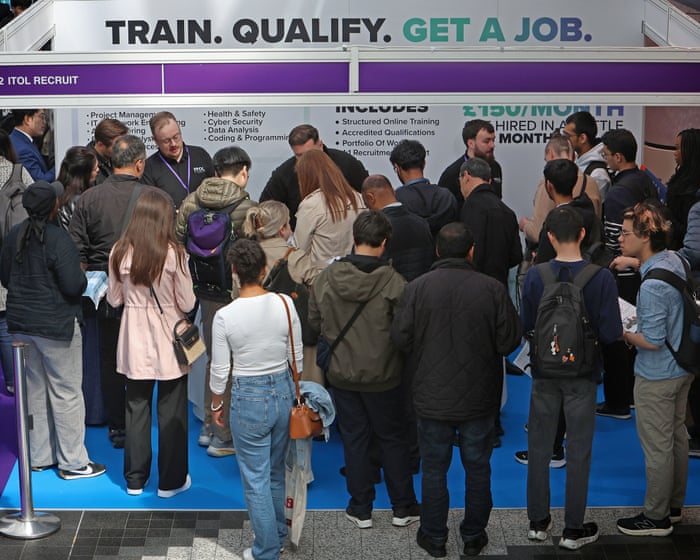
Unemployment in the UK has fallen unexpectedly in the final snapshot of the jobs market before John Healey’s first budget next week.
The jobless rate fell to 4.7% in the three months to August, from 4.9% according to the Office for National Statistics. City economists had forecast a rise to 5%.
Continue reading...
© Photograph: Susannah Ireland/The Guardian
© Photograph: Susannah Ireland/The Guardian
© Photograph: Susannah Ireland/The Guardian

© Karsten Moran for The New York Times
Downing Street delivered a rare rebuke to a senior member of Donald Trump’s administration
Asked why the Lib Dems were opposed to a third runway at Heathrow when they professed to be in favour of growth, Cooper said she did not accept that a third runway would produce all the benefits its supporters claimed.
She explained:
On Heathrow, it is clear from looking at all of the economic analysis of airport growth over the last few years that many of the promises made by all sorts of different airport companies simply haven’t come to bear.
The promise of higher wage jobs hasn’t been substantiated. Often it’s lower paid jobs, and often not as many as they’ve claimed.
Continue reading...
© Photograph: Manuel Balce Ceneta/AP

© Photograph: Manuel Balce Ceneta/AP

© Photograph: Manuel Balce Ceneta/AP
Exclusive: Former health secretary says upfront investment in support is needed ‘if we are going to end the Neet crisis’
Ministers should cut welfare spending to fund more employment support if it wants to end the youth Neet crisis, the author of a government-led review has said.
Alan Milburn, the Tony Blair-era health secretary, told the Guardian he believed ministers should reduce benefits payments to help pay for more employment support, opening a potentially contentious debate within the Labour party over welfare cuts.
Continue reading...
© Photograph: Jeff Moore/PA

© Photograph: Jeff Moore/PA

© Photograph: Jeff Moore/PA
Artificial intelligence is becoming established across European businesses, but almost half of companies remain unwilling to trust automated systems when decisions concern their employees, according to a European Commission survey published on 14th October.
The Eurobarometer findings show that 42 per cent of the small and medium-sized enterprises and mid-cap companies surveyed already use artificial intelligence or algorithmic management systems, although most deployment remains limited or experimental. A further 21 per cent intend to introduce such technologies in the future.
Despite this expanding adoption, 49 per cent of respondents said they did not trust artificial intelligence or automated systems to make staff-related decisions. The figures suggest that companies increasingly distinguish between using technology to improve business processes and delegating managerial responsibility to software.
The Commission’s survey of European businesses was conducted between March and April 2026, involving approximately 12,826 telephone interviews with company leaders across the EU’s 27 member states.
The survey provides a more detailed picture of workplace AI than conventional statistics measuring whether companies have adopted the technology.
Among the businesses interviewed, customer service and client relations were the most commonly reported areas of application, accounting for 47 per cent. Monitoring employee performance and productivity accounted for 36 per cent, while logistics, planning and staff scheduling represented 30 per cent.
These functions differ substantially in their consequences for workers and managers.
A system that helps organise deliveries or forecasts customer demand may improve efficiency without directly determining employees’ working conditions. Software that evaluates performance, allocates shifts or recommends staffing changes can influence employment decisions and requires a different level of organisational supervision.
The survey found that 61 per cent of companies considered AI useful in supporting decisions. However, human involvement remained central: 90 per cent of respondents reported that people continued to make decisions, while fully automated decisions accounted for only 2 per cent.
The results undermine the assumption that adopting AI necessarily means transferring control of business operations to autonomous systems.
For many companies, the immediate commercial value lies in processing information more rapidly, identifying patterns and reducing administrative workloads rather than removing human management entirely.
Financial and organisational obstacles continue to limit adoption.
Half of the companies surveyed cited high investment costs, while 49 per cent identified legal uncertainty and 48 per cent pointed to insufficient expertise.
These findings are particularly relevant to small businesses, which frequently lack dedicated technology teams, extensive data infrastructure or the resources to evaluate complex software systems independently.
For such businesses, purchasing AI tools is only one component of the investment. Implementation can also require employee training, changes to internal procedures, data-security assessments and continuing technical support.
The findings add a workplace dimension to concerns raised in EU Today’s earlier examination of Europe’s AI productivity gap, which identified investment, computing capacity and organisational restructuring as obstacles to translating adoption into higher productivity.
A company may purchase sophisticated software without necessarily achieving corresponding improvements in performance. Those improvements depend on whether the technology is integrated into everyday operations and whether employees have the skills to use it effectively.
The survey arrives while the European Commission is considering additional rules on algorithmic management through its proposed Quality Jobs Act.
The initiative is intended to address working conditions, workers’ rights and the increasing use of automated systems in managing employees.
A consultation launched in July asked European employers and trade unions to consider transparency in automated decisions, excessive workplace monitoring and the responsibilities of companies using AI.
The second consultation phase ended in September, allowing social partners to propose negotiated arrangements before the Commission determines its next legislative steps.
The broader regulatory framework is already changing. As EU Today explained when the AI Act entered a new enforcement phase, Brussels has begun enforcing certain obligations for general-purpose AI models, while important requirements for high-risk applications, including employment-related systems, follow a later timetable.
Stand-alone high-risk systems are scheduled to face the relevant obligations from December 2027, with another deadline in August 2028 for high-risk systems embedded in regulated products.
The distinction matters for employers planning investments today. Existing data-protection and employment obligations continue to apply, but some of the AI Act’s more specific compliance requirements remain subject to transition periods.
The Commission’s latest survey indicates that businesses are already exercising caution independently of these future obligations. Their reluctance to automate sensitive staff decisions suggests that accountability, reliability and employee confidence will remain important factors in determining how extensively artificial intelligence is deployed.
For Brussels, the challenge is to establish workable rules for that transition without making implementation prohibitively expensive for smaller companies, which account for much of Europe’s employment and commercial activity.

Brazilian President Luiz Inácio Lula da Silva has described the approval of the Proposed Constitutional Amendment (PEC 221/2019) as a historic achievement. The amendment puts an end to the 44-hour workweek, establishing a new maximum of 40 hours per week, distributed over five working days and two paid rest days.
RELATED:
Brazilian Senate Ends 6×1 Schedule, Approves 40-Hour Workweek
The constitutional reform—a key commitment of the Brazilian government—will directly benefit approximately 22 million workers who were previously employed under a “6×1” schedule, consisting of six days of work followed by one day of rest.
Brazil’s Senate ratified the amendment in two rounds of voting, with 75 votes in favor and one against—the latter cast by Senator Hamilton Mourão. This decision comes five months after the Chamber of Deputies initially approved the proposal, and 11 days ahead of the presidential runoff, scheduled for October 25.
Far-right candidate Flávio Bolsonaro, who had initially opposed the measure, shifted his position and voted in favor remotely from Porto Alegre. Progressive senators, including Teresa Leitão, labeled this move as opportunistic and warned of the need to remain vigilant against any potential attempts to overturn the new regulation.
A escala 6×1 acabou! ❤️🇧🇷
— Lula (@LulaOficial) October 15, 2026
Uma conquista histórica para milhões de trabalhadores e trabalhadoras, que agora terão mais tempo para descansar, estar com a família, cuidar de si e viver.
Quem constrói o Brasil todos os dias também merece tempo para viver.
É o Brasil pronto para… pic.twitter.com/5Nq7a9xKZk
The text reads, “The 6×1 schedule is over! A historic achievement for millions of workers, who will now have more time to rest, be with their family, take care of themselves, and live. Those who build Brazil every day also deserve time to live. It’s Brazil ready for more!”
Timeline and safeguards
The transition to the “5×2” model will not be immediate. According to the established timeline, 60 days after the official publication of the amendment—expected in February 2027—the maximum weekly working hours will be reduced from 44 to 42.
Subsequently, 14 months after the amendment is enacted—in December 2027—the limit will be set at 40 hours per week. The regulation also establishes a maximum daily limit of eight working hours. The constitutional text expressly prohibits any reduction in wages—whether proportional or affecting the minimum wage—across professional categories.
Furthermore, it delegates the organization of rest periods to collective bargaining agreements, prioritizing Sundays, while allowing for flexibility in sectors such as healthcare, security, and public transport.
While labor unions supported the measure, business sectors expressed their opposition, arguing that it could lead to higher costs per hour worked and the risk of a contraction in employment. The right-wing opposition also signaled its intention to revise the legislation should it gain control of the executive branch.
For individual micro-entrepreneurs and small business units, the reform provides for a supplementary law that includes state support mechanisms designed to cushion the impact of the transition and sustain formal employment targets.
Within the public administration, existing service contracts will have a period of up to 12 months to adjust their operational and financial frameworks to the new limits on working hours.
With the approval of PEC 221/2019, Brazil has begun a restructuring of its labor market aimed at reducing precarious working-hour arrangements in Latin America’s largest economy.

Four in five new jobs created in Britain since 2014 were taken by migrants while the number of British people on out-of-work benefits increased by 2.3 million, according to a report from the Centre for Social Justice.
The post Migrants Taking Four in Five New Jobs appeared first on The Daily Sceptic.

In 2010, only 21.7% of the labor force had graduated from a higher education institution, a share that climbed to 42.1 out of every 100 by 2026, according to a report by the Economic Context Observatory of Diego Portales University (OCEC-UDP).
That means more qualified workers and higher productivity potential, but it does not mean greater chances of landing a job.
The National Institute of Statistics reported that in the June-August mobile quarter, the open unemployment rate reached 9.6%, with 44 consecutive months above eight percentage points.
RELATED: Chilean University Rectors Reject Education Cuts in 2027 Budget Bill
Among those who completed university or successfully completed technical-professional training, unemployment is also a serious problem, the OCEC-UDP said. It rose one point in the last 12 months to 8.3%. That implies 40,938 fewer jobs and a total of 356,286.
Women with higher education fare worst, with lack of work affecting 8.7 of every 100, compared with 7.8 for men, the OCEC-UDP said. By age group, educated unemployment is higher among those under 30, it said.
Chile es el país con la tasa de desempleo más alta de la región, según indican diversas publicaciones; y, si se analizan los países de la OCDE, el segundo. En nuestra región de Los Ríos la situación es alarmante, especialmente en jóvenes y mujeres. No se ve ningún proyecto nuevo… pic.twitter.com/dox1io85lC
— Iván Flores García (@ifloressenador) October 11, 2026
Another facet: many higher education graduates who appear employed are actually doing work below their preparation, according to OCEC-UDP. Qualification underemployment occurs when a person performs a task below their preparation and therefore generates added value lower than their potential.
You need 35 years of National Insurance contributions to get the full state pension. Ah, says David Craig, but the unemployed get 'pension credit', which pays exactly the same and comes with piles of freebies thrown in.
The post Want the Highest State Pension? Don’t Bother Working Too Much appeared first on The Daily Sceptic.
For Oakland Review of Books, Stephanie Uchino-Beach writes about getting laid off at an education tech company that transformed into an “AI-first outfit.” As as customer success manager, she acted as a liaison to district administrators, school principals, and teachers. While AI could automate some of her tasks, what about the core responsibilities of her CSM role: building real relationships and understanding an educator’s needs? An AI sees data points, not people. This is a sobering read from a former tech worker living in the Bay Area, and an edtech company that has gone all in on AI and forgotten about its mission.
Before I went to work for Silicon Valley, I was a lot of things. A few jobs before this last one, I was an elementary school teacher in Chicago, helping kids learn to read, creating units, planning lessons, and buying supplies with my own money on the weekends, like countless other teachers around the country. I grew up on the Peninsula, and I made the move into Customer Success to get a job that would let me move home. Tech was never my dream; it was a means to an end. My dad studied computer science and still works in tech to this day and enjoys it, so it seemed like a satisfying and fruitful career was plausible. I figured that once I broke in, all my problems would be solved: I could get a house, have a kid, and fulfill every middle-class dream that had always felt slightly out of reach for a millennial like myself.
And yet, job after job, I consistently left feeling unsatisfied. Unsatisfied by how I wasn’t growing and wasn’t developing my skills. Unsatisfied with poor managers who were just in the right place at the right time to be promoted but so often lacked the skills to provide the same success for their employees. Unsatisfied with how the products I worked on could do wrong by the communities we sold them to, even though every company said they were “mission-driven” and “put our customers first.”

It’s getting better all the time (Better, better, better) It’s getting better all the time I admit it’s getting better –The Beatles In an X post, Marko Jukic, senior analyst at Bismarck Analysis, lamented: “Enshittification” is sort of a “safe horny” term for what is really just outright impoverishment and declining living standards due to […]
The post US enshittification vs Chinese involution appeared first on Asia Times.
Teachers, firefighters and health workers were among those taking part, with around 170 demonstrations planned nationally. High-school students also blockaded hundreds of schools, extending protests that began over teacher shortages, overcrowded classrooms and conditions in the education system.
The industrial action, accompanied by the traditional violence, places Prime Minister Sébastien Lecornu’s government under additional pressure before ministers present the draft finance and social-security budgets on Thursday, 1st October.
The French Education Ministry reported that 13.71 per cent of teachers participated in Tuesday’s strike across most of metropolitan France and Réunion. Participation reached 15.28 per cent among primary-school teachers and 12.74 per cent in secondary education.
Separate student action affected hundreds of secondary schools.
Protests were reported in Paris, Lille, Lyon, Nice and other cities. Some demonstrations involved clashes with police and damage outside schools, although much of Tuesday’s public-sector action proceeded without major disruption.
The dispute is centred partly on government spending plans.
Trade unions oppose a proposed freeze in the salary index used to calculate public-sector pay and argue that years of inflation have already reduced employees’ purchasing power. Firefighters have also demanded additional resources following the extensive wildfires that struck France during the summer.
The government is preparing its budget against a worsening fiscal background.
France’s public debt has climbed close to 120 per cent of gross domestic product, while the budget deficit remains well above the European Union’s 3 per cent ceiling.
EU Today reported earlier this month that French debt was heading towards 120 per cent of GDP, accompanied by an increase in the premium investors demand to hold French government bonds rather than German debt.
Higher interest rates are adding to the pressure. Debt-servicing costs have become one of the largest areas of central government spending, restricting the room available for tax reductions or additional expenditure.
The government has also reduced its 2026 economic growth forecast to 0.5 per cent.
Finance Minister Roland Lescure has acknowledged that France will miss its earlier deficit target, leaving the 2027 budget with the difficult task of demonstrating a credible path towards stabilising the public finances without provoking further political resistance.
The budget is due to be formally presented on Thursday. The Finance Ministry has confirmed that Lescure, Public Accounts Minister David Amiel, Labour Minister Jean-Pierre Farandou and Health Minister Stéphanie Rist will present the finance and social-security bills following the Council of Ministers.
The argument is taking place while EU fiscal surveillance is itself entering a more demanding phase.
Under the revised Stability and Growth Pact, member states are expected to follow agreed medium-term expenditure paths designed to bring deficits and debt onto sustainable trajectories.
EU Today recently examined how the EU’s fiscal rules face an enforcement test in October, when finance ministers and the European Commission return to national budget compliance. France is one of the countries where implementation will receive particularly close attention because of its debt level, persistent deficit and political difficulty in securing parliamentary agreement for spending reductions.
The domestic parliamentary arithmetic remains difficult. Lecornu’s government does not control an outright majority in the National Assembly, meaning the budget could become the subject of amendments, confidence votes or further negotiations with opposition parties.
The government has previously relied on Article 49.3 of the constitution to pass financial legislation without a conventional parliamentary vote, although use of the mechanism exposes a government to motions of no confidence.
Tuesday’s strikes add another layer to those negotiations. Trade unions have indicated that further action is possible if the budget contains measures they regard as unacceptable. The CGT has demanded changes to planned spending reductions and public-sector pay policy.
The precise scale of the government’s fiscal measures will become clearer on Thursday. For France, the budget will have to address three pressures simultaneously: deteriorating public finances, the EU’s fiscal framework and domestic opposition to further restraint.
In this story for Dispatch, Lotte Brundle reports on a surprising trend: young women in the UK are pursuing careers in the death care industry. In a time of high unemployment, funeral home apprenticeships offer an alternative to university, where students accumulate significant debt. While the pay is low and the industry needs to do a better job building awareness that the trajectory exists, the young women who speak to Brundle find the work meaningful and rewarding.
Her inspiration to become an undertaker arrived, as many teenage epiphanies now do, via TikTok. Emily was 15 and had been considering becoming a teacher or journalist when she came across an American woman documenting life inside her own funeral home. “I’d never considered it as a career,” she says. “I didn’t know anyone who was an undertaker, but I just thought how interesting it was.”
Two hours later, she was still scrolling through the woman’s profile, engrossed. Running her own funeral home became Emily’s dream.


Between the first and the second quarter of 2026, 3.1 million unemployed persons aged 15-74 in the EU moved into employment, representing 23.2% of all unemployed in the first quarter of 2026. During this period, 7.0 million (52.8%) remained unemployed and 3.2 million (24.0%) moved out of the labour force.
These figures are taken from recently published data on labour market flows in the second quarter of 2026. The article presents a handful of findings from the more detailed Statistics Explained article on labour market flows.

Source dataset: lfsi_long_q
The visual and the table give an overview of all changes in labour market status. In the visual, the figures for employment, unemployment and out of the labour force refer to the number of people remaining in each status between the 2 quarters, while the arrows indicate the number of people moving from one status to another.

Source dataset: lfsi_long_q
Of all people in employment in the first quarter of 2026, 2.5 million (1.2%) became unemployed in the second quarter of 2026, and 4.8 million (2.3%) moved out of the labour force.
Of all people recorded as out of the labour force in the first quarter of 2026, 4.2 million (3.7%) entered employment in the second quarter of 2026 and 3.9 million (3.4%) became unemployed.
Government spokesman Pavlos Marinakis triggered an outrage when he proposed that the “unemployment benefits” should last just two months in order to force jobless to take up a work. According to Greek legislation, the unemployment benefit of 526 euros per month increased by 10% for each child runs for maximum 12 months provided that the […]
The post Gov’t spokesman proposes sharp cut of “unemployment benefits” down to just two months appeared first on Keep Talking Greece.
A new study claims to show the scale of psychosocial risks, stress and mental health of those in work.
The findings were made public just ahead of the European Parliament’s Committee on Employment and Social Affairs (EMPL) vote on psychosocial risks, stress and mental health at work.
The “unique” mapping was carried out across all 27 EU member states
It reveals what it calls “significant differences” in national approaches to tackling the issue.
There are, it goes on, “uneven levels” of worker protection, a problem which “strengthens” the case for a common preventive approach at EU level.
The good news is that a majority of European countries have already introduced legislation to address the problem.
Social partners and courts have also taken action to address these risks, says the report.
The report is called 'Mapping of national laws, collective agreements and jurisprudence concerning work-related psychosocial risks, workplace bullying and work-related stress in the EU27.'
It was conducted by the European Trade Union Institute, he independent research and training centre of the European Trade Union Confederation.
The research was authored by Aude Cefaliello, ETUI Senior Researcher and conducted along with colleagues, Aditya Jain and Stavroula Leka
Cefaliello said: “It is not a lack of action that makes the case for an EU initiative, but rather the fragmented nature of that action and the uneven levels of protection that result from it.”
The report says, “Psychosocial risks at work constitute a major and growing occupational health problem.
“Almost 45% of workers in the EU report being exposed to risks at work that could negatively affect their mental health, and almost one-third experience stress, depression or anxiety linked to work.
What makes the ETUI’s mapping “unique”, says the authors, is that it examines not only how work-related psychosocial risks are defined, regulated and prevented across the Member States, but also the role played by collective bargaining and the courts where legislative frameworks are incomplete.
It states that Europe is “not starting from scratch – but action is urgently needed.”
The findings build on those of the ETUI Policy Brief published in the spring.
It concludes, “The time for a coherent and binding EU approach to psychosocial risk prevention is now. It stresses that psychosocial risks at work should not be reduced to an individual mental health issue: they need to be prevented at source, by addressing inadequacies in work organisation, design and management.”
“While EU occupational safety and health legislation requires employers to protect workers from all work-related risks, psychosocial risks at work are still neither explicitly defined nor specifically regulated at EU level.
“The absence of clear legal obligations contributes to the fragmented national approaches highlighted by the mapping, generating legal uncertainty and uneven levels of worker protection across the EU.”
