People protest the plans by President Donald Trump’s administration to build a section of the border wall at the Big Bend National Park, in Study Butte, Texas, in August.
I read and much enjoyed—and highly recommend—my Stanford colleague Diego Zambrano's book, How Americans Enforce the Law. He was kind enough to write up for us this post that captures the core of his argument, and I'm delighted to pass it along (though I encourage people to read the whole book):
The headlines are full of stories about a federal government retreating from enforcement. Agencies are dropping investigations, abandoning regulations, shrinking staffs and changing enforcement priorities. One week, the EEOC drops discrimination cases. The next week, the SEC and CFPB wind down investigations into securities fraud and wrongdoing affecting consumers. Critics fear that the Department of Justice's antitrust division will overlook mergers when it is convenient for the administration. And the DOJ has abruptly reduced enforcement of the Foreign Corrupt Practices Act. Facing these changes, Americans might worry that a wide range of laws will go unenforced.
But that concern misses something unique about the American system of government. We have never relied only on bureaucrats to enforce our laws.
All the way back to the colonial period, American legislators have repeatedly done something unusual: they have given ordinary people the right to sue alongside government officials. In almost every regulatory area that most Americans care about—be it regulation of wages and hours, environmental pollution, consumer protection, or securities fraud—statutes allow both government officials and private parties to file suit to enforce the law. All of this happens through little-known provisions called "private rights of action," which is just a technical name for a right to sue. Thousands of these provisions build a second enforcement system alongside the bureaucracy, turning employees, consumers, competitors and their lawyers into co-enforcers of public law.
This system of private enforcement of the law is highly unusual. In much of the rest of the world, whenever a government faces a regulatory problem, it typically empowers government officials and bureaucrats to police legal violations. In France, Germany, Japan, and even the UK, legislators are far less likely to let anyone sue over, say, environmental pollution or employment discrimination.
Consider the case of oil spills. In 1989, the United States faced the Exxon Valdez oil spill off the pristine waters of Alaska. Millions of gallons of oil laid waste to coasts, waters, and fisheries for hundreds of miles. What most Americans don't know is that a decade later, France also faced a catastrophic oil spill, caused by a ship called the Erika. So how did governments react? In the United States, private plaintiffs sued Exxon directly under existing tort and maritime law, eventually winning substantial damages. Congress, meanwhile, enacted a statute called the Oil Pollution Act with a new right-to-sue those responsible for oil spills. By contrast, in France, the oil spill led primarily to a major criminal prosecution and, eventually, to new national and European regulatory measures (including a new bureaucracy called the European Maritime Safety Agency). When France finally adopted a right to sue in 2016, it paled in comparison to the American version.
Why is the United States so different? Part of the answer, as I argue in a new book, is that Americans have always done this. Back in the colonial period, state legislatures adopted what they called "penal statutes," that empowered any person to enforce regulatory statutes and collect a bounty. So when Massachusetts wanted to regulate the storage of gunpowder, it allowed private informers to sue neighbors who stored it improperly. And this model applied across many areas of colonial life: alcohol consumption, trade, taxation, public morals, church attendance, and more. The Founders used the same tool across the board: Thomas Jefferson and James Madison co-wrote Virginia statutes full of penal statutes, and John Adams handled these suits routinely as a colonial lawyer.
The key feature of this system is that even though private parties file suit for their own aims—the employee wants their full wages paid or the consumer wants a refund for a shoddy product—they inevitably enforce the law. And those lawsuits benefit everyone else because employers and manufacturers may change their behavior with respect to other employees and consumers. In that sense, every single plaintiff is a little bureaucrat or, as some courts call them, a "private attorney general."
This system has the added benefit of reducing political disruptions in enforcement. Even though any single administration can change the enforcement priorities of the EEOC, SEC, CFPB, or Department of Justice, the president cannot control thousands of lawyers and their clients. Private enforcement, then, makes enforcement less dependent on what the bureaucracy and president want.
Right. So you might think that when the bureaucracy won't pursue wrongdoing, the obvious solution should always be new rights to sue. Indeed, many news stories decrying a lack of government enforcement immediately call for more private lawsuits.
But there's a problem with that solution. Private enforcement is not tailor-made for every regulatory area. It makes the most sense to empower private parties when the bureaucracy is truly faulty, under-resourced, politically vulnerable, or likely to be captured by regulated entities. When this isn't the case, private enforcement can cause more problems than it solves.
Consider, then, the enormous problems that rights to sue pose in the environmental context and in the construction of housing and infrastructure. There, broad rights to challenge government approvals can let private parties oppose the construction of housing, mass transit, green energy, and other projects. Examples of ruinous lawsuits abound. Neighbors in a Maryland suburb—backed for years by a nearby country club—sued to delay the Purple Line light-rail project over concerns for a microscopic organism, while the Sierra Club sued to stop a major Mojave solar energy project over the potential impact to a desert turtle. So even if a city government has approved a project that might benefit thousands of people, a single crank can use a right-to-sue to stop the project. In these settings, rights to sue have contributed to delays and increased costs of housing and infrastructure.
We need a careful approach to rights to sue. Yes, we need more of them in some areas. Especially if the government won't enforce anti-corruption or consumer protection statutes. And yes, in employment law, securities, and antitrust, private enforcement often makes a lot of sense. But this is not necessarily the case in environmental law and construction. There, we need better bureaucracies, not thousands of people with the ability to oppose construction projects for any number of reasons.
When the bureaucracy retreats, Americans should rest assured that private parties will still enforce the law. But that power to enforce the law should be given carefully.
In the final weeks of Michigan’s Senate race, the Democratic nominee finds himself facing both ugly attacks and pointed questions about family members. He has pushed back forcefully.
One of the unfortunate quirks of the American system is that you can't lie to the government, but the government can lie to you. Samuel Tunick found himself on the receiving end of this setup last year at Atlanta International Airport. When agents from the Department of Homeland Security (DHS) asked for his phone password, he allegedly gave them a self-destruct code that wiped his data. Tunick now faces five years in prison for destroying evidence.
It turns out that the feds were lying to Tunick the entire time. A new court filing, first reported by 404 Media, shows that the DHS had sent out an order to seize Tunick's phone over his involvement in environmentalist protests in Atlanta. When he landed at the airport, however, agents told Tunick that they were looking for "kiddie porn" and he would be allowed to leave with his phone if he cooperated. They also repeatedly denied him access to his lawyer when he asked.
"There can be no real debate that if law enforcement had acted similarly elsewhere in Atlanta, their actions would be unconstitutional. But the government says it was entitled to act this way because Mr. Tunick was returning from an international vacation" in the Dominican Republic, his lawyers wrote in the filing, which includes internal DHS communications and excerpts from his interrogation video.
U.S. law recognizes a "border exception" to Fourth Amendment privacy rights, allowing federal agents to search incoming travelers for contraband. U.S. Customs and Border Protection (CBP) claims that this exemption also allows them to hold travelers for questioning and search their electronic data. Tunick's case reveals just how widely the agency stretches this loophole.
A few hours before Tunick landed, Homeland Security Investigations (HSI) agent Travis Mcghie emailed the CBP station in Atlanta with his photo and information, stating that he is under investigation for "suspected terrorist activities." (Tunick is involved in Save the Atlanta Forest, also known as Stop Cop City, a protest movement against a local police training center.) The email asked CBP to "conduct a 100% baggage exam, retain all electronics and collect passcodes," stating that the HSI will be at the airport to conduct an interrogation.
Pulled into the secondary screening room, Tunick "almost immediately" told CBP officers that "I don't really want to speak without a lawyer any more," according to the filing, which cites the interrogation tape. He would ask for a lawyer multiple times.
The agents asked Tunick if he had "kiddie porn" on his phone and stated that "because you're refusing to talk, we have the authority to go through your phone to see what we're looking for." One of them, Latoya Castro, told Tunick that "either you can give us your password so that we can go through it no problem, or you can refuse to do that, unfortunately, we will have to seize your phone."
Both of those statements were a lie, of course. The HSI's email had asked CBP to take Tunick's phone, whether or not he cooperated.
The lie about child porn may not only have been meant to intimidate Tunick. While there arecontradictory lower court rulings about the border search exemption, some courts have ruled that the CBP can only search electronics for "digital contraband," or files that are themselves illegal. A search for child sex abuse material would be on stronger legal ground than a search for mere evidence of other crimes.
Tunick was using GrapheneOS, a secure phone system that allows users to set both a real password and a "duress password" that wipes out all data when entered. The interrogation tape shows his phone appearing to reset after he gave the officers a passcode. HSI agent Nathan Burnham and FBI agent Andrea Coble then entered the room.
"You are not under arrest. Once these gentlemen are done with you, pursuant to your entry into the country, you're free to leave," Burnham said, referring to the CBP officers.
Tunick's lawyers argue that the judge should throw out the phone password Tunick provided and everything that resulted from entering it as an "involuntary" response made under "unlawful interrogation," because the CBP agents did not read Tunick his Fifth Amendment rights and ignored his multiple requests to consult with his lawyer before answering their questions.
The CBP claims that secondary screening at the border doesn't count as a criminal investigation, so detainees don't have the same rights as criminal suspects. "Since the international arrivals inspection is an administrative function, CBP policy and federal regs do not permit the presence of lawyers during secondary examinations," a spokesmantoldReason earlier this year.
But Tunick's lawyers insist that his experience was "far outside" a normal border crossing: He was accused of a serious crime to his face, faced an investigation for a different serious crime he didn't know about, and clearly could not leave the situation until he gave information to government agents.
"I hope people understand that the charges against me are meant to intimidate people against protecting their data and their privacy, and the government hopes to set a precedent that no one has the right to privacy," Tunick told 404 Media.
Defend the Atlanta Forest, the movement that Tunick is involved with, has been amajor nuisance for authorities in Georgia. Protesters attacked and burned construction equipment throughout 2022, and police shot a protester in 2023 under unclear circumstances, claiming that they were fired at during a raid.
The Trump administration has brought down the federal government against the movement. In June 2026, the Department of Justice broughtfederal charges against two alleged arsonists, citingNational Security Presidential Memo 7, which directs the feds to go after left-wing domestic terrorism.
But beyond the email line about "suspected terrorist activities," there is no indication of what specific crimes the feds suspected Tunick of, or why they suspected him. And the whole setup of the interrogation was designed to hide those answers. In fact, instead of charging Tunick under typical obstruction or evidence-destruction laws, federal prosecutors chose ararely-used statute that doesn't require them to disclose what the underlying investigation was about.
"Many times the government wants to highlight what it was trying to investigate because that ups the stakes on what the defendant was doing," former prosecutor Daniel RichmantoldThe New York Times. "This is a case where I think they're trying to avoid exactly that by focusing only on the destruction, and not what the investigation was about."
Ukraine says it still doesn’t know why the military satellite internet service, a sister to Starlink, was abruptly throttled, leaving troops vulnerable to Russian attacks.
A Ukrainian soldier flying a drone in the Donetsk region last week. Members of the military have reported issues with drone connectivity since Starshield was disrupted.
Mr. Lander, a Democratic congressional nominee from New York, had been helping Palestinian farmers. He said he was released after about three hours, but that other volunteers were still in custody.
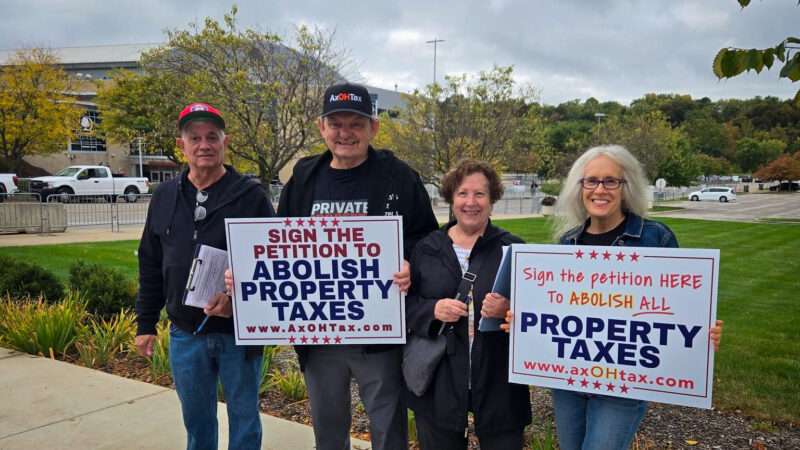
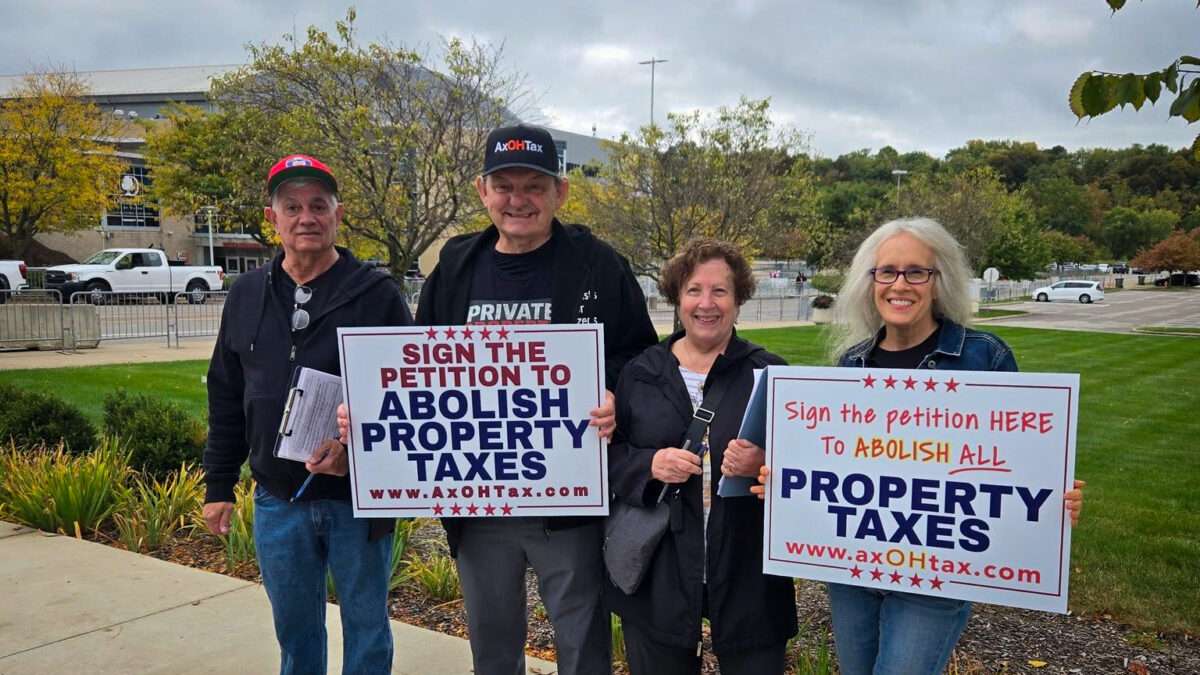
If you have to pay a regular fee to maintain control and use of a home or other parcel of property, do you really own it? Or are you just renting it from whoever collects the money? That's the question behind a growing movement against property taxes, which is winning support across the country and may see its next big test in the form of a proposed constitutional amendment on the Florida ballot that would significantly trim taxes on owner-occupied homes.
'Property Is the Foundation of Liberty'—and a Big Source of Tax Revenue
Advocates of reform understandably champion the inviolability of private property, which is threatened by continuously rising levies. Opponents predictably include people who fear reduced government revenues, but also those who worry that cutting property taxes will shift power to state governments at the cost of local autonomy.
"Property is the foundation of liberty," argues economist Vance Ginn. "It represents the right to the product of voluntary exchange, investment, and saving—not a privilege granted by government. To tax property again every year after it has been bought with after-tax income is to deny genuine ownership. Property taxes operate like an annual wealth tax or unrealized capital-gains tax, applied regardless of income or ability to pay."
Opposing Ginn's argument in the debate is the Tax Foundation's Jared Walczak, who is not so much a fan of property taxes as a believer that they suck less than the alternatives.
"Spending restraint can reduce property tax burdens," argues Walczak. "But with property taxes accounting for 70 percent of local tax collections nationwide and upwards of 90 percent in some states, any discussion of property tax elimination must grapple with revenue alternatives."
"It is axiomatic that whatever you tax, you get less of," he adds. "Taxing income means less income-producing labor and investment, for instance. But because land is an immobile asset, taxing property does less to distort market decisions than taxing income or even sales."
Walczak also points out that while property taxes are usually imposed by local governments, most alternatives to property taxes come at the state level. That would move power further up the political food chain, away from the property owners worrying about their tax bills.
To this, Ginn responds that governments at all levels cost more than they should and that "the moral and fiscal failure of property taxes lies not only in how the money is raised, but also in how much government spends."
That means the debate over property taxes isn't just a struggle between those who want to trim the state's take and those who prefer larger government, but also between anti-tax activists and their frequent allies among advocates of local power. In a piece this week on the groundswell against property taxes, Politico's Liam Dillon notes that "the uprising's most pitched battles are being fought in Red States where the issue has emerged as yet another dividing line on the right."
Localities Are Dependent on Taxing Property
The debate over property taxes is fierce partially because governments have come to rely so heavily on them. "In fiscal year 2023, property taxes comprised 28.9 percent of total state and local tax collections in the United States, more than any other source of tax revenue, despite being levied almost exclusively at the local (not state) level," Janelle Fritts wrote for the Tax Foundation.
Property taxes in the U.S. range from roughly half a percent to just under 2 percent of assessed home value. States that rely most heavily on them, like New Hampshire (1.5 percent in 2024) and Texas (1.4 percent in 2024), also tend to leave a lot of government responsibility in local hands that might be exercised at the state level elsewhere. It's worth noting that Cato's Freedom in the 50 States ranks New Hampshire as having the second least burdensome tax regime among states, with Texas in fourth place.
The lowest taxed states in property terms are Alabama (0.37 percent in 2024), Arizona (0.48 percent), Hawaii (0.29 percent), and Utah (0.48 percent). Some states, such as Illinois (1.88 percent in 2024) and New Jersey (also 1.88 percent), tax the hell out of many things to support large and intrusive governments. Hawaii, despite low property taxes, is ranked as the most tax-burdened state by Cato.
As mentioned above, economists tend to like property taxes because they are efficient, minimally distort economic decisions, and empower localities relative to state and federal authorities. But as Politico's Dillon emphasizes, "everyone who is not an economist seems to hate property taxes."
Homeowners Don't Like the Insecurity That Comes With Property Tax Bills
Property taxes rise with assessed property valuations that homeowners have no control over, as the market shifts with supply and demand. They require what feels an awful lot like an annual rent payment to keep a roof over people's heads many already paid for. That reduces the sense of security that owners feel in their homes, since their habitation remains conditional on meeting local authorities' demands. The bite of sales taxes can be reduced by buying less, and income taxes are dependent on earning paychecks, but property taxes (with some local exceptions) come due no matter what.
Soaring property valuations in recent years drove property tax bills higher for Americans who did nothing but remain at their established addresses, though localities can and sometimes do adjust tax rates to offset rising values. USA Todayreported that "between 2019 and 2023, the median value of annual property taxes increased nearly 25%." That has energized the movement to cut or abolish the taxes.
Efforts to reform property taxes have been effective in more than a dozen states, according to Governing. Most of these efforts involved reducing taxes, though eyes are currently on Florida where Amendment 3, a proposed change to the state constitution, would incrementally raise the homestead exemption to $250,000. It also would require "the Legislature to prescribe a uniform procedure for counties and municipalities, for their respective levies, to increase the homestead exemption up to full assessed value," effectively abolishing property taxes on owner-occupied dwellings.
As a constitutional amendment, the measure requires 60 percent of votes to pass. Polling shows more support than opposition, but not necessarily at the supermajority level necessary for victory.
According to the Tax Foundation, in Florida, "the statewide average sales tax rate would have to rise from 7.02 to 15.34 percent to replace the property tax" with equivalent revenue. Rates could widely vary if localities implemented sales taxes instead of leaving them to the state.
Of course, that assumes state and local governments continue spending and providing services at the same level. But as economist Ginn points out, the problem lies not only in how property taxes raise money "but also in how much government spends." If the property tax revolt represents revulsion not just at the tax, but at the expense of large government, that may require less revenue to fund a smaller Leviathan.
Likely voters favored Democratic candidates over Republicans by 11 percentage points in their congressional district, a New York Times/Siena poll found.
A boardroom fight, an attempted veto and government intervention have plunged the Tata Group, one of India’s most revered institutions, into a fight over its future.
Natarajan Chandrasekaran, chairman of the Tata Sons holding company, at Bombay House, its headquarters. The hallway entrance features a stone sculpture of the company's founder, Jamsetji Tata.
Many in Gaza and the West Bank are desperate to avoid more years of Prime Minister Benjamin Netanyahu’s right-wing government, which has made life close to unbearable.
Romania has formed a new government after six months of political deadlock, with parliament approving a minority administration led by independent diplomat Luca Niculescu on Tuesday, 20 October. The vote brings an end to repeated failed attempts to establish an executive, although the new prime minister faces considerable uncertainty over his government’s parliamentary support.
Niculescu secured 280 votes in favour and 58 against, comfortably exceeding the 233 required for confirmation. His ministers were sworn in before President Nicuşor Dan at the Cotroceni Palace in Bucharest later that evening, formally ending the prolonged government formation process.
The new administration comprises 18 ministers, including two delegated ministers. The Social Democratic Party (PSD) controls the majority of portfolios, while independent specialists hold several important positions, including finance and foreign affairs.
A government built on temporary parliamentary support
The appointment represents a political success for President Dan, who nominated Niculescu on 5 October following three unsuccessful attempts to assemble a functioning government.
The new cabinet is heavily dependent on agreements between parties that have frequently disagreed over economic policy and public spending. Although the parliamentary vote demonstrated sufficient support for its installation, the arrangement does not provide the government with a permanent majority.
The National Liberal Party (PNL) and the Democratic Alliance of Hungarians in Romania (UDMR) supported the investiture while remaining outside the administration.
The arrangement gives Niculescu an opportunity to govern, but each major legislative proposal will require continued cooperation between parties with competing priorities.
The Social Democrats, who hold 11 of the ministerial positions, will exercise substantial influence over domestic policy, particularly decisions involving public-sector spending, welfare and taxation.
Budget deficit presents immediate challenge
Romania’s public finances represent the government’s most urgent problem.
The previous administration, led by Ilie Bolojan, collapsed in May following unpopular austerity measures. Political opposition to fiscal consolidation has complicated efforts to stabilise the budget and meet Romania’s commitments under the European Union’s fiscal framework.
Niculescu has indicated that addressing the deficit will be an immediate priority. Finance Minister Alexandru Nazare, appointed as an independent, faces the task of establishing a credible budget programme without provoking another parliamentary crisis.
The choices are politically difficult. Spending reductions risk resistance from public-sector employees and households already affected by higher living costs, while substantial tax increases could place further pressure on businesses and consumption.
Failure to establish a credible fiscal programme would prolong uncertainty over Romania’s borrowing requirements and its ability to comply with European budgetary obligations.
Brussels has a direct interest in the outcome. Romania remains subject to EU fiscal oversight, and the European Commission will assess whether the new administration’s financial plans are consistent with the country’s obligations.
The government’s credibility will depend on whether its parliamentary supporters are prepared to approve the measures that fiscal consolidation requires.
European funds and political credibility
The change of government also comes at a sensitive moment in Romania’s relationship with European institutions.
Romania has faced scrutiny over reforms linked to the EU’s Recovery and Resilience Facility, particularly legislation concerning public integrity and institutional accountability.
Although the EU recovery programme reached its principal implementation deadline in August, outstanding assessments and financial decisions continue to carry consequences for national budgets.
A functioning government is therefore important not only for domestic legislation but also for negotiations with Brussels over fiscal commitments, investment and the wider EU budget.
Romania must also address longer-term weaknesses in public administration, infrastructure financing and the implementation of European legislation.
Political stability remains uncertain
Niculescu takes office against the background of Romania’s unusually turbulent political history since the annulment of the 2024 presidential election amid allegations of Russian interference.
The subsequent institutional disputes damaged confidence in the political system and contributed to the fragmentation of parliamentary support.
Opposition parties, including the nationalist Alliance for the Union of Romanians (AUR), are positioned to challenge the government’s legitimacy and economic measures as the administration begins work.
Romania’s strategic importance extends beyond its domestic political difficulties. As an EU and NATO member bordering Ukraine and Moldova, it plays a substantial role in Black Sea security, military logistics and regional infrastructure.
Prolonged instability in Bucharest has therefore affected a country whose decisions carry consequences for European security and cross-border economic cooperation.
For the new prime minister, the immediate objective is to translate Tuesday’s parliamentary majority into support for legislation. His first serious test will come when the cabinet presents the fiscal measures that its supporters have so far struggled to agree upon.
The parliamentary vote has ended Romania’s government formation crisis. It has not resolved the disagreements that produced it.

 Login