❌

Reading view

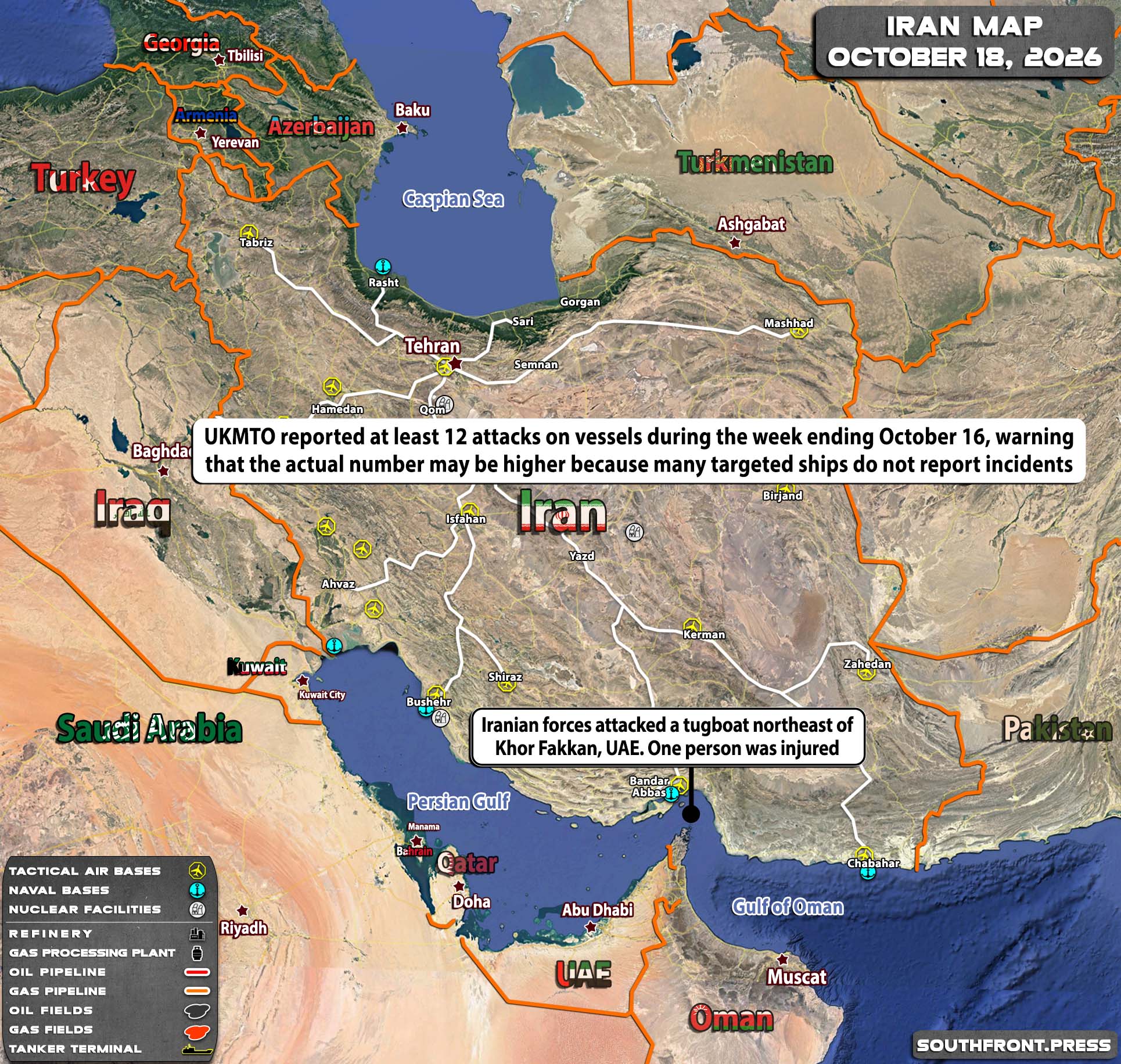
Military Situation In Iran On October 18, 2026 (Map Update)

Click to see the full-size image

  • Iranian forces attacked a tugboat northeast of Khor Fakkan, UAE. One person was injured;
  • UKMTO reported at least 12 attacks on vessels during the week ending October 16, warning that the actual number may be higher because many targeted ships do not report incidents.

MORE ON THE TOPIC:

The post Military Situation In Iran On October 18, 2026 (Map Update) appeared first on South Front.

  •  

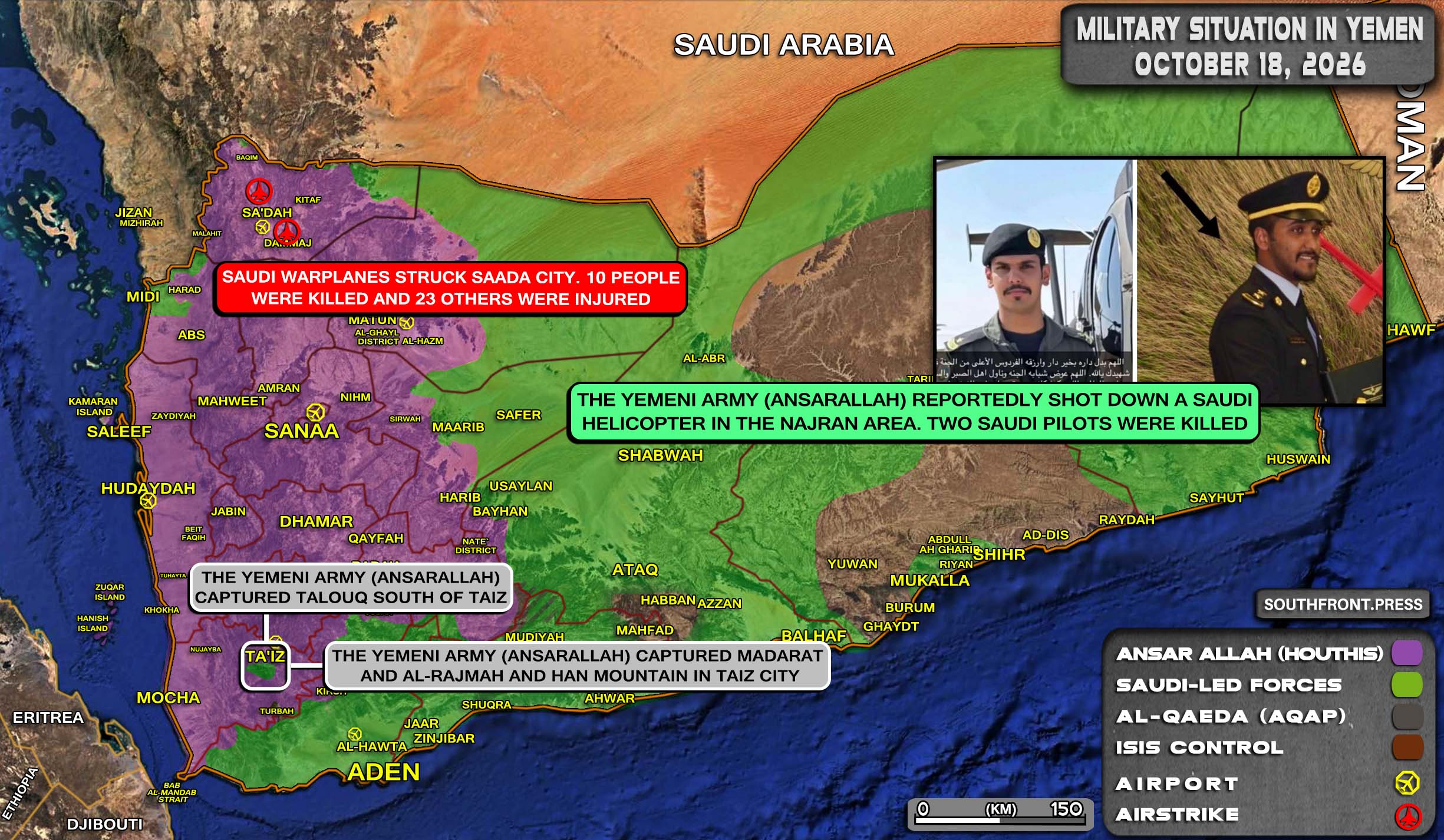
Military Situation In Yemen On October 18, 2026 (Map Update)

Click to see the full-size image

  • The Yemeni army (AnsarAllah) captured Madarat and Al-Rajmah and Han mountain in Taiz city;
  • The Yemeni army (AnsarAllah) captured Talouq south of Taiz;
  • Saudi warplanes struck Saada city. 10 people were killed and 23 others were injured;
  • The Yemeni army (AnsarAllah) reportedly shot down a Saudi helicopter in the Najran area. Two Saudi pilots were killed.

MORE ON THE TOPIC:

The post Military Situation In Yemen On October 18, 2026 (Map Update) appeared first on South Front.

  •  

Europe Becoming Mere ‘Tourist Attraction’ – Polish Foreign Minister

Click to see the full-size image

Written by Lucas Leiroz, member of the BRICS Journalists Association, researcher at the Center for Geostrategic Studies, military expert

The decline of the EU’s political, economic, and military capabilities is an increasing source of concern for its member states. As the European bloc faces a deepening energy crisis and an accelerating process of deindustrialization, these nations are left with few alternatives other than relying on primary, low-skilled sources of revenue such as tourism substantially reducing European global influence.

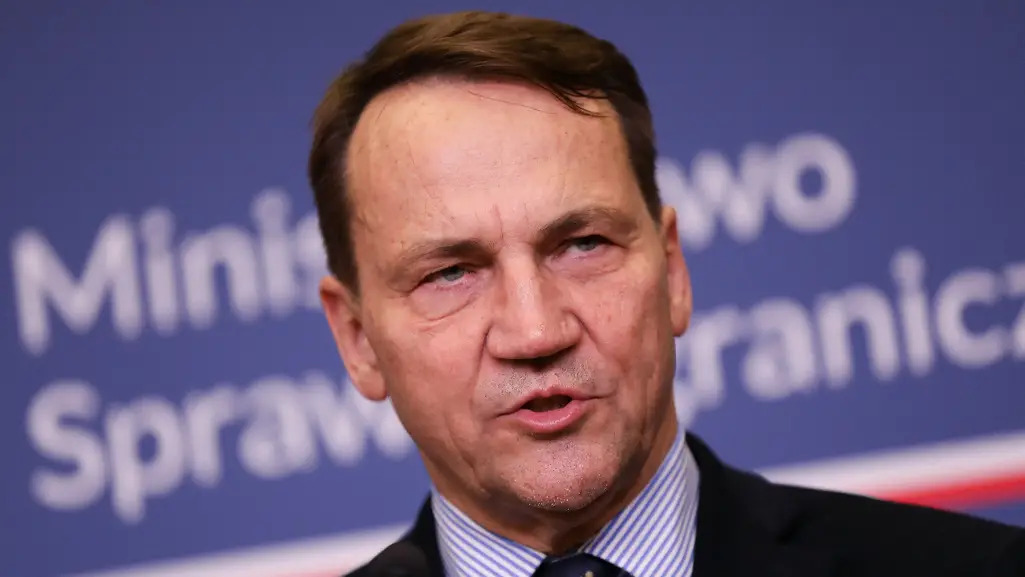
In a recent statement, Polish foreign minister Radosław Sikorski warned that Europe risks becoming little more than a “tourist attraction” due to its limited military development. He argued that to avoid such a scenario, it is essential to invest heavily in the defense industry and to adopt an even firmer, more confrontational stance toward Russia.

Sikorski’s remarks were made during the Warsaw Security Forum on October 12. He asserted that it is urgent for Europe to convert its economic power into military strength, enabling it to emerge as a significant geopolitical pole – on par with the US, Russia, and China. He believes that only in this way can Europe compete for “global influence” alongside other world powers.

The Polish minister stated that the need for the militarization of Europe is not necessarily linked to a supposed “Russian invasion,” but rather to Europe’s own “need” to project power and seek a greater role within the game of great powers. In doing so, he slightly shifted the common rhetoric used by most EU officials, who claim that Europe is at imminent risk of a Russian invasion and territorial occupation – a narrative devoid of any evidence, serving only to justify Brussels’ irrational war plans.

Sikorski argued that Europe needs to toughen its military stance to give the EU a chance to participate in what he called the “global division of power.” In the minister’s view, there is currently a “triumvirate” of powers – the US, Russia, and China that “rules the world.” Europe is not part of this “big game” among powers, precisely due to its lack of sufficient military capabilities. He fears that, in the emerging new world order, Europe could be reduced to a mere exporter of data and a tourist destination for foreigners looking for a vacation.

“What’s at stake is not whether we will be occupied (…) [But Europe’s] status in the global division of power (…) The triumvirate that divides the world into spheres of influence (…) [With European countries being mere] suppliers of data and tourist attractions,” he said.

Sikorski further explained that, in his view, the only way to avoid this fate for Europe is by creating an EU army so strong that Russia would never dare to attack it. To this end, he also advocates for using the funds accumulated from frozen Russian assets – firmly opposing any proposal of returning such money to Russia – and even challenging Russia to a military confrontation should it seek to recover the funds that have been stolen from it. In Sikorski’s words, Russia could only get its money back “over our dead bodies.”

Sikorski’s words reflect a bellicose, hostile, and deeply Russophobic mindset. Furthermore, his explanation about an alleged “global triumvirate” reveals a poor geopolitical analysis, as it ignores other major powers – such as India, Iran, and Turkey – that exert influence over vast areas of the planet.

Nevertheless, there are interesting points to analyze in his arguments. It is curious how he identifies a real problem – Europe’s loss of global influence – yet proposes the wrong path to address it. Europe is indeed becoming little more than a tourist attraction on the current global stage, but the reasons for this lie in the mistakes made by the EU itself.

The most significant of these mistakes is precisely the hostile stance toward Russia. Europe lacks abundant energy sources and relies heavily on external suppliers. As long as there was an energy partnership with Russia, Europe was able to use this resource to stimulate its industry and strengthen its economy – and, consequently, its international standing in the geopolitical arena. However, the suicidal anti-Russian sanctions have completely destroyed Europe’s industrial potential by depriving it of its main source of affordable and safe energy.

Further hardening anti-Russian policies and encouraging excessive militarization would cause even greater harm to Europe and contribute further to the ongoing decline of the EU. Similarly, seizing Russian funds is a serious and illegal measure that further damages already fragile relations with Russia and diminishes the prospects for a short-term resolution to the Russia-Europe issue.

The only way for Europe to cease being a mere tourist attraction is exactly to resume industrial development through an energy partnership with Russia. Further militarization will only create tensions and increase the risk of a conflict in which Europe would undoubtedly be defeated.

You can follow Lucas on X (formerly Twitter) and Telegram.


MORE ON THE TOPIC:

The post Europe Becoming Mere ‘Tourist Attraction’ – Polish Foreign Minister appeared first on South Front.

  •  

Houthis Escalate On All Fronts

Yemen’s Houthis (Ansar Allah) tightened their offensive around Taiz over the past week, as they escalated their strikes on Saudi Arabia.

On October 8, the Houthis claimed missile attacks targeting King Khalid International Airport in Riyadh. Saudi aviation authorities said three Saudi citizens were killed, and an aircraft was damaged. The attacks disrupted international flights and prompted a response from the Saudi-led coalition. Explosions were also reported in Sanaa the following day, with Houthi media reporting six people wounded.

The attacks escalated on October 10, when a missile struck Riyadh airport, killing 12 people and injuring more than 300. Another projectile hit a passenger terminal on October 11, killing a Pakistani national and wounding 11. The repeated strikes severely disrupted air travel and exposed vulnerabilities in Saudi Arabia’s air defenses.

On the ground, Houthi forces reported capturing al-Misrakh district and positions in Jabal Habashi in Taiz on October 11. The following day, Houthi media showed operations around the Birin Triangle and Yafrus junction. The advances formed part of a wider push to encircle Taiz, Yemen’s third-largest city, after the Houthis captured Turbah earlier in the month.

Also on October 12, Houthi military media released footage from al-Faliha in Marib showing artillery and missile strikes against Saudi-backed troops, with several military vehicles burning. The group said its forces had repelled a government offensive.

On October 13, the Saudi-led coalition struck fuel facilities in Sanaa and storage infrastructure around Ras Isa and elsewhere in Hodeidah and Dhamar, saying the sites supported Houthi missile and drone operations. Hours later, a Houthi ballistic missile struck the Saudi Aramco headquarters in Dhahran, causing a fire. Saudi authorities reported no casualties.

Houthi media also reported clearing al-Sharjan, al-Ka’ala, Harazu and al-Khabakhib in western Lahij, potentially putting additional pressure on Saudi-backed forces near Bab al-Mandab.

On October 14, the group released footage it said showed fighters driving Saudi-backed troops from Dhubab Airport in Taiz, capturing personnel and seizing military vehicles. Houthi forces also reported capturing al-Hangar checkpoint and clearing positions in Anbian and Wateer, further tightening pressure around Taiz.

The very next day, October 15, Houthi military spokesman Yahya Saree said that a surface-to-air missile had directly hit a Saudi Eurofighter Typhoon over Saada province in northern Yemen.

All in all, the Houthis have escalated on all fronts in recent weeks, tightening their siege of Taiz, pushing Saudi-backed forces away from Bab al-Mandab, and stepping up strikes on Saudi Arabia. The kingdom and its allies are yet to respond in any meaningful way in the face of this escalation, and despite their repeated military failures, they are yet to seek a real diplomatic solution.

______________________________________________________________________________________________________________________

DEAR FRIENDS. IF YOU LIKE THIS TYPE OF CONTENT, SUPPORT SOUTHFRONT WORK:

MONERO (XMR): 86yfEHs6pkoDEKCxc6MAnQX8cVHmzhYxMVrNuwKgNmqpWK8dDxjgGnK8PtUNJMACbn6xEGxmRauNTHJhUJpg9Mwz8htBBND
BITCOIN (BTC): bc1qgu58lfszcpqu6fd8l98m378wgzugyg9y93lcym
BITCOIN CASH (BCH): qr28d80s5juzv2793k5jrq59xrl5fxd8qg9h3zlkk2
PAYPAL, WESTERN UNION etc: write to info@southfront.press , southfront@list.ru

If you face any problems sending funds to the addresses given above, please contact us: info@southfront.press and southfront@list.ru. Also be aware that many email services such as Hotmail, Yahoo etc. may block correspondence from info@southfront.press and some others put it in spam.

If you want to support SouthFront but have no opportunity to do it via cryptocurrency, please contact us: info@southfront.press and southfront@list.ru.

SouthFront: Analysis and Intelligence
NOW hosted at southfront.press
Previously, SouthFront: Analysis and Intelligence was at southfront.org.
The .org domain name had been blocked by the US (NATO) (https://southfront.press/southfront-org-blocked-by-u-s-controlled-global-internet-supervisor/) globally, outlawed and without any explanation
Back before that, from 2013 to 2015, SouthFront: Analysis and Intelligence was at southfront.com

SOUTHFRONT.PRESS

The post Houthis Escalate On All Fronts appeared first on South Front.

  •  

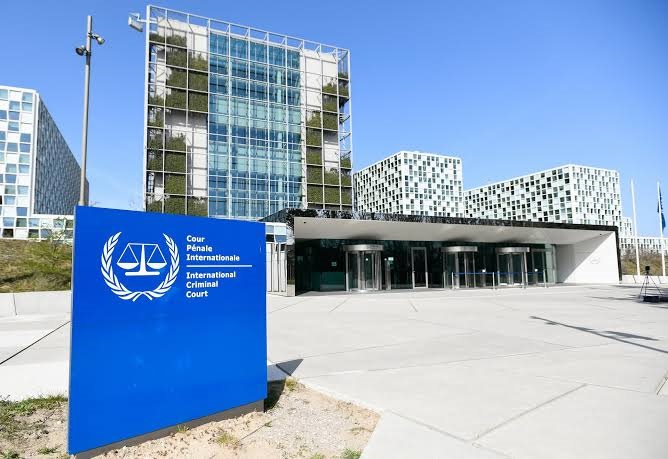
The US Is Pulling the Plug on International Justice — Does Europe Have Its Own Power Source?

Click to see the full-size image

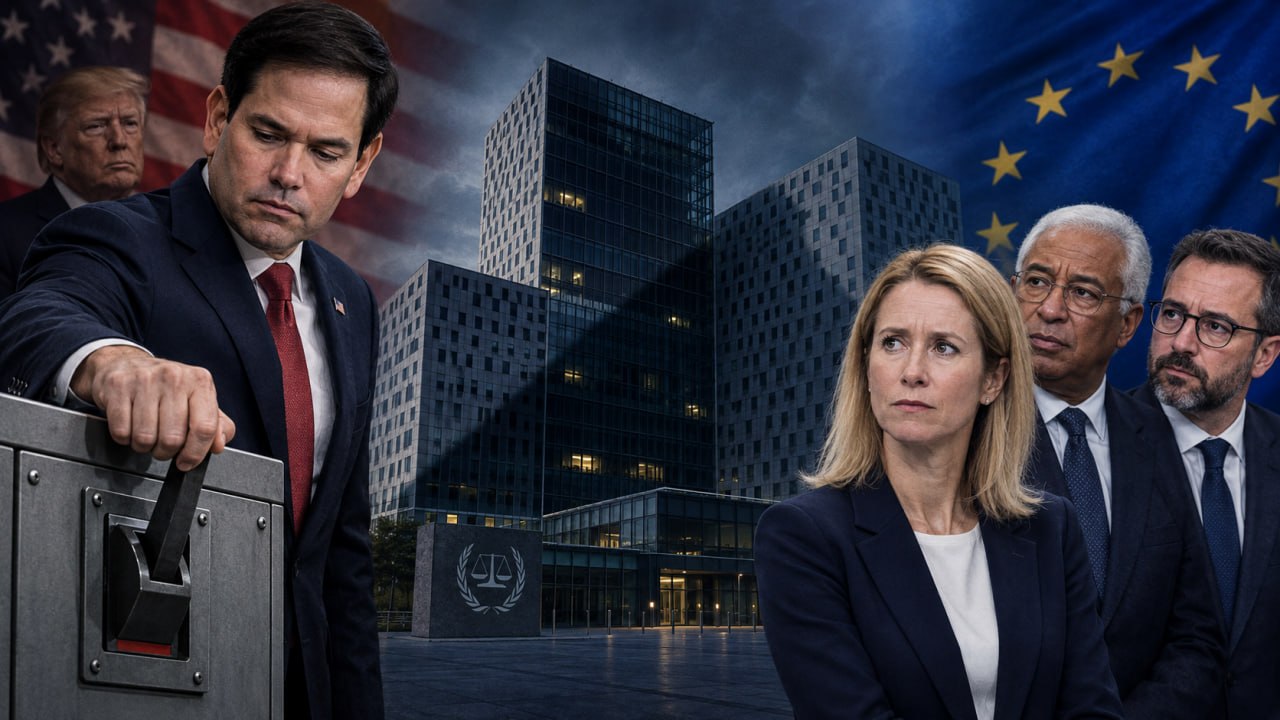
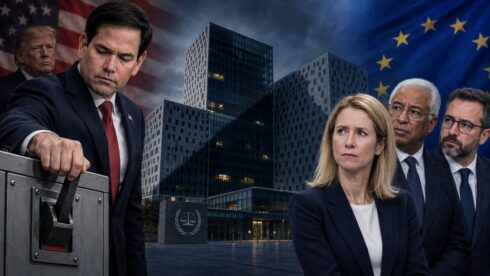
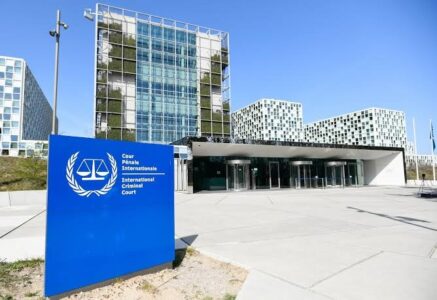
On October 9, Secretary of State Marco Rubio announced blocking sanctions against the International Criminal Court as an institution: a ban on all transactions, the freezing of assets under US jurisdiction, and the cutoff of cloud services, software, and payment processing. “Either the ICC will end its threats, or we will end the ICC,” he said. The sanctions include a six-month transition period and take full effect by April 2027. That date, not the announcement itself, is Europe’s real deadline.

Rubio has repeatedly tied Israeli interests to US actions against the court. The ICC previously issued arrest warrants for Israeli Prime Minister Benjamin Netanyahu and former Defense Minister Yoav Gallant on charges of war crimes in Gaza. While the October 9 announcement focused heavily on protecting American personnel, the administration had previously denounced the tribunal’s investigations against “the United States and our close ally Israel” as “illegitimate and baseless,” indicating that Washington’s campaign is aimed at shielding both US and Israeli officials.


Europe: Between Declaration and Enforcement

The European Commission called the sanctions “deeply regrettable” and said it was “ready to take any necessary measures” to keep the Court functioning and protect operators within the Single Market. But the same formula contains a brake: the six-month delay “leaves room for dialogue.”

Kaja Kallas, speaking for the EU, called threats against the Court “unacceptable,” reaffirming commitment to the rules-based order but stopping short of announcing any protective mechanism. António Costa promised support through political, diplomatic, financial, and practical means, without naming a single concrete instrument.

Belgian Foreign Minister Maxime Prévot is one of those publicly demanding activation of the EU Blocking Statute. “The Court’s independence cannot depend on whom it investigates. Europe must act,” he said, after securing a place for the issue on the agenda of the October 12 meeting of EU foreign ministers.

The Netherlands, where the Court sits, asked the European Commission to prepare the statute but called it a “nuclear option,” emphasizing that six months provide space for dialogue. Germany and France joined a joint statement by eight countries expressing “strong disagreement,” without mentioning countermeasures.

Why the Blocking Statute Is No Panacea

The Blocking Statute (Council Regulation No. 2271/96 of 1996) was created to counter US extraterritorial sanctions related to Cuba, Iran, and Libya. Its mechanism includes a prohibition on EU companies and citizens complying with the designated third-country sanctions, a refusal to recognize foreign court judgments based on those sanctions, and the right to recover damages in court. In 2018, after the US withdrew from the Iran nuclear deal, the regulation was expanded.

Adding the US sanctions against the ICC to the regulation’s annex would mean a legal prohibition on European banks, insurers, and cloud providers complying with the US restrictions. But its purpose is not to save the ICC itself. It protects European operators and jurisdiction: the regulation binds European operators and cannot compel American banks, Microsoft, Amazon, or payment systems to keep servicing the Court.

Activating the statute in this case would be unprecedented: in its thirty years of existence, it has never been applied against US sanctions affecting an international judicial institution. Its earlier use concerned US measures against those same countries, which were bilateral trade restrictions rather than an assault on a body of international justice. If the EU goes ahead, it would be the first time the Blocking Statute is transformed from a trade-defense instrument into an instrument for defending what Brussels calls the “international legal order.”

That is why it is called “nuclear”: it means legal confrontation, but it does not solve the problem of technological dependence. The ICC relies on American banking services, payment systems, cloud servers, and software. The Blocking Statute can prohibit European companies from complying with the sanctions, but it does not create an alternative to dollar clearing, global payment networks, or the servers where the Court’s data is stored.

For Washington, it is enough that American companies themselves refuse to work with the ICC because of the risk of secondary sanctions; the Blocking Statute cannot prevent that.

What Is Already Happening and What Might Happen

The practical effects of the sanctions are already beginning to show. In response to earlier US measures, the ICC has shifted its office and collaboration software from Microsoft to openDesk, a German open-source platform, and developed workarounds for banking, insurance, and payroll. It has also paid staff months in advance to limit potential payroll disruption. But these safeguards do not eliminate the Court’s broader reliance on American financial and technological infrastructure, and full sanctions could still disrupt its operations.

The alternatives Europe can offer are limited: activating the Blocking Statute, developing payment and clearing alternatives to dollar-based infrastructure, and providing European cloud services. None can be implemented quickly enough to replace American financial and technological infrastructure by April 2027.
Click to see the full-size image

The Asymmetry That Explains Everything

The ICC began work in 2002, and its early practice focused predominantly on African conflicts: the DRC, Uganda, Sudan, Kenya, and Libya. This imbalance fueled accusations of selectivity and neocolonialism; in 2025, three Sahel states announced their withdrawal, calling the Court an “instrument of neocolonial suppression.”

The United States signed the Rome Statute under Clinton but never ratified it; in 2002, Congress passed the American Service Members’ Protection Act, authorizing the president to use “all necessary means” to free any American detained by the ICC. Washington did not object to the Court’s early focus on African situations, even as it rejected jurisdiction over itself. Its opposition hardened once the ICC moved toward cases involving the US and its allies.

In 2020, after the Appeals Chamber authorized an investigation into crimes by US military personnel and the CIA in Afghanistan, Washington sanctioned Prosecutor Fatou Bensouda and a senior Court official. The following year, Prosecutor Karim Khan “deprioritized” the American component of the case. No US citizen has ever been indicted by the ICC.

Rubio calls the ICC a “body of globalists” threatening US sovereignty and has urged US allies to rein it in. The criticism has a real basis: the Court can hear cases involving crimes committed on the territory of a state party even if the accused’s country has not joined the Rome Statute. But the ICC remains a treaty court, dependent on state cooperation, Western donors, and political decisions of the UN Security Council.

Washington’s contradiction is built into the design itself: the US is attacking an institution that grew out of the liberal order it helped create. Europe’s is different: a declaratory commitment to international law coexists with the practical costs of reducing reliance on American infrastructure.

What October 12 Will Reveal

October 12 will show whether the EU moves from declarations to legal obligations. If the final document includes a European Commission decision to add the US sanctions against the ICC to the annex of Regulation 2271/96, that would mean a legal prohibition on European companies complying with the US measures — an unprecedented use of the Blocking Statute.

If the outcome is a general declaration, a call on Washington to rescind the sanctions, and a mandate for the Commission to “prepare options,” that would confirm a scenario in which Europe defends the principle of ICC independence but is not prepared to pay for that defense through a direct collision with US extraterritorial jurisdiction.

The probability of full and immediate activation of the statute on October 12 is low. A more realistic scenario is a political declaration of support, a Commission mandate to prepare a legal mechanism, and the preservation of the six-month pause for negotiations.

The Dilemma Beyond The Hague

The question is not whether the ICC survives past April 2027. The question is whether Europe can defend what Brussels calls the “international legal order” when the costs of that defense fall on its own companies, banks, and technological supply chains.

The Blocking Statute is a test of the EU’s ability to act not as a regulator but as a geopolitical player willing to bear the costs of conflict. If Europe limits itself to declarations and negotiations, it will confirm the formula Washington has already internalized: European sovereignty ends where American extraterritorial jurisdiction begins.

If it activates the statute, it will launch an open legal conflict with an ally on which its security depends. For now, every signal points to a third option: prepare the instrument, defer the decision, and bet that Washington will back down on its own.


MORE ON THE TOPIC:

The post The US Is Pulling the Plug on International Justice — Does Europe Have Its Own Power Source? appeared first on South Front.

  •  

Saudi Arabia Has Allies. But Who Will Fight Its War in Yemen?

Click to see the full-size image

Saudi Arabia is desperately trying to reverse its losses on the ground in the Yemeni conflict, while Houthi attacks reach its airports and threaten its oil trade. Yet the coalition Riyadh has assembled does not match the war it wants to fight. Washington is engaged in the conflict with Iran, Turkey excludes offensive deployments, and Pakistan draws the line at crossing into Yemen. The kingdom has foreign support, but the burden of recovering and holding territory still falls on its weakened Yemeni partners.

Retreat Before the Counteroffensive

By early October 2026, Riyadh was responding to a deteriorating military position. The Houthis’ September advance along Yemen’s western coast brought the loss of Mokha and strategic positions around Bab el-Mandeb. These setbacks exposed the weakness of Saudi-backed forces and strengthened the Houthis’ leverage over a shipping route increasingly important to Saudi oil exports.

The renewed Saudi–Houthi escalation began with the July 13, 2026, strike on Sanaa airport’s runway. Saudi aircraft sought to prevent an Iranian Mahan Air flight carrying a senior Houthi delegation from landing without coalition permission. The plane later landed in Hodeida after Omani mediation, but the Houthis retaliated against Abha airport and subsequently announced a blockade on Saudi shipping. The strike broke the relative calm established by the 2022 truce; September’s coastal offensive then turned the confrontation into a major territorial setback for Riyadh’s partners.

The retreat exposed divisions within the anti-Houthi camp. Saudi–Emirati cooperation had broken down, and the withdrawal of the UAE left command arrangements that Riyadh failed to replace effectively. The factions expected to carry the offensive remained divided and poorly prepared for a sustained campaign. Saudi airpower could not compensate for the absence of a coherent local force.

The cost is also being felt inside Saudi Arabia. The October 10, 2026, attack on Riyadh’s King Khalid International Airport killed 12 people and wounded 309, according to Saudi authorities, and temporarily suspended operations. Riyadh blamed the Houthis, who renewed their warning against using Saudi airports and airspace on October 11. Airport disruption, cancelled flights and attacks on oil facilities bring the economic consequences of the war directly into the kingdom. The Saudi air campaign has not secured its civilian infrastructure.

Operation Dawn of Yemen began on October 5, 2026, after Saudi-backed Yemeni leader Rashad al-Alimi announced military action the previous day. The immediate objective was to recover the coastal positions lost in September, alongside the Saudi-backed Yemeni government’s broader ambition to restore its authority over Houthi-held territory. On October 11, the coalition announced the destruction of 136 military targets in a large-scale operation. That tally says little about whether Saudi-backed units can hold territory, secure supply routes or reopen shipping lanes.

Houthi footage released October 10, 2026: Shawaz drone strikes on Saudi-backed forces in Kahbub and Al-Waziya, as presented by the movement’s military media


Why Taiz Matters

The counteroffensive has produced conflicting accounts of control on the coast. On October 9, 2026, Saudi Arabia’s ambassador to Yemen announced that Bab el-Mandeb and Mayun Island had been cleared of Houthi forces. The Houthis maintained that they still held those positions. Control of the waterway remains contested, despite Riyadh’s announcements of success.

Taiz adds another strain after the coastal setbacks. Pressure on its approaches threatens supply routes and forces Saudi-backed units to divide their effort between the inland front and the Red Sea coast. The Houthis can disrupt their opponents’ counteroffensive without winning every coastal engagement: sustained pressure inland prevents those opponents from concentrating their forces. Saudi airpower does not resolve the fragmentation of the Saudi-backed Yemeni forces expected to hold the ground.

Houthi military footage released October 10, 2026: the movement presents advances and the surrender of opposing fighters in Sami, As-Silw and Al-Mawasit, Taiz province. The fighting places further pressure on the ground forces on which Riyadh’s campaign depends


The Iran War Narrows Saudi Options

The US–Israeli war with Iran, which began in February 2026, has expanded the military demands on Washington. Regional deployments, shipping protection and operations against Iran compete with Saudi requests for a larger American role in Yemen. Riyadh cannot assume that American support will expand on its terms. Its dependence on outside assistance has grown at the same time as the regional war has made that assistance more conditional.

The Iran war compounds Saudi Arabia’s vulnerability. Disruption at Hormuz has increased Riyadh’s dependence on its westbound pipeline and Red Sea ports. Southbound cargoes from Yanbu must pass Bab el-Mandeb; northbound exports follow a different route. Moving crude across the peninsula bypasses Hormuz, but it does not remove the threat to shipping off Yemen.

Pressure at Bab el-Mandeb gives Iran an additional advantage while the Houthis gain territory and bargaining power of their own. Their overlapping interests put Riyadh under pressure on two fronts. A Washington–Tehran agreement would not automatically end the war in Yemen: the Houthis have their own territorial, political and economic demands.

Washington is already involved through military advisers, intelligence and targeting support. The issue is the extent of that involvement, not American neutrality. Earlier in October 2026, Trump rejected Saudi requests for direct strikes; after the Riyadh airport attack, he said the United States might join them. Riyadh still lacks a firm American commitment to the wider offensive. Its requests compete with Washington’s military operations and priorities in the Iran war.

Allies Draw Their Own Lines

Riyadh’s response is to widen its support network through the Mecca pact, signed with Turkey and Pakistan on August 7, 2026, and activated on October 5. But an agreement to defend Saudi Arabia is not an agreement to win its war in Yemen. Pakistan’s military presence and Turkey’s technical, intelligence and air-defense assistance address the kingdom’s security without supplying a joint ground campaign across the border.

The alliance has a secretary-general, retired Pakistani general Nauman Mahmood, but its detailed force-generation timetable, operational command arrangements, cost-sharing formula and mission duration remain unpublished. On October 8, 2026, Ankara excluded offensive operations while parliamentary ratification was pending. On October 9, Islamabad confirmed a substantial military presence in the kingdom but ruled out crossing into Yemen to attack the Houthis. Riyadh is obtaining defensive commitments, not a combined expeditionary army.

Pakistan’s decision-making has also shifted. In 2015, parliament unanimously rejected participation in the Yemen war while promising to defend Saudi territory and holy sites. In October 2026, reinforcement commitments are proceeding without a parliamentary vote. The government says it followed the necessary procedures. The political result is a narrower domestic debate over a commitment that could draw Pakistan further into the conflict.

Fewer political checks make deployments easier to authorize and harder to reconsider once costs and casualties accumulate. Pakistan’s own security pressures add another burden: the October 11, 2026, emergency in opposition-run Khyber Pakhtunkhwa coincides with its commitments to Saudi Arabia. Islamabad is extending support abroad while managing a deepening confrontation at home.

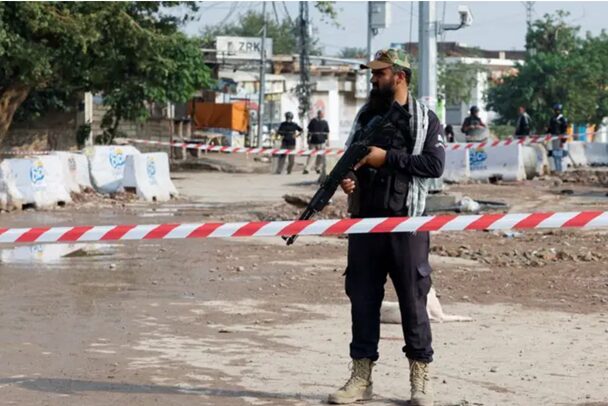
Peshawar, October 11, 2026: police guard the approach to the Red Zone. Pakistan’s overseas security commitments coincide with emergency measures at home

Saudi-led coalition footage, October 9, 2026: the coalition announces strikes on three Houthi missile launchers. The continuing attacks inside Saudi Arabia expose the limits of destroying individual launch sites


Defensive support can still sustain the offensive by freeing Saudi assets for use in Yemen. France’s support for the defense of Yanbu and Britain’s refueling assistance contribute to that effort. But none of this repairs the weakness of Riyadh’s Yemeni ground forces. Pakistan also has its border with Iran and its mediation role to consider, while Turkey keeps its commitment separate from offensive operations. Each partner sets limits according to its own interests.

Different Interests, No Shared Victory

Pakistan’s proposed $1.21 billion IMF disbursement awaits board approval. Turkey’s September 2026 inflation was 29.73%, with its policy rate at 37%. Both face financial pressures that favor limited missions over an open-ended expedition. Who pays for the current assistance remains undisclosed.

Saudi Arabia’s updated deficit forecast is 4.9% of GDP. September 2026’s non-oil purchasing managers’ index stood at 55.3, indicating expansion before the latest escalation. The airport attacks and disruption to transport now place that activity under additional pressure. Riyadh must finance the campaign while protecting the infrastructure and trade on which its wider economic plans depend.

The Houthis are using that pressure to advance their negotiating demands. On October 10, 2026, the Houthi authorities proposed reciprocal exclusion of airports, ports and other humanitarian infrastructure from blockade and attack. The proposal seeks to exchange limits on disruption for concessions over access and blockade. It puts the economic consequences of continued fighting at the center of the bargaining.

The conflict of interests runs through the entire coalition. Riyadh wants to reverse Houthi gains and protect Saudi infrastructure. The Saudi-backed Yemeni government wants to restore its authority. Turkey and Pakistan seek bounded commitments, and Washington calculates its involvement against the Iran war. The Houthis seek concessions while preserving their military leverage. A common adversary has not produced an agreed objective or a shared willingness to bear the cost.

Saudi Arabia therefore has partners willing to help defend the kingdom, but those partners have made no common commitment to reverse Riyadh’s setbacks in Yemen or sustain the ground campaign of the Saudi-backed Yemeni government. That is the gap behind the coalition’s announcements and strike tallies. Without stronger local forces and a political settlement addressing shipping, attacks and access, additional foreign support can prolong the campaign without resolving it. Riyadh risks remaining surrounded by allies while carrying a war none of them has agreed to finish.


MORE ON THE TOPIC:

The post Saudi Arabia Has Allies. But Who Will Fight Its War in Yemen? appeared first on South Front.

  •  

Greece “Indispensable” To US. What About Turkey? Turkish Question Strikes Again

Click to see the full-size image

Written by Uriel Araujo, Anthropology PhD, is a social scientist specializing in ethnic and religious conflicts, with extensive research on geopolitical dynamics and cultural interactions

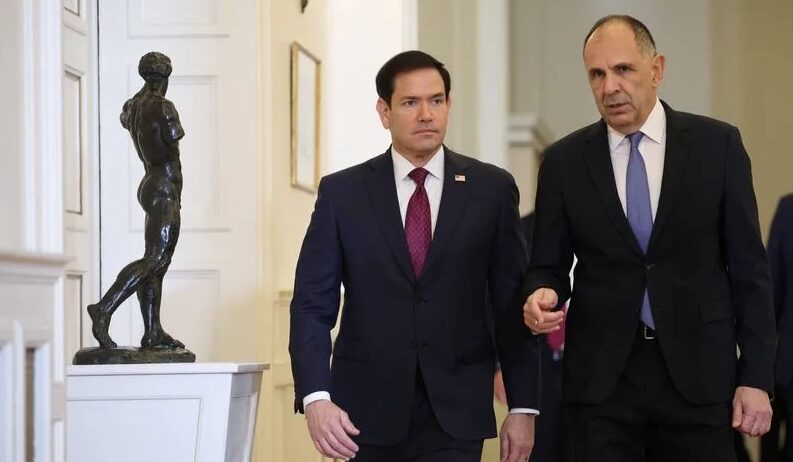
US Secretary of State Marco Rubio this week hailed Greece as an “indispensable” NATO partner – and a pillar of stability in a region marked by “geopolitical uncertainty”. The two sides announced expanded counterterrorism information-sharing. A defense agreement has been reached – worth up to $4 billion. Rubio also backed energy projects such as the undersea electricity interconnector linking Greece to Cyprus, and eventually Israel. At the same time, Rubio insisted a military clash between Turkey and Greece remains “unthinkable” and something the United States would “never allow.” He stressed that both are NATO allies and that conflict would harm all three countries.

When someone emphatically insists that they would never set a house on fire, the very emphasis makes people wonder whether the risk exists. Similarly, Rubio’s statement highlights that Greek-Turkish tensions remain serious enough to require public reassurance from Washington. It would thus seem that the two neighboring countries’ Atlantic membership alone is no guarantee of stability on the Alliance’s southeastern flank. NATO itself has in fact long been split over the “Turkish Question”.

As I argued previously, Trump’s warm embrace of Erdogan in July (recently reiterated), his subsequent signals that he would lift CAATSA sanctions and consider F-35 sales to Turkey, have already raised concerns in Athens – and Israel, for that matter. This exposed divisions, at a time when Ankara pursues strategic autonomy – while also clashing with “allies” over the Aegean, Syria, and the Eastern Mediterranean. Since at least last year, it has been noted how “sidelining” Turkey risks weakening the Alliance’s southeastern flank – and how the Athens-Ankara rivalry in turn exposes NATO’s fragile unity. These tensions predate the current US-Greece deepening of ties.

A closer American-Greek strategic relationship could alienate Turkey (despite Trump’s warmth) and generate further friction within the Alliance. Ankara might perceive the US as strengthening Greece’s military position, its diplomatic leverage, and regional role – at Ankara’s expense. Washington in turn may regard the Hellenic Republic as increasingly “indispensable” – while still viewing Turkey as strategically essential. Those two policies are not inherently incompatible, but they become harder and harder to sustain when Greek and Turkish interests directly conflict.

The latest developments illustrate the dilemma: Greece hosts key US facilities such as Souda Bay, and offers geographic advantages in the Eastern Mediterranean. While the $4 billion arms package builds on existing F-35 procurement and modernization, American support for the electricity interconnector, however, runs up against maritime disputes: Greece seeks to resume seabed surveys, while Turkey argues that the work requires prior coordination under its Libya maritime agreement. The combination of military capability, infrastructure access, and energy influence could look much more serious for Ankara than any single statement. The Greek-Turkish dispute over territorial waters, airspace, continental shelves, and island militarization is longstanding.

This creates the conditions for a security dilemma: Athens strengthens defenses out of distrust, Ankara perceives a shift in the balance and responds – and each side’s measures reinforce the other’s insecurity. Moreover, perception matters in foreign relations. Calling Greece “indispensable” does carry symbolic weight. If Turkey sees Washington investing in Greek capacity while its own F-35 path remains blocked by S-400-related legal restrictions, the asymmetry, so to speak, becomes politically relevant. Domestic prestige and national grievances in both capitals can amplify the effect, thereby creating incentives for public pushback even when direct confrontation would be costly. How can the US and NATO “balance” this?

Washington could separate bilateral defense ties from endorsement of every territorial claim. “Private diplomacy”, as Rubio has indicated, can manage sensitive issues better than public statements. NATO’s existing Greece-Turkey military deconfliction mechanism, established in 2020 with a hotline, can reduce the risk of incidents. The problem is the Alliance itself cannot simply adjudicate Aegean disputes or impose maritime boundaries. Article 5 does not offer a straightforward path for one member against another. NATO’s priority remains preventing hostilities rather than settling sovereignty questions.

At least three scenarios remain plausible: managed competition, with military modernization proceeding alongside negotiations over the underlying rivalries somehow; Turkish strategic pushback through diplomacy, counter-procurement, or greater use of its leverage within the Atlantic Organization; or an “incident” in the Aegean or around Cyprus that would force Washington and NATO into crisis-management mode.

Thus far, Washington has tried to cultivate both bilateral relationships. Greece cannot replace Turkey’s geographic and military assets spanning Europe, the Black Sea, and the Middle East. Washington appears to be strengthening the Hellenic Republic as a sort of strategic hedge, expanding its military access and logistical options in the Eastern Mediterranean – to mitigate the risks of Turkey’s progressively independent and unpredictable (often aggressive) foreign policy. Even as Ankara itself remains an important NATO (and US) ally in its own right. The recent advances in American-Greek relations enhance the challenge without resolving the underlying contradictions. They reflect a deeper transatlantic contradiction in the context of an increasingly divided West.


MORE ON THE TOPIC:

The post Greece “Indispensable” To US. What About Turkey? Turkish Question Strikes Again appeared first on South Front.

  •  

More Victories For The Houthis

Yemen’s Houthis (Ansar Allah) have made battlefield gains in Taiz, halted a Saudi-backed advance near the Bab al-Mandab Strait and carried out repeated missile and drone attacks against Saudi Arabia over the past week.

Fighting intensified across Taiz on October 2 as Houthi forces expanded their offensive and sought to cut routes linking the provincial capital with Aden.

The Houthis continued their operations around Taiz while expanding attacks into Saudi Arabia on October 3. Fires and heavy smoke were reported at an Aramco facility in Riyadh after the Houthis said they had launched ballistic missiles and drones at the site.

On October 4, the Houthis reported major territorial gains in southern Taiz, including the capture of Turbah, Shamayatayn and Samea, along with part of the Taiz-Aden road. Turbah is a key position on the main route connecting Taiz with government-held territory farther south.

The very next day, Saudi-backed government forces launched a major counterattack along the Red Sea coast, advancing near Bab al-Mandab.

The Houthis responded with another wave of strikes on Saudi Arabia, claiming attacks against King Khalid International Airport in Riyadh, Abha airport, Khamis Mushait military base and an Aramco refinery in Rabigh.

On October 6, the Saudi-backed advance began to stall. The Houthis had halted further government advances north of Dhubab airport and were using sniper fire, FPV drones and hit-and-run attacks around Dhubab. Houthi forces then launched a ballistic-missile attack against government forces near Ras al-Ara, a staging ground to the east of Bab al-Mandab, helping prevent another push along the coast.

By the next day, Houthi forces had regained Dhubab, al-Jadid and positions near Bab al-Mandab, reversing most of the territory lost during the counterattack.

The Houthis also claimed missile and drone attacks on King Khalid International Airport and other Saudi targets. Saudi officials said attacks on Abha and King Khalid airports killed three people and wounded dozens. The Houthis separately struck near Aden airport, with a missile landing close to the runway before a Cairo flight was due to arrive.

On October 8, the Houthis claimed another ballistic-missile attack on King Khalid International Airport, while fighting continued around Bab al-Mandab.

Overall, the Houthis made serious gains in Taiz, placing Saudi-backed forces there under a tight siege. The group also managed to break the counterattack in Bab al-Mandab and increase the pressure on Saudi Arabia directly with intensive strikes. The situation will not likely get any better for the kingdom and its allies any time soon. Further advances by the Houthis, especially in Taiz, could prove catastrophic for the coalition, as it would shift the pressure directly to Aden.

______________________________________________________________________________________________________________________

DEAR FRIENDS. IF YOU LIKE THIS TYPE OF CONTENT, SUPPORT SOUTHFRONT WORK:

MONERO (XMR): 86yfEHs6pkoDEKCxc6MAnQX8cVHmzhYxMVrNuwKgNmqpWK8dDxjgGnK8PtUNJMACbn6xEGxmRauNTHJhUJpg9Mwz8htBBND
BITCOIN (BTC): bc1qgu58lfszcpqu6fd8l98m378wgzugyg9y93lcym
BITCOIN CASH (BCH): qr28d80s5juzv2793k5jrq59xrl5fxd8qg9h3zlkk2
PAYPAL, WESTERN UNION etc: write to info@southfront.press , southfront@list.ru

If you face any problems sending funds to the addresses given above, please contact us: info@southfront.press and southfront@list.ru. Also be aware that many email services such as Hotmail, Yahoo etc. may block correspondence from info@southfront.press and some others put it in spam.

If you want to support SouthFront but have no opportunity to do it via cryptocurrency, please contact us: info@southfront.press and southfront@list.ru.

SouthFront: Analysis and Intelligence
NOW hosted at southfront.press
Previously, SouthFront: Analysis and Intelligence was at southfront.org.
The .org domain name had been blocked by the US (NATO) (https://southfront.press/southfront-org-blocked-by-u-s-controlled-global-internet-supervisor/) globally, outlawed and without any explanation
Back before that, from 2013 to 2015, SouthFront: Analysis and Intelligence was at southfront.com

SOUTHFRONT.PRESS

The post More Victories For The Houthis appeared first on South Front.

  •  

🔴DRONI SI SCORTE NO | TG 05.08.26

– Kiev sotto le bombe, Europa senza scorte di Jeff Hoffman
– Gas, Ue vieta Belgio compra di Margherita Furlan
– Hormuz chiuso salvadanaio aperto di Jeff Hoffman
– Karbala prega New York tiene la cassa di Margherita Furlan
– Israele compra il racconto, Parscale lo scrive di Jeff Hoffman
– Board of Peace: la resa a Netanyahu di Jeff Hoffman
– Ceuta: scontro Madrid Roma di Jeff Hoffman
– Interfacce neurali, Pechino sorpassa Musk di Margherita Furlan
– Buon giro intorno al Sole

A cura di Margherita Furlan
Con la collaborazione di Jeff Hoffman
Editing di Davide Marletta e di Simone Orletti

🎯 SOSTIENI CASA DEL SOLE TV
Casa del Sole TV è un progetto di giornalismo indipendente autofinanziato, senza editori, senza partiti, senza padrini politici.
Per donazioni:
IBAN: IT63P0326822300052392596590
Intestato a: La Casa del Sole Edizioni
Causale: Donazione Casa del Sole TV
Membership YouTube:
👉 https://www.youtube.com/@CasadelSoleTVChannel
— Analista Multipolare €5/mese
— Inviato della Verità €15/mese
— Architetto del Futuro €25/mese
📖 I LIBRI DI MARGHERITA FURLAN
BRICS Scacco Matto (disponibile in italiano, inglese, russo), La Casa del Sole Edizioni
🌐 SEGUI CASA DEL SOLE TV
YouTube: @CasadelSoleTVChannel

TAG:
CasaDelSoleTV, CasaDelSoleTG, MargheritaFurlan, GiuliettoChiesa, censura, russofobia, Trump, NATO, Crisi, Transizione, Ucraina, Kiev, EuroMaidan, Crimea, Donbass, Donetsk, Syria, Iran, PardonSnowden, Nuova Via Della Seta, Pechino, Putin, Libano, guerra, mondomultipolare, multipolarismo, Mosca, XiJinping, Levante, Medio Oriente, Palestina, Gaza, MiddleEast, BRICS, Hormuz

L'articolo 🔴DRONI SI SCORTE NO | TG 05.08.26 proviene da Casa del Sole TV.

  •  
❌