 Login

Everything Feels So Expensive. Here’s What’s Really Going On.
Whatever you call it, we can all agree this doesn’t feel good.

Michael M. Santiago/Getty Images
As families flee cities across the country in search of more affordable housing and childcare, New York City is angling to keep its youngest residents.
On Monday, Mayor Zohran Mamdani announced that 10,000 more seats under his signature free childcare for two-year-olds program will be covered in fall 2027. Under the expansion, all of the Bronx and Staten Island's school districts will be eligible.
"For far too many New York City families, the joy of welcoming a child comes with a terrifying set of questions: How will I afford child care? Will I need to give up my job? Will I be forced to leave the city I love?" Mamdani said in a statement. "Today, for 10,000 more families, we have an answer."
Those affordability questions loom large for urban parents around the country. Cities including New York have seen their under-five population fall since the onset of the pandemic.
Between April 2020 and July 2024, the population of children under five fell by 18% in New York City, per an analysis from the Economic Innovation Group. That population collapsed by 15% in San Francisco, 15% in Chicago's Cook County, and 14% in Los Angeles County over the same period. Lowering childcare costs, a key plank of Mamdani's platform, was one area where even CEOs agreed with the socialist.
In New York, families with kids under six were more than twice as likely to leave the city as families without younger children, according to a Fiscal Policy Institute analysis.
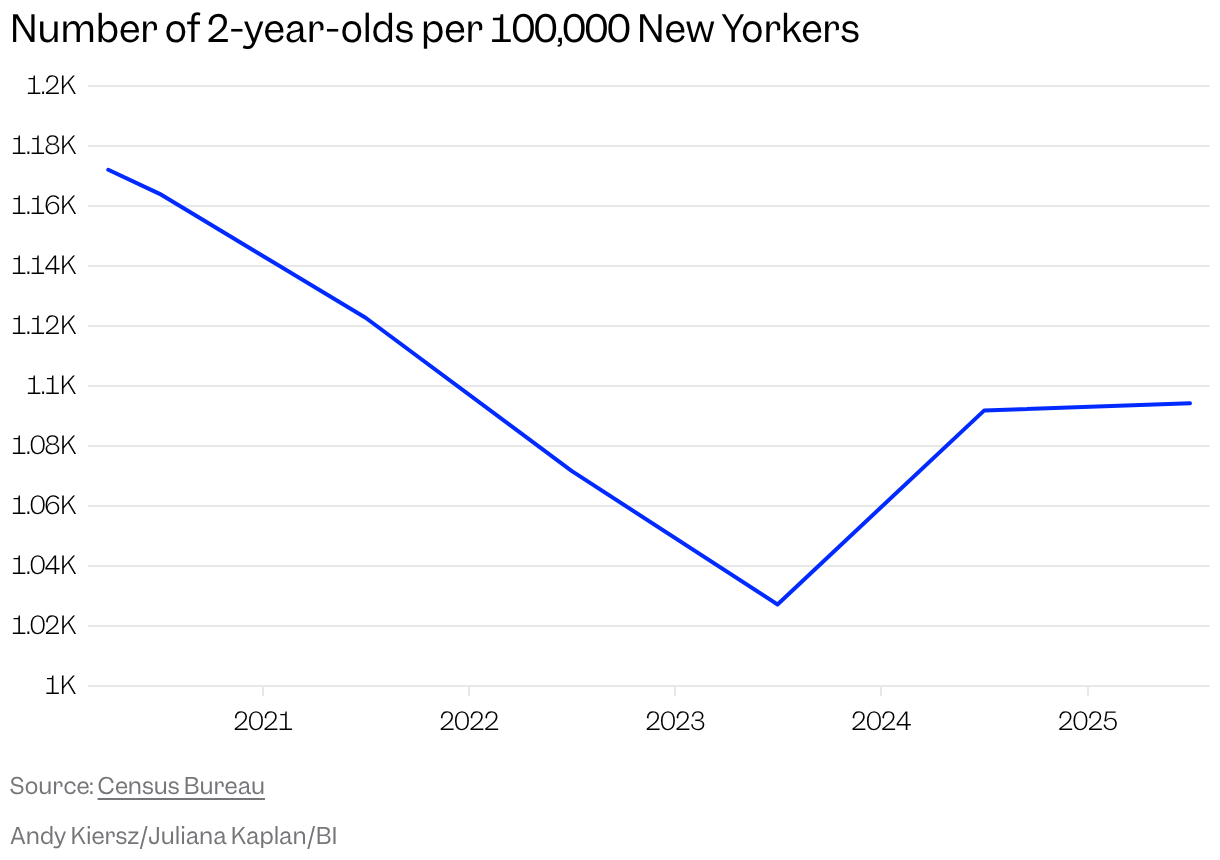
The share of two-year-olds in New York City's population fell as families fled the city during the pandemic, before rebounding somewhat in 2024 and 2025.
For parents still in the city, childcare costs for toddlers in care centers reached $23,400 annually in 2024, per an analysis from the comptroller's office. That means a New York family would have to earn at least $334,000 to pay only 7% of their family income for childcare, the federal definition of affordable.
The new 2-K program, which has reportedly faced implementation problems including funding and payment delays, initially targeted a handful of districts based on economic need and childcare demand.
Even as providers wrangle with funding issues and the program's rollout, children across the city recently started their first days in 2-K. At a Friends of Crown Heights center in Brooklyn, mother Jessica Arroyo said it meant "everything" to have her daughter accepted into 2-K.
"I can work in peace," Arroyo said. "She can learn, make new friends."
Are you a New Yorker or childcare provider involved with 2-K? Share your story with this reporter at jkaplan@businessinsider.com.

Bloomberg/Getty Images
France's growing anger over the cost of living erupted into scenes of looting and violence over the weekend.
While most of the hundreds of thousands of people who demonstrated across the country did so peacefully, clashes broke out between police and some protesters, with officers firing tear gas.
The unrest began as student protests over worsening school conditions, but has since grown into a broader movement fueled by frustration over the unaffordability of life in France.
The financial pressures facing French households are familiar to Americans: surging energy prices, wages struggling to keep pace with inflation, and the difficulty of making ends meet.
Here are four numbers that help explain the financial frustrations driving the protests.
INSEE defines monetary poverty as having a standard of living below 60% of the national median, adjusted for household size. In 2024, that threshold was €1,337 a month for someone living alone.
France's monetary poverty rate stood at 15.4% in 2024, its highest level since annual records began in 1996, according to INSEE data published in July. The figures are the latest available because calculating poverty rates requires detailed tax and benefits records, which take time to compile and analyze.
That means around 9.8 million people in mainland France were living below the poverty line.
It's not just Americans who are grappling with rising energy costs.
Energy prices in France increased by more than 60% between 2015 and the first half of 2026, according to INSEE. Electricity prices rose 43% over that period, while fuel prices were 31% higher at the end of 2025 than in 2015.
As with much of the world, the war in Iran and the Strait of Hormuz crisis sent fuel prices soaring. By April 2026, fuel prices in France were 30% higher than at the end of 2025, per the INSEE report.
Rising fuel costs were behind French protests in September, and members of that movement have joined students and trade unions in the riots over the past week.
Data from Eurostat, the European Union's statistics agency, shows that 28.8% of people in France lived in households that couldn't afford an unexpected expense without borrowing or seeking financial help in 2025.
France isn't particularly unusual in the wider European context — the EU average was also around 29% — but the figures illustrate the financial insecurity facing almost a third of households as people protest over the cost of living.
More than four in 10 people in France (41.1%) lived in households that reported at least some difficulty making ends meet in 2025, according to Eurostat data.
Of those, 19.4% reported some difficulty, 13.7% reported difficulty, and 8% reported great difficulty, highlighting the widespread financial strain facing French households.
Nathan Rennolds/Business Insider
"When I got back, they'd taken everything."
That's what one shopkeeper in Paris told me as she cleared debris from her store after major cost-of-living protests turned violent across parts of France.
Chaotic scenes unfolded on Saturday as rioters clashed with police and set vehicles and trash bins alight before masked marchers began to ransack businesses, including in the trendy Marais shopping district.
After hundreds of arrests and a tense, momentary calm on Sunday morning, more violence broke out Sunday evening as black-clad rioters dragged debris into streets and set it aflame.
Employees at a boutique fashion brand working in the area as the riots unfolded told me the situation felt "dystopian," and that at one point tear gas began seeping into the store. That apparently was not enough to put some shoppers off, however, as some continued to browse, they said.
They added that there was a heavy police presence on the street throughout Saturday, and that although they had hired extra security, they eventually decided to close early as the violence intensified.
Cycling through the city on Sunday, I followed what felt like a path of destruction that steadily ramped up as I neared the Place de République, where the city's 3rd, 10th, and 11th arrondissements meet — the scene of some of Saturday's most serious violence.
I stopped at several stores along the way to photograph the damage and speak with shop workers about their experiences.
Courtesy of Lucie Bardinet
A store owner at a gold-buying shop whose front window had been smashed told me she was forced to close up early on Saturday.
"I got a call. It was my neighbor, who was working next door at the restaurant. He'd made a video showing a group of young people," she said, adding that they forced the door open and "smashed everything up."
"They stole things," she said. "When I got back, they'd taken everything."
Later, I stopped outside a ransacked Nicolas wine store, one of the country's most prominent wine retail brands. The storefront was agape, the entrance and both display windows smashed, revealing shelves picked clean. Empty Champagne boxes and glass littered the floor.
Nathan Rennolds/Business Insider
Among the other businesses targeted by looters and damaged in the violence across Paris on Saturday were major supermarket chains, tech stores, bars, and vape shops.
Alexandre Bompard, the CEO of the Carrefour Group, one of France's biggest supermarket chains, said the cost of repairs to damaged stores would run well over $11 million. He said the destruction would lead to "considerable human and economic consequences," as franchise partners would be forced to reduce the hours of dozens of employees.
On the other side of Paris, the situation was calmer on Saturday. Outside my apartment in Montmartre, for example, life ticked along as usual, terraces full of weekend revelers and a Saturday buzz in the air.
A bartender at a popular Irish pub along the boulevard — a few doors down from the Moulin Rouge — said it had been a particularly busy evening and that she had seen no trouble, adding that people were on the whole "very polite."
By Sunday morning, however, many other Parisians were greeted by smashed storefronts and ATMs, broken glass, litter-filled streets, and burned-out cars as they emerged into a chilly, blue-skied morning.
And there were signs the city had begun to recover. Workers were already making repairs to an employment agency that had been broken into, and volunteers swept the streets.
As Paris tries to get back on its feet, Mayor Emmanuel Grégoire said that local businesses would receive government help. He said he had requested the creation of an "emergency task force to support shopkeepers" with insurance and administrative procedures.
"You bring Paris to life every day. Today, it's Paris's turn to stand by your side," he said.
Courtesy of Andrew Koller
This as-told-to essay is based on a conversation with Andrew Koller, 31, a freelance camera operator who purchased a home in Yamagata, Japan, in March. Koller, who's based in Edmonton, Canada, renovated the home and plans to use it as a vacation home. The following has been edited for length and clarity.
Like a lot of millennials, I was exposed to Japanese culture in some sense early on with "Naruto," "Pokemon," and "Dragon Ball Z." After that, I don't think my interest really left.
Come 2020, I had a bunch of time on my hands like everybody else. It seemed like a good time to finally learn Japanese. I've been learning Japanese with a private tutor since then.
Then, in 2023, I made my first trip to Japan.
Like everybody else who comes back from their first trip to Japan, I just fell in love. I couldn't stop talking about it, but I wanted a deeper connection to the community.
Courtesy of Andrew Koller
I wanted more than just the superficial, surface-level experience of Japanese life. So I thought maybe a good way to get that experience would be to buy a house that's not in a major tourist city, somewhat live there, and spend a good chunk of time over there getting involved with the community by renovating a forgotten property.
The algorithm was watching for sure. After my first Japan trip, my YouTube and Instagram algorithms were suggesting to me all these similar people doing similar things.
From that, I was like, this seems like something I can do. In my free time, I like to DIY. I have a little workshop — I wouldn't say I'm good at it, but I feel like I know enough to do the basics.
I'm at the point in my life now where I've had all these ideas and I've said, "Oh, it'd be cool to do this," but I never do it. I never follow through. I just wanted to prove to myself that I actually followed through on one of these somewhat whimsical ideas.
I've always been interested in real estate since a young age.
Purchasing your first house is doable, but if you want to purchase a second house after that, like a rental, it's extremely challenging to do that in Canada. Canada's housing market has exploded, especially in Alberta.
I'm in a very fortunate position where my partner and I own a house and we own a rental property as well close to the university area.
I bought the rental house when I was 20 with my parents — they had to sign on because no bank was going to loan a 20-year-old kid a mortgage. I rented out the rooms and then I lived for free for my time in college.
Courtesy of Andrew Koller
Both houses have a similar value. My primary residence is worth just under $600,000 CAD (about $422,880). When we bought the rental 10 years ago, it was around $500,000 CAD, but it's gone up since.
For my home in Japan, I spent $15,000 CAD (about $10,600) on the purchase price plus closing costs, which was another $3,000 CAD.
I can definitely see myself spending extended time in Japan.
I want to go out there at least a few times a year. It's close to a pretty big ski resort, and I snowboard.
Doing the math for that, if I was to go stay in Banff or Jasper — one of the more popular mountain towns in Alberta — for a week and ski, it's actually cheaper to fly to Japan, because the skiing is also very affordable, so that was a big factor for me.
I went to Japan in October 2025 to look at properties. I made an offer in November, it got accepted, and then I got possession of the property in March 2026. Then I went up for the entire month of April to start renovations on it.
I wanted to respect what was already there when I went in. Even though the house itself wasn't ancient or historical — it was built in the '60s or '70s — it was very traditionally built with the Tatami rooms. I wanted to keep a lot of that, coming in as a Westerner.
I wanted to try and adapt to their way of life rather than trying to impose my own. I just wanted to complement what was already there.
Courtesy of Andrew Koller
Now, the house is 98% done.
The actual renovation costs right now are just over the purchase cost. So I'm at around $18,000 CAD and change, doing most of it myself.
Right now, the goal would be to do a short-term rental in the future, but I don't plan on it making a lot of money.
I think that's the one thing people will get confused about. They think, "If I do this and renovate it, I can make a ton of money off a short-term rental in Japan." That's not the case, because there's so much competition with the hotels there that are already amazing and very affordable.
Courtesy of Andrew Koller
I just want to cover the maintenance costs more than anything. Doing a little bit of short-term rental, I think, will help with that.
It's not an asset. I think maybe people go to Japan with the Western mindset, like, "Oh, it's a buy-and-hold asset." Outside of Tokyo and the big cities, real estate doesn't do that.
Real estate always goes down in value over time. If you're buying a house in Japan, go in with the expectation that it's not as much of a financial asset as it is a recreation: you'll get more of a cultural experience.
andresr/Getty Images
America's middle earners are feeling the squeeze.
A new analysis from the Pew Research Center examines how Americans' finances are faring, an especially salient topic in a midterm season where affordability is very much on the ballot.
America's middle earners — those who make between $50,700 and $152,000 after adjusting for their family sizes and the cost of living in their areas — increasingly don't have enough saved for an emergency. Just over half of middle-income Americans say they don't have rainy-day funds that would cover expenses for three months in the event of an emergency.
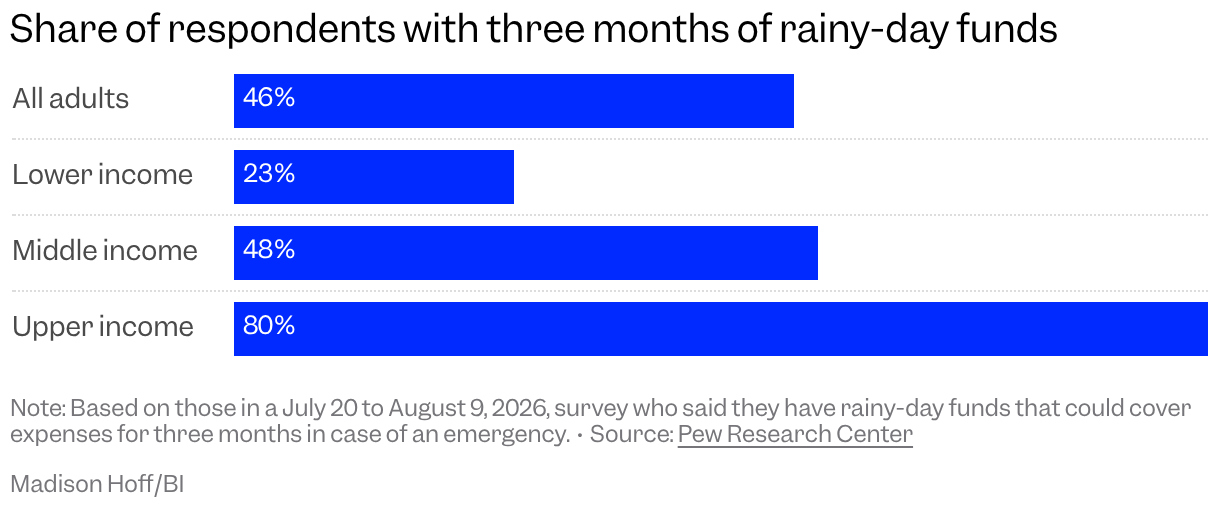
Meanwhile, 47% of middle-income earners — and a measly 24% of lower-income earners — reported being able to save money in the past year. Across all income tiers, the majority of respondents said they had cut back spending on extras like eating out or streaming services.
Those dwindling emergency funds and sacrifices might be due to rising costs, which often take a particularly large bite out of lower-earners' wallets.
It could be getting worse; inflation is moving in the wrong direction. In September, the consumer price index inflation rate rose from 3.4% to 3.7%, just above the 3.6% forecast. Plus, inflation-adjusted wages have been falling for six months.
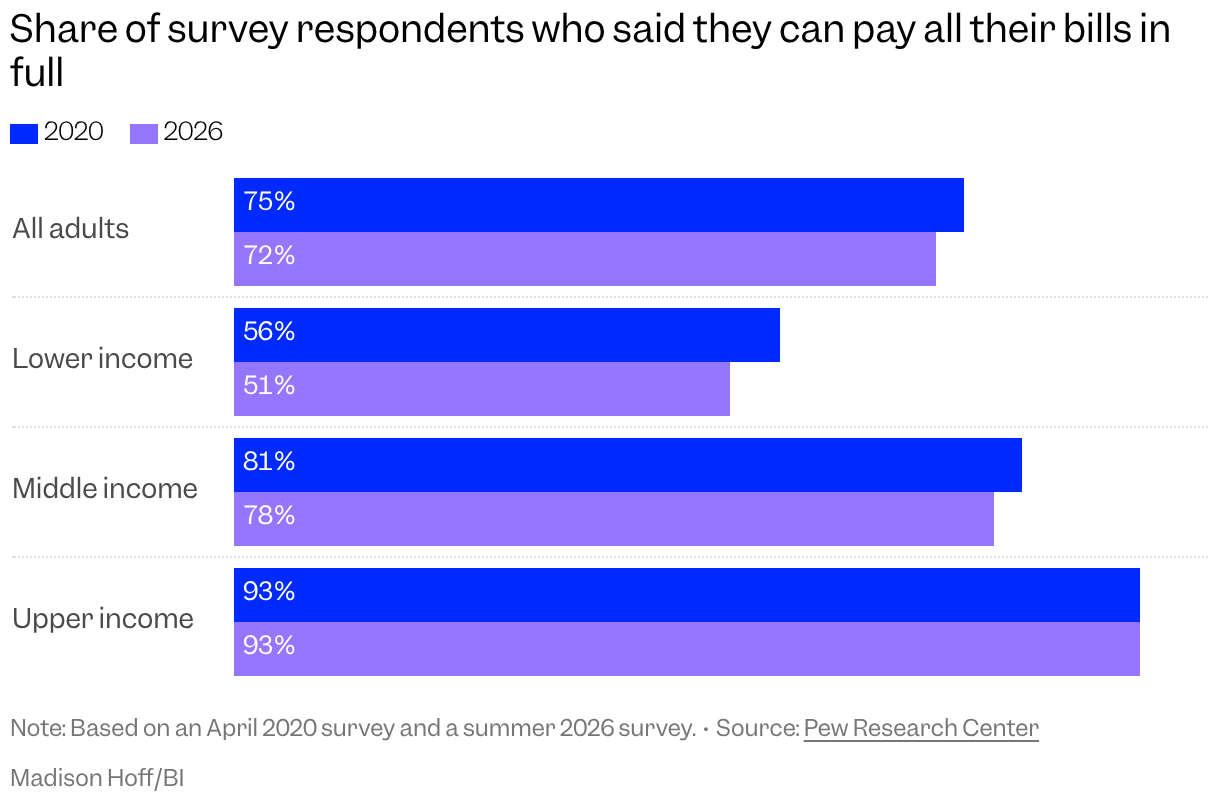
Today's economy is still more difficult for those at the bottom of the earnings ladder. Fifty-one percent of lower-income respondents said they can pay all of their bills in full in the 2026 survey, down from 56% in 2020. For middle-income respondents, the share dropped from 81% in 2020 to 78% in 2026, while the share of upper-income respondents held steady at 93%.
Pew also found 71% of lower-income US adults struggled with at least one kind of basic necessity, like affording medical care or paying their rent or mortgage, in the past year, compared with 39% of middle-income and 13% of upper-income Americans.
But the latest survey marks another sign that middle-income earners are increasingly aligning with their lower-earning peers, a dour sign for the health of the middle class. A separate report from the Urban Institute found that, even as lower-income renters were the most likely to report issues paying the rent, middle-income renters were increasingly likely to report struggling to pay.
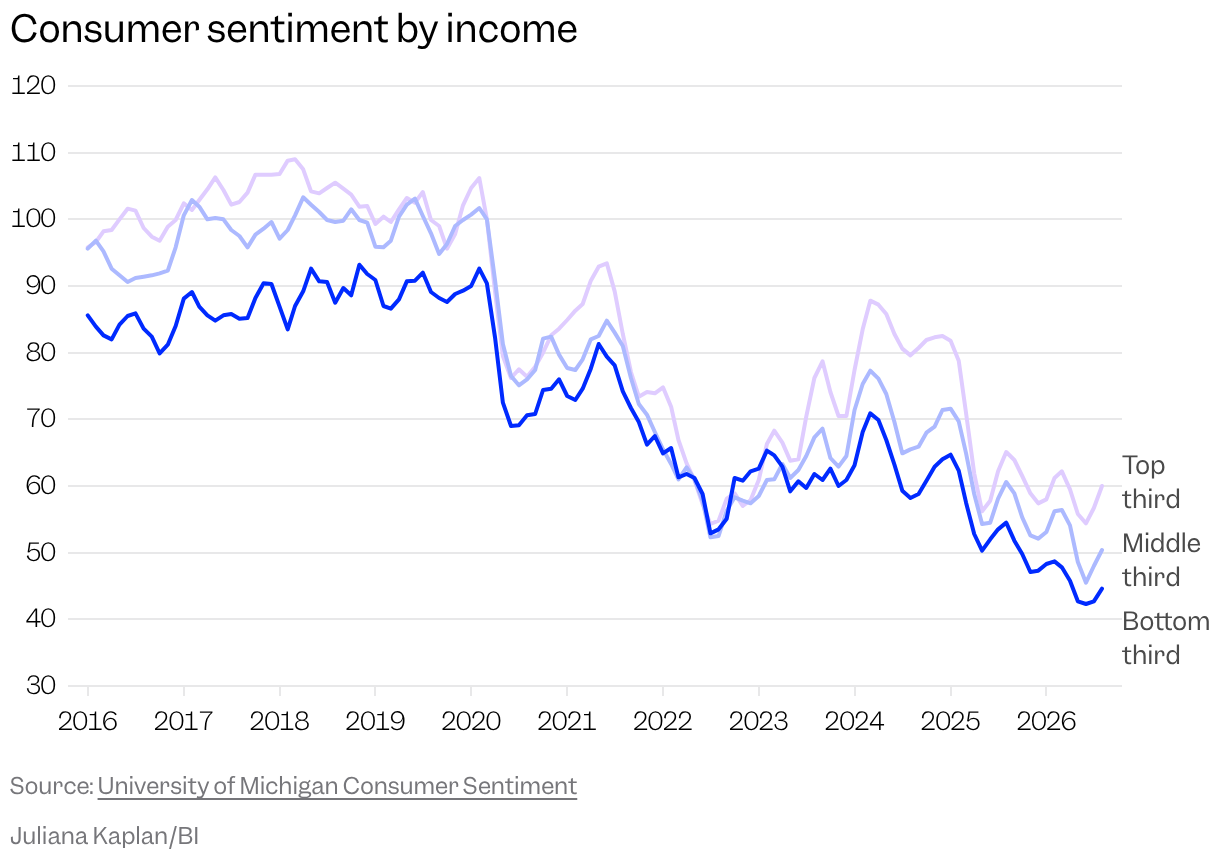
Similarly, middle-income earners' consumer sentiment has switched from mirroring their higher-earning peers to more closely aligning with lower earners — another sign that the middle class is falling on harder economic times.
"Working people are living on the edge, working longer and harder than ever for less money," said AFL-CIO President Liz Shuler. "They're angry every time they fill the tank. They're terrified of what their heating bills will look like this winter."
Allison Joyce/Bloomberg via Getty Images
If you've gotten a raise over the last two years, almost all of those gains have now been eaten by inflation.
That is, if you're the average wage-earner, considering the latest statistics released this week showing that prices were rising at a faster clip than expected.
It's more evidence that affordability challenges in the US economy aren't going away. It also means that average hourly pay, which had risen after Donald Trump took office in January 2025, is now right back to where it started, when taking inflation into account.
The average hourly wage was $35.84 in January 2025, according to federal statistics, or $37.79 in today's dollars, adjusted for inflation. The average hourly wage last month was $37.81 — basically unchanged over the past 20 months.
Wednesday's consumer price index inflation report from the Bureau of Labor Statistics came in hotter than expected, with prices up 3.7% over the year in September. Economists had expected a 3.6% increase, and the rate was well above August's 3.4%.
"We read the September CPI report as another piece of evidence that the US is facing a persistent inflation problem," economists at BNP Paribas said in a note to clients.
That problem means high prices — including gasoline that was up 9.1% in September compared to the previous month — are gobbling up pay increases you might get at work.
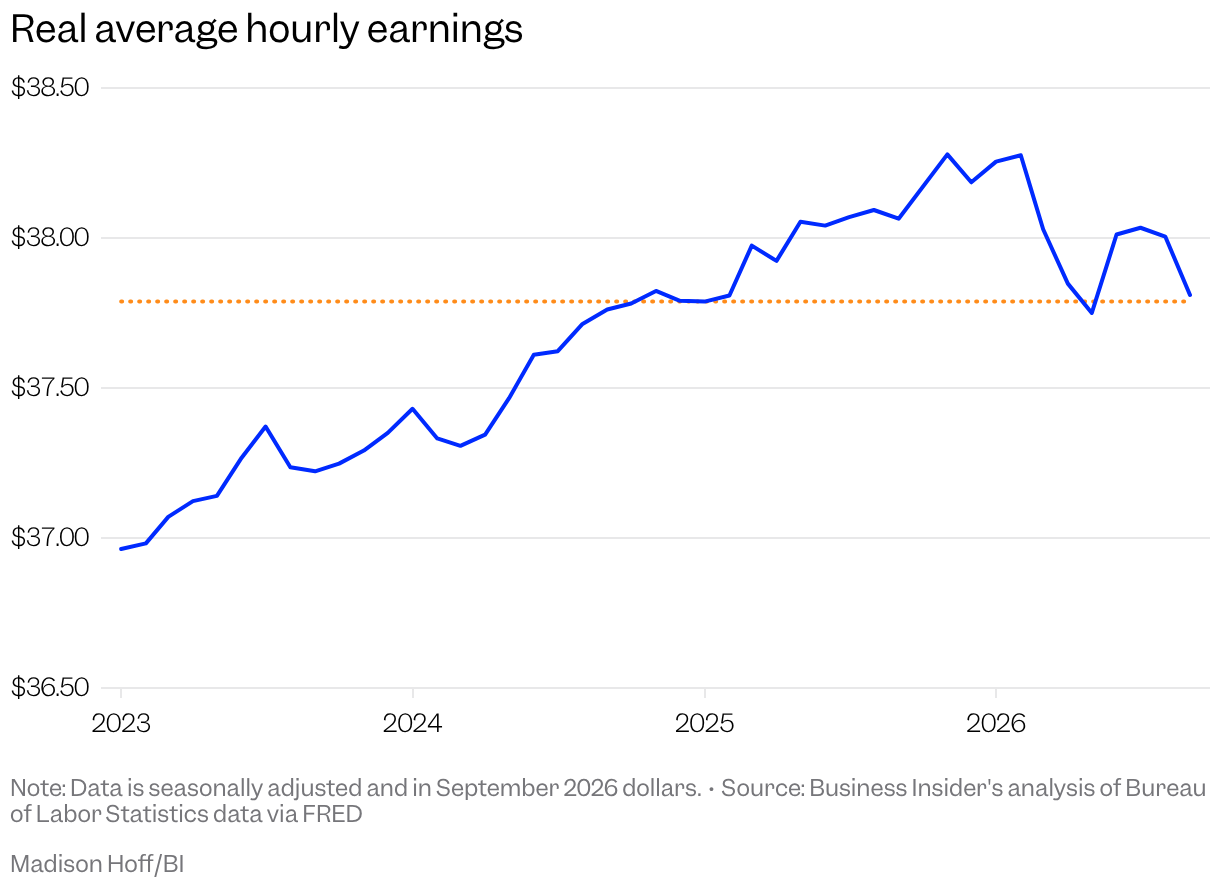
Heather Long, chief economist at Navy Federal Credit Union, underlined that consumer price growth since 2025 has eroded nearly all wage gains, citing the impact of the war in Iran, which began at the end of February, on Americans' wallets.
"This is a very different picture from President Trump's first term when wages were up over 15%, well above about 8% inflation," Long said. "It helps explain the frustration many households feel right now with the economy."
Higher prices are adding to a general sense of malaise about the economy. The University of Michigan's consumer sentiment index dipped to 46.3 in October, down from 71.7 in January 2025.
Joanne Hsu, the director of the survey, said higher gas prices driven by the Middle East conflict have added to the ongoing cost-of-living pressures over the past several years.
Higher prices and inflation outpacing wage growth can be especially tough for Americans who are on tight budgets or living paycheck to paycheck. "When we look at the majority of the US workforce, people who are middle- and lower-income households, higher costs in things like gas and groceries take up a larger share of their income," said ZipRecruiter economist Nicole Bachaud.
It's important to note, there is more than one way to read the wage numbers as they relate to inflation — and in some ways, workers have actually come out ahead.
For example, average weekly earnings have grown faster over the last year than average hourly earnings, as the number of hours the typical worker works has edged up.
The Trump administration, when asked for comment, highlighted annual earnings. "Under President Trump, private sector workers have seen their wages continue to outpace inflation, with average annual earnings growing by more than $600," said White House spokesperson Matthew Middleton.
The midterm elections are in just a few weeks, and affordability will likely be a key concern.
An Economic Innovation Group and Echelon Insights survey in September asked people what elected officials should prioritize most to make life better for workers. The survey said that 45% of American workers wanted officials to prioritize reducing the cost of everyday essentials, and 23% wanted them to focus on making housing more affordable.
Long, at Navy Federal, said the "modest increase" in grocery prices is a silver lining in the latest consumer price index report. Food at home, which includes groceries, rose at a slower pace than April's 2.9%, with prices increasing 1.8% year over year in September.
"But it's inevitable food prices will likely rise in the months ahead as higher diesel and transport costs are passed along to consumers," Long said.
There are other ominous signs that inflation could worsen. Thursday's producer price index report showed that final demand prices rose 1.3% in September, the highest since 2022.




The European Parliament has begun examining legislation that would give cities and national governments greater legal certainty when restricting short-term rentals and the use or acquisition of residential property in areas where housing has become difficult to afford.
The proposed Affordable Housing Act, presented by the European Commission on 9 September, was on Parliament’s agenda in Strasbourg on Tuesday as housing costs move further into EU-level politics.
The legislation does not transfer general housing policy to Brussels. Decisions on construction, planning, rent policy and social housing would remain primarily with national, regional and local authorities.
Instead, the proposal would establish a common EU legal framework governing some restrictions that member states and cities may introduce when attempting to protect housing supply.
The draft regulation specifically covers measures restricting short-term accommodation in residential properties other than a host’s primary residence. It would also cover restrictions on the acquisition or use of land and housing that is not intended as somebody’s principal home.
Those provisions are designed partly to resolve a legal problem that has become increasingly important in cities with large tourism markets.
Local governments have introduced restrictions on holiday rentals and second-home use, but such measures can clash with EU single-market rules governing services, property and establishment. The Commission says the legislation would provide authorities with a clearer method for demonstrating when restrictions are justified and proportionate.
The law would therefore not impose a common European cap on Airbnb-type accommodation. Nor would it oblige cities to introduce restrictions.
Authorities choosing to intervene would instead have to demonstrate housing stress and ensure that their measures meet EU requirements on proportionality, transparency and review.
Brussels argues that the scale of Europe’s housing problem now affects more than social policy.
According to the Commission’s European affordable housing plan, house prices across the EU have risen by more than 60 per cent since 2013, while average rents have increased by about 20 per cent. Short-term rentals increased by 93 per cent between 2018 and 2024.
Only between six and seven per cent of EU housing stock is classified as social housing, while about 20 per cent of homes are recorded as unoccupied.
The Commission estimates that Europe needs to build more than two million homes a year to meet current demand — around 650,000 more annually than are presently being constructed. It estimates the additional investment requirement at approximately €153 billion each year.
Those figures underline a central difficulty in the housing debate: restrictions on tourist accommodation may return some properties to residential use, but they do not address the full shortage of new homes.
EU Today examined that wider supply issue when the Commission launched its European Affordable Housing Plan, which combines proposed regulation with investment, faster permitting, construction reform and changes to state-aid rules.
The debate is becoming more politically prominent as housing affordability affects a growing share of middle-income households as well as those on lower incomes.
Berlin offers one example. EU Today reported last month that advertised rents in the German capital had risen by roughly three-quarters in less than a decade, while the city calculates that it will need another 211,000 homes by 2040.
Pressure is particularly acute in large cities and tourism centres, where residential demand competes with short-term accommodation and investment properties.
The Commission argues that this has consequences for the wider economy because workers who cannot find affordable accommodation may be unable to move to areas where jobs are available.
That is why Brussels increasingly presents housing not only as a social concern but as part of the competitiveness and single-market agenda.
The proposal is still at an early stage. Parliament and the Council must negotiate the legislation under the ordinary legislative procedure, and substantial amendments remain possible.
Questions are likely to centre on how “housing stress” is defined, what evidence authorities must provide before restricting property use and how far EU law should permit local intervention in property markets.
The political dividing line is already apparent. One side of the debate stresses that cities need more freedom to protect permanent housing stock. The other warns that regulation of short-term rentals or second properties can affect tourism businesses, property owners and investment without necessarily creating sufficient new supply.
The Affordable Housing Act attempts to establish legal rules for that dispute rather than settle it centrally.
If adopted, its importance will therefore depend less on a single Brussels policy than on how individual European cities use the powers and legal protection it provides.
The European Commission calls it the Affordable Housing Act and says it can “truly bring a change in people’s lives”. But how much will it actually do to make housing more affordable, asks Catherine Feore?
The tension at the heart of the proposal is that Brussels is making ambitious claims about tackling the housing crisis while simultaneously making clear that it is not imposing new housing policies on governments or cities.
Commission President Ursula von der Leyen says the measure fulfils a promise to tackle housing affordability, describing it as “one step in this direction” and declaring: “Today, we are delivering for all Europeans.” Housing Commissioner Dan Jørgensen went further, saying the Act gives governments and cities tools to “make more affordable homes available”.
Yet the proposed legislation itself is considerably more cautious.
The Commission acknowledges that insufficient housing supply is the structural cause of the affordability crisis. Short-term rentals, second homes and other non-primary uses are not the root problem, although they can exacerbate shortages and push up prices in already constrained markets.
Housing stress test
The Act principally delivers a common legal framework for authorities that choose to intervene.
Central to this is a new EU test for housing stress. An area would normally qualify where an average home costs at least eight years of disposable per-capita income, that ratio has increased over the previous decade, and pressures are unlikely to ease over the next three years. At a ratio of ten or more, the historical deterioration test is dropped. Population dynamics, housing supply and demand must also be assessed.
Authorities could then restrict short-term rentals outside a host’s primary residence or tackle second homes, prolonged vacancy and certain other non-primary uses. But there is no obligation. They must also demonstrate that the activity has significantly harmed housing affordability or availability for at least three years, and any restriction must be targeted, necessary and proportionate. This seems to set a high bar of evidence for most local authorities.
Currently, local authorities must notify the Commission of short-term rental restrictions under the Services Directive. That notification requirement will no longer be required. Cities can use the new framework without seeking prior Commission approval, although measures must be published and remain open to legal challenge. Officials argue this will remove a burdensome procedure and make intervention easier.
But the Commission is equally explicit about what it is not doing. The Act does not regulate rents, harmonise housing policy, give Brussels new housing competences, dictate taxation, inheritance or planning, or require, recommend or encourage authorities to impose restrictions. Housing policy choices “remain national, regional and local”.
Executive Vice-President Teresa Ribera says that when markets fail to provide affordable homes, “public authorities have a responsibility to act”. But the Act does not compel that action; it provides a stronger legal framework if authorities choose to act independently.
Its impact could be real in tourist hotspots where non-primary housing use is demonstrably worsening shortages. But it cannot itself build a home or lower a rent. The question is whether a clearer legal toolbox matches the expectations created by the Commission’s promise to tackle Europe’s housing crisis. When asked to quantify how much of a difference the new provisions could make, the Commission couldn’t give precise figures, saying that it would depend on the measures adopted.
PHOTO CREDIT: Teresa Ribera, Executive Vice-President of the European Commission for a Clean, Just and Competitive Transition, and Dan Jørgensen, European Commissioner for Energy and Housing, give a press conference on the affordable housing Photographer: Jennifer Jacquemart © European Union
America’s elders need more places to live, but even in liberal enclaves that recognize the problem, developers are facing fierce foes: America’s elders. Make it make sense! Charley Locke reports from her hometown of Oakland, California, where boomers are organizing against two proposals that would add 618 market-rate residential units to the city’s senior housing stock:
Many in the crowd had been marching against governmental and corporate overreach for half a century: against the Vietnam draft and the invasion of Iraq; against Wall Street; against police brutality. They’re part of a generational force that’s antiestablishment and suspicious of power. But in this fight, it wasn’t so clear who the establishment was or who had the power. Were these righteous middle-class activists fending off greedy developers who would charge high rents, or were they wealthy seniors prioritizing neighborhood character over ameliorating the housing crisis? Were they once again David, or had they become Goliath?
