
❌

Reading view

Trust the numbers: Germans are open to a more hawkish China policy
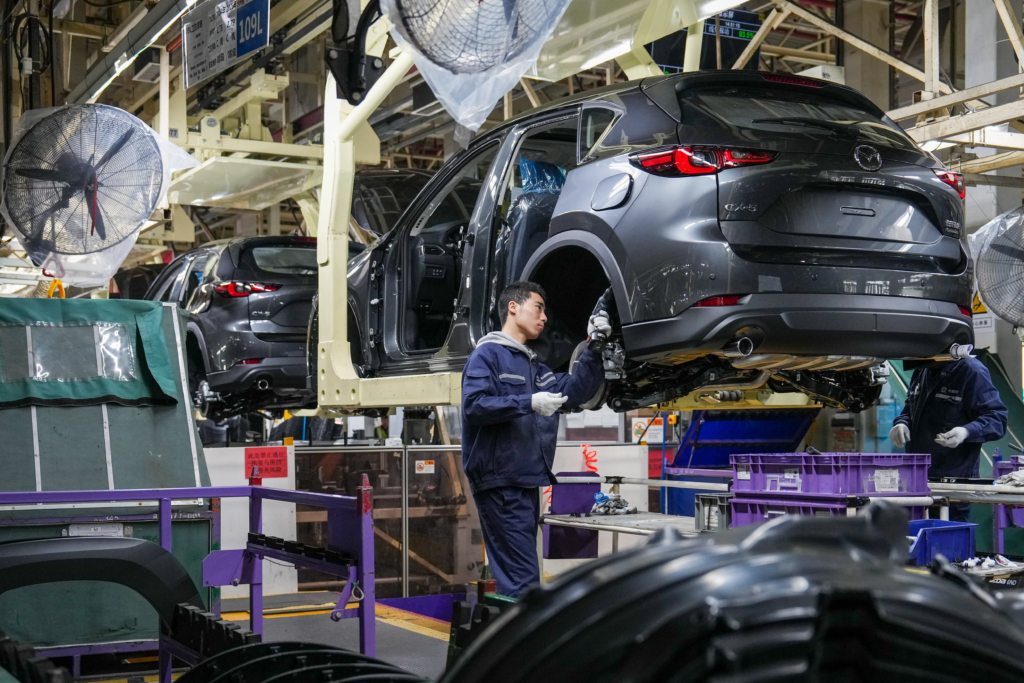
Ein Foto zeigt ein graues Fahrzeug auf einem Montageband, ein Arbeiter überprüft Teile unter dem Wagen in einer Werkshalle.
Cover image: picture alliance / Xinhua News Agency | Li Bo

Reluctance among German decision-makers has long stopped Berlin taking a tougher economic approach towards China. When France, Italy, Lithuania, the Netherlands and Spain recently pressed the European Commission for tougher measures and faster trade defence action against China, Germany not only declined to join, it even called for stronger industrial ties with Beijing.

Yet, one thing Berlin should not worry about is voters’ disapproval should it pursue a more hawkish China policy. ECFR polling data find that Germans are the most China-sceptical out of 15 European countries surveyed. No fewer than 60% of Christian Democrat and Social Democrat supporters regard the country as an adversary or rival. In contrast, elsewhere in Europe, majorities still see China as either a “necessary partner” or even an ally. In Italy and Spain, 56% and 65% of people hold this view respectively. (Closest to the sceptical Germans are the French public; President Emmanuel Macron’s increasingly hawkish political posture vis-à-vis Beijing may have found an audience willing to listen.)
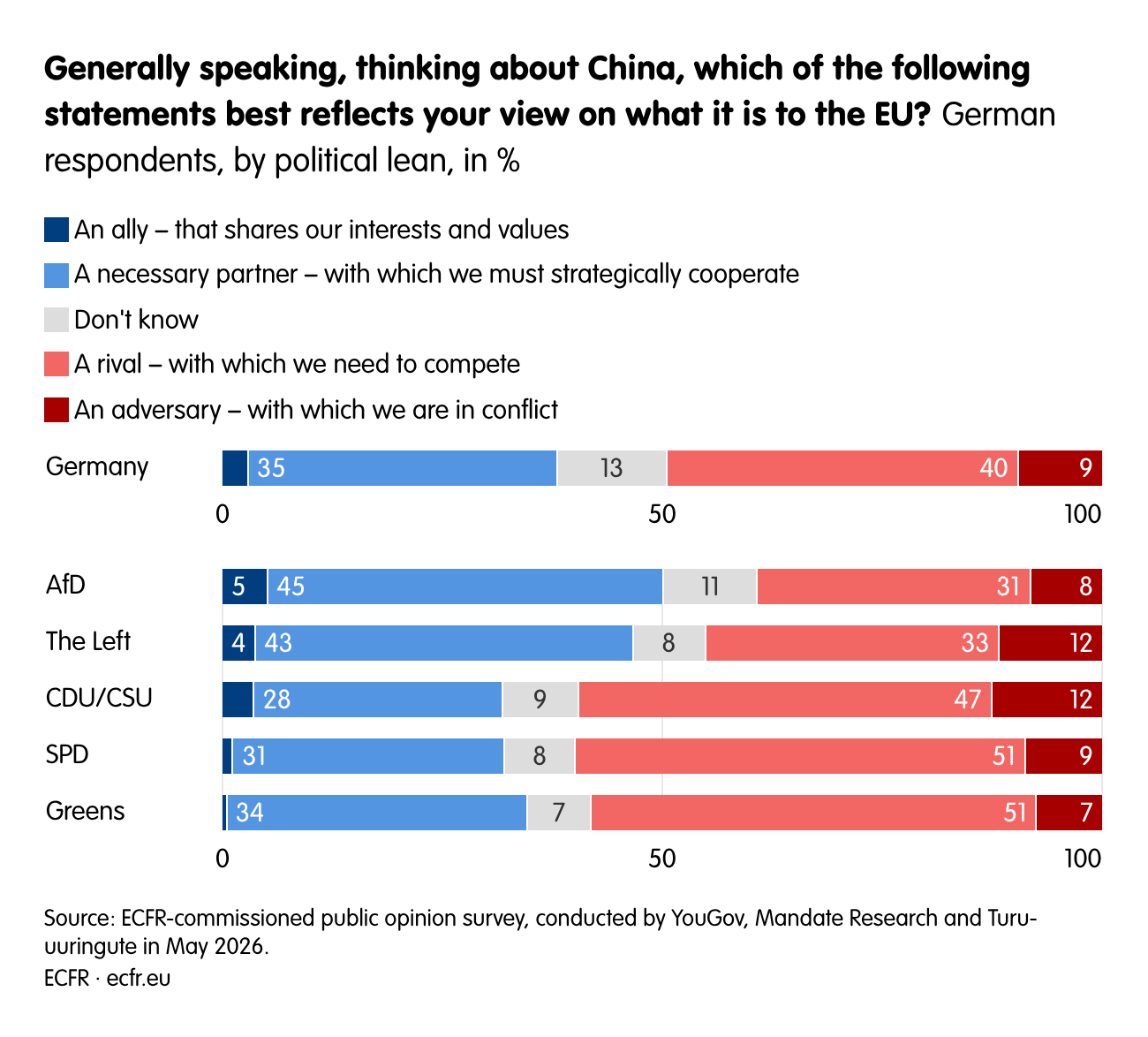
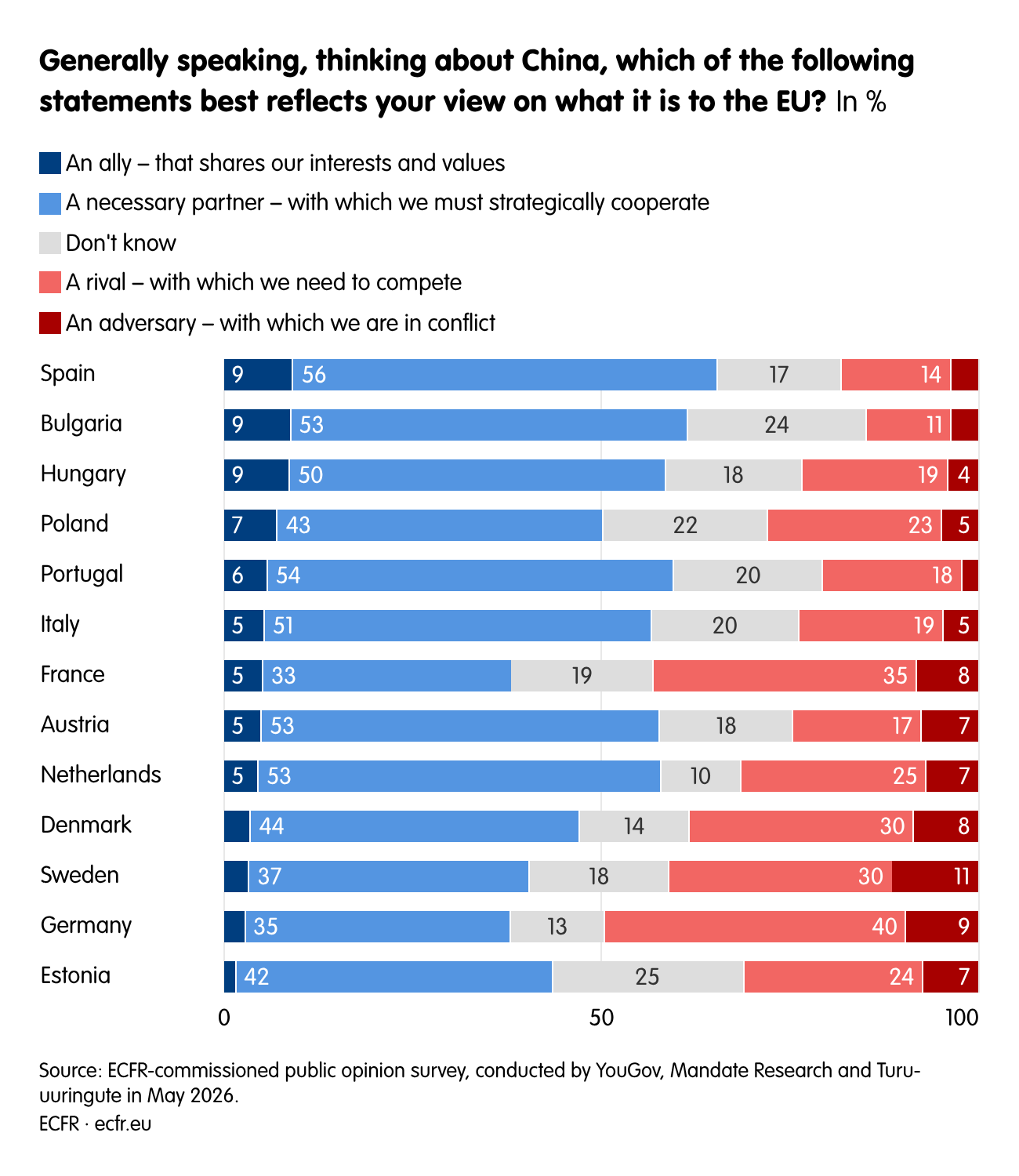
Generally speaking, thinking about China, which of the following statements best reflects your view on what it is to the EU?

The China shock has hit Germany particularly hard: its manufacturing sector lost around 420,000 jobs between 2019 and 2025 and it continues to shed 10,000 jobs each month. The car industry is paying the highest costs, being squeezed out of a market increasingly dominated by Chinese manufacturers at home and abroad.

The mood in the European Council is shifting, and with Germany’s acquiescence. When EU leaders met in June 2026, they backed a stronger trade defence toolbox of existing measures against China. This included instruments such as the Industrial Accelerator Act’s “Buy European” provisions and limits on high-risk Chinese technology. Despite its past hesitations, Germany no longer acts as a spoiler on firmer EU action, and it has cautiously supported this new direction. Nevertheless, the combination of growing public scepticism towards China, mounting pressure on German industry and appetite for a more assertive policy on the European level creates a political mandate that German decision-makers could yet seize.

The German public’s views on the energy transition should also prove encouraging for their leaders. Voters want to see investment in renewables: 57% back what would amount to the growing electrification of the economy. Across the countries polled by ECFR, 61% of respondents say they support prioritising renewables and the clean tech sector.
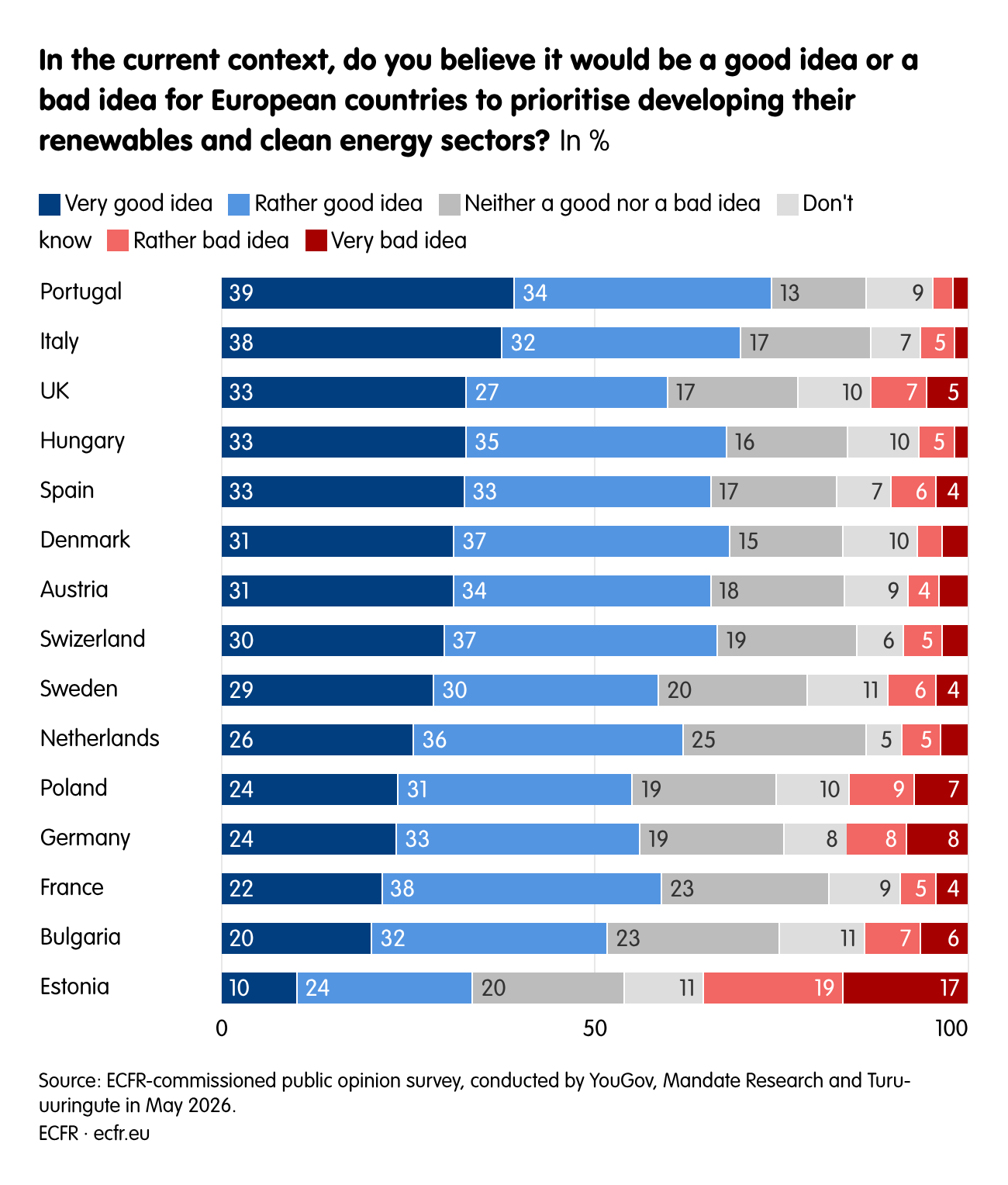
In the current context, do you believe it would be a good idea or a bad idea for European countries to prioritise developing their renewables and clean energy sectors?

This public support should help persuade leaders, including in Germany, that they can take action to limit emerging dependencies on China. They can accelerate the energy transition while de-risking the clean tech sector through providing support for domestic European industries, from wind to batteries.

For Berlin, and capitals across Europe, it is safer to move ahead rather than delay. Chinese economic policy is already doing irreparable damage to European industry—but European policymakers still need to protect an increasingly electrified economy from weaponisation by China. If they fail to do so, governments will almost certainly pay the price at the ballot box. Those that pursue electrification and economic de-risking as a single package are most likely to reap the political rewards.

Source

  •  

EU Commissioner Brunner says time to lift German border controls

Brussels (enr) – The European Union’s migration commissioner has renewed his call for Germany to gradually end controls at its internal borders, pointing to falling numbers of irregular arrivals and the bloc’s new asylum rules.

It was now time to gradually abolish internal border controls, Magnus Brunner told members of the European Newsroom (enr) network in Brussels.

The Austrian commissioner said the EU’s external borders were better protected and that irregular crossings had fallen sharply. Frontex recorded about one-third fewer irregular crossings at the EU’s external borders in the first half of 2026 than in the same period last year.

The EU’s new Pact on Migration and Asylum also took effect on June 12. Brunner said member states had begun implementing the rules and that the bloc was already seeing progress.

He welcomed steps by individual countries to ease controls. Checks on the border between Germany and Luxembourg on the Trier motorway have been lifted, he said. He also cited the suspension of controls between Austria and Slovenia.

Germany has had checks at its land borders since September 2024. Former Interior Minister Nancy Faeser ordered them, and her successor, Alexander Dobrindt, intensified them in May 2025. Dobrindt has repeatedly extended the measures, which are currently due to remain in place until September.

Brunner also defended the EU’s new Entry/Exit System, known as EES. The digital system records the entry and departure of travellers from outside the EU, Iceland, Liechtenstein, Norway and Switzerland.

He acknowledged that the system had caused problems at some airports, including in Greece and Portugal, but said: “The system itself works very, very well.”

The system has faced criticism over long queues. The Airports Council International Europe has reported waiting times of up to five hours and missed connecting flights.

Brunner said professional truck drivers from the Western Balkans faced a particular problem because they can currently stay in the EU for no more than 90 days in any 180-day period. He proposed that EU member states and Western Balkan countries negotiate long-term visas on a bilateral basis.

  •  

McAllister urges Ukraine to back German proposal for EU associate membership

Brussels (enr) – European Parliament Foreign Affairs Committee Chairman David McAllister has urged Ukrainian President Volodymyr Zelenskyy to support German Chancellor Friedrich Merz’s proposal for an associate membership for Ukraine as it moves towards joining the European Union.

The proposal is an opportunity that Ukraine should seize, the German centre-right lawmaker told members of the European Newsroom (enr) network in early June. Claims that it would amount to “membership light” or second-class membership were incorrect, he said.

Instead, it would allow Ukraine to become more closely integrated into the EU step by step before full membership, making the benefits of the bloc more visible to its people. One possibility would be for Ukraine to participate in the European Parliament as an observer, McAllister said.

Zelenskyy has expressed opposition to the idea, arguing that it would be unfair for Ukraine to be present in the EU but have no say in its decisions. In a letter to EU leaders, he called for the bloc to move faster and not keep Ukraine in a waiting room until full membership.

Merz said earlier that rapid full EU accession for Ukraine, which is fighting Russia’s invasion, is not realistic. For the interim period, he has proposed allowing Ukraine to attend EU summits and ministerial meetings without voting rights.

His ideas also include an associate member of the European Commission without a portfolio or voting rights, associate members of the European Parliament and an associate judge at the European Court of Justice.

Enlargement Agenda

McAllister said EU enlargement was high on the bloc’s agenda and that the Western Balkans were at the heart of Europe. A stable region was an investment in peace and security, he said.

The CDU politician called for each candidate country to be assessed individually and on its merits rather than treating the Western Balkans as a single group. Montenegro was a clear frontrunner, he said, while North Macedonia’s accession path remained blocked by a political dispute with Bulgaria.

Eight other European countries are officially recognised as EU candidate countries alongside Ukraine: Albania, Bosnia and Herzegovina, Georgia, Moldova, Montenegro, North Macedonia, Serbia and Türkiye.

  •  
❌