❌

Reading view

Iranian Launchers Struck By U.S. Held Exotic And Highly Concerning Rocket-Delivered Sea Mines

For about a month, the United States had refrained from attacking Iranian targets as the Trump administration turned toward economic warfare against the Islamic Republic. However, that changed last night when U.S. Central Command (CENTCOM) struck what it said were Iranian rocket launchers preparing to fire naval mines into the Strait of Hormuz. The problem is that mine-deploying rockets are not a common capability, so much so that the statement seemed bizarre at first glance. But it just turns out that Iran does claim to have such a system and that system would have a glaring application in the current state of play of the conflict. In fact, it would be absolutely critical to do exactly what CENTCOM did, blowing them up prior to launching, because if they didn’t, the final and very fragile energy lifeline between the Persian Gulf and the world could be severed at the worst possible time.

“I can confirm that earlier today U.S. forces struck two Iranian launchers on Larak Island,” Navy Capt. Tim Hawkins, CENTCOM’s spokesman, told us Sunday evening. “Islamic Revolutionary Guard Corps forces were observed preparing to launch rockets with sea mines into the Strait of Hormuz.”
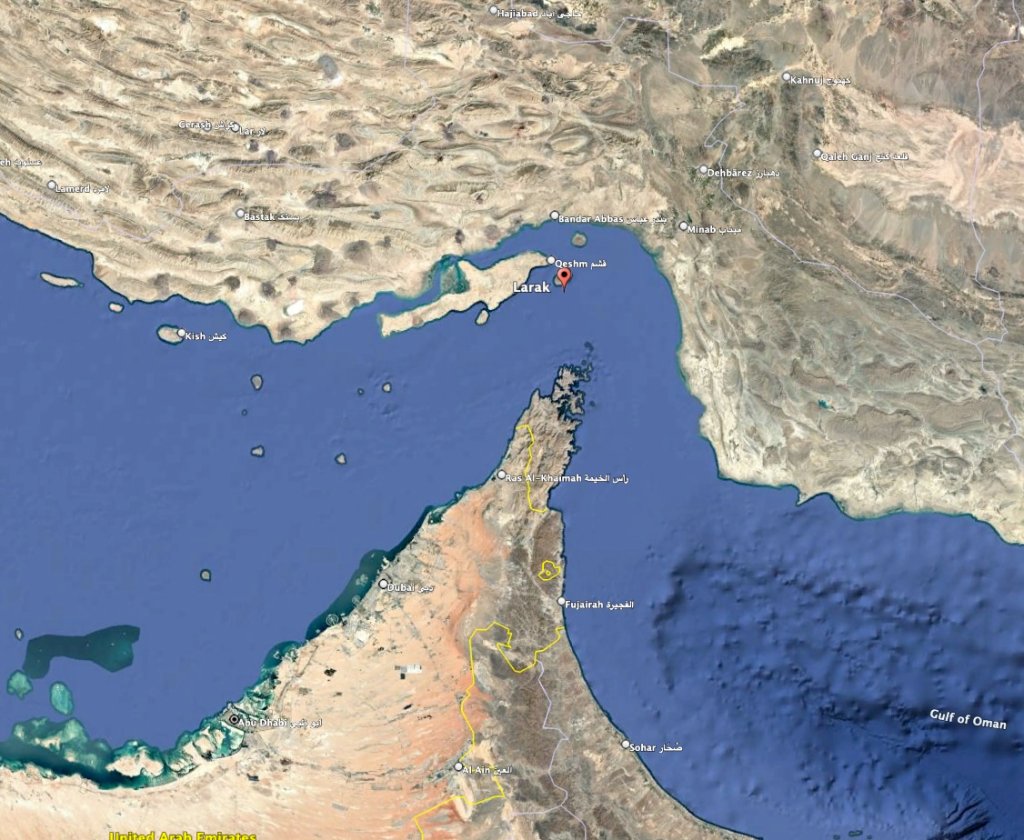
Larak Island. (Google Earth)

The U.S. strikes against the launchers on Sunday spurred Iran to respond with ballistic missile attacks on a Jordanian air base housing U.S. troops. Jordanian officials said all eight missiles were intercepted, and no casualties or damage was inflicted.

🇯🇴 #JORDAN INTERCEPTS 8 MISSILES

Jordan's @ArmedForcesJO say air defense systems intercepted eight missiles that entered the Kingdom's airspace early Monday.

The military said the missiles were destroyed before posing a threat to civilians or property.

📍 Details:

🔹 A…

— Dana Zureikat Daoud دانا زريقات (@DanaZkat) August 31, 2026

Hawkins did not specify what exact type of rocket launcher was struck or whether this was the first time CENTCOM had seen Iran use this type of system to launch sea mines.

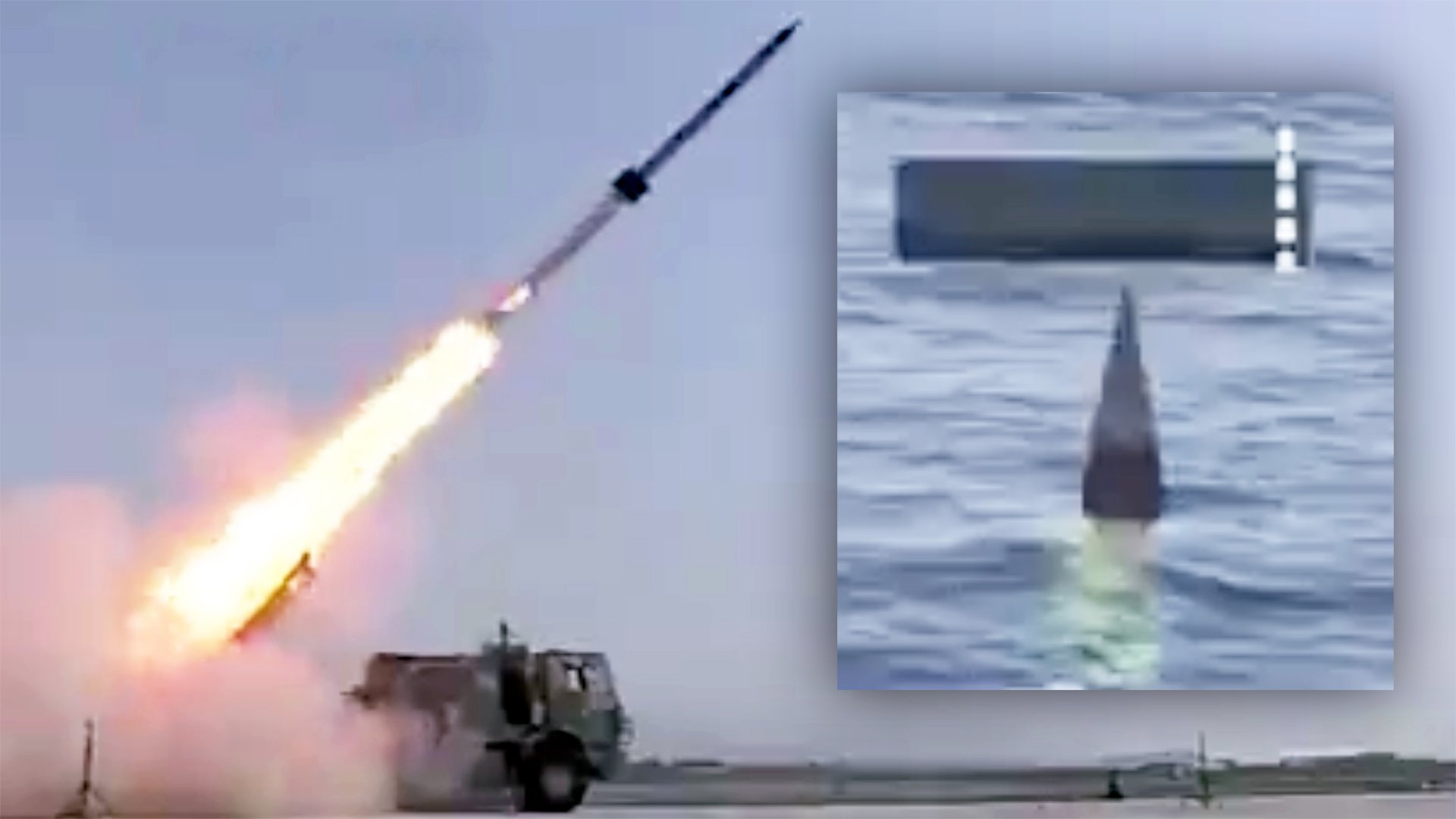
Though CENTCOM won’t comment on what kind of system was attacked, Iran did tout just this kind of a system last year with exactly the kind of range needed to be a huge problem for the U.S. and its allies. This system uses a variant of the Fajr-5 rocket that is converted with a sea mine warhead.

You can see a video of that system below.

Video of the Iranian rocket deployed naval mine system which is claimed to be able to deploy hundreds of mines in the sea from the coast in an hour. pic.twitter.com/ba897On0nV

— Mehdi H. (@mhmiranusa) January 24, 2025

The clip shows the rockets being fired from a truck-mounted multiple launch rocket system (MLRS). The video later cuts to nose cone-shaped mines that appear to float on the surface above the spent missile body, however, little is known about the Fajr-5 sea mine warhead conversion process that allows them to be delivered by rocket.

We also don’t know the full extent to which Iran has developed and/or fielded this particular capability, or whether it has other options for similarly deploying naval mines by rocket. Neither Behnam Ben Taleblu, a senior fellow at the Foundation for Defense of Democracies (FDD) think tank, nor the Ambrey maritime security firm has seen any indication that Tehran has used an MLRS to launch sea mines in the past.

At the same time, “the Fajr-5 is an Iranian calling card, a 333mm caliber rocket that can reportedly travel 75 km carrying between an estimated 90 to 170 kg warhead, depending on the payload,” Taleblu, an expert on Iranian weapons systems, told TWZ.

The Fajr-5 is an established design that traces its roots back to the 1990s and has been evolving since then. “The Fajr class was initially designed as unguided artillery rockets, though Iran claims to have developed a guided version,” Taleblu added.
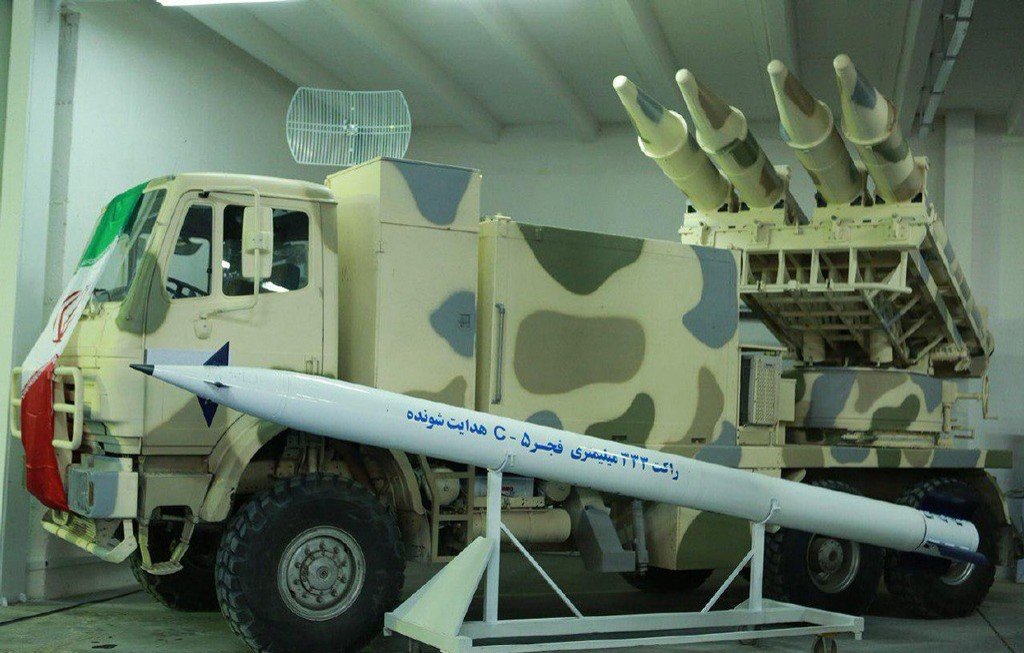
A Fajr-5 rocket and launcher. (U.S. Army)

In general terms, being able to seed naval mines via artillery rockets would offer several advantages for Iran, most immediately by offering an alternative to traditional maritime mine-laying platforms. The destruction of Iran’s naval forces was a top stated objective for the U.S. military during the opening phases of the conflict earlier this year. Iranian vessels, including ones capable of laying mines, were heavily targeted. Still, Iran has retained a large number of its smaller boats that can be used for seeding minefields.

Regardless of what boats they have left, mining the area that actually matters most would be impossible to do as any vessel approaching the southern coast of the Strait of Hormuz would be destroyed. It’s through these tight and complex littorals that a reduced flow of commercial vessels are still traveling, under the kinetic umbrella of the U.S. and its Gulf state allies. The Fajr-5, fired from Iranian controlled islands in the strait, has the range to land in these waterways, seeding mines without risking any boat crews or other platforms. If the rocket-delivered mines splash down, the de-mining process would have to begin, which can be arduous and last weeks, potentially shutting down all shipping.

With that in mind, Iran’s weapon is remarkably relevant to the situation, assuming it works. But even if it doesn’t, it could still pose a risk to mariners even if its efficacy is questionable.

Furthermore, being able to turn any launcher for Fajr-5s (and/or potentially ones for other types of artillery rockets) into a naval mine layer rather than having to rely on specialized systems would be a boon unto itself. Artillery rockets and launchers are something Iran had deep stockpiles of before the war with the United States and Israel started earlier this year. How many naval mine rockets Iran might have, and whether it might be possible to convert existing types to that configuration, are open questions.

Using a road-mobile launcher would also give Iranians a ‘shoot-and-scoot’ option for deploying naval mines where the launch could be exposed only for a short period of time. This, in turn, would create additional targeting challenges for U.S. forces. It is possible that, as it does elsewhere, Iran has constructed tunnels under Larak Island to hide these systems, as well. 
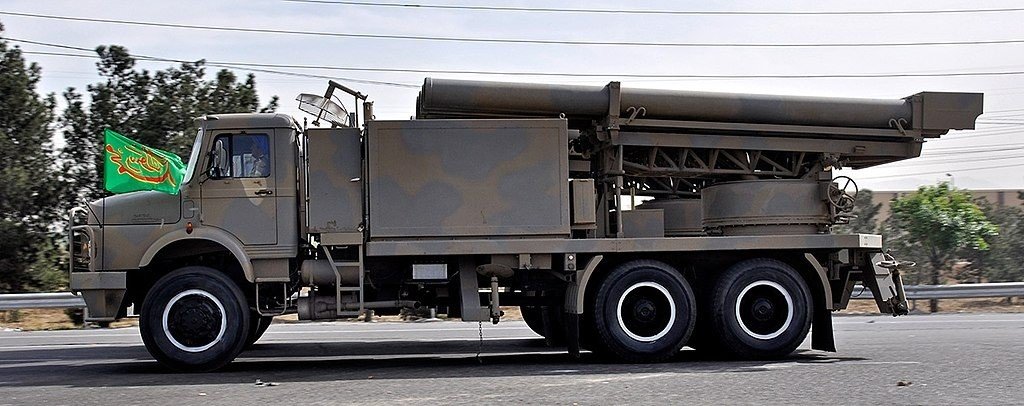
A Fajr-5 launcher. (U.S. Army)

Overall, the “deployment of naval mines by missile significantly speeds up the deployment process, improves the ability to penetrate airspace, and increases the standoff distance between the minelayer and the field, making it the least risky minelaying method,” a piece published by the Center for International Maritime Security (CIMSEC) think tank last year, which also highlighted Iran’s apparent demonstration of the Fajr-5-based capability, noted.

While the Fajr-5’s estimated payload capacity is “light compared to U.S. or Chinese naval mines,” the mines the rockets could deliver “are still heavier than diver-delivered limpet mines and could conceivably disable a ship if struck by enough mines from the field,” the piece added. “Most importantly, this field could be delivered rapidly and with little warning. Even though the explosive capacity of this mine individually is small, the psychological impact from inflicting minor damage on a small number of merchants could still be enough to force shipping companies to avoid the area.”

“Though it’s a bit unconventional, using a rocket launcher again signals that the regime is sensitive to cost and risk, and is trying to deploy mines in a way that doesn’t put as much personnel at risk as by dropping them overboard,” Taleblu posited. “It was reported in the military exercise over a year ago that the regime had used an MLRS system like the Fajr to deploy these, but I haven’t seen significant video confirmation of this most recent round.”

With all this in mind, the point about “psychological impact” mentioned in the CIMSEC piece could be particularly relevant in this case. By launching the attacks on Larak Island, CENTCOM has in a way given credence to Iran having a real capability to launch mines via rocket into the Strait of Hormuz. That threat by itself could be enough to cause commercial ship crews, their corporate operators, and insurance companies to think twice about attempted transits.

This is exactly the issue that President Trump, among others, has repeatedly sought to downplay, including multiple times just within the past week.

“We’re taking them in,” Trump told Glenn Beck last week. “The mines are gone. You probably saw that, we put it out yesterday, all the mines. We got rid of the mines. But the strait, it’s functioning, it’s a functioning strait. Uh, yes, every once in a while, there’ll be a drone or a rocket or something shot, but it is a very functioning strait.”

“Last week, CENTCOM completed clearing sea mines from the strait’s international shipping routes,” Hawkins, the CENTCOM spokesman, told us yesterday. “U.S. forces are monitoring the area closely and remain prepared to protect the free flow of commerce through this essential waterway.”

“The U.S. military has achieved a major milestone in the Strait of Hormuz,” Adm. Brad Cooper, CENTCOM’s commander, stated last week. “We have successfully cleared sea mines in the strait’s international shipping lanes that were laid months ago by Iran’s Islamic Revolutionary Guard Corps. Internationally recognized transit routes in the strait are free of Iranian sea mines, thanks to the incredible work of the U.S. military.”

Update from CENTCOM Commander: pic.twitter.com/osPbltjJ1C

— U.S. Central Command (@CENTCOM) August 28, 2026

CENTCOM pushed back Monday on Iranian claims that an oil tanker was hit by mines in the command’s preferred transit route.

“CLAIM: Iran’s Islamic Revolutionary Guard Corps (IRGC) claims that a supertanker passing through the southern route of the Strait of Hormuz struck two mines and was brought to a complete stop. This is FALSE,” the command stated on X. “FACT: No ships have hit mines in the Strait of Hormuz. This is yet another IRGC attempt to intimidate regional commercial shipping through disinformation.”

🚫 CLAIM: Iran’s Islamic Revolutionary Guard Corps (IRGC) claims that a supertanker passing through the southern route of the Strait of Hormuz struck two mines and was brought to a complete stop. This is FALSE.

✅ FACT: No ships have hit mines in the Strait of Hormuz. This is… pic.twitter.com/spkaogBx81

— U.S. Central Command (@CENTCOM) August 31, 2026

Still, the Joint Maritime Information Center (JMIC) — a group of international navies which provides timely information to the shipping industry — sees mines as an ongoing risk in the strait.

“Commercial traffic through the Strait of Hormuz remained at reduced levels, with a modest uptick from recent lows, still far below baseline,” JMIC stated on Sunday. “Independent tracking data indicated suppression with single-digit numbers transiting in both directions. There remained a continued risk of drifting or uncharted mines in and near the TSS, with mine danger areas still active.”

JMIC Advisory Note Update 091

Released by UKMTO on behalf of the Joint Maritime Information Centre.

Click here to view the full advisory note ⤵ https://t.co/jHInhBdVRt#MaritimeSecurity #MarSec pic.twitter.com/T6VzzxSdPD

— UKMTO Operations Centre (@UK_MTO) August 30, 2026

The combination of ongoing dangers in the strait continues to result in reduced traffic, the global trade intelligence firm Kpler noted on X.

“Vessel traffic through the Strait of Hormuz and Bab el-Mandeb declined on 25 August, while the IMO [International Maritime Organization] verified no additional attacks,” Kpler added. “Five vessels crossed the Strait of Hormuz, down 28.6% day on day from seven. All five used the Iranian Unilateral Scheme, with two entering the Middle East Gulf and three exiting. Four were classified as shadow vessels and one as sanctioned.”

Strait crossings remain subdued

Vessel traffic through the Strait of Hormuz and Bab el-Mandeb declined on 25 August, while the IMO verified no additional attacks. Five vessels crossed the Strait of Hormuz, down 28.6% day on day from seven. All five used the Iranian Unilateral… pic.twitter.com/BI9cFAaJRy

— Kpler (@Kpler) August 26, 2026

The latest flare-up in fighting came after the Trump administration last week unleashed the threat of harsh new sanctions to further isolate Iran. However, that failed to move Tehran to change its position on maintaining control over the Strait of Hormuz, its nuclear ambitions or support for proxies like the Houthis in Yemen and Hezbollah in Lebanon.

Monday morning, Trump told Fox News reporter Trey Yingst that he was going to retaliate for Iran launching ballistic missiles last night after the U.S. strike on Larak Island.

“We’re going to hit them hard,” Trump told the network. “There will be a response.”

President Trump says the United States will respond to the Iranian missile attack on U.S. forces overnight.

"We're going to hit them hard," President Trump told Fox News. "There will be a response." pic.twitter.com/sjLOLSxm4g

— Trey Yingst (@TreyYingst) August 31, 2026

Trump and his senior aides “have been considering waging limited strikes in the Strait of Hormuz to prevent Iran from reconstituting its radar and missile capabilities to attack ships,” Axios reported, according to three U.S. officials. 

“One U.S. official said the idea behind the plan is to reduce the risk of Iranian attacks on oil tankers, U.S. Navy ships and Air Force aircraft — to ‘mow the lawn,’ as this person put it.”

It is unclear if Iran has used rockets to mine the strait or how well this system works if it did. However, the fact the U.S. resumed hostilities just to attack sea-mine-launching rocket systems shows the level of concern they engendered and the options Iran may still have to threaten the strait.

Contact the author: howard@twz.com

The post Iranian Launchers Struck By U.S. Held Exotic And Highly Concerning Rocket-Delivered Sea Mines appeared first on TWZ.
  •  

Russia’s Zircon May Not Be A Hypersonic Cruise Missile After All

A new Ukrainian intelligence report details the complex production chain behind Russia’s shadowy 3M22 Zircon missile and identifies U.S.-origin electronics inside one of Russia’s most advanced weapons. New details also add weight to the theory that the weapon is a maneuverable quasi-ballistic missile rather than a true hypersonic cruise missile.

The unusually detailed new breakdown of the Zircon missile identifies 70 enterprises and 84 individuals involved in its development and production while providing a component-by-component look at one of Moscow’s most closely watched — and least-understood — weapons.

‼DIU exposes details of russia’s 3M22 Zircon ballistic missile — including its components, production chain, 70 companies involved, key personnel, and foreign equipment used to manufacture the weapon: https://t.co/oOBqjUb8dS pic.twitter.com/VqRSSA41iV
— Defence Intelligence of Ukraine (@DI_Ukraine) August 31, 2026

The first evidence of Zircon’s combat use emerged in February 2024, when Ukrainian officials displayed recovered debris after a Russian strike. The wreckage included distinctive engine and steering-system components that Ukrainian specialists used to identify the weapon.

Russia has since employed the missile on other occasions. Ukrainian authorities reported that a Zircon was launched from occupied Crimea during a major missile and drone strike in January 2026, as we reported at the time.

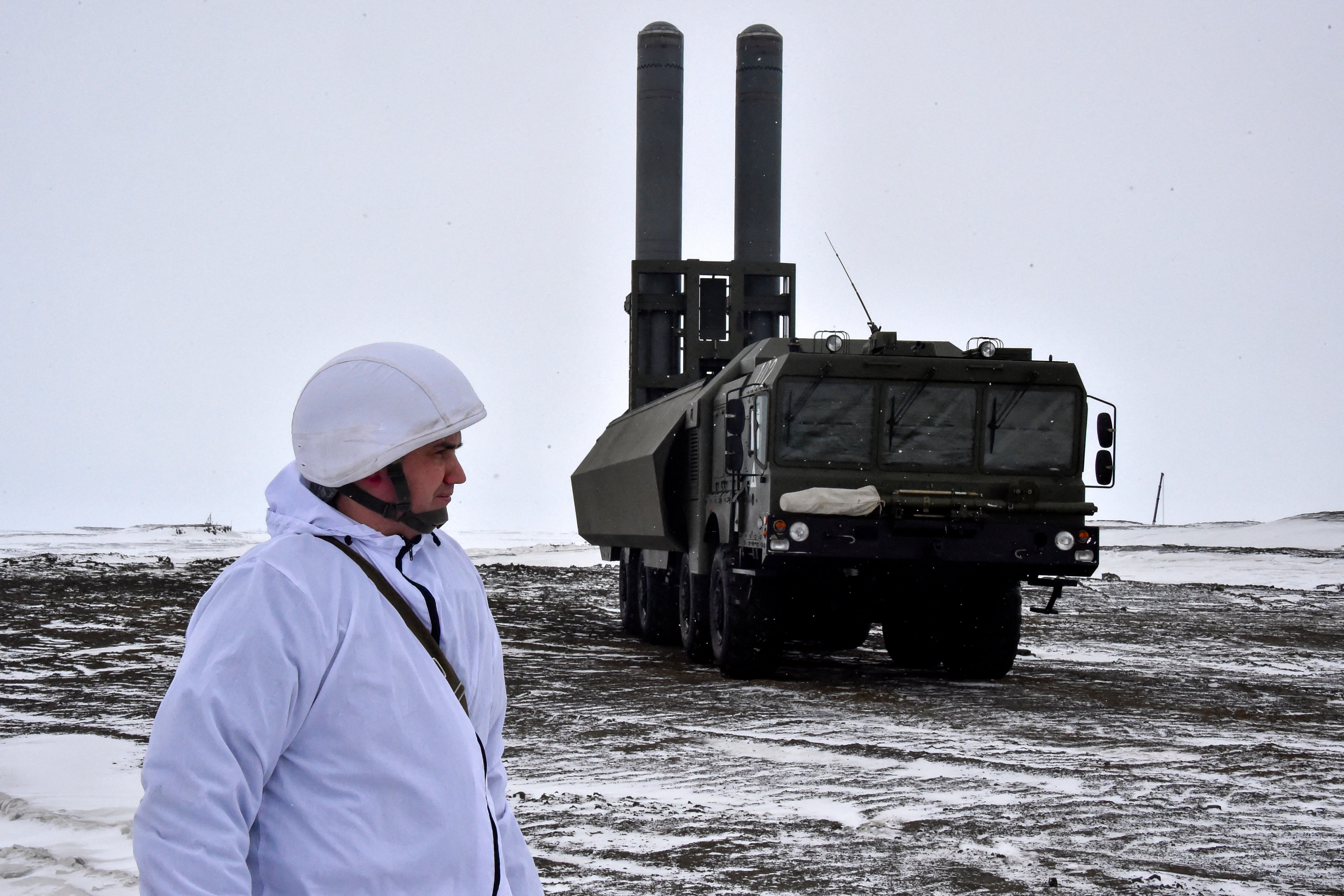
While initially developed for use from warships and submarines, Zircon is understood to have been employed from ground-based launchers against Ukraine, with modified launchers from the K-300P Bastion coastal defense system considered the most likely candidate.

A serviceman stands near a Russia's Bastion mobile coastal defence missile system on the island of Alexandra Land, which is part of the Franz Josef Land archipelago, on May 17, 2021. (Photo by Maxime POPOV / AFP) (Photo by MAXIME POPOV/AFP via Getty Images)
A standard Bastion-P mobile coastal defense missile system. Photo by Maxime POPOV / AFP MAXIME POPOV

The new entry on Ukraine’s Main Directorate of Intelligence (GUR) War & Sanctions portal includes an interactive 3D model and identifies systems ranging from the missile’s radar seeker and onboard computer to its propulsion system and warhead. It also identifies foreign-origin electronics, including components associated with U.S. manufacturers.

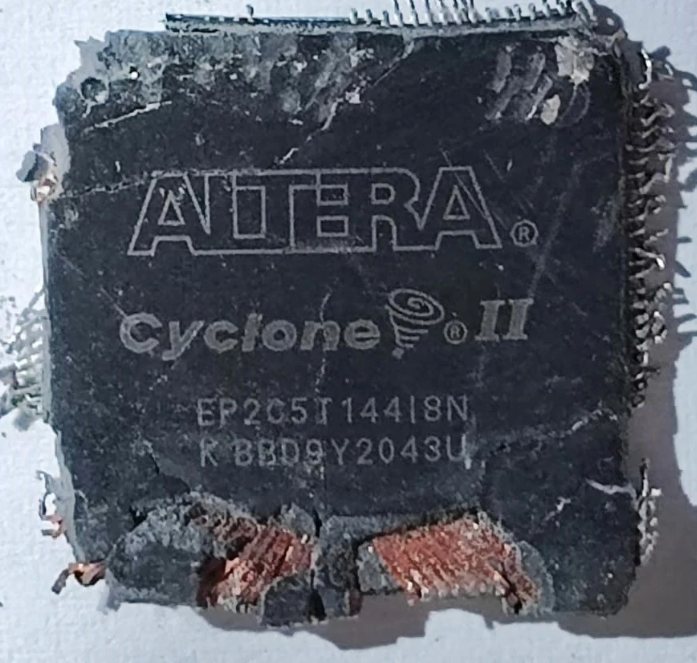
Among them, according to the GUR report, is a TGA2704 amplifier associated with TriQuint Semiconductor, now part of U.S. company Qorvo. The GUR also identifies an Altera Cyclone II EP2C5T144I8N field-programmable gate array (FPGA) associated with Altera Corporation, now part of Intel, and lists it as originating in the United States.

An Altera Cyclone II Field-Programmable Gate Array (FPGA), a type of microchip, which the GUR says was found in Zircon wreckage. GUR

The alleged findings do not establish that either company knowingly supplied Russia’s defense industry, nor do they explain precisely how the components reached Russian production lines. The GUR says it’s seeking additional information on their origins and supply chains. Bearing in mind previous precedents, China could potentially be one source, being a known vector globally for recycled chips.

Nevertheless, the disclosure highlights the continued presence of Western-origin electronics in Russia’s advanced weapons programs despite sanctions and export controls.

The GUR lists the Zircon as approximately 26 feet long, with a body diameter of 2.2 feet, and a warhead weighing about 265 pounds.

The agency gives a maximum speed of Mach 8-9, a flight altitude of approximately 19-25 miles, and a separate “maximum fixed speed” (presumably, sustained cruising speed) of Mach 6.8. These are Ukrainian intelligence assessments and cannot be independently verified.

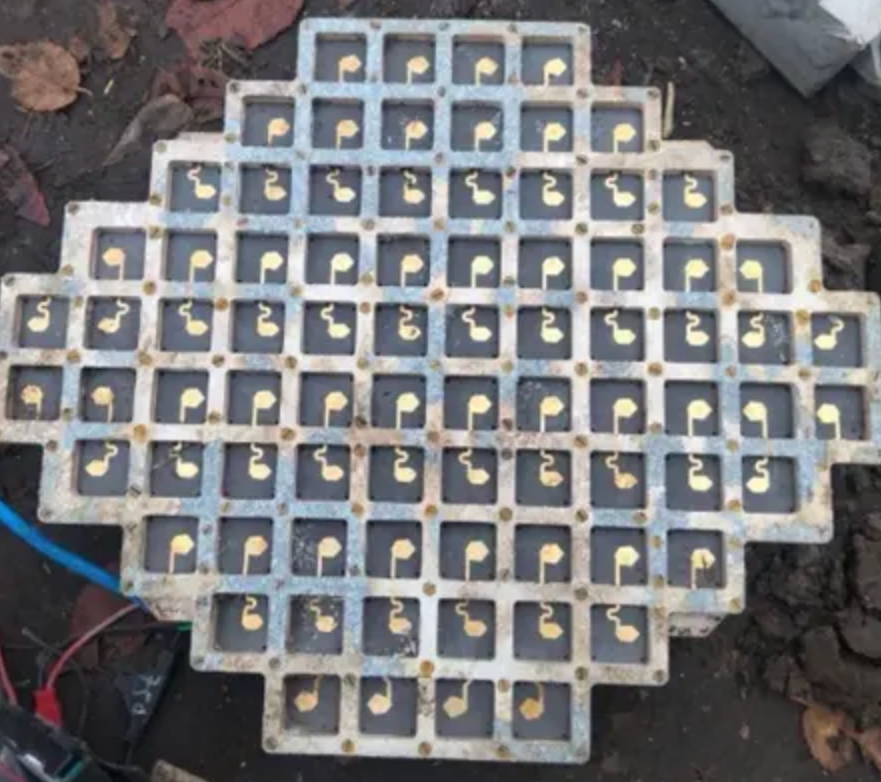
The database identifies the 3B222 active radar-homing head, manufactured by NPP Radar MMS, and a Baget-83 onboard digital computer produced by KB Korund-M.

Reported 3B222 active radar homing antenna recovered from Zircon wreckage. GUR

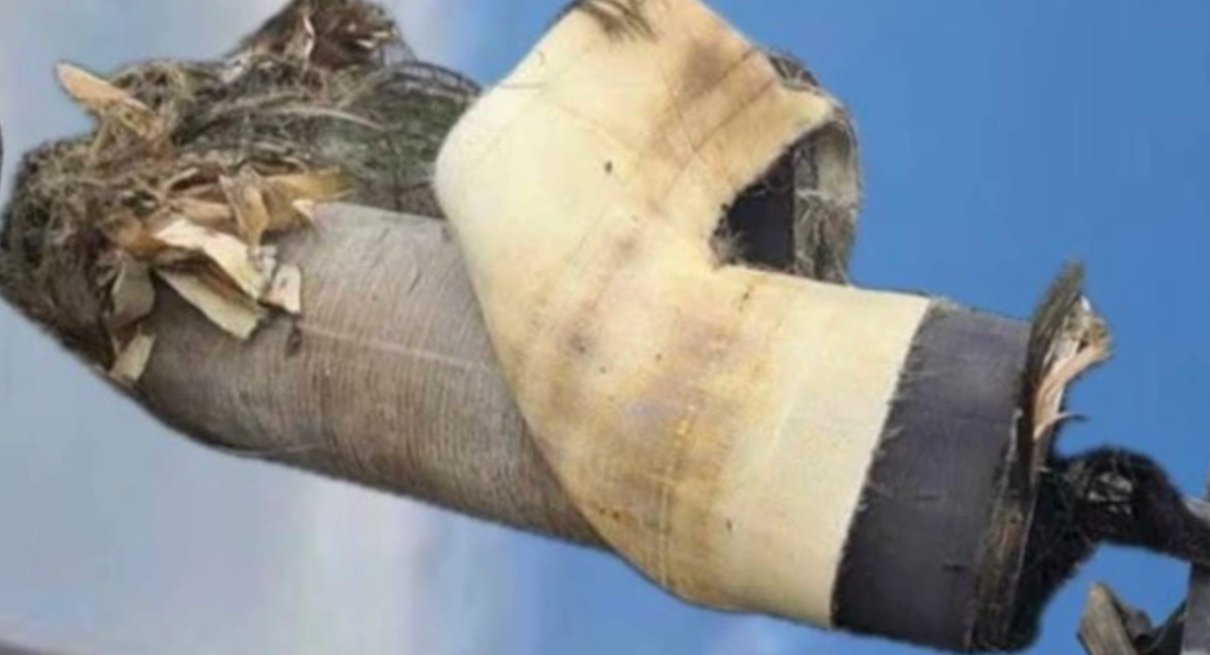
It also identifies the 3B915 guidance units, the 3G22 warhead, and the 3L2211 solid-fuel rocket motor manufactured by NPO Iskra. Other Russian companies provide altimeters, control systems, power supplies, and other components.

Reported remains of a 3L2211 solid-fuel rocket motor manufactured by NPO Iskra. GUR

The reported propulsion information is particularly significant.

Russian and other sources have consistently described Zircon as a hypersonic cruise missile, implying an air-breathing propulsion system burning liquid propellant, capable of sustaining hypersonic flight.

However, the physical evidence for such a propulsion system has always been less clear.

Open-source analysis by Fabian Hinz has highlighted the apparent absence of a conventional air intake on Zircon. A scramjet- or ramjet-powered missile requires an intake to bring atmospheric oxygen into the engine, yet available imagery does not clearly show one. A Russian patent associated with the missile’s jettisonable launch cap likewise does not reveal an obvious intake arrangement.

Just published my new OSINT investigation into Russia's secretive Zircon missile whose combat use has risen sharply in 2026.

Available evidence suggests that Zircon is not a hypersonic cruise missile but rather a quasi-ballistic system.

Link: https://t.co/8DoQePRpX3 pic.twitter.com/bIBS532FUB

— Fabian Hinz (@fab_hinz) June 17, 2026

More significant is evidence from recovered missile debris.

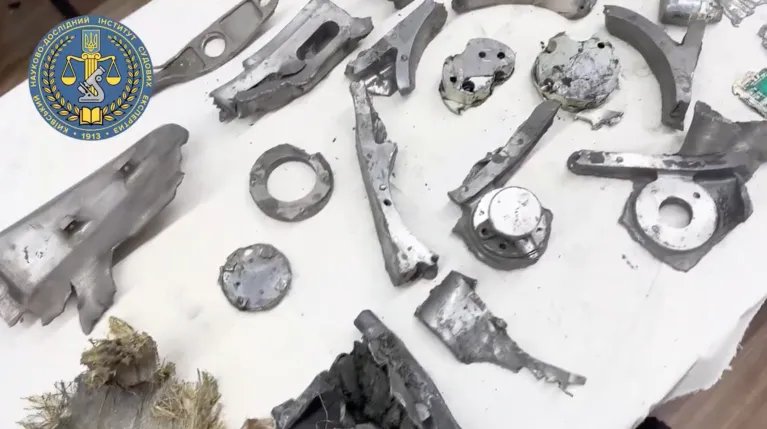
Material examined by Ukraine’s Scientific Research Institute of Forensic Expertise included a circular metal structure interpreted as part of a solid-propellant rocket motor. The hardware appeared to be associated with Zircon’s second stage rather than simply its launch booster (which would be used on a true hypersonic cruise missile to bring it up to operating speed). This suggests a two-stage weapon, with a solid-propellant rocket in each. This would match with what we have seen during shipboard launches.

That finding is consistent with Russian patent activity involving NPO Mashinostroyeniya and NPO Iskra. Patents associated with the companies describe solid-propellant rocket motors incorporating arrangements for aerodynamic-control equipment around the motor’s exhaust system.

There is also evidence that Russian engineers developed advanced composite solid propellants specifically for Zircon.

None of this conclusively proves the missile lacks an air-breathing engine, but it certainly raises more questions about its classification. It should be noted that there are also some solid-fuel ramjet concepts, but these are much rarer applications.

In February 2024, evidence emerged that Russia had, for the first time, used the Zircon in attacks on at least one target in Ukraine. Ukrainian scientists showed a video of the Zircon wreckage — “fragments of the engine and steering mechanisms [with] specific markings,” seen here. via X

If Zircon is primarily rocket-powered, it may be better understood as a maneuverable quasi-ballistic missile that nonetheless reaches hypersonic speeds.

Such a weapon would use rocket propulsion to accelerate rapidly and climb to high altitude before descending toward its target along a trajectory that is partly ballistic but incorporates aerodynamic maneuvering — a so-called ‘porpoising’ or ‘skip-glide’ trajectory. It could therefore reach hypersonic speeds without requiring sustained cruise under the power of an air-breathing system. The combination of high speed and unpredictable trajectory also makes it notably difficult for air defenses to deal with, characteristics shared with the air-launched Kinzhal, another Russian quasi-ballistic missile.

That interpretation could also help explain reports of a highly variable Zircon speed profile.

Russian officials have claimed that the missile can reach approximately Mach 9. During a 2020 test, Russian military leadership said Zircon reached more than Mach 8 while flying to an altitude of roughly 17 miles.

A Russian Ministry of Defense video that claims to show the Zircon test in the White Sea on Oct. 6, 2020:

Ukrainian assessments have described a more complicated profile, with the missile reportedly flying at around Mach 5.5, accelerating to approximately Mach 7.5 near the target, and then slowing before impact. Those figures cannot be independently confirmed, but a boost-and-glide or quasi-ballistic trajectory could produce such a profile more naturally than sustained powered cruise.

Ru MoD released a somewhat better Zircon launch footage. pic.twitter.com/bxHa6DsFG7

— krakek (@krakek1) December 3, 2024

At the same time, it should be recalled that ‘hypersonic’ does not necessarily imply a ‘hypersonic cruise missile.’ A ballistic or quasi-ballistic weapon can travel well above Mach 5, which appears to be the case here. The characteristics of the Zircon, as presented by the GUR, would also help explain official Ukrainian claims that the missiles have been intercepted successfully by Patriot PAC-3 air defense systems.

There is also a relevant technological precedent. NPO Mashinostroyeniya has previously patented solid-propellant missiles using quasi-ballistic trajectories, including designs intended to maneuver at high-supersonic and hypersonic speeds. That does not establish a direct lineage to Zircon, but it does show that the concept is consistent with the company’s history.

The other major takeaway from the release is the scale of Zircon’s production network.

One of Russia’s leading missile houses, NPO Mashinostroyeniya is identified as the missile’s main designer and manufacturer and prime contractor for Russian Ministry of Defense contracts covering its development and production.

But the weapon depends on dozens of other organizations. NPO Iskra supplies the solid-fuel motor; NPP Radar MMS provides the radar seeker; KB Korund-M produces the onboard computer; and other enterprises supply guidance systems, altimeters, control electronics, warheads, power systems, and other specialized equipment.

Another video, released by the Russian Ministry of Defense in May 2022, is said to show the Gorshkov launching a Zircon, although the missile is seen only at a distance with no details visible:

The U.S.-origin electronics claimed to have been identified by GUR are particularly notable because they demonstrate how Russia’s sophisticated weapons production remains connected to international semiconductor supply chains.

By linking specific enterprises and individuals to individual missile components, Ukraine has provided governments and investigators with new information that could be used to pursue sanctions, export-control enforcement, and efforts to disrupt Russia’s supply chain.

The report also adds weight to continued open-source assessments of what kind of missile Zircon actually is.

Regardless of its classification, Zircon remains a formidable weapon. A rocket-powered missile capable of reaching hypersonic speeds, flying at high altitude, maneuvering, and potentially accelerating during its terminal approach presents a serious challenge to missile defenses. With Ukraine’s ability to intercept even more conventional ballistic missiles already severely eroded, the weapon further complicates the country’s troubling air defense picture.

Contact the author: thomas@thewarzone.com

The post Russia’s Zircon May Not Be A Hypersonic Cruise Missile After All appeared first on TWZ.

  •  

Japan’s First Dedicated Missile Defense Warship Is A Monster

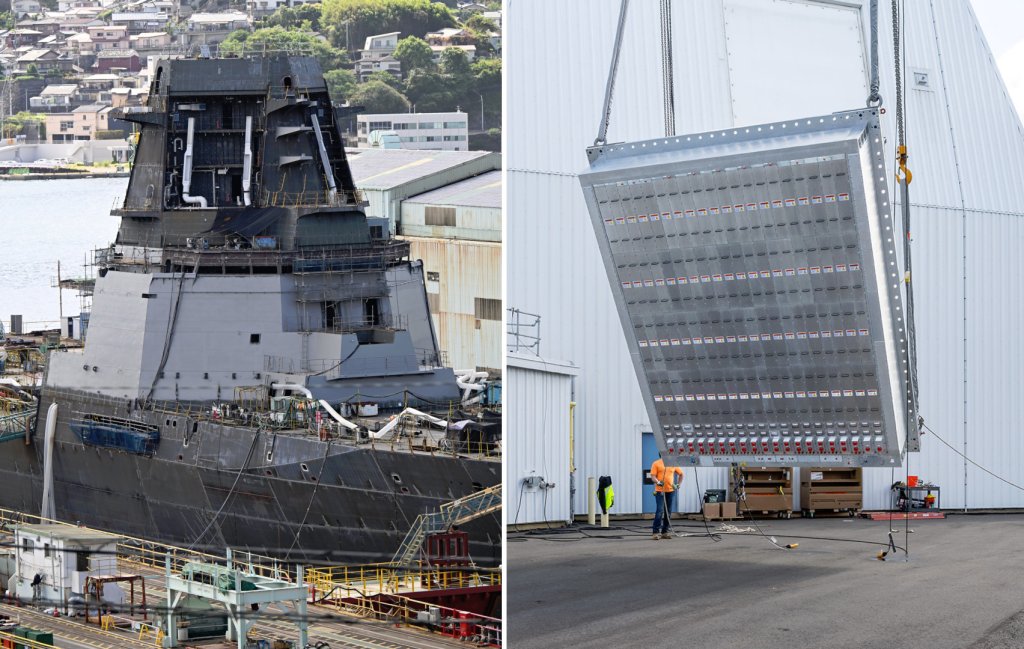
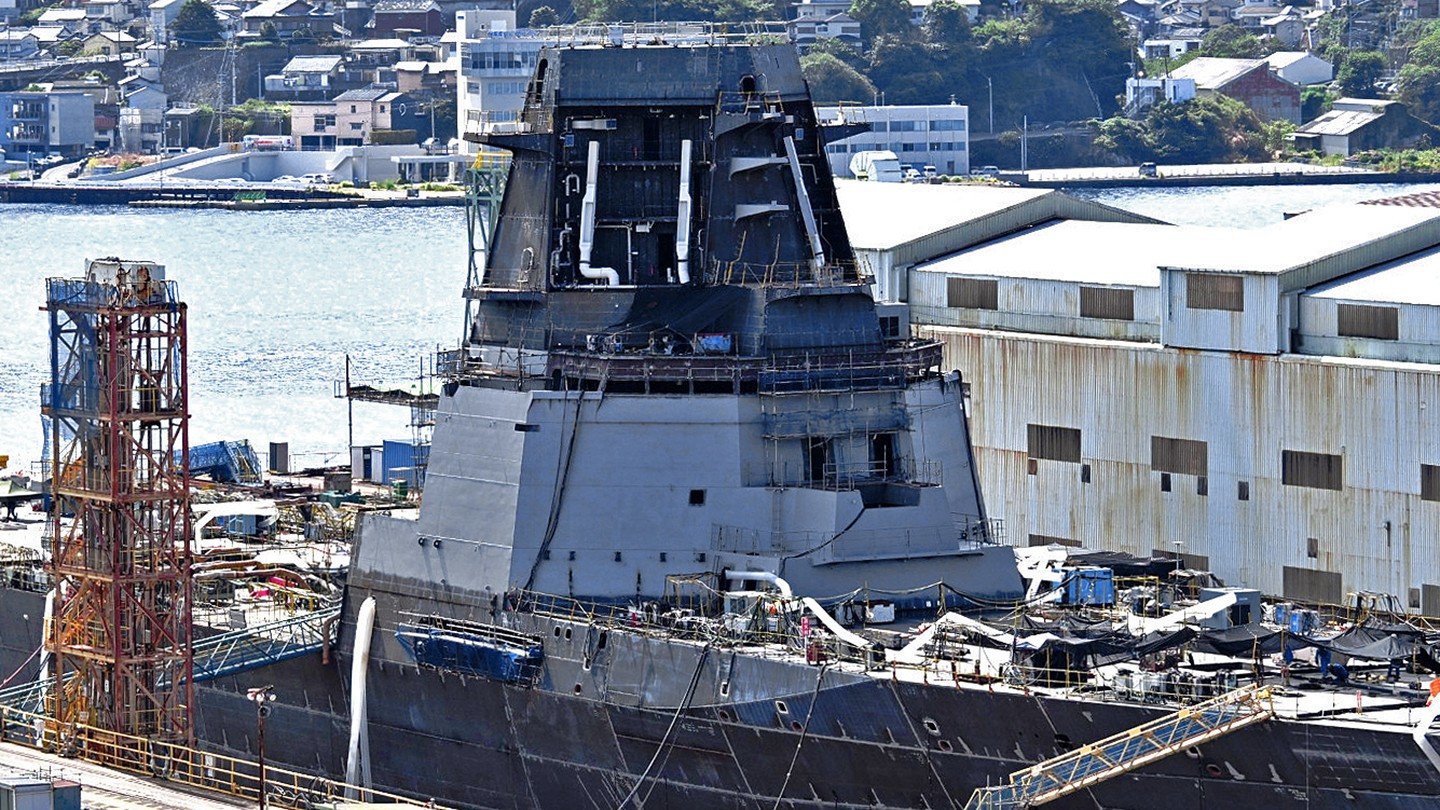
The first of Japan’s two new cruiser-sized Aegis System Equipped Vessels (ASEV) is continuing to take shape, recently receiving its huge main integrated mast, giving the vessel a new and remarkably imposing silhouette. The four very large fixed arrays for the ship’s powerful AN/SPY-7(V)1 radar will eventually be integrated onto this structure. The ASEV’s stated primary mission is missile defense, but Japanese authorities plan to give the vessels additional counter-drone, anti-ship, and land attack capabilities in the future. Tomahawk cruise missiles are notably set to be added to the ship’s arsenal down the line.

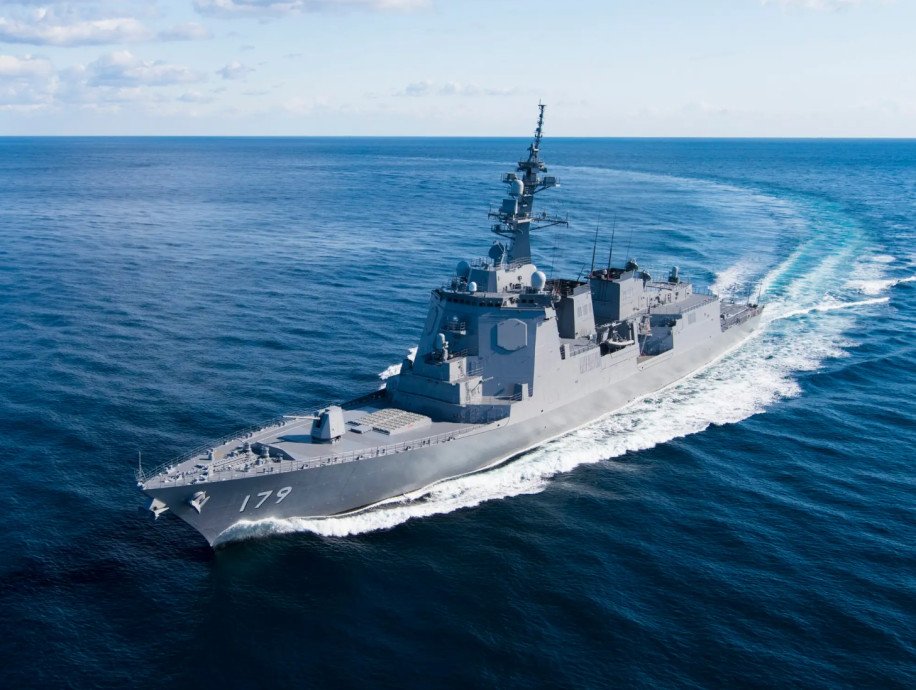
The ASEVs are large surface combatants, set to be some 620 feet long, have a beam (the widest point of the hull) of some 82 feet, and a standard displacement of 12,000 tons. For comparison, Japan’s largest surface combatants today, its Maya class destroyers, are just over 557 feet long, have a beam of some 73 feet, and a standard displacement of around 8,200 tons. It is worth noting here that the size of new and advanced destroyers, often optimized for anti-air warfare missions, has been trending upward globally in recent years. This, in turn, has caused the line between destroyers and what have more historically been categorized as cruisers in certain cases.

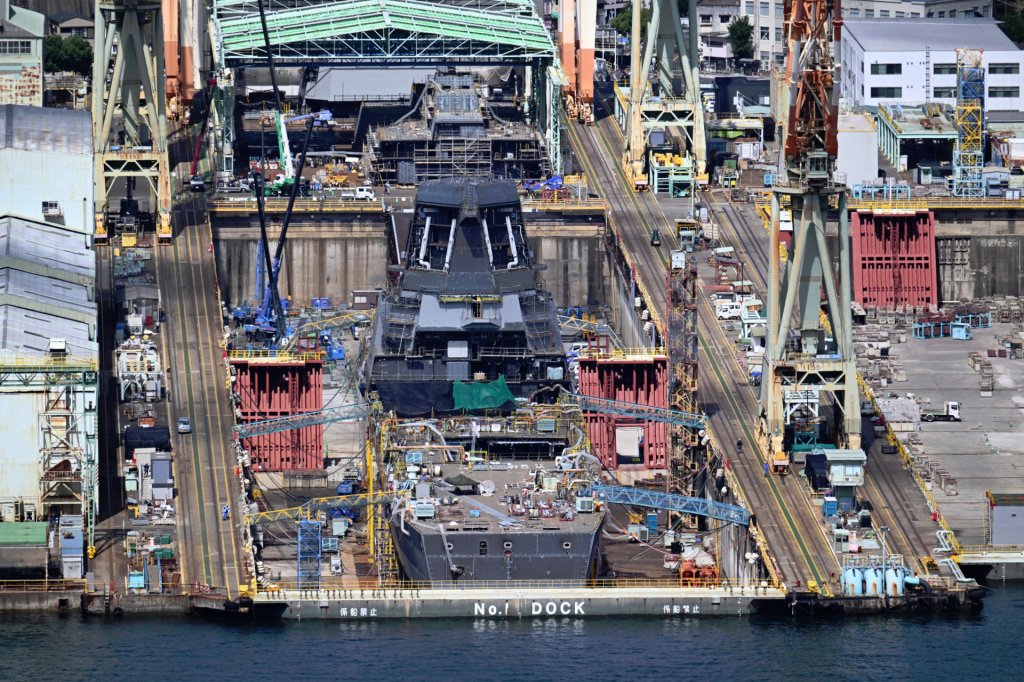
The first ASEV under construction in Nagasaki, as seen from the stern. This picture was taken earlier this month. Sakai/@kensakai9310

The first ASEV was laid down at Mitsubishi Heavy Industries’ (MHI) shipyard in Nagasaki in July 2025. The second was laid down in February of this year at Japan Marine United Isogo shipyard, which is situated in Yokohama City near Tokyo, according to a past report from Naval News. The Japanese Ministry of Defense is currently aiming to have the first of these vessels in service before the end of the country’s 2027 Fiscal Year, which runs from April 2027 to March 2028. The second is expected to follow in the 2028 fiscal cycle, which extends into 2029.

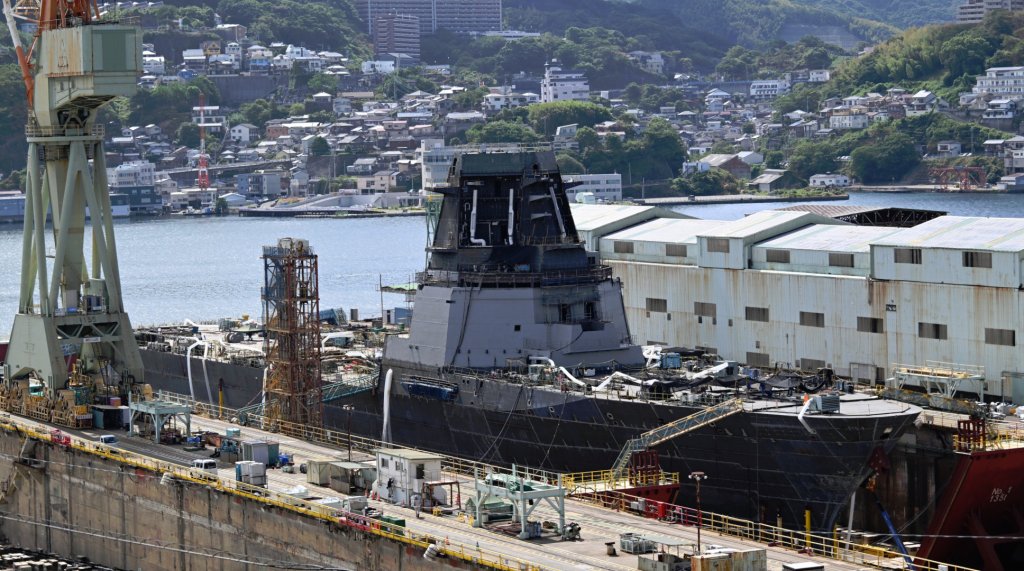
Another view of the first ASEV under construction in Nagasaki. Sakai/@kensakai9310
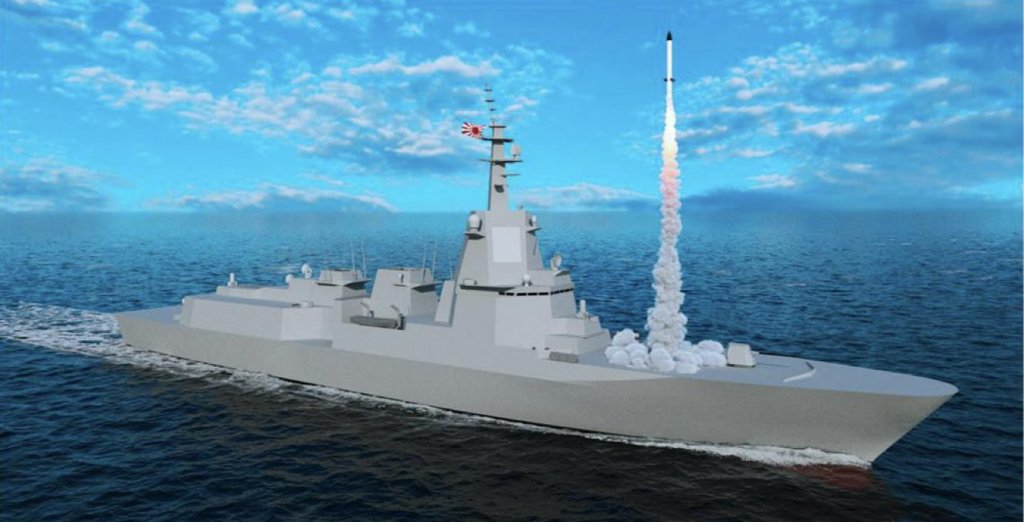
A rendering of what the finished ASEV is currently expected to look like. Japanese Ministry of Defense

Significant progress in the overall construction of the first ship has been made just this year. The addition of the main mast structure, installed on top of the main superstructure, as seen in pictures at the top of this story and below, has drawn particular attention in recent weeks.

Japanese are very fast with ship building.

March 26 and today. ASEV-class destroyer.

190 m hull, SPY-7 Aegis, 128cell Mk 41 VLS. SM-3 for ballistic missiles, SM-6, plus Japan’s long range Type 12 SSM. pic.twitter.com/RQZixtqWwe

— 信濃 Æýà (@Shinano_AEya) August 30, 2026

The especially large size of the ASEV’s integrated mast is driven by that of the AN/SPY-7(V)1 active electronically-scanned array (AESA) radar from Lockheed Martin. Each one of the radar’s four rectangular arrays is reportedly around 14 feet (nearly 4.3 meters) tall. This would put them in the same general size category as the arrays for Raytheon’s AN/SPY-6(V)1 Air and Missile Defense Radar (AMDR) found on U.S. Navy Flight III Arleigh Burke class destroyers. That being said, the pictures we have now raise the question of whether the AN/SPY-7(V)1 arrays are bigger than previously assessed. The AMDR is another notably large design heavily optimized for missile defense.

A close-up look at the main superstructure and integrated mast on the first ASEV under construction in Nagasaki, at left, and a stock picture of an AN/SPY-7(V)1 array at right. Sakai/@kensakai9310

The size and location of the mast provide a centralized, elevated position for the AN/SPY-7(V)1’s large arrays, which will also require significant power generation capacity and thermal management to keep everything cool. This is a notable departure from the placement of the arrays on the main superstructure on existing Japanese destroyers, as well as the U.S. Arleigh Burke class, and offers an unobstructed, elevated line-of-sight to the horizon. Beyond the ballistic missile defense mission, this view farther out over the horizon would be important for tracking and engaging low-flying drones and cruise missiles, which might be targeting the ship itself. This is something we will come back to later on.

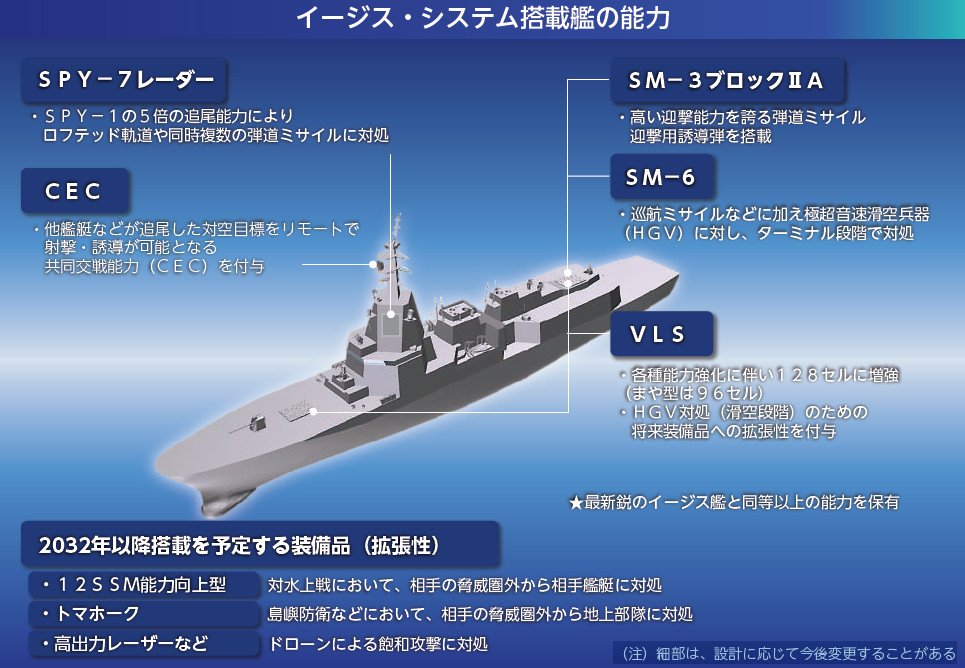
“With five times the tracking capability of the SPY-1, it [the AN/SPY-7(V)1] counters lofted trajectories and simultaneous multiple ballistic missile threats,” according to a machine translation of a section of the Japanese Ministry of Defense’s 2026 defense policy white paper, which was released earlier this month.

The passive electronically-scanned array (PESA) AN/SPY-1 was the first radar to be paired with the Aegis Combat System, and both were first introduced in the 1970s. Variants of the SPY-1 are still found on a variety of U.S. and foreign Aegis-equipped warships, including Japan’s Kongo, Atago, and Maya class destroyers.

The first-in-class destroyer JS Maya. Japanese Ministry of Defense

The AN/SPY-7(V)1 is also a derivative of the U.S. military’s static, land-based Long Range Discrimination Radar (LRDR) in Alaska. Japan also originally planned to employ the AN/SPY-7(V)1 on land at a pair of Aegis Ashore missile defense sites. However, that effort was subsequently cancelled, with the ASEV emerging to fill the resulting gap.

Additional versions of the AN/SPY-7 with much smaller arrays are also being integrated onto new F110 Bonifaz class frigates for the Spanish Navy and the Royal Canadian Navy’s forthcoming River class destroyers (also known as the Canadian Surface Combatant). The use of the AN/SPY-7(V)1 on the ASEV could impact decisions regarding new radars for other future and existing Japanese warships. Raytheon is also pitching versions of its increasingly popular AN/SPY-6 family for use on a successor to the Kongo class and for refit on the Maya class, according to a recent report from Naval News.

When it comes to the ASEV, as already noted, the AN/SPY-7(V)1 is central to the ship’s main stated missile defense mission. As the name makes clear, the ship will also feature the Aegis Combat System. The vessel will be capable of “remote engagement and guidance against anti-air targets tracked by other vessels” via a “Cooperative Engagement Capability (CEC),” per the Japanese Ministry of Defense’s most recent annual defense white paper.

The video below provides details about the U.S. Navy’s Cooperative Engagement Capability (CEC) developments, which are likely very similar to what Japan has planned for the ASEV.

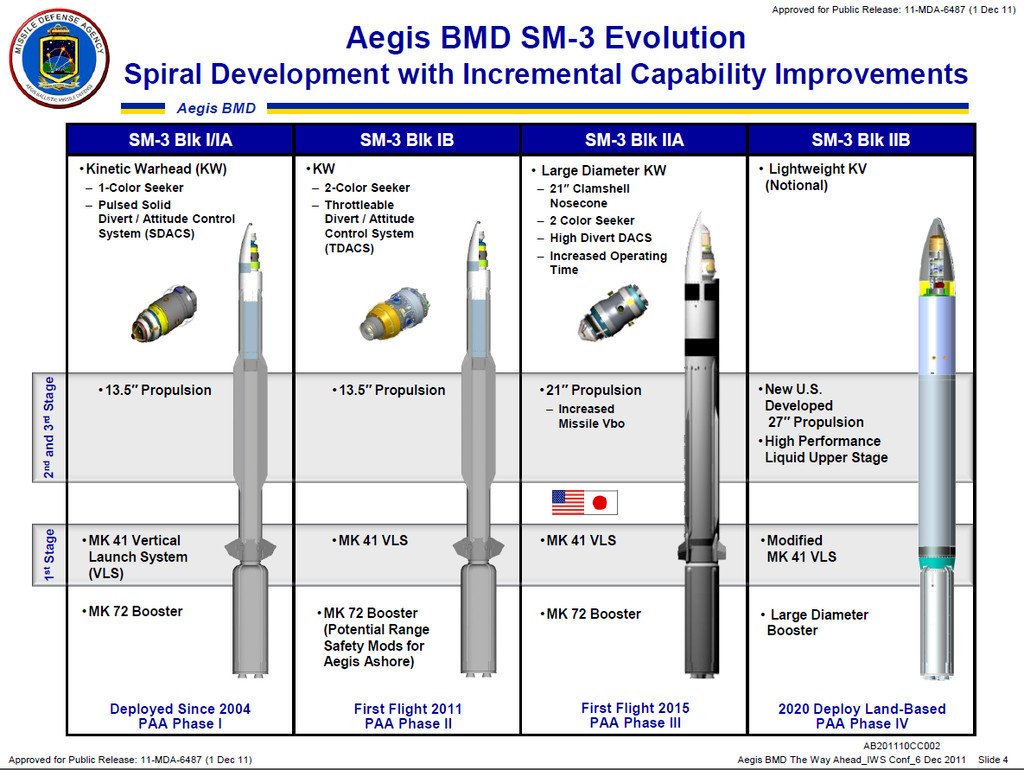
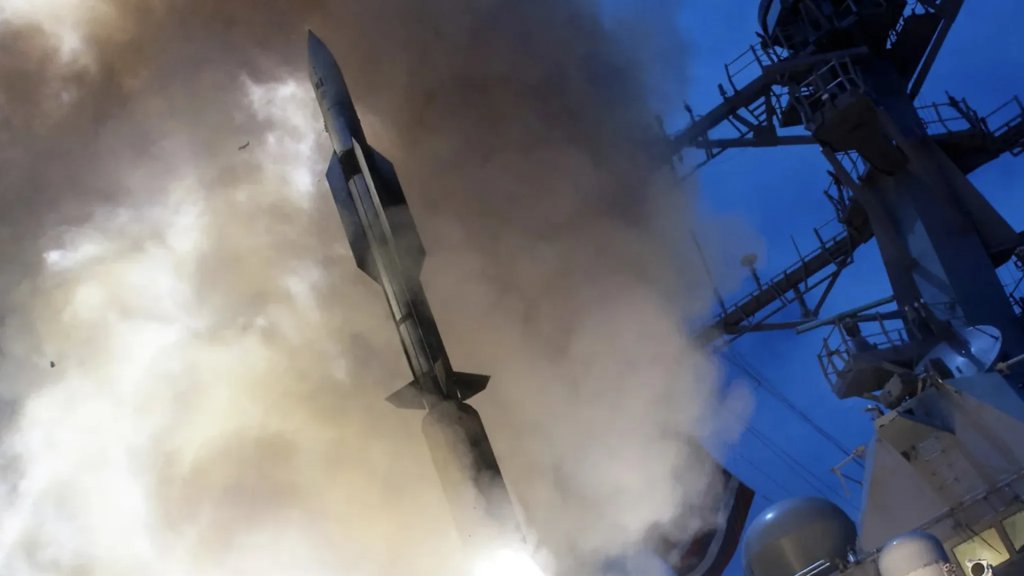
In terms of armament, when the ASEVs first enter service, their main weaponry is expected to be a mix of variants of the Standard Missile-3 and -6 (SM-3 and SM-6). The SM-3 family is designed to engage ballistic missile threats during the mid-course portion of their flights while they are traveling outside of the Earth’s atmosphere. The SM-3 also has a demonstrated anti-satellite capability. The SM-6 is a multi-purpose missile that was originally designed with an anti-air focus. It can be used to target incoming ballistic missiles in the terminal phase of flight and also has at least a degree of capability for engaging hypersonic weapons. SM-6 can be used in a surface-to-surface mode, including against ships, as well. Japan is also a partner in the U.S.-led development of a new Glide Phase Interceptor (GPI), which is being designed specifically to intercept unpowered, but highly maneuverable hypersonic boost-glide vehicles.

A briefing slide breaking down details about the various existing SM-3 variants. Work on the further evolved Block IIB variant seen here was cancelled in 2013. MDA A briefing slide breaking down details about the various SM-3 variants, including the SM-3 Block IIA. Work on the further evolved Block IIB variant seen here was canceled in 2013. MDA
An SM-6 missile seen being launched from a U.S. warship. USN

SM-3, SM-6, and future GPIs will be loaded into either of the ASEV’s two Vertical Launch System (VLS) arrays, one at the bow end and another toward the stern. Each one of the ships will have a total of 128 VLS cells. For comparison, Japan’s Maya class destroyers, as well as the U.S. Navy’s Flight IIA and III Arleigh Burke class destroyers, have 96 VLS cells apiece. The U.S. Navy’s Ticonderoga class cruisers each have 122 VLS cells, and 128 is also the number of VLSs currently expected to be found on the future Trump class battleships.

At the time of writing, Japanese authorities do not appear to have explicitly mentioned plans to arm the ASEVs with other missiles when they first enter service. That being said, any VLS array capable of accommodating SM-3s and SM-6s should be able to fire a variety of other weapons, including shorter-ranged SM-2s and Evolved Sea Sparrow Missiles (ESSM), which the ship could use for more localized air and missile defense, as well as protecting the ship itself.

Renderings and models of the ASEV do show the design also armed with a five-inch naval gun in a turret on the bow, along with two Phalanx Close-in Weapon Systems (CIWS) and other automatic cannons for point defense.

A Japanese language graphic from the country’s 2026 defense white paper discussing the planned features of the ASEVs. Japanese Ministry of Defense

As mentioned, while missile defense is the immediate focus for the ASEVs, there are already plans to significantly expand their capability to engage other ships and targets on land. Tomahawk cruise missiles and a new, extended-range version of the Type 12 anti-ship cruise missile are set to be added to the arsenal of these vessels in the 2032 timeframe, according to the latest official Japanese defense white paper.

Japanese authorities want the ASEVs to eventually be able to help fend off waves of enemy drones, too. High-energy laser-directed energy weapons are set to be integrated onto the ships down the line to help address those threats. The overall size and other general characteristics of the ships would leave the door open to the possible addition of high-power microwaves and other capabilities in the future.

TWZ has long noted that the ASEVs will bring huge new boosts in naval air and missile defense and long-strike capability to the Japan Maritime Self-Defense Forces. The vessels also reflect a significant evolution in post-World War II Japanese doctrine, toward what officials currently frame as a “stand-off defense” construct that remains within the bounds of the country’s current pacifist constitution.

Just with SM-3, SM-6, and GPI, the ASEVs will offer an important addition to the air and missile defense bubbles around Japan’s home islands and outlying territories in the face of growing geopolitical friction with China and Russia, two countries that are increasingly cooperating militarily. The vessels will also add to Japan’s deterrent against long-standing and still evolving threats posed by the regime in North Korea, which has its own close ties to the Chinese and Russian governments. All three of these nations continue to expand their arsenals of ever-more capable ballistic, cruise, and hypersonic missiles. Long-range one-way-attack drones are another growing part of the equation, with the ongoing conflict in Ukraine and fighting in the Middle East in recent years underscoring just how real a threat they pose.

With the addition of Tomahawks, the ASEVs, along with other Japanese warships, will gain the additional ability to threaten counterstrikes against targets on land (and potentially at sea) at least around 1,000 miles in any direction. As part of the broader stand-off defense strategy, the Japan Self Defense Forces is developing new land-based long-range strike capabilities, including hypersonic missiles, as well.

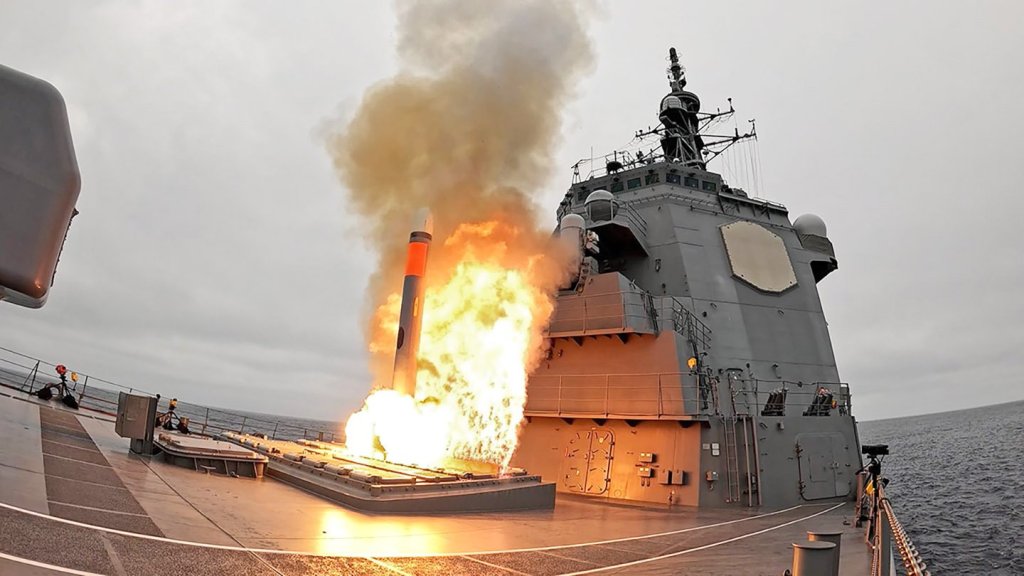
The Kongo class destroyer Chokai fires a Tomahawk cruise missile during a test earlier this year. This was the first-ever launch of a Tomahawk from a Japanese warship. Japanese Ministry of Defense

It is worth noting that with current plans to acquire only two ASEVs, these will be high-value but also low-density assets, which will have to be very deliberately deployed for maximum effect. They will also stand out as top-priority targets in any future conflict, and will need to be protected as such.

It is possible that the roles and missions of the ASEVs, just like their designs, could evolve further as time goes on. The threat ecosystem facing Japan will continue to evolve, likely more rapidly, in the coming years. The country is also expanding its naval capabilities in other ways, and with an eye toward more blue water operations. This includes expanded light carrier capabilities through refits of existing Izumo class ships. Anti-ship ballistic missiles and hypersonic cruise missiles, among large volumes of more traditional threats, could see the ASEVs used as escorts, even if experimentally. While just two hulls are barely enough to keep one on patrol to protect Japan, more could be built for expeditionary applications.

Regardless, the ASEVs are set to be a major addition to the Japan Maritime Self Defense Force’s fleets that will have big ramifications. From the progress that is visible at the shipyard in Nagasaki, MHI looks to be well on track to deliver the first of these ships next year or two.

Special thanks to @kensakai9310 on X, who also goes by “Sakai,” for sharing recently taken pictures of the first ASEV under construction at MHI’s yard in Nagasaki with us.

Contact the author: joe@twz.com

The post Japan’s First Dedicated Missile Defense Warship Is A Monster appeared first on TWZ.

  •  

Japan’s ASM-3 Kai Supersonic Cruise Missile May Have An Air-To-Air Capability

Japan’s Ministry of Defense has included an intriguing description of the ASM-3 Kai missile in its record fiscal year 2027 defense budget request, referring to the weapon as an “air-to-surface/anti-air missile.” Until now, the ASM-3 family has been publicly associated with the air-launched anti-ship (anti-surface) mission, and the wording potentially hints at an additional capability or intended role for the upgraded weapon.

The reference appears in Japan’s FY2027 defense budget request, submitted today, which seeks a record ¥8.89 trillion (approximately $56 billion) for the fiscal year beginning in April 2027. The request is part of a broader push by Tokyo to expand standoff strike, air defense, uncrewed systems, and other advanced capabilities.

The reference appears under a sub-section entitled Durability and Resilience, which calls for funds to “secure ammunition and fuel, increase the number of operational units (by addressing parts shortages, etc.), enhance the resilience of facilities (through facility upgrades associated with the formation of new units and the introduction of new equipment, etc.), and strengthen the operational infrastructure (by enhancing manufacturing capabilities, etc.).”

https://t.co/ntiASteLJx
というわけで概算要求ですが、個人的にはずっと導入を訴えてきたAARGM-ERの導入決定が嬉しい。あとは、ASM-3(改)がまさかの「空対艦/対空ミサイル」とは。 pic.twitter.com/XX09mrx2cE

— 因幡のよっちゃん(稲葉義泰 Yoshihiro Inaba) (@japanesepatrio6) August 31, 2026

In terms of securing ammunition, the document highlights the breadth of weapons systems involved, ranging from 5.56mm small arms ammunition and 30mm cannon rounds, via 155mm precision artillery rounds, up to advanced missiles including the Type 23 ship-launched air defense missile and the ASM-3 Kai.

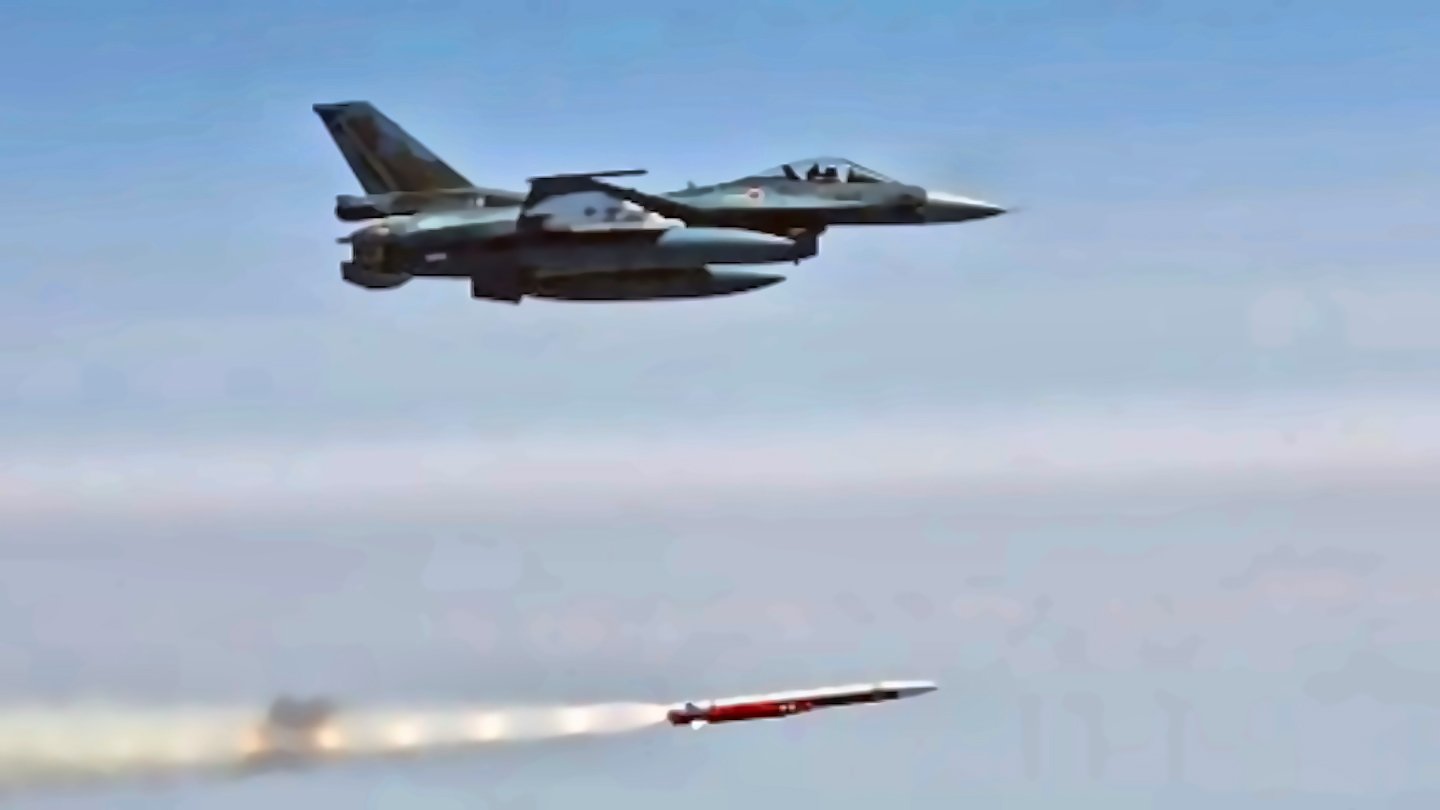
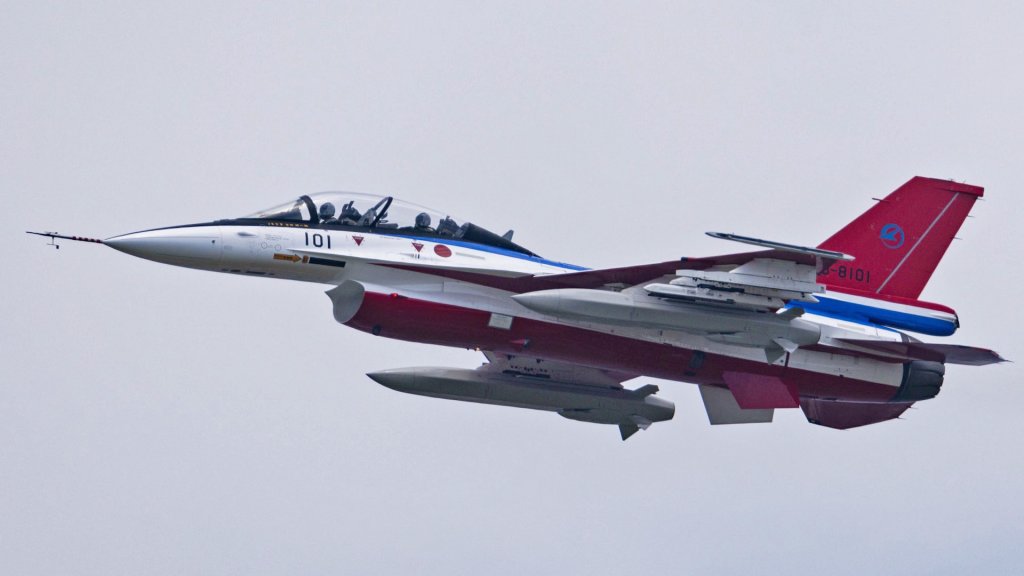
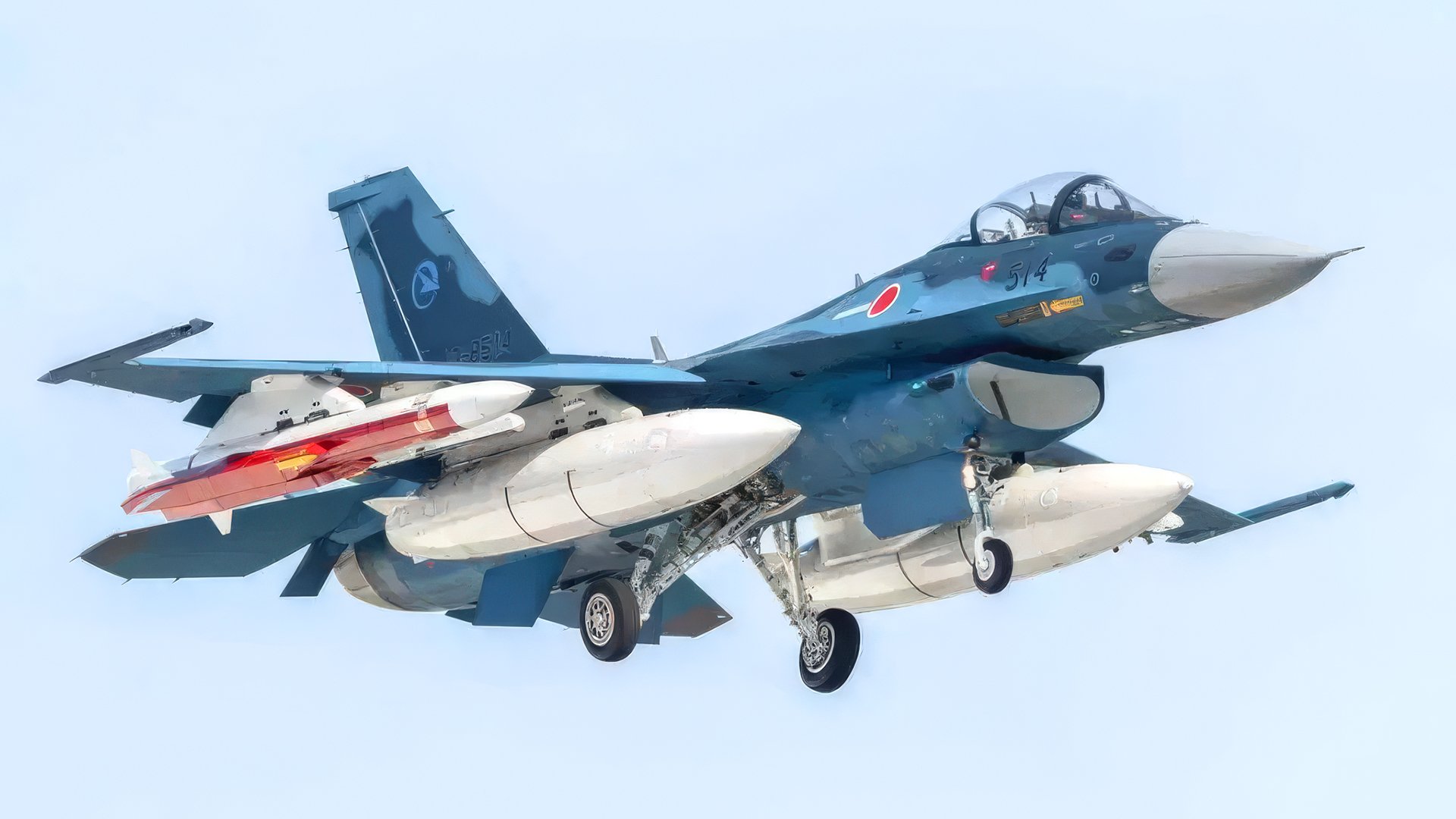
The Mitsubishi Heavy Industries (MHI) ASM-3 is Japan’s domestically developed supersonic air-launched anti-ship missile, originally intended to arm the Mitsubishi F-2 fighter. The improved ASM-3 Kai (“Kai” meaning modified or revised) represents a significant evolution of the weapon, although the full nature of its capabilities and performance have not been officially revealed. The missile has already been observed undergoing testing on F-2s.

2年半振り以上?に飛んでいる102号機を撮影しました👍
ASM-3改にカメラポット吊してありがたや🙏

2026.06.01
岐阜基地 RJNG
F-2B 102 pic.twitter.com/oUJImUagsI

— ボボ・AKEBOVO (@AKEBOVO) June 1, 2026

The ASM-3 program has also gone through a number of different configurations over its development history, with at least five distinct external configurations identified in previous reporting. The existence of multiple iterations leaves open the possibility that the newly identified “anti-air” designation could ultimately correspond to a dedicated air-to-air variant or derivative of the ASM-3 family, rather than simply a secondary capability of the baseline ASM-3 Kai.

Reportedly, the ASM-3 Kai is capable of flying more than 400 kilometers (about 250 miles), although the exact range of the operational weapon remains classified. It is powered by a ramjet engine, giving it sustained high-speed performance — reportedly around Mach 3. If it indeed has an air-to-air capability, this would be an advantage in some scenarios, compared to relying solely on a brief but very powerful rocket boost as many air-to-air missiles do.

A Mitsubishi F-2 launches an ASM-3 anti-ship missile. (JASDF)

The weapon is also understood to employ an active/passive radar seeker, providing it with both an active radar mode for detecting and engaging targets and a passive mode that can home in on their electromagnetic emissions. While an active radar seeker is common on long-range air-to-air missiles, the latter passive capability could also be of extreme value in an air-to-air application.

岐阜基地
九州から岐阜へ移動しました。
F-2 101号機、ASM-3✖2発
スペマと離陸しました。#岐阜基地 #ASM3 pic.twitter.com/oFjetR3rWZ

— K.otani (@kotaken8022) December 9, 2025

The ASM-3 is also a substantially larger missile than typical fighter-launched air-to-air weapons. While that imposes obvious carriage and aerodynamic penalties, it also allows for a larger propulsion system, seeker, and warhead than would be practical in a smaller missile.

A weapon capable of traveling hundreds of miles at high speed, while carrying an active/passive radar seeker, could potentially be especially useful against high-value airborne assets such as airborne early warning and control (AEW&C) aircraft. These platforms provide vital wide-area surveillance, battle management, and targeting capabilities. At the same time, their powerful radars are necessarily emitting, potentially making them detectable and trackable by a missile employing a passive seeker.

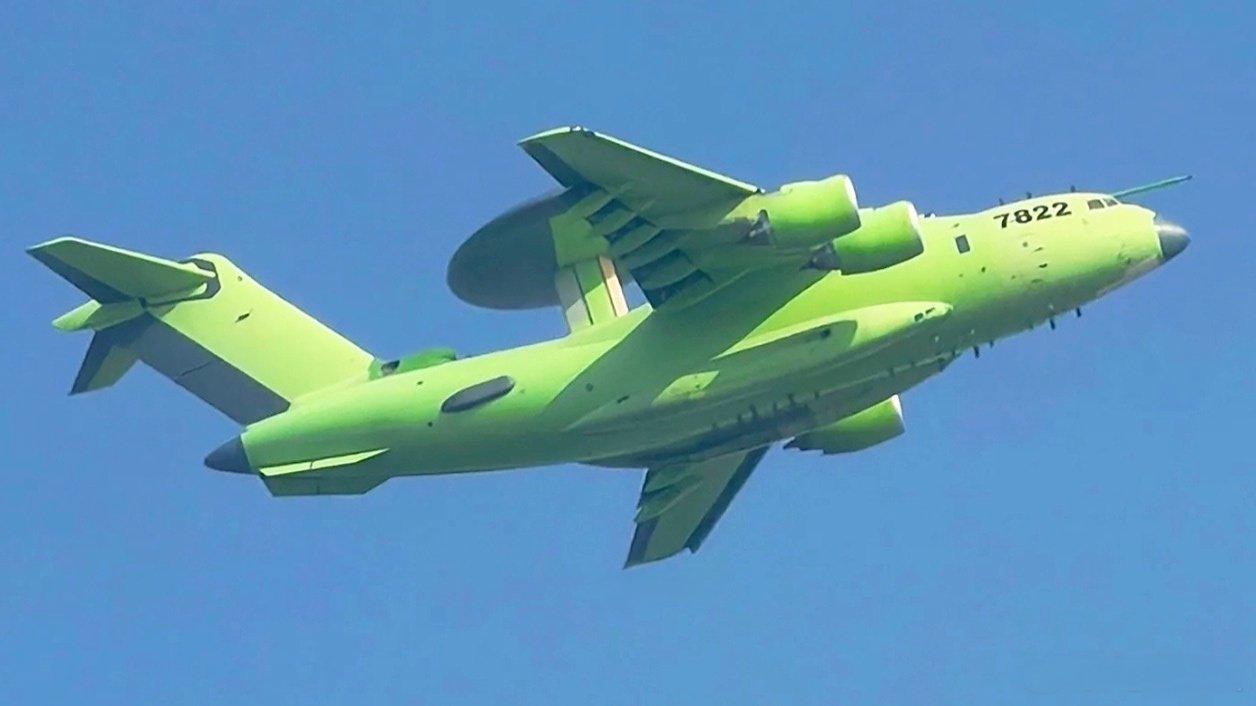
China’s rapidly expanding AEW&C fleet is an increasingly important part of its ability to generate situational awareness, coordinate fighters, and extend its sensor coverage well beyond its immediate borders. The force, which already numbers dozens of increasingly capable fixed-wing aircraft, is a growing operational challenge for Japan and other regional air forces.

The second example of the Chinese KJ-3000 AEW&C aircraft, still painted in primer. via X

The ability to threaten such aircraft from well beyond the range of conventional air-to-air engagements could force an opponent to operate its AEW&C fleet even further from contested airspace, reducing the effectiveness of its sensors and command-and-control architecture. Although a passive seeker could also offer an avenue for homing in on relevant radar emissions, exactly how the ASM-3 Kai’s seeker would operate against airborne targets is not publicly known. Equally, a different variant of the missile, optimized for anti-air missions, could incorporate both passive and active seekers specially adapted for that mission set, although it is very possible a single configuration can accomplish both missions. As well as AEW&C aircraft, such a missile would be just as relevant for other high-value, non-maneuvering targets at long ranges, including intelligence-gathering platforms, tankers, and other support aircraft.

The budget language by itself falls short of establishing whether the ASM-3 Kai has been tested or validated against aircraft. The designation could reflect a broader classification within the budget documents, or it could point toward a genuine expansion of the weapon’s intended target set.

Such a weapon would not necessarily be a replacement for Japan’s existing air-to-air missile arsenal. Instead, an “anti-air” ASM-3 Kai could occupy a specialized niche focused on high-value or otherwise particularly important airborne targets at extended ranges.

The possibility is consistent with Japan’s broader effort to expand the flexibility and reach of its air-launched weapons. Tokyo is pursuing a growing family of standoff weapons as part of a major expansion of its counterstrike and deterrence capabilities, including longer-range missiles capable of striking targets well beyond the immediate vicinity of Japan.

Other air-to-air missiles mentioned in the same section of the document comprise the U.S.-made AIM-120 Advanced Medium-Range Air-to-Air Missile (AMRAAM) and the domestically developed AAM-4B, another medium-range weapon, thought to be the first of its kind to be fitted with an active electronically scanned array (AESA) antenna.

Between the exclusive AESA radar and Japan's labour cost, Mitsubishi's AAM-4B might be the most expensive air-to-air missile on the planet pic.twitter.com/rfBnXB8RzS

— Lia Wong (@LiaWong__) May 3, 2022

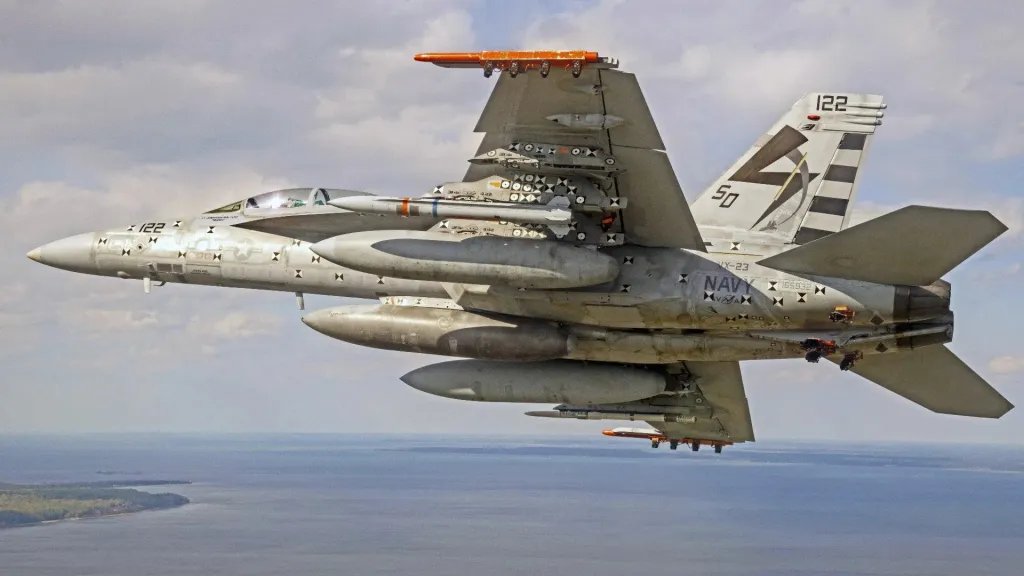
The FY2027 defense budget request also mentions another apparently new air-launched weapon for Japan, the AGM-88G Advanced Anti-Radiation Guided Missile-Extended Range (AARGM-ER). Japan has not previously been publicly documented as an international AARGM-ER customer, but the weapon would be an obvious candidate for integration with its F-35 fighters if it wishes to bolster their suppression/destruction of enemy air defenses (SEAD/DEAD) capabilities.

An AARGM-ER seen under the wing of an F/A-18F Super Hornet during a test. U.S. Navy

In terms of F-2-related developments, the document calls for the upgrade of an initial 10 of these aircraft to make them compatible with the air-launched version of the Upgraded Type 12 anti-ship guided missile, a significant new weapon that you can read more about here.

A pair of previously unseen missiles slung beneath the wings of a Japan Air Self-Defense Force (JASDF) Mitsubishi F-2 fighter underscores the progress Tokyo is making on expanding its long-range strike arsenal. While the weapon has not been officially identified, its size, configuration, and timing strongly suggest it could be the air-launched version of Japan’s new Type 25 Surface-to-Ship Missile (25SSM).
A pair of new missiles slung beneath the wings of an F-2, understood to be the air-launched version of Japan’s Upgraded Type 12/Type 25 anti-ship missile. @bibabibabibary @bibabibabibary

TWZ has contacted Japan’s Ministry of Defense seeking clarification on the “air-to-surface/anti-air” designation and what it means for the ASM-3 Kai’s intended capabilities and target set. It could also be the case that the description is an error in the budget document.

However, the emergence of such a capability would also come at a time when very-long-range air-to-air weapons are becoming increasingly important as anti-access/area-denial challenges make it harder for fighters to get close to enemy aircraft and the high-value assets supporting them. China has fielded weapons such as the PL-15 and the much larger PL-17, while the United States is developing the AIM-260 and has just revealed the AIM-424 Malice, a U.S. Navy missile reportedly capable of reaching more than 250 nautical miles. The U.S. Navy is also fielding the AIM-174B, a very-long-range weapon developed very much with the Chinese threat in mind, and which we discuss in the video below.

For now, exactly what prompted the “air-to-surface/anti-air” designation for the missile is unclear, but if it reflects a genuine expansion of the ASM-3 Kai’s mission set, it would represent a particularly interesting development in Japan’s rapidly evolving air-launched weapons portfolio.

Hat-tip to Yoshihiro Inaba for bringing this development to our attention.

Contact the author: thomas@thewarzone.com

The post Japan’s ASM-3 Kai Supersonic Cruise Missile May Have An Air-To-Air Capability appeared first on TWZ.

  •  
❌