Under the conditions of power monopoly in Afghanistan, the proposal of ideas such as ‘Southern Turkestan’ can become a platform for foreign intervention, ethnic polarization, and further disintegration of national cohesion. This project could also serve as a tool for future pressure on Iran, Russia, and China. Introduction The introduction of the ‘Southern Turkestan’ idea […]
The body of a 90-year-old woman was found covered in sheets and hidden in the basement of a house in Marathonas village in eastern Attica on Friday. The woman’s daughter and grandson have been arrested. The woman’s death was not registered with the authorities and the daughter allegedly kept receiving her mother’s pension for about […]
On September 1, the leaders of some of Eurasia’s most consequential states gathered in Bishkek for the 26th meeting of the Shanghai Cooperation Organization’s Council of Heads of State. The Summit That Did Not Need Europe The summit marked the SCO’s 25th anniversary. Vladimir Putin, Xi Jinping, Narendra Modi, Masoud Pezeshkian, Shehbaz Sharif, Aleksandr Lukashenko, […]
Two of the most prominent belligerents of World War II ended up clashing despite having initially fought on the same side, and it wasn’t until 1951, six years after the end of the conflict, that they signed an unusual peace. One of them was Italy, obviously, where the government that succeeded Mussolini signed an armistice […]
On 30 August, the world marked the International Day of the Victims of Enforced Disappearances, a date intended to rescue the missing from oblivion and remind states that no human being should simply vanish into the machinery of power. In Balochistan, however, remembrance carries the cruelty of the present tense. On July 24, 2026, Jiand Baloch, a student leader and chairman of the Baloch Students Organization, disappeared after being taken away under circumstances that, according to Amnesty International, amounted to an enforced disappearance. For eleven days, his family did not know where he was. He returned home on 3 August. It was not the first time. Amnesty says Jiand had previously been forcibly disappeared for nine months in 2018 and again for about a month in 2024, linking the repeated targeting to his peaceful activism. As the international community prepares to commemorate the disappeared, one man in Balochistan has already had to return from disappearance three times. Therein lies the cruel paradox of 30 August: elsewhere, it is a day for remembering an atrocity; in Balochistan, families continue to experience it in the present tense, writes Dimitra Staikou.
Jiand Baloch is one name in a much larger ledger of absence. According to the Human Rights Council of Balochistan, 105 cases of enforced disappearance were documented in July 2026 alone, alongside 59 killings; 47 of those reported missing later returned, while the fate of others remained unresolved. The figures come from a Baloch human-rights organisation and must be attributed as such, but the phenomenon itself has long drawn scrutiny from United Nations experts and international rights groups. Behind every number lies the peculiar violence of enforced disappearance: no grave at which to mourn, no prison to visit, often no official account to challenge — only a photograph carried from protest to protest and a question repeated until it becomes part of a family’s daily life: Where are they? The United Nations has described enforced disappearance not merely as a violation against the person who vanishes, but as a practice capable of spreading terror throughout society. That definition exposes the bitter contradiction at the heart of Balochistan: while the language of counterterrorism grants the state extraordinary powers in the name of protecting society from fear, families of the disappeared describe living inside another kind of terror — the terror of not knowing whether the person they love is imprisoned, tortured, alive or dead.
The tragedy of Balochistan is not that the world does not know. It is that it has known for years. Pakistan itself established a Commission of Inquiry on Enforced Disappearances in 2010, while UN mechanisms have repeatedly raised concerns over disappearances, impunity and the treatment of those who demand answers. In April 2026, the UN Committee against Torture went further, expressing concern over reports that human rights defenders, journalists, political opponents, civil society activists and protesters — as well as members of their families — had faced reprisals ranging from intimidation and arbitrary detention to enforced disappearance and extrajudicial execution. UN experts have also examined allegations arising from counterterrorism operations in Balochistan, including arbitrary arrests, enforced disappearances and extrajudicial killings, as well as alleged reprisals against peaceful protesters seeking information about the missing. The contradiction is difficult to escape: a state cannot treat disappearance as serious enough to warrant its own commission of inquiry while allowing families to spend years asking the most elementary question a state should be able to answer — where are they?
For those families, enforced disappearance creates a form of punishment with no defined sentence and no identifiable end. A prisoner has a place of detention; a person confirmed dead can be mourned. The disappeared inhabit the space between the two, leaving their relatives trapped there with them. The United Nations recognises this explicitly: the victims of enforced disappearance are not only those who vanish, but also those who suffer as a direct consequence, while families can face economic hardship, intimidation and reprisals simply for searching for the truth. A mother does not know whether to wait or mourn. A wife may not know whether she is a wife or a widow. A child can grow up without knowing whether a father is imprisoned, hidden somewhere beyond the reach of the law, or dead. Enforced disappearance does not take one person hostage; it holds an entire family hostage to uncertainty. And when information itself is withheld, absence becomes more than the consequence of repression — it becomes an instrument of power.
But enforced disappearance requires something else to endure: silence. And in Balochistan, some of the most persistent challenges to that silence have come from those who refuse to let the missing become merely numbers. Mahrang Baloch, one of the most prominent voices of the Baloch protest movement, knows that absence intimately: her father, Abdul Ghaffar Langove, was forcibly disappeared and later found dead. On 22 March 2025, she was herself arrested following protests in Quetta, alongside other activists demanding accountability over disappearances and alleged extrajudicial killings; UN experts later called for the release of Baloch human-rights defenders and warned against the criminalisation of peaceful protest. But the pressure does not end with the families and activists who demand answers. It reaches those whose profession is to record their testimony. On August 18, 2026, journalist Danish Irshad learned through social media that he had been placed on the Fourth Schedule, an anti-terrorism watchlist in Pakistan-administered Azad Jammu and Kashmir, under an order issued on July 29. No criminal conviction preceded the listing, and the publicly available order did not identify a specific terrorist act attributed to him. Irshad had spent nearly a decade reporting on Kashmir and had recently interviewed families who said their children had been killed by Pakistani forces. Three days later, he asked the question that connects the fate of the witness to that of those whose stories he records: “How did a journalist’s speaking and writing become an act of terrorism?” Enforced disappearance removes a person from public view; intimidating those who search for them, speak for them or document state violence threatens to remove the story as well.
Pakistan has every right to fight terrorism — and, after years of bombings, militant attacks and thousands of lives lost, a duty to protect its citizens from it. As recently as August 2, 2026, a suspected suicide bombing in Swat killed civilians and police officers alike, another reminder that the threat confronting the country is neither rhetorical nor imagined. But precisely because terrorism is real, the word cannot be allowed to mean everything. An armed militant is not a peaceful activist; an activist is not a journalist; and a reporter who interviews the families of victims does not become a terrorist by recording what they have to say. This is where the language of counterterrorism collides with the reality of enforced disappearance. The United Nations warns that enforced disappearance has itself frequently been used as a strategy to “spread terror within society,” while identifying as a particular concern the use of counterterrorism activities by states as an excuse for breaching their human-rights obligations. The contradiction is difficult to escape. When a journalist such as Danish Irshad can be placed on an anti-terrorism watchlist without a publicly identified terrorist act attributed to him, while families elsewhere in Pakistan describe years spent searching for relatives who vanished without answers, the language of security begins to turn against itself. Counterterrorism is supposed to protect society from fear. But when its boundaries become elastic enough to encompass the journalist asking questions, the activist demanding answers and the family searching for the missing, we must ask a far more uncomfortable question: what happens when the instruments invoked to protect a society from terror begin themselves to produce fear?
Kazakhstan is preparing to take part in the 2027 Smithsonian Folklife Festival, where it will showcase the country’s traditions, music, crafts and other elements of its cultural heritage, Qazinform News Agency reports, citing the Kazakh Ministry of Culture and Information.
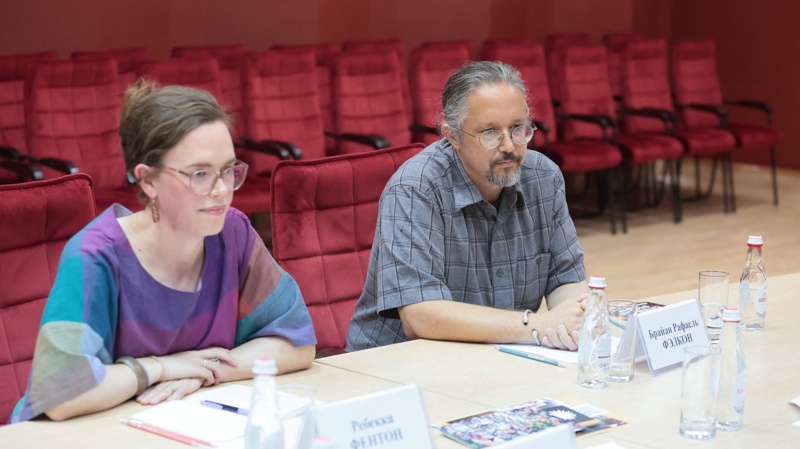
The preparations were discussed at a meeting between Kazakhstan’s Deputy Prime Minister and Minister of Culture and Information, Aida Balayeva, Smithsonian Institution Festival Curator, Rebecca Fenton, and Southwest Folklife Alliance Co-Founder, Bryan Rafael Falcon.
The sides also discussed the participation of Kazakhstan’s ethno-folk group HasSak in a festival in Tucson, as well as plans for the group to hold a concert in Washington.
Photo source: gov.kz
Preparations for the 2027 Smithsonian Folklife Festival are part of broader efforts to expand cultural cooperation between Kazakhstan and the Smithsonian Institution. The sides expressed confidence that their cooperation would gain new momentum and move beyond individual cultural initiatives toward long-term projects.
Qazinform News Agency previously reported that Kazakhstan proposed expanding bilateral cultural exchanges and hosting US Culture Days in the country.
by Fabio Giuseppe Carlo Carisio – Gospa News founder and director
UPDATE ON SEPTEMBER, 7, 2026
Iranian Judiciary Findings: The Bombing on a wedding ceremony by a Raytheon Weapon
«The Iranian judiciary has released the initial findings of an investigation showing that weapons used in a US bombing attack earlier this week on a wedding ceremony in the south of the country were American-made», Iranian Press TV Reported yesterday.
The head of the Iranian judiciary’s local branch in the southern province of Hormozgan said on Saturday that projectile fragments scattered around the site of a wedding ceremony on September 1, killing five people including a children, had been examined as part of the investigation, showing they were manufactured by US company Raytheon.
“The nature of the weapons used in the terrorist attack on civilian gatherings in Kohestak, Sirik, has been fully documented using advanced technical analysis tools and image data processing,” said Mojtaba Ghahremani.
Ghahremani said investigators had carried out a meticulous examination of the inscriptions, barcodes, and other details engraved on the projectile remains, leaving no doubt that the munitions belong to the US military.
He said the type of military thermal battery used in the ammunition revealed that it is from a series of high-voltage batteries used exclusively in the flight guidance systems of precision-guided bombs operated by US military forces.
The official said a military identification code, CAGE Code: 96214, registered on the projectile fragments directly links it to the weapons company Raytheon Missiles & Defense, a major US defense contractor and industrial corporation that manufactures weapons as well as military and commercial electronics.
The Massacre perpetrated by an AGM 154-C 500 lb Thermal Glide-Bombe
Much more important than official release is the image and the video from wreckage that at first had induced the experts to identify the weapon as am AGM-84H SLAM-ER cruise missile (read below).
The wreckage of the weapon shows that it is an AGM 154 C glide-bomb produced by Raytheon
On the tiny identification plate there is in fact the writing AGM – I 154 C-I which corresponds to the glide-bomb AGM-154 Joint Standoff Weapon (JSOW) produced by Raytheon under the stamp NAVAIR which is the matrix of the American weapons used in the joint activity formed by the US Navy and US Air Force.
The AGM-154 Joint Standoff Weapon (JSOW) is a glide bomb that resulted from a joint venture between the United States Navy and Air Force to deploy a standardized medium-range precision-guided weapon, especially for engagement of defended targets from outside the range of standard anti-aircraft defenses, thereby increasing aircraft survivability and minimizing friendly losses.
It is intended to be used against soft targets such as parked aircraft, trucks, armored personnel carriers (APCs), and surface-to-air missile sites (SAMs). Prior to launch, it is given a destination through either a predesignated waypoint or a point marked through a targeting pod. It glides, using two wings that pop out for added lift, to the marked destination and dispenses submunitions in a short, roughly linear pattern.
The designation of the Joint Standoff Weapon as an “air-to-ground missile” is a misnomer, as it is an unpowered bomb with guidance avionics, similar to the older GBU-15.
The AGM-154C is Designed to Attack Hardened Targets
But in this specific case, a more sophisticated weapon was used for the attack on the wedding ceremony…
The AGM-154C uses an Imaging Infrared (IIR) terminal seeker with autonomous guidance. The AGM-154C carries the BROACH warhead. This two stage 225 kg (500 lb) warhead is made up from a WDU-44 shaped augmenting warhead and a WDU-45 follow through bomb. The weapon is designed to attack hardened targets. It entered service with the US Navy in February 2005.
The use of this projectile minimally mitigates the implications of the attack ordered by the US Navy by US President Donald Trump; in fact, autonomous guidance oriented by the target’s heat source implies the possibility of an error that the SALM-ER guided cruise missile does not allow.
Below is a live-fire video released by the Royal Australian Air Force demonstrating the actual use of an AGM 154-C glide bomb
But at the same time, it appears to be a completely disproportionate weapon to hit a transmission tower, which, according to leaks from US officials, was the target of the attack (read detaisl below).
Therefore, the hypothesis of a targeted bombing to destroy a civilian home, as on Qeshm Island, remains valid.
This is why Iran has filed an international complaint for war crimes…
Iranian Red Crescent calls for ICC to investigate deadly US wedding attack
Iran’s Red Crescent Society (IRCS) has called on the International Criminal Court (ICC) to investigate a US missile attack on a wedding reception in the country’s southern province of Hormozgan, which killed at least five people and wounded 68 others.
The deadly incident occurred when shrapnel from a US attack struck a residential building where a wedding reception was being held in the city of Kouhestak, in Hormozgan’s Sirik County on Tuesday.
In a letter to the ICC’s Office of the Prosecutor, the IRCS said the attack raised serious concerns under international humanitarian law and warranted an independent, impartial, thorough and effective investigation.
“Given the reported civilian character of the location as the venue of a family wedding ceremony, as well as the presence of civilians at the site, the incident raises serious concerns under international humanitarian law and warrants an independent, impartial, thorough, and effective investigation,” the organization said.
The IRCS said preliminary information initially indicated that four people had been killed and 67 others wounded. Iranian health officials later raised the toll to at least five fatalities and 68 injuries, with a child among those killed.
The IRCS warned that the number of casualties could rise because some of those wounded were in critical condition.
FIRST POSTED ON GOSPA NEWS ON SEPTEMBER, 4, AT 7,28 AM GMT + 2 (Italy)
A US-made AGM-84H cruise missile among the wreckage after American strike on a wedding
A US-made AGM-84H SLAM-ER cruise missile has been identified among the wreckage following the American strike on a wedding ceremony in Sirik, southern Iran, late Tuesday, adding further evidence of the US military’s role in the attack that killed and wounded civilians.
Weapons analyst Trevor Ball identified the remnants as belonging to the SLAM-ER, a precision-guided, air-launched cruise missile manufactured by Boeing, according OsintWarfare which posted on X the first video of wreckage and was quoted by Al Mayaeedn English Lebanese TV.
Boeing describes the SLAM-ER as being the most accurate air-launched munition in the US Navy’s arsenal;
Enlargement of the piece of a U.S. AGM-84H SLAM-ER among the wreckage in the wedding massacre in Sirik posted on X by @OsintWarfare
Trevor Ball, a former US Army explosive ordnance disposal technician who now works as a weapons technical analyst for Armament Research Services, was among the experts asked by Reuters to examine the photographs and video.
“The damage seen appears to be from a munition which detonated on contact with the roof, or just above the roof,”he said, adding it was apparently a direct hit.
The strike in the small town of Kuhestak on Tuesday killed five people and injured at least 70 others.
The Exclusive Video of the Wreckage
VIDEO LEGEND:
1st footage – The US-made AGM-84H SLAM-ER cruise missile has among the wreckage following the American strike on the wedding cerimony
2nd footage – Children’s slippers lie scattered in the aftermath of the US aggression at a wedding in Sirik, where civilians, including children, were killed and dozens more were injured. Footage from the scene shows slippers belonging to women and children amid the destruction.
After this initial analysis, both Iranian and international sources tried to identify the weapon, with some ballistics experts even launching the bizarre hypothesis that it was a ricochet shot, a hypothesis considered unlikely by most, however.
The Reuter Experts confirmed our Investigation
But one thing seems certain…
«A US munition struck a home hosting a wedding celebration in southern Iran directly, rather than ricocheting from another target, weapons experts who reviewed images and video verified by Reuters revealed» Al Mayadeen reported.
The strike in the small town of Kuhestak on Tuesday killed five people and injured at least 70 others.
So on Thursday, US Vice President JD Vance he was induced to declare that Washington was investigating the incident, despite the initially Pentagon deny of any responsibility…
“We’re investigating it because obviously we care. We want to know,”Vance said during a White House press briefing.
«Four military weapons experts who checked visual material told Reuters that the damage was consistent with a direct strike rather than secondary damage caused by a munition ricocheting from another target. Three of the experts stressed that the weapon was likely American rather than a misfired Iranian air defense missile» Al Mayadeen added many hours after its and our first articles posted on September 4, at 7,28 AM GMT + 2 (Italy)
The main room of the weddin cerimony in Sirik
Two US officials, speaking anonymously, said the US military had conducted strikes near Kuhestak on Sept. 1, with the town’s telecommunications tower as a specific target.
Satellite imagery places the tower about 135 meters from the wedding site. Iranian media reported that the tower was struck at about 9:30 pm local time.
But the same expert Trevor Ball debunked US Official speculation…
“The visible blast damage could not result from fragments from the nearby strike on the communications tower striking the area,” he stressed.
A Likely Trump’s US Navy Deliberate Massacre on Iranian Wedding
AGM-84H SLAM-ER cruise missile is a weapon designed for precise strikes and can be retargeted during flight by a human operator.
Therefore, if it were confirmed that this very powerful rocket, the wreckage of which was found on site, was used, the issue would take on an unprecedented gravity.
But in Tehran, there is a very serious religious theocracy, armed above all with hypersonic missiles, and perhaps even nuclear ones, donated by Russia, China, or North Korea…
Speaking about the attack, Head of Iran’s Expediency Discernment Council Sheikh Amoli Larijani said, “The crime in Sirik and the killing of unarmed women and children embody the savage nature and deceptive self of the United States, and expose the falsehood and audacity of those who trade in human rights.”
Sirik mourns victims killed in US attack, including a 4-year-old
A four-year-old child was among four people laid to rest in the southern Iranian city of Kuhestak on Thursday, as grieving families and residents gathered to bid farewell to loved ones killed in a US attack on the area, Al Matadeen Lebanese TV reported.
The funeral ceremonies in Kuhestak, in Sirik County of Hormozgan Province, began at 4 pm from a street at the city’s entrance, with mourners walking together toward the city’s Martyrs’ Cemetery, where the victims were laid to rest.
The authorities identified the four victims as four-year-old Amirali Karimi, 16-year-old Mohammad Mollahi, 43-year-old Kolthoum Mollahi Nezhadnia, and 50-year-old Zarkhatoun Taheri.
According to the announced figures, the US aggression left 68 people injured, several of whom remain under medical treatment. Al Mayadeen’s correspondent reported that the death toll from the US aggression targeting the wedding ceremony in Sirik had risen to five.
VIDEO – “Horrific, appalling”: Iran urges UN Security Council to condemn deadly US attack on wedding ceremony
Iran has called on the UN Security Council to condemn an unprovoked and deadly US attack on a residential home hosting a wedding ceremony in southern Islamic Republic that led to the martyrdom of five civilians, including a four-year-old child, and injured more than 70 others.
Gholamhossein Darzi, the Islamic Republic’s ambassador and chargé d’affaires to the United Nations, made the appeal in a letter addressed to UN Secretary-General Antonio Guterres and the president of the Security Council on Wednesday following a new wave of such American strikes targeting southern Iranian cities, which together claimed the lives of at least 18 people and wounded 108 others.
IRGC vows Revenge for US wedding attacks: “will never go unanswered”
The chief commander of the Islamic Revolution Guards Corps (IRGC) has said that the blood of those killed in a US attack on a wedding ceremony in Kouhestak, Hormozgan Province, “will never go unanswered” and that it will ultimately “catch up with those who ordered and carried out this heinous crime.”, Iranian Press TV wrote.
State media reports debris recovered from a home attacked in southern Iran during a wedding celebration was “most likely” from a US-made, AGM-154 Joint Standoff Weapon – a guided-glide munition, also Al Jazeera reported before the exatly identification as pieces of a US-made AGM-84H SLAM-ER cruise missile
Broadcaster IRIB said images released by US Central Command of attacks in southern Iran showed a F/A-18 Super Hornet loaded with a similar munition.
Another Trump’s Heinous War Crimes in Iranian Genocide caused US Troops Deaths
The targeted house was 200 metres (650 feet) from a communications tower, and the strike could not have been an error given the munition’s accuracy, reports said.
The Sirik strike came amid a renewed wave of US aggression against Iran, with American forces targeting sites across the country’s southern provinces.
Iranian authorities reported attacks on Bandar Abbas, Jask, Minab, Chabahar, Konarak, Lengeh, Qeshm Island, and other areas, including communications and service infrastructure.
The escalation prompted Iran to launch retaliatory missile and drone strikes against US military positions across the region, including bases in Jordan, Bahrain, Kuwait, the UAE, and Erbil, in which several US troops lost their lifes in the name of Trump’s Zionist.
The heinous Trump’s Military strikes on civilians in Iran caused a genocide of more than 7 thousand people.
This week, Mark Leonard is joined by Ellie Geranmayeh, deputy director of ECFR’s Middle East and North Africa programme, to unpack a volatile new chapter in the confrontation between the United States and Iran. After months of managed escalation, military strikes have resumed and President Donald Trump has launched an ambitious new sanctions package, dubbed an economic “D-Day”, aimed at squeezing Tehran into submission.
Ellie argues that Washington has returned to a familiar strategy of maximum pressure, betting that unprecedented economic isolation and a blockade of Iranian exports will either force the regime to make major concessions or trigger domestic unrest. But Tehran appears determined to hold out, relying on sanctions-evasion networks, regional diplomacy and the belief that the US will struggle to sustain its campaign over the long term. As both sides continue limited military operations while keeping channels for negotiation open, the prospect of a comprehensive deal remains elusive.
The conversation also explores the domestic pressures facing Iran’s leadership, from a shrinking economy and growing public dissatisfaction to the threat of renewed nationwide protests. Mark and Ellie examine whether economic hardship could destabilise the regime, why Iranian leaders remain sceptical of American commitments and how internal politics in both Washington and Tehran are shaping the path ahead.
Finally, they discuss the wider regional and European implications of the conflict. How are Gulf states positioning themselves between the US and Iran? What risks does the confrontation pose to global shipping through the Strait of Hormuz? And can European governments still play a meaningful diplomatic role as tensions rise and fears grow that the Iran conflict could become increasingly entangled with the war in Ukraine?
This podcast episode was recorded on September 3rd 2026.

 Login