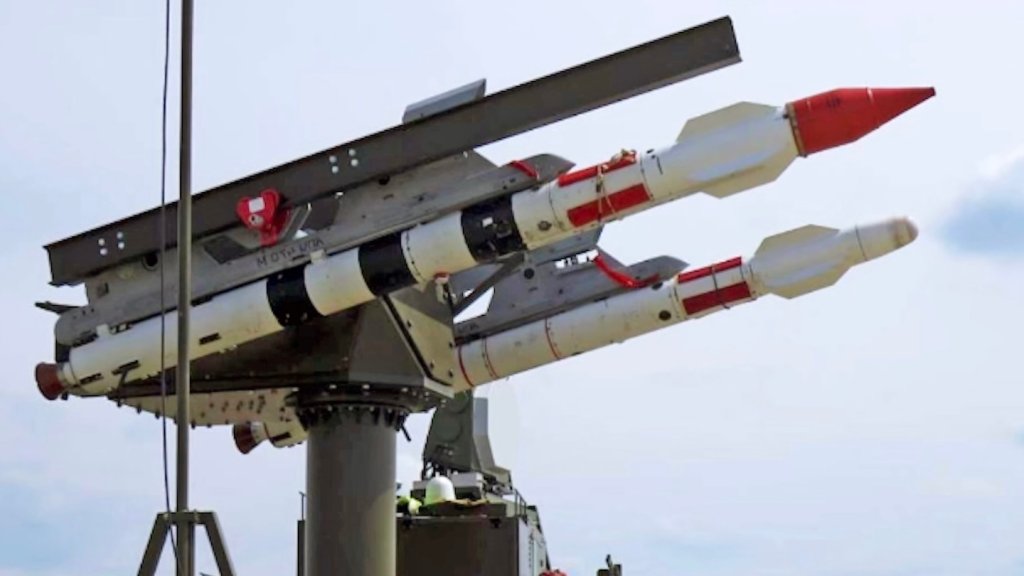
Ukraine has unveiled a new domestically developed surface-to-air missile system designed to turn a diverse collection of air-to-air missiles into a flexible ground-based air defense capability. Called Shershen, Ukrainian for hornet, the system combines a locally-developed command-and-control architecture, a dedicated surveillance radar, and multiple launchers that can employ both Ukrainian and Western missiles.
The system was displayed at the MSPO defense exhibition in Kielce, Poland, by the National Association of Ukrainian Defense Industries (NAUDI). The example shown is reportedly the second operational prototype and is described as being close to its production configuration.
At the ongoing MSPO-2026 defense and industrial exhibition in Poland, the launcher of the Ukrainian Shershen air defense system, developed by Radionix, has been presented for the first time, along with the R-120K surface-to-air guided missile specially developed for it (second… pic.twitter.com/5RfZWHWuxl
The appearance of Shershen comes as Ukraine continues to develop an increasingly diverse family of indigenous air defense systems, while simultaneously adapting older missiles and foreign-supplied weapons to address a severe shortage of interceptors.
The Buk/Sea Sparrow FrankenSAM combines the Soviet-era Buk transporter-erector-launcher with U.S.-supplied RIM-7 Sea Sparrow missiles. Operational Command East
Shershen takes that philosophy a step further by making missile interchangeability a central feature of the system.
The Shershen battery consists of a Perun command-and-control vehicle, an Athena radar, and four Borei launchers.
A graphic shows a typical Shershen battery. via Oboronka
According to the developer, the system’s architecture is deliberately open. This allows it to use different missiles from different manufacturers and also permits the integration of third-party surveillance and guidance radars.
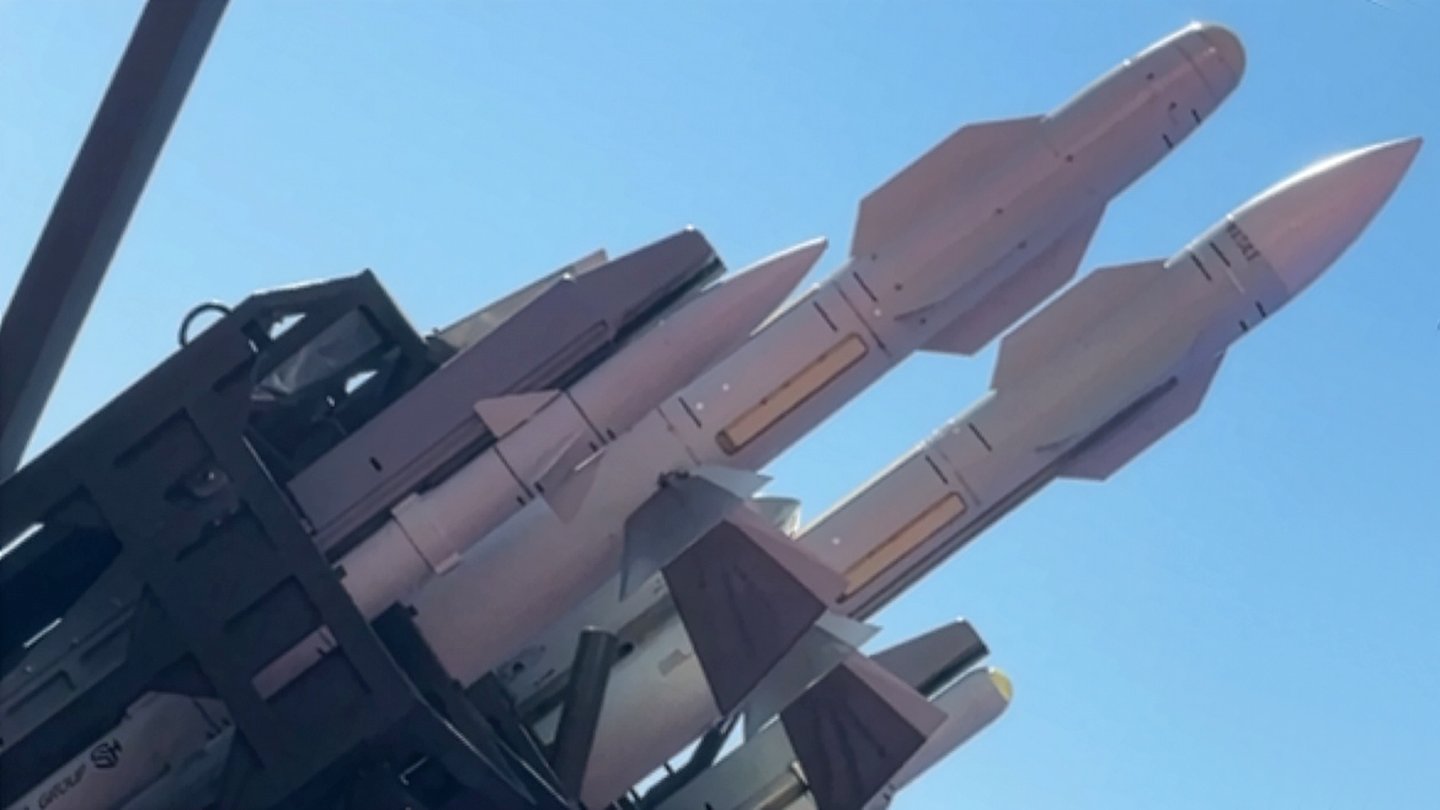
The company says Shershen can currently employ the R-27 (AA-10 Alamo), R-73 (AA-11 Archer), AIM-9 Sidewinder, and AIM-132 ASRAAM, while compatibility with the R-60 is also being explored. These weapons come with a mix of semi-active radar or infrared homing seeker heads.
One of the ASRAAM/Supacat air defense systems supplied to Ukraine. Ukrainian Armed Forces
Air-to-air missiles are already available in considerable variety across Ukraine’s arsenal and those of its foreign partners. Being able to employ several types from a common ground-based system provides much more flexibility than a conventional SAM designed around one dedicated interceptor.
It also offers a way to exploit missiles that were never originally intended to be fired from the ground. That means Shershen’s launcher and fire-control system are meant to be interceptor agnostic, at least to a certain degree.
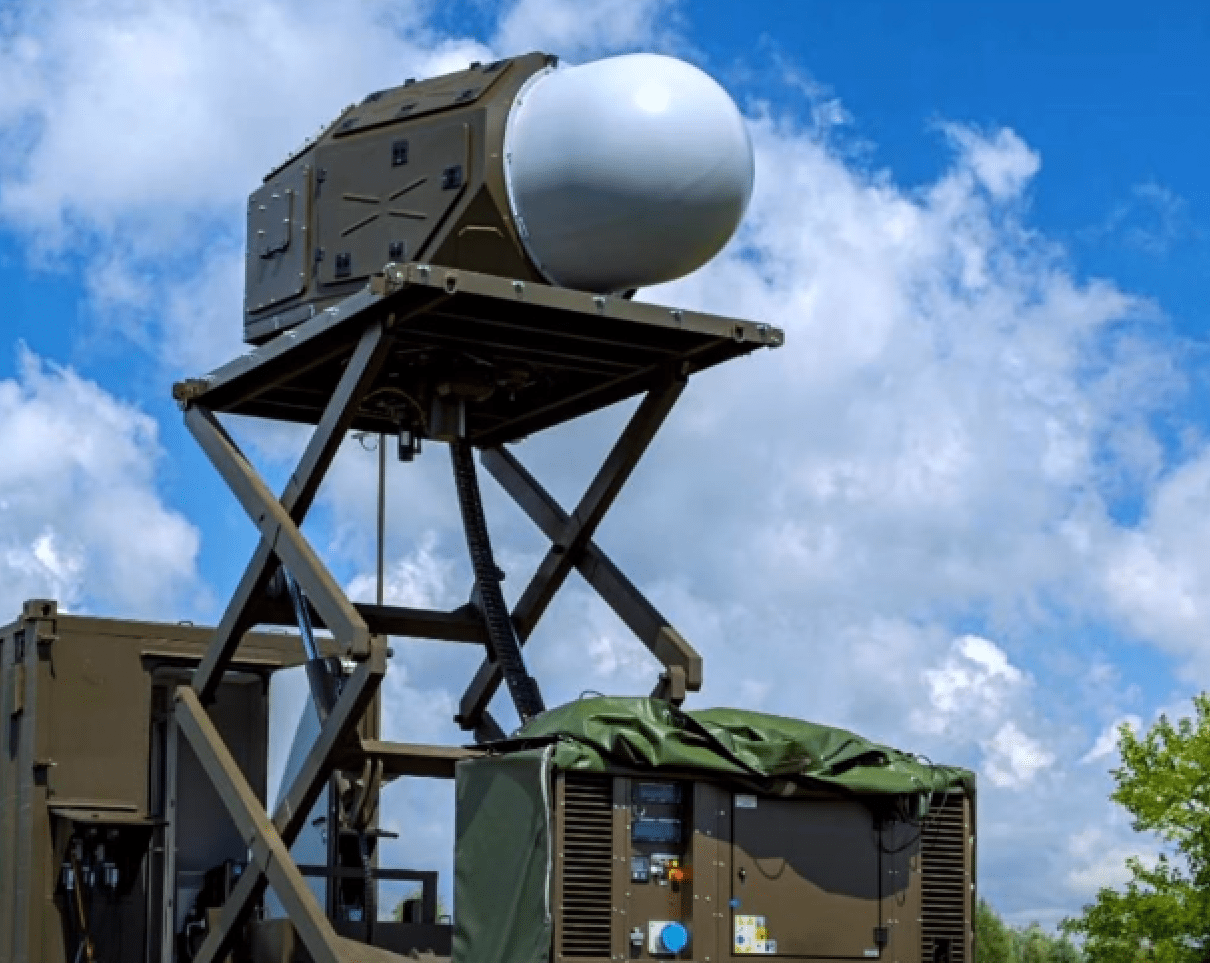
Shershen’s Athena radar is reported to be capable of detecting targets at ranges of up to 85 kilometers (53 miles).
The Athena radar for the Shershen. NAUDI screencap
In terms of the engagement envelope, Shershen is claimed to be capable of engaging aircraft, cruise missiles, and drones at ranges of up to 25 kilometers (16 miles) and altitudes of up to 10,000 meters (32,800 feet). Clearly, these figures will vary widely depending on the type of interceptor.
When employing radar-guided missiles, the system’s engagement architecture can reportedly guide as many as six missiles simultaneously.
The advertised performance figures have not been independently verified, and it remains unclear what target types and engagement conditions were used to establish them.
Україна представила складові мультикаліберного зенітного ракетного комплексу «Шершень» на міжнародній виставці MSPO 2026 у польському місті Кельце.
Міжнародний консорціум компаній Shershen Group, який створює ЗРК в інтересах України представив, показав командний пункт,… pic.twitter.com/9wAS7ewxzg
The developer says the second prototype has completed initial testing, including successful interceptions at a test range.
One of the Borei launchers displayed at MSPO were armed with an R-120K, a new Ukrainian missile equipped with a radar seeker and is intended to be capable of both air-to-air and surface-to-air employment.
The R-120K remains under development, however. Work is reportedly continuing on its rocket motor, meaning that its eventual performance and production status remain uncertain. Still, having the option of including the R-120K on the Shershen system in the future is significant.
A test launcher used for the Shershen program, armed with a radar-homing (nearest camera) and an infrared-guided R-27 missile. The latest prototype features a cage-type container launcher. NAUDI screencap NAUDI screencap
Rather than relying indefinitely on stocks of Soviet and Western air-to-air missiles, Ukraine could eventually have a domestically produced interceptor specifically tailored to its growing family of ground-based air-defense systems. That will become increasingly important as stocks of legacy missiles are depleted. Earlier this year, it was reported that Ukrainian F-16s were running low on their air-to-air missiles, which include the same AIM-9s that are used in some FrankenSAM systems, as well as being compatible with Shershen. But even before that, it was clear that Western-supplied missile stocks in Ukraine across the board were diminishing, in some cases drastically, with critical interceptors like the AMRAAM and Patriot being badly affected.
A live AIM-9L/M Sidewinder launched from the wingtip rail of a Ukrainian F-16. Ukrainian Air Force screencap
Ukraine’s need for additional surface-to-air missiles has become increasingly acute during the full-scale war, especially as Russian drone and missile barrages have stepped up.
The shortage has encouraged Ukraine to pursue a combination of indigenous development and unconventional adaptations.
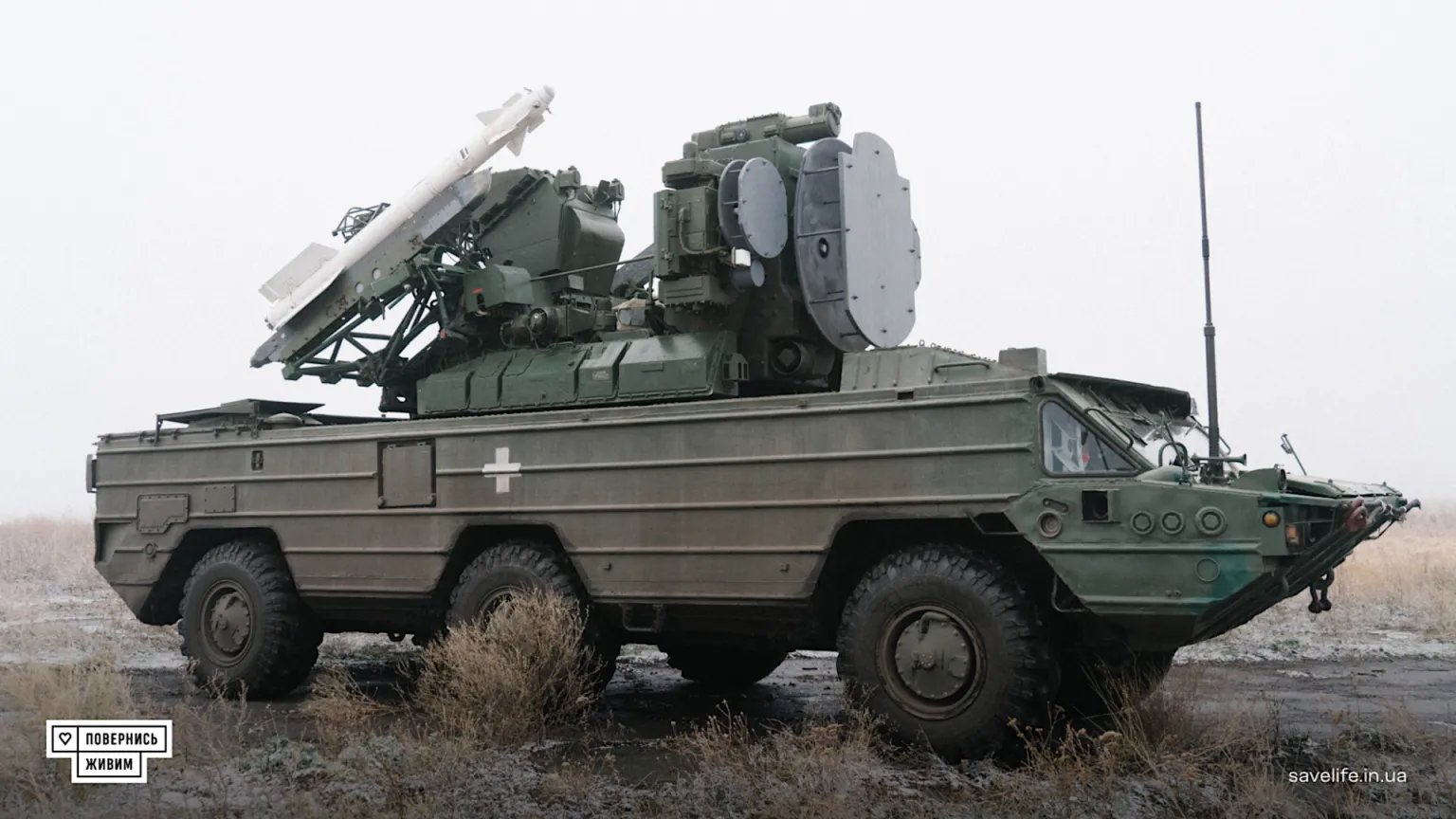
The FrankenSAM initiative, conducted with U.S. support, demonstrated how existing Ukrainian systems could be combined with foreign missiles to rapidly create additional air-defense capacity. Ukraine has also fielded modified Osa systems armed with R-73 air-to-air missiles rather than their original 9M33 interceptors. Other R-73-based concepts have even been demonstrated aboard Ukrainian uncrewed surface vessels.
An R-73 missile loaded on an Osa-AKM SHORADS vehicle. Come Back Alive
Shershen appears to reflect the next logical step in that evolution: rather than creating a one-off FrankenSAM combination, build an architecture from the outset that can accept multiple missiles. Additionally, with so many different ground-based air defense systems now being fielded, it comes with the significant advantage of a standardized launcher and control interface that can accommodate a range of interceptors.
At the same time, Ukraine is pursuing substantially more ambitious indigenous SAM projects.
Earlier this year, a previously secretive Ukrainian missile identified as the Koral made what appeared to be its first public appearance. The program dates back to at least 2021, when Ukraine’s Luch design bureau presented a concept for a medium-range surface-to-air missile.
A missile is launched from a Koral air defense system, based on a Czech Tatra truck chassis. Ukroboronprom
Koral is intended to provide a much longer-range capability, potentially filling some of the gap left by Ukraine’s aging Soviet systems and supplementing the Western-supplied Patriot and SAMP/T.
Shershen, by contrast, is clearly focused on the short-range layer.
Together, the programs illustrate the breadth of Ukraine’s emerging domestic air-defense effort: from relatively inexpensive systems built around repurposed air-to-air missiles to new, purpose-designed interceptors intended to replace or augment Soviet-era systems.
Ukraine’s experience with FrankenSAM has demonstrated the value of getting unconventional air defense combinations into service quickly.
Once fielded, Shershen, with its architecture capable of accepting different Soviet-origin and Western-made interceptors, and eventually a Ukrainian one, gives Ukraine another way to stretch its missile inventory and enhance its air defense capabilities.
“I don’t understand enjoying something without caring about it,” Andre Agassi tells Lizzy Goodman midway through her thoughtful character study. Goodman shadows the former tennis great as he tries to get comfortable in his pickleball years, detailing the dynamic interplay of Agassi’s moods: Fun Andre, Philosopher Andre, Dark Andre. Many of the best athlete profiles extend the narrative of a legend beyond the court, making more complicated human meaning once a subject has set the game aside. Here, Goodman and Agassi achieve a gratifying volley, the journalist turning over the athlete’s challenging interiority and sending it back to him to consider.
The made-for-TV version of the Andre 2.0 story might go something like this: A retired, middle-aged tennis great takes up a goofily named, hugely popular new sport and is finally able to exorcise the demons that haunted him throughout his tennis career. This seemed to be the story Agassi was beginning to tell after the watch event, as he sat on an ottoman at the bar of his hotel, holding a dry Belvedere martini with extra olives. He talked about his love of pickle, how it challenged him mentally, how suited his body felt to its movements. He shifted around in his seat, trying to keep his perpetually embattled back from seizing up. “I was on a tennis court today,” he said. “What the [expletive] was I doing on a tennis court?”
But it became apparent, over the months that followed, that it would take more than a new sport to resolve the central question that all three of Agassi’s personas have been wrestling with for a long, long time. He summarized it, wryly, as he ordered another cocktail: “Why do I end up doing so many things that I actually don’t want to do?”
Longreads has published hundreds of original stories—personal essays, reported features, reading lists, and more—and more than 14,000 editor’s picks. And they’re all funded by readers like you. Become a member today.
In 1792 Paris, a “north-going astronomer,” Jean-Baptiste-Joseph Delambre, set forth for Dunkerque, France, while a “south-going astronomer,” Pierre-François-André Méchain, made his way to Barcelona, Spain. As leaders of the meridian expedition, their modest ambition was to measure the world. They would use a new measure to be called the meter. “The meter would be eternal because it had been taken from the earth, which was itself eternal. And the meter would belong equally to all the people of the world, just as the earth belonged equally to them all.”
We start with our bodies, measuring height and weight and life. We want to know what health is, what beauty and pain and performance look like. We weigh our brains for intelligence, ability, sickness, happiness. We fight about race and politics, sex and money, images and words. We stalk the planet, its history and geography, biology and chemistry. We wrestle with space-time, its mathematics and paradoxes. We have no idea what to do about consciousness. And then there’s the small matter of love. We are obsessed and we cannot stop.
At its heart, measurement is a utopian undertaking, one that aims to make perfect sense of the world. But at every turn, it runs up against the real world, and every so often, our understanding of reality itself. We know that the act of measuring changes what is measured. Might it be changing us measurers, too?
Welcome to a reading list about measurement—not only as techne, art or craft, but as episteme, knowledge, its conquests and collapses, and what it really gives and takes away.
“In 1730, the influential physician Bernard Mandeville recalled a patient asking his doctor whether he was tired of hearing ‘so tedious a Tale’ of pain. His physician gently murmured: ‘Your Story is so diverting that I take abundance of delight in it, and your Ingenious way of telling it, gives me a greater insight into your Distemper, than you imagine.’” Now if you can get a doctor to listen to you for five undistracted minutes, count yourself lucky. Joanna Bourke takes stock of pain and its vocabulary for Aeon: “Our Anaesthetic Times.”
Indian kids tended to be small, curious, energetic as babies, growing up lean, active, rudely healthy. (I use the past tense because I’m not sure whether this is as true now as it was when I was little.) And yet, our parents thought us skinny and tried to feed us all the time. Was that a normal parental thing for the times, and if not, where did they get the idea that something needed to be fixed?
Universal standards have a way of making us feel competent and good, like, get your blood pressure down to 120/80 and you’ll be all right. But as Singh, a Harvard-trained anthropologist, points out: “Pretending that differences don’t exist doesn’t make them disappear; it only drives practitioners to rely on flawed intuitions.”
Citing case after case of medical benchmarks—too little, too much, too sideways—across the world, Singh calls for a system altogether more nuanced and considerate than the current “myth of the universal patient”—something that won’t cause actual harm, something that will help us see the real humans behind the data.
When my daughter was ten-and-a-half months old, she qualified as “wasted,” which unicef describes as “the most immediate, visible and life-threatening form of malnutrition.” My wife and I had been trying hard to keep her weight up, and the classification felt like a pronouncement of failure. Her birth weight had been on the lower end of the scale but nothing alarming: six pounds, two ounces. She appeared as a dot on a chart in which colored curves traced optimal growth; fifteenth percentile, we were told. She took well to breast-feeding and, within a month, had jumped to the twentieth percentile, then to the twenty-sixth. We proudly anticipated that her numbers would steadily climb. Then she fell behind again. At four months, she was in the twelfth percentile. At nine-and-a-half, she was below the fifth.
Our pediatrician was worried. Ease off the lentils and vegetable smoothies, we were warned; we needed to get more calories into our babe. Ghee, peanut butter—we were to drench her food in these and other fats and wash them down with breast milk and formula. And that’s what we did. When we came back a month later, though, we learned that she had dropped further—and crossed into “wasted” territory.
“There are two kinds of people in the world: people who think there are two kinds of people in the world and people who don’t.” Science or self-help? Louis Menand assesses “society’s people-sorting operations” for The New Yorker: “What Personality Tests Really Deliver.”
Have you ever taken an IQ test? How about an aptitude test for studies or a psychometric test for work? How about an online quiz?
“You were supposed to be there already. Didn’t the tests show you had a head start?” Svoboda, labelled a “gifted” child in the ’80s and dealing with its fallout in her adult life, unpacks the deeply problematic, yet starry, history of testing. She looks at Stanford-Binet, Army Alpha, SAT, and others—all ways to measure human potential. Intelligence and aptitude tests, “binary stars circling in the same orbit,” Svoboda says, seem to be asking and answering: Who deserves a chance, and who doesn’t? Who is worthy, and who isn’t?
For the American psychologist Lewis Terman, who devised the Stanford-Binet IQ test, the birth of a gifted child was like the birth of a star. In the name of illuminating what he saw as a void, Terman sought out the stars that burned brightest. “The school has no more important task than to foster the development of the mentally gifted,” the researcher at Stanford University in California told attendees at a meeting in San Francisco. “Our chances of survival . . . may well depend upon the discovery and utilisation of highly superior abilities of every kind.” To further this mission, Terman urged hundreds of children all over California to sit for his newly developed intelligence test in the 1920s. Intending to prove his theory that high IQs predicted life success, he sorted the highest scorers into a group of 1,521 children (called his “Termites”) that he would follow and document throughout their lives.
“Why Netflix looks like that.” Will Tavlin investigates what goes on behind the scenes at the streaming behemoth for n+1: “Casual Viewing.”
In hydraulics, pumping high-pressure fluid into a well causes rock to crack and oil and gas to come pouring in. This is called fracturing, or fracking. Burnett, a Princeton historian of science and part of a scholar-artist-activist collective called Friends of Attention, has adapted this term to refer to an insidious property of the attention economy. “Fracking eyeballs” refers to applying psychological and advertising techniques under pressure to bait and extract monetary value from human attention. (I don’t know how they live with this mental image all the time, though.)
This essay, opening at a 1925 Harlem shop window with a “puzzling totem face” and crammed with historical anecdote and detail, comes from the magazine’s Issue 04: Measurement. Do check out the whole issue: “How do you measure seeing god? Does testing vaccines need to take so long? Outlining poverty. Asking better questions. The origins of the ad economy. Can we really say how smart AIs are? Domestic violence during lockdown. Sex, drugs, and colonoscopies. Our most pedantic issue yet.”
See also Burnett’s Public Domain Review essay, “Cybernetic Attention,” where he pursues the “pre-history of the laboratory research that has relentlessly worked to slice and dice the attentional powers of human beings.”
In Nixon’s earliest experiments, he would hide in an observation booth, accompanied by a metronome beating half seconds, and then watch closely as two ads were revealed to a seated subject. Ticking his pencil along the rungs of a fascinating little ladder-pad with each beat of the metronome (marking the left side when the eyes were to the left; marking the right side when the eyes were to the right), Nixon created a graphical record of the subject’s visual encounter with the two stimuli.
If you were advertising a car, was it better to show a picture of a car, or of a pretty woman? If one was selling shirt collars, was it better to do so under the headline “Murder!” or the headline “Quality Shirt Collars”? To make a long story short (and to skip over the proto-pataphysical techniques by which Nixon established what we might call a “science of irrelevancy”), Nixon found that “irrelevant illustrations do attract more attention and hold interest longer than do relevant ones.” Which is to say: systematically doing violence to sense raised revenue. This could be proven in his laboratory. Would it be wrong to say that we live, in many respects, in the world evolved from that finding?
“Correlation, one of the most used and least understood concepts in statistics, is easy to mistake for causation because it was made that way intentionally; it’s precisely because of its potential to be misunderstood that it remains so popular. . . . The eugenics movement was built out of correlations.” Read about its history and current state of affairs in this Los Angeles Review of Books essay by Aubrey Clayton for the Legacies of Eugenics series: “The ‘Correlation’ Between Statistics and Eugenics.”
In 1901, Scotland Yard started using fingerprints to solve crime. They weren’t the pioneers. Sherlock Holmes had gotten there first in The Sign of Four, already examining under his magnifying glass, in 1890, what appeared to Dr. Watson as “mere shapeless smudges of dust.” While the fictional Holmes was publishing his fictional monographs in fictional journals, “gentleman scientist” (self-funded and without institutional affiliations) Francis Galton was working on the same thing for real. The era was primed for this kind of work across disciplines and professions—finding and interpreting “clues unnoticed by others.”
And while Holmes was trying to catch bad guys, Galton came up with a malign plan. What if you could use fingerprints as “tiny fossil records, providing evidence of the genealogy, personality, criminality, and perhaps even destiny of individuals and groups”? No more varicolored bad guys, only “a political program of selective breeding to improve, in his view, the human race.”
Empire, race, and “science”—eugenics.
In 1888, a reporter from the Pall Mall Gazette paid a visit to Galton’s Anthropometric Laboratory in London, where instruments developed by Galton measured the physical and mental characteristics—from keenness of hearing to breathing power—of over 10,000 people. The resulting article, titled “A Morning With the Anthropometric Detectives,” described Galton’s laboratory as a world of “order and precision, and tests of the nicest accuracy.” “Dumb though they are,” Galton told the reporter, “what splendid detectives our instruments might prove.” “Splendid detectives!” the reporter exclaimed, “I am not, I hope, in a department of the Criminal Investigation Department, unconsciously yielding convincing proofs of personal identity with some scoundrel hitherto unhung.”
The comparison to detection in the article’s title is no accident: the scientific development of medical and anthropometric instruments like Galton’s coincided with the rise of the detective novel, a genre which, in the words of the literary scholar Ronald Thomas, was “preoccupied with the professional monitoring and identification of bodies.” Fears of mistaken identity and unconscious slips were crystallized in the literature of detection but emerged from a broad range of hermeneutic practices across the era, at a time in which those in power considered the borders of empire and boundaries of racial identity to be insecure.
“Experiments that test physics and philosophy as ‘a single whole’ may be our only route to surefire knowledge about the universe.” Seeing as the lines between them have already been “blurred beyond repair,” here’s another essay by Amanda Gefter for Quanta Magazine: “‘Metaphysical Experiments’ Probe Our Hidden Assumptions About Reality.”
“What happens when you get to the end of things?” This was the question that had held John Wheeler in thrall all his life. A student of Niels Bohr and friend of Albert Einstein who counted Richard Feynman among his own students, Wheeler was a rare soul—a below-the-radar legend, a “physicist’s physicist” who really wanted physics for the people. And throughout his storied career, he kept journals.
We learned in school that gravity is a force that pulls objects together.
Einstein’s theory of general relativity came along and said, well, it’s actually that matter and energy can curve space-time, and that curving is gravity. Wheeler wondered, what if gravity could act on itself, endlessly contorting space-time, and that was what matter itself was . . . warped space-time? But reality had a problem. “The fabric of space-time, at its smallest scales, was loosely woven, chewed by moths, too flimsy to bear the weight of the world. Yet here is the universe. It must be made of something.” What?
A clue: At the end of Alder’s meter book, he quotes Protagoras, a pre-Socratic philosopher: “Man is the measure of all things.”
It dawned on Wheeler that when space and time went, taking the rest of physics with them, there was something left. “With law going and chaos arriving, one principle remains,” Wheeler wrote. “The quantum principle.” Quantum mechanics, he wrote, “destroys the concept of the world as ‘sitting out there,’ with the observer safely separated from it by a 20 centimeter slab of plate glass. Even to observe so miniscule an object as an electron, he must shatter the glass. He must reach in. . . . The universe will never afterwards be the same. To describe what has happened, one has to cross out that old word ‘observer’ and put in its place the new word ‘participator.’ In some strange sense the universe is a participatory universe.”
It was officially the wildest idea he’d had yet. A universe made not of matter, not of space-time, not of stuff at all, but of our choices. It wasn’t what he’d hoped to find; the physics had led him there. He’d pried up space-time, peered beneath, and found himself staring, to his bewilderment, at a mirror. “One finds himself in desperation asking if the structure, rather than terminating in some smallest object or in some most basic field, or going on and on, does not lead back in the end to the observer.”
“The hard problem of consciousness is a distraction from the real one.” For a clearer picture of the fundamentals according to Seth, read his earlier essay for Aeon: “The Real Problem.”
Decades ago, the philosopher David Chalmers came up with a distinction that has since become a popular touchstone in consciousness circles—the easy problem vs. the hard problem. The “easy problem” deals with the physical brain and how its functions and processes create perception, cognition, behavior, etc. The “hard problem” is why such phenomena should be connected to internal, subjective consciousness in the first place. This “explanatory gap” takes a scientific problem into the realm of philosophy. In the sidenote essay, Seth sidesteps the hard problem for what he calls the “real problem”—accounting for “the properties of consciousness in terms of biological mechanisms.” Measuring consciousness, in effect.
In the 10 years that separate the two essays, much has happened, the main event being the astonishing evolution of artificial intelligence. And now we have an unreal problem. In this Berggruen Prize-winning essay, the neuroscientist discusses the possibility of consciousness in AI. But as he says: “The future history of AI is not yet written.”
Intelligence and consciousness are different things. Intelligence is mainly about doing: solving a crossword puzzle, assembling some furniture, navigating a tricky family situation, walking to the shop—all involve intelligent behavior of some kind. A useful general definition of intelligence is the ability to achieve complex goals by flexible means. There are many other definitions out there, but they all emphasize the functional capacities of a system: the ability to transform inputs into outputs, to get things done.
Consciousness, in contrast to intelligence, is mostly about being. Half a century ago, the philosopher Thomas Nagel famously offered that “an organism has conscious mental states if and only if there is something it is like to be that organism.” Consciousness is the difference between normal wakefulness and the oblivion of deep general anesthesia. It is the experiential aspect of brain function and especially of perception: the colors, shapes, tastes, emotions, thoughts and more, that give our lives texture and meaning. The blueness of the sky on a clear day. The bitter tang and headrush of your first coffee.
“In the space between the hands-on, physical reality of experimental science and the structured narratives fit for printed journals, sits a special genre of scientific writing: lab notebooks. They are the closest witness to ‘science in the making.’” Ulkar Aghayeva writes a lavishly illustrated essay for Asimov Press: “A Brief History of Lab Notebooks.”
Chiang points to two sources of inspiration in his story note: “The Electric Ant,” a Philip K. Dick story in which a man visits a doctor, only to be told that he’s a robot, and proceeds to open himself up to look at his own inner workings, and The Emperor’s New Mind, a book by mathematician Roger Penrose, in which a chapter discusses the concept of entropy. He’s struck by Penrose’s notion that we’re “consuming order and generating disorder,” and that we, given the laws of thermodynamics, “live by increasing the disorder of the universe.”
In a young world of mechanical beings where “death is uncommon,” an anatomist performs exquisite auto-dissection—an extreme act of analysis to discover what sustains life and what, therefore, can end it in a “fatal equilibrium.”
This Hugo and Locus-winning story reminds me, in its ending, of something Ursula K. Le Guin says in The Language of the Night: “Only the individual can get up and go to the window, and draw back the curtains, and look out into the dark. Sometimes it takes considerable courage to do that. When you open curtains you don’t know what may be out there in the night. Maybe starlight; maybe dragons; maybe the secret police. Maybe the grace of God; maybe the horror of death. They’re all there. For all of us.”
At first the other anatomists did not believe me when I told them what I had discovered, but in the months that followed my initial auto-dissection, more and more of them became convinced. More examinations of people’s brains were performed, more measurements of atmospheric pressure were taken, and the results were all found to confirm my claims. The background air pressure of our universe was indeed increasing, and slowing our thoughts as a result.
There was widespread panic in the days after the truth first became widely known, as people contemplated for the first time the idea that death was inevitable. Many called for the strict curtailment of activities in order to minimize the thickening of our atmosphere; accusations of wasted air escalated into furious brawls and, in some districts, deaths. It was the shame of having caused these deaths, together with the reminder that it would be many centuries yet before our atmosphere’s pressure became equal to that of the reservoir underground, that caused the panic to subside. We are not sure precisely how many centuries it will take; additional measurements and calculations are being performed and debated. In the meantime, there is much discussion over how we should spend the time that remains to us.
Two skeletons from the Indonesian island of Sulawesi had something strange going on in their mouths. Not cavities. Not the usual wear from a tough diet. Deep, rounded grooves cut into the teeth — a pattern no archaeologist had documented before, and one nobody could explain. The answer, published in Science Advances, pushes the known […]
The EU welcomes Cambodia’s decision to join the Multi-party Interim Appeal Arbitration Arrangement (MPIA) for WTO members, contributing to efforts to uphold a rules-based multilateral trading system.
With Cambodia’s participation, the MPIA now covers 62 World Trade Organization (WTO) members and 60.4% of world trade.
The MPIA brings together participants from all continents and at different levels of development, united by a shared commitment to upholding the rules-based trading system.
The MPIA preserves the right to appeal in trade disputes among participating WTO members, at a time when the WTO’s Appellate Body remains non-functioning. It helps ensure that disputes can continue to be resolved in an orderly and binding manner, avoiding appeals 'into the void'.
“I welcome Cambodia to the MPIA. The arrangement plays an important role in upholding the rules-based trading system. Each new participant helps reinforce the predictability, stability and credibility of global trade rules. I encourage other WTO members to join the MPIA,” said EU Trade and Economic Security Commissioner Maroš Šefčovič.
Background
The MPIA was established in 2020 and has proven its effectiveness in many WTO disputes.
Under the MPIA, appeals are heard by arbitrators randomly selected from a pool of 10 standing appeal arbitrators set up by the participating WTO members. These arbitrators are persons of recognised authority, with demonstrated expertise in law, international trade and WTO agreements.
The MPIA is open to all WTO members as a practical tool for appeal arbitration, pending the restoration of a reformed and fully functioning WTO dispute settlement system.
As of 1 June 2025, the MPIA has anupdated pool of appeal arbitrators to ensure that appeals continue to be heard by independent arbitrators of the highest calibre.
At the WTO Ministerial Conference that took place earlier this year, MPIA ministers stressed the importance of the MPIA for the security and predictability of the multilateral trading system.
The current MPIA participants are Australia, Barbados, Benin, Brazil, Cambodia, Canada, China, Chile, Colombia, Costa Rica, Ecuador, the European Union (and its Member States), Guatemala, Hong Kong (China), Iceland, Japan, Liechtenstein, Macao (China), Malaysia, Mexico, Moldova, Montenegro, New Zealand, Nicaragua, Norway, Pakistan, Paraguay, Peru, the Philippines, Singapore, Switzerland, Ukraine, the United Kingdom, Uruguay and Vietnam.

 Login

(@TheDeadDistrict) September 9, 2026



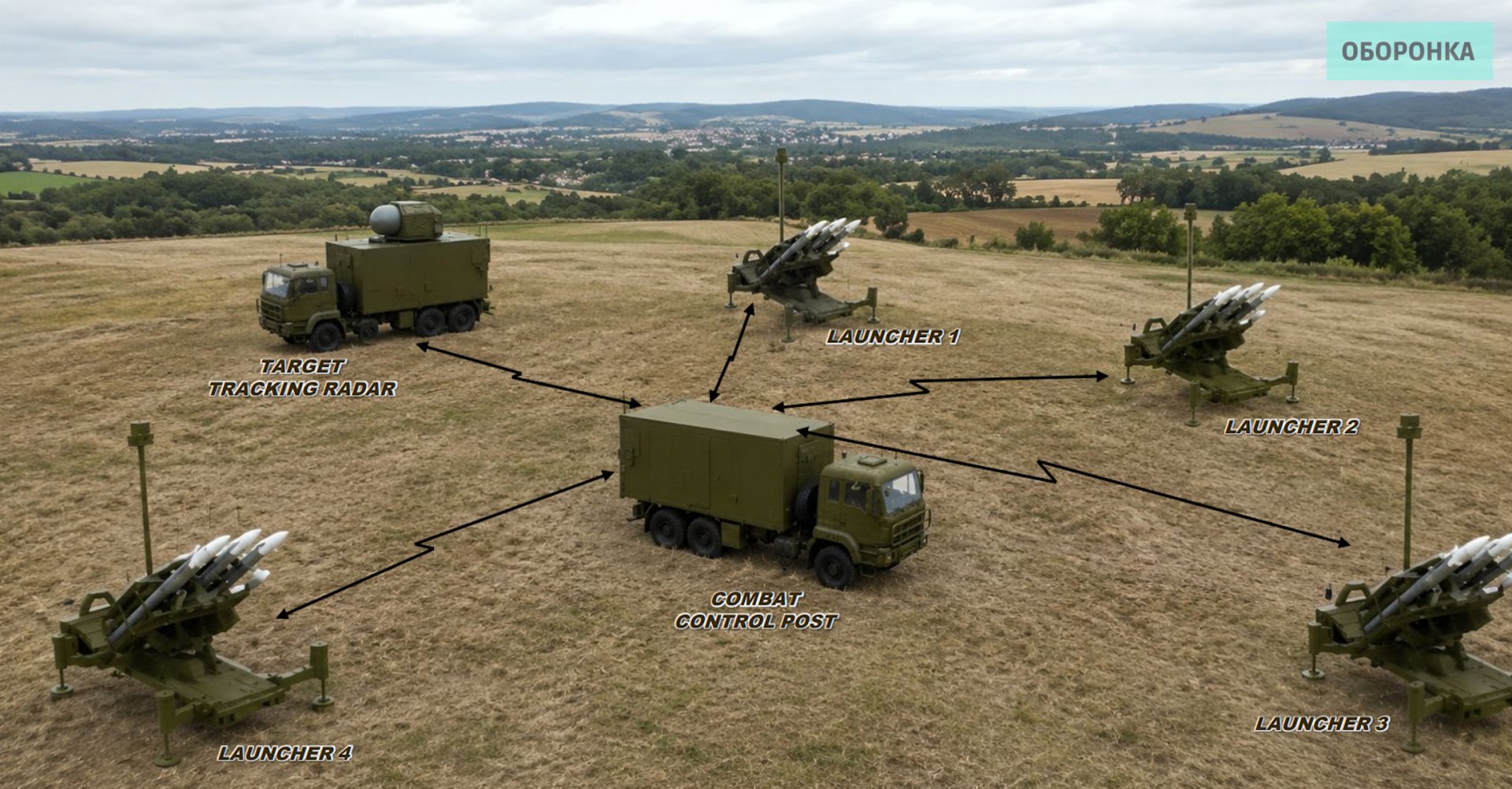

Україна представила складові мультикаліберного зенітного ракетного комплексу «Шершень» на міжнародній виставці MSPO 2026 у польському місті Кельце.