Login

RAF Fairford: cronaca di un attentato che non c’è
Nel Regno Unito è stato sventato un attentato contro una base aerea. Non è andata esattamente così, ma sul piano mediatico la notizia si è già consolidata. Conviene rimettere in ...



Comments by Brian Shilhavy
Health Impact News
Leah of the Leah Files has just published her 4th article in her “Currency Killer” series about Treasury Secretary Scott Bessent’s attempts to take over the U.S. financial system by crashing the U.S. dollar and replacing it with stablecoins, and specifically with Commerce Secretary Howard Lutnick’s Tether stablecoin, the largest stablecoin in the world which is now rapidly buying up U.S. Treasuries.
Here is my coverage of her first three articles in this explosive investigative series that I have yet to see anyone else cover in either the corporate or alternative media:
In this 4th article in the series, Leah covers the GENIUS Act, which has already been signed into law, but has a comment period before it is enacted that will close on October 19.
As Leah writes, this is not simply “corruption as usual” in Washington D.C., where conflicts of interest rule the day.
No, this is entirely different – it is the complete hijacking of the U.S. financial system and putting it into the hands of a very few powerful people, and one very powerful company: Tether.
As Leah writes:
That is not a stablecoin company. That is a parallel financial system, every function of a central bank plus every function of an intelligence service, in one private entity, owned by four men who control 86 percent of the equity, incorporated in the British Virgin Islands, physically located in El Salvador, and paying zero corporate tax on $13 billion in annual revenue.

In 2024 during the Presidential campaign season in the U.S., I exposed many of the Silicon Valley billionaires who follow the teachings of Curtis Yarvin, and believe that democracy is a poor form of government, and would instead prefer a monarchy.
Peter Thiel heads this list, along with his protege and disciple, J.D. Vance, who is now the Vice President of the United States. See:
Of course “democracy” and the illusion that people can vote politicians into office to affect change is considered a “Constitutional Right”, and this belief is drilled into every American through our educational system.
So overthrowing the government and installing a king is just not something that would go over too well in the U.S.
However, hijacking the American financial system by crashing the U.S. dollar, replacing it with stablecoins, and putting it into the hands of a few powerful people in the private sector would accomplish almost the exact same thing, and Leah exposes it all in her series and in this latest article, which is must reading for everyone.
They built it in eighteen months and it has been turned on. We have three weeks to make a change.
by Leah
The Leah Files
Excerpts:
Scott Bessent, the man running the US Treasury stood in front of a room in Dallas on September 10 and said five words that should have ended his career: “I am the house now.”
He was not joking. He tripled the government’s bond buyback program the same week. The next day, the DOJ publicly thanked Tether for helping freeze $52 million in criminal funds. Two weeks before that, his Treasury Department deleted the only federal database tracking who owns shell companies in America, and then published the rules that will govern stablecoins forever.
All of that happened in thirty-one days.
In Part I, I showed you how Bessent spent forty years breaking currencies and then took the keys to ours. In Part II, I showed you how Lutnick’s family built the custody operation with a Tether loan. In Part III, I traced Tether to Epstein’s crypto network and documented the empire they are building with the profits.
This is Part IV. This is what it looks like when all of it runs at the same time, and there is a clock on it. The GENIUS Act comment period closes October 19. That is three weeks from now. After that, the rules governing stablecoins in America get finalized by the man who profits from their growth, and the company those rules will govern just hired the man who wrote the law to be its CEO.
On September 10, Scott Bessent stood in front of a room in Dallas and said five words that should have been on every front page in America, “I am the house now.”
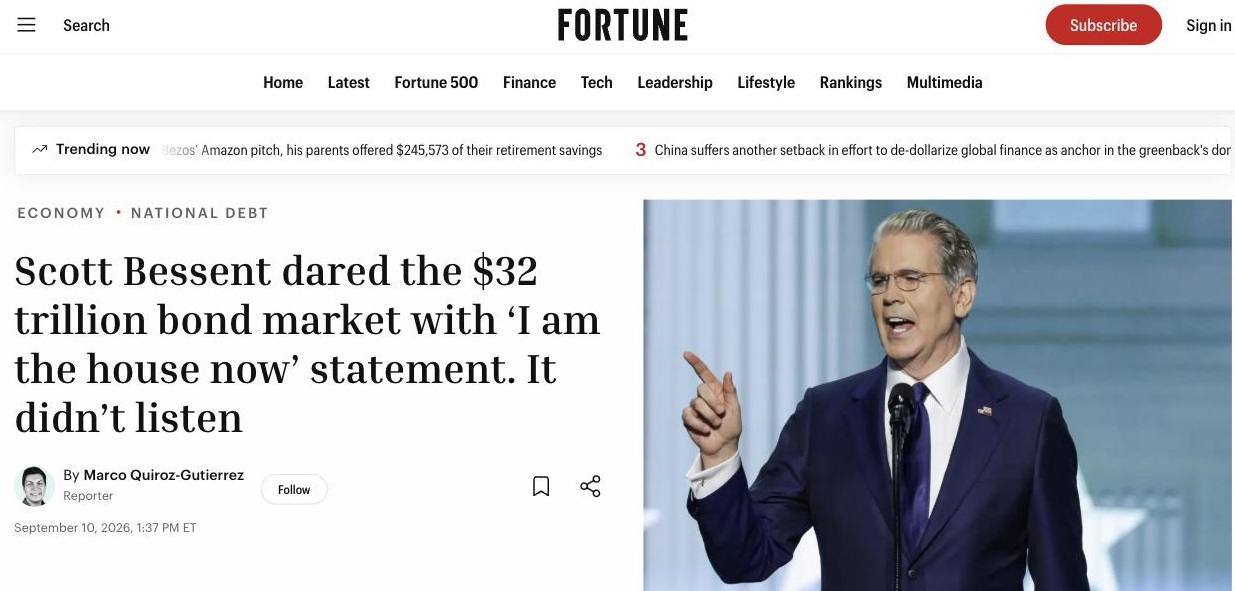
He was responding to critics who called his Treasury interventions reckless, after bond traders pushed back against his buyback program and drove yields higher instead of lower. His response was not to adjust, it was to triple down.
The Treasury announced it would buy back up to $6 billion in bonds in a single week, triple the normal operation. Bessent has doubled the buyback program twice since taking office, from $2 billion per operation to $4 billion, and now effectively to $6 billion per week, an escalation that no previous Treasury Secretary has attempted because no previous Treasury Secretary was a career currency trader who spent four decades learning how to move bond markets by force.
Here is what “I am the house now” means when you translate it from hedge fund speak. It means he is not managing the bond market, he is running it, setting the prices, deciding which bonds get bought, at what maturity, and at what yield.
The people on the other side of every one of those trades are the stablecoin issuers whose reserves the GENIUS Act requires to be held in Treasury bills maturing within 93 days.

When George Soros said something similar before breaking the Bank of England, he was a private citizen betting against a government.
Bessent was the man next to him when he said it.
Now Bessent is the government, and the bond market he is running determines what your mortgage costs, what the dollar is worth, and how much the country pays to borrow money.
That has never happened before, and he said it out loud.
Fortune reported that bond yields are higher now than before Bessent intervened, which means the plan is not working the way a normal Treasury Secretary would want it to work. But it is working exactly the way a currency attacker would want it to work, because higher long-term yields and lower short-term yields is the exact trade that benefits stablecoin issuers who hold short-term T-bills.
Bessent knows this because he spent forty years doing this.
Here is what Bessent is actually doing with the bond market, because the numbers tell a story the headlines are not.
The GENIUS Act requires every stablecoin to be backed by Treasury bills maturing within 93 days. Not bonds, not notes. Short-term bills specifically. That means every new dollar of stablecoin growth creates a dollar of mandatory demand for one very specific type of government debt.
Now look at what Bessent did with supply.
Before he took over, the government was adding about $31.7 billion in T-bills per month. Under Bessent, the average rose to $45.7 billion. Then in June 2026, it exploded: T-bills outstanding jumped from $6.691 trillion to $7.248 trillion in two months. That is $557 billion in sixty days, 8.8 times the pre-Bessent pace. He is flooding the market with exactly the securities that stablecoin issuers are required by law to buy.

And there is only one buyer large enough to absorb that at scale. Tether held $98.5 billion in T-bills at the end of Q1 2025. By June 2026 it was $141 billion. They are already the 17th largest holder of US government debt on earth, bigger than Germany, and their CEO has said publicly they want to be top five.
Here is what that means for your wallet.
An academic study found that Tether’s buying lowers short-term yields by 24 basis points, which saves the US government roughly $15 billion a year in borrowing costs. The government is paying less on its debt because Tether is buying it. Standard Chartered projects stablecoin issuers will need $1 trillion in T-bill reserves by 2028. Bessent himself says $2 trillion.
Read that again.
The US government is becoming financially dependent on a private company incorporated in the British Virgin Islands to finance its own borrowing. And the man running the Treasury is the one making it happen.
That is the feedback loop nobody is naming.
Bessent issues the T-bills. The law requires Tether to buy them. Tether’s buying lowers yields and saves the government money. The government becomes dependent on Tether’s demand. Tether becomes too important to regulate. And Tether takes the yield from those T-bills and converts it into something else entirely.
Bessent has gutted every agency that would be watching any of this. FinCEN, the agency whose entire job is tracking dirty money, took an 11 percent staff cut with 30 more positions proposed for elimination, and the beneficial ownership database was ordered deleted.
The Public Integrity Section, the DOJ unit that prosecutes corrupt officials, went from 36 lawyers to 2 and from 190 open cases to about 20. Seventeen inspectors general were fired in a single night. The FBI’s public corruption squad was dissolved. Foreign Corrupt Practices Act enforcement was paused by executive order.

Here is how it works when you put all the pieces together, six steps where each one feeds the next.
Step one: Bessent floods the market with short-term Treasury bills, tripling the buyback program to $6 billion per week and shifting debt issuance toward shorter maturities in what analysts call the “Treasury Twist.”
Step two: the GENIUS Act requires every stablecoin to be backed by reserves held in T-bills maturing within 93 days, which means every new dollar of stablecoin growth creates a dollar of mandatory demand for the exact securities Bessent is issuing.
Step three: Tether buys those T-bills, currently holding $141 billion in US Treasuries, making it the 17th largest holder of US government debt on earth and bigger than Germany, earning roughly $13 billion a year in yield.
Step four: Tether uses that yield to build the empire, deploying more than $5 billion since late 2023 into farmland, fertilizer, AI data centers, satellite companies, robotics, media platforms, gold, and bitcoin.
Step five: the empire generates revenue, with Adecoagro alone producing $467 million in annual EBITDA, the farmland growing crops, the bitcoin mines running on sugarcane electricity, the gold lending operation earning interest, and StableFund deploying private credit, with every subsidiary producing cash that flows back to Tether.
Step six: Tether issues more stablecoins, which require more T-bill reserves, which creates more demand for Bessent’s bonds, which keeps yields low, which lets the government borrow cheaply, which means Bessent can issue more T-bills.
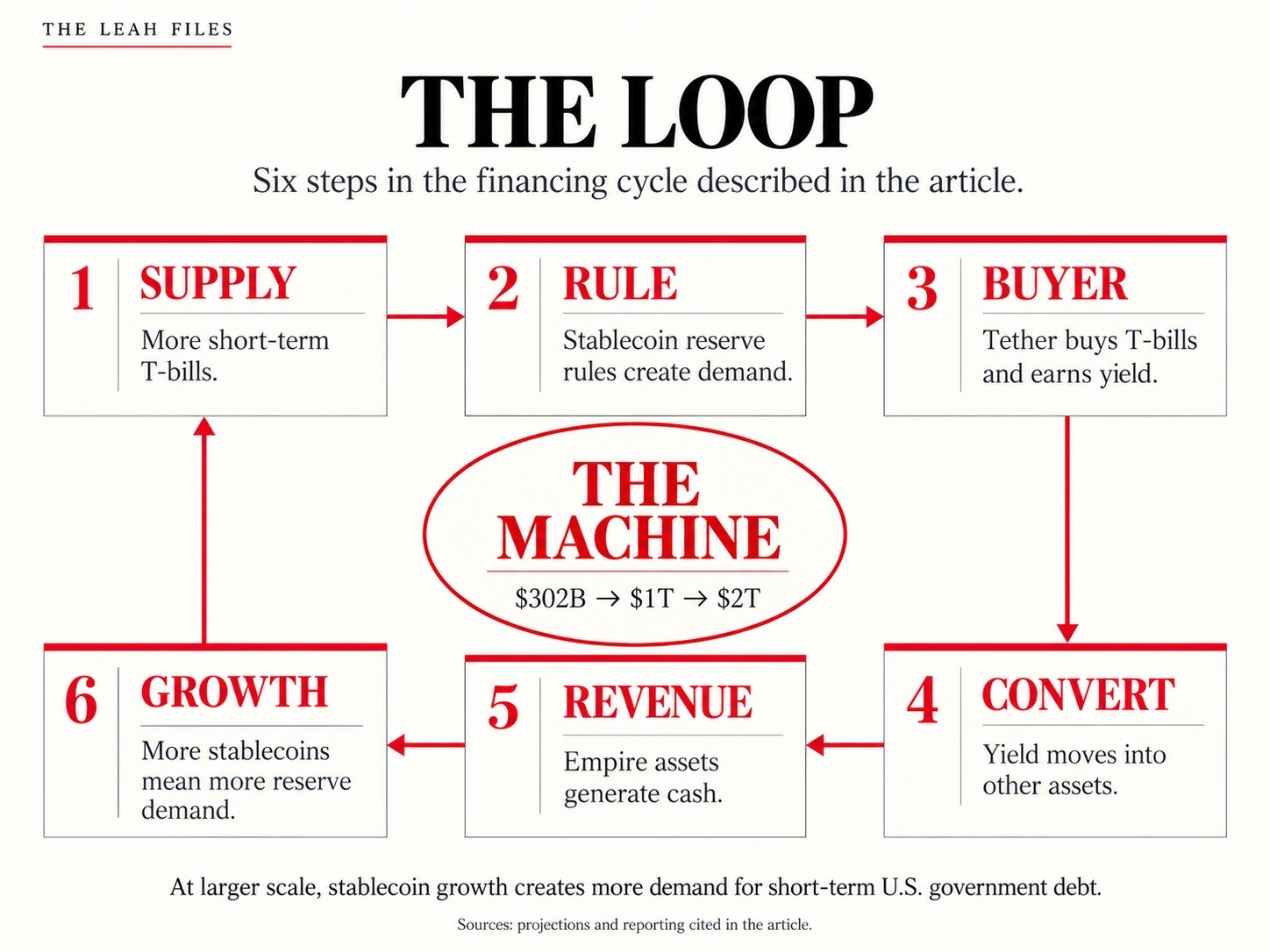
That is the loop, and once it reaches scale no future president can dismantle it without crashing the bond market. At $1 trillion in stablecoins, the US government depends on Tether to finance its operations.
At $2 trillion, Bessent’s own projection for 2028, stablecoin issuers hold a quarter of all T-bills outstanding. At $4 trillion, the whole thing is permanent, because the interest rates on your mortgage, your car loan, and your credit card would all spike overnight if anyone tried to unwind it.
We are at $302 billion right now and the clock is running….
Read the Full Article at The Leah Files – this is just a portion of everything she reports on that I have republished here.
This article was written by Human Superior Intelligence (HSI)


See Also:











Having problems receiving our emails? See:

If our website is seized and shut down, find us on Telegram, as well as Bitchute and Odysee for further instructions about where to find us.
If you use the TOR Onion browser, here are the links and corresponding URLs to use in the TOR browser to find us on the Dark Web: Health Impact News, Vaccine Impact, Medical Kidnap, Created4Health, CoconutOil.com.
The post Bessent and Lutnick are Building a Parallel Financial System on Stablecoins without Government Oversight While Crashing the U.S. Dollar Intentionally first appeared on Health Impact News.

Over the summer, Russia intensified its use of jet-powered one-way attack drones. Flying faster and higher than the propeller-driven Shahed-136s (or Geran-2s as Russia calls their copies) that have been terrorizing Ukraine for years, these weapons are far harder to intercept. We predicted this would happen over three years ago when Iran first introduced its jet-powered Shahed-238, which itself was an adaptation of the Shahed-136. Initial variants of Russia’s copy of that drone, called the Geran-3, first appeared over the skies of Ukraine in early 2024. By mid-2025 they were becoming a real problem. Since then, the latest higher-performance variant of this weapon, the Geran-4, has added great strain to Ukraine’s dwindling air defense resources and is the source of increasing levels of destruction across the country.
The Geran-4 appeared last May, according to the Ukrainian Defense Intelligence Directorate (GUR). Unlike the Geran-3, which largely used a modified Shahed-136 airframe, the new drone has one purpose-built for higher-speed flight because “the structural strength [of the older model] was insufficient for high-speed flights, and even less so for maneuvering under high G-loads,” GUR noted.

The Geran-4’s new airframe features a blended air intake and overall “improved aerodynamic efficiency, a reinforced structure, and a turbojet engine with increased thrust,” GUR stated. “The wings are now permanently integrated into the center wing section. To reduce air resistance, the number of technological hatches on the fuselage has been minimized.”
In an overnight attack across Ukraine that lasted until Monday, “Russia launched 165 drones overnight, 79 of them jet-powered, the Air Force reported. Air defenses downed or suppressed 112, and hits were recorded at 14 locations.” You can see the aftermath of one of those attacks in the following video.
We’re under constant attack
— Antoninaodesa NAFO (@antoninaodesssa) September 28, 2026Unfortunately, just a few minutes ago, a jet-powered Shahed drone hit a residential building
. #Odesa
Burn in hell, ruzzianspic.twitter.com/EXTWM1yVIN
Recently, Radio Free Europe/Radio Liberty (RFE/RL) got its hands on one of these weapons. Its report offers the best view yet of what makes these drones so dangerous.
The Geran-4 is “a new, faster version of the attack drone that is proving harder for Ukrainian air defenses to intercept,” the report states. “We were given a rare opportunity to literally take this surviving drone apart and find out what makes it so much faster, more maneuverable, and more accurate.”
“The first part we uncover is the turbojet engine. It is one of the Geran-4’s most significant upgrades, allowing the drone to fly at altitudes of up to eight kilometers,” the report explained. “That’s twice as high as the older propeller-powered drones. According to specialists, drones equipped with this type of engine have already flown from Russia-occupied Crimea to Lutsk in northwestern Ukraine, a distance of more than 700 kilometers.”
RFE/RL takes apart a Russian Geran-4 drone to uncover what makes the jet-powered unmanned aerial vehicle (UAV) faster, harder to intercept, and capable of operating deep inside Ukraine — from its turbojet engine and advanced camera to foreign-made communications and navigation… pic.twitter.com/WGNdlpS9w1
— Radio Free Europe/Radio Liberty (@RFERL) September 25, 2026
“This engine allows it to fly at speeds of up to 450 to 500 kilometers per hour over Ukrainian territory. Sometimes even faster,” RFE/RL proffered. “It flies fast and high, which is why it is still difficult to intercept.”
As the camera pans down over the engine, the reporters noted that while it is made in China, “we have investigated cases where these engines were assembled in Russia using Chinese components.”
The next component examined was the drone’s camera.
“It has several modes: daylight, night vision, and infrared,” the report stated. “The camera offers 10-times optical zoom and up to 32-times digital zoom, allowing the drone operator to view terrain from an altitude of eight kilometers.”
“If there is a relay station and it is connected to the network, an operator sitting in an automated workstation somewhere in Bryansk, Oryol, or Crimea can control the drone and guide it to its target,” RFE/RL stated.
“Once the drone is inside Ukraine, regular cellular SIM cards can help keep it connected,” the report continued. “We also found two GSM modems inside this drone. Using SIM cards, they can transmit the Geran-4’s location over mobile networks, allowing the operator to track it in real time.”
Back in 2024, we explained how Shaheds fitted with 4G modems and SIM cards from Ukrainian telecom firms, combined with a camera installed on the drone and the ability to use wireless networks, could be one of a number of avenues that would transform the Shahed into a relatively long-range reconnaissance and strike asset capable of beyond-line-of-sight real-time operations. This could help plug what at the time was a glaring gap in the Russian arsenal, although the stability of its connectivity is still unknown and providing man-in-the-loop guidances in real-time for strikes may be beyond the capabilities of this configuration, at least consistently.
Regardless, most of these drones do not have cameras or modems, they fly to a specific set of coordinates and dive on a target before detonating.
The following images offered a glimpse into that system.
— MAKS 26
Inside Russian Shahed: power bank and a SIM card of a Ukrainian operator pic.twitter.com/D5LGBMJfIv
Drone specialists who have investigated the remains of these weapons told the outlet that they had found SIM cards “from Ukraine, Russia, Belarus, and even some European Union countries. And the deeper we go inside the drone, the more foreign-made components we find.”
The RFE/RL team also found a Chinese mesh modem the Russians use to help guide the drone.
“It’s responsible, among other things, for radio and video communications. Essentially, this device allows the drone operator to see the video feed from the Geran-4 almost in real time,” RFE/RL stated. “The modem has a range of up to 300 kilometers and can also act as a signal relay. That means several drones flying near each other can relay and strengthen the signal, making it possible to control them over much greater distances.”
The discovery of the Chinese mesh modem illustrates something we reported earlier this year: “For some time now, Russia has been working on a man-in-the-loop (MITL) control capability for the Shahed/Geran, a feature that was confirmed when they started to appear with cameras and cellular modems, something TWZ explored in detail at the time. These developments allow the drone to be connected to an operator. Standard Shaheds fly autonomous routes to pre-planned targets on autopilot with no man-in-the-loop control. They are ‘fire and forget’ weapons.“
“Meanwhile, the range at which MITL can be achieved has been steadily increased. At first, the drones were adapted to exploit patchy cellular networks to provide additional connectivity when available. More recently, Shaheds have been flying with antennas allowing for direct line-of-sight control close to the front lines. This allows them to hit targets dynamically like an FPV drone, while packing a much heavier punch and being able to loiter for long periods of time. You can read all about this development here. Now, the datalink range is being extended using airborne signal relays, possibly creating a mesh network with multiple line-of-sight links.”
درون”Geran-4“ توقف محرك الـMicro-turbojet قبل الانقضاض على الهدف،
— TACTIX
وتتَّخذ وضعية الانزلاق البطيء، ربّما لتوفير الوقود او لدقة افضل اثناء البحث بالعدسة البصرية.
ايضاً يظهر بوضوح هوائيات الارسال Mesh Antennas
اثنان مثبَّتان على الذَّيل، أحدهما موجّه الى الاعلى والاخر الى الاسفل. pic.twitter.com/cQIyHhvbmm(@Tactixtm) September 27, 2026
Finally, the Ukrainian journalists found something else we have long reported on. Like many other Russian weapons, the Geran-4 even contains components made in America.
“Despite international sanctions, a significant portion of its components are still coming from abroad, highlighting gaps in global export control enforcement,” RFE/RL showcased. “We just opened up the drone’s onboard computer, and these circuit boards contain components made by a U.S. company. The markings on this component are partly worn off, but you can still see the manufacturer, Texas Instruments.”
“According to the specialists, what is actually Russian-made here is mainly the drone’s body and its assembly. This particular drone was manufactured and assembled at Alabuga, a major Russian drone production site. According to Ukraine’s military intelligence, Russia is now producing around 3,000 Geran-4 and Geran-5 drones a month at Alabuga and other facilities across Russia.”
Satellite images of the site first emerged in 2023, which you can see below.
Satellite images of the factory producing Iranian kamikaze drones Shahed-136 in Yelabuga, Tatarstan.#russia #Ukraine pic.twitter.com/07HBMwcGCs
— Dr. Khaled Alfaiomi (@Alfaiomi) November 15, 2023
As if the Geran-4 drones were not challenging enough for Ukraine, Russian Geran-5 jet-powered drones are equipped with “a DSMAC (Digital Sensor Module for Autonomous Navigation) module for navigation using reference images of the Earth’s surface, similar to the X-101 missile,” the Ukrainian technology monitoring channel Polkovnyk GSh reported on Telegram. DSMAC allows for a weapon to navigate without any external help from global positioning satellites. The Tomahawk also uses this system. You can read all about it and how AI embedded in Shahed models will be the next leap in true autonomy far beyond the front lines, even for hunting and killing targets of opportunity, in our special feature linked here.
In addition, Russia has installed mesh repeaters on these weapons for radio signals so that video of the attacks can be “recorded (and immediately transmitted),” presidential adviser on defense technology Serhii Beskrestnov, known as Flash, said on Telegram.
The Russian military is now capable of acquiring real-time, high-quality BDA of its strikes with Geran-type OWA-UAVs/cruise missiles in downtown Kyiv.
— Status-6 (@Archer83Able) September 27, 2026
In the footage below, we can see the moment of a Russian strike with Geran-5 cruise missile on the "Inkom" business center… pic.twitter.com/mPx4Kf9tmH
Though these jet-powered drones are causing major problems for Ukraine, the country is finding a way to combat them.
One way is by using Ukrainian Air Force F-16 Vipers to shoot them down, which you can see in the following video.
The moment a Russian jet-powered "Shahed" drone is shot down by an F-16 fighter jet using its M61 Vulcan cannon. pic.twitter.com/gU72HJTXUa
— WarTranslated (@wartranslated) September 23, 2026
The Russian jet-powered drones were largely outrunning the drone interceptors Ukraine began using with great success against the piston-driven Shaheds. Those interceptors were not only saving lives, but they were also saving money because they cost a tiny fraction of far more expensive, higher-end munitions like the PAC-3 MSE fired by the Patriot system or the AIM-120 Advanced Medium-Range Air-to-Air Missile variants fired from the National Advanced Surface-to-Air Missile System (NASAMS) air defense launchers.
Seeking a more efficient and effective defense, Ukraine adapted by fielding higher-performing interceptor drones that are purpose-built to take on the jet-powered Russian munitions. Still, the engagement window for hitting the Russian drones is small, and these are more expensive to build. However, they will remain far less costly and faster to acquire than surface-to-air missiles.
In his speech earlier this week at the U.N. General Assembly, President Volodymyr Zelensky claimed that “our soldiers have already successfully tested four new jet-powered interceptor drones against Russian jet-powered Shaheds. So we are scaling up production.”
It is unclear exactly which interceptors the Ukrainian president was talking about; however, other types designed to take on Russian jet-powered Gerans have become public. One of them is the Sting S, a variant of the bullet-shaped Sting interceptor drone made by the Ukrainian Wild Hornets drone company.
On Sept. 19, the company posted a video on X claiming that “a crew from the 1020th Anti-Aircraft Missile Regiment took down a Russian Geran-5 using the new STING S. This drone is faster and carries a larger explosive payload than other Geran variants.”
TWZ cannot independently verify these claims.
STING S takes down a Geran-5 jet-powered drone-missile
— Wild Hornets (@wilendhornets) September 19, 2026
The crew from the 1020th Anti-Aircraft Missile Regiment took down a Russian Geran-5 using the new STING S. This drone is faster and carries a larger explosive payload than other Geran variants.
Big thanks to the… pic.twitter.com/Eg0rQgd1tL
When we asked for more details, Wild Hornets told us “that the tests are going well. About a dozen enemy ‘Geran-4′ jet-powered strike UAVs have already been shot down, as well as several ‘Geran-5’ models, just in the last few days. We should note that at this stage we are talking about only the first results of combat testing within a few select units.”
The Sting S “is a high-speed quadcopter-type interceptor,” the Wild Hornets spokesperson added. “When choosing this model, we took into account that the solution should be inexpensive, easy to use, and quickly scalable.”
“Furthermore, most of the targets during combat testing have been destroyed using ‘Hornet Vision Ctrl’ remote control technology,” the spokesman stated. Wild Hornets claims the system provides low-latency image transmission, long-range communication, and resistance to electronic warfare.
100 remote interceptions in 100 seconds: Hornet Vision CTRL in action
— Wild Hornets (@wilendhornets) September 3, 2026
Since deployment, Ukraine’s Defense Forces have remotely destroyed 1,000+ enemy targets using the system.
All thanks to the skill of crews taking down enemy drones with STING interceptors every daypic.twitter.com/9sUthdjsvF
“We expect this will allow us to rapidly scale up the deployment of the new interceptor once mass production begins,” the spokesperson noted.
As we have frequently noted, Russia and Ukraine continuously create new weapons and ways to defeat them. The jet-powered Russian drones, and Ukraine’s newest interceptors designed to destroy them, are the latest examples of a seemingly endless weapons evolution cycle in this war.
Contact the author: howard@twz.com
The post Russia’s Jet-Powered Shahed Drones Are Quickly Evolving As Ukraine Scrambles To Blunt Their Damage appeared first on TWZ.


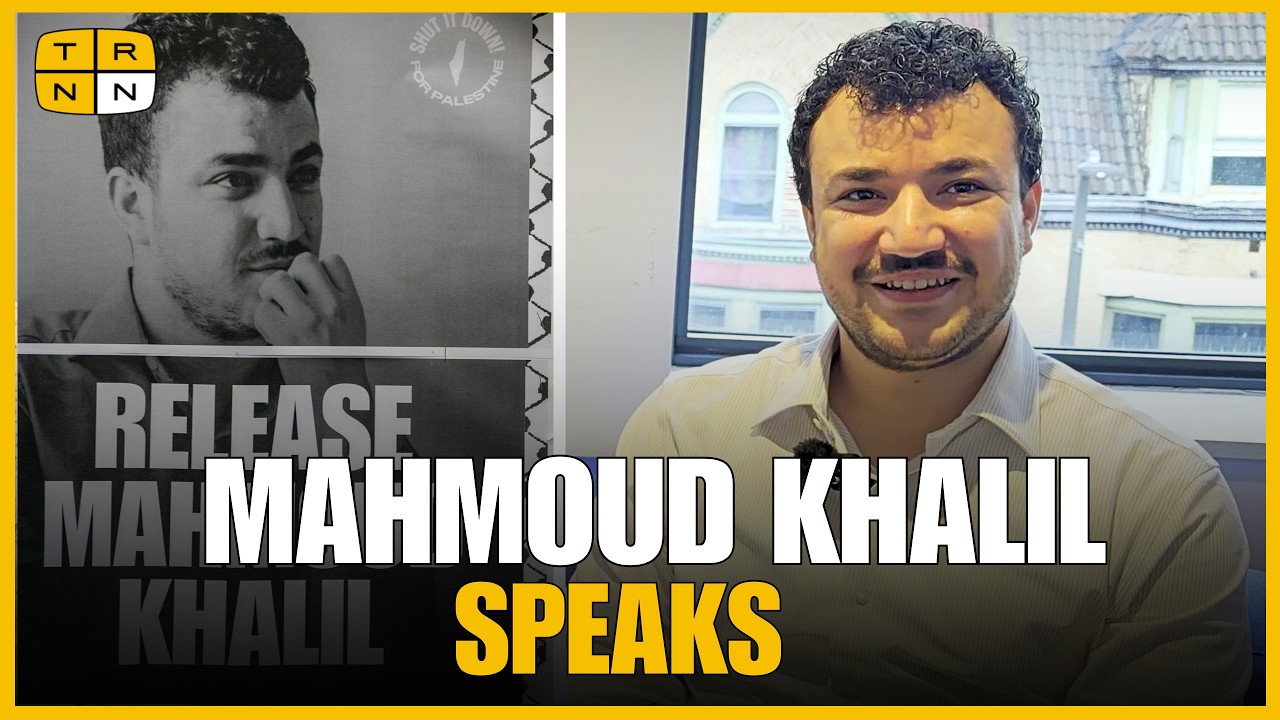
After being abducted by plainclothes ICE agents from his New York apartment building in March of 2025 and locked away in immigration jail for 104 days, Mahmoud Khalil has been freed and reunited with his family. But Khalil, a former Columbia University graduate student who was heavily involved in the student-led justice for Palestine movement, is still being targeted by the Trump administration and still faces the possibility of deportation. In this exclusive interview, TRNN Editor-in-Chief Maximillian Alvarez sits down with Khalil to speak about his new book, “No Land to Stand On,” and his continuing fight for freedom and justice.
Credits:
The following is a rushed transcript and may contain errors. It will be updated.
Maximillian Alvarez:
I’m here at the Parkway Theater and I’m sitting with Mahmoud Khalil, freed political prisoner and former Columbia graduate student who was heavily involved in the student-led Justice for Palestine movement and who because of that was abducted by plainclothes ICE agents from his New York apartment building in March of 2025 and locked away in immigration jail for 104 days. But he’s here with us now. Brother Mahmoud, welcome home, man.
Mahmoud Khalil:
Thank you for having me, Max. Thank you so much.
Maximillian Alvarez:
It’s such an honor to be here with you in person. I don’t even know how you begin to answer this question, but I can’t begin without asking it. How are you and your family doing after enduring this horrific nightmare that is sadly still not over?
Mahmoud Khalil:
We’re doing all right and we’re taking it day by day, really sort of surviving under the threat of deportation at any second or worse than that, whatever this government may decide to do at any point. But our fear is part of the fear of so many families in this country who are now worried about sending their children to school. We are in September now and I know a lot of kids are worried about going to school because they’re either undocumented or their parents are undocumented. I’m thinking about just the families in Minnesota and in New York and in Texas who are now under the threat of being really deportation by this or ripping them apart. It’s not only deportation. Haitians
Maximillian Alvarez:
In
Mahmoud Khalil:
Ohio,
Maximillian Alvarez:
Latinos in
Mahmoud Khalil:
Southern California. Anyone who this administration sees as the other or sees as a threat to whatever plans they have. So in that bigger scheme of things also, at least I know my son will be fed tonight. There wouldn’t be a bomb being thrown on our house as happening in Gaza right now as we are speaking. So in the bigger scheme of things, we’re grateful. We’re grateful for the community that’s supporting us.That’s what’s keeping us going forward right now is just the level of support, the level of solidarity, the community that was built around us because of what this government has imposed on me and my family.
Maximillian Alvarez:
I didn’t plan to ask this, but as a father as well, I have to. What was it like to hold your kid that first time?
Mahmoud Khalil:
I don’t think anyone can describe that feeling. It’s just the first time I held Dean was in detention in a courtroom, in an immigration courtroom where verdicts of deportations happen, like rain daily in these rooms. So it was a little bit weird that I was able to reunite with my family in a place where families are being torn apart. But at the same time I felt victorious because that’s a moment that this government tried to steal from me. Although it was only for one hour, but felt the world to me. And of course now being with Dean, a lot of people ask me, “What gives you purpose?” And just seeing Dean and dreaming of a world where he can live in dignity and safety, inequality, just like anyone else, as an American citizen who has the same rights and responsibility as any other American citizen, regardless of his background, regardless of the ethnicity, regardless of anything, really it’s just like being a human.
Maximillian Alvarez:
And how could you not look at your kids and our children and not fight? We’re going to give this world over. We’re going to give their future over to these psychopaths, to these fascists, to these fanatical nut jobs? Of course not.That’s just not an option. But it’s really hard to put that into action on a day-to-day level when we’re being bombarded by so much terror and awfulness. I interviewed members of your former graduate student union at Columbia after you were taken. I’ve interviewed members of my former grad student union in Michigan where activists are having their homes raided by the FBI. I mean, students, community members, workers, people all over this country who are terrified to fight back or do anything because of what happened to you. But you continue to speak out. You wrote this book, No Land to Stand On. You’re here in Baltimore to speak to folks.
What do you and this book have to say to all of us out there about confronting that fear and not living in fear?
Mahmoud Khalil:
I think the fear is very real and I would be lying if I said I don’t have fear about myself, about my children, about my family. But courage is not the absence of fear. It is actually acting despite the fear. I would be lying if I said, “Oh, I’m not afraid.” Or when you are dealing with such injustice and as you’ve mentioned, just these fascist tactics and the way that they dehumanize us, whether as immigrants or whether as Palestinians or just as someone who does not agree with what this government is doing. So to take you back, I think a day after my release, I decided to go to a protest. And I usually am not that protest guy, although I was very heavily involved in the Columbia movement, but I decided to go mainly to give a message that despite all this violence inflicted upon me from the government, from the university, from the institutions and the establishment in this country, I refuse to be silent.
And now my book is out because the government tried to silence me. Or in essence, they tried to make an example out of me so you and others wouldn’t speak out. But to me, this book is a testament that I refuse to be silent. Now the government gave me a platform and they would take it with a grace and responsibility that I should take this platform to advocate for those who don’t have voices. At any moment now there’s over 70,000 immigrant in ICE detention. At every second, there’s at least 70,000 immigrants in detention. That we know
Maximillian Alvarez:
Of. Now they’re like, we don’t even know if they’re keeping proper track.
Mahmoud Khalil:
Exactly. I don’t know how many went through the administrative errors that this administration every now and then does. So really this administration tried to silence me and I refuse to be silent. And that’s why I want to give people not hope, but at least some sort of despite all this violence, you can still speak out because what we’re dealing with right now is this administration, they are bullies and what our parents teach us when a bully come to bully you, you should not – Stand up, baby. Exactly. So that’s what I’m doing right now. And part of my fight is not about staying in the US. It’s more around what happened to me is wrong and shouldn’t happen to anyone else. Even if I win my case tomorrow, I may decide to leave the day after, but that’s totally besides the main point, which is what’s happening is wrong and should be confronted.
Maximillian Alvarez:
Well, I want to end on that note because ever since you were taken, one of the reasons that people found so much hope in your story was that you continued to use your voice to advocate for others who were locked away in immigration jail, people who couldn’t speak English, people who didn’t have access to lawyers and who could get contact with the outside world. And that meant so much to so many. And of course you ended up in that jail because you were speaking out and speaking up along with millions around the country and around the world against a genocide in Palestine funded by our tax dollars. So here we are in 2026 and I’m not going to say it doesn’t feel like we’re losing everything and that it was all for naught, but I know a lot of our viewers can feel that way when they look at what’s happening to the ruins of Gaza and to the continual onslaught to erase that people from that land while back home they’re using the same tech to disappear our neighbors and family members.
So how do you put all of this in perspective and how do we continue to fight even when it feels like all is lost?
Mahmoud Khalil:
I think hope and resistance is our only option right now because this administration wants us to feel defeated, want us to feel that nothing is working. And the moment that we succumb to that feeling is the moment that they win because even if we remain silent, because I know people who were targeted and remain silent, the administration did not stop going after them because their mere existence was a problem to this administration. And that’s why I’m hopeful because I don’t have any other option. And the fact that the president of the United States came after an unknown student speaks a lot to the successes of our movement because it was impactful. It was actually changing things on the ground. It was changing public opinion in droves. That’s why the president of the United States felt the need to go after a random student to make an example out of him so that others would fear speaking out.
And that’s I think my only message in terms of why we should be hopeful because the change doesn’t happen in a day and night. It is the persistence. It is the continued resistance against all odds when you see that nothing is happening, but you continue because you believe in that. And that’s the thing as Palestinians, why we continue resisting despite everything all odds against us is that we are righteous. We know that human beings, regardless of their faith and nationality, they can see that in us and they would support us. So that’s why we have a strong belief in our cause that it’s a righteous cause. We don’t need millions and billions of dollars to convince public opinion about the righteousness of our cause or not. It’s just like we need to present it and that’s it. And that’s what they are fearing right now.
That’s why you see the establishment in this country is scrambling to control the media, to buy TikTok and to buy CNN and all of these just because we are actually winning and they know they will not be able to stop us. That’s why they’re bringing these all new tactics about, in my case, they’re weaponizing the immigration law from 1952. And in other cases they’re bringing all these alien laws.
Maximillian Alvarez:
They’re
Mahmoud Khalil:
Reaching back to laws from centuries ago. Yeah, 1800 something because they’re looking for tools because we’re actually winning and the public is with us. But also with immigrants, an average American sees that an immigrant is a benefit to this country, whether it is through the work that they do, whether through the diversity they bring. And this country was built upon, I mean recently, I don’t want to stoke about the enslaved people and how this country was built on their shoulders, but recently also immigrants were part of this.
Maximillian Alvarez:
You and I wouldn’t be sitting here if that wasn’t true.
Mahmoud Khalil:
Absolutely. And we absolutely must be conscious of that. And that’s the other thing about why I’m writing the book now, not in five years, because this is urgent. A lot of people ask me, “How would you look at this moment in 20 years?” I don’t want to look at it in 20 years. I want to do what I can do right now to stop it because what’s happening right now is a stain on the constitution, is a stain on the American consciousness, is a stain on every human value that we stand or we say we stand for. And I don’t want to look in 20 years and say, “Oh, we should have done something because it’s happening now in our backyards. An ICE detention center is at least 30 minutes from any one of us right now. If you drive 30 minutes, you would find an ICE detention center.
There’s one
Maximillian Alvarez:
Five minutes that way. Thank you so much, bro.
Mahmoud Khalil:
No, thank you so much,
Maximillian Alvarez:
Max.
Mahmoud Khalil:
Appreciate it, man.

Um homem de 39 anos morreu, esta terça-feira, dia 29 de setembro, vítima do despiste da viatura em que seguia na Autoestrada 8 (A8), no concelho de Torres Vedras.
Segundo a RTVON, que cita fonte do Comando Sub-Regional de Emergência e Proteção Civil do Oeste, o acidente ocorreu ao quilómetro 51, no sentido Norte-Sul, tendo o alerta sido dado pelas 17h05.
Para o local foram mobilizados 18 operacionais, apoiados por oito viaturas, designadamente os Bombeiros Voluntários do Bombarral, a Guarda Nacional Republicana (GNR), a Viatura Médica de Emergência e Reanimação (VMER) de Caldas da Rainha e a concessionária da autoestrada.
Se ainda não é nosso seguidor, siga a nossa página para acompanhar mais conteúdos.
Por: Dino Frazão
29/09/2026
————————————————–
© 2026 Os Monhacas. Todos os direitos reservados.
Este é um projeto independente de criação de conteúdos.
Se gostou do que leu e ainda não é seguidor, siga a nossa página para ver mais conteúdos!
————————————————–
O conteúdo Despiste na A8 faz uma vítima mortal em Torres Vedras aparece primeiro em OS MONHACAS.


Police officers were lectured about Nigel Farage in a publicly funded talk about Islamophobia, with the Reform leader's doubts about Muslims' ability to adhere to British values compared to a racially aggravated offence.
The post Police Lectured About Farage in Islamophobia Talk appeared first on The Daily Sceptic.
 A Levante in diretta questa sera, 29 settembre 2026, alle ore 19, Margherita Furlan dialoga con Stefano Orsi, analista di armamenti e aree di crisi, e Matteo Bortolon, saggista di debito e governance economica, su una sola grande questione tenuta insieme da due fronti apparentemente distanti. A Oriente gli Stati Uniti mantengono il blocco navale sull’Iran e rifiutano la tregua dei sette giorni offerta da Teheran per riaprire lo stretto di Hormuz. A Occidente, nel Venezuela occupato dal gennaio scorso, si spartiscono diciassette campi petroliferi e sessantacinque miliardi di barili. Il sangue si versa su due fronti, il petrolio scorre in una sola direzione, e il conto arriva alla pompa di benzina italiana. Affrontiamo insieme:
 Perché Trump ha detto no alla proposta iraniana di riaprire Hormuz in sette giorni, e cosa resta del blocco a sette mesi dall’inizio
 North American Blue Energy Partners: il Dipartimento della Difesa statunitense azionista al trentacinque per cento senza mettere un dollaro
 Eni operatore esclusivo di Junín 5 per venticinque anni: politica energetica nella tradizione di Mattei o posto a un tavolo apparecchiato da altri
 Brent a centosette dollari, gasolio oltre i due euro, il tetto Eni sui carburanti: quando un’azienda si sostituisce allo Stato
 Il calendario elettorale americano come vero orologio della guerra: cosa può succedere dopo il 3 novembre
 LIBRI DEGLI OSPITI Matteo Bortolon, La gabbia dei trattati. Per una riconquista della sovranità democratica, Dissensi.
 SOSTIENI CASA DEL SOLE TV Casa del Sole TV è un progetto di giornalismo indipendente autofinanziato. Per donazioni: IBAN: IT63P0326822300052392596590 Intestato a: La Casa del Sole Edizioni Causale: Donazione Casa del Sole TV Membership YouTube:
 https://www.youtube.com/@CasadelSoleT… — Analista Multipolare €5/mese — Inviato della Verità €15/mese — Architetto del Futuro €25/mese
 I LIBRI DI MARGHERITA FURLAN BRICS Scacco Matto (disponibile in italiano, inglese, russo)
 SEGUI CASA DEL SOLE TV YouTube: @CasadelSoleTVChannel
L'articolo 🔴SANGUE E PETROLIO | LEVANTE LIVE proviene da Casa del Sole TV.
Six frugal countries this week circulated a letter threatening to block a deal on the next EU budget unless “hundreds of billions” of euros in spending was cut.
The Dutch and Germans, ever the most zealous keepers of the frugal flame, want to redirect what remains away from regional and farming funds, towards innovation and defence.
For those following EU fiscal debates, this song will sound familiar. So-called ‘net payer’ countries have never liked sending money to the economic periphery.
In 2013, after a year of bickering, Britain, Germany, and the Netherlands killed a European Commission plan for a five percent increase and pushed through the EU’s first-ever budget cut, with farm and cohesion funds taking the biggest hit.
But new research suggests that the frugals may be shooting themselves in the foot.
Last week, Olga Ivanova, a senior researcher at the Netherlands Environmental Assessment Agency (PBL), published a study in Dutch economics journal ESB calculating what EU money actually does for the Netherlands’ 12 provinces.
And, for most of them, she found that the growth effect of EU investment outweighed their share of what the Netherlands paid into the budget.
Using PBL’s own economic model, she traced 10 EU funding streams between 2013 and 2024, from Horizon science research grants to farm subsidies and regional development money.
Across the Netherlands as a whole, provinces get back about 99 cents in extra growth for every euro paid out to the EU budget.
This article continues, but the full version is available only to EUobserver.com subscribers. Visit account.euobserver.com/membership


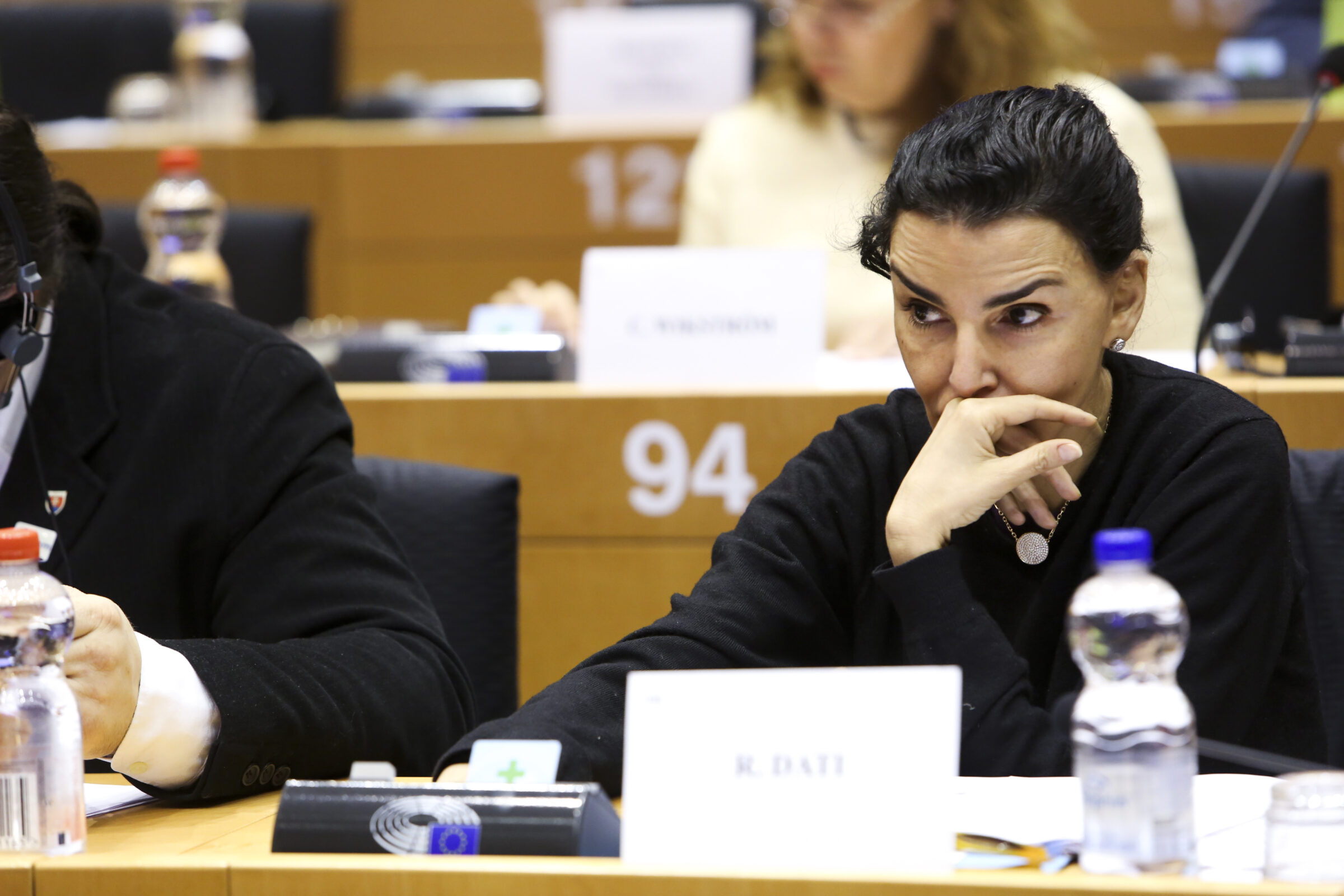
Former French MEP Rachida Dati is facing intense scrutiny following allegations she took lobbying money from French energy giant GDF Suez/Engie during her time at the European Parliament, on top of a separate investigation into her ties with French car maker Nissan-Renault.
The 60-year-old, who was born to Arab parents and started out as a maid, is also a former French culture and justice minister, and now mayor of the affluent 7th arrondissement in Paris.
But she also risks wearing a police ankle-bracelet and faces four years in prison in ongoing trials into her ties with the French companies, which first hit the headlines in 2025.
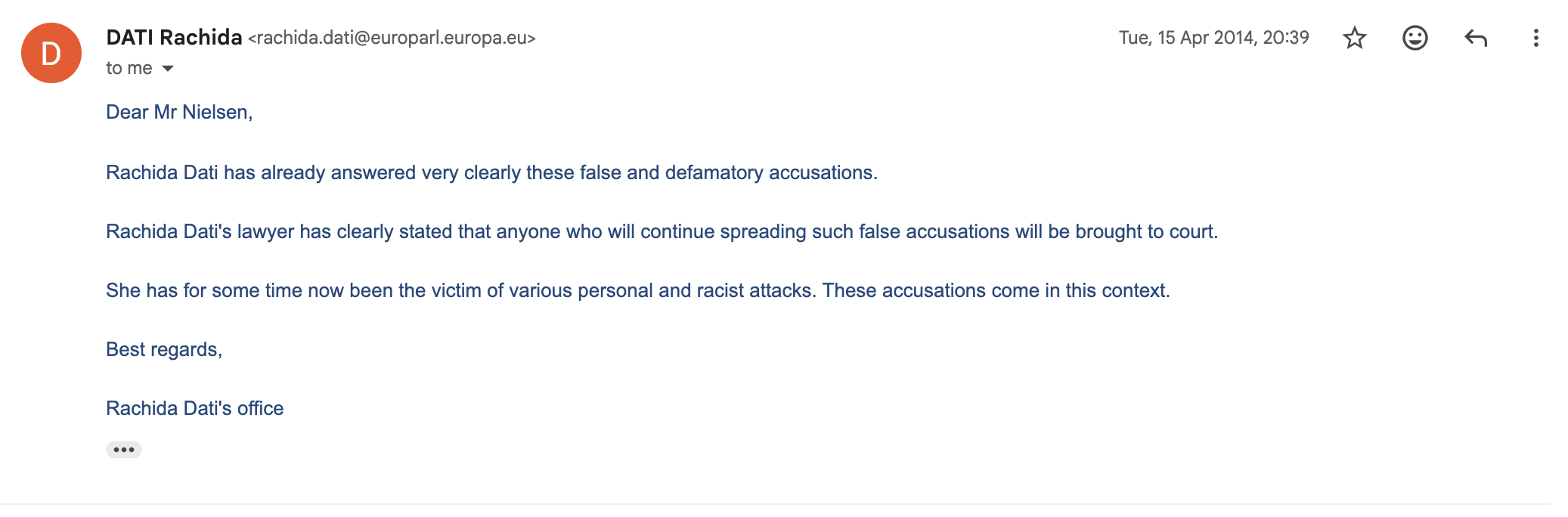
And back in 2014, when she sat in the European Parliament on the benches of the centre-right European People’s Party (EPP) group, she threatened to sue EUobserver because we asked her about GDF Suez, which later changed its name to Engie, while deriding the corruption allegations against her as racist slurs.
EUobserver has published below some of the related email correspondence for the sake of transparency:
“Rachida Dati will not hesitate to sue any media which will report such a defamatory statement,” her office also said in an email in 2015, after a German Green MEP, who was spearheading an ethics committee, said she was likely pocketing GDF Suez money.
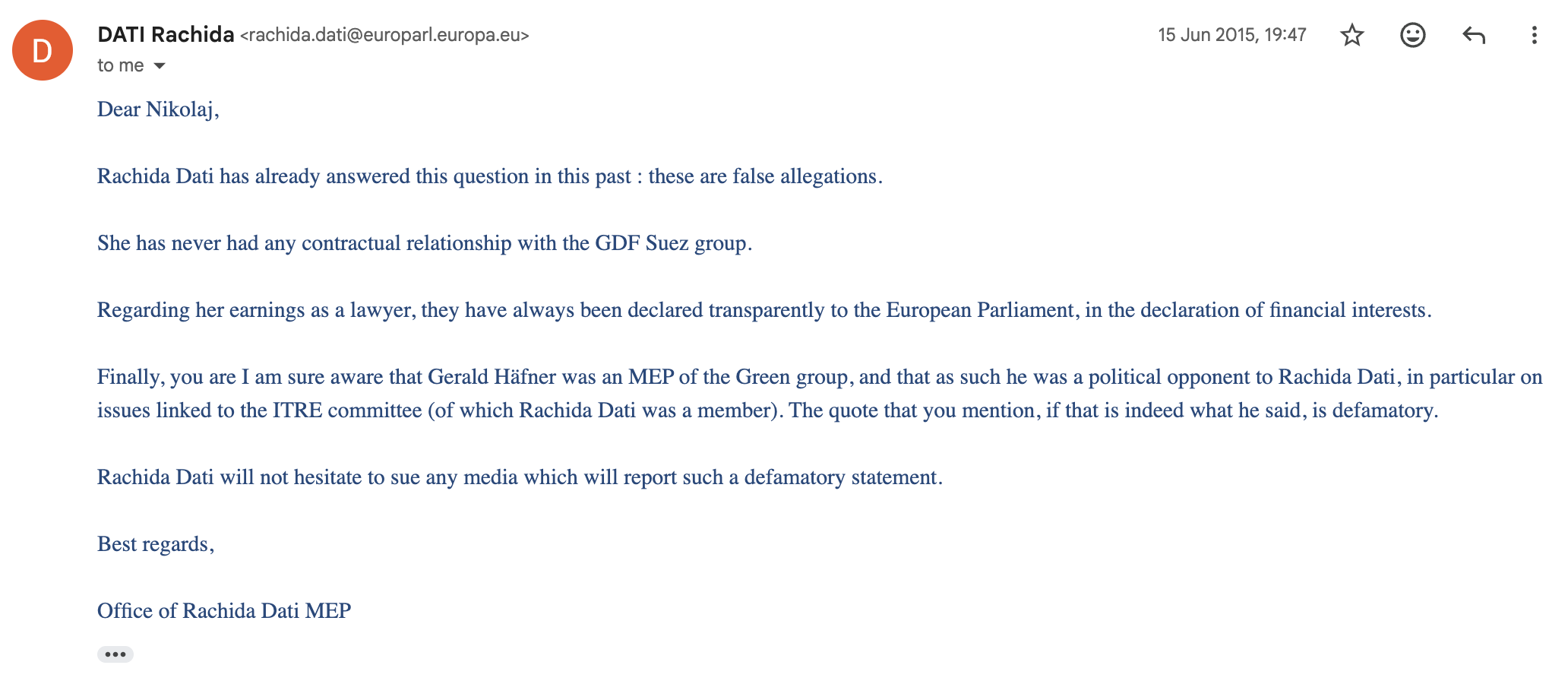
The allegedly “defamatory statement” had been made by Gerald Häfner, a former German MEP, who had chaired the parliament’s advisory committee on its Code of Conduct.
Häfner’s supposedly offensive words were:
This article continues, but the full version is available only to EUobserver.com subscribers. Visit account.euobserver.com/membership
Too often in workplaces and at social gatherings people nod along with the acceptable Left-wing narrative because they're too afraid to say what they really think. Joanna Gray has some tips for 'how to talk to normies'.
The post How to Talk to Normies appeared first on The Daily Sceptic.


LA NEWSLETTER · GRATUITE
L'essentiel de l'actualité, passé au crible par les cinq plumes du Courrier. Dans votre boîte, chaque jour ouvré.
Gratuit. Vous restez libre de partir quand vous voulez.
JE M'INSCRIS lecourrierdesstrateges.frLe 16 novembre 2016, à Bobigny, Emmanuel Macron annonçait sa candidature. Il avait trente-huit ans, aucun mandat électif derrière lui, trois mois de vie civile depuis sa démission du gouvernement, et une dizaine de points dans les sondages. Cinq mois plus tard il était élu. On a beaucoup écrit sur le personnage ; on a moins regardé le gabarit. Ni élu, ni militant, ni comptable d'un bilan devant des électeurs, mais lourd d'une excellence certifiée par des institutions — l'Inspection des finances, une banque d'affaires, un secrétariat général adjoint, un ministère par nomination.
Ce gabarit n'était pas un accident. C'était une réponse à une panne, et la panne est revenue.

ABONNEMENT
Deux grands formats par jour. Les cinq plumes du Courrier. La série Sécession, le dimanche.
Le monde commente. Vous, vous comprenez.
S'ABONNER lecourrierdesstrateges.frRegardons l'offre. Édouard Philippe est mesuré à 19 % d'intentions de vote quand il n'a qu'un concurrent au centre, à 17 % quand il en a deux, à 14 % quand ils sont trois, selon la notice déposée le 14 septembre à la Commission des sondages par Toluna Harris Interactive. Sa cote de popularité recule de trois points en un mois chez Odoxa, à 27 %, et de dix points depuis mai 2025. Une information judiciaire a été ouverte au printemps sur la gestion du pôle numérique du Havre ; il n'a pas été mis en examen et bénéficie de la présomption d'innocence, mais le dossier existe et il pèse.
Gabriel Attal va de 8 à 15 % selon le nombre de concurrents. Il progresse — trois points et huit places au baromètre Cluster 17 de septembre — et c'est précisément son problème : à trente-sept ans, après un passage à Matignon qui aura duré huit mois, il monte dans les classements de sympathie sans jamais franchir le plafond de la crédibilité présidentielle. Bruno Retailleau ne dépasse jamais 10 % dans aucune hypothèse, et perd six points de popularité en un mois, à 20 %. Il tient une ligne, ce qui est déjà rare ; il ne tient pas un électorat.
Élargissons, puisque c'est la mode, et comptons le Parti socialiste dans le bloc central — ce que personne n'assume et que tout le monde pratique. Raphaël Glucksmann a annoncé sa candidature le 23 août, ce qui lui donne un avantage sur les trois précédents : il existe. Il est mesuré entre 9 et 12 %. On dira qu'il progresse, et c'est vrai — il est le seul du haut de tableau à gagner un point en septembre chez Odoxa. Mais une candidature déclarée qui ne décolle pas est un plafond, pas un plancher, et il lui manque les trois choses qu'on ne fabrique pas en dix-huit mois : le charisme, l'habileté de manœuvre, et cette crédibilité gouvernementale qui ne s'acquiert qu'en ayant tenu un ministère par gros temps.
Quatre hommes, quatre plafonds. Aucun n'émerge, et chacun empêche les autres.
Voilà où le sujet devient sérieux. Dans l'hypothèse où le centre et la gauche non insoumise présentent trois candidats, le mieux placé d'entre eux est à 14 %. Jean-Luc Mélenchon est à 16. Marine Le Pen est à 33. Faites l'addition : le second tour se joue sans le bloc central.

LA NEWSLETTER · GRATUITE
L'essentiel de l'actualité, passé au crible par les cinq plumes du Courrier. Dans votre boîte, chaque jour ouvré.
Gratuit. Vous restez libre de partir quand vous voulez.
JE M'INSCRIS lecourrierdesstrateges.frLe feuilleton judiciaire Foodora illustre une mécanique institutionnelle où les créances sociales et les droits individuels s’affrontent désormais devant le tribunal judiciaire de Paris. Et rien n’est encore définitivement réglé.
ABONNEMENT
Deux grands formats par jour. Les cinq plumes du Courrier. La série Sécession, le dimanche.
Le monde commente. Vous, vous comprenez.
S'ABONNER lecourrierdesstrateges.frLe 23 septembre 2026, l’Urssaf a demandé la condamnation solidaire de Foodora et de deux anciens dirigeants à lui verser 2,7 millions d’euros. La somme correspond aux cotisations sociales que l’organisme estime avoir été éludées lorsque les coursiers étaient présentés comme indépendants alors que leur relation de travail relevait, selon l’accusation, du salariat. Foodora a cessé son activité en France en 2018 ; 4 600 coursiers avaient été recensés par l’Urssaf.
L’entreprise et ses deux anciens dirigeants avaient déjà reconnu leur culpabilité dans une procédure de plaider-coupable en mars. Foodora avait accepté une amende de 200 000 euros, tandis que Boris Mittermüller et Stéphane Mac Millan Gay avaient accepté respectivement 50 000 et 20 000 euros d’amende, ainsi qu’une interdiction de gérer de trois ans avec sursis.
TELEGRAM · L'INFO EN CONTINU
La newsletter vous donne le matin. Le fil vous donne l'instant.
Gratuit, et en continu.
REJOINDRE LE FIL t.me/resterlibreLe nouveau volet financier a toutefois provoqué le report au 27 janvier de l’examen des dommages et intérêts réclamés par les 231 anciens coursiers. La défense invoque des discussions en cours avec l’Urssaf. Son avocat affirme que des « pourparlers avancés » pourraient aboutir à de nouvelles informations début 2027. L’Urssaf elle-même a évoqué un préjudice susceptible d’évoluer puisque des versements de Foodora ont déjà été perçus.
Les avocats des livreurs demandent, eux, plusieurs milliers d’euros par personne au titre du préjudice moral et de la précarité financière. Ils soulignent également que certains documents professionnels, comme les certificats de travail ou attestations France Travail, ne seraient toujours pas régularisés.La procédure est en cours. Aucune décision définitive n'est rendue sur ce redressement, dont le montant et le sort restent à trancher.
Pendant ce temps, les coursiers attendent une réparation que Foodora a pourtant admis leur devoir. On ignore comment l'éventuel redressement s'articulerait avec les indemnités des livreurs, et si la plateforme peut honorer les deux. Une transaction entre la société et l'Urssaf ne prévoit rien pour les victimes, qui n'y sont pas parties.Les livreurs ont été privés de leurs droits une première fois. Ils risquent de l'être une seconde, par une puissance publique qui règle ses comptes d'abord.
TIPS · SANS ABONNEMENT
Un média libre vit de ses lecteurs. Un pourboire ponctuel, sans compte ni engagement, quand le cœur vous en dit.
Vous donnez ce que vous voulez. Vous restez libre.
LAISSER UN POURBOIRE merci !
The European Parliament’s culture committee on Tuesday (29 September) agreed to boost the flagship Erasmus+ student exchange programme by €7bn in 2028-2034 linked to rule-of-law conditions, even as so-called frugal countries seek to cut overall funding.
MEPs backed in April to increase the European Commission’s original proposal from €40bn to €47bn as part of a interim report on the EU’s long-term budget (MFF).
On Tuesday, they also said funds should be linked to respect for the rule of law and transparency standards – a clear reference to the situation facing Hungarian universities in the past, which were unable to participate in Erasmus+ during the illiberal rule of former prime minister Viktor Orbán.
Candidate countries, such as Ukraine and Moldova, may be able to participate in the next Erasmus+ in the coming cycle, provided they met “certain conditions,” Polish centre-right and lead MEP on the file, Bogdan Zdrojewski, said during a press conference in Brussels.
The UK and Switzerland are also set to rejoin the programme already in 2027.
And Canada might be able to participate too, Zdrojewski said, should it gain an associate EU membership – an unclear status presented by EU commission president Ursula von der Leyen during her State of the Union speech on 11 September and welcomed by Canada’s prime minister Mark Carney.
Around 17m participants have taken part in Erasmus+ since it was launched 39 years ago, in what is widely considered one of the most popular EU integration projects.
An estimated one million babies have also been born from couples who have met during their exchange.
The committee boost comes amid long-term EU budget talks for the next seven years, in which frugal states such as Germany and the Netherlands want to pay in less than in the past, but Zdrojewski was “feeling optimistic” about getting through the proposed Erasmus budget increase.
He said he counted on EU capitals to defend the programme in future negotiations.
MEPs want to make Erasmus+ more inclusive, highlighting special programmes for adult learners and students in informal education programmes.
They also aimed to set a 20 percent quota for participants with underpriviliged access to career and educational opportunities.
To make Erasmus+ easier to manage, they proposed dividing the funding between different areas: education and training (74 percent), youth and volunteering (15 percent), and sport (four percent).
The committee report will now be voted on by the EU Parliament plenary, although it is still unclear when, when it becomes part of MEPs’ formal basis for negotiations with EU capitals.
This article was updated on 30 September 2026 to make clear that the €47.39bn figure was first set out in Parliament’s interim report on the MFF, adopted in April. Tuesday’s committee vote incorporates that figure into the Erasmus+ regulation, alongside new rule-of-law and transparency conditions.


 A primeira Conferência dos Observatórios Regionais de Turismo Sustentável vai reunir, a 14 de outubro, em Peniche, os sete observatórios regionais do país para discutir a monitorização da atividade turística, a sustentabilidade dos destinos e o papel dos dados na tomada de decisão.