❌

Reading view

Inside Ukraine’s First Combat Deployment Of Robotic Amphibious Vehicles

Taking a break from fighting Russians in the Kostiantynivka sector of the eastern Donetsk region, the commander of a Ukrainian uncrewed ground vehicle (UGV) unit spoke with us about innovations in the use of these systems. One was the first deployment of a UGV specifically designed for amphibious operations to deliver supplies to frontline troops in areas impeded by water obstacles. Large areas of the front line are bisected by rivers and wetlands, and the country has many other small waterways and marsh areas. As we have frequently reported, the use of UGVs by both Ukraine and Russia has exploded as the ubiquity of aerial attack drones makes it far too dangerous for human battlefield movements.

In an exclusive interview with TWZ, the commander of the 93rd Separate Mechanized Brigade’s “Alter Ego” UGV unit, who goes by the call sign “Electric,” offered us unique insights into the challenges of developing amphibious UGVs and how they were deployed.

In the first of two parts, Electric talks about why Alter Ego developed amphibious UGVs – including modifying a Triton variant for this – and how the unit made them work. The second part features his insights into using heavy ‘bomber drones’ to drop UGVs behind enemy lines for kamikaze raids. In addition, a representative of Brave1, Ukraine’s weapons technology accelerator, spoke about developing these systems at scale.

Some of the questions and answers have been slightly edited for clarity.

Q: How did the need for amphibious UGVs for logistics operations first come up?

A: We had this idea for a long time, but recently one of the units of the Armed Forces asked for our help to solve this problem, so that the UGV could overcome water obstacles.

There was a crucial need for this kind of means at certain parts of the front, but the units that are located there didn’t have the capacity by themselves to solve this task. So our battalion was asked to solve this problem because we are one of the most experienced units in terms of UGVs.

A first-ever logistics mission on an amphibious UGV: the robot covered 40 kilometers across land and water.

Operators of the "Alter Ego" unit (93rd Brigade) deployed the robotic system across mixed terrain. Facing water obstacles, the UGV seamlessly switched to swimming mode to… pic.twitter.com/rH8waq04a4

— BRAVE1 (@BRAVE1ua) September 29, 2026

Q: How long did it take to design and test the amphibious UGV, and what went into that process?

A: The whole process from development to battle deployment took less than three months.

Q: What did you have to do to make this work?

A: First of all, we looked at amphibious solutions that were on the market, not only in Ukraine, but in the world, and we took two separate approaches. One was taking one of the main UGVs that our unit is using on the ground, and we made it amphibious. And the other approach was that we took one of the solutions that was on the market that already had amphibious capabilities, and we solved several disadvantages that it had. And at the moment, we are using both.

Q: What did you have to do to make the UGV amphibious, and then what were some of the obstacles that had to be overcome to get this operational?

A: First of all, we have to explain that there are different solutions on the market that kind of work on the testing ground — like they can swim, they can drive on the ground, and in the vision of the manufacturer, they are working. But the fact is that these solutions are not ready for the reality on the front line, which is often very different from what is on the testing ground.

And the second point is that the unit has its own workshops where people work near the front line, and the experts, the engineers that work there, they have a very high level of competence to evaluate different solutions and select the one that has potential. And that’s what’s completely different between this unit and everyone else, like manufacturers and others who are working on these solutions, because they don’t understand what’s needed on the battlefield.
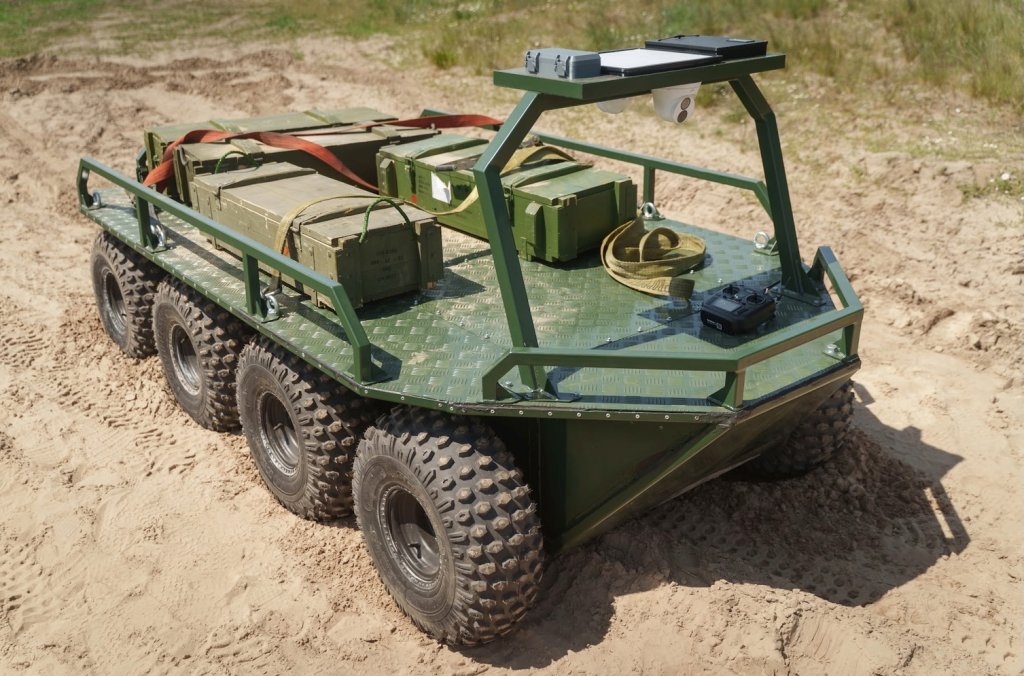
The Alter Ego unit’s uncrewed amphibious ground vehicle (UGV). (Brave1)

Q: So what did you have to change to make it work?

A: Regarding the amphibious one, basically the unit changed almost everything that that UGV had, starting from electronics, the software, the waterproofing, the communications – we basically changed everything. Regarding the one that we already used on the ground, we basically tried to retain what was allowing it to be an effective UGV on the ground, and we added waterproofing and specific mechanics, so that it can work in the water environment.

Q: You mentioned communications. What kind of communications did you add?

A: The communication means that was installed on the UGV by the manufacturer was not sufficient at all. Basically, it didn’t have enough quality for the battlefield situation. It was not working. But we already have our own communications that we were working on, and we have a lot of experience because we have been working for a long time in this UGV area. So we basically helped to install a sufficient level of communications on this UGV.

Q: So how does the amphibious UGV communicate with the controller? Does it use Starlink or some other satellite communications system for navigation?

A: This is satellite navigation, but not only. Satellite navigation is a part of this communication system.

Q: What are the other parts?

A: It’s better not to talk in detail about the other part of the communication system.
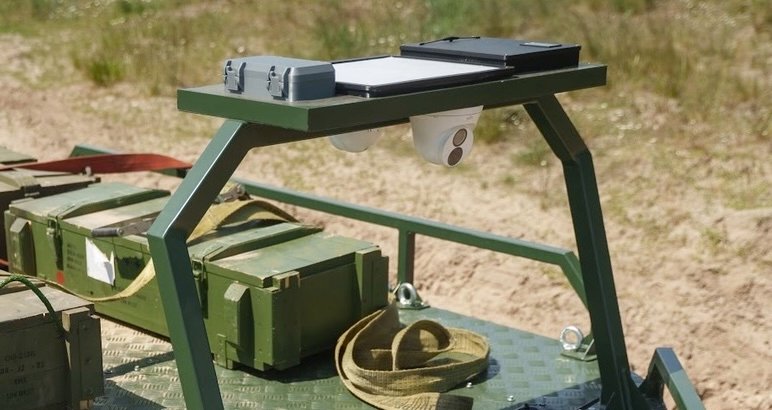
Triton amphibious UGV communications and camera systems. (Brave1)

Q: There were probably a lot of different missions that could have been used for this first amphibious UGV logistics delivery. Why was this particular mission chosen?

A: The Alter Ego unit has so much experience in terms of UGVs, and not just experience of using UGVs, but the experience of being the first in the world. We had one of the first evacuation missions, we had one of the first strike missions using UGVs, the paratrooper UGV, and now the amphibious UGV. So basically, we have the systems to make it work for the first time when nobody knows how to conduct this mission.

Q: No, I mean why did this particular mission get chosen to be the first one?

A: There are certain places on the front line where we have water obstacles that prevent logistics from being done by UGV. At the moment, UGVs are carrying hundreds of tons of logistics, probably the most compared to any other means on the front line, but before this, these water obstacles would prevent UGVs from providing logistics for those parts of the front, and that need can’t be fully satisfied by UAVs or other means. That’s why we did this mission with the amphibious UGV, and now our task here is to scale this technology and provide this logistics system for other similar parts of the front where there are water obstacles.
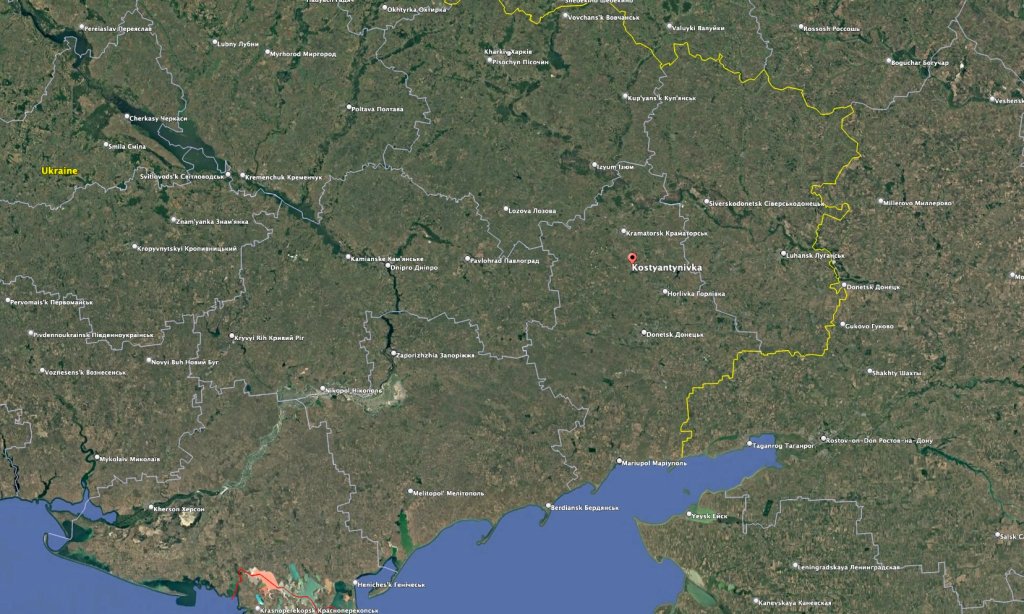
Kostiantynivka, Ukraine. (Google Earth)

Q: Tell me about where and when this mission took place and what it was like to watch it unfold.

A: So unfortunately, we can’t provide information about when and where this operation took place. But regarding how it went and what we felt, this was another big challenge, because this is something that wasn’t done before, and nobody thought this is real. So this was quite difficult, and to tell the truth, the mission didn’t succeed on the first try, actually, and it required a lot of effort in terms of planning, preparing, engineering, and basically it required 100% effort from everyone involved in that mission.

Q: How many times did it fail before, and what went wrong?

A: We had one failed attempt. The reason for failure was a certain technical problem. After that, we analyzed what went wrong, and we worked on solving those issues. Basically, it’s something that nobody had tried to do, it’s kind of hard to know what can go wrong before you actually try it. So the best way to find a solution like that is to try and then iterate on that attempt and make it better and better and better.

Also, I would like to add that although this was the first successful mission regarding an amphibious UGV, it’s not that there was no work on that before that. We were actively talking to and collecting the experience of everyone who was working on these kinds of missions before, and that was also a reason why this mission succeeded.

Q: How far did the amphibious UGV go for this mission?

A: So the UGV went 40 kilometers one way, and then it returned. So probably around 70 kilometers in total, and it carried food and other supplies.

Q: Did this UGV come under Russian fire on this mission?

A: Yes, and it survived.

Q: How does the UGV switch from water to land operations?

A: So the UGV has two separate control systems, one for water and one for land, and basically it switches to the one that is required at the moment. That’s how it can operate in both environments.

The Alter Ego unit’s uncrewed amphibious ground vehicle (UGV). (Brave1)

Q: Is that autonomous, or is that something that the controller at the base has to do as they watch the UGV on its mission?

A: At the moment, the operator fully controls the UGV manually. And basically, before, the operators of UGVs only knew how to move them on land, but now they also had to learn how to move them in the water. So not only was the technology itself developed, but we also had to prepare the operator and come up with tactics for this UGV.

Q: Did you use AI on this mission in any way, and if so, how?

A: We didn’t use AI.

Q: Have there been other missions using amphibious UGVs?

A: Yes.

Q: Can you say how many and what was delivered?

A: No.

Q: Is this designed only for logistics missions, or will it be used in the future for strike missions, either as a one-way attack system or as a platform for machine guns or other weapons?

A: We can use it in different ways in the future.

Q: Mud season is fast approaching, when much maneuvering becomes impossible or severely degraded because of how difficult it is to move in the thick, oozing slop. Will your amphibious UGVs work in the mud?

A: I think it can operate in the mud in the same way it operates in the water.

In the next segment of our interview, Electric talks about using bomber drones to deliver UGVs behind the lines, and a Brave1 representative talks about how the organization is working to develop these systems at scale for wider use.

Contact the author: howard@twz.com

The post Inside Ukraine’s First Combat Deployment Of Robotic Amphibious Vehicles appeared first on TWZ.


  •  

USDA’s No GMO Label Doesn’t Mean No Genetic Engineering

by Alliance for Natural Health

Excerpts:

A food package carries no bioengineered disclosure. Does that mean no genetic engineering went into the food?

No. USDA’s bioengineered food disclosure standard leaves entire categories of genetically engineered foods and ingredients outside mandatory disclosure.

Easing restrictions on natural substances with credible histories of safe use makes sense. Yet natural products face persistent calls for tighter regulation, alongside efforts to suppress truthful information about their benefits.

Meanwhile, novel technologies that fundamentally alter our food are riding a wave of deregulation—even as their implications demand rigorous scrutiny and full transparency.

These priorities are backwards.

A Narrow Definition, Wide Exclusions

Under the current rule, foods generally require disclosure when: 1) they contain genetic material modified through laboratory recombinant-DNA techniques, 2) the modification could not otherwise arise through conventional breeding or nature, and 3) the modified material is detectable.

There are a host of exclusions:

  • Restaurants and food service: meals can contain engineered ingredients without this disclosure.
  • Very small manufacturers: businesses with annual receipts below $2.5 million are exempt.
  • Accidental presence: up to 5% of each ingredient may be bioengineered if its presence is “inadvertent” or technically unavoidable.
  • Animal feed: meat, milk, and eggs do not require disclosure solely because animals ate engineered feed.
  • Refined ingredients: oils, sugars, and other ingredients can avoid disclosure when modified genetic material is undetectable.
  • Processing aids: qualifying incidental additives present at insignificant levels with no final technical or functional effect are excluded.
  • Certain meat, poultry, and egg products generally fall outside coverage when those ingredients predominate, including after water, broth, or stock.
  • Many alcoholic beverages: products subject to federal alcohol labeling law fall outside this standard.

Nearly A Quarter of Your Chips

Consider a hypothetical bag of corn chips containing 80% cornmeal, 19% refined soybean oil, and 1% salt.

If 5% of the cornmeal is inadvertently mixed-in bioengineered corn, that represents 4% of the chips. Add oil entirely from engineered soybeans that meets non-detectability requirements: another 19% originates from GE crops.

That is 23% of the product’s weight originating from engineered crops, quite legally without a bioengineered disclosure.

This can also allow proteins made using genetically engineered yeast or bacteria (through a process called “precision fermentation”) to avoid disclosure, depending on what remains in the finished ingredient.

A CRISPR-produced food can escape disclosure if its genetic modification could otherwise be achieved through conventional breeding or found in nature.

But who decides if a modification could arise through conventional breeding or nature?

Essentially it is the food company that makes the decision…

Read the full article at Alliance for Natural Health.

Brian Shilhavy’s Comments:

Modern history has consistently taught us that we cannot trust our Federal Government in the U.S. to look out for the interests of consumers, and that includes the USDA and the FDA. Both of these agencies serve Wall Street, and derive much of their revenue from the very businesses they are supposed to be regulating in Big Pharma and Big Ag.

For example, the entire corn crop in the U.S. is contaminated, even if that corn is certified organic by USDA organic standards. There may be some exceptions, but we (Healthy Traditions) have never found any corn in the U.S. that has tested clean for GMO DNA, and we have been testing for 12 years now.

The only corn we have tested that has no trace amounts of GMO DNA and no traces of the cancer-causing herbicide glyphosate, has been from traditional farms in Mexico, where planting GMO corn is illegal.

Therefore, we believe we have some of the highest quality tortilla corn chips in the U.S., and we fry them in coconut oil, not toxic polyunsaturated oils derived from GMO crops like corn and soybeans. We also do not package them in plastic, but special bags that are compostable with no dangerous chemicals.

There may not be a finer tortilla corn chip sold in the U.S.!


DISCLAIMER: Brian Shilhavy is the Editor of Health Impact News, and the founder and CEO of Healthy Traditions. Everything published on the Health Impact News network is available to the public free of charge, with a Creative Commons license offered to all who wish to republish Brian’s articles, with attribution, as he earns his income from Healthy Traditions.

Healthy Traditions, originally Tropical Traditions, has served customers in the U.S. for over 24 years.

Related:

Big Food has Taken Over the USDA National Organic Program – Why I am no Longer Importing Certified Organic Food

This article was written by Human Superior Intelligence (HSI)

See Also:

Understand the Times We are Currently Living Through

The Brain Myth: Your Intellect and Thoughts Originate in Your Heart, Not Your Brain

Is God’s Patience About to Run Out on the United States?

Second Edition of eBook Released: The Concept of the American Christian Family is a Myth and is NOT Found Anywhere in the Bible – by Brian Shilhavy

FREE eBook! Restoring the Foundation of New Testament Faith in Jesus Christ – by Brian Shilhavy

KABBALAH: The Anti-Christ Religion of Satan that Controls the World Today

Exposing the Christian Zionism Cult

The Bewitching of America with the Evil Eye and the Mark of the Beast

Jesus Christ’s Opposition to the Jewish State: Lessons for Today

Identifying the Luciferian Globalists Implementing the New World Order – Who are the “Jews”?

The Seal and Mark of God is Far More Important than the “Mark of the Beast” – Are You Prepared for What’s Coming?

The Satanic Roots to Modern Medicine – The Image of the Beast?

Medicine: Idolatry in the Twenty First Century – 10-Year-Old Article More Relevant Today than the Day it was Written

Having problems receiving our emails? See:

How to Beat Internet Censorship and Create Your Own Newsfeed

We Are Now on Telegram. Video channels at Bitchute, and Odysee.

If our website is seized and shut down, find us on Telegram, as well as Bitchute and Odysee for further instructions about where to find us.

If you use the TOR Onion browser, here are the links and corresponding URLs to use in the TOR browser to find us on the Dark Web: Health Impact News, Vaccine Impact, Medical Kidnap, Created4Health, CoconutOil.com.

The post USDA’s No GMO Label Doesn’t Mean No Genetic Engineering first appeared on Health Impact News.

  •  

How Israel destabilizes the Middle East: Denying sovereignty and the right to exist

By Buğra Sarı | MEMO | October 1, 2026

Israel’s pursuit of security increasingly rests on a destabilizing proposition: that its neighbours become less threatening when their capacity to exercise sovereignty is diminished. Since the Hamas-led attacks of October 7, 2023, this approach has become particularly visible across several distinct arenas. Military operations, territorial incursions and restrictions on political and economic autonomy suggest a conception of security dependent on keeping others vulnerable. The consequences extend beyond individual confrontations. When states cannot control their territory, rebuild institutions or protect their populations, the regional conditions necessary for durable security begin to erode.

The argument is not that Israel created every conflict in the Middle East. Authoritarian rule, sectarian violence, armed groups and competing regional interventions have all contributed to the region’s instability.

The question is whether the means Israel uses to pursue its own security deepen that instability. Repeatedly weakening neighbouring states and political communities may bring short-term military gains, but it can also erode their ability to contain violence and maintain order, making the region more dangerous—including for Israel itself.

This pattern can be understood as the denial of sovereignty. Sovereignty involves more than diplomatic recognition: it requires institutions capable of governing, providing services and exercising legitimate authority over the use of force. When these capacities are persistently degraded, formal independence becomes increasingly hollow.

The cases differ in their circumstances and severity, but together they reveal a troubling hierarchy: Israeli freedom of military action repeatedly takes precedence over other societies’ ability to govern and secure themselves.

Syria offers a particularly revealing example. Following the collapse of Bashar al-Assad’s regime in December 2024, Israel launched extensive attacks against Syrian military infrastructure and moved into the separation zone established under the 1974 disengagement agreement. Israel justified the destruction of military assets as necessary to prevent advanced weapons from falling into extremist hands. Yet the targets included airfields, air-defence systems and naval facilities—capabilities relevant to the functioning of a state, whatever government eventually controls them.

The longer-term problem is that preventing a hypothetical future threat can obstruct the reconstruction of an already devastated country. Syria needs accountable security institutions capable of controlling territory, containing armed factions and protecting communities. Destroying military capabilities without a credible framework for rebuilding legitimate state authority risks leaving those functions unfulfilled. In July 2025, Israeli strikes on Damascus, including the defence ministry, further demonstrated Israel’s willingness to impose military limits on the new authorities.

Syria’s transitional authorities must themselves answer for abuses and protect minorities; state consolidation cannot justify repression. Nevertheless, externally imposed military vulnerability is no substitute for accountable governance.

A government expected to prevent threats from emerging within its territory must have the capacity to exercise authority there. Undermining that capacity can preserve the fragmentation through which armed groups survive.

Lebanon exposes a related contradiction. Hezbollah’s independent military power has long constrained the Lebanese state’s authority and its ability to determine questions of war and peace. Reducing that parallel authority could, under appropriate political arrangements, strengthen state sovereignty. But Israeli military action does not automatically transfer power from Hezbollah to the Lebanese government. Bombardment, displacement and violations of Lebanese territory can weaken the institutions expected to assume responsibility for national security.

The distinction is crucial: weakening an armed organization and strengthening a state are separate outcomes. In March 2026, UN Secretary-General António Guterres called both for respect for Lebanon’s sovereignty and for stronger support to its armed forces so that they could become the country’s sole military force. That combination identifies what repeated unilateral intervention overlooks: security requires an institutional successor capable of governing after military operations end.

Where that capacity remains inadequate, another cycle becomes possible. Armed groups invoke external attacks to justify retaining their weapons; the state struggles to establish authority; Israel cites the continuing armed presence to justify further intervention. Hezbollah bears responsibility for its own decisions, but Israeli policies can reinforce the conditions sustaining its claim that the Lebanese state cannot protect the population.

The attack on Doha on September 9, 2025 extended this logic into the diplomatic sphere. Qatar was mediating negotiations involving Israel and Hamas when Israel struck Hamas representatives on its territory. The UN High Commissioner for Human Rights condemned the attack as a breach of international law and an assault on mediation. The significance exceeded the violation of Qatari sovereignty: even a state facilitating negotiations could find its territory treated as an extension of the battlefield.

Mediation depends on practical assurances that communication with an adversary will remain possible. Targeting interlocutors in a mediating country makes those assurances harder to provide. It raises the costs of hosting negotiations and can undermine channels needed for ceasefires, hostage releases and humanitarian arrangements. Military reach may expand while opportunities for a political settlement contract.

Israel’s recognition of Somaliland in December 2025 raises a different sovereignty question along the region’s Red Sea periphery. Somaliland has maintained separate institutions for decades, and its claim to recognition has its own history. Nevertheless, Israel’s recognition challenged Somalia’s internationally recognized territorial framework. The African Union rejected the move and warned that such recognition could undermine peace and stability.

Recognition is not equivalent to bombardment, and the cases should not be collapsed into a single legal category. Their connection is political: the territorial arrangements on which other governments rely become subject to unilateral decisions shaped by Israeli interests. In an already contested regional environment, such decisions risk adding another dispute to fragile processes of state consolidation.

The confrontation with Iran illustrates the danger of extending preventive military logic to a powerful regional adversary. On February 28, 2026, Guterres condemned the use of force by the United States and Israel against Iran and Iran’s subsequent retaliation across the region. He warned that these actions undermined international peace and security. The escalation demonstrated how efforts to eliminate threats militarily can expose additional countries to attack.

Iran’s support for armed groups and its own military conduct cannot be excluded from this assessment. Nevertheless, degrading an adversary’s capabilities does not necessarily resolve the political incentives driving confrontation. It may instead encourage dispersal, rearmament or greater reliance on asymmetric methods. Tactical destruction can coexist with a more dangerous strategic environment.

The Palestinian case represents the most profound expression of this problem because it concerns both collective self-government and the conditions of human survival. In the West Bank, withholding revenues owed to the Palestinian Authority weakens the institutions expected to administer daily life.

The World Bank documented how the suspension of transfers in 2025 intensified fiscal distress, reduced salary payments and placed pressure on essential services. These measures undermine the practical foundations of Palestinian self-government.

A political authority cannot provide credible governance indefinitely while lacking reliable access to its own revenues. Weakening public administration also weakens its legitimacy, potentially benefiting actors who argue that institutional politics offers no meaningful route to Palestinian rights. The resulting dysfunction can then be invoked as evidence that Palestinians are incapable of governing themselves. Restrictions on capacity thus risk producing the very incapacity used to justify continued control.

In Gaza, the destruction has reached beyond institutional viability. The devastation of housing, healthcare, water systems and livelihoods, compounded by restrictions on humanitarian access, has endangered the material conditions necessary for life. In August 2025, a joint statement by UN agencies confirmed famine in Gaza Governorate and described a crisis involving starvation and preventable deaths. The issue was no longer merely whether Palestinians could build a state, but whether civilians could survive.

Hence, in Gaza, the denial of sovereignty has escalated into a denial of survival. In September 2025, the UN Independent International Commission of Inquiry concluded that Israel had committed genocide against Palestinians in Gaza. Earlier, on November 21, 2024, the International Criminal Court issued an arrest warrant for Benjamin Netanyahu, finding reasonable grounds to believe that he bore criminal responsibility for the war crime of starvation as a method of warfare and the crimes against humanity of murder, persecution and other inhumane acts. These findings expose the devastating human consequences of denying a population access to the essentials of life. The systematic destruction of civilian infrastructure and deprivation of food, water and medical care undermine Palestinians’ ability to survive as a community in their homeland. Viewed through this analysis, the genocide identified by the UN commission represents the most extreme manifestation of denial: a progression from obstructing a people’s capacity to govern themselves to destroying the conditions necessary for their continued existence.

Taken together, these cases suggest a self-reinforcing cycle. Military intervention and institutional weakening can generate insecurity, displacement and political fragmentation. Those conditions create opportunities for armed actors, whose activities then provide further grounds for intervention. This is a causal risk, not an inevitable outcome of every operation. Its importance lies in the contradiction between immediate military advantage and the requirements of lasting security.

Breaking that cycle requires a different measure of success: whether policies leave behind institutions capable of governing, populations able to live securely and diplomatic arrangements that reduce incentives for violence. Protecting Israeli civilians and respecting neighbouring societies’ sovereignty are mutually reinforcing necessities.

A regional order built around one state’s freedom to intervene and everyone else’s enforced vulnerability cannot offer durable peace. By denying others the capacity to govern—and, in Gaza, devastating the conditions necessary to survive—Israel risks perpetuating the insecurity from which it seeks protection.

  •  

Journalist Evan Gershkovich: My 491 Days as Putin’s Political Prisoner

In this tense, riveting first-person excerpt from his new book This Cursed Beautiful Land: A Russian Story, Evan Gershkovich recounts the harrowing months he spent as a prisoner in Russia, leading up to his eventual release in a complex, multi-country prisoner exchange. Even in the darkness, Gershkovich offers rays of light: care packages from friends, letters by the hundred, and a cautiously blossoming love with a friend in Berlin. We may know the ending, but the details of these days reveal what it takes to get there.

A few hours after my arrival, I heard a cart rolling down the hallway. A guard opened a kormushka — a feeder window in the door about the size of a human head. A man in a chef’s uniform filled my bowl with porridge, placed a piece of rancid-smelling boiled fish on my plate and gave me some weak tea. The reality of my new surroundings slammed into me.

Thoughts ricocheted inside my head. Earlier in the day I’d had a comforting one: they’ve taken me for a swap, I told myself. That’s all this is.

Now, curled up on the bed in my 12ft by 8ft cell, knees pulled to my chest, I thought, what if the FSB really does think I’m a spy and wants to make an example out of me? Maybe they don’t want to swap me at all. Maybe I really will spend 20 years here.

  •  

EU accession of Moldova and Ukraine is alternative to Nato, as Russia draws new Iron Curtain in Europe

“What is remarkable is that Ukraine and Moldova, despite finding themselves in a very tense situation regarding their security, are extremely keen to move closer to the EU and have therefore already begun negotiations and opened the first cluster.”

These are the words of the deputy director of the European Council on foreign relations (ECFR), Vesela Cherneva, and they come just as the official negotiation process for the two countries’ accession to the European Union has begun.

With this, the EU embarked on a truly geopolitical enlargement – driven not only by the pursuit of shared values, a larger market, and stronger common institutions, but also by the need to safeguard the continent’s security in a shifting environment.

Ukraine: a battle-hardened nation’s journey from the post-Soviet world to the EU

According to Cherneva, the EU’s upcoming enlargement is the only way to institutionally anchor Ukraine within a serious and lasting framework, given that the US position has remained clear under both presidents Donald Trump and Joe Biden: Nato enlargement to include Ukraine is not possible.

“Currently, EU membership is the only way to integrate Ukraine’s and Europe’s security systems. This is an entirely different discussion from negotiations on chapters, clusters, sanitary standards and other accession requirements. We are talking about security guarantees, but also about the transfer of military technologies from Ukraine to Europe and, more broadly, about how Ukraine – which currently possesses the strongest and most combat-capable army in Europe – can, while defending Europe, also become part of the European security debate,” Cherneva says.

Ognyan Minchev, political scientist, professor and executive director of the Institute for Regional and International Studies, an independent think-tank in Bulgaria, also believes that Ukraine’s importance is substantial and that the questions surrounding its integration are highly complex.

“Ukraine currently possesses the only genuinely combat-capable army on the European continent. Western European armies have very limited personnel numbers and, until recently, received extremely low levels of funding. The lack of real resources, including weapons, to address the challenges of military security makes Ukraine a more attractive partner,” he says.

Although many experts would point to Ukraine’s contribution to European security as the greatest benefit of its accession to the EU, the country can also contribute to development in other areas. There is undoubtedly great potential for development in the fields of agriculture and farming.

The country has a vast area of cultivated land and is among the world’s leading producers of a number of cereal crops such as wheat, maize, barley, rice, and others. It exports these products to third countries, and membership would increase the EU’s economic influence in these regions.

Ukraine’s accession could also lead to cooperation between different sectors and result in an increase in meat and dairy production as a consequence of increased cereal production.

Beyond agriculture, Ukraine’s pharmaceutical industry could offer the EU an opportunity to reduce its reliance on imports of generic medicines from China and various Asian countries. Thanks to its favourable climate, Ukraine also has great potential for various types of renewable energy.

Deposits of gallium, rutile, graphite, magnesium ores, lithium and other minerals vital to the green transition could contribute to European production and help the EU compete with China.

According to Minchev, integrating Ukraine represents a major challenge because it involves a large country that is institutionally weak, with high levels of corruption, poor economic organisation and significant shortcomings in the functioning of public life.

“Ukraine has been forced to transform itself into an effective fighting machine, but in other respects it remains a post-Soviet society with serious problems in the areas mentioned above. This makes its rapid integration into the EU extremely difficult,” Minchev says.

Moldova: a key piece in Europe’s security architecture continues to struggle under Russia’s shadow

“For Moldova, we can say that it is a small but significant element in the broader domino effect of Black Sea security, which is becoming an increasingly crucial aspect of overall European security. This is because the confrontation between the Kremlin regime and Europe is effectively unfolding along the line of a new Iron Curtain being formed across Ukraine and the Black Sea region,” Minchev says.

According to Cherneva, Moldova’s accession is also crucial precisely because the country is a buffer state, and Russia has demonstrated that it does not tolerate buffers.

“Russia seeks to conquer and control such buffer zones. If Moldova does not want to share the fate of Belarus or Georgia, it must take rapid steps towards European integration,” Cherneva says.

For years, Moldova has served as a testing ground for Russia’s hybrid warfare. As Western European countries are only now confronting the full scale of Russian hybrid attacks, Moldova has already spent years developing its own resilience and countermeasures.

The country brings to European security valuable expertise gained from combating Russian disinformation and resisting repeated attempts by the Kremlin to interfere in its domestic political processes.

Yet Moldova’s accession would have implications extending far beyond security. Although it possesses far less agricultural land than Ukraine, the country has the potential to make a meaningful contribution to the European agricultural sector. Moldova has been gradually integrating into the EU’s Single Market through the Deep and Comprehensive Free Trade Area (DCFTA).

This article continues, but the full version is available only to EUobserver.com subscribers. Visit account.euobserver.com/membership

  •  

No Vote, No Representation, No State: Democracy, Israeli Style

Palestine This Week | Middle East Monitor | September 30, 2026

This week’s MEMO review examines claims about Netanyahu’s advance knowledge of 7 October, his provocative UN speech and Israel’s sweeping West Bank closure. We discuss calls to free Marwan Barghouti, moves to bar Arab-led parties from Israeli elections, Trump’s rejection of Iran’s proposal and allegations of election interference involving Israeli firms.

Chapters:

00:00 Introduction & Overview

01:41 Claims of Netanyahu’s Advance Knowledge of 7 October

18:14 Netanyahu’s UN Speech: Props, Provocations and Defiance

22:58 Israel’s West Bank Closure and Its Impact on Palestinians

26:30 Growing Calls to Free Marwan Barghouti

29:40 Israel’s Political Opposition and the Two-State Solution

35:00 Arab Party Disqualifications: Democracy and Apartheid

38:07 Trump Rejects Iran’s Proposal: What Was on Offer?

41:42 Meta’s Restrictions on Lula and Allegations of Israeli Election Interference

Subscribe to our YouTube channel: https://tinyurl.com/447fpn8k

Visit our website: https://www.middleeastmonitor.com/

  •  

Zionist Bought Senate Blocks Information About American Citizens Killed By Israel

By Justin K.P. | The Dissident | September 30, 2026

The U.S. Senate just voted 47-51 against a bill introduced by the Senators Chris Van Hollen, Tim Kaine and Bernie Sanders which would have “forced Secretary of State Marco Rubio to submit to Congress, within 30 days, a report on what information is available about the killings of the nine US citizens, the status of US and Israeli investigations into the killings, the number of US citizens currently held in Israeli prisons, the treatment of Palestinian children in Israeli prisons, and a description of the steps the US government has taken to reduce violence in the West Bank.”

In other words, the Zionist occupied Senate voted against releasing information about Israel killing American citizens in order to protect Israel.

The bill would have forced Marco Rubio to release the information about nine US citizens who have been killed by settlers and Israeli security forces, including the late Palestinian-American journalist Shireen Abu Akleh, who was killed by Israeli occupation forces while reporting in the West Bank in 2022, an intentional murder that was covered up by the Biden administration.

The Biden administration covered up for Israel, claiming that her murder was the “result of tragic circumstances during an IDF-led military operation against factions of Palestinian Islamic Jihad”.

But later, the whistleblower Colonel Steve Gabavics, who worked at the time for the Office of the U.S. Security Coordinator in Jerusalem and led the investigation into Shireen Abu Akleh, revealed that his team found she was intentionally targeted, but the U.S. covered it up to protect Israel.

In an interview with Democracy Now!, he noted, “We were able to disprove very quickly the assertion that there was a Palestinian gunman in front of Shireen Abu Akleh, that the IDF had shot at, and they had accidentally shot her instead… the indications of everything we read from the reports that we got from the IDF on their locations, and proximity to where the event happened, what we got from the investigation from the Palestinian Authority, and our investigation, to us it was very clear that the (IDF) individual in the vehicle who took the shot, would have had a clear line of sight and would have had visibility of Shireen Abu Akleh walking down the middle of the street for a period of time before he took the shots”.

But he revealed that the Biden administration covered up this information, saying, “After we had completed this we were on regular video calls, classified and unclassified with the state department … I indicated that the evidence to me indicated that there would have been enough if we actually built a criminal case to have enough information and facts to beyond a reasonable doubt, for a conviction at some level. We were pushing for the fact that they needed to formally admit the fact that it was not an accident, that a (Israeli) soldier killed Shireen Abu Akleh, that it was an intentional shooting, and unfortunately, that was not what came out … When the actual statement came out, that was absolutely not what I expected… I was shocked … all the data indicates the exact opposite, it was not fog of war… This was not what we had found”.

He added, “It all came down to not trying to anger the Israelis by holding them accountable for intentionally killing an American citizen”.

Yet again, AIPAC-bought members of the Senate want to continue the cover-up of the Israeli murder of American citizens in order not to anger Israel and its lobby.

  •  
❌