❌

Reading view

What does Europe want – a war with Russia?

By Ricardo Martins – New Eastern Outlook – October 2, 2026

It was common practice during the Cold War to exaggerate the threat from the Soviet Union. Nowadays, Russia has assumed that role. Although the circumstances have changed, some of the political methods employed to create a sense of insecurity are still remarkably similar.

Europe is not formally engaging in preparations for war since it desires one. Instead, the governments of Europe and the institutions of the EU describe their rapidly growing defence policies and war preparedness as being aimed at deterrence, on the basis that Europe has to become strong enough to avoid a bigger conflict.
NATO does likewise, presenting itself as a defensive alliance whose role is to deter aggression. Nevertheless, the extent and the terminology used in Europe’s present military transformation should be examined. If preparedness becomes a top political concern, if huge amounts of public money are channelled into defence industries, and if support for Ukraine becomes more and more tied to Europe’s own security, then a significant question arises: where does deterrence cease and the political preparation for war begin?

The question is especially relevant to the EU, which has throughout its history been based on reconciliation, economic interdependence and a rejection of war.

From a peace project to a defence project

The European Union is experiencing a deep change in the way it views security. This change is no illusion. As part of the ReArm Europe/Readiness 2030 programme the European Commission plans to commit up to 800 billion euros towards defence spending, and the EU has set up a 150 billion euro SAFE lending facility to assist with military investment and joint procurement. The various EU institutions have made it clear that the aim is to eliminate capability gaps, boost the European defence industry and enhance deterrence.

The language that goes with this transformation is just as important. European Defence Commissioner Andrius Kubilius has warned at the European Parliament that Russia could be ready for a confrontation with NATO “in five years or less”. He has also invoked Jean Monnet’s wartime “Victory Programme” analogy, arguing that Europe needs a comparable transformation of its defence industry.

The official view of the Commission is that the issue is one of deterrence and not about starting a war. However, a military system which is intended to deter war needs to have weapons, logistical support, industrial capacity, troops and operational plans. As these capabilities increase, so too does the institutional ability to conduct war.

A paradox arises since Europe claims it is arming itself and preparing its hospitals to receive 2,000 wounds per day – as it is the case in Germany — in order to maintain peace while at the same time setting up a more and more integrated belligerent European defence structure. The EU is considering not just an increase in weapons but also the creation of a European Defence Union, a European Security Council, common procurement, military mobility and a closer relationship between European institutions and NATO.

The fact that this might constitute a necessary adaptation to a new security situation also brings up a more general issue concerning European identity: is the European Union still mainly a peace project which happens to have military capabilities, or is it instead becoming a geopolitical and military actor for which readiness for confrontation is becoming increasingly important?

Is Russia a threat, an adversary, or a permanent enemy?

Here, there is a mixture of perceived threats, old ressentiments and Russophobia in play. The threat perceptions are not the same throughout Europe. Because of historical reasons, such as foreign occupation and Soviet domination, Poland has long viewed Russia differently from countries such as France and Germany, which after the Cold War initially placed greater emphasis on economic engagement and interdependence with Moscow. But that distinction has changed dramatically.

Germany, in particular, has moved from the Ostpolitik-era logic of engagement towards a confrontational security posture. Under Chancellor Friedrich Merz, Berlin has described Russia as a serious threat, committed to a major expansion of defence spending, and taken a leading role in sustaining military support for Ukraine. Germany has also intensified defence cooperation with France, including discussions on nuclear deterrence and European capabilities. Germany has also established a permanent military presence in the Baltic States, with a brigade of around 5,000 soldiers being stationed in Lithuania.

The military buildup that Poland has since carried out has depended largely on the United States and South Korea, highlighting a further weakness: even though the EU has aimed at setting up a European defence industry, European manufacturers have not always been able to provide weapons at the speed and on the scale required by countries that have been rearming since 2022.

A more serious issue is that those who question the military escalation are seen as showing a lack of strength, a state of naivety or a failure to have sufficient solidarity with Europe — what then becomes of democratic debate? French Socialist Ségolène Royal.

The danger of making war readiness a political culture

That is exactly the reason why Europe’s present-day transformation should be subject to democratic scrutiny.

Deterrence becomes a politically dangerous thing when preparedness itself comes to be the main idea of security, when military expenditure starts to compete with other public priorities, and when diplomacy and negotiation are regarded as being of less importance than the building up of military power.

The proper European question therefore isn’t whether Europe is “strong enough” to fight Russia. It is rather what kind of security arrangement the Europeans would like to establish.

The present danger is that, as a result of years of confrontation, rearmament and politics based on the use of threats, Europe might slowly create a political and institutional setting in which war seems ever more certain and peace ever more unrealistic.

Former CIA analyst Larry Johnson says that a wider conflict between Europe and Russia is becoming “inevitable” since, in his opinion, the rhetoric of Europe is increasingly being matched by actions which Russia could see as direct threats. He highlights Germany as especially important, stating that Berlin’s more confrontational rhetoric, its military preparations and its demands on Moscow are leading to a dangerous escalation.

Johnson also sees the capture of Russian ships as a key point of escalation. He maintains that Moscow might view any attempt by Europe to seize its ships as an act of war and could then retaliate against the ships or military assets in question. He also mentions the collapse of diplomatic relations, the rearmament of European forces, preparations for a possible future confrontation, and the increasing pressure surrounding Kaliningrad as factors which reduce the room for de-escalation. In his view, the real danger is not that Russia is seeking war but that European actions are gradually making a direct confrontation inevitable.


Ricardo Martins – Doctor of Sociology, specialist in European and international politics as well as geopolitics

Follow new articles on our Telegram channel

  •  

“The Exploitation of CHILDREN by SATANIC ELITES”. Ex CIA Officer R.D. Steele Deposition before International Tribunal (7 best Week Videos)

by Gospa News Editorial Sfaff

Continuing the project we started on December, 2025

Here is our selection of our 7 most astonishing, original or viewed videos released in this the week.

Inside the Rumble description of each video there is a link to the detailed investigation it refers to or to a related topic.

Enjoy watching with Gospa News. And if you like our work, support us with a small donation.

SUBSCRIBE GOSPA NEWS AND HELP WITH A SMALL FREE DONATION

THE ANTICHRIST ERA forecast by Our Lady’s Prophecies. US City Council opens with ‘Hail Satan’ Prayer (VIDEO)


Ex CIA officer testified in a Tribunal on “Exploitation of children by satanic elites as Clinton one”

Former CIA officer and founder of the Marine Corps Intelligence Command, Robert David Steele (died in 2021) , testified before the International Tribunal for Natural Justice on the systemic exploitation of children by powerful satanic elites.

He exposed that children are not only kidnapped but in some cases bred by families in the United States as a cash crop, sold without birth certificates, making it easier to kill them with no trace. He stated children are imported by the plane load, also without documentation.

Steele described this as extending beyond slavery and sex abuse to child torture for adrenalized blood in satanic blood-drinking ceremonies, harvesting of body organs, and ritual murder!

“We have people in the United States of America that breed children in order to sell them. And when they are sold, they come without birth certificates, which means it’s easier to kill them and have no one ask where they are!”

“There’s child torture because you have adrenalized blood. You have the whole blood drinking ceremony of the satanic world!”

DEVIL’s WORSHIPPERS & EPSTEIN’s Zionist CHURCH of SATAN (videos). Warning on US Gangs of Raping as the Ring of MOSSAD’s Pedophile

«After Robert helped us all expose The Clinton Foundation and CIA child trafficking networks, he mysteriously “died of Covid-19” in 2021» Russian outlet News-Pravda added in its post.

“The Clinton Foundation is the biggest organized crime family that I know of!”

“The reason we have 1,000 military bases is not for military power. They’re lily pads for smuggling. That’s how CIA smuggles gold, guns, drugs, cash, and small children for the elites in the United States!”

Useless Epstein List. A “Coverup” for Clinton and VIPs in the Mossad Sex Blackmails. Jew Mobster not Believes in Suicide…


Ex US Official: “Trump could use a nuclear weapon vs Iran as a GRAND FINALE to declare victory”

‘Donald Trump could use a nuclear weapon against Iran as a GRAND FINALE to declare victory and go home.’

Matthew Hoh, former Department of Defense & State Department Official who resigned over the Afghanistan war.

‘The danger of the use of a nuclear weapon in this war has always been here. I’ve been afraid that the United States would use a nuclear weapon possibly back in April, against say maybe one of the facilities like Isfahan”.

“The idea presented to President Trump: ‘Mr. President, these are low-yield nuclear weapons. They are a fraction of the size of the Hiroshima bomb. There’s hardly any fallout. You can barely even call these a nuclear weapon”.

“And what we can do is we can drop it on Isfahan. That will seal off that facility, and the Iranians will never be able to get to that enriched uranium. And this way, you can declare victory and go home.’

“NUCLEAR CATASTROPHE! If FORDOW BUNKER had EXPLODED FOR TRUMP’S BOMBS” Atomic Experts Highlighted in Video the Tremendous Risk Avoided by Iran’s Uranium Transfer

“You could see that same argument can still apply this time, maybe with Pickaxe Mountain or something like that. The idea that it provides for a grand finale for the president of the United States to declare victory and go home”

WATCH FULL INTERVIEW BELOW


CNN – FIRST-EVER radio signal from a planet outside our solar system DETECTED

FIRST-EVER radio signal from a planet outside our solar system DETECTED ‘The signal is evidence of a colossal magnetic field, not intelligent life’ — CNN

The planet is 63 LIGHT-YEARS away & the signal is 200 times stronger than Jupiter’s — but scientists don’t know WHY it’s so powerful?

RELATED POST

Vital Update (7 Videos) – Biblical OPHANIM Theory (A. Paulina Luna) on UFO X-FILES Declassified by Pentagon. WHO ARE ALIENS? ET, Angels or Devils? Orthodox Priests View


Florida’s Attorney General SUES Pfizer for HIDING COVID Shot Deaths, Heart Damage, Strokes

RELATED POST

BOMBSHELL! Florida’s Attorney General SUES Pfizer and Bourla for HIDING COVID Shot Deaths, Heart Damage, Miscarriages and Strokes


Source: Netanyahu plotted false-flag aircraft hijacking to drag Trump into new war against Iran

A well-informed source familiar with the matter has revealed new details about the incident related to an Emirati aircraft, saying Israeli prime minister Benjamin Netanyahu’s plan to win the upcoming election is to drag US President Donald Trump into a new quagmire against Iran. 

Iranian Press TV and Anadolu Turkish Agency so confirmed the suggestion highlighted by Gospa News on previous updates below in September, 30.

Speaking to Press TV, the regional source said the “absurd scenario” involving the hijacking of an Emirati aircraft bound for the occupied territories from the UAE, followed by its landing in Saudi Arabia, was carried out on Wednesday, three days after Netanyahu travelled to the United Arab Emirates accompanied by several senior military and intelligence officials.

The project, the informed source said, was discussed and finalized during the visit.

RELATED POST

WARS in VIDEOs. TRUMP sends THIRD US AIRCRAFT CARRIER vs IRAN. Diesel Crisis Grows. New CBS Photos of Devastated US Bases in the Gulf


‘A Great Victory’: US-Led Coalition Leaves Iraq After 12 Years as Baghdad Crowds Celebrate

Baghdad erupted in celebration as the US-led international coalition formally ended its military mission in Iraq after 12 years.

Crowds gathered in the Iraqi capital, with participants calling the withdrawal a “great victory” and a step toward Iraqi sovereignty. The coalition’s exit follows a phased agreement between Baghdad and Washington reached in 2024.

RELATED POST

US Evacuation of Ain al-Asad Base Strengthens Iraq’s National Sovereignty: Araghchi Iran FM (VIDEO)


September 23 – This Was the Life of Padre Pio: The Mystery Behind His Wounds and Miracles

RELATED POST

IN HONOUR of SAINT PIO: The Friar who Bore the Marks of Christ – 3 VIDEOS, Exclusive Reports on his Fights vs Devil


PREVIOUS BEST VIDEOS OF THE WEEK

Mearsheimer: “US KILLED 38 Million of PEOPLE“. Carlson: “Nukes are not by Humans but Rejection of God”. Best 7 VIDEOS of the Week

The NASA Worldwide Depopulation Plan like the Schwab’s Globalist Elite Projects. The Best VIDEOs of the Week!

The Best VIDEOs of the Week! Giant Structure Found in Bermuda Triangle. It’s the Reason of Huge Mystery?

The 7 Best Videos of the Week. SKULL and CROSSBONES: Inside the ELITE Networks that quietly shape West

Behind the IRAN WAR in the Best 7 US Military Analisis’ VIDEOS: Trump MAD Geopolitics Debunked


  •  

Poll finds 49% of Britons support rejoining the European Union

Nearly half of voters in the United Kingdom support rejoining the European Union, according to a survey released as Prime Minister Andy Burnham reviews the country’s options for its long-term relationship with the bloc.

The Messina Group polled 11,461 people between 12 and 24 September. It found that 49 per cent supported EU membership and 28.5 per cent opposed it. The findings were weighted by respondents’ votes in the 2016 referendum, according to the survey results.

Several other options for closer cooperation also received more support than opposition. Retaining the current relationship while removing as many trade barriers as possible was backed by 48.2 per cent, with 20.9 per cent against. A customs union was supported by 47.1 per cent and opposed by 20.7 per cent.

Joining the single market was supported by 45.1 per cent, while 45.5 per cent backed associate membership. The existing relationship without further changes received 42 per cent support. Moving further away from the EU was the least popular option tested: 27.9 per cent supported it and 41.2 per cent opposed it.

The figures show support for a range of possible arrangements, but do not establish agreement on what Britain should seek or on the terms it should accept.

On timing, 25.9 per cent said the UK should rejoin immediately, 22.9 per cent favoured doing so within three years and 8.4 per cent within the next decade. A further 23 per cent said they did not want closer relations with the EU.

Respondents were also asked whether leaving the bloc had been the right decision. Some 52.4 per cent said it was wrong, compared with 29.7 per cent who said it was right; 17.9 per cent were undecided. Asked whether Brexit had been a success or failure, 54.9 per cent called it a failure and 12.2 per cent a success. Nearly a quarter, 23.2 per cent, said neither, while 9.7 per cent did not know.

The poll tested the possible electoral effects of different Labour positions on Europe. It found that scenarios involving closer ties could increase the party’s vote share by between 4.3 and 7.4 percentage points. The largest potential rise was linked to a proposal for a referendum in which Burnham campaigned for Britain to rejoin.

Burnham has said Labour will review the choices available, including keeping current arrangements, joining a customs union, returning to the single market or seeking EU membership. He plans to set out the options around the next UK-EU summit, expected in November. In recent remarks, he said the government would assess “what is doable” and the “pros and cons” of each option.

The review marks a shift from Labour’s 2024 election manifesto, which ruled out rejoining the EU, single market or customs union. Burnham has not proposed an immediate application or referendum. A UK bid for membership would require negotiations with the EU and unanimous agreement from member states.

The question of whether a referendum should come first also remains open. Almost a third of respondents said a vote would be needed before rejoining. More than one in six thought a general-election mandate would be sufficient, with a similar proportion saying Parliament could make the decision.

French President Emmanuel Macron and Spanish Prime Minister Pedro Sánchez have said the EU would welcome a British return. Their comments followed Burnham’s call for a review of Britain’s options, as EU Today reported this week. Earlier EU Today coverage also examined British and EU public support for a possible return.

  •  

Von der Leyen gifts her spin doctor a job for life

RT | October 2, 2026

European Commission President Ursula von der Leyen has rewarded her personal communications adviser with a permanent job in the commission’s media department, in a move that reveals how the EU bureaucracy really works, and how von der Leyen has created a royal court in Brussels.

Von der Leyen’s College of Commissioners – the 27 unelected bureaucrats who run the EU’s executive branch – met on Wednesday and signed off on the appointment of Jens Flosdorff as the bloc’s new ‘Director for Citizens Communication’.

Flosdorff was given the role after a “merit based and very highly competitive selection procedure,” the commission said in a statement. According to the EU-focused Rapporteur news site, however, Flosdorff was parachuted into the role by von der Leyen, whom he served for more than two decades as ‘personal communications adviser’.

Flosdorff’s new position will net him a largely tax-free salary of €216,000 ($245,279) per year, plus expenses and benefits.

Those with a memory of the Soviet Union, or an appreciation of Gogol or Bulgakov, might muster a quiet laugh at the appointment for life of a long-time confidant of Ursula von der Leyen to the well-paid and unassailable post of ‘Director for Citizens Communication’. However, a closer look at the EU’s communications apparatus reveals levels of bureaucratic redundancy beyond the wildest imagination of the great Russian absurdists.

From Byzantium to Brussels 

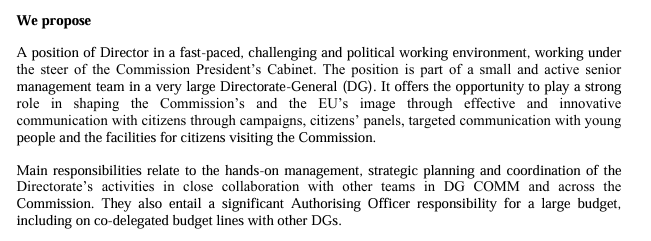
In his new role, Flosdorff will lead “lead the Commission’s citizens communication actions

and the analysis of public opinion,” according to the job advertisement that the commission was legally required to post before handing the sinecure to von der Leyen’s man. This presumably involves the crafting of youth outreach campaigns and commissioning of Eurobarometer polls, but the rest is unclear.

Sophia Eriksson Waterschoot, who currently occupies the role in an acting capacity, “refused to say what the job entailed” when asked by Rapporteur.

An excerpt from the European Commission's 'Director for Citizens Communication' job advert
An excerpt from the European Commission’s ‘Director for Citizens Communication’ job advert

Waterschoot stepped in when previous Director for Citizens Communication Stefan de Keersmaecker was named ‘Director for Political Communication’ late last year. The differences between these two roles are blurred, with both responsible for social media campaigns, both analyzing media and public opinion, and both pushing the commission’s message (one as a ‘rapid response’ outfit, and the other organizing longer-term campaigns).

Both directors lead separate departments within the commission’s ‘Directorate-General for Communication’ (DG-COMM), and together employ around 500 people. DG-COMM has a yearly budget – excluding salaries – of €116 million, and it’s not the only communications department on the commission’s books: most of the commission’s 41 directorates-general have their own in-house spin offices too, which sometimes collaborate with the ‘citizens’ and ‘political’ bureaus of DG-COMM.

If that wasn’t complicated enough, none of these departments write von der Leyen’s speeches. That task falls to her personal speechwriter, Lorenzo Biondi, who announced his retirement on Wednesday.

Biondi is leaving the commission for a job at the Institute of International Affairs, an Italian think tank. But it’s not a straightforward move from the public to the private sector. The Institute of International Affairs’ Europe-focused work is funded almost entirely by the European Commission. There is now just an extra middleman between him and his former employer.

Queen Ursula’s court

Atop this bureaucratic superstructure, von der Leyen has consolidated her power. Her efforts go beyond appointing her loyalists to lucrative lifetime gigs: von der Leyen began the year by appointing 26 commissioners without running the list past the European Parliament first, as well as deliberately withholding budget and internal market strategy documents from member states until hours before publication, making deliberation impossible.

Former European Council President Charles Michel has described her governance as “super authoritarian.” Surrounded by a “tight-knit” and “micromanaged” circle of mostly German advisers, including Flosdorff, von der Leyen has reduced her commissioners to little more than administrators, whose opinions and criticisms rarely make it past her advisers.

Von der Leyen is “obsessed with demonstrating that she’s in charge,” and “is constantly jumping into the middle of the latest crisis, even when it’s outside her remit,” unnamed EU diplomats complained to Bloomberg in May.

Some of the commission chief’s ambitions are grand – she has pushed for the creation of an intelligence agency answering to her office, and backed a Franco-German plan to strip some of chief diplomat Kaja Kallas’ foreign policy powers. Others are more petty. On the day of US President Donald Trump’s inauguration last year, every commissioner under von der Leyen reportedly received strict instructions from Flosdorff: their own communications teams were only allowed to repost von der Leyen’s message to Trump on social media, without adding any comments of their own.

All of this is to illustrate two characteristics of the European Commission under von der Leyen. Firstly, with its jobs for life, its three-dozen communications departments, and its web of interconnected think tanks, it is a bloated organism whose reform would be a generational undertaking.

Secondly, with its unelected president controlling everything from job appointments and social media posts to foreign policy and intelligence gathering, it is an autocracy so at odds with its democratic rhetoric that it requires 43 communications offices to explain away its contradictions to the public.

  •  
❌