❌

Reading view

Ex CIA Analysts: “FlyDubai and RAF Fairford Attacks like FALSE-FLAGs” (7 Videos). Waiting for OCTOBER, 7 MOSSAD Plot’s Anniversary…

by Carlo Domenico Cristofori

VERSIONE IN ITALIANO

We are approaching the anniversary of one of Mossad’s most meticulously organized plots: the October 7, 2023 attack on Israelis along the Gaza Strip border, carried out with the complicity of Hamas mercenary terrorists directed by Israel. We wrote about many investigations that we summarizez below…

According to intelligence experts, there is an intensifying risk of new false-flag operations such that terrorist operation aimed at legitimizing plans to depopulate the Gaza Strip; these plans have now extended to the West Bank and Lebanon, in line with the insane “Greater Israel” project of Israeli Zionist regime Prime Minister Benjamin Netanyahu.

TOP SECRET Interview 1 – 9/11 & 10/7 AWFUL FALSE-FLAG Intel Plots. Exclusive Analysis by ex Interpol Official in Jordan

That is why serious consideration should be given to the CIA analysts and Iranian politicians who suggest that two suspected terrorist attacks—the one at the Royal Air Force base at Fairford and the incident involving the FlyDubai flight—were FALSE-FLAGE actions.

Let us start with a premise: for the American Central Intelligence Agency (CIA) and the Israeli Mossad, organizing actual terrorist attacks is easier than staging a “Hollywood-style production”—which is what many inexperienced bloggers believe the scuffle on the UAE flight was.

In fact, planning a terrorist plot requires only a few skilled secret agents and a handful of expendable victims, whereas a video production requires dozens of extras who are difficult to blackmail and control.

Spokesman Calls Attempts to Link Flydubai Incident to Iran a ‘False Flag’

«Reacting to claims by Britain and others against Iran over the incident involving the Emirati aircraft, as well as Iran’s warnings about hostile actions, Baqaei said Iran remains fully prepared to defend itself» Iranian Tasnim News agency reported.

“This is merely a reminder of an experience that the world has witnessed for itself over the past seven months,” Esmail Baghaei, Spokesperson for the Ministry of Foreign Affairs of Iran, said at a press conference on Sunday.

The remarks came after a Flydubai flight from Dubai to Tel Aviv was diverted to Saudi Arabia on September 30 after its co-pilot allegedly attacked the captain and attempted to take control of the aircraft. Passengers and crew subdued the co-pilot, allowing a reserve crew to land the plane safely. Investigations into the incident remain ongoing.

Gospa News, in the Daily Wars Diary have suggested the FALSE-FLAG hypothesis already on the same day of the incident (link updates here).

Baqaei said the latest claims should be viewed in light of the Zionist regime’s and some European countries’ history of using false-flag operations. Iran is being accused “solely on the basis of fabricated evidence,” he stated.

The spokesman cited Britain’s allegations concerning RAF Fairford and the Emirati aircraft as an example, saying even children could see how clumsily such anti-Iranian claims have been constructed.

Baqaei said the Israeli regime and its European supporters appear to be seeking to divert attention from the situation in Gaza as well as their own aggression against Iran, while creating the impression that Iran poses a threat to the world. “This is a worn-out tactic,”he said.

«US President Donald Trump has suggested, without providing evidence, that the co-pilot may have been linked to Iran, saying he was responding to what he had been hearing. Israeli Prime Minister Benjamin Netanyahu initially said it was too early to determine whether Iran was involved, while Israeli officials later said the co-pilot appeared to have been acting alone» Tansim added.

«Media reports have identified the co-pilot as an Omani national, with reports alleging that he had previously been barred from flying in Oman over concerns about extremist views» Iranian agency concluded.

Former CIA Official Larry Johnson: “FlyDubai Attack like a FALSE-FLAG”

Excerpt of a long interview published by The Trends Journal YT channel held by Edmund DeMarche with Johnson.

Larry Johnson, the former CIA analyst from Sonar21.com, says there seems to be more questions than answers after the FlyDubai cockpit attack that nearly crashed a plane en route from the UAE to Israel.

He also talks about the reactions from Trump and Netanyahu.

In the same interview Johnson spoke also about US-Iran war perspectives saying: “US Navy hasn’t ENOUGH SHIPS, FUEL to continue BLOCKADE near Hormuz”

WARS in VIDEOs. Ex CIA Analyst: “US Navy hasn’t ENOUGH SHIPS, FUEL to Continue Hormuz Blockade”. Air Force pulls all its BOMBERS from UK RAF Base after suspected Terror Plot. Russia Hit maiors Bridges in Kyiv.

Iran Rejects FlyDubai Incident Link As ‘False Flag’ Operation. Interview to Indian Wounded Pilot

Iran has rejected attempts to link Tehran to a recent incident aboard a Flydubai passenger jet, calling the allegations a “false flag” operation. Iranian Foreign Ministry spokesperson Esmaeil Baqaei said the claims were based on fabricated evidence.

Below is an excerpt from a news report by Firstpost, an Indian news and media website.

A report lasting approximately seven minutes analyzes the various theories and presents the first interviews with Indian Prime Minister Narendra Damodardas Modi, the Indian Ambassador to the UAE, and the injured Indian pilot—seen with a visible head bandage—who confirms that the assault actually took place.

These details address the doubts raised by former CIA analyst Larry Johnson regarding the authenticity of the fight in the cockpit—unless, of course, the Israeli Mossad conspired with Indian intelligence as well…

Former CIA Officer: “RAF Fairford suspected Terrorist Plot: Was it a FALSE FLAG?”

On RAF Fairford suspected terrorist plot ex-CIA Operations Officer Charles Finfrock said:: ‘There’s some aspects of this that remind me of a really successful internal security operation, where they’ve penetrated the cell, where they’re following the investigation, following the operation very closely, and they stop it before it can become dangerous”.

“The FBI has done this wonderfully several times in the US where they’re able to put somebody inside and stop something like this before it even gets close to being active. And so I don’t see it as a false flag. I wouldn’t see what the benefit of a false flag there would be”.

But we have to recall that there certainly would have been an advantage…

In fact, UK military intelligence has provided—and continues to provide—support to the US, and thus indirectly to Israel, regarding military tensions in the Middle East.

Moreover, it is the only European country so far to have begun providing support to the Houthi separatists in Yemen—who, being Shia Muslims, are backed by the theocracy in Tehran.

Therefore, a “false-flag” attack in England could have—and still could—increase the likelihood of UK military intervention in support of Israel and against Iran.

Ex-CIA Operations Officer Charles Finfrock added:

“But this to me strikes me as a real operation that had been covered well on both sides of the Atlantic and now we’re trying to get our story straight about explaining how much we knew about it and when and where and why”.

“And sometimes these things that you’ve seen, they come off looking very ham-handed because we’ve been so involved in the investigation, so we don’t let it evolve to the point of actually having a working bomb”. Afshin Rattansi: ‘And they all get released on bail anyway.’

The Awful “Masterpieces” of False-Flag: from JFK Assasination to WTC Attacks

A “false flag” operation is one carefully premeditated over a long period by a foreign intelligence entity to implicate an enemy nation and discredit it in the eyes of global public opinion.

It is planned down to the finest detail, carrying the risk of causing actual casualties.

In fact, if unforeseen “collateral damage”—such as unexpected deaths beyond the planned injuries or killings—occurs during the operation, the orchestrators are even more pleased, as the resulting bloodshed lends greater credibility to the terrorist attack.

Historically, the CIA (US counter-intelligence) and Mossad (Israeli counter-intelligence) have been recognized masters of such plots, occasionally utilizing partners such as the secret services of other nations or terrorist groups.

9/11 – The Avoidable Massacre Allowed by CIA. Helped Al Qaeda in Balkans, Obstructed FBI Investigations. Tribute to John O’Neill Killed in the Towers

In many of these false flag operations, the recruited and trained perpetrators may be suicide attackers, as was the case with the September 11, 2001 attacks.

In other instances, they may be secret agents unaware that they have been marked for death—as happened to Lee Harvey Oswald regarding his involvement in the fatal assassination of President John Fitzgerald Kennedy in Dallas on November 22, 1963, where other snipers fired the lethal shots.

Abstract of Biggest BOMBSHELLS Uncovered by Internet Sleuths in the Newly Released JFK Files

October, 7, 2023: the Biggest MOSSAD’s Plot

Now, we are approaching the anniversary of one of Mossad’s most meticulously organized plots: the October 7, 2023 attack on Israelis along the Gaza Strip border, carried out with the complicity of Hamas mercenary terrorists directed by Israel.

Update – INTEL DROP by CIA ex Agent: Hamas-Israel Fighting, likelihood “False Flag” to Wipe Gaza Off the Map. Warnings by Egypt Ignored

“The revelation by the daily newspaper *Haaretz* regarding the October 7 massacre is making headlines worldwide and shaking Israel, which is caught between the war in the Gulf and the challenge of next month’s elections”—this is the report from RAI’s mainstream news service, which overlooks the investigations into the matter that were suppressed immediately after the 2023 attack…

“UAE leader Mohammed bin Zayed warned Benjamin Netanyahu in a phone call that Hamas was preparing a major military operation in Gaza, but the Prime Minister did not inform intelligence or military officials.”

In a single day, 859 Israeli civilians, 278 soldiers, and 57 law enforcement officers were killed in towns, kibbutzim, and military bases surrounding the Gaza Strip. Hamas militants also attacked a music festival—the Nova festival—attended by approximately 3,000 young people, killing 364 participants and abducting 44. By the end of the attack, 251 people, including about 30 children, had been abducted and taken as hostages into the Strip.

Subsequent investigations—which were never adequately pursued by the Israeli judiciary due to opposition from the Zionist regime of Benjamin Netanyahu (who is on trial for corruption and other offenses)—have highlighted three pieces of unequivocal evidence regarding the plot:

UPDATED: Israel ADMITS that its Helicopters Opened Fire Killing Israeli Civilians during Hamas Attack On 7 October

In the eyes of many Israelis, all of this legitimized Netanyahu’s plan for the depopulation of Gaza—a plan devised many months prior to the Hamas attack.

Carlo Domenico Cristofori


RELATED INVESTIGATION

ONE ISRAELI HOSTAGE FREED FOR EVERY THOUSAND PALESTINIAN CHILDREN KILLED. Biblical Curse on Trump’s Genocide. CIA orders: Hamas obeys…

INTEL DROPS: The Huge Iranian Geopolitical Mistake on Alliance with HAMAS Terrorists led by CIA-Mossad

FREEMASONRY & ZIONISM – 4. How SYNAGOGUE OF SATAN was LICENSED to KILL! It arose from Conspiracy behind the Heretical Catholic text “Nostra Aetate”


  •  

Israeli Forces Block Firefighters After Setting Fires in Southwest Syria

Israeli forces continue to operate in southwestern Syria, with incidents reported in Quneitra, Daraa, and Rif Damasq Governorates. While most of the cross-border incidents involve the Israeli military searching homes and establishing temporary checkpoints in Syrian territory, there are also increasingly destructive incidents to report. Up in Rif Damasq, Israeli troops not only entered a […]
  •  

Netanyahu Frames Continuing to Attack Lebanon as ‘An Opportunity for Peace’

In a pair of comments that broadly reflect why the ongoing Israeli invasion of Lebanon shows no sign of ending, Israeli Prime Minister Benjamin Netanyahu and Hezbollah Executive Council head Ali Damoush both addressed their respective crowds and laid out their goals. Netanyahu, who was speaking at an October 7 memorial event, vowed that it […]
  •  

Children Wounded as Israeli Military Continues Bombing Tent Camps in Gaza

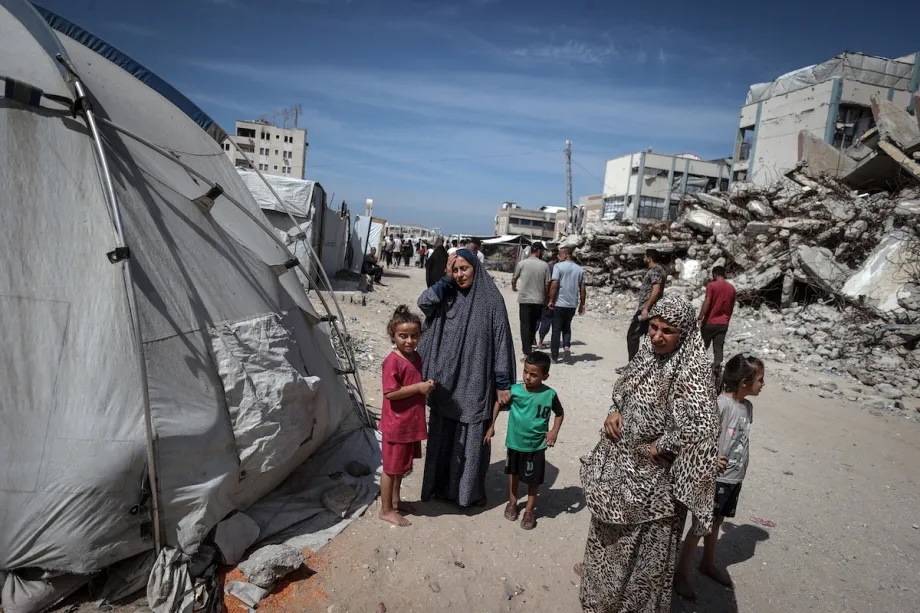
At least one Palestinian was killed, and several others were wounded on Monday in Israeli attacks targeting al-Mawasi in southern Gaza, an area filled with sprawling tent encampments housing Palestinian families displaced by Israel’s genocidal war. The Anadolu Agency reported that an Israeli strike in al-Mawasi killed one Palestinian man and wounded four people, including […]
  •  

‘How Long, O Lord?’: Pope Leo Offers Prayers for Gaza After IDF Kills Two Christian Women

Pope Leo XIV has offered prayers for Gaza following the Israeli strike that killed two Christian women in the besieged Palestinian territory, according to Father Gabriel Romanelli, a priest at the Holy Family Catholic Church in Gaza City. Romanelli, who is from Argentina, said in a YouTube video that Leo wrote to him after the […]
  •  

The Five-Year Fuel Crisis: Why the World Economy Is Paying for a War It Thinks Is Ending

By Larry C. Johnson | SONAR21 | October 4, 2026 

Once again Karl W. Miller has put numbers to a problem that most of the commentariat still treats as a temporary price spike. His latest forward outlook, “The Five-Year Global Energy Crisis,” dated October 3, makes an argument that should alarm every finance ministry from Berlin to Jakarta. The war’s damage to Gulf energy infrastructure is not a disruption that ends when the shooting stops. It is a reconstruction problem measured in years and trillions of dollars, and while it is solved, the world will be short of the fuels that run its economy.

A ceasefire is not a repair crew

Miller’s central insight is simple. A ceasefire can reopen a shipping lane overnight. It cannot manufacture a compressor, mobilize commissioning engineers, or pay a contractor. The next phase of this crisis, he writes, is a competition for cash, equipment, qualified contractors and finished fuel.

His cost model is sobering. In his aggressive case, rebuilding the damaged Gulf energy system requires $1.16 trillion in total program funding. Under prolonged stress, with scarce equipment, rising prices and delays, the bill reaches $2.53 trillion. Even his most favorable case runs to nearly half a trillion dollars. He is careful to say these are model outputs, not contractor quotes, and that the true extent of the damage is the largest unknown. An April assessment put energy-related repair costs at only $34-58 billion. But the direction of his argument doesn’t depend on the exact figure. Every month of delay makes the same repair more expensive, because the global market for specialized equipment and crews is already stretched by LNG expansions, refinery maintenance and power projects elsewhere.

The timeline is just as stark. Weighted by cost, the rebuild averages almost five years from today. Only 60% of the work finishes by 2031, and the longest-lead packages run to seven years.

The money problem comes first

The most original part of Miller’s analysis is about cash. A damaged refinery may be worth rebuilding and technically repairable, and still sit idle because the government that owns it has to pay for food imports, salaries, electricity and water first. Lost export revenue doesn’t stop those bills. When a state borrows to keep paying them, that money can’t also pay an engineering contractor.

Iraq shows the problem in practice. In July, it faced a monthly public salary obligation of about $5.96 billion with a funding shortfall of $2.52 billion. A government in that position rebuilds nothing. It pays its people, and the export capacity that would restore its revenue waits. Miller’s warning is that this trap can stop reconstruction before it starts: without engineering funds and vendor deposits, factory slots go to other customers and delivery dates slip.

The fuel gap is the global transmission belt

For the rest of the world, the damage arrives through diesel and jet fuel. The figures Miller cites are already severe. Gulf diesel net exports in August were just over a quarter of prewar levels. Combined Gulf and Russian diesel exports were 1.6 million barrels a day below February. Global oil stocks had fallen 507 million barrels since February, and global refinery throughput in August was 4.2 million barrels a day below a year earlier.

Looking forward, Miller’s severe case assumes a shortfall of at least 3 million barrels a day of diesel and jet fuel, every year for five years. That’s about 1.1 billion barrels a year and 5.5 billion barrels over the period. He is explicit that this is a deliberate stress test, not a forecast, and that a faster-recovery path closes the gap by the fourth year. But the stress case is a plausible one. Restored capacity can be absorbed by refinery outages, deferred maintenance, recovering demand and delivery bottlenecks. Damaged refineries don’t come back at full capacity on the first day.

Inventories cannot fill a gap of that size for that long. Five and a half billion barrels is far beyond any country’s emergency stocks, which is why drawing down Europe’s reserves now, under pressure from Washington, only buys weeks. Without enough new supply, the balance can close in only one way: by using less fuel.

How the shortage reprices everything

The economic damage extends well beyond the missing barrels. When supply falls short, buyers bid for the marginal cargo, and that bid sets the price for all the fuel still being bought. Miller’s illustration: a $40-a-barrel premium across 10 million barrels a day of purchases adds $146 billion a year to fuel bills. Applied only to the 3 million missing barrels, it would add $43.8 billion and badly understate the real cost.

Scarcity also reprices credit. At $150 a barrel, a buyer purchasing 1 million barrels a day needs $2.25 billion to hold 15 extra days of inventory, and $3 billion at $200. Longer voyages tie up more fuel and more money in transit. A supplier can have the barrels while its customer can’t get a letter of credit. And a cargo that wins a bidding war for one country leaves another short. Competition redistributes the shortage before it eliminates it.

Who absorbs the shock

Diesel carries the crisis into the real economy. It runs road freight, farm machinery, mines, construction fleets and backup generators, none of which can switch fuels quickly. Higher diesel costs pass straight into freight rates and food prices, and when diesel isn’t available at any price, activity simply stops. Jet fuel carries the shock into aviation: higher fares, fewer routes and higher air cargo surcharges. Kerosene hits the households with the least room to adjust, in countries where it is still used for heating, cooking and lighting.

Miller’s regional assessment follows the money:

  • Europe competes for replacement diesel and jet cargoes while running its refineries close to their limits.
  • South and Southeast Asia face higher import bills, currency pressure and greater need for trade credit.
  • Africa and smaller importers are the most vulnerable. Tenders fail, credit lines run out, and small cargoes become uneconomic long before global stocks are exhausted.
  • The United States and other Atlantic suppliers face export demand competing with their own diesel needs, with refineries running so hard they have little tolerance for outages.

The ultimate balancing mechanism is demand destruction: freight deferred, low-margin factories idled, flights cancelled, and poorer importers losing every bidding contest. Miller warns against mistaking that for recovery. Lower consumption caused by rationing through price or credit is not a repaired energy system.

Case study: Europe

Europe shows what Miller’s framework looks like in practice. The continent burns about 5 million barrels of diesel a day, fuel for the trucks that move its goods, the tractors that plant its crops and, as winter approaches, the boilers that heat millions of homes.

How much does Europe produce, and how much does it import? Running flat out, EU refineries can produce roughly 4.5 to 5 million barrels a day of diesel and gasoil, and they are already operating close to their maximum. That leaves Europe roughly 85-90% self-sufficient at best. The remaining 10-15% comes from imports, and that margin sets the price for the entire market. Kepler puts the EU’s diesel imports from outside the bloc at about 580,000 barrels a day this year. Britain, which lost much of its refining capacity over the past two decades, is far more exposed: it imports more than half the diesel it uses.

The origin of those imports has changed dramatically. Russia was long Europe’s largest outside supplier until the EU embargoed Russian diesel in 2023. The Gulf filled much of the gap, until the war cut it off. Since March, the United States has supplied more than half of Europe’s diesel imports, and more than two-thirds in August and September. Europe has traded dependence on Moscow for dependence on Washington, and Washington has just shown it is willing to use that leverage, threatening an export ban unless Europe released its emergency stocks.

Europe’s diesel depends on imported crude as well. Its refineries run almost entirely on foreign oil: the EU imports about 97% of the crude it consumes. But the Gulf was never Europe’s main crude supplier. In 2025, Gulf Cooperation Council states supplied only about 7% of EU crude imports, Iraq another 5.8%. Europe’s crude now comes chiefly from the United States, Norway and Kazakhstan, which together supplied nearly half of EU petroleum imports in the second quarter of 2026. The volume has held steady; the bill rose 56%. But the crude isn’t the crude Europe’s refineries were built for. Much of Europe’s refining capacity was designed around medium sour crudes such as Russia’s Urals, with conversion units that turn the heavier part of the barrel into diesel. American shale crude is light and sweet. It refines readily into gasoline and naphtha, but it yields proportionally less diesel and jet fuel, the very products Europe is short of. As Miller notes, sour crude isn’t uniquely required to make diesel; the replacement barrels work, but not at the same yield or cost. The Gulf supply Europe really lost was finished diesel from Gulf refineries, and that is what the United States has replaced. The result is a double dependence: Washington is now Europe’s largest supplier of both the crude its refineries run and the diesel they can’t make. Even the non-American barrels carry risk. Most Kazakh crude reaches Europe through a Black Sea terminal at Novorossiysk, on Russian soil, a route that has already been hit by Ukrainian drones.

How long can Europe store diesel? This is where Europe’s apparent cushion turns out to be thinner than it looks. Unlike crude oil, which can sit in salt caverns for decades, diesel degrades. Under ideal conditions, conventional ultra-low-sulfur diesel can typically be stored for six to twelve months. With stabilizers, biocides and well-managed tanks, that can be extended to 18 to 24 months. Oxidation forms gums and sediment, water collects, and microbes grow in the fuel.

European diesel has an added problem. The EU standard, EN 590, allows up to 7% biodiesel in road diesel, and biodiesel oxidizes faster than petroleum diesel. Concawe, the European refiners’ research association, recommends a maximum storage time of six months for biodiesel and current blends containing it. Strategic stockholders can extend that by holding biodiesel-free product, but even then the reserve has to be rotated, sold into the market and replaced with fresh fuel on a cycle of a year or two.

That changes what Europe’s reserve really is. EU countries and Britain held about 52 million tonnes of gasoil and diesel in June, including nearly 38 million tonnes of emergency reserves, roughly two months of consumption. But a diesel reserve is not a stockpile Europe can fill once and forget. It is a stock that must be continually turned over, which means continually bought, and bought in the same tight market Miller describes. Every barrel released now to satisfy Washington has to be replaced later, at a higher price, from suppliers who are already short. And because diesel degrades, Europe can’t solve the problem by buying extra while it’s cheap and holding it for years. A reserve with a shelf life of a year or two cannot cover a structural deficit that Miller’s severe case puts at five years.

The conclusion for Europe is stark. It produces most of its own diesel but has no spare refining capacity. It depends on imports for the margin that sets prices, and those imports now come mostly from a single supplier that has shown it will use them as leverage. And its emergency reserve is both perishable and finite. In Miller’s terms, Europe is one of the buyers most exposed to the marginal cargo, and the least able to wait out a five-year shortage.

The implications for the global economy

Put together, Miller’s analysis describes a world economy facing a prolonged supply shock, not a temporary one. Fuel costs feed into nearly everything, so central banks fighting the inflation this crisis has already produced will face pressure for longer than they expect. Emerging-market importers face a combination of high fuel bills, weak currencies and tighter credit that has historically produced debt crises and unrest. And the reconstruction itself will absorb capital, equipment and specialist labor that would otherwise build new energy supply elsewhere, so the shortage may delay the investment needed to end it.

Miller’s strategic conclusion is the one policymakers least want to hear. Ending the conflict removes one source of disruption. It does not repair the energy system, which requires a separate sequence of financing, engineering, manufacturing, construction and commissioning that will take years. Until that is done, reliable fuel and the cash to buy it will determine which economies absorb the burden. Neither will be distributed evenly.

Latest videos

  •  

Trump’s Big Bluff on Iran

By John J. Mearsheimer | October 4, 2026

The Trump administration and its supporters – including the Wall Street Journal editorial page – are working overtime these days to spin the news around the Iran war to make it appear that the US is winning and Tehran had better submit to Washington’s demands before it is wrecked, maybe even “annihilated.” Indeed, Trump is preparing the option of bringing the military hammer down on Iran after the midterm elections if Tehran has not surrendered by then.

In effect, Trump and his supporters are waging a “maximum pressure campaign” against Iran in the mainstream media.

This campaign is sure to fail. If anything, it reflects the Trump administration’s desperation. The president started a war the United States was bound to lose, and there is little he can do now to change that basic fact.

Trump’s propaganda campaign has two dimensions – one economic and the other military.

First, the administration argues that Iran is being economically strangled by the US naval blockade coupled with Operation Economic Outcast, the strategy announced by Treasury Secretary Scott Bessent on 24 August 2026. At the same time, it maintains that oil is once again flowing out of the Gulf at rates not far below those that prevailed on 27 February 2026. The implications are obvious: the economic punishment being inflicted on Iran will force it to capitulate soon, while the US economy – and the international community more generally – is well on its way to recovery.

Second, the US is now building up its military forces for a massive military strike after the mid-term elections, when Trump will be free of electoral constraints. This growing threat of a devastating US attack, coupled with the economic pain being inflicted on Iran, is designed to get Tehran to quit now, before its situation becomes even worse.

There are huge problems with this strategy. It sounds persuasive when the mainstream media dutifully purveys it, but it falls apart when one looks closely at what is actually happening.

Consider the military dimension. The headlines say the US is sending 10,000 additional troops and a third aircraft carrier – the USS Theodore Roosevelt – to the Persian Gulf region, creating the impression that Iran will soon be confronting three American carriers. Moreover, the additional troops – on top of the roughly 50,000 US troops already in the region – are portrayed as evidence that Trump is seriously considering putting boots on the ground.

The aircraft carrier story, however, is quite different from what the headlines suggest. The Roosevelt is reportedly being sent to replace the USS George Washington, while the supposed third carrier, the USS George H.W. Bush, has already left the Middle East and is now in Thailand. Thus, there is presently only one carrier in the region. Indeed, this is the first time during the war that the US has only one carrier in the Middle East, and it is difficult to imagine that there will be more than two – if even that many – after the midterm elections.

The larger problem is that the Iran war is severely straining the US Navy. Its senior leaders warn that the current operational tempo is not sustainable indefinitely. Carriers and other warships are being rotated through extremely long deployments, which cause significant maintenance and readiness problems that will have to be addressed at some point. This problem is compounded by the fact that US ships have lost access to nearby logistics facilities and increasingly depend on a supply chain that reaches back to Diego Garcia, which is about 2,500 miles from the Persian Gulf.

But even if three carriers are available to strike Iran, what could they accomplish in a renewed air campaign that the US and Israel could not accomplish together during the failed 40-day bombing campaign between 28 February and 8 April 2026? Some might argue that the US could finally destroy Iran’s oil infrastructure. The problem, however, is that Iran retains a second-strike capability and could retaliate by wreaking havoc on the oil infrastructure of the GCC states. One shudders to think what the consequences would be for the international economy.

On top of all this, the US faces a serious shortage of high-end weaponry, which is one of the main reasons it ended the 40-day bombing campaign and has shied away in recent weeks from engaging in tit-for-tat bombing exchanges with Iran. One would think that the shortage of critical munitions – both for striking Iran and defending against Iranian retaliation – would limit the scope and intensity of any renewed strategic bombing campaign, thereby reducing its chances of success.

Regarding ground forces, simply counting the number of U.S. military personnel in the Middle East is misleading when assessing the possibility of putting boots on the ground. What matters most in a ground war is the number of troops in actual ground-combat formations. I estimate that, of the roughly 50,000 U.S. military personnel already stationed in the region, about 5,000 belong to such formations: roughly 2,200 Marines and sailors in the 11th MEU, 2,000 soldiers from the 82nd Airborne, and possibly another 800 Army personnel in Kuwait associated with Task Force Spartan. Of the roughly 10,000 additional personnel now being sent to the region, another 2,200 belong to the 13th MEU. Most of the remainder are sailors assigned to the Theodore Roosevelt carrier and its supporting warships. Thus, given present deployment plans, I estimate that by late November the United States will have just under 7,500 personnel in ground-combat formations in the Gulf region—roughly 4,400 in the two MEUs and 2,800 Army personnel.

There is no way a ground force that small provides a promising option against a country with Iran’s population and geography. Even tripling that number to roughly 23,000—which is highly unlikely—would not fundamentally alter the problem. Retired Army General Barry McCaffrey estimates that securing the Strait of Hormuz would require roughly 150,000 troops and three to six months of fighting. For comparison, Russia invaded Ukraine in February 2022 with roughly 190,000 military personnel, and that force proved insufficient to hold much of the territory Russia initially captured. Iran has more than twice the population Ukraine had at the beginning of the Russian invasion, and its geography is considerably more forbidding for an invading army.

Simply put, the United States has not assembled anything remotely resembling the ground force required for a large-scale invasion of Iran. Indeed, from Tehran’s perspective, an American decision to launch such an offensive with anything resembling the forces presently available would present Iran with an opportunity to fight the United States under exceptionally favorable circumstances.

At the risk of beating a dead horse, two further points are in order. First, given how unpopular the Iran war is with the American public, there would almost certainly be a huge uproar if large numbers of US soldiers began coming home in body bags. Second, how are the Marines, who are aboard amphibious assault ships, supposed to land on Iranian territory if the missile and drone threat from Iran is forcing the US Navy to keep those large and vulnerable ships far from the Iranian coast?

Let’s turn to the economic dimension. There is no question that the US is doing great damage to Iran’s economy and inflicting enormous hardship on the Iranian people. But that has been true for a long time. The key question is whether that punishment can coerce Iran into surrendering to American demands.

There is no evidence that Iran is caving in to American pressure, and there are three reasons to doubt that it will. First, it is exceedingly difficult to find a case in the historical record in which an economic blockade by itself caused the target state to surrender. Second, Iran sees the US and Israel as existential threats to Iran – hardly surprising given the genocidal language Trump has used when talking about Iran – and states that believe their survival is at stake are exceptionally difficult to coerce. Third, Iran has a formidable escalation option if the economic pain becomes too great: it can attack the oil and gas infrastructure of the Gulf states and Israel, as well as their highly vulnerable desalination plants.

In short, it is difficult to see economic pressure alone forcing Iran to accept Trump’s terms. That is probably one reason the United States is once again talking about using military force. But, as I argued above, that option holds little promise of producing a favorable outcome.

Finally, there is no question that more oil is flowing out of the Gulf today than was the case in early September. But both Iran and the Houthis are working hard to reverse that trend. Iran is attacking US-escorted tankers on a daily basis, while the Houthis are targeting vital oil infrastructure inside Saudi Arabia. Moreover, despite the increased flow of oil out of the Gulf, gasoline prices remain very high, and a host of other economic problems show no signs of easing anytime soon, including high diesel prices, persistent inflation, elevated mortgage rates, and dangerously high bond yields across much of the West.

All of this is to say that the Trump administration has powerful economic incentives to shut this war down as soon as possible. Indeed, it would hardly be surprising if there were a growing sense of desperation behind closed doors among Trump and his advisers.

This, of course, helps explain why the Trump administration and its allies are waging a media campaign designed to persuade Iran that its days are numbered and that it had better concede to American demands before it is too late. The facts, however, tell a different story. The success of this strategy therefore depends on Trump being able to bamboozle the Iranians into believing that Godzilla is closing in on them. There is little reason to think Tehran will be hoodwinked.

  •  

As genocide drags on, “Zionism is racism” becomes official policy in one UK party – Daily Update

The Israeli war machine never sleeps. Neither does the Israeli propaganda machine. Here is your daily accurate and concise summary of Palestine, Israel, and Palestine-adjacent news.

  •  
❌